Genetic diversity of Macrophomina phaseolina and antifungal potential of lemongrass essential oil
ABSTRACT
Macrophomina phaseolina is a soil-borne fungal pathogen responsible for root rot and vine decline in melons. To develop effective control strategies, it is essential to understand the pathogen's genetic diversity. This study aimed to characterize the genetic diversity of M. phaseolina isolates and evaluate the effectiveness of Cymbopogon flexuosus (lemongrass) essential oil as a control agent. DNA from 30 isolates was extracted and analyzed using 13 RAPD markers, which generated 135 polymorphic bands (71.85% polymorphism). Genetic similarity among isolates ranged from 0.23 to 0.92. To test the antifungal potential of C. flexuosus oil, two specific isolates (CMM-4739 and CMM-4762) were treated with six oil concentrations (0.02, 0.05, 0.10, 0.15, 0.20, and 0.25%). A negative control (PDA medium) and a positive control (Maxim fungicide) were included. Colony diameter was measured daily in two perpendicular directions; the control treatment reached the edge of the Petri dish within three days. Results showed that a concentration of 0.15% resulted in the complete in vitro growth inhibition of both isolates. No significant difference in oil efficacy was observed between the two isolates. This study concludes that RAPD markers are suitable for assessing the genetic diversity of M. phaseolina and that C. flexuosus essential oil is highly effective at inhibiting fungal growth in vitro. These findings suggest that C. flexuosus oil holds significant potential for future in vivo management of the M. phaseolina-melon pathosystem.
Keywords:
Cymbopogon flexuosus; RAPD-PCR; Root rot and vine decline; Soil-borne fungi.
RESUMO
Macrophomina phaseolina é um fungo habitante de solo, agente causal da podridão radicular e declínio de ramas em meloeiro. Para o desenvolvimento de métodos de controle, é importante conhecer sua diversidade genética. Assim, este trabalho teve como objetivo caracterizar a diversidade genética de M. phaseolina e avaliar a eficácia do óleo essencial de Cymbopogon flexuosus em seu controle. DNAs de 30 isolados de M. phaseolina foram extraídos e analisados com 13 marcadores RAPD. Os marcadores geraram um total de 135 bandas (71,85% polimórficas). A similaridade genética variou de 0,23 a 0,92. Para o ensaio do óleo essencial de C. flexuosus, dois isolados de Macrophomina (CMM-4739 e CMM-4762) foram utilizados em seis doses do óleo (0,02; 0,05; 0,10; 0,15; 0,20 e 0,25%). Um controle negativo (meio BDA) e um controle positivo (fungicida Maxim) foram incluídos. Medições do diâmetro das colônias foram realizadas diariamente em duas direções perpendiculares. Na concentração de 0,15%, houve inibição completa do crescimento in vitro dos isolados. Não houve diferença no efeito do óleo essencial entre os isolados estudados. Este estudo conclui que o marcador RAPD foi adequado para avaliar a diversidade genética de M. phaseolina e que o óleo essencial de C. flexuosus demonstrou eficácia na inibição do crescimento in vitro dos isolados estudados. Esses resultados sugerem que o RAPD pode ser usado para demonstrar a diversidade genética de M. phaseolina e que o óleo essencial de C. flexuosus tem potencial para futuros estudos in vivo para o manejo do patossistema de M. phaseolina e melão.
Palavras-chave:
Cymbopogon flexuosus. RAPD-PCR; Podridão radicular e declínio da videira; Fungos de solo.
INTRODUCTION
Melon (Cucumis melo L.) is a member of the Cucurbitaceae family and holds significant economic importance in Brazil. In 2023, Brazilian production reached 862,387 tons across 30,535 hectares, generating a production value of R$ 1.25 billion. The state of Rio Grande do Norte is the leading producer, accounting for R$ 823 million of this total (IBGE, 2024).
However, various phytosanitary challenges threaten melon growth, development, and yield. Notably, certain soil-borne pathogens cause charcoal rot in stems and roots, inducing a water imbalance between the roots and shoots, particularly near harvest. Several etiological agents are associated with this disease, primarily fungi within the genus Macrophomina (NEGREIROS et al., 2019). While M. phaseolina was the only known species in the genus until 2013, subsequent morphological and phylogenetic analyses have identified M. pseudophaseolina (SARR et al., 2014), M. euphorbiicola (MACHADO et al., 2019), M. vaccinii (ZHAO et al., 2019), and M. tecta (POUDEL et al., 2021). In Brazil, M. phaseolina, M. pseudophaseolina, and M. euphorbiicola have been reported to date.
Macrophomina phaseolina (Tassi) Goid. is a polyphagous pathogen attacking over 500 botanical species (FARR; ROSSMAN, 2025), including major crops such as beans, soybeans, and melons (NEGREIROS et al., 2019). Weeds can also serve as hosts for this pathogen, which exhibits high genetic diversity among isolates (NEGREIROS et al., 2019). Various techniques have been proposed to study this genetic similarity, including molecular analysis via Polymerase Chain Reaction (PCR) using Random Amplified Polymorphic DNA (RAPD) markers (ŽIVANOV et al., 2019; SAMANTA et al., 2021). Using molecular markers to identify genetic similarity provides more conclusive data regarding the effectiveness of control methods for phytopathogenic diseases (COSTA et al., 2020).
While chemical control remains the most common approach, increasing global concern surrounds the indiscriminate use of synthetic fungicides due to their high toxicity to non-target organisms. Furthermore, studies have highlighted the environmental contamination and adverse effects these chemicals pose to human and animal health (LEITE et al., 2024). Consequently, natural compounds, such as plant essential oils, have emerged as potential components for M. phaseolina management. Essential oils from the genus Cymbopogon, particularly C. flexuosus, have demonstrated significant antifungal activity (GAO et al., 2020; PEREIRA et al., 2022; PARVEEN et al., 2022; MANJULA; PRATHIBHA; MARHOOB, 2023). These oils may also meet the Organic Materials Review Institute (OMRI) standards for certified crop pest and disease control (OMRI, 2025).
In this sense, this study aimed to evaluate the capacity of RAPD markers to determine the genetic similarity among M. phaseolina isolates and to assess the efficacy of C. flexuosus essential oil in inhibiting the in vitro growth of genetically distinct isolates.
MATERIALS AND METHODS
Macrophomina phaseolina isolates
Thirty M. phaseolina isolates were utilized in this study, obtained from the fungal culture collection of Phytopathology Laboratory II at the Universidade Federal Rural do Semi-Árido (Table 1). These isolates had been previously characterized both morphologically and phylogenetically by Negreiros et al. (2019).
DNA extraction, analysis with specific gene primers and RAPD markers
For fungal multiplication, isolates were cultured on PDA (potato dextrose agar) medium and incubated in a BOD chamber (biochemical oxygen demand incubator) at 30 ± 1 °C in the dark. After five days, fungal colonies were used for genomic DNA extraction withthe Macherey-Nagel NucleoSpin™ Microbial DNA Kit, following the manufacturer’s instructions. Genomic DNA was quantified by agarose gel electrophoresis (DASH; SHRIVASTAVA, 2020).
Specific gene primers, MpKFI(5'-CCGCCAGAGGACTATCAAAC-3')andMpKRI (5'-CGTCCGAAGCGAGGTGTATT-3') (BABU et al., 2007) were used. Reaction mixtures and amplification conditions followed Silva et al. (2023). Amplified products were separated by electrophoresis at 110 V for 70 min on 1.5% agarose gel prepared with 1× TBE buffer and stained with ethidium bromide (1 μg mL-1).
For RAPD-PCR, an initial screening of 100 RAPD primers from the OPA, OPAA, OPD, OPH, and OPM series was performed using DNA from two M. phaseolina isolates, 4 (CMM-4738) and 5 (CMM-4739). Amplification reactions were carried out in a final volume of 13 μL containing 10 ng DNA, 1× reaction buffer, 0.25 g mL-1 purified BSA, 0.33 μM RAPD primer, 0.16 mM dNTPs, and 1 U μL-1 Taq DNA polymerase. Reactions were performed in a TX96 Plus Amplitherm thermocycler programmed for initial denaturation at 94 °C for 1 min, followed by 40 cycles of denaturation at 92 °C for 1 min, annealing at 40 °C for 1 min, and extension at 72 °C for 2 min, with a final extension at 72 °C for 5 min. Amplified products were separated under the same electrophoresis conditions described above.
Genetic diversity was assessed based on fragment patterns generated by each primer. A binary matrix was constructed by assigning 1 for presence and 0 for absence of polymorphic bands. Then, a genetic similarity matrix was estimated using Jaccard’s coefficient, and cluster analysis was performed by the UPGMA (unweighted pair group method with arithmetic mean). Mean distances were used to determine the degree of similarity among individuals or groups, and the cophenetic correlation coefficient (r) was calculated to assess clustering reliability. Statistical analyses were performed using NTSYS-pc 2.1.
Effect of Cymbopogon flexuosus essential oil on the growth of Macrophomina phaseolina
The experiment was conducted with M. phaseolina isolates 5 (CMM-4739) and 29 (CMM-4762). These isolates were selected because they differ in disease severity, exhibiting low and high aggressiveness in melon plants, respectively (NEGREIROS et al., 2019; SALES JÚNIOR et al., 2020). Cymbopogon flexuosus essential oil from Terraflor was used.
Treatments consisted of the two isolates, six oil concentrations (0.02, 0.05, 0.10, 0.15, 0.20, and 0.25%), a negative control (PDA medium), and positive control (PDA medium supplemented with Maxim fungicide). The experiment followed a completely randomized design with eight replicates per treatment.
PDA medium was autoclaved for 15 min at 121 °C and 1 atm. After cooling to approximately 45 °C, essential oil concentrations were added to the medium using an automatic pipette. Under aseptic conditions, the medium was then poured into 90 × 90 mm Petri plates. After solidification, 8 mm mycelial discs were removed from actively growing fungal cultures and transferred to the center of each plate. Plates were incubated in a BOD chamber at 30 ± 2 °C.
Mycelial growth was evaluated by measuring colony diameter in two perpendicular directions when fungal growth in the control treatment reached the edge of the dish, which occurred after three days. Percentage inhibition of growth (% PIG) was calculated as: %PIG = (growth in control plate - growth in treated plate)/ growth in control plate x 100.
A four-parameter logistic model was used to predict the effect of essential oil on M. phaseolina mycelial growth using TableCurve. Means between isolates were compared using the Mann-Whitney test at the 5% probability level.
RESULTS AND DISCUSSION
DNA extraction, analysis with specific gene primers, and RAPD markers
PCR product fragments of approximately 320 bp were detected in all thirty M. phaseolina isolates, as expected according to Babu et al (2007). Of the 100 RAPD primers evaluated, 13 showed greater polymorphism and were therefore selected for assessment of genetic diversity (Table 2). These 13 RAPD primers amplified 135 loci, of which 97 (71.85%) were classified as polymorphic.
RAPD primers used for DNA amplification of Macrophomina phaseolina genotypes and corresponding results.
The average number of polymorphic bands per primer was 7.5, which was considered satisfactory for detecting polymorphism with the selected primers. Moreover, PIC values ranged from 0.24 (OPM 13) to 0.46 (OPAA 17). An average of five polymorphic bands per primer has been considered adequate for polymorphism detection (MAZUMDAR et al., 2020).
High PIC values and substantial variation were also observed, consistent with the findings of Mahdizadeh, Safaie, and Goltapeh (2011). This variation may be associated with differences in primer sets used among studies. The primers selected in the present study revealed high genetic variability and were therefore suitable for evaluating genetic diversity among M. phaseolina isolates.
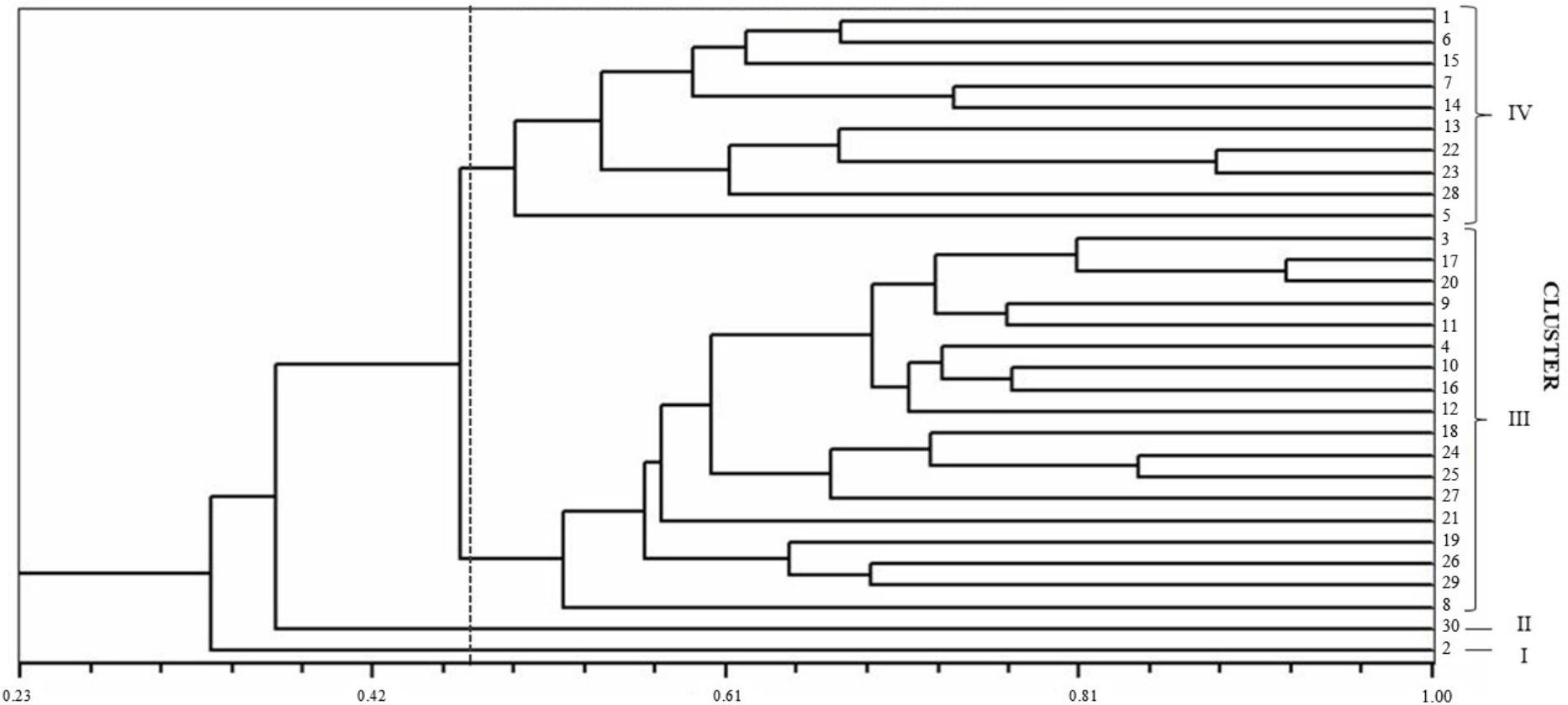
A dendrogram was generated using the UPGMA hierarchical method, and a cutoff value of 47% genetic similarity separated the isolates into four groups. Groups III and IV were further divided into subgroups (Figure 1). Grouping in the dendrogram was not associated with host species or geographical origin of the isolates. Isolates 2 (CMM-4747) and 7 (CMM-4733) were the most genetically distant, showing the lowest similarity coefficient (0.23), whereas isolates 17 (CMM-4749) and 20 (CMM-4754) showed the highest genetic similarity (0.92).
Cluster analysis of 30 Macrophomina phaseolina isolates based on the genetic distance matrix calculated using Jaccard's similarity coefficient.
RAPD markers are arbitrarily amplified, highly polymorphic dominant markers. They require moderate amounts of DNA and involve intermediate technical and operational costs. Because RAPD uses random primers, polymorphisms can be analyzed without prior knowledge of the target organism’s DNA sequence, which is one of the main advantages of this technique (OLIVEIRA; AZEVEDO, 2022). However, a major limitation is the low reproducibility of results and, despite this limitation, RAPD markers remain widely used in studies of fungal population genetics (ŽIVANOV et al., 2019; SAMANTA et al., 2021).
Moreover, Živanov et al. (2019) also reported similar findings when investigating genetic variability in M. phaseolina isolates collected from six countries (Turkey, Bulgaria, Romania, Spain, Ukraine, and Serbia) and from different hosts, including sunflower (Helianthus annuus), maize (Zea mays), soybean (Glycine max), flax (Linum usitatissimum), common bean (Phaseolus vulgaris), and zebra plant (Aphelandra squarrosa).
The genetic variability observed among the isolates in the present study may be associated with differences in pathogenic severity. The most divergent isolates, 2 (CMM-4747) and 7 (CMM-4733), showed contrasting severity scores in a pathogenicity test conducted by Sales Júnior et al. (2020) on cowpea.
The degree of genetic similarity observed in the present study was greater than that reported by Martínez-Hilders and Laurentin (2012), who evaluated phenotypic and molecular characteristics of M. phaseolina isolates from the sesame-producing region of Venezuela. In the present study, analysis of thirty isolates allowed estimation of a cophenetic correlation coefficient of r = 0.84, indicating good agreement between the dendrogram and the similarity matrix generated using Jaccard’s coefficient. These results support the reliability of RAPD markers for assessing genetic diversity in M. phaseolina.
Effect of Cymbopogon flexuosus essential oil on the growth of Macrophomina phaseolina
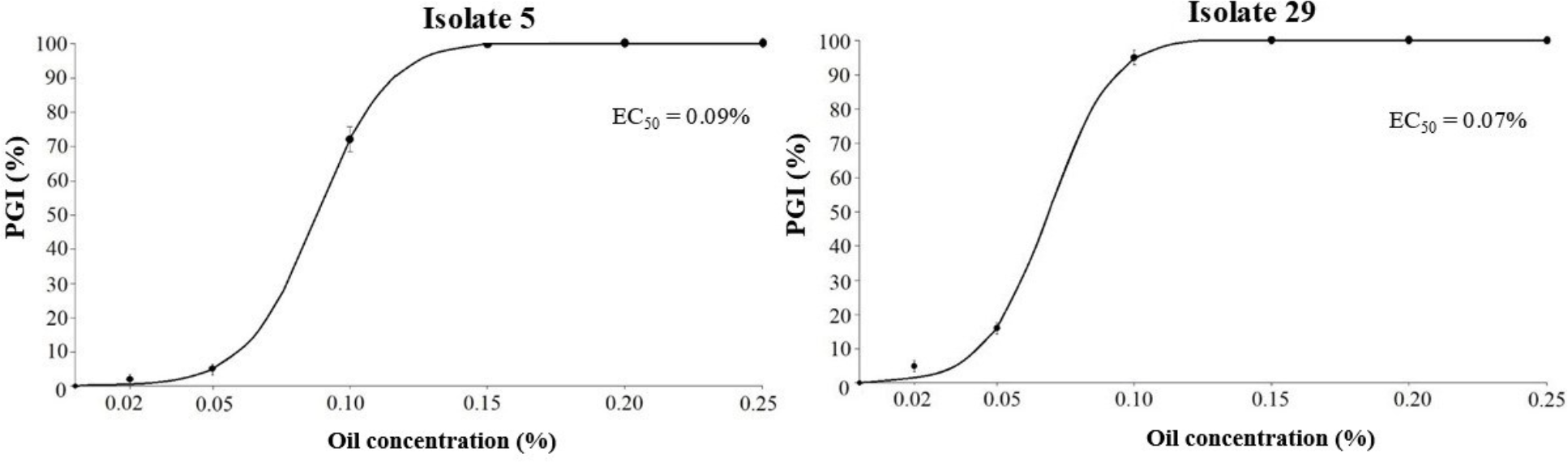
In the assay evaluating the effect of Cymbopogon flexuosus essential oil on the growth of M. phaseolina isolates, all tested concentrations inhibited mycelial growth of isolates 5 (CMM-4739) and 29 (CMM-4762). Percentage inhibition of growth ranged from 2 to 100% (Figure 2). In addition, logistic regression analysis showed that percentage inhibition of growth (%PIG) increased with increasing essential oil concentration.
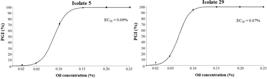
Logistic regression curves and half-maximal effective concentration (EC50) for each Macrophomina phaseolina isolate exposed to Cymbopogon flexuosus oil. EC50 represents the concentration required to cause 50% inhibition of mycelial growth, as estimated from the regression equation.
According to EC50 analysis, the essential oil concentration required to induce 50% growth inhibition in isolate 5 (CMM-4739) was 0.09%. For isolate 29 (CMM-4762), a lower concentration of 0.07% was required (Figure 2). Maximum percentage inhibition of growth (PIG = 100%) was achieved at an essential oil concentration of 0.15% for both M. phaseolina isolates. Therefore, this concentration was considered the minimum required for complete inhibition of mycelial growth in the evaluated isolates.
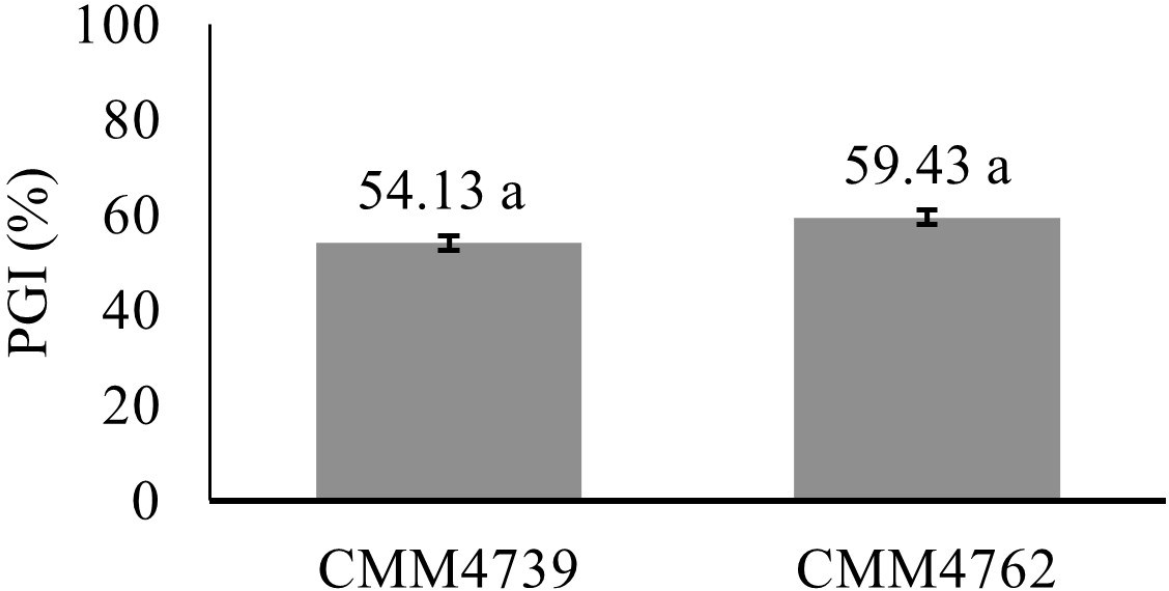
Regarding percentage inhibition of growth between isolates 5 (CMM-4739) and 29 (CMM-4762), no significant difference in inhibitory effect was detected between the two M. phaseolina isolates according to the Mann-Whitney test (p > 0.05) (Figure 3). These results indicate that C. flexuosus essential oil was effective in suppressing M. phaseolina mycelial growth, including two genetically divergent isolates.

Percent growth inhibition (PGI) of Macrophomina phaseolina isolates treated with Cymbopogon flexuosus essential oil.
Regarding the effect of C. flexuosus essential oil, percentage inhibition of M. phaseolina growth increased as oil concentration increased. Similarly, Costa, Mora and Millezi (2019) reported that C. flexuosus essential oil contains biologically active compounds, with geranial and neral isomers as major constituents.
Likewise, Parikh, Agindotan, and Burrows (2021), while evaluating the antifungal activity of plant-derived essential oils against pulse crop pathogens, found that C. flexuosus essential oil completely inhibited mycelial growth of Aphanomyces and Pythium, and also reduced growth of Botrytis, Colletotrichum, Didymella, Fusarium, Stemphylium, and Sclerotiorum.
The present results showed that C. flexuosus essential oil was effective for in vitro inhibition of M. phaseolina growth at lower concentrations than those reported for C. citratus essential oil. Pandey (2003) found that C. citratus oil inhibited growth of Colletotrichum gloeosporioides at concentrations of 1.0 and 1.5%. This difference may be attributed to variation among pathogen species, as well as differences in chemical composition between essential oils extracted from distinct plant species within the genus Cymbopogon.
Lemongrass oil contains citral, nerol, geraniol, and linalool, compounds known for strong antifungal activity (SARKAR et al., 2024). The antifungal action of citral may be associated with its ability to form charge-transfer complexes with electron donors in fungal cells. In addition, the hydrophobic nature of essential oils allows them to partition into lipids of fungal cell membranes and mitochondria, disrupting membrane structure, increasing permeability, and causing leakage of ions and other cellular constituents (KUMAR et al., 2008).
Cymbopogon flexuosus essential oil inhibited mycelial growth of the M. phaseolina isolates evaluated in this study, demonstrating consistent antifungal activity against the pathogen.
CONCLUSION
The RAPD marker was effective for assessing genetic diversity among Macrophomina phaseolina isolates. Cymbopogon flexuosus essential oil showed strong inhibitory potential against M. phaseolina, reducing mycelial growth of the isolates at most concentrations assessed under in vitro conditions. This genetic diversity should be considered when designing disease management strategies, including germplasm screening assays as well as in vitro and in vivo evaluations.
Data Availability:
The data that support the findings of this study can be made available, upon reasonable request, from the corresponding author.
REFERENCES
- BABU, B. K. et al. Identification and detection of Macrophomina phaseolina by using species-specific oligonucleotide primers and probe. Mycologia, 99: 797-803, 2007.
- COSTA, K. A. D.; MOURA, R.; MILLEZI, A. Antimicrobial and antibiofilm activity of Cymbopogon flexuosus essential oil microemulsions. Revista Ceres, 66: 372-379, 2019.
- COSTA, T. E. et al. Genetic similarity of Macrophomina pseudophaseolina isolates associated with weeds in the Brazilian semiarid region. Revista Caatinga, 33: 908-917, 2020.
- DASH, H. R.; SHRIVASTAVA, P. S. Quantification of DNA by Using Agarose Gel Electrophoresis Technique. Humana, 1: 119-125, 2020.
- FARR, D. F.; ROSSMAN, A. Y. Fungal Databases, U.S. National Fungus Collections, ARS, USDA. In: Fungal Databases US Natl. Fungus Collect. ARS USDA Available at: <nt.ars-grin.gov/fungaldatabases/fungushost/ FungusHost.cfm>. Access on: Jun. 10, 2025.
- GAO, S. et al. Antimicrobial Activity of Lemongrass Essential Oil (Cymbopogon flexuosus) and Its Active Component Citral Against Dual-Species Biofilms of Staphylococcus aureus and Candida Species. Frontiers in Cellular and Infection Microbiology, 10: 603858, 2020.
-
IBGE - Instituto Brasileiro de Geografia e Estatística. Produção de melão Available at: <https://www.ibge.gov.br/explica/producao-agropecuaria/melao/br>. Access on: Mar. 15, 2024.
» https://www.ibge.gov.br/explica/producao-agropecuaria/melao/br - KUMAR, A. et al. Assessment of Thymus vulgaris L. essential oil as a safe botanical preservative against post-harvest fungal infestation of food commodities. Innovative Food Science & Emerging Technologies, 9: 575-580, 2008.
- LEITE, F. G. et al. Toxicological impact of strobilurin fungicides on human and environmental health: a literature review. Journal of Environmental Science and Health, 59: 142-151, 2024.
- MACHADO, A. R. et al. Bayesian analyses of five gene regions reveal a new phylogenetic species of Macrophomina associated with charcoal rot on oilseed crops in Brazil. European Journal of Plant Pathology, 153: 89-100, 2019.
- MAHDIZADEH, V.; SAFAIE, N.; GOLTAPEH, E. Diversity of Macrophomina phaseolina based on morphological and genotypic characteristics in Iran. The Plant Pathology Journal, 27: 128-137, 2011.
- MANJULA, A. C.; PRATHIBHA, K. Y.; MARHOOB, B. Antifungal activity of eight plant extracts against Macrophomina phaseolina by agar well diffusion method. TWIST, 18: 323-327, 2023.
- MARTÍNEZ-HILDERS, A.; LAURENTIN, H. Caracterización fenotípica y molecular de Macrophomina phaseolina (Tassi) goid. proveniente de la zona de producción de ajonjolí en venezuela. Bioagro, 24: 187-197, 2012.
- MAZUMDAR, S. R. et al. Genetic variability analysis of partially salt tolerant local and inbred rice (Oryza sativa L.) through molecular markers. Heliyon, 6: 1-7, 2020.
- NEGREIROS, A. M. P. et al. Identification and pathogenicity of Macrophomina species collected from weeds in melon fields in Northeastern Brazil. Journal of Phytopathology, 167: 326-337, 2019.
- OLIVEIRA, M.; AZEVEDO, L. Molecular markers: An overview of data published for fungi over the last ten years. Journal of Fungi, 8: 803, 2022.
-
OMRI - Organic Materials Review Institute. Products list. Crop products Available at: <https://www.omri.org/sites/default/files/opl_pdf/CropByProduct-NOP-EN.pdf>. Access on: 15 Mar, 2025.
» https://www.omri.org/sites/default/files/opl_pdf/CropByProduct-NOP-EN.pdf - PANDEY, A. Solid-state fermentation. Biochemical Engineering Journal, 3: 81-84, 2003.
- PARIKH, L.; AGINDOTAN, B. O.; BURROWS, M. E. Antifungal activity of plant-derived essential oils on pathogens of pulse crops. Plant Disease, 105: 1692-1701, 2021.
- PARVEEN, G. et al. Antifungal activity of lemongrass (Cymbopogon citratus) extracts, biocontrol agents to control the root rotting fungi in brinjal plant: lemongrass as a biocontrol agent. Biological Sciences - PJSIR, 65: 228-234, 2022.
- PEREIRA, F. A. C. et al. Cinnamomum cassia essential oil and (E)-cinnamaldehyde as control agents of anthracnose on common bean seeds. Journal of Phytopathology, 170: 414-421, 2022.
- POUDEL, B. et al. Hidden diversity of Macrophomina associated with broadacre and horticultural crops in Australia. European Journal of Plant Pathology, 161: 1-23, 2021.
- SALES JÚNIOR, R. et al. Pathogenicity of Macrophomina species collected from weeds in cowpea. Revista Caatinga, 33: 395-401, 2020.
- SAMANTA, S. et al. Genotypic-phenotypic diversity and distinctiveness among Magnaporthe grisea isolates from riceand weed Echinochloa colonum Journal of Phytopathology, 169: 581-596, 2021.
- SARKAR, R. et al. In vitro antifungal activities of Cymbopogon citratus, Cymbopogon martini, Pogestemon cablin, and Curcuma longa essential oils against spoilage fungi isolated from tomatoes. Plant Science Today, 11: 102-109, 2024.
- SARR, M. P. et al. Genetic diversity in Macrophomina phaseolina, the causal agent of charcoal rot. Phytopathologia Mediterranea, 53: 250-268, 2014.
- SILVA, S. M. F. et al. A simple and cost-effective diagnostic of Macrophomina phaseolina on watermelon by direct PCR. Acta Scientiarum Agronomy, 45: 1-6, 2023.
- ZHAO, L. et al. Macrophomina vaccinii sp. nov. causing blueberry stem blight in China. MycoKeys, 55: 1-14. 2019.
- ŽIVANOV, S. T. et al. Analysis of genetic diversity among Macrophomina phaseolina (Tassi) Goid. isolates from Euro-Asian countries. Journal of Plant Diseases and Protection, 126: 565-573, 2019.