
 Ascorbic acid seed priming improves germination and initial growth of guava under salt stress
ABSTRACT
Seed priming with physiological regulators increases crop tolerance to salt stress. However, the use of non-enzymatic antioxidants, such as ascorbic acid (AsA), in fruit species remains under-researched, particularly during the germination and initial growth stages the most sensitive periods to salinity. This study aimed to evaluate seed priming with ascorbic acid as a mitigator of salt stress in the germination and initial growth of 'Paluma' guava. The experiment followed a completely randomized design in a 5 x 5 factorial arrangement, consisting of five levels of water electrical conductivity (ECw: 0.3, 1.3, 2.3, 3.3, and 4.3 dS m-1) and five ascorbic acid concentrations (0, 1.5, 2.0, 2.5, and 3.0 mM L-1). Salinity above 1.0 dS m-1 impairs the germination and initial growth of 'Paluma' guava. Seed priming with 1.5 mM L-1 AsA resulted in the highest germination (91.1%) under an ECw of 0.81 dS m-1, maintaining germination above 80% up to an ECw of 2.69 dS m-1. Seedling growth and vigor were stimulated by priming under low-salinity conditions. AsA represents a viable alternative to mitigate the impact of salt stress under semi-arid conditions.
Keywords:
Psidium guajava L.; Salinity; Seed physiological quality; Non-enzymatic compound.
RESUMO
O priming de sementes com reguladores fisiológicos aumenta a tolerância das culturas ao estresse salino. No entanto, a utilização de antioxidantes não enzimático como o ácido ascórbico e em espécies fruteiras é pouco explorado, especialmente durante a fase de germinação e crescimento inicial, a mais sensível ao estresse salino. Objetivou-se com este trabalho avaliar o priming de sementes com ácido ascórbico como atenuante do estresse salino na germinação e crescimento inicial de goiabeira cv. Paluma. O delineamento estatístico utilizado foi o inteiramente casualizado, em arranjo fatorial 5 × 5, sendo cinco níveis de condutividade elétrica da água - CEa (0,3; 1,3; 2,3; 3,3 e 4,3 dS m-1) e cinco concentrações de ácido ascórbico - AsA (0; 1,5; 2,0; 2,5 e 3,0 mM L-1). A salinidade acima de 1,0 dS m-1 compromete a germinação e o crescimento inicial de goiabeira cv. Paluma. O priming das sementes com 1,5 mM L-1 AsA promoveu a maior germinação (91,1%) sob a CEa de 0,81 dS m-1, mantendo a germinação superior a 80% até a CEa de 2,69 dS m-1. O crescimento e o vigor de plântulas foram estimulados pelo priming em condições de baixa salinidade. O AsA se mostra uma alternativa viável para reduzir o impacto do estresse salino em condições semiáridas.
Palavras-chave:
Psidium guajava L.; Salinidade; Qualidade fisiológica de sementes; Composto não-enzimático.
INTRODUCTION
Guava (Psidium guajava L.), a member of the Myrtaceae family, is adapted to tropical and subtropical climates. It is consumed fresh and utilized in the food industry for juices, sweets, and jellies. Its pulp contains fiber, folate, thiamine, riboflavin, vitamins A, C, and B6, and minerals including calcium, phosphorus, magnesium, iron, and potassium, which provide antioxidant, anti-inflammatory, and analgesic properties (SIMÕES et al., 2023).
Despite production levels, the semi-arid region faces abiotic factors including high temperatures and irregular rainfall, leading to high evapotranspiration rates and necessitating irrigation (LIMA et al., 2022). However, water quality in this region is a limiting factor, as sources often contain dissolved salts (LESSA et al., 2022).
Salinity in water or soil impairs biochemical, physiological, and morphological processes in plants, particularly during germination and initial establishment (NÓBREGA et al., 2018). These effects result from reduced osmotic potential, which decreases the free energy of water and water potential, limiting root absorption (LIMA et al., 2022). Furthermore, the accumulation of Na+ and Cl- ions causes ionic toxicity, nutrient imbalance, and oxidative stress through the excessive production of reactive oxygen species (ROS) (TORRES et al., 2025; FERREIRA et al., 2026).
Seed propagation is a common method for seedling production. However, under high salinity, seed metabolism undergoes alterations, resulting in reduced germinative power and vigor (PAIVA et al., 2020).
Seed priming with mitigating substances is effective in counteracting the deleterious effects of salinity on germination, providing higher germination rates under adverse conditions. Among these substances, ascorbic acid (AsA) reduces salinity damage during germination and initial growth, functioning as a metabolite that protects cells and subcellular compartments from ROS (NUNES et al., 2019).
Despite advances in the use of physiological regulators for seed priming, the application of non-enzymatic antioxidants like ascorbic acid is limited in fruit species. Most studies focus on annual crops including oats (MI et al., 2025), rice (ZHANG et al., 2024), and beans (NUNES et al., 2019). In tropical fruit trees, especially guava, evidence regarding the mechanisms and efficiency of priming under salt stress is scarce, limiting the adoption of this technology in semi-arid production systems.
The hypothesis of this study is that seed priming with AsA decreases the damage from salt stress through ROS scavenging and the reduction of cell membrane oxidation, resulting in tolerance during germination and initial establishment. Therefore, this study aimed to evaluate seed priming with ascorbic acid as a mitigator of salt stress in the germination and initial growth of 'Paluma' guava.
MATERIALS AND METHODS
The research was conducted at the Center for Science and Agrifood Technology of the Federal University of Campina Grande (CCTA/UFCG), Pombal Campus, Paraíba, Brazil, in the Seed and Seedling Analysis Laboratory (LABSEM), located at the coordinates 6° 46′ 8″ S and 37° 47′ 45″ W.
Guava (Psidium guajava L.) seeds were obtained from mature fruits harvested from healthy mother plants in a commercial orchard located in the rural area of Aparecida - PB (6° 46′ 18″ S, 38° 2′ 52″ W). The regional climate is classified as Bsh (hot and dry semi-arid). The fruits were processed at LABSEM, where seeds were manually extracted, washed in running water, and sieved (1/4 mesh) to remove pulp and prevent microbial proliferation. The seeds were dried at room temperature on trays covered with paper towels for seven days. Before evaluation, seeds were surface-disinfested using 2% sodium hypochlorite for 5 minutes.
The experimental design was completely randomized (CRD) in a 5 x 5 factorial arrangement, consisting of five water electrical conductivity levels (ECw: 0, 1.3, 2.3, 3.3, and 4.3 dS m-1) and five ascorbic acid (AsA) concentrations (0, 1.5, 2.0, 2.5, and 3.0 mM L-1), with four replicates of 50 seeds each, following the Rules for Seed Analysis (BRASIL, 2025). The 0.0 dS m-1 water was obtained by distilling the local supply water from Pombal, PB.
Seed priming involved diluting the AsA concentrations in 200 mL of distilled water. Seeds were soaked in these solutions for 12 hours in airtight containers to prevent contamination, maintained in darkness at a room temperature of 28 °C, based on the methodology described by Santos et al. (2014). Control treatment seeds (0.0 mM L-1 AsA) were soaked in distilled water.
Saline solutions were prepared by adding NaCl, CaCl2.2H2O and MgSO4.7H2O to distilled water at an equivalent ratio of 7:2:1 for Na+, Ca2+, and Mg2+, respectively, reflecting the average composition of semi-arid water sources. Salt quantities were determined based on the relationship between ECw and salt concentration (RICHARDS, 1954), according to Equation 1:
Where:
Q = Sum of cations (mmolc L-1);
ECw = Water electrical conductivity (dS m-1).
The seeds were sown on Germitest paper moistened with saline water at a volume 2.5 times the dry paper weight. Rolls were placed in a Biochemical Oxygen Demand (BOD) germination chamber set to alternating temperatures of 20 and 30 °C with a 12-hour photoperiod (BRASIL, 2025).
Germination percentage was determined through daily counts. The first germination count (FGC) was recorded at 15 days after sowing (DAS), and the final percentage was determined at 23 DAS. Seeds were considered germinated if they exhibited two leaf primordia and a developed radicle. Results were expressed as percentage of normal seedlings.
The germination speed index (GSI) was calculated using daily counts according to the formula by Maguire (1962). Mean germination time (MGT) and mean germination speed (MGS) were estimated using the formulas proposed by Labouriau (1983) and Labouriau and Valadares (1976), respectively.
Initial seedling growth was assessed by measuring root, shoot, and total seedling length using a graduated ruler (cm). Seedling parts were separated, placed in Kraft paper bags, and dried in a forced-air circulation oven at 65 °C until reaching a constant weight. Dry mass was measured on a semi-analytical balance (0.001 g) and expressed in g seedling-1. The vigor index was calculated based on germination percentage and seedling length (ORCHARD, 1977), while the seedling vitality index followed the methodology of Li et al. (2014).
Data were subjected to Shapiro-Wilk (normality) and Bartlett (homogeneity of variances) tests. Analysis of variance (ANOVA) was performed using the F-test (p ≤ 0.05). Significant cases were subjected to regression analysis using Sisvar software version 5.6 (FERREIRA, 2019).
RESULTS AND DISCUSSION
The interaction between water electrical conductivity levels (ECw) and AsA priming was significant (Table 1) for germination percentage (GER) and germination speed index (GSI) (p≤0.01), as well as for the first germination count (FGC) (p≤ 0.05). For mean germination time (MGT) and mean germination speed (MGS), individual effects occurred for salinity levels (p≤0.01). Ascorbic acid priming showed an individual effect (p≤0.01) only for MGT.
Summary of the analysis of variance (ANOVA) for germination percentage (GER), first germination count (FGC), germination speed index (GSI), mean germination time (MGT), and mean germination speed (MGS) of ‘Paluma’ guava seeds subjected to ascorbic acid (AsA) priming as a mitigator of salt stress.
Germination was improved by AsA priming, with the highest percentage of germinated seeds (91.1%) observed at an AsA concentration of 1.5 mM L-1 under an ECw of 0.81 dS m-1 (Figure 1A). The lowest percentage (53.4%) occurred in seeds subjected to the highest ECw (4.3 dS m-1) and those without AsA priming (0 mM L-1). Salinity is detrimental to guava germination, demonstrating the sensitivity of the species to salt stress. This is associated with the concentration of dissolved salts in the irrigation water, which reduces the osmotic potential of the substrate, impairs water uptake kinetics, and increases ion absorption to toxic levels (especially Na+ and Cl-) during seed imbibition (NÓBREGA et al., 2021)
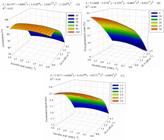
Response surface plots for germination percentage (A), first germination count (B), and germination speed index (C) of ‘Paluma’ guava seeds subjected to ascorbic acid (AsA) priming and salt stress.
Seeds subjected to 1.5 mM L-1 AsA priming had a germination of 81.20% up to an ECw of 2.69 dS m-1, indicating efficiency in reducing the damage of salt stress on guava seed germination. This effect is due to the capacity of AsA to regulate processes such as oxidative balance, potentially improving the enzymatic activity of amylase and protease, which are required to hydrolyze starch and proteins involved in germination metabolism (CHEN; CAO; NIU, 2021).
The values for the first count (Figure 1B) demonstrate that AsA priming stimulated germination, with a maximum value (27.4%) at an AsA concentration of 2.63 mM L-1 and 0.0 dS m-1 ECw. At the same concentration of 2.63 mM L-1, increasing the ECw to 1.1 dS m-1 resulted in a reduction of less than 5%, indicating an effect on seed vigor. Increased salinity levels resulted in decreases, reaching zero germination (0%) at 4.3 dS m-1 ECw and 0 AsA (control). Salinity impaired seed vigor due to high levels of toxic ions (Na+ and Cl-) in the substrate, reducing water absorption capacity and impairing the imbibition phase (PAIVA et al., 2020).
The germination speed index (GSI) was enhanced by AsA priming at 1.69 mM L-1, with an estimated maximum value of 2.73 under 0.54 dS m-1 salinity (Figure 1C). Increasing the ECw to 2.15 dS m-1 at 1.69 mM L-1 AsA resulted in a GSI of 2.48, representing a reduction of 9.15%, which demonstrates the effect of AsA in mitigating salinity impacts on seed vigor. The minimum estimated GSI was 1.36 at 4.3 dS m-1 ECw and 0.0 dS m-1 AsA (control), a reduction of 50.2% compared to the value at 0.54 dS m-1 and 1.69 mM L-1 AsA. The effect on GSI may be associated with AsA influencing the remobilization of reserve substances for embryo germination, stimulating the production of enzymes involved in this process (SILVA et al., 2023).
MGT (Figure 2A) increased with salinity levels; seeds subjected to 4.3 dS m-1 ECw reached 18.93 days, while those under 0.0 dS m-1 required 16.85 days. These results align with FGC and GSI tests, where increased salinity reduced seed vigor, affecting speed, percentage, and the time required for germination. This effect is caused by damage during imbibition in high salt concentrations, resulting in embryonic axis toxicity and directly affecting germination metabolism (JOVIČIČ et al., 2019).

Mean germination time (MGT) for the main effect of salinity levels (A) and ascorbic acid (AsA) concentrations (B), and mean germination speed (MGS) as a function of salinity levels (C) of ‘Paluma’ guava seeds.
The effect of priming on MGT was described by a quadratic model, where seeds under 2.2 mM L-1 AsA required the shortest time (17.7 days) to germinate, while those at 0 mM L-1 AsA showed the highest MGT (18.3 days) (Figure 2B). This reduction in germination time is due to AsA stimulating enzymes responsible for remobilizing reserve substances for embryo growth (SHAH et al., 2019), accelerating germination metabolism. Mean germination speed (MGS) decreased as salinity increased, with a reduction of 3.74% per unit increase in ECw. When comparing the highest ECw (4.3 dS m-1) to the control (0 dS m-1), a decrease of 14.9% was observed (Figure 2C). High salt levels impair water absorption and the transport of reserves for embryonic axis development (NÓBREGA et al., 2018).
There was a significant effect (p≤0.01) of the interaction between salinity levels and AsA priming on root, shoot, and seedling length and the vigor index (Table 2). Salinity had an individual significant effect on root dry mass (p≤0.05), shoot and seedling dry mass, and the seedling vitality index (p≤0.01). AsA priming significantly affected (p≤0.05) shoot dry mass and the seedling vitality index.
Summary of the analysis of variance (ANOVA) for root length (RL), shoot length (ShL), seedling length (SeedL), root dry mass (RDM), shoot dry mass (ShDM), seedling dry mass (SDM), vigor index (VI), and seedling vitality index (SVI) of ‘Paluma’ guava seeds subjected to ascorbic acid (AsA) priming as a mitigator of salt stress.
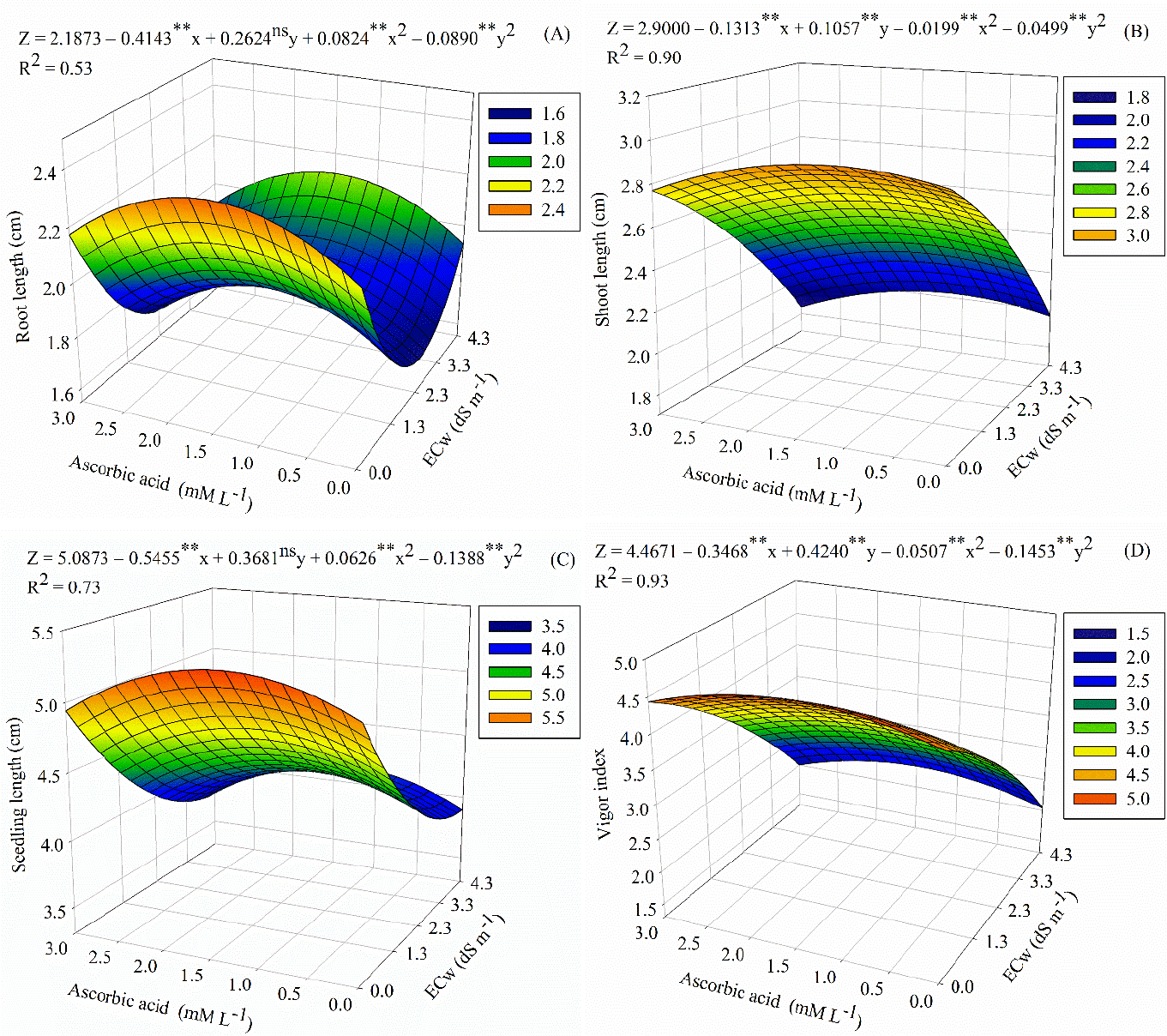
Root length (RL) was improved by AsA priming, with an estimated maximum value (2.38 cm) at 1.5 mM L-1 and 0 dS m-1 ECw (Figure 3A). Increased salinity reduced RL to a minimum of 1.65 cm at an estimated ECw of 2.41 dS m-1 and 3.0 mM L-1 AsA. This stimulus to root growth may be due to AsA acting on plant hormone synthesis, which is fundamental for establishment and nutrient uptake, as also observed by Nunes et al. (2020) in common beans at a concentration of 0.75 mM L-1 AsA.

Response surface plots for root length (A), shoot length (B), seedling length (C), and vigor index (D) of ‘Paluma’ guava as a function of the interaction between salinity levels (ECw) and ascorbic acid (AsA) seed priming.
Priming was beneficial for shoot length, with a maximum estimated value (2.96 cm) at 1.12 mM L-1 and 0.0 dS m-1 ECw. Increasing ECw to 1.88 dS m-1 at 1.12 mM L-1 AsA resulted in 2.64 cm, a reduction of 10.1%, indicating mitigation of salt stress. The lowest growth (1.83 cm) occurred at 4.3 dS m-1 ECw and 3.0 mM L-1 AsA (Figure 3B). High salt concentrations reduce osmotic potential, causing an imbalance in solute entry into plant cells, which decreases turgor and inhibits shoot expansion (PEDRO et al., 2016). Conversely, AsA priming reduced salinity damage due to its antioxidant activity, participating in ROS control and protecting subcellular compartments (NUNES et al., 2019).
Seedling length (Figure 3C) was higher (5.33 cm) at 1.31 mM L-1 AsA and 0 dS m-1 ECw, while the lowest value (3.75 cm) occurred at 4.3 dS m-1 ECw and 3.0 mM L-1 AsA. At 1.34 dS m-1 ECw and 1.31 mM L-1 AsA, the value (4.71 cm) showed a decrease of 11.6%, which is a positive effect on stress mitigation, potentially associated with increased soluble sugars, proline, total phenolics, and antioxidant enzyme activity induced by AsA (SALEMI; ESFAHANI; TRAN, 2019).
The vigor index (Figure 3D) was highest (4.78) at 1.5 mM L-1 AsA and the lowest ECw, while the lowest value (2.0) was observed at 4.3 dS m-1 and 3.0 mM L-1 AsA. At 1.08 dS m-1 ECw and 1.5 mM L-1 AsA, the value (4.34) showed a reduction of 9.20%. This effect indicates that increasing salinity compromises both germination and seedling dry matter accumulation, likely reflecting the osmotic effect that limited water absorption by the seed, directly affecting the initial establishment of the crop. AsA improved vigor, likely by increasing antioxidant enzyme activity and the expression of genes in the ascorbate-glutathione cycle, favoring the repair of structural damage (MI et al., 2025).
Root dry mass (Figure 4A), shoot dry mass (Figure 4B), and seedling dry mass (Figure 4C) were described by quadratic models, with maximum increments (0.0004, 0.0017, and 0.0022 g seedling-1, respectively) at ECw levels of 0.8, 1.1, and 0.5 dS m-1. Salinity above these levels resulted in reductions of 22.4, 15.7, and 16.3% in root, shoot, and seedling dry mass, respectively, when comparing maximum and minimum values at 4.3 dS m-1. This occurs because seedlings under salt stress expend more energy for water absorption, inhibiting physiological actions required for growth, such as auxin production (LOPES; DIAS-FILHO; GURGEL, 2021).
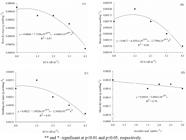
Root dry mass (A), shoot dry mass (B), and seedling dry mass (C) of ‘Paluma’ guava subjected to salt stress, and shoot dry mass (D) as a function of seed priming with ascorbic acid (AsA).
AsA concentrations for shoot dry mass (Figure 4D) was described by a decreasing linear model, with maximum increment (0.0018 g seedling-1) in the control (0 mM L-1), followed by decreases as AsA concentration increased. However, the difference between AsA concentrations was low, with values of 0.0016 g seedling-1 observed up to 3.0 mM L-1 AsA. Similar biomass effects were reported for cucumber (REIS et al., 2014) and watermelon (SANTOS et al., 2014) under AsA priming.
The seedling vitality index was described by a quadratic regression model, with the highest value (0.199) at 0.7 dS m-1 ECw and the lowest (0.104) at 4.3 dS m-1, a decrease of 47.73% (Figure 5A). This demonstrates the detrimental impact of excess salts on germination metabolism and initial establishment, characterized as the phenological phase most sensitive to salt stress (NÓBREGA et al., 2018).

Seedling vitality index for the main effect of salinity levels (A) and ascorbic acid (AsA) concentrations (B) of ‘Paluma’ guava.
The vitality index for AsA concentrations (Figure 5B) was also described by a quadratic model, with a maximum estimated value (0.170) at 1.7 mM L-1 AsA. The lowest value (0.158) occurred in seedlings without AsA priming. This effect is attributed to AsA contributing to hormonal balance in germination metabolism, potentially stimulating indole-acetic acid (IAA) levels, which is associated with increased cellular activity and seedling growth, as observed in rice cultivation (ZHANG et al., 2024).
CONCLUSIONS
Seed priming with 1.5 mM L-1 of ascorbic acid (AsA) promotes germination and initial seedling vigor of ‘Paluma’ guava up to a salinity of 0.81 dS m-1. Although electrical conductivity (ECw) above 1.0 dS m-1 impairs seed and seedling vigor, the use of ascorbic acid reduces salt stress damage on the germination and initial growth of ‘Paluma’ guava, proving a viable strategy for production in the Brazilian semi-arid region.
ACKNOWLEDGMENTS
We to thank for their financial support from the National Council for Scientific and Technological Development (CNPq Processo: 151057/2024-9) and Tutorial Education Program in Agronomy (PET Agronomy).
Data Availability:
The data that support the findings of this study can be made available, upon reasonable request, from the corresponding author.
REFERENCES
- BRASIL. Ministério da Agricultura, Pecuária e Abastecimento. Regras para análise de sementes 2 ed. Brasília, DF: MAPA/ACS, 2025. 399 p.
- CHEN, Z.; CAO, X.; NIU, J. P. Effects of exogenous ascorbic acid on seed germination and seedling salt-tolerance of alfalfa. PLoS ONE, 16: e0250926, 2021.
- FERREIRA, D. F. Sisvar: A computer analysis system to fixed effects split plot type designs. Revista Brasileira de Biometria, 37: 529-535, 2019.
- FERREIRA, F. N. et al. Growth and gas exchange responses of guava rootstocks to salt stress in a semi-arid region. Revista Caatinga, 39: e13969, 2026.
- JOVIČIČ, D. et al. The interaction between salinity stress and seed ageing during germination of Brassica napus seeds. Seed Science & Technology, 47: 47-52, 2019.
- LABOURIAU, L. G. A germinação das sementes 1. ed. Washington: Secretaria da OEA, 1983. 174 p.
- LABOURIAU, L. G.; VALADARES, M. E. B. On the germination of seeds Calotropis procera (Ait.) Ait.f. Anais da Academia Brasileira de Ciências, 48: 263-284, 1976.
- LESSA, C. I. N. et al. Salt stress in the early development stage of peanut genotypes. Revista de Ciências Agroveterinárias, 21: 441-448, 2022.
- LI, Z. et al. Exogenous spermidine improves seed germination of white clover under water stress via involvement in starch metabolism, antioxidant defenses and relevant gene expression. Molecules, 19: 18003-18024, 2014.
- LIMA, G. S. et al. Saline water irrigation strategies and potassium fertilization on physiology and fruit production of yellow passion fruit. Revista Brasileira de Engenharia Agrícola e Ambiental, 26: 180-189, 2022.
- LOPES, M. J. D. S.; DIAS-FILHO, M. B.; GURGEL, E. S. C. Successful plant growth-promoting microbes: Inoculation methods and abiotic factors. Frontiers in Sustainable Food Systems, 5: 606454, 2021.
- MAGUIRE, J. D. Speed of germination-aid in selection and evaluation for seedling emergence vigor. Crop Science, 2: 176-177, 1962.
- MI, C. et al. Ascorbic acid priming restores the seed vigor by enhancing the mitochondrial AsA-GSH cycle and related gene expression in the aged oat seeds. Physiologia Plantarum, 177: e70190, 2025.
- NÓBREGA, J. S. et al. Quality of sesame seeds produced under soil salinity level. Pesquisa Agropecuária Tropical, 48: 280-286, 2018.
- NÓBREGA, J. S. et al. Seed quality and vigor of germination of Moringa oleífera Lam. in saline stress. Brazilian Archives of Biology and Technology, 64: e21210106, 2021.
- NUNES, L. R. L. et al. Ascorbic acid of cowpea seeds under saline stress. Journal of Seed Science, 41: 442-459, 2019.
- NUNES, L. R. L. et al. Effects of ascorbic acid on the germination and vigour of cowpea seeds under water stress. Revista Ciência Agronômica, 51: e20196629, 2020.
- ORCHARD, T. Estimating the parameters of plant seedling emergence. Seed Science and Technology, 5: 61-69, 1977.
- PAIVA, F. J. S. et al. Influência da salinidade da água de irrigação na qualidade de sementes no semiárido paraibano. Meio Ambiente, 1: 46, 2020.
- PEDRO, A. A. et al. Crescimento inicial de cultivares de algodoeiro submetido ao estresse salino. Revista de Agricultura Neotropical, 3: 32-38, 2016.
- REIS, L. C. F. et al. Embebição de sementes de pepino com soluções de ácido ascórbico e ácido fólico e sua influência na velocidade de germinação. Horticultura Brasileira, 31: S3735-S3742, 2014.
- RICHARDS, L. A. Diagnosis and improvement of saline and alkali soils Washington: U.S. Department of Agriculture, 1954. 160 p. (Agriculture Handbook, 60).
- SALEMI, F.; ESFAHANI, M. N.; TRAN, L. S. P. Mechanistic insights into enhanced tolerance of early growth of alfalfa (Medicago sativa L.) under low water potential by seed-priming with ascorbic acid or polyethylene glycol solution. Industrial Crops and Produtcs, 137: 436-445, 2019.
- SANTOS, H. C. A. et al. Efeito de tratamento de sementes com ácido ascórbico no vigor de sementes e plântulas de melancia. Horticultura Brasileira, 31: S3502-S3509, 2014.
- SHAH, T. et al. Ascorbic acid priming enhances seed germination and seedling growth of winter wheat under low temperature due to late sowing in Pakistan. Agronomy, 9: 757, 2019.
- SILVA, C. D. et al. The physiological potential of marandu grass seeds under water stress conditioned with ascorbic acid. Acta Biológica Colombiana, 28: 29-38, 2023.
- SIMÕES, W. L. et al. Fruit production and quality of ‘Paluma’ guava with nematode-tolerant rootstock irrigated in the semi-arid region. Revista Brasileira de Engenharia Agrícola e Ambiental, 27: 400-406, 2023.
- TORRES, R. A. F. et al. Ascorbic acid as an elicitor of salt stress on the physiology and growth of guava. Revista Caatinga, 38: e12425, 2025.
- ZHANG, K. et al. Seed priming with ascorbic acid and spermidine regulated auxin biosynthesis to promote root growth of rice under drought stress. Frontiers in Plant Science, 15: 1482930, 2024.
Edited by
-
Section Editor:
Salvador Barros Torres
-
Editor in Chief:
Aurélio Paes Barros Júnior

 X and Y - water electrical conductivity (ECw) and ascorbic acid (AsA) levels, respectively. Z - response variable; ** and *: significant at p≤0.01 and p≤0.05, respectively; ns - non-significant (p>0.05).
 ** and *: significant at p≤0.01 and p≤0.05, respectively.
 X and Y - water electrical conductivity (ECw) and ascorbic acid (AsA) levels, respectively. Z - response variable; ** and *: significant at p≤0.01 and p≤0.05, respectively; ns - non-significant (p>0.05).
 ** and *: significant at p≤0.01 and p≤0.05, respectively.
 ** and *: significant at p≤0.01 and p≤0.05, respectively.