Characterization of the maturation stages of umbu fruit produced in Campo Redondo, RN, Brazil
ABSTRACT
Research on umbu (Spondias tuberosa) fruit is essential to enhance the value of the species. The objective of the study was to characterize the maturation stages of umbus produced in the municipality of Campo Redondo, RN, Brazil. The fruit were categorized into four stages: I (green), II (light green), III (slightly yellow) and IV (completely yellow). The research was carried out in a completely randomized experimental design, with four replications with twenty fruit. The physicochemical attributes and bioactive compounds of the crushed fruit pulps and peels were evaluated, and Pearson's correlation was performed among the parameters. Stage I of maturation exhibited higher values of vitamin C (16.81 mg.100g-1), and phenolic compounds (121.23 mg GAE.100g-1). Stage IV showed larger sizes (32 mm in diameter), higher values of soluble solids (11%), and carotenoids (3.6 µ.g-1). This research study characterized umbus from Campo Redondo, RN, Brazil, highlighting stage I for the extraction of bioactive compounds and stage IV for commercial use.
Keywords:
Native fruits; Anacardiaceae. Quality; Spondias tuberosa. Postharvest.
RESUMO
As pesquisas sobre os frutos de umbuzeiro (Spondias tuberosa) são essenciais para valorização da espécie. O objetivo do estudo foi caracterizar os estádios de maturação dos umbus produzidos no município de Campo Redondo (RN). Os frutos foram classificados em estádio I (verdes), estádio II (verde claro), estádio III (início da pigmentação amarela) e estádio IV (totalmente amarelos). A pesquisa foi realizada em delineamento experimental inteiramente casualizado e as avaliações continham quatro repetições de 20 frutos. Foram avaliados os atributos físico-químicos e compostos bioativos das polpas e cascas trituradas dos frutos.O estádio I de maturação obteve maiores valores de vitamina C (16,81 mg.100g-1) e compostos fenólicos (121,23 mg GAE.100g-1). O Estádio IV apresentou maiores tamanhos de frutos (32 mm de diâmetro), maiores valores de sólidos solúveis (11%) e carotenoides na polpa e casca (3,6 µ.g-1). A caracterização dos frutos dos umbuzeiros do município de Campo Redondo (RN), destacou o estádio I para extração de compostos bioativos e o estádio IV para aproveitamento comercial.
Palavras-chave:
Frutos nativos; Anacardiaceae; Qualidade. Spondias tuberosa. Pós-colheita.
INTRODUCTION
Among the species present in the Caatinga, the genus Spondias spp. stands out. Fruits of this genus are tropical, belonging to the Anacardiaceae family and they have a significant potential as exotic fruits. The umbu tree (Spondias tuberosa), which is native to northeastern Brazil, is an endemic species with vast possibilities for exploitation (FREITAS et al., 2024; SILVA et al., 2023).
Spondias ssp. fruit play an important role for the regional economy due to their adaptability to the soil and the climate, along with their sensory appeal. Spondias tuberosa fruit originate from the semi-arid plateaus, being produced spontaneously, and encompass several types spread across the Northeast states of Brazil. They boast a distinctive flavor which pleases the local population. Recognized for their resistance to drought, heat, and unfertilized soil, the plant roots are more resistant due to their capacity to store water and nutrients. This behavior is caused by the adaptation of the plants that develop in places with irregular rainfall (SANTOS et al., 2020).
While serving as a source of employment and income for rural communities, the commercialization of fresh umbu fruit poses significant challenges concerning the preservation of their post-harvest quality. Being climacteric, these fruit face difficulties in maintaining optimal conditions for long periods after harvesting (TEODÓSIO et al., 2021). Therefore, post-harvest studies are crucial to identify procedures which enhance their market value nationally and internationally.
Aspects of fruit quality are decisive for market acceptance, encompassing physical appearance characteristics, such as size, fresh mass, shape, and skin color. Moreover, the chemical and nutritional constitution plays an important role in defining the organoleptic attributes which make these fruit acceptable to consumers. These attributes also serve as maturation indices, which determine a suitable stage for harvesting the fruit (PEREIRA et al., 2021).
Spondias tuberosa (umbu) fruit are highly perishable upon harvest, which highlights the importance of obtaining them at the ideal ripening point. However, there are still challenges in characterizing the maturation stages of this species. Harvesting fruit at stages prior to full ripeness enhances their resilience and extends their shelf life. Nevertheless, immature stages tend to have lower sugar accumulation compared to more mature fruit, which offer better flavor (LIMA; CASTRICINI, 2019).
Despite their significance, the phytochemical, nutritional, physicochemical, and bioactive parameters of S. tuberosa fruit remain understudied, particularly in the semiarid region. The scarcity of research in this area accentuates the need to explore the technological and industrial potential of umbu (MOREIRA et al., 2021).
Therefore, research on the characterization of S. tuberosa fruit is necessary. Knowing the quality attributes of this species contributes to greater appreciation, utilization, and commercialization, highlighting this native fruit as an alternative for agro-industrial purposes. Furthermore, studying the development of S. tuberosa fruit at different maturity stages, facilitates the selection of a suitable point for harvesting or processing the fruit.
The objective of this study is to characterize the maturation stages based on physical, physicochemical, and bioactive compound analyses of umbu fruit, from the municipality of Campo Redondo, Rio Grande do Norte, Brazil. This research aims to highlight the potential for using umbu fruit in the Seridó region, evidencing its diverse applications.
MATERIAL AND METHODS
Plant material
The fruit were harvested in March 2022 from a plantation in the municipality of Campo Redondo, Rio Grande do Norte, Brazil (06 º 14' 29" S, 36º 10' 57" W), situated at 471 meters above sea level. Intensive soil management is not practiced in the region, as the production is primarily extractive. The fruit were harvested by hand from the mother plant between 6 and 7 a.m., at 21 °C, then transported 45.6 km to the Food Chemistry Laboratory of the Federal Institute of Education, Science and Technology of Rio Grande do Norte, Currais Novos Campus.
Conducting the experiment
Fruit at all stages of maturation were harvested directly from 50 plants, selected for color, uniformity of size, absence of apparent defects, diseases, pest attack, and mechanical damage. The S. tuberosa fruit were washed under running water and evaluated for their physicochemical characteristics.
The four stages of fruit ripeness were classified. Figure 1 shows stage 1 (SI), in which the fruit is totally green and firm; stage 2 (SII) presents a fruit with a lighter shade of green (close to white); stage 3 (SIII) shows a fruit with yellow pigmentation; stage 4 (SIV) presents fruit with a fully developed yellow color.

S. tuberosa fruit obtained at different stages of ripeness, harvested in the municipality of Campo Redondo, Rio Grande do Norte, Brazil, showing stage 1 (S1), stage 2 (S2), stage 3 (S3) and stage 4 (S4).
Experimental design
This study was performed using a completely randomized experimental design, with four replications, each containing 20 fruit for each stage of ripeness evaluated, totaling 320 fruit used in the experiment.
Physical characterization
The fruit were weighed individually on an analytical balance, with values expressed in grams (g). Longitudinal (LD) and transverse (TD) diameters were assessed using a digital caliper (mm). Fruit pulp yield was determined by separating, weighing, and then calculating the difference between the fresh mass and the pulp. Fruit shape index (SI) was assessed using the ratio between the longitudinal and transverse diameters, with values <1 corresponding to flattened fruit; = 1, rounded; and >1, elongated (COSTA; ATAÍDE; BASTOS, 2021).
Peel color
Color analysis was carried out using the CIElab system (COMMISSION INTERNATIONALE DE L'ECLAIRAGE), following the procedures of Saraiva et al. (2022), with the aid of a Miniscan® EZ colorimeter, model MSEZ0506 (HunterLab, Osaka, Japan), measuring the parameters of lightness (L*), green/red (a*), yellow/blue (b*), chromaticity (C*) and determination of the Hue angle (H).
Physicochemical analyses
In order to conduct the physicochemical analysis, the pulp was obtained using a fruit processor, without adding water. Soluble solids (%) and titratable acidity, expressed as citric acid (%), pH and soluble solids to titratable acidity ratio (SS/TA) were determined according to the Association of Official Analytical Chemists - AOAC (2019).
Starch content
Starch content was determined following the instructions of AOAC (2019) and adapting the method of Silva et al. (2015). The procedure was performed using a solution of DNS (3,5-dinitrosalicylic acid). The sample dilutions were read using a spectrophotometer at 540 nm. The data acquired was expressed in percentages (%).
Bioactive compounds
Vitamin C analysis (mg.100g-1) was carried out according to the titrimetric method of AOAC (2019). Total extractable polyphenols (mg GAE.100g-1) were determined using the Folin-Ciocalteu method, according to Larrauri, Rupérez and Saura-Calixto (1997). Chlorophyll (mg.100g-1) was determined according to Engel and Poggiani (1991). Carotenoids (µg.g-1) were extracted and quantified according to the methodology modified by Rodriguez-Amaya (2001). Quantification was performed using a spectrophotometer, and absorbance was measured at a wavelength of 450 nm. The results were expressed as carotenoids corresponding to βcarotene per g of sample. Frozen fruit samples were used to determine chlorophyll and carotenoids.
Statistical analysis
Data were presented as means and standard deviations using Microsoft Excel and Statistica 7.0 software. The data were subjected to the analysis of variance (ANOVA) and Tukey's test, considering p<0.05 as significant differences. Pearson's correlation was also established, considering the correlation to be very strong (r = 0.91 to r = 1.00), strong (r = 0.71 to r = 0.91), medium (r = 0.51 to r = 0.71) and weak (r = 0.31 to r = 0.51), at a significance level of 5%, according to Costa, Ataíde and Bastos (2021). Principal Component Analysis (PCA) was performed in order to reduce the dimensionality of the data and identify patterns and key variables that influence the maturation stages.
RESULTS AND DISCUSSION
Physical measurements
For fruit mass, there was no significant difference between maturation stages (Table 1). In general, a 7% increase in fresh mass in absolute numbers was noted with fruit ripening, reaching 16.80 g. It was verified that there were no significant differences in determining pulp yield at the evaluated stages, while there was an increase in absolute numbers of the pulp yield until complete development, reaching 60%.
Physical measurements of S. tuberosa fruit at different stages of maturation, harvested in the municipality of Campo Redondo, RN, Brazil.
Regarding fruit diameters, both longitudinal and transverse (Table 1), significant differences were observed in the green stages (I and II) when compared to the fully yellow fruit (SIV), which were larger when compared to the others. For the shape index (Table 1), a significant difference was observed in the green fruit (stages I and II), in contrast to the completely yellow ones (stage IV), as the fruit conformation changed from elongated to rounded in stage IV of ripening.
Campos et al. (2018), in their study on umbus from Pernambuco at five stages of maturation, observed increases in fresh mass in semi-ripe and ripe fruit, ranging from 16.78 to 18.64 g. However, a decrease in fresh mass was noted in the final stage, nearing senescence, with a value of 17.95 g, similar to present study's findings. Similarly, Dutra et al. (2017) evaluated the physicochemical attributes of S. tuberosa fruit from Bahia and reported values ranging from 59.18 to 73.54%. In the present study, the values found in the stages were consistent with this range. These observed results aided in understanding the physical characteristics of fruit from Rio Grande do Norte (Table 1), compared to other Northeastern regions. It can be inferred that the increase in fresh mass and pulp yield in the fruit is conducive to consumption and offers a viable source for agro-industrial purposes.
Faustino et al. (2023), when applying edible coatings based on beeswax and cassava starch to S. tuberosa fruit from Rio Grande do Norte, found diameters of 29.1 mm in green fruit, similar in color to fruit at stage I in this study. These data were similar to the transverse diameter obtained in stages I and II of the present research, differing in terms of ripe fruit, which showed higher values, reaching 32.68 mm. The diameters obtained in the present study were also similar to the results of Souza et al. (2019), who characterized Spondias purpurea (seriguelas) from Jataí, in Goiás state, in three stages of maturation and obtained dimensions in the range of 29 to 31 mm. With this research, it can be seen that ripe fruit belonging to stage IV, due to their larger dimensions, can be considered attractive, suitable for traditional consumption, or other forms of processing.
The result in the present work showed that the fruit, being 30.98-32.60 mm long and 29.57-32.66 mm in diameter, and their shape indicates that the fruit exhibit a rounded appearance, a desirable trait for consumers, and are preferable for both industrial processing and fresh consumption. The results confirm what was described by Lima and Castricini (2019) when describing umbus.
Peel color
Significant differences in the lightness parameter (L*) were observed in Stage I as compared to Stages III and IV, while Stages III and IV did not show significant differences from each other (Table 2). The lightness value increased, with greater values observed in the last two stages analyzed, ranging from 42.16 to 45.48, respectively.
Color of the skin of S. tuberosa fruit at four stages of maturity, harvested in the municipality of Campo Redondo, RN, Brazil.
Peel color is one of the most important quality attributes for fresh fruit. In umbu, the pigments responsible for color are primarily chlorophylls and carotenoids (LIMA; CASTRICINI, 2019). The data suggest that, as the fruit ripens, its tone becomes increasingly lighter and brighter. This process occurs due to the degradation of the chlorophyll pigment, which provides the dark green color, and an increase in carotenoids, which are responsible for the yellow and orange hues (SOUZA et al., 2019). Additionally, there is a discernible impact of ripening on the color parameters a* and b*. Negative values of a* during immature stages (I and II) confirm the predominance of green hues, whereas b* values increase with maturation, indicating the greater presence of yellow tones (Table 2).
C* chromaticity showed an effect of maturation: there was a difference in stage I (green fruit), which showed a lower value compared to the last stage. Furthermore, higher values were obtained with ripening, indicating an increase in the intensity of the yellow color.
Statistical differences in Hue angle were observed between stages I and IV, indicating a decrease in this characteristic as the fruit matured (Table 2). Stage I (Hue > 90°) exhibited tones close to greenish yellow, while Stage IV (Hue < 90°) ranged from orange to yellow.
The Stage IV results of this research were similar to those reported in the study by Santos et al. (2021), who examined S. tuberosa fruit from Pernambuco intended for dessert production at the semi-ripe stage. Lightness varied from 45.18 to 50.88, indicating lighter and brighter fruit. Unlike Saraiva et al. (2022), who observed that hairy umbu peels are associated with lower light reflection and thus lower lightness, the fruit analyzed in this study showed smooth peels, which resulted in higher lightness values. Chlorophyll degradation and advancing fruit ripening also contribute to increased lightness (SOUZA et al., 2019).
Santos et al. (2021), using S. tuberosa fruit from Pernambuco intended for the production of preserves at the semi-ripe stage, observed that one accession had an average b* value ranging from 18.52 to 22.62, and similar results were observed in the present research; the b* coordinate indicates the yellow-blue color variation, and the obtained results represent the predominance of yellow color, especially in stage IV, showing the advancement of fruit ripening, but the work of Saraiva et al. (2022) presents also different characteristics with a* and b* in all stages.
Local factors, such as soil and climatic conditions, influence the fruit’s composition and play an essential role in determining the appearance of umbu.
The results obtained by determining the coordinates a*, b*, C* and the Hue angle showed a color transition with ripening, highlighting the presence of the yellow tone, mainly in stage IV, which indicates a greater tendency for local traditional marketing, as the consumer associates the more yellowish or orange color of the fruit with the higher sugar content. Lightness is also important, as lighter or brighter colors attract consumers, enabling greater commercialization.
Physicochemical measurements
Soluble solids, titratable acidity, pH and ratio (SS/TA)
Significant effects of maturation were observed for soluble solids. An increase in soluble solids was noted, as a result of the decrease in titratable acidity during maturation (Table 3). It can be inferred that the increase in soluble solids is associated with the sugar synthesis process, influenced by the degradation of organic acids and polysaccharides.
Physicochemical attributes of umbu fruit, harvested in the region of Campo Redondo, RN, Brazil.
There was an increase in starch content between stages I and II in absolute numbers, without statistical effects, and a decrease was observed in stages III and IV, which showed a significant difference when compared to the initial stages (Table 3).
The titratable acidity of umbus, expressed in citric acid, showed a significant decrease of approximately 0.9% from unripe to fully ripe fruit across maturation stages I, II, and IV (Table 3). This decrease aligns with the observed increase in pH values, which showed a significant difference between stages I and IV, with a gradual rise as maturation progressed.
Regarding the ratio (SS/TA) (Table 3), a difference was observed between green fruit and those with more advanced maturation, resulting in increased ratio values.
In relation to soluble solids, all results in Table 3 are lower than those found in the control group by Teodósio et al. (2021), although the data obtained in stages III and IV, in the present study, were similar to those reported by Campos et al. (2018), who characterized ripe umbus from the state of Pernambuco and found values ranging from 9.1 to 10.8° Brix. The higher soluble solids content during umbu fruit ripening is associated with a high respiration rate, mass loss, and polysaccharide accumulation (TEODÓSIO et al., 2021).
Regarding starch, it was noted that, despite the statistical similarity between stages I and II, there was an accumulation of this component at the second point of maturation, and a decrease in the value of soluble solids (Table 3), indicating that, at this stage, the fruit still synthesizes carbohydrates. In a study conducted by Silva et al. (2015) on Spondias bahiensis (umbu-cajá) from the state of Ceará, it was observed that the amount of starch varied from 0.1 to 0.3%, which is lower than the results found in this study. The reduction of starch is a desirable factor, contributing to the improvement of flavor due to the conversion into sugars.
Ripe S. tuberosa fruit had 1.3% titratable acidity, which was similar to the value found in S. tuberosa, characterized by Dutra et al. (2017) in Bahia, who observed 1.84% citric acid content in the fruit. Santos et al. (2021) investigated the potential of the fruit for making preserves, characterizing different accessions of umbus, from the state of Pernambuco, and found citric acid levels ranging between 1.26 and 1.34% in green fruit, levels which are below the data obtained in the present study. Higher acidity levels are desirable for processing industries because they reduce the need for subsequent correction with citric acid. Acidity levels above 1.0% are preferable for the industrial sector (DUTRA et al., 2017).
Faustino et al. (2023) evaluated the application of coatings based on cassava starch and beeswax on umbus, obtained in Rio Grande do Norte, and observed that at the beginning of the experiment, the green fruit from the control treatment (without coating) showed a pH average of 2.23 and, with maturation, a decrease to 2.03. The effect observed in the experiment by Faustino et al. (2023) demonstrates the influence of fruit coating, which alters natural ripening.
Santos et al. (2021), who characterized S. tuberosa fruit from Pernambuco for the production of preserves, observed pH values ranging from 2.34 to 2.42 in semi-ripe fruit. These values were similar to those obtained for ripe fruit in the present study. The pH is an important parameter for assessing fruit quality, as it directly impacts nutritional and sensory properties. It also serves as an indicator of the fruit's ripening stage. This trend is consistent with the behavior observed in this research.
The ratio (SS/TA) results found in this study, within the range of 4.29 to 8.65, were similar to the data reported by Souza et al. (2019), when they characterized S. purpurea at different stages of maturation, in Jataí, state of Goiás, and found a variation in the ratio index from 3 to 9. According to Santos Neto et al. (2021), the increase in the ratio is an important indicator of the degree of ripeness and the better flavor of the fruit, as a result of the higher value of soluble solids obtained due to the reduction of organic acids with ripening.
In this study, it can be inferred that the data were coherent in relation to the effect of ripening on increasing the fruit ratio, as well as the highest value of soluble solids obtained, highlighting stage IV with the highest index, which is considered useful for fresh consumption or for the industrial level, and can promote the processing of fruit for the production of pulps, juices, nectars, and other fruit-based products.
The results indicate that climacteric fruits, such as umbu, show rapid physiological changes with maturation. The data presented in Table 3 highlights these physicochemical changes in the stages collected at points of more advanced maturity, III and IV, compared to stage II, for example. Considering these factors, from a commercial standpoint, stage II has characteristics suitable for transporting fruit over greater distances, being more resistant and showing attributes associated with conservation, such as greater acidity and lower pH. Based on the highlighted points, stage II can also be considered the best stage for applying biodegradable coatings, which represent an effective method of preservation for reducing the rapid ripening of the fruit and with low environmental impact.
Bioactive compounds
There was a significant difference between the maturation stages with a reduction in vitamin C levels (Table 4) during the ripening of the fruit. Stage I had the highest vitamin C content, with a reduction of 5.75 mg.100g-1 up to the last stage, in which the vitamin C content reached its lowest level.
Bioactive compounds of umbu fruit, harvested in the municipality of Campo Redondo, RN, Brazil.
In relation to total polyphenols (Table 4), the effects of maturation were observed on the fruit, showing significant differences for each stage evaluated. There was a gradual decrease in values, from 121.23 to 50.40 mg GAE.100g-1.
The results regarding chlorophyll and carotenoid values can be observed in Table 4. Effects of maturation were observed for carotenoid values, differing statistically between the first and fourth stages, with an increase occurring with the development of the fruit: when fully ripe and yellowish, 3.65 µ.g-1 was obtained. Regarding chlorophyll values, there was a statistical difference between the first and fourth stages, with green fruit having the highest value of approximately 1.26 mg.100g-1.
In the work of Santos et al. (2021), evaluating umbu genotypes from the state of Pernambuco at a semi-ripe stage, the researchers observed ascorbic acid values ranging from 13 to 16 mg.100g-1, with results similar to the values obtained in the present research. According to Quesada-Matos et al. (2021), vitamin C values are initially high in the initial stages of ripening due to the increased synthesis of intermediate metabolites, decreasing throughout maturation. The factors mentioned may be associated with the reduction in the levels of ascorbic acid, a precursor of vitamin C, in the current research. It was noted that green fruit, in the present study, especially Stage I, had higher levels of this vitamin, and, as in acerola, processing at this stage to extract ascorbic acid was recommended.
Stafussa et al. (2018), researching bioactive components in 44 traditional and native fruit pulps, in the states of Paraná and São Paulo, found around 216.74 mg.100g-1 of total phenolic compounds in S. tuberosa fruit. Ribeiro et al. (2022), when optimizing the process of extracting bioactive substances from ripe S. tuberosa fruit, from Rio de Janeiro, obtained higher values, with contents varying between 525 and 1986 mg.100g-1. In our study, the levels obtained were lower than those found in the literature, with levels above 100 mg GAE.100g-1 being obtained in Stage I.
Ferreira et al. (2022) evaluated volatile compounds from two genotypes of S. tuberosa fruit from Minas Gerais and verified variation in the behavior of the analyzed components, an increase in esters and a reduction in aldehydes over the course of four days of storage, reporting that post-harvest maturation stages directly influence volatile compounds.
According to Freitas et al. (2020), the content of phenolic compounds varies among different varieties, depending on fruit maturity, species, cultivation method, region, and the extraction method used. These factors contribute to understanding the difference found in the literature between the values of phenolic compounds and the data of this study. In this study, the high values at the beginning of maturation show that green fruit have potential for processing. In this way, the extraction of polyphenols at Stage I can be indicated as the best form of use, as well as Stage II for export, considering that it is an ideal harvest point, which allows the fruit maturation process without excessive losses. Rodrigues et al. (2024) in their review report that mature fruit have lower phenolic contents than semimature fruit.
With regard to the pigments evaluated, it is understood that the processes of color change in S. tuberosa fruit are important for understanding fruit maturation. The results of this study showed an inversely proportional relationship between the compounds analyzed during fruit ripening, with a reduction in chlorophyll and an increase in total carotenoids.
In the study by Silva et al. (2018), who evaluated the chlorophyll pigment in fully developed Spondias dulcis in the state of Goiás, it was observed that the skin of the fruit harvested 260 days after anthesis obtained a value of 2.85 mg.100g-1. However, in this study, lower values were found.
Ribeiro et al. (2019), when evaluating bioactive compounds from umbus in Milagres, Bahia, found carotenoid values in the fresh pulp of the fruit to be around 7.9 μg.g-1. Similarly, Silva et al. (2018), when studying the physicochemical characteristics and bioactive compounds of S. dulcis at a mature stage in the state of Goiás, observed carotenoids levels in the fruit of 0.85 mg.100g-1, equivalent to 8.5 μg.g-1. Cangussu et al. (2021), when analyzing the mature pulp of S. tuberosa in Minas Gerais, reported carotenoid content of 38 μg.g-1. These values align with the findings of Rodrigues et al. (2024), who reported that carotenoids in umbu pulp vary according to maturation degree and noted that umbu extracts exhibited higher carotenoid contents compared to three other Spondias species.
However, the present study found a carotenoid content of 3.65 μg.g-1 in ripe umbu fruit from Rio Grande do Norte. This discrepancy may be attributed not only to natural factors such as soil, climate, and genetic variation, but also to the fact that both peel and pulp were used together, which may have negatively influenced the carotenoid content.
Pearson’s Correlation
Table 5 presents Pearson’s correlations between the evaluated attributes.
Pearson’s Linear Correlation of main quality attributes of umbu fruit among fresh mass (M), longitudinal diameter (LD), transverse diameter (TD), shape index (SI), pulp yield (PY), soluble solids (SS), starch (S), pH, titratable acidity (TA), soluble solids to titratable acidity ratio (SS/TA), vitamin C (VC), carotenoids (CR), chlorophyll (CL), and total extractable polyphenols (EP).
The correlations showed expected results. In terms of physical attributes, the fresh mass showed a strong and positive correlation with pulp yield, pH, and ratio (SS/TA). There was also a strongly negative connection with starch, acidity and polyphenols. These relationships show that maturation promotes an increase in mass, pulp yield and the development of a more striking sweet flavor, in addition to causing a decrease in starch and acidity levels, promoting better palatability for consumers. These behaviors are expected, as they are related to the maturation process.
The shape index stood out with strong negative correlations for ratio (SS/TA) and carotenoids, in addition to fresh mass, diameter and pulp yield, indicating that more rounded fruit (Stage IV) have greater mass, size, pulp, sweetness and they are more yellow; their shape showed a positive effect on acidity, chlorophyll and polyphenols, indicating that the more elongated fruit (Stage 1) are greener, acidic, and concentrated in phenolic compounds. Fruit diameters showed a very strong positive correlation with carotenoids. From the data, it can be observed that, as fruit ripen and increase in size, they also exhibit an increase in carotenoid content.
Regarding bioactive compounds, chlorophyll showed a strong correlation with vitamin C and polyphenols, indicating that the greater the accumulation of this pigment, the higher the concentration of antioxidant compounds.
Considering the correlations between the parameters of peel color and bioactive compounds (Table 6), the L* parameter showed a negative correlation with the hue angle, vitamin C, and chlorophyll, indicating that the change in tone, the degradation of chlorophyll pigments, and the ascorbic acid content with ripening promoted greater lightness in the fruit.
Pearson’s Linear Correlation between color parameters L, a, b*, C, Hue Angle (H) and bioactive compounds (Vitamin C (VC), Carotenoids (CR), Chlorophyll (CL), and total extractable polyphenols (EP)).
It was observed that the color parameters a*, b* and C were positively influenced by the chemical attributes of ratio (SS/TA) and pH, while opposite behavior was observed for acidity, which decreased with maturation. As for the hue angle, the color coordinate of the fruit was negatively influenced by pH and positively influenced by acidity. These correlations between color attributes and physicochemical composition indicate that ripening causes a reduction in citric acid, an increase in pH values and an increase in the ratio values (SS/TA), contributing to the change from green to yellow.
Very strong negative correlations were identified between the coordinates a*, b*, C* and the bioactive compounds, except for carotenoids, for which strong positive dependencies were obtained. This effect showed that the decrease in vitamin C, the deterioration of chlorophyll and phenolic compounds contributed to the development of the yellow color in S. tuberosa fruit.
Principal Component Analysis
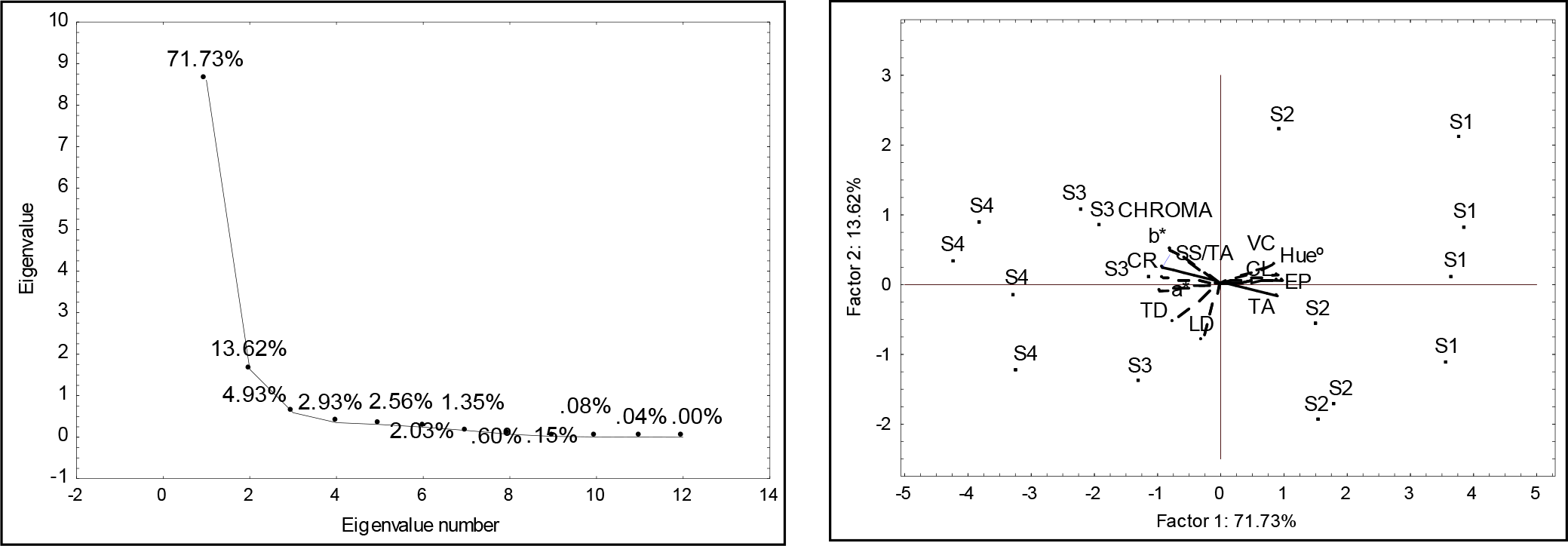
To facilitate the interpretation of the correlation analysis between the chemical, physicochemical, physical, and color parameters at different stages of maturation of the umbu, a two-dimensional projection was performed using principal component analysis, and the results are presented in Figure 2.

Principal Component Analysis (PCA) for the analyzed variables of S. tuberosa fruit harvested at different stages of ripening: Stage 1 (S1), Stage 2(S2), Stage 3 (S3) and Stage 4 (S4). Legend: longitudinal diameter (LD), transverse diameter (TD), soluble solids (SS), starch (S), pH, Titratable Acidity (TA) solids to Titratable Acidity ratio (SS/TA), Vitamin C (VC), Carotenoids (CR), Chlorophyll (CL), and total extractable polyphenols (EP).
A total cumulative explained variance of 90.3% was observed for the analyzed samples (Figure 2). The generated factors produced eigenvalues greater than 1, describing the significant variability in the data. The highest eigenvalue (8.60) was observed for factor 1, accounting for 71.73% of the variability in the data set. An eigenvalue of 1.63 for factor 2 was observed, accounting for 13.62% of the variance in the data.
PC1 accounts for most of the sample separation and is strongly associated with the fruit's physicochemical and chemical characteristics. PC2 contributes to a smaller portion of the variation and is linked to secondary attributes, such as color and the ratio of soluble solids to titratable acidity (SS/ TA). The distribution of maturation stages across the quadrants suggests a clear differentiation between the early stages (S1, S2) and the more advanced stages (S3, S4) based on the evaluated attributes. Samples from stage S1 are located at the far right of the graph, indicating a strong association with chemical parameters such as vitamin C (VC), chlorophyll (CL), extractable polyphenols (EP), and titratable acidity (TA). This suggests that fruit at this stage have higher concentrations of bioactive compounds and greater acidity, which are typical characteristics of unripe fruit. These findings highlight the potential of using these attributes as markers for assessing fruit maturity and optimizing harvest timing to meet specific quality and nutritional goals.
CONCLUSION
This study characterizes the ripening stages of S. tuberosa fruit produced in Campo Redondo, in the state of Rio Grande do Norte, helping to show the potential of this fruit species and contributing as a source of information for further research.
Fruit at Stage IV are more suitable for industrial processing, including pulp production, traditional consumption, and other commercial purposes, such as jam making. They are larger and have higher carotenoid content, higher soluble solids value and ratio index (SS/TA), resulting in better flavor. Although the titratable acidity decreases at this stage, the acid content of these fruit remains higher compared to other Spondias species, making them more suitable for industrial processing.
At Stage I, the evaluation revealed that completely green fruit had the highest levels of phenolic compounds and vitamin C, making them a valuable source of bioactive components. Therefore, extracting these substances is more suitable for fruit at the beginning of ripening. Stage II fruit also has high levels of vitamin C, polyphenols and titratable acidity (expressed as citric acid). This is considered an ideal harvest point for transporting fruit over long distances and applying biodegradable coatings, as the fruit is more developed compared to Stage I and more resistant than the more mature fruit.
As suggestions for future research, it is recommended to harvest and monitor the physiological development of Spondias tuberosa fruit during storage.
ACKNOWLEDGEMENTS
The authors would like to thank Laécio Galvão Maciel for his valuable contributions to this article.
Data Availability:
The data that support the findings of this study can be made available, upon reasonable request, from the corresponding author.
REFERENCES
- AOAC - Association of Official Analytical Chemists International. Official Methods of Analysis of AOAC International. 21. ed. Gaithersburg, MD: AOAC International, 2019.
- CAMPOS, C. et al. Caracterização de umbu (Spondia tuberosa) durante seu desenvolvimento. Revista Iberoamericana de Tecnología Postcosecha, 19: 159-166, 2018.
- CANGUSSU, L. B. et al. Chemical characterization and bioaccessibility assessment of bioactive compounds from umbu (Spondias tuberosa A.) fruit peel and pulp flours. Foods, 10: 2597, 2021.
- COSTA, R. S.; ATAÍDE, E. M.; BASTOS, D. C. Physical and chemical characterization of umbugueleira fruits (Spondias sp.) in the semi-arid state of Pernambuco. Research, Society and Development, 10: e236101724838, 2021.
- DUTRA, F. V. et al. Características físicas e químicas de acessos de umbuzeiros (Spondias tuberosa Arr. Cam). Revista de Ciências Agrárias, 40: 814-822, 2017.
- ENGEL, V. L.; POGGIANI, F. Estudo da concentração de clorofila nas folhas e seu espectro de absorção de luz em função do sombreamento em mudas de quatro espécies florestais. Revista Brasileira de Fisiologia Vegetal, 3: 39-45, 1991.
- FAUSTINO, C. F. A. et al. Avaliação do comportamento póscolheita dos frutos do umbuzeiro (Spondias tuberosa L.) submetidos ao revestimento com cera de abelha e fécula de mandioca. RECIMA21 - Ciências Exatas e da Terra, Sociais, da Saúde, Humanas e Engenharia/Tecnologia, 4: e422778, 2023.
- FERREIRA, G. R. et al. Volatile compounds of umbu (Spondias tuberosa Arruda) fruits during post-harvest ripening from two accessions. Food Science and Technology, 42: e42321, 2022.
- FREITAS, B. S. M. et al. Preliminary evaluation and nutritional properties of Spondias mombin L. fruits from different native plants. Research, Society and Development, 9: e55963418, 2020.
- FREITAS, J. S. et al. Spondias tuberosa and Spondias mombin: Nutritional Composition, Bioactive Compounds, Biological Activity and Technological Applications. Resources, 13: 68, 2024.
- LARRAURI, J. A.; RUPÉREZ, P.; SAURA-CALIXTO, F. Effect of drying temperature on the stability of polyphenols and antioxidant activity of red grape pomace peels. Journal of Agricultural and Food Chemistry, 45: 1390-1393, 1997.
- LIMA, M. A. C.; CASTRICINI, A. Qualidade e pós-colheita do umbu. 1. ed. Belo Horizonte, MG: Informe agropecuário, 2019.11 p.
- MOREIRA, M. N. et al. Phytochemical profile and antioxidant property of different genotypes of umbuzeiro fruits (Spondias tuberosa Arruda Câmara): a review. Research, Society and Development, 10: e58101623116, 2021.
- PEREIRA, F. R. A. et al. Biometry in umbu fruits from the semi-arid region of Paraiba. Revista Brasileira de Fruticultura, 43: e-808, 2021.
- QUESADA-MATOS, R. L. et al. Transformação do morango “Festival” a doce e determinação de parâmetros físicos e físico-químicos. Revista Cubana de Química, 33: 383-400, 2021.
- RIBEIRO, L. O. et al. Umbu fruit peel as source of antioxidant, antimicrobial and α-amylase inhibitor compounds. Molecules, 27: 1-16, 2022.
- RIBEIRO, L. O. et al. Nutrients and bioactive compounds of pulp, peel and seed from umbu fruit. Ciência Rural, 49: e20180806, 2019.
- RODRIGUES, N. L. et al. Nutritional and biological attributes of Spondias tuberosa (Umbu) fruit: An integrative review with a systematic approach. Journal of Food Composition and Analysis, 130: 106196, 2024.
- RODRIGUEZ-AMAYA, D. B. A Guide to Carotenoid Analysis in Foods. Washington DC: ILSI Human Nutrition Institute, 2001. 64 p.
- SANTOS NETO, J. P. et al. Functional liquor based on umbu (Spondias tuberosa Arruda) and microalgae (Spirulina spp.). Research, Society and Development, 10: e42010313557, 2021.
- SANTOS, L. J. S. et al. Leaf. contents and biochemical cycling of nutrients in accessions of umbu and umbu-caja. Revista Caatinga, 33: 690-701, 2020.
- SANTOS, R. T. S. et al. The potential of “umbuzeiro” genotypes for the development of preserves. Ciência Rural, 51: e20191008, 2021.
- SARAIVA, M. M. T. et al. Colorimetric variation and correlation of biometric parameters between umbu matrices. Revista Brasileira De Fruticultura, 44: e-479, 2022.
- SILVA, L. A. A. et al. Morphophysiology and water relations of Spondias rootstocks under different irrigation frequencies. Revista Caatinga, 36: 865-874, 2023.
- SILVA, L. R. et al. Caracterização físico-química de frutos dos genótipos de umbu-cajazeiras oriundos da microrregião de Iguatu, CE. Revista Brasileira de Tecnologia Agroindustrial, 9: 1647-1659, 2015.
- SILVA, T. L. L. et al. Physicochemical characterization and behavior of biocompounds of caja-manga fruit (Spondias mombin L.). Food Science and Technology, 38: 399-406, 2018.
- SOUZA, L. K. F. et al. Caracterização de frutos de ciriguelas em diferentes estádios de amadurecimento. Revista Engenharia na Agricultura, 27: 390-399, 2019.
- STAFUSSA, A. P. et al. Bioactive compounds of 44 traditional and exotic Brazilian fruit pulps: Phenolic compounds and antioxidant activity. International Journal of Food Properties, 21: 106-118, 2018.
- TEODÓSIO, A. E. M. M. et al. Effects of edible coatings of Chlorella sp. containing pomegranate seed oil on quality of Spondias tuberosa fruit during cold storage. Food Chemistry, 338: 127916, 2021.
Edited by
-
Editor in Chief:
Aurélio Paes Barros Júnior
-
Section Editor:
Daniel Alexandre Neuwald