Salt stress and water stress in maize cultivation in the semi-arid region
ABSTRACT
Water deficit associated with salt stress can affect maize (Zea mays L.) yield. In this context, the objective of this study was to evaluate the yield aspects of maize irrigated with lowerand higher-salinity water and under suppression intervals. The experiment was carried out at the Piroás Experimental Farm, Redenção, Ceará, Brazil. The experimental design used was randomized blocks, in a 2 x 4 factorial arrangement, with the first factor being two levels of electrical conductivity of the irrigation water (0.8 and 3.0 dS m-1) and the second factor being four suppression intervals (NS: no suppression intervals; SI10 = suppression intervals from 40 to 55 DAS (V10 to V14); SI15 = suppression intervals from 50 to 65 DAS (R1); and SI20 = suppression intervals from 65 to 80 DAS (R2 to R4)), with four replicates. The following variables were evaluated: unhusked ear mass, husked ear mass, 1000-grain mass, number of grains per row, ear diameter, ear length, and yield. Salt stress negatively affects unhusked and husked ear mass, number of grains per row and ear length. Suppression intervals SI10, SI15, and SI20 had a negative effect on unhusked and husked ear mass, number of grains per row, and ear length. Salt stress and suppression intervals SI10, SI15 and SI20 negatively affected maize performance in terms of 1000-grain mass and yield.
Keywords:
Zea mays L.; Salinity; Water deficit.
RESUMO
O déficit hídrico associado ao estresse salino pode afetar a produtividade da cultura do milho (Zea mays L.). Neste sentido, objetivou-se avaliar os aspectos produtivos da cultura do milho irrigada com água de menor e maior salinidade e intervalos de supressão da irrigação. O experimento foi realizado na Fazenda Experimental Piroás, Redenção, Ceará, Brasil. O delineamento experimental utilizado foi em blocos ao acaso, em arranjo fatorial 2 x 4, sendo o primeiro fator referente as condutividades elétricas da água de irrigação (0,8 e 3,0 dS m-1) e o segundo fator, quatro intervalos de supressões (SS: sem intervalos de supressão; IS10 = intervalos de supressão de 40 a 55 DAS (V10 a V14); IS15 = intervalos de supressão 50 a 65 DAS (R1) e IS20= intervalos de supressão 65 a 80 DAS - R2 a R4), com quatro repetições. Foram avaliadas as seguintes variáveis: massa de espiga com palha, massa de espiga sem palha, massa de 1000 grãos, número de grãos por fileira, diâmetro de espiga, comprimento de espiga e a produtividade. O estresse salino afeta negativamente a massa da espiga com e sem palha, números de grãos por fileira e o comprimento da espiga. Os intervalos de supressão IS10, IS15 e IS20 proporcionaram efeito negativo para a massa da espiga com e sem palha, números de grãos por fileira e o comprimento da espiga. O estresse salino e os intervalos de supressão IS10, IS15 e IS20 afetaram negativamente o desempenho em massa de 1000 grãos e na produtividade.
Palavras-chave:
Zea mays L.; Salinidade; Déficit hídrico.
INTRODUCTION
Maize (Zea mays L.) is one of the crops of great agricultural importance in the national and international scenario, occupying a prominent position among the agricultural species exploited worldwide, due to its great diversity, and can be used in human and animal nutrition and in the production of biodiesel (CAVALCANTE et al., 2022). Brazil is the third largest maize producer in the world, with an average yield of 6,109 kg ha-1 (CONAB, 2026).
In the Northeast of Brazil, the region with the largest area of the Brazilian semi-arid region, the average yield is 3,472.74 kg ha-1 (CONAB, 2026). This low yield is mainly due to the climatic characteristics of the semi-arid region, characterized by high temperatures, high evapotranspiration rates, poor rainfall distribution, and long periods of drought, which can lead to water deficit and concentration of salts in the water (SILVEIRA et al., 2021). Salt and water stresses are the main abiotic factors that limit agricultural productivity in the semi-arid region. Sousa et al. (2023), in a study with the maize crop under water reduction (50% crop evapotranspiration - ETc) associated with the use 3.0 dS m-1 brackish water, found reductions in leaf gas exchange and yield. Similarly, Zhang et al. (2022) describe that the combination of salt and water stresses during the reproductive stage can negatively affect maize yield.
Excess salts in water cause a reduction in the osmotic potential of the soil solution, and the accumulation of ions, mainly sodium (Na+) and chloride (Cl-), in plant tissues can lead to nutritional imbalances and inhibition of vital enzymatic processes, resulting in chlorophyll degradation and reduced photosynthetic efficiency (SOUSA et al., 2024). It is also worth pointing out that salt stress reduces water absorption by plants and alters cell division, differentiation and expansion, as well as metabolic and morphological structures, causing reductions in the seed germination, growth and yield of agricultural crops (SOUZA et al., 2025).
Irrigation is the only way to ensure safe agricultural production, especially in tropical regions with hot and dry climates. However, water must be used rationally, without causing water deficit in crops. Plant adaptation to water stress involves a set of morphological, metabolic, and molecular changes (SELEIMAN et al., 2021). Rajasekar, Hussainy and Karthik (2020) highlight that water limitations can negatively influence agricultural production and maize yield, as stress varies according to the crop, exposure time and edaphic factors.
In view of the context presented, the hypothesis of the present study is that salt stress combined with water stress affects the yield performance of maize in the Brazilian semi-arid region. Thus, the objective of this study was to evaluate the yield aspects of maize irrigated with lowerand higher-salinity water and under irrigation suppression intervals.
MATERIAL AND METHODS
The experiment was carried out at the Piroás Experimental Farm, belonging to the University of International Integration of Afro-Brazilian Lusophony (UNILAB), located in the rural area of the municipality of Redenção, Ceará, Brazil. The climate of the region is of the Aw’ type, that is, characterized as tropical rainy, very hot, with predominant rainfall in the summer and autumn seasons (ALVARES et al., 2013). Data on air temperatures and relative humidity during the experiment are presented in Figure 1.

The soil of the experimental area is classified as Argissolo Vermelho Amarelo (Ultisol) (SANTOS et al., 2018). Before the experiment, soil samples were collected and chemical analyses were performed. The chemical attributes of the soil are presented in Table 1.
Fertilization for crop maintenance was carried out based on the initial chemical analyses of the soil following the recommendation of Fernandes (1993) for irrigated maize in the state of Ceará, corresponding to 90 kg ha-1 of nitrogen (N), 40 kg ha-1 of phosphorus (P2O5) and 30 kg ha-1 of potassium (K2O). As the experimental area is within an agroecological system, 20 t ha-1 of aged cattle manure was applied.
The maize cultivar used was ‘BRS Catingueiro’, chosen because it is adapted to the semi-arid conditions, widely cultivated by farmers in the region, and well adapted to local climatic conditions. Sowing was carried out using four seeds per hole. The experimental plot was composed of an area of 4.0 m2, with 20 plants at spacing of 0.2 m between plants and 1.0 m between rows of plants, with the five central ones being used for the analyses. Thinning was carried out ten days after sowing (DAS), leaving one plant per hole.
The experimental design was randomized blocks, in a 2 x 4 factorial arrangement, with the first factor being two levels of electrical conductivity of the irrigation water (0.8 and 3.0 dS m-1) and the second factor being four suppression intervals (NS: no suppression intervals; SI10 = suppression intervals from 40 to 55 DAS (V10 to V14); SI15 = suppression intervals 50 to 65 DAS (R1); and SI20 = suppression intervals from 65 to 80 DAS (R2 to R4)), with four replicates. Before and after the suppression intervals, irrigation was carried out with 0.8 and 3.0 dS m-1 water adopting a 2-day irrigation interval for all treatments.
Brackish water was prepared using NaCl, CaCl2.2H2O and MgCl2.6H2O salts, in a ratio of 7:2:1, in non-saline water (0.8 dS m-1), following the relationship between ECw and their respective concentrations (mmolc L-1 = EC x 10), according to Rhoades et al. (2000). Electrical conductivity was monitored using a portable conductivity meter.
Irrigation was performed using a drip system, using emitters with a flow rate of 8 L h-1. The amount of water applied was calculated based on the crop coefficient (Kc): 0.86 (up to 40 DAS); 1.23 (from 41 to 53 DAS); 0.97 (from 54 to 73 DAS); and 0.52 (from 74 DAS until the end of the cycle), as determined by Souza et al. (2015), and the reference evapotranspiration (ETo) estimated by the method of the class A pan, set up close to the experimental area, with a 2-day irrigation interval and a distribution uniformity coefficient (DUC) of approximately 92%.
Crop evapotranspiration, expressed in mm/day, was determined from evaporation measured in a Class A pan, as described in Equation 1.
Where:
ETc - Crop evapotranspiration, in mm day-1;
ECA - Evaporation measured in class A pan, in mm day-1; Kp - Class A pan coefficient, dimensionless;
Kc - Crop coefficient, dimensionless.
Irrigation time was estimated from Equation 2:
where:
Ti - irrigation time (min);
ETc - crop evapotranspiration (mm);
Sr - spacing between rows (m);
Se - spacing between emitters (m);
Ea - application efficiency (0.9); and,
q - flow rate (L h-1).
A leaching fraction of 0.15 was added to the water depth to be applied (AYERS; WESTCOT, 1999).
At the end of the crop cycle (110 DAS), when maize plants were at the phenological stage R6 (physiological maturity stage) and with 35% moisture, five ears were harvested from each usable plot and the following variables were analyzed: unhusked ear mass (UEM, g), husked ear mass (HEM, g) and 1000-grain mass (TGM, g), determined with a digital analytical scale; ear diameter (ED, mm) and ear length (EL, cm), measured with a digital caliper; number of grains per row (NGR), obtained through the average direct count of three rows of the ear; and yield (YLD, kg ha-1), estimated based on the average grain mass per plant and the stipulated plant stand per hectare (50,000 plants ha-1).
The data were subjected to assessment of the assumptions of the analysis of variance, using Shapiro-Wilk test for normality, Bartlet test for homogeneity of variance, and Durbin-Watson test for independence of errors. Data that did not meet the assumptions were subjected to transformations using the Box-Cox family (BOX; COX 1964).
Where: y is the original data (with y>0), λ is the transformation parameter, and y(λ) is the transformed data. The optimal value of λ was determined to maximize the log-likelihood function, ensuring that the transformed data approach a normal distribution.
Next, an analysis of variance (ANOVA) was performed and, when the means were significant, they were compared by Tukey test (p ≤ 0.05) using the Assistat 7.7 Beta software (SILVA; AZEVEDO, 2016).
RESULTS AND DISCUSSION
According to the analysis of variance (Table 2), there were effects of interaction between the factors brackish water (BW) and suppression interval (SI) for the variables 1000-grain mass (TGM), ear diameter (ED) and yield (YLD) at 1% probability level (p<0.01) and main effects for unhusked ear mass (UEM), husked ear mass (HEM), number of grains per row (NGR) and ear length (EL) at 1 and 5% probability levels (p<0.01 and p<0.05).
Summary of the analysis of variance for unhusked ear mass (UEM), husked ear mass (HEM), 1000-grain mass (TGM), number of grains per row (NGR), ear diameter (ED), ear length (EL) and yield (YLD) of maize (Zea mays L.) plants subjected to irrigation suppression intervals and brackish water.
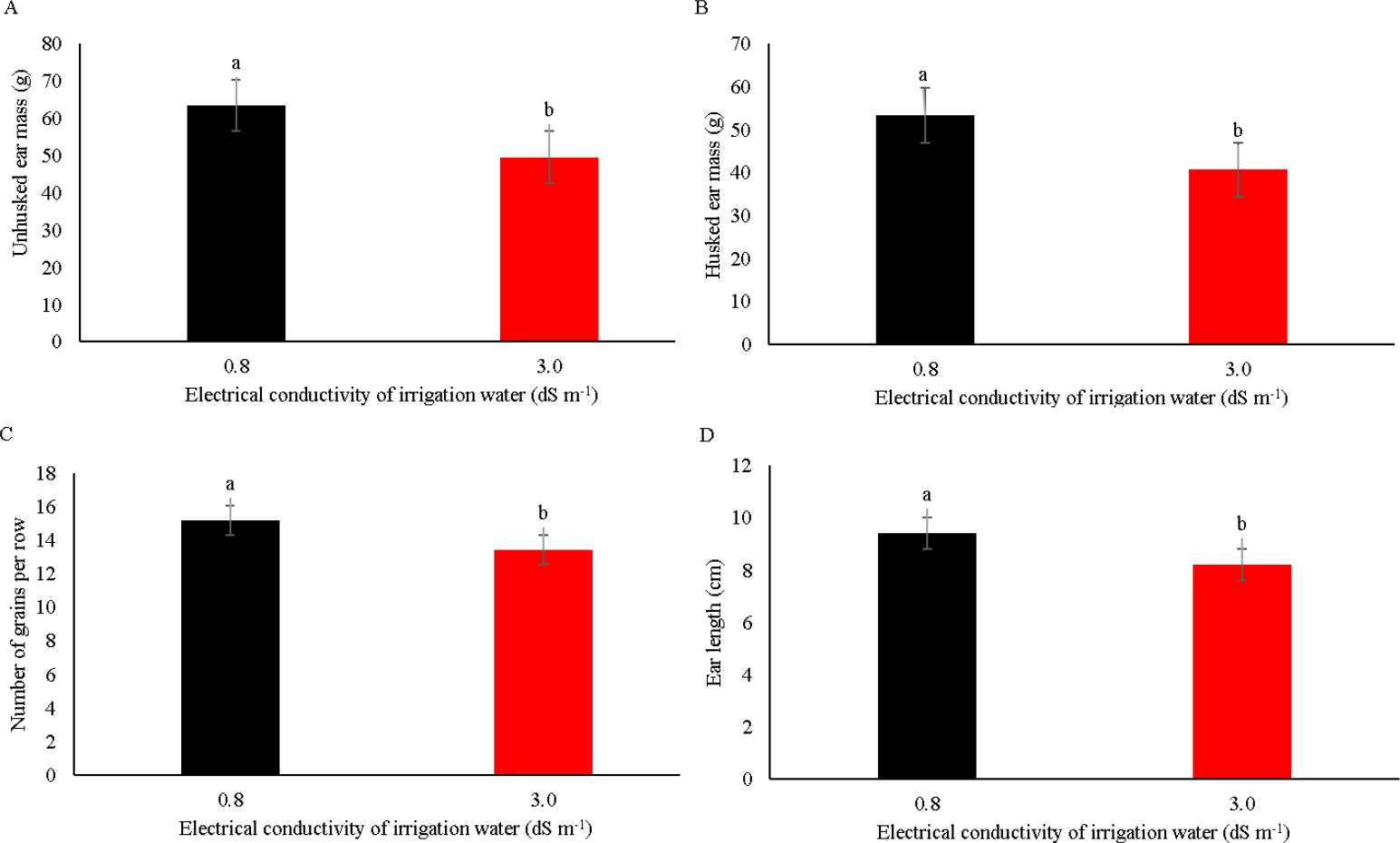
Figure 2A shows that the water with the highest salinity (3.0 dS m-1) caused a 16.66% reduction in unhusked ear mass compared to the water with the lowest salinity (0.8 dS m-1). This effect may be related to a reduction in osmotic potential, lower absorption of water and nutrients and, consequently, lower gain in ear mass (SOUSA et al., 2023). Similar trends were found by Rodrigues et al. (2020), who reported that unhusked ear mass was higher when plants were irrigated with lower-salinity water. Under salt stress, Goes et al. (2021) also detected a reduction in the dry mass of unhusked maize ear.

Unhusked ear mass (A), husked ear mass (B), number of grains per row (C) and ear length (D) as a function of the electrical conductivity of irrigation water. Means followed by different lowercase letters indicate significant differences according to Tukey test (p ≤ 0.05). Vertical bars represent the standard error of the mean (n = 8).
The treatment irrigated with lower-salinity water had higher mean values compared to the one under salt stress, which showed a reduction of 16% for husked ear mass (Figure 2B). This result reflects the negative effect of salt stress on water flow to plants, on the translocation of photoassimilates and, consequently, on ear formation during the crop cycle. Corroborating the results of the present study, Sousa et al. (2022) observed losses in husked ear mass for maize plants subjected to water salinity. When studying the maize crop under field conditions and irrigated with brackish water, Goes et al. (2021) also found a reduction in HEM.
The use of higher-salinity water also reduced the number of grains per row by 19.35% compared to the control treatment (Figure 2C). It should be noted that salt stress applied during the reproductive stage can reduce the translocation of photoassimilates for grain filling (IQBAL et al., 2020). Similarly, salt stress can cause a reduction in the number of grains (JUNG; HÜTSCH; SCHUBERT, 2017).
Irrigation water with higher salinity (3.0 dS m-1) negatively affected ear length, resulting in a lower mean (8.2 cm) and a 15% reduction compared to the control treatment (9.4 cm) (Figure 2D). Salinity inhibits plant performance due to osmotic and toxic effects, affecting the absorption of essential nutrients and, consequently, reducing production components (SOUSA et al., 2023).
When working under field conditions, Goes et al. (2023) also found a reduction in ear length with the increase in irrigation water salinity. Additionally, Souza et al. (2025) studied the maize crop under the same edaphoclimatic conditions as the present study and observed a reduction in ear length under electrical conductivity of water of 3.0 dS m-1.
Regarding the suppression intervals, the data presented in Figure 3A reveal reductions of 37.69%, 37.5% and 39.68% for the SI10, SI15 and SI20 intervals, respectively, compared to the control treatment (no irrigation suppression interval), which was statistically superior. It should be noted that water stress applied to treatments in the reproductive stage can result in floral inhibition, leading to embryo abortion and reduction in the number of grains in the ear, reducing its mass, according to data presented by Sah et al. (2020). When evaluating the performance of maize under water stress, Fernandes et al. (2022) found a reduction in ear mass caused by the low availability of water to the plants.
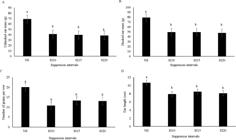
Unhusked ear mass (A), husked ear mass (B), number of grains per row (C) and ear length (D) as a function of suppression intervals (NS = no suppression intervals; SI10 = suppression intervals from 40 to 55 DAS (V10 to V14); SI15 = suppression intervals from 50 to 65 DAS (R1); and SI20 = suppression intervals from 65 to 80 DAS (R2 to R4). Means followed by different lowercase letters indicate significant differences according to Tukey test (p ≤ 0.05). Vertical bars represent the standard error of the mean (n = 8).
Water stress also reduced HEM (Figure 3B) by 40%, 42.65% and 44.43% under the SI10, SI15 and SI20 intervals, respectively, compared to the control treatment (no irrigation suppression interval). It is worth mentioning that the reduction of water stress in the various stages of maize development reduces ear mass and grain yield (SONG; JIN; HE, 2019). Similarly, Fernandes et al. (2022) found a reduction in husked ear mass caused by water stress.
Figure 3C shows reductions in the number of grains per row of 46.18%, 33.63% and 34.72% for the SI10, SI15 and SI20 intervals, respectively, compared to the control treatment (no irrigation suppression interval). This result may be associated with the lower distribution of photoassimilates in reproductive organs and, consequently, in the number of grains (SANTOS et al., 2021). Similarly, Nogueira et al. (2026) worked with the maize crop under continuous deficit irrigation (50% ETc throughout the crop cycle) and also found a lower number of grains per row.
Suppression interval NS was statistically superior to the other treatments, which obtained reductions of 26.09, 24.48 and 24.22% in ear length under the SI10, SI15 and SI20 intervals, respectively (Figure 3D). Water stress interrupts photosynthetic pigments and reduces gas exchange, impairing plant water relations and decreasing water use efficiency, leading to a decrease in yield and affecting ear quality, making the ear smaller, which results in reduced grain yield (RAJASEKAR; HUSSAINY; KARTHIK, 2020). Similarly, Sah et al. (2020) also reported a reduction in ear length in maize under water stress conditions.
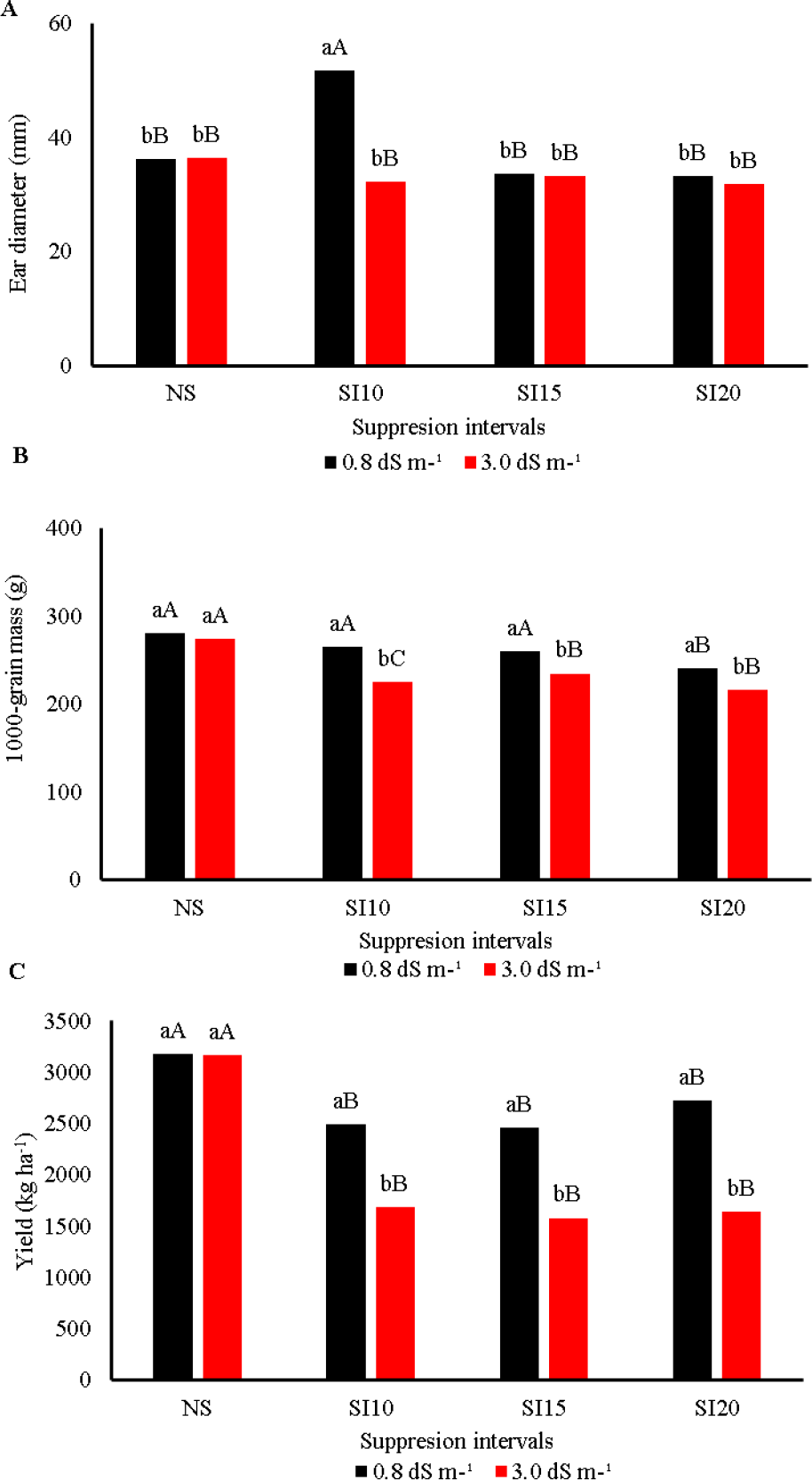
The treatment with no suppression (NS) and the suppression intervals SI15 and SI20 did not differ statistically from each other under irrigation water with lower (0.8 dS m-1) and higher (3.0 dS m-1) salinity for ear diameter (Figure 4A). However, in the SI10 treatment, the water with lower salinity was statistically superior to water with higher salinity. This result shows that, in this phenological stage, the combined stresses (salt and water) severely affect the absorption of water and nutrients, affecting growth, physiological processes and consequently yield aspects of the crop (SOUSA et al., 2023).

Ear diameter (A), 1000-grain mass (B) and yield (C) as a function of the electrical conductivity of water and suppression intervals. Equal uppercase letters comparing the mean values of electrical conductivity of water at each irrigation suppression intervals and equal lowercase letters comparing the mean values of the different irrigation suppression intervals at the same level of electrical conductivity do not differ statistically from each other by Tukey test (p ≤ 0.05). Vertical bars represent the standard error of the mean (n = 4).
Corroborating this study, Goes et al. (2023) found a negative effect on maize ear diameter with the increase in the electrical conductivity of water. A similar response was reported by Sousa et al. (2023), who found lower ear diameter compared to the control treatment when irrigating the maize crop with brackish water under field conditions.
Considering the effect of the irrigation suppression intervals (Figure 4A), the SI10 treatment was statistically superior to the others when associated with lower-salinity water, while for the salt stress treatment, there was no statistical difference between the suppression intervals studied. This result is similar to that reported by Kang et al. (2017), who found that water restriction at this stage compromised vegetative growth, physiological functions and consequently ear diameter. Similar results were described by Nogueira et al. (2026) in a study with maize irrigated with 50% crop evapotranspiration.
For 1000-grain mass (Figure 4B), the statistical analysis showed that the results were not significantly affected by the suppression intervals when the crop was subjected to the lowest salinity (0.8 dS m-1). On the other hand, there was a reduction in 1000-grain mass when the plants were subjected to treatments with combined water and salt stresses. Corroborating the results of the present study, Rodrigues et al. (2020) observed in their study that the increase in irrigation water salinity caused a reduction in 1000-grain mass.
For the effect of the suppression intervals with lower-salinity water, the treatments NS, SI10 and SI15 were statistically superior to SI20, while with the use of higher-salinity water, NS was statistically superior to the others for 1000-grain mass (Figure 4B), revealing a negative effect of water restriction in this period studied, directly affecting grain performance. Corroborating the data presented in this study, Djadjo et al. (2025) investigated the maize hybrid ‘Pioneer 30F53’ irrigated without water deficit during the crop cycle and recorded similar data for 1000-grain mass.
Figure 4C shows that there was no significant difference between the irrigation waters in the treatment with no suppression, but lower-salinity water was superior to higher-salinity water in the SI10, SI15 and SI20 treatments. It is worth noting that water stress combined with salt stress can intensify the reduction of nutrients and consequently lead to lower distribution of photoassimilates to the grains, which act as a sink. Sousa et al. (2023) used brackish water in the reproductive stage of the maize crop and observed a reduction in yield, which is similar to the present study. Likewise, Goes et al. (2023) recorded lower yield performance when cultivating maize irrigated with brackish water throughout the cycle.
For the effect of the suppression intervals considering each type of irrigation water, the NS treatment showed higher yield and was statistically superior to the others (Figure 4C). This result shows that water deficit during the reproductive stage severely compromises the yield performance of maize. Corroborating the data presented in this study, Souza et al. (2025) found a reduction in yield when using a 50% ETc irrigation depth in the irrigation of maize crop.
CONCLUSIONS
Higher-salinity water negatively affects unhusked and husked ear mass, number of grains per row and ear length.
Suppression intervals SI10, SI15 and SI20 caused negative effects on unhusked and husked ear mass, number of grains per row and ear length.
Suppression interval SI10 combined with lower-salinity water was more efficient for ear diameter.
Salt stress and suppression intervals SI10, SI15 and SI20 associated with higher-salinity water negatively affected maize performance in terms of 1000-grain mass and yield.
ACKNOWLEDGMENTS
To the National Council for Scientific and Technological Development (CNPq) and the Ceará Foundation for Support to Scientific and Technological Development (FUNCAP).
Data Availability:
The data that support the findings of this study can be made available, upon reasonable request, from the corresponding author.
REFERENCES
- ALVARES, C. A. et al. Köppen’s climate classification map for Brazil. Meteorologische Zeitschrift, 22: 711-728, 2013.
- AYERS, R. S.; WESTCOT, D. W. A qualidade da água na agricultura Campina Grande, PB: UFPB. Tradução de GHEYI, H. R.; MEDEIROS, J. F.; DAMASCENO, F. A. V., 1999. 153 p. (Estudos FAO: Irrigação e Drenagem, 29 Revisado).
- BOX, G. E. P.; COX, D. R. An analysis of transformations. Journal of the Royal Statistical Society: Series B (Methodological), 26: 211-252, 1964.
- CAVALCANTE, E. S. et al. Supplemental irrigation with brackish water improves carbon assimilation and water use efficiency in maize under tropical dryland conditions. Agriculture, 12: 1-15, 2022.
-
CONAB - Companhia Nacional de Abastecimento. Acompanhamento de safra brasileira de grãos: abril de 2026. Available at:< http://www.conab.gov.br>. Access on: Apr. 27, 2026.
» http://www.conab.gov.br - DJADJO, C. L. et al. Desempenho produtivo de diferentes híbridos de milho na região da Depressão Central - RS. Revista Observatorio de la Economía Latinoamericana, 23: 1-16, 2025.
- FERNANDES, C. N. D. et al. Irrigation depth and silicate fertilisation in green maize. Revista Ciência Agronômica, 53: e20207517, 2022.
- FERNANDES, V. L. B. Recomendações de adubação e calagem para o estado do Ceará Fortaleza, CE: UFC, 1993. 248 p.
- GOES, G. F. et al. Saline stress in maize grown in soil under different mulches. Revista Brasileira de Ciências Agrárias, 18: e3126, 2023.
- GOES, G. F. et al. Uso de cobertura morta e água salina na produtividade da cultura do milho. Irriga, 1: 730-738, 2021.
- IQBAL, S. et al. The response of maize physiology under salinity stress and its coping strategies. Plant Stress Physiology, 22: e602, 2020.
- JUNG, S.; HÜTSCH, B. W.; SCHUBERT, S. Salt stress reduces kernel number of corn by inhibiting plasma membrane H+-ATPase activity. Plant Physiology and Biochemistry, 113: 198-207, 2017.
- KANG, S. et al. Improving agricultural ware productivity to ensure food security in China under changing environment: From research to practice. Agricultural Water Management, 179: 5-17, 2017.
- NOGUEIRA, D. B. et al. Integrating deficit irrigation and bacterial inoculation to mitigate water stress and enhance maize productivity in semiarid regions. Plants, 15: 1-25, 2026.
- RAJASEKAR, M.; HUSSAINY, S. A.; KARTHIK, A. Effect of moisture deficit conditions on the performance of maize (Zea mays): A review. International Journal of Chemical Studies, 8: 2603-2609, 2020.
- RHOADES, J. D.et al. Uso de águas salinas para produção agrícola Campina Grande, PB: UFPB. 2000, 117 p.
- RODRIGUES, V. D. S. et al. Yield of maize crop irrigated with saline waters. Revista Brasileira de Engenharia Agrícola e Ambiental, 24: 101-105, 2020.
- SAH, R. P. et al. Impact of water deficit stress in maize: Phenology and yield components. Scientific Reports, 10: e2944, 2020.
- SANTOS, H. G. et al. Sistema brasileiro de classificação de solos 5.ed. Brasília, DF: Embrapa Informação Tecnológica, 2018. 355 p.
- SANTOS, T. T. et al. Discrimination of responses of corn genotypes to drought through physiological, growth, and yield traits. Pesquisa Agropecuária Brasileira, 56: e01948, 2021.
- SELEIMAN, M. F. et al. Drought stress impacts on plants and different approaches to alleviate its adverse effects. Plants, 10: 1-25, 2021.
- SILVA, F. A. S.; AZEVEDO, C. A. V. The Assistat Software Version 7.7 and its use in the analysis of experimental data. Africa Journal and Agriculture Research, 11: 3733-3740, 2016.
- SILVEIRA, E. S. et al. Caracterização de diferentes classes genéticas de milho cultivados em região semiárida quanto ao potencial forrageiro. Matéria, 26: e13102, 2021.
- SONG, L.; JIN, J.; HE, J. Effects of severe water stress on maize growth processes in the field. Sustainability, 11: e5086, 2019.
- SOUSA, G. G. et al. Emergency, initial growth and biomass of peanut genotypes irrigated with brackish waters. Water Resources and Irrigation Management, 13: 110-119, 2024.
- SOUSA, G. G. et al. Saline water and nitrogen fertilization on leaf composition and yield of corn. Revista Caatinga, 35: 191-198, 2022.
- SOUSA, H. C. et al. Bacillus aryabhattai Mitigates the Effects of Salt and Water Stress on the Agronomic Performance of Maize Under an Agroecological System. Agriculture, 13: e1150, 2023.
- SOUZA, L. S. B. et al. Requerimento hídrico e coeficiente de cultura do milho e feijão-caupi em sistemas exclusivo e consorciado. Revista Caatinga, 28: 151-160, 2015.
- SOUZA, M. V. P. et al. Cattle manure fertilizer and biostimulant Trichoderma application to mitigate salinity stress in green maize under an agroecological system in the Brazilian semiarid region. Plants, 14: 1-22, 2025.
- ZHANG, Y. et al. Optimizing drip irrigation with alternate use of fresh and brackish waters by analyzing salt stress: The experimental and simulation approaches. Soil and Tillage Research, 219: 105355, 2022.
Edited by
-
Section Editor:
João Everthon da Silva Ribeiro
-
Editor in Chief:
Aurélio Paes Barros Júnior