Meu Amigo Diggo: A tool to stimulate reading and spelling skills in students with learning disabilities
ABSTRACT
Purpose: to present an application developed for mobile devices, called ‘Meu Amigo Diggo’, to support intervention in reading and spelling skills in students with learning disorders, especially dyslexia.
Methods: the development of an application for the Android operating system provides two specific activities, referred to as ‘Words with Diggo’ and ‘Labyrinth of Letters’, in addition to a reading activity associated with the Cloze technique and Aesop’s fables.
Results: in its implementation, the technological resource of the mascot 'Diggo' facilitates the user's relationship with the application, and the Aesop's fables for reading activities, in addition to being short stories, present important lessons of values and morals.
Conclusion: this application proposes gamified challenges that stimulate reading and spelling skills through a set of activities planned in an intuitive and captivating interface.
Keywords:
Reading; Dyslexia; Technology
RESUMO
Objetivo: apresentar um aplicativo desenvolvido para dispositivos móveis, denominado Meu Amigo Diggo, como apoio à intervenção nas habilidades de leitura e ortografia em escolares com transtornos de aprendizagem, em especial a dislexia.
Métodos: trata-se do desenvolvimento de um aplicativo para o sistema operacional Android que disponibiliza duas atividades específicas: ‘Palavras com o Diggo’ e ‘Labirinto de Letras’, além de uma atividade de leitura associada à técnica de Cloze e fábulas de Esopo.
Resultados: em sua implementação, o recurso tecnológico da mascote ‘Diggo’ facilita a relação do usuário com a aplicação, e as fábulas de Esopo para as atividades de leitura, além de serem histórias curtas, apresentam importantes lições de valores e morais.
Conclusão: este aplicativo propõe desafios gamificados que estimulam habilidades de leitura e ortografia por meio de um conjunto de atividades planejadas em uma interface intuitiva e cativante.
Descritores:
Leitura; Dislexia; Tecnologia
INTRODUCTION
Reading and writing are fundamental for the acquisition of knowledge and exchange of experiences that allow access to a multitude of ideas and offer opportunities for the individual to participate, more actively, in the social context in which they are inserted1. In the process of learning to read and write, students may experience temporary difficulties in keeping up with their peers2,3. On the other hand, this learning process may not be easy for all students, and they may follow a different trajectory, with more persistent academic difficulties. These difficulties in school learning may be symptoms of specific learning disorders, such as dyslexia2.
A key feature of specific learning disorders is persistent difficulties in learning fundamental academic skills. Basic academic skills include accurate and fluent reading of single words, reading comprehension, written expression and spelling, arithmetic calculations, and mathematical reasoning3. Specific learning disorders modify the expected pattern of learning academic skills; they are not simply a consequence of a lack of learning opportunities or inadequate school education3,4.
Specific learning disorder with reading impairment (dyslexia) is characterized by reading words inaccurately or slowly, requiring a lot of effort; difficulty in understanding the meaning of what is read, although it is possible to read accurately, but without understanding the sequence, relationships, inferences or deeper meanings of what is read.
Schoolchildren with dyslexia frequently present the co-occurrence of persistent spelling difficulties2,4, as the deficits in phonographemic conversion observed in dyslexia interfere with spelling learning.
Regarding the manifestations observed in specific learning disorder with writing impairment (dysorthography), difficulties in writing orthographically are observed, making errors by adding, omitting or substituting vowels and consonants; difficulties with written expression, presenting multiple grammatical or punctuation errors in sentences, inadequate organization of paragraphs and written expression of ideas without clarity. However, these characteristics must have persistent difficulty for at least six months, without response to targeted intervention4.
The main diagnostic criterion for specific learning disorder with reading impairment is the lack of response to intervention (RTI - Response to Intervention)3-5 and, in this context, the use of interventions based on scientific evidence in a sequential, successive manner and with different intensities of strategies, in a system for monitoring the student's progress, would be indicated to determine this lack of response to intervention4.
Research addresses the benefits of information technologies to promote better reading and writing skills in dyslexics6-10. Although dyslexia is a neurodevelopmental condition - i.e., it will accompany the individual throughout their life - the intervention proposals promote better teaching-learning conditions.
Mobile gaming interventions can be an effective and engaging way to support students with dyslexia8,11. Using the accessibility of mobile devices, these interventions can be easily integrated into everyday life. Mobile devices provide opportunities for targeted practice, reinforcement and skill development in areas such as phonemic awareness, reading comprehension, visuospatial processing and attention, combining the power of technology with evidence-based strategies11.
The exclusive use of traditional approaches to intervene in learning disorders, which prioritize the use of paper and pencil, tends to be less motivating when compared to multisensory approaches12-16. Information and Communication Technologies (ICT) allow students to be seen as protagonists in their learning, increasing their motivation and interest17. In this sense, this article aims to present an application developed for mobile devices, called ‘Meu Amigo Diggo’, as support for intervention in reading and spelling skills in students presented with learning disorders, especially dyslexia.
METHODS
As this study presents the development of an application, submission to the Research Ethics Committee was not necessary.
The application was developed for the Android operating system, with its first version for smartphones, using the libGDX framework and the Java programming language18. libGDX is a cross-platform game development framework based on OpenGL (ES) and written in the Java programming language. Its use is justified by the simplicity and speed in developing a project. The choice of the Android operating system is due to the fact that it is the most widely used operating system in the world today19.
The conception of the idea and the entire operation of the application described here did not rely on any existing technological tool, with the development team being comprised of a computer scientist, which is a speech therapist, a specialist in learning disorders, and an electrical engineer. Furthermore, the scientific support for the creation of the proposed activities is in line with recent research in the field of dyslexia and technology, as elucidated in the Discussion Section.
‘Meu Amigo Diggo’ offers two specific activities, one with letters, and the other with isolated words: ‘Words with Diggo’ and ‘Labyrinth of Letters’, respectively, in addition to a reading activity associated with the Cloze technique20 and six fables by Aesop21 (‘The Grasshopper and the Ant’, ‘The Lion and the Mouse’, ‘The Crow and the Fox’, ‘The Dog and the Shadow’, ‘The Bull and the Frog’ and ‘The Tortoise and the Hare’). The development of these activities was designed in a simple, intuitive and easy-to-understand way, in which the mascot ‘Diggo’ invites students to his ‘study room’.
The list ‘Dyslexic Sight Words’22,23 was used as a basis for creating the database of words for the activities of this application. Initially, ‘Words with Diggo’ and ‘Labyrinth of Letters’ are activities to work on reading and spelling words in isolation, before the student has access to the words in the fables.
The list ‘Dyslexic Sight Words’ consists of 60 words that are often misspelled by students with dyslexia. No compound words were used, nor words that could become ambiguous if a letter were removed, such as the word ‘gente’. In this case, the omission of the first letter could lead to other choices, such as: ‘dente’, ‘pente’, ‘mente’, ‘lente’, ‘tente’. The font used for the words written in the game was Arial, with a larger spacing than the standard used in libGDX (0 pixels), being 10 pixels between letters, for better recognition of words by students with dyslexia24.
Aesop's Fables, now in the public domain, are a collection of short, timeless stories attributed to the Greek fabulist Aesop, who lived around the 6th century B.C. These fables feature animals as characters who act and speak like human beings, conveying moral lessons and universal teachings25. The choice of fables in this application was made because they are known for their simplicity, as the fable usually presents a challenging situation or a moral dilemma, with the animal characters representing different human characteristics26. In the context of the application, the use of Aesop's fables provides an interesting experience for schoolchildren, as they are exposed to important moral lessons and values.
Associated with the fables, the Cloze ‘test’20 was used, which is a resource widely used in the assessment of reading comprehension25,26. It is also possible to use it as a ‘technique’ in interventions with the aim of stimulating reading comprehension and related skills and, in this context, it is qualified as a ‘Cloze technique’26 which uses texts with gaps that must be filled in by the reader with words that fit the text, giving meaning to the textual material25,26.
RESULTS
When starting the ‘Meu Amigo Diggo’ application, the user is greeted by a welcome message superimposed on the home screen, as can be seen in Figure 1. The screen consists of a study room with a bookshelf, a computer and the mascot Diggo. The user can interact with the mascot, making it move around the screen. The application’s ‘activities’ action button is on the left side of the screen and the fables’ access button is on the right side, as shown in Figure 2. The user can select the activity they wish to start. However, when the application is used by a professional, the suggestion is to start with the word activities before accessing the fables.


By clicking on the computer that displays the word ‘activities’, the user has access to the activities screen (Figure 3). The user can access the set of activities by clicking on the arrows positioned on the left and right sides of the screen. By clicking on one of the arrows, the activity displayed in the center of the screen changes; by clicking on the selected activity, the user will start the activity. Two activities are available: ‘Words with Diggo’ and ‘Labyrinth of Letters’.

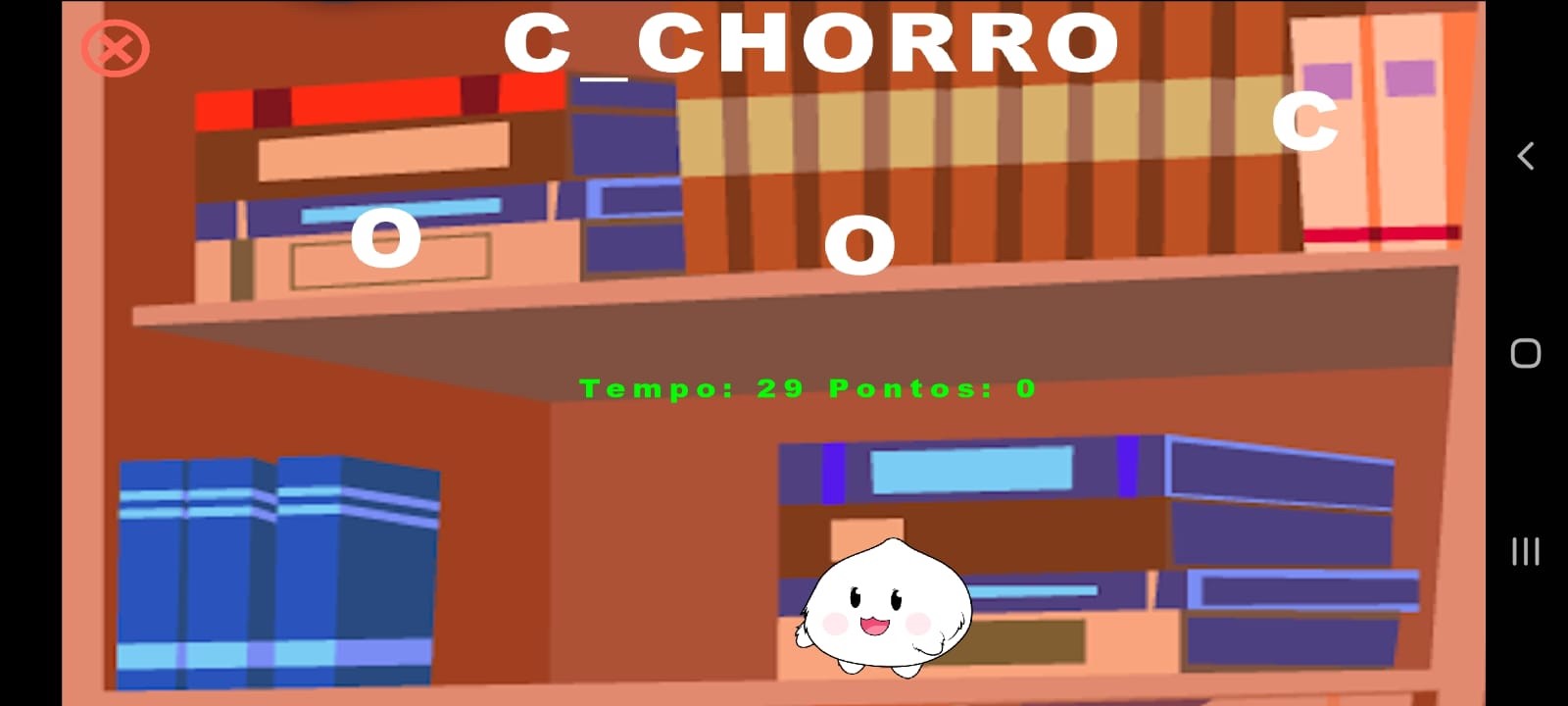
The activities have initial messages that explain how they work, as can be seen in Figure 4. In the first activity, the user will collect letters in a certain period of time (Figure 5). At the top of the activity screen, an incomplete word appears (only one letter missing). The word to be completed is ‘CACHORRO’ (which means dog), ‘A’ being the missing letter. To get the corresponding letter, the user must avoid the other letters that are moving down the screen. The user starts with no points and for each correct letter obtained, one hundred points and five seconds are added to the countdown. The letters of the word at the top of the screen descend randomly. If the countdown reaches zero, the activity ends and the user's final score is displayed.


The second activity is a maze, visible in Figure 6, in which the user must guide the mascot Diggo to the end of the path, following the letters present in the labyrinth as clues. The letters indicate the correct order of a word to reach the solution. The ‘hint letters’ in the correct order form the word ‘ALMOÇO’ (which means lunch). By following the letters in the correct order, the user finds the path through the labyrinth. Upon reaching the correct path, the user is greeted on the screen in Figure 7, where they can choose to exit the activity or play again using the “Back” and “Play Again” buttons. On the left side of the screen, the game's mascot is displayed, while on the right side there is a 'congratulations' message, the aforementioned buttons and three decorative stars. Fireworks are displayed on the screen as part of the celebration.


When accessing the ‘fables’ button on the bookshelf, it is possible to see a fable already selected in the center of the screen and two arrows, one on the left of the screen and the other on the right (Figure 8).

The user can view the available fables by clicking on the arrows at the ends of the screen. It is possible to see star shapes above the selected fable, indicating that the activity for that fable has not been completed.
When selecting a fable, the user is directed to the reading screen, as can be seen in Figure 9. On the left page of the book, there is a fragment of the fable with missing words, which were chosen randomly. On the right side of the screen, there are four buttons with words on them. The user presses the buttons corresponding to the words that are missing in the fable fragment on the left side of the screen. If the user selects an incorrect word, the button will turn red, while if the user selects a correct word, the button will turn green. When all the correct options are selected, the user advances to the next page by clicking on the arrow on the far right of the screen (Figure 10) until they reach the end of the fable, when they will be greeted by the congratulations screen. At this point a score is displayed, as shown in Figure 11. The vertical blue lines in the image are fireworks that explode at points on the screen (Figure 11).


It is important to note that the score starts at one hundred and for each incorrect word selected, twenty points are deducted. The minimum score is thirty points. If the user obtains at least eighty points, fireworks are displayed on the screen as a form of celebration. If one scores less than eighty points, fireworks will not be displayed, but one will still receive ‘congratulations’ for completing the activity. Stars will be displayed next to your score. The number of stars depends on the user's score. If the user gets a score lower than fifty, they will receive one star, if they get a score greater than or equal to fifty and less than eighty, they will receive two stars, and if they get a score greater than or equal to eighty, they will receive three stars. The number of stars obtained is saved and displayed on the fable selection screen above the fable icon (Figure 12). If the user obtains more stars than he had previously in the same fable, the number of stars is updated. The stars inform whether the fable has already been accessed and the user's performance in the best attempt, i.e., the best performance will be saved and if the user wants to redo the activity with the fable and obtains a worse performance, the best performance will not be replaced.

DISCUSSION
In educational practice, the use of technological devices by students with dyslexia is a useful tool and facilitates learning8,27,28. The use of technology brings positive changes to the learning of these students, as it can offer additional resources, such as font and color adjustment, voice recognition, visual cues and animations, letter recognition, among others27,28. It is important to know the profile of students so that technological support can provide better learning opportunities by applying strategies specific to their needs29.
Applications that enable educational intervention for students with specific learning difficulties improve the quality of education6,10,30, allowing greater opportunities for inclusion. The strategies used in the teaching-learning process need to be planned at different levels, so that students with dyslexia can achieve their goals in the best possible way7. When work is effectively differentiated, students enjoy learning9. Incorporating technology-mediated activities for students with learning disabilities increases multisensory experiences, which significantly favor language learning11,13.
In general, the use of applications in the intervention and teaching of students with dyslexia offers advantages when compared to traditional methodologies30: learning is not specifically limited to the context of the intervention or classroom; applications can have an important playful component, integrating typical game dynamics and rewards to achieve learning objectives based on gamification and this allows the user to learn while playing; it seeks to actively maintain the user30 and the versatility of technological applications that makes activities adaptable to different contexts27, favoring greater engagement on the part of those learning14.
Reading is a complex process, and students with learning disabilities, such as dyslexia, are among those who struggle the most to adapt to this process in the school environment31. Researchers have developed applications for children, aimed at intervening in the reading area of schoolchildren with dyslexia32-34.
The ‘Leiturando’32 application followed the model of boards used in the RAN test, composed of a bank of words extracted from a Brazilian study35 which investigated words frequently written incorrectly by students with dyslexia. In this application, three levels of difficulty were defined according to the complexity of the number of syllables in the words. In its functionality, the words are displayed randomly on a board with which the user interacts by reading. Using the voice recognition tool, the application determines the number of words read correctly by the user, as well as the time spent by the user in the voiceover.
‘LiteracyPlanet’33, which is a technological tool designed to stimulate reading skills in children, in general, was used for intervention and monitoring of the progress of learning ‘sight words’ in students with low reading performance. ‘LiteracyPlanet’ comprises activities that encourage learning of irregular words that make up the ‘sight words’ lists, such as: spelling, recognition of letters of the alphabet, recognition of words read, in addition to the module for reading short stories. The Mr. Read V2.034 application, in turn, was also created with the aim of stimulating reading skills for students with dyslexia through activities with short stories, activities with rhymes, musical verses and games that use word lists.
Often, students with dyslexia have low expectations regarding their academic opportunities36. In line with advances in specialized literature, the activities proposed in this application sought to meet the needs of students with learning disorders, but which can be expanded in the context of education, since the use of technological tools generates greater motivation and interactivity in the teaching-learning relationship, enabling the combination of different multimedia elements (audio, image and text)36-39.
CONCLUSION
This article presents an application for mobile devices called ‘Meu Amigo Diggo’, which targets students with learning difficulties, especially dyslexia. Through a set of planned activities, the application proposes gamified challenges that stimulate reading and spelling skills. The technological resource of the mascot that facilitates the user's relationship with the application stands out in its implementation, and the reading activity with fables, as they are short stories that present important lessons of values and morals.
As future work, a new stage of this study is intended to be developed, including evaluation by judges and the development of a pilot study with the target population; collecting feedback from users to improve the application; increasing the word bank in order to cover a greater number of words that are more challenging for students with learning disorders and add other fables.
REFERENCES
-
1 Puntel Basso F, Inchausti de Jou G, Alves Gonçalves H, Bassôa de Moraes A, Pallaoro Moojen SM, Fumagalli de Salles J. A produção textual escrita de adultos com dislexia de desenvolvimento. Revista Rev. Lat. Neurop [Journal on the internet]. 2017;9(2):19-32. Available at: https://www.redalyc.org/articulo.oa?id=439552509003
» https://www.redalyc.org/articulo.oa?id=439552509003 -
2 Chiaramonte TC, Capellini SA. Desempenho ortográfico de escolares com dislexia e dificuldades de aprendizagem. Rev Ibero-Am Estud E. 2022;17(1):314-27. https://doi.org/10.21723/riaee.v17i1.14610
» https://doi.org/10.21723/riaee.v17i1.14610 - 3 Capellini SA, Xavier IN, Scollo LB, Moura RFB, Marguti MP. Intervenção na dislexia do desenvolvimento segundo os tipos, os modelos e os níveis. In: Zuliani LM, editor. Fonoaudiologia, Aprendizagem e Educação. Ponta Grossa: Atena; 2022, p.18-28.
- 4 American Psychiatric Association. Diagnostic and statistical manual of mental disorders. Fifth Edition. Text Revision (DSM-5-TR); 2022.
-
5 Aurich MM, Peixoto CB, Amorim LS, Lopes-Silva JB. Subtipos de dislexia do desenvolvimento descritos no Português Brasileiro: uma revisão integrativa. Psico-USF. 2023,28(4):711-26. https://doi.org/10.1590/1413-82712023280405
» https://doi.org/10.1590/1413-82712023280405 -
6 Lyzenko L, Abrami P. Promoting reading comprehension with the use of technology. Comput Educ. 2014;75(1):162-72. https://doi.org/10.1016/j.compedu.2014.01.010
» https://doi.org/10.1016/j.compedu.2014.01.010 -
7 Zikl P, Bartosova I, Viskova K, Havlickova K, Kucirkova A, Navrátilova J et al. The possibilities of ICT use for compensation of difficulties with reading in pupils with dyslexia. Procedia Soc. Behav. Sci. 2015;176(1):915-22. https://doi.org/10.1016/j.sbspro.2015.01.558
» https://doi.org/10.1016/j.sbspro.2015.01.558 -
8 Cidrim L, Madeiro F. Information and communication technologies (ICT) applied to dyslexia: Literature review. Rev. CEFAC. 2017;19(1):99-108. https://doi.org/10.1590/1982-021620171917916
» https://doi.org/10.1590/1982-021620171917916 -
9 Ferraz M, Pedro KM. Tecnologias digitais na escolarização de estudantes com dislexia: uma revisão de literatura. Devir Educação. 2023;7(1):1-17. https://doi.org/10.30905/rde.v7i1.614
» https://doi.org/10.30905/rde.v7i1.614 -
10 Cidrim L, Braga P, Madeiro F. Desembaralhando: A mobile application for intervention in the problem of dyslexic children mirror writing. Rev. CEFAC. 2018;20(1):13-20. https://doi.org/10.1590/1982-0216201820111917
» https://doi.org/10.1590/1982-0216201820111917 -
11 Bertoni S, Franceschini S, Puccio G, Mancarella M, Gori S, Facoetti A. Action video games enhance attentional control and phonological decoding in children with developmental dyslexia. Brain Sci. 2021;11(2):11-8. https://doi.org/10.3390/brainsci11020171 PMID: 33572998.
» https://doi.org/10.3390/brainsci11020171 - 12 Birsh JR. Connecting research and practice. In: Birsh JR, editor. Multisensory teaching of basic language skills. Baltimore: Paul H. Brookes Publishing; 2011. p.1-24.
- 13 Broadhead M, Zad DD, Mackinnon L, Bacon L. A multisensory 3D environment as intervention to aid reading in dyslexia: A proposed framework. In Proceedings of the 10th International conference on virtual worlds and games for serious applications. Wuzburg: 2018. p. 1-4.
-
14 Cano SR, Alonso PS, Benito VD, Villaverde VA. Evaluation of motivational learning strategies for children with dyslexia: A FORDYSVAR proposal for education and sustainable innovation sustainability. Sustainability. 2021;13(5):2666. https://doi.org/10.3390/su13052666
» https://doi.org/10.3390/su13052666 -
15 Kalyvioti K, Mikropoulos TA. Virtual environments and dyslexia: Review of literaure. Procedia Comput. Sci. 2014;27:138-47. https://doi.org/10.1016/j.procs.2014.02.017
» https://doi.org/10.1016/j.procs.2014.02.017 -
16 Saputra MRU, Alfarozi SAI, Nugroho KA. LexiPal: Kinect-based application for dyslexia using multisensory approach and natural user interface. Int. J. Comput. Appl. Technol. 2018;57:334-42. https://doi.org/ 10.1504/IJCAT.2018.10014728
» https://doi.org/ 10.1504/IJCAT.2018.10014728 -
17 Sevillano García ML, Rodríguez Cortés R. Integración de tecnologías de la información y comunicación en educación infantil en Navarra (Spain). Pixel-Bit. Rev. Medios Educ. [Journal on the internet]. 2013;(42):75-87. Available at: https://www.redalyc.org/articulo.oa?id=36825582007
» https://www.redalyc.org/articulo.oa?id=36825582007 -
18 Badlogic games. Libgdx [Webpage on the internet]. Framework de desenvolvimento de jogos multiplataforma [acessed 2024 mar 2]. Available at: https://libgdx.com/
» https://libgdx.com/ -
19 Business of apps Android statistics [Webpage on the internet]. Dados estatísticos. [acessed 2024 mar 2]. Available at: https://www.businessofapps.com/data/android-statistics/
» https://www.businessofapps.com/data/android-statistics/ - 20 Taylor WL. "Cloze Procedure": A new tool for measuring readability. Journal. Q. 1953;30(4):415-33.
- 21 ESOPO. As Fábulas de Esopo (em texto bilíngue: grego-português). Tradução direta do grego, prefácio, introdução e notas de Manuel Aveleza de Sousa. Rio de Janeiro: Thex, 2002.
-
22 Cidrim L, Azevedo N, Madeiro F. Elaboração de uma lista de palavras no âmbito da ortografia para escolares com dislexia: 'Dyslexic Sight Words'. Rev. Psicopedagogia. 2021;38(115):5-17. https://doi.org/10.51207/2179-4057.20210001
» https://doi.org/10.51207/2179-4057.20210001 -
23 Cidrim L, Batista AO, Madeiro F, Capellini SA. Analysis of spelling errors from the 'dyslexic sight words' list. Front. Psychol. 2024;15(1160247). https://doi.org/10.3389/fpsyg.2024.1160247
» https://doi.org/10.3389/fpsyg.2024.1160247 -
24 Stagg SD, Kiss N. Room to read: The effect of extra-large letter spacing and coloured overlays on reading speed and accuracy in adolescents with dyslexia. Res. Dev. Disabil. 2021;119:104065. http://doi.org/10.1016/j.ridd.2021.104065 PMID: 34600780.
» http://doi.org/10.1016/j.ridd.2021.104065 -
25 Lima TH, Inácio ALM, Jesuíno ADSA, Santos AAA dos, Rueda FJM, Ferraz AS. O Cloze e o Bender (B-SPG) como propostas de instrumentos para avaliação psicoeducacional. Recital. 2024;5(3):92-104. https://doi.org/10.46636/recital.v5i3.471
» https://doi.org/10.46636/recital.v5i3.471 -
26 Ferraz AS, de Brito Cunha N, Santos AAA. Impact of writing skills on the fixed-ratio Cloze test scores. Rev. Iberoam. Psicol. 2021;14(3):47-55. https://doi.org/10.33881/2027-1786.rip.14305
» https://doi.org/10.33881/2027-1786.rip.14305 -
27 Jing CT, Chen CJ. A research review: How technology helps to improve the learning process of learners with dyslexia. JCSHD. 2017;2(2):26-43. https://doi.org/10.33736/jcshd.510.2017
» https://doi.org/10.33736/jcshd.510.2017 -
28 Ozbek AB. Use of technology in reading difficulty interventions. JESET. 2015;1(1):48-53. https://doi.org/10.18844/jeset.v1i1.3550
» https://doi.org/10.18844/jeset.v1i1.3550 -
29 Degirmenci N, Baglama B, Yucesoy Y. The use of technology in dyslexia: An analysis of recent trends. Int. J. Emerg. Technol. Learn. 2020;15(5):30-9. https://doi.org/10.3991/ijet.v15i05.11921
» https://doi.org/10.3991/ijet.v15i05.11921 -
30 Rodríguez-Cano S, Cuesta-Gómez JL, Delgado-Benito V, de la Fuente-Anuncibay R. Educational technology as a support tool for students with specific learning difficulties - Future education professionals' perspective. Sustainability. 2022;14(10):1-14. https://doi.org/10.3390/su14106177
» https://doi.org/10.3390/su14106177 -
31 Silva Junior D, Cidrim L, Roazzi A, Madeiro F. Digital version of the Rapid Automatized Naming (RAN): A contribution to early detection of reading problems in children. Rev. CEFAC. 2019;21(1):1-9. https://doi.org/10.1590/1982-0216/20192112518
» https://doi.org/10.1590/1982-0216/20192112518 - 32 Soares L, Cidrim L, Caiado R, Madeiro F. Um aplicativo para apoio à intervenção de escolares com dislexia baseado na lista 'Dyslexic Sight Words'. In: Ilharco F et al. Em português Falar, Viver e Pensar no século XXI. Lisboa: Universidade Católica Editora; 2022. p. 427-9.
-
33 Mcarthur G, Kohnen S, Jones K, Eve P, Banales E, Larsen L et al. Replicability of sight word training and phonics training in poor readers: A randomized controlled trial. Peer J. 2015; 3:222-1. https://doi.org/10.7717/peerj.922 PMID: 26019992.
» https://doi.org/10.7717/peerj.922 -
34 Borhan N, Shianag C, Chiu P, Sharbini H, Ping Ping T, Othman R et al. An enhancement of dyslexic mobile application using sight word reading strategy: Results and findings. J. Comput. Syst. Sci. 2018;14(7):919-29. https://doi.org/10.3844/jcssp.2018.919.929
» https://doi.org/10.3844/jcssp.2018.919.929 - 35 Meira LCCM. "Dyslexic Sight Words" (DSW) e intervenção fonoaudiológica em escolares com dislexia [thesis]. Recife (PE): Universidade Católica de Pernambuco; 2019.
-
36 Vouglanis T. The use of ICT in the education of students with dyslexia. GJETA. 2023;16(2):38-46. https://doi.org/10.30574/gjeta.2023.16.2.0131
» https://doi.org/10.30574/gjeta.2023.16.2.0131 -
37 Lorusso ML, Borasio F, Da Rold M, Martinuzzi A. Towards consensus on good practices for the use of new technologies for intervention and support in developmental dyslexia: A Delphi study conducted among Italian specialized professionals. Children. 2021;8(12):2-19. https://doi.org/10.3390/children8121126 PMID: 34943322.
» https://doi.org/10.3390/children8121126 -
38 Back GA, Lindeblad E, Elmqvist C, Svensson I. Dyslexic students' experiences in using assistive technology to support written language skills: A five-year follow-up. Disabil. Rehabil. Assist. Technol. 2023;19(4):1217-27. https://doi.org/10.1080/17483107.2022.2161647 PMID: 36641779.
» https://doi.org/10.1080/17483107.2022.2161647 -
39 Berner K, Alves AN. A scoping review of literature using speech recognition technologies by individuals with disabilities in multiple contexts. Disabil. Rehabil. Assist. Technol. 2021;18(7):1139-45. https://doi.org/10.1080/17483107.2021.1986583 PMID: 34670100
» https://doi.org/10.1080/17483107.2021.1986583