 Moderate doses of selenium alleviate the effects of salt stress on the growth of eucalyptus seedlings
ABSTRACT
Although selenium (Se) is not essential for plant metabolism, low Se concentrations can enhance tolerance to abiotic stress. This study evaluated the effects of exogenous Se (1, 5, and 25 μM) on two eucalyptus genotypes (VCC 865 and AEC 0144) under saline stress (100 mM NaCl). Growth, biomass, gas exchange, ion accumulation (K+, Na+, Ca2+), and pigment content were analyzed. Salinity significantly impaired physiological performance, reducing height, stem diameter, net photosynthesis (PN), transpiration (Tr), and stomatal conductance (gs), while increasing Na+ in roots and leaves. Se at 1 and 5 μM mitigated these effects, particularly by reducing Na+ accumulation. VCC 865 showed increased K+ in roots and decreased Na+ in shoots with 1 μM Se, while AEC 0144 displayed improved ionic balance in roots and leaves. The chlorophyll pigment content remained unchanged between the treatments. However, 25 μM Se intensified salinity damage, indicating the importance of dose optimization. Photosynthetic parameters were sensitive indicators of Se-mediated responses. Therefore, the targeted use of selenium represents a promising strategy to improve seedling establishment in environments affected by salinity, contributing to the development of more resilient forest systems and the expansion of areas suitable for production.
Keywords
sustainable forestry; salinity; gas exchange and growth
INTRODUCTION
The genus Eucalyptus L'Hér. (eucalyptus) has more than 800 species and is native to Australia and other islands, such as the Philippines, Indonesia, Timor-Leste and Papua New Guinea.(1) In Brazil, there are approximately 7.5 million hectares of planted eucalyptus forests(2) focused mainly on the production of wood, energy, paper and pulp.(3) Despite the scenario of productive growth, the expansion of new planting areas has been hampered by environmental restrictions caused by climate change. Thus, the possibility of expanding planted forests to traditional nonforested regions is among the greatest challenges for the growth of eucalyptus production.(4-5)
It is estimated that 20% of cultivated land and 33% of irrigated agricultural land are affected by high salinity and, if not enough, that salinized areas around the world increase every year because of factors such as low rainfall, high surface evapotranspiration, saltwater irrigation, inadequate cultural practices,(6) deforestation and sea level rise. (7)
Salt stress inhibits plant growth and development, mainly through decreased water potential (which compromises plant water absorption) and ionic toxicity (which causes ionic imbalance and hinders nutrient absorption).(8) Therefore, increasing the concentration of soluble salts in the soil has become a serious problem for agricultural productivity, and several techniques and methods have been employed in an attempt to control this problem and increase productivity.(9) These include (i) the adoption of appropriate agronomic strategies, as well as the accurate selection of species and cultivars more tolerant to salinity,(10) and (ii) the use/application of exogenous substances, such as silicon,(11) boron,(12) salicylic acid, and hydrogen peroxide,(13) to improve the mechanisms of stress tolerance, among others.
Although selenium (Se) is not yet recognized as an essential nutrient for plant metabolism,(14) its application at low concentrations can have beneficial effects on plants, especially under adverse environmental conditions.(15) Pigments, gas exchange, the photosynthetic rate, the accumulation of osmoprotectants and improvements in the antioxidant defense system improve tolerance to diverse environmental stresses, such as high temperatures, drought,(15) heavy metals(16) and salinity.(17) On the other hand, excess Se can promote reduced growth, chlorosis, wilting and drying of leaves, decreased protein synthesis, lesions and premature plant death.(18)
In view of the above, on the basis of the premise of the need for eucalyptus production expansion and the hypothesis that the application of Se at low concentrations is able to attenuate the effects of saline stress in plants, the objective of this study was to evaluate the effects of Se application on the physiological behavior (growth, biomass, saline ion concentration in plant tissues, gas exchange, and pigment content) of plants of two eucalyptus genotypes (VCC 865 and AEC 0144), grown under non-saline and saline conditions.
MATERIALS AND METHODS
Plant material and growing conditions
The experiment was conducted in the experimental area of the Botany Department of the Federal University of Espírito Santo, Brazil (20°16'29''S; 40°18'21''W, altitude 4 m). The seedlings used were acquired from the ClonaTech nursery (19°10'58''S; 40°5'32''W, altitude 57 m), which is located in Sooretama city, Espírito Santo State, Brazil. The acquired eucalyptus genotypes (cultivars) are widely used in large-scale plantations, namely, VCC 865 (Eucalyptus urograndis, a hybrid between Eucalyptus grandis W. Hill and Eucalyptus urophylla STblake), which is registered in MAPA under n° 22124/2007, and AEC 0144 (Eucalyptus urophylla STblake), which is registered at MAPA under No. 21874/2007.
During the acquisition stage, the seedlings were 90 days old and had an average height of 30 cm, four pairs of leaves, a uniform collar diameter and good nutritional and phytosanitary conditions. The seedlings were collected in tubes and transplanted into 12 L plastic pots measuring 30 cm × 25 cm × 22 cm (Nutriplan, model n° 06).
Before transplanting, the pots were painted white to reduce heat absorption. The substrate used to fill the pots was washed river sand previously sieved through a 5 mm mesh. Next, each pot received a layer of Styrofoam, and the upper portion was sealed with PVC plastic film to reduce direct water loss through evaporation. The drainage holes in the lower portion of the pot remained uncovered. Soon after transplanting, each pot received 2.8 L of Clark's nutrient mixture,(19) the amount of which was sufficient to reach the maximum retention capacity of the pot (Table 1). The plants were subjected to a period of adaptation to the nutrient solution with 50% and 100% ionic strength, remaining at each concentration for one week. The pH of the nutrient solution was adjusted to 5.5 using 0.1 M HCl or NaOH.
Experimental design
After 14 days of acclimation, the seedlings were subjected to different treatments for 60 days in a completely randomized design with the following treatments: control (0 μM Se and 0 mM NaCl), 1 Se (1 μM Se and 0 mM NaCl), 5 Se (5 μM Se and 0 mM NaCl), 25 Se (25 μM Se and 0 mM NaCl), S (0 μM Se and 100 mM NaCl), S + 1 Se (1 μM Se and 100 mM NaCl), S + 5 Se (5 μM Se and 100 mM NaCl) and S + 25 Se (25 μM Se and 100 mM NaCl). Each genotype was evaluated individually in relation to the treatments; that is, each genotype constituted an independent experiment. Each experiment included one genotype and eight treatments with four sampling units (n = 4), totaling 32 plants per experiment.
Se concentrations were established according to the methods of Jiang et al.,(17) and sodium selenite (Na2SeO3) was used as the selenium source because it is more efficient than sodium selenate (Na2SeO4) in attenuating the effects of salinity.(20) During the experiment, irrigation was performed daily, according to each treatment, in an amount sufficient to drain 10% of the maximum retention capacity of the pot, and every week, irrigation was performed until 40% of the maximum retention capacity was drained. of the vase. This procedure was performed according to Lacerda(21) and aimed to avoid the concentration of salts in the nutrient solution of the vessels. The salinity of the vessels was monitored via a conductivity meter (Digimed CD-20).
Growth measurements
Growth data were collected every 10 days from the beginning to the end of the experiment. The height was determined with a tape measure, which measures the length from the region of the plant neck, at the base of the stem, to the top of the apical bud. The values are expressed in centimeters (cm). The collar diameter (Dc) was determined with a digital calliper, and the values are expressed in millimeters (mm).
Biomass measurements
After 60 days, the plant material from each sampling unit was packed in kraft paper bags and placed in a forced circulation oven at 60 °C until a constant mass was reached. Next, the dry matter (DM) of each vegetative organ (root, stem, or leaf) was weighed separately on a precision scale. The total DM was determined as the sum of the individual masses, and the values were expressed in grams (g).
Concentrations of ions in plant tissues
At the end of the experiment (60 days), the plant tissue samples (n = 4) were placed in kraft paper bags and placed in a forced circulation oven at 60 °C until a constant mass was reached. The dried plant material was then weighed (0.5 g), crushed and subsequently used in the preparation of extracts obtained from nitroperchloric digestion. The K+, Ca2+ and Na+ contents were determined according to the methodology proposed by Malavolta et al.(22) The results are expressed in g kg-1.
Gas exchange measurements
Gas exchange was evaluated at the end of the experiment and determined with an infrared gas analyser (Infrared Gas Analyser - IRGA; LI-6400XT, LI - COR, Lincoln, USA). Measurements were taken between 7:00 am and 9:00 am on young, fully expanded leaves present in the middle third of each experimental unit (plant). The acclimatization chamber attached to the equipment was set up to supply fixed amounts of PAR (1000 μmol m-2 s-1; previously defined value through light curves), temperature (25 °C) and CO2 (380 μmol CO2 mol -1). The variables evaluated were the net photosynthesis rate (PN), transpiration rate (TR), stomatal conductance (gs) and internal CO2 concentration (Ci).
Pigment content
To determine the pigment contents, two leaf discs with a diameter of 0.5 cm were removed from each experimental unit and immersed in test tubes containing 7 ml of dimethyl sulfoxide (DSMO). Then, extraction was performed in a water bath at 65 °C for one hour. The aliquots were read in a spectrophotometer (Genesys 10S UV‒Vis, Thermo Fisher Scientific, Waltham, USA) at wavelengths of 480, 649, and 665 nm. The chlorophyll (Chl) and carotenoid (Car) contents were determined via the equations developed by Welburn(23) for DMSO, and the results are expressed in mg g-1 DM.
Statistical analysis
The normality and homogeneity of the data were tested via the Shapiro‒Wilk test and Leneve test, respectively. The data obtained were subjected to analysis of variance (ANOVA) and, when significant according to the F test, compared via the Duncan test (p < 0.05). Statistical analyses were performed via InfoStat software (FCA, Universidad Nacional de Córdoba, Argentina).
RESULTS
Changes in growth
Plant height was monitored throughout the 60-day experimental period and systematically measured to evaluate growth responses to Se application and saline conditions. At the end of the experiment, treatment-dependent differences in plant height were evident.
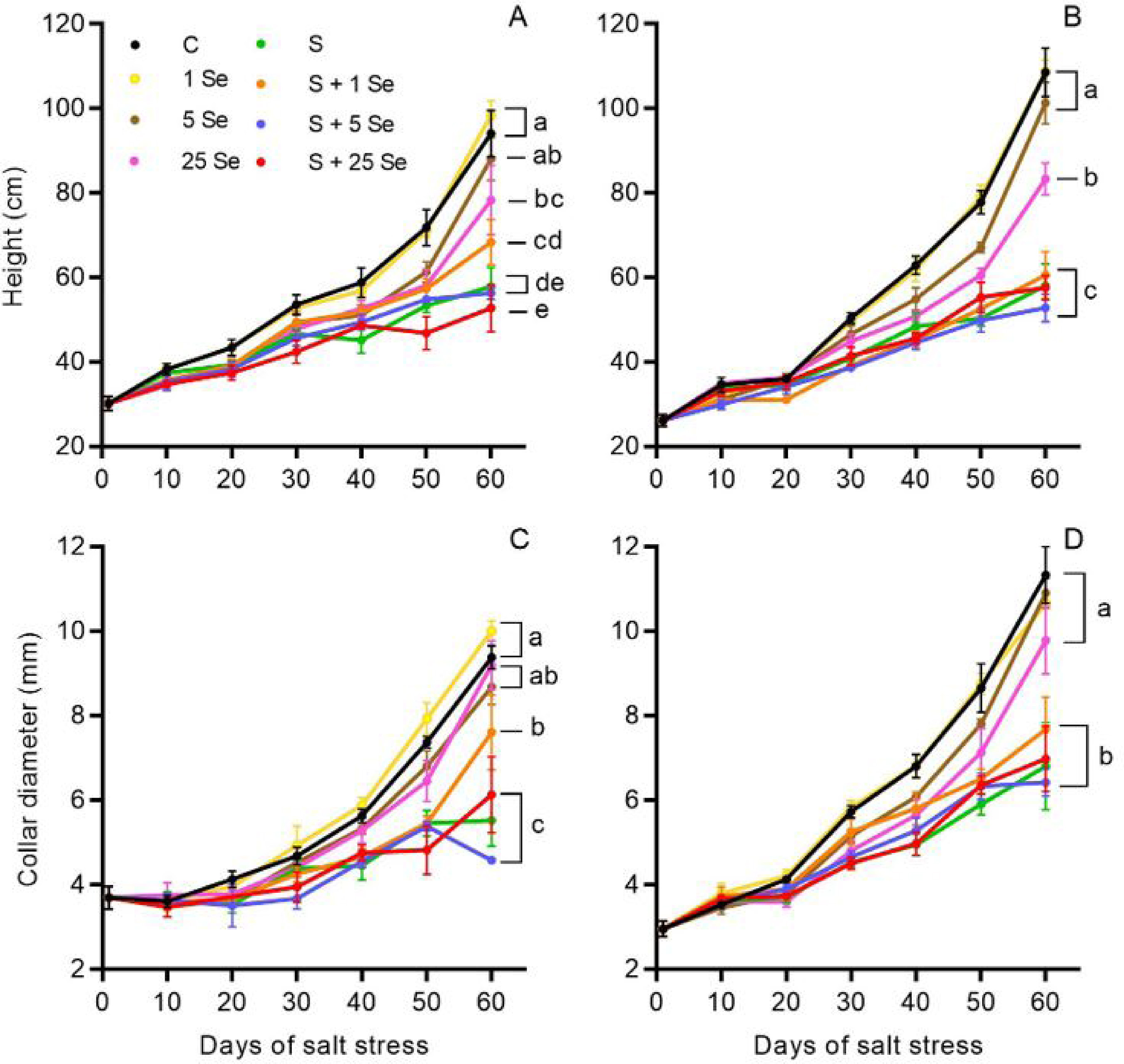
With respect to the height of the VCC 865 genotype, after 60 days, the heights of the control plants and those treated with only Se at the lowest concentrations (1 and 5 μM) were significantly greater than those of the plants treated with only Se at the highest concentration (25 μM) and those cultivated under saline conditions (with or without Se application). In this scenario, the application of different Se concentrations (1, 5, and 25 μM) did not attenuate the effects of salinity on height growth (Figure 1A). The same behavior was observed in plants of genotype AEC 0144 after 60 days of treatment (Figure 1B).
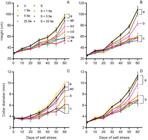
Effects of Se application on the height and collar diameter of plants of two eucalyptus genotypes, VCC 865 (A, C) and AEC 0144 (B, D), grown under non-saline and saline conditions. (S) for 60 days. The data are presented as the means (n = 4), and the bars represent the standard error of the mean. The means followed by the same letter did not differ statistically from each other according to Duncan's test (p < 0.05).
With respect to Dc, in the VCC 865 genotype, after 60 days, the control plants and those treated with only Se were significantly thicker than the plants grown under saline conditions (with or without Se application). However, the application of 1 μM Se to plants grown under saline conditions attenuated the effects of salinity and partially restored Dc (Figure 1C). After 60 days, in the AEC 0144 genotype, the control plants and those treated with only Se were significantly greater than those of the plants grown under saline conditions (with or without Se application), and none of the different Se concentrations (1, 5, and 25 μM) were able to attenuate the effects of salinity on Dc (Figure 1D).
Changes in biomass
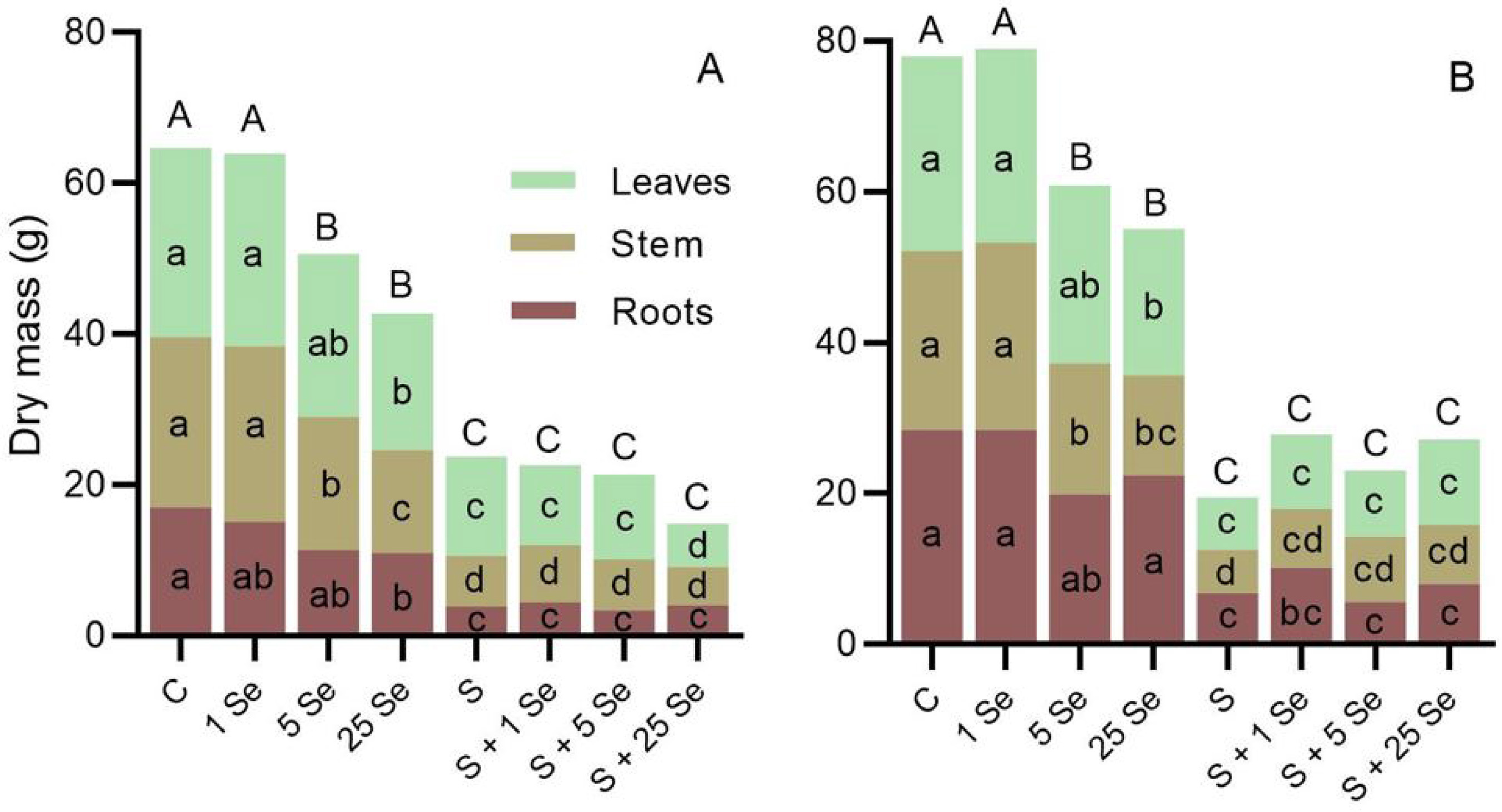
In the VCC 865 genotype, after 60 days, the control plants and those treated with only Se at the lowest concentration (1 μM) presented significantly greater total biomass than did the plants treated with only Se at concentrations of 5 and 25 μM and those cultivated under saline conditions (with or without Se application). In addition, the application of different Se concentrations (1, 5, and 25 μM) did not attenuate the effects of salinity on the accumulation of total biomass (Figure 2A). The same behavior was observed in plants of genotype AEC 0144 after 60 days of treatment (Figure 2B). In summary, under saline stress, the accumulation of biomass in the evaluated organs (roots, stems, and leaves) was significantly affected, and under these conditions, none of the Se concentrations (1, 5, and 25 μM) were able to attenuate the effects of salinity both in VCC 865 and in AEC 0144.
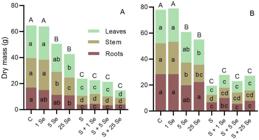
Effects of selenium (Se) application on the dry biomass of eucalyptus plants after 60 days of cultivation or not under saline conditions (S); VCC 865; and B: AEC 0144. The means followed by the same letter are not significantly different from each other according to Duncan's test (p < 0.05). The lowercase letters compare the masses of each plant organ between columns, and the uppercase letters compare the columns (n = 4).
Changes in the concentrations of ions in plant tissues
For the VCC 865 genotype, after 60 days, the plants grown under saline conditions presented K+ and Na+ contents in the roots; K+, Ca2+ and Na+ contents in the aerial parts (stem and leaves); and K+/Na+ and K+/Ca2+ ratios in the roots, stems and leaves that were significantly different from those of the control (Table 2). However, the application of 1 μM Se to plants grown under saline conditions increased the K+ content, reduced the Ca2+ content in the roots, and reduced the Na+ content in the shoots. Furthermore, in the same scenario, the application of 5 μM Se was able to reduce the Ca2+ content in the roots and increase the Ca2+ content in the stems. The application of 25 μM Se reduced the Ca2+ content in the roots and the Na+ content in the stems.
Effects of Se on the concentrations of K+. Ca2+. Na+. K+:Ca2+ and K+:Na+ in the roots, stems and leaves of VCC 865 plants (E. urograndis) after 60 days of culture under saline conditions (S: 100 mM NaCl). The data presented are the means (n = 3). Different letters within the same line represent significant differences (p < 0.05) according to Duncan's test. Note: Compared with the control treatment the 1Se, 5Se, and 25Se treatments resulted in no significant differences (p < 0.05) according to Duncan's test
In genotype AEC 0144, after 60 days, the plants grown under saline conditions presented K+, Na+ and Ca2+ contents in the roots; K+ and Na+ contents in the stem; and K+, Na+ and Ca2+ contents in the leaves, as well as the K+/Na+ and K+/Ca2+ ratios in the roots, stems and leaves, which were significantly different from those of the control (Table 3). However, the application of 1 μM Se to plants grown under saline conditions increased the K+ content in the roots and leaves and reduced the Na+ content in the leaves. In addition, under the same conditions, the application of 5 μM Se reduced the Na+ content in the leaves, and the application of 25 μM Se increased the Ca2+ content in the roots and the K+ content in the leaves. In the culture without salinity, none of the Se doses (1, 5, and 25 μM) significantly changed compared with those in the control.
Effects of Se on the K+, Ca2+, Na+, K+:Ca2+ and K+:Na+ concentrations in the roots, stems and leaves of AEC 0144 plants (E. urophylla) after 60 days of culture under saline conditions (S: 100 mM NaCl). The data presented are the means (n = 3). Different letters within the same line represent significant differences (p < 0.05) according to Duncan's test. Note: Compared with the control treatment, the 1 Se, 5 Se and 25 Se treatments resulted in no significant differences (p < 0.05) according to Duncan's test
Changes in gas exchange
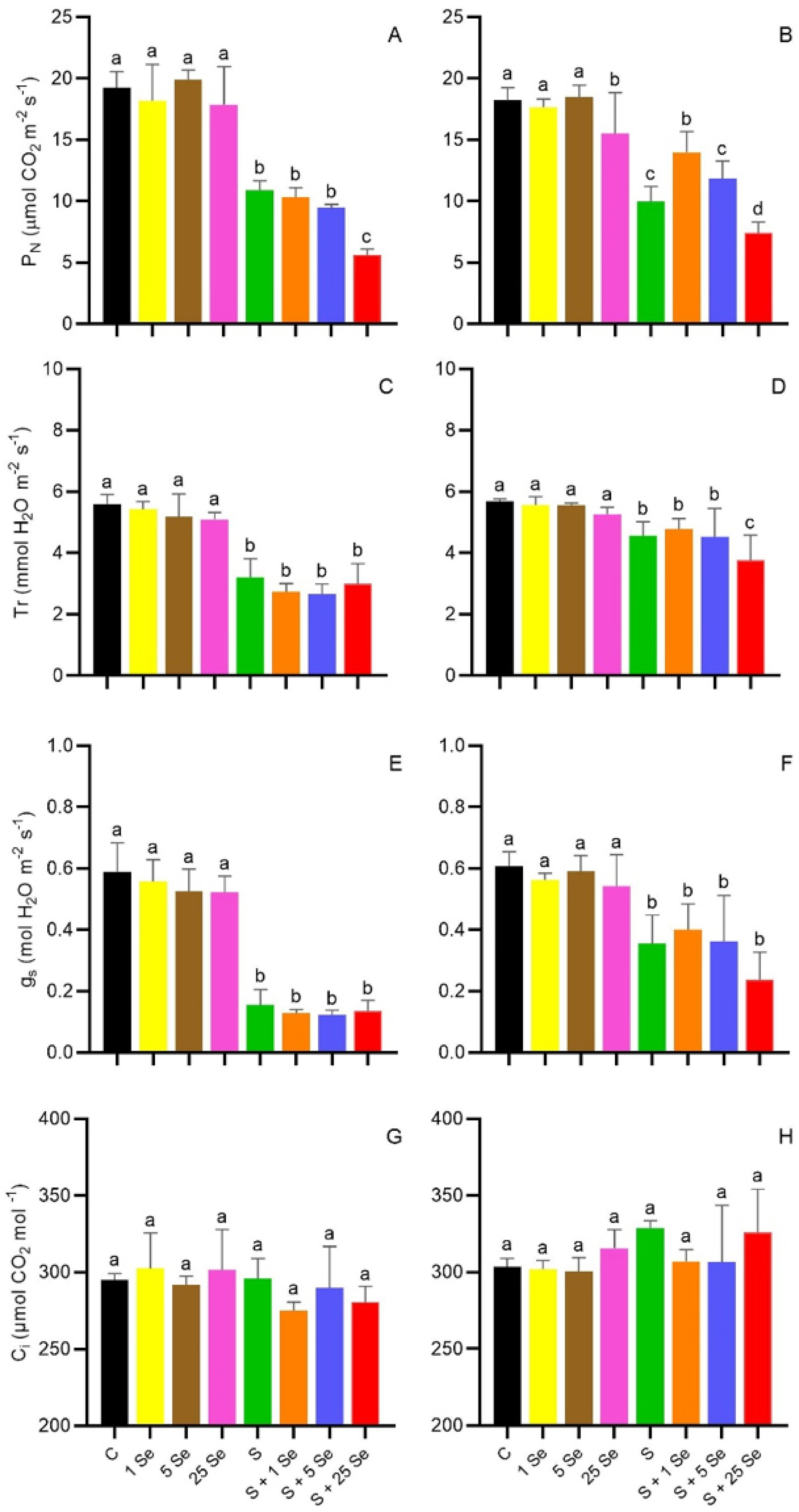
Regarding gas exchange for the VCC 865 genotype, after 60 days, the control plants and those treated with only Se (1, 5, and 25 μM) presented significantly greater means of PN than did the plants grown in saline solutions (with or without Se application) (Figure 3A, C, E, and G). In this scenario, the application of the lowest Se concentrations (1 and 5 μM) did not attenuate the effects of salinity on PN, and the application of the highest Se concentration (25 μM) aggravated the effects of salinity and further reduced PN. The TR were significantly reduced by cultivation under saline conditions, and the application of different Se concentrations (1, 5, and 25 μM) did not attenuate the effects of salinity.
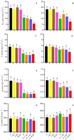
Effects of selenium (Se) application on the net photosynthesis rate (NP), transpiration rate (TR), stomatal conductance (gs) and internal CO2 concentration (Ci) in the leaves of eucalyptus seedlings of the VCC 865 (A, C, E, G) and AEC 0144 (B, D, F, H) genotypes after 60 days of cultivation or not in saline conditions (S). The means (n = 4) followed by the same letter did not differ statistically from each other according to Duncan's test (p < 0.05). The bars represent the standard error of the mean.
In genotype AEC 0144, after 60 days, the control plants and those treated with only Se at the lowest concentrations (1 and 5 μM) presented significantly greater means of PN than did the plants treated with only Se at the highest concentration (25 μM) and those cultivated under saline conditions (with or without Se application). However, the application of 1 μM Se to plants grown under saline conditions attenuated the effects of salinity and partially recovered the PN, and simultaneously, the application of 25 μM Se aggravated the effects of salinity and further reduced the PN (Figure 3B, D, F, and H).
As in the previous genotype, TR and gs were significantly reduced by cultivation under saline conditions, and the application of different Se concentrations (1, 5, and 25 μM) was not able to attenuate those of salinity. The Ci of both VCC 865 and AEC 0144 was not significantly affected by any of the treatments performed.
Pigment content
In the VCC 865 genotype, after 60 days, the Chl a, Chl (a + b) and Car contents, Chl (a/b) ratios and Chl (a + b)/Car ratios, as well as the Chl (a/b) ratios and Chl (a + b)/Car ratios, did not significantly differ between the control plants and those treated with only Se (with 1 μM Se and without Se application) (Table 4). However, the application of the highest Se concentrations (5 and 25 μM) to plants grown under saline conditions significantly reduced the Chl a, Chl b and Chl (a + b) contents. After 60 days, the pigment content of the AEC 0144 genotype changed little as a function of the treatment, the most significant of which was the reduction in the Chl (a/b) ratio of the plants grown in saline conditions (with 5 μM Se and without Se application). Compared with the control plants and the plants treated with only Se (1, 5, and 25 μM).
Effects of selenium (Se) application on the chloroplast pigments content of two eucalyptus clone plants (genotype) after 60 days of cultivation under saline conditions (S). Note: The means (n = 4) followed by the same letter in the same column do not differ statistically from each other according to Duncan's test (p < 0.05), where VCC 865 (E. urograndis), AEC 0144 (E. urophylla)
DISCUSSION
Se at 1 and 5 μM mitigated the effects of saline stress by reducing Na⁺ accumulation
The cultivation of genotypes VCC 865 and AEC 0144 under saline conditions increased the concentration of Na+ ions and reduced that of K+ and Ca2+ ions in plant tissues, drastically affecting the K+/Na+ and K+/Ca2+ ratios, as well as growth, biomass, and gas exchange. An adequate K+/Na+ ratio in plant tissues is essential for the maintenance of cellular osmotic adjustment, stomatal opening and closing, photosynthesis, enzyme activation and protein synthesis.(21) The similarity between Na+ and K+ causes excess Na+ to compete with K+ for absorption sites and, consequently, restricts the assimilation of K+.(24) In this sense, the toxicity caused by Na+ is related mainly to interference with K+ metabolism and inactivation of K+ metabolism as a stimulator of several enzymes.(25) Furthermore, at high concentrations in the cytosol, Na+ replaces Ca2+ in membranes and may affect cell permeability.(26)
Despite the increase in Na+ concentration in the roots of VCC 865 and AEC 0144 plants grown under saline conditions, the leaves were responsible for the greater accumulation of these ions. This occurs because the first line of defense against salt stress is formed by the roots, and the main protective response to delay the effects of toxicity from high Na+ concentrations is the exclusion of Na+ ions by the root cells.(27) Other mechanisms for tolerating excess Na+ include its translocation to intracellular compartments and preferential deposition in leaves in older and less photosynthetically active leaves.(25) Under saline stress, the roots export Na+ ions to the soil or to the aerial parts. Therefore, the accumulation of Na+ ions in the leaves, which are transported by the transpiration current in the xylem and accumulate after transpiration, increases their vulnerability to excess Na+.
In both genotypes, the accumulation of Na+ in the leaves at 60 days of cultivation under saline conditions promoted lesion and leaf abscission and drastically reduced photosynthesis. According to Willadino and Camara,(26) the concentration of Na+ in plant tissues increases with exposure time, causing lesions and injuries, especially in older leaves.
Photosynthesis parameters were identified as sensitive markers of the response to Se-mediated stress
Selenium (Se) plays a notable protective role in mitigating the effects of salt stress in plants, particularly through its ability to stabilize photosystem II (PSII) and improve energy distribution within the photosynthetic apparatus. In a recent study with eucalyptus, Santos Junior et al.(15) reported that the application of low doses of Se effectively restored photochemical parameters affected by salinity, including maximum quantum yield (φP₀), electron transport efficiency, and the total performance index (PITOTAL). These improvements were attributed to greater organization of light-harvesting complexes (LHCII) and optimized energy transfer to reaction centers, indicating that Se contributes to photosynthetic resilience under adverse conditions. The results of the present study complement these findings by demonstrating that, beyond photochemical responses, salinity also reduces growth-related traits, such as height and collar diameter (Dc), as well as gas exchange and net photosynthesis (PN), in the eucalyptus genotypes VCC 865 and AEC 0144. The partial recovery observed under low Se doses, particularly in genotype AEC 0144, further supports the hypothesis that Se can alleviate salt-induced damage by improving both photochemical performance and physiological functioning.
According to Zhao et al.,(8) the reduction in growth, biomass, and gas exchange variables observed in plants grown under saline conditions reinforces that high salinity is responsible for inducing stomatal closure (reducing CO2 absorption), reducing the efficiency of the photosynthetic activity of the apparatus, increasing ROS production (oxidative stress), damaging the thylakoid membrane, impairing osmotic and ionic homeostasis (osmotic stress) and interrupting protein turnover. In addition, the reduction in PN under saline conditions can be attributed to the reduction in gs and/or to the decrease in the content of photosynthetic pigments.(28) Thus, as there was no reduction in the Chl or Car contents due to cultivation under saline conditions in this experiment, the reduction in PN is likely attributed to the reduction in gs.
Most likely, the reduction in height and Dc of VCC 865 and AEC 0144 plants grown in saline conditions was due to the energy expenditure used in the osmoregulation process because, according to Willadino and Camara,(26) the maintenance of the homeostasis process, which requires constant energy to transport ions between the vacuole and the cytoplasm, involves the deviation of photosimilated ions that should be invested in growth and production.
The tolerance of a plant is usually related to the amount of biomass produced under saline conditions compared with the biomass produced under control conditions, (10) and in this scenario, the results suggest that both VCC 865 and AEC 0144 have some tolerance to salt stress. The results agreed with those reported by Botelho et al., (29) who studied the effects of salinity on the growth and morphology of different eucalyptus genotypes and concluded that VCC 865 is more tolerant to saline stress than the VCC 361, AEC 0144 and AEC 1528 genotypes. Additionally, VCC 865 was classified as extremely tolerant, and AEC 0144 was classified as tolerant to salt stress. The potential of the VCC 865 genotype to tolerate salt stress was also described by Castro-Filho et al.,(30) who evaluated the biomass of Eucalyptus genotypes CO 1407 and VCC 865, which were irrigated with saltwater for 114 days, and the results revealed that VCC 865 was more tolerant to salinity.
Under cultivation without salinity, the effects of Se on VCC 865 and AEC 0144 plants were dependent on the dose used. In general, regardless of the genotype, the application of relatively high concentrations of Se (25 μM) reduced plant growth and biomass but did not affect the PN, TR, gs or pigments. Moreover, the application of lower concentrations of Se (1 μM) did not affect any of the parameters evaluated. By observing how Se counteracts the effects of salinity, it was observed that 1 and 5 μM Se were able to reduce the concentration of Na+ ions in the leaves of plants under salinity stress. According to Hasanuzzaman et al.,(31) although the beneficial effects of Se in plants are still unclear, the application of low concentrations of Se to plants under stress can increase growth, biomass, photosynthetic pigment synthesis, the photosynthetic rate, gas exchange, and the accumulation of osmoprotectants and secondary metabolites.
Studies such as that by Hawrylak-Nowak et al.(20) have shown that the beneficial effect of Se is associated with an increase in the content of photosynthetic pigments in NaCl-stressed plants. However, in the present study, this effect was not observed because the pigments were only slightly affected by both salinity and Se application. Our results corroborate those of Lacerda,(21) who studied the effects of salt stress on the early growth of four Eucalyptus genotypes (AEC 0144, AEC 1528, VCC 361 and VCC 865) and reported that the total chlorophyll content was not affected by the different genotypes or salinity concentrations.
On the other hand, the high concentrations (25 μM) of Se used in this study were not able to promote beneficial effects; therefore, the results indicate that 25 μM Se may be an overdose for plants of the genus Eucalyptus. According to Gupta and Gupta,(16) excess Se can promote toxicity to plants either by inducing oxidative stress or by incorrect incorporation of SeCys/SeMet instead of Cys/Met in the protein chain, impairing both structure and function. This is because, according to Brown and Shrift, (32) Se is chemically very similar to sulfur (S), and the excess Se hinders competition with S for participation in biochemical reactions.
Se metabolism in plant cells begins in the chloroplast through the action of SO42- anabolic enzymes,(31) which undergo several metabolic processes until it is converted into dimethylselenide (DMSe) and volatilized from the leaves into the atmosphere.(16) This may explain why the application of adequate Se can attenuate the damage caused to chloroplasts by stress(33) and why high Se concentrations can aggravate damage to chloroplasts.
Finally, the tendency for the restoration of net photosynthesis promoted by the application of Se in eucalyptus growing under saline conditions, especially the AEC 0144 genotype, may be related to the reduction in the Na+ concentration in the leaves and improvement in ionic homeostasis. This behavior was observed in both genotypes and thus indicates that such behavior may be the pattern for the genus Eucalyptus. However, the application of high concentrations of Se (25 μM) potentiated the reduction in PN caused by salinity in both genotypes and, especially in VCC 865, potentiated the reduction in total chlorophyll content.
CONCLUSION
The eucalyptus genotypes VCC 865 and AEC 0144 appeared to possess intrinsic physiological mechanisms that confer tolerance to salt stress. Exogenous application of Se at concentrations of 1 and 5 μM significantly mitigated the deleterious effects of salinity, particularly by reducing sodium (Na⁺) accumulation in leaf tissues and restoring net photosynthesis. In contrast, higher Se concentrations (25 μM) potentiated stress symptoms, highlighting the importance of dose optimization. Gas exchange proved to be a sensitive and reliable indicator of Se-mediated stress responses, whereas the chloroplast pigment content remained unaffected by salinity or Se treatment. These results suggest that low-dose Se supplementation can improve the ionic balance and photochemical performance of eucalyptus seedlings under saline conditions. Therefore, the targeted use of selenium represents a promising strategy to improve seedling establishment in environments affected by salinity, contributing to the development of more resilient forest systems and the expansion of areas suitable for production.
ACKNOWLEDGEMENTS, FINANCIAL SUPPORT AND FULL DISCLOSURE
The present study was conducted with the support of the Coordination for the Improvement of Higher Education Personnel - Brazil (CAPES) - Financing Code 001. The authors declare that they have no known competing financial interests or personal relationships that could have influenced the work reported in this paper.
DATA AVAILABILITY STATEMENT
The generated and analysed database for the current study is available from the corresponding author on reasonable request.
SUPPLEMENTARY DATA
Supplementary data are available at https://doi.org/10.6084/m9.figshare.32415117.v1
REFERENCES
- 1 Flora e Funga do Brasil. Eucalyptus in Flora e Funga do Brasil. Rio de Janeiro: Jardim Botânico do Rio de Janeiro; 2023.
- 2 IBÁ – Indústria Brasileira de Árvores. Relatório IBÁ 2022. São Paulo: IBÁ; 2022.
- 3 Lorenzi HJ, Bacher LB, Torres MAV. Árvores e arvoretas exóticas no Brasil: madeireiras, ornamentais e aromáticas. Nova Odessa: Instituto Plantarum de Estudos da Flora; 2018.
- 4 Reis LAC, de Oliveira JA, dos Santos Farnese F, Rosado AM, Reis LAC. Chlorophyll fluorescence and water content parameters are good biomarkers for selecting drought tolerant eucalyptus clones. For Ecol Manag. 2021;481:118682.
- 5 Cunha TQG, Santos AC, Novaes E, Hansted ALS, Yamaji FM, Sette Jr CR. Eucalyptus expansion in Brazil: Energy yield in new forest frontiers. Biomass Bioenergy. 2021;144:105900.
- 6 Shrivastava P, Kumar R. Soil salinity: A serious environmental issue and plant growth promoting bacteria as one of the tools for its alleviation. Saudi J Biol Sci. 2015;22(2):123-31.
- 7 FAO – Food and Agriculture Organization of the United Nations. World map of salt-affected soils launched at virtual conference. Roma: FAO; 2021.
- 8 Zhao C, Zhang H, Song C, Zhu JK, Shabala S. Mechanisms of plant responses and adaptation to soil salinity. Innovation (N Y). 2020;1(1):100017.
- 9 Srivastava P, Wu QS, Giri B. Salinity: an overview. In: Giri B, Wu QS, editors. Microorganisms in Saline Environments: Strategies and Functions. Cham: Springer; 2019. p. 3-18.
- 10 Dias NS, Blanco FF, Souza ER, Ferreira JFS, Neto ONS, Queiroz Í. Efeitos dos sais na planta e tolerância das culturas à salinidade. In: Gheyi HR, Dias NS, Lacerda CF, editors. Manejo da salinidade na agricultura: estudos básicos e aplicados. Fortaleza: INCTSal; 2016. p. 151-62.
- 11 Tripathi DK, Singh S, Singh S, Chauhan DK, Dubey NK, Prasad R. Silicon as a beneficial element to combat the adverse effect of drought in agricultural crops: capabilities and future possibilities. Water Stress Crop Plants Sustain Approach. 2016;2:682-94.
- 12 Dong X, Sun L, Guo J, Liu L, Han G, Wang B. Exogenous boron alleviates growth inhibition by NaCl stress by reducing Cl⁻ uptake in sugar beet (Beta vulgaris). Plant Soil. 2021;464(1-2):423-39.
- 13 Sohag AAM, Tahjib-Ul-Arif M, Brestic M, Afrin S, Sakil MA, Hossain MT, Hossain MA. Exogenous salicylic acid and hydrogen peroxide attenuate drought stress in rice. Plant Soil Environ. 2020;66(1):7-13.
- 14 Azizi I, Esmaielpour B, Fatemi H. Effect of foliar application of selenium on morphological and physiological indices of savory (Satureja hortensis) under cadmium stress. Food Sci Nutr. 2020;8(12):6539-49.
- 15 Santos Junior RN, Faria-Silva L, Falqueto AR, Werner ET. Selenium enhances photosynthetic efficiency in eucalyptus under saline stress. S Afr J Bot. 2025;183:13-22.
- 16 Gupta M, Gupta S. An overview of selenium uptake, metabolism, and toxicity in plants. Front Plant Sci. 2017;7:2074.
- 17 Jiang C, Zu C, Lu D, Zheng Q, Shen J, Wang H, Li D. Effect of exogenous selenium supply on photosynthesis, Na⁺ accumulation and antioxidative capacity of maize (Zea mays L.) under salinity stress. Sci Rep. 2017;7:42039.
- 18 Terry N, Zayed AM, De Souza MP, Tarun AS. Selenium in higher plants. Annu Rev Plant Biol. 2000;51:401-32.
- 19 Clark RB. Characterization of phosphatase of intact maize roots. J Agric Food Chem. 1975;23(3):458-60.
- 20 Hawrylak-Nowak B. Beneficial effects of exogenous selenium in cucumber seedlings subjected to salt stress. Biol Trace Elem Res. 2009;132:259-69.
- 21 Lacerda JJ. Estresse Salino e Seus Efeitos no Crescimento Inicial de Clones de Eucalyptus spp. [dissertação]. Vitória da Conquista: Universidade Estadual do Sudoeste da Bahia; 2016.
- 22 Malavolta E, Vitti GC, Oliveira SAD. Avaliação do estado nutricional das plantas: princípios e aplicações. 2a ed. Piracicaba: Potafos; 1997.
- 23 Wellburn AR. The spectral determination of chlorophylls a and b, as well as total carotenoids, using various solvents with spectrophotometers of different resolution. J Plant Physiol. 1994;144(3):307-13.
- 24 Islam F, Farooq MA, Gill RA, Wang J, Yang C, Ali B, Wang G, Zhou W. 2,4-D attenuates salinity-induced toxicity by mediating anatomical changes, antioxidant capacity and cation transporters in the roots of rice cultivars. Sci Rep. 2017;7:10443.
- 25 Schmoeckel SM, Jarvis DE. Salt stress. In: Kole C, editor. Genomic Designing of Climate-Smart Cereal Crops. Cham: Springer; 2017. p. 1-25.
- 26 Willadino L, Camara T. Tolerância das plantas à salinidade: aspectos fisiológicos e bioquímicos. Encicl Biosf. 2010;6(11):1-23.
- 27 Ji H, Pardo JM, Batelli G, van Oosten MJ, Bressan RA, Li X. The salt overly sensitive (SOS) pathway: established and emerging roles. Mol Plant. 2013;6(2):275-86.
- 28 Kwon OK, Mekapogu M, Kim KS. Effect of salinity stress on photosynthesis and related physiological responses in carnation (Dianthus caryophyllus). Hortic Environ Biotechnol. 2019;60:831-39.
- 29 Botelho VV, Lacerda JDJ, Cairo PAR, Barbosa RP. Efeito da salinidade sobre características morfológicas de clones de Eucalyptus spp. durante o crescimento inicial. Semana Agron UESB SEAGRUS. 2017;1(1):1-10.
- 30 Castro Filho MN, Tagliaferre C, Oliveira FS, Silva BL, Alves RO, Paula AD, Barros FM. Biomass of two Eucalyptus clones (E. grandis × E. urophylla) irrigated with saline water. Rev Arvore. 2022;46:e4607.
- 31 Hasanuzzaman M, Bhuyan MB, Raza A, Hawrylak-Nowak B, Matraszek-Gawron R, Al Mahmud J, Nahar K, Fujita M. Selenium in plants: Boon or bane? Environ Exp Bot. 2020;178:104170.
- 32 Brown TA, Shrift A. Selenium: toxicity and tolerance in higher plants. Biol Rev Camb Philos Soc. 1982;57(1):59-84.
- 33 Feng R, Wei C, Tu S. The roles of selenium in protecting plants against abiotic stresses. Environ Exp Bot. 2013;87:58-68.
Edited by
-
Editors:
Ricardo Antônio AyubDanielle Fabíola Pereira da Silva