
 COVID-19 mortality: Impact on benefits for retirees in a state pension plan
ABSTRACT
This article sought to analyze the impacts of mortality by COVID-19 pandemic on the retirement benefits and pensions of retirees in a Special Social Security System. The study addresses a gap in the literature regarding the impact of COVID-19 on the social security obligations of retirees in the Brazilian public sector, specifically within the system. For the financial equilibrium of a pension plan, it is evident that the impact of the pandemic on the actuarial “mortality” assumption must be considered, given its influence on pension obligations related to the payment of retirement benefits and pensions. The change in mortality tables, in scenarios where COVID-19 is not considered a cause of death, resulted in an average increase of 4.66% in the present value of future benefits (PVFB) and 4.64% in the mathematical provision (MP) for retirement benefits, as well as an average reduction of 3.58% in the NPB and 3.64% in the MP for death pensions between 2020 and 2022. Using the multiple-decrement model, mortality tables were constructed, including (Scenario 1) and excluding deaths from COVID-19 (Scenario 2). The probabilities of death derived from these tables were applied in the calculation of the plan’s actuarial liabilities for retired civil servants (retirement benefits and pensions) under the system. Next, VPBF and PM results for benefits granted during the pandemic period (2020-2022) were compared across the different scenarios. When COVID-19 was excluded as a cause of death, the probabilities of death and pension liabilities were lower in all the years analyzed. The study of mortality by specific causes, though still recent, contributes to actuarial work by quantifying its impact through the application of the results to a real-world database of a Special Social Security System.
Keywords:
COVID-19 pandemic; mortality; multiple decrements; special social security system; pension liabilities
RESUMO
Este artigo buscou analisar os impactos da mortalidade causada pela pandemia de covid-19 sobre as aposentadorias e pensões dos inativos em um Regime Próprio de Previdência Social (RPPS). O estudo explora a lacuna na literatura sobre o impacto da covid-19 nas obrigações previdenciárias dos inativos no setor público brasileiro, mais especificamente em um RPPS. Para o equilíbrio de um plano previdenciário, evidencia-se a importância de considerar o impacto da pandemia sobre a premissa atuarial “mortalidade”, dada sua influência nas obrigações previdenciárias relativas ao pagamento de aposentadorias e pensões. A mudança das tábuas de mortalidade, nos cenários em que a covid-19 não é considerada causa de morte, resultou em um aumento médio de 4,66% no valor presente dos benefícios futuros (VPBF) e de 4,64% na provisão matemática (PM) das aposentadorias, além de uma redução média de 3,58% no VPBF e de 3,64% na PM das pensões por morte, entre 2020 e 2022. A partir do modelo de múltiplos decrementos, foram construídas tábuas de mortalidade, incluindo (Cenário 1) e excluindo os óbitos por covid-19 (Cenário 2). As probabilidades de morte oriundas dessas tábuas foram aplicadas no cálculo das obrigações atuariais do plano para os servidores inativos (aposentadorias e pensões) de um RPPS. Em seguida, foram comparados, para os diferentes cenários, os resultados do VPBF e da PM de benefícios concedidos durante o período da pandemia (2020 a 2022). Ao eliminar a covid-19 como causa de morte, as probabilidades de morte e os compromissos com as pensões foram menores em todos os anos analisados. O estudo da mortalidade por causas específicas, ainda recentes, contribui para o trabalho atuarial, quantificando seu impacto por meio da aplicação dos resultados a uma base de dados real de um RPPS.
Palavras-chave:
pandemia de covid-19; mortalidade; múltiplos decrementos; Regime Próprio de Previdência Social; compromissos com inativos
1. INTRODUCTION
The Brazilian social security system consists of Social Security and the Supplementary Social Security System.Social Security is provided by the government, is mandatory for workers, and comprises the General Social Security System (GSSS) and the Special Social Security System (SSSS). The second one, on the other hand, is optional for workers and consists of closed supplementary social security entities and open supplementary social security entities.
According to article 40 of the Federal Constitution of Brazil (Brazil, 1988), GSSS is contributory in nature, is established by each state, and must guarantee all statutory public servants at least retirement and death benefits, subject to criteria that preserve financial and actuarial balance.
The balance of these plans, from an endogenous perspective, depends on the actuarial assumptions used and the calculation methodology employed. According to Rodrigues (2008), the assumptions can be biometric, economic, or generic. Generic assumptions refer to general characteristics of the plan; economic assumptions, to macroeconomic factors; and biometric assumptions, to the entry and exit of participants, such as the mortality assumption, in which the participant’s death terminates the series of contribution or benefit payments to them, while simultaneously triggering a pension benefit for dependents.
Although biometric assumptions are estimated based on experience and population trends, such unpredictable events can cause these assumptions to deviate sharply. This is the case, for example, with COVID-19 pandemic. Meanwhile, the Pan American Health Organization based on data from previous years, defined excess mortality as the difference between the number of deaths that occurred and what would have been expected in the absence of the pandemic, including direct causes (due to the disease) or indirect causes (due to the pandemic’s impact on health systems and society). From January 2020 to December 2021, this excess was estimated at approximately 14.9 million deaths, with a higher incidence among men and the elderly (PAHO/World Health Organization [WHO], 2022). Thus, the “mortality” assumption, as one of the main parameters in calculating the liabilities of a benefit plan, can directly affect the financial and actuarial status of the plans (Rodrigues, 2008).
The pandemic has had various effects on social security systems, including impacts on mortality, revenue collection, and the dynamics of benefit disbursement. The literature on these effects is still evolving, as the public health emergency status was not lifted until 2023. Some studies have already quantified impacts from an international perspective, but there remains a need for regional analyses (Fonsêca, 2024; Fratoni et al., 2022; Martins, 2024). In Brazil, Fonsêca (2024) highlights that the pandemic led to a significant increase in COVID-19-related benefits, both for disability and for pension due to death benefits, filed by beneficiaries and dependents. Ferreira et al. (2021), in turn, observed an increase in applications for death benefits under the GSSS, highlighting a financial impact on the social security system. In this vein, data from the Ministry of Social Security indicate that the number of death pension grants quadrupled from February 2020 to May 2021, pointing to a significant increase in the need for funds to pay benefits (Ministry of Social Security, 2023).
Given this scenario, the hypothesis is formulated that the high mortality rate associated with the pandemic may have impacted the mathematical provisions for granted benefits (PMBC) associated with social security benefits in the SSSS, given that the mortality assumption is highly sensitive and has a direct relationship with the present value of future benefits (VPBF). Thus, this study aims to analyze the impacts of mortality caused by the COVID-19 pandemic on the retirement benefits and pensions of retirees in an SSSS for the years 2020, 2021, and 2022, which constitute the COVID-19 pandemic period.
2. THEORETICAL BACKGROUND
2.1 From COVID-19 to Military Police Officers in the SSSS
COVID-19 is an infection caused by the SARS-CoV-2 virus, which is responsible for severe acute respiratory syndrome (Ministry of Health, 2023). In Brazil, a Public Health Emergency of International Concern was declared in January 2020, and following unchecked global spread, in March 2020, the World Health Organization (WHO) declared COVID-19 a pandemic. Meanwhile, Ordinance No. 188, dated February 3, 2020, and Ordinance GM/MS No. 913, dated April 22, 2022, declared the beginning and end of the period of Public Health Emergency of National Importance due to human infection with the novel coronavirus (2019-nCoV), respectively.
Regarding the indirect effects of the pandemic, these can be assessed based on the increase in overall mortality relative to previous baseline mortality levels, given that excess deaths impact mortality from other causes: they decrease mortality from some causes by reducing exposure to other infections; and increase mortality from other causes due to delays or forgoing care associated primarily with the overload of the health system (Castro et al., 2021; Marois et al., 2020; PAHO/WHO, 2022).
Since mortality is an insurable event - in the insurance industry, for example, it can trigger the payment of benefits (in the form of a lump-sum payment or a pension) to the insured person’s family - actuarial studies must account for the time until the death of participants (insured individuals and beneficiaries). This understanding enables calculations that estimate the impacts of mortality on the obligations of the pension plan, given that, within the scope of the GSSS, death may trigger the payment of a pension, as detailed below.
One of the benefits guaranteed by GSSS is the death pension, intended for the insured person’s dependents when the insured person dies, ensuring support for the family after the provider’s death. In addition to the rules for granting and calculating benefits established by MTP Ordinance No. 1,467, dated June 2, 2022, generally speaking, entitlement to the benefit is contingent upon meeting certain basic requirements: the death of the insured, the deceased’s status as an insured person, and the status of the deceased’s dependents (Nunes, 2021). Furthermore, ME Ordinance No. 424, dated December 29, 2020, amended Law No. 8,213, dated July 24, 1991, establishing the ages that determine the duration of the pension.
In short, MTP Ordinance No. 1,467, dated June 2, 2022, in Article 10 (Chapter VII), stipulates that, currently, the pension amount is calculated based on a family allowance of 50% of the retirement pension, with an additional 10% for each dependent, up to a limit of five dependents, while maintaining the maximum limit of 100% of the amount (Brazil, 2022). Given the pandemic and its implications for mortality and the death pension benefit, the following section addresses the financing of this coverage.
According to Article 50 of MTP Ordinance No. 1,467, dated June 2, 2022, the actuarial liabilities of the plans consist of the pension liabilities, which represent the net obligations of the benefit plan valued under the funded financial regime. The total actuarial liability, also known as the mathematical reserve, consists of the sum of the actuarial liability for benefits already in payment and the actuarial liability for benefits to be granted (PMBAC), which represent, respectively, the plan’s obligations to participants already receiving benefits and to participants still in active service. Both the PMBC and the PMBAC correspond to the difference between the present value of future benefits and the present value of future contributions (VPCF), with the former relating to retirees and pensioners and the latter to active participants (Brazil, 2022).
Finally, MTP Ordinance No. 1,467, dated June 2, 2022, also establishes the method for quantifying contributions and the method for accumulating funds to cover the benefits and expenses provided for in the plan, in accordance with the financial regime.
2.2 Literature Review
In the context of the pandemic, Brazil was severely affected by COVID-19. In an initial study (May 2020), Demografia UFRN (2020), applying the theory of multiple decrements based on death records, estimated that the reduction in life expectancy at birth would be 217 days, when considering and disregarding deaths from the SARS-CoV-2 virus.
Using the same approach, Silva et al. (2020) estimated that life expectancy at birth fell by 1.018 years for men and 0.590 years for women; at age 60, the reductions were 1.211 and 0.980 years, respectively. Subsequently, Silva et al. (2022), when comparing the scenario with and without deaths caused by COVID-19, observed that life expectancy at birth, which was 74 years for men and 80 years for women, fell to 63 and 70 years, respectively.
From a global perspective, Marois et al. (2020) indicated the decline in life expectancy at birth could range from 3 to 8 years in Latin America. Heuveline and Tzen (2021), specifically for Brazil, estimated a reduction of 1.72 years in 2020. Castro et al. (2021) also estimated a decline of 1.3 years in 2020, a mortality level not observed since 2014. Furthermore, they estimated that if mortality rates had remained at 2019 levels (in the absence of the pandemic), the reduction would have been 1.8 years, a result slightly higher than the estimated reduction for 2020.
In summary, the studies highlight the importance of: a) considering regional differences, given Brazil’s structural and economic inequalities; b) recognizing disparities between men and women, given the greater impact on males; and c) paying attention to the higher risk in older age groups, particularly among those aged 40 to 60, in whom COVID-19 accounted for the majority of deaths in 2021 (Castro et al., 2021; Marois et al., 2020; Silva et al., 2020).
Gonzaga et al. (2024) point out that traditional mortality estimates do not adequately capture the impact of the pandemic. This underscores the need for studies that consider the actual effects on mortality and social security obligations.
In the actuarial field, Delbrouck and Alonso-García (2024) developed an epidemiological model to estimate COVID-19-related mortality in Belgium and its effects on insurance and pension products. They observed that mortality is higher in the presence of COVID-19 for all age groups, which increases the net present value (NPV) of insurance and reduces that of annuities. Schnürch et al. (2022) demonstrated that mortality shocks significantly affect the parameters of the Lee-Carter model, impacting mortality rate forecasts and, consequently, the valuation of mortality-related products.
In specific studies on SSSS, Bezerra and Santos (2024) noted that, among the actuarial assumptions analyzed, mortality had the greatest impact on the PM. Oliveira and Silva (2024) analyzed the effects of the pandemic on the obligations of the SSSS of Santa Rita, in the state of Paraíba, noting that mortality resulting from COVID-19 had significant effects on both the probability of death and the present value of future benefits (VPBF) of scheduled retirements, generating negative impacts on the entity’s actuarial liabilities.
Regarding broader effects, Moura (2022) noted a significant increase in the granting of temporary disability benefits during the pandemic, with COVID-19 being the sole cause: by 2020, these had already reached approximately 37,000. Martins (2024), in turn, demonstrated the increase in social security expenditures on these benefits, particularly under the International Classification of Diseases code B34, which accounted for 5.72% of total temporary disability benefits recognized in 2021, contrasting with percentages close to 0 before the pandemic.
Olivera and Valderrama (2022) point out that, in Peru, excess mortality reduced the actuarial liability by 2.4%, but this reduction was partially offset by increases in pensions and a decline in contributions. This mixed pattern-a reduction in future payments coupled with the creation of new obligations-was also noted by Fratoni et al. (2022).
Although previous studies have highlighted the impacts of COVID-19 on different countries and on the GSSS, the gap addressed here concerns the analysis of its impacts on benefits for retirees (retirement benefits and pensions).
3. METHODOLOGICAL PROCEDURES
3.1 Type of Research, Data Collection, and Variables Analyzed
This is a quantitative, applied, and descriptive case study. The data used are secondary, provided by a small (anonymized) public pension fund, covering only retired employees due to the higher concentration of COVID-19 deaths among older age groups. Mortality data were also used: for deaths due to COVID-19, information was collected from the Brazilian Open Data Portal (Ministry of Health, 2024a); for deaths from all causes, from the Mortality Information System (SIM), provided by OpenDataSUS (Ministry of Health, 2024b).
Finally, data were also extracted from Brazilian population projections provided by the Brazilian Institute of Geography and Statistics (IBGE, 2024), by age and sex. It was assumed that the impact of COVID-19 mortality on the SSSS is similar to that of the general population, which allowed for the use of death and population data for Brazil for the years 2020, 2021, and 2022. Table 1 summarizes the information from the death records used.
Based on mortality and population data, multiple-decrement life tables were constructed and applied to the data on retired plan participants. Since IBGE population projection is available only up to age “90+,” it was necessary to extrapolate mortality probabilities for older ages, performed according to the methodology of Silva (2015). Table 2 presents the data provided by the analyzed SSSS.
Using the data from Tables 1 and 2, we were able to perform actuarial calculations and conduct a comparative analysis of the potential impacts of pandemic-related mortality on the present value of future benefits (PVFB) and the present value of premiums (PVP) for inactive SSSS participants. The procedures were implemented using the R programming language (R Core Team, 2024) for data manipulation and Microsoft Excel (Microsoft, 2011) for the actuarial calculations.
3.2 Types of Analysis
3.2.1 Descriptive analysis
This analysis describes the characteristics of SSSS database. The statistics are presented using measures of central tendency (mean, median, minimum, and maximum) and measures of variability (standard deviation). The equations and other measures can be found in Azevedo (2016).
3.2.2 Multiple-increment model
The theory of multiple decrements is based on the fact that an individual, starting from an initial state, is subject to various forces (decrements) that can remove them from that condition over time. In a benefit plan, an active participant is exposed to various decrements, such as retirement, death, or turnover (Rodrigues, 2008).
In the context of mortality, this theory allows for the estimation of mortality functions based on the study of specific causes, evaluating changes in probabilities and life expectancy when a cause of death is removed (Chiang, 1968). In this study, two scenarios were considered for the construction of mortality tables for the years 2020, 2021, and 2022:
-
Scenario 1: considers deaths from all causes, including COVID-19.
-
Scenario 2: considers deaths from all causes, excluding COVID-19.
To calculate mortality estimates, the specific mortality rate and the crude and net probabilities of death are presented. The specific mortality rate , which represents the mortality experience of the population, is given by Eq. 1.
where is the number of deaths occurring during the year, by age or age group, is the population at risk (mid-year population), n is the duration of the interval, x is the age, and j is the year.
The crude mortality rate is the probability that an individual of age x will die between ages x and x + n, considering deaths from all causes. It can be expressed according to Eq. 2.
where n is the age interval, is the age-specific mortality rate, and is the average time lived by those who died between x and x + n.
The net probability of death , which excludes deaths from COVID-19, is represented by Eq. 3.
where δ is the cause of death, is the probability of survival, which is the complement of the crude mortality rate, is the number of deaths from all causes during the year, by age or age group, and is the number of deaths from cause δ during the year, by age or age group. Based on the crude and net mortality probabilities estimated for each sex and for the 3 years of the pandemic, multiple-decrement life tables were developed. Subsequently, these tables were used to construct the transition functions necessary for the actuarial calculations of the VPBF and PMBC, whose formulations are presented below.
3.2.3 Calculation of the VPBF and PM for retired employees
To analyze the variation in the plan’s present value of future benefits (PVFB) and projected market value (PM) regarding expenditures on benefits for retired participants during the pandemic, the same actuarial assumptions (interest rate, plan’s financial regime, inflation, among others) used by the analyzed SSSS were used. For comparative purposes, the only exception was the general mortality table, for which those constructed in this study were used, in accordance with the scenarios already presented.
The formulas for calculating the VPBF of benefits granted for scheduled retirements and their conversion into a spousal or partner pension, in accordance with the calculation methods used in internal SSSS documents, are:
where 𝑎𝑝𝑜𝑠𝑉𝑃𝐵𝐹𝑥 represents the VPBF for scheduled retirements and 𝑎𝑝𝑜𝑠𝑉𝑃𝐵𝐹𝑥/𝑦, its conversion into a pension, r is the estimated age of entry into scheduled retirement, x is the current age of the civil servant, x - k is the age difference between the civil servant and the dependent y, Bt is the projected benefit amount at retirement age, ar is the actuarial present value of a series of future payments to the beneficiary, starting at retirement age r, and 𝑎 𝑟/ 𝑥−𝑘 is the actuarial present value of a series of future payments to the dependent upon the death of the insured beneficiary, as expressed in Eq. 6.
where ary is the actuarial present value of a series of future payments to the policyholder and the dependent, provided that both are alive. To calculate the PMBC, the prospective method was used, which determines the PMBC based on the difference between the VPBF and the VPCF, according to Eqs. 7, 8, and 9:
where 𝑎𝑝𝑜𝑠𝑉𝑃𝐵𝐹𝑥 represents the PMBC of scheduled pensions and 𝑎𝑝𝑜𝑠𝑉𝑃𝐵𝐹𝑥/𝑦 represents their conversion into a pension, FC is the capacity factor for compensation and benefits, and corresponds to the effective monthly rate, for an annual inflation rate Y and n months between base dates (in this case, 12 months), 𝑎𝑝𝑜𝑠𝑉𝑃𝐵𝐹𝑥 represents the present value of future contributions for scheduled retirements and 𝑎𝑝𝑜𝑠𝑉𝑃𝐵𝐹𝑥/𝑦 represents their conversion into a pension. Having explained the procedures and equations, the results and discussions are presented below.
4. RESULTS AND DISCUSSION
4.1 Descriptive Analysis of SSSS Database
SSSS database analyzed contains information on 504 civil servants who were receiving retirement benefits. Because the data is anonymous, it was not possible to identify SSSS by location or total number of participants. Table 3 presents the general characteristics of inactive participants, based on the database received.
From the total number of participants, the majority (77.38%) are female. Regarding marital status, the majority (53.97%) are married. Among those eligible for a survivor’s pension, 63.30% are married or in a common-law relationship.
As for age, the insured individuals analyzed are, on average, 65 years old, and their spouse, if applicable, is, on average, 1 year older, which can be explained by the fact that the majority of civil servants are female and, consequently, their spouses are male.
Finally, the average retirement benefit received by civil servants is R$ 3,665.00 with an average contribution of R$ 14 for those whose benefit exceeds the GSSS ceiling.
4.2 Analysis of the Multiple Decrement Model
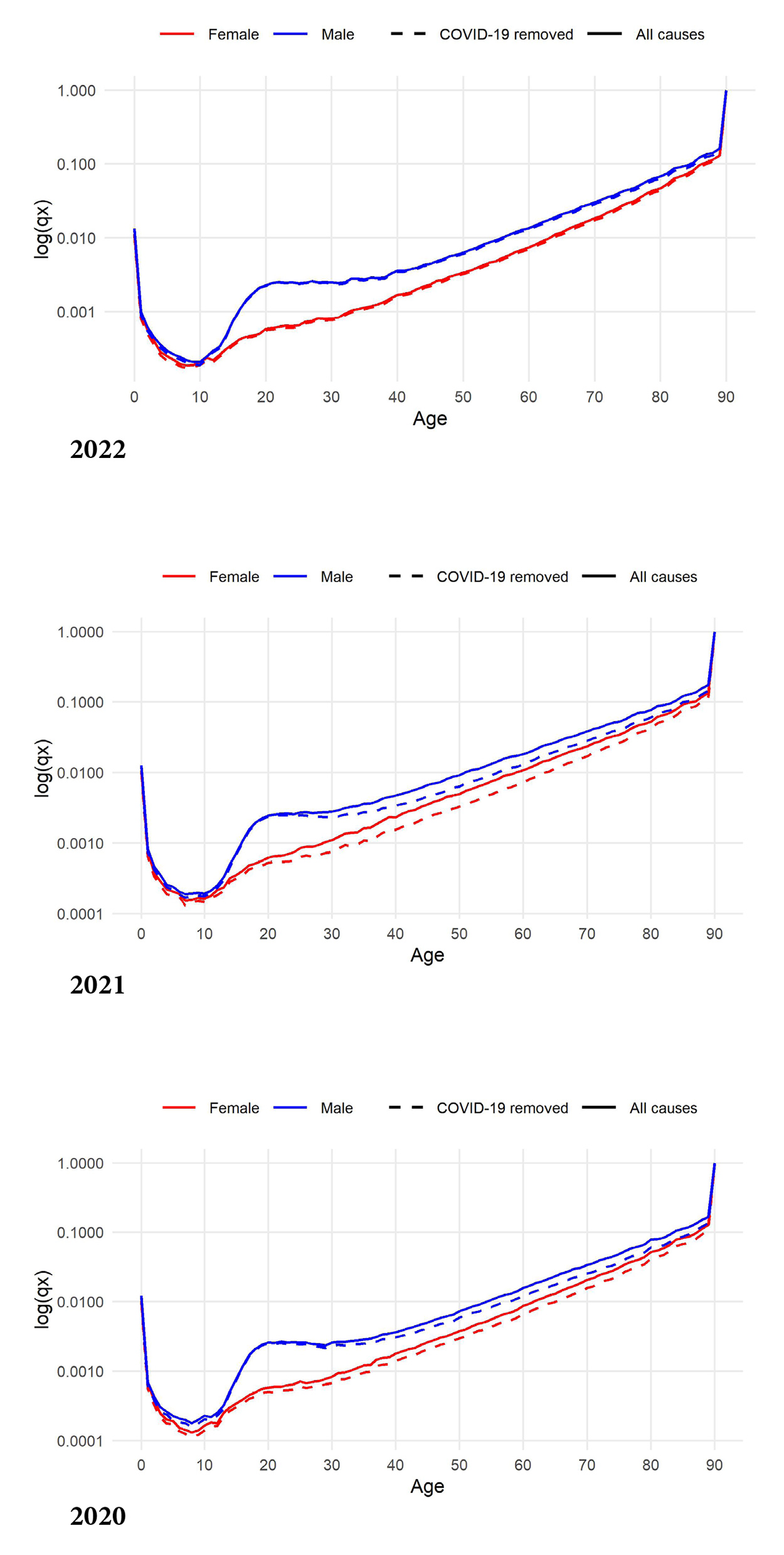
When constructing multiple-decrement life tables, we examine the probabilities of an individual dying from any cause in the presence of all other risks (crude mortality probability) and of an individual dying if a specific risk is excluded as a cause of death (net mortality probability). Figure 1 presents the logarithm of the crude and net mortality probabilities (excluding COVID-19), by age and sex, for the years 2020, 2021, and 2022.

In general, the curves decline in early childhood, become steeper among younger children, and rise again as age increases. When analyzing Figure 1, it can be observed that male mortality is higher than female mortality in both scenarios (with and without COVID-19) and over the course of the 3 years. The elimination of COVID-19 deaths (dashed lines) always results in lower probabilities of death and higher life expectancies for both sexes.
In younger age groups, the differences between the scenarios are less pronounced; in older age groups, the impact of COVID-19 becomes clearer, especially for men, among whom mortality without COVID-19 tends to converge with the pattern of overall female mortality in 2020 and 2021. In 2022, the curves for females are nearly superimposed; for males, the probability of death without COVID-19 approaches that with COVID-19 at younger ages and remains lower at older ages.
Summarizing the trends observed in the scenario with COVID-19 eliminated, the probability of dying decreases for men from 2020 to 2021 but increases from 2021 to 2022. For women, although smaller, it continues to rise from one year to the next. For both sexes, the probability of death increases in older age groups, a pattern observed in the study by Demografia UFRN (2020) and by Silva et al. (2020, 2022).
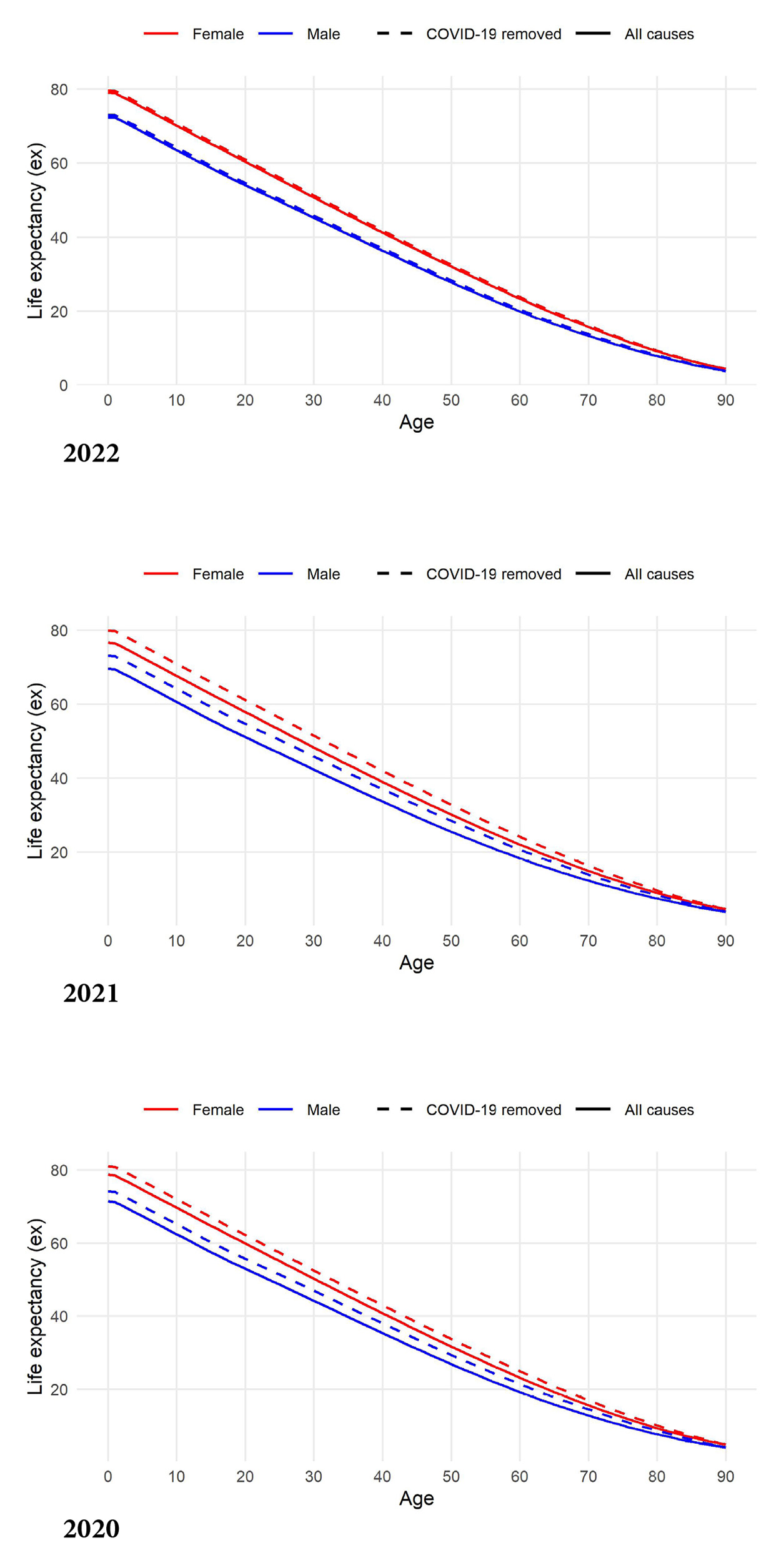
Since mortality rates influence life expectancy estimates, these were also calculated. Figure 2 then presents life expectancy figures with and without COVID-19 deaths, by age and sex, for the years 2020, 2021, and 2022. In 2020, according to Figure 2, life expectancy is higher when COVID-19 deaths are excluded, for both sexes. It is evident that the gap between the lines is wider for men, especially at younger ages. In older age groups, however, the lines are very close for both sexes. Just as the curve for men’s net probability of death crosses that for women’s crude probability of death under the given scenarios, the same occurs with life expectancy.

As shown in Figure 2, the trend is similar in 2021; however, the lines are already further apart compared to 2020, especially for women. In addition, male life expectancy remains lower.
In 2022, the difference in life expectancy trends between the sexes is more noticeable. However, for both, there is little difference between the scenarios, particularly for women, as the lines actually overlap at younger ages.
Also according to Figure 2, life expectancy at birth for males in 2020 was 71 and 74 years, while for females it was 79 and 81 years, in the scenarios where all deaths are considered and where deaths from COVID-19 are excluded, respectively. In 2021, life expectancy was 69 and 77 years (all causes) and 73 and 80 years (excluding the cause) for males and females, in that order. In 2022, they were 72 and 79 (all causes) and 73 and 80 (excluding the cause) for the same genders.
To better understand the impact of eliminating COVID-19 on life expectancy, the difference between life expectancy in the two scenarios was calculated. These differences can be understood as how many more years individuals would live if COVID-19 were not affecting the population.
As Marois et al. (2020) found, the difference amounts to approximately 3 years of life lost across the two cause scenarios, from 2020 to 2021. By 2022, life expectancy increases for men and remains stable for women, a difference shown in Figure 2. According to the results of Castro et al. (2021), the decline in life expectancy at birth is slightly greater in 2021 compared to the previous year.
The differences in life expectancy observed across the scenarios can be understood as the number of additional years individuals would live if the cause of death were not affecting the population. In other words, they represent the number of years of life lost due to deaths associated with the risk in question.
Heuveline and Tzen (2021) estimated a reduction of 1.72 years in Brazilian life expectancy in 2020. In this study, the average difference between life expectancies was 2.19 years (men) and 1.82 years (women) for the same year; in 2021, an average of 2.64 years (men) and 2.37 years (women) were lost; and in 2022, approximately 0.52 years (men) and 0.46 years (women). Thus, in all years, the reduction in life expectancy is greater for men than for women (Castro et al., 2021; Demografia UFRN, 2020; Heuveline & Tzen, 2021; Marois et al., 2020; Silva et al., 2020, 2022).
4.3 Analysis of the VPBF and the PMBC
This subsection presents the results of VPBF and PMBC, calculated according to the formulas described in the Multiple Decrements Model, to demonstrate the impact of pandemic-related mortality on the actuarial liabilities of retired members of the analyzed SSSS.
To this end, the table, initially truncated at age 90, was first extrapolated to age 108. The extrapolation ensured its adherence to the biometric patterns expected for advanced ages. For example, an increasing probability of death (q_x) was observed, which reaches a value of 1 at age 108, along with a decreasing number of survivors (l_x) that reaches a value of 0 at the same age, defining the upper age limit of the extrapolated table. Subsequently, the probabilities of death generated by the multiple-decrement life tables were applied.
Keeping the other actuarial assumptions constant, except for the general mortality table, two scenarios were considered: Scenario 1 (mortality with COVID-19) and Scenario 2 (mortality without COVID-19).
Table 4 presents the results for the 3-year period.
An analysis of the results presented in Table 4 reveals patterns of COVID-19’s impact on longevity and the components of pension obligations, given that the variables x and x/y refer to the obligations associated with the participant and the dependent, respectively, upon the participant’s death.
In Scenario 2 (without COVID-19), in which survival probabilities are higher, the liabilities related to the VPBF and PMBC pertaining to the participant’s retirement-VPBFx and PMBCx, respectively-tend to be higher. This occurs because the civil servant (x) survives longer, prolonging the expenditure on their own retirement. Conversely, the liabilities for the death pension (VPBFx/y and PMBCx/y) are reduced, as the benefit payout is delayed.
Since the results differ across years, the change in liabilities resulting from eliminating COVID-19 deaths was calculated. A positive change indicates an increase in the values of Scenario 2 relative to Scenario 1, and a negative change indicates a decrease in those values. The percentages are presented in Table 5.
The percentage change in liabilities when excluding deaths from COVID-19 shows that, although retirement results (x) exhibited a greater positive change in 2021 (e.g., 6.87% for VPBFx), the largest percentage decrease in pension results (x/y) was observed in 2020 (e.g., -5.21% for VPBFx/y). This difference is explained by the variation between gross and net mortality probabilities in each year and by the inverse relationship between retirement and pension. The largest differences between the probabilities (gross and net) in 2021 resulted from the elimination of COVID-19, which led to higher survival rates, higher retirement expenditures, and lower pension expenditures, justifying the larger variations for the (x) component.
The removal of COVID-19, despite reducing pension liabilities (x/y), led to an increase in total VPBF and PMBC over the three years analyzed, when compared to Scenario 1. This result demonstrates that retirement-related obligations have a more significant financial impact on the entity’s actuarial liabilities than pension obligations due to death. On average, the change in assumptions in scenarios where COVID-19 does not pose a risk of death increased pension liabilities by 4.66% (VPBFx) and 4.64% (PMBCx). Conversely, it reduced pension liabilities by 3.58% (VPBFx/y) and 3.64% (PMBCx/y).
These findings are consistent with studies that have investigated the effects of COVID-19 on actuarial analyses. Delbrouck and Alonso-García (2024), for example, observed that increased mortality due to COVID-19 raises the NPV of life insurance and lowers that of annuities. Similarly, Schnürch et al. (2022) demonstrated that mortality shocks significantly impact the valuation of mortality-related products, with a decrease in annuities and an increase in life insurance. The results corroborate this dynamic: when COVID-19 is eliminated, retirement values (analogous to annuities) increase (higher VPBFx and PMBCx), while death benefit values (analogous to life insurance) decrease (lower VPBFx/y and PMBCx/y).
This sensitivity of social security liabilities to changes in mortality probabilities has also been noted in previous studies (Bezerra & Santos, 2024; Oliveira & Silva, 2024), which highlight the magnitude of its impact on provisions, which are directly affected by the underestimation or overestimation of longevity in the tables used.
Summarizing the main results of this analysis, it follows that altering the mortality table by disregarding deaths from COVID-19 not only affects the values for the VPBF and PMBC but also demonstrates how the population’s longevity-whether poorly estimated or during times of epidemiological events-impacts the magnitude of the effects on actuarial calculations.
Additionally, the composition of the database (504 employees, 77.38% female) must be considered. Since the impacts of pandemic-related mortality on women were smaller than on men, SSSS plans with a higher proportion of male employees could yield divergent results. Thus, for plans with distinct characteristics or other actuarial databases, the same mortality experiences may yield different results.
Finally, Gonzaga et al. (2024) highlight the importance of detailed mortality estimates in the context of COVID-19, which go beyond understanding excess mortality and also serve to inform the planning of public and social security policies in specific areas. This makes it possible to anticipate the potential impacts of new diseases.
5. FINAL REMARKS
This study aimed to analyze the impacts of mortality caused by COVID-19 pandemic on the projected benefit value (PBV) and the projected benefit amount (PBA) for non-working members of a public pension plan. To this end, the life table used was extrapolated, and the multiple-decrement model was employed to construct tables for two scenarios: 1) deaths from COVID-19 are included; and 2) deaths from COVID-19 are disregarded as a cause of death during the pandemic period (2020, 2021, and 2022).
Actuarial calculations were performed based on data from 504 retired civil servants in a public pension plan, using the mortality probabilities resulting from Scenarios 1 and 2, as described above. Finally, the plan’s results were compared specifically regarding the VPBF and the formation of the PM for retired employees.
The main results demonstrate that eliminating COVID-19 as a cause of death reduces the probability of death and increases life expectancy for both sexes and in all years analyzed. Additionally, a greater impact was observed among males and in older age groups.
Regarding the results obtained for VPBF and the PMBC, excluding COVID-19 from the actuarial calculations led to an increase in retirement liabilities and a reduction in death benefit liabilities, compared to the scenario that includes COVID-19. On average, retirement liabilities increased by 4.66% (VPBFx) and 4.64% (PMBCx), while pension liabilities decreased by 3.58% (VPBFx/y) and 3.64% (PMBCx/y).
The significance of this study lies in quantifying the pandemic’s impact on specific pension obligations, a key aspect of actuarial risk management in SSSS. However, this study has some limitations. First, since it was assumed that deaths from COVID-19 in each year would not have occurred from other causes, the indirect effects of the pandemic may have overestimated the direct impact. Another limitation relates to the impossibility of replicating the study and verifying the tables’ applicability to the specific SSSS population, due to anonymity and the lack of death data exclusive to the analyzed SSSS. In this regard, the non-homogeneity of the pandemic’s impacts across different locations may influence the application of general mortality tables to a specific SSSS. Finally, the results are restricted to a single SSSS and only to inactive civil servants, without altering the other actuarial assumptions.
Future studies are suggested to further analyze the pandemic’s impact on mortality, exploring methodologies for estimating mortality tables specific to SSSS. For a detailed understanding of indirect effects and excess mortality, studies such as those by Fernandes et al. (2025) and Shang et al. (2022) may be consulted. Additionally, it is recommended to consider variations in other actuarial assumptions beyond mortality tables, as well as to include active participants, other dependents, and other SSSS.
This study highlights the importance of considering the impact of the pandemic not only on the mortality structure but also on specific areas that rely on assumptions based on such behavior, since a change in just one assumption affected the overall result.
REFERENCES
- Azevedo, P. R. M. de. (2016). Introdução à estatística (3ª ed.). EDUFRN.
-
Bezerra, A. M. R., & Santos, L. C., Jr. (2024). Análise de sensibilidade de premissas atuariais: o caso de um SSSS paraibano. Revista Evidenciação Contábil & Finanças, 11(3), 118-136. https://doi.org/10.22478/ufpb.2318-1001.2023v11n3.68318
» https://doi.org/10.22478/ufpb.2318-1001.2023v11n3.68318 -
Brasil. (1988). Constituição da República Federativa do Brasil de 1988. https://www.planalto.gov.br/ccivil_03/constituicao/constituicao.htm
» https://www.planalto.gov.br/ccivil_03/constituicao/constituicao.htm -
Castro, M. C., Gurzenda, S., Turra, C. M., Kim, S., Andrasfay, T., & Goldman, N. (2021). Reduction in life expectancy in Brazil after COVID-19. Nature Medicine, 27(9), 1629-1635. https://doi.org/10.1038/s41591-021-01437-z
» https://doi.org/10.1038/s41591-021-01437-z - Chiang, C. L. (1968). Introduction to stochastic processes in biostatistics. John Wiley & Sons.
-
Delbrouck, C., & Alonso-García, J. (2024). COVID-19 and excess mortality: An actuarial study. Risks, 12(4), 61. https://doi.org/10.3390/risks12040061
» https://doi.org/10.3390/risks12040061 -
Demografia UFRN. (2020, 22 maio). Expectativa de vida e SRAG. https://demografiaufrn.net/2020/05/22/expectativa-vida-srag/
» https://demografiaufrn.net/2020/05/22/expectativa-vida-srag/ -
Fernandes, F., Turra, C. M., França, G. V. A., & Castro, M. C. (2025). Mortality by cause of death in Brazil: A research note on the effects of the COVID-19 pandemic and contribution to changes in life expectancy at birth. Demography, 62(2), 381-404. https://doi.org/10.1215/00703370-11862487
» https://doi.org/10.1215/00703370-11862487 -
Ferreira, V. R., Teixeira, E. M. de S. F., & Scaff, L. C. de M. (2021). Reforma da previdência, pensão por morte e a covid-19. Cadernos do Programa de Pós-Graduação em Direito/UFRGS, 16(2), 110-127. https://doi.org/10.22456/2317-8558.118962
» https://doi.org/10.22456/2317-8558.118962 - Fonsêca, W. S. D. (2024). O impacto da pandemia de covid-19 no Regime Geral de Previdência Social [Dissertação de Mestrado]. Instituto Brasileiro de Ensino, Desenvolvimento e Pesquisa.
-
Fratoni, L., Levantesi, S., & Menzietti, M. (2022). Measuring financial sustainability and social adequacy of the Italian NDC pension system under the COVID-19 pandemic. Sustainability, 14(23), 16274. https://doi.org/10.3390/su142316274
» https://doi.org/10.3390/su142316274 -
Gonzaga, M. R., Queiroz, B. L., Freire, F. H. M. A., Monteiro-da-Silva, J. H. C., Lima, E. E. C., Silva-Júnior, W. P., Diógenes, V. H. D., Flores-Ortiz, R., Da Costa, L. C. C., Pinto-Junior, E. P., Ichihara, M. Y., Teixeira, C. S. S., Alves, F. J. O., Rocha, A. S., Ferreira, A. J. F., Barreto, M. L., Katikireddi, S. V., Dundas, R., & Leyland, A. H. (2024). Estimation and probabilistic projection of age- and sex-specific mortality rates across Brazilian municipalities between 2010 and 2030. Population Health Metrics, 22(1), 9. https://doi.org/10.1186/s12963-024-00329-x
» https://doi.org/10.1186/s12963-024-00329-x -
Heuveline, P., & Tzen, M. (2021). Beyond deaths per capita: Comparative COVID-19 mortality indicators. BMJ Open, 11(3), e042934. https://doi.org/10.1136/bmjopen-2020-042934
» https://doi.org/10.1136/bmjopen-2020-042934 -
Instituto Brasileiro de Geografia e Estatística. (2024, 26 setembro). Projeções da população. https://www.ibge.gov.br/estatisticas/sociais/populacao/9109-projecao-dapopulacao.html?edicao=41053
» https://www.ibge.gov.br/estatisticas/sociais/populacao/9109-projecao-dapopulacao.html?edicao=41053 -
Lei n. 8.213, de 24 de julho de 1991. (1991, 24 de julho). Dispõe sobre os Planos de Benefícios da Previdência Social e dá outras providências. https://www.planalto.gov.br/ccivil_03/leis/l8213cons.htm
» https://www.planalto.gov.br/ccivil_03/leis/l8213cons.htm -
Marois, G., Muttarak, R., & Scherbov, S. (2020). Assessing the potential impact of COVID-19 on life expectancy. PLoS ONE, 15(9), e0238678. https://doi.org/10.1371/journal.pone.0238678
» https://doi.org/10.1371/journal.pone.0238678 - Martins, R. O. (2024). Impacto da pandemia de covid-19 na despesa previdenciária brasileira com a concessão do benefício por incapacidade temporária [Dissertação de Mestrado]. Fundação Getulio Vargas.
-
Microsoft. (2011). Microsoft Excel [Software]. https://www.microsoft.com
» https://www.microsoft.com -
Ministério da Previdência Social. (2023). Benefícios do GSSS - concessões. https://www.gov.br/previdencia/pt-br/assuntos/previdencia-social/paineis-estatisticos/beneficios-do-GSSS-concessoes
» https://www.gov.br/previdencia/pt-br/assuntos/previdencia-social/paineis-estatisticos/beneficios-do-GSSS-concessoes -
Ministério da Saúde. (2023). Covid-19. https://www.gov.br/saude/pt-br/assuntos/saude-de-a-a-z/c/covid-19
» https://www.gov.br/saude/pt-br/assuntos/saude-de-a-a-z/c/covid-19 -
Ministério da Saúde. (2024a). Síndrome respiratória aguda grave (SRAG) 2021 e 2022 [Conjunto de dados]. Portal Brasileiro de Dados Abertos. https://dados.gov.br/dados/conjuntos-dados/srag-2021-e-2022
» https://dados.gov.br/dados/conjuntos-dados/srag-2021-e-2022 -
Ministério da Saúde. (2024b). Sistema de Informação sobre Mortalidade - SIM (1979-2019) [Conjunto de dados]. Portal Brasileiro de Dados Abertos. https://dados.gov.br/dados/conjuntos-dados/sim-1979-2019
» https://dados.gov.br/dados/conjuntos-dados/sim-1979-2019 - Moura, A. R. P. (2022). O impacto da pandemia na concessão dos benefícios por incapacidade temporária [Trabalho de Conclusão de Curso]. Centro Universitário do Rio Grande do Norte.
-
Nunes, J. M. (2021). Pensão por morte: alterações introduzidas pela Emenda Constitucional 103/2019. Revista Ciências Jurídicas e Sociais - UNG-Ser, 10(2), 30. https://doi.org/10.33947/2238-4510-v10n2-4467
» https://doi.org/10.33947/2238-4510-v10n2-4467 -
Oliveira, H., & Silva, M. (2024). Implicações da crise da covid-19 no valor atual dos benefícios futuros do SSSS de Santa Rita/PB. Revista Brasileira de Previdência, 15(1), 23-43. https://dx.doi.org/10.21902/rbp.v15i1.6922
» https://dx.doi.org/10.21902/rbp.v15i1.6922 -
Olivera, J., & Valderrama, J. A. (2022). The impact of the COVID-19 pandemic on the future pensions of the Peruvian pension system [Working Paper]. Inter-American Development Bank. https://doi.org/10.18235/0004533
» https://doi.org/10.18235/0004533 -
Organização Pan-Americana da Saúde/Organização Mundial da Saúde. (2022, 5 de maio). Excesso de mortalidade associado à pandemia de COVID-19 foi de 14,9 milhões em 2020 e 2021. https://www.paho.org/pt/noticias/5-5-2022-excesso-mortalidade-associado-pandemia-Covid-19-foi-149-milhoes-em-2020-e-2021
» https://www.paho.org/pt/noticias/5-5-2022-excesso-mortalidade-associado-pandemia-Covid-19-foi-149-milhoes-em-2020-e-2021 -
Portaria ME n. 424, de 29 de dezembro de 2020. (2020). Fixa as novas idades de que tratam a alínea “b” do inciso VII do art. 222 da Lei no 8.112, de 11 de dezembro de 1990, e a alínea “c” do inciso V do § 2o do art. 77 da Lei no 8.213, de 24 de julho de 1991. https://www.in.gov.br/en/web/dou/-/portaria-me-n-424-de-29-de-dezembro-de-2020-296880511
» https://www.in.gov.br/en/web/dou/-/portaria-me-n-424-de-29-de-dezembro-de-2020-296880511 -
Portaria n. 188, de 3 de fevereiro de 2020. (2020). Declara Emergência em Saúde Pública de importância Nacional (ESPIN) em decorrência da Infecção Humana pelo novo Coronavírus (2019-nCoV). https://bvsms.saude.gov.br/bvs/saudelegis/gm/2020/prt0188_04_02_2020.html
» https://bvsms.saude.gov.br/bvs/saudelegis/gm/2020/prt0188_04_02_2020.html -
Portaria MTP n. 1.467, de 2 de junho de 2022. (2022). Disciplina os parâmetros e as diretrizes gerais para organização e funcionamento dos regimes próprios de previdência social dos servidores públicos da União, dos Estados, do Distrito Federal e dos Municípios, em cumprimento à Lei no 9.717, de 1998, aos arts. 1o e 2o da Lei no 10.887, de 2004 e à Emenda Constitucional no 103, de 2019 https://www.gov.br/previdencia/pt-br/assuntos/SSSS/legislacao-dos-SSSS/portarias/copy_of_PortariaMTPn1.467de02jun2022Atualizadaat28jun20231.pdf
» https://www.gov.br/previdencia/pt-br/assuntos/SSSS/legislacao-dos-SSSS/portarias/copy_of_PortariaMTPn1.467de02jun2022Atualizadaat28jun20231.pdf -
Portaria GM/MS N. 913, de 22 de abril de 2022. (2022). Declara o encerramento da Emergência em Saúde Pública de Importância Nacional (ESPIN) em decorrência da infecção humana pelo novo coronavírus (2019-nCoV) e revoga a Portaria GM/MS nº 188, de 3 de fevereiro de 2020. https://bvsms.saude.gov.br/bvs/saudelegis/gm/2022/prt0913_22_04_2022.html
» https://bvsms.saude.gov.br/bvs/saudelegis/gm/2022/prt0913_22_04_2022.html -
R Core Team. (2024). R: A language and environment for statistical computing (versão x.x.x) [Software]. R Foundation for Statistical Computing. https://www.r-project.org/
» https://www.r-project.org/ - Rodrigues, J. Â. (2008). Gestão de risco atuarial. Saraiva.
-
Schnürch, S., Kleinow, T., Korn, R., & Wagner, A. (2022). The impact of mortality shocks on modelling and insurance valuation as exemplified by COVID-19. Annals of Actuarial Science, 16(3), 498-526. https://doi.org/10.1017/S1748499522000045
» https://doi.org/10.1017/S1748499522000045 -
Shang, W., Wang, Y., Yuan, J., Guo, Z., Liu, J., & Liu, M. (2022). Global excess mortality during COVID-19 pandemic: A systematic review and meta-analysis. Vaccines, 10(10), 1702. https://doi.org/10.3390/vaccines10101702
» https://doi.org/10.3390/vaccines10101702 - Silva, B. da C., Gonçalves, D. de O., Pala, L. O. de O., & Terra, L. P. (2020). O impacto do COVID-19 na expectativa de vida ao nascer da população brasileira. In Anais do IX Congreso de la Asociación Latinoamericana de Población (pp. 1-20).
-
Silva, L. G. de C. (2015). Nota técnica atuarial: Extrapolação da tábua IBGE. Ministério da Previdência Social. https://sa.previdencia.gov.br/site/2015/06/NOTA-TECNICA-ATUARIAL-EXTRAPOLACAO-DA-TABUA-IBGE-MPS.pdf
» https://sa.previdencia.gov.br/site/2015/06/NOTA-TECNICA-ATUARIAL-EXTRAPOLACAO-DA-TABUA-IBGE-MPS.pdf - Silva, R. L., Duarte, A. S., & Terra, L. P. (2022). COVID-19: impactos na mortalidade e expectativa de vida no Brasil em 2020 e 2021. Sigmae, 10(2), 22-35. https://doi.org/10.29327/2520355.10.2-2
-
This is a bilingual text. This article was originally written in Portuguese, published under the DOI https://doi.org/10.1590/1808-057x20252319.pt
-
This article is derived from an undergraduate thesis defended by the author Vitória Cássia Oliveira Gomes da Silva, under the supervision of the author Luiz Carlos Santos Júnior, in 2024.
-
Study presented at the Congresso de Ciências Contábeis e Atuariais da Paraíba (CONCICAT), João Pessoa, PB, Brazil, August 2024.
-
DATA AVAILABILITY STATEMENT
The dataset supporting the results of this study is not publicly available.
-
STATEMENT ON THE USE OF AI
The authors declare that generative artificial intelligence was used in the following stages of the production of this manuscript: text refinement (ChatGPT). The authors declare that, regardless of the use of the tools mentioned above, all generated content was supervised, verified, and critically validated by humans. The authors assume full and exclusive responsibility for the accuracy of the data, integrity of mathematical/statistical formulas, originality of the text, and the conclusions presented in the published article.
The dataset supporting the results of this study is not publicly available.

 Source: Prepared by the authors using data from the Mortality Information System (
 Source: Prepared by the authors using data from the Mortality Information System (