 Informational and formative strategies aimed at the LGBTQIAPN+ population in school libraries
ABSTRACT
Introduction: Societies have advanced in debates about minority groups, raising questions to rethink practices that act in this perspective. Based on this, education and the school library can play an important role in seeking to address issues relating, for example, to the LGBTQIAPN+ population, as a socially vulnerable group, and this due to existing and recurrent prejudices in social structures. Therefore, it is urgent to think about training strategies to be developed within the school library so that they can act to reduce prejudice and discrimination against this particular community.
Objective: The objective is to outline some proposals for educational and informational practices that can be developed in school libraries, in the Brazilian context, to combat LGBTphobia in the educational environment. Methodology: this research, of an exploratory nature, uses a bibliographic and documentary approach to understand relationships between the themes of school library, gender and sexuality, prejudice at school and LGBTQIAPN+ communities.
Results: From the discussions held, it is clear that this social minority suffers prejudice in the school environment, causing an impact on academic performance and even dropping out in some cases. Thus, the importance of working on strategic actions that can combat prejudice and discrimination in the school context is evident, so that it is possible to achieve effective and affective social inclusion, thus helping to confront the discourse of heteronormativity. Conclusion. Finally, some premises are outlined that can serve as training and informational strategies to combat LGBTphobia in the educational environment, in order to contribute to the construction of welcoming and inclusive spaces, respecting the differences.
KEYWORDS
Library science; School library; Education; LGBTQIAPN+ population; Social minotiry.
RESUMO
Introdução: As sociedades têm avançado quanto aos debates acerca dos grupos menorizados, levantando questões para repensar práticas que atuem nessa perspectiva. A partir disso, a educação e a biblioteca escolar podem ter papel importante ao procurar abordar questões atinentes, por exemplo, à população LGBTQIAPN+, enquanto grupo em vulnerabilidade social, e isso devido aos preconceitos existentes e recorrentes nas estruturas sociais. Assim, é urgente pensar estratégias formativas a serem desenvolvidas no âmbito da biblioteca escolar para que possam atuar na redução de preconceitos e discriminações contra essa comunidade em particular.
Objetivo: O objetivo é traçar algumas proposições de práticas educativas e informacionais que possam ser desenvolvidas em bibliotecas escolares, no contexto brasileiro, para combater a LGBTfobia no ambiente educacional. Metodologia: Esta pesquisa, de natureza exploratória, lança mão de abordagem bibliográfica e documental para compreender relações existentes entre os temas biblioteca escolar, gênero e sexualidade, preconceito na escola e comunidades LGBTQIAPN+.
Resultados: A partir das discussões realizadas, percebe-se que essa minoria social sofre preconceitos no ambiente escolar, gerando impacto no rendimento escolar e até mesmo evasão em alguns casos. Assim, flagra-se a importância de se trabalhar ações estratégicas que possam combater os preconceitos e discriminações no contexto escolar, de modo que seja possível alcançar uma efetiva e afetiva inclusão social, ajudando, assim, a confrontar o discurso da heteronormatividade.
Conclusão: Por fim, esboçam-se algumas premissas que podem servir de estratégias formativas e informacionais de combate à LGBTfobia no ambiente educacional, de modo a contribuir com a construção de espaços acolhedores e inclusivos, respeitando as diferenças.
PALAVRAS-CHAVE
Biblioteconomia; Biblioteca escolar; Educação; População LGBTQIAPN+; Grupos menorizados.
1 INTRODUCTION
Discussions about minoritized groups (groups and populations that are minoritized within a prejudiced social structure) are gaining ground in contemporary social debates, demonstrating the need to reflect on and produce fairer practices in a wide variety of spaces and environments. In this sense, the school library is one of those spaces that needs to work in line with the debates on social vulnerability, so that they can be allied with the fight against prejudice and discrimination in the school context.
In light of the above, LGBTQIAPN+ people 1 are a group that suffers from prejudice and discrimination in society, given their dissident experiences, which deviate from the expected standard (Sousa Júnior; Mendes, 2020). These factors are commonly manifested in school environments, resulting in bullying and often causing school attrition, physical and psychological suffering, and isolation, among others, directly impacting people's lives, since such issues are not solely confined to the school environment (Ventimiglia; Menezes, 2020).
Therefore, the educational function of school libraries provides the potential to envisage the development of actions and strategies aligned with education from an informational perspective that can combat the harms caused by LGBTphobia2. Minoritized groups suffer from certain factors in society; in the case of the LGBTQIAPN+ population, prejudice and discrimination cause these people to find themselves in a situation of social vulnerability.
Education is one of the essential foundations for the development of a critical thinking sense, for reflecting on social inequalities, and for the shaping of ethical and autonomous individuals. In addition to this, it is through education that individuals acquire skills (technical, social, emotional, etc.) that are fundamental for social interaction, as well as knowledge that will be invaluable for exercising citizenship and accessing information.
From this perspective, information is an important resource for ensuring access to rights, and access to services (health, education, legal, social, etc.) which, in turn, are pillars for demystifying prejudices, stigmas, and discrimination. The new demands of the 2020s, severely intensified by the COVID-19 pandemic, the proliferation of misinformation and fake news, the spread of denialist and anti-scientific discourses, as well as the vast amount of information available on the web, amplified by artificial intelligence, leads us to the need to seek new ways of circumventing and even confronting these problems that so affect our populations, particularly those who have historically been -and continue to be- placed in situations of vulnerability.
Consequently, drawing up strategies to deal with such demands, starting from education and information, places the school library as one of the essential spaces for this fight. In a social fabric which is sewn together by the “thread” of the white cisheteropatriarchy, LGBTQIAPN+ people, as well as black, indigenous, riverside, disabled, and other people who do not fit into the colonizing discourses of normativity, each in their own way, suffer the weight of prejudice and discrimination not only in the context of schools but in society as a whole, which makes their lives more difficult to live.
Thus, the aim presented in this paper is to outline some proposals for educational and informational practices that can be developed in school libraries in the Brazilian context, to combat LGBTphobia in the educational environment. In terms of methodological aspects, this exploratory study employs a bibliographical approach (referring to the relevant literature) and a documentary approach (referring to statistical data provided in documents from non-governmental organizations - NGOs), in order to understand the relationships between the themes of school library, gender and sexuality, prejudice at school and LGBTQIAPN+ communities, so as to outline some premises that can serve as formative and informational strategies.
2 LIBRARY, EDUCATION AND INFORMATION: AIMING FOR CONFLUENCES
Libraries have been known throughout human history as the place where knowledge resides, where memories are preserved and conserved, where information is processed and disseminated, as well as diverse cultures (Bernardino & Suaiden, 2011). It is worth remembering that these spaces were not always accessible to the general public, but were rather restricted to religious, economic and intellectual elites, etc.
Murguia (2010) had previously discussed the library as a social space since its associative nature allows for the formation of different networks and different types of knowledge. Sales & Garzez (2021), by addressing the library as a device, which in the Foucauldian tradition is understood as a network of heterogeneous elements that fulfill strategic functions, have demonstrated how the library can actually interfere as a counter-device in favor of decoloniality, providing an understanding of how transformative these spaces of culture and knowledge can be.
Concerning public libraries, they are spaces for building cultures and knowledge, as well as providing learning environments, with a social function connected to access to information, the dissemination of culture, and the construction of new knowledge (Bernardino & Suaiden, 2011). On the other hand, school libraries fulfill the function of supporting teaching and learning in an educational context, as well as encouraging reading, combining education and information in a single function.
Librarians assigned to school libraries play a fundamental role in making information available and contributing to student learning, based on the school's objectives, working in conjunction with teachers. (Cavalcante; Velanga; Pimenta, 2020). In this sense, school libraries are environments meant for the development of actions that promote the production of new knowledge, the encouragement of reading habits, the promotion of cultural activities, and also access to information for the school community.
Given this, Cavalcante, Velanga & Pimenta (2020, p. 2) state that:
The action of mediating is welcome in such a school environment since it aligns with pedagogical practice. In this scenario, the library interacts with the teacher in the incessant search to fulfill one of its functions: to support, to connect the content of bibliographic materials to those of the teachers as a practice of the school curriculum (Cavalcante; Velanga; Pimenta, 2020, p. 2).
It is safe to state that the school library is a space in constant motion and must be led by library professionals, teachers, and students who take on a leading role in making information available in places of learning (Lipinski; Cristovam, 2021). By understanding the importance of libraries, we can perceive the opportunity to address issues that can contribute to reducing social inequalities.
Individuals who are part of the LGBTQIAPN+ communities suffer from violent manifestations of LGBTphobia rooted deep in the historical construction of the social fabric as a whole. These factors also extend to the school context, causing harm to the learning process of students, as well as traumas in their lives. In this way, the school library, a device-space that connects education, information, and knowledge, can take on the ethical and social commitment of contributing to the reduction of violence that affects the LGBTQIAPN+ community.
3 SCHOOL LIBRARIES AND THEIR EDUCATIONAL ROLE: LGBTQIAPN+ POPULATION IN FOCUS
The school library is of great importance in the process of building knowledge and teaching and learning in an educational context. It is in this environment that the student body can have contact with the world of reading, through literature, for example, but also in the construction of knowledge that is offered in the classroom. From this perspective, Lipinski & Cristovam (2021) argue that far from being stereotyped as a place to store books, the school library performs an essential pedagogical function when it is worked on in conjunction with school professionals (librarians, teachers, pedagogues, etc.), thus providing an environment that is conducive to promoting a rich space for the teaching and learning process.
The International Federation of Library Associations and Institutions (IFLA) (2015, p. 19), in its guidelines for school libraries, defines it as “a physical and digital space in the school where reading, research, investigation, thinking, imagination, and creativity are fundamental to the students' journey”, emphasizing that this characteristic permeates the personal, social and cultural spheres, from information to knowledge. In addition, it is stated that the school library should be accessible to all individuals, as well as a safe, equitable, educational, social, and cultural place.
Similarly to IFLA (2015), the authors Lipinski and Cristovam (2021) state that the school library is a place for teaching and learning, in which education plays a fundamental role in the development of critical and reflective thinking, contributing to the school community being a place of citizenship where people will learn to use tools, resources, and technologies that assist in the search for information.
Furthermore, Nunes and Santos (2020) corroborate and complement this statement by affirming that the school library enables the mediation of reading in the education of readers, and should involve librarians and teachers to work together to achieve this goal. Critical and reflective thinking is also emphasized by the authors, in addition to the construction of knowledge, with the school library being a place with the mission of providing information and services that contribute to the formation of responsible citizens.
Collaborative work to achieve a common goal is pointed out by Nunes & Santos (2020, p. 8) when they state that “Teachers and librarians should act in partnership to develop educational activities and cultural actions, thus transforming the library into a pedagogical tool”. In these circumstances, we can understand how the school library can and should contribute to building and proposing educational, informational, and cultural activities that value the diversity that exists in societies.
Nascimento (2022) addresses the school library as an auxiliary instrument in the learning process that must have an up-to-date collection that meets the needs of the institution in which it is inserted, but which, above all, provides a welcoming environment for its visitors.
In line with Nunes & Santos (2020), who raise the issue of the mediation of reading and cultural actions, Nascimento (2022) states that information and culture act as stimuli for individuals' learning, as well as for social interactions between teaching staff and librarians, as they have the potential to motivate reading and, who knows, foster the critical and reflective use of information.
Silva et al. (2021) presented a study that revealed the psychological suffering of LGBTQIAPN+ young individuals as a result of discrimination, prejudice, oppression, stigmatization, and exclusion suffered by people with a sexual orientation and gender identity different from what society has historically understood as heteronormativity. The mental health of schoolchildren directly affects their lives in the most varied areas, as Silva et al. (2021, p. 2648) point out: “[...] the fear of suffering new violence limits their involvement and inclusion in various social contexts, causing them to drop out of school, withdraw from friends and lose emotional ties”.
In this sense, the violence that LGBTQIAPN+ individuals suffer has an impact on their mental health, undermining their self-esteem, and causing fear and seclusion to be frequent, in an attempt at self-preservation. In addition, school attrition occurs due to the oppression that students may experience in this context, making them seek to escape this reality of vulnerability so as not to suffer from LGBTphobia.
Subsequently, Melo (2016) emphasizes that the school library is an environment that needs to be welcoming and contribute to the construction of knowledge, since after the classroom, the school library needs to be a space that will enable access to information that will be useful for the development of knowledge and critical thinking. School teachers and library professionals are important agents in democratizing the space and knowledge of a school library, not only in the educational sphere but also in the cultural, social, and informational spheres, so that it is possible to contribute to the development of socially aware citizens and lifelong learning.
4 LGBTQIAPN+ POPULATION IN CIS-HETERONORMATIVE SOCIETY
LGBTQIAPN+ social movements began in the 1970s when they were still called the “Brazilian Homosexual Movement (MHB)”. Over the years, new political actors have joined the social movements, such as lesbians, travesties, transsexuals, and bisexuals (Sousa Júnior; Mendes, 2021). While at the beginning the MHB's name was singular, representing a single group, other groups soon came to be identified until the current acronym was formed, with each letter representing a specific group, in a conglomeration of various LGBTQIAPN+ activism movements.
The existence of social movements arose primarily as a counterpoint to the oppression and violence that this population suffered (and suffers) and to demand rights that were denied to these individuals. Thus, the struggles of the social movements of individuals who did not fit into the cis-heteronormative3 standard sought recognition as human beings worthy of living their lives freely, without the repressions that were imposed upon them.
Although social movements have gained ground and won some battles, violence against this social minority continues to occur in Brazil. To illustrate this issue, Graph 1 below provides some data on this reality.
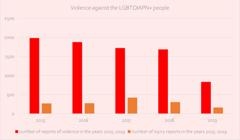
The 2021 Atlas of Violence provides data on violence, especially through Dial 100 (Human Rights Hotline of the Ministry of Women, Family and Human Rights). It is important to fight against the violence and other oppressions that this population suffers, through actions and activities that can help minimize this damage, especially through education and information.
The struggle for the recognition of the rights and citizenship of the LGBTQIAPN+ population transcends social activism, materialized by social movements, by individuals who are engaged in the fight and political participation by demanding from the State the rights that are denied to this population. (Albernaz; Kauss, 2015). Social activism and engagement, which join forces in a political and coordinated way to pressure the State, due to its lack of effective action, have succeeded in securing rights through the Federal Supreme Court (STF), such as, for example, the legitimization by law of the stable union of LGBTQIAPN+ individuals, a right granted by this body with the active participation of social movements. (Albernaz; Kauss, 2015).
Regarding the rights of this social minority, although the 1988 Federal Constitution defines social rights, such as the right to education, health, security, housing, and food, among others (Brazil, 1988), not all LGBTQIAPN+ individuals can access citizenship in terms of the rights guaranteed by the Constitution.
As for the educational environment, prejudice and discrimination end up materializing in bullying and LGBTQIAPN+ individuals who study, and experience school suffer from this violence. This has a direct impact on the performance, mental health, and permanence of these individuals in the school environment. Symbolic violence is a factor that affects the school community and contributes to a toxic environment for those who do not conform to cis-heternormativity (Ventimiglia; Menezes, 2020).
In this sense, Louro (2007) points out that both boys and girls learn the practice of bullying from a very early age, materialized in joking, gestures, mockery, and nicknames directed at those who do not fit into the gender and sexuality standards accepted in the society in which they live. As a result, an environment is created in which LGBTphobia has fertile ground to develop, directly affecting the school experience and the lives of LGBTQIAPN+ individuals who find themselves in these places.
Cardoso and Ferro (2012) state that LGBTQIAPN+ individuals constitute a vulnerable population in that they face barriers to accessing basic public services, such as the healthcare sector. They also point out that there is a need for professionals in these public places to know how to provide care and accommodate the specific needs of this particular population, especially concerning the training of healthcare workers. Trans people, for example, have specific health demands, therefore it is necessary for healthcare professionals to be prepared to provide assistance to all LGBTQIAPN+ individuals, without discrimination. (Cardoso; Ferro, 2012).
In addition, Graph 2 below presents some data on the deaths of LGBTQIAPN+ individuals in Brazil. Given the lack of statistics from the Brazilian Government in this regard, organized social movements seek to compile and make this scenario visible. The figures presented below were taken from activist groups: Acontece Arte e Política LGBTI+; National Association of Transvestites and Transsexuals (ANTRA); Brazilian Association of Lesbians, Gays, Bisexuals, Travestis, Transsexuals and Intersex Individuals (ABGLT), Distrito Drag and Grupo Gay da Bahia (GGB).

The activist groups warn in their records that the statistics presented are underreported, especially considering the size of the country and the difficulties in carrying out more comprehensive mapping. The lack of financial and human resources are also factors that hinder the collection of these figures, however, with such data it is possible to observe the reality of this specific population in terms of violence.
While LGBTQIAPN+ people lose their lives as victims of prejudice, discrimination, violence, vulnerability, and other oppressions, the politicians elected by the people have never passed a law that protects these lives and criminalizes those who directly or indirectly corroborate these deaths (Santana, 2019). Thus, in 2019, in an attempt to combat this violence, the Federal Supreme Court equated LGBTphobia with the Racism Law, thus marking a milestone in the rights of this social group in Brazil (Santana, 2019).
Furthermore, there is a lack of actions aimed at addressing the demands of these individuals, given that there are specific needs for each group represented by the letters of the acronym LGBTQIAPN+, a fact that requires different attention and actions for each letter of the initials. (Cardoso; Ferro, 2012). Thinking about strategies that move towards the development and involvement of actions aimed at the LGBTQIAPN+ population is of great social relevance, in order to contribute to an inclusive society, confronting social inequalities.
5 METHODOLOGICAL ASPECTS
The study presented here takes a qualitative approach, relying on bibliographical and documentary research, as the paper seeks to develop strategic actions to help combat prejudice and discrimination against the LGBTQIAPN+ population. In this sense, the bibliographical research was conducted using databases such as the Information Science Database (BRAPCI), the Scientific Electronic Library Online (SciELO), and the CAPES Journal Portal.
The searches contained keywords such as: “LGBTQIAPN+” and its variations (LGBT, LGBTI, LGBTQIA, LGBTQ), combined using the Boolean “and” with the terms “actions in school libraries”, “practices in school libraries”, “strategies in libraries” so that no materials were found that addressed practices, actions or training strategies aimed at school libraries on the subject of LGBTQIAPN+.
In this sense, the documentary research focused on Non-Governmental Organizations (NGOs) that provided reports and documents with statistical data on the violence endured by this population in the Brazilian context. On this basis, the NGOs selected were: Acontece Arte e Política LGBTI+; Associação Nacional de Travestis e Transexuais (ANTRA); the Brazilian Association of Lesbians, Gays, Bisexuals, Transvestites, Transsexuals and Intersex Individuals (ABGLT), Distrito Drag and Grupo Gay da Bahia (GGB).
Although the 2021 Atlas of Violence report was published by the Institute for Applied Economic Research (IPEA), there is data on violence experienced by the LGBTQIAPN+ population, even though we do not have more recent data (the latest data is from the year 2021), it nevertheless helps us to see the reality of this community in Brazil. The NGO reports are slightly more focused on the statistics regarding physical violence (such as deaths, suicides, murders, etc.), while the Atlas of Violence provides a broader overview, including verbal, psychological, and physical violence, etc., obtained from reports made via Dial 100. It should be noted that all the documents employed to produce the graphs “Statistical data on violence against LGBTQIAPN+ people” and “Statistical data on deaths of LGBTQIAPN+ people” contain more information concerning the violence suffered by this population; the graphs are utilized here to show a “general summary” of the panorama experienced in the Brazilian context.
Accordingly, by taking into account the data presented, based on the readings of the theoretical framework that has been utilized throughout this study, and based on the perception of the authors, actions were drawn up from an informational and educational perspective, with respective objectives for each action, in order to contribute to the fight against LGBTIphobia in the country. Thus, it is not the intention to place the responsibility for a structural problem on the areas of Education and Librarianship, rather, these are areas that have fertile environments to help in this necessary struggle. By understanding the school as a space that shapes individuals, it is possible to contribute to social transformation in the hope of developing a more just, equal, and welcoming society for all people.
6 FORMATIVE STRATEGIES IN THE SCHOOL LIBRARY
The factors that lead the LGBTQIAPN+ population to experience social vulnerability have a direct impact on their access to citizenship and their rights. Violence, poverty, social exclusion, prejudice, and unemployment are some of the aspects that contribute to social vulnerability impacting the lives of LGBTQIAPN+ people. (Righetto; Vitorino; Muriel-Torrado, 2018). From this perspective, the school is an environment with great potential for developing activities that can combat said factors.
It should be noted that social vulnerability is not an exclusive feature that affects the LGBTQIAPN+ population, as other socially minoritized populations also suffer from issues of disrespect for human rights. Specifically about the LGBTQIAPN+ population, the aim here is to consider actions that can be developed in school libraries in order to confront the scenario of violence that assails the LGBTQIAPN+ community.
The school library is a fertile environment for education and the construction of knowledge, as well as a learning and teaching space that can contribute to the development of the school community. In this sense, Casali & Gonçalves (2019) state that the social function of the school is based on promoting the right to education, on building school spaces as environments that will operate in a secure manner and without prejudice and intolerance, so that it will be possible to promote citizenship and equality.
In this perspective, Casali & Gonçalves (2019) argue that discrimination based on sexual orientation and gender identity are factors that lead students to drop out of school, thereby contributing to increased social, economic, and emotional vulnerability and other forms of violence that further contribute to the weakening of a socially just nation. That said, the school needs to be a welcoming and safe environment so that people can develop their learning and the construction of knowledge, and thus the school library may become a safe and welcoming space for these people.
Nascimento (2022) argues that the school library is an interdisciplinary environment and highlights the importance of partnerships between librarians, teachers, pedagogues, and other professionals who work in this context, to develop activities that seek equality and equity in these spaces. Moreover, the school library is a fundamental institution for improving reading habits, education, and culture, promoting a welcoming and inclusive environment, and also stimulating critical and reflective thinking (Nascimento, 2022).
Based on the assumption that the school library is an environment for the construction of knowledge, with the potential to promote welcoming and inclusive practices, capable of combating prejudices and stigmatized cultures, the chart below presents ten proposals for actions that can be developed in school libraries and which are taken here as premises for combating LGBTIphobia in schools. Chart 1 presents actions that can be carried out in schools to confront and combat oppression and violence that affects the LGBTQIAPN+ population, to be implemented in school libraries with the support and partnership of the educational community.
The activities presented above can be carried out in school libraries together with the entire school community, as well as involving the guardians of the students, contributing to an inclusive and welcoming environment. Moreover, these actions are intended to contribute to the appreciation of LGBTQIAPN+ experiences, combating prejudice and bullying in the school context, demystifying stigmas about these individuals, as well as promoting diversity, basing actions on ethical values of empowerment of this population.
6 CONCLUSION
The role of the school library can go beyond the teaching and learning process, as well as providing relevant information not only within the educational sphere but can also be useful for the lives of the people within this context. The construction of knowledge can develop fertile ground in this space, especially when it seeks to be a place of refuge and safety for all the people who experience the school, such as LGBTQIAPN+ individuals.
Thus, although prejudice, discrimination, stigma, violence, and social vulnerability are factors that impact the school lives of these individuals, the school library plays an important role in combating such problems. In a collaborative effort between education professionals, such as librarians, teachers, pedagogues, etc., actions and activities can be implemented in school libraries to promote and value diversity.
Therefore, in addition to its role in education, the school library can contribute to the dissemination of culture, through the mediation of reading, for example, thereby enabling students to develop critical and reflective thinking. In this manner, in addition to facilitating access to and the use of existing information in society, the school library and its social function contribute to the empowerment of social groups in situations of social vulnerability, such as the LGBTQIAPN+ population, through education and information strategies, thus combating the social inequalities endured by these individuals.
From this perspective, the suggestions for actions presented above directed at the environment of the school library are not intended to be an absolute proposition, but rather to contribute theoretically to the discussion and promote concerns/reflections regarding minority groups and, perhaps, awaken the desire for these actions to actually be carried out in that setting.
As such, the actions expressed here start primarily from the perspective of education and information, so that they value diversity, culture, education, and social inclusion, such as literary events (poetry soirees and literary clubs) which, combined with the themes pertaining to the LGBTQIAPN+ population, encompass the social, educational and empowerment dimensions of said group, since they also seek to value these individuals.
Furthermore, it is important to emphasize that this article is an attempt to sow the seeds of a discussion on the school library as a place that seeks to promote diversity, especially concerning LGBTQIAPN+ individuals who endure so much violence in society and at school.
Availability of data and material:
Not applicable.
Acknowledgments:
Not applicable.
-
ODS: 5 -
Gender Equality
-
JITA: DE.
School libraries
-
Image:
Author's private collection.
-
Ethical approval:
Not applicable.
-
Funding:
Not applicable.
-
1
Lesbian, Gay, Bisexual, Travestis, Transsexual, Queer, Intersex, Asexual, Pansexual, Non-Binary and other sexual orientations, gender identities and gender/sexual expressions.
-
2
Hatred, aversion, prejudice and discrimination against LGBTQIAPN+ people (Reis, 2018).
-
3
Expression used to refer to a social norm regarding following heterosexual and cisgender standards (Reis, 2018).
References
-
ALBERNAZ, R. O.; KAUSS, B. S. Reconhecimento, igualdade complexa e luta por direitos à população LGBT através das decisões dos tribunais superiores no Brasil. Revista Psicologia Política, São Paulo, v.15, n.34, dez. 2015. Disponível em: http://pepsic.bvsalud.org/pdf/rpp/v15n34/v15n34a07.pdf Acesso: 5 ago. 2023.
» http://pepsic.bvsalud.org/pdf/rpp/v15n34/v15n34a07.pdf -
BENEVIDES, B. Mapa dos assassinatos de travestis e transexuais no Brasil em 2017 Brasília, DF: Associação Nacional de Travestis e Transexuais (ANTRA), 2018. Disponível em: https://abrir.link/WoslO Acesso em: 10 out. 2023.
» https://abrir.link/WoslO -
BENEVIDES, B.; NOGUEIRA, S. N. B. (org.). Dossiê dos assassinatos e violência contra travestis e transexuais no Brasil em 2018. Brasília, DF: Associação Nacional de Travestis e Transexuais (ANTRA); Distrito Drag; Instituto Brasileiro Trans de Educação (IBTE), 2019. Disponível em: https://encurtador.com.br/XiVtO Acesso em: 10 out. 2023.
» https://encurtador.com.br/XiVtO -
BENEVIDES, B.; NOGUEIRA, S. N. B. (org.). Dossiê dos assassinatos e da violência contra travestis e transexuais brasileiras em 2019 São Paulo: Expressão Popular; Associação Nacional de Travestis e Transexuais (ANTRA); Instituto Brasileiro Trans de Educação (IBTE), 2020. Disponível em: https://encurtador.com.br/7NZky Acesso em: 10 out. 2023.
» https://encurtador.com.br/7NZky -
BENEVIDES, B.; NOGUEIRA, S. N. B. (org.). Dossiê dos assassinatos e da violência contra travestis e transexuais brasileiras em 2020 São Paulo: Expressão Popular; Associação Nacional de Travestis e Transexuais (ANTRA); Instituto Brasileiro Trans de Educação (IBTE), 2021. Disponível em: https://abrir.link/zFclc Acesso em: 10 out. 2023.
» https://abrir.link/zFclc -
BENEVIDES, B. (org.). Dossiê dos assassinatos e violências contra travestis e transexuais brasileiras em 2021 Brasília, DF: Distrito Drag; Associação Nacional de Travestis e Transexuais (ANTRA), 2022. Disponível em: https://abrir.link/Nulrx Acesso em: 10 out. 2023.
» https://abrir.link/Nulrx -
BENEVIDES, B. (org.). Dossiê dos assassinatos e violências contra travestis e transexuais brasileiras em 2022 Brasília, DF: Distrito Drag; Associação Nacional de Travestis e Transexuais (ANTRA), 2023. Disponível em: https://abrir.link/IQJHd Acesso em: 10 out. 2023.
» https://abrir.link/IQJHd -
BERNARDINO, M. C. R.; SUAIDEN, E. J. O papel social da biblioteca pública na interação entre informação e conhecimento no contexto da ciência da informação. Perspectivas em Ciência da Informação, Belo Horizonte, v. 16, n. 4, p. 29-41, out./dez. 2011. Disponível em: https://www.scielo.br/j/pci/a/59tSQqr4G9TjSBNBGdXnrrv/?format=pdf⟨=pt Acesso em: 26 jul. 2023.
» https://www.scielo.br/j/pci/a/59tSQqr4G9TjSBNBGdXnrrv/?format=pdf⟨=pt - BRASIL. [Constituição (1988)]. Constituição da República Federativa do Brasil Brasília, DF: Senado Federal, 1988.
-
CARDOSO, M. R.; FERRO, L. F. Saúde e população LGBT: demandas e especificidades em questão. Psicologia: Ciência e Profissão, Brasília, v. 32, n. 3, 2012. Disponível em: https://www.scielo.br/j/pcp/a/8pg9SMjN4bhYXmYmxFwmJ8t/ Acesso em: 5 ago. 2023.
» https://www.scielo.br/j/pcp/a/8pg9SMjN4bhYXmYmxFwmJ8t/ -
CASALI, J. P.; GONÇALVES, J. P. População LGBT em âmbito escolar: preconceitos e discriminações x direito à educação e cidadania. Itinerarius Reflectionis, Goiânia, v. 15, n. 1, p. 1-18, 2019. Disponível em: https://revistas.ufj.edu.br/rir/article/view/55095/32845 Acesso em: 2 ago. 2023.
» https://revistas.ufj.edu.br/rir/article/view/55095/32845 -
CAVALCANTE, F. de O. F.; VELANGA, C. T.; PIMENTA, J. S. Biblioteca escolar: ação mediadora e o papel do bibliotecário. Revista Educação Pública, Rio de Janeiro, v. 20, n. 4, jan. 2020. Disponível em: https://abrir.link/thkxQ Acesso em: 26 jul. 2023.
» https://abrir.link/thkxQ -
CERQUEIRA, D. et al. (coord.). Atlas da Violência 2021 São Paulo: FBSP; IPEA, 2021. Disponível em: https://abrir.link/JnA7x Acesso em: 5 ago. 2023.
» https://abrir.link/JnA7x -
GASTALDI, A. B. F. et al. (org.). Observatório de mortes violentas de LGBTI+ no Brasil - 2020: relatório da Acontece Arte e Política LGBTI+ e Grupo Gay da Bahia. Florianópolis: Editora Acontece Arte e Política LGBTI+, 2021. Disponível em: https://abrir.link/uukRj Acesso em: 10 out. 2023.
» https://abrir.link/uukRj -
GASTALDI, A. B. F.; BENEVIDES, B.; LARRAT, S. (org.). Mortes e violências contra LGBTI+ no Brasil: dossiê 2021. Florianópolis: Acontece Arte e Política LGBTI+; Associação Nacional de Travestis e Transexuais (ANTRA); Associação Brasileira de Lésbicas, Gays, Bissexuais, Travestis, Transexuais e Intersexos (ABGLT), 2022. Disponível em: https://abrir.link/OCgEG Acesso em: 10 out. 2023.
» https://abrir.link/OCgEG -
GASTALDI, A. B. F.; BENEVIDES, B.; COUTINHO, G. (org.). Mortes e violências contra LGBTI+ no Brasil: dossiê 2022. Florianópolis: Acontece Arte e Política LGBTI+; Associação Nacional de Travestis e Transexuais (ANTRA); Associação Brasileira de Lésbicas, Gays, Bissexuais, Travestis, Transexuais e Intersexos (ABGLT), 2023. Disponível em: https://l1nq.com/ordOJ Acesso em: 10 out. 2023.
» https://l1nq.com/ordOJ -
INTERNATIONAL FEDERATION OF LIBRARY ASSOCIATIONS AND INSTITUTIONS (IFLA). Diretrizes da IFLA para a biblioteca escolar 2. ed. Comitê Permanente da Secção de Bibliotecas Escolares da IFLA, 2015. Disponível em: https://abrir.link/UsICL Acesso em: 10 out. 2023.
» https://abrir.link/UsICL -
LIPINSKI, B.; CRISTOVAM, P. F. A biblioteca escolar como agente potencializador do processo ensino-aprendizagem. Biblioteca Escolar em Revista, Ribeirão Preto, v. 7, n. 2, p. 61-81, 2021. Disponível em: https://www.revistas.usp.br/berev/article/view/178594/171850 Acesso em: 27 jul. 2023.
» https://www.revistas.usp.br/berev/article/view/178594/171850 - LOURO, G. L. Pedagogias da sexualidade. In: LOURO, G. L. (org.). O corpo educado: pedagogias da sexualidade. 2. ed. 3. reimp. Belo Horizonte: Autêntica, 2007.
-
MELO, T. S. A importância da biblioteca escolar e a formação dos bibliotecários em universidades federais do Brasil Monografia (Bacharel em Biblioteconomia) - Faculdade de Ciência da Informação (FCI), Universidade de Brasília (UnB), Brasília, DF. p. 43, 2016. Disponível em: https://abrir.link/WMTUu Acesso em: 10 out. 2023.
» https://abrir.link/WMTUu - MURGUIA, E. I. A memória e sua relação com arquivos, bibliotecas e museus. In: MURGUIA, E. I. Memória: um lugar de diálogo para arquivos, bibliotecas e museus São Carlos, SP: Compacta, 2010, p. 11-32.
-
NASCIMENTO, V. R. A importância da função pedagógica na biblioteca escolar brasileira. Ensaio Geral, Niterói, n. 2, p. 69-96, 2022. Disponível em: https://periodicos.uff.br/ensaiogeral/article/view/50737/30198 Acesso em: 3 ago. 2023.
» https://periodicos.uff.br/ensaiogeral/article/view/50737/30198 -
NUNES, M. S. C.; SANTOS, F. de O. Mediação da leitura na biblioteca escolar: práticas e fazeres na formação de leitores. Perspectivas em Ciência da Informação, Belo Horizonte, v. 25, n. 2, p. 3-28, jun. 2020. Disponível em: https://abrir.link/uJUvQ Acesso em: 10 out. 2023.
» https://abrir.link/uJUvQ -
REIS, T. (org.). Manual de comunicação LGBTI+ 2. ed. Curitiba: Aliança Nacional LGBTI; GayLatino, 2018. Disponível: https://abrir.link/vGiIK Acesso em: 3 set. 2023.
» https://abrir.link/vGiIK -
RIGHETTO, G. G.; VITORINO, E. V.; MURIEL-TORRADO, E. Competência em Informação no contexto da vulnerabilidade social: conexões possíveis. Informação & Sociedade: estudos, João Pessoa, v. 28, n. 1, p. 77-90, jan./abr. 2018. Disponível em: https://periodicos.ufpb.br/ojs2/index.php/ies/article/view/34735/19694 Acesso em: 3 ago. 2023.
» https://periodicos.ufpb.br/ojs2/index.php/ies/article/view/34735/19694 - SALES, R. de; GARCEZ, D. C. Biblioteca como um contradispositivo de resistência e decolonialidade. In: DUQUE CARDONA, N.; SILVA, F. C. G. Epistemologias latino-americanas na biblioteconomia e ciência da informação: bibliotecas desde AbyaYala e as sociedades e culturas na perspectiva sul. Florianópolis: Nyota, 2021, p. 183-208.
- SANTANA, L. O Estado Laico no confessionário: o debate sobre a criminalização da homofobia e da transfobia. Curitiba: Appris, 2019. 163p.
-
SILVA, J. C. P. da et al Diversidade sexual: uma leitura do impacto do estigma e discriminação na adolescência. Ciência & Saúde Coletiva, Rio de Janeiro, n. 7, v. 26, 2643-2652, jul. 2021. Disponível em: https://abrir.link/iMzch Acesso em: 10 out. 2023.
» https://abrir.link/iMzch -
SOUSA JÚNIOR, C. A. A. de; MENDES, D. C. Políticas públicas para a população LGBT: uma revisão de estudos sobre o tema. Cadernos EBAPE.BR, Rio de Janeiro, v. 19, ed. esp., nov. 2021. Disponível em: https://abrir.link/cCwZg Acesso em: 27 jul. 2023.
» https://abrir.link/cCwZg - VENTIMIGLIA, R.; MENEZES, A. B. LGBTfobia na escola: possibilidades para o enfrentamento da violência. Curitiba: Appris, 2020. 131p.
Edited by
-
Editor:
Gildenir Carolino Santos

 Source: Adapted from the Institute of Applied Economic Research (2021).
 Source: Data retrieved from ANTRA, Acontece, GGB, and ABGLT, prepared by the authors (2024).