
 Technological Development and Innovation in Knowledge Management
ABSTRACT
Introduction: Intellectual production on Knowledge Management is evident in research across various fields such as Administration, Management, Information Science, Marketing, among others, focusing on sustaining organizations and companies within their market segments.
Objective: To analyze technological development and innovation based on patent productions in knowledge management.
Methodology: A patentometric study utilizing the search term “knowledge management” in the Derwent Index Innovation database for data collection related to patents on knowledge management, resulting in a total of 1311 results. Subsequently, the temporal evolution of patent applications, main patent areas, co-occurrence among international patent classifications, and cooperation among organizations or inventors were analyzed.
Results: A growing trend of patent applications in Knowledge Management was observed between 1992 and 2024, with engineering and Computer Science being the areas of highest concentration and the most representative international patent classification codes being: G06N, G06F, G06Q, and H04L. Regarding cooperation, major collaborations occurred among organizations such as IBMC, Hitachi Ltd., Hewlett-Packard Company, and Oracle.
Conclusion: Patent applications in knowledge management are experiencing significant growth, with certain organizations standing out, particularly in the development of artifacts and/or industrial processes related to Engineering and Computing, represented by classifications G06F, G06Q, G06N, and H04L.
KEYWORDS:
Knowledge management; Innovation; Industrial property; patentometrics
RESUMO
Introdução: A produção intelectual sobre Gestão do Conhecimento manifesta-se em pesquisas de várias áreas do conhecimento como Administração, Gestão, Ciência da Informação, Marketing entre outras, que tem como foco a manutenção das organizações e empresas no segmento de mercado em que atuam.
Objetivo: analisar o desenvolvimento tecnológico e inovação, a partir das produções de patentes sobre gestão do conhecimento
Metodologia: Estudo patentométrico que utiliza termo de busca “knowledge management” na base de dados Derwent Index Innovation para coleta de dados relacionados as patentes sobre gestão do conhecimento obtendo um total de 1311 resultados. Em conseguinte foram analisadas a evolução temporal da solicitação de patentes, as principais áreas das patentes, a coocorrência entre as classificações internacional de patentes e a cooperação entre organizações ou inventores.
Resultados: verificou-se uma crescente solicitação de patentes em Gestão do Conhecimento entre 1992 e 2024 em que as áreas de conhecimento de maior concentração são engenharia e Ciência da Computação e os códigos de classificação internacional de patentes mais representativos são: G06N, G06F, G06Q e H04L. Com relação a cooperação entre. As principais cooperações se deram entre as organizações IBMC, Hitachi Ltd., Hewlett-Packard Company e Oracle.
Conclusão: A solicitação de patentes em gestão do conhecimento encontra-se em pleno crescimento em que algumas organizações se destacam perante as demais e as patentes referem-se, principalmente, ao desenvolvimento de artefatos e/ou processos industriais relacionados a Engenharia e Computação, cujas classificações são representadas pelas classificações G06F, G06Q, G06N e H04L.
PALAVRAS-CHAVE:
Gestão do conhecimento; Inovação; Propriedade industrial; Patentometria
1 INTRODUCTION
The intellectual production on Knowledge Management (KM) is manifested in research from various fields of knowledge such as administration, management, information science, marketing, among others, whose focus is the maintenance of organizations and companies in the market segment in which they operate. However, the centrality of knowledge in the management of contemporary organizations has sparked an intellectual race to the beginnings of the discussion on the basic types of knowledge in the field of classical philosophy through the intellectual contributions of Polanyi (1966) and Tzu (2015). The rapid changes in the dynamics of the global, national and local economy place organizations in an environment of intense search for differentiation in the products and services they offer to the market, thus making knowledge management central as a process of generating new knowledge capable of feeding the normal maintenance of the services and products of organizations in the midst of complex and diversified competitiveness.
KM in organizations enables the generation of new knowledge, intelligence and, consequently, innovation (Massa, Damian, Valentim, 2018). There are two intellectual paradigms of business management in the literature: the Western paradigm strongly influenced by the American school of management, and the Eastern paradigm, represented by the Japanese school of management. From this perspective, Nonaka and Takeuchi (2008, p. 313) state "to create new knowledge, it must include both tacit and explicit knowledge". However, these models are widely applied in a complementary manner, largely because of the intellectual exchanges that take place between these two contexts, both from the perspective of business and management schools, as well as exchanges between international corporations in the two contexts. As a result, the production of knowledge about knowledge management goes beyond the physical and intellectual boundaries of the places of origin of the paradigms illustrated above.
Theorists such as the aforementioned Nonaka and Takeuchi (1997; 2008) favor philosophical theoretical contributions from both paradigms, and their intellectual production on KM constitutes the surest foundation for consolidating the subject as a scientifically coherent discipline and a place for intellectual inquiry in undergraduate and postgraduate courses, research groups, lines of research, as well as scientific journals dedicated to communicating knowledge about the field of knowledge management research. The authors (2008) state that the generation of new knowledge enables the production of innovation and promotes change within organizations. However, it is important to note that the sharing of information, knowledge, and intelligence in organizations allows the generation of innovations capable of responding to the problems faced by societies, companies, governments, and other organizations in contemporary times.
With globalization, there are many cases of companies that travel the four corners of the globe seeking to control the market in the segment in which they operate, so the exchange of data, information, knowledge, intelligence, and innovation is no longer channeled or shared between employees of the same company, today there is a wide variety of patent sharing and other mechanisms to accelerate the generation of products, services, and innovation between organizations in the same and different countries. This characterizes the economic globalization and operational integration in which large corporations find themselves, generating the rapid production of solutions to problems facing the globe as a whole.
Given the above, this research aims to answer the following problem: How are technological development and innovation in knowledge management represented by patents? The central objective is to analyze technological development and innovation based on patents in knowledge management. Specifically, it seeks to understand the evolution of knowledge management based on patents, identify areas of knowledge related to knowledge management technologies, identify applications related to the International Patent Classification (IPC), and analyze cooperation between organizations on the subject. To obtain better results, patentometrics, one of the approaches of information metrics studies, will be used.
Considering the above, this research aims to answer the following problem: How is technological development and innovation in knowledge management represented by patents? The central objective is to analyze technological development and innovation based on patents on knowledge management. Specifically, it seeks to understand the evolution of knowledge management based on patents, identify areas of knowledge related to knowledge management technologies, identify applications related by the International Patent Classification (IPC), and analyze cooperation between organizations on the subject. To obtain better results, patentometrics, one of the approaches of Information Metrics Studies, will be used.
2 KNOWLEDGE MANAGEMENT AND INNOVATION
Knowledge management is based on the construction of knowledge through the integration of tacit and explicit knowledge in the context of organizations. The combination of these fundamental elements enables the generation of intelligence, which in turn guarantees the development of disruptive and radical innovation in products and services, promoting a new management process, new markets and competitiveness in the organization's segment (Schumpeter, 1934; Darroch, 2005; Nonaka; Konno, 2008; Choo, 2013).
Tacit knowledge is associated with Japanese (Eastern) organizations, and explicit knowledge is generally associated with Western organizations, especially the United States of America (Nonaka; Takeuchi, 2008). Taylor's (1911) adoption of scientific procedures and methods for organizing and carrying out operational, tactical, and strategic activities in American industry, recorded in his work "Principles of Scientific Management," allows us to situate the American engineer's commitment in his attempt to inculcate a work culture focused on organizational efficiency, reducing waste, and reducing human fatigue. These scientific assumptions, applied by Taylor (1911) in American industry, were clearly focused on the tasks of the workers.
In the same period, Fayol (1918) adopted another perspective of administrative management focused on organizational efficiency from the organizational structure, clearly describing the administrative functions of an organization, i.e., these two approaches were adopted in different contexts, but they allowed the procedures, practices, techniques, and methods of administrative science to be used.
Explicit knowledge can be expressed in words, numbers, or sounds, and can be shared in the form of data, scientific formulas, visual aids, tapes, product specifications, or manuals. Explicit knowledge can be communicated quickly, formally, and systematically to individuals. Tacit knowledge, on the other hand, is not easily visible or explainable. On the contrary, it is highly personal and difficult to formalize, making it difficult to communicate and share. Intuition and subjective hunches fall under the heading of tacit knowledge. Tacit knowledge is deeply rooted in the actions and bodily experiences of individuals, as well as in the ideals, values, or emotions they embody (Nonaka; Takeuchi, 2008, p. 19).
It should be noted that the foundations of knowledge management "[...] are based on several disciplines. How we learn and build knowledge with a view to sharing and socializing it is the focus of knowledge management" (Valentim, 2020, p. 19). The applicability of knowledge management is materialized through the transformation of tacit knowledge into explicit knowledge and explicit knowledge into tacit knowledge, creating a knowledge spiral. The combination of tacit and explicit knowledge takes place when the members of an organization share data, information, and knowledge, moving from individual knowledge to organizational knowledge, which accelerates the procedures inherent in daily activities at the operational, tactical, and strategic levels, thus enabling the generation of organizational intelligence that guarantees decision-making and the competitive positioning of organizations.
Contemporary organizations, in contrast to those described above, were clearly inscribed in the closed system, based on an emphasis on tasks and structure as a way to generate maximum organizational efficiency (Taylor, 1911; Fayol, 1918). Contemporary organizations, on the other hand, adopt different cultural assumptions, prioritizing the articulation of diverse organizational and information cultures. Thus, Choo's (2013) perspective stands out, as he appropriates Cameron and Quinn's (2011) model of organizational culture to propose a model of information culture that focuses on the diversity of cultures applied to organizations for the efficient and effective management of organizational resources, as well as the information collected, stored and used in the organization for the decision-making process that is consistent with the reality and context in which the organization is inserted, with the aim of maintaining the organization in the universe of competitive organizations in the segment in which it operates.
Choo's (2013) proposal is manifested in four basic categories for positioning organizations, namely: relationship-based, rule-following, risk-taking, and results-oriented. These elements allow the organization to establish rules and procedures for sharing information and knowledge internally, as well as with the external environment. Organizations share explicit knowledge through patents, technologies, and knowledge with national and international organizations, enabling the creation of new products and services that benefit both the recipient of the patents, technologies, and knowledge and the sharing organization. However, the sharing rules adopted in organizations are relevant to the generation of institutional synergies that guarantee organizational efficiency and effectiveness. The development of management or organizational science can be divided into two moments, the first having to do with theories that emphasized organizational efficiency and the second having to do with theories that emphasized effectiveness; however, contemporary organizations associate efficiency and effectiveness from a dialectical perspective to cope with the volatile and competitive market in which they are inserted.
Wiig (1993, p. 18) defines knowledge management as follows
KM, in its broadest sense, is a conceptual framework that encompasses all the activities and perspectives needed to gain an overview of, deal with and benefit from the corporation's resources, knowledge assets and their condition. It identifies and prioritizes the knowledge areas that require management attention. It identifies the most important alternatives and suggests methods for managing them and conducting the activities needed to achieve the desired results.
Wiig's (1993) theoretical discourse on knowledge management emphasizes that knowledge management requires several perspectives: the first relates to why knowledge management is needed and what the benefits are; the second looks at knowledge management from a practical standpoint and what tools and methods are available to support the practice; and finally, it relates to what knowledge is, how it is used, created, and shared by individuals and organizations, in what forms it takes under different circumstances and for different purposes (i.e., how it manifests itself). It is this latter perspective that underlies the organizations studied in this research, as their focus is on interorganizational sharing.
The creation, sharing, and use of knowledge in organizations is related to the research field of information science, which deals with the processes of collecting, storing, retrieving, and disposing of information (Sant'Ana, 2016). Thus, in the context of the knowledge era, organizations need to equip their employees with information literacy, which is associated with continuous training programs based on an information culture, to value the tacit and explicit knowledge that is collected, stored, organized, created and made usable to satisfy information needs and the decision-making process at the operational, tactical, and strategic levels of the organization. Organizational resources, when used efficiently, can generate organizational effectiveness, which is why the combination of individual and collective efforts allows the knowledge established in the minds of employees to be transformed into explicit knowledge and, in turn, into intelligence, and subsequently generate innovation in processes, methods, products, and services.
Nonaka and Takeuchi's (1997) knowledge spiral emphasizes the transformation of tacit knowledge into explicit knowledge through socialization, externalization, combination, and internalization. This creates a knowledge lifecycle in which knowledge can be created, shared, and used within the organization or with other organizations through the transfer of knowledge, patents, technology, or resources. The foundations of knowledge management can be seen in the pillars of knowledge management described by Wiig (1993, p. 19-20), which are established by the following elements 1. Exploring knowledge and its adequacy - searching for knowledge; categorizing knowledge, i.e., describing and characterizing it; analyzing knowledge and knowledge-related activities; extracting and codifying knowledge; organizing knowledge. 2. Finding the value of knowledge - assessing the value of knowledge. 3. Actively manage knowledge - synthesize knowledge-related activities; manage, use, and control knowledge; leverage, distribute, and automate knowledge; implement and monitor knowledge-related activities. These pillars, combined with the fundamentals of knowledge management - creation, sharing, and use - provide the strategic positioning of the organization and generate competitive advantages in the market in which it operates.
3 METHODOLOGY
A patentometric study, which seeks to analyze technological development and innovation based on the production of patents on knowledge management, was conducted by searching the Derwent Index of Innovation (DII) database, which is linked to the Clarivate Group's Web of Science. The DII is considered one of the world's leading patent databases, with more than 65 million indexed patent documents.
It is important to elucidate the analysis of indicators related to patent production, allowing us to observe the development and distribution of technology at different levels of aggregation (micro, meso, macro) (Bochi; Gabriel Junior; Moura, 2020). In this way, "keeping up with technological development has become a prerequisite for institutions that want to stand out in the technological and innovation environment" (Silva; Dias; Segundo, 2023).
The search was carried out on January 16, 2024, using the search term "knowledge management" in the subject area, obtaining a total of 1,311 results (patents produced). In this data collection, the following patent fields were identified: fields of knowledge, year of publication, filing organizations, and IPC.
The fields of knowledge of the number of patents retrieved were extracted from the DII itself, and 22 different fields were found, which are presented in Table 1 according to their frequency. Regarding the date of publication of the patent, the GA (GA - Derwent Primary Accession Number) field of the file exported from the database was used. This field refers to the publication date of the patent or the first patent in the patent family (if applicable). Based on this information, the temporal evolution of technological development in knowledge management was analyzed, as shown in the graph in Figure 1. Of the 1311 patents, the oldest date back to 1992 and the most recent to 2024.
Regarding the applicant organizations, the codes for each of the patent assignee organizations were extracted, and then it was observed how the organizations applied for patents together. Based on this extraction, the VosViewer software was used to visualize the network, shown in Figure 2, of collaboration between organizations that have filed patents related to knowledge management. The verification of this type of collaboration in the field of technology and innovation is of paramount importance, since the complexity of developing new technologies can be costly, imposing obstacles to the innovation process, which requires interaction between actors of different nature, where these interactions structure collaboration/cooperation networks (Pereta; Furtado; Costa, 2022).
In this case, the actors are represented by the organizations responsible for filing the patents, and to make the visualization of these data more representative, only the organizations that were assignees of at least two patents were considered, excluding those that produced only one patent. In this sense, we identified 1,416 different actors, inventors, or organizations that filed patents related to KM, of which 245 were assignees of two or more patents. To analyze the network, some topological network measures were considered, which could help to understand the context analyzed. Thus, the network density, the average number of patents filed by each organization, the average degree, which represents the number of organizations with which each organization cooperates, and the average connectivity strength, which represents the average number of cooperation, established for each pair of patents, were calculated.
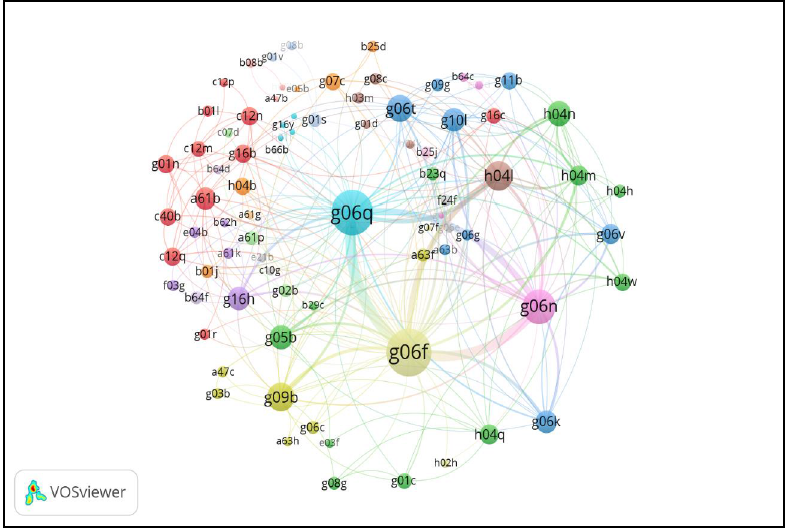
Regarding the IPC of each of the 1311 patents found, knowing that the same patent can have several IPC classifications, the co-occurrence relationship between the IPC codes was observed to verify the main themes of the knowledge management patents, as well as the main relationships between them. Figure 3 shows the co-occurrence network between the codes for each patent. The IPC, created in the 1970s by the Strasbourg Agreement, is a universal language, although offices such as the United States Patent and Trademark Office (USPTO) and databases such as the DII have their classifications. In this study, we analyze the IPC provided by the World Intellectual Property Organization (WIPO) and represented in the DII metadata. The technological fields are divided into eight sections A through H, each of which presents its classes, subclasses, and groups using a hierarchical system.
Each IPC code is composed of a letter indicating the IPC section, followed by a number of up to two digits indicating the class, sometimes complemented by a letter indicating the subclass, a number of one to three digits indicating the main group, and a slash "/" and numbers of up to three digits indicating the subgroup (Bochi; Gabriel Junior; Moura, 2020).
From the 1311 patents, 731 different classifications were found. Given the large number, it was decided to consider only the section, class, and subclass categories of each patent's IPC. For example, the IPC code G06f-017/30 was converted to G06f. This procedure made it possible to reduce the size of the network and to privilege the information contained in these three fields (section, class, and subclass), thus favoring the visualization of the interaction between the main contents present in the patents related to knowledge management indexed in the DII. In addition, all the research data used to prepare this study were made available through the digital repository Zenodo and can be found in Castanha, Bochi and Macucule (2024).
4 RESULTS AND DISCUSSION
In order to understand the rise of KM in industrial property, data on the evolution over time of patent grants in this area were extracted, as shown in Figure 1. It can be seen that the publication of new patents in the DII has an increasing profile over the years. The time window analyzed considers patents published between 1992 and 2024 (date of collection), with only 1994, 1995 and 1999 having no published patents.

The last decade of the millennium was marked by the end of the Cold War, a period of great global polarization, and the beginning of a new economic scenario. This period was marked by the financial crisis in Europe (1992-1994), the creation of the euro in 1999, and the NASDAQ stock market crash in the United States in 2000 (Menezes et al., 2010). While the economic changes transformed companies and consumers, there was a significant increase in the creation of journals on knowledge management (KM) and intellectual capital, from 14 journals in 1990 to 23 in 2012 (Serenko; Bontis, 2013), increasing the discussions on the topic in the organizational and academic scenario.
In addition, the 1990s saw the opening of the Internet for commercial use, leading to the growth of e-commerce through companies such as Amazon.com and eBay.
This period saw the popularization of companies such as Microsoft and the first browsers such as Internet Explorer and Opera. All these facts played a fundamental role in making companies, large and small, evaluate their management strategies, as commercial transactions moved to a digital environment, using different technologies such as Electronic Data Interchange (EDI) and Electronic Funds Transfer (EFT) (Mendes, 2013).
Malhado (2017) distinguishes between companies that were born digital and companies that have undergone the transition from old management habits to a digital environment. Companies that were born in a completely technological environment did not need to transform their processes and business models, while companies that preceded this technological corporate bias not only needed to rethink their management strategies, but also presented the need for tools that provide data security, management of the company-customer relationship, management of information obtained from the internal and external environment. Thus, from an intellectual property perspective, these changes have become a niche in the technology industry.
Malhado (2017) points out that 64% of these companies have not restructured their workflows and business processes, maintaining traditional workplaces consisting of desktops, files, printers, photocopiers and meeting rooms, all in a fixed and confined space called an office, thus failing to capture knowledge, customers, markets and partners, as well as analyzing competitors' business strategies.
Today, the ingenuity of companies takes much less time to bring disruptive technologies to market. For this reason, companies, researchers, and academic institutions are studying and developing KM systems to optimize the productivity of internal and external employees and to improve organizational processes in a way that puts business objectives first. Malhado (2017) states that the entry into the organizational ecosystem of digital companies, which he refers to as the "disruptive market" or "born digital", has disrupted historical business models and therefore companies have had to transform themselves digitally. According to the author, in an attempt to deliver continuous customer experiences, companies are looking to transform the way they operate, understanding that it is essential to align corporate knowledge and corporate actions with intended outcomes. In this way, they rely on tools that provide information security management, as well as tools that promote the management of customer relationships with the organization.
Malhado (2017) points out that only 24% of organizations can turn internally generated information into a competitive advantage. This gap reinforces the importance of advanced KM technologies to effectively index and manage data. In this way, companies that adopt more efficient technologies that meet the needs and interests of customers and employees will be advantaged. To achieve this, they are relying on KM tools and systems that provide adequate information indexing and data management. These tools have become a niche market for technology, information, and communication organizations. Still on the temporal evolution of KM technologies, we can see a significant increase in the years 2021 to 2023. It is worth remembering that this period saw a boom in e-commerce businesses, as well as a significant growth in COVID-19 research in both academic institutions and the pharmaceutical industry around the world. From this perspective, KM has become a fundamental tool to ensure that the entire process of knowledge exchange between institutions and researchers is safe and reliable. Wang and Wu (2020) and Tomé and Hatch (2022) argue that the pandemic was also a crisis of knowledge and that the technologies applied to KM were fundamental in overcoming such adversities in health organizations and in society as a whole.
Observing that the apogee of patents in KM has been in the past three years, from the collection and extraction of data, we identified the set of areas of knowledge that have patents related to KM, since it dialogues with several areas of knowledge, culminating in a conception of tools and discussions in the business and organizational spheres.
Kakabadse, Kakabadse, and Kouzmin (2003), from the perspective of the cognitive model of KM, believe that IT tools can be particularly useful for codifying, storing, retrieving, and transferring codified knowledge, bringing competitive advantages in the various organizational ecosystems. According to the authors, many companies focus on the use of knowledge through IT, while a less representative number focus on its development to create new knowledge.
Table 1 shows the diversity of KM when analyzed from an intellectual property perspective. The categorization provided by the Derwent Innovations Index database shows how many KM patents are related to different fields of study, with engineering and computer science being the most representative, accounting for 99.5% and 98% of the patents in the study, followed by instrumentation (16.4%), which is a field of study on the science of manufacturing measuring instruments, including the related fields of metrology, automation, and control theory.
Although Gonzales and Martins (2017) believe that the knowledge management process should not be based on IT actions due to its tacit and explicit nature, these results reiterate the idea that KM must combine organizational processes with tools that allow the retrieval, measurement, evaluation, and storage of internal and external customer knowledge to make the scenario more competitive and dynamic.
According to the DII classification of knowledge fields, there are 22 (different) knowledge fields that index the 1311 patents, demonstrating the diverse applicability of knowledge management in technology and innovation processes. The most common fields are engineering (1304 patents) and computer science (1285). This suggests that companies have understood that the fundamental bases of competition have changed and that it is necessary to master the process of knowledge management in all areas in which they operate. Wiig (1997) and Nonaka and Takeuchi (1997) illustrate the importance of this area and how much it contributes to the process of innovation and the creation of better quality products and services.
The prominence of these areas over the others is in line with Valentim (2008), who states that organizational processes are profoundly influenced by the intersection between information, knowledge, and information and communication technologies (ICTs), the integration of which has been a significant catalyst in the transformation of organizational environments. According to the author, various fields are dedicated to the development of models, methods, techniques, instruments, and tools to improve these processes, with the aim of boosting economic, commercial, political, and social activities, among others, and ensuring the sustainability of organizations in their respective markets. In addition, knowledge management practices represent frequently performed activities that support organizational management to improve processes, products, and services, and to facilitate the implementation of these practices, various tools are developed and adapted to the needs of different user profiles (Menegassi et al., 2019).
When evaluating patent classifications by IPC, out of the 731 (different) IPC codes identified in the analyzed patents, only the section, class, and subclass attributes of each IPC were considered, resulting in 88 codes to form the IPC co-occurrence network, as shown in Figure 2. In other words, knowing that a patent can have more than one IPC, the network illustrates the co-occurrence of IPCs in each patent document. From a topological perspective, the network is poorly connected since the network density is 0.0674, i.e., only 6.74% of the IPC codes are connected to each other, which shows a low relationship between them. Furthermore, it was found that each of the IPC codes has an average occurrence of 24.84, i.e., on average, each of the codes is present in 23.84 patent documents. In addition, each of the 88 codes co-occurs on average with 5.86 other codes. In terms of connectivity strength, each pair of IPC codes was found to co-occur simultaneously 4.83 times.

One of the purposes of the IPC codes is to categorize the technical content of a patent document, making it possible to apply different classifications, from sections A to H, in a single document. In terms of classes (A to H), the analyzed corpus contains 24 patents in class A, 17 in class B, 14 in class C, 5 in class E, 3 in class F, 1961 in class G, and 162 in class H. It is important to note that the same patent can have more than one class at the same time. Figure 1 shows that section G, related to physics, is a recurring presence among the clusters that make up the network, with class 06 being the most obvious. This class includes simulators that calculate the conditions of a real system or device; simulators that demonstrate the operation of devices or systems; and image or generation data processing.
The classifications with the highest frequency, considering the subsections, are G06F (971), G06Q (491), G06N (277) and H04L (97). These classifications focus respectively on electrical processing of digital data, information and communication technology, computing equipment based on specific computing models, and transmission of digital information. More specifically, the technologies analyzed from the IPCs discuss artificial intelligence (AI), machine learning and data storage, and cloud computing, which in this case are related to knowledge management (KM). It is worth noting that the three classifications with the highest occurrence belong to the same section and class G06, and the fourth IPC with the highest occurrence belongs to section H - Electricity, more specifically IPC H04L, which covers the transmission of signals provided in digital form and includes data transmission and other methods. As mentioned above, patents contain various classifications that, when combined, represent the content of the invention and serve as a basis for examining the state of the art in certain technological fields.
In Fuji and Manage's (2018) study on AI patents, the most relevant IPC codes were G06N and G06F, with the former applied to AI technology patents related to specific mathematical or knowledge-based models, and the latter code focused on labeling and tagging data to achieve more efficient machine learning. However, in this research, as observed in the network, we identified an intense correlation between the classifications observed by the authors with classes G06Q and H04L, indicating that KM is strongly related to knowledge-based computer systems, covering knowledge engineering, knowledge acquisition, data extraction, as well as machine learning and automatic call answering systems for use with chatbots.
Looking at the main links between IPC codes, pair by pair, there are 278 co-occurrences between G06F and G06Q, 210 co-occurrences between G06F and G06N, 89 co-occurrences between G06N and G06Q, and 65 co-occurrences between G06F and H04L. These results confirm the report presented by the World Intellectual Property Organization (WIPO, 2022), in which the number of patents, called general-purpose digital technologies, grew exponentially in the post-war period, with a significant leap in artificial intelligence, from 0% of patent applications in 1950 to approaching 6% of applications in 2020. In this context, considering that the flow of information in the organizational scenario has become increasingly dense, AI, predictive technologies, advanced automation and big data can contribute to knowledge management, sorting the information generated, optimizing time, and increasing human productivity. On the other hand, as described in the report (WIPO, 2022), while these technologies have the capacity to transform industries by bringing in new inventors and improving structures and values, they also run the risk of exacerbating economic inequality, as they require large investments of capital and highly skilled labor.
The analysis of patent production in knowledge management revealed a network, shown in Figure 3, composed of 245 actors (organizations or inventors), each responsible for two or more patents. On average, each actor contributed 3.69 published patents. However, cooperation between actors in this network was relatively low, with an average number of connections of only 1.36. Of the 245 network members, 140 did not establish any form of cooperation with other entities, representing 57.14% of the total. Only 13.88% of the total (34) established only one cooperation, while 28.99% of the total (71) established two or more partnerships.

Analyzing the average strength of the connections between the actors in the network, it was found that the network consists of 166 connections with an average strength of 2.67. This means that, on average, each connected pair cooperated in the production of approximately 2.67 patents. However, the density of the network turns out to be low, with a value of 0.00121, meaning that only 1.21% of the network is connected to each other. These results suggest that cooperation between patent assignee or inventor organizations is limited in terms of knowledge management. However, an analysis of patent trends in KM reveals an increasing number of patents, with seven patents identified as belonging to American companies, highlighting the leading role of the United States in knowledge management innovation. This trend indicates a strategic focus on integrating KM practices into business processes (Putri et al., 2002). Among the 245 components of the network in Table 2, we highlight the organizations International Business Machines Corporation (ibmc), Hitachi.Ltd. (hita), Hewlett-Packard Company (hewp), Oracle Corporation (orac), Kana Software (kana software inc), and the inventors goodwin jp, sunm, adar e, lukose, sengupta, and tyler Jr. for being the organizations and inventors that published the most patents and established the most connections, as shown in Table 2. These companies are among the 250 most valuable global brands according to the Global 500 ranking (Brand Finance; 2021, 2022, 2023).
Looking at the process of patent publication by the organizations in Table 2, the US Company IBM (IBMC) stands out as the most prolific, with 54 patent applications. This organization can be considered an example of intellectual property innovation focused on knowledge management, demonstrating an ongoing commitment to the development of new technologies and/or work processes. IBM, or International Business Machines Corporation, is one of the largest technology companies in the world, offering solutions related to the production of software and hardware, as well as infrastructure services, with a strong focus on research, innovation, and development.
In this cooperative context, the company with the second-largest investment in intellectual property is Hitachi Ltd. (HITA), with 23 patents in KM. Founded in Japan in 1910; Hitachi is a multinational conglomerate with interests ranging from engineering and transportation to information technology.
In turn, with 13 patents, we have the company (HEWP) called the Hewlett-Packard Company, known as HP. It was founded in 1939 by Bill Hewlett and David Packard, two American engineers. As an information technology company, it was split in 2015 into HP Inc, which is responsible for the development and supply of hardware such as personal computers and printers, and Hewlett Packard Enterprise, which focuses on the enterprise segment, providing solutions to transform enterprise data to the cloud to help them connect, protect, analyze, and act on their data and applications.
Oracle (ORAC), which holds 10 patents, was founded in 1977 as SDL in a Silicon Valley start-up. In 1982, the partners changed the name to Oracle, and the company became a multinational information technology company specializing in database management systems, producing and selling software, hardware, and databases.
Fuji and Manage (2018) analyzed patents in artificial intelligence, considering a time window of 17 years (2000-2016), and found that these four companies are among the 30 largest patent applicants in AI, which is one of the main strategies of companies to transform their business. Thus, the four companies with the highest number of patents in this study come from the information technology sector with a certain affinity to knowledge management. This fact confirms the fields of knowledge highlighted in Table 1, so that engineering and computing are the most prominent fields.
Looking at the links established by the organizations, i.e., the number of collaborations, Kana Software and ORAC stand out as the companies that collaborate most with others in the development of patents, with the former collaborating with 9 different organizations and the latter with 7. The already prominent Oracle (ORAC) reinforces its importance in the knowledge management patenting process, while Kana Software also proves to be an important company, being the most collaborative organization when it comes to publishing patents related to knowledge management, among the 245 organizations analyzed and shown in Figure 3. Kana Software is a subsidiary of Verint and focuses on the development of customer relationship management and customer experience solutions. In doing so, this organization increases the potential of knowledge management applied to the management of people from the customer-company relationship.
In terms of the strength of the relationships between companies and inventors, Eytan Adar, Rajan Lukose, Joshua Tyler, Caesar Sengupta are the inventors, along with HP, of the patent (US2004068499-A1) that covers a KM method for flagging new messages in the system to collect community knowledge. In addition to this patent, the inventors and HP are collaborating on patents US2003200190-A1 and EP1343100-A2, which deal with methods for collecting knowledge from the user community and managing knowledge in corporate networks, respectively. It is worth noting that these inventors collaborate with each other and hold other patents.
Still looking at the strength of the connection between the organizations represented in the network and the inventors, we highlight the relationship between IBMC and James P. Goodwin and his co-inventors, who together hold 5 patents (US2003158866-A1, US2003154196-A1, US2003154186-A1, US2003135516-A1, US2003135489-A1) that deal with methods for synchronizing, processing, organizing, and storing data in KM systems.
Still on the subject of analysis, we observed that the ownership of the patents is not concentrated in the industry, but is shared among the creators of these tools, giving them the rights due to a patent holder. In this way, both the company and the inventors who own the patents have the right to prevent third parties from manufacturing, offering for sale, using or importing the product covered by the patent without their consent, as well as the right to the profits and possible compensation generated by the improper exploitation of their inventions (BRASIL, 1996). Internationally, as described in Articles 108 to 110 of the Patent Law (Official Gazette of Serbia and Montenegro, 2004), the employee (inventor) is granted the right to recognition, co-ownership, and remuneration for the created technology, except in the case of a trade secret, in which case the employer is entitled to keep the invention secret and the inventor, although remunerated, has no right to exploit this instrument.
5 FINAL CONSIDERATIONS
The objective of this research was to analyze patent documents on knowledge management using patentometrics to understand their evolutionary process, the areas of knowledge related to this topic, the cooperation between patent holders and the co-occurrence of international classifications that make up these patents. The data showed that there was a progressive evolution from the 1990s to the present (2024), with the most prominent period between 2021 and 2023.
The fields of knowledge were very diverse, with the most prominent being Engineering (99.5%) and Computer Science (98%), which is very consistent when looking at the International Patent Classification (IPC). The IPC codes that stood out in the network of co-occurrences between IPCs were G06F (971), G06Q (491), G06N (277) and H04L (97), focusing on electrical processing of digital data, information and communication technology, computing devices based on specific computing models and transmission of digital information. These same codes, analyzed pair by pair, confirm the report presented by the World Intellectual Property Organization (WIPO, 2022), which assures that digital technologies for general use have grown exponentially since the postwar period.
With regard to the analysis of cooperation between patent holders, it was found that the organizations that stand out are American, except for the Japanese company Hitachi. They are: IBM (IBMC) with 54 patents, Hitachi Ltd (HITA) with 23 patents, the Hewlett-Packard Company (HEWP), known as HP, and Oracle (ORAC) with 10 patents. These are companies that develop databases, AI technologies, and tools aimed at organizational needs as KM instruments. It was also observed that patent applications come from inventors, with five of them standing out: Eytan Adar, Rajan Lukose, Joshua Tyler, and Caesar Sengupta. This finding suggests that organizations are legally recognizing the role of inventors in the development of these technologies.
Legally, the right to commercially exploit inventions is given to patent holders, and when this ownership is shared between companies and inventors, it means that both share in the profits and have the same legal rights to the innovation. This may not be the case if, for example, the invention contains trade secrets of the employer for whom the inventor works, who has the right to prohibit disclosure. Furthermore, while the employee may be entitled to compensation for the invention, he or she will not have the right to seek protection for it.
Thus, in answering the proposed research problem, the technological development and innovation in knowledge management, represented by the production of patents, is configured, from the perspective of temporal evolution, in full growth, in which some organizations stand out from the rest, such as those already highlighted IBMC, Hitachi, HP and Oracle, as well as a small group of inventors (Eytan Adar, Rajan Lukose, Joshua Tyler, Caesar Sengupta), and the patents mainly refer to the development of artifacts and/or industrial processes related to engineering and computing, whose IPCs are represented by the classifications G06F, G06Q, G06N and H04L.
As a limitation, it is recognized that the chosen database (DII) may not represent the totality of patent applications in knowledge management, since the DII, despite its well-deserved recognition, does not aggregate all patents produced in the world. Therefore, it is suggested that future work explore other databases such as Lens, Patentscope, Espacanet and/or the National Institute of Industrial Property (INPI) itself. It is also suggested that this study be extended to identify the application of the Triple Helix model, in which university institutions, companies, and the government interact to promote development through innovation and entrepreneurship.
Thus, this research contributes to the understanding of technological development and innovation established in the centers of global technological production with an emphasis on knowledge management, a multidisciplinary field of study that develops in the way organizations create, share and use knowledge. Finally, the importance of analyzing the production of patents in knowledge management is emphasized, since its role is fundamental in identifying trends and gaps that can guide future innovation and technological development strategies related to KM.
Acknowledgements:
Not applicable.
References
-
CASTANHA, R. G.; BOCHI, F.; MACUCULE, A. J. Conjunto de dados utilizados no estudo "O desenvolvimento tecnológico e de inovação em gestão do conhecimento". [Data set]. Zenodo. 2024. DOI: https://doi.org/10.5281/zenodo.10904621
» https://doi.org/10.5281/zenodo.10904621 -
BOCHI, F.; GABRIEL JUNIOR, R. F.; MOURA, A. M. M. Patentes nos Estudos Métricos da Informação. In: Tópicos da bibliometria para bibliotecas universitárias. GRÁCIO, M. C. C. et al. (org.). Marília: Oficina Universitária, 2020. DOI: https://doi.org/10.36311/2020.978-65-86546-91-0.p264-287
» https://doi.org/10.36311/2020.978-65-86546-91-0.p264-287 -
BRAND FINANCE. Global 500: The annual report on the most valuable and strongest global brands January 2021. London: Brand Finance, 2021. Disponível em: https://static.brandirectory.com/reports/brand-finance-global-500-2021-preview.pdf Acesso em: 23 fev. 2024.
» https://static.brandirectory.com/reports/brand-finance-global-500-2021-preview.pdf -
BRAND FINANCE. Global 500: The annual report on the most valuable and strongest global brands January 2022. London: Brand Finance, 2022. Disponível em: https://static.brandirectory.com/reports/brand-finance-global-500-2022-preview.pdf Acesso em: 23 fev. 2024.
» https://static.brandirectory.com/reports/brand-finance-global-500-2022-preview.pdf -
BRAND FINANCE. Global 500: The annual report on the most valuable and strongest global brands January 2023. London: Brand Finance, 2023. Disponível em: https://static.brandirectory.com/reports/brand-finance-global-500-2023-preview.pdf Acesso em: 23 fev. 2024.
» https://static.brandirectory.com/reports/brand-finance-global-500-2023-preview.pdf -
BRASIL. Lei nº 9.279, de 14 de maio de 1996. Regula direitos e obrigações relativos à propriedade industrial. Brasília, DF: Presidência da República, 1996. Disponível em: https://www.planalto.gov.br/ccivil_03/leis/l9279.htm Acesso em: 23 fev. 2024.
» https://www.planalto.gov.br/ccivil_03/leis/l9279.htm - CAMERON, K. S.; QUINN, R. E. Diagnosing and Changing Organizational Culture: Based on the Competing Values Framework. 3. ed. New Jersey: Jossey-bass, 2011.
-
CHOO, C. W. Information culture and organizational effectiveness. International Journal of Information Management, Netherlands, v. 33, n. 5, p. 775-779, 2013. DOI: https://doi.org/10.1016/j.ijinfomgt.2013.05.009
» https://doi.org/10.1016/j.ijinfomgt.2013.05.009 -
DARROCH, J. Knowledge management, innovation and firm performance. Journal of Knowledge Management, Indonesia, v. 9, n. 3, p. 101-115, 2005. DOI: https://doi.org/10.1108/13673270510602809
» https://doi.org/10.1108/13673270510602809 - FAYOL, H. Administration industrielle et générale: prévoyance, organisation, commandement, coordination, controle. Paris: Dunod, 1918.
-
FUJI, H.; MANAGI, S. Tendências e mudanças de prioridade na invenção de tecnologia de inteligência artificial: uma análise de patente global. Economic Analysis and Policy, Australia, v. 58, p. 60-69, 2018. DOI: https://doi.org/10.1016/j.eap.2017.12.006
» https://doi.org/10.1016/j.eap.2017.12.006 -
GONZALEZ, R.V.D.; MARTINS, M.F. O Processo de Gestão do Conhecimento: uma pesquisa teórico-conceitual. Gestão & Produção, São Carlos, v. 24, n. 2, p. 248-265, 2017. DOI: http://dx.doi.org/10.1590/0104-530X0893-15
» http://dx.doi.org/10.1590/0104-530X0893-15 -
KAKABADSE, N. K.; KAKABADSE, A.; KOUZMIN, A. Reviewing the knowledge management literature: towards a taxonomy. Journal of Knowledge Management, Indonesia, v. 7, n. 4, p. 75-91, 2003. DOI: https://doi.org/10.1108/13673270310492967
» https://doi.org/10.1108/13673270310492967 - WIIG, K. M. Knowledge Management Foundations: Thinking about Thinking - How People and Organizations Create, Represent, and Use Knowledge. Texas: Schema Press, 1993.
-
MALHADO, R. Harnessing Corporate Knowledge in a Time of Digital Disruption: corporate knowledge in the context of digital transformation. IDC, Madrid, may 2017. Disponível em: https://encr.pw/ZozzZ Acesso em: 20 fev. 2024.
» https://encr.pw/ZozzZ -
MASSA, H. C. O.; DAMIAN, I. P. M.; VALENTIM, M. L. P. Competência em informação no apoio à Gestão do Conhecimento. Informação & Sociedade, Paraíba, v. 28, n. 1, 2018. Disponível em: https://periodicos.ufpb.br/ojs2/index.php/ies/article/view/32569 Acesso em: 8 mar. 2024.
» https://periodicos.ufpb.br/ojs2/index.php/ies/article/view/32569 -
MENDES, L. Z. R. E-commerce: origem, desenvolvimento e perspectivas. 2013. Trabalho de Conclusão de Curso (Monografia em Ciências Econômicas) - Faculdade de Ciências Econômicas, Universidade Federal do Rio Grande do Sul, Porto Alegre, 2013. Disponível em: https://lume.ufrgs.br/bitstream/handle/10183/78391/000899483.pdf?sequence=1&isAllowed=y Acesso em: 15 jan. 2025.
» https://lume.ufrgs.br/bitstream/handle/10183/78391/000899483.pdf?sequence=1&isAllowed=y -
MENEGASSI, C. H. M. et al. A gestão do conhecimento no contexto da franchising: estudo de caso em uma franqueada. Ciência da Informação, Brasília, DF, v. 48, n. 3, p. 205-220, set./dez. 2019. DOI: https://doi.org/10.18225/ci.inf.v48i3.4515
» https://doi.org/10.18225/ci.inf.v48i3.4515 - MENEZES, A. M. F. et al. 20 Anos da SECEX e 200 Anos de Comércio Exterior. Brasília, DF: Ministério do Desenvolvimento Indústria e Comércio Exterior-MDIC, 2010.
-
NONAKA, I.; KONNO, N. The Concept of “Ba”: Building a Foundation for Knowledge Creation. California Management Review, United States, v. 40, n. 3, p. 40-54, 1998. DOI: https://doi.org/10.2307/41165942
» https://doi.org/10.2307/41165942 - NONAKA, I.; TAKEUCHI, H. Criação de conhecimento na empresa: como as empresas japonesas geram a dinâmica da inovação. Rio de Janeiro: Elsevier, 1997.
- NONAKA, I.; TAKEUCHI, H. Gestão do conhecimento. Porto Alegre: Bookman, 2008.
-
OFFICIAL GAZETTE OF SERBIA AND MONTENEGRO. The patent Law, no. 15, 2 july 2004. Geneva: WTO, 2004. Disponível em: https://www.wto.org/english/thewto_e/acc_e/cgr_e/wtacccgr3a2_leg_3.pdf Acesso em: 06 mar. 2024.
» https://www.wto.org/english/thewto_e/acc_e/cgr_e/wtacccgr3a2_leg_3.pdf -
PERETA, M. G. S; FURTADO, A. T.; COSTA, J. O. P. A emergência do processamento submarino de petróleo e gás natural sob a perspectiva dos sistemas tecnológicos de inovação (1990-2019). Nova Economia, Minas Gerais, v. 32, n. 2, maio/aug., 2022. DOI: https://doi.org/10.1590/0103-6351/6947
» https://doi.org/10.1590/0103-6351/6947 - POLANYI, M. The tacit dimension. London: Routledge and Kegan Paul, 1966.
-
PUTRI, S. I. E. et al. Knowledge management in business using patent landscape analysis. In: INTERNATIONAL CONFERENCE ON INFORMATION MANAGEMENT AND TECHNOLOGY, 7., 2023, Malang, Indonesia. Proceedings [...]. Malang: IEEE, 2023. p. 1-6. DOI: 10.1109/ICIMTech59029.2023.10278066.
» https://doi.org/10.1109/ICIMTech59029.2023.10278066. -
SANT’ANA, R. C. G. Ciclo de vida dos dados: uma perspectiva a partir da Ciência da Informação. Informação & Informação, Londrina, v. 21, n. 2, p. 116-142, 2016. DOI: https://doi.org/10.5433/1981-8920.2016v21n2p116
» https://doi.org/10.5433/1981-8920.2016v21n2p116 - SCHUMPETER, J. A. The theory of economic development: An inquiry into profits, capital, credit, interest, and the business cycle. Cambridge: Harvard University Press, 1934.
-
SERENKO, A.; BONTIS, N. Global ranking of knowledge management and intellectual capital academic journals: 2013 update. Journal of Knowledge Management, Indonesia, v. 17. n. 2, p. 307-326, 2013. DOI: https://doi.org/10.1108/13673271311315231
» https://doi.org/10.1108/13673271311315231 -
SILVA, R. R.; DIAS, T. M. R.; CARVALHO SEGUNDO, W. L. R. Caracterização e análise da produção técnica no Brasil: um estudo baseado em registros de patentes. Informação & Informação, Belo Horizonte, v.27, n. 3, p. 380-401, 2023. DOI: https://doi.org/10.5433/1981-8920.2022v27n3p380
» https://doi.org/10.5433/1981-8920.2022v27n3p380 - TAYLOR, F. W. The principles of scientific management. New York: Harper, 1911.
-
TOMÉ, E.; GROMOVA, E.; HATCH, A. Knowledge management and COVID-19: Technology, people and processes. Knowledge and Process Management, United Kingdom, v. 29, n. 1, p. 70-78, 2022. DOI: https://doi.org/10.1002/kpm.1699
» https://doi.org/10.1002/kpm.1699 - TZU, S. A arte da guerra: os 13 capítulos originais. São Paulo: Novo Século, 2015.
-
VALENTIM, M. L. P. Gestão da Informação e Gestão do Conhecimento em ambientes organizacionais. Tendências da Pesquisa Brasileira em Ciência da Informação, Salvador, v. 1, n. 1, 2008. Disponível em: http://inseer.ibict.br/ancib/index.php/tpbci/article/view/110/151 Acesso em: 23 fev. 2024.
» http://inseer.ibict.br/ancib/index.php/tpbci/article/view/110/151 -
VALENTIM, M. L. P. . Conceitos sobre Gestão do Conhecimento: uma revisão sistemática da literatura brasileira. Informação & Sociedade, Paraíba, v. 30, n. 4, p. 1-34, 2021. DOI: https://doi.org/10.22478/ufpb.1809-4783.2020v30n4.57186
» https://doi.org/10.22478/ufpb.1809-4783.2020v30n4.57186 -
WANG, W-T.; WU, S-Y. Knowledge management based on information technology in response to COVID-19 crisis. Knowledge Management Research & Practice, United Kingdom, v. 19, n. 4, 2021. DOI: https://doi.org/10.1080/14778238.2020.1860665
» https://doi.org/10.1080/14778238.2020.1860665 -
WIPO. World Intellectual Property Report 2022: The Direction of Innovation. Geneva: WIPO, 2022. DOI: https://doi.org/10.34667/tind.45356
» https://doi.org/10.34667/tind.45356



 Source: Prepared by the authors.
 Source: Prepared by the authors. Available online at: VOSviewer Online
 Source: Prepared by the authors. Available online at: VOSviewer Online

