 The use of acupuncture versus dry needling in the treatment of myofascial temporomandibular dysfunction
ABSTRACT
BACKGROUND AND OBJECTIVES: Orofacial pain is the pain felt in the oral cavity and the face, with a multifactorial etiology, being a representative of the temporomandibular dysfunction. Among the various possibilities for treatment are acupuncture and the dry needling. The objective of this study was to compare the effectiveness of these two therapies in the cases of myogenic temporomandibular dysfunction.
CONTENTS: A review of articles relating to the topic was conducted on the LILACS, Medline, Scielo and Pubmed database, cross-referencing the following descriptors: “acupuncture” OR “electroacupuncture” OR “dry needling” AND “orofacial pain syndrome” OR “orofacial pain” OR “temporomandibular dysfunction” OR “temporomandibular disorders”, myofascial temporomandibular dysfunction or trigger points in last the 16 years. Clinical trials, systematic reviews, metanalysis, case studies involving human beings were included. The selected languages were English and Portuguese. Twenty-one articles were found that were carefully evaluated and tabulated. The present study identified that both acupuncture and dry needling were significantly important in the resolution of the signs and symptoms of the myogenous temporomandibular dysfunction, with adequate effectiveness.
CONCLUSION: It can be pointed out that dry needling seems to be more effective in the resolution of local pain on the myofascial trigger points than just using of acupuncture points at a distance. Acupuncture demonstrated positive influences in the general health quality and pain of patients with myofascial temporomandibular dysfunction. Therefore, the therapy of choice will depend on the professional’s assessment of the clinical conditions of the patient and the therapeutic goals to be achieved.
Keywords:
Acupuncture; Orofacial pain; Temporomandibular joint
RESUMO
JUSTIFICATIVA E OBJETIVOS: A dor orofacial é aquela que é experimentada na cavidade bucal e na face, e que apresenta uma etiologia multifatorial, sendo um representante a disfunção da articulação temporomandibular. Dentre as várias formas de tratamento, tem-se a acupuntura e o agulhamento seco. O objetivo deste estudo foi comparar a efetividade dessas duas terapias nos casos de disfunção da articulação temporomandibular miogênica.
CONTEÚDO: Foi realizado um levantamento bibliográfico nas bases de dados LILACS, Medline, Scielo e Pubmed a partir do cruzamento dos seguintes descritores: “acupuncture” OR “electroacupunture” OR “dry needling” AND “orofacial pain syndrome” OR “orofacial pain” OR “temporomandibular dysfunction” OR “temporomandibular disorders”, disfunção temporomandibular ou pontos-gatilho miofasciais nos últimos 16 anos. Foram incluídos ensaios clínicos, revisões sistemáticas, meta-análises, estudos de caso, envolvendo seres humanos. Os idiomas selecionados foram o inglês e o português. Foram encontrados 21 artigos que, posteriormente, foram criteriosamente avaliados e tabelados. O presente trabalho pode identificar que tanto a acupuntura, como o agulhamento seco, foram significativamente importantes na resolução dos sinais e sintomas da disfunção da articulação temporomandibular de caráter miogênico, com adequada eficácia.
CONCLUSÃO: Pode-se salientar que o agulhamento seco parece ser mais eficaz na resolução da dor local sobre o ponto-gatilho miofascial do que somente a utilização de pontos de acupuntura à distância. A acupuntura demonstrou influências positivas na qualidade de saúde geral e dor dos pacientes com disfunção da articulação temporomandibular miofascial. Dessa forma, a escolha da terapêutica a ser aplicada dependerá da avaliação do profissional sobre as condições clínicas do paciente e dos objetivos terapêuticos a serem atingidos.
Descritores:
Acupuntura; Articulação temporomandibular; Dor orofacial
INTRODUCTION
The myofascial pain syndrome can be defined as a pain originated from myofascial trigger points (MTP) located in a tensioned muscle band that produces the localized and/or diffuse or irradiated pain1,2.
The etiopathogenic factors are multidimensional, corresponding to biomechanical, structural, neuromuscular and biopsychosocial changes that encompass, metabolic, traumatic, and genetic conditions and habits of daily life1,3. In this context, special mention must be given to the temporomandibular joint disorder (TMD). The TMD involves the masticatory muscles, the temporomandibular joint (TMJ), or both, as well as its adjacent structures4.
The main triggering risk factors of TMD are related to the presence of micro and/or macro traumas. The first one results from forces of a small magnitude that repeatedly act over time, generating changes in the joint itself. The second comes from any abrupt external force on the joint causing structural or biomechanical lesions5.
The treatment depends on the diagnosis, which should be meticulous and ad hoc. Currently, the treatment options for TMD include behavioral and postural therapy, and physiotherapy techniques including ultrasound, transcutaneous electrical nerve stimulation (TENS), laser, exercises, massage, and mobilization. Interocclusal appliances (IOA), pharmacotherapy with tricyclic antidepressants, painkillers, central action muscle relaxants, in addition to botulinum toxin, acupuncture, and dry needling (DN)6-8 can also be used.
DN corresponds to a mechanical stimulus from the insertion of a needle in the muscle where the presence of an MTP was detected. This technique acts directly on the nerve fibers of painful sensation, stimulating the local activation of the A-delta fibers and the inhibition of the C fibers that carry the local pain impulses, resulting in the relaxation of the tense muscle band9.
Likewise, the acupuncture therapy involves the insertion and manipulation of needles in acupoints, that are specific sites of the body located in the meridians. In accordance with the Traditional Chinese Medicine, the acupoints put the energy flow into motion (QI) through the meridians in the entire body10.
The physiological mechanisms for analgesia with acupuncture, described in the current literature, comprise the activation of the hypothalamus with the release of endogenous opioid peptides as a probable immune response pathway to the relief of pain. Another hypothesis described is that acupuncture is capable of producing analgesia on neuropathic pain by suppressing the activation of microglia and astrocytes. It is also suggested that the acupuncture pathways are related to pain pathways, as well as to the sensory-somatic nervous system with impulses described in the posterior horn of the spinal cord and medial thalamus, among others11.
The practice of DN and the traditional acupuncture has, to a large extent, positive and significant effects in the treatment of pain12, presenting different results depending on the case. Traditional Chinese acupuncture has shown greater efficacy in solving problems related to local pain and stress13. On the other hand, DN on the MTP seems to produce a better response than the insertion of this same needle in an acupuncture point that is not an MTP14.
Starting with the analysis of the different types of clinical and physiological responses obtained with the use of DN and traditional acupuncture, the aim of this study was to compare the effectiveness of these two therapies in patients with myofascial TMD.
CONTENTS
We did a bibliographic survey in the following databases: BVS, LILACS, Medline, Scielo, and Pubmed. The search was structured from the crossing of the following keywords: acupuncture OR electroacupuncture OR dry needling AND orofacial pain syndrome OR orofacial pain OR temporomandibular dysfunction OR temporomandibular disorders, or temporomandibular dysfunction or myofascial trigger points. The search was concluded on June 17, 2016.
The selection obeyed the following inclusion criteria: quasi-experiments, randomized clinical trials involving only humans, and systematic reviews that had acupuncture, electroacupuncture and/or DN treatment in English and Portuguese, published in the last 16 years. Studies with animal models, open-label studies as well as protocols with moxibustion and laser therapy were excluded.
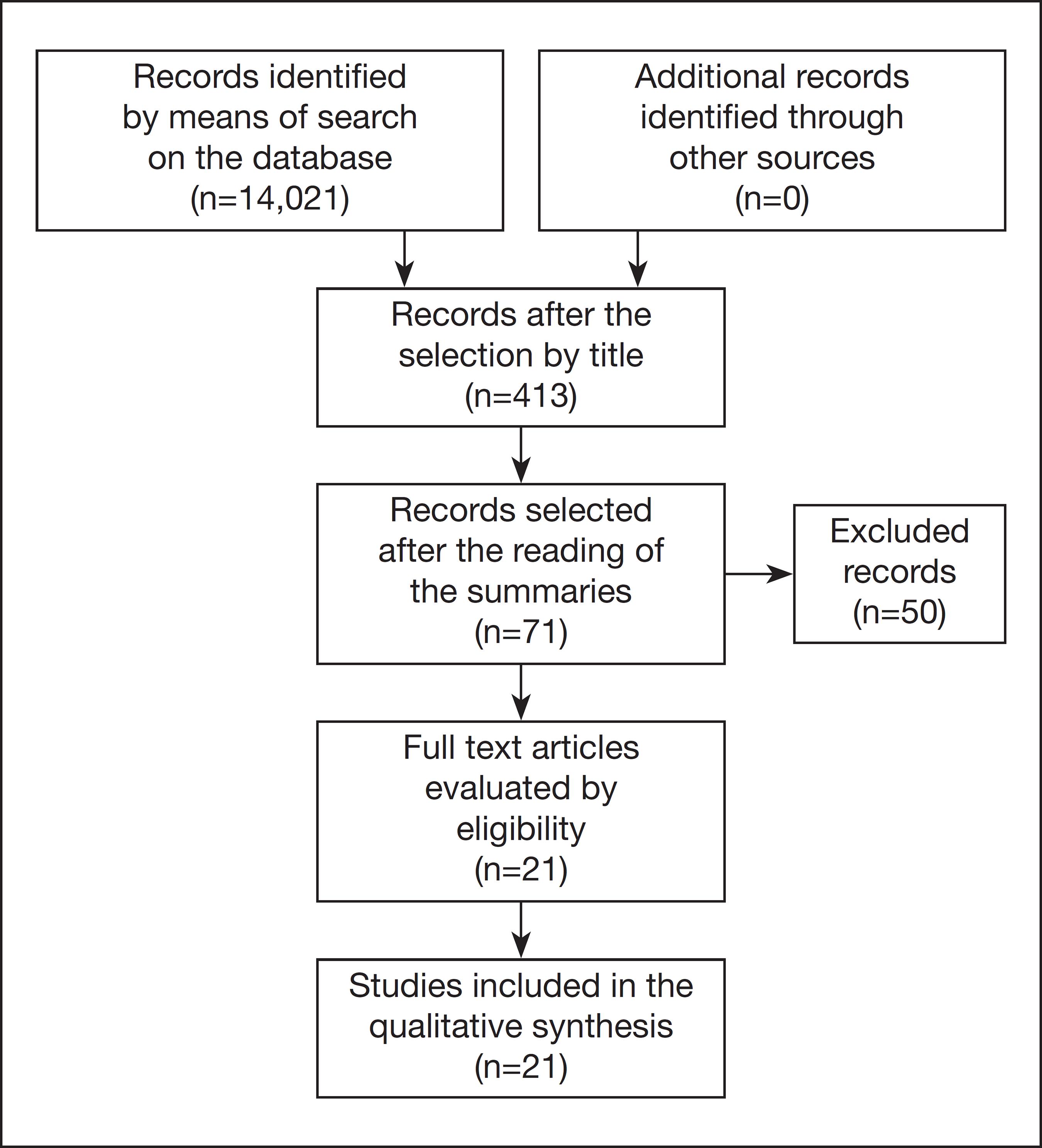
We found 14,021 articles for evaluation and selection of the titles. At that stage, articles that were not related to the subject of the study, or that did not present specific treatment or study focusing on the myogenic TMD were excluded, remaining 413 studies.
The reading of the summaries was subsequently performed keeping the exclusion criteria described above, also excluding the articles that did not present a methodological design consistent with the objectives and the theme of the study. Then, 71 studies were left to be read in full. Of these, a total of 21 articles were selected (Figure 1), which fit the objectives and the methodology of this survey (Table 1).
RESULTS
Of the 21 studies, 4 presented DN and 17 acupunctures as a treatment to evaluate the effectiveness of its effects on TMD in relation to other therapies. Of the total studies selected, 3 were systematic reviews, 2 systematic reviews followed by a meta-analysis of 16 clinical trials.
Of the four articles corresponding to the DN technique of, all had positive results concerning pain sensation, electric activity of the masseter and temporal muscles, maximum mouth opening, laterality, and jaw protrusion. Yet, the 17 articles that used the traditional acupuncture demonstrated that it was more effective than the placebo treatment, fake acupuncture, acupuncture without needle penetration and laser therapy. Acupuncture on painful sites and electrotherapy showed equal effectiveness on the perception of pain, electric muscle activity, maximum mouth opening mouth without pain, supported pressure level, sensitivity, and TMD severity.
The muscles involved in TMD in the studies were the masseter, temporal (anterior bundle), pterygoid, upper trapezius, anterior and posterior region of the neck that when palpated produced headaches, common in the TMD. The muscles that had more intervention were right (R) and left (L) masseter, left and right temporal (anterior bundle), right and left pterygoid.
Three studies described the technique of deep DN32,34,35, in its majority, on masseter, lateral pterygoid, temporal, through the back and forth movement for approximately 5 times, as well as insertions and withdrawal of the needles. The depth of the needle remained between 5 and 15mm, except for one article that deepened 1 to 2cm at a 30° angle in relation to the skin18. The average frequency of applications was of 4 sessions, with intervals varying between once a week and 1 session every 2 and 3 days33.
Concerning acupuncture, treatments varied between one and 10 sessions, with a frequency of 1 to 3 times per week, with an average duration of 10 to 30min, with or without Qi activation (energy flow), being only considered the manual stimulation. The deepening of the needle varied, approximately 3 to 30mm15,17,23,24,26,28,31.
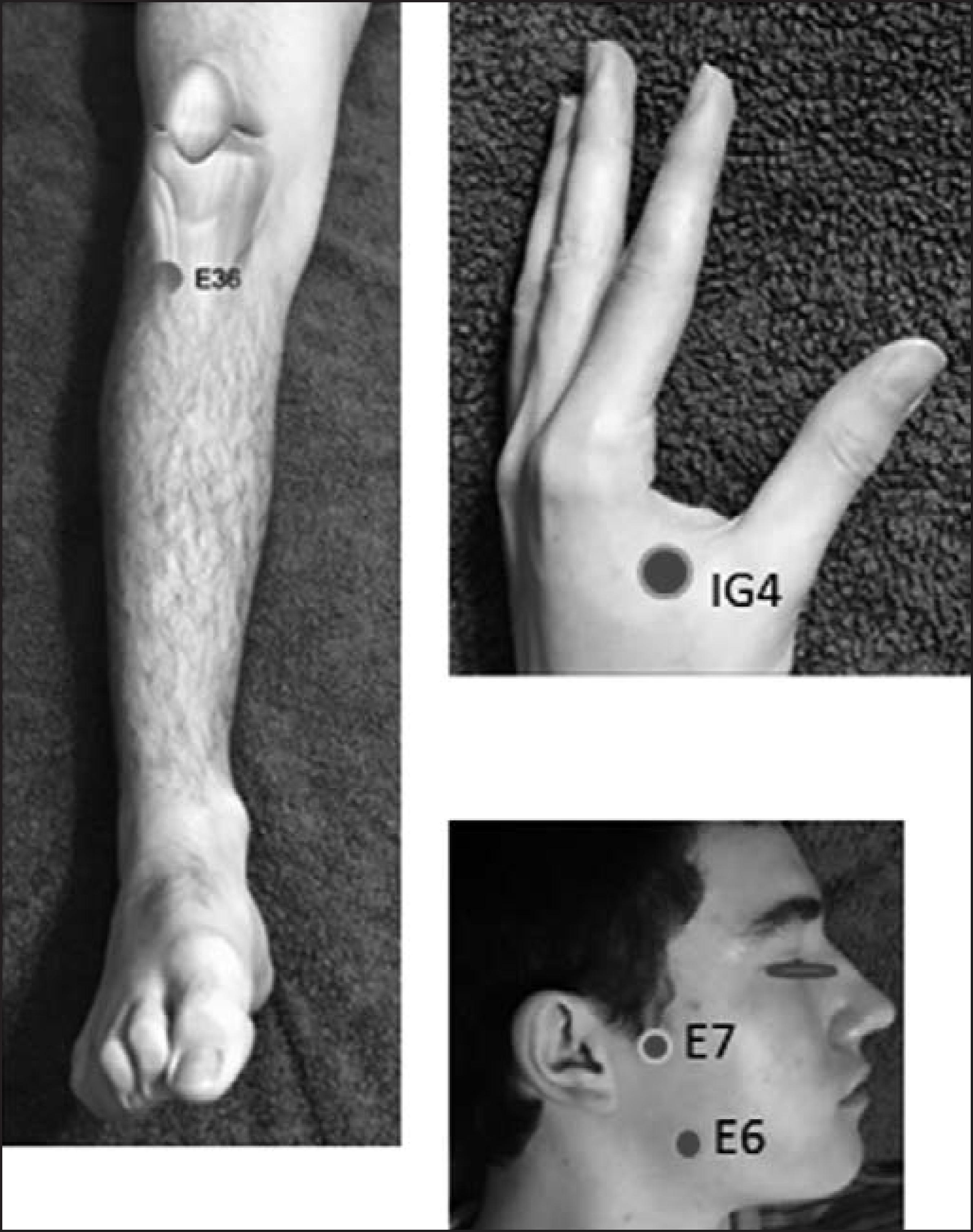
The most used and recommended points for the TMD treatment were: stomach 6 (E6) that corresponds to the masseter muscle insertion (jaw angle) and stomach 7 (E7) that is located right below the zygomatic arch to the front of the ATM. There are distant points with analgesic function such as the large intestine 4 (IG4) that is anatomically between the first and second metacarpal19, the stomach (E36) located in the tibial muscle anterior, inferior and lateral to the patella, as well as the points in the head and neck to help the relaxation of the adjacent musculature28,36 (Figure 2).
The methods to assess TMD used in the studies were the visual analogical scale (VAS), pressure algometry, sensitivity to pressure force, maximum mouth opening without pain, jaw movements as protrusion and laterality, deviation of the jaw, electromyography of the masticatory muscles, RDC/TMD axis II questionnaire, GCPS scale, TMD severity questionnaire, craniomandibular dysfunction index, pain distribution questionnaire, frequency of joint noises, stomatognathic evaluation, numeric pain rating scale (NPRS)15,24,26,31.
Moreover, it was possible to observe in this study that most of the patients that seek TMD treatment are female, with age between 18 and 68 years17,20,35.
DISCUSSION
TMD has signs and symptoms that include ATM and/or masticatory muscles pain, especially when palpated, with limitation, deviation or deflection of mandibular movements and joint noises2,7. Pain is the most common symptom, affecting more women than men in a 4:1 ratio16,37. However, other studies reported a proportional occurrence of TMD in both gender21, but reinforcing that women seek more treatment than men, relating it their concern with their health15.
On the other hand, the MTPs can be characterized as a pre-synaptic dysfunction in the endplate, with an excessive release of acetylcholine in the synaptic cleft, causing a sustained contraction, recognized as muscle contraction next to this plate40. Therefore, it is defined as a neuromuscular disease, characterized by motor and sensory changes, causing referred pain on palpation and hyperirritability in the assessed muscle band9,39.
Several techniques have been described for TMD, and MTP treatment and acupuncture and DN stand out15,35. The results of this review show that there was no study comparing the effect of acupuncture with the effect of DN in cases of myogenic TMD in the conducted search for evidence. As for the studies related to the effectiveness of acupuncture compared to other treatments, it can be pointed out that it was more effective on the overall health quality40. In TMD, there was similar efficacy to laser acupuncture, occlusal therapy with IOA, parafunctional habits guidelines and sham or placebo acupuncture36.
In the studies that use DN, this showed significant effectiveness in resolving the pain32,35,41. Acupuncture with distant points showed a favorable effect on stress, quality of sleep, and headache due to its action on the physical and mental balance in comparison to the application specifically in local points40. One of the explanations of the physiological mechanism of action of acupuncture refers to the stimulation of peripheral innervation, responsible for forwarding the message to the spinal cord, brain stem and hypothalamic neurons, triggering an endogenous release mechanism of opiates such as endorphins, enkephalins, serotonin, acetylcholine, and hormones24,25,42,43.
Acupuncture in the IG4, associated with the high-intensity current electrostimulation resulted in the activation of the contralateral prefrontal region, reflecting modulation in the anterior and subcortical cingulate cortex, as well as sensory-motor cortical areas involved in the emotional and cognitive relation of pain44. The high frequency conducted by the acupoint may act by reducing the propagation of the Theta and alpha 1 waves, decreasing the anterior cingulate cortex activity, resulting in antinociception as pain modulation44.
Needling and manual stimulation on the E36 acupoint with Qi sensation also showed a decrease in sign excitation on fiber connections and projections to the encephalon, cerebellum and limbic system, emphasizing the analgesic function of this point. It also influences the response patterns of the central nervous system related to the regulation of dopaminergic, norepinephrinergic and serotonergic substances27. Some authors even mention that there is the release of enkephalins and dynorphin associated with a cascade of reactions not yet fully understood18,36.
According to La Touche et al.17,28, the benefits obtained with acupuncture are more evident in the short term, being the E6, E7, and IG4 the points for the treatment of TMD. As advantages of this therapy, Camargo, Grillo and Sousa22 highlighted its applicability in public healthcare services since the therapy seems to be cost-effective, safe and simple, providing pain control in a few visits. However, two systematic reviews included in this study showed that the methodological quality of primary studies conducted so far is moderate or weak, requiring better research design17,28.
Studies that tried to evaluate the electromyographic activity after the use of manual acupuncture with distant and local points, as in the case of E7, have shown the reduction of the electric muscle activity at rest, during posture maintenance and teeth clenching, and a better distribution of the nervous impulse on the masticatory muscles, but with no uniform response pattern. It was also possible to identify changes in the bite force pattern and pain reduction18,20.
On the other hand, in the deep needling, it is expected to effectively reach the MTP generating muscle contraction, mechanoreceptors excitement and activation of the sensory afferent pathways entering the dorsal horn of the spinal cord. However, it should be noted that the needle manipulation in deep tissue is painful and can cause more tissue damage45,46. In this context, Uemoto et al.33 demonstrated that when comparing DN with the 2% lidocaine injection and laser therapy, it was effective in reducing the pain evaluated by VAS. Moreover, evidence suggests that the use of DN the is superior to fake acupuncture after 5 weeks.
Another important result worth mentioning is related to the DN superiority in relation to pharmacological substances when evaluating the reduction of pain, the amplitude of mouth opening, laterality and jaw protrusion after 3 weeks of therapy35. Considering the population profile on the unrestricted use of drugs, the use of a more effective technique, with a lower risk of pharmacological interactions seems to be an important indicator in the clinical practice.
One of the limitations of the present study relates to the evaluation of therapies through indirect comparisons, being necessary to conduct randomized clinical trials that compare the two therapies in one single clinical trial. It is worth mentioning that the profile of the patients included in the mentioned clinical trials is composed mainly of adult women corroborating the data already described in the literature16,37. More studies should be conducted with male patients in order to check whether the results obtained so far with the use of DN and acupuncture are similar in both genders.
CONCLUSION
The present study identified that both acupuncture and dry needling were significantly important in the resolution of the signs and symptoms of the myogenic temporomandibular dysfunction, with adequate effectiveness.
-
Sponsoring sources: none.
REFERENCES
- 1 Carrara SV, Conti PC, Barbosa JS. Statement of the 1st Consensus of temporomandibular disorders and orofacial pain. Dental Press J Orthod. 2010;15(3):114-20.
- 2 Benoliel R, Sharav Y. Chronic orofacial pain. Curr Pain Headache Rep. 2010;14(1):33-40.
- 3 Oral K, BalKüçük B, Ebeoglu B, Dinçer S. Etiology of temporomandibular disorder pain Temporomandibular. AGRI. 2009;21(3):89-94.
- 4 Leite RA, Rodrigues JF, Sakima MT, Sakima T. Relations hip between temporomandibular disorders and orthodontic treatment: A literature review. Dental Press J Orthod. 2013;18(1):150-7.
- 5 García RC, León IB, Uribazo AM. Factores de riesgo de los trastornos temporomandibulares en el adulto mayor. Medisur. 2016;14(2):189-94.
- 6 List T, Axelsson S. Management of TMD: evidence from systematic reviews and meta-analyses. J Oral Rehabil. 2010;37(6):430-51.
- 7 Grossmann E, de Paiva HJ, de Paiva AM. Dores bucofaciais: conceitos e terapêutica. 1ª ed. São Paulo: Artes Médicas; 2013. v. 1. 231p.
- 8 Dujoncquoy JP, Ferri J, Raoul G, Kleinheinz J. Temporomandibular joint dysfunction and orthognathic surgery: a retrospective study. Head Face Med. 2010;6:27.
- 9 Rodríguez-Mansilla J, González-Sánchez B, De Toro García A, Valera-Donoso E, Garrido-Ardila EM, Jiménez-Palomares M, et al. Effectiveness of dry needling on reducing pain intensity in patients with myofascial pain syndrome: a meta-analysis. J Tradit Chin Med. 2016;36(1):1-13.
- 10 Lee H, Lee JY, Kim YJ, Kim S, Yin C, Khil JH, et al. Acupuncture for symptom management of rheumatoid arthritis: a pilot study. Clin Rheumatol. 2008;27(5):641-5.
- 11 Lin L, Skakavac N, Lin X, Lin D, Borlongan MC, Borlongan CV, et al. Acupuncture-induced analgesia: the role of microglial inhibition. Cell Transplant. 2016;25(4):621-8.
- 12 Zhou K, Ma Y, Brogan MS. Dry needling versus acupuncture: the ongoing debate. Acupunct Med. 2015;33(6):485-90.
- 13 Yang Y, Que Q, Ye X, Zheng GH. Verum versus sham manual acupuncture for migraine: a systematic review of randomized controlled trials. Acupunct Med. 2016;34(2):76-83.
- 14 Simons DG, Travell JG, Simons LS. Dor e Disfunção Miofascial - Manual dos Pontos-Gatilho - Vol 1 - Parte Superior do Corpo. 2ª ed. Porto Alegre RS: Artmed; 2005.
- 15 Vicente-Barrero M, Yu-Lu SL, Zhang B, Bocanegra-Pérez S, Durán-Moreno D, López-Márquez A, et al. The efficacy of acupuncture and decompression splints in the treatment of temporomandibular joint pain-dysfunction syndrome. Med Oral Patol Oral Cir Bucal. 2012;17(6):e1028-33.
- 16 Jung A, Shin BC, Lee MS, Sim H, Ernst E. Acupuncture for treating temporomandibular joint disorders: a systematic review and meta-analysis of randomized, sham-controlled trials. J Dent. 2011;39(5):341-50.
- 17 La Touche R, Angulo-Díaz-Parreño S, de-la-Hoz JL, Fernández-Carnero J, Ge HY, Linares MT, et al. Effectiveness of acupuncture in the treatment of temporomandibular disorders of muscular origin: a systematic review of the last decade. J Altern Complement Med. 2010;16(1):107-12.
- 18 Rancan SV, Bataglion C, Bataglion SA, Bechara OM, Semprini M, Siéssere S, et al. Acupuncture and temporomandibular disorders: a 3-month follow-up EMG study. J Altern Complement Med. 2009;15(12):1307-10.
- 19 Borin GS, Corrêa EC, Silva AM, Milanesi JM. Acupuntura como recurso terapêutico na dor e na gravidade da desordem temporomandibular. Fisioter Pesqui. 2011;18(3):217-22.
- 20 Borin GS, Corrêa EC, Silva AM, Milanesi JM. Avaliação eletromiográfica dos músculos da mastigação de indivíduos com desordem temporomandibular submetidos à acupuntura. Rev Soc Bras Fonoaudiol. 2012;17(1):1-8.
- 21 Grillo CM, Canales GD, Wada RS, Alves MC, Barbosa CM, Berzin F, et al. Could acupuncture be useful in the treatment of temporomandibular dysfunction? J Acupunct Meridian Stud. 2015;8(4):192-9.
- 22 Camargo BA, Grillo CM, Sousa ML. Temporomandibular disorder pain improvement with acupuncture: preliminary longitudinal descriptive study. Rev Dor. 2014;15(3):159-62.
- 23 Shen YF, Goddard G. The short-term effects of acupuncture on myofascial pain patients after clenching. Pain Pract. 2007;7(3):256-64.
- 24 Smith P, Mosscrop D, Davies S, Sloan P, Al-Ani Z. The efficacy of acupuncture in the treatment of temporomandibular joint myofascial pain: a randomised controlled trial. J Dent. 2007;35(3):259-67.
- 25 McNeely ML, Olivo SA, Magee DJ. A systematic review of the effectiveness of physical therapy interventions for temporomandibular disorders. Phys Ther. 2006;86(5):710-25.
- 26 Nogueira CM, Nascimento MG, Malouf AB, Didier MS, Caldas Júnior AF, Kosminsky M. Acupuncture and percutaneous electric nerve Stimulation to control chronic masticatory myalgia: preliminary study. Rev Dor. 2015;16(3):162-5.
- 27 Grillo CM, Canales GL, Wada RS, Barbosa CM, Berzin F, Sousa ML. Psychological aspects of temporomandibular disorder patients: evaluation after acupuncture treatment. Rev Dor. 2015;16(2):114-8.
- 28 La Touche R, Goddard G, De-la-Hoz JL, Wang K, Paris-Alemany A, Angulo-Díaz-Parreño S, et al. Acupuncture in the treatment of pain in temporomandibular disorders: a systematic review and meta-analysis of randomized controlled trials. Clin J Pain. 2010;26(6):541-50.
- 29 Cho SH, Whang WW. Acupuncture for temporomandibular disorders: a systematic review. J Orofac Pain. 2010;24(2):152-62.
- 30 Rosted P, Bundgaard M, Pedersen AM. The use of acupuncture in the treatment of temporomandibular dysfunction--an audit. Acupunct Med. 2006;24(1):16-22.
- 31 Goddard G, Karibe H, McNeill C, Villafuerte E. acupuncture and sham acupuncture reduce muscle pain in myofascial pain patients. J Orofac Pain. 2002;16(1):71-6.
- 32 Fernández-Carnero J, La Touche R, Ortega-Santiago R, Galan-del-Rio F, Pesquera J, Ge HY, et al. Short-term effects of dry needling of active myofascial trigger points in the masseter muscle in patients with temporomandibular disorders. J Orofac Pain. 2010:24(1);106-12.
- 33 Uemoto L, Garcia MA, Gouvêa AV, Vilella OV, Alfaya TA. Laser therapy and needling in myofascial trigger point deactivation. J Oral Sci. 2013;55(2):175-81.
- 34 Itoh K, Asai S, Ohyabu H, Imai K, Kitakoji H. Effects of trigger point acupuncture treatment on temporomandibular disorders: a preliminary randomized clinical trial. J Acupunct Meridian Stud. 2012;5(2):57-62.
- 35 Gonzalez-Perez LM, Infante-Cossio P, Granados-Nunez M, Urresti-Lopez FJ, Lopez-Martos R, Ruiz-Canela-Mendez P. Deep dry needling of trigger points located in the lateral pterygoid muscle: efficacy and safety of treatment for management of myofascial pain and temporomandibular dysfunction. Med Oral Patol Oral Cir Bucal. 2015;20(3):e326-33.
- 36 Hui KK, Liu J, Marina O, Napadow V, Haselgrove C, Kwong KK, et al. The integrated response of the human cerebro-cerebellar and limbic systems to acupuncture Stimulation at ST 36 as evidenced by fMRI. Neuroimage. 2005;27(3):479-96.
- 37 Quinto CA. Classificação e tratamento das disfunções temporomandibulares: qual o papel do fonoaudiólogo no tratamento dessas disfunções? Rev CEFAC. 2000;2(2):15-22.
- 38 McPartland JM, Simons DG. Myofascial trigger points: translating molecular theory into manual therapy. J Man Manip Ther. 2006;14(4):232-9.
- 39 Simons DG. Clinical and etiological update of myofascial pain from trigger points. J Musculoskelet Pain. 1996;4(1-2):93-121.
- 40 Bensoussan A. Part 1: Acupuncture meridians - myth or reality? Comp Ther Med. 1994;2(1):21-6.
- 41 Gonzalez-Perez LM, Infante-Cossio P, Granados-Nuñez M, Urresti-Lopez FJ. Treatment of temporomandibular myofascial pain with deep dry needling. Med Oral Patol Oral Cir Bucal.2012;17(5):e781-5.
- 42 Kaptchuk TJ. Acupuncture: theory, efficacy, and practice. Ann Intern Med. 2002;136(5):374-83.
- 43 Wu MT, Sheen JM, Chuang KH, Yang P, Chin SL, Tsai CY, et al. Neuronal specificity of acupuncture response: a fMRI study with electroacupuncture. Neuroimage. 2002;16(4):1028-37.
- 44 Chen AC, Liu FJ, Wang L, Arendt-Nielsen L. Mode and site of acupuncture modulation in the human brain: 3D (124-ch) EEG power spectrum mapping and source imaging. Neuroimage. 2006;29(4):1080-91.
- 45 Baldry P. Management of myofascial trigger point pain. Acupunct Med. 2002;20(1):2-10.
- 46 Chu J. Dry needling (intramuscular stimulation) in myofascial pain related to lumbo sacral radiculopathy. Eur J Phys Med Rehabil. 1995;5(4):106-21.