
 The dairy agribusiness system in Brazil: a literature review with a focus on the state of Paraná
ABSTRACT
Objective The dairy sector plays an essential role in national agriculture. Its production system has undergone several transformations in recent years, largely driven by institutional issues that affect the relationships among participating agents. Therefore, this article analyzed the scientific production on the dairy Agribusiness System (AGS) in Brazil and in the state of Paraná, with a particular focus on the coordination among agents, based on the theoretical frameworks of New Institutional Economics and Transaction Cost Economics.
Methodology To this end, a bibliometric survey was conducted using the Web of Science and SciELO databases, followed by a bibliographic review of scientific articles on the subject.
Results The analyzed articles reveal a diversity of areas, methodologies, and themes that coexist and interact to enhance the understanding of AGS coordination, involving economic, social, and technical and productive issues. The complexity and dynamics of this AGS are evident, highlighting the need for more systemic, holistic, and interdisciplinary research perspectives.
Practical implications Regarding practical implications, this study offers insights for scholars, policymakers, and practitioners to consider strategies for improving the coordination, performance, and competitiveness of the Brazilian dairy sector and that of Paraná in the global market.
Keywords
Agriculture; New institutional economics; Transaction cost economics
RESUMO
Objetivo O setor leiteiro é destaque na agropecuária nacional, com seu sistema produtivo passando por diversas transformações nos últimos anos, grande parte em questões institucionais que impactam a inter-relação dos agentes participantes. Diante disso, este artigo analisou a produção científica sobre o Sistema Agroindustrial (SAG) do leite no Brasil e no estado do Paraná, especialmente ao considerar a coordenação dos agentes, tendo como bases teóricas a Nova Economia Institucional e Economia dos Custos de Transação.
Metodologia Para tanto, foi realizado um levantamento bibliométrico nas bases WoS e Scielo, seguido de uma revisão bibliográfica de artigos científicos sobre o tema.
Resultados Como resultado, os artigos analisados mostram uma diversidade de áreas, metodologias e temas que coexistem e interagem para compreender a coordenação do SAG, envolvendo questões econômicas, sociais e técnicas-produtivas. Assim, evidenciam-se a complexidade e a dinâmica desse SAG, como também indica a necessidade de pesquisas com visões mais sistêmicas, holísticas e interdisciplinares.
Implicações práticas Assim, como implicação prática, o trabalho fornece subsídios para que pesquisadores, formuladores de políticas e profissionais do setor pensem em caminhos para melhorar a coordenação, o desempenho e a competitividade do SAG do leite do Brasil e do Paraná frente ao mercado global.
Palavras-chave
Agropecuária; Nova economia institucional; Economia dos custos de transação
1 INTRODUCTION
Brazil is the sixth-largest milk producer in the world, with 25.6 million tons in 2025 (FAS/USDA, 2026), making it an important player in the global dairy market (FAO, 2024). In Brazil, the dairy production chain is one of the most relevant economic activities in terms of both income generation and employment. Its operations involve more than one million farmers and generate millions of other jobs along the chain, which is present in almost all Brazilian municipalities (Rocha et al., 2020). In 2024, the Brazilian Gross Value of Agricultural Production (GVAP) was around R$ 1.35 trillion. Dairy production occupied fifth place, totaling R$ 97.944 billion, ahead of other products such as chicken and arabica coffee (CNA, 2025).
Paraná state holds the second position in Brazilian milk production, behind Minas Gerais, with around 4.55 billion liters in 2023, representing 12.8% of the total national production (IBGE, 2023). According to the Secretariat of Agriculture and Supply of Paraná (SEAB, 2022), the state’s production is predominantly family-based and situated on small farms. In addition, dairy production is present in all 399 municipalities of the state (Laurenti et al., 2022). Furthermore, the importance of this chain for both Brazil and Paraná is evident, making it strategic for the state.
The dairy chain in Brazil, and particularly in Paraná, has undergone several transformations in recent years (Rocha et al., 2020; Casali et al., 2020; Diniz et al., 2021). Notably, there has been a simultaneous increase in production and a reduction in the number of producers. On the one hand, this reflects an increase in productivity and scale, driven by efficiency gains from new technologies (Rocha et al., 2020; Diniz et al., 2021). On the other hand, there are producers abandoning the profession due, among other reasons, to difficulties in meeting institutional and market demands, such as milk quality standards, scale of production, and institutional regulations (Casali et al., 2020; Rocha et al., 2020; Caunetto et al., 2024). Additionally, small producers face limited access to technologies, high production costs combined with low productivity levels, and difficulties in accessing public policies (Campos & Piacenti, 2007; Tortelly Neto & Orlandini, 2020).
The dynamics in the Brazilian dairy Agribusiness System are evident (FAO, 2024), and coordination challenges have been highlighted in several studies in Brazil (Hayer et al., 2019; Martinelli et al., 2022; Polastrini et al., 2022) and Paraná (Brito et al., 2015b; Acosta & Souza, 2017; Bánkuti & Caldas, 2018; Nogueira et al., 2018; Bastian & Schneider, 2022; Mirales & Souza, 2023; Sudré et al., 2023; Caunetto et al., 2024). This environment of transformation directly impacts the configuration and coordination of agents in the dairy AGS.
The study of AGS enables a more systemic view of the vertical relationships that occur between production chain segments, whether under formal or informal agreements, contracts, or long-term relationships, based on prevailing institutions and organizations (Zylbersztajn, 2000; 2017). In this sense, New Institutional Economics (NIE) and Transaction Cost Economics (TCE) are relevant for studies on AGS.
Paraná’s dairy chain has been shown to be relevant in recent research. Oliveira, T. et al. (2023), for instance, while investigating studies on territorial development, identified that the dairy chain in Paraná is addressed by research in different fields, such as Administration, Animal Science, and Economics. Among the main topics linked to that chain are aspects related to agribusiness and production systems, utilizing theoretical approaches such as New Institutional Economics (NIE), Transaction Cost Economics (TCE), Measurement Cost Economics (MCE), and issues regarding cooperation, fair trade, and sustainability (Oliveira, T. et al., 2023).
NIE provides two analytical levels: the macro level and the micro level. The macroanalytical branch, also known as the institutional environment, is where the “rules of the game” are established. It is constituted by formal rules (laws, norms, and property rights) and informal restrictions (culture and customs). Meanwhile, the microanalytical branch represents the “play of the game”, composed of governance structures, that is, the way transactions are organized by the participating agents (North, 1990; Ménard & Shirley, 2014; Ménard & Shirley, 2025).
Its microanalytical branch, TCE, is concerned with the adoption of governance structures to coordinate transactions to minimize transaction costs (Williamson, 1985). Given the behavioral assumptions (bounded rationality and opportunistic behavior), according to Williamson (1985), governance structures should be aligned with transaction attributes (frequency, uncertainty, and asset specificity) through the spot market, hybrid forms, or vertical integration/hierarchy.
Along with the increasing importance of Paraná’s dairy chain over the years, complexities arise, deepening the diversity of dairy production systems across the different regions of the state (Laurenti et al., 2023) and impacting coordination. Thus, although Paraná has a significant role in the Brazilian dairy AGS, several aspects indicate coordination failures and persistent challenges to be faced by agents along the chain, requiring efforts from public entities and the private sector.
Despite the number of studies focusing on Paraná’s dairy AGS, there is a lack of an overview on recent research to support scholars, policymakers, and practitioners in better understanding its overall dynamics from a scientific perspective. Thus, to fill this gap, an integrated analysis of the recent studies on this AGS is needed, aiming at understanding how recent literature has discussed the transformations of the dairy AGS in Brazil, and particularly in Paraná, concerning coordination. Therefore, a bibliographic review of studies on dairy AGS from the perspectives of NIE and TCE becomes relevant. Thus, the objective of this article is to analyze the scientific production on dairy AGS in Brazil, with a special focus on the characteristics of Paraná state, especially considering the coordination between agents.
This research aims to contribute empirically to the dairy AGS by analyzing what the scientific field has discussed regarding the transformations that have occurred, especially those related to coordination. Theoretically, it seeks to contribute to NIE and TCE theories by considering the economic and strategic relevance, as well as the transformations of the dairy AGS in Brazil, especially in the state of Paraná.
To this end, the article is divided into five parts. Besides this introduction, we present the theoretical background of the study. Next, the methodological procedures are described. Section four brings the results and discussions. Finally, we provide the final remarks and conclusions.
2 THEORETICAL BACKGROUND
The present study uses the Agribusiness Systems approach, NIE and TCE as theoretical backgrounds. To support the study of dairy AGS, this section explores those theoretical frameworks.
2.1 Agribusiness Systems (AGS)
AGS has its origins in discussions on agribusiness (Zylbersztajn, 2017). Agribusiness, as defined by Davis and Goldberg (1957), encompasses a wide range of activities related to the manufacturing and distribution of agricultural products. This vision was fundamental for the development of systemic approaches, as it highlighted the interdependence among the agents involved (Batalha, 2005).
An AGS can be understood as a set of sequential activities, which begins with the production of inputs and extends to the delivery of the final product to the consumer (Batalha, 2001). However, when using the concept of AGS, greater importance is given to the institutional environment and to the support organizations present in the transactions, which become more relevant (Zylbersztajn, 2000).
Unlike the traditional supply chain approach, which focuses on the production and distribution aspects of the product, AGS is more concerned with coordination mechanisms among the agents, i.e. the set of contractual relationships (Zylbersztajn, 2000; Buainain et al., 2014; Zylbersztajn et al., 2015), as seen in Figure 1.
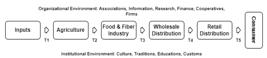
According to Zylbersztajn (2000), as the relationships between agents evolve, whether due to internal or external changes, the contractual relationships within the AGS also change, causing adaptations in the system as a whole. Thus, AGS can be understood as a network of relationships that undergoes constant transformations (Zylbersztajn, 2000; 2017).
In short, an AGS goes beyond being a mere chain of sequential transactions of physical goods between different agents, as it adds greater importance to the behavior of its participants. It means that a transaction involves more than a single aspect of analysis, covering contractual aspects as well as institutional and organizational environments, and is itself a more complete and complex analysis than usually considered in agricultural supply chain approaches (Zylbersztajn, 2000; 2017; Buainain et al., 2014; Zylbersztajn et al., 2015).
2.2 The New Institutional Economics (NIE)
The New Institutional Economics (NIE) has its origins in different scholarly bases. Emerging as a set of alternative approaches, NIE is based on theoretical foundations by Ronald Coase, Douglass North, Oliver Williamson, and Elinor Ostrom. Early developments of NIE brought together elements from theories such as Public Choice, Positive Political Economics, Contracts, Transaction Costs, Property Rights and Measurement Costs Economics (Ménard & Shirley, 2022).
NIE focuses on the study of the rules and norms established by human beings to minimize uncertainties (Ménard & Shirley, 2025). Uncertainties arise from agents’ cognitive limitations in fully predicting future events, generating transaction costs associated with market functioning to acquire and process information (Coase, 1937; Coase, 1988; Ménard & Shirley, 2025). Such costs arise from the delimitation and supervision of the necessary conditions for organizing transactions, that is, the transfer of ownership and use rights of an asset (Ménard & Shirley, 2022).
Transaction costs are related to formal and informal institutions and vary according to the governance structures chosen to govern the transaction, as well as the conditions established by the institutional environment for the transfer of property rights (Alston et al., 2018; Ménard & Shirley, 2022). Therefore, the focus of NIE lies in how these institutions act in the different arrangements that sustain production and exchange, offering a solid field for the analysis of AGS activities due to the existence of formal and informal agreements established between agents (Zylbersztajn, 2005; Ménard & Shirley, 2022).
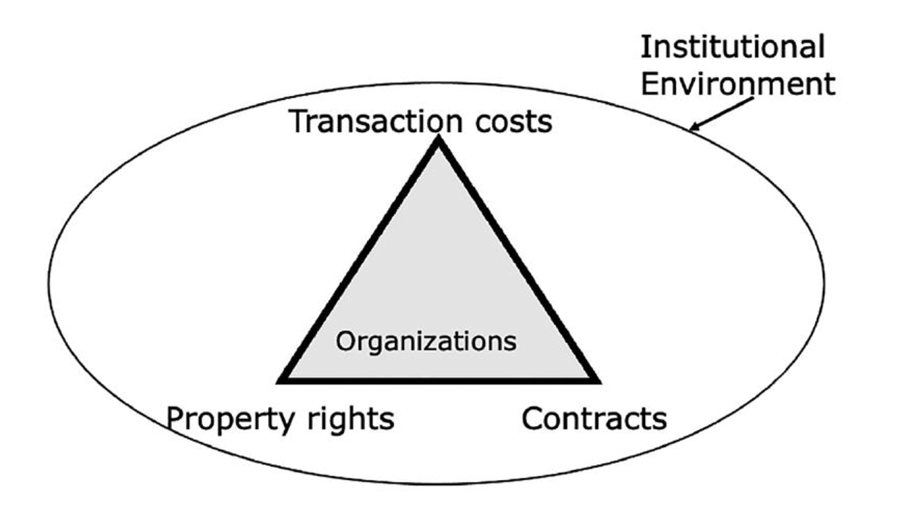
The structuring of NIE focuses on two distinct analytical levels: the macro-institutional and the micro-institutional (Azevedo, 2000). The macro-institutional level looks at the origin, structuring, and change in institutions and organizations; the central idea is to explain how the “rules of the game”, also called the institutional environment, affect the performance and development of agents (Zylbersztajn, 2005; Ménard & Shirley, 2022). The micro-institutional level, on the other hand, is based on the different governance structures adopted to organize transactions, aiming to reduce transaction costs (Azevedo, 2000; Ménard & Shirley, 2025). Also, according to Zylbersztajn (2005), the link between the two strands lies in the operation of firms as institutional arrangements aligned with the institutional environment. In that sense, three key concepts are at the core of NIE, forming the so-called golden triangle (Figure 2): transaction costs, property rights, and contracts. These concepts are fundamental for understanding interlinkages between organizations and institutions, and between the macro- and micro-institutional levels (Ménard & Shirley, 2022).

From the perspective of AGS, it is important to highlight the interactions between institutions and organizations, since different entities may assume specific roles in the “rules of the game” scheme: rules and norms are not only designed or created, but often need to be “translated”, transmitted, applied, and enforced upon agents, which might be performed by organizations. This scheme helps to reduce coordination failures in AGS.
According to Azevedo (2000), the institutional environment is composed of three central elements: formal rules, informal restrictions, and property rights. Formal rules correspond to the legal set, such as laws and public policies, and to the constitutional apparatus of a State. Informal restrictions arise from social and cultural barriers, such as customs, religion, and moral and ethical codes, among other aspects that cannot be easily changed by public policies (Azevedo, 2000). Finally, property rights consist of the set of rights to use and transfer resources; the more secure the property rights, the greater the incentive to keep the asset. Otherwise, greater investment is required to strengthen one’s claim (Ménard & Shirley, 2022; Ménard & Shirley, 2025).
Thus, NIE can be characterized as a tool for analyzing the complex nexus of formal and informal contracts present in transactions (Zylbersztajn, 2005; Ménard & Shirley, 2022). To this end, two different analytical levels are used: the macro-institutional level, corresponding to the institutional environment with its “rules of the game”, and the micro-institutional level, focusing on governance structures (Azevedo, 2000; Ménard & Shirley, 2022).
2.3 Transaction Cost Economics (TCE)
The microanalytical branch of NIE focuses on the governance structures used to coordinate economic transactions, which is the focus of Transaction Cost Economics (TCE). TCE discusses the improvement of coordination between agents through the minimization of transaction costs via governance structures such as the spot market, hybrid forms, and hierarchy (Williamson, 1985; Azevedo, 2000).
The understanding of TCE is based on two behavioral assumptions. The first is that agents display opportunistic behavior, that is, they take actions aiming at their own benefit (Ménard & Shirley, 2025). The second assumption deals with bounded rationality, which postulates that due to informational and cognitive limitations, it becomes impossible for agents to predict all future contingencies, generating contractual incompleteness (Ménard & Shirley, 2022; Ménard & Shirley, 2025). According to Azevedo (2000), to deal with inevitable contractual gaps, agents need to build adequate governance structures.
Transaction costs have a certain variability and can increase or decrease according to the characteristics of a given transaction (Azevedo, 2000). According to Williamson (1985), transactions present three attributes. Frequency reflects the recurrence of a transaction between two agents. The higher the frequency, the lower the average fixed costs involved and the greater the chance of avoiding opportunistic behavior (Williamson, 1985; Williamson, 1991; Ménard & Shirley, 2022). Uncertainty refers to the agents’ inability to predict future events, thus widening the gaps that a contract cannot cover and increasing the need for adjustments or renegotiation (Williamson, 1985; Ménard & Shirley, 2022). Finally, asset specificity is related to the dependence of the return on assets on the continuity of a specific transaction. The greater the specificity, the greater the impact of opportunistic behavior, resulting in increased transaction costs (Williamson, 1985).
The greater the specificity of the assets, the higher the transaction costs, as the risk of loss in the event of a breakdown in the relationship becomes significant (Azevedo, 2000). According to Azevedo (2000), if asset specificity is low, transaction costs will be low, and it is not necessary to use control tools, as the market becomes efficient by itself to govern the transaction. The role of institutions in general, and governance structures in particular, is to mitigate transaction costs (Azevedo, 2000; Sent & Kroese, 2022).
Williamson (1985) indicates that there is a continuum in the transaction forms: at one end there is the spot market, and at the other there is hierarchy, passing through intermediate modes, namely hybrid forms. The spot market can be understood as an institutional arrangement in which agents are autonomous, and prices act as parameters for interactions. Hierarchy, on the other hand, is composed of a set of activities consistently ordered within the firm (Ménard et al., 2014). Finally, hybrid forms are understood as those executed through a combination of formal and informal contractual elements (Williamson, 1985), in which agents aim to cooperate and are governed by bilateral restrictions, as in the case of franchises (Ménard et al., 2014).
In short, TCE theory seeks to improve coordination between agents by minimizing transaction costs, considering governance structures (Ménard & Shirley, 2022; Ménard & Shirley, 2025). Based on the behavioral assumptions of bounded rationality and opportunism, TCE recognizes contractual incompleteness in transactions and proposes forms of governance to deal with these gaps (Azevedo, 2000). Exchanges vary according to transaction attributes – frequency, uncertainty, and asset specificity – and greater specificity increases transaction costs due to the risk of ruptures (Williamson, 1985).
Despite the theoretical and empirical advances achieved over the decades with the development of NIE and the construction of a central conceptual framework, the various perspectives of its foundations follow distinct directions, and few researchers have dared to combine these branches into a unified structure. This means that NIE is not a single theory, but a tree with a strong conceptual trunk. As Ménard & Shirley (2022, p. 12) point out, “NIE may be best portrayed as a movement towards a synthesis that has not yet arrived.” Thus, while NIE has evolved and proven useful for studying complex real-world problems, supporting that institutions are essential to our understanding of how societies and economies function, theoretical advancements are still necessary, making room for divergent views and fruitful debates.
3 METHODOLOGICAL PROCEDURES
The present work is characterized as qualitative, descriptive research (Triviños, 1987; Merriam, 1998). For its design, two complementary methodologies were used: bibliometric analysis and bibliographic review, based on Moher et al. (2009) and Malanski et al. (2019). Following Silva et al. (2012), bibliographic research utilizes secondary data, allowing the use of a series of resources to study a given theme. The bibliographic review is not a mere repetition, but a new approach to a given content based on new perspectives (Lakatos & Marconi, 2009).
It is noteworthy that bibliographic research differs from a literature review because it is not limited to a mere analysis of the theoretical framework but seeks to generate new knowledge from such a review, answering specific questions through the explored bibliography (Silva et al., 2012). Thus, bibliographic research becomes indispensable for the knowledge and processing of previous data (Silva et al., 2012).
Bibliometric analysis, on the other hand, seeks quantitative and statistical analyses of scientific production and dissemination metrics, examples of which include the number of publications, authors, year of publication, citations, keywords, etc. (Fonseca, 1986; Araújo, 2006; Malanski et al., 2019).
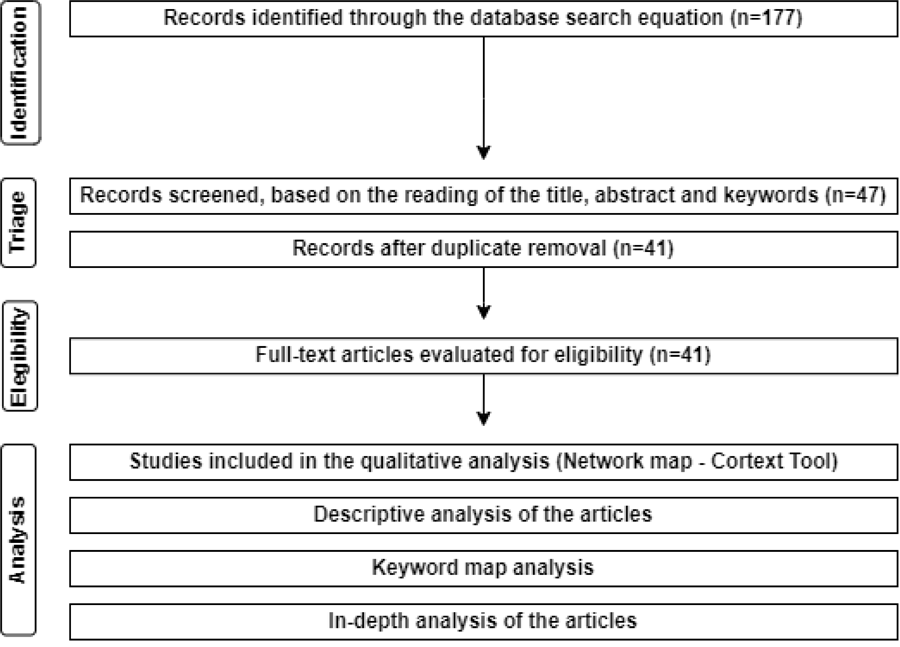
For this research, data collection and bibliometric analysis were carried out based on the work of Moher et al. (2009) and Malanski et al. (2019). These methodological procedures are part of the PRISMA statement (Moher et al., 2009), which consists of a list of items to support reviews. This methodological statement provides a diagram divided into four phases, which were followed in this work. It should be noted that in the data analysis phase, adaptations were made to include an in-depth analysis of the surveyed articles. Figure 3 shows the methodological approach adopted in this research.

The first phase consisted of identifying articles in the Web of Science database (main collection) and the SciELO Citation Index, referring to the period 2002-2023, since the SciELO database began indexing articles in 2002. The identification of articles was carried out through the elaboration of a search equation based on terms linked to the theories of NIE and TCE and the dairy AGS, considering Brazil and particularly the state of Paraná. This choice comes from the identification, throughout the equation elaboration process, of relevant discussions about Paraná’s dairy AGS in nationwide studies. Initially, the focus of the present study would be the state of Paraná, but during the process, the importance of the national scope was identified and considered in the study. Thus, after initial searches, it was decided to include research in both the Brazilian context and particularly in Paraná. To elaborate on the equation, terms in English, Portuguese, and Spanish were used, and the data collection process took place from June to August 2024.
Phases two and three included the screening and eligibility assessment of the articles by reading their titles, abstracts, and keywords. The inclusion and exclusion criteria were the following: only scientific articles whose themes were related to dairy AGS coordination, with no language restrictions. Thus, those that did not fit the research theme or were duplicated – that is, present in both databases consulted – were excluded. As seen in Figure 3, of the 177 articles found, 41 were selected for analysis in the next phase.
The fourth and final phase corresponded to the analysis of these 41 articles. In this stage of analysis, a descriptive analysis of the 41 articles was carried out based on bibliometric data such as year, university, author, journal, and funding agencies. After that, a keyword network map was generated with the keywords of the articles. This map was generated using the Cortext analysis tool (CorTexT Manager, 2024). With the help of the keyword map, it was possible to identify the most relevant themes for the theories under study and for chain coordination in general. Finally, a full reading of the selected articles was carried out to enable a more in-depth analysis. To analyze the articles, a content analysis was performed. Content analysis leads to systematic descriptions and allows for the understanding of meanings that go beyond common reading (Moraes, 1999). According to Bardin (1977), content analysis has three phases: pre-analysis, exploration of the material, and treatment of the results, which are used to enable inferences from the data.
The categories chosen to describe the coordination of the dairy AGS followed the framework of the theoretical background. Figure 4 represents the structure that guided the description of results based on the theoretical foundations of this study.

Finally, the content was organized to enable analysis, inferences, and conclusions, evidenced in the next section.
4 RESULTS AND DISCUSSIONS
4.1 Bibliometric survey on dairy AGS coordination
4.1.1 Descriptive analysis of the data collected
Based on the 41 articles, 16 of which come from the SciELO Citation Index database and 25 from the Web of Science Main Collection database, a descriptive analysis was initially carried out. Regarding the number of publications per year, the first articles appeared in 2006, remained relatively constant until 2011, then paused in 2012 (with no publications), resuming in 2013. Figure 5 shows that since 2019, the number of articles published annually has increased, demonstrating a growing interest in the study of dairy AGS coordination in recent years.

– Number of articles published per year related to scientific production on dairy AGS in Brazil
In total, 127 authors were identified, with only three having more than three publications. From Figure 6, it is possible to observe that the author with the greatest representativeness is Ferenc Istvan Bánkuti, the second author with the most publications is Júlio Cesar Damasceno, and the third author is Marcel Moreira De Brito. All of them have publications linked to the State University of Maringá (UEM). The three authors appear in 41.45% of the 41 articles included in the study.

– Number of articles published by the ten authors with the most papers related to scientific production on dairy AGS in Brazil
Among the universities with the most publications, the State University of Maringá (UEM) stands out, with 11 publications, followed by the Federal University of Viçosa (UFV), with 7 articles, and the University of São Paulo (USP), with 4 publications. Thus, although there is a strong representativeness of UEM in studies referring to dairy AGS coordination in Paraná, research institutions from other states or even from other countries also appear among the main ones, notably through research partnerships, as evidenced in Figure 7.

– Number of articles published by the ten universities with the most studies related to scientific production on dairy AGS in Brazil
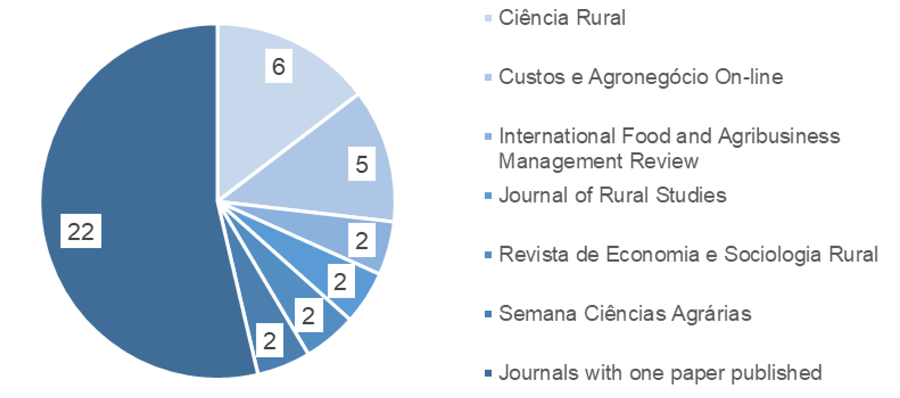
The most relevant journals were Ciência Rural, with 6 articles, and Custos e Agronegócio Online, with 5 articles, with the remaining journals accounting for one or two publications each, as shown in Figure 8. It is important to mention the diversity of journals, comprising 28 in total.

Finally, the funding agencies with the greatest representation were the Coordination for the Improvement of Higher Education Personnel (CAPES) and the National Council for Scientific and Technological Development (CNPq), supporting research in 12 and 5 articles, respectively. Other funding agencies include Fundação Araucária, FAPESC, FAPERGS and European agencies, among others.
4.1.2 Analysis of the keyword map
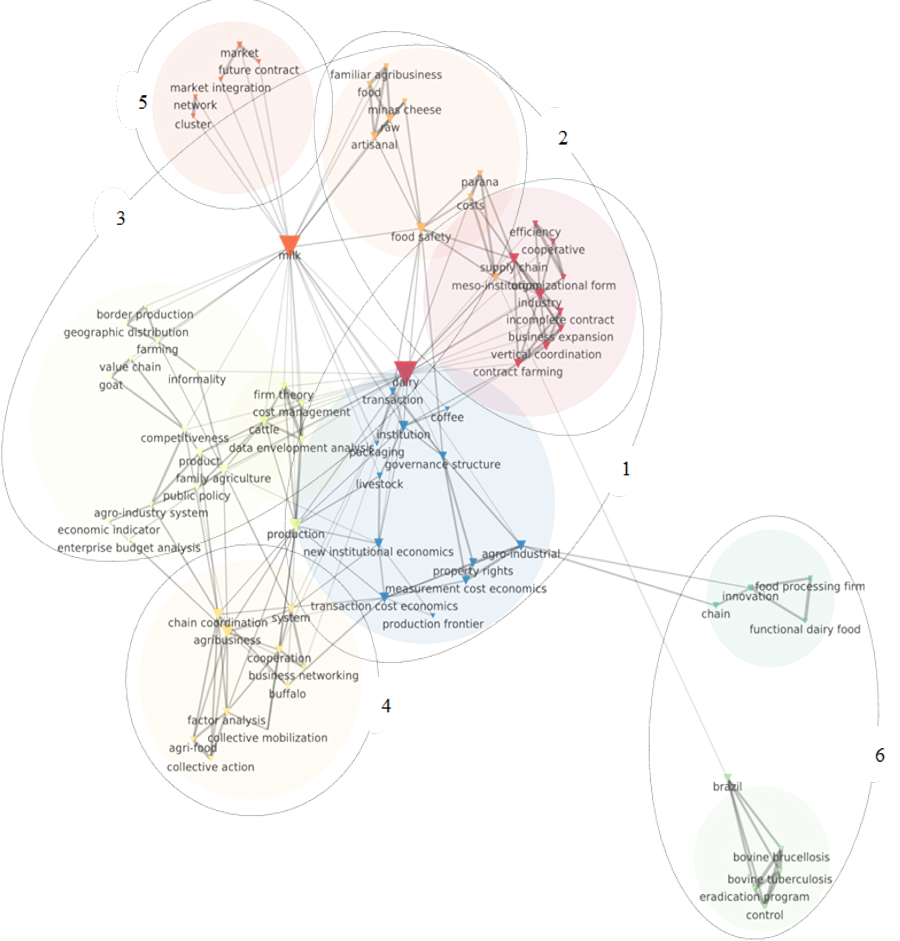
After a descriptive analysis of the articles surveyed, a network map was generated with the keywords of the 41 studies, as seen in Figure 9. This map represents the keywords as triangles, with lines indicating the interconnections among elements. The colored clusters reflect groups of keywords with a high level of co-occurrence, following the logic of the larger the size and the thicker the line, the greater its occurrence and co-occurrence, respectively. The network map made it possible to identify the main discussions about the coordination of the dairy AGS, which were grouped into six thematic axes (circles) for subsequent analysis, as shown in Figure 9.

– Keyword network map with the research themes related to the coordination of the dairy AGS
On the map, it is observed that the most frequent terms refer to the product – the central object of study – covering not only bovine milk but also other types, such as buffalo and goat milk. It is also noticed that there are several research fields investigating dairy AGS coordination, such as Administration, Economics, Animal Science, and Food Engineering and Technology – the latter two focusing on technical and productive aspects.
Regarding the circles, in Circle 1, it is possible to see the centrality of New Institutional Economics (NIE) and Transaction Cost Economics (TCE) theories in discussions, particularly concerning transaction efficiency and the guarantee of property rights. In addition to covering both macro and micro-institutional aspects, the circle also includes terms specific to these theories, such as governance structure, transaction, incomplete contracts, agricultural contracts, and vertical integration. It also encompasses recently developed aspects of NIE, such as the discussion on meso-institutions and the complementary use of Measurement Cost Economics (MCE).
In turn, Circle 2 indicates issues related to food safety in different contexts, covering both large-scale/industrial and small-scale/artisanal production systems. This discussion involves the search for quality assurance and food safety in supply chains, particularly for artisanal production and raw milk cheese. It also involves a discussion on industrial production, including aspects of vertical coordination for supply chain efficiency (e.g., vertical coordination, contract farming, incomplete contracts, organizational form, efficiency, and supply chain).
In Circle 3, it is possible to observe that dairy AGS is approached from a broader perspective, encompassing several dimensions such as family farming, competitiveness, public policies, and aspects related to processing and informality. The strong interconnection with food safety is once again evident. It is in this circle that the term “milk” becomes more evident, in its center and connecting with other circles, bringing a wider discussion about the commodity. Thus, research in this circle focuses more on the productive aspects of both cow and goat milk (e.g., production, product, cattle, goat, family agriculture, farming, border production), chain competitiveness (e.g., competitiveness, value chain, and informality), and public policy issues.
Circle 4 highlights coordination that extends beyond verticalization, incorporating elements of horizontal coordination, which involves terms such as collective actions, cooperation, and collective mobilization. Additionally, discussions focus on optimizing production and cost management. This circle also demonstrates the variety of analysis methods used by different dairy AGS scholars. Finally, circles 5 and 6 integrate other perspectives present in transactions, respectively covering sanitary issues regarding herd management, and themes on innovation, product engineering, and finance, based on new proposals for the sale of milk and dairy products.
In short, it is possible to see that there is a diversity of themes that have brought about the identification of six thematic axes. Theoretical terms related to coordination are more central to the map and strongly connected with other elements. Meanwhile, other elements appear in the periphery of the map, though still connected to the core, as seen in Circles 5 and 6.
4.2 Literature review on coordination in dairy AGS: Brazilian context
After identifying the main topics discussed in the scientific field regarding dairy AGS coordination through the keyword map, an in-depth reading of the articles in each circle and a bibliographic review were conducted. This analysis considered the Brazilian context, highlighting characteristics of the Paraná state.
From Circle 1, in which keywords directing theories are more concentrated, it was possible to identify different methodologies used to characterize dairy AGS coordination in Brazil. The methodologies are predominantly qualitative and descriptive (Rosales & Batalha, 2013; Watanabe et al., 2017; Almeida & Souza, 2021; Ménard et al., 2022; Sudré et al., 2021, 2023), 2023), with some studies employing quantitative approaches, such as those by Bánkuti and Caldas (2018) and Casali et al. (2020).
Regarding formal rules, which are part of the institutional environment (Zylbersztajn, 2000; Ménard & Shirley, 2022), there are efforts to comply with Normative Instruction 62/2011 (later replaced by NIs 76 and 77/2018) (Watanabe et al., 2017; MAPA, 2018a, 2018b). Such regulations aim to ensure quality in terms of sanitary and food safety standards, establishing minimum quality standards for milk production (Watanabe et al., 2017).
The study by Ménard et al. (2022) highlights the role of entities and organizations in complying with these Normative Instructions. The Ministry of Agriculture, Livestock, and Supply (MAPA) is responsible for coordinating private laboratories that perform tests on milk samples collected from farmers by dairy processing companies. These tests verify attributes such as fat and protein content, somatic cell counts, and bacterial counts, as well as analyze the presence of veterinary product residues, aiming to meet minimum quality standards. Studies reveal the influence of the institutional environment (legal requirements) and organizations on the functioning of the dairy AGS and agents’ relationships.
Regarding property rights, it is generally noted that they are better defined when contractual safeguards exist between parties, as these clearly signal the obligations and rights of both agents (Watanabe et al., 2017; Almeida & Souza, 2021; Sudré et al., 2021, 20, 2023). This finding corroborates the studies of Williamson (1985) and Zylbersztajn (2000).
Regarding transaction attributes, from the perspective of Transaction Cost Economics (TCE), there is a certain diversity in Brazil. Concerning transaction frequency, Almeida and Souza (2021) suggest a high recurrence in terms of product delivery. Sudré et al. (2021) note that transaction frequency is defined by contract, considering the frequency of microbiological tests. According to Casali et al. (2020), the frequency of technical visits can also be considered a means to increase transparency in the information exchanged between agents. As highlighted in the theory, higher frequency allows trust to be built and relational contracts to be adopted, which can mitigate conflicts and improve coordination.
Uncertainty is addressed from different perspectives. Casali et al. (2020) analyze information asymmetry as a factor generating uncertainty among farmers, leading them to engage in horizontal relationships, such as cooperatives. These relationships enhance trust through greater information sharing. Another common uncertainty is linked to the variation in the price per liter paid to the farmer, which fluctuates according to the market and negotiations between parties (Sudré et al., 2023).
Among the asset specificities found, time specificity is present in all analyzed studies (Watanabe et al., 2017; Bánkuti & Caldas, 2018; Casali et al., 2020; Almeida & Souza, 2021; Sudré et al., 2021, 2023), 2023), while site and human asset specificities are highlighted by Bánkuti and Caldas (2018) and Watanabe et al. (2017). Casali et al. (2020) emphasized human specificity, arguing that farmers’ level of knowledge provides an important basis for correct management and milking practices, increasing production performance. A summary of the analysis of transaction attributes, based on TCE, can be seen in Chart 1.

Regarding the articles concentrated in Circles 2 and 3 of Figure 9, they complement the view of studies in Circle 1. They provide an in-depth analysis of the impact of organizations on disseminating information concerning milk quality in Brazil, and consequently in Paraná, in both artisanal and industrial production systems (Ménard et al., 2022; Oliveira, G. et al., 2022). They also present a characterization of farmers in both realities (Santos & Bevilacqua, 2019; Hayer et al., 2019; Roldan et al., 2023; Bánkuti et al., 2023).
Some entities and organizations are responsible for “translating” and transmitting information to producers, addressing information asymmetries and discouraging low-quality production (Oliveira, G. et al., 2022). Among the organizations present in the dairy AGS, studies mention Embrapa, which provides R&D programs and technical assistance; Conseleite, a joint council for the dairy sector that uses its own methodologies to estimate a reference price for milk commercialization, which tends to be well accepted by producers and processing companies; and MAPA, which coordinates both the private laboratories responsible for physicochemical tests and the jurisdiction of the Federal Inspection Service (SIF), responsible for monitoring compliance with regulations (Ménard et al., 2022).
According to Oliveira, G. et al. (2022), the presence of such organizations strengthens coordination through the translation of the “rules of the game”, leading to greater adherence to milk safety standards, especially among low-quality producers who benefit most from the information passed on. Moreover, this scheme provides feedback to the government on the effectiveness of these norms (Ménard et al., 2022).
In the characterization of the processing segment, two distinct realities are noted: artisanal processing and industrial-scale processing. Studies by Roldan et al. (2023) and Bánkuti et al. (2023) address the characteristics of small-scale artisanal producers, who rely predominantly on family labor. The main motivations for this type of production relate to maintaining cultural traditions, remaining in rural areas, the difficulty in meeting the quality requirements of industrial processing agents, and the objective of increasing income – either through value addition or by eliminating intermediaries in the production chain (Bánkuti et al., 2023; Roldan et al., 2023). The main market channel for artisanal products is direct sale to consumers, where farmers build relationships based on trust and convenience, such as home delivery – factors perceived as differentials by buyers (Santos & Bevilacqua, 2019; Roldan et al., 2023; Bánkuti et al., 2023). In this sense, the strong role of informal norms in the institutional environment is observable, where cultural and social aspects prevail over legal requirements.
The second reality is industrial-scale processing, generally characterized by larger scales due to greater investments in production structures to meet market demands (Bánkuti et al., 2023). According to Santos and Bevilacqua (2019), industrial production has better conditions to comply with legal aspects for the commercialization of animal products. This compliance may ensure greater competitiveness in the medium and long term (Bánkuti et al., 2023). On the map, discussions encompassing industrial and artisanal production (Circles 2 and 3) are linked to food safety, highlighting the relevance of this issue for the dairy AGS.
Articles concentrated in Circle 4 focus on the main aspects of producers participating in horizontal arrangements, such as cooperatives and farmers’ associations (Brito et al., 2015a, 2015b; Casali et al., 2020; Martinelli et al., 2022). According to Brito et al. (2015a) and Casali et al. (2020), farmers participating in such arrangements enjoy several advantages over those who do not, starting with a greater capacity to deal with prices and negotiations due to lower information asymmetry, which increases the probability of remaining in the activity. In addition, the sharing of information and technical knowledge among farmers, along with easier access to credit from financial institutions, increases the productivity levels of participating producers (Brito et al., 2015b; Casali et al., 2020; Martinelli et al., 2022), which demonstrates the importance of horizontal arrangements in the functioning of the dairy AGS.
Finally, Circles 5 and 6 contain articles integrating different perspectives on dairy transactions. Circle 5 addresses innovation and financial issues, such as the analysis of implementing a new type of contract in the dairy futures market (Siqueira et al., 2008; Lima et al., 2009). Circle 6 discusses the agroecological transition, focusing on the organization and governance structure of rural dairy properties (Siqueira et al., 2021). In both cases, although apparently detached from discussions in the other axes, these elements indicate important perspectives on dairy AGS coordination, especially considering the need for transformation towards sustainability.
4.3 Literature review on coordination in dairy AGS: Specificities of Paraná State
After analyzing the results at the national level, we observe that the dairy AGS in the state of Paraná presents unique characteristics, mainly regarding the institutional environment, governance structures, and asset specificity, as discussed below.
Through a study in the Western region, Bánkuti and Caldas (2018) described a greater presence of physical asset specificity due to higher investments by producers in that territory. Regarding governance structures, Watanabe et al. (2017) showed that transactions in Paraná’s dairy chain occur mostly through hybrid forms, where some producers are closer to vertical relationships, while others rely on long-term verbal agreements based on trust. Vertical integration also becomes a feasible option in Paraná, especially when there is a greater need for product differentiation, which is more common in regions with contracts guaranteeing additional payment for higher quality milk (Watanabe et al., 2017; Sudré et al., 2021; Sudré et al., 2023).
According to Bánkuti and Caldas (2018), producers who do not adapt to legal requirements often move towards informal markets – i.e. markets that do not follow formal rules and are not subject to sanitary and food quality inspection. In general, sales in these markets are made directly to consumers or to small retailers (such as bakeries and neighborhood grocery stores). Such occurrences are supported by cultural issues, as consumers often believe that informal products are artisanal, more natural, tastier, and of better quality; besides, economic issues also arise, since informal products generally have lower prices (Bánkuti & Caldas, 2018).
Bánkuti et al. (2023) identified that a portion of the farms analyzed in their study did not have sanitary authorization for artisanal cheese production in Paraná, thus characterizing an informal activity. According to the authors, this is justified by the difficulty and high cost of complying with legislation (Bánkuti et al., 2023), which requires investments in equipment and infrastructure. According to Santos and Bevilacqua (2019), although this type of production departs from scientific and technical rigor, national legislation for dairy production continues to be developed with a focus on the industrial sector, complicating changes to this scenario.
Finally, the relevance of collective organizations in the dairy chain in Paraná is also observed, with an emphasis on cooperatives, especially in the Western, Southeast, and Center-East regions (Bánkuti & Caldas, 2018). According to the authors, collective actions reduce transaction costs due to lower negotiation and monitoring costs (Bánkuti & Caldas, 2018).
It is noted, therefore, that aspects addressed in the surveyed articles extend beyond the core theories considered in this study (NIE and TCE). These come from different disciplines, such as collective organizations – although Zylbersztajn (2000) emphasizes their importance –, technical and sanitary aspects, and issues regarding innovation, finance, and agroecological transition. However, these elements are linked to these theories and impact dairy AGS coordination.
In that sense, some theoretical highlights can be made. The survey showed that, on the one hand, the coordination of the dairy AGS is widely studied through the lens of NIE, considering its potential to address institutional and market failures. On the other hand, a wide range of studies do not rely on NIE to discuss aspects relevant to the coordination of the dairy AGS. There is a diversity of issues that do not connect directly to the central elements of NIE.
Although not theoretically connected, empirical elements intertwine, which is clearly observed by the links in the keyword map. This suggests the need for an interdisciplinary approach to the study of coordination in the dairy agro-industrial system. However, the findings may also reinforce the importance of efforts to advance NIE itself, as suggested by Ménard & Shirley (2018; 2022; 2025).
Results show that the richness and complexity of empirical elements that permeate the coordination of the dairy AGS need to be studied and understood in a more integrated way, in which elements such as institutions, technical and productive standards, behavioral aspects, strategy, market and consumption, norms, culture, beliefs, sustainability, and public policies, among others, can be examined simultaneously. Efforts in other sectors have already been observed in recent studies, such as in fish (Cunico et al., 2019; Cunico et al., 2020), beef (Pereira et al., 2023; 2024), and coffee (Guimarães et al. 2022; Chaves et al., 2024). Thus, the combined contribution of theoretical perspectives, such as Economic Sociology, Supply Chain and Global Value Chains, Strategy, Collective Action, Convention Theory, and Sustainability approaches, can be useful for advancing empirical studies as well as for reflecting on theoretical advancements in such fruitful terrain as NIE.
5 FINAL CONSIDERATIONS
This research analyzed the scientific production on the dairy Agribusiness System (AGS) in Brazil and in the state of Paraná, with a particular focus on coordination among agents. Based on the analyses conducted, it is concluded that scientific production on the AGS in Brazil, with special emphasis on the state of Paraná, has increased in recent years, with strong representation from the State University of Maringá (UEM). The articles portray a diversity of areas, methodologies, and themes that interact to understand coordination in the AGS, which is central to the discussions and involves economic, social, and technical and productive issues.
This diversity can be observed in the six thematic axes identified. Elements related to coordination are central, especially terms related to New Institutional Economics (NIE) and Transaction Cost Economics (TCE), which are also connected to other elements such as food safety, artisanal and industrial production, family farming, and public policies. Some aspects remain more segmented, including themes of innovation and animal health issues regarding herd management, indicating the need for greater interdisciplinarity and a more integrative view of AGS coordination.
Considering the theoretical foundations of this study, NIE and TCE, a strong influence of the institutional environment on transactions is perceptible in the national context, related to both formal rules and cultural issues and habits (informal rules). Complementing this view, a discussion has emerged regarding the role of meso-institutions in mediating and translating information from the macro-institutional level (institutional environment) to the micro-level (governance structures).
From the perspective of property rights, the existence of contractual safeguards proves to be the best option for defining obligations and rights regarding asset use. Regarding transaction attributes, there is diversity in transaction frequency patterns, differing from uncertainty and asset specificity, which manifest similarly throughout the territory. In this environment, studies related to the coordination of transactions between producers and processors prevail. The role of horizontal arrangements is also discussed; they are important for reducing transaction costs by decreasing negotiation costs and minimizing uncertainties through information sharing.
In the context of the state of Paraná, a diversity of arrangements was observed, including the existence of formal and informal agreements reflecting the regional particularities of each part of the state. Governance structures indicate the coexistence of spot markets, hybrid forms, and hierarchies to govern transactions in the dairy AGS, with special attention to the upstream segments of the chain. Thus, there is a gap in studies focused on downstream transactions, such as distribution and consumption – except for those related to direct sales from farmers to final consumers.
Furthermore, this study revealed that issues related to AGS coordination extend beyond the theoretical elements usually addressed, which indicates the importance of multi- and interdisciplinary approaches for studies on dairy AGS coordination. Therefore, future research could focus on downstream segments of the chain and bring interdisciplinary approaches to address elements of the dairy AGS in a more integrated manner, also considering the combination of complementary theories and approaches, such as Measurement Cost Economics (MCE), the Resource-Based View (RBV), Social Capital, and Collective Action, among others.
In summary, this review reveals that different areas of knowledge are encompassed and that their elements are strongly interconnected, demonstrating the complexity of the dairy Agribusiness System (AGS) in Brazil and Paraná. Thus, although the analyzed studies are often conducted within specific knowledge areas, conducting research that seeks to view the literature corpus more comprehensively – as done in this study – allows for a better understanding of the complexity and dynamics of the system. This underscores the need for more interdisciplinary, systemic, and holistic studies. Finally, this study contributes to the dialogue among scholars, policymakers, and practitioners, encouraging strategies to improve the coordination, performance, and competitiveness of the dairy AGS in Brazil and Paraná within the global dairy market.
ACKNOWLEDGEMENTS
This study was financed in part by CAPES - Brazil, and is part of a research project intitled "Inovação e transição sustentável: cesta de bens e serviços em territórios amazônicos", supported by Araucaria Foundation (CP nº 003/2022 – Iniciativa Amazônia+10 / proc. 1111/2023- SGPEX UEM / TC 22/2023 - FA).
REFERENCES
-
Acosta, D. C., & de Souza, J. P. (2017). Organizing strategies of the milk production chain in Paraná. Revista Ibero-Americana De Estratégia, 16(2), 66-89. https://doi.org/https://doi.org/10.5585/ijsm.v16i2.2451
» https://doi.org/https://doi.org/10.5585/ijsm.v16i2.2451 -
Almeida, B. U., & Souza, J. P. (2021). Milk agri-industrial system packaging and transactions: transaction attributes, dimensions and governance structure. Custos e agronegócio online, 17 (3), 343-365. From: http://www.custoseagronegocioonline.com.br/sessenta%20e%20tres.html
» http://www.custoseagronegocioonline.com.br/sessenta%20e%20tres.html -
Alston, E., Alston, L. J., Mueller, B., & Nonnenmacher, T. (2018). Institutional and Organizational Analysis: Concepts and Applications Cambridge: Cambridge University Press. https://doi.org/https://doi.org/10.1017/9781316091340
» https://doi.org/https://doi.org/10.1017/9781316091340 -
Araújo, C. A. (2006). Bibliometria: evolução histórica e questões atuais. Em Questão, 12(1), 11-32. https://www.redalyc.org/articulo.oa?id=465645954002
» https://www.redalyc.org/articulo.oa?id=465645954002 -
Azevedo, P. F. (2000). Nova economia institucional: referencial geral e aplicações para a agricultura. Agricultura em São Paulo, 47 (1), 33-52. https://www.bibliotecaagptea.org.br/agricultura-novo/agricultura-geral/artigos/
» https://www.bibliotecaagptea.org.br/agricultura-novo/agricultura-geral/artigos/ -
Bánkuti, F. I., Oliveira, G., Damasceno, J. C., Lima, P. G., Zambom, M. A., & Bouroullec, M. D. (2022). Differences in the typology of dairy systems producing artisanal cheese and those producing only raw milk in Paraná State, Brazil. Revista Brasileira de Zootecnia, 52. https://doi.org/10.37496/rbz5220220154
» https://doi.org/10.37496/rbz5220220154 -
Bánkuti, F. I., & Caldas, M. M. (2018). Geographical milk redistribution in Paraná State, Brazil: Consequences of institutional and market changes. Journal of Rural Studies, 64, 63-72. https://doi.org/10.1016/j.jrurstud.2018.10.004
» https://doi.org/10.1016/j.jrurstud.2018.10.004 - Bardin, L. (1977). Análise de conteúdo São Paulo: Lisboa edições 70.
-
Bastian, A., & Schneider, M. B. (2022). UM MERCADO SEM CONTRATOS: OS PRODUTORES FAMILIARES DE LEITE DO OESTE DO PARANÁ. Revista Orbis Latina, 12 (3). From: https://revistas.unila.edu.br/orbis/article/view/3291
» https://revistas.unila.edu.br/orbis/article/view/3291 - Batalha, M. O. (2001). Gestão Agroindustrial (2 ed.). São Paulo: Atlas.
- Batalha, M. O. (2005). Gestão do agronégocio: textos selecionados. São Carlos: EduFSCar.
-
Brito, M. M., Bánkuti, F. I., Bánkuti, S. M., Ferreira, M. C., Damasceno, J. C., Massuda, E. M., ...Zambom, M. A. (2015). Arranjos horizontais: estratégia para redução da assimetria de informações para produtores de leite no Paraná, Brasil. Ciência Rural, 45 (11), 2069-2075. https://doi.org/10.1590/0103-8478cr20141724
» https://doi.org/10.1590/0103-8478cr20141724 -
Brito, M. M., Bánkuti, F. I., Bánkuti, S. M., Santos, G. T., Damasceno, J. C., & Massuda, E. M. (2015). Horizontal Arrangements and Competitiveness of Small-Scale Dairy Farmers in Paraná, Brazil. International Food and Agribusiness Management Review, 18 (4), 155-172. From: https://ideas.repec.org/a/ags/ifaamr/211658.html
» https://ideas.repec.org/a/ags/ifaamr/211658.html - Buainain, A. M., Alves, E., Silveira, J. M., & Navarro, Z. (2014). O mundo rural no Brasil do século 21 Embrapa.
-
Campos, K. C., & Piacenti, C. A. (2007). Agronegócio do leite: cenário atual e perspectivas. Congresso da Sociedade Brasileira de Economia, Administração e Sociologia Rural, 45, 1-19. From: http://repositorio.ufc.br/handle/riufc/5424
» http://repositorio.ufc.br/handle/riufc/5424 -
Casali, M., Mendonça, B. S. de, Brito, M. M. de, Santos, M. G. R. dos, Lima, P. G. L., Siqueira, T. T. da S., … Bánkuti, F. I. (2020). Information asymmetry among dairy producers in Paraná, Brazil. Semina: Ciências Agrárias, 41(1), 293-304. https://doi.org/10.5433/1679-0359.2020v41n1p293
» https://doi.org/10.5433/1679-0359.2020v41n1p293 -
Caunetto, M. M., Souza, J. P., & Schiavi, S. M. (2024). Transactions in Paraná's dairy AGS: a study based on transaction and measurement costs. Revista de Economia e Sociologia Rural, 62 (1). https://doi.org/10.1590/1806-9479.2022.267722
» https://doi.org/10.1590/1806-9479.2022.267722 -
Chaves, P. T. T., Schiavi, S. M. A., & Granco, G. (2024). Inserção de pequenos produtores na cadeia de cafés especiais no Paraná: um estudo considerando ECT e VBR. Revista de Economia e Sociologia Rural, 62 (4), e282728. https://doi.org/10.1590/1806-9479.2023.282728
» https://doi.org/10.1590/1806-9479.2023.282728 -
Coase, R.H. (1937), The Nature of the Firm. Economica, 4: 386-405. https://doi.org/10.1111/j.1468-0335.1937.tb00002.x
» https://doi.org/10.1111/j.1468-0335.1937.tb00002.x - Coase, R. H. (1988). The firm, the market and the law. University of Chicago Press.
-
CorTexT Manager. (2024). CorTexT Manager [Software]. Cortext. From: https://www.cortext.net
» https://www.cortext.net -
Confederação da Agricultura e Pecuária do Brasil. (2025, April 25). VBP da agropecuária deve crescer 11,4% em 2025. CNA Brasil. From: https://www.cnabrasil.org.br/publicacoes/vbp-da-agropecuaria-deve-crescer-11-4-em-2025
» https://www.cnabrasil.org.br/publicacoes/vbp-da-agropecuaria-deve-crescer-11-4-em-2025 -
Cunico, E., Bánkuti, S. M. S., & de Souza, J. P. (2019). Coordenação de sistemas agroindustriais e a importância do fluxo de informações: um estudo na cadeia piscícola no Paraná. Revista Expectativa, 18 (1), 71-98. https://doi.org/10.48075/revex.v18i1.19334
» https://doi.org/10.48075/revex.v18i1.19334 -
Cunico, E., Souza, J. & Schiavi, S. (2020). Contratos de sustentação de valor: uma estrutura de governança para ativos específicos, estratégicos e difíceis de mensurar. Revista Ibero-Americana de Estratégia, 19 11-40. https://doi.org/10.5585/riae.v19i4.17673
» https://doi.org/10.5585/riae.v19i4.17673 - Davis, J. H., & Goldberg, R. A. (1957). A concept of Agribusiness: Division of Research. Graduate School of Business Administration. Boston: Harvard University.
-
Diniz, V. M., Schmidt, C. M., & Cielo, I. D. (2021). Estruturas de governança no sistema agroindustrial do leite no oeste do Paraná: custos de transação e formas plurais. Revista de Economia e Agronegócio, 19 (1), 1-19. https://doi.org/10.25070/rea.v19i1.10462
» https://doi.org/10.25070/rea.v19i1.10462 - Fonseca, E. N. da (Org). (1986). Bibliometria: teoria e prática São Paulo, SP: Cultrix; Edusp.
-
Food and Agriculture Organization of the United Nations. (2024). Dairy market review: Overview of global market developments in 2024. From: https://openknowledge.fao.org/handle/20.500.14283/cd3524en
» https://openknowledge.fao.org/handle/20.500.14283/cd3524en -
Guimarães, A. F., Schiavi, S. M. de A., Bouroullec, M. D. M., & Pereira, J. A. (2022). Criação e Distribuição de Valor na Cadeia de Cafés Especiais: um estudo da relação entre agentes do Paraná, Brasil e da Europa. Organizações Rurais & Agroindustriais, 24, e1842. From: https://www.revista.dae.ufla.br/index.php/ora/article/view/1842
» https://www.revista.dae.ufla.br/index.php/ora/article/view/1842 -
Hayer, S. S., Staduto, J. A. R., & Darr, D. (2019). Vertical coordination in the Brazilian milk supply chain: the case of 3B Agro LTDA. International Food and Agribusiness Management Review, 22(3), 435-450. https://doi.org/10.22434/IFAMR2018.0080
» https://doi.org/10.22434/IFAMR2018.0080 -
IBGE - Instituto Brasileiro de Geografia e Estatística. (2023). Acesso em 13 de Outubro de 2024, from Produção agropecuária: leite. From: https://www.ibge.gov.br/explica/producao-agropecuaria/leite/br
» https://www.ibge.gov.br/explica/producao-agropecuaria/leite/br - Instrução Normativa nº 76, de 26 de novembro de 2018. (2018). Diário Oficial da União, 230, 9.
- Instrução Normativa nº 77, de 26 de novembro de 2018. (2018). Diário Oficial da União, 230, 10.
- Lakatos, E. M., & Marconi, M. d. (2009). Técnicas de pesquisa: planejamento e execução de pesquisas, amostragens e técnicas de pesquisas, elaboração, análise e interpretação de dados (7 ed.). São Paulo: Atlas.
-
Laurenti, A. C., Soares Junior, D., & Costa, G. V. da. (2022). Tipos de estabelecimentos agropecuários familiares no Paraná. DRd - Desenvolvimento Regional Em Debate, 12 (ed.esp.Dossie), 217-238. https://doi.org/10.24302/drd.v12ied.esp.Dossie.3929
» https://doi.org/10.24302/drd.v12ied.esp.Dossie.3929 -
Laurenti, A. C., Júnior, D. S., & Costa, G. V. (2023). Sistemas de produção na agropecuária do Paraná: Especialização e diversidade. Technical Bulletin No. 105. From: https://www.idrparana.pr.gov.br/Pagina/BT-105-Sistemas-de-producao-na-agropecuaria-do-Parana-especializacao-e-diversidade
» https://www.idrparana.pr.gov.br/Pagina/BT-105-Sistemas-de-producao-na-agropecuaria-do-Parana-especializacao-e-diversidade -
Lima, M. S., Révillion, J. P., & Padula, A. D. (2009). Estratégias competitivas e de desenvolvimento de produtos lácteos funcionais: estudos de caso em empresas agroindustriais da região Sul do Brasil. Ciência Rural, 39(5), 1547-1551. https://doi.org/10.1590/S0103-84782009005000134
» https://doi.org/10.1590/S0103-84782009005000134 -
Malanski, P.D., Schiavi, S. & Dedieu, B. Characteristics of "work in agriculture" scientific communities. A bibliometric review. Agron. Sustain. Dev. 39, 36 (2019). https://doi.org/10.1007/s13593-019-0582-2
» https://doi.org/10.1007/s13593-019-0582-2 -
Martinelli, R. R., Damasceno, J. C., Brito, M. M., Costa, V. D., Lima, P. G., & Bánkuti, F. I. (2022). Horizontal collaborations and the competitiveness of dairy farmers in Brazil. Journal of Co-operative Organization and Management, 10(2). https://doi.org/10.1016/j.jcom.2022.100183
» https://doi.org/10.1016/j.jcom.2022.100183 -
Ménard, C., & Shirley, M. M. (2014). The future of new institutional economics: from early intuitions to a new paradigm? Journal of Institutional Economics, 10(4), 541-565. https://doi.org/10.1017/S174413741400006X
» https://doi.org/10.1017/S174413741400006X -
Ménard, C., & Shirley, M. M. (Eds.). (2018). A Research Agenda for New Institutional Economics Cheltenham, UK: Edward Elgar Publishing. Retrieved Mar 24, 2026, from https://doi.org/10.4337/9781788112512
» https://doi.org/10.4337/9781788112512 -
Ménard, C., Martino, G., Oliveira, G. M., Royer, A., Saes, M. S., & Schnaider, P. S. (2022). Governing food safety through meso-institutions: Across-country analysis of the dairy sector. Applied Economic Perspectives and Policy, 44 (4), 1722-1741. https://doi.org/10.1002/aepp.13278
» https://doi.org/10.1002/aepp.13278 - Ménard, C., Saes, M. S., Silva, V. L., & Raynaud, E. (2014). Economia das organizações: formas plurais e desafios São Paulo: Atlas.
-
Mirales, E., & Souza, J. P. (2023). The Uncertainty of the TCE and MCE in the Agroindustrial System: a Study with Producers and Suppliers from Paraná. Gestão & Regionalidade, 39 From: https://api.semanticscholar.org/CorpusID:265661887
» https://api.semanticscholar.org/CorpusID:265661887 -
Moher, D., Liberati, A., Tetzlaff, J., & Altman, D. G. (2009). Preferred reporting items for systematic reviews and meta-analyses: the PRISMA statement. BMJ. https://doi.org/10.1136/bmj.b2535
» https://doi.org/10.1136/bmj.b2535 -
Ménard, C., & Shirley, M. M. (2022). Advanced Introduction to New Institutional Economics Cheltenham, UK: Edward Elgar Publishing. https://doi.org/10.4337/9781789904499
» https://doi.org/10.4337/9781789904499 -
Ménard, C., & Shirley, M. M. (2025). Handbook of New Institutional Economics Springer. https://doi.org/https://doi.org/10.1007/978-3-031-50810-3
» https://doi.org/https://doi.org/10.1007/978-3-031-50810-3 - Moraes, R. (1999). Análise de conteúdo. Revista Educação, 22 (37), 7-32.
-
Nogueira, C. R., Bánkuti, S. M., Lourenzani, A. E., Bánkuti, F. I., & Lourenzani, W. L. (2018). COORDENAÇÃO DE SISTEMAS AGROALIMENTARES DIFERENCIADOS: UM ESTUDO SOBRE O LEITE ORGÂNICO NO PARANÁ. Gestão & Regionalidade, 34(100). 74-91. https://doi.org/https://doi.org/10.13037/gr.vol34n100.3696
» https://doi.org/https://doi.org/10.13037/gr.vol34n100.3696 -
North, D. C. (1990). Institutions, Institutional Change and Economic Performance. Cambridge: Cambridge University Press. https://doi.org/10.1017/CBO9780511808678
» https://doi.org/10.1017/CBO9780511808678 -
Oliveira, G. M., Schnaider, P. S., Saes, M. S., & Martino, G. (2022). Do private translation mechanisms encourage food safety in dairy production? Evidence from the Brazilian Conseleites. Managerial and Decision Economics, 44 (2), 862-875. https://doi.org/10.1002/mde.3718
» https://doi.org/10.1002/mde.3718 -
Oliveira, T. C., Chaves, P. T., Cavalcante, A. C., & Schiavi, S. M. (2023). Desenvolvimento Territorial Sustentável: um levantamento de pesquisas científicas realizadas pela Universidade Estadual de Maringá. In: Anais do 61º Congresso da Sociedade Brasileira de Economia, Administração e Sociologia Rural (SOBER). ESALQ/USP. https://doi.org/10.29327/sober2023.627329
» https://doi.org/10.29327/sober2023.627329 -
Pereira, J. A., Schiavi, S. M. de A., & Guimarães, A. F (2023). Revisiting the organization of economic transactions: A theoretical proposal based on new institutional economics and new economic sociology. Revista de Estudos Sociais, 25(50), 124-142. From: https://periodicoscientificos.ufmt.br/ojs/index.php/res/article/view/15594/
» https://periodicoscientificos.ufmt.br/ojs/index.php/res/article/view/15594/ -
Pereira, J. A., Schiavi, S. M. d. A., & Guimarães, A. F. (2024). Social capital in transactions: The role of economic and social trust in the specialty beef production system in Brazil. International Food and Agribusiness Management Review, 27 (3), 593-610. https://doi.org/10.22434/ifamr2022.0049
» https://doi.org/10.22434/ifamr2022.0049 -
Polastrini, A., Rodrigues, W., & Filho, M. X. (2022). The A2 milk as an upgrading strategy in the cattle global value chain in Brazil. Desenvolvimento em Debate (10), 119-145. From: http://www.alice.cnptia.embrapa.br/alice/handle/doc/1147003
» http://www.alice.cnptia.embrapa.br/alice/handle/doc/1147003 - Rocha, D. T., Carvalho, G. R., & Resende, J. C. (2020). Cadeia produtiva do leite no Brasil: produção primária. Juiz de Fora: Embrapa Gado de Leite.
-
Roldan, B. B., Ambrosini, L. B., Bremm, C., & Kroeff, D. R. (2023). Characterization of colonial cheese: appreciation a traditional product from southern Brazil. Ciência Rural, 53 (9). https://doi.org/10.1590/0103-8478cr20220277
» https://doi.org/10.1590/0103-8478cr20220277 - Rosales, F., & Batalha, M. (2013). Coordination of the chain of buffalo milk in São Paulo State (Brazil). Buffalo Bulletin, 32 (2), 1200-1203.
-
Santos, P. A., & Bevilacqua, P. D. (2019). Family farming in agroecological transition: a look at the marketing of milk and dairy products in municipalities of the Zona da Mata of Minas Gerais State, Brazil. Ciência Rural, 49 (7). https://doi.org/10.1590/0103-8478cr20180299
» https://doi.org/10.1590/0103-8478cr20180299 - SECRETARIA DA AGRICULTURA E DO ABASTECIMENTO DO PARANÁ. In: Prognóstico Agropecuário: Pecuária de leite 2022/ 2023. (2022). Departamento de Economía Rural, 14 (45).
-
Sent, E.-M., & Kroese, A. L. J. (2022). Commemorating Oliver Williamson, a founding father of transaction cost economics. Journal of Institutional Economics, 18 (2), 181-193. https://doi.org/https://doi.org/10.1017/S1744137421000606
» https://doi.org/https://doi.org/10.1017/S1744137421000606 - Silva, L. V., Machado, L., Saccol, A., & Azevedo, D. (2012). Metodologia de pesquisa em administração: uma abordagem prática Porto Alegre: Unisinos.
-
Siqueira, K.B., da Silva, C.A.B. and Aguiar, D.R.D. (2008), Viability of introducing milk futures contracts in Brazil: a multiple criteria decision analysis. Agribusiness, 24: 491-509 https://doi.org/10.1002/agr.20175
» https://doi.org/10.1002/agr.20175 -
Siqueira, T. T. d. S., Galliano, D., Nguyen, G., & Bánkuti, F. I. (2021). Organizational Forms and Agri-Environmental Practices: The Case of Brazilian Dairy Farms. Sustainability, 13 (7), 3762. https://doi.org/10.3390/su13073762
» https://doi.org/10.3390/su13073762 -
Sudré, C. A., Souza, J. P., & Bouroullec, M. D. (2021). Property rights and reputation in the dairy agro-industrial system. RAUSP Management Journal, 56 (4), 425-443. https://doi.org/10.1108/RAUSP-07-2020-0145
» https://doi.org/10.1108/RAUSP-07-2020-0145 -
Sudré, C. A., Souza, J. P., & Bouroullec, M. D. (2023). Mechanisms of property rights protection in dairy agro-industrial systems: A study in Paraná, Brazil, and old Midi-Pyrénées, France. Revista de Administração Mackenzie, 24 (4). https://doi.org/https://doi.org/10.1590/1678-6971/eRAMR230171.en
» https://doi.org/https://doi.org/10.1590/1678-6971/eRAMR230171.en - Triviños, A. N. S. (1987). Introdução à pesquisa em ciências sociais: a pesquisa qualitativa em educação. Atlas.
-
Tortelly, R., Neto, & Orlandini, I. (2020). Redução de impactos ambientais gerados pela bovinocultura de leite: revisão bibliográfica. Arquivos Brasileiros de Medicina Veterinária FAG, 3 (1), 144-156. From: https://themaetscientia.fag.edu.br/index.php/abmvfag/article/view/352
» https://themaetscientia.fag.edu.br/index.php/abmvfag/article/view/352 -
U.S. Department of Agriculture, Foreign Agricultural Service. (2026). Production, Supply and Distribution Online Retrieved January 22, 2026. From: https://apps.fas.usda.gov/psdonline/app/index.html#/app/advQuery
» https://apps.fas.usda.gov/psdonline/app/index.html#/app/advQuery -
Watanabe, K., Bánkuti, S. S., & Lourenzani, A. E. (2017). "Pingado Dilemma": Is formal contract sweet enough? Journal of Rural Studies, 54, 126-137. From: https://doi.org/10.1016/j.jrurstud.2017.06.001
» https://doi.org/10.1016/j.jrurstud.2017.06.001 - Williamson, O. E. (1985). The economic institutions of capitalism. New York: Free Press.
-
Williamson, O. E. (1991). Comparative Economic Organization: The Analysis of Discrete Structural Alternatives. Administrative Science Quarterly, 36 (2), 269-296. https://doi.org/https://doi.org/10.2307/2393356
» https://doi.org/https://doi.org/10.2307/2393356 - Zylbersztajn, D. (2000). Conceitos gerais, evolução e apresentação do sistema agroindustrial. In Economia e gestão dos negócios agroalimentares: indústria de alimentos, indústria de insumos, produção agropecuária São Paulo, SP: Pioneira.
-
Zylbersztajn, D. (2005). Papel dos Contratos na Coordenação Agroindustrial: um olhar além dos mercados. RESR, 43 (3), 385-420. https://doi.org/10.1590/S0103-20032005000300001
» https://doi.org/10.1590/S0103-20032005000300001 -
Zylbersztajn, D. (2017). Agribusiness systems analysis: origin. evolution and research perspectives. Revista de Administração, 52, 114-117. https://doi.org/http://dx.doi.org/10.1016/j.rausp.2016.10.004
» https://doi.org/http://dx.doi.org/10.1016/j.rausp.2016.10.004
-
Plagiarism Check:
The ReA/UFSM maintains the practice of submitting all documents approved for publication to the plagiarism check, using specific tools, e.g.: Turnitin.
-
Data availability statement:
Data will be available upon request
Edited by
-
Edited by:
Jordana Marques Kneipp
Data will be available upon request

 Source:
  Source:
  Source: The authors, based on
  Source: The authors, based on
  Source: The authors (2025)
 Source: The authors (2025)
 Source: The authors (2025)
 Source: The authors (2025)
 Source: The authors (2025).
 Source: The authors (2025)