
 Integrated work processes between community health workers and vector control agents: a scoping review
ABSTRACT
Objectives: to map the available evidence on integrated work processes between community health workers and vector control agents in primary health care.
Methods: this scoping review was conducted in November 2024 using the Cochrane Library, Embase, the Latin American and Caribbean Health Sciences Literature database, PubMed, Scopus, and Web of Science.
Results: nine documents met the inclusion criteria-five articles, one conference proceedings abstract, one e-book, one monograph, and one law-underscoring the importance of professional integration to reduce fragmentation in primary health care.
Final Considerations: the limited number of publications indicates a substantial evidence gap. Integration between these two professional groups may strengthen public health actions and support more efficient vector control efforts, while also contributing to responses to other public health priorities.
Descriptors:
Community Health Workers; Primary Health Care; Work; Health Personnel; Review.
RESUMO
Objetivos: mapear as evidências científicas disponíveis acerca do trabalho integrado entre agentes comunitários de saúde e agentes de combate às endemias, na Atenção Primária à Saúde.
Métodos: revisão de escopo, realizada em novembro de 2024, nas bases de dados Cochrane Library, EMBASE, Literatura Latino-Americana e do Caribe em Ciências da Saúde (LILACS), National Library of Medicine National Institutes of Health (PubMed), SCOPUS e Web of Science.
Resultados: a amostra obtida, composta por nove documentos, cinco artigos, um resumo em anais de evento, um e-book, uma monografia e uma lei, evidenciou a importância da integração profissional para a desconstrução da fragmentação da Atenção Primária à Saúde.
Considerações Finais: a escassez de artigos sugere uma lacuna significativa na temática. A integração de ambas as categorias profissionais pode melhorar as ações de saúde e oferecer uma abordagem mais eficiente no combate às endemias, bem como para outras questões de saúde pública.
Descritores:
Agentes Comunitários de Saúde; Atenção Primária à; Saúde; Trabalho; Pessoal de Saúde; Revisão.
RESUMEN
Objetivos: mapear la evidencia sobre la integración del trabajo entre agentes comunitarios de salud y agentes de control de vectores en la atención primaria de salud.
Métodos: revisión de alcance realizada en noviembre de 2024 en Cochrane Library, EMBASE, Literatura Latinoamericana y del Caribe en Ciencias de la Salud (LILACS), National Library of Medicine (PubMed), Scopus y Web of Science.
Resultados: el corpus, compuesto por nueve documentos -cinco artículos, un resumen en actas de congreso, un libro electrónico, una monografía y una ley-, puso de manifiesto la importancia de la integración profesional para superar la fragmentación de la atención primaria de salud.
Consideraciones Finales: la escasez de publicaciones sugiere una laguna significativa. La integración de ambas categorías profesionales puede fortalecer las acciones de salud y favorecer un enfoque más eficiente para el control de endemias y otros problemas de salud pública.
Descriptores:
Agentes Comunitarios de Salud; Atención Primaria de Salud; Trabajo; Personal de Salud; Revisión.
INTRODUCTION
Primary health care (PHC), which organizes and reorients health services, serves as the population’s point of entry into the Unified Health System (Sistema Único de Saúde-SUS) and aims to address the most common, less complex health problems. The Family Health Strategy (Estratégia Saúde da Família-ESF) follows a care model grounded in determinants of health and disease and considers individuals within their family, social, economic, and cultural contexts, while also incorporating health surveillance and health promotion activities. ESF is delivered by multiprofessional PHC teams that include, at a minimum, one physician, one nurse, one nursing assistant or nursing technician, and community health workers (Agente Comunitário de Saúde-ACS), assigned to a defined catchment area(1,2). ESF requires a minimum of four ACSs to ensure 100% population coverage of the catchment area, and ACSs account for more than 50% of the ESF workforce(3).
In 2006, with the enactment of Law No. 11,350, the roles of ACS and vector control agents (Agente de Combate às Endemias-ACE) were regulated, and the law already envisaged joint work between the two groups(4).
ACSs play a central role in health promotion in the daily lives of users and families in the areas they serve. By building rapport with users and their families, ACS staff facilitate health actions and strengthen community mobilization(5).
ACEs play an equally important role in the surveillance, prevention, and control of diseases associated with environmental risk factors(6,7). When their work is integrated with ACSs, ACEs can support the implementation of disease control measures during outbreaks and epidemics, including environmental management and integrated management of control activities(8).
The Ministry of Health (Ministério da Saúde) recommends incorporating ACEs into ESF teams to foster collaborative work, given the need to strengthen health promotion and disease prevention by understanding and transforming the territories served(6,7). This approach requires moving beyond existing fragmented, poorly integrated models and can open new possibilities for these professionals and for health managers across levels of care. Despite these guidelines, in many settings ACEs remain assigned to endemic disease control centers or to municipal epidemiological surveillance units, coordinated by professionals who are not directly part of PHC(9,10).
Therefore, coordinating the work of ACSs and ACEs is essential to promote more comprehensive, problem-solving health care. Integrating their actions enables a fuller and better coordinated response to population needs, spanning health promotion, disease prevention, and endemic disease surveillance and control. Overcoming fragmentation and investing in integrated professional training are essential to strengthening health care and supporting more comprehensive care. Such integration should preserve each professional group’s specific scope of practice and facilitate the sharing of experience(10,11).
OBJECTIVES
To map the available evidence on integrated work processes between community health workers and vector control agents in primary health care.
METHODS
Ethical aspects
Because this review relied exclusively on publicly available data and involved no direct human participation, it was exempt from Research Ethics Committee review.
Study design
This scoping review was conducted according to a protocol registered with the Open Science Framework (OSF; DOI: 10.17605/OSF.IO/S8ZY2) and followed Joanna Briggs Institute (JBI) guidance(12) and Arksey and O’Malley’s framework(13). Reporting adhered to the Preferred Reporting Items for Systematic Reviews and Meta-Analyses Extension for Scoping Reviews (PRISMA-ScR) checklist(14) and comprised the following stages: defining the guiding question, identifying relevant studies, selecting studies, charting the data, and collating, summarizing, and reporting the results(15).
Identifying the guiding question
The review question was developed using the PCC framework (Population, Concept, Context): P = ACS and ACE; C = integrated work processes; and C = PHC. Accordingly, the review question was: What scientific evidence is available on integrated work processes between ACS and ACE in PHC?
Identifying relevant studies
Data collection was conducted in November 2024 across six health databases: Cochrane Library, Embase (Elsevier), Latin American and Caribbean Health Sciences Literature (LILACS), PubMed (National Library of Medicine, National Institutes of Health), Scopus (Elsevier), and Web of Science (WoS). These sources were selected because they index a large volume of primary health research, supporting both breadth and quality of retrieval. We also searched the grey literature on official institutional websites, including those of the World Health Organization (WHO), the Pan American Health Organization (PAHO), and the Brazilian Ministry of Health. We consulted catalogs of theses and dissertations as well as national and international guidelines and resolutions. Searches across all sources were standardized through the CAPES Journals Portal (Portal de Periódicos da CAPES), accessed via the Federated Academic Community (CAFe), with access provided by a federal higher education institution.
Study selection
Study selection followed a rigorous process that included screening titles, abstracts, and index terms to identify records that matched the predefined criteria. To maximize both sensitivity and specificity, we developed source-specific search strategies. These strategies combined Health Sciences Descriptors (DeCS) and Medical Subject Headings (MeSH) using the terms “Agentes Comunitários de Saúde”, “Atenção Primária à Saúde”, “Trabalho”, “Doenças Endêmicas”, “Community Health Workers”, “Primary Health Care”, “Work”, and “Endemic Diseases”, along with their respective synonyms, applying the Boolean operators “AND” and “OR” (Chart 1)
Search strategies used across databases for the scoping review, Uberaba, Minas Gerais, Brazil, 2025
Data charting
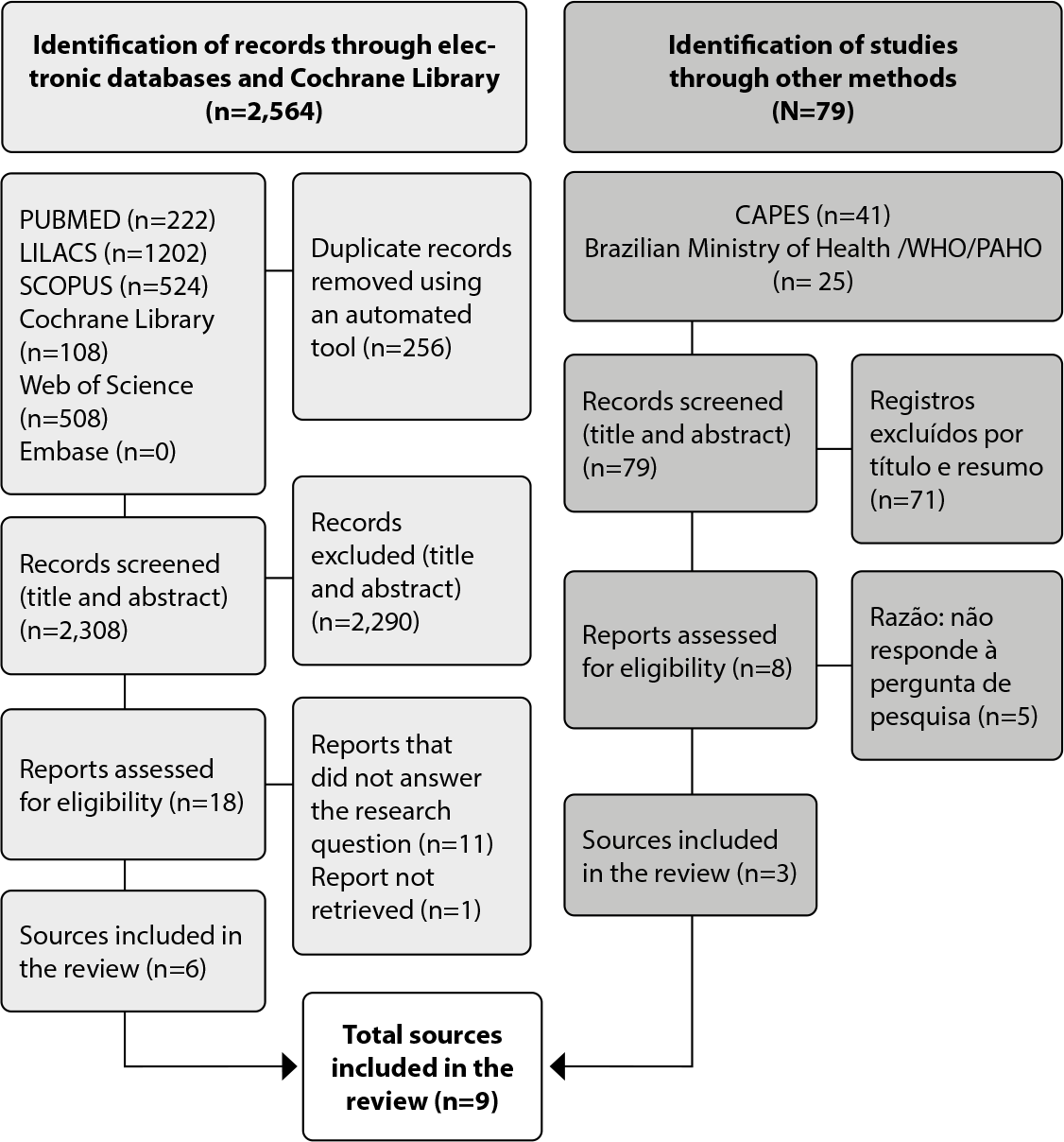
A total of 2,564 records were retrieved from the six databases searched, and 79 documents were identified from other sources. The PRISMA flow diagram was used to document the study inclusion process(14). After retrieval, records were imported into Rayyan for screening and duplicate removal.
To minimize selection bias, two reviewers (primary and secondary) independently screened titles and abstracts against the predefined criteria and then compared their screening decisions to identify discrepancies. Disagreements were resolved by consensus; when needed, a third reviewer arbitrated.
Data extraction followed the JBI data charting tool and captured article identification, year and study setting, methodological characteristics, assessment of methodological rigor, and notes relevant to this review’s thematic focus.
Collating, summarizing, and reporting the results
To support critical appraisal of the sources, we classified the studies’ levels of evidence and grades of recommendation according to the JBI methodology(16). Levels of evidence ranged from 1 to 5, and grades of recommendation from A to C; thus, studies were classified from 1A (highest methodological quality) to 5C (lowest). We also checked the impact factor of the journals in which the studies were published using Journal Citation Reports (JCR).
Extracted information was organized in a table to facilitate synthesis. This approach supported a broad descriptive analysis, including a detailed summary of each primary study included in the review. Two experienced researchers worked collaboratively and met regularly for in-depth discussions to ensure consistency and accuracy of the results.
RESULTS
A total of 2,643 records were identified: 2,564 records retrieved from the six electronic databases searched and 79 documents identified through other search methods. Of the 2,564 database records, 256 were duplicates and were removed, leaving 2,308 records for title and abstract screening. Of these, 2,290 were excluded for failing to meet the eligibility criteria. Eighteen reports underwent full-text assessment; 12 were excluded based on the predefined criteria, leaving six sources included from database searching. For the other methods search, 79 documents were screened by title and abstract; 71 were excluded, and eight reports were assessed for eligibility. Five were excluded for failing to answer the review question, yielding three additional sources. Thus, the final corpus comprised nine sources included in this scoping review (Figure 1).

All sources included in this review were published in Portuguese (100%): two (22.2%) in 2024, two (22.2%) in 2022, two (22.2%) in 2018, and one (11.1%) each in 2020, 2019, and 2016. In terms of document type, five (55.5%) were journal articles, one (11.1%) was a conference proceedings abstract, one (11.1%) was an e-book, one (11.1%) was a monograph, and one (11.1%) was a law.
In the synthesis, the following study designs were identified: four qualitative studies (44.4%), one descriptive-exploratory study (11.1%), one integrative review (11.1%), and one experience report (11.1%). Because the law and the e-book were not journal articles, they were not classified by study design. When sources were classified by level of evidence according to the JBI methodology(16), three (33.3%) were rated as 3B, three (33.3%) as 5B, two (22.2%) as 4A, and one (11.1%) as 4B. Overall, most sources underscored the importance of integrated work processes.
Chart 2 provides full details for each included source.
DISCUSSION
This review mapped the published scientific evidence on integration between ACEs and ACSs in the context of PHC. The limited number of articles and documents included indicates a substantial research gap on this topic.
Across the studies reviewed, ACEs were less frequently included as a study population than ACSs. One possible explanation is that ACEs were incorporated into PHC only in 2010 to strengthen health surveillance actions in partnership with ESF teams in Brazil(6).
This underrepresentation of ACEs in the literature also reflects the category’s historical erasure within PHC. While ACSs were progressively incorporated into and regulated within PHC teams-and recognized as a mandatory component of the ESF minimum team since the mid-1990s through Laws No. 10,507/2002 and No. 11,350/2006-ACEs were incorporated later, through Ministerial Ordinance No. 1,007/GM/MS (2010)(4,6,23).
Notably, Caderno de Atenção Básica No. 39, which addresses integration between health surveillance and primary care, is grounded in surveillance-related responsibilities for ACEs without including them as members of the PHC team(24). In the 2012 National Primary Care Policy (PNAB), ACEs were not framed in the same way as ACSs and were only mentioned indirectly within endemic disease surveillance and control actions, whereas ACSs were recognized as mandatory members of the ESF minimum team(25). Only in 2017, with the PNAB revision issued through GM/MS Ordinance No. 2,436 (September 21, 2017), did the policy allow for the possibility of incorporating ACEs as an additional member of the primary care team, reinforcing that their inclusion is optional and at the local manager’s discretion rather than part of the core team composition. This decision denotes progress, but also the persistence of a hierarchy between ACSs and ACEs in the PHC context(3,18).
This finding aligns with another review that examined advances in policy guidelines for integrating the work of these professionals. That review found greater publication output on the work of ACSs and ACEs during the 2010s, comprising mainly descriptive and qualitative studies, particularly analyses using the Collective Subject Discourse (DSC) approach. These studies focus primarily on these professionals’ work processes in PHC settings, particularly in the response to arboviral diseases (including dengue) and in Aedes aegypti vector control. The review also notes that ACEs’ work tends to prioritize the transmission of technical and scientific information related to controlling infestation sites, vector breeding sites, and zoonotic reservoirs, whereas lay knowledge and popular logics are undervalued(26).
Notably, a specific ordinance intended to regulate integrated actions will require strategies to promote changes in these professionals’ work processes in the setting analyzed. Moving away from entrenched management models and long-standing practices will require ongoing opportunities for reflection involving different stakeholders(10).
Accordingly, existing governance and coordination mechanisms need strengthening to ensure effective integration between ACEs and ACSs and to provide the minimum structural conditions indispensable for adequately performing their roles(27).
The present findings also point to a lack of meaningful, sustained coordination between ACEs and ACSs. The limited number of studies and the lack of broader geographic coverage constrain the generalizability of these findings, making it impossible to conclude that this distance is reproduced nationwide.
Practical integration between ACSs and ACEs remains a challenge for strengthening PHC and for effective health surveillance actions. Recent studies indicate that, although the complementary nature of these two categories is recognized, operational and regulatory gaps persist, hindering coordinated work(27).
Permanent health education strategies, local governance protocols, and shared communication pathways represent concrete opportunities to address current limitations and consolidate more effective collaborative practices(27,28).
An integrative review documented concrete experiences of integrating ACSs’ and ACEs’ actions across different settings, mainly in the response to arboviral diseases(17). Investments in EPS are highlighted as a way to strengthen joint work between ACSs and ACEs(9).
Another study found that when joint activities function as intended, ACSs and ACEs benefit by building dialogue with the population and strengthening ties. According to the authors, both play essential roles in surveillance actions and share responsibility for the health of the populations in their catchment areas. Integrating activities can strengthen work overall, with these professionals complementing each other in territorial practice(21).
One of the included studies identified a long path ahead to achieve more effective epidemic control due to management weaknesses, lack of professional training, and low awareness among the population targeted by public health actions delivered through public services. Ongoing investment in public policies and academic research is therefore needed to reduce the incidence of confirmed cases and prevent deaths-core goals in professional practice(21).
In addition, recent data indicate that, in their day-to-day work during home visits, ACSs and ACEs carry out health promotion and disease prevention actions tailored to local demands and specific needs within their respective territories. According to the agents’ reports, despite the Ministry of Health’s efforts to integrate them into municipal work processes, they still operate independently and engage in collaboration only at specific moments(29).
In the context of the present investigation, the literature also points to substantial challenges to integration, including communication difficulties, lack of joint training, and resistance to change among professionals. The need for ongoing training programs involving both ACSs and ACEs is highlighted as crucial for overcoming barriers and ensuring effective integrated practice(30).
ACEs’ work in addressing arboviral diseases involves integrated actions with ESF teams. This collaboration enables early identification of notified or confirmed cases and related health risks based on information provided by community members; such information is part of ACEs’ characteristic, role-specific responsibilities(21).
In dengue control, integration between ACSs and ACEs is essential, yet it remains marked by major challenges. Key barriers include fragmented regulatory guidance across PHC and health surveillance policies, territory-mapping strategies developed independently by teams, and the absence of effective mechanisms to coordinate field activities. In addition, inadequate infrastructure and limited space for joint planning constrain the implementation of integrated surveillance, vector control, and health education activities(10,31).
At the same time, the setting under analysis also offers meaningful opportunities to strengthen integration between these categories. Recent evidence indicates that a single, shared territory for both groups supports joint action planning, strengthens intersectoral coordination, and increases the effectiveness of local health promotion and disease prevention actions(31,32).
This collaborative work also enables combining ACEs’ technical capacity in vector control with ACSs’ community ties and educational role, resulting in more comprehensive and sustainable strategies for dengue prevention and control(28).
Historically, PHC teams were organized under a predominantly uniprofessional model, which undermines coordination between ACSs and ACEs. From an interprofessional perspective-understood as systematic collaboration across professional categories characterized by communication, shared responsibility, and co-planning-this structural limitation becomes a barrier to the practical integration of these categories within the territory(33,34).
Regarding facilitators and barriers to integration between the two categories, one study found that, on the positive side, reports of teamwork, information sharing, immediate case notification, and prioritization of ESF actions underscore the relevance of integrating ACEs into ESF teams for dengue control. On the negative side, some ACEs and ACSs pointed to ACSs’ workload burden and the lack of intersectoral workflows, effective integration, and autonomy for legal interventions as factors that can undermine ACSs’ credibility with the families for whom they are responsible(11).
In this new sociopolitical context, in which ACEs operate alongside ACSs in a shared territory, it is essential to develop innovative training approaches. Garcia et al.’s proposal(10) guided the review of local strategies, which should be revisited over time and expanded regionally during the initial implementation phase.
That study also showed the need to create forums where health managers can discuss work processes with ACSs and ACEs, clarify areas of shared responsibility, and still respect each profession’s distinct competencies and scope of practice.
A critical step toward overcoming fragmented care is to redesign continuing education processes for health professionals, with a focus on integrating ACSs’ and ACEs’ activities. It is essential to recognize the specificities of each role, while also identifying and valuing the shared and complementary aspects of their practice. Integrated training can foster a broader, more coordinated approach to health care and, in turn, encourage collaboration and teamwork(21).
In this context, investing in EPS with ACSs and ACEs is particularly important. These activities can strengthen problem-solving capacity and alleviate work-related distress. They also foster stakeholder participation and strengthen workforce competencies. Joint work between ACSs and ACEs brings the groups closer together and reinforces that collaboration yields meaningful benefits for the community’s quality of life(35).
Based on the included studies and documents, EPS contributes to greater integration between these two groups of professionals and, consequently, encourages communication and teamwork(7,9,20,22). These EPS activities provide opportunities to refresh, reinforce, and build valuable knowledge in day-to-day work(27). Short-term impacts are already evident, with ACSs and ACEs showing greater motivation to carry out health education activities both in the community and in PHC units, as well as adopting a more discerning approach during home visits.
The law, included as a document, also reinforces the importance of integrating both professional categories within the SUS. By regulating their roles and competencies, it supports professional recognition and acknowledges the essential role these professionals play in health promotion and disease prevention. By establishing guidelines for joint work, the law encourages an integrated approach in which both groups can collaborate in complementary ways to strengthen health surveillance actions, health education, and endemic disease control, contributing to improved living conditions in the communities served(7).
In light of these considerations, integrating ACSs and ACEs within the ESF can strengthen local health actions by enabling a more comprehensive and efficient approach to addressing endemic diseases and other public health issues(6).
Study limitations
A limitation of this review is that the small number of articles identified may reflect the study’s narrow focus on integration between these two professional categories. Despite this limitation, the chosen scope remains relevant because current guidelines provide for both categories to work jointly.
It is also important to note that ESF is a national initiative that strengthens PHC by organizing care through multiprofessional teams. Internationally, however, ACSs and ACEs are not recognized as distinct categories in the same way as in Brazil. In many countries, similar functions are performed by other health workers without specific regulatory frameworks for these categories. This distinctive feature of the Brazilian system underscores these agents’ national importance: they work directly in health promotion and disease prevention, bringing health services closer to communities and supporting responses to a range of diseases.
In addition, the absence of DeCS and MeSH terms for ACEs limited the search process. Participatory dialogue and measures to strengthen professional recognition may help address this gap and expand the visibility these agents receive for their essential role in Brazilian public health.
Contributions to the field
This review of integrated work between ACSs and ACEs in the PHC context contributes to the health field by providing an overview of the available scientific evidence. The mapping identified good practices, challenges, and the impacts of cooperation between these two groups of professionals in health promotion, epidemiological surveillance, and endemic disease control. By addressing both the challenges and potential benefits of integration, the study informs managers and policymakers, helping strengthen health work processes and expand access and the quality of care in support of comprehensive care.
FINAL CONSIDERATIONS
This review identified the available scientific evidence on joint work by ACSs and ACEs in the PHC context, highlighting both barriers to and facilitators of this integration. The findings also highlight a substantial evidence gap in studies examining integration between these professionals in this PHC context.
Based on the included studies, local governance actions are needed to translate the existing regulatory framework into practice and enable effective integration between ACSs and ACEs. Key measures include establishing effective coordination mechanisms, adopting protocols, creating intersectoral communication workflows, defining shared territories for ACSs and ACEs, and implementing interprofessional EPS cycles delivered as a team. The need for adequate infrastructure-especially venues for joint planning-is also emphasized.
Training and capacity-building initiatives that involve both professional categories are recommended, with a focus on communication skills, coordination, and role-specific technical knowledge. In parallel, ongoing monitoring and evaluation systems should be implemented to track the progress and outcomes of integrated actions.
When aligned with PNAB guidelines, these measures can help consolidate a territory-based integrated model and, in turn, strengthen local health surveillance and health promotion. They may also help address longstanding coordination gaps between these categories, underscoring the manager’s central role in organizing this work process. Nevertheless, further studies are needed to examine the intervention strategies used to integrate ACSs’ and ACEs’ work.
Future investigations should also prioritize developing proposals to strengthen this integration, as it represents a promising strategy for reinforcing Brazil’s public health system. Although challenges persist, the available scientific evidence suggests that cooperation between these agents can lead to meaningful improvements in health indicators, provided that appropriate policies and practices are implemented to support integration.
This review may help raise awareness among managers, health professionals, and policymakers about the relevance of this topic, as well as the consequences and impacts of integration for health care delivery in the PHC context, supporting efforts to transform current practice.
AVAILABILITY OF DATA AND MATERIAL
The research data are available within the article.
REFERENCES
-
1 Macinko J, Mendonça CS. Estratégia Saúde da Família, um forte modelo de Atenção Primária à Saúde que traz resultados. Saúde Debate. 2018;42(1):18-37. https://doi.org/10.1590/0103-11042018S102
» https://doi.org/10.1590/0103-11042018S102 -
2 Signor E, Weiller TH, Lopes LFD, Gonzales RIC, Antunes LB, Kessler M. Evaluation of integrality in primary health care according tocare models. Rev Enferm UFSM. 2022;12:e46. https://doi.org/10.5902/2179769267809
» https://doi.org/10.5902/2179769267809 -
3 Ministério da Saúde (BR). Portaria nº 2.436, de 21 de setembro de 2017. Aprova a Política Nacional de Atenção Básica, estabelecendo a revisão de diretrizes para a organização da Atenção Básica, no âmbito do Sistema Único de Saúde (SUS) [Internet]. 2017[cited 2025 Mar 20]. Available from: https://bvsms.saude.gov.br/bvs/saudelegis/gm/2017/prt2436_22_09_2017.html
» https://bvsms.saude.gov.br/bvs/saudelegis/gm/2017/prt2436_22_09_2017.html -
4 Presidência da República (BR). Lei nº 11.350, de 5 de outubro de 2006. Regulamenta o § 5º do art. 198 da Constituição, dispõe sobre o aproveitamento de pessoal amparado pelo parágrafo único do art. 2º da Emenda Constitucional nº 51, de 14 de fevereiro de 2006, e dá outras providências [Internet]. 2006[cited 2025 Mar 20]. Available from: https://www.planalto.gov.br/ccivil_03/_ato2004-2006/2006/lei/l11350.htm
» https://www.planalto.gov.br/ccivil_03/_ato2004-2006/2006/lei/l11350.htm -
5 Nepomuceno RCA, Barreto ICHC, Frota AC, Ribeiro KG, Ellery AEL, Loiola FA, et al. The work of Community Health Workers in light of Communities of Practice Theory. Ciênc Saúde Coletiva. 2021;26(5):1637-1646. https://doi.org/10.1590/1413-81232021265.04162021
» https://doi.org/10.1590/1413-81232021265.04162021 -
6 Ministério da Saúde (BR). Portaria nº 1.007, de 4 de maio de 2010. Define critérios para regulamentar a incorporação do Agente de Combate às Endemias - ACE, ou dos agentes que desempenham essas atividades, mas com outras denominações, na atenção primária à saúde para fortalecer as ações de vigilância em saúde junto às equipes de Saúde da Família [Internet]. 2010 [cited 2025 Mar 20]. Available from: https://bvsms.saude.gov.br/bvs/saudelegis/gm/2017/prt2436_22_09_2017.html
» https://bvsms.saude.gov.br/bvs/saudelegis/gm/2017/prt2436_22_09_2017.html -
7 Ministério da Saúde (BR). Lei nº 13.595, de 5 de janeiro de 2018. Altera a Lei no 11.350, de 5 de outubro de 2006, para dispor sobre a reformulação das atribuições, a jornada e as condições de trabalho, o grau de formação profissional, os cursos de formação técnica e continuada e a indenização de transporte dos profissionais Agentes Comunitários de Saúde e Agentes de Combate às Endemias [Internet]. 2018. [cited 2025 Mar 20]. Available from: https://www.planalto.gov.br/ccivil_03/_ato2015-2018/2018/lei/l13595.htm
» https://www.planalto.gov.br/ccivil_03/_ato2015-2018/2018/lei/l13595.htm -
8 França LS, Macedo CMA, Lima JJP, Silva JM, Almeida MB, Sales SN. O que está errado? Percepção dos agentes comunitários de saúde e endemias sobre o combate ao aedes aegypti. Enfermería Actual de Costa Rica. 2020;(38):61-74. https://doi.org/10.15517/revenf.v0i38.37115
» https://doi.org/10.15517/revenf.v0i38.37115 -
9 Almeida WNM, Cavalcante LM, Miranda TKS. Permanent education as an integration tool between health agents and endemic. Rev Bras Promoc Saúde. 2020;33:10266. https://doi.org/10.5020/18061230.2020.10266
» https://doi.org/10.5020/18061230.2020.10266 -
10 García GSM, Souza EA, Araújo VM, Macedo MSS, Andrade RMA, Ferreira PR, et al. Territory, neglected diseases and the action of community and endemic combat agents. Rev Saude Publica. 2022;56:27. https://doi.org/10.11606/s1518-8787.2022056003730
» https://doi.org/10.11606/s1518-8787.2022056003730 -
11 Pereira GA, Pícoli RP, Cazola LHO. Integration of endemic disease control workers in the Family Health Strategy, Campo Grande, Mato Grosso do Sul, Brazil, 2017. Epidemiol Serv Saude. 2021;30(1):e2019500. https://doi.org/10.1590/S1679-49742021000100018
» https://doi.org/10.1590/S1679-49742021000100018 -
12 The Joanna Briggs Institute. Methodology for JBI Scoping Reviews. Adelaide (AU): JBI [Internet]. 2015 [cited 2025 Mar 20]. Available from: https://jbi.global/scoping-review-network/resources
» https://jbi.global/scoping-review-network/resources -
13 Arksey H, O’Malley L. Scoping studies: towards a methodological framework. Int J Soc Res Methodol. 2005;8(1):19-32. https://doi.org/10.1080/1364557032000119616
» https://doi.org/10.1080/1364557032000119616 -
14 Page MJ, McKenzie JE, Bossuyt PM, Boutron I, Hoffmann TC, Mulrow CD, et al. The PRISMA 2020 statement: an updated guideline for reporting systematic reviews. BMJ Clin Res. 2021;372:n71. https://doi.org/10.1136/bmj.n71
» https://doi.org/10.1136/bmj.n71 -
15 Peters MDJ, Godfrey C, McInerney P, Munn Z, Tricco AC, Khalil, H. Chapter 11: Scoping Reviews. In: Aromataris E, Lockwood C, Porritt K, Pilla B, Jordan Z, editors. JBI Manual for Evidence Synthesis. Adelaide (AU): JBI; 2024. https://doi.org/10.46658/JBIMES-24-09
» https://doi.org/10.46658/JBIMES-24-09 -
16 The Joanna Briggs Institute. JBI Levels of Evidence[Internet]. Adelaide (AU): JBI. 2013 [cited 2024 Dec 16]. Available from: https://jbi.global/sites/default/files/2019-05/JBI-Levels-of-evidence_2014_0.pdf
» https://jbi.global/sites/default/files/2019-05/JBI-Levels-of-evidence_2014_0.pdf -
17 Araújo IMM, Melo DZF, Sousa LMP. Ecologia de saberes e território: integração do ACS e do ACE na Atenção Primária à Saúde. Rev Bras Educ Prof Tecnol. 2024;2(24):e15523. https://doi.org/10.15628/rbept.2024.15523
» https://doi.org/10.15628/rbept.2024.15523 -
18 Soares JVRO, Hoffmann KD, Pinto ML, Knauth DR, Teixeira LB, Raizer l, et al. Trabalho integrado entre Agentes Comunitários de Saúde (ACS) e Agentes de Combates às Endemias (ACE): um desafio a ser superado no que tange às ações de Atenção à Saúde e Vigilância em Saúde no Brasil. In: Anais do 16. Congresso Internacional da Rede Unida; 2024; Santa Maria, Brasil. Porto Alegre: Revista Saúde em Redes; 2024. 494 p. https://doi.org/10.18310/2446-48132024v10nsup2
» https://doi.org/10.18310/2446-48132024v10nsup2 -
19 Ministério da Saúde (BR). Fundamentos do trabalho do agente de saúde: programa saúde com agente e-book 7 [Internet]. 2022[cited 2025 Mar 20]. Available from: https://bvsms.saude.gov.br/bvs/publicacoes/fundamentos_trabalho_agentes_saude.pdf
» https://bvsms.saude.gov.br/bvs/publicacoes/fundamentos_trabalho_agentes_saude.pdf - 20 Almeida WNM. Integração entre Agentes Comunitários de Saúde (ACS) e de Combate às Endemias (ACE) nas ações de saúde do município de Camaragibe - PE [Dissertação]. [Recife]: Instituto Aggeu Magalhães, Fundação Oswaldo Cruz; 2019. 64 p.
-
21 Girão HR, Souza AR, Ferreira IS. Experiência da integração entre agentes de endemias e as equipes de saúde da família no enfrentamento ao Aedes aegypti no município de Maracanaú-CE. Cad ESP [Internet]. 2019[cited 2025 Mar 20];12(2):67-75. Available from: https://cadernos.esp.ce.gov.br/index.php/cadernos/article/view/146
» https://cadernos.esp.ce.gov.br/index.php/cadernos/article/view/146 -
22 Pessoa, JPM, Oliveira ASF, Teixeira RAG, Lemos CLS, Barros NF. Control of dengue: consensus views of Endemic Disease Control Agents and Community Health Agents on their integrated action. Ciênc Saúde Colet. 2016;21(8):2329-2338. https://doi.org/10.1590/1413-81232015218.05462016
» https://doi.org/10.1590/1413-81232015218.05462016 -
23 Presidência da República (BR). Lei nº 10.507, de 10 de julho de 2002. Cria a profissão de Agente Comunitário de Saúde e dá outras providências [Internet]. 2002[cited 2025 Oct 31]. Available from: https://www.planalto.gov.br/ccivil_03/leis/2002/l10507.htm
» https://www.planalto.gov.br/ccivil_03/leis/2002/l10507.htm -
24 Ministério da Saúde (BR). Vigilância em Saúde: Dengue, Esquistossomose, Hanseníase, Malária, Tracoma e Tuberculose [Internet]. 2010[cited 2025 Oct 31]. Available from: https://bvsms.saude.gov.br/bvs/publicacoes/cadernos_atencao_basica_vigilancia_saude.pdf
» https://bvsms.saude.gov.br/bvs/publicacoes/cadernos_atencao_basica_vigilancia_saude.pdf -
25 Ministério da Saúde (BR). Política Nacional de Atenção Básica [Internet]. 2012[cited 2025 Oct 31]. Available from: https://bvsms.saude.gov.br/bvs/publicacoes/politica_nacional_atencao_basica.pdf
» https://bvsms.saude.gov.br/bvs/publicacoes/politica_nacional_atencao_basica.pdf -
26 Araújo IMM, Sousa LMP. Ecologia de saberes e território: integração do ACS e do ACE na Atenção Primária à Saúde. Tempus Actas Saúde Colet [Internet]. 2023 [cited 2025 Mar 20];15(01):43-68. Available from: https://www.tempusactas.unb.br/index.php/tempus/article/view/2912
» https://www.tempusactas.unb.br/index.php/tempus/article/view/2912 -
27 Macêdo TFC, Bispo Junior JP. Atuação de agentes comunitários de saúde e agentes de combate às endemias na prevenção e controle das arboviroses: análise da articulação e integração do trabalho. Physis. 2024;34:e34099. https://doi.org/10.1590/S0103-7331202434099pt
» https://doi.org/10.1590/S0103-7331202434099pt -
28 Costa L, Andrade N, Alvarenga JP, Mendonça AV, Sousa MF. Informação e comunicação em saúde: atuação dos agentes de Combate às endemias e Comunitários de Saúde no Brasil. Tempus Actas Saúde Colet. 2025;18(4):43-53. https://doi.org/10.18569/tempus.v18i4.3540
» https://doi.org/10.18569/tempus.v18i4.3540 -
29 Santana GP, Simeão ELMS. Estudo multicêntrico sobre as práticas dos Agentes de Combate às Endemias e dos Agentes Comunitários de Saúde no Brasil. RICI [Internet]. 2022[cited 2025 Mar 20];15(3):828-41. Available from: https://brapci.inf.br/v/211489
» https://brapci.inf.br/v/211489 -
30 Gualdi CB, Diefenbach LMG, Gomes CS. Análise da Dificuldade de Integração entre Agentes de Controle de Endemias e Agentes Comunitários de Saúde do RS. Bol Epidemiol [Internet]. 2018[cited 2025 Mar 20];20(3/4):1-3. Available from: https://docs.bvsalud.org/biblioref/2020/10/1120921/be-v-20-n-3-set-2018-pag-1-3-ses-rs.pdf
» https://docs.bvsalud.org/biblioref/2020/10/1120921/be-v-20-n-3-set-2018-pag-1-3-ses-rs.pdf -
31 Lima LRA, Almeida WM, Brandespim DF. Perfil e atuação dos profissionais atuantes na Vigilância em Saúde e na Atenção Primária em Saúde na I Gerência Regional de Saúde do estado de Pernambuco. Vigil Sanit Debate. 2023;11:e0204. https://doi.org/10.22239/2317-269x.02047
» https://doi.org/10.22239/2317-269x.02047 -
32 Faria RM. O território na Atenção Primária à Saúde no Brasil: definições, processos e desafios para o trabalho em equipe. Ciênc Saúde Colet. 2020;25(11):4521-4530. https://doi.org/10.1590/1413-812320202511.30662018
» https://doi.org/10.1590/1413-812320202511.30662018 -
33 Ribeiro AA, Giviziez CR, Coimbra EA. Interprofessional collaboration in primary health care: the team’s intentions versus the reality of work processes. Esc Anna Nery. 2022;26:e20210141. https://doi.org/10.1590/2177-9465-EAN-2021-0141
» https://doi.org/10.1590/2177-9465-EAN-2021-0141 -
34 Kanno NP, Peduzzi M, Germani ACCG, Soárez PC, Silva ATC. Interprofessional collaboration in primary health care from the perspective of implementation science. Cad Saúde Pública. 2023;39(10):e00213322. https://doi.org/10.1590/0102-311XPT213322
» https://doi.org/10.1590/0102-311XPT213322 -
35 Gomes RS, Fonseca KF da, Costa MEA, Monteiro TA, Rodrigues LSMA, Almeida EM. Educação permanente em saúde para agentes comunitários de saúde e agentes de combate as endemias: um relato de experiência. Editora Integrar. 2023;1:1-9. https://doi.org/10.55811/integrar/livros/3775
» https://doi.org/10.55811/integrar/livros/3775
Edited by
-
EDITOR IN CHIEF:
Dulce Barbosa
-
ASSOCIATE EDITOR:
Hugo Fernandes

 Source: Adapted from Page et al., 2021(