 Application of the LRFD methodology in the design of offshore structures
Abstract
The use of the Limit State Design method in the design of offshore structures is not common among engineers (Qing Yu et al., 2016), who mostly rely on the Working Stress Design (WSD) method for this type of structure. The fundamental difference between Load and Resistance Factor Design (LRFD) and the WSD method is, then, that the WSD employs one factor while the LRFD uses one factor with the resistance and one factor each for the different load effect types (Galambos, 1978). The objective of this article is to quantify the weight savings achieved by using the LRFD methodology instead of the WSD methodology, as well as to present the load and resistance factors for such structures. For the development of this study, six modules installed on the topside of an FPSO (Floating Production Storage and Offloading), located off the Brazilian coast, are evaluated. Both in-service and installation analyses are conducted for each of the six structures. The in-service analysis considered operational conditions with an annual return period, extreme conditions with a 100-year return period, and accidental conditions. The results show a weight reduction of up to 11.50% in the topside modules.
Keywords:
offshore structure; topside structure; structural design criteria; WSD (Working Stress Design); LRFD (Load and Resistance Factor Design)
1. Introduction
The offshore industry is in constant evolution, adapting to the challenges posed by new oil and gas fields and the interests of society. Discoveries in deep and ultra-deep waters have driven the preference for FPSO units, especially in fields located far from the coast. Figure 1 shows the composition of the global FPSO market, where it can be observed that Brazil is the global leader in this sector.

FPSO units utilize the concept of modularization for the primary processing plant (Topside), which is located above the main deck of the hull. Figure 2 shows a typical scheme of an FPSO.

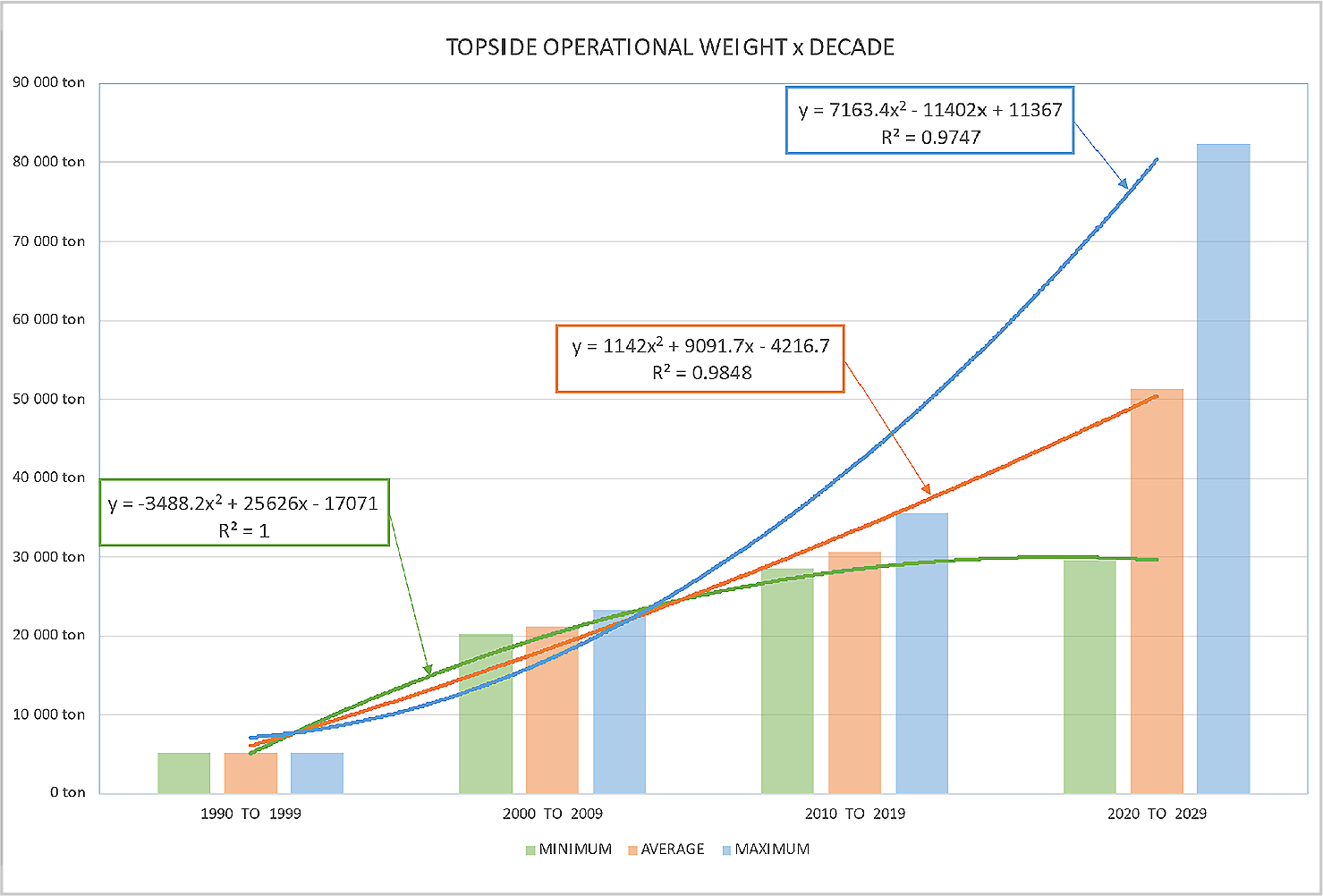
The high concentration of CO2 in the pre-salt fields, associated with strong pressure from society to reduce GHG (Greenhouse Gases) emissions, are the main factors contributing to the increased complexity of primary processing plants installed on SPU (Stationary Production Units) (Soares, 2023). As a result, the weight of the primary processing plant installed on SPU has shown quadratic growth over the past decades, as illustrated in Figure 3.

The availability of credit for fossil fuel exploration projects has been facing increasing restrictions due to the impact of climate targets according to the Paris Agreement (2015) and ESG (Environmental, Social and Governance). As a result, financial institutions are increasingly focusing on investing in renewable energy and low-carbon technologies. Consequently, to remain economically viable, there is a growing need to invest in engineering to make exploration and production projects more efficient, in terms of cost and with lower GHG emissions.
The objective of this study is to quantify the weight savings achieved through the application of the LRFD methodology in offshore structure design, as well as to establish a reference for its implementation, suggesting the partial load factors and combinations that should be considered.
The WSD methodology is well-established in industry, and there are numerous regulatory references that can be used as a basis for design. In this article, the following regulatory references are considered:
-
• ABS - American Bureau of Shipping;
-
• API - American Petroleum Institute;
-
• AISC - American Institute of Steel Construction;
-
• DNV - Det Norske Veritas;
-
• ISO - International Organization for Standardization.
2. Material and methods
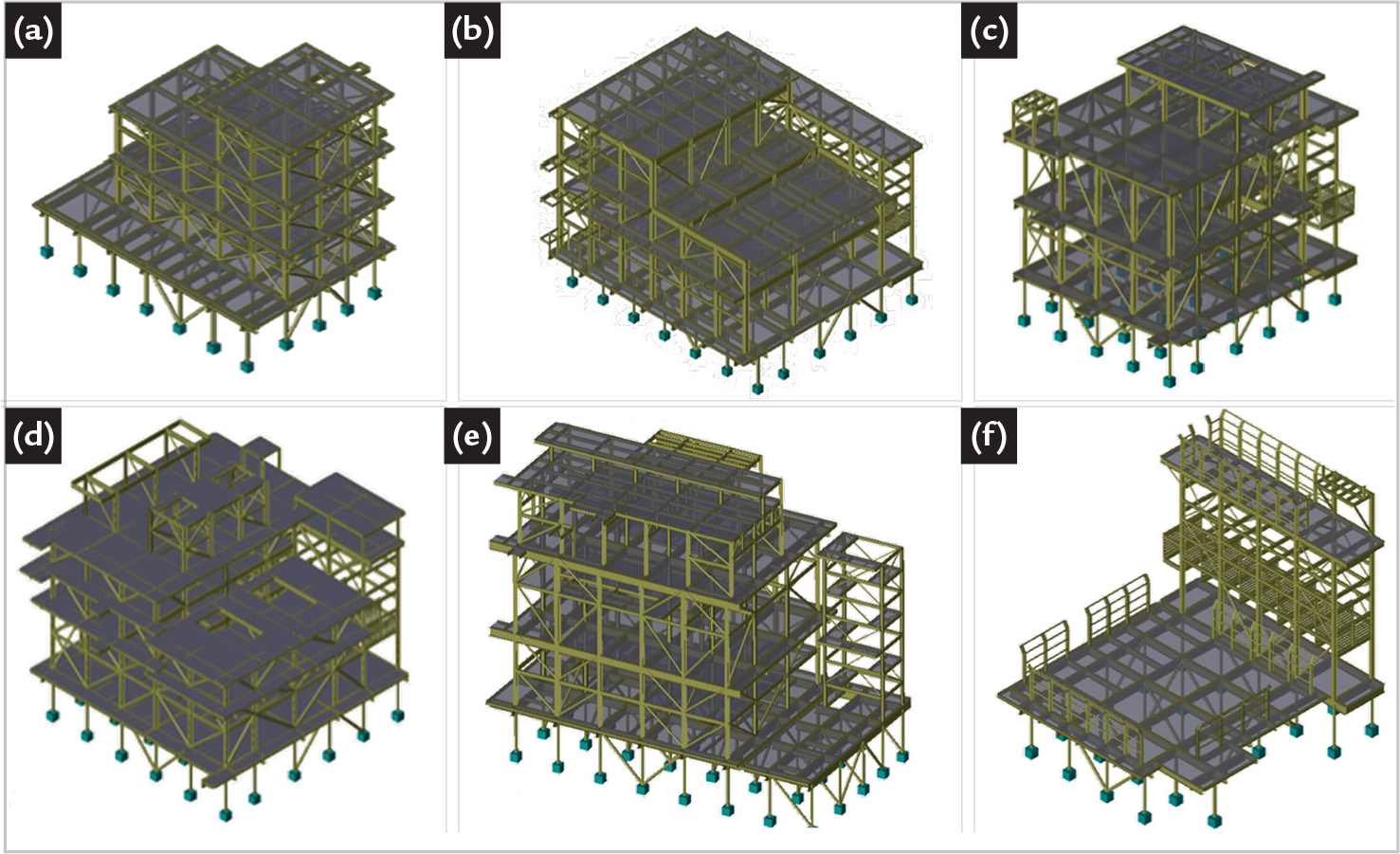
To assess the impacts on structural design due to the change in methodology, six modules from an FPSO with a multi-column support type are evaluated. In the first step, the design was carried out according to industry practices, using the WSD methodology. In the second step, the structure initially designed using the WSD methodology was re-evaluated and redesigned using the LRFD methodology. After these two steps, the final weight of the structures was compared. Figure 4 presents the 3D model of the evaluated modules, which are: (a) CO2 Compression, (b) CO2 Removal, (c) Gas Dehydration, (d) Injection, (e) Oil Processing, and (f) Laydown.

The API-RP (Recommended Practice)-2A - WSD, with its first revision released in 1969, is one of the pioneering standards defining recommended practices for offshore structure design.
In the LRFD methodology, the first regulatory reference is API-RP-2A - LRFD, with its first edition issued in 1994, followed by DNV-RP-C101 in its first edition issued in 2000, ISO 19904-1 in its first edition issued in 2006, API-RP-2FPS (Floating Production Systems) only in its second edition issued in 2011, and the ABS Guide For Load And Resistance Factor Design (LRFD) Criteria For Offshore Structures in its first edition issued in 2016. The evolution of these standards is shown in Figure 5.

Therefore, to define the partial action factors and the resistance reduction factor used in the LRFD methodology, the regulatory references mentioned above have been consulted and are presented in Table 1. Dead (D) and Live (L) Loads are grouped in the gravity column of Table 1 and Table 2, since the partial load factors are equal for both.
For the in-service condition, the normative references indicate the following cases to be evaluated:
-
• ULS-a → Ultimate Limit State where Permanent (G) and Variable (Q) loads are increased (Gravitational action dominated conditions);
-
• ULS-b → Ultimate Limit State where Environmental (E) loads are increased (Environmental action-dominated conditions);
-
• SLS: Serviceability Limit State;
-
• ALS: Accidental Limit State;
-
• FLS: Fatigue Limit State.
It is noted in Table 1 that, for ultimate limit state conditions (ULS-a and ULS-b), the partial load factors indicated by DNV, ISO, and API are aligned with the basis of the LRFD methodology, where one of the actions is considered primary and the other secondary. However, in the factors indicated by ABS, there is no reduction in environmental loading when it is considered a secondary action. Since the resistance reduction factor differs among the consulted references, the comparison will be made based on the total safety factor.
The total safety factor for each action can be expressed as γfN × γR, as presented in equation (1):
Where:
RSd → Design Load;
Rd → Design Resistance;
D → Dead Loads;
L → Live Loads;
E → Environmental Loads;
γf 1 → Partial Load Factor (Dead and Live Loads);
γf 2 → Partial Load Factor (Environmental Loads);
γR → Material Factor;
fY → Yield Strength.
The total safety factor for each type of loading can be expressed according to equations (2) and (3):
As shown in Table 2, the total safety factor exhibits little variation. The exception is the ABS Guide, which presents a higher total safety factor compared to the other normative references.
The ABS safety factor adopted for environmental loads in ultimate limit state A (ULS-a) is 56% higher than that indicated by the other normative references. This difference suggests that the calibration of the factor, based on reliability, was not carried out for typical offshore conditions. In the ULS-a condition, the primary action is the gravitational load, with the environmental load being secondary; thus, it is expected that the partial load factor would be less than or equal to 1.00.
For the Accidental Limit State (ALS), the 25% difference is already present in the WSD methodology and occurs because the ABS considers accidental loads more leniently, treating them probabilistically as an extreme condition instead of an accidental one.
In this study, the factors indicated by ISO 19904-1 are adopted.
It is noted that for ULS conditions, the normative references only indicate the extreme condition, where environmental loads have a probability of occurrence of 102 (return period of 100 years). In this study, the verification for the operational condition (return period of 1 year) are included, maintaining consistency with the WSD methodology and better reflecting the occurrence of functional overloads (Live Loads).
In this last revision (July 2023), DNV-OS-C101 also included the operational condition.
Therefore, the load combinations considered, with the return period of environmental loads, are those indicated in Table 3:
3. Results and discussion
For the numerical models developed using DNV's SESAM GeniE software, as shown in Figure 6, the results indicate a reduction in the stress ratio of structural elements, confirming the opportunity for weight and MHER (Man Hour Exposed to Risk) reduction by redesigning of the structure using the LRFD methodology.

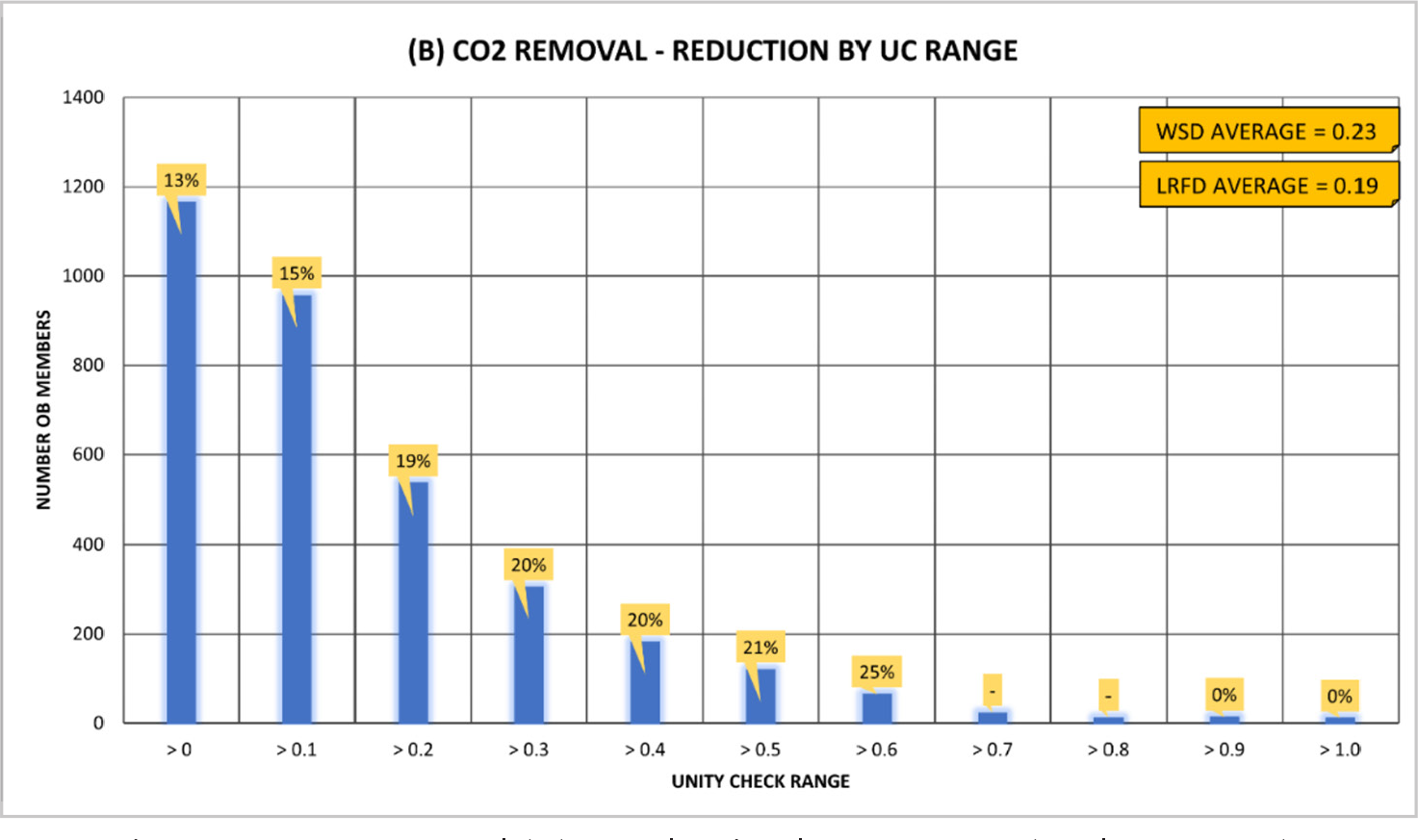
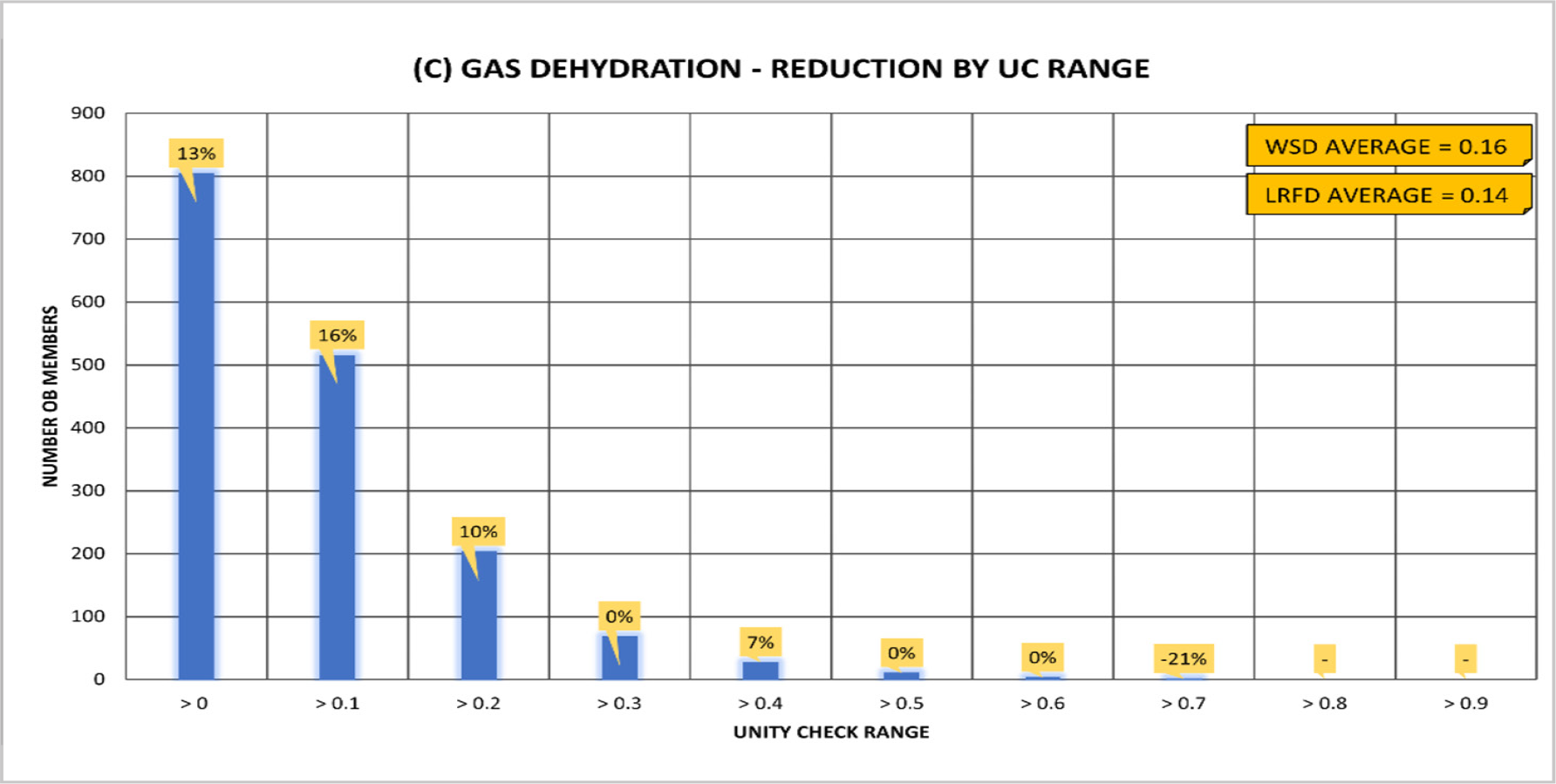
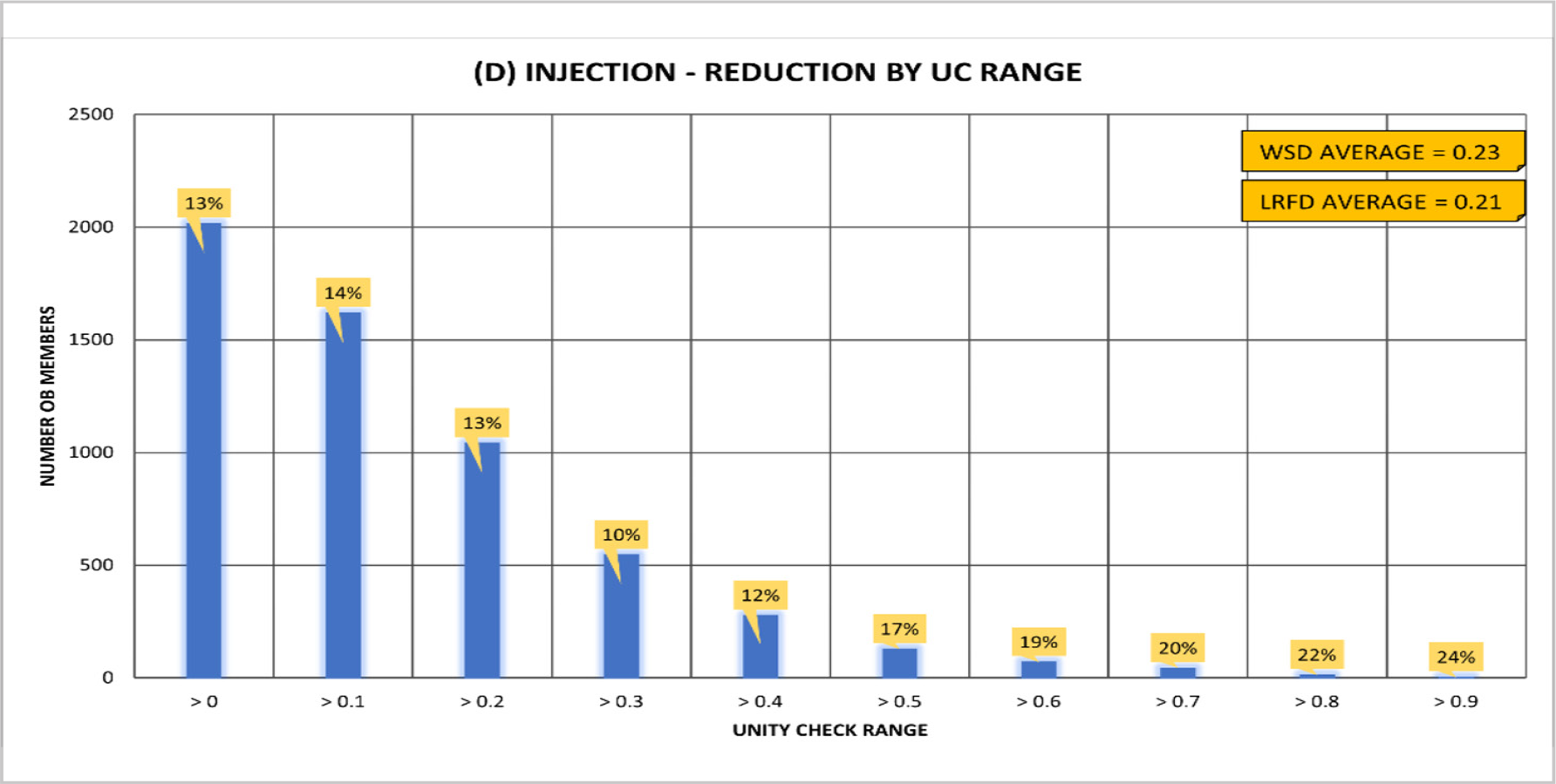
For each range of stress ratios, or unity check (UC), the average variation of members within the interval between 0 and 1.0 was evaluated, where a positive value indicates a reduction in UC, and a negative value indicates an increase in UC when applying the LRFD methodology. Figure 7 to Figure 12 show the UC reduction for each of the modules evaluated in this study.
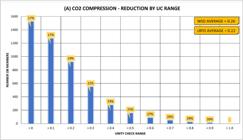


Table 4 presents the average reduction, considering the six modules evaluated, and Table 5 reports the variation according to the UC range for each evaluated module.
Table 5 demonstrates that the average reduction is proportional to the UC increase. Consequently, members with higher UC values exhibit a greater average reduction when comparing both methodologies. For each evaluated module, the first row presents the average reduction value for the assessed UC range, while the second row indicates the number of members within each range. The last row displays the weighted average based on the number of members for each UC range.
With the reduction in UC values, the structure was redesigned, considering construction and assembly criteria. The critical fatigue joints (multi-column support) are not resized; that is, for these members, the cross-sections designed using the WSD methodology are maintained, since their design is governed by the fatigue design condition. Table 6 presents the weight of each of the evaluated modules considering both methodologies and the weight difference (∆Weight) between them.
The LRFD methodology is semi-probabilistic, meaning that its partial load and material factors were calibrated through reliability studies. To assess the dominant conditions in each methodology, the governing condition for the bars in the evaluated modules was checked and is presented in Figure 13.
Where: GWO: Green Water Conditions with 1-year environmental loads;
GWO: Green Water Conditions with 100-year environmental loads;
DOC - Design Operational Condition - 1-year environmental loads;
DEC - Design Extreme Condition - 100-year environmental loads;
DAC - Design Accidental Condition.
It can be observed that no significant changes have occurred in the distribution of governing design conditions, suggesting that the load amplification factors and resistance reduction factor are well-suited for the evaluated structure.
4. Conclusions
The results of the analyses conducted in this article indicate a weight reduction of up to 11.5% when using the LRFD methodology for the design of offshore structures. This reduction is significant in an industry where minimizing MHER and CAPEX (Capital Expenditure) is crucial for making projects safer and financially viable. Table 7 presents the reductions in weight, CAPEX, and MHER, considering the average topside weight and current offshore industry metrics.
The API-RP-2A-WSD states in its introduction that when using the WSD methodology, the 1989 version of the Specification for Structural Steel Buildings (AISC 335-89) shall be applied, as transcribed below:
Reference in this document is made to the 1989 edition of the AISC Specification for Structural Steel Buildings - Allowable Stress Design and Plastic Design. The use of later editions of AISC specifications is specifically not recommended for design of offshore platforms. The load and resistance factors in these specifications are based on calibration with building design practices and may not be applicable to offshore platforms. Research work is now in progress to incorporate the strength provisions of the new AISC code into offshore design practices.
This restriction overlooks the advancements gained through years of study and accumulated knowledge in the design of steel structures, representing a portion of the conservatism associated with using the WSD methodology.
In the offshore industry, the WSD methodology has been the standard practice for at least 50 years, solidifying it among professionals in the field and leaving a legacy of tools for automating structural analyses. To establish the LRFD methodology in the offshore industry, a cultural shift among engineers involved in this activity is necessary.
The dissemination of the advantages, as well as the load and resistance factors that should be applied, is essential to accelerate this shift, with the goal of achieving structures with equivalent failure probabilities and reduced resource consumption, both in construction and assembly as well as in their maintenance phases.
-
Funding information
There are no funders to report for this submission.
Data availability
Datasets related to this article will be available upon request to the corresponding author.
References
- AMERICAN BUREAU OF SHIPPING - ABS. Guide for load and resistance factor design - LRFD - criteria for offshore structures, 2016.
- AMERICAN INSTITUTE OF STEEL CONSTRUCTION - AISC 335-89 - Specification for structural steel buildings - allowable stress design and plastic design, 1989.
- AMERICAN NATIONAL STANDARDS INSTITUTE - ANSI/AISC 360-16 - Specification for structural steel buildings - load and resistance factor design, 2016.
- API-RP-2A LRFD - Planning, designing, and constructing fixed offshore platforms - load and resistance factor design, 2019.
- API-RP-2A WSD - Planning, designing, and constructing fixed offshore platforms - working stress design, 2014.
- API-RP-2FPS - Planning, designing, and constructing floating production systems, 2011. Reaffirmed 2020.
- DNV OS C101- Design of offshore steel structures, general - LRFD method - 2021.
- GALAMBOS, Theodore V. Load and resistance factor design for steel. American Institute of Steel Construction, 1978.
- ISO 19904-1 - Petroleum and natural gas industries - floating offshore structure, 2019.
-
Offshore Magazine - poster 138, 2020. Worldwide survey of floating production, storage, and offloading - FPSO- Units. Disponível em: <https://www.offshore-mag.com/resources/maps-posters/document/14184322/2020-worldwide-survey-of-floating-production-storage-and-offloading-fpso-units> Acesso em: 11 oct. 2024.
» https://www.offshore-mag.com/resources/maps-posters/document/14184322/2020-worldwide-survey-of-floating-production-storage-and-offloading-fpso-units -
OpenWater Energy Newsletter #1-2023. Three important trends in the FPSO industry. Disponível em: <https://www.openwaterenergy.com/wp-content/uploads/2023/02/Q1-2023-OWEL-Newsletter.pdf> Acesso em: 11 oct. 2024.
» https://www.openwaterenergy.com/wp-content/uploads/2023/02/Q1-2023-OWEL-Newsletter.pdf - SOARES, Fabricio. Engineering future FPSOs - portfolio, challenges, available solutions and necessary breakthroughs. In: BRAZIL OFFSHORE ADVISORY COMMITTEE, 2023, Rio de Janeiro. (oral presentation).
- YU, Qing; TAN, Pao-Lin; LO, Tzu-Wei; WENG-YIN (Jan) Chow. New LRFD - based design criteria for mobile offshore units and floating production installations. In: OFFSHORE TECHNOLOGY CONFERENCE, Houston, Texas, USA, May 2016.
-
Associate Editor
Herlander Mata Fernandes Lima