 Optimum Design of truss structures considering nonlinear analysis and dynamic loading using metaheuristic algorithms
Abstract
The structural optimization of trusses is a complex problem that can be affected by many different factors. In this research, the authors investigated the optimization of trusses performing a geometric nonlinear analysis under dynamic loading, using two different metaheuristic algorithms: the Genetic Algorithm (GA) and Particle Swarm Optimization (PSO). The objective function was to minimize the weight of the structure. A number of benchmark test problems for spatial trusses considering a geometric nonlinear analysis, and dynamic loading are analyzed to verify the performance of the optimization algorithms. The results showed that both algorithms were able to find efficient solutions to the optimization problem and suggest that the choice of the optimization algorithm can have a significant impact on the performance of the optimization process.
Keywords:
trusses; nonlinear geometric analysis; dynamic loading; optimization; metaheuristics algorithms.
1. Introduction
Ezugwu et al. (2021) define optimization as a set of methods from operational research, artificial intelligence, computer science, and machine learning used to improve processes in almost every industry. In structural engineering, optimization techniques help engineers to develop more economical and efficient designs, and to automate the process.
The optimization procedure begins with a problem formulation, where the design variables, objective functions, and constraint functions are defined. The structure configuration is then automatically modified by changing the variables until the best solution is found.
Probabilistic methods, especially metaheuristics, are well-suited for problems with robust solutions. Metaheuristics is a type of optimization technique that can provide approximate best solutions for problems that are difficult to optimize using deterministic techniques (Lagaros et al., 2022). Metaheuristics have been used to optimize a variety of engineering problems, including steel frame structures, dampers displacement, machining of aluminum hybrid composites, composite bridges cost and environmental impact, dam displacement monitoring, and beam damage prediction. In the field of truss structures, Bigham and Gholizadeh (2020) studied the topology optimization of domes and Jawad et al. (2021) researched the size and layout optimization of trusses.
Bioinspired metaheuristics are the most popular ones found in optimization literature. They are commonly based on the metaphor of ecological interaction between living organisms and their behavioral patterns. The genetic algorithm (GA) and particle swarm optimization (PSO) are the first ones to attract interest in widespread research on optimization methods (Ezugwu et al., 2021).
The Genetic algorithm (GA), developed by Holland (1975), is inspired by Darwin's theory of natural selection. From an initial population, new solutions are generated through genetic operators (crossover, mutation) to replace the existing solution. In literature, several studies involving GA application to optimize some aspects of structures can be found, such as cost (Arpini et al., 2022; Benzo et al., 2022; Korus et al., 2021; Netto et al., 2023), environmental impact (Arpini et al., 2022; Benzo et al., 2022), design (Huang et al., 2020), and topology (Khodzhaiev and Reuter, 2021).
Particle swarm optimization (PSO), developed by Kennedy and Eberhart, (1995), is a metaheuristic algorithm that imitates the behavior of birds (particles) in search of food (best solution). Each particle has a position and velocity in the search space, which is iteratively updated according to its personal best and global best positions (Mahapatra et al., 2022). Similar to GAs, PSO has been used to optimize various aspects of structures, including design (Abo-Bakr et al., 2021; Jarrahi et al., 2020; Sharma and Ganguli, 2021), and environmental impact (Arpini and Alves, 2022).
The efficiency of the optimization process is significantly affected when a structure is subjected to dynamic loading. If a nonlinear analysis is also included, the process becomes even more difficult due to the extensive analytical process, which leads to a large computational cost. However, when a nonlinear analysis is performed, it is possible to improve the analytical simulation and provide a more realistic prediction of the structure's behavior (McGuire et al., 2000).
Large-scale truss structures, such as domes and lattice towers, are often very slender and can experience large displacements. The impact of these geometric changes on the structural response can be captured by considering geometric nonlinear analysis. Additionally, if the material behavior changes due to deformation, a material nonlinear analysis must also be considered (Shi et al., 2015).
The structural nonlinear analysis is well established in literature (Pacoste and Eriksson, 1995; Rodrigues et al., 2019, 2021; Yang and Kuo, 1994). Moreover, studies involving structural optimization of trusses considering geometric nonlinearity have already been presented over the last years (Kameshki and Saka, 2006; Koohestani, 2012; Li and Khandelwal, 2016; Ma et al., 2022; Madah and Amir, 2017, 2019; Mai et al., 2022; Tort et al., 2016). However, studies that include both geometric nonlinear analysis and dynamic loading, using a mathematical programming algorithm, have been little explored (Alfouneh and Tong, 2018; Fu et al., 2018; Martinelli and Alves, 2020a, 2020b; Martins et al., 2021)
Therefore, in this article, an optimization problem is formulated to analyze spatial truss structures considering geometric nonlinear analysis with dynamic loading. The optimization problem is solved using two algorithms: the Genetic Algorithm (GA) and the Particle Swarm Optimization (PSO). A comparative analysis with benchmark problems is performed to verify the efficiency of the algorithms.
2. Optimization problem formulation
The optimization problem aims to define the cross-sectional areas of the bars that minimize the final weight of the structure, by imposing constraints on nodal displacements and axial stresses. The design variables that set the optimization problem are the cross-sectional area of each bar of the structure, included in vector A:
where bn is the total number of bars.
These variables were considered discrete, determine the geometry of the steel bar sections and may assume area values from a catalog of tubular structural profiles.
The objective function calculates the total weight of the structure by the sum of the weight of each truss bar:
where ρ is the specific mass of the steel, Ai is the cross-sectional area of bar i, and Li is the length of bar i. The constraints imposed to the optimization problem are:
where σTmax and σCmax are the maximum values of tensile and compressive axial stresses, respectively; σTlim and σClin are the allowable limit values of tension and compression, respectively; Umax is the maximum absolute value of nodal displacement suffered by the structure; Ulim is the allowable limit value for nodal displacements; NC,crit is the resistant compressive force defined according to ABNT NBR 16239:2013, and NC,Sd the applied compression design load . All values of stress and displacement are obtained considering a geometric nonlinear analysis with a dynamic load.
When a reference example is not used, the limit of the nodal displacement and the axial compression force are calculated based on values present in the Brazilian standard ABNT NBR 8800:2008. The allowable limit values of tension and compression are defined by:
where fy is the yield stress and γa1 is the resistance weighting coefficient equal to 1 in a serviceability combination.
It is highlighted that the constraints given by Eq. (3) require a nonlinear dynamic analysis for each iteration of the optimization process. This analysis was performed via Ansys software using the LINK180 element and the Newmark method for solving the dynamic problem described in Eq. (5).
Where [K] is the stiffness matrix of the structure, which depends on the cross-sectional area of the bar, [M] is the mass matrix of the structure, which also depends on the cross-sectional area of the bar, [C] is the damping matrix, which when considered is a linear combination of the former two. On the right-hand side of the equation, we have the time-dependent loading F(t). Figure 1 shows how the optimization process works.

2.1 Implementation of optimization routines
The PSO algorithm was chosen for solving the optimization problem due to its ease of computational implementation and its robustness in searching for the optimal solution. Additionally, the GA from the Matlab Platform toolbox was used to validate the solutions proposed by both algorithms. For the implementation of PSO, the velocity function proposed by Shi and Eberhart (1998) was used based on the initial proposition of PSO by Kennedy and Eberhart (1995), where the inertia factor w was inserted as described in Eq. (6).
Where c1 and c2: acceleration constants, corresponding to the individual and global best given by; φ1= φ2=2.05; φ = φ1+ φ2; c1=c2= χ φ1 rand and Rand: randomizing functions in the interval [0,1]; vid: velocity of particle i; xid: position of particle i; pid: position of the i-th particle with the best value of the objective function obtained from previous iterations; pgd: position of the i-th particle with the best value of the objective function among all particles in the population.
Where κ was adopted to be equal to 1, and the inertia coefficient is updated iteratively at each new generation, initially given by wi-1 = c; wdamp = 0.99; and wi = wi-1 × wdamp
The optimization routines were implemented using the following parameters for each algorithm. They were determined after a series of preliminary analyses to arrive at the population size for each algorithm, tolerance factors, as well as the number of generations. These parameters are:
-
• Particle Swarm Optimization (PSO)
-
°Adaptive Penalties method (APM) (Barbosa and Lemonge, 2008)
-
°Maximum number of iterations: 50
-
° Population size: 50 individuals
-
° Tolerance: 10-6
-
-
• Genetic Algorithm (GA)
-
°Maximum number of generations: 100
-
°Crossover factor: 0.8
-
°Mutation factor: random [0,1]
-
°Population size: 200 individuals
-
3. Numerical results
This section explores two numerical examples of truss structures. For each one, a linear analysis and a geometric nonlinear analysis was performed, both with dynamic load without considering damping parameters. Additionally, an optimization of the same problem was performed 10 times for each proposed algorithm. Two types of loads were considered in the dynamic analyses, as shown in Figure 2. The solutions were obtained with discrete variables using the tube catalog from the Vallourec manufacturer.

3.1 24-Bar dome truss
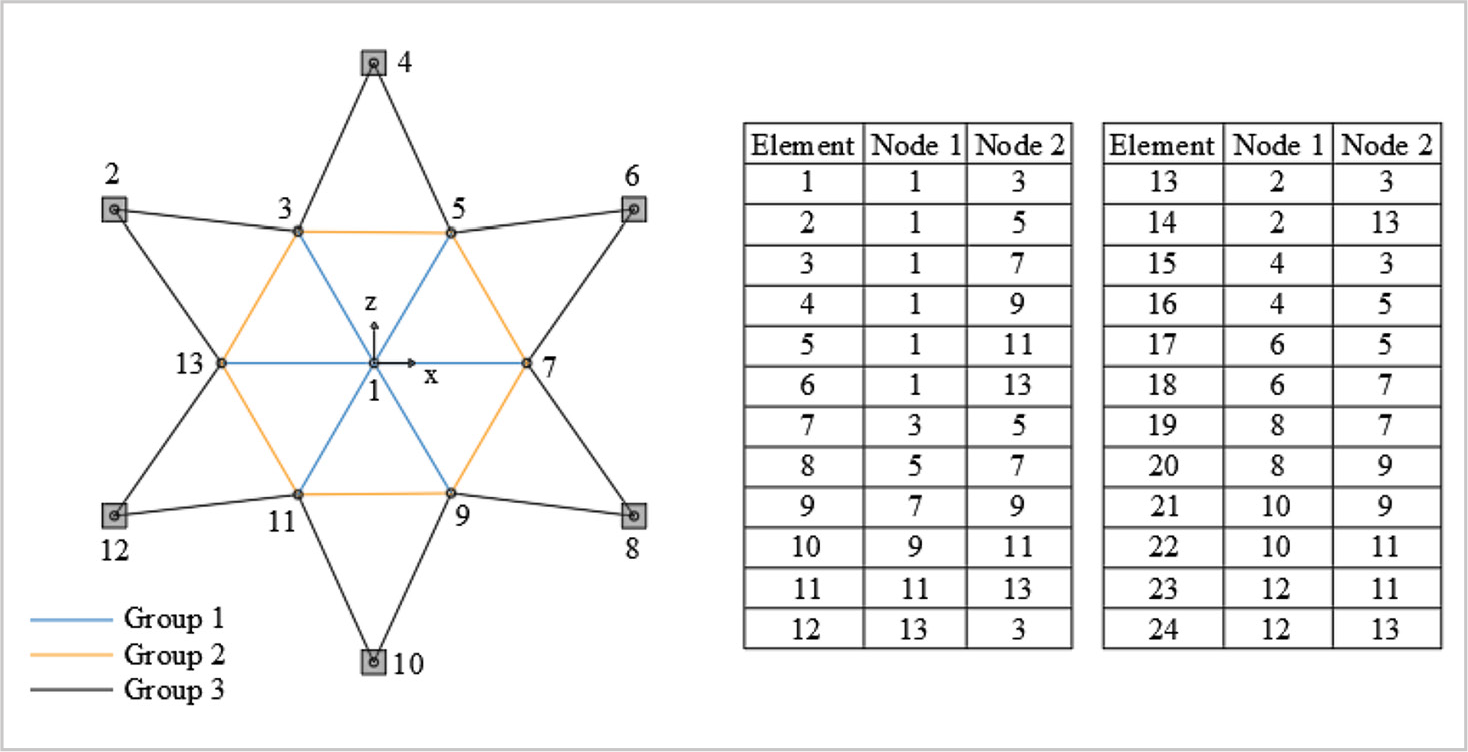
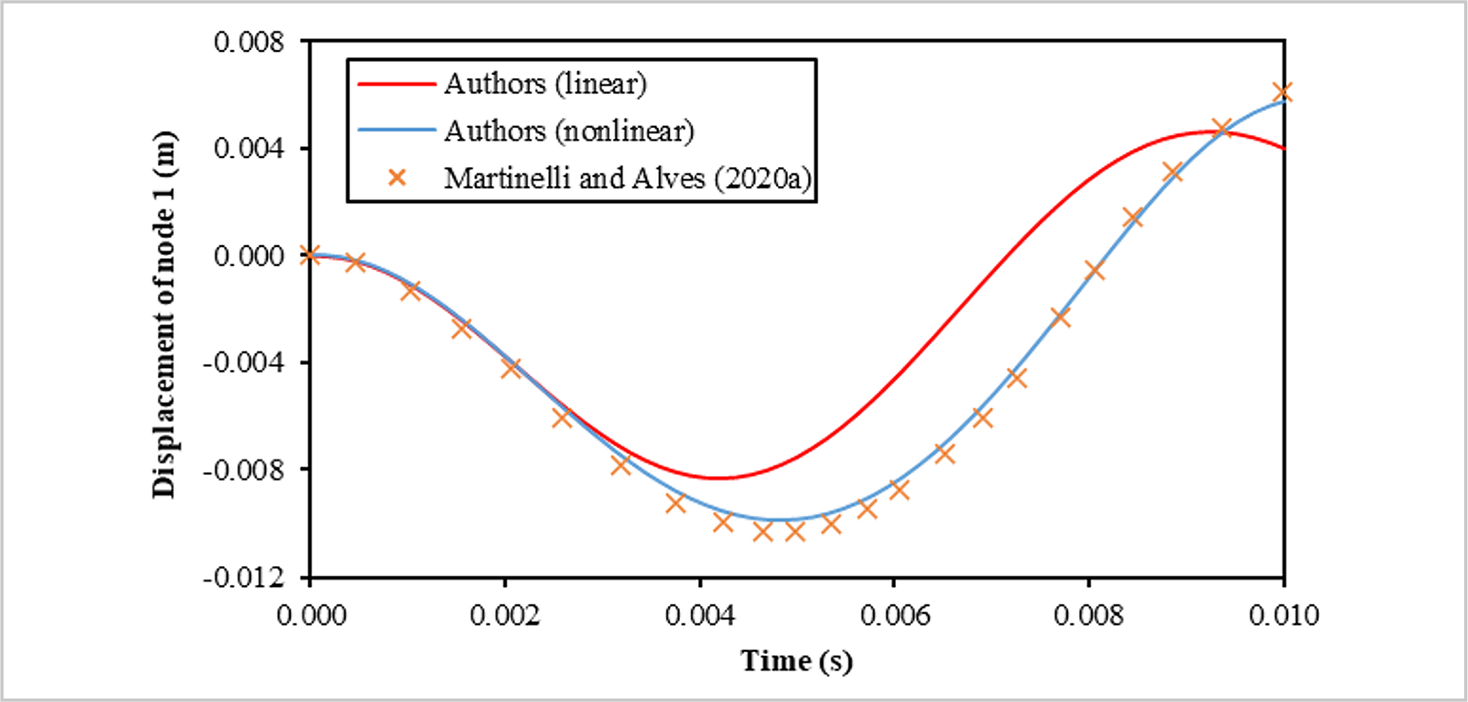
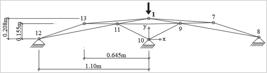
The first problem analyzed is a space truss with 24 members, as illustrated in Figures 3 and 4. The structure has a cross-sectional area A = 6.45 x 10⁻⁴ m2, a specific mass p = 2760 kg/m3 and a Young’s modulus E = 68992 MPa, for all members. It was subjected to a linear dynamic load with F(t) = 8900 N and t = 0.01 s, as seen in Figure 2(a), applied downwards at the middle point (node 1). The problem was previously analyzed by Martinelli and Alves, (2020a) by an updated Lagrangian formulation combined with the Newmark method, adopting Newton-Raphson type iterations with a time increment ∆t = 0.000156 s. The results were compared to validate the geometric nonlinear dynamic analysis without damping parameters.

The results for the displacement of node 1 on the y-axis are presented in Figure 5 for both linear and nonlinear analysis. The results show a strong agreement with the reference. Besides that, the nonlinear analysis resulted in a displacement about 19% (or 1 mm) greater than the linear analysis. This indicates that the loading is causing an additional displacement in the structure that can only be observed through nonlinear analysis.

For the optimization, the structure was divided into three groups of bars, as shown in Figure 4, representing each design variable. The problem was also previously studied by Martinelli and Alves, (2020a), who used the Sequential Quadratic Programming (SQP) and Interior Point (IP) algorithms to minimize the truss weight. The properties of the structure were modified to p = 7850 kg/m3 and E = 200 GPa, while the dynamic load intensity increased, being F(t) = 356 N and t = 0.1 s in Figure 2(b). A time increment ∆t = 0.0001 s was considered. The constraints imposed were 0.007 m for the nodal displacement limit, and 227 MPa for the tension limit and compression stresses. To maintain consistency with the proposal by Martinelli and Alves, (2020a), the constraint related to the critical load was not considered in this optimization analysis. Table 1 shows the results obtained, being RSD the relative standard deviation.
The differences related to the reference result are due to the use of continuous variables, while in this study discrete variables were considered. Despite this, the total weight in the results was very close, with the genetic algorithm (GA) presenting the best solution and a better RSD value for the nonlinear analyses. On the other hand, both algorithms found the same solution in the linear analysis. However, GA presented a better RSD value again, showing itself as a more robust algorithm in both cases.
The maximum value of displacement occurred in node 1 in the same direction of the load for both analyses. However, in the optimization with linear analysis, the displacement was smaller, as expected. The maximum stresses occurred in element 13, for both tension and compression, but in different instants. In Figure 6 is presented the displacement of node 1 and Figure 7 is observed the stresses over time of element 13 described on Figure 4.


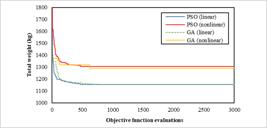
As can be observed in the curves of Figures 6 and 7, there is a different behavior for PSO and GA due to the different solutions provided by them according to Table 1. The convergence curve's total weight versus objective function evaluations of each algorithm is presented in Figure 8. The structures optimized considering nonlinear analysis had a greater weight than the linear one. This can be justified, since the first one presented greater displacements, and consequently, larger cross-sections.
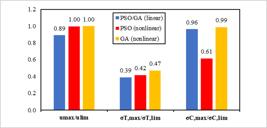
A relevant analysis about the constraint functions is seen in Figure 9, where a graph with their normalized values shows that the nodal displacement is the constraint responsible for commanding the optimization for all algorithms. In the case of the GA, the compressive stress was also very close to the limit in both analyses, indicating the good performance of the algorithm.
3.3 25-Bar Tower Truss
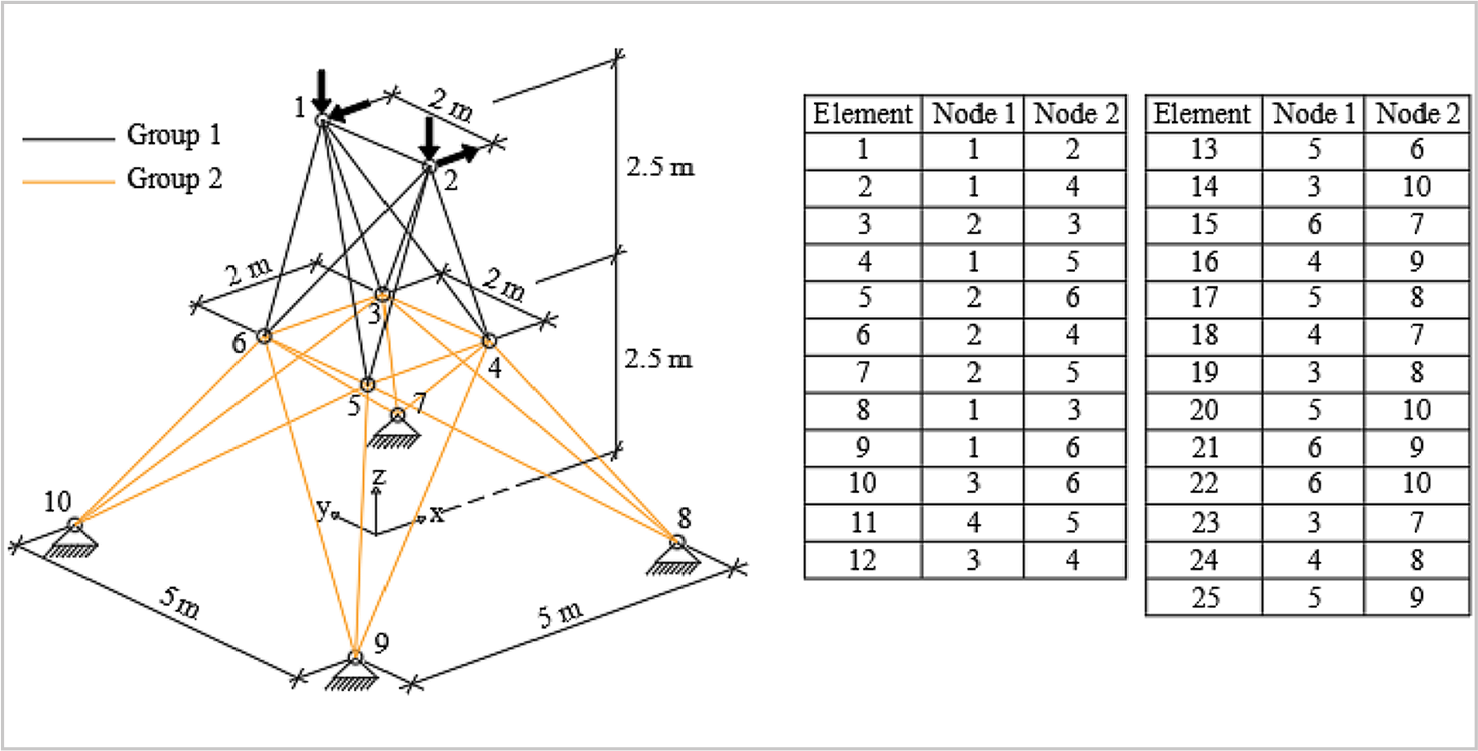
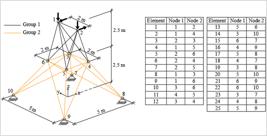
A new problem was now proposed, based on Mai et al., (2022a), wherein the 25-bar tower truss in Figure 10 was subjected to the load seen in Figure 2(b), being t = 0.1 s and F(t) assuming the values presented in Table 2. A time increment of ∆t = 0.0001 s was adopted. First, a geometric nonlinear dynamic analysis was made, where the structure has a cross-sectional area A = 1 cm2, a specific mass p = 7850 kg/m3 and a Young’s modulus E = 200 GPa, for all members. The applied load is represented in Table 2.
The displacements obtained for node one are seen in Figure 11, for both linear and nonlinear analyses.

Similarly, the two algorithms proposed were used to minimize the truss weight and the results are in Table 3. The effect of nonlinearity did not significatively impact the PSO final weight when compared to the linear analysis for this load. However, the algorithm showed itself to be more robust, as it presented better values for weight and RSD compared to GA.
In Figure 12 the displacement of node 1 is presented, and in Figure 13, the curves with the axial stresses over time of element 18 and 19 are seen, respectively presented on Figure 10. In some instants the nonlinear analysis showed greater displacements, and in the others, the linear analysis did. The maximum compressive stress occurred equally in elements 18 and 21, and maximum tension stress occurred in elements 19 and 20. Although the results were different between the algorithms, the maximums occurred in the same place and instant.

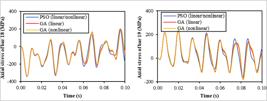
Figure 14 shows the convergence curves of total weight versus objective function evaluations of each algorithm. The structure optimized by PSO had the same final result in both analyses, while by GA, the weight was greater in the nonlinear one.
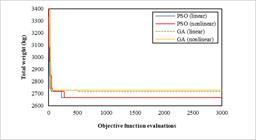
As can be observed in Figure 14 and according to Table 3, the structure did not exhibit a strong nonlinear behavior for the applied loading, leading to the same results as the linear analysis. Despite the identical results, for the nonlinear analysis, the solution via PSO converged from the 300th evaluation of the objective function, while for the linear analysis, it was at the 250th. evaluation. According to the graph and also demonstrated in Table 3, PSO presented better solutions compared to GA for both linear and nonlinear analysis.
The normalized values of the constraint function are shown in Figure 15, where the nodal displacement, the compressive stress and the axial compressive load are responsible for controlling the optimization similarly for all algorithms.

3. Conclusions
This study proposes a formulation of an optimization problem to analyze truss structures considering geometric nonlinear analysis with dynamic loading. The optimization problem is solved using two algorithms: the Genetic Algorithm (GA) and the Particle Swarm Optimization (PSO). First, a comparative analysis with benchmark problems is performed to verify the efficiency of the algorithms when compared with mathematical programing algorithms. Then, a new analysis is proposed to add references for this type of problem, due to the lack of such references in current literature. The results show that the algorithms run efficiently. In general, when the optimization process is done considering a nonlinear analysis, the greater the displacements, the heavier the structure. Moreover, the results indicate that the behavior of the algorithms depends on the situation. Regarding the constraints, displacement has been the main factor that has guided the optimizations, but in some cases, the stresses and axial force also had a considerable influence.
Acknowledgements
The authors would like to thank CAPES for the support given to the postgraduate program in civil engineering at UFES and FAPES for the research grant provided to the first and third authors.
References
- ABO-BAKR, R. M.; SHANAB, R. A.; ATTIA, M. A. Multi-objective optimization for lightweight design of bi-directional functionally graded beams for maximum frequency and buckling load. Composite Structures, v. 278, p. 114691, set. 2021.
- ALFOUNEH, M.; TONG, L. Topology optimization of nonlinear structures with damping under arbitrary dynamic loading. Structural and Multidisciplinary Optimization, v. 57, n. 2, p. 759-774, 2018.
- ARPINI, P. A. T.; LOUREIRO, M. C.; BREDA, B. D.; CALENZANI, A. F.; ALVES, É. C. Optimum design of a composite floor system considering environmental and economic impacts. Revista IBRACON de Estruturas e Materiais, v. 15, n. 3, p. 1-17, 2021.
- ARPINI, P. A. T.; ALVES, É. C. Optimization of CO2 Emission of the Composite Floor System via Metaheuristics Algorithm. Journal of Engineering Science and Technology Review, v. 15, n. 6, p. 1-14, 2022.
- ASSOCIAÇÃO BRASILEIRA DE NORMAS TÉCNICAS. NBR 8800: projetos de estruturas de aço e de estruturas mistas de aço e concreto de edificações. Rio de Janeiro: ABNT, 2008.
- ASSOCIAÇÃO BRASILEIRA DE NORMAS TÉCNICAS. NBR 16239: projetos de estruturas de aço e de estruturas mistas de aço e concreto de edificações com perfis tubulares. Rio de Janeiro: ABNT, 2013.
- BARBOSA, H. J. C.; LEMONGE, A. C. C. An adaptive penalty method for genetic algorithms in constrained optimization problems. In: IBA, H. (ed.). Frontiers in evolutionary robotics. Viena: I-Tech Education and Publishing, 2008. 598 p., cap. 2, p. 9-34.
- BENZO, P. G.; PEREIRA, J. M.; SENA-CRUZ, J. Optimization of steel web core sandwich panel with genetic algorithm. Engineering Structures, v. 253, p. 113805, 2022.
- BIGHAM, A.; GHOLIZADEH, S. Topology optimization of nonlinear single-layer domes by an improved electro-search algorithm and its performance analysis using statistical tests. Structural and Multidisciplinary Optimization, v. 62, n. 4, p. 1821-1848, 2020.
- EZUGWU, A. E.; SHUKLA, A. K.; NATH, R.; AKINYELU, A. A.; AGUSHAKA, J. O.; CHIROMA, H.; MUHURI, P. K. Metaheuristics: a comprehensive overview and classification along with bibliometric analysis. Artificial Intelligence Review, v. 54, n. 6, p. 4237-4316, 2021.
- FU, J. Y.; WU, B. G.; WU, J. R.; DENG, T.; PI, Y. L.; XIE, Z. N. Wind resistant size optimization of geometrically nonlinear lattice structures using a modified optimality criterion method. Engineering Structures, v. 173, p. 573-588, 2018.
- HOLLAND, J. H. Adaptation in natural and artificial systems. University of Michigan Press: Ann Arbor, 1975. 232 p.
- HUANG, D.; PEI, S.; BUSCH, A. Optimizing displacement-based seismic design of mass timber rocking walls using genetic algorithms. Engineering Structures, v. 229, p. 111603, 2020.
- JARRAHI, H.; ASADI, A.; KHATIBINIA, M.; ETEDALI, S.; SAMADI, A. Simultaneous optimization of placement and parameters of rotational friction dampers for seismic-excited steel moment-resisting frames. Soil Dynamics and Earthquake Engineering, v. 136, p. 106193, 2020.
- JAWAD, F. K. J.; OZTURK, C.; DANSHENG, W.; MAHMOOD, M.; AL-AZZAWI, O.; Al-JEMELY, A. Sizing and layout optimization of truss structures with artificial bee colony algorithm. Structures, v. 30, p. 546-559, 2021.
- KAMESHKI, E. S.; SAKA, M. P. Optimum geometry design of nonlinear braced domes using genetic algorithms. Computers and Structures, v. 85, p. 71-79, 2006.
- KENNEDY, J.; EBERHART, R. Particle swarm optimization. In: INTERNATIONAL CONFERENCE ON NEURAL NETWORKS - ICNN’95. Proceedings [...]. Perth: IEEE, 1995. p. 1942-1948.
- KHODZHAIEV, M.; REUTER, U. Structural optimization of transmission towers using a novel Genetic Algorithm approach with a variable length genome. Engineering Structures, v. 240, p. 112306, 2021.
- KOOHESTANI, K. A hybrid method for efficient solution of geometrically nonlinear structures. International Journal of Solids and Structures, v. 50, p. 21-29, 2012.
- KORUS, K.; SALAMAK, M.; JASINSKI, M. Optimization of geometric parameters of arch bridges using visual programming FEM components and genetic algorithm. Engineering Structures, v. 241, p. 112465, 2021.
- LAGAROS, N. D.; PLEVRIS, V.; KALLIORAS, N. A. The mosaic of metaheuristic algorithms in structural optimization. Archives of Computational Methods in Engineering, v. 29, n. 7, p. 5457-5492, 2022.
- LI, L.; KHANDELWAL, K. Topology optimization of geometrically nonlinear trusses with spurious eigenmodes control. Engineering Structures, v. 131, p. 324-344, 2016.
- MA, S.; YUAN, X.; DENG, M.; YANG, L. Minimal mass design of a new cable truss in two states. Mechanics Research Communications, v. 125, p. 103995, 2022.
- MADAH, H.; AMIR, O. Truss optimization with buckling considerations using geometrically nonlinear beam modeling. Computers and Structures, v. 192, p. 233-247, 2017.
- MADAH, H.; AMIR, O. Concurrent structural optimization of buckling-resistant trusses and their initial imperfections. International Journal of Solids and Structures, v. 162, p. 244-258, 2019.
- MAGEVESKE NETTO, P.; CALENZANI, A. F. G.; ALVES, É. C. Optimum design of prestressed steel beams via genetic algorithm. REM - International Engineering Journal, v. 76, n. 1, p. 29-37, 2023.
- MAHAPATRA, A. K.; PANDA, N.; PATTANAYAK, B. K. Hybrid PSO (SGPSO) with the incorporation of discretization operator for training RBF neural network and optimal Feature selection. Arabian Journal for Science and Engineering, v. 48, p. 9991-10019, 2022.
- MAI, H. T.; LIEU, Q. X.; KANG, J.; LEE, J. A robust unsupervised neural network framework for geometrically nonlinear analysis of inelastic truss structures. Applied Mathematical Modelling, v. 107, p. 332-352, 2022a.
- MAI, H. T.; LEE, S.; KIM, D.; LEE, J.; KANG, J.; LEE, J. Optimum design of nonlinear structures via deep neural network-based parameterization framework. European Journal of Mechanics / A Solids, v. 98, p. 104869, 2022b.
- MARTINELLI, L. B.; ALVES, E. C. Optimization of geometrically nonlinear truss structures under dynamic loading. REM - International Engineering Journal, v. 73, n. 3, p. 293-301, 2020a.
- MARTINELLI, L. B.; ALVES, É. C. Analysis of damping ratio on the optimization of geometrically nonlinear truss structures subjected to dynamic loading. Revista de la Construccion, v. 19, n. 3, p. 321-334, 2020b.
- MARTINS, A. M. B.; SIMÕES, L. M. C.; NEGRÃO, J. H. J. O. Optimization of extradosed concrete bridges subjected to seismic action. Computers and Structures, v. 245, p. 106460, 2021.
- MCGUIRE, W.; GALLAGHER, R. H.; ZIEMIAN, R. D. Matrix structural analysis. New York: John Wiley & Sons, 2000. 460 p.
- PACOSTE, C.; ERIKSSON, A. Element behavior in post-critical plane frame analysis. Computer Methods in Applied Mechanics and Engineering, v. 125, p. 319-343, 1995.
- RODRIGUES, M. A. C.; BURGOS, R. B.; MARTHA, L. F. A unified approach to the Timoshenko Geometric Stiffness Matrix considering Higher-Order Terms in the Strain Tensor. Latin American Journal of Solids and Structures, v. 16, n. 4, p. 185-207, 2019.
- RODRIGUES, M. A. C.; BURGOS, R. B.; MARTHA, L. F. A unified approach to the Timoshenko 3D beam-column element tangent stiffness matrix considering higher-order terms in the strain tensor and large rotations. International Journal of Solids and Structures, v. 222-223, p. 111003, 2021.
- SHARMA, H.; GANGULI, R. Optimization of a higher-order sandwich composite beam under uncertainties. Composite Structures, v. 269, p. 1140003, 2021.
-
SHI, Y; EBERHART, R. A modified particle swarm optimizer. In: IEEE INTERNATIONAL CONFERENCE ON EVOLUTIONARY COMPUTATION; IEEE WORLD CONGRESS ON COMPUTATIONAL INTELLIGENCE (Cat. No.98TH8360) 1998. Proceedings [...]. p. 69-73. DOI: http://dx.doi.org/10.1109/icec.1998.699146
» http://dx.doi.org/10.1109/icec.1998.699146 - SHI, H.; SALIM, H.; SHI, Y.; WEI, F. Geometric and material nonlinear static and dynamic analysis of space truss structures. Mechanics Based Design of Structures and Machines, v. 43, n. 1, p. 38-56, 2015.
- TORT, C.; SAHIN, S.; HASANÇEBI, O. Optimum design of steel lattice transmission line towers using simulated annealing and PLS-TOWER. Computers and Structures, v. 179, p. 75-94, 2016.
- YANG, Y. B.; KUO, S. R. Theory & analysis of nonlinear framed structures. Singapore: Prentice Hall, Simon & Schuster (Asia) Pte Ltd, 1994. 450 p.