 Effect of bedding mortar with low strength and high entrained air content on the strain and failure mode of masonry prisms under compression
Abstract
Brazilian standards regarding structural masonry does not consider the effect of bedding mortar properties on the strength and failure mode of masonry. Thus, the objective of this study was to evaluate the effect of bedding mortars with low strength and high entrained air content on the stress-strain curve and failure mode of masonry prisms under compression. The prisms were constructed from concrete or ceramic blocks (hollow core or solid) and mortars with low strength and high entrained air content. Three types of mortars were tested, one dry pre-mixed mortar and two ready-to-use, with open times of 36 and 72 h. All physical and mechanical properties of the materials were determined following Brazilian standards. Strain under compression was evaluated on two-block high prisms equipped with linear variable differential transformers (LVDT) placed on opposing faces. Results pointed out that both strength and strain of ceramic block prisms were affected by mortar strength. On the other hand, the concrete block prism strength was affected by mortar strength and porosity while strain was largely affected by mortar porosity. Failure modes differed between ceramic and concrete block prisms: ceramic prisms cracked from mortar joint crushing and resulted in structural failure, while concrete prisms lost block-mortar adhesiveness from joint crushing. Therefore the prism was no longer a single entity but was still able to withstand the axial compression stress test.
Keywords:
structural masonry; bedding mortar; stress-strain behavior; entrained air content; failure mode.
1. Introduction
In Brazil, structural masonry has been frequently used in large building construction due to advantages such as rational use of materials, lower labor cost and economic savings. However, as the number of floors increases, so do the performance demands on a structural wall (Camacho et al., 2015; Mohamad et al., 2017; Diamantino, Oliveira, 2021).
The main purpose of a structural masonry system is to support and transfer vertical and lateral loads to foundation elements through the interaction between slabs and walls on each floor (Mohamad et al., 2006; Martins et al. 2018). Since walls are composed of blocks bound by bedding mortar, their mechanical performance depends on the properties of these components. As noted by Camacho et al. (2015), an adequate combination of masonry components is essential to optimize and maximize structural performance. However, it should be noted that there is a lack of studies on block and mortar joint interaction under different loads (elastic, inelastic and rupture) (Lübeck, 2016; Martins et al., 2018).
Thus, more refined parameters are essential so that structural design can achieve higher structural durability, safety and comfort. Compression strength and failure mode in unreinforced masonry elements are directly related to the complex interaction between blocks and mortar through their physical and mechanical properties (Hilsdorf, 1967; Atkinson et al., 1985; Drysdale, Wong, 1985). Blocks are primarily responsible for resisting compressive stresses while mortar provides adhesiveness between elements, absorbs strains and ensures load transfer (Parsekian et al., 2012; Ramalho, Corrêa, 2003).
Compressed masonry in situations where the block deforms less than the mortar results in mortar joint confinement and an increase in mortar’s strength. This effect often allowed designers to neglect the role of the mortar in the overall behavior of the masonry system (Mota, 2001; Mohamad, 2007; Lima, 2010; Mohamad et al., 2017). In this regard, to reduce cracking, standard NBR 16868 (ABNT, 2020) recommended that bedding mortar compressive strength be restricted to 1.5x the characteristic strength (in gross area) of the specific block in contact with it.
Ramalho and Correa (2003), citing the results of Gomes (1983) and the values prescribed in the BS 5628 (2005), stated that mortar compressive strength did not significantly affect the compressive strength of masonry walls unless the mortar strength is less than 40 % of the block. Additionally, Parsekian et al. (2012) noted that even if mortar strength was considerably higher, it produced only a small increase in masonry strength; and not much effect was to be expected in masonry prism strength if mortar strength was between 70 % and 150 % over the gross area of the block.
As stress level demands increase, the mortar becomes confined and its behavior dominates masonry performance (Kaushik et al., 2007; Mohamad et al. 2017; Mohamad et al. 2018; Thamboo, Dhanasekar, 2019). The influence of joint confinement on the strength and deformability of mortar, and consequently, on the change in the failure mode of masonry, has been studied by different authors and extensively described in Lübeck (2016). As such, different types of blocks, geometries and mortar composition affect the strain and failure mode of masonry prisms (De Marco, 2016; Lübeck, 2016; Alvarenga et al., 2017).
However, in some situations, the use of low strength mortar could result in crushed mortar joints and induce premature rupture. Mohamad et al. (2018) observed that the mortar joint tends to crush when the confined mortar’s compressive strength is lower than the tensile strength of the blocks. The stress-strain behavior was non-linear from a prism compressive stress/strength ratio of approximately 40%, due the beginning of joint crushing. Zahra et al. (2021) evaluated concrete block prisms with low-strength mortar and observed crushing of the joint and consequent splitting and propagation of cracks in the blocks. On the other hand, Calderia et al. (2020) observed that crushing the mortar joint induced cracks in the blocks when evaluating the failure mode of prisms made with high-strength concrete blocks. In this case, the large difference between the compressive strength of the mortar confined in the joints and the tensile strength of the blocks induces failure of the mortar joint by crushing.
Lübeck et al. (2017) and Machado et al. (2019) noted that mortars with low compressive strength and high entrained air content are more susceptible to joint crushing under compression which produces effects on the mechanical performance of the masonry. In this case, the use of air-entraining admixtures could result in mortars with inadequate mechanical performance being used as bedding mortar. Beningfield (1986) stated that mortars with high content of entrained air (between 20 % and 25 %) had noticeable reductions in compressive strength while contents of around 15 % and 20 % could produce slight decreases in the mechanical properties. Casali et al. (2011) and Carasek (2017) noted that high air entrainment was common in ready-to-use mortars. If no admixtures were used, air entrainment decreased significantly to between 4 % and 12 % (Brugali et al., 2019; Schackow et al., 2019).
In addition, while decreases in strength and susceptibility to crushing in masonry prisms constructed with low strength and high air-entrainment mortars have been documented, little has been evaluated regarding stress-strain behavior. Mohamad et al. (2017) state that design codes need to consider the effects of low-strength mortar on the failure mode of the masonry, especially the non-linear behavior caused by the crushing of the mortar joint.
Unfortunately, the use of very low strength mortar for laying masonry is a reality in Brazil. For example, Leite (2023), evaluating 875 samples of control tests of concrete block masonry prisms, observed that in 28 of them the compressive strength of the mortar was less than 4 MPa. Also, the authors of this article carried out a survey of control tests for masonry buildings in Rio Grande do Sul and evaluated at the Civil Construction Materials Laboratory (LMCC) of the Federal University of Santa Maria (UFSM) and found that the years 2014 and 2023, 181 construction sites were evaluated and of these, 25 used low-strength ready-to-use mortar for laying the masonry. One of the reasons is that the Brazilian structural masonry standard does not present a lower limit for the compressive strength of the laying mortar.
Thus, the objective of this study was to evaluate the stress-train behavior and failure mode of masonry prisms constructed from three types of blocks (solid ceramic, hollow core ceramic or concrete) and mortar with low strength and high entrained air content. Two types of ready-to-use mortars were used with setting times of 36 h and 72 h as well as a general purpose dry pre-mixed mortar for comparison purposes.
2. Materials and methodology
The masonry prisms evaluated in this study were produced from three types of blocks and three types of low strength mortars. The blocks measured 14 x 19 x 29 cm and were of solid ceramic (SCB), hollow core ceramic (HCB) and concrete (CB). The types of mortar were a general-use dry pre-mixed, ready-to-use with 36 h setting time and ready-to-use with 72 h setting time. All ready-to-use mortars were sourced locally from manufacturers in the city of Santa Maria, RS. Masonry prisms were constructed with combinations of all types of blocks and all types of mortars. All necessary tests and characterizations were performed at the Civil Construction Materials Laboratory (LMCC) at the Federal University of Santa Maria.
Blocks were characterized from 13 samples of each type of block and the results are shown in Table 1, while average compressive strength over gross area and net area are shown in Table 2. In Table 1, AAI is the initial water absorption index, and in Table 2fbm is the average compressive strength of the blocks.
Mortars were characterized with respect to the flow table test, entrained air index, water retention, fresh state density, flexural strength, compressive strength and capillary coefficient as shown in Table 3.
Masonry prisms were molded with 2-block high samples, fully bound by a mortar joint and capped at the ends as shown in Figure 1. The bedding mortar joint had a thickness of 10 cm ± 0.3 cm. Caps were applied to top and bottom surfaces of the block and were made from a high strength mortar of cement and sand to maintain the prisms leveled and not produce a concentration of loads when tested. Prior to molding, the ceramic blocks were soaked in order to minimize water loss to the bedding mortar. After molding, the prisms were air-cured for 28 days prior to testing. A total of 6 samples were prepared for each type of prism. For identification purposes, a nomenclature was established to denote the type of mortar and block of each prism as shown in Table 4.

Prisms were subjected to axial compression tests in accordance with the procedures of standard NBR 16868-3:2020 in an Instron servo-controlled press, model 1500HDX. Data acquisition was performed with Bluehill 3.0 software with displacement control and a step speed of 0.005 mm/s.
Strain was measured with two HBM WA-50 (model WA-T) linear variable differential transformers (LVDT). Sensors were affixed vertically with acrylic supports and aluminum frames glued on opposing block faces as shown in Figure 2 and connected to an HBM SPIDER 8 data acquisition system. Strain was measured over an LVDT base length of 13 cm that encompassed part of two blocks and the mortar joint.

Compression strength and strains tests were preceded by 3 load cycles of compress load up to a stress of approximately 30% of the estimated strength in order to settle deformations. Afterwards, the prisms were loaded continuously until rupture.
3. Results and discussion
Strain was measured on six samples of each type of prism in this study by averaging data from the LVDTs on opposite faces. From the data, specific strain was calculated as well as the stress-strain curve of each type of prism. Results of average compressive strength over the gross area (fp,gross) and rupture strain (εrupt) are shown in Table 5. The rupture strain was measured at maximum strength.
The effect of block type and mortar on prism strength was evaluated with an analysis of variance (ANOVA) complemented by a Tukey’s test with 95 % confidence (Jamovi, 2022) and the results are presented in Tables 6 and 7, respectively. In Tables 6 and 7, values in which the pvalue indicated a significant different in the results have been highlighted. Results show that the type of block affected prism strength. Mortars, on the other hand, presented differences between pre-mixed and ready-to-use but not between the two types of ready-to-use mortar. In Table 6fmor is the average compressive strength of the mortar.
Tukey’s test results comparing the interaction between blocks and mortar strength with respect to prism compressive strength and rupture strain.
In addition to an analysis of variance, the Spearman correlation was also evaluated between the strength and mortar entrained air content and between the strength and block net/gross area ratio with respect to prism strength and maximum strain (Jamovi, 2022). Results are shown in Table 8 in which highlighted pvalues (p < 0.05) indicated if the property has an effect and ρ Spearman indicated the strength of the correlation (with absolute correlation when ρ = 1). In Table 8fb,gross is the average compressive strength of the block in gross area.
Table 8 shows that the entrained air content had a weak correlation with respect to prism compressive strength, while the block strength and net/gross area ratio had moderate to strong correlations. The maximum strain had only a moderate correlation with respect to the prism compressive strength. These results, taken together with stress-strain curves, denoted an existing interaction between mortar and blocks in prism behavior.
Figure 3 shows stress-strain curves for the types of prisms of this study. Grey lines corresponded to the average over 2 LVDTs for each sample while the black line corresponded to the average curve over all samples of that block type. Curves were cut off at the start of rupturing since as cracks or joint crushing occurred, shifting LVDT tended to display nonsensical strain readings. Thus, for some prism types, the curve did not reach the maximum stress levels which were applied continuously to the point of total failure and causes the curves not to coincide with the total measurements indicated in the results of the previous tables.

Results show that different block and mortar combinations produced distinct stress-strain behaviors. Both hollow and solid ceramic blocks had a near-linear behavior up to the start of failure and higher strength mortars (ready-to-use and with high entrained air content) produce stronger prisms with higher strain at the point of failure. On the other hand, concrete blocks show non-linear behavior irrespective of mortar type but lower strength mortars with lower entrained air content produce stronger prisms with higher strains at the point of failure.
For prisms composed of concrete blocks and mortars with high levels of entrained air, the stress-strain curves also show abrupt variations in strain which indicate localized crushing of the bedding mortar. Schossler (2019) observed that in prisms with concrete blocks and low strength mortars, strains accumulated in the joints until rupture from joint crushing. Joint crushing as a failure mode in masonry had been reported in other studies such as Khoo (1972), Atkinson et al. (1985), Mohamad (1998), Hayen et al. (2003), Schankoski et al. (2015), Lübeck et al. (2017) and Machado et al. (2019). These studies pointed out that low strength mortars failed by joint crushing or pore collapse due to volumetric compression flattening internal pores.
The concrete blocks and solid ceramic blocks had similar net area/gross area ratios but presented different behaviors. This indicated that, in addition to mortar strength, block contact area and block-mortar adhesion affects join containment, and by extension, the stress-strain behavior and the probability of joint crushing from occurring.
Mohamad (2007) and Schankoski et al. (2015) noted that joint crushing was related to the loss of adhesion between mortar and block. As material integrity became compromised, masonry no longer behaved as a composite material, but rather, as independent superimposed blocks which would be unable to resist shearing stresses or lateral loads applied to the structure. Schankoski et al. (2015) observed joint crushing when stress reached 70 % of the maximum value. Lübeck et al. (2017) and Machado et al. (2019) observed initial joint crushing at lower stress levels: between 30 % and 70 % for the former and 60 % of the maximum for the latter.
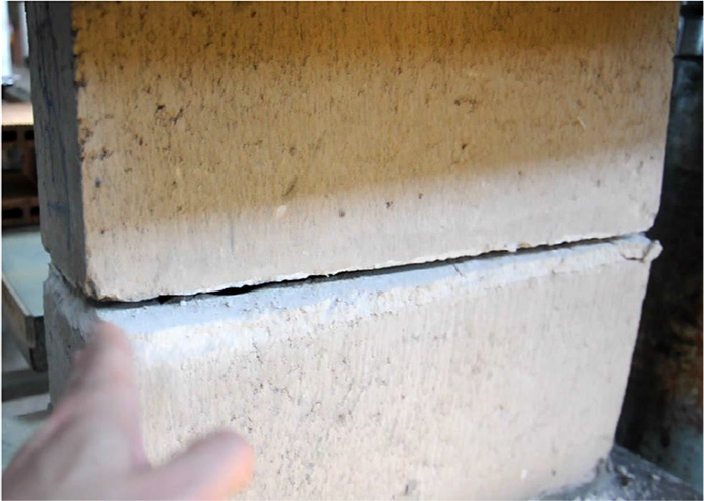
The loss of adhesion in prisms with concrete blocks was notable because of the bond break of the upper blocks from the mortar joint and one such example is shown in Figure 4. In all separation cases, the mortar joint came completely loose with no leftover bond to the block.

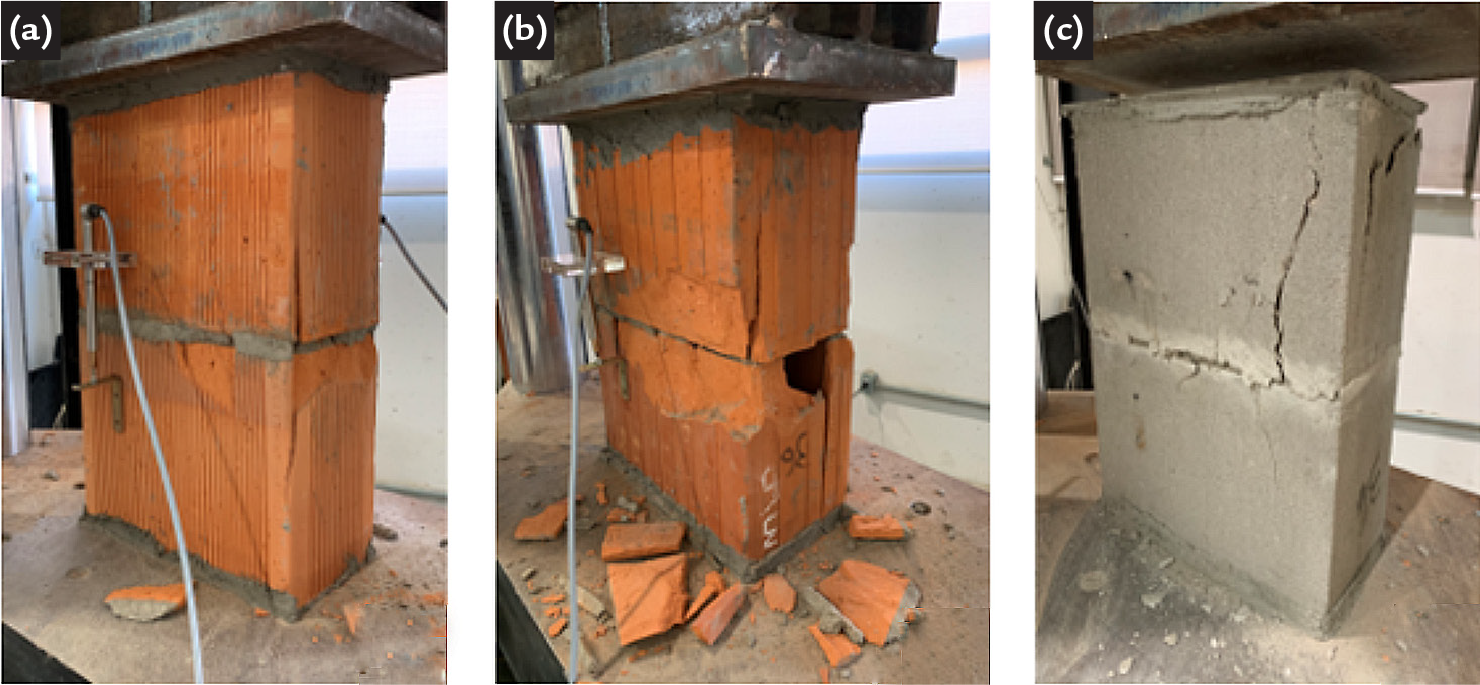
The importance of adhesion and mortar joint confinement in the prism failure mode became clear when comparing each type of prism after failure. In ceramic block prisms, mortar joint failure results in tensile stresses that split the block near the joint. This splintered the blocks but preserved block-mortar adhesion despite joint crushing. On the other hand, in concrete blocks, joint crushing induces bond breaking and loss of integrity of the prism. In this case, rather than behaving as a composite, the prism behaves as a collection of blocks compressing a joint of pulverizable material and rupturing occurs when the blocks themselves fail under sufficient stress. These behaviors are exemplified by the post-rupture images of Figure 5 of prisms manufactured with ready-to-use mortar with setting time of 36 h.

Post-rupture results of prisms manufactured with ready-to-use mortar with setting time of 36 h: (a) solid ceramic block, (b) hollow ceramic block and (c) concrete block.
The behavior of the concrete blocks would suggest that mortar strength did not affect prism strength (Drysdale and Hamid, 1979; Haach et al., 2014). However, results of this study and others (Schankoski et al., 2015; Lübeck et al., 2017; Machado et al., 2019) demonstrate that the maximum compressive strength achieved in prisms did not necessarily represent the behavior of a masonry material. Rather, the maximum allowed stress under which mortar joint crushing started should also be considered and these could be identified from the discontinuity in the stress-strain curves of prisms.
Results of this study also denote that the stress level at which joint crushing starts in prisms with concrete blocks depended not only on mortar strength but also on porosity, which in turn is related to the level of entrained air in the fresh state. Prisms manufactured from pre-mixed mortar (strength of 1.8 MPa and air entrainment of 8 %) had discontinuities in the stress-strain curve near maximum stress. On the other hand, prisms manufactured with ready-to-use mortars with 36 h and 72 h setting time (strengths of 2.7 MPa and 3.0 MPa, air entrainment of 21.4 % and 23 %, respectively) had discontinuities appear at stress levels approximately between 70 % and 55 % of the maximum.
4. Conclusions
This study produced valuable information on the mechanisms that affect strain in masonry prisms under compression. It indicated that, in addition to mortar strength and how block type affected joint confinement, mortar pore structure also contributed to the strain behavior and susceptibility of joint crushing from occurring. Results from this study represented an initial stage in the development of improved standards regarding bedding mortars and design of masonry structures.
-
• Despite air entrainment having a weak correlation with prism compressive strength, it was determined that it affects the susceptibility of joint crushing and block-mortar bonding.
-
• Both hollow and solid ceramic block prisms presented a near-linear stress-strain behavior until rupture. Higher strength mortars produced stronger prisms which were able to reach higher strain at rupture.
-
• Concrete block prisms, regardless of mortar type, presented non-linear stress-strain behavior. Low strength mortars with lower entrained air content produced stronger prisms able to reach higher strain levels prior to rupturing. For these blocks, the behavior was a result of lower adhesiveness between block and mortar resulting in lower joint confinement and higher propensity for crushing.
-
• In prisms with concrete blocks, strength must be evaluated alongside stress-strain behavior, since abrupt variations in strain indicated localized joint crushing and could denote the beginning of a rupturing process.
-
• With the ceramic blocks, joint failure led to rupture by splitting the blocks. But with the concrete blocks, joint crushing led to loss of adhesion and the prism no longer behaved as a composite. Thus, in terms of resisting compression, shearing and tension, joint crushing signaled masonry failure, even if compressive loads could still be applied due to the peculiarities of the laboratory test.
-
• The stress level that signaled joint crushing in concrete block prisms depended on mortar strength and porosity. Prisms with pre-mixed mortar (strength of 1.8 MPa and air entrainment of 8 %) presented discontinuities in the stress-strain curve near maximum stress. On the other hand, prisms manufactured with ready-to-use mortars with 36 h and 72 h setting time (strengths of 2.7 MPa and 3.0 MPa, air entrainment of 21.4 % and 23 %, respectively) presented discontinuities at stress levels between 70 % and 55 % of the maximum.
These results provided valuable data on the behavior of masonry structures and could be used in building design to aid in the choice of materials which could produce the desired strength and strain behavior.
References
- ALVARENGA, R. C. S. S.; NALON, G. H.; FIORESI, L, A. F.; PINTO, M. C.; PEDROTI, L. G.; RIBEIRO, J. C. L. Experimental evaluation of the influence of mortar’s mechanical properties on the behavior of clay masonry. The Minerals, Metals & Materials Series, p. 671-679, 2017.
- ASSOCIAÇÃO BRASILEIRA DE NORMAS TÉCNICAS - ABNT. NBR 12118: blocos vazados de concreto simples para alvenaria - métodos de ensaio. Rio de Janeiro: ABNT, 2014. 14 p.
- ASSOCIAÇÃO BRASILEIRA DE NORMAS TÉCNICAS - ABNT. NBR 15270-2: componentes cerâmicos. Parte 2: Blocos cerâmicos para alvenaria estrutural e de vedação - Terminologia e requisitos. Rio de Janeiro: ABNT, 2017.
- ASSOCIAÇÃO BRASILEIRA DE NORMAS TÉCNICAS - ABNT. NBR 13276: argamassa para assentamento e revestimento de paredes e tetos - Preparo da mistura e determinação do índice de consistência. Rio de Janeiro: ABNT, 2016. 6 p.
- ASSOCIAÇÃO BRASILEIRA DE NORMAS TÉCNICAS - ABNT. NBR 13277: argamassa para assentamento e revestimento de paredes e tetos - determinação da retenção de água. Rio de Janeiro: ABNT, 2005. 3 p.
- ASSOCIAÇÃO BRASILEIRA DE NORMAS TÉCNICAS - ABNT. NBR 13278: argamassa para assentamento e revestimento de paredes e tetos - determinação de densidade de massa e teor de ar incorporado. Rio de Janeiro: ABNT, 2005. 4 p.
- ASSOCIAÇÃO BRASILEIRA DE NORMAS TÉCNICAS - ABNT. NBR 13279: argamassa para assentamento e revestimento de paredes e tetos - determinação da resistência à tração na flexão e à compressão. Rio de Janeiro: ABNT, 2005. 13 p.
- ASSOCIAÇÃO BRASILEIRA DE NORMAS TÉCNICAS - ABNT. NBR 15259: argamassa para assentamento e revestimento de paredes e tetos - determinação da absorção de água por capilaridade e do coeficiente de capilaridade. Rio de Janeiro: ABNT, 2005. 3 p.
- ASSOCIAÇÃO BRASILEIRA DE NORMAS TÉCNICAS - ABNT. NBR 16868-1: alvenaria estrutural - parte 1: projeto. Rio de Janeiro: ABNT, 2020.
- ATKINSON, R. H.; NOLAND, J. L.; ABRAMS, D. P. A deformation failure theory for stackbond brick masonry prisms in compression. In: INTERNATIONAL BRICK AND BLOCK MASONRY CONFERENCE, 7., 1985. Proceedings [...]. Melbourne, Australia, 1985.
- BENINGFIELD, N. Ready-to-use mortars. Structural Survey, v. 4, ISS 2, p. 109-113, 1986.
- BRITISH STANDARD. BS 5628-1: code of practice for use of masonry - part 1: structural use of unreinforced masonry. Londres, 2005. 64 p.
- BRUGALI, D. R.; CASAGRANDE, E.; STOLZ, C. M. Caracterização de argamassas industrializadas e estabilizadas disponíveis em Caxias do Sul, RS. In: SIMPÓSIO BRASILEIRO DE TECNOLOGIA DAS ARGAMASSAS, 2019. Anais [...]. Goiânia, 2019.
- CALDEIRA, F. E.; NALON, G. H.; OLIVEIRA, D. S.; PEDROTI, L. G.; RIBEIRO, J. C. L.; FERREIRA, F. A.; CARVALHO, J. M. F. Influence of joint thickness and strength of mortars on the compressive behavior of prisms made of normal and high-strength concrete blocks, Construction and Building Materials, 234, 117419, 2020.
- CAMACHO, J. S.; LOGULLO, B. G.; PARSEKIAN, G. A.; SOUDAIS, P. R. N. The influence of grouting and reinforcement ratio in the concrete block masonry compressive behavior. Revista Ibracon de Estruturas e Materiais, v. 8, n. 3, p. 341-364, jun. 2015.
- CARASEK, H. Argamassas. In: ISAIA, G. C. (Ed.) Materiais de construção civil e princípios de ciências e engenharia de materiais. São Paulo: Ibracon, 2017.
- CASALI, J. M.; MANN NETO, A.; ANDRADE, D. C.; ARRIAGADA, N. T. Avaliação das propriedades do estado fresco e endurecido da argamassa estabilizada para revestimento. In: SIMPÓSIO BRASILEIRO DE TECNOLOGIA DAS ARGAMASSAS - SBTA, 9, 2011. Anais [...]. Minas Gerais, 2011.
- DE MARCO, C. E. G. Resistência à compressão de prismas preenchidos com argamassa/graute. Dissertação (Mestrado em Engenharia Civil) - Universidade Federal de Santa Maria, 2016.
- DIAMANTINO, L. S.; OLIVEIRA, E. A. Análise experimental e numérica do comportamento de prismas de blocos de concreto preenchidos com graute produzido com resíduo da construção civil. Brazilian Journal of Development, v. 7, n. 9, p. 87700-87726, 2021.
- DRYSDALE, R. G.; WONG, H. E. Interpretation of the compressive strength of masonry prisms In: INTERNATIONAL BRICK AND BLOCK MASONRY CONFERENCE, 7., 1985. Proceedings […]. Melbourne, Australia, 1985.
- DRYSDALE, D. R.; HAMID, A. A. Behaviour of concrete block masonry under axial compression. Journal ACI, v. 76, n. 6, p. 707-721, 1979.
- GOMES, N. S. A resistência das paredes de alvenaria. São Paulo. 190p. Dissertação (Mestrado) - Escola Politécnica - Universidade de São Paulo, 1983.
- HAACH, V. G.; VASCONCELOS, G.; LOURENÇO, P.B. Assessment of compressive behavior of concrete masonry prisms partially filled by general mortar. Journal of Materials in Civil Engineering, v. 26, n. 10, 2014.
- HAYEN, R.; VAN BALEN, K.; VAN GEMERT, D. The mechanical behaviour of mortars in triaxial compression. In: INTERNATIONAL CONFERENCE ON MATERIALS SCIENCE AND RESTORATION, 6., 2003. Proceedings […]. Karlsruhe, p. 295-302. 2003.
- HILSDORF, H. K. Investigation into the failure mechanism of brick masonry loaded in axial compression. In: INTERNATIONAL BRICK AND BLOCK MASONRY CONFERENCE, 1, 1967. Proceedings […]. Austin, Texas, 1967.
-
JAMOVI. The Jamovi Project, Version 2.3, Computer Software. Available at: https://www.jamovi.org 2022.
» https://www.jamovi.org - KAUSHIK, H. B.; RAI, D. C.; JAIN, S. K. Stress-Strain properties of clay brick masonry under uniaxial compression. Journal of Materials in Civil Engineering, v. 19, n. 9, p. 728-739, set, 2007.
- KHOO, C. L. A failure criterion for brickwork in axial compression. Tese (Doutorado) - University of Edinburgh, Edimburgo, Escócia. 1972.
- LEITE, M. L. P. Análise sistemática da relação de resistência à compressão entre prisma e bloco de concreto para alvenaria estrutural. Dissertação (Mestrado em Engenharia Civil) - Universidade Estadual de Maringá, Maringá, PR, 2023.
- LIMA, A. N. Análise experimental da influência da resistência e espessura da argamassa de assentamento no desempenho mecânico de prismas de blocos cerâmicos. 128 p. Dissertação (Mestrado em Engenharia Civil) - Universidade Federal de Alagoas, Maceió, AL, 2010.
- LÜBECK, A. Comportamento mecânico e influência da argamassa no modo de ruptura da alvenaria estrutural. Tese (Doutorado em Engenharia Civil) - Universidade Federal de Santa Maria, Santa Maria, RS, 2016.
- LÜBECK, A.; MOHAMAD, G.; FONSECA, F. S.; MODLER, L. E.; SCHMIDT, R. P. B. Compressive strength and failure mode of axially loaded hollow concrete block masonry. In: CANADIAN MASONRY SYMPOSIUM, 13., 2017, Canada. Proceedings […]. Halifax, Canada, Jun. 2017.
- MACHADO, J. F.; LÜBECK, A.; MOHAMAD, G.; FONSECA, F. S.; SANTOS NETO, A. B. S. Assessment of the compressive strength of masonry prisms using the Eurocode 6 approach. In: NORTH AMERICAN MASONRY CONFERENCE, 13., Jun. 2019. Proceedings […], Salt Lake City, Estados Unidos, 2019.
- MARTINS, R. O. G.; NALON, G. H.; ALVARENGA, R. C. S. S.; PEDROTI, L. G.; RIBEIRO, J. C. L. Influence of blocks and grout on compressive strength and stiffness of concrete masonry prisms. Construction And Building Materials, v. 182, p. 233-241, set, 2018.
- MOHAMAD, G. Comportamento mecânico na ruptura de prismas de blocos de concreto não-grauteado. Dissertação (Mestrado). Universidade Federal de Santa Catarina. Florianópolis, 1998.
- MOHAMAD, G.; LOURENÇO, P. B.; ROMAN, H. R. Propriedades mecânicas das argamassas sob compressão triaxial - análise e previsão. In: JORNADAS SULAMERICANAS DE ENGENHARIA ESTRUTURAL, 32, maio 2016. Anais [...], p. 2954-2963, 2006.
- MOHAMAD, G. Mechanism failure of concrete block masonry under compression. Tese (Doutorado) - Universidade do Minho, Guimarães, Portugal, 2007.
- MOHAMAD, G.; FONSECA, F. S.; VERMELTFOORT, A. T.; MARTENS, D. R. W.; LOURENÇO, P. B. Strength, behavior, and failure mode of hollow concrete masonry constructed with mortars of different strengths. Construction and Building Materials, v. 134, p. 489-496, mar. 2017.
- MOHAMAD, G.; FONSECA, F. S.; VERMELTFOORT, A. T.; LÜBECK, A. Stiffness plasticity degradation of masonry mortar under compression: preliminary results. Revista IBRACON de Estruturas e Materiais. v. 11, n. 2, 2018. p. 279-295.
- MOTA, J. A. V. Influência da junta vertical na resistência à compressão de prismas em alvenaria estrutural de blocos de concreto e blocos de concreto celular autoclavado. Dissertação (Mestrado em Engenharia de Estruturas) - Escola de Engenharia da Universidade Federal de Minas Gerais. Belo Horizonte, 2001.
- PARSEKIAN, G. A.; HAMID, A.; DRYSDALE, G. Structural masonry behavior and design. São Carlos: EdUFSCar, 2012.
- RAMALHO, M. A; CORRÊA, M. R. S. Projeto de edifícios de alvenaria estrutural. São Paulo: Pini, 2003.
- SCHACKOW, A.; FERRARI, A. K.; EFFTING, C.; ALVES, V. O.; GOMES, I. R. Stabilized mortar with air incorporator agent and plasticizer set retarder: performance measurement. Revista IBRACON de Estruturas e Materiais, São Paulo, v. 12, n. 6, p. 1248-1259, dez. 2019.
- SCHANKOSKI, R. A.; PRUDÊNCIO JR., L. R.; PILAR, R. Influência do tipo de argamassa e suas propriedades do estado fresco nas propriedades mecânicas de alvenarias estruturais de blocos de concreto para edifícios altos. Revista Matéria, v. 20, n. 4, p. 1008-1023, 2015.
- SCHOSSLER, R. T. Deformações e modo de ruptura em prismas de alvenaria de blocos concretos: análise experimental com extensometria e correlação de imagem. Dissertação (Mestrado em Materiais de Construção Civil e Preservação Ambiental) - Programa de Pós-Graduação em Engenharia Civil - Universidade Federal de Santa Maria. Santa Maria, 2019.
- THAMBOO, J. A.; DHANASEKAR, M. Correlation between the performance of solid masonry prisms and wallettes under compression. Journal Of Building Engineering, v. 22, p. 429-438, mar. 2019.
- ZAHRA, T.; THAMBOO, J.; ASAD, M. Compressive strength and deformation properties of concrete block masonry made with different mortars, blocks and mortar beddings types. Journal of Building Engineering, 38, 102213, 2021.