 Reindustrialization in the sustainable development convention
ABSTRACT
This article assumes the importance of the manufacturing industry to long-term growth and examines Brazil’s deindustrialization process since its economic opening. The manufacturing sector’s recovery is analyzed in light of the proposal to reindustrialize the economy in the ongoing global climate emergency. In line with the new-developmentalist literature, reindustrialization implies widening policy space to recover public and private investment in productive assets, providing financial conditions compatible with long-term returns. It assumes an active role in state intervention. In this sense, the New Brazilian Industry industrial policy should anchor long-term expectations to enhance productive investment committed to the green transition. This approach positions industrial policy as the anchor to build a sustainable development convention.
KEYWORDS:
Deindustrialization; reindustrialization; industrial policy; sustainable development convention; green sustainable transition
RESUMO
Este artigo assume a importância da indústria manufatureira para o crescimento no longo prazo e examina o processo de desindustrialização do Brasil desde a abertura econômica. A recuperação da indústria manufatureira é analisada à luz da proposta de reindustrialização da economia na atual emergência climática global. Em linha com a literatura novo-desenvolvimentista, a reindustrialização implica alargar o espaço de política para recuperar o investimento público e privado em ativos produtivos, proporcionando condições financeiras compatíveis com retornos a longo prazo. Assume um papel ativo na intervenção estatal. Nesse sentido, a política industrial da Nova Indústria Brasileira deve ancorar expectativas de longo prazo para potencializar o investimento produtivo comprometido com a transição verde. Esta abordagem posiciona a política industrial como a âncora para a construção de uma convenção de desenvolvimento sustentável.
PALAVRAS-CHAVE:
Desindustrialização; reindustrialização; política industrial; convenção para o desenvolvimento sustentável; transição verde sustentável
1. INTRODUCTION
Propelled by a robust process of industrialization in the post-World War II era through to the late 1970s, the Brazilian economy emerged as one of the fastest growing on a global scale. This period was characterized by rapid and sustained expansion within the industrial sector. However, the external debt crisis at the beginning of the 1980s interrupted the period of fast growth, and a subsequent transition ensued, marked by a substantial reduction in the country’s economic dynamism, coupled with a slow decline in the relative contribution of the industrial sector to the overall economic activity.
More recently, the COVID-19 pandemic significantly disrupted global value chains and underscored the critical importance of autonomy in industrial production processes, especially in the health, food, and energy sectors. Furthermore, in the context of the accelerating global climate and environmental crisis, there is a compelling argument for the necessity of a robust and innovative productive structure that is carbon neutral. This requirement is not merely a response to the expanding climate crisis but also fundamental to fulfilling international climate and biodiversity agreements and national targets.
Developing a complex and technologically sophisticated manufacturing industry is paramount in a growth strategy aligned with a sustainable green transition. This is so because a more technologically advanced manufacturing industry is less intensive in consuming non-renewable natural resources and less intensive in high-carbon activities. Besides, the manufacturing industry presents special characteristics such as more forward and backward linkages, greater static and dynamic economies of scale, as well as a capacity to incorporate and disseminate technical progress rapidly. These characteristics allow productivity gains in the manufacturing industry and its associated services to spread throughout the entire economy, increasing growth potential in the long run. In contrast, a country that has not yet completed its industrialization process, internalizing the production of technical progress through the presence of technologically advanced sectors and activities, exhibits low aggregate productivity compared to frontier countries and tends to lose competitiveness over time. The same is observed in the case of a country that prematurely retreats from the industrialization process over time.1
The Brazilian economy serves as a prime example, with its increasing deindustrialization since the 2000s and further specialization in the production of resource-intensive goods. Thus, the goal of reindustrializing in the 2020s should not only focus on modernizing the Brazilian industrial base with more sophisticated processes and embracing sectors and activities of high technological complexity but also ensure a green, sustainable transition (GST) that facilitates a structural change in the economy and addresses the climate crisis. This approach to reindustrialization presents a significant challenge and an opportunity to rejuvenate the country’s productivity and competitiveness through investments in fixed assets and Research and Development (R&D), driving productive transformation. Investing in sustainable industrial processes and advanced technology has the potential to reduce the environmental impact of industrial production, create quality jobs, and enhance the competitiveness of Brazilian products in the global market, helping to reduce external constraints on economic growth.
However, reindustrialization depends on a large amount of investment in physical assets, and long-term investment decisions require a conducive and stable macroeconomic environment with room for discretionary public policy decisions. Therefore, from an economic policy perspective, the challenge of promoting structural change with environmental sustainability and greater external competitiveness is significant. This involves a sustainable development convention anchored by the industrial policy, that is, implementing well-targeted industrial policies in harmony with a finely tuned macroeconomic policy that allows for the resumption of public productive investment and the attraction of private investments with the goal of sustainability. This implies that the macroeconomic tripod model, which is focused on price stability and has been in the Brazilian economy since 1999, should be flexible and incorporate new and dynamic intervention tools. That is, the excessive focus on monetary stability does not consider the long-term benefits that a mature industry can bring to the economy’s long-term growth and climate transition.
To discuss strategies to re-industrialize the Brazilian economy in the 2020s, this article is organized into three main sections, along with this introduction and a concluding segment. The second section offers an analysis of the factors contributing to premature deindustrialization. The following section explores the available policy scope for reindustrialization. In the third section, the focus shifts to the critical alignment of industrial policy with a long-term developmental vision essential for the country’s economic and ecological transformation. This part underscores the necessity for a convention on sustainable development that synchronizes industrial policy with a mission-oriented approach. The article concludes with a summary reflection in the final section.
2. PREMATURE DEINDUSTRIALIZATION
The primary cause of premature deindustrialization in the Brazilian economy (and in industrialized Latin American countries in general), according to Palma (2005), was the radical change in the economic policy regime implemented in the early 1990s because of negotiations with international creditors to resolve the external debt crisis that endured throughout the 1980s. The sudden and sharp increase in the United States’ interest rate in 1979, following two oil shocks, strongly impacted Latin American economies with high external debt, leading to balance of payments crises that, in the case of Brazil, were only overcome in the early 1990s with adherence to the Brady Plan for external debt renegotiation. Illustratively, while Brazil’s per capita Gross Domestic Product (GDP) grew at an average annual rate of 4.7% from 1961 to 1980, this rate decreased to a mere average annual growth of 0.7% from 1981 to 2019. Furthermore, the share of the manufacturing industry in the GDP, which stood at approximately 30% in 1980, dwindled to about 11% in 2020.2
In this context, among the economic policy recommendations conditioning the restoration of international financial flows, the most impactful was the liberalization of the financial account. This, given the subordinate financial integration of the Brazilian economy in the international monetary and financial system, reduced domestic policy space.3 Thus, economic liberalization led to the abandonment of traditional industrial and trade policies, as well as to significant changes in the management of economic policy and the role of the State, based on the assumption that it should be less interventionist and reduce in size. Such change caused shifts in relative prices that were not beneficial for the manufacturing industry.4
The strategic price for guiding resource allocation to the manufacturing sector, as per the new developmentalism literature (Bresser-Pereira, 2020b), is the real exchange rate, which tends to appreciate in economies with comparative advantages in exploiting natural resources. The shift in economic policy orientation towards liberalization entailed abandoning policies that neutralized the Dutch disease (Bresser-Pereira, 2020a). Combined with the free movement of capital, this tends to maintain the real exchange rate at a non-competitive level. The result is a disincentive to invest in sectors producing non-commodity tradable, leading the economy to deindustrialization.
As advocated by the structuralist and new developmentalist literature, post-war industrialization strategies were a means for developing economies to aspire to reach the level of developed economies. In the new context of economic liberalization in the 1990s and beyond, commercial, and financial interaction was viewed as the liberal strategy for the Brazilian economy to increase industrial productivity and resume growth, along with price stability. The result, however, was a regression in the Brazilian productive structure, which reverted to its natural Ricardian position, that is, a position associated with its comparative advantages corresponding to its abundant endowment of natural resources.
In this context, the decline in the share of the manufacturing industry in the total value added intensified in the 2010s. In 2000, according to the national accounts (IBGE), the manufacturing industry accounted for 15.3% of the economy’s value-added, a percentage that remained relatively stable until 2010, when it reached 15.0% and then decreased to 12.3% in 2020. From 2000 to 2020, the agriculture and extractive industries sectors, in turn, gained weight, increasing from 6.9% to 9.5% of the GDP.
Likewise, the premature decline in the importance of manufacturing becomes apparent when this trend occurs before the industry reaches the stage of maturity (Kaldor, 1968), where productivity gains are relatively well-distributed along the production chains.5 That is, an economy that deindustrializes prematurely does not benefit from the scale gains observed more intensely in the manufacturing sector, and its productivity tends to stagnate, affecting the productivity of the entire economy. Premature deindustrialization can thus compromise long-term economic growth by interrupting the process of productive transformation toward greater technological complexity. In this case, in addition to the loss of weight in the total value added, it is observed that the sectoral composition within the industry shows a retreat in sectors with higher technological intensity.
A consequence of the diminishing weight of the manufacturing industry in the total value added and the reduction in the complexity of the productive matrix is the negative impact on the economy’s growth dynamism.6 Table 1 compares the growth rates of the GDP and the manufacturing industry for selected periods and allows for two observations. Firstly, growth rates were higher in the 2000s, when the manufacturing industry grew by 2.4% per annum than in subsequent periods, indicating that the economy loses dynamism as it reduces its weight. Secondly, the growth rates of the manufacturing industry are lower than those of the economy in all periods and have been declining since 2010, recording, on average, negative results. Notably, in the 2000s and 2010s, the highest growth productive sectors were agriculture and oil and gas extraction.
Another consequence of premature deindustrialization is the increased external constraint on growth. According to the Kaldor-Thirlwall law, in an open economy, the main constraint to long-term aggregate product growth is the balance of payments. This is because the sustainability of growth depends on the country’s ability to maintain the competitiveness of its exports, which in turn depends on the increase in productivity of manufacturing production. In other words, the balance of payments equilibrium condition highlights the importance of exports in alleviating the growth constraint imposed over time, and the effect of exports on product growth depends on the productive structure of each country.
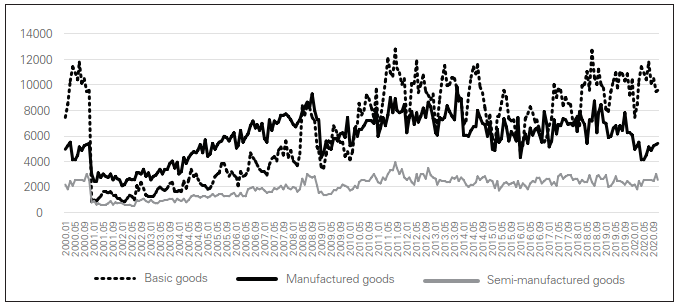
Figure 1 illustrates the evolution of Brazilian export patterns since 2000, corroborating the thesis that the advancement of the deindustrialization process and the regression in the productive structure in terms of technological complexity have led to a reversal in the composition of the export basket from 2010 onwards, becoming specialized in basic products, intensive in natural resources and of low added value. This signals the fact that a strong resumption of economic growth should consider the need to generate surpluses in external trade transactions to sustain growth but not focus on primary goods.

Finally, it should be emphasized that, while in the initial years of economic liberalization in the 1990s, the impact of trade liberalization was to recover the industrial sector’s productivity, which had been stagnant since the mid-1980s, the initial gains dissipated as a process of substitution of domestic production with imports was observed. This weakened links in the production chain and reinforced premature deindustrialization.
3. PRODUCTIVE REGRESSION, POLICY SPACE, AND CLIMATE TRANSITION
As observed in the previous section, the premature process of Brazilian deindustrialization is associated with economic liberalization, the abandonment of industrial policies, and the neutralization of the Dutch disease. In this section, we will discuss how economic liberalization restricts the space for macroeconomic policy and contributes to the discouragement of productive investment. We also introduce the climate and environmental crisis, which, in the context of specialization in the exploitation of natural resources, increases the degree of vulnerability of the Brazilian economy to climate shocks.
To discuss these issues, this section is divided into two subsections. In the first, we argue that macroeconomic policies in the post-economic liberalization period did not foster a conducive environment and the necessary stability in terms of growth to awaken ‘animal spirits’ and sustain investment in capital formation. The productive specialization was further reinforced by sectoral policies supporting the agro-export sector. In the second, we contend that the climate crisis is a novel component that presents new challenges to the development of peripheral economies specialized in the production of resource-intensive goods.
3.1. Policy Space and Productive Transformation
For a growth strategy based on the absorption of external capital to be efficient from the perspective of economic development, that is, to alleviate the external constraint on growth, making the economy less vulnerable to shocks and increasing its long-term aggregate productivity, there should be a guarantee that private external financing would be provided over an extended period. This would enable the economy to undergo a structural change towards more sophisticated and complex activities, and for the trade balance to evolve in a direction that generates sustainable trade surpluses. To this end, the process of economic liberalization should promote investment in the formation of physical and human capital and in R&D in sufficient volume and quality, resulting in increased productivity and competitiveness. In this scenario, a virtuous growth cycle could occur, and the economy would be on a trajectory to close the productivity gap with developed economies.
The virtuous growth cycle presupposes a macroeconomic context of growth with stability, which depends, among other factors, on how developing economies are integrated into the global economy. The economic liberalization of developing economies in financial globalization deepens the dependency on short-term capital flows, reducing the scope for macroeconomic policy. This is because financial integration occurs within a hierarchical monetary and financial system, and the currencies of developing economies, named as peripheral currencies, and the assets represented in them exhibit a low degree of international liquidity (Kaltenbrunner and Painceira, 2018). Consequently, economies that open their capital accounts must operate with a higher level of real interest rates to compensate for the lower liquidity premium.7
Furthermore, as the classic study by Rey (2015) showed, regardless of the exchange rate regime, developing economies under free capital movement are ‘business cycle takers’, in the words of Ocampo (2003). That is, the flow of international liquidity determines the currency movements of these economies, largely independent of their fundamentals. Thus, financial liberalization tends to increase the financial vulnerability of developing economies since capital flows are pro-cyclical and volatile, and the management of monetary policy finds limited scope as the tendency is to manage interest rates to offset capital movements. High real interest rates, in turn, reduce the scope of fiscal policy, particularly public spending. Similarly, the interest differential tends to appreciate the real exchange rate, and if the Dutch disease is not neutralized, the real exchange rate level tends to be overvalued.
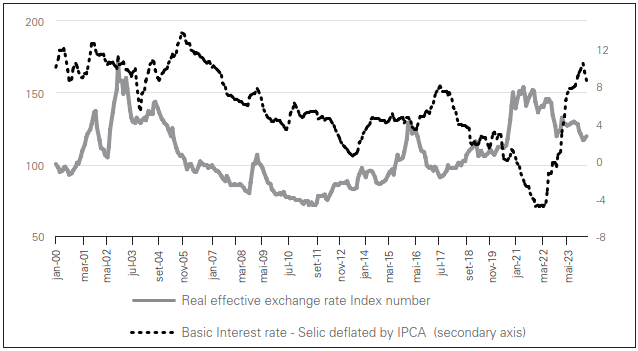
Figure 2 illustrates the evolution of the real interest rate and real exchange rate from 2000 to 2022 and highlights one of the main characteristics of the Brazilian economy during this period: maintaining a permanently high level of the real interest rate and keeping the interest rate differential high to attract foreign capital. Consequently, this contributes to a tendency for the real exchange rate to appreciate,8 which is one of the main explanations for the severe and rapid process of deindustrialization.
These constraints negatively impact the decisions to invest in long-term capital assets, which largely explains the loss of dynamism in the Brazilian economy. The process of progressive structural change, with the advancement of production of higher value-added goods, requires an environment of macroeconomic stability beyond price stability, where short-term policy can establish the main macroeconomic prices - that is, the interest rate and the exchange rate - at a level that encourages long-term investment. Contrarily, what has been observed in recent experience is that the subordinate integration into international monetary and financial markets has not provided the necessary conditions for sustaining investment in long-duration assets.9
From the economic integration perspective, in the modern view of integration into global value chains, the dynamism of developing economies should be understood based on the type of insertion, whether in more or less technologically complex activities. This is because the greater the distance between the income elasticity of exports and that of imports, the less the long-term growth constraint imposed by the balance of payments will be. On the contrary, what is observed is that commercial integration and the advancement of the financialization process in developing economies financially integrated and specialized in the production of commodities tend to increase the degree of external vulnerability of these economies. The implication is the exacerbation of the effects of both positive and negative trade shocks on the local economy.
Akyüz (2020) notes a positive correlation between commodity price appreciation and capital inflows into financially subordinately integrated developing economies. The author argues that commodity prices and capital inflows mutually reinforce each other, influencing the pace of economic activity and subordinating developing economies to international trade cycles. From this analytical perspective, the financial and international trade cycles dictate the degree of freedom for developing economies to grow and develop.
Throughout the 2000s and 2010s, the Brazilian economy increasingly specialized in the production and export of agricultural and mineral commodities.10 As observed, the most dynamic sectors since the 2000s have been agriculture and extractive industries. The industrial policies implemented in 2003,11 however, were not able to achieve the expected effect of reversing the deindustrialization process, while the targeted policies (mainly credit and subsidies) for the agro-export sectors were successful. Thus, it cannot be said that there was no sectoral policy in recent decades, but rather that explicit choices have been (and continue to be) made to privilege productive activities with lower added value. If, from the perspective of economic growth, a productive matrix specialized in goods of low-income elasticity and low complexity reduces long-term output and productivity growth, the context of climate transition poses even greater challenges to the performance of these sectors, as climate change-induced disasters have significant impacts on the production of resource-intensive goods.
3.2. Productive Regression and Climate Crisis
Greater specialization in the production of resource-intensive goods exposes the country’s productive base to higher climate physical risks. Thus, climate vulnerability negatively impacts the trade balance specialized in commodity exports. Carney (2018) defines physical risks as those referring to threats arising from changes in climatic conditions and their direct impacts, such as sudden or continuous variations, heatwaves, droughts, sea-level rise, flooding, desertification, and extreme weather events. These risks can cause physical damage to properties and significantly affect the trade of goods and services. Therefore, climate crises can exacerbate cyclical fluctuations in economies and, by increasing the perception of risk among international investors regarding balance of payments difficulties, make the resumption of growth slower and financially more costly.
Also, Carney (2018) defines transition risks as the financial risks that could result from the process of adjustment toward a lower-carbon economy. These risks stem from a variety of factors including policy changes, technological breakthroughs, and shifts in market sentiment and social norms. The transition towards greener energy sources and sustainable practices implies a significant restructuring of the current economic and industrial landscape.
A crucial aspect of transition risks is the concept of stranded assets - assets that have suffered from unanticipated or premature write-downs, devaluations, or conversion to liabilities. In the context of the GST, stranded assets predominantly refer to those tied to fossil fuels and carbon-intensive industries. As policies and market preferences shift towards sustainable alternatives, assets linked to fossil fuels may lose their value rapidly, thereby becoming ‘stranded.’ The existence of stranded assets poses a potential destabilizing risk to the current productive structure. The devaluation of assets within these industries can lead to the loss of jobs, a reduction in investment, and a decrease in the availability of capital for these sectors. Moreover, the broader financial system could be impacted due to the decreased value of investments and loans tied to these assets. This could lead to a ripple effect, affecting the financial health of banks and investors with significant exposure to fossil fuels and related industries.
Therefore, understanding and managing transition risks is critical for a smooth transition to a sustainable economy. It requires careful planning and coordination among various stakeholders, including governments, industries, and the financial sector, to minimize disruptions and ensure economic stability during this transformative phase.
Another element to consider is that specialization in the export of resource-intensive products within a context of subordinate financial integration has led to the financialization of companies linked to the exploitation of these products. In the case of agribusiness, financialization has driven the expansion of agricultural companies,12 particularly in frontier expansion regions. Not coincidentally, the largest contribution to greenhouse gas emissions in the Brazilian case originates from land use and deforestation.13
To achieve a GST, that is, a virtuous circle of sustainable growth, green investments, and productive diversification, it is necessary to identify strategic sectors and provide targeted incentives oriented towards expanding capacity and output while addressing environmental and climate constraints. Investment decisions in this context should be informed by a social rate of return, wherein projects are evaluated based on their impact on development, welfare, financial feasibility, and ecological sustainability. Such initiatives necessitate comprehensive state planning, regulation, adequate funding, and stringent performance monitoring. They must be underpinned by accommodating fiscal, monetary, and financial policies. This approach is crucial for their success in fostering sustainable and inclusive economic growth and enabling economies heavily reliant on primary sectors to navigate the complex pathway toward sustainable transition effectively. It requires a shift in focus from traditional resource-intensive practices to innovation-driven, clean, and sustainable economic activities (Saad-Filho and Feil, 2023).
The above discussion, thus, points to the importance of reindustrializing the Brazilian economy, as argued by the structuralist and new developmentalist literatures, to lay the foundations for economic, social, and now also environmental development in a sustainable manner. Among other measures, the potential of sectors producing agricultural and mineral commodities should be considered to advance downstream and upstream activities with higher added value, generating greater resilience of production to climate effects. In other words, productive investment should aim to diversify the commodity production chain and reduce the impact on emissions that contribute to global warming.
4. REINDUSTRIALIZATION AND INDUSTRIAL POLICY AS ANCHORS FOR LONG-TERM EXPECTATIONS: BUILDING A SUSTAINABLE DEVELOPMENT CONVENTION
The Brazilian reindustrialization requires implementing industrial policies within a macroeconomic environment where the real interest rate is positioned below the return rate on fixed capital, and the exchange rate remains competitive. As observed, the subordinate financial integration of the Brazilian economy limits the maneuverability for administering policies to stimulate aggregate demand driven by productive investment, which is essential for reindustrialization. Investment in capital formation requires a stable environment and confidence in positive expectations of return, conditions that the macroeconomic arrangement characterized by the tripod of inflation targeting, fiscal surpluses, and floating exchange rates of the past three decades has not facilitated.
Moreover, reindustrialization in the 2020s will occur in the context of climate transition, adding new challenges to long-term investment decisions. These challenges are linked to evaluating the physical and transition risks and to uncertainties regarding the expected returns concerning climate changes and their impacts on the productive structure. Consequently, industrial policy emerges as a significant tool to awaken the ‘animal spirits’ of the private sector. As Altenburg and Rodrik (2017, p. 8) alerted, the design of a contemporary industrial policy must meet two challenges: to accelerate structural change towards greater productivity in a socially inclusive way and, simultaneously, to align with environmental sustainability.
In the context of discussions about the Brazilian economy, the reindustrialization project should encompass both short-term policies that create a conducive environment for the resumption of productive investment and long-term structural policies. This means that industrial policies should be coordinated with macroeconomic policies to build the necessary confidence base to induce private investment and financing decisions with a long-term horizon.
It is worth mentioning that in market economies, long-term decisions made in an environment of non-probabilistic uncertainty are supported by ‘conventions’ (shared beliefs) that are constructed with rules, habits, and institutions that mitigate the impact of uncertainty. Keynes (2012 [1936]). Therefore, the GST demands synergetic actions between the private and public sectors. It calls for an economic policy paradigm shift, from merely targeting short-term economic relief to actively changing the production architecture for sustainable structural transformation. The proposed sustainable development convention positions the government as the central agent in promoting the structural transformation required to achieve a sustainable transition (Feijó et al., 2023). The concept of the “Entrepreneur State,” as articulated by Mazzucato (2012), is pivotal in this context. It defines a state that must act decisively, shaping markets, assuming risks, and thus building the new convention to growth.14
The international context encouraging an energy transition15 presents a window of opportunity for reindustrialization projects. Brazil, possessing reserves of critical minerals, which are essential inputs for the energy transition in developed countries, stands at a strategic advantage that helps to create policy space to enlarge the state’s capacity for intervention to redirect the allocation of resources.
Given the current productive structure and commercial integration, at least two sectoral strategies for reindustrialization can be identified, in addition to exploiting and processing new minerals. The first strategy would focus on technologically sophisticated sectors, which exhibit higher productivity gains and a lower environmental impact. This approach involves directing incentives towards sectors that benefit from economies of scale, as they also drive modernizing production processes in other sectors. Therefore, import substitution in these areas represents significant progress in the country’s reindustrialization process. Magacho (2020), based on international classifications, lists technologically advanced sectors in manufacturing: machinery and equipment, motor vehicles, transport equipment; chemicals and pharmaceuticals; electrical machinery; medical, optical, and precision equipment; and electronic and communication equipment. These sectors are critical for fostering technological advancement and increasing productivity within the Brazilian economy. By focusing on these industries, Brazil can enhance its competitive edge in the global market and drive economic development. Moreover, the development of these sectors is likely to stimulate innovation and skill development, contributing to broader economic benefits, such as job creation and technological spillovers into other industries.
The second strategy recognizes that maintaining balance in external accounts is crucial in the reindustrialization process, and thus, industrial policy should also target sectors with competitive capacity. This approach focuses on diversifying production in resource-intensive industries by extending the productive chain of agricultural and extractive activities. The aim is to promote forward linkages, enhancing the degree of processing of natural resources, and backward linkages, connecting with other national industries that supply goods and services to the agricultural and extractive sectors. This would result in a strategy of strength in both upstream and downstream productive chains. In addition to diversification, there is an emphasis on making these chains more efficient in terms of environmental resource utilization.
In line with the above discussion, the program New Industry Brazil (NIB), launched by the federal government in January 2024, comprehensively addresses the highlighted strategies for the country’s reindustrialization. This action plan recognizes the national industry as a crucial pillar for Brazil’s sustainable development from social, economic, and environmental perspectives. By placing the global triple crisis - environmental, climate, and social - at the heart of its agenda, the NIB directly responds to the challenges posed by Brazil’s early and intensified deindustrialization.
There are several novelties in the design of this new industrial policy. It is mission-oriented and involves mechanisms such as directed financing through public financial institutions, favored interest rates, conditionalities, and policies linked to knowledge sharing. Economic incentives and public procurement policies assume not just functional but also strategic importance, acting as catalysts for achieving goals of productive diversification, social inclusion, and environmental sustainability. This perspective substantially differs from previous industrial policies and more vertically integrated industrial paradigms.
As Mazzucato (2022, p. 7) emphasizes, it is crucial to pay attention to both institutional and organizational design and policy design. Mission-oriented policy approaches recognize the importance of aligning public objectives with private interests, meaning that the process of reindustrialization needs to be constructed and legitimized by society. This implies a need for symbiotic collaboration around shared goals among the state, private companies, workers, and other stakeholders, demanding a new social contract for economic and ecological transformation (Mazzucato, 2023). It is in this sense, that we interpret that a new sustainable developmental convention, as a shared belief, can be built (Feil, 2021).
Finally, the dimension of financing is central to achieving the sustainable development convention, necessitating new capacities within domestic financial systems. In this regard, the BNDES (Brazilian Development Bank), currently managing the Climate Fund, a resource pool independent of public funding, holds significant potential to lead the financing of environmentally sustainable projects. However, its role is not solitary.16 As Teixeira et al. (2024) point out, the recent process of creating and developing subnational funds from extractive activity compensation resources (sovereign funds) can introduce new key allies in the task of converting dependency on finite resources into potential sources for transformation.
NIB represents an important step toward building a sustainable development convention, with industry serving as an anchor for this convention. However, the NIB requires more flexible macroeconomic targets, to build confidence on long-term commitment of financial resources. In a word, the reindustrialization process requires the awaken the ‘animal spirits’ of private investment. The plan’s success hinges on more effective coordination between short-term targets and long-term goals of reindustrialization, that is to say, short-term macroeconomic policy should make room for maneuvering widening policy space for pro-developmental economic policy.
5. FINAL REMARKS
Reindustrialization, as a project of structural change within the context of climate transition, presents a long-term development vision for the Brazilian economy that contrasts with the liberal development agenda, which gained prominence with economic liberalization in the 1990s. The new international scenario of energy transition in developed countries opens an opportunity for economies endowed with critical mineral resources, such as Brazil’s. The exploration and generation of clean energy sources can help ease external growth constraints and expand policy space. Under an industrial development strategy, strengthening productive chains in the mineral and agro-export sectors can create policy space for implementing an industrial policy that recuperates aggregate investment and contributes to advancing the diversification of the national productive matrix. The recovery of investment in sectors with high economies of scale, in R&D, and in product and process innovation can set the Brazilian economy on a path of high growth, with social inclusion and environmental sustainability.
In other words, the reindustrialization proposal for the 2020s implies reallocating resources towards the production and investment in goods and services with higher added value and greater environmental efficiency. Given the Brazilian economy’s dependence on capital flows, the reindustrialization strategy should aim to increase the degrees of freedom of economic policy, allowing the country not only to regain its dynamism in terms of sustainable growth and job creation but also to enhance its external participation in dynamic markets within the limits of the environment.
Thus, reindustrialization is a bold development strategy that implies a new economic development model, with a greater role for interventionist economic policies. The high degree of uncertainty inherent in the investment process in climate transition repositions the role of industrial policy, now oriented by missions that imply a new sustainable development convention. The industrial policy operates as an anchor for expectations to guide long-term decisions, where economic calculation is difficult, if not impossible, to perform. Just as in the post-war period, Latin American countries, including Brazil, faced an opportunity to industrialize, the 2020s present a new opportunity in the climate transition agenda as a means to reverse deindustrialization.
REFERENCES
- Akyüz, Y. (2020). The Commodity-Finance Nexus: Twin Boom and Double Whammy, Revista de Economia Contemporânea, vol. 24, no. 1
- Altenburg, T. and Rodrik, D. (2017). Green Industrial Policy: accelerating structural change towards wealthy green economies, pp. 2-20, in Green Industrial Policy - Concept, Policies, Country Experiences
- Balestro, M. V. and Lourenço, L. C. de B. (2014). Notas para uma análise da financeirização do agronegócio: além da volatilidade dos preços das commodities, pp. 241-65, in Buainain, A. M., Alves, E., Silveira, J. M., and Navarro, Z. (eds.), O mundo rural no Brasil do século 21: a formação de um novo padrão agrário e agrícola, Brasilia, Embrapa
- Bresser-Pereira, L. C. (2020a). Neutralizing the Dutch disease, Journal of Post Keynesian Economics, vol. 43, no. 2, 298-316
- Bresser-Pereira, L. C. (2020b). New Developmentalism: development macroeconomics for middle-income countries, Cambridge Journal of Economics, vol. 44, no. 3, 629-46
-
Cammeraati, E., Dechezleprêtre, A., and Lalanne, G. (2022). Innovation and industrial policies for green hydrogen: date last accessed January 19, 2024, at Innovation and industrial policies for green hydrogen: date last accessed January 19, 2024, at https://www.oecd-ilibrary.org/science-and-technology/innovation-and-industrial-policies-for-green-hydrogen_f0bb5d8c-en
» https://www.oecd-ilibrary.org/science-and-technology/innovation-and-industrial-policies-for-green-hydrogen_f0bb5d8c-en - Carney, M. (2018). A Transition in Thinking and Action, date last accessed at International Climate Risk Conference for Supervisors, De Nederlandsche Bank
- Delgado, G. C. (2012). Do capital financeiro na agricultura à economia do agronegócio, Porto Alegre, UFRGS Editora
- Delgado, G. and Leite, S. P. (2024). O agro é tudo? Financeirização como novo atributo da economia agrária, Le Monde Diplomatique, Advance Access published 2024
- Feijó, C. (2024). Stagnation of the Brazilian Economy and Peripheral Financialization, Economia Internazionale, Advance Access published 2024
- Feijó, C., Braga, J. de M., and Corrêa, M. F. (2019). Developmentalism and the determinants of investment: an econometric exercise for Brazil in the 2000s, Brazilian Keynesian Review, vol. 4, no. 2, 250
- Feijó, C., Feil, F., and Pessoa, L. (2023). State Planning and the Sustainable Development Convention: an introduction, Brazilian Journal of Political Economy, vol. 43, no. 4, 837-52
- Feijó, C. and Lamonica, M. T. (2012). Importancia del sector industrial para el desarrollo de la economía brasileña, Revista Cepal, 115-36
- Feil, F. (2021). ‘State-owned financial institutions as an arm of public policy for sustainable development’, Universidade Federal Fluminense
-
IPCC. (2023). IPCC, 2023: Climate Change 2023: Synthesis Report. Contribution of Working Groups I, II, and III to the Sixth Assessment Report of the Intergovernmental Panel on Climate Change, date last accessed at https://www.ipcc.ch/report/ar6/syr/
» https://www.ipcc.ch/report/ar6/syr/ - Kaldor, N. (1968). Causes of the Slow Rate of Economic Growth of the United Kingdom. An Inaugural Lecture, Cambridge University Press, vol. 34, no. 2, 222-222
- Kaldor, N. (1970). The Case for Regional Policies, Scottish Journal of Political Economy, vol. 17, no. 3, 337-48
- Kaltenbrunner, A. and Painceira, J. P. (2018). Subordinated Financial Integration and Financialisation in Emerging Capitalist Economies: The Brazilian Experience, New Political Economy, vol. 23, no. 3
- Kato, Y.M. and Pereira Leite, S. (2020). Land grabbing, financeirização da agricultura e mercado de terras: velhas e novas dimensões da questão agrária no Brasil, Revista da ANPEGE, vol. 16, no. 29, 458-89
- Keynes, J. M. (2012 [1936]). The collected writings of John Maynard Keynes, volume 7, Cambridge University Press for the Royal Economic Society
- Kindleberger, C. P. and Kaldor, N. (1969). Strategic Factors in Economic Development.
-
Magacho, G. R. (2020). Política Industrial Verde: Construindo uma Economia Competitiva e Sustentável: Texto para Discussão nº 2/2020, date last accessed January 19, 2024, at Política Industrial Verde: Construindo uma Economia Competitiva e Sustentável: Texto para Discussão nº 2/2020, date last accessed January 19, 2024, at https://eaesp.fgv.br/centros/centro-estudos-novo-desenvolvimentismo/noticias/politica-industrial-verde-construindo-economia-competitiva-e-sustentavel
» https://eaesp.fgv.br/centros/centro-estudos-novo-desenvolvimentismo/noticias/politica-industrial-verde-construindo-economia-competitiva-e-sustentavel - Mazzucato, M. (2012). The entrepreneurial state, Debunking Public vs. Private Sector Myths, PublicAffairs, NY.
-
Mazzucato, M. (2022). Cambio transformacional en América Latina y el Caribe: un enfoque de política orientada por misiones, date last accessed at http://www.issuu.com/publicacionescepal/stacks
» http://www.issuu.com/publicacionescepal/stacks -
Mazzucato, M. (2023). Transformational change in Latin America and the Caribbean: a mission-oriented approach, date last accessed January 20, 2024, at Transformational change in Latin America and the Caribbean: a mission-oriented approach, date last accessed January 20, 2024, at https://repositorio.cepal.org/server/api/core/bitstreams/cc36b4ce-eebb-4650-b334-bcfe1e27dfe4/content
» https://repositorio.cepal.org/server/api/core/bitstreams/cc36b4ce-eebb-4650-b334-bcfe1e27dfe4/content - Nassif, A. (2023). Desenvolvimento e estagnação, São Paulo, Contracorrente
- Nassif, A., Bresser-Pereira, L. C., and Feijó, C. (2017). The case for reindustrialisation in developing countries: towards the connection between the macroeconomic regime and the industrial policy in Brazil, Cambridge Journal of Economics, no. May 2017, 355-81
- Ocampo, J. A. (2003). International Asymmetries and the Design of the International Financial System, pp. 45-74, in Indart, G. (ed.), Critical Issues in International Financial Reform, Routledge
- Ocampo, J. A. (2016). Balance of Payments Dominance: Its Implications for Macroeconomic, pp. 211-28, in Ocampo, J. A. and Stiglitz, J. (eds.), Macroeconomics and Development: Roberto Frenkel and the Economics of Latin America, Columbia University Press
- Palma, J. G. (2005a). Four sources of “de-industrialization” and a new concept of the “Dutch disease”.
- Palma, G. (2005b). Four sources of de-industrialisation and a new concept of the Dutch disease, pp. 71-117, in Palma, G. (ed.), Beyond Reforms, ECLAC
- Palma, J. G. (2019). Desindustrialización, desindustrialización ‘prematura’ y ‘síndrome holandés’, El Trimestre Económico, vol. 86, no. 344, 901-66
- Pope, N. and Smith, P. (2023). Brazil’s critical and strategic minerals in a changing world
- Rey, H. (2015). Dilemma not Trilemma: The Global Financial Cycle and Monetary Policy Independence, NATIONAL BUREAU OF ECONOMIC RESEARCH, vol. Working Pa, 42
- Rodrik, D. (2016). Premature deindustrialization, Journal of Economic Growth, vol. 21, no. 1
-
Saad-Filho, A. and Feil, F. (2023). From Climate Change to Sustainable and Inclusive Economies: A Policy Agenda, Critical Sociology, Advance Access published 2023: doi: 10.1177/08969205231160628
» https://doi.org/10.1177/08969205231160628 - Santiago, S. Q. and Amado, A. M. (2017). Elementos pós-Keynesianos e Estruturalistas para a análise da vulnerabilidade externa Latino-Americana no contexto de finanças globalizadas, Brazilian Keynesian Review, vol. 3, no. 1, 25
- Soares, L. (2023). ‘A natureza subjugada à lógica financeira: evidências da agricultura brasileira’, Universidade Federal Fluminense
- Stein, G. de Q. and Herrlein Júnior, R. (2016). Política Industrial no Brasil: uma análise das estratégias propostas na experiência recente (2003-2014), Planejamento e Políticas Públicas, 251-87
- Teixeira, F. A., Feijo, C., and Feil, F. (2024). Fundos Soberanos Subnacionais e financiamento a infraestrutura: como combinar inovação financeira e estratégia de desenvolvimento local para garantir a riqueza das gerações futuras, Cadernos do Desenvolvimento, vol. (forthcoming)
-
1
See Kaldor, 1966, 1970, who presented a set of ‘laws’ to explain the dynamics of industrial economies through stylized facts. According to Kaldor’s ‘laws’, the dynamics of the development of modern economies are sector-specific, meaning that greater dynamism is associated with the development of the manufacturing industry and the services related to it. For a debate on structuralist growth models, see the recent work by Nassif, 2023. For a discussion on Kaldor’s laws and the development of the Brazilian economy, see Feijó and Lamonica, 2012.
-
2
According to the World Development Indicators (WDI) database, the per capita GDP in US dollars at 2010 prices, excluding the period of high inflation in the 1980s and early 1990s, showed an average annual growth of 1.1% from 1996 to 2019.
-
3
Refer to Feijó, 2024.
-
4
Refer to Palma, 2019.
-
5
Rodrik (2016) observes that deindustrialization occurs in both developed and developing economies. However, for the author, deindustrialization in developing economies, particularly in Latin America, is premature because these countries are losing industrialization opportunities at much lower income levels compared to the experience of developed economies.
-
6
Refer to Feijó and Lamonica, 2012.
-
7
Ocampo (2016) develops the thesis of Balance of Payments dominance to explain the limited policy space of financially integrated peripheral economies. In contrast to the fiscal dominance thesis, where fiscal instability explains capital outflows and balance of payments instability, under the Balance of Payments dominance, it is the recurrent deficits in current transactions and the permanent need for external financing that make fiscal and monetary policy pro-cyclical.
-
8
Refer to Nassif et al. (2017).
-
9
For a discussion on the impact of currency appreciation on investment in machinery and equipment, see Feijó et al., 2019.
-
10
One of the key instruments supporting agribusiness production is rural credit policies, which channel subsidized public funds, particularly for crops such as soybeans, coffee, sugarcane, and corn, which can account for up to 80% of the resources of the entire National Rural Credit System for crops.
-
11
From 2003 to 2014, three industrial policies were announced and implemented (see Stein and Herrlein Jr, 2016): the Industrial, Technological, and Foreign Trade Policy (PITCE, 2003), the Productive Development Policy (PDP, 2008-2010), and the Greater Brazil Plan (PBM, 2011-2014). In 2023, a new industrial policy began to be developed with the goal of reindustrializing the Brazilian economy.
-
12
The financialization of agricultural companies, for instance, occurs with the entry of pension and investment funds into the agribusiness chain. Financial funds can participate in the production chain in various ways: directly through the acquisition of land or leasing of properties; financing machinery and inputs; and in the mechanisms of storage and commercialization of the product. The final product would guarantee the financing at each stage. Thus, the financialization of the production chain allows for the multiplication of titles related to the same product.
-
13
Soares (2023) analyses the process of financialization of large companies linked to agriculture and livestock and finds that the advancement of financialization occurs with the increase in the diversification of financial instruments and the number of institutional investors in the acquisition of rural properties and in Brazilian agricultural production. A characteristic of the financialization of large companies linked to the exploitation of natural resources is that their profit generation is more tied to the conditions of financing to produce the product, which depend on price expectations formed in commodity exchanges, than on the delivery of the product itself and its destination. Furthermore, in the Brazilian case, agribusiness suffers little or no taxation, and the financial fund companies that finance agribusiness also benefit from exemptions and subsidies given by the government. The literature on financialization in agriculture is extensive. See, for example, Delgado, 2012; Balestro and Lourenço, 2014; Kato and Leite, 2020; Delgado and Leite, 2023, among others.
-
14
Refer to Minsky (1996). For a discussion on development conventions in Brazil, see Feil, 2021.
-
15
See IPCC, 2023. An important strategy for the energy transition is the development of technology to produce green hydrogen. For example, see Cammeraat et al., 2022.
-
16
An important initiative in the debate on climate transition in the Brazilian context has been the commencement of the process to develop a taxonomy for sustainable finance. This effort contributes significantly towards creating a new business environment where environmental sustainability is prominently featured.

 Sources: Ipeadata; Ministério do Desenvolvimento, Indústria e Comércio Exterior; Secretaria de Comércio Exterior.
 Sources: Brazilian Central Bank (Selic interest rate - serie 4189; real exchange rate - serie 11752); Brazilian Statistical Office (IBGE) (IPCA - serie 1737).