 Prevalence and distribution of multimorbidity according to sex and age groups among elderly Brazilians: a nationally representative cross-sectional study
ABSTRACT
Objective To analyze the prevalence of multimorbidity and its distribution according to sex and age groups in elderly Brazilians in 2013 and 2019.
Method Cross-sectional study with individualized data from the National Health Survey of 2013 (n = 11,177) and 2019 (n = 22,728). Analyses for complex samples were performed, applying sample weights and chi-square tests, considering sociodemographic, behavioral, and health variables.
Results The prevalence of multimorbidity was 51.2% in 2013 and 56.7% in 2019. Statistically significant differences were observed in the distribution of multimorbidity according to sex and age groups. Among men, higher daily consumption of alcohol, tobacco, and hospitalizations were observed in both years. Among women, lower income, occurrence of falls, and a higher concentration in the younger age group stood out in 2019. The 60-79 age group showed a higher proportion of married individuals, alcohol and tobacco consumption, and lower income. Among the elderly ≥80 years, higher proportions of widowhood, white race, medical consultation in the last year, falls in both years, and hospital admission in 2019 were observed.
Conclusions The study revealed an increase in multimorbidity and differences in its distribution according to sex and age groups, supporting actions for the care of the elderly, with a focus on comprehensiveness.
Descriptors:
Health of the Elderly; Chronic Disease; Multimorbidity; Aging; Geriatric Nursing
RESUMO
Objetivo analisar a prevalência de multimorbidade e sua distribuição segundo sexo e grupos etários em idosos brasileiros, nos anos de 2013 e 2019.
Método estudo transversal com dados individuados da Pesquisa Nacional de Saúde de 2013 (n = 11.177) e 2019 (n = 22.728). Realizaram-se análises para amostras complexas, com aplicação de pesos amostrais e teste qui-quadrado, considerando variáveis sociodemográficas, comportamentais e de saúde.
Resultados a prevalência de multimorbidade foi de 51,2% em 2013 e 56,7% em 2019. Observaram-se diferenças estatisticamente significativas na distribuição da multimorbidade segundo sexo e grupos etários. Entre os homens, verificou-se maior consumo diário de álcool, tabaco e internação hospitalar, em ambos os anos. Entre as mulheres, destacaram-se menor renda, ocorrência de quedas e maior concentração no grupo etário mais jovem, em 2019. O grupo etário de 60-79 anos apresentou maior proporção para casados, consumo de álcool e tabaco e menor renda. Entre os idosos ≥80 anos, observaram-se maiores proporções de viuvez, cor branca, consulta médica no último ano e quedas em ambos os anos e internação hospitalar em 2019.
Conclusões evidenciou-se aumento da multimorbidade e diferenças na sua distribuição segundo sexo e grupos etários, subsidiando ações de cuidado a pessoa idosa, com foco na integralidade.
Descritores:
Saúde do idoso; Doença Crônica; Multimorbidade; Envelhecimento; Enfermagem Geriátrica
RESUMEN
Objetivo Analizar la prevalencia de multimorbilidad y su distribución por sexo y grupo de edad en adultos mayores brasileños en 2013 y 2019.
Método Estudio transversal con datos individualizados de la Encuesta Nacional de Salud de 2013 (n = 11.177) y 2019 (n = 22.728). Se realizaron análisis para muestras complejas, aplicando ponderaciones muestrales y pruebas de chi-cuadrado, considerando variables sociodemográficas, conductuales y de salud.
Resultados La prevalencia de multimorbilidad fue del 51,2 % en 2013 y del 56,7 % en 2019. Se observaron diferencias estadísticamente significativas en la distribución de la multimorbilidad por sexo y grupo de edad. Entre los hombres, se observó un mayor consumo diario de alcohol, tabaco y hospitalizaciones en ambos años. Entre las mujeres, se destacaron los menores ingresos, la incidencia de caídas y una mayor concentración en el grupo de edad más joven en 2019. El grupo de 60 a 79 años presentó una mayor proporción de personas casadas, consumo de alcohol y tabaco, y menores ingresos. Entre las personas mayores de 80 años o más, se observaron mayores proporciones de viudez, raza blanca, consulta médica en el último año, caídas en ambos años e ingreso hospitalario en 2019.
Conclusiones El estudio reveló un aumento de la multimorbilidad y diferencias en su distribución según el sexo y los grupos de edad, lo que respalda las acciones para el cuidado de las personas mayores, con un enfoque en la integralidad.
Descriptores:
Salud del Anciano; Enfermedad Crónica; Multimorbilidad; Envejecimiento; Enfermería Geriátrica
INTRODUCTION
Concomitant with the accelerated increase in the elderly population is the prolongation of longevity, with the significant growth in the number of elderly people over 80 years of age and the feminization of aging, due to the greater life expectancy of women(1). The demographic transition is accompanied by the epidemiological transition, making the elderly more susceptible to the accumulation of Non-Communicable Chronic Diseases (NCDs), resulting in increased multimorbidity(2).
A study that investigated estimates from the Global Burden of Disease (GBD) survey, from 1990 to 2019, for Brazil and its states, listed results that highlight achievements in these 35 years of the Unified Health System (SUS). The period was marked by structural advances in the health area and a consequent improvement in global morbidity and mortality indicators. There was an increase in chronic non-communicable diseases in the morbidity of Brazilians - especially the elderly population - and a reduction in infectious diseases - still predominantly present in childhood. This demonstrates an advanced stage of the epidemiological and demographic transition processes, with a significant increase in the life expectancy of the population(3), revealing the complexity of health care in chronic illness.
Multimorbidity consists of two or more NCDs coexisting in the same individual. It is considered a global public health challenge, being associated with greater use of health services, poorer quality of life and reduced functional capacity when not adequately controlled, especially among the elderly(4). In the global context, the prevalence of multimorbidity in elderly people aged 60 or over can reach 50% in some world populations, being more common in older elderly people and women both internationally(5)and nationally (6). In Brazil, the prevalence of multimorbidity among this population can vary from 46.9% to 59.3% in certain regions. The prevalence of multimorbidity in low- and middle-income countries is increasing, mainly in the older and female population(7).
Women have a longer life expectancy than men and, proportionally, live longer with multimorbidity(8). Notable differences were also observed in the health conditions of young older adults (60 to 79 years) compared to older elderly adults (80 years or more)(9). The presence of multimorbidity can be up to five times more common among the longest-lived older adults than among younger ones, with a higher prevalence especially among women(9). Thus, it is important to consider sex and age groups in research on older adults and multimorbidity, since a generalized analysis of the elderly population may not produce reliable results for specific care actions(10).
However, little attention has been given to the epidemiological analysis of multimorbidity, especially considering its distribution according to age groups and sex in elderly Brazilians, as well as its distribution in different time periods, with national coverage, in a continental country. This context becomes challenging for the Health Care Network (RAS), regarding the complexity in monitoring the coexistence of NCDs and nursing interventions in this condition. Thus, the present study provides innovative data on this topic, as well as subsidies for health professionals, especially nurses, for the comprehensive care of elderly people with multimorbidities, particularly within the scope of Primary Health Care (PHC). Furthermore, valuing the specificities between sexes and age groups is fundamental to understanding the health care needs of the elderly population in Brazil, so that specific and targeted care actions can be proposed. Therefore, the objective is to analyze the prevalence of multimorbidity and its distribution according to sex and age groups in elderly Brazilians in the years 2013 and 2019.
METHOD
Type of study
This is a cross-sectional study using individual data from the National Health Survey (PNS), conducted in Brazil in 2013 and 2019. The PNS is a population-based household survey, representative of the Brazilian population, carried out by the Brazilian Institute of Geography and Statistics (IBGE) in partnership with the Ministry of Health. As the largest national health survey, the PNS provides data on the determinants, conditioning factors, and health needs of the Brazilian population.
This study report followed the Strengthening the Reporting of Observational Studies in Epidemiology (STROBE) protocol recommendations for reporting observational studies.
Population and sample
The population of this study consisted of elderly people aged 60 years or older, residing in all Brazilian states. The final sample comprised all elderly people who responded to the complete selected resident questionnaire (2013: n = 11,177; 2019: n = 22,728).
In both the 2013 and 2019 editions, the PNS sample selection was carried out using cluster sampling in three stages. In the first stage, census tracts were selected by stratified probability sampling, with probability proportional to size, from the IBGE master database, ensuring national, regional, and urban/rural representativeness. In the second stage, a number of households were randomly selected in each census tract. In the third stage, an eligible resident (18 years or older in the 2013 edition and 15 years or older in the 2019 edition) was selected by simple random sampling using electronic equipment with a randomization algorithm, ensuring equal probability among the residents of the household.
Expansion factors were calculated as the inverse of the product of the selection probabilities at each stage. The calibration process, including a correction factor for losses, was carried out based on population projections for Brazil and its Federative Units. Therefore, to allow for comparison of the 2013 and 2019 National Health Survey (PNS) data, IBGE recalibrated the expansion factors used in the 2013 PNS.
Data collection
The data were obtained from the 2013 and 2019 National Health Survey (PNS) databases, available on the IBGE website (https://www.ibge.gov.br/estatistica). The PNS information was collected by IBGE through face-to-face interviews, using a structured questionnaire administered by trained interviewers, with recording on mobile devices. All variables were measured by self-report, using a nationally standardized instrument, ensuring comparability between the analyzed PNS editions.
The primary outcome was multimorbidity, defined as the presence of two or more coexisting NCDs in the same individual. The operational definition was based on self-reported prior medical diagnosis of NCDs investigated in the PNS, using the standardized question: “Has any doctor ever diagnosed you with...?”. Fourteen NCDs investigated in the PNS were considered: systemic arterial hypertension, diabetes, heart disease, high cholesterol, arthritis or rheumatism, chronic spinal problems, stroke, depression, other mental illnesses (schizophrenia, bipolar disorder, psychosis or obsessive-compulsive disorder), asthma, other lung diseases, chronic renal failure, work-related musculoskeletal disorder, and cancer.
The following sociodemographic variables were considered: Sex (female/male); Age (60 to 79 years and 80 years or over); Self-reported race or color (white, black, yellow, brown, and indigenous); Marital status (married, separated/divorced, widowed, single); Education (no schooling, incomplete primary education, complete primary/incomplete secondary education, complete secondary/incomplete higher education, and complete higher education); Household per capita income (less than one minimum wage, one minimum wage, one to two minimum wages, more than two minimum wages); Behavioral: Daily alcohol consumption; Daily smoking. Health conditions: Perception of health status (very good/good, fair, and poor/very poor); Hospitalization in the last year; Fall in the last year that led the individual to seek health services; Had a medical consultation in the last year; Usually seeks care at the Basic Health Unit (UBS) when needing health care; Is registered at the Family Health Unit (USF).
Data analysis
Statistical analyses were performed using the Statistical Package for Social Sciences (SPSS®) for Windows, version 20.0. Complex sample analyses were conducted using the variables primary sampling unit (UPA_PNS), individual weight (V00291), and stratum (V0024). All analyses considered the sampling complexity of the PNS.
To determine multimorbidity, the definition of two or more NCDs in the same individual was adopted. The proportions of the variables and their respective 95% confidence intervals (95% CI) were estimated according to the year of the surveys. The distribution of multimorbidity according to sociodemographic, behavioral, and health variables was analyzed using the chi-square test, considering a significance level of 5%.
Measures were adopted to minimize potential biases inherent in the cross-sectional design using secondary data from the National Health Survey (PNS). To reduce selection bias, sample weights, strata, and primary sampling units were used for data analysis, as recommended by the Brazilian Institute of Geography and Statistics (IBGE), ensuring representative estimates of the Brazilian population. Information bias was mitigated by the use of a standardized questionnaire, administered by trained interviewers, although the possibility of recall bias and underestimation of diagnoses is acknowledged, especially in individuals with less access to health services.
Ethical aspects
This study analyzed publicly available data, without identifying the research participants, in accordance with the ethical guidelines of resolution 466/12 of the National Health Council (CNS) for conducting research involving human subjects.
The PNS project was approved by the National Research Ethics Committee (CONEP) in July 2013, under protocol No. 328.159 for the 2013 edition, and in August 2019, under protocol No. 3.529.376, for the 2019 edition. All respondents signed the Informed Consent Form. Furthermore, the PNS complies with CNS resolution 196/96, ensuring participants’ voluntariness, anonymity, and the possibility of withdrawing from the study at any time.
RESULTS
In both years, most elderly individuals were female, young (60 to 79 years old), white, married, with incomplete primary education, who did not consume alcohol or tobacco daily, who perceived their health status as very good/good, who had not been hospitalized in the previous year, who had not experienced falls in the last year that led them to seek healthcare services, who had a medical consultation in the last year, and who did not usually seek care at the primary health care unit (UBS) when ill, even though they were registered at the Family Health Unit (USF). A significant increase of 8.2 percentage points (pp) was also observed in the proportion of falls in 2019 compared to 2013 (Table 1).
The prevalence of multimorbidity increased from 51.2% in 2013 to 56.7% in 2019. This increase means that, for every 100 elderly individuals, approximately five to six additional individuals began to present with multimorbidity in 2019 compared to 2013.
Statistically significant differences were found in the distribution of multimorbidity in both editions of the PNS, according to: female sex, marital status (married), and perception of regular health status. It was also observed that the occurrence of hospitalization, falls, and having consulted a doctor in the last year showed a significant difference in both years, as did daily smoking. The variable daily alcohol consumption showed a significant difference only in 2013, while the variables age (60-79 years), per capita household income (one to two minimum wages), and incomplete primary education showed statistical significance only in 2019, presenting the highest proportions. The variables race or color, usually seeks care, and is registered at the UBS did not show a statistically significant difference (Table 2).
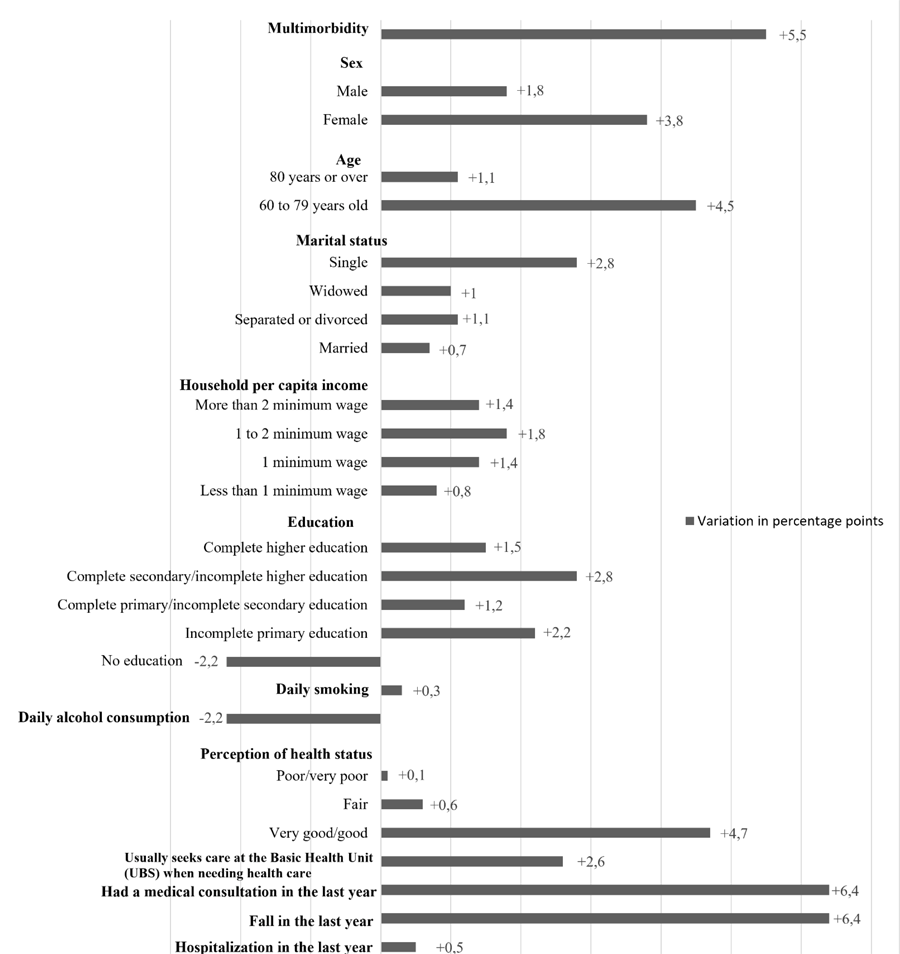
The magnitude of the differences in multimorbidity can be interpreted from the absolute variation shown in Figure 1. The sociodemographic, behavioral, and health variables among older adults with multimorbidity showed a percentage increase between the years analyzed, with particular emphasis on having consulted a doctor and having decreased in the last year (6.4 pp), on the increase in registration at the Family Health Unit (5.8 pp), and on the improvement in health perception (4.7 pp). Only the variables of lack of schooling and daily alcohol consumption showed a decrease (-2.2 pp) (Figure 1).

Variation, in percentage points, of multimorbidity between the years 2013 and 2019 according to sociodemographic, behavioral and health characteristics. National Health Survey, Brazil, 2013 and 2019.
Table 3 presents the distribution of multimorbidity in Brazilian elderly individuals, considering the proportionality for each sex in each year analyzed. A higher prevalence of multimorbidity was observed, with a statistically significant difference, according to sex among elderly individuals with multimorbidity in both years, proportionally. A statistically significant difference was evidenced according to male sex in daily alcohol and tobacco consumption and hospital admissions, in both years, and according to female sex in age 60 to 79 years, lower income, and falls, in 2019. The variables perception of health status, usually seeks care, and is registered at the primary health care unit did not show a significant difference according to sex in any year.
The distribution of multimorbidity stratified by age groups is presented in Table 4. Marital status (married), alcohol and tobacco consumption, and lower income showed a statistically significant difference compared to the younger age group. Incomplete primary education showed a difference in the younger elderly group in 2013, and in the older group in 2019. Among the older group, a statistically significant difference was observed with marital status (widowed), white race, consultation with a doctor in the last year, and falls, in both years, and with hospital admission in 2019. The variables perception of health status, having consulted a doctor in the last year, and being registered at the Family Health Unit (USF) did not show a statistically significant difference in either year.
DISCUSSION
This study revealed a high prevalence of multimorbidity among elderly Brazilians, with an increase between 2013 and 2019, as well as statistically significant differences in distribution according to sex and age groups. The increase corresponded to 5.5 percentage points, indicating a consistent growth in the burden of multimorbidity during the period. These findings reinforce the magnitude of multimorbidity as a growing challenge in the context of the aging Brazilian population and indicate the need for continuous monitoring at the national level. Because these are representative data of the Brazilian elderly population, the results offer relevant support for care planning and for advancing knowledge in the field.
The predominance of females corroborates the phenomenon of the feminization of aging and the consequent prevalence of multimorbidity among women(1,11-12). In Brazil, life expectancy at birth for men is 72 years, and for women it is 79 years(13). Globally, it is 74.7 years for women and 69.9 years for men(14). Although the proportion of young elderly people has been higher than that of older elderly people, Brazil shows accelerated growth in the population aged 80 or over, making national research that considers age groups relevant for the proper planning of public health actions aimed at this population(10). Life expectancy at age 60, in 2024, was 20.8 years for men and 24.2 years for women, while at age 80 it is 8.3 and 9.5 years, respectively(13).
A considerable percentage of elderly people were identified who received less than one minimum wage in 2013 and one to two minimum wages in 2019, which may reflect the reduction in the percentage of elderly people without education and the increase in the percentages with higher levels of education. These results highlight the socioeconomic problems of elderly Brazilians, which can influence the health conditions of this population (12).
An increase was observed in the proportion of elderly people who had a medical consultation in the last year, were registered and usually sought the UBS when they needed health care, between 2013 and 2019. The capillarity of the actions and interventions of the PHC model, based on the Family Health Strategy, is important for registered and monitored users in all regions of Brazil, especially among the elderly population with NCDs, who use the services of the Unified Health System (SUS) more frequently(15).
The high prevalence of multimorbidity in elderly Brazilians in both years analyzed corroborates other studies that show a high global prevalence, with percentages above 50%, especially in low- and middle-income countries(5-6). The increase in multimorbidity observed in this study can be partially explained by population aging and epidemiological transition resulting in an increase in NCDs in the elderly, which may reflect an increase in acute conditions and mortality and, consequently, an impact on quality of life and costs for health services(16).
Among older adults with multimorbidity, the difference between women and men exceeded 15 pp in 2019, highlighting significant and persistent inequality in the distribution of the condition. National(17-18)and international(19-20)studies have found a significant association between female sex and multimorbidity.
This difference can be explained by the higher proportion of elderly women and related to the greater demand for health services, resulting in a greater opportunity for diagnoses. The feminization of aging highlights the importance of recognizing the specific demands of elderly women, not only as a numerically significant segment, but also due to the possible nuances in the health conditions they face(1). For the Brazilian population, the literature shows that at age 60, more than half (53.6%) of life expectancy is with multimorbidity, with women living with this for longer, considering their higher life expectancy(8. Thus, sex plays a determining role in the aging process, directly relating to health conditions(11).
Corroborating these findings, a population-based study representative of Iran, with 49,946 participants aged between 40 and 75 years, found that women had a prevalence of multimorbidity of 25%, while men had a prevalence of 13.4%. In order to control multimorbidity, especially in women, the authors recommend the use of educational and health promotion methods to increase awareness of modifiable risk factors, such as smoking (20).
In this study, daily tobacco and alcohol use showed a statistically significant difference when associated with male sex and younger age group in older adults with multimorbidity. A study that assessed the association between lifestyle factors and multimorbidity stratified by sex in older adults showed that among men, smoking is associated with a higher chance of this condition(21).
A statistically significant difference was observed in the distribution of multimorbidity according to marital status, which differs from another national cross-sectional study conducted with 384 elderly individuals in Paraíba, which did not find a significant association with marital status(18). Corroborating this study, while widowhood was associated with the older age group in elderly individuals with multimorbidity, a longitudinal study with 4,187 Americans over 60 years of age found that spousal loss is common among older elderly individuals and is linked to NCDs(22). It is possible that married elderly individuals survive longer, and that widows and widowers may also be among the oldest. These factors, combined with physiological aging, may result in a greater likelihood of NCD accumulation (22).
Lower per capita household income and lower education levels showed a statistically significant difference with multimorbidity in 2019, with lower income also showing significance for females and younger age groups in 2019. Corroborating these findings, another study with Brazilian elderly indicates that multimorbidity is more prevalent in elderly people with lower socioeconomic positions, indicating an association between socioeconomic status and health outcomes(7). Social inequality in access to health services in Brazil may contribute to this scenario(7, 19).
In this study, incomplete primary education showed a significant distribution associated with males in 2013 and females in 2019, in older adults with multimorbidity. In contrast to these findings, the associations between education and multimorbidity differed between sexes in a population-based household survey conducted with Brazilian adults aged 18 years or older(6). In men, multimorbidity was inversely associated with completed primary education and completed secondary education, while in women no significant difference was observed between these variables(6). The same survey identified that the prevalence rates of multimorbidity also increased substantially with age(6).
Negative self-perception of health was related to the presence of multimorbidity in older adults in both years, although it did not show statistical significance with sex and age groups. The literature indicates that this association can be understood because older adults with multimorbidity may present poorer quality of life, in addition to difficulty with self-care and increased dependence for activities of daily living(17).
Falls were shown to be related to multimorbidity, corroborating a national study with community-dwelling older adults(17). In this study, a 6.5 pp increase in falls was evidenced, in addition to a statistically significant difference according to sex and age groups, with an 8.8 pp increase among the younger age group and 7.8 pp among women, configuring variations of high magnitude. NCDs can contribute to this scenario through functional disability and medication use(17).
A statistically significant difference was found between females and the younger age group in 2019. Other studies have identified an association between age and multimorbidity, since most individuals over 60 years of age have multiple diseases(19, 23). In addition, along with advancing age, older adults experience an increase in the number and complexity of morbidities(24). In the present study, approximately 86% of multimorbidity cases were concentrated in the 60-79 age group, a difference of more than 70 pp compared to those ≥80 years, highlighting a marked concentration in this age range.
In this regard, it is important to consider age groups in health policies and practices, since the adequate provision of health care to younger elderly people may extend their life expectancy free from disabilities. Similarly, public policies to support the elderly, both younger and older, even with moderate levels of dependency, may prolong their period of life with autonomy(12).
A household-based study conducted with 118 elderly people from a municipality in Minas Gerais identified that the most significant characteristics in the progression from “young” to “old” elderly were the increased chance of presenting NCDs and difficulty in activities of daily living. Thus, the analysis of the health conditions of elderly people across age groups may be related to the increased prevalence of NCDs and to factors that compromise functional capacity(25).
Consulting a doctor showed a significant distribution related to multimorbidity in older adults, with a 6 pp increase between 2013 and 2019, consistent with a study that points to greater use of health services by this population(26). This variable was associated with male sex in 2013 and female sex in 2019 and older age group in both years. This finding reinforces the need to reorganize care for NCDs, strengthening primary health care and coordination in the health care network, focusing on continuity of care and comprehensive assistance(27).
An increase was observed among elderly people with multimorbidity who usually seek primary health care, corroborating a study that evaluated trends in access to and use of health services in primary health care among elderly people in Brazil(28), which may be explained by the increase in public health services and socioeconomic inequalities, with fewer elderly people having supplementary health insurance, using the SUS exclusively(29). In this study, it was observed that seeking primary health care was more common in the younger elderly age group, contrasting with a Brazilian study that showed that the use of health services was higher among older elderly people(31). It is necessary to strengthen health professionals, especially nurses, in primary health care for the multidimensional assessment of the elderly, monitoring of NCDs and identification of individual priorities, aiming at improving the coordination of health services(30).
The limitations of this study relate to previously collected publicly available data, over which there is no control over how the variables were collected. The limited number of NCDs considered and the self-reporting related to memory bias may have impacted the prevalence of multimorbidity. It should be considered that different individuals were included in each edition of the PNS, limiting some comparative aspects. The analyses performed were bivariate, which limits the interpretation regarding the independence of the observed differences.
Furthermore, the number of comparisons performed in the study may increase the probability of type I error, that is, the identification of statistically significant differences by chance, especially when the p-values approach the adopted threshold. Therefore, the results should be analyzed with caution, being understood as differences in the distribution between the investigated groups, and not as evidence of causal relationships. On the other hand, the use of a nationally representative database, with complex probabilistic sampling conducted by the IBGE, stands out as a strength, which enhances the external validity of the findings for the Brazilian elderly population.
Future research is suggested that addresses this topic in a longitudinal and multidimensional way to provide specific information about healthcare for these elderly individuals, with an emphasis on follow-up in primary health care, as well as to determine risk factors for multimorbidity, aiming to ensure comprehensive care and promote healthy aging.
CONCLUSION
The results of this study highlighted important differences in the distribution of multimorbidity according to sex and age groups among elderly Brazilians, providing support to health professionals, especially nurses and managers, for planning actions aimed at the comprehensive care of this population. A high prevalence of multimorbidity was observed, increasing from 51.2% in 2013 to 56.7% in 2019, with a greater increase among women, the younger age group, those who had a consultation and reported falls in the last year, those registered at the Family Health Unit (USF), and those with a perception of very good/good health.
The distribution of multimorbidity occurred more frequently among females, married individuals, those with a perception of regular health status, those with daily tobacco use, and those with hospitalizations, falls, and medical consultations in the last year. It was evident that while males showed a higher proportion of daily alcohol and tobacco consumption and hospitalizations in both years, females showed higher prevalence in the 60-79 age group, those with lower income, and those with falls in 2019. Younger elderly individuals presented a higher proportion of married individuals, those with daily alcohol and tobacco consumption, and those with lower income, while among older individuals, widowhood, white ethnicity, medical consultations, and falls stood out in both years.
Recognizing differences in the distribution of health conditions between men and women and between young and older adults is relevant to promoting healthy and equitable aging, avoiding generalizations in the organization of care. Effective strategies for the prevention and control of multimorbidity are urgently needed, with particular emphasis on the inclusion of nursing in the comprehensiveness of health care.
Within the field of nursing, the findings support the improvement of care in primary health care by highlighting the high prevalence of multimorbidity and its unique distribution according to sex and age groups. These results can guide the organization of the care schedule and the longitudinal follow-up of elderly individuals with greater vulnerability, as well as provide a basis for interventions such as systematic multidimensional assessment, polypharmacy management, fall prevention, and health education actions focused on self-care. Thus, the results contribute to improving care coordination and strengthening the nurse’s role in the comprehensive healthcare of the elderly.
Given the identified sociodemographic characteristics and health conditions, a challenging epidemiological scenario emerges at the national level, reinforcing the importance of expanding public investments aimed at promoting healthy aging, which is a challenge for the Brazilian Unified Health System (SUS).
REFERENCES
-
1 Cepellos VM. Feminização do envelhecimento: um fenômeno multifacetado muito além dos números. RAE. 2021;61(2). https://doi.org/10.1590/s0034-759020210208
» https://doi.org/10.1590/s0034-759020210208 -
2 Alves CCP, Costa VV, Costa CO, Santos BL, Barbosa-Júnior F, Meiners MMMA et al. Multimorbidity in the elderly of an educational program in Brazilian capital: a cross-sectional study. Medicine. 2024;103:e40493. https://doi.org/10.1097/md.0000000000040493
» https://doi.org/10.1097/md.0000000000040493 -
3 Martins TCDF, Silva JHCMD, Máximo GDC, Guimarães RM. Transição da morbimortalidade no Brasil: um desafio aos 30 anos de SUS. Ciênc Saúde Coletiva. 2021;26:4483-96. https://doi.org/10.1590/1413-812320212610.10852021
» https://doi.org/10.1590/1413-812320212610.10852021 -
4 Skou ST, Mair FS, Fortin M, Guthrie B, Nunes BP, Miranda JJ, et al. Multimorbidity. Nature Rev Dis Prim. 2022;8(1):48. https://doi.org/10.1038/s41572-022-00376-4
» https://doi.org/10.1038/s41572-022-00376-4 -
5 Zhu X, Wang Z, Yang X, Ning Z. About half of older adults have two or more chronic conditions at the same time: a systematic review and meta-analysis. Front Public Health. 2025;13:1680745. https://doi.org/10.3389/fpubh.2025.1680745
» https://doi.org/10.3389/fpubh.2025.1680745 -
6 Pereira CC, Pedroso CF, Batista SRR, Guimarães RA. Prevalence and factors associated with multimorbidity in adults in Brazil, according to sex: a population-based cross-sectional survey. Front Public Health. 2023;11:1193428. https://doi.org/10.3389/fpubh.2023.1193428
» https://doi.org/10.3389/fpubh.2023.1193428 -
7 Bof FA, Thumé E, Facchini LA, Torres JL, Nunes BP. Education and income-related inequalities in multimorbidity among older Brazilian adults. PLOS ONE. 2022;17(10):e0275985. https://doi.org/10.1371/journal.pone.0275985
» https://doi.org/10.1371/journal.pone.0275985 -
8 Guimarães RM, Andrade FCD. Expectativa de vida com e sem multimorbidade entre idosos brasileiros: pesquisa nacional de saúde 2013. Rev Bras Estud Popul. 2020;37:e0117. https://doi.org/10.20947/S0102-3098a0117
» https://doi.org/10.20947/S0102-3098a0117 - 9 Freitas EV, Py L. Tratado de geriatria e gerontologia. 4 ed. Rio de Janeiro: Guanabara Koogan, 2017.
-
10 Damor N, Makwana N, Kagathara N, Yogesh M, Damor RD, Murmu AA. Prevalence and predictors of multimorbidity in older adults, a community-based cross-sectional study. J Fam Med Prim Care. 2024;13:2676-82. https://doi.org/10.4103/jfmpc.jfmpc_1856_23
» https://doi.org/10.4103/jfmpc.jfmpc_1856_23 -
11 Lim A, Benjasirisan C, Tebay J, Himmelfarb CD, Davidson PM, Koirala B. Gender differences in disease burden and quality-of-life trajectories among older adults living with multimorbidity. Innovat Aging. 2024;8:978. https://doi.org/10.1093/geroni/igae098.3150
» https://doi.org/10.1093/geroni/igae098.3150 -
12 Chaimowicz F, Chaimowicz GF. O envelhecimento populacional brasileiro. Pista [Internet]. 2022[cited 2025 Dec 30];4(2):6-26. Available from: https://periodicos.pucminas.br/pista/article/view/29830
» https://periodicos.pucminas.br/pista/article/view/29830 -
13 Instituto Brasileiro de Geografia e Estatística (IBGE). Tábuas completas de mortalidade para o Brasil: 2024 [Internet]. Rio de Janeiro: IBGE; 2025[cited 2025 Dec 30]. Available from: https://www.ibge.gov.br/estatisticas/sociais/populacao/9126-tabuas-completas-de-mortalidade.html
» https://www.ibge.gov.br/estatisticas/sociais/populacao/9126-tabuas-completas-de-mortalidade.html -
14 United Nations (UN). World population ageing 2019 [Internet]. 2019[cited 2022 Dec 26]. Available from: https://digitallibrary.un.org/record/3907988/files/WorldPopulationAgeing2019-Report.pdf
» https://digitallibrary.un.org/record/3907988/files/WorldPopulationAgeing2019-Report.pdf -
15 Pinto LF, Quesada LA, D'Avila OP, Hauser L, Gonçalves MR, Harzheim E. Primary Care Asssement Tool: diferenças regionais a partir da Pesquisa Nacional de Saúde do Instituto Brasileiro de Geografia e Estatística. Ciên Saúde Coletiva. 2021;26(9):3965-79. https://doi.org/10.1590/1413-81232021269.10112021
» https://doi.org/10.1590/1413-81232021269.10112021 -
16 Xi J, Li PWC, Yu DSF. Multimorbidity: the need for a consensus on its operational definition. J Adv Nurs. 2024;80(12):4755-7. https://doi.org/https://doi.org/10.1111/jan.16292
» https://doi.org/https://doi.org/10.1111/jan.16292 -
17 Gusmão MSF, Cunha PO, Santos BG, Costa FM, Caldeira AP, Carneiro JA. Multimorbidade em idosos comunitários: prevalência e fatores associados. Rev Bras Geriatr Gerontol [Internet]. 2022[cited 2022 Dec 26];25(1):e220115. Available from: https://www.scielo.br/j/rbgg/a/XvWpGV35MqHNG7sbKd8BVGG/?lang=pt
» https://www.scielo.br/j/rbgg/a/XvWpGV35MqHNG7sbKd8BVGG/?lang=pt -
18 Alexandrino A, Oliveira CBS, Gomes SM, Nogueira MF, Mendes TCO, Lima KC. Prevalência e fatores associados à multimorbidade em pessoas idosas residentes na zona rural de um município do Nordeste brasileiro. Rev Bras Geriatr Gerontol. 2023;26:e230105. https://doi.org/10.1590/1981-22562023026.230105.pt
» https://doi.org/10.1590/1981-22562023026.230105.pt -
19 Sharma P, Maurya P. Gender differences in the Prevalence and Pattern of Disease Combination of Chronic Multimorbidity among Indian Elderly. Ageing Int. 2021;1-19. https://doi.org/10.1007/S12126-021-09419-9
» https://doi.org/10.1007/S12126-021-09419-9 -
20 Hu X, Li S, Wei Z, Wu D, Meng L, Li J, et al. Prevalence and pattern of multimorbidity in China: a cross-sectional study of 224,142 adults over 60 years old. Front Public Health. 2024;12. https://doi.org/10.3389/fpubh.2024.1349418
» https://doi.org/10.3389/fpubh.2024.1349418 -
21 Almeida MGN, Nascimento-Souza MA, Lima-Costa MF, Peixoto SV. Lifestyle factors and multimorbidity among older adults (ELSI-Brazil). Eur J Ageing. 2020;17(4):521-9. https://doi.org/10.1007/s10433-020-00560-z
» https://doi.org/10.1007/s10433-020-00560-z -
22 Karakida M, Song Q, Stokes J, Leveille S, Dugan B. Multimorbidity and its association of widowhood, race, and ethnicity in older adults. Innovat Aging. 2022;1:504-5. https://doi.org/10.1093/geroni/igac059.1934
» https://doi.org/10.1093/geroni/igac059.1934 -
23 Pillai RS, Paul NSS, Davis GD, Dev SS. Prevalence of Multimorbidity and Associated Sociodemographic Factors among Elderly Population in a Rural Area in South Kerala. Indian J Pain. 2023;37:45-S49. https://doi.org/10.4103/ijpn.ijpn_56_23
» https://doi.org/10.4103/ijpn.ijpn_56_23 -
24 Reis CB, Jesus RS, Silva CSO, Pinho LD. Condições de saúde de idosos jovens e velhos. Rev Rene. 2016;17:120-7. https://doi.org/10.15253/2175-6783.2016000100016
» https://doi.org/10.15253/2175-6783.2016000100016 -
25 Bordin D, Michalski J, Barbosa JLI, Bordin R, Bernartt MDL, Lima ML. Multimorbity in brazilian elderly and the relationship with the use of health services. Saglik Akademisi Kastamonu. 2023;8(1):102-113. https://doi.org/https://doi.org/10.25279/sak.1088575
» https://doi.org/https://doi.org/10.25279/sak.1088575 -
26 Chaparro-Díaz L, Valbuena-Castiblanco CL, Carreño-Moreno S, Hernández-Zambrano SM, Carrillo-Algarra AJ. Case management as an opportunity for healthcare: user experiences. Rev Cuidarte. 2023;14(3). https://doi.org/10.15649/cuidarte.2923
» https://doi.org/10.15649/cuidarte.2923 -
27 Cesário VAC, Santos MM, Mendes TCO, Souza Júnior PRB, Lima KC. Tendências de acesso e utilização dos serviços de saúde na APS entre idosos no Brasil nos anos 2008, 2013 e 2019. Ciên Saúde Coletiva. 2021;26(9):4033-44. https://doi.org/10.1590/1413-81232021269.08962021
» https://doi.org/10.1590/1413-81232021269.08962021 -
28 Malta DC, Bernal RTI, Lima MG, Silva AG, Szwarcwald CL, Barros MBA. Desigualdades socioeconômicas relacionadas às doenças crônicas não transmissíveis e limitações: pesquisa nacional de saúde, 2019. Rev Bras Epidemiol. 2021;24(2):e210011. https://doi.org/10.1590/1980-549720210011.supl.2
» https://doi.org/10.1590/1980-549720210011.supl.2 -
29 Francisco PMSB, Assumpção D, Bacurau AGM, Silva DSM, Malta DC, Borim FSA. Multimorbidade e uso de serviços de saúde em idosos muito idosos no Brasil. Rev Bras Epidemiol. 2021;24(2):e210014. https://doi.org/10.1590/1980-549720210014.supl.2
» https://doi.org/10.1590/1980-549720210014.supl.2 -
30 Lütz KCC, Bierhals CCBK, Rosset I, Paskulin LMG. Utilização dos serviços públicos de saúde especializados por pessoas idosas no sul do Brasil. Rev Bras Geriatr Gerontol. 2022;25(1). https://doi.org/10.1590/1981-22562022025.220183.pt
» https://doi.org/10.1590/1981-22562022025.220183.pt