 Teachers' perceptions regarding the implementation of an educational first aid booklet in schools
ABSTRACT:
Objective: To understand the perceptions of preschool and elementary school teachers regarding the application of an educational first aid booklet in schools.
Methods: A qualitative, exploratory-descriptive study was conducted in 14 preschool and elementary schools in the municipality of União dos Palmares, Alagoas, Brazil. The study participants were preschool and elementary school teachers. Data collection took place in November 2024, and focus groups were used as the data source. Data was systematized using the IRaMuTeQ® software and analyzed via Descending Hierarchical Classification.
Results: Three classes were found: Educational moment (relevance given by teachers to first aid actions in the context of school health); Booklet content (relevance of the booklet's content compared to actions performed due to popular knowledge); Reading time (evidenced as good, although the need for a more detailed exploration was highlighted).
Final considerations: The study showed that teachers considered the first aid booklet to be a useful resource for expanding their knowledge and guiding conduct in school emergencies, although they pointed out the need for more time for reading and continuous training.
Descriptors:
Perception; Educational action; First aid; Teachers
RESUMO:
Objetivo: Conhecer as percepções de professores do ensino infantil pré-escolar e do fundamental I sobre a aplicação de uma cartilha educativa de primeiros socorros na escola.
Métodos: Estudo exploratório-descritivo, de abordagem qualitativa, realizado em 14 escolas do ensino infantil pré-escolar e do ensino fundamental I do município de União dos Palmares, Alagoas, Brasil. Os participantes foram professores destes níveis de ensino. A coleta ocorreu em novembro de 2024, utilizando-se o grupo focal como fonte de dados. Os dados foram sistematizados com o software IRaMuTeQ® e analisados a partir da Classificação Hierárquica Descendente.
Resultados: Foram obtidas três classes: Momento educativo (relevância dada pelos professores às ações de primeiros socorros no contexto da saúde escolar); Conteúdo da cartilha (pertinência dos conteúdos da cartilha educativa em contraponto às ações realizadas por meio do conhecimento popular); e Tempo de leitura (evidenciado como adequado, porém com o destaque para a importância de um detalhamento).
Considerações finais: O estudo evidenciou que os professores consideraram a cartilha de primeiros socorros um recurso útil para ampliar seus conhecimentos e orientar condutas em emergências escolares, embora tenham apontado a necessidade de capacitação contínua e de mais tempo para leitura.
Descritores:
Percepção; Ação educativa; Primeiros socorros; Professores
RESUMEN:
Objetivo: Comprender las percepciones de los docentes de educación infantil y primaria sobre la aplicación de un folleto educativo de primeros auxilios en las escuelas.
Métodos: Se realizó un estudio cualitativo, exploratorio-descriptivo en 14 escuelas de educación infantil y primaria del municipio de União dos Palmares, Alagoas, Brasil. Los participantes fueron docentes de educación infantil y primaria. La recolección de datos se llevó a cabo en noviembre de 2024, utilizando grupos focales como fuente de información. Los datos se sistematizaron con el software IRaMuTeQ® y se analizaron mediante Clasificación Jerárquica Descendente.
Resultados: Se obtuvieron tres categorías: Momento educativo (relevancia otorgada por los docentes a las acciones de primeros auxilios en el contexto de la salud escolar); Contenido del folleto (relevancia del contenido del folleto en comparación con las acciones realizadas a través del conocimiento popular); Tiempo de lectura (considerado bueno, pero destacando la importancia y la necesidad de mayor detalle).
Consideraciones finales: El estudio mostró que los profesores consideraban el folleto de primeros auxilios un recurso útil para ampliar sus conocimientos y orientar la actuación en emergencias escolares, aunque señalaron la necesidad de más tiempo para la lectura y la formación continua.
Descriptores:
Percepción; Acción educativa; Primeros auxilios; Docentes
INTRODUCTION
Educational booklets are efficient tools to promote health, as they provide direct, practical, and accessible access to information, helping readers understand and assimilate content. This illustrative resource allows interacting with the information presented in different ways, helping to understand guidance and relevant strategies1.
The booklet "First-Aid at School: Guidance for Preschool and Elementary Teachers" was developed with the active participation of teachers from these levels of education, being validated by specialists and the target audience. The materials were elaborated by an MS student from the Post-Graduation Nursing Program at the Universidade Federal de Pernambuco (UFPE) in 2016, reaching a Content Validity Index (CVI) of 0.96 and an Index of Agreement on Appearance (IAA) of 1.0, as its text and content were considered to be understandable by the teachers2.
The school environment is recognized as an essential space for the intellectual, emotional, and social development of individuals, promoting their learning and favoring their integration into society. However, this environment also presents potential risks of accidents3.
According to the World Health Organization (WHO), accidents are unexpected events that may take place in several different contexts, including in schools, leading to physical and emotional injuries of different natures and severities and causing suffering not only to the victim, but also to their families and communities4.
The most common accidents in schools include loss of consciousness, asphyxia, convulsive crises, electric shock, wounds, fractures, and epistaxis. Children spend nearly one-third of their day in school, being exposed to potentially dangerous situations, such as recreational spaces, sports fields, ladders, and educational environments, which increases their vulnerability to accidents5.
Currently, these occurrences have high levels of child morbimortality, being a major public health concern. In the United States, 3.7 million children are estimated to suffer school accidents every year. In Brazil, accidents are among the main causes of children's mortality, being responsible for nearly 4.7 thousand deaths and 125 thousand hospitalizations each year5.
Despite the efforts to ensure a safe environment, emergencies that require immediate care are still common in schools. Thus, institutions are responsible for ensuring that children are protected, adopting preventive measures and effective protocols of action when dealing with complications6.
First aid is the immediate care provided to people affected by acute conditions, be it due to sudden disease or trauma. Its goal is stabilizing the victim, minimizing complications, and preserving vital function until specialized care arrives, performing an essential role in damage reduction and the prevention of secondary consequences7.
Since it is based on simple procedures, first aid can be provided by anyone capable of recognizing risky situations fast and taking appropriate decisions to preserve life until health workers arrive8.
Federal Law No. 13.722, from October 4, 2018, known as Lucas Law, made mandatory annual training in first aid for teachers and other workers of public and private basic health institutions. Furthermore, these institutions are required to keep first aid kits at hand, in compliance with directives from entities that specialize in emergency care9.
The school environment is a strategic space for the implementation of first aid educational activities, within the directives of the Single Health System (SUS). Thus, integrating education and health allows creating continuous training programs for the school community, in line with public policies to promote health and prevent health issues10.
Investing in the professional qualification and structuring of first aid protocols not only improves school health but also consolidates a culture of prevention and efficient responses to emergencies, within the educational environment and without11. A pedagogical approach aimed at teaching first aid must favor practical and participative methods that can ensure effective learning and the proper management of stress in emergency situations5.
From this perspective, educational technologies are innovative strategies based on scientific evidence, playing an essential role in the teaching-learning process. Their use has significantly improved knowledge and helped develop safe attitudes when faced with incidents in school12.
The active participation of health workers is essential to create, validate, and disseminate educational technologies, using diversified educational resources, such as programs, print-outs, and multimedia tools13.
In this context, the knowledge and perception of professors about first aid is determinant to optimize the first response and the clinical evolution of victims, since they are often the first ones present when there are accidents in the school environment7. Nonetheless, many teachers still feel unprepared to deal with these situations, especially due to their lack of specific training. They often resort to empirical practices or popular beliefs, which can be harmful9.
As a result, this study aims to uncover the perception of preschool and elementary school teachers about the application of an educational booklet about first aid at school.
METHOD
Type of study
Exploratory, descriptive, and qualitative study. This type of study is recommended to investigate a phenomenon, opinion, or the perception of a specific group14. The research followed the directives of the COREQ (Consolidated Criteria for Reporting Qualitative Research)15.
Place of research
The research was developed in 14 schools in the urban area of União dos Palmares, a city in the state of Alagoas, Brazil, and included pre-school and elementary school. These schools receive students from 4 to 5 years old for preschool and from 6 to 10 for elementary education.
Population and sample
The study included preschool and elementary school teachers. Data sources included a focus group, which should include from six to ten people16. According to the data provided by the Municipal Secretariat of Education, the 14 schools had 298 preschool and elementary school education professionals. Researchers received a list of 40 teachers from them, which could be invited to participate in the research.
Considering inclusion and exclusion criteria, all 40 teachers, from the 14 schools, were addressed in person and invited to participate in the study. 16 of them accepted the invitation. The sample was non-probabilistic, by convenience, and formed by professors who showed interest in participating.
Only 16 participants were included in the final selection because 8 were already trained in first aid (exclusion criteria). Six of them stated they did not have the time. The 10 others did not explain their refusal to participate.
Participants were distributed in three focal groups: two of them had five members, and one, six. Focal group sessions took place in meeting rooms in the Municipal Secretariat of Education, at different times. Each session lasted for 60 minutes.
Eligibility criteria
Inclusion criteria were: being a preschool or elementary school teacher, and having more than three months of experience as a teacher. Exclusion criteria included: being on leave due to vacations or any other reason during the intervention; being a health worker, firefighter, first-aider, or from any other profession that meant they had previous training in providing first aid.
Data collection strategy
Collection took place in November 2024, in a meeting room in the Municipal Education Secretariat, which was reserved to conduct the focus groups. The procedure began with self-presentation. Then, participants signed the Consent Form and filled in the sociodemographic and professional characteristics questionnaire.
After that, we distributed a printed version of the educational booklet "First-Aid at School: Guidance for Preschool and Elementary Teachers". The booklet is self-explanatory and addresses the following topics: hits and fractures, cuts and hemorrhage, amputation, burns, tooth accidents, convulsive crises, bites from poisonous animals, faints, cardiac arrest, obstruction of airways by foreign bodies, and drowning2.
30 minutes were provided for individual reading. Afterwards, the following questions were used to trigger group discussions: How do you evaluate this moment? Is the content in the booklet pertinent? Is the reading time sufficient?
Discussions were recorded in a portable recorder and later transcribed into Microsoft Word®. Each focus group lasted for 60 minutes and counted on the participation of the main researcher and of two nurses who aided this research, and made relevant observations and notes.
Data analysis
Data was systematized through the use of the software IRaMuTeQ® (Interface de R pour les Analyses Multidimensionnelles de Textes et de Questionnaires), which works based on the software R. This software separates the written content into segments of approximately three lines, depending on the size of the text. This makes it possible to perform analyses that vary from the use of simple methods, such as finding word frequency (basic lexicography), to more complex ones, such as multivariate analyses16.
In this study, a multivariate analysis was conducted using the method of Descending Hierarchical Classification (DHC). This method involves grouping text segments in classes, according to their frequency, and the application of a chi-squared test on the vocabulary. In this grouping, the segments of a certain class have a similar vocabulary, which is different from the segments of other classes.
The DHC is presented by the software in the form of a dendrogram, showing the relationship between the classes found in the text analysis16. The text corpus that resulted from the transcription was considered to be compatible and viable for analysis by IRaMuTeQ®. It contained 934 words and 346 text segments, with 59.54% of segments being used for processing by the software. The grouping led to the formation of three classes: educational moment; booklet content; and time of reading.
Ethical aspects
Ethical precepts established by Resolutions No. 466/2012 and 510/2016, from the National Council of Health, were rigorously followed. Participants that agreed to participate signed an informed consent. The anonymity of participants was ensured by using the letter T, for Teacher, followed by their numbers as participants int the focus groups.
The research project was approved by the Research Ethics Committee at the Universidade Federal de Pernambuco, under CAAE No. 77877724.0.0000.5208 and opinion No. 6.922.140.
RESULTS
The study included 16 participants. 12 (75.0%) were female, 14 (87.5%) brown, and 3 (18.8%) single. Most of them had complete higher education (55.6%). Most of them had an income of up to a minimum-wage (61.9%), owned their houses (76.2%), and had access to the sewage drainage network (93.7%). Their mean age was 39.4 (±10.9), and they had graduated for 9.1(±7.2) years.
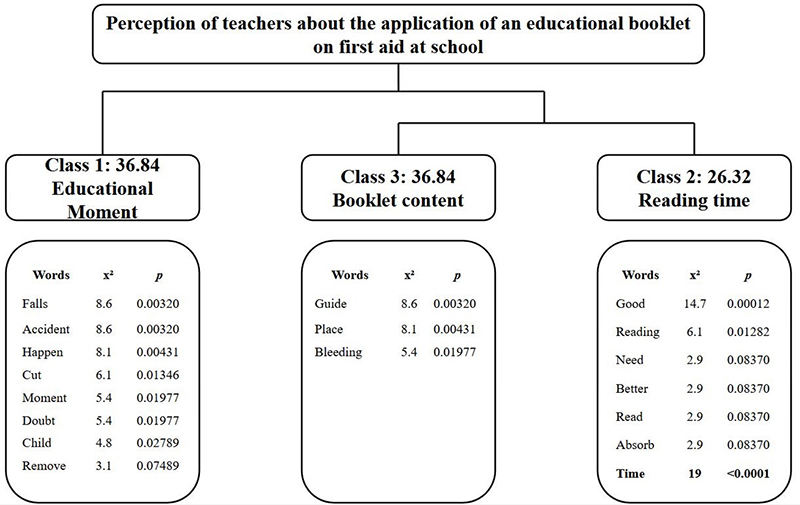
IRaMuTeQ® divided the text into 346 segments, grouping them in three classes, according to the dendrogram below (Figure 1).
Dendrogram of the words, distributed into classes. União dos Palmares, Alagoas, Brazil, 2025.
In Class 1 (Educational moment), teachers were found to consider the booklet about first aid in school to be relevant, and that, since moments such as these are not a common part of their daily lives, they could take place more often.
This moment was really important, especially because we work with children and adolescents who are exposed to the risks of accidents. (T1)
[...]extremely important, acquiring knowledge in the event of any accident situation with our students. It cleared some doubts about myths and truths about how to help our children. (T3)
The feelings of teachers when evaluating their moment with the educational booklet resulted mainly from their individual experiences with children in the school environment, as they have witnessed cases of falls and accidents that they were unable to handle properly.
We deal with children on a daily basis, there are always accidents, a fall, a cut, so this moment was very rich. (T5)
We learned a lot of important things, but we don't know how to put them into practice because it takes a course, a moment like this to give us support, so we know how to act and, especially, how to remain calm. (T10)
Class 3 (Booklet content) presents the perceptions of educational professionals regarding the relevance of the topic of first aid, as presented in the booklet. The statements show that professors are aware that they provide first aid inappropriately.
It's a very valid content, students fall, get cut, so I go there and wash with my hand, I get it wet, I put pressure with my hand without wearing a glove [...] The booklet indicates using a plastic bag, in case there is no glove. (T12)
Despite being unprepared, the teachers showed, through their statements, that based on knowledge from popular belief, they performed first aid actions before sending the child to a specialized service.
The booklet has a lot of important information about bleeding. I didn't know that I didn't need to remove the cloth from it and put another one, that I could go ahead with the one that was already there. (T15)
It caught my attention that when the wound is soaked with blood you should not remove it and put another, clean and dry one, that you should keep the one that was already in position. (T6)
Regarding nosebleed, the booklet says we should lower our heads, and we always asked the children to get up so as not to bleed. (T13)
Teachers reported accidents in the learning environments, during classroom teaching, as well as in recreational interactions, with children being hit on the head, nose, and upper and lower limbs with blows, in addition to falls, all leading to edemas, loss of consciousness, bleeding, and fractures, which highlights the need for training to properly intervene in these situations.
According to Class 2 (Reading time), although they considered the time spent reading the educational materials to be pertinent, they reiterated that it was necessary to better prepare the teachers, seeing as, despite the fact that the booklet was easy to understand, a longer time would be needed for closer reading.
Since this was a very didactic booklet, I think the time was enough for me, but if I could read it more slowly I would absorb it better. (T16)
The booklet is easy to understand, the time for reading it was good. I wish I had more time to read it and understand more thoroughly. (T4)
In such a short term reading it is difficult to get that good a sense, I would need to have more time so we could get a better hold of the subject. (T8)
The time was good, it prepared the teachers about first aid. I would like to have more time, so I can absorb it better, but it was really good, although in spite of being easy to understand the time was fast. (T9)
DISCUSSION
The findings of this study showed that professors considered the educational moment spent with the first aid booklet to be very relevant, highlighting the importance of initiatives such as this, seeing as this type of knowledge is not a part of their professional routine. Teachers reported they have witnessed accidents involving their students, in which they felt unprepared to respond properly.
The booklet helped clarify myths, present proper conducts, and reiterate the need to stay calm when dealing with emergencies with children in the school environment. Despite the accessible language and practical content, teachers expressed the desire to have more time to read the material and understand it better, recognizing the importance of continuous training, considering how often accidents take place in the school environment.
Historically, schools have had a strategic role in the promotion of practices and experiences related to health. These institutions contribute to reflecting on the factors that affect health and disease conditions and to analyzing these factors, guiding efforts to control and prevent situations of risk and health issues17.
A previous study showed that these spaces are effective for the significant learning of first aid by teachers through educational interventions, considering that this environment is susceptible to the occurrence of accidents, and that teachers are often the first to get in touch with children who suffer accidents18.
The target audience was found to understand the relevance of promoting health education practices, as associated with first aid, in new encounters. This finding corroborates studies that highlight the sensitization of school professionals about first aid measures, which are essential to ensure responses that are fast and efficient when emergencies take place in the school environment19.
There are recommendations to the effect that school workers should participate in formal and practical training sessions that address first aid in the school environment, and this topic should be integrated into the educational topics at school. Addressing emergencies in school, with children, leads to the fastest possible implementation of first aid interventions, reducing complications and the potential of permanent damage to be dealt to the victims, and making these environments safer. They also contribute to reducing the severity of injuries, through means such as preparing teachers to respond to critical situations more effectively20.
A study has shown a significant improvement in the knowledge and trust of teachers immediately after they received practical and interactive training in the school environment, as they understood the potential of acquiring theoretical and practical knowledge associated with new skills, and the applicability of these skills in risky situations that may take place within school21.
The perception of professionals in this study shows that using the booklet as an educational tool has brought about a new approach to first aid health promotion, considering that this is a tangible method, in which the content can be seen in an accessible and practical manner.
Scientific studies indicate that the use of illustrative materials, such as educational booklets, is an efficient pedagogical resource, since they allow the reader to get closer to the information provided on many occasions, which helps understanding important strategies and promotes interactions between the speaker, the receiver, and the content22.
A research has shown that, in addition to the booklet, technologies such as e-books, posters, leaflets, and videos are appropriate alternatives to the transformation in the learning process, improving the first aid knowledge of school professionals. These resources make the educational practice more dynamic, helping retain this knowledge for longer periods and making the teaching-learning process more efficient when compared to the traditional method23.
The contact of teachers with the topics addressed was in opposition to their experiences and popular beliefs about how to handle children who suffer accidents. It was found that teachers would provide first aid to children even when unprepared, which is in accordance with a study according to which teachers, even when they do not have enough training or knowledge, provided care to children who suffered accidents at school24.
Preschool and elementary school teachers who participated in this research recognized that they are unprepared to deal with health complications of children at school. Similar results in regard to the unpreparedness of teachers for school accidents were pointed out in other studies, carried out in Saudi Arabia25, Nigeria 26, and Belgium27, in which cases teachers reported feeling insecure, afraid, and concerned when dealing with emergency situations, which often led them to act in an impulsive or inadequate way.
The lack of knowledge can be the result of deficient or improper training, which reflects on unprepared professionals. This setting contributes to their experiences not being constructive, but traumatic, and riddled with negative feelings.
It was possible to observe that the perceptions of the teachers about their ability in first aid can influence their actions. A study has shown that only one-third of teachers evaluated their first aid skills as high or very high, suggesting they feel ill-prepared to deal with such situations28. This study emphasized how important it is for teachers to understand that they can take critical actions to provide care to a child victim of an accident, even when no health worker is present.
When considering the quality of educational interventions, preschool and elementary teachers report the need for more time or reading, as well as the provision of practical training on how to act for first aid. A study suggested that the regular provision of short-term training courses, with theoretical or theoretical-practical focus, significantly help prepare teachers in the context of prevention and of emergency care in accidents involving children at school29.
Considering these reflections, actions of health promotion and education about first aid in schools can help professors to think about ways of acting that protect both them and their students, reflecting about behavior and creating spaces for discussions on this topic. Thus, training sessions addressing first aid as a topic are strategies that contribute to their safety and self-confidence.
The limits of this study are associated to both methodological and contextual aspects. The low number of participants can restrict the representativity of results, since this study was developed in a single city in Alagoas. Another issue to be considered is the time spent reading and discussing the booklet, which may have limited the possibility of a more in-depth discussion of the contents and a critical reflection from the teachers regarding the practical application of the guidance presented.
The main contributions of this study for nursing concern recognizing the value of educational practices in health, and increasing the scope of the role of the nurse as a transformational agent in the school environment. The study shows the relevance of health education actions for teachers, especially regarding first aid, reiterating the need of accessible pedagogical strategies that favor understanding and the practical application of knowledge.
FINAL CONSIDERATIONS
This study showed that teachers recognized the first aid booklet as a relevant resource, as it helped fill in the gaps in the knowledge of school emergencies. The material produced helped deconstruct myths, provided guidance on appropriate conduct, and helped value calm when providing care.
Although its language was considered to be accessible, teachers pointed out they would need more time to read and continuous training, reiterating the importance of permanent educational actions in the school environment.
Furthermore, this study allowed identifying that teachers consider the topic addressed in the booklet as relevant, providing support for health workers to implement permanent health actions destined to teachers, in order to provide a theoretical and practical base to implement protective actions and appropriate first aid conduct.
REFERENCES
-
1. Gonçalves MTC, Silva ARVD, Furlan MCR, Luchesi BM, Martins TCR. Educational booklet on labor and delivery: validity study. Rev Bras Enferm. 2024;77(5):e20240138. https://doi.org/10.1590/0034-7167-2024-0138
» https://doi.org/10.1590/0034-7167-2024-0138 -
2. Galindo NM, Caetano JÁ, Barro LM, Silva TM, Vasconcelos EMR. Primeiros socorros na escola: construção e validação de cartilha educativa para professores. Acta Paul Enferm. 2017;30(1):87-93. https://doi.org/10.1590/1982-0194201700013
» https://doi.org/10.1590/1982-0194201700013 -
3. Abelairas-Gómez C, Carballo-Fazanes A, Martínez-Isasi S, López-García S, Rico-Díaz J, Rodríguez-Núñez A. Knowledge and attitudes on first aid and basic life support of pre- and elementary school teachers and parents. An Pediatr (Barc). 2020;92(5):268-276. https://doi.org/10.1016/j.anpedi.2019.10.010
» https://doi.org/10.1016/j.anpedi.2019.10.010 -
4. World Health Organization (WHO), Regional Office for Europe. European report on child injury prevention [Internet]. Copenhague: WHO Regional Office for Europe; 2008 [cited 2025 Oct 25]. Available from: https://santesecu.public.lu/dam-assets/fr/publications/e/european-report-child-injury-prevention/european-report-child-injury-prevention.pdf
» https://santesecu.public.lu/dam-assets/fr/publications/e/european-report-child-injury-prevention/european-report-child-injury-prevention.pdf -
5. Santana RCB, Oliveira MMC, Rios AAS, NetoNMG. Mobile application for first aid to children: a technological innovation in schools. Rev Bras Enferm. 2025;78(1):e20240057. https://doi.org/10.1590/0034-7167-2024-0057
» https://doi.org/10.1590/0034-7167-2024-0057 -
6. Dahal GR, Vaidya P. Knowledge of first aid in school students and teachers. J Nepal Health Res Counc [Internet]. 2022 [cited 2025 Nov 05];20(54):96-101. Available from: https://elibrary.nhrc.gov.np/bitstream/20.500.14356/1015/1/3886-Manuscript-27874-1-10-20220606.pdf
» https://elibrary.nhrc.gov.np/bitstream/20.500.14356/1015/1/3886-Manuscript-27874-1-10-20220606.pdf -
7. Alenezi MM, Bohulaigah ZH, Aldajani NF, Alotaibi LG, Alshammari MF. Assessment of knowledge, attitude, and practice of first aid management of choking among primary school teachers in Riyadh, Saudi Arabia: a cross-sectional study. Cureus. 2024;16(1):e51519. https://doi.org/10.7759/cureus.51519
» https://doi.org/10.7759/cureus.51519 -
8. Alkhotani MA, Alkhotani MA. Effect of health education on female primary school teachers’ knowledge of seizure first aid: an interventional study. Epilepsy Behav. 2022;127:108523. https://doi.org/10.1016/j.yebeh.2021.108523
» https://doi.org/10.1016/j.yebeh.2021.108523 -
9. Presidência da República (BR). Lei Federal n° 13.722, de 4 de outubro de 2018. Torna obrigatória a capacitação em noções básicas de primeiros socorros a professores e funcionários de estabelecimentos de ensino públicos e privados de educação básica e de estabelecimentos de recreação infantil. Diário Oficial da União. 2018[cited 2025 Mar 29];193(Seção1):2. Available from: https://pesquisa.in.gov.br/imprensa/jsp/visualiza/index.jsp?jornal=515&pagina=2&data=05/10/2018
» https://pesquisa.in.gov.br/imprensa/jsp/visualiza/index.jsp?jornal=515&pagina=2&data=05/10/2018 -
10. Maalim IA, Jiru T, Wubetie AA. Assessment of knowledge, attitude and practice on first aid management of choking and associated factors among kindergarten teachers in Addis Ababa governmental schools, Addis Ababa, Ethiopia. a cross-sectional institution-based study. PLoS One. 2021;16(7):e0255331. https://doi.org/10.1371/journal.pone.0255331
» https://doi.org/10.1371/journal.pone.0255331 -
11. Pereira RMO, Chagas AFS, Panarra BACS, Souza SV, Esteves AVF. Gerontotecnologia sobre primeiros socorros para pessoas idosas: uma revisão integrativa. Cogitare Enferm [Internet]. 2025 [cited 2025 Nov 08]; 30. Available from: https://revistas.ufpr.br/cogitare/article/view/98932
» https://revistas.ufpr.br/cogitare/article/view/98932 -
12. Ribas PD, Olivera R, Mendoza MA, Solano MB. Knowledge of first aid measures in dental trauma: a survey of teachers in the Province of Seville, Spain. Children (Basel). 2022;9(8):1225. https://doi.org/10.3390/children9081225
» https://doi.org/10.3390/children9081225 -
13. Lima FC, Sagica TP, Souza JLM, Prado ML, Santana ME, Peixoto IVP, et al. Profile of scientific production on nursing technology construction, validity and application: a bibliometric study. Rev Bras Enferm. 2024;77(3):e20230452. https://doi.org/10.1590/0034-7167-2023-0452pt
» https://doi.org/10.1590/0034-7167-2023-0452pt - 14. Polit DF, Beck CT. Fundamentos de pesquisa em enfermagem: avaliação de evidências para a prática da enfermagem. 9. ed. Porto Alegre: Artmed; 2018.
-
15. Tong A, Sainsbury P, Craig J. Consolidated Criteria for Reporting Qualitative Research (COREQ): A 32-Item Checklist for Interviews and Focus Groups. Int J Qual Health C. 2007;19(6):349-357. https://doi.org/10.1093/intqhc/mzm042
» https://doi.org/10.1093/intqhc/mzm042 -
16. Camargo BV, Justo AM. Tutorial para o uso do software de análise textual IRAMUTEQ [Internet]. Universidade Federal de Santa Catarina. 2013 [citado 2025 abr 02]. Disponível em: Disponível em: http://www.iramuteq.org/documentation/fichiers/tutoriel-en-portugais
» http://www.iramuteq.org/documentation/fichiers/tutoriel-en-portugais -
17. Vasconcelos CMR, Vasconcelos EMR de, Ramos VP, Vasconcelos ALR, Raposo MCF, Moura JWS, et al. Estudo de intervenção com escolares utilizando jogo de cartas “o enigma da pirâmide’’ sobre alimentação saudável. Cogitare Enferm. 2022;27. https://doi.org/10.5380/ce.v27i0.81354
» https://doi.org/10.5380/ce.v27i0.81354 -
18. Ilha AG, Cogo SB, Ramos TK, Andolhe R, Badke MR, Colussi G. Educational actions on first aid for early childhood education teachers: a quasi-experimental study. Rev Esc Enferm USP. 2021;55:e20210025. https://doi.org/10.1590/1980-220X-REEUSP-2021-0025
» https://doi.org/10.1590/1980-220X-REEUSP-2021-0025 -
19. Tse E, Plakitsi K, Voulgaris S, Alexiou GA. Schoolteachers teach first aid and trauma management to young primary school children: an experimental study with educational intervention. Children (Basel). 2023;10(6):1076. https://doi.org/10.3390/children10061076
» https://doi.org/10.3390/children10061076 -
20. Elizalde A, Hammer D, Su Y, Prasun MA. Increasing teachers' confidence during health emergencies: a hands-on quality improvement program led by the school nurse. J Pediatr Nurs. 2024;77:263-269. https://doi.org/10.1016/j.pedn.2024.04.038
» https://doi.org/10.1016/j.pedn.2024.04.038 -
21. Bowyer M, Fein EC, Krishnamoorthy G. Teacher mental health literacy and child development in Australian primary schools: a program evaluation. Educ Sci. 2023;13(4):329. https://doi.org/10.3390/educsci13040329
» https://doi.org/10.3390/educsci13040329 -
22. Diniz IV, Mendonça AEO, Brito KKG, Albuquerque AM, Oliveira SHS, Costa IKF, et al. Health education: a booklet for colostomized people in use of the plug. Rev Bras Enferm. 2022;75(1):e20210102. https://doi.org/10.1590/0034-7167-2021-0102
» https://doi.org/10.1590/0034-7167-2021-0102 -
23. Miranda PS, Silva LF, Cursino EG, Góes FGB, Pacheco STA, Moraes JRMM. Elaboração e validação de vídeo sobre primeiros socorros em situação de engasgo no ambiente escolar. Rev Gaúcha Enferm. 2023;44:e20220251. https://doi.org/10.1590/1983-1447.2023.20220251.pt
» https://doi.org/10.1590/1983-1447.2023.20220251.pt -
24. Katthika VK, Fauziah E, Budiardjo SB. Animated video for increasing primary school teachers’ knowledge regarding first aid management of dental avulsion. Braz Dental Sci. 2020;23(4):7. https://doi.org/10.14295/bds.2020.v23i4.2108
» https://doi.org/10.14295/bds.2020.v23i4.2108 -
25. Alsulami M, Madkhali AA, Alharbi M, Alzahrani AR, Aljohani NI, Al-Thaqafy MS, et al. Knowledge and attitude of paediatric first aid among elementary schoolteachers in Jeddah, Saudi Arabia. J Fam Med Prim Care. 2022;11(11):6795-800. https://doi.org/10.4103/jfmpc.jfmpc_369_22
» https://doi.org/10.4103/jfmpc.jfmpc_369_22 -
26. Ivanović S, Trgovčević S, Jovanović MC, Kocić B, Milutinović S. The Cross-Sectional Study of attitudes towards risk factors of viral infections transmitted by blood borne pathogens. Rev Esc Enferm USP. 2023;57:e20220097. https://doi.org/10.1590/1980-220X-REEUSP-2022-0097en
» https://doi.org/10.1590/1980-220X-REEUSP-2022-0097en -
27. Vermonden M, Dehaerne L, Toelen J, Coninck D. Teacher preparedness for medical emergencies in Belgian classrooms: studying objective and subjective first-aid knowledge. Children. 2023;10(4):669. https://doi.org/10.3390/children10040669
» https://doi.org/10.3390/children10040669 -
28. O’Connor S, Comerford E, Moran K, Whyte E, Lacey P, Concannon A. Irish primary school teachers’ experiences, training and knowledge in first aid. Irish Educational Studies. 2023:789-804. https://doi.org/10.1080/03323315.2023.2174568
» https://doi.org/10.1080/03323315.2023.2174568 -
29. Li F, Zhang JS, Sheng XY, Wang JL, Shen XM, Xia WP, et al. Effects of three different first-aid training methods on knowledge retention of caregivers and teachers: a randomized and longitudinal cohort study in China. Public Health. 2020;178:97-104. https://doi.org/10.1016/j.puhe.2019.08.021
» https://doi.org/10.1016/j.puhe.2019.08.021
Access to the dataset may be obtained by requesting it from the corresponding author.

 Source: Research data, 2025.