
 Endodontic surgery with bone graft: apicoectomy of left maxilar lateral incisor
ABSTRACT
In cases where endodontic treatment is unsuccessful, endodontic retreatment is usually the first option for clinical management. However, it is possible for periapical infection to persist. Eventually, these apical infections reach inaccessible locations, requiring surgical intervention. Female patient, elderly, diabetic, without other comorbidities and allergies, presented a persistent circumscribed and well-defined periapical bone defect around the root apex of the left maxillary lateral incisor (#22), with disruption of the buccal and palatal bone plates, with no signs of regression after six months of endodontic retreatment. The objective of this paper was to demonstrate the stages of endodontic surgery − apicoectomy of an upper left lateral incisor, with bone graft and collagen membrane, both of bovine origin, as well as six months’ postoperative follow-up. It can be concluded that endodontic surgery performed with bovine bone graft and collagen membrane showed therapeutic success, considering a six-month follow-up period. Periodic clinical and radiographic follow-ups are strongly recommended for the assessment of endodontic surgery success.
Indexing terms
Apicoectomy; Bone transplantation; Membranes, artificial
RESUMO
Em casos em que não há sucesso no tratamento endodôntico convencional, o retratamento endodôntico costuma ser a primeira opção de conduta clínica. Porém, é possível que a infecção periapical persista. Eventualmente, estas infecções apicais desenvolvem-se em locais inacessíveis, sendo necessária então uma intervenção cirúrgica como terapêutica. Paciente do sexo feminino, idosa, diabética, sem outras comorbidades e alergias, apresentou um defeito ósseo periapical persistente, circunscrito e bem definido ao redor do ápice radicular do incisivo lateral superior esquerdo (#22), com comprometimento das corticais ósseas bucal e palatina, sem sinais de regressão após seis meses de retratamento endodôntico. O objetivo deste trabalho foi demonstrar as etapas de uma cirurgia paraendodôntica − apicectomia do dente 22, com enxerto ósseo e membrana, ambos de origem bovina, bem como o acompanhamento pós-operatório de seis meses. Conclui-se que a cirurgia paraendodôntica realizada com enxerto ósseo e membrana, ambos de origem bovina, após seis meses, apresentaram sucesso terapêutico. Acompanhamentos clínicos e radiográficos periódicos são fortemente recomendados.
Termos de indexação
Apicectomia; Enxerto ósseo; Membranas artificiais
INTRODUCTION
Endodontic treatment traditionally focuses on the decontamination of root canals by eliminating microorganisms and establishing a barrier to prevent recontamination. The success of this therapy hinges on the thorough preparation and filling of the entire root canal system [1]. However, the persistence of microorganisms within the root canal or the reinfection of a recently treated canal is often linked to treatment failure [2].
Failures in conventional endodontic treatment may arise from various factors, including extra-radicular infections [3], untreated cystic lesions [4], or foreign body reactions, such as the extravasation of filling materials [5]. The success of endodontic therapy, therefore, depends on multiple factors, which are best confirmed through consistent clinical follow-ups and radiographic assessments [4,5].
When initial endodontic treatment fails due to persistent periapical infection, retreatment is generally the first line of action. However, in cases where infections persist in anatomically challenging locations, surgical intervention becomes necessary [6,7]. Endodontic surgery, particularly in the anterior region, is usually straightforward when correctly indicated and executed. However, surgical treatment in the posterior jaws may be complicated by the proximity of critical anatomical structures such as the maxillary sinus and mandibular canal [8,9]. Additionally, the amount and distribution of bone around the roots can significantly impact the prognosis of endodontic surgery [10,11]. Understanding the surgical landscape and the impact of anatomical challenges is crucial. Recent studies have increasingly demonstrated the efficacy of combining membranes with bone grafts to enhance post-surgical healing of bone defects [10-12].
Autologous bone grafts are considered the gold standard for bone replacement, particularly in load-bearing situations, due to their superior osteoconductive, osteogenic, and osteoinductive properties [13]. However, the disadvantages of autologous grafts include donor site morbidity and limited availability of harvestable bone. These limitations have led to a growing interest in synthetic bone grafts [14].
Mineralized allografts, which possess both osteoinductive and osteoconductive capabilities, have been shown to produce results comparable to autogenous bone grafts in the repair of deficient alveolar crests [15]. Moreover, bone substitutes, including allogeneic, xenogeneic, and alloplastic grafts, have emerged as viable alternatives to autogenous bone grafts, offering the advantage of eliminating the need for additional surgical intervention to harvest bone from a donor site [16,17].
The objective of this paper was to demonstrate the stages of an endodontic surgery: apicoectomy of an upper lateral incisor using bovine bone graft and collagen membrane, as well as its post-operative six-month follow-up, in order to support the existing scientific basis regarding this topic.
CASE REPORT
Female patient, elderly, diabetic, without other comorbidities and allergies, presented a persistent circumscribed and well-defined periapical bone defect around the root apex of the left maxillary lateral incisor (#22), with disruption of the buccal and palatal bone plates, with no signs of regression after six months of endodontic retreatment, according to figure 1. The patient did not report pain after endodontic retreatment, and this lesion was a follow-up radiographic finding.

Endodontic surgery was performed for apicoectomy and excision of the periapical lesion associated with the root apex, under local anesthesia with Lidocaine 2% 1:100,000, semilunar incision in the buccal mucosa of the left side of the anterior maxilla and removal of the 2 mm apical portion of the root with a multi-bladed surgical drill − under irrigation with 0.9% saline solution. The resulting bone pocket was then curetted and abundantly irrigated. A collagenous membrane of bovine origin (Lumina-Coat. Critéria indústria e comércio de produtos medicinais e odontológicos Ltda. São Carlos, São Paulo, Brasil) was positioned in order to cover its margins. Internally, the cavity was filled with xenogeneic bone graft (Lumina Bone Porus Small – 0.5 g. Critéria Indústria e Comércio de Produtos Medicinais e Odontológicos Ltda. São Carlos, São Paulo, Brasil) and covered with the collagenous membrane. After this step, the mucosa was sutured with 4-0 nylon thread, according to figure 2 and figure 3.


Seven days after surgery, satisfactory soft-tissue repair was noted, with the patient showing no clinical signs of inflammation or infection. Suture removal and periapical radiography of the site were performed.
Six months after the surgery, a radiographic image compatible with bone formation in the grafted area was noted – which is even more evident when compared to the radiographic appearance after seven days, according to figure 4, suggesting success of the surgical procedure.

DISCUSSION
Considering the clinical relevance regarding the use of bone grafts – also called bone substitutes – in various surgical procedures that cover the maxillo-mandibular complex, it is essential to understand their different origins, compositions, characteristics and indications. Bone graft is the second most common type of transplant tissue, second only to blood transplant [18].
Generally speaking, there are four characteristics deemed as ideal in bone grafts, namely: osteoconductivity, that which provides a structure for bone regeneration; osteoinductivity, growth and regulatory factors that will act in bone induction and formation; osteogenesis, cells that promote bone neoformation and, the last characteristic is the bone connection between the graft and the host’s bone tissue [19].
Osteogenesis, osteoinduction and osteoconduction are the three primary elements of bone regeneration, along with the final connection between the host bone and the graft material – whose name is osteointegration. The osteoprogenitor cells from the donor material can survive during transplantation, having the potential for proliferation and the capacity to differentiate into osteoblasts and, eventually, into osteocytes. These cells are responsible for the graft ‘s osteogenic potential [20].
The literature highlights that ideal bone grafts should be osteoconductive, osteoinductive, osteogenic, and allow osteointegration [19,20]. In this case, a xenogeneic bone graft was used, which, according to studies, offers osteoconduction and osteointegration but may not provide osteoinduction and osteogenesis like an autogenous graft [21]. The choice of graft was based on the need to fill the bone defect and promote regeneration, considering the specific characteristics of the case and the patient, such as age and diabetic condition, which can influence bone healing.
Synthetic grafts have two of the four characteristics of an ideal graft: osteoconduction and osteointegration. All synthetic grafts must be biocompatible and promote as little fibrotic changes as possible. They must also be able to support new bone growth and undergo remodeling [21]. Several factors are involved in the success of bone grafting. Therefore, the chosen graft, the characteristics of the recipient bed, the vascularization and blood nutrition, the mechanical resistance and the particle size of the material will affect the reliability and predictability of the therapy [22].
Clinical understanding of the case, thorough knowledge of the overall health of the patient and the local conditions of the affected area, mastering the surgical technique, as well as the size and location of the grafted area are all factors that contribute to the success of the therapy, along with the type of graft and membrane used.
The use of any bone substitute in a given surgical site does not necessarily mean that its performance will be similar in a different location. The choice of the appropriate bone substitute must be based on several parameters; knowing that the reference standard is the autogenous graft [23]. Bone substitutes of animal origin, originating from the same individual, originating from the same species – but originating from different individuals, or even those of synthetic origin may not present the results expected by the patient and operator.
By itself, the type of graft is not capable of guaranteeing new bone formation in the recipient area. A very important point in this procedure is the use of membranes. Currently, there are two types of resorbable membranes: polymeric and collagenous, coming from different animal sources. The advantages of resorbable membranes include the elimination of the need to remove the membrane in a second surgical procedure, greater cost-benefit and reduced postoperative morbidity for the patient [24]. The collagen present in these membranes assists in platelet aggregation and migration of fibroblasts to the region, facilitating tissue stability and repair at the surgical site [25].
The choice of resorbable collagen membranes is widely supported by the literature due to their ability to facilitate tissue stability, repair, and avoid the need for a second surgery for removal [24). Additionally, these membranes act as barriers, preventing soft tissue invasion into the graft, which could compromise bone formation [25].
These, in turn, act as barriers. They protect the graft – whatever its origin – from direct contact with the host’s soft tissues. It is known that the invagination of this soft tissue in the grafted area, which happens when no membrane barrier is installed at the surgical site, could negatively interfere with the graft success, resulting in the formation of fibrous tissue at the site and/or reabsorption – partial or total – of the grafted material.
Several successful graft cases are described in the literature, presenting various graft origins and membrane materials, being performed in different locations, with several sizes and purposes. Thus, the application of these procedures is as varied as possible.
The combined use of membranes and grafts, as described in this case, is an established practice to promote bone regeneration in periapical defects and is supported by several studies showing similar positive clinical outcomes [11,16,17].
CONCLUSION
This study detailed the stages of an endodontic surgical procedure, specifically the apicoectomy of an upper lateral incisor with the use of a bovine bone graft and a collagen membrane along with its six-month postoperative follow-up. The clinical and radiographic outcomes demonstrated therapeutic success, as evidenced by new bone formation at the surgical site, remission of the pre-existing periapical lesion, and absence of symptoms. These findings contribute to the existing scientific basis by reinforcing the effectiveness of bone grafting techniques in periapical surgery and their role in promoting periapical tissue regeneration. However, periodic clinical and radiographic monitoring remains essential to ensure long-term treatment stability and detect potential late complications.
Acknowledgments
This study was financed in part by the Coordenação de Aperfeiçoamento de Pessoal de Nível Superior – Brasil (CAPES) – Finance Code 001.
-
How to cite this article
Albuquerque CB, Carneiro ALE, Costa C, Gomes RAC, Salgado DMRA. Endodontic surgery with bone graft: apicoectomy of left maxilar lateral incisor. RGO, Rev Gaúch Odontol. 2025;73:e20250026. http://dx.doi.org/10.1590/1981-8637202500262020240025
-
Artigo alinhado ao objetivo Boa saúde e Bem-estar dos Objetivos de Desenvolvimento Sustentável (ODS)
REFERENCES
-
1 Kim S, Kratchman S. Modern endodontic surgery concepts and practice: a review. J Endod. 2006;32(7):601-23. https://doi.org/10.1016/j.joen.2005.12.010
» https://doi.org/10.1016/j.joen.2005.12.010 -
2 Siqueira Jr JF. Reaction of periradicular tissues to root canal treatment: benefits and drawbacks. Endod Topics. 2005;10(1):123-47. https://doi. org/10. 1111/j.1601 -1546.2005.00134. x
» https://doi.org/10. 1111/j.1601 -1546.2005.00134. x -
3 Tronstad L, Barnett F, Cervone F. Periapical bacterial plaque in teeth refractory to endodontic treatment. Dental Traumatol. 1990;6(2):73-7. https: //doi.org/10.1111/j.160 0-9657.1990.tb00394. x
» https://doi.org/10.1111/j.160 0-9657.1990.tb00394. x -
4 Nair PNR, Pajarola G, Schroeder HE. Types and incidence of human periapical lesions obtained with extracted teeth. Oral Surg Oral Med Oral Patho Oral Radiol Endod. 1996;81(1):93-102. https://doi.org/10.1016/s1079-2104(96)80156-9
» https://doi.org/10.1016/s1079-2104(96)80156-9 -
5 Nair PNR, Sjögren U, Krey G, Sundqvist G. Therapy-resistant foreign body giant cell granuloma at the periapex of a root-filled human tooth. J Endod. 1990;16(12):589-95. https://doi.org/10.1016/S0099-2399(07)80202-0
» https://doi.org/10.1016/S0099-2399(07)80202-0 -
6 Gorni FGM, Gagliani MM. The outcome of endodontic retreatment: a 2-yr follow-up. J Endod. 2004;30(1):1-4. https://doi.org/10.1097/00004770-200401000-00001
» https://doi.org/10.1097/00004770-200401000-00001 -
7 Wu MK, Dummer PMH, Wesselink PR. Consequences of and strategies to deal with residual post‐treatment root canal infection. Int Endod J. 2006;39(5):343-56. https://doi.org/10.1111/j.1365-2591.2006.01092.x
» https://doi.org/10.1111/j.1365-2591.2006.01092.x - 8 Gartner AH, Dorn SO. Advances in endodontic surgery. Dental Clin North Am. 1992;36(2):357-78.
- 9 Kalender A, Aksoy U, Basmaci F, Orhan K, Isil OA. Cone-beam computed tomography analysis of the vestibular surgical pathway to the palatine root of the maxillary first molar. Eur J Dent. 2013;7(1):35-40.
- 10 Johnson BR, Fayad MI, Witherspoon DE. Periradicular surgery. In: Hargreaves KM, Cohen S, editors. Cohen’s Pathways of the Pulp. 10th ed. St. Louis: Mosby Elsevier; 2011. p.720-76.
-
11 Marin‐Botero ML, Dominguez‐Mejia JS, Arismendi‐Echavarria JA, Mesa‐Jaramillo AL, Florez‐Moreno GA, Tobon‐Arroyave SI. Healing response of apicomarginal defects to two guided tissue regeneration techniques in periradicular surgery: a double‐blind, randomized‐clinical trial. Int Endod J. 2006;39(5):368-77. https://doi.org/10.1111/j.1365-2591.2006.01081.x
» https://doi.org/10.1111/j.1365-2591.2006.01081.x -
12 Lin L, Chen MYH, Ricucci D, Rosenberg PA. Guided tissue regeneration in periapical surgery. J Endod. 2010;36(4):618-25. https://doi.org/10.1016/j.j oen.2009.12.012
» https://doi.org/10.1016/j.j oen.2009.12.012 -
13 Samartzis D, Shen FH, Goldberg EJ, An HS. Is autograft the gold standard in achieving radiographic fusion in one-level anterior cervical discectomy and fusion with rigid anterior plate fixation? Spine. 2005;30(15):1756-61. https://doi.org/10.1097/01.brs.0000172148.86756.ce
» https://doi.org/10.1097/01.brs.0000172148.86756.ce -
14 Zimmermann G, Moghaddam A. Allograft bone matrix versus synthetic bone graft substitutes. Injury. 2011;42:S16-S21. https://doi.org/10.1016/j.injury.2011.06.199
» https://doi.org/10.1016/j.injury.2011.06.199 -
15 Beitlitum I, Artzi Z, Nemcovsky CE. Clinical evaluation of particulate allogeneic with and without autogenous bone grafts and resorbable collagen membranes for bone augmentation of atrophic alveolar ridges. Clin Oral Implants Res. 2010;21(11):1242-50. https://doi.org/10.1111/ j.1600-0501.2010.01936. x
» https://doi.org/10.1111/ j.1600-0501.2010.01936. x - 16 Khojasteh A, Behnia H, Soleymani Shayesteh Y, Morad G, Alikhasi M. Localized bone augmentation with cortical bone blocks tented over different particulate bone substitutes: a retrospective study. Int J Oral Maxillofac Implants. 2012;27(6):1481-93.
-
17 Retzepi M, Donos N. Guided bone regeneration: biological principle and therapeutic applications. Clin Oral Implants Res. 2010;21(6):567-76. https://doi.org/10.1111/j.1600-0501.2010.01922.x
» https://doi.org/10.1111/j.1600-0501.2010.01922.x -
18 Boyce T, Edwards J, Scarborough N. Allograft bone: the influence of processing on safety and performance. Orthopedic Clin. 1999;30(4):571-81. https://doi.org/10.1016/s0030- 5898(05)7 0110-3
» https://doi.org/10.1016/s0030- 5898(05)7 0110-3 -
19 Janicki P, Schmidmaier G. What should be the characteristics of the ideal bone graft substitute? Combining scaffolds with growth factors and/or stem cells. Injury. 2011;42:S77-S81. https://doi.org/10.1016/j.injury.2011.06.014
» https://doi.org/10.1016/j.injury.2011.06.014 -
20 Cypher TJ, Grossman JP. Biological principles of bone graft healing. J Foot Ankle Surg. 1996;35(5):413-7. https://doi.org/10.1016/s1067-2516(96)80061-5
» https://doi.org/10.1016/s1067-2516(96)80061-5 - 21 Moore WR, Graves SE, Bain GI. Synthetic bone graft substitutes. ANZ J Surg. 2001;71(6):354-61.
-
22 Kao ST, Scott DD. A review of bone substitutes. Oral Maxillofac Surg Clin North Am. 2007;19(4):513-21. https://doi.org/10.1016/j.coms.2007.06.002
» https://doi.org/10.1016/j.coms.2007.06.002 -
23 Giannoudis PV, Dinopoulos H, Tsiridis E. Bone substitutes: an update. Injury. 2005;36(3):S20-S7. https://doi.org/10.1016/j.injury.2005.07. 029
» https://doi.org/10.1016/j.injury.2005.07. 029 -
24 Hämmerle CHF, Jung RE. Bone augmentation by means of barrier membranes. Periodontology 2000. 2003;33(1):36-53. https://doi.org/10.1046/j.0906-6713.2003.03304.x
» https://doi.org/10.1046/j.0906-6713.2003.03304.x -
25 Bashutski JD, Wang H-L. Periodontal and endodontic regeneration. J Endod. 2009;35(3):321-8. https://doi.org/10.1016/j.joen.2008.11.023
» https://doi.org/10.1016/j.joen.2008.11.023
Edited by
-
Assistant editor:
Luciana Butini Oliveira

 Note: 1: 3D Reconstruction - Cone Beam Computed Tomography, illustrating periapical bone defect in the region of left maxillary lateral incisor (#22). 2: Final periapical X-Ray after endodontic retreatment of left maxillary lateral incisor (#22). Satisfactory appearance of root canal filling and circumscribed periapical bone rarefaction – (#22). 3: Sagittal section of CBCT, highlighting periapical bone defect in left maxillary lateral incisor (#22). 4: Xenogenic bone graft and resorbable collagen membrane was used in this case.
 Note: 5: Initial aspect after semilunar incision and tissue divulsion. Note the apical bone defect and root apex of left maxillary lateral incisor (#22). 6: Aspect after osteotomy of sclerotic margins of the periapical bone defect around left maxillary lateral incisor (#22).
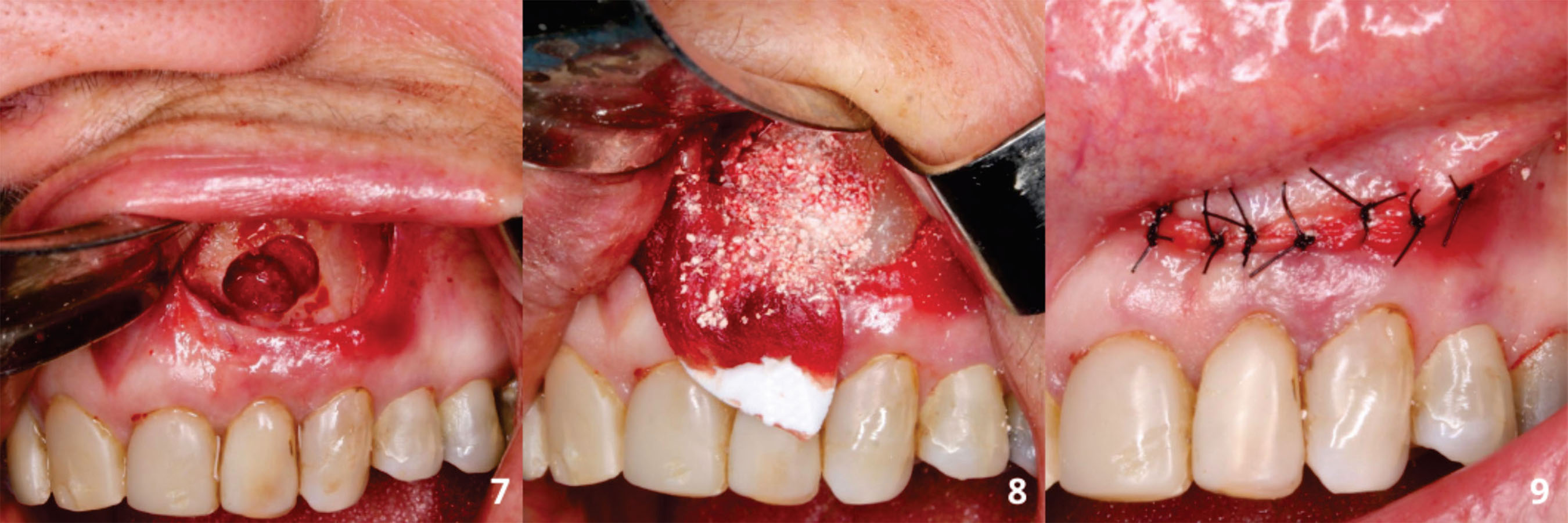 Note: 7: Surgical site appearance after removal of the root apex of left maxillary lateral incisor (#22) (Apicoectomy). Still without curettage. 8: Resorbable collagen membrane and bone graft, both of bovine origin, properly installed. Covering the surgical site with resorbable collagen membrane, of bovine origin, after bone graft insertion. 9: Suturing performed with 07 (seven) simple interrupted suture using 4-0 Nylon thread.
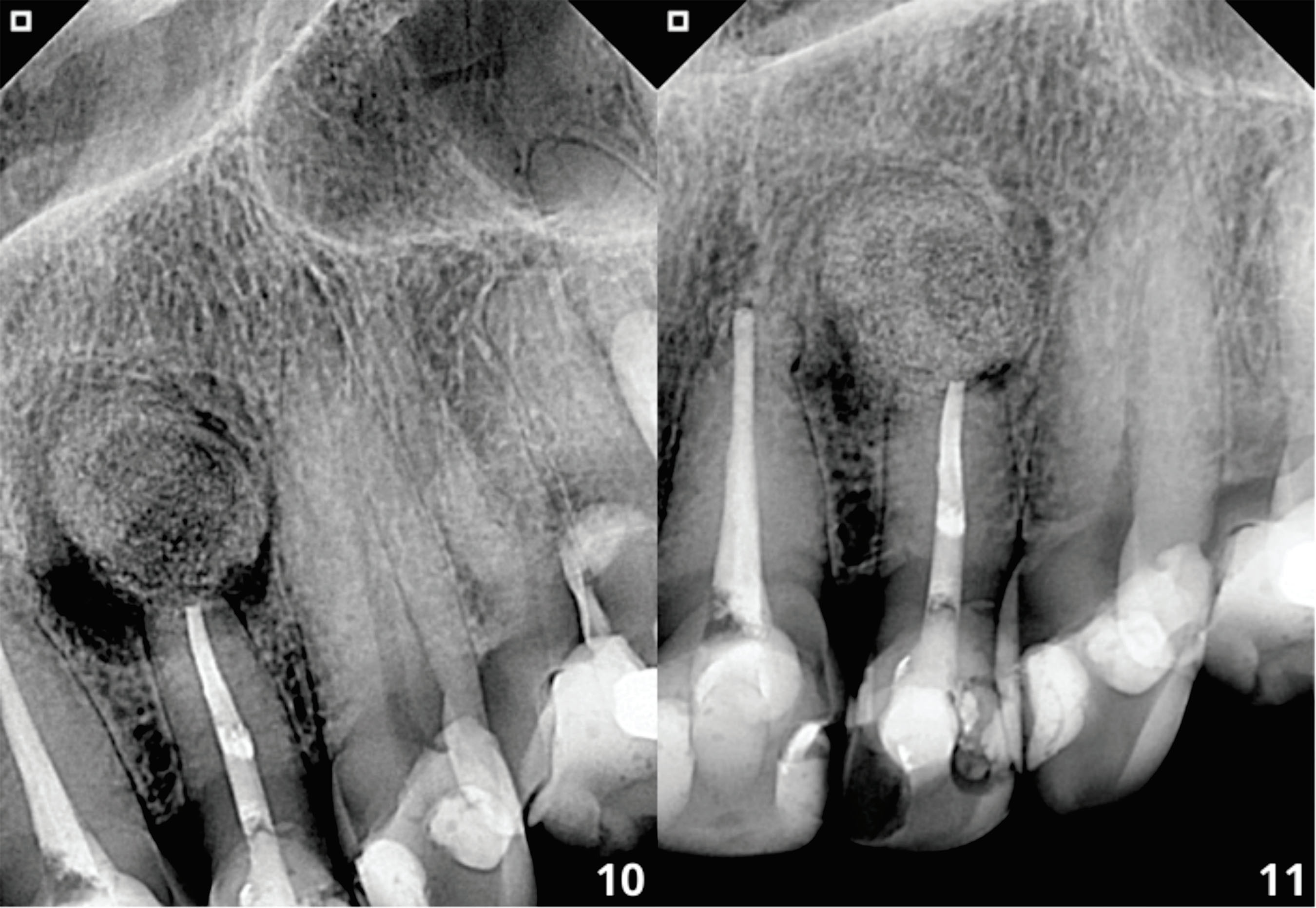 Note: 10: Periapical X-ray seven days after the procedure. 11: Periapical X-ray six months after the procedure.