
 Application of Icon® infiltrant for masking hypomineralization in the maxillary central incisor: a case report
ABSTRACT
Materials that enhance aesthetics and function in dentistry have become increasingly common. The Icon® resin infiltrant (DMG Chemisch-Pharmazeutische Fabrik GmbH, Hamburg, Germany) was specifically developed for masking white spots on the enamel surface. Studies have shown that the aesthetic effect of Icon® remains intact for up to 6 months and undergoes minimal changes over 12 to 24 months. In molar-incisor hypomineralization, the spots may exhibit more pronounced chromatic alterations and compromise dental structure. Icon® emerges as an effective conservative alternative for masking these spots due to its high penetration capacity in the dental structure. This case report presents the application of this conservative approach to the maxillary right central incisor of a 24-year-old patient with moderate molar-incisor hypomineralization, dissatisfied with the appearance of hypomineralization in tooth 11. The procedure was performed following the protocol established by the manufacturer. The use of Icon® resin infiltrant provided satisfactory masking of the MIH spot, restoring the tooth’s aesthetics and meeting the patient’s preference for a minimally invasive procedure, without the need for tooth reduction for direct or indirect restorations.
Indexing terms
Composite resins; Molar hypomineralization; Pediatric dentistry
RESUMO
Os materiais que favorecem a estética e a função na Odontologia têm se tornado cada vez mais comuns. O infiltrante resinoso Icon® (DMG Chemisch-Pharmazeutische Fabrik GmbH, Hamburgo, Alemanha) foi especificamente desenvolvido para o mascaramento de manchas brancas na superfície do esmalte dentário. Estudos demonstram que o efeito estético do Icon® se mantém intacto por até 6 meses e apresenta alterações mínimas ao longo de 12 a 24 meses. Na hipomineralização molar incisivo, as manchas podem exibir alterações cromáticas mais marcantes, além de comprometer a estrutura dentária. O Icon® surge como uma alternativa conservadora eficaz para o mascaramento dessas manchas, devido à sua alta capacidade de penetração na estrutura dentária. Este relato de caso apresenta a aplicação dessa abordagem conservadora em um incisivo central superior direito de um paciente de 24 anos com hipomineralização molar incisivo moderada, que estava insatisfeito com a aparência da hipomineralização no dente 11. O procedimento foi realizado conforme o protocolo estabelecido pelo fabricante. Constatou-se que o uso do infiltrante resinoso Icon® proporcionou um mascaramento satisfatório da mancha de HMI, restaurando a estética do dente e atendendo ao desejo do paciente por um procedimento minimamente invasivo, sem a necessidade de desgaste dentário para restaurações diretas ou indiretas.
Termos de indexação
Resinas compostas; Hipomineralização molar incisivo; Odontopediatria
INTRODUCTION
Dental enamel, composed of over 98% minerals, less than 2% organic matrix, and water, is the hardest tissue in the human body. However, enamel developmental disturbances can occur at any time [1]. Among these disturbances are enamel hypoplasia, hypomineralization, diffuse and demarcated opacities, fluorosis, amelogenesis imperfecta, and Molar-Incisor Hypomineralization (MIH). The prevalence of MIH ranges from 3.6% to 25.0% worldwide and was identified in 2001 as a qualitative enamel anomaly of systemic origin, typically affecting the first molars and permanent incisors [2].
In MIH cases, the aesthetic complaint arises from a qualitative enamel defect characterized by changes in color or structure, with clear and distinct margins of normal enamel surrounding the defect. These alterations are generally present in one or all four permanent first molars, often associated with upper incisors and less frequently with lower incisors [3]. The resin infiltrant Icon® can be a viable treatment option for such clinical situations, as its fluid characteristics allow it to penetrate the enamel, blocking the diffusion of cariogenic acids.
The concept of Minimal Intervention Dentistry advocates for the minimal removal of healthy tissue when treating carious lesions. It suggests that lesions not yet reaching the dentin may have their demineralization process halted through minimally invasive strategies combined with biofilm control [4]. Icon® is effective in treating incipient caries, as its microinvasive technology fills intercrystalline spaces in hypoplastic lesions [2,5].
A 2023 study explored the use of resin infiltrants for treating hypomineralized enamel. In this study, 58 permanent central incisors affected by MIH were treated with Icon®, with results evaluated at four distinct time points: immediately after application, and at 1, 3, and 6 months post-treatment [6]. The study concluded that this microinvasive technique effectively addresses anterior teeth affected by MIH. Thus, the aim of this study is to present a case report demonstrating the use of Icon® as a minimally invasive alternative to mask MIH-related hypomineralization in the maxillary central incisor of a young adult patient.
CASE REPORT
A 24-year-old male patient visited the Pediatric Dentistry Clinic at São Leopoldo Mandic Faculty in Campinas, São Paulo, complaining about an aesthetically displeasing stain on his upper tooth. During anamnesis, it was confirmed that the patient had no systemic diseases and was not taking any medications. The clinical examination revealed molar-incisor hypomineralization, with hypomineralizations on teeth 11, 16, 31, and 46. The patient expressed significant aesthetic dissatisfaction with tooth 11 (figure 1). Despite consulting other professionals, he had avoided treatment due to reluctance to prepare the tooth for a veneer or an aesthetic crown.

The patient exhibited excellent general health and oral hygiene. A comprehensive dental treatment plan was developed to determine the most appropriate intervention sequence. Prophylaxis was performed using prophylactic paste and a rubber cup, followed by photographic documentation of the case. After evaluating the tooth and photographic records, a transillumination examination was conducted using the Radii Xpert Diagnostic LED Tip – SDI (SDI Limited, Victoria, Australia) (figure 2) to assess the depth of the hypomineralization.

Lip retraction was achieved using the Optragate Retractor (Ivoclar Vivadent, Schaan, Liechtenstein), and relative isolation of teeth 11 and 21 was performed using the MiniDam Gingival Barrier – DMG (DMG Chemisch-Pharmazeutische Fabrik GmbH, Hamburg, Germany). The barrier was adapted with the assistance of dental floss and a Suprafill resin spatula.
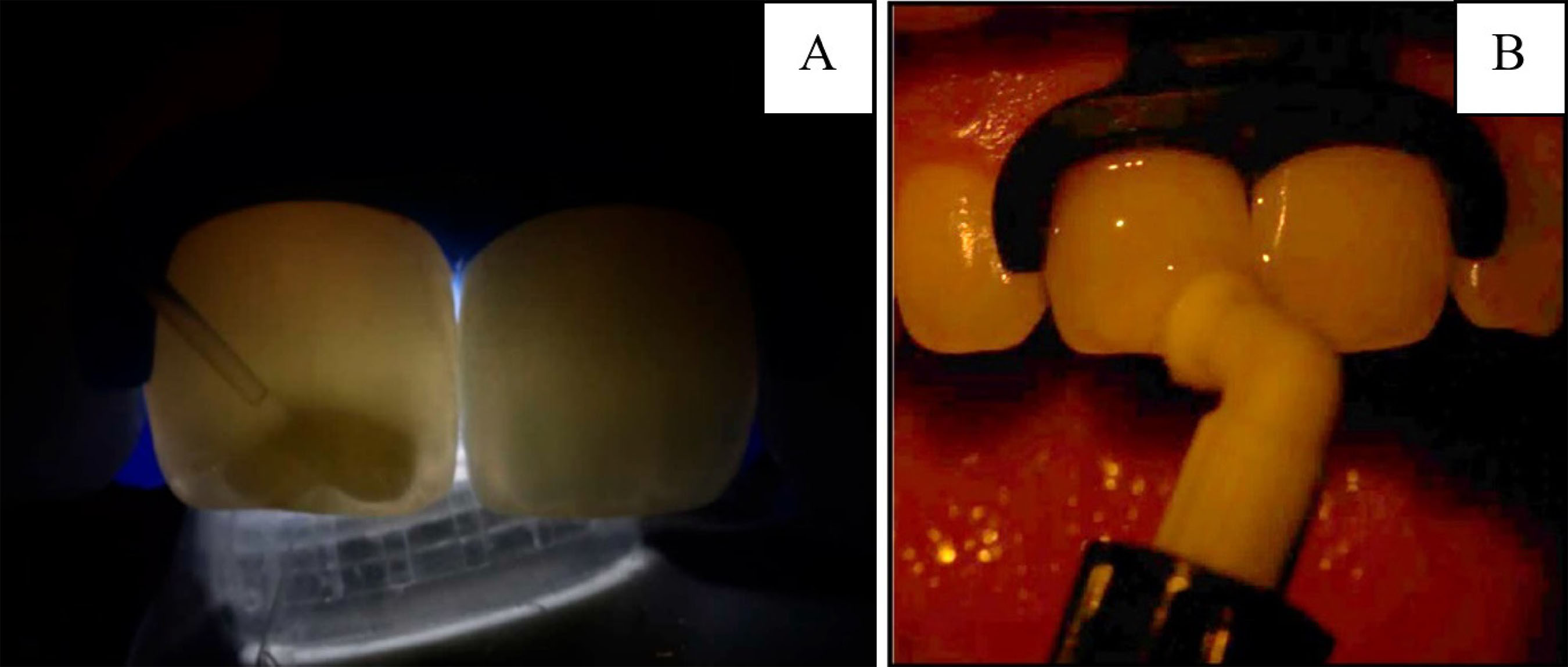
Once isolation was achieved, Icon-Etch was applied to the surface of tooth 11 (figure 3A). This initial step involved conditioning the dental element with 15% hydrochloric acid for 2 minutes, followed by rinsing with water spray for 30 seconds and drying with an air jet (figure 3B).

Subsequently, Icon-Dry, a 99% ethanol solution, was applied for 30 seconds to dehydrate the dental structure and maintain open spaces for product infiltration (figure 4A). After application, the surface was dried with an air jet for 30 seconds. Following these preliminary steps, the Icon-Infiltrant resin infiltrant was applied to the tooth surface according to the manufacturer’s instructions. Due to its high penetration coefficient, the resin infiltrated the lesion’s pores, masking the defect and reinforcing unsupported tissue (figure 4B).

The infiltrant was actively applied for 25 minutes as guided by the attending professional. As shown in the figure above, it is crucial to minimize ambient light sources during Icon-Infiltrant application, as the material’s high fluidity makes it susceptible to polymerization upon minimal exposure to blue light. After application, excess material was removed using specific resin spatulas, and light-curing was immediately performed for 40 seconds. The immediate post-application result is shown in the figure below (figure 5).

There was a significant and satisfactory masking of the hypomineralization, accompanied by the patient’s satisfaction with avoiding invasive intervention.
DISCUSSION
The patient’s concern about the stain on tooth 11 led to the diagnosis and treatment decision. Due to the patient’s reluctance to invasive procedures like veneers or crowns, a conservative approach was chosen. The Icon® resin infiltrant was selected for its effectiveness in masking hypomineralizations while preserving dental structure [7]. The decision was supported by evidence highlighting the benefits of Icon® resin infiltrant, such as preserving tooth structure, preventing demineralization, stabilizing enamel, reducing the risk of filling leakage and secondary caries, and achieving favorable aesthetic outcomes [2,8].
The initial planning, including prophylaxis and photographic documentation, was crucial for a thorough evaluation. The transillumination examination confirmed the depth of hypomineralization, enhancing diagnostic accuracy. Isolating teeth 11 and 21 with the Optragate Retractor and MiniDam Gingival Barrier ensured a controlled environment, reducing contamination risk and improving treatment efficacy. Preparing tooth 11 with Icon-Etch and Icon-Dry opened enamel pores for effective resin infiltration. This sequence is vital for achieving long-lasting aesthetic results and minimizing treatment failure risks [8].
The application of the Icon® resin infiltrant stood out as a minimally invasive and highly effective approach. The material’s ability to deeply penetrate the enamel structure facilitated the satisfactory masking of hypomineralization while preserving the tooth’s integrity. In addition to restoring aesthetic appearance, the procedure maintained enamel functionality, demonstrating the feasibility of less aggressive solutions for similar cases.
The improvement in the appearance of tooth 11 brought personal satisfaction to the patient, highlighting the importance of considering emotional aspects in Dentistry. The approach respected the patient’s preference to avoid unnecessary wear on the dental structure, demonstrating that effective communication between the professional and the patient is crucial for treatment success. Other studies also support the success of this treatment using the same technique, as it contributes to tooth preservation and promotes a preference for microinvasive treatments [9-11].
This clinical case highlights the importance of conservative dental approaches, using evidence-based procedures that preserve tissue and enhance patient satisfaction. The Icon® resin infiltrant effectively treated MIH, improving smile aesthetics in a single session without anesthesia or tooth wear. While improvements in enamel translucency were clear, further research is needed on long-term outcomes and broader populations to assess its impact on enamel durability and wear prevention. The clinical success also led to increased patient satisfaction and well-being.
CONCLUSION
Through this study, it can be concluded that the resin infiltration technique is effective in enhancing smile harmony and patient aesthetics. The clinical case demonstrated that its application did not require local anesthesia, rotary instruments, or rubber dam isolation, thereby facilitating patient cooperation. A significant improvement in enamel translucency and aesthetics was observed, as evidenced by the comparison of transillumination images before and after treatment. Initially, the darker areas exhibited difficulty in light penetration, whereas, after infiltration, light traversed the dental surface more easily, and areas of opacity were reduced.
The use of the Icon® resin infiltrant proved to be an effective treatment for white spot lesions caused by enamel formation defects. This minimally invasive technique yielded excellent aesthetic outcomes in a single session, without any damage to the dental structure, providing greater patient comfort. Furthermore, the clinical success was complemented by the patient’s satisfaction with their smile, resulting in increased self-esteem and personal fulfillment.
-
How to cite this article
Martins Junior IG, Braga MS, Corrêa PFB, Sampaio ARM, Moreira KMS, Pettorossi Imparato JC. Application of Icon® infiltrant for masking hypomineralization in the maxillary central incisor: a case report. RGO, Rev Gaúch Odontol. 2025;73:e20250024. http://dx.doi.org/10.1590/1981-86372025002420240091
REFERENCES
-
1 Goel N, Jha S, Bhol S, Dash BP, Sarangal H, Namdev R. Molar incisor hypomineralization: clinical characteristics with special emphasis on etiological criteria. J Pharm Bioallied Sci. 2021;13(Suppl 1):S651-S5. https://doi.org/10.4103/jpbs.JPBS_801_20
» https://doi.org/10.4103/jpbs.JPBS_801_20 -
2 Manoharan V, Arun Kumar S, Arumugam SB, Anand V, Krishnamoorthy S, Methippara JJ. Is resin infiltration a microinvasive approach for white spot lesions of calcified dental structures? A systematic review. Int J Clin Pediatr Dent. 2019;12:53-8. https://doi.org/10.5005/jp-journals-10005-1579
» https://doi.org/10.5005/jp-journals-10005-1579 -
3 Ammari MM, Badran Z, Ayman K, Dweck L. Efficacy of resin infiltration of proximal caries in primary molars: 1-year follow-up of a split-mouth randomized controlled clinical trial. Clin Oral Investig. 2018;22(3):1355-62. https://doi.org/10.1007/s007 84-017-2227-7
» https://doi.org/10.1007/s007 84-017-2227-7 -
4 Banihani A, Abuhijleh E, Al-Tarawneh S. Minimal intervention dentistry for managing carious lesions into dentine in primary teeth: an umbrella review. Eur Arch Paediatr Dent. 2022;22:667-93. https://doi.org/10.1007/s40368-021-00675-6
» https://doi.org/10.1007/s40368-021-00675-6 -
5 Perdigão J. Resin infiltration of enamel white spot lesions: an ultramorphological analysis. J Esthet Restor Dent. 2020;32(3):317-24. https://doi.org/10.1111/jerd.12550
» https://doi.org/10.1111/jerd.12550 -
6 Altan H, Yilmaz RE. Clinical evaluation of resin infiltration treatment masking effect on hypomineralised enamel surfaces. BMC Oral Health. 2023;23(1):215. https://doi.org/10.1186/s12903-023-03140-6
» https://doi.org/10.1186/s12903-023-03140-6 -
7 Bulanda S, Ilczuk-Rypuła D, Dybek A, Pietraszewska D, Skucha-Nowak M, Postek-Stefańska L. Resin infiltration technique for the management of molar-incisor hypomineralization: a systematic review. Coatings. 2022;12(7):964. https://doi.org/10.3390/coatings12070964
» https://doi.org/10.3390/coatings12070964 -
8 Jandu J, Barry S. White spot lesions in children: Considering caries, chronological and congenital causes, and their subsequent care. Br Dent J. 2021;230(7):523-7. https://doi.org/10.1038/s4 1415-021-2838-x
» https://doi.org/10.1038/s4 1415-021-2838-x -
9 Mabrouk R, Yahia S, Oueslati A, Frih N. Erosion infiltration in the treatment of molar-incisor hypomineralization (MIH) defects. Case Rep Dent. 2020;2020:8888256. https://doi.org/10.1155/2020/8888256
» https://doi.org/10.1155/2020/8888256 - 10 Araújo IDT, Câmara ACML, Assunção IV. Resin infiltration in white carious and non-carious lesions: case reports. Rev Ciênc Plural. 2024;10(1):1-14.
- 11 Farias JO, Cunha MCA, Martins VL, Mathias P. Microinvasive esthetic approach for deep enamel spot lesion. Dent Res J. 2022;19(29):1-5.
Edited by
-
Assistant editor:
Luciana Butini Oliveira

 Fonte: Acervo pessoal (2022).

 Fonte: Acervo pessoal (2022).
 Fonte: Acervo pessoal (2022).
 Fonte: Acervo pessoal (2022).