 Late diagnosis of tongue squamous cell carcinoma: clinical implications
ABSTRACT
Oral squamous cell carcinoma (OSCC) is still being late diagnosed in Brazilian population, which implies in worst survival rates. The present clinical case aimed to report a 64-year-old female patient that was referred to the university with main complain of a lump on the tongue. During anamnesis, she did not report addictions, such as smoking or drinking. Extra-oral physical examination revealed an increase and stiffening of the submandibular lymph nodes. Intraorally, it could be observed an extensive and ulcerated nodule on the lateral right tongue, extending to the floor of the mouth and to the alveolar ridge. The lesion was firm, but with irregular shape and raised edges, undefined limits and the patient reported about 3 months of evolution. The clinical hypothesis was of tongue squamous cell carcinoma. An incisional biopsy was performed and the histopathological examination, confirmed the diagnosis of tongue squamous cell carcinoma. Although the traditional risk factors for OSCC are tobacco and alcohol consumption, with a higher incidence in man, the present clinical case highlights the occurrence of OSCC in a female patient, without the traditional risk factors. An increase of tongue SCC in women and without risk factors has been observed in the literature, but the etiological risk factor associated with this increase has not been yet defined. Therefore, this clinical case reinforce that SCC can occur in patients without risk factors ant thar it is necessary to be aware to the initial signs of the disease, since late diagnosis implies in worst survival rates.
Indexing terms
Carcinoma, Squamous cell; Mouth; Mouth neoplasms
RESUMO
O carcinoma espinocelular de boca (CEC) ainda vem sendo tardiamente diagnosticado na população brasileira, o que implica em piores taxas de sobrevida. O presente caso clínico tem por objetivo reportar uma paciente de 64 anos de idade, sexo feminino, que foi encaminhada para a clínica universitária com a queixa principal de um caroço na língua. Durante a anamnese, não relatou vícios, como tabagismo e elitismo. No exame físico extrabucal, observou-se um aumento e enrijecimento dos linfonodos submandibulares. Ao exame físico intrabucal, notou-se a presença de uma área nodular extensa e ulcerada, na região lateral de língua, se estendendo para assoalho de boca e rebordo alveolar, há aproximadamente 3 meses. De acordo com os aspectos clínicos, a hipótese diagnóstica foi de carcinoma espinocelular de língua. Procedeu-se à biopsia incisional e o fragmento foi enviado para análise histopatológica, confirmando o diagnóstico de carcinoma espinocelular. Os fatores de risco tradicionais para o CEC são o tabaco e o álcool, sendo sua incidência maior em homens, porém, o presente caso clínico destaca a ocorrência de CEC em uma paciente do sexo feminino e sem fatores de risco para a doença. Nota-se um aumento de casos de CEC de língua em pacientes sem fatores de risco e mulheres, porém ainda não está definido o fator etiológico associado a esse aumento. Reforça-se, portanto, que o CEC pode ocorrer em pacientes sem fatores de risco e que é necessário estar atento aos sinais iniciais da doença, visto que o diagnóstico tardio implica em piores taxas de sobrevida.
Termos de indexação
Carcinoma de células escamosas; Boca; Neoplasias bucais
INTRODUCTION
Oral squamous cell carcinoma (OSCC) in patients who neither smoke nor consume alcohol appears to present a distinct profile compared to those with the traditional risk factors [1,2]. Epidemiological data indicate that OSCC occurrence in patients without such habits accounts for 10-15% of cases, primarily affecting young individuals and women, with the tongue being the most commonly involved site [1,3-8].
Although smoking and alcohol consumption are the primary risk factors for the development of OSCC, it is important to note that other potential factors associated with its development need to be explored, given their increasing incidence in patients without such habits [1]. One hypothesis is infection by human papillomavirus (HPV); however, this association has not been confirmed and is mainly valid for cases of oropharyngeal cancer [2,3,8]. Other factors, such as genetic disorders, new lifestyle habits, environmental, and nutritional factors, have been reported, but no consensus has been reached on these [8].
It is also noteworthy that the tongue is among the most frequent site of squamous cell carcinoma in patients without risk factors, followed by the gingiva and buccal mucosa [3,7]. Its occurrence in the tongue is associated with a more aggressive disease behavior and a worse prognosis [2,8,9].
Additionally, there is a higher proportion of women affected by head and neck squamous cell carcinoma who neither smoke nor consume alcohol compared to men [10,11].
Despite advances in the treatment of oral cavity cancer, late diagnosis at extremely advanced stages continues to result in unfavorable survival and higher mortality rates [10,12].
Thus, this study aims to report the clinical case of a 64-year-old female patient, without associated traditional risk factors, diagnosed with advanced-stage squamous cell carcinoma of the tongue. It also seeks to aware surgeon dentists about this distinct profile of OSCC, emphasizing the importance of early diagnosis and vigilance in cases occurring in patients without risk factors.
CASE REPORT
A 64-year-old female patient presented to the university dental clinic, complaining of tongue pain for approximately three months. During the anamnesis, the patient reported neurological issues and is under medical follow-up but did not disclose about taking medications for treatment. Regarding habits and addictions, she denied smoking and alcohol consumption.
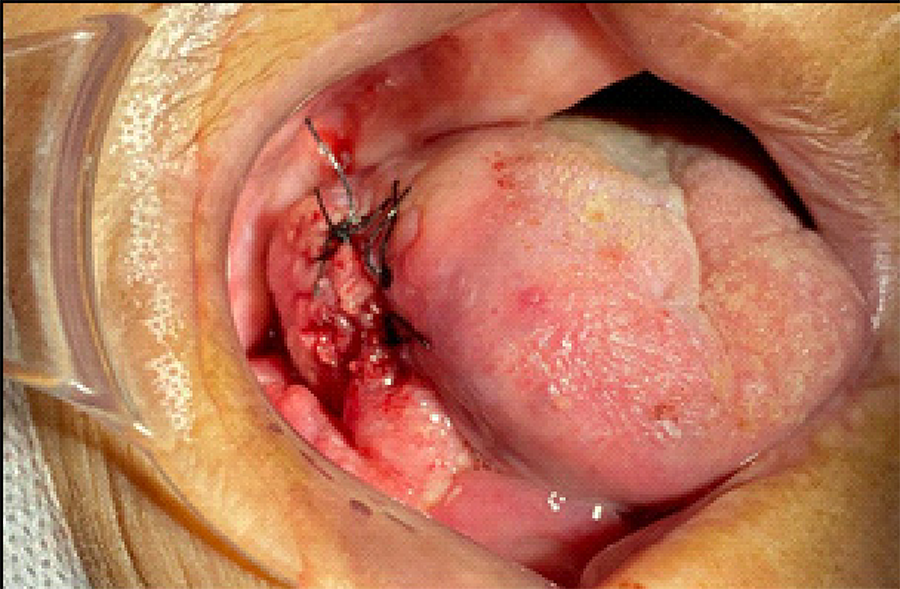
On extraoral physical examination, enlargement and hardening of the submandibular and sublingual lymph nodes were observed. In the intraoral examination, a nodular mass was noted on the right lateral border of the tongue, approximately 2 cm in diameter, with a reddish appearance, yellowish points, and bleeding upon touch. The lesion was solitary, extending to the floor of the mouth, with a firm consistency, indurated base, rough surface, elevated borders, irregular contours, and undefined margins (figure 1). Based on clinical features, a provisional diagnosis of squamous cell carcinoma of the tongue was made, and an incisional biopsy was performed (figures 2 and 3). Seven days postoperatively, the patient continued to report intense pain, and an analgesic medication (sodium dipyrone 1g) was prescribed.

Initial clinical aspect of the lesion. Nodular mass on the lateral border of the tongue, right side, with raised edges and an irregular surface.


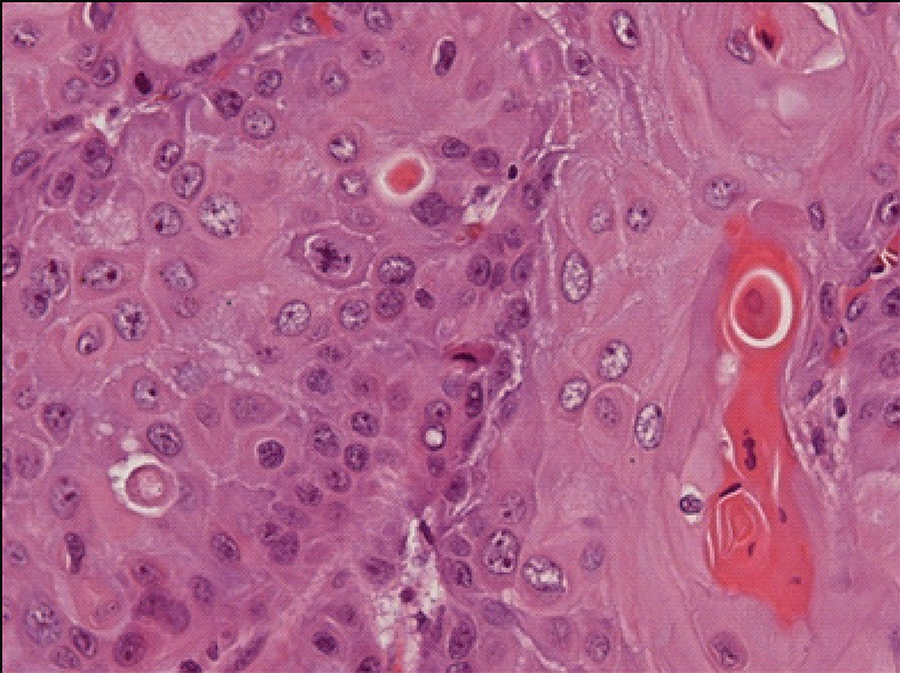
The histopathological examination revealed cords and nests of neoplastic epithelial cells, showing mild pleomorphism, hyperchromatism, atypical mitoses, and several keratin pearls invading the connective tissue (figures 4 and 5). A pattern of destruction of striated skeletal muscle fibers was also observed. In the tumor stroma, an intense mononuclear inflammatory infiltrate was present among the neoplastic epithelial cells, confirming the diagnosis of squamous cell carcinoma of the tongue. The patient was referred to an oncology center for treatment.

Presence of several islands of epithelial neoplastic cells, exhibiting hyperchromatism, pleomorphism, and areas of dyskeratosis (10x).

Presence of neoplastic cells with pleomorphism and hypercromatism, areas of dyskeratosis and atypical mitosis. (40x).
DISCUSSION
Oral squamous cell carcinoma (SCC) occurs more frequently in male individuals, smokers, and/or alcohol consumers, typically above the age of 40 [12]. A reduction in SCC incidence was expected, particularly due to campaigns and lifestyle changes that have led to decreased tobacco and alcohol consumption in recent years [12]. However, an increase in SCC incidence has been observed in a distinct group of patients, such as young patients and elderly women who do not have these habits, as seen in the clinical case reported [2,4,7,11,13].
The etiological factors associated with the development of SCC in this group remain unclear in the literature. Genetic alterations are the most commonly cited causes, including mutations in the p16 gene, the K-RAS gene [14], and, more recently, in the tumor suppressor gene CDKN2A [7]. Other factors, such as viral infections, chronic exposure to metals, nutritional factors, immunodeficiencies, and chronic trauma from prostheses, have also been suggested, although there is no consensus in the literature regarding their influence [7].
Another uncommon aspect is that patients without risk factors present more frequently SCC on the tongue [2,7]. This is unusual, as the highest occurrence of SCC in patients with such habits is in the floor of the mouth and the lateral border of the tongue. This pattern is attributed to substances like alcohol and tobacco products dissolved in saliva, combined with the greater permeability of the mouth floor, which favors SCC development in these locations among smokers and alcohol consumers. According to data presented by Koo et al. [7] and Koo et al. [2], the authors state that there is a predilection for the tongue in patients without such habits, as demonstrated in the case presented here.
Furthermore, when a second tumor develops, Koo et al. [2] observed that it also occurs in the oral cavity of patients without habits such as smoking or alcohol consumption [2]. Dediol et al. [3], on the other hand, noted an equal frequency of second tumors in patients with and without such habits but did not report the location of occurrence. In the case reported here, no second tumor occurred.
Regarding prognosis, studies indicate that when SCC occurs in elderly women without these habits, they present a worse prognosis and higher disease-specific mortality rates [2,15]. However, these findings are still conflicting in the literature. Fiedler et al. [16] observed better survival rates for women, and Krishnamurthy et al. [12] also noted a better prognosis for patients without these habits. It is suggested that the presence of comorbidities in elderly women may influence the disease prognosis, although the patient reported in this case died months after the diagnosis.
According to Dediol et al. [3], patients who neither smoke nor consume alcohol typically present with smaller tumors without regional involvement, compared to patients with such habits. However, in the clinical case reported here, the tumor was at an advanced stage, which may be attributed to the patient’s lower socioeconomic capacity and neglect of general health, as previously observed by Dahlstrom et al. [17].
Another important aspect noted by Fiedler et al. [16] is that patients with SCC and without these habits have a higher incidence of potentially malignant oral disorders (PMODs), such as lichen planus, which predominantly affects women. This finding suggests a possible malignant progression of these PMODs. It is noteworthy that in the reported case, the patient already presented with an advanced-stage lesion, with no prior lesions reported, requiring immediate surgical intervention.
This underscores the importance of self-examination of the oral cavity and frequent visits to the dental surgeon, as early diagnosis directly impacts treatment and prognosis. It is also crucial for dental surgeons to pay attention to the early signs of potentially malignant lesions, even in patients without these habits, considering the possibility of less invasive treatment.
To date, no differences have been reported regarding the treatment of this group of patients, with surgical treatment and adjuvant chemotherapy or radiotherapy still being recommended2. According to Koo et al. [2], non-smoking patients exhibit a better response to the epidermal growth factor receptor (EGFR), which is a marker for response to treatment with cetuximab [2,7], thereby enhancing therapeutic outcomes. In this case, the patient was undergoing radiotherapy.
CONCLUSION
Based on the reported clinical case and studies published in the literature, SCC in non-smoking and non-drinking patients presents a distinct profile, with higher incidence in young individuals and elderly women, with the most frequent location being the tongue. Regarding prognosis, the results are conflicting, and it cannot be concluded that survival is lower for this group of patients.
-
How to cite this article
Siqueira AJ, Leite IR, Molina JM, Oliveira DT, Assao A. Late diagnosis of tongue squamous cell carcinoma: clinical implications. RGO, Rev Gaúch Odontol. 2025;73:e20250002. http://dx.doi.org/10.1590/1981-86372025000220240040
REFERENCES
-
1 Tran Q, Maddineni S, Arnaud EH, Divi V, Megwalu UC, Topf MC, et al. Oral cavity cancer in young, non-smoking, and non-drinking patients: A contemporary review. Crit Rev Oncol Hematol. 2023;190:104112. http://dx.doi.org/10.1016/j.critrevonc.2023.104112
» https://doi.org/10.1016/j.critrevonc.2023.104112 -
2 Koo K, Barrowman R, McCullough M, Iseli T, Wiesenfeld D. Non-smoking non-drinking elderly females: a clinically distinct subgroup of oral squamous cell carcinoma patients. Int J Oral Maxillofac Surg. 2013;42(8):929-933. http://dx.doi.org/10.1016/j.ijom.2013.04.010
» https://doi.org/10.1016/j.ijom.2013.04.010 -
3 Dediol E, Sabol I, Virag M, Grce M, Muller D, Manojlović S. HPV prevalence and p16INKa overexpression in non-smoking non-drinking oral cavity cancer patients. Oral Dis. 2016;22(6):517-522. http://dx.doi.org/10.1111/odi.12476
» https://doi.org/10.1111/odi.12476 -
4 DeAngelis A, Breik O, Koo K, Iseli T, Nastri A, Fua T, et al. Non-smoking, non-drinking elderly females, a 5 year follow-up of a clinically distinct cohort of oral squamous cell carcinoma patients. Oral Oncol. 2018;86:113-120. http://dx.doi.org 10.1016/j.oraloncology.2018.09.004
» https://doi.org/10.1016/j.oraloncology.2018.09.004 -
5 Pérot P, Falguieres M, Arowas L, Laude H, Foy JP, Goudot P, et al. Investigation of viral etiology in potentially malignant disorders and oral squamous cell carcinomas in non-smoking, non-drinking patients. PLoS One. 2020;15(4):e0232138. http://dx.doi.org/10.1371/journal.pone.0232138
» https://doi.org/10.1371/journal.pone.0232138 - 6 Pinheiro CAS, de Carvalho PAG. Câncer de boca em mulheres jovens: Estudo dos fatores de risco / Oral cancer in young women: Study of risk factors. Braz J Develop. 2020;6(9):65174-81.
-
7 Koo K, Mouradov D, Angel CM, et al. Genomic Signature of Oral Squamous Cell Carcinomas from Non-Smoking Non-Drinking Patients. Cancers (Basel). 2021;13(5):1029. http://dx.doi.org/10.3390/cancers13051029
» https://doi.org/10.3390/cancers13051029 -
8 Uddin S, Singh A, Mishra V, Agrawal N, Gooi Z, Izumchenko E. Molecular drivers of oral cavity squamous cell carcinoma in non-smoking and non-drinking patients: what do we know so far?. Oncol Rev. 2022;16(1):549. http://dx.doi.org/10.4081/oncol.2022.549.
» https://doi.org/10.4081/oncol.2022.549 -
9 Jones BM, Villavisanis DF, Lehrer EJ, Dickstein DR, Sindhu KK, Misiukiewicz KJ, et al. high failure rates in young nonsmoker nondrinkers with squamous cell carcinoma of the oral tongue. Laryngoscope. 2023;133(5):1110-1121. http://dx.doi.org/10.1002/lary.30253
» https://doi.org/10.1002/lary.30253 -
10 de Melo Cardoso D, Conrado Neto S, Urbano Collado F, Furuse C, Callestini R, et al. Tongue cancer in non-smoking and non-alcoholic mother and daughter. Oral Oncol. 2024;152:106779. http://dx.doi.org/10.1016/j.oraloncology.2024.106779
» https://doi.org/10.1016/j.oraloncology.2024.106779 -
11 Bonetti Valente V, Mantovan Mazzon B, Urbano Collado F, Conrado Neto S, Lúcia Marçal Mazza Sundefeld M, et al. Clinicopathological and prognostic profile of non-smoking and non-drinking head and neck cancer patients: a population-based comparative study. Oral Oncol. 2022;127:105799. http://dx.doi.org/10.1016/j.oraloncology.2022.105799
» https://doi.org/10.1016/j.oraloncology.2022.105799 -
12 Krishnamurthy A, Ramshankar V. Early stage oral tongue cancer among non-tobacco users--an increasing trend observed in a South Indian patient population presenting at a single centre. Asian Pac J Cancer Prev. 2013;14(9):5061-5065. http://dx.doi.org/10.7314/apjcp.2013.14.9.5061
» https://doi.org/10.7314/apjcp.2013.14.9.5061 -
13 Pérot P, Falguieres M, Arowas L, Laude H, Foy JP, Goudot P, et al. Investigation of viral etiology in potentially malignant disorders and oral squamous cell carcinomas in non-smoking, non-drinking patients. PLoS One. 2020;15(4):e0232138. http://dx.doi.org/10.1371/journal.pone.0232138
» https://doi.org/10.1371/journal.pone.0232138 -
14 Yang Z, Du W, Zhang X, Chen D, Fang Q, He Y, et al. Nonsmoking and nondrinking oral squamous cell carcinoma patients: a different entity. Front Oncol. 2021;11:558320. http://dx.doi.org/10.3389/fonc.2021.558320
» https://doi.org/10.3389/fonc.2021.558320 -
15 Bachar G, Hod R, Goldstein DP, Irish JC, Gullane PJ, Brown D, et al. Outcome of oral tongue squamous cell carcinoma in patients with and without known risk factors. Oral Oncol. 2011;47(1):45-50. http://dx.doi.org/10.1016/j.oraloncology.2010.11.003
» https://doi.org/10.1016/j.oraloncology.2010.11.003 -
16 Fiedler M, Off A, Eichberger J, Spoerl S, Schuderer JG, Taxis J, et al. OSCC in Never-Smokers and Never-Drinkers Is Associated with Increased Expression of Tumor-Infiltrating Lymphocytes and Better Survival. Cancers (Basel). 2023;15(10):2688. http://dx.doi.org/10.3390/cancers15102688
» https://doi.org/10.3390/cancers15102688 -
17 Dahlstrom KR, Little JA, Zafereo ME, Lung M, Wei Q, Sturgis EM. Squamous cell carcinoma of the head and neck in never smoker-never drinkers: a descriptive epidemiologic study. Head Neck. 2008;30(1):75-84. http://dx.doi.org/10.1002/hed.20664
» https://doi.org/10.1002/hed.20664
Edited by
-
Assistant editor:
Luciana Butini Oliveira