 An idiopathic case of multiple supernumerary teeth
ABSTRACT
Supernumerary teeth are a developmental alteration in the number of teeth, commonly located in the maxilla and more frequent in males, in most cases, they are asymptomatic and can delay tooth eruption. Its etiology is still not well understood, and may be related to syndromic or nonsyndromic phenotypes, alterations in the modulation of signaling molecules, and an autosomal dominant inheritance relationship. This article reports a rare case of multiple supernumerary teeth in a nonsyndromic patient, discovered by radiographic finding. A 32-year-old male patient sought care for diagnostic evaluation of hyperdontia, observed in a previous radiographic examination, requested in private practice. A thorough investigation was performed on the systemic conditions and medical history of the patient and his family, including craniofacial changes and presence of multiple teeth in other family members, in which two members of his family had extra teeth, but in smaller quantity. Thus, after questioning and clinical evaluation, the absence of systemic diseases and/or syndromes in the patient was noted. To plan the extractions, a Cone-Beam Computed Tomography was performed, which verified the surgical risk of some elements, due to the proximity of noble structures, thus opting for follow-up and evaluation of further intervention. Other elements were extracted under local anesthesia, in two stages, without major complications. From this case report, it can be concluded that early diagnosis allows relating clinical, imaging and systemic features consistent with syndromes, especially craniofacial syndromes. Moreover, it is up to the dental surgeon to intervene at the right time, avoiding invasive procedures that may lead to iatrogenesis.
Indexing terms
Diagnostic imaging; Tooth, impacted; Tooth supernumerary
RESUMO
Dentes supranumerários são uma alteração de desenvolvimento do número de dentes, comumente localizado em maxila e mais frequente no sexo masculino, na maioria das vezes, são assintomáticos e podem retardar a erupção dentária. Sua etiologia ainda não é bem esclarecida, podendo estar relacionada a fenótipos sindrômicos, não sindrômicos, alterações na modulação das moléculas de sinalização e relação de herança autossômica dominante. Este artigo relata um raro caso de múltiplos dentes supranumerários em paciente não sindrômico, descoberto por achado radiográfico. Paciente do sexo masculino, 32 anos, procurou atendimento para avaliação diagnóstica da hiperdontia, observada em exame radiográfico prévio, solicitado em consultório particular. Foi realizada uma investigação aprimorada sobre as condições sistêmicas e história médica do paciente e seus familiares, incluindo alterações craniofaciais e presença de múltiplos dentes em outros membros da família, no qual dois membros de sua parentela possuíam dentes extras, todavia em menor quantidade. Sendo assim, após os questionamentos e avaliação clínica, percebe-se a ausência de doenças sistêmicas e/ou síndromes no paciente. Para planejamento das extrações foi realizado Tomografia Computadorizada de Feixe Cônico, verificou risco cirúrgico de alguns elementos, pela proximidade de estruturas nobres, assim optando pelo acompanhamento e avaliação de posterior intervenção. Outros elementos foram extraídos sob anestesia local, em duas etapas, sem maiores complicações. A partir desse relato de caso, conclui-se que o diagnóstico precoce permite relacionar características clínicas, imaginológicas e sistêmicas condizentes com síndromes, em especial, craniofacial. Ademais, cabe ao cirurgião dentista intervir em momento oportuno evitando condutas invasivas que possam levar à iatrogenias.
Termos de indexação
Dente impactado; Diagnóstico por imagem; Dente supranumerário
INTRODUCTION
Supernumerary teeth are a common human dental anomaly, defined as the presence of extra teeth. They can be classified as supplementary teeth (normal size and shape) or rudimentary teeth (abnormal shape and smaller size). They are also classified according to their location; when in the upper incisor region they are called mesiodentals, in the upper posterior region they are called fourth molars or distomolars; and when located lingually or buccally to a molar they are called paramolars [1].
The etiology of this alteration may be related to syndromic and non-syndromic phenotypes. Genetic factors, which exert a strong influence, can be associated with numerous syndromes such as Cleidocranial Dysplasia [2-5], Gardner’s Syndrome [6,7], Trico-rhino-phalangeal Syndrome [5], among others.
On the other hand, although rare, multiple supernumerary teeth have also been found in non-syndromic patients [8,9] and this can be explained because there are more than 200 genes involved in odontogenesis [1]. Thus, alterations in the modulation of signaling molecules may be responsible for the extra teeth, since these molecules control dental development. Therefore, any changes may result in a failure of the inhibitors responsible for apoptosis of the tooth sprouts [10]. Similarly, hyperactivity of the dental lamina can lead to increased formation of more tooth germs [11,12] .
The prevalence of supernumerary teeth has been reported to be between 0.2 and 3%, and is more frequent in males than in females [12]. They are most commonly found in the maxilla, specifically in the central incisor region [13]. In relation to the number of extra teeth, approximately 76% to 86% of cases present hyperdontia of a single tooth, 12% to 23% of two teeth and less than 1% of three or more teeth [1].
Most patients are asymptomatic and hyperdontia is discovered through routine radiographic findings or delayed tooth eruption [4]. As far as treatment is concerned, the option is to extract the extra teeth and evaluate them for orthodontic treatment, since the tooth can be left as a replacement if its biological value is sufficient to complete the dentition both functionally and aesthetically [8].
In this context, the aim of this paper is to describe and analyze a rare case with the presence of seven or eight supplementary supernumerary teeth distributed in all quadrants in a non-syndromic patient. This case highlights the challenges in diagnosis, with investigation of possible genetic alterations or related systemic conditions.
CASE REPORT
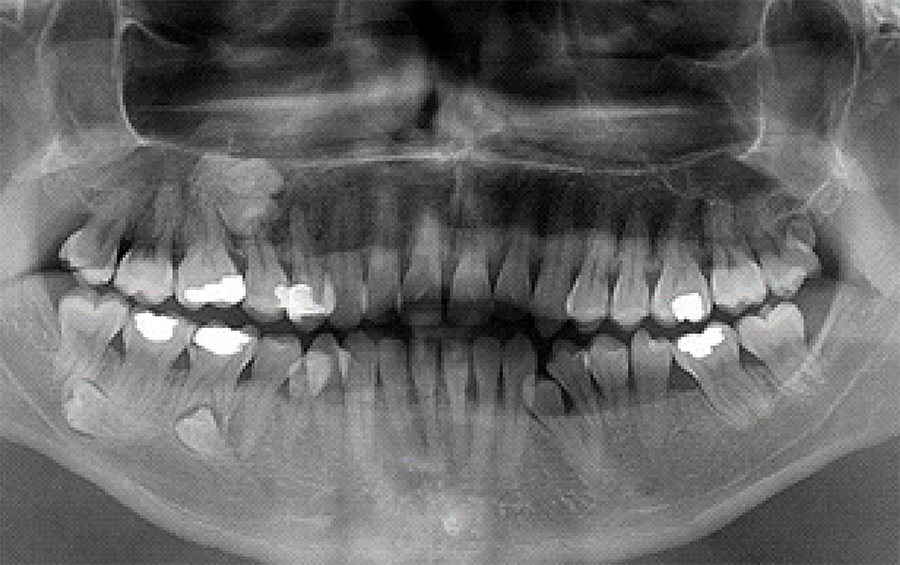
A 32-year-old male patient came to the School of Dentistry at the Federal University of Juiz de Fora with the complaint of a diagnostic assessment of hyperdontia observed in a previous radiographic examination, requested at a private practice when planning to extract his third molars (figure 1). The patient had no complaints of pain or signs of infection.

In terms of past medical history, the patient was in good general health, with no other alterations; he did not report taking any medication, nor did he have any chemical dependencies, such as smoking, alcoholism or illicit drugs. In addition, he had no heart, respiratory, kidney, digestive, liver, blood, neurological and/or endocrinological problems.
During the evaluation of the panoramic radiograph, the presence of supernumerary teeth was detected: in the first quadrant, the presence of fused or twinned teeth (close to the roots of elements 15 and 16); in the second quadrant, the presence of a fourth molar; in the third quadrant, two supernumerary premolars, between elements 33 and 36; and finally, in the fourth quadrant, three supernumeraries, one of which is between elements 44 and 45 and two intraosseous between the roots of elements 46 and 48. This means a total of 7 or 8 extra teeth, since a radiopaque mass was observed in the upper right region, which may correspond to fused or germinated teeth.
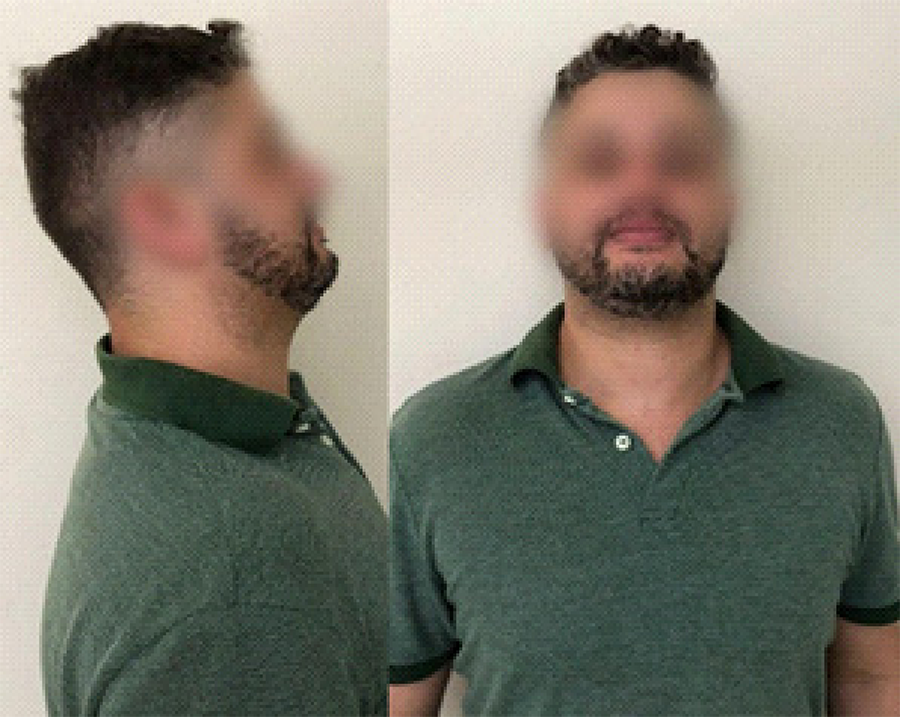
Following the discovery of the supernumerary teeth, an in-depth investigation was carried out into the patient’s systemic conditions, including his medical history and that of his family members, such as craniofacial alterations (orofacial cleft, Cleidocranial Dysplasia, Down’s Syndrome, Kerubism, among others) and the presence of multiple teeth in other family members. The patient reported that his brother and a cousin also had supernumerary teeth, but to a lesser extent, both paternal relatives. Based on the investigation, there were no systemic diseases and/or syndromes, either in relation to the patient or his family members (figure 2). The diagnosis of the supernumerary teeth was late, which was justified by the fact that radiographic examinations had not been carried out previously to find the finding described in the case.

Facial photograph, showing no clinical characteristics that could be associated with syndromes that present supernumerary teeth.
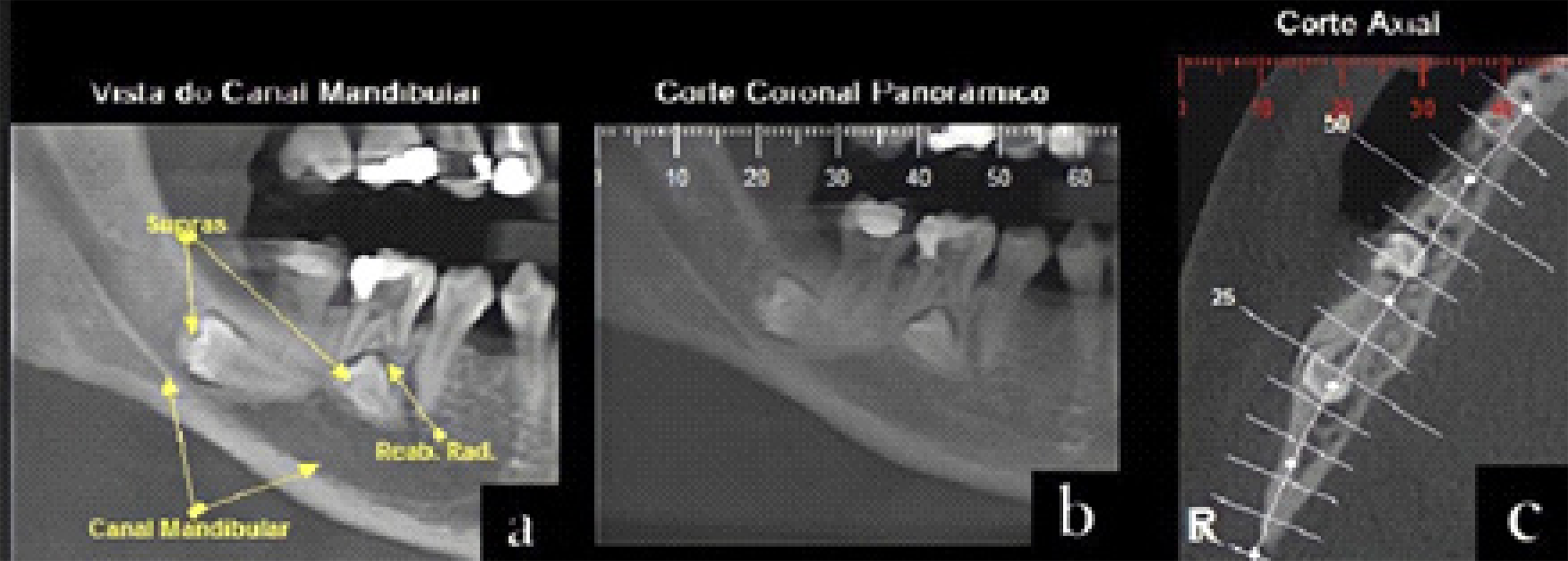
In order to plan the extraction surgeries, a Cone-Beam Computed Tomography (CBCT) scan of the lower right arch was requested (figure 3), to obtain more details of the contact with adjacent teeth. Contact with adjacent teeth and to assess priority. It was found that in this region the intraosseous elements had caused resorption of the root of 46 and are in close contact with the mandibular canal, leading to a risk at the time of surgery.

Cone-Beam Computed Tomography: (a) view of the mandibular canal; (b) panoramic coronal section; (c) axial section.
Due to the risk of intraosseous elements, it was decided to start the treatment by extracting two supernumeraries, one in the region of 34 and the other in the region of 44, both lingualized. The procedure was carried out under local anesthesia (Lidocaine 2% with epinephrine 1:100,000), followed by detachment, osteotomy and odontosection on the left side and only a flap on the right side. The surgeries were carried out without any complications. Post-surgical recommendations included the use of analgesics and anti-inflammatories (Dipyrone 500 mg every 6 hours and Nimesulide 100 mg every 12 hours, both for three days), cold food and regular cleaning/brushing. Post-operative follow-up was carried out and after seven days, the patient was reassessed and the suture was removed. After the extraction of these elements, there was a loss of bone thickness and a defect was created due to the mesialization of the adjacent tooth (figure 4).

After approximately two months, the patient returned for the extraction of element 28 and the 4th molar. The procedure was carried out under local anesthesia, with a flap made with a relaxing incision, detachment and tooth extraction. As before, there were no complications in the trans-operative period and post-operative guidance and medication were prescribed.
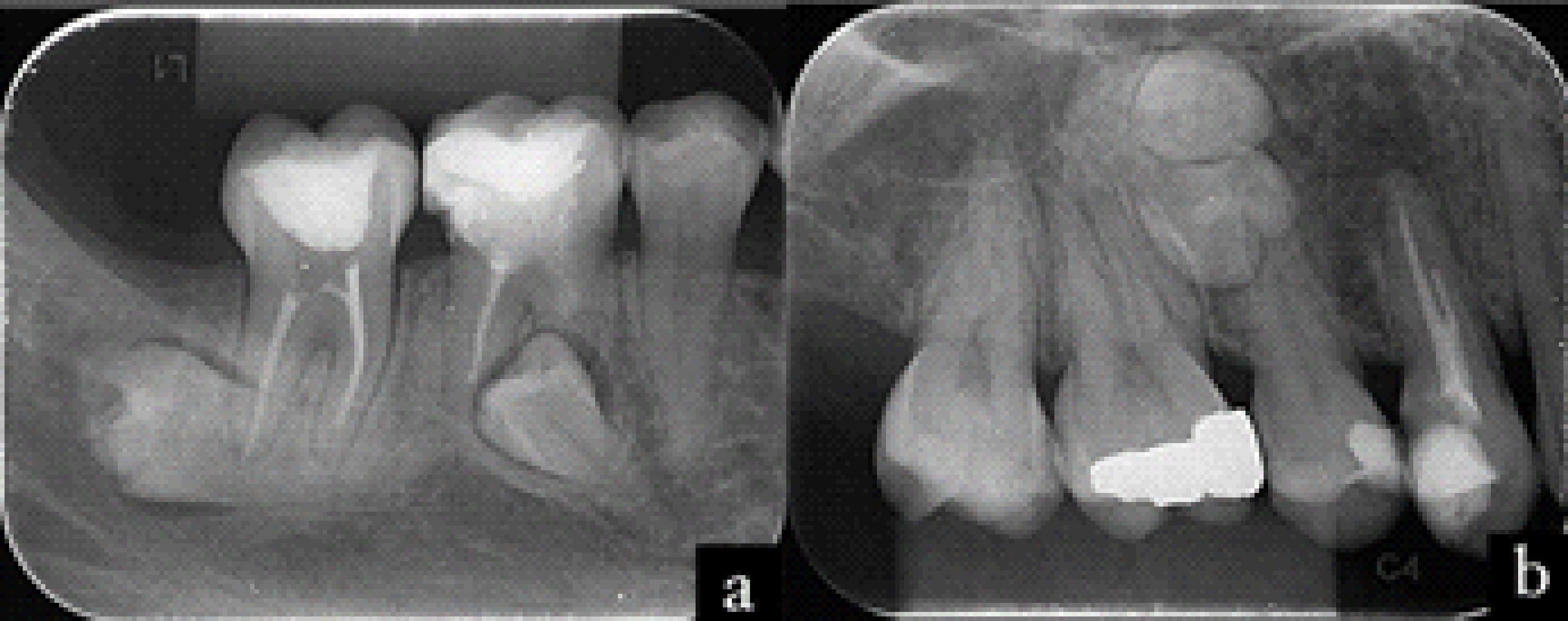
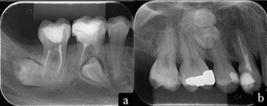
CBCT scans showed that the roots of teeth 46 and 47 (figure 2) were being resorbed due to the presence of supernumeraries between the roots, while palpation revealed no bulging of the buccal and lingual cortices. Endodontic treatment was therefore carried out on both teeth. It is worth mentioning that the mesial root of tooth 46 was filled with MTA due to the large amount of resorption and proximity to the supernumerary, and the distal root of this element and the root canals of tooth 47 were filled normally with gutta-percha (figure 5). Subsequently, these teeth were restored.
The proximity of the supernumerary to the root of element 15 (figure 5) was observed, however, in order to define whether the image seen is superimposition or resorption of the root, more detailed examinations such as CBCT of the upper arch are required.

Periapical radiographs: (a) elements 46 and 47 filled, mesial root of 46 filled with MTA; (b) proximity of the supra to the root of 15.
To date, the patient has not completed the removal of all the extra teeth, i.e. the intraosseous elements in the region of teeth 14, 15, 46 and 47, are still present in the oral cavity, as is the pre-molar in the third quadrant (figure 6). The patient is therefore being followed up until treatment is completed. The treatment plan will depend on the feasibility of the surgical procedure, avoiding invasive procedures that could lead to iatrogeny or the option of adjunctive treatments, such as replacing the resorbed tooth with the supernumerary tooth using the orthodontic traction technique, although this alternative should be evaluated with the help of a specialist. The patient was advised of the risk of the teeth remaining in the bone, due to the formation of cysts and impairment of adjacent teeth (figure 6).
Panoramic radiograph after extraction of supernumerary teeth in the upper and lower left arches.
DISCUSSION
This clinical case is considered rare, as it does not fit into any of the conditions or syndromes usually associated with supernumerary teeth. Therefore, the patient is classified as non-syndromic, which indicates a rare condition with no known cause, characterized as idiopathic. This is due to the large number of supernumerary teeth in the oral cavity and the absence of a clear etiological factor.
The etiology of supernumerary teeth may be mainly related to alterations in the modulation of signaling molecules that control tooth development, as well as failure in the inhibitory mechanisms responsible for the apoptosis of tooth sprouts. In addition, there is the possibility of an autosomal dominant genetic inheritance, which is observed in non-syndromic patients [10,11]. In order to determine the exact cause, it is necessary to investigate other clinical, radiographic and systemic characteristics that may be related to some craniofacial syndromes.
Some syndromes that may be associated with supernumerary teeth include Cleidocranial Dysplasia, Familial Adenomatous Polyposis (including Gardner syndrome), Apert Syndrome, Autosomal Dominant Ankyloglossia, orofacial clefts, Kerubism, Down Syndrome, among others [2-5]. Cleidocranial Dysplasia is the condition most described in the literature in relation to hyperdontia. It is a rare autosomal dominant skeletal dysplasia characterized by clavicular aplasia or hypoplasia, Wormian bones, delayed closure of the cranial suture, brachycephalic head, maxillary deficiency, retention of deciduous teeth, inclusion of permanent teeth and multiple supernumerary teeth [2]. However, in this patient’s case, none of these clinical characteristics were observed, leading to the exclusion of these syndromes as the cause of the supernumerary teeth.
Another syndrome that is known to frequently present dento-osseous anomalies, including the presence of supernumerary teeth, is Gardner’s Syndrome [6]. This syndrome is of genetic origin, transmitted in an autosomal dominant manner, and is considered a phenotypic variant of Familial Adenomatous Polyposis. It is characterized by the development of multiple adenomas in the rectum during adolescence [7]. It is important to note that, in the case in question, these alterations associated with Gardner’s Syndrome were not identified.
Previous studies have also mentioned a relationship between supernumerary teeth and conditions such as Pindborg’s Tumor, Turner’s Syndrome and Tricorhinophalangeal Syndrome [14-16]. This highlights the association between hyperdontia and craniofacial alterations. The identification of syndromes is crucial for the proper management of complications related to them, which justifies the detailed investigation of this case.
Furthermore, it has been observed that supernumerary teeth may be more common in patients with orofacial clefts than in patients without this anomaly [5,17,18]. However, as the times of facial development and odontogenesis do not coincide, it cannot be said that the formation of a cleft lip and palate directly causes the formation of supernumerary teeth. It is believed that growth factors can induce the formation of supernumerary teeth through hyperactivity of the local lamina at these separate ends or interfaces [11]. However, this congenital alteration was not observed in the present case.
Thus, in non-syndromic patients, supernumerary teeth may be related to alterations in the signaling that controls tooth development, failure in the mechanisms that inhibit apoptosis of tooth sprouts and possibly an autosomal dominant genetic inheritance. Since, during the period of dentinogenesis, the interaction between the oral epithelium and the underlying mesenchymal tissue can interfere with tooth formation, leading to anomalies such as that of Numbers [10,19].
As a result, the presence of supernumerary teeth can cause impacts on surrounding structures due to the lack of space in the dental arch. This can include the development of caries lesions, tooth and bone resorption, periodontal disease, dental crowding, diastemas, impaction of permanent teeth, delayed and/or ectopic eruption, tooth rotation, the development of cysts and tumors, among others [20-22]. Therefore, careful extraction of supernumerary teeth is generally recommended, taking into account the surgical access, location and direction of the supernumerary teeth, in order to avoid iatrogenesis due to their proximity to noble structures. When necessary, if there are risks, short-, medium- and long-term imaging examinations can be carried out to monitor progress [23,24]. The approach taken in this case has been cautious so far, avoiding iatrogenesis, and the patient was informed of the risks associated with retaining the teeth within the bone and the development of possible complications.
CONCLUSION
The case presented highlights the rarity of supernumerary teeth in non-syndromic patients, whose etiology remains unclear in the literature. This highlights the need for further studies to better understand this condition. Diagnosis becomes challenging when there is no evidence of clinical, imaging or systemic features associated with craniofacial syndromes. In addition, this case illustrates that the late diagnosis of multiple supernumerary teeth can result in complications, such as the resorption of adjacent teeth and the involvement of important structures. It is therefore recommended that children and adolescents are assessed by a pediatric dentist to monitor the chronology of tooth eruption using panoramic radiographs, in order to identify the presence of supernumerary teeth early on and the need for intervention. It is also important to consider the association between hyperdontia and syndromic conditions during the dental assessment.
-
How to cite this article
Elerati RF, Guedes IP, Oliveira IS, Fabri GMC. An idiopathic case of multiple supernumerary teeth. RGO, Rev Gaúch Odontol. 2025;73:e20250007. http://dx.doi.org/10.1590/1981-86372025000720240055
REFERENCES
- 1 Neville BW, Damm DD, Allen CM, Chi AC. Patologia oral e maxilofacial. 4° ed. Rio de Janeiro: Guanabara Koogan; 2016.
-
2 Inchingolo AD, Patano A, Coloccia G, Ceci S, Inchingolo AM, Marinelli G, et al. Genetic pattern, orthodontic and surgical management of multiple supplementary impacted teeth in a rare, cleidocranial dysplasia patient: a case report. Med Lithuania. 2021;57(12):1350. https://doi.org/10.3390/medicina57121350
» https://doi.org/10.3390/medicina57121350 -
3 Ayub NAFM, Hamzah SH, Hussein AS, Rajali A, Ahmad MS. A case report of cleidocranial dysplasia: A noninvasive approach. Special Care in Dentistry. 2021 Jan 1;41(1):111-7. https://doi.org/10.1111/scd.12532
» https://doi.org/10.1111/scd.12532 -
4 Martins A, Caixeirinho P, Fernandes A. Case of odontoma-related infection in a cleidocranial dysplasia. BMJ Case Reports. 2019;7(12) http://dx.doi.org/ 10.1136/bcr-2018-228748
» https://doi.org/10.1136/bcr-2018-228748 -
5 Pippi R. Odontomas and supernumerary teeth: Is there a common origin? Int J Med Sci. 2014 Nov 12;11(12):1282-97. https://doi.org/10.7150/ijms.10501
» https://doi.org/10.7150/ijms.10501 -
6 Arruda KAR, Normando AGC, Pacheco-Pereira C, Amorim dos Santos J, Yamaguti PM, Mazzeu JF, et al. Phenotypic dento-osseous characterization of a Brazilian family with Familial Adenomatous Polyposis. Arch Oral Biol. 2021;129:105206. https://doi.org/10.1016/j.archoralbio.2021.105206
» https://doi.org/10.1016/j.archoralbio.2021.105206 -
7 Yu F, Cai W, Jiang B, Xu L, Liu S, Zhao S. A novel mutation of adenomatous polyposis coli (APC) gene results in the formation of supernumerary teeth. J Cell Mol Med. 2018;22(1):152-62. https://doi.org/10.1111/jcmm.13303
» https://doi.org/10.1111/jcmm.13303 -
8 Suljkanovic N, Balic D, Begic N. Supernumerary and supplementary teeth in a non-syndromic patients. Med Arch. 2021;75(1):78-81. https://doi.org/10.5455/medarh.2021.75.78-81
» https://doi.org/10.5455/medarh.2021.75.78-81 - 9 Jain A, Taneja S. Bilateral presentation of different supernumerary teeth in nonsyndromic patients. Gen Dent. 2020;68(2):39-42.
-
10 Santos VCDO, Castro BAM, Martins VM, Paranhos LR, Silva GR, Dietrich L, et al. Múltiplos dentes impactados em paciente não sindrômico. Res, Soc Develop. 2021;10(1):e49110111626. https://doi.org/10.33448/rsd-v11i8.30553
» https://doi.org/10.33448/rsd-v11i8.30553 -
11 Consolaro A, Medeiros MCM, Miranda DAO, de Oliveira IA. Supernumerary teeth in patients with cleft lip and palate: The tooth germs do not separate. Dental Press J Orthod. 2021;26(4). https://doi.org/10.1590/2177-6709.26.4.e21ins4
» https://doi.org/10.1590/2177-6709.26.4.e21ins4 -
12 Cammarata-Scalisi F, Avendaño A, Callea M. Main genetic entities associated with supernumerary teeth. Arch Argent Pediatr. 2018;116(6):437-44. http://dx.doi.org/10.5546/aap.2018.eng.437
» https://doi.org/10.5546/aap.2018.eng.437 -
13 McBeain M, Miloro M. Characteristics of Supernumerary Teeth in Nonsyndromic Population in an Urban Dental School Setting. J Oral Maxillofac Surgery. 2018;76(5):933-8. https://doi.org/10.1016/j.joms.2017.10.013
» https://doi.org/10.1016/j.joms.2017.10.013 -
14 Morais HGF, da Silva WR, Andrade ACM, E Silva NS, Xerez MC, Santos JWM, et al. Pindborg tumor associated with a supernumerary tooth: a case report. Autops Case Rep. 2022;12: e2021358. http://dx.doi.org/10.4322/acr.2021.358
» https://doi.org/10.4322/acr.2021.358 -
15 Andrade NS, Tenório JR, Gallottini M. Supernumerary teeth in a patient with Turner syndrome: An unusual finding. Special Care in Dentistry. 2019;39(5):538-42. https://doi.org/10.1111/scd.12412
» https://doi.org/10.1111/scd.12412 -
16 Nik Kantaputra P, Jotikasthira D, Carlson B, Wongmaneerung T, Quarto N, Khankasikum T, et al. TRPS1 mutation associated with trichorhinophalangeal syndrome type 1 with 15 supernumerary teeth, hypoplastic mandibular condyles with slender condylar necks and unique hair morphology. J Dermatol. 2020;47(7):774-8. https://doi.org/10.1111/1346-8138.15360
» https://doi.org/10.1111/1346-8138.15360 -
17 Marzouk T, Alves IL, Wong CL, DeLucia L, McKinney CM, Pendleton C, et al. Association between dental anomalies and orofacial clefts: a meta-analysis. JDR Clin Trans Res. 2021;6(4):368-381. https://doi.org/10.1177/2380084420964795
» https://doi.org/10.1177/2380084420964795 -
18 Kan S, Zhu G, Du Y, Fan L, Yang F, Lou S, et al. Non-syndromic cleft lip with or without palate-susceptible SNPs is associated with hyperdontia. Oral Dis. 2019;25(7):1751-8. https://doi.org/10.1111/odi.13024
» https://doi.org/10.1111/odi.13024 -
19 Bae DH, Lee JH, Song JS, Jung HS, Choi HJ, Kim JH. Genetic analysis of non-syndromic familial multiple supernumerary premolars. Acta Odontol Scand. 2017 ;75(5):350-4. https://doi.org/10.1080/00016357.2017.1312515
» https://doi.org/10.1080/00016357.2017.1312515 -
20 Talaat DM, Hachim IY, Afifi MM, Talaat IM, ElKateb MA. Assessment of risk factors and molecular biomarkers in children with supernumerary teeth: a single-center study. BMC Oral Health. 2022;22(117). https://doi.org/10.1186/s12903-022-02151-z
» https://doi.org/10.1186/s12903-022-02151-z - 21 Dantas BPSS, Espinheira PRD’A, Santos MOSS, Silva LOR, Aguiar J. Cisto dentígero associado a dente supranumerário relato de caso. Full Dent Sci. 2018 9(36):34-37.
-
22 Rafael RRWS, Rafael MP, Gustavo CM, Marcelo VB. Os efeitos dos dentes supranumerários: complicações, diagnóstico e tratamento. Rev Pró-univerSUS. 2021;12(2):55-9. https://doi.org/10.21727/rpu.v12i2.3034
» https://doi.org/10.21727/rpu.v12i2.3034 -
23 Sarica I, Derindag G, Kurtuldu E, Naralan M, Caglayan F. A retrospective study: Do all impacted teeth cause pathology? Nigerian J Clin Practice. 2019;22(4):527-33. https://doi.org/10.4103/njcp.njcp_563_18
» https://doi.org/10.4103/njcp.njcp_563_18 -
24 Park SY, Jang HJ, Hwang DS, Kim YD, Shin SH, Kim UK, Lee JY. Complications associated with specific characteristics of supernumerary teeth. Oral Surg Oral Med Oral Pathol Oral Radiol. 2020 Aug;130(2):150-155. https://doi.org/10.1016/j.oooo.2020.03.002
» https://doi.org/10.1016/j.oooo.2020.03.002
Edited by
-
Assistant editor:
Luciana Butini Oliveira