
 Salivary flow analysis and oral injuries in homebound older persons care
ABSTRACT
Objective: Test the association between salivary flow and oral conditions in homebound older persons in Palhoça, Santa Catarina.
Methods: This cross-sectional observational study included older persons aged >60 years, confined to their homes, and registered in the Better in Home program. Home visits were conducted with Community Health Agents between December 2019 and March 2020 and between December 2021 and March 2022. Were considered low flow when stimulated salivary flow rates <0.7 ml/min and unstimulated rates <0.1 ml/min. Socioeconomic variables, DMFS index, Visible Plaque Index, and mucosal alterations were included. Pearson’s Chi-squared and Student’s t-test were used (α=5%).
Results: The sample included 44 older persons. The prevalence of low-stimulated salivary flow was 65.9% (95% CI: 50.3-78.7), while low-unstimulated salivary flow was 27.3% (95% CI: 15.8-42.8). Two-thirds were aged 60–79 years, and 56.8% were female. Daily use of 5-10 medications was reported by 63.6%, with antihypertensives (88.6%), diuretics (36.4%), and antidiabetics (34.1%) being most common; 59.2% used at least one combination of these. Visible plaque was present in 96.0%, mean DMFS was 125.9, two-thirds exhibited mucosal lesions, and 52.3% required dental prostheses. Low-stimulated salivary flow was associated with older age (p=0.023), use of antidiabetics (p=0.037), and mucosal alterations (p=0.036). Low unstimulated salivary flow was associated with a higher mean of caries (p=0.036).
Conclusion: Low salivary flow, stimulated or unstimulated, was associated with oral ulcerations, gingivitis, caries, advanced age, and medication use, highlighting specific strategies for the oral health needs of homebound older persons.
Indexing terms
Aged; Homebound persons; Oral health
RESUMO
Objetivo: Testar associação entre o fluxo salivar e condições bucais de idosos domiciliados no município de Palhoça, Santa Catarina. Estudo observacional, de caráter transversal, com idosos de 60 anos ou mais, restritos ao domicílio, cadastrados no Programa Melhor em Casa.
Métodos: Visitas com Agentes Comunitárias foram realizadas de dezembro/2019 a março/2020 e dezembro/2021 a março/2022. Considerou-se baixo fluxo estimulado valor <0,7 ml/min e não estimulado <0,1 ml/min. Variáveis exploratórias: condições socioeconômicas, índice CPO-S, Índice de Placa Visível e alterações de mucosa. Associações realizadas pelo teste de Qui-quadrado de Pearson e t de Student, α=5%. Parecer do CEP-Unisul 3.725.172.
Resultados: Amostra de 44 idosos, prevalência de baixo fluxo salivar estimulado foi 70% (IC 95% 50,3;78,7) e não estimulado, 27% (IC 95% 15,8;42,8). Mais de 2/3 era composta por idosos 60 e 79 anos, sexo feminino (57%); 65% utilizavam de 5 a 10 medicamentos diários, anti-hipertensivo (88%), diuréticos (36%) e antidiabéticos (34%), 59% usavam pelo menos uma combinação destes medicamentos; 90% apresentavam placa; média de CPO-S 125,9; 2/3 apresentam alguma lesão de mucosa e 52% necessitavam de prótese. Associados à maior proporção de baixo fluxo salivar estimulado: maior idade (p=0,023), uso de antidiabéticos (p=0,037) e presença de alterações de mucosa bucal (p=0,036) e, baixo fluxo salivar não estimulado e maior média de cárie (p=0,036).
Conclusão: Baixo fluxo salivar estimulado ou não estiveram associados às condições bucais, sinalizando a importância da atenção à saúde bucal dos idosos domiciliados.
Termos de indexação
Idoso; Pacientes domiciliares; Saúde bucal
INTRODUCTION
The increase in life expectancy and the growth of older people pose complex challenges that demand innovative solutions in social, economic, political, and health implications as factors inherent to aging gain greater prominence [1]. Health services, along with society as a whole, need to structure themselves to adequately meet this population’s demands and, most importantly, contribute to prolonging life and maintaining the individual’s functional capacity, ensuring they remain autonomous and independent for as long as possible [2].
However, due to age-related difficulties, the older persons often experience significant oral health impairment, such as extensive tooth loss, root caries, periodontal disease, and the need for oral rehabilitation [3].
Additionally, with aging, a reduction in salivary flow is observed, and low salivary flow rates have been associated with the use of six or more medications [4], diabetes mellitus [5], chronic kidney disease [4], radiotherapy treatment in the head and neck region [4], and diseases affecting the salivary glands, such as HIV and Sjögren’s syndrome [4]. The main oral consequences for patients with low salivary flow include lesions in the oral mucosa, as 81.6% of older persons with low salivary flow presented such conditions [6], as well as crown and root caries [7], difficulties in chewing, swallowing, taste alterations, and halitosis [4].
Nonetheless, in Brazil, the oral health of the older persons population remains precarious. According to the 2010 National Oral Health Survey, the DMFS (Decayed, Missing, and Filled Surfaces) index was 27,53, with the mean for the missing component at 25,29 (92% of the DMFS) [8]. Data from a 2022 follow-up study on the progression of oral health conditions in non-institutionalized older persons showed that the DMFS remained at least 28.1 [9]. Dental mutilation causes feeding difficulties, impairs social relationships, and burdens health services due to the demand for prosthetic needs. According to the National Survey, 92.6% of older persons aged 65 to 74 require some prosthesis8. Root caries is a concern in older persons since, according to the literature, the most commonly observed condition is untreated root caries, despite its low prevalence due to the high proportion of lost teeth in this population [7].
Several practices are considered appropriate for enhancing older persons, in special home care, among them the performance of home visits as a fundamental means of diagnosing the health, socioeconomic, and cultural reality of the homebound patients often face motor difficulties and require assistance from caregivers or family members for daily activities [10].
Considering that home care should adopt care pathways based on the individual’s needs [11] and recognizing the importance of identifying reduced salivary flow and its association with oral health problems as a means to guide the actions of the multidisciplinary team and improve the quality of life of homebound older persons, this study aimed to test the association between salivary flow and oral conditions in homebound older persons in Palhoça, Santa Catarina.
METHODS
The present study was approved by the Research Ethics Committee of the University of Southern Santa Catarina, protocol number 4.837.091. The research was conducted in the municipality of Palhoça, Santa Catarina, and data collection took place at the homes of older persons participants of the Better in Home Program, a program aimed at people unable to leave their homes to reach a Primary Health Unit for care. It seeks to provide patients with care closer to their routines, avoiding hospitalizations.
Study design
This is an exploratory, cross-sectional, descriptive, and analytical study with a quantitative basis. The study population consisted of homebound older persons over 60 years old who were Sistema Único de Saúde (SUS, Unified Health System) users. Thus, a convenience and non-probabilistic sample was obtained during home visits, accompanied by Community Health Agents (CHAs), between December 2019 and March 2020 and between December 2021 and March 2022. Included were older persons participants of the Better in Home Program, from the municipality of Palhoça (SC), and available on the days and times established by the researcher and CHAs. Were excluded homebound older persons who refused to participate or were unable to perform the salivary flow test (patients with stroke, patients using feeding tubes, home oxygen therapy, and who with gastrostomy).
Oral health assessment
For data collection, the researcher accompanied the home visit guided by the CHAs according to a predetermined schedule. Data collection occurred from December 2019 to March 2020 and between December 2021 to March 2022, beginning after approval by the ethics committee of Universidade do Sul de Santa Catarina (Unisul) and researcher training. A formal research request was submitted to the Coordination of Oral Health of Palhoça and duly authorized.
The clinical data collection instruments, based on the World Health Organization (WHO) [12], included: for the index of decayed, missing, and filled surfaces (DMFS), the number of dental surfaces with caries, the number of surfaces lost due to caries, and restored surfaces with caries were summed and divided by the total number of dental surfaces of the older person. For the visible plaque index [13], teeth were divided into surfaces (buccal, lingual/palatal, mesial, and distal), and visible plaque presence was noted. The total surfaces with plaque were divided by the total surfaces examined and multiplied by 100 to obtain the percentage. Oral mucosal lesions were assessed following the sequence: labial mucosa and sulci (upper and lower), labial commissures, buccal mucosa (right and left), tongue, floor of the mouth, hard and soft palate, alveolar ridge/gums.
Salivary flow collection
The unstimulated salivary flow rate was measured using the spitting method, asking the patient to accumulate saliva in the mouth and deposit it in a graduated test tube every 60 seconds for 5 minutes. The patient was instructed to sit comfortably with the head slightly tilted forward. The amount of saliva expelled was divided by the chewing time to obtain the salivary secretion rate measured in millimeters per minute. Values below 0.1 ml/min were indicative of low unstimulated salivary flow [14]. The stimulated salivary flow rate required the patient to chew a stimulating agent (suction tube tip) for one minute [14]. The first saliva sample was discarded, and the patient was then asked to chew the stimulating agent again, depositing saliva into a graduated test tube for 5 minutes. The amount of saliva was divided by the chewing time to obtain the secretion rate. Values below 0.7 ml/min were considered low for stimulated salivary flow. To measure stimulated and unstimulated salivary flow, patients were asked to refrain from eating, drinking, or performing oral hygiene for at least one hour before sample collection. The collection was conducted in the morning to ensure that circadian cycle fluctuations, such as variations in saliva production that follow a biological rhythm, did not interfere with the results, for example, the increase in salivary flow during feeding. After collection, all samples were discarded.
Statistical analysis
The study’s outcome was the salivary flow rate, including both unstimulated and stimulated flow rates, categorized into normal and low values. Exploratory variables included sociodemographics: sex, age (categorized as 60-69, 71-79, and 80-99 years), Schooling (categorized as 0 = ≥ 12 years, 1 = 9-11 years, 2 = 5-8 years, 3 = < 4 years), and Family income, according to Brazilian minimum wage in Reais (categorized as 0 = less than one minimum wage, 1 = 1-3 minimum wages, 2 = 3-5 minimum wages, 3 = 5-7 minimum wages, 4 = more than 7 minimum wages), presence of oral mucosal lesions (dichotomous), lesion location, need for total prosthesis (dichotomous), and visible plaque quantity (categorized as 0 = less than 10%, 1 = between 10% and 25%, 2 = > 25%). Clinical examination variables included the mean number of decayed surfaces (root + coronal), lost, and filled surfaces distributed by sex.
Descriptive analysis was performed using the public domain software EpiData. Associations were tested using Stata® software, version 2013, with Pearson’s Chi-square test and Student’s t-test at a significance level of 5%. Data were presented through contingency tables.
RESULTS
The sample consisted of 44 homebound older persons, more than two-thirds of whom were between 60 and 79 years old. The prevalence of low stimulated salivary flow was 65.9%, and low unstimulated salivary flow was 27.3%. The most observed schooling was up to 4 years completed (75.0%). Regarding family income, 93.2% of participants received between 1 and 3 minimum Brazilian wages. The most common reason for using the Better in Home program was mobility difficulties (68.2%) (table 1).
Description of socioeconomic variables, the reason for using the Better in Home program, and the proportion of stimulated and unstimulated salivary flow in homebound older persons to the municipality of Palhoça, Santa Catarina, 2020-2022 (n=44).
In the sample, approximately 64.0% of the homebound older persons used 5 to 10 medications daily, with antihypertensive drugs being the most frequent (88.6%), followed by diuretics (36.4%), antidiabetics (34.1%), and anxiolytics (9.1%). The need for a total upper or lower prosthesis was observed in 52.3% of participants, with the missing tooth being the most prevalent, as 45.5% were completely edentulous and 54.5% partially edentulous. Additionally, 34.1% had decayed teeth, and 27.3% had restorations; 96.0% of the homebound older persons had more than 10.0% visible plaque (table 2).
Description of clinical examination variables, quantity and type of medications used, need for total dentures in homebound older persons to the municipality Palhoça, Santa Catarina, 2020-2022 (n=44).
About 59% of the homebound older persons had some oral mucosal lesion, with the most common conditions being ulceration (59.3%), followed by candidiasis (25.9%). The most frequent locations were the hard and/or soft palate and the alveolar ridge and/or gingiva (34.6%) (figure 1).
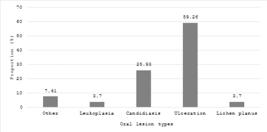
Oral lesion types in homebound older persons to the municipality of Palhoça, Santa Catarina, 2020-2022 (n=26).
With increasing age, a higher proportion of low stimulated salivary flow was observed (81.8%, CI 95% 46.2;95.9) compared to younger homebound older persons (41.2%, CI 95% 20.0;66.0). Regarding the use of antidiabetic drugs, 86.6% (CI 95% 57.1;96.9) had low stimulated salivary flow compared to their peers. Having a mucosal lesion was associated with a high prevalence of low stimulated salivary flow (77.8% CI 95% 57.4;90.0) (table 3).
Association between Low-stimulated salivary, demographic variable, health variables, and oral condition in homebound older persons to the municipality of Palhoça, Santa Catarina, 2020-2022 (n=44).
For the DMFS index, a significantly higher average was observed among those with low unstimulated salivary flow, at 120.35 (SD±13.33), compared to their peers (table 4).
Association between unstimulated salivary flow and mean DMFS in homebound older persons to the municipality of Palhoça, Santa Catarina, 2020-2022 (n=44).
DISCUSSION
The present study showed that 65.9% of participants exhibited low stimulated salivary flow, while 27.3% presented low unstimulated salivary flow. The most prevalent age group was homebound older persons aged 60 to 69 years. The most commonly reported reason for participation was mobility difficulties. Two-thirds of the participants used between five and ten continuous-use medications, with 88.6% taking antihypertensive drugs. Additionally, 52.3% of the sample required upper or lower dental prostheses. The most prevalent component of the DMFS index was the missing component. Furthermore, 59.1% presented some form of oral mucosal lesion, most frequently located on the alveolar ridge/gingiva and the hard/soft palate. Advanced age was associated with a higher prevalence of low-stimulated salivary flow, as was the use of antidiabetic medications.
The sample consisted of Two-thirds of the participants used between five and ten continuous-use medications, with 88.6% taking antihypertensive drugs enrolled in the Better in Home Program, designed for patients with health issues and physical limitations preventing them from reaching a Basic Health Unit independently, requiring more frequent care, health resources, and continuous monitoring [15,16]. The most frequent reason for program utilization was mobility difficulties.
The study population predominantly consisted of female individuals, aligning with the literature [1], which may be explained by women’s greater longevity. A predominance of homebound older persons with low schooling and income levels was observed, consistent with findings from a quantitative study conducted in a municipality in Rio de Janeiro, where participants had an average of 5.34 years of schooling and 65.22% received up to two minimum Brazilian wages [17]. These findings also aligned with the average monthly income in Palhoça (SC) in 2019, which was [2,3] minimum Brazilian wages [18].
The present study confirmed that 65.9% of participants had low stimulated salivary flow, and the prevalence of low unstimulated salivary flow was 27.3%, consistent with the literature. A cross-sectional study evaluating 872 older adults in southern Brazil reported a 56.6% prevalence of low stimulated salivary flow and 36.7% for low unstimulated salivary flow [19]. Despite findings in the literature [19], the present study did not identify a higher prevalence of low salivary flow among women compared to men.
Among homebound older persons with low stimulated salivary flow, 81.1% were in more older. This biological process can be explained by the replacement of acinar cells in the salivary glands with connective tissue and fat over time, which may result in reduced salivary flow. However, evidence indicates that in healthy older persons not using medications, the decrease in salivary production is less pronounced, with no significant clinical alterations [20]. More than two-thirds of homebound older persons using antidiabetic medications exhibited low stimulated salivary flow. The literature emphasizes the relationship between diabetic patients and reduced stimulated and unstimulated salivary flow [21], with a higher prevalence observed in type II diabetes mellitus patients [22].
Furthermore, continuous-use medications have been associated with a higher prevalence of low salivary flow [23]. It is known that aging increases comorbidities and medication use. In the study sample, 63.3% of homebound older persons used five or more daily medications, with antihypertensives being the most prevalent class (88.6%), aligning with previous literature [20].
A primary consequence of low salivary flow is the presence of oral mucosal lesions6. Among homebound older persons with low salivary flow, 77.8% presented oral mucosal lesions, similar to previous findings [24]. The most frequent lesions were ulcerations (59.3%), followed by candidiasis (25.9%). The most common locations were the alveolar ridge/gingiva and the hard/soft palate.
A higher mean of dental caries was associated with low unstimulated salivary flow. Considering saliva’s crucial role in the dental surface by reducing the availability of sugary substrates involved in plaque formation and its buffering and antimicrobial capacity, low salivary flow may mediate tooth loss by keeping the surface prone to dental caries, potentially leading to tooth mutilation [25].
Regarding the DMFS index, the missing component was the most prevalent, with 45.5% of the sample being completely edentulous. Tooth loss has been consistently reported as the most prevalent component in the literature [9]. According to the National Oral Health Survey, 76.5% of Brazilian older persons used a complete upper prosthesis, and 37.5% used a complete lower prosthesis [8].
The need for upper or lower prostheses was present in 52.3% of individuals. In the case of lower prostheses, this need may be related to non-adaptation due to the anatomical and functional characteristics of the mandible, while for both prostheses, poor prosthesis condition could be a contributing factor. A study conducted in southern Brazil with older persons in rural areas in 2020 showed that 61.8% required prostheses [26]. When considering institutionalized older persons, 79.2% required dental prostheses [27].
As limitations, the reduced sample size resulted from the difficulty in identifying homebound older persons due to the lack of a comprehensive Better in home registry and the availability of CHAs and homebound older persons for data collection. However, the study’s strengths include the collection of primary data and the assessment of oral health conditions and salivary flow in homebound older persons, providing an overview of their health status.
CONCLUSION
The presence of low stimulated and unstimulated salivary flow in homebound older persons was related to the presence of unfavorable conditions such as ulceration and candidiasis, caries, and the fact that they were associated with the consumption of medications, especially antidiabetics, in addition to the increase in the prevalence of low salivary flow with increasing age. These data highlight the importance of actions by the multidisciplinary team, recognizing oral health as an integral and necessary part of improving the quality of life of older persons confined to their homes. In addition, new follow-up studies with this population are needed.
-
How to cite this article Mussatto F, Wonsovicz FG, Coelho BB, Figueiredo DR. Salivary flow analysis and oral injuries in homebound older persons care. RGO, Rev Gaúch Odontol. 2025;73:e20250008. http://dx.doi.org/10.1590/1981-86372025000820240030
REFERENCES
-
1 Veras PR, Oliveira M. Aging in Brazil: the construction of a care model. Ciênc Saúde Colet. 2018;23(6):1929-36. https://doi.org/10.1590/1413-81232018236.04722018
» https://doi.org/10.1590/1413-81232018236.04722018 -
2 Costa EC, Nakatani AYK, Bachion MM. Capacity of community elders to develop activities of daily living and instrumental activities of daily living. Acta Paul Enferm. 2006;19(1):43-8. https://doi.org/10.1590/S0103-21002006000100007
» https://doi.org/10.1590/S0103-21002006000100007 -
3 Bastos RS. The impacts of oral health-related quality of life of elderly people living at home: a cross-sectional study. Ciênc Saúde Colet. 2021;26(5):1899-910. https://doi.org/10.1590/1413-81232021265.11962019
» https://doi.org/10.1590/1413-81232021265.11962019 -
4 Pedersen AML, Dynesen AW, Heitmann BL. Older age, smoking, tooth loss, and denture-wearing but neither xerostomia nor salivary gland hypofunction are associated with low intakes of fruit and vegetables in older Danish adults. J Nutr Sci. 2021;10:e47. http://doi.org/ 10.1017/jns.2021.38
» https://doi.org/10.1017/jns.2021.38 -
5 Lima DFL, Carneiro SDRM, Barbosa FTS, Saintrain MVL, Moizan JAH, Doucet J. Salivary flow and xerostomia in older patients with type 2 diabetes mellitus. PLoS One. 2017;12(8):e0180891. https://doi.org/ 10.1371/journal.pone.0180891
» https://doi.org/10.1371/journal.pone.0180891 - 6 Lucena AAG, Costa EB, Alves PM, Figuêiredo RLQ, Pereira JV, Cavalcanti AL. Salivary flow in elderly patients. Rev Gaúch Odontol. 2010;58(3): 301-5.
-
7 Ichikawa Y, Kaneko N, Thwin KM, Senpuku H, Nohno K, Ogawa H. Low salivary IgA levels against PAc (361-386) as a risk factor for root caries in older adults. Clin Exp Dent Res. 2024;10(4):e945. h ttps://doi.org/10.1002/cre2.945
» https://doi.org/10.1002/cre2.945 - 8 Ministério da Saúde, Coordenação Nacional de Saúde Bucal, Departamento de Atenção Básica, Secretaria de Atenção à Saúde (Brasil). Projeto SB BRASIL 2010: condições de saúde bucal da população brasileira 2010: resultados principais. Brasília: Ministério da Saúde; 2012.
-
9 Freitas YNL, Pinheiro NCG, Lima KC. Evaluation of oral health in a cohort of non-institutionalized older adults. Cad Saúde Colet. 2022;30(4):496-506. https://doi.org/10.1590/1414-462X202230040126
» https://doi.org/10.1590/1414-462X202230040126 -
10 Aarønes TR, Taraldsen K, Kvæl LAH. Assessment of older persons with multimorbidity in Norwegian primary care: a qualitative study of healthcare professionals’ experiences and preferences in fostering continuity of care. BMC Health Serv Res. 2025;25(1):6. https://doi.org/10.1186/s12913-024-12185-4
» https://doi.org/10.1186/s12913-024-12185-4 - 11 Ministério da Saúde (Brasil). Portaria No 825, de 25 de abril de 2016. Redefine a Atenção Domiciliar no âmbito do Sistema Único de Saúde (SUS) e atualiza as equipes habilitadas. Brasília: Ministério da Saúde; 2016.
- 12 World Health Organization. Oral health surveys: basic methods. 5th ed. Geneva: ORH/EPID; 2013.
- 13 Ainamo J, Bay I. Problems and proposals for recording gingivitis and plaque. Int Dent J. 1975;25(4): 229-35.
-
14 Navazesh M. Methods for Collecting Saliva. Ann N Y Acad Sci. 1993; 694: 2-7. https://doi.org/10.1111/j.1749-6632.1993.tb18343.x
» https://doi.org/10.1111/j.1749-6632.1993.tb18343.x - 15 Ministério da Saúde, Secretaria de Atenção à Saúde. Departamento de Atenção Básica (Brasil). Caderno de atenção domiciliar. Brasília: Ministério da Saúde; 2012.
-
16 Rajão FL, Martins M. Home Care in Brazil: an exploratory study on the consolidation and use of services in the Unified Health System. Ciênc Saúde Colet. 2020;25(5):1863-77. https://doi.org/10.1590/1413-81232020255.34692019
» https://doi.org/10.1590/1413-81232020255.34692019 -
17 Jeronymo ACO, Seixas CT, Andrade AM, Castro EAB. Home care: care profile of a service linked to a teaching hospital. Physis. 2019;29(2). https://doi.org/10.1590/S0103-73312019290214
» https://doi.org/10.1590/S0103-73312019290214 -
18 Instituto Brasilieiro de Geografia e Estatística. Census populacional 2010. Rio de Janeiro: IBGE; 2010 [citado 25 maio 25]. Disponível em: http:www.ibge.gov.br
» http:www.ibge.gov.br -
19 Rech RS, Hugo FN, Tôrres LHN, Hilgert JB. Factors associated with hyposalivation and xerostomia in older persons in South Brazil. Gerodontology. 2019;36(4):1-7. https://doi.org/10.1111/ger.12415
» https://doi.org/10.1111/ger.12415 -
20 Liu B, Dion MR, Jurasic MM, Gibson G, Jones JA. Xerostomia and salivary hypofunction in vulnerable elders: prevalence and etiology. Oral Surg Oral Med Oral Pathol Oral Radiol. 2012;114(1):52-60. https://doi.org/10.1016/j.oooo.2011.11.014
» https://doi.org/10.1016/j.oooo.2011.11.014 -
21 Al-Maweri SA, Altayyar MO, AlQahtani KW, Bamasud MS, AlGhamdi OY, Ashraf S, et al. Xerostomia, Salivary Flow, and Oral Health Status Among Saudi Diabetic Patients: A Comparative Cross-Sectional Study. Clin Cosmet Investig Dent. 2021;13:451-8. https://doi.org/10.2147/CCIDE.S337581
» https://doi.org/10.2147/CCIDE.S337581 -
22 Diep MT, Jensen JL, Skudutyte-Rysstad R, Young A, Sødal ATT, Petrovski BÉ, et al. Xerostomia and hyposalivation among a 65-year-old population living in Oslo, Norway. Eur J Oral Sci. 2021;129(1):e12757. https://doi.org/10.1111/eos.12757
» https://doi.org/10.1111/eos.12757 -
23 Johanson C, Osterberg T, Lernfelt B, Ekstrom J, Birkhed D. Salivary secretion and drug treatment in four 70-year-old Swedish cohorts during a period of 30 years. Gerodontology. 2015;32(3):202-10. https://doi.org/10.1111/ger.12089
» https://doi.org/10.1111/ger.12089 -
24 Lynge Pedersen AM, Nauntofte B, Smidt D, Torpet LA. Oral mucosal lesions in older people: relation to salivary secretion, systemic diseases and medications. Oral Dis. 2015;21(6):721-9. https://doi.org/10.1111/odi.12337
» https://doi.org/10.1111/odi.12337 -
25 Marques FP, Tôrres LHN, Bidinotto AB, Hilgert JB, Hugo FN, De Marchi RJ. Incidence and predictors of edentulism among south Brazilian older adults. Community Dent Oral Epidemiol. 2017;45(2):160-7. https://doi.org/10.1111/cdoe.12274
» https://doi.org/10.1111/cdoe.12274 -
26 Schroeder FMM, Mendoza-Sassi RA, Meucci RD. Oral health condition and use of dental services among the elderly in a rural area in southern Brazil. Ciênc Saúde Colet. 2020;25(6):2093-102. https://doi.org/10.1590/1413-81232020256.25422018
» https://doi.org/10.1590/1413-81232020256.25422018 -
27 Ribeiro AE, Santos GS, Baldani MH. Edentulism, need for prosthesis and self-perception of oral health among institutionalized elderly. Saúde Debate 2023;47(137):222-41. https://doi.org/10.1590/0103-1104202313716
» https://doi.org/10.1590/0103-1104202313716
Edited by
-
Assistant editor:
Luciana Butini Oliveira

