 Apexification in anterior tooth: case report
ABSTRACT
Incomplete root formation is characterized by the apical end of the root not being fully developed. This condition can occur due to traumatic oral injuries in children and adolescents, carious lesions, or other events that may cause partial or total damage to the pulp tissue. The treatment of these teeth requires special attention due to their anatomical characteristics, such as wide canals and thin, fragile canal walls. Therefore, the objective of this study was to present a clinical case of endodontic treatment in tooth 21 with incomplete root formation. The patient was referred to the endodontic specialization clinic, an initial periapical radiograph was taken which revealed that tooth 21 had incomplete root formation and a periapical lesion, and a CT scan was requested. After clinical and imaging examinations, it was diagnosed as chronic apical abscess. The endodontic treatment was initiated, with intracanal medication exchanges using calcium hydroxide, the creation of an apical plug, and obturation using Hemospon and MTA, and it was restored with composite resin. It was concluded that endodontic treatment using an apical plug with Hemospon in teeth with incomplete root formation is an effective technique, and prolonged follow-up is suggested.
Indexing terms
Coated materials, biocompatible; Cone beam computed tomography; Dentistry; Endodontics; Oral pathology
RESUMO
A rizogênese incompleta, caracteriza-se quando o extremo apical da raiz não está completamente formado. Essa condição pode ocorrer devido a lesões traumáticas bucais em crianças e adolescentes, lesões cariosas ou outros eventos que possam causar injúria parcial ou total no tecido pulpar. O tratamento desses dentes requer uma atenção especial, devido suas características anatômicas, como, canal amplo, parede dos canais radiculares finas e frágeis. Sendo assim, o objetivo desse trabalho foi apresentar um caso clínico de um tratamento endodôntico no dente 21 com rizogênese incompleta. Paciente foi encaminhado para a clínica de especialização de endodontia, foi realizado uma radiografia periapical inicial que revelou que o dente 21 apresentava rizogênese incompleta, lesão periapical e foi solicitado tomografia computadorizada. Após os exames clínicos e de imagem foi diagnosticado como abcesso apical crônico. O tratamento endodôntico foi iniciado, foram realizadas trocas de medicações intracanal com hidróxido de cálcio, confecção de um tampão apical e obturação utilizando hemospon e MTA e foi restaurado com resina composta. Conclui-se que o tratamento endodôntico utilizando tampão apical com hemospon em dentes com rizogênese incompleta é uma técnica efetiva e sugere-se acompanhamento prolongado.
Termos de indexação
Materiais revestidos biocompatíveis; Tomografia computadorizada de feixe cônico; Odontologia; Endodontia; Patologia bucal
INTRODUCTION
Endodontic treatment can present some challenging clinical situations, among which are cases of teeth with incomplete root formation [1]. This condition is defined when the complete formation of the root apex does not occur. Histologically, the root apex lacks apical dentin covered by cementum. Incomplete root formation is not a pathology per se but rather a phase of the dental development process [2]. As such, it becomes a factor that makes endodontic treatment challenging, especially when there is damage to the vitality of the dental pulp and surrounding tissues.
Although multifactorial, the primary causes compromising root formation are carious lesions or dentoalveolar trauma. Both events damage the dental pulp and Hertwig’s epithelial root sheath, which plays a crucial role in root formation [2,3]. Oral traumatic injuries occur more frequently in children and adolescents, which may result in pulp inflammation or necrosis, consequently halting the complete root formation when it has not yet occurred. The teeth most commonly affected are the maxillary central incisors, accounting for the majority of traumatized teeth [4].
The anatomical differences associated with teeth with incomplete root formation are the main factor that makes endodontic treatment for these teeth unique. This is because teeth with incomplete root formation have an extremely wide canal, an unformed apical third, a broad foramen diameter, and thin, fragile walls. Due to these characteristics, treatment steps such as cone blockage during obturation, retention of filling materials, irrigation, and mechanical preparation are considered the most critical [5].
Therefore, it is essential for professionals to have theoretical knowledge about this condition and the technical skills to address the challenges that may arise during treatment. This article aims to present a clinical case of endodontic treatment for a tooth with incomplete root formation in an adult patient.
CASE REPORT
A 22-year-old male patient was seen at the endodontic specialty clinic, referred from a private practice, asymptomatic, with a complaint of discoloration of tooth 21 and the sensation of a “small lump” on the gum.
During the anamnesis, he denied any allergies, chronic illnesses, or continuous medication use and reported having suffered trauma to the facial/oral region more than ten years ago. Clinical examination revealed the presence of a fistula in the region of tooth 21, discoloration of the same tooth, and the presence of fixed orthodontic appliances. Pulp sensitivity tests were performed, yielding negative responses, and vertical and horizontal percussion tests also showed negative responses.
The periapical radiographic examination revealed an open root apex, a wide root canal, and a periapical lesion with diffuse contours (figure 1). The diagnosis was established as chronic periapical abscess.

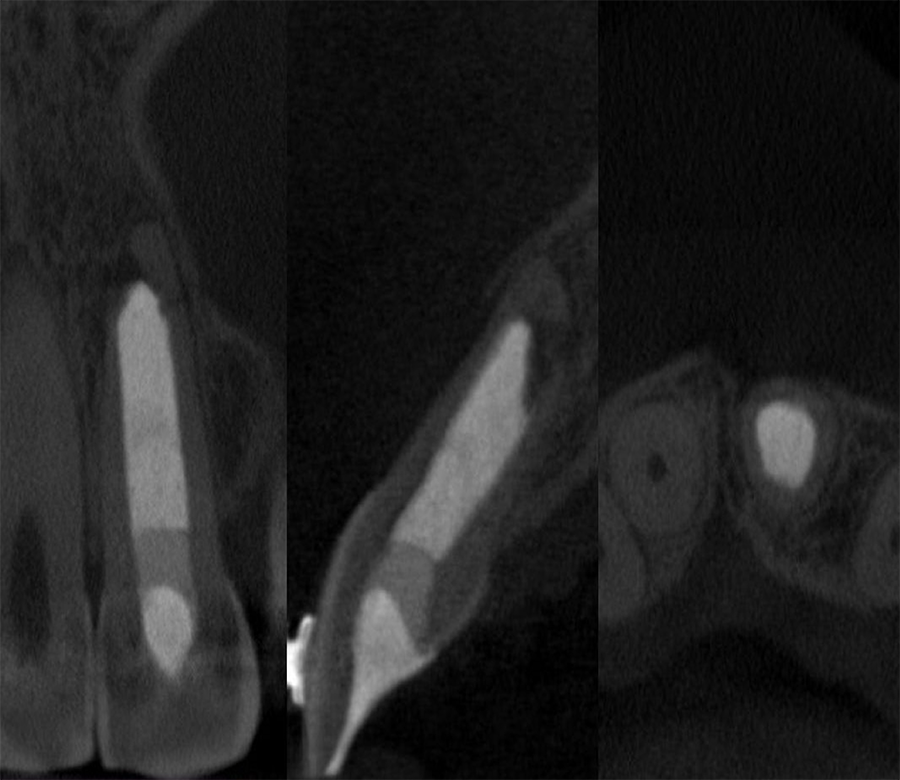
For a more accurate evaluation of the case and a more effective treatment, a cone-beam computed tomography (CBCT) scan was requested (figure 2). This confirmed the radiographic findings and also detected buccal cortical bone destruction in the axial slice. Considering that the patient was wearing fixed orthodontic appliances, the orthodontist was asked to suspend scheduled adjustments until the patient was cleared from endodontic treatment.

In the first session, local anesthesia was administered using 2% lidocaine with 1:100,000 epinephrine (DFL, Taquara, Rio de Janeiro, Brazil). The tooth was isolated with a rubber dam, the restoration was removed, and radiographic odontometry was performed. The chemomechanical preparation was carried out using manual K-type files up to size #80 and 24 mm. The R1 - ClearSonic Black insert (Helse Ultrasonic, Santa Rosa do Viterbo, São Paulo, Brazil) was used on the canal walls to activate the irrigating solution of 2.5% sodium hypochlorite (Asfer, São Caetano do Sul, SP, Brazil) and EDTA (Maquira, Maringá, PR, Brazil) with the ultrasonic insert E1 - Irrisonic (Helse Ultrasonic, Santa Rosa do Viterbo, São Paulo, Brazil). The intracanal medication chosen was calcium hydroxide paste (Maquira, Maringá, PR, Brazil) with propylene glycol (Botique Ouro Preto, Maringá, PR, Brazil) and iodoform (Maquira, Maringá, PR, Brazil), inserted with the ultrasonic insert E1 - Irrisonic (Helse Ultrasonic, Santa Rosa do Viterbo, São Paulo, Brazil). Finally, a coronal seal was made with temporary restorative material Obtur (Maquira, Maringá, PR, Brazil) and glass ionomer cement Ionglass (Maquira, Maringá, PR, Brazil).
After 15 days, a new intracanal medication change was performed (figure 3), as the previous medication had not reached the apical third. The coronal seal was removed, and the irrigating solution was activated with 2.5% sodium hypochlorite (Asfer, São Caetano do Sul, SP, Brazil) and EDTA (Maquira, Maringá, PR, Brazil) using Mklean (MK Life, Porto Alegre, RS, Brazil). The intracanal medication was inserted with calcium hydroxide paste (Maquira, Maringá, PR, Brazil), propylene glycol (Botique Ouro Preto, Maringá, PR, Brazil), and iodoform (Maquira, Maringá, PR, Brazil) using a lentulo spiral #40 (Dentsply Sirona, Charlotte, North Carolina, USA), followed by agitation of the intracanal medication with the ultrasonic tip E1 - Irrisonic (Helse Ultrasonic, Santa Rosa do Viterbo, São Paulo, Brazil). Finally, a coronal seal was performed with temporary restorative material Obtur (Maquira, Maringá, PR, Brazil) and glass ionomer cement Ionglass (Maquira, Maringá, PR, Brazil).
After 1 month, an attempt at revascularization was made; however, the necessary stimulation for bleeding was not achieved. The following month, an apical plug was placed using Hemospon collagen sponge (Maquira, Maringá, PR, Brazil), followed by the application of MTA Repair HP (Angelus Odonto, Londrina, PR, Brazil) along the entire length of the root canal. Then, temporary restorative material Obtur (Maquira, Maringá, PR, Brazil) was placed in the cervical third, and the definitive restoration was completed with Z100 composite resin (3M, Saint Paul, Minnesota, USA). After 4 (figure 4) and 27 months (figure 5), clinical and radiographic evaluations were performed, revealing the absence of a fistula or any gingival inflammation and complete periapical healing.


DISCUSSION
Incomplete root formation requires a detailed clinical and radiographic diagnosis for proper planning, based on information such as: stage of root development, periodontal health, potential lesions, fractures, and carious tissues [5]. This assessment is important because, in young patients, less invasive techniques, such as apexification and revascularization, are known to be highly valuable for preserving dental tissues and minimizing the risk of pulp injury [2].
Conceptually, apexification is a procedure that involves the deposition of a hard tissue barrier at the apical level to close the apical foramen. It is most suitable for immature teeth with devitalized pulp tissue that cannot form a blood clot for revascularization [6]. This technique can be performed using two materials: calcium hydroxide paste or the formation of an apical barrier with MTA (Mineral Trioxide Aggregate), which differ in treatment time and tissue preservation levels [7]. Calcium hydroxide is an intracanal medication capable of promoting the formation of a mineralized barrier and is the preferred material initially for apexification, inducing sealing and facilitating endodontic treatment. However, it has disadvantages, such as the unpredictable duration of treatment, requiring multiple sessions for medication changes, and making dental tissues more fragile, which may predispose to fractures. Alternatively, apexification can also be performed by creating an apical plug with materials such as MTA. This material also serves as an option for cases of pulp necrosis and incomplete root formation due to its ability to form an apical seal through a calcified barrier in a shorter therapy time. Furthermore, MTA acts as a protective factor against pulp microleaks, leading to tissue regeneration, as it is a biocompatible material [8,9].
The comparison between the efficacy of the two materials for performing the apexification technique was studied by Shaik et al. [10], based on clinical studies. The evidence supports the findings that, although there is no significant difference between the materials, there is a consensus that the clinical use of MTA is more advantageous for the success of direct pulp capping, in addition to avoiding root fractures [11].
Moreover, revascularization is also an eligible approach for the endodontic treatment of teeth with incomplete root formation. It involves inducing the regeneration of dental tissues around the pulp through mechanical stimulation, contributing to its longevity. However, as the principle of this technique assumes the biological capacity for such regeneration, the use of the revascularization technique is reserved for younger patient profiles [12].
In the presented case, since the patient was an adult, the use of MTA Repair HP cement was chosen due to its well-described physical, chemical, and biological properties in the literature [13] and its ease of handling and insertion into the root canal with an open apex. Before its insertion, a collagen sponge, Hemospon, was used as a barrier to prevent excessive extrusion of the material, allowing its apical condensation. This material is biocompatible, resorbable, and also has the ability to maintain its structural integrity even in moist environments [14].
Furthermore, cone-beam computed tomography (CBCT) is an innovative imaging exam that stands out for providing three-dimensional images without distortion, unlike conventional radiographs. This tool is highly valuable for the diagnosis of dental pathologies, facilitating case planning and management [15-17].
CONCLUSION
Given the presented case, it was concluded that endodontic treatment using an apical plug with Hemospon and MTA in teeth with incomplete root formation is an effective technique, and prolonged follow-up is suggested. The case is considered a success so far.
How to cite this article
-
Victorino MLZ, Gonçalves GB, Borges TCV, Seron MA, Almeida RS, Victorino FR. Apexification in anterior tooth: case report. RGO, Rev Gaúch Odontol. 2025;73:e20250006. http://dx.doi.org/10.1590/1981-86372025000620240051
REFERENCES
-
1 Nicoloso GF, Goldenfum GM, Pizzol TSD, Scarparo RK, Montagner F, de Almeida Rodrigues J, et al. Pulp revascularization or apexification for the treatment of immature necrotic permanent teeth: systematic review and meta-analysis. J Clin Pediatr Dent. 2019;43(5):305-13. https://doi.org/10.17796/1053-4625-43.5.1
» https://doi.org/10.17796/1053-4625-43.5.1 -
2 Edanami N, Yoshiba K, Shirakashi M, Ibn Belal RS, Yoshiba N, Ohkura N, et al. Impact of remnant healthy pulp and apical tissue on outcomes after simulated regenerative endodontic procedure in rat molars. Sci Rep. 2020;10:20967. https://doi.org/10.1038/s41598-020-78022-w
» https://doi.org/10.1038/s41598-020-78022-w -
3 Claudia GG, Tania MP, Sara QG, Carolina LF, Paula BE. Clinical, histological, and molecular perspective on regenerating nonvital immature teeth. Contemp Clin Dent. 2023;14(3):220-6. https://doi.org/10.4103/ccd.ccd_44_23
» https://doi.org/10.4103/ccd.ccd_44_23 -
4 Bratteberg M, Thelen DS, Klock KS, Bårdsen A. Traumatic dental injuries and pulp sequelae in an adolescent population. Dent Traumatol Off Publ Int Assoc Dent Traumatol. 2021;37(2):294-301. https://doi.org/10.1111/edt.12635
» https://doi.org/10.1111/edt.12635 -
5 Phillips JM, McCann CT, Welbury R. Endodontic Management of Traumatised Permanent Anterior Teeth. Prim Dent J. dezembro de 2020;9(4):37-44. https://doi.org/10.1177/2050168420963304
» https://doi.org/10.1177/2050168420963304 -
6 Phillips JM, McCann CT, Welbury R. Endodontic management of traumatised permanent anterior teeth. Prim Dent J. 2020;9(4):37-44. https://doi.org/10.1177/2050168420963304
» https://doi.org/10.1177/2050168420963304 -
7 Li C, Zheng Z, Deng X, Zhang L, Wang B, Guo Q, et al. Apexification management of mandibular second premolar with a blunderbuss apex and periapical lesion of an adult patient. Case Rep Dent. 2019;2019:7546842. https://doi.org/10.1155/2019/7546842
» https://doi.org/10.1155/2019/7546842 -
8 Boufdil H, Mtalsi M, El Arabi S, Bousfiha B. Apexification with Calcium Hydroxide vs. Revascularization. Case Rep Dent. 2020;2020:9861609. https://doi.org/ 10.1155/2020/9861609
» https://doi.org/10.1155/2020/9861609 -
9 Nassar MAM, Abdelgawad LM, El Rouby MEKDH, Sabry D, Radwan MM. Experimental nano calcium aluminate/tri calcium silicate root repair: Synthesis, physical and mechanical properties compared to mineral trioxide aggregate and Biodentine. Braz Dent Sci. 2022;25(4):1-10. https://doi.org/10.4322/bds.2022.e3368
» https://doi.org/10.4322/bds.2022.e3368 -
10 Shaik I, Dasari B, Kolichala R, Doos M, Qadri F, Arokiyasamy JL, et al. Comparison of the success rate of mineral trioxide aggregate, endosequence bioceramic root repair material, and calcium hydroxide for apexification of immature permanent teeth: systematic review and meta-analysis. J Pharm Bioallied Sci. 2021;13(Suppl 1):S43-7. https://doi.org/10.4103/jpbs.JPBS_810_20
» https://doi.org/10.4103/jpbs.JPBS_810_20 -
11 de Sá MA, Nunes E, de Souza Gruppioni Côrtes MI, Silveira FF. A Short time period in the treatment of an open apice intruded tooth: an 8-year follow-up. Int J Clin Pediatr Dent. 2019;12(2):160-3. https://doi.org/10.5005/jp-journals-10005-1612
» https://doi.org/10.5005/jp-journals-10005-1612 - 12 Siddiqui SH. Management of pulp canal obliteration using the Modified-Tip instrument technique. Int J Health Sci. 2014;8(4):426-8.
-
13 Silva EJNL, Cardoso ML, Rodrigues JP, De-Deus G, Fidalgo TKS. Solubility of bioceramic- and epoxy resin-based root canal sealers: A systematic review and meta-analysis. Aust Endod J. 2021;47(3):690-702. https://doi.org/10.1111/aej.12487
» https://doi.org/10.1111/aej.12487 -
14 Vy CH, Baumgartner JC, Marshall JG. Cardiovascular effects and efficacy of a hemostatic agent in periradicular surgery. J Endod. 2004;30(6):379-83. https://doi.org/10.1097/00004770-200406000-00001
» https://doi.org/10.1097/00004770-200406000-00001 -
15 Santana FFM, Silveira MPM, Diamantino PJS, Fardim KAC, Manhães Júnior LRC, Costa ALF, et al. Study of the pterygoid canal (vidian canal) through images of cone beam computer tomography. Braz Dent Sci. 2020;23(3):1-7. https://doi.org/10.14295/bds.2020.v23i3.1966
» https://doi.org/10.14295/bds.2020.v23i3.1966 -
16 Shokri A, Poorolajal J, Faramarzi F. Comparison of the accuracy of cone-beam computed tomography, photostimulable phosphor imaging plate, charge coupled device, and conventional intraoral radiography in the diagnosis of internal root resorption: an in vitro study. Braz Dent Sci. 2014;17(1):72-80. https://doi.org/10.14295/bds.2014.v17i1.937
» https://doi.org/10.14295/bds.2014.v17i1.937 -
17 Sheikhi M, Karami M, Abbasi S, Moaddabi A, Soltani P. Applicability of cone beam computed tomography gray values for estimation of primary stability of dental implants. Braz Dent sci. 2021;24(1):1-8. https://doi.org/ 10.14295/bds.2021.v24i1.2068
» https://doi.org/10.14295/bds.2021.v24i1.2068
-
Assistant editor:
Luciana Butini Oliveira