 Genotypic virulence profiles and mobile genetic elements related to invasiveness in Neisseria gonorrhoeae strains
ABSTRACT
Neisseria gonorrhoeae (NG) has become an increasing global health threat due to drug resistance and potentially invasive disease. In this study, we assessed the genotypic profile in both invasive and non-invasive NG strains from patients at University of Sao Paulo Faculty of Medicine Clinics Hospital, Brazil. We analyzed the NG genotypic profiles and clinical data from 25 patients hospitalized at Hospital das Clinicas da Faculdade de Medicina da Universidade de Sao Paulo (HC-FMUSP) from January 2017 to March 2020. A total of 25 isolates underwent whole genome sequencing, of which 10 (40%) were collected from sterile sites like blood and classified as invasive. Invasive and noninvasive specimens were clustered in 5 STs and 11 STs, respectively, sharing 3 STs in common. We identified resistance markers for macrolides (mtrR) in 40% of isolates and 92% exhibited at least one resistance marker for beta-lactams (penA, blaTEM-1B, or blaTEM-135), predominantly PBP1 and PBP2 alterations. Resistance genes blaTEM-1B (7%vs.50%, p=0.023) and tetM (13%vs.80%, p=0.002) were more frequently found in invasive disease isolates, always accompanied by the mobile genetic elements pJD4 and pEP5289, respectively. Associated with these elements were two toxin encoding genes (vapD and zeta1/2) previously described as possible virulence factors and resistance genes for beta-lactams and tetracyclines. Results revealed that invasive strains of NG are genotypically clustered and frequently harbor two plasmids which may be associated with invasive disease. Resistance markers for beta-lactam as PBP1 and PBP2 alterations warn against a future potential resistance to this class.
KEYWORDS:
Neisseria gonorrhoeae
; Invasive; Non-invasive; Virulence; Whole genome sequencing
INTRODUCTION
Sexually transmitted infections (STIs) are a global public health issue and can be associated with severe outcomes1-4. Estimates indicate that approximately 1 million STIs are contracted worldwide each day, with about 82.4 million Neisseria gonorrhoeae (NG) infections occurring globally in 2020. According to the World Health Organization (WHO), the Americas registered approximately 9.8 million NG cases during this period3. In response to this global public health concern, the WHO has set targets to reduce the incidence of NG infections by 2030 as part of its Global Health Strategy for STIs.
Treating bacterial infections, especially those caused by NG, is challenging due to increasing antimicrobial resistance5. Neisseria gonorrhoeae has shown resistance to all classes of antimicrobials available for treatment, which may render it untreatable6-8. In this scenario, knowledge about the resistance and virulence profile of infectious agents can play a crucial role in formulating effective public health policies to combat STIs1.
Without early diagnosis and adequate treatment, NG infections can lead to complications such as pelvic inflammatory disease, ectopic pregnancy and infertility9-11. Less frequently, untreated disease could manifest as invasive gonococcal disease (IGD) where the bacteria are isolated from sterile sites due to hematogenous spread from the initial mucosal infection focus. IGD accounts for 0.5% to 3% of gonorrhea cases and can manifest as purulent arthritis, endocarditis, meningitis, osteomyelitis, and bloodstream infection11.
In addition to host-related factors like immunosuppression12, research has already linked a higher likelihood of IGD presentation to genotypic elements of NG strains. Studies have shown gonococcal genetic islands associated with conjugation mechanisms, opa genes related to phagocytosis resistance, allele 1A of the porB gene encoding porin variations, among others13,14.
In Brazil, studies on the genetic characterization of NG isolates and virulence profiles are limited and primarily focused on antibiotic resistance surveillance15-19. Despite their scarcity, the available data indicate a high and increasing antimicrobial resistance in NG, with resistance rates of 67.3%, 40.0% and 10.6% for ciprofloxacin, tetracyclines and azithromycin, respectively. To date, no Brazilian strains with ceftriaxone resistance have been described in surveillance studies18.
Thus, this study assessed the genotypic virulence profiles related to IGD compared with non-invasive NG strains from individuals with gonococcal disease hospitalized at the Hospital das Clinicas da Faculdade de Medicina da Universidade de Sao Paulo (HC-FMUSP).
MATERIALS AND METHODS
Study population
This retrospective study included 25 NG samples from all available isolates of invasive and non-invasive gonococcal disease cases treated at the HC-FMUSP from 2017 to 2020.
Ethics
Ethics approval for this study was obtained from the HC-FMUSP Ethical Committee (Sao Paulo, Brazil), Nº 5.054.730.
Patient data
Patients were evaluated by reviewing epidemiological and clinical data registered on electronic medical records. Clinical and demographic variables, including age, gender, date and isolation site, use of immunosuppressive medications, serology for other STIs, treatment details, and hospitalization status were extracted. Additional patient data were recovered from the Ministry of Health's Laboratory Exams Control System (SISCEL) to access records in the national HIV treatment program.
Bacterial isolates and genomic analysis
A total of 25 NG isolates from invasive (n=10) and non-invasive (n=15) infections were identified by matrix-assisted laser desorption/ionization time-of-flight (MALDI-TOF; Bruker Biotyper 3.1, Bruker Daltonics) available at the HC-FMUSP. All isolates underwent Whole Genome Sequencing (WGS) by Ion Torrent PGM technology (Thermo Fisher Scientific, Waltham, MA, USA) located at the Sao Paulo Institute of Tropical Medicine20.
Resistome was analyzed using ResFinder 4.0 and Comprehensive Antibiotic Resistance Database Card (CARD) 4.021,22. Virulence genes were identified using the Virulence Factor Database (VFDB) tool23. NG Multi-Antigen Sequence Typing (NG-MAST) and Sequence Typing for Antimicrobial Resistance (NG-STAR) were performed and types identified by the PubMLST tool24, also confirming species identification. Mutations in resistance genes were manually searched in the genomes using the Basic Local Alignment Search Tool (BLAST). Creating the consensus sequence for Neisseria gonorrhoeae involved the assembly of sequences on Unipro UGENE 48.1, using a closely related reference sequence (sequence typing) as a key component25,26.
A phylogenetic tree was constructed using the REALPHY tool (v. 1.12). Neisseria gonorrhoeae FA19 (GenBank accession Nº NZ_CP012026.1) served as reference for molecular characterization. Single Nucleotide Polymorphisms (SNPs) were calculated on Seaview25, and multiple sequence alignments were recreated using PhyML with 500 bootstrap replications for tree construction27. All Neisseria gonorrhoeae sequencing data from this study were submitted to GenBank and are available through Bioproject Nº PRJNA625087.
Data analysis
Categorical variables were expressed as absolute numbers (percentage), and continuous variables as medians (interquartile range [IQR]). Comparison of categorical variables used the chi-squared test or Fisher's exact test as appropriate. Statistical tests were two-tailed, with a significant level of 0.05. All analyses were performed on Stata software (version 13.0, StataCorp LLC, Texas, USA).
RESULTS
Analysis included a total of 25 patients (Table 1) who sought hospital care due to NG related symptoms. Of these, 60% were male and 64% were white, with a median age of 23 years (p25=20, p75=32). Three (12%) patients were undergoing treatment with an immunosuppressive medication (Mycophenolate + Prednisone, Hydroxychloroquine + Methotrexate + Prednisone, and Mycophenolate) for Systemic Lupus Erythematosus (SLE).
Characterization of the 25 individuals with Neisseria gonorrhoeae at the Clinics Hospital, Brazil
Serological tests for other STIs (HIV, Hepatitis B, Hepatitis C, and Syphilis) were requested for only 14 (56%) patients; testing for Mycoplasma, Chlamydia or other infections was not performed. No patients had positive serology for other STIs, and none were registered in the national HIV treatment program. Twelve (48%) patients required hospitalization for investigating and treating complications, with no recorded fatalities.
Isolates were obtained from anogenital (n=7; 28%), ophthalmic (n=8; 32%), joint (n=7; 28%), and blood culture samples (n=3; 12%). Ten (40%) IGD cases were identified (Table 1). One patient in the blood culture group appeared in medical records as having aortitis due to NG, while another was diagnosed with endocarditis on a prosthetic pulmonary valve.
Four patients (16%) left hospital care without receiving antibiotic therapy, all of whom had presented with anogenital symptoms. Of the 21 remaining patients, 18 (85%) received ceftriaxone as part of their treatment regimen. One patient with ophthalmic symptoms was administered topical ciprofloxacin treatment, while another with anogenital symptoms had been prescribed oral ciprofloxacin. One patient who had presented with joint symptoms was initially treated with clindamycin and gentamicin; seven days after culture results, their treatment was switched to oral azithromycin.
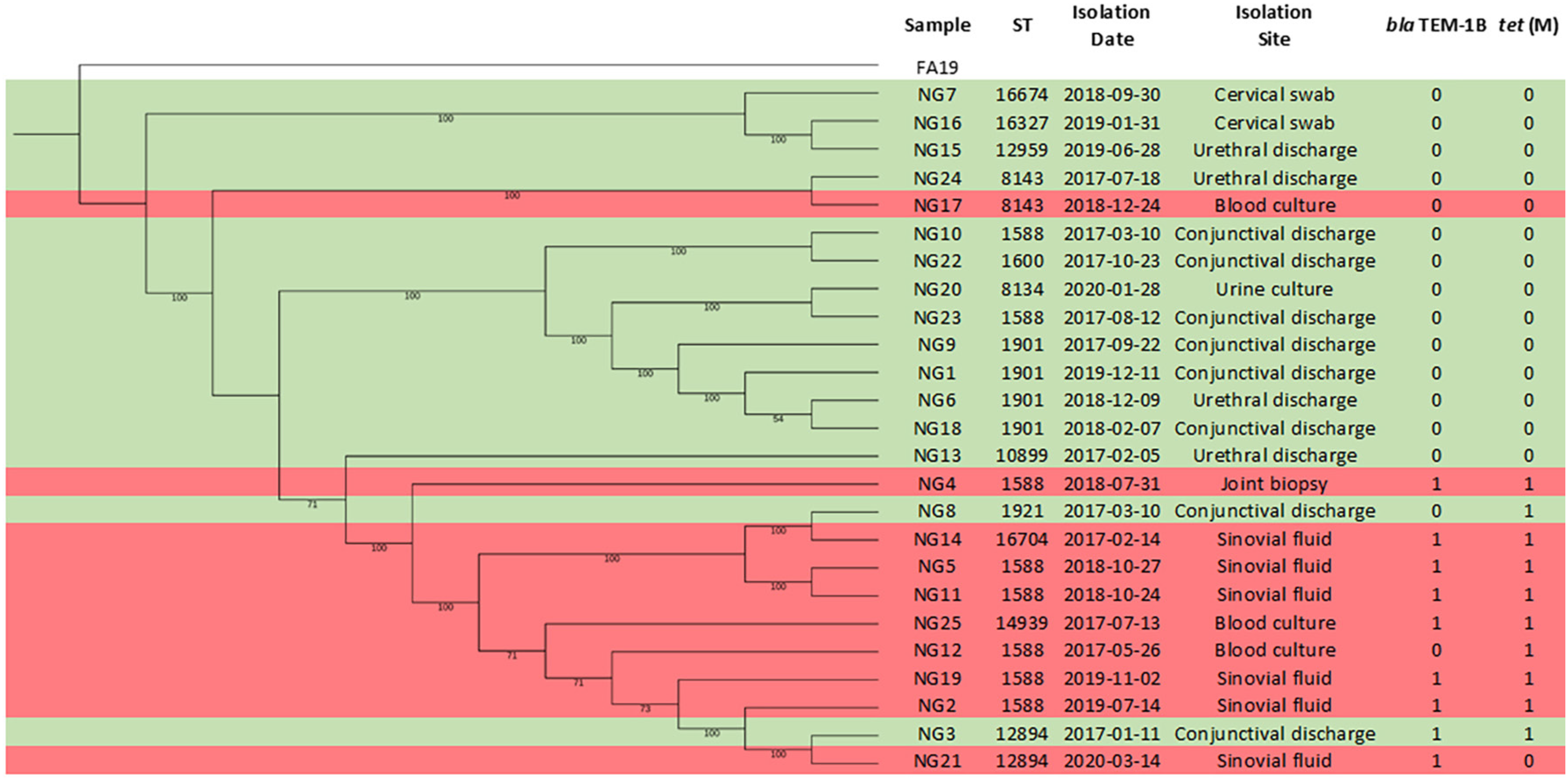
Molecular characterization of the isolates identified 13 different Sequence Types (STs), namely: 1588, 1600, 1901, 1921, 8134, 8143, 10899, 12894, 12959, 14939, 16327, 16674, 16704, and four (10899, 16327, 16674, 16704) which had not previously been described in Brazil. STs 1588 (n=8; 32%) and 1901 (n=4; 16%) were the most frequently observed. Phylogenetic tree analysis showed two clusters broadly grouping by ST, differentiating between IGD and non-IGD isolates (Figure 1). Table 2 presents a more detailed description of genotypic profile and individual patient characteristics.
Phylogenetic tree of the analyzed samples with corresponding MLST, isolation site, and presence (1) or absence (0) of the blaTEM-1B and tetM genes. MLST: Multilocus Sequence Typing; NG: Neisseria gonorrhoeae. Red: Invasive Gonococcal Disease (IGD); Green: Non- Invasive Gonococcal Disease (Non-IGD).
Descriptive characteristics and genotypic profile of the 25 individuals with Neisseria gonorrhoeae
Resistome analysis detected the rpsJ and tetM genes in 40% of isolates, both associated with tetracycline resistance, whereas 92% of strains exhibited at least one resistance marker gene for beta-lactams (penA, blaTEM-1B, or blaTEM-135), predominantly PBP1 and PBP2 alterations. We also identified resistance markers for fluoroquinolones (gyrA and parC) in 32% and for macrolides (mtrR) in 40% of patients (Table 3).
Descriptive/demographic variables and genes evaluated in bivariate analysis comparing IGD and Non-IGD in 25 individuals with Neisseria gonorrhoeae.
Other identified genes related to adhesion (LOS and Type IV Pili), efflux pump (FarAB and MtrCDE), IgA protease, immunomodulation (NspA and fHbp), invasion, iron uptake (HmbR, HpuAB, Lbp, Tbp), and stress proteins (KatA, MntABC, MsrAB, RecN). None of the strains exhibited genes related to anti-phagocytosis.
Bivariate analysis showed a marginal association between the use of immunosuppressive drugs and presence of IGD (0% vs. 30%, p = 0.052). No demographic and clinical data or virulence gene identified in the database tools exhibited a statistically significant association with IGD. Regarding resistance genes, the blaTEM-1B (7% vs. 50%, p = 0.023) and tetM genes (13% vs. 80%, p = 0.002) were more frequently detected in isolates from IGD patients (Table 3). These genes encode for beta-lactamases and modify the binding site of tetracyclines, respectively. All samples exhibiting these genes belonged to the cluster with predominantly IGD cases in the phylogenetic tree (Figure 1).
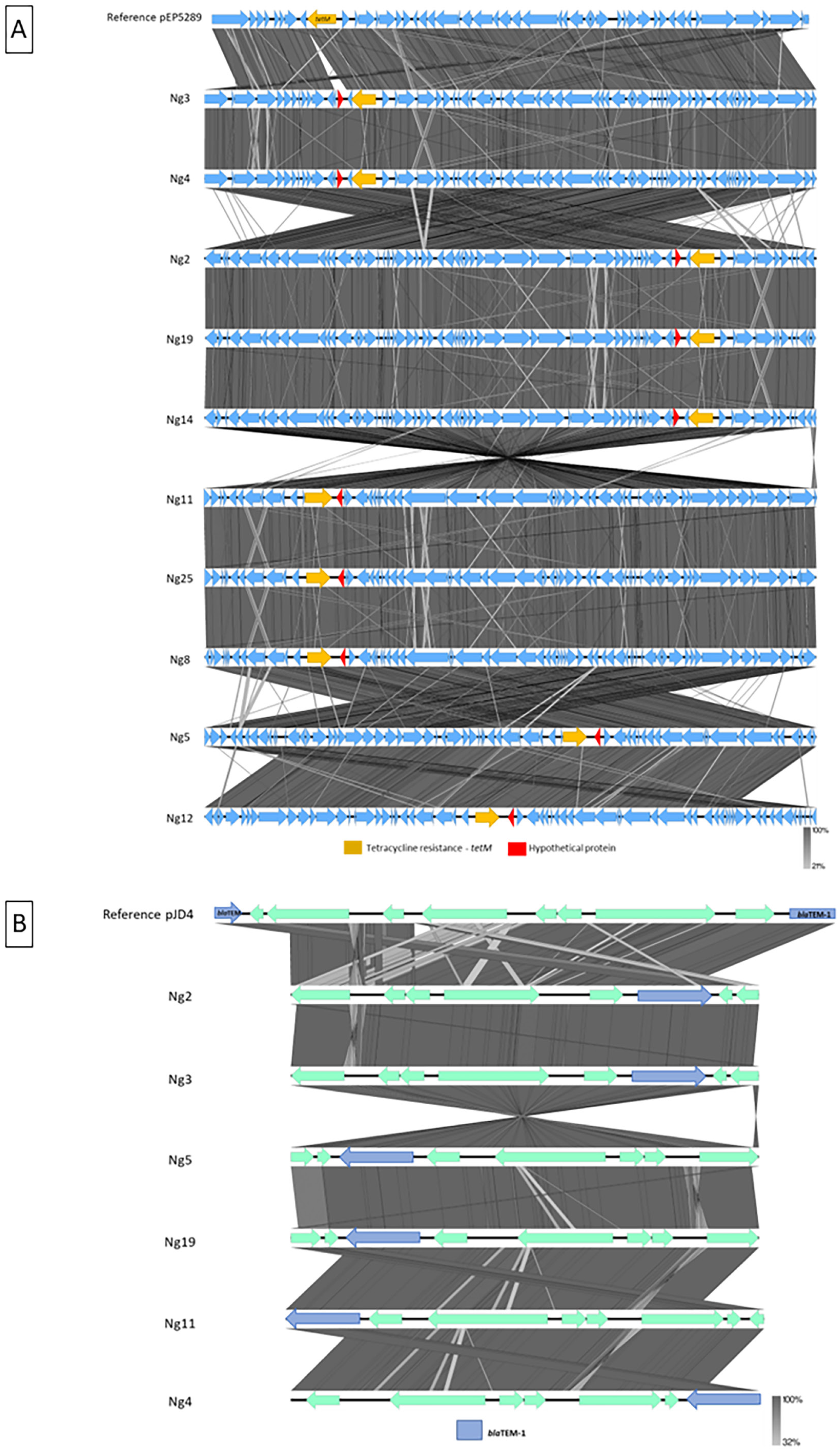
We detected Mobile Genetic Elements (MGEs) associated with the tetM gene within the plasmid pEP5289, and blaTEM-1B gene associated with plasmid pJD4. All samples that yielded positive results for tetM or blaTEM-1B also exhibited MGEs. The MGEs observed in our genome samples aligned with a reference sequence, revealing a high degree of similarity (Figure 2).
(A) Alignment with reference plasmid pEP5289 with those found in the samples. Yellow: tetM gene; Red: Hypothetical protein; Blue: Remaining genes. (B) Alignment with reference phage pJD4 with those found in the samples. Blue: blaTEM-1B; Green: Remaining genes.
DISCUSSION
The present study observed a clear phylogenetic grouping of NG STs associated with invasive disease and identified four NG STs which had not been previously described in Brazil. Interestingly, we identified MGEs from the NG genome—plasmids pEP5289 and pJD4—that were potentially associated with increased IGD risk and that patients using immunosuppressive medications might also be at higher risk of IGD. Particularly, we identified potential sub-optimal care for these patients, given the inappropriate or absent antibiotic treatment in a minority of cases and the low frequency of STIs testing.
Said association between the presence of pJD4 and pEP5289 plasmids and IGD occurrence has not been shown previously. Plasmid pJD4 has previously been associated with resistance transfer from beta-lactams to other enterobacteria and Haemophilus influenzae28,29. Plasmid pEP5289 has also been associated with the carriage of tetracycline resistance genes and has been found in commensal species of the Neisseria genus and other bacteria such as Kingella denitrifans and Eikenella corrodens, suggesting it functions as a resistance reservoir30,31. This possible association between these plasmids and invasiveness may be related to the presence of virulence genes inserted in these MGEs. For example, the vapD and zeta1/2 genes found in plasmid pEP5289 encode two toxins previously described as possible virulence factors in in vitro studies32,33.
The clustering of invasive samples could indicate that phylogenetic factors may also influence NG pathogenicity. The most prevalent STs observed, 1588 and 1901, were also the most frequently identified in previous Brazilian studies19. However, the invasive strains of a previous study conducted by Guglielmino et al.14 showed no phylogenetic grouping of invasive strains between the two populations analyzed. Moreover, the authors observed a much lower frequency of pJD4 and pEP5289 plasmids among invasive strains compared with our findings.
These findings suggest the existence of other factors related to the pathogen or host that may explain IGD occurrence in that study. The association found between immunosuppression and susceptibility and IGD occurrence had previously been suggested in different immunosuppression contexts. SLE patients using other immunosuppressants and patients with deficiencies in the complement system have already been associated in case series with greater susceptibility to IGD12,34,35. These findings highlight the likely influence of host-associated factors on IGD risk, and not NG virulence itself.
The frequency of NG strains in Brazil has been previously described16,18,19 using WGS and MLST. These analyses enable evaluating the circulation of genotypic resistance markers and predominant STs, and predict the introduction of international strains with reduced susceptibility to antimicrobials. In the most recent analysis prior to our study, 1901 and 1588 were the predominant STs in Brazil, corresponding to over 30% of strains analyzed19. In our study, 48% of specimens belonged to these STs.
A concerning fact is the significant percentage of IGD patients who were not tested for other STIs such as HIV, hepatitis and syphilis. This finding highlights missed opportunities for improving patient care in our institution. Testing for other STIs at the time of IGD diagnosis is a recommended procedure in the STIs management protocol issues by the Brazilian Ministry of Health36. STI testing is important for a two-fold reason: first, gonorrhea may increase the risk of acquiring other STIs; second, STI co-infections and associated morbidities are common37,38.
Another concerning finding regarding patient care was evidence of sub-optimal or lack of treatment. Three patients did not receive ceftriaxone, two of whom were administered ciprofloxacin monotherapy. Ceftriaxone is recommended by the Ministry of Health36 for treating NG in Brazil for all clinical presentations given high resistance rates to fluoroquinolones and macrolides18. Moreover, four patients were discharged without any antibiotic prescription, most likely due to prolonged waiting times in urgent care. Improving treatment management of NG patients in this setting is a priority.
Our findings emphasize the need for genotypic surveillance studies of NG isolates beyond antimicrobial resistance profiles, and further studies with a larger and more diverse sample size to confirm such findings. The causality between the presence of pathogen genetic factors and virulence could also be better assessed by in vitro studies or animal models, both lacking in this context.
Regarding study limitations, the small sample size and evaluation of patients from a single center may compromise the internal and external validity of our findings, respectively. Evaluation of noninvasive gonococcal infection cases using only patients with positive culture may represent a selection bias, since this subgroup may not be representative of all non-IGD cases. However, to our knowledge this is the first Brazilian study to evaluate genotypic characteristics of NG isolates associated with IGD.
CONCLUSION
Our results revealed that invasive strains of NG in our sample were genotypically clustered and harbored two plasmids which could be associated with invasive disease, evincing the need for more NG surveillance projects in Brazil to better ascertain these findings.
DATA AVAILABILITY
The anonymized dataset generated during this study is available from the corresponding author upon reasonable request.
REFERENCES
-
1 World Health Organization. Global action plan to control the spread and impact of antimicrobial resistance in Neisseria gonorrhoeae. Geneva: WHO; 2012. [cited 2026 Jan 27]. Available from: https://www.who.int/publications/i/item/9789241503501
» https://www.who.int/publications/i/item/9789241503501 -
2 World Health Organization. Sexually transmitted infections: evidence brief. Geneva: WHO; 2019. [cited 2026 Jan 27]. Available from: https://www.who.int/publications/i/item/WHO-RHR-19.22
» https://www.who.int/publications/i/item/WHO-RHR-19.22 -
3 World Health Organization. Global progress report on HIV, viral hepatitis and sexually transmitted infections, 2021: accountability for the global health sector strategies 2016–2021: actions for impact. Geneva: WHO; 2022. [cited 2026 Jan 27]. Available from: https://www.who.int/publications/i/item/9789240027077
» https://www.who.int/publications/i/item/9789240027077 - 4 Unemo M, Shafer WM. Antimicrobial resistance in Neisseria gonorrhoeae in the 21st century: past, evolution, and future. Clin Microbiol Rev. 2014;27:587-613.
- 5 Sánchez-Busó L, Cole MJ, Spiteri G, Day M, Jacobsson S, Golparian D, et al. Europe-wide expansion and eradication of multidrug-resistant Neisseria gonorrhoeae lineages: a genomic surveillance study. Lancet Microbe. 2022;3:e452-63.
- 6 Eyre DW, Sanderson ND, Lord E, Regisford-Reimmer N, Chau K, Barker L, et al. Gonorrhoea treatment failure caused by a Neisseria gonorrhoeae strain with combined ceftriaxone and high-level azithromycin resistance, England, February 2018. Euro Surveill. 2018;23:1800323.
- 7 Whiley DM, Jennison A, Pearson J, Lahra MM. Genetic characterisation of Neisseria gonorrhoeae resistant to both ceftriaxone and azithromycin. Lancet Infect Dis. 2018;18:717-8.
-
8 European Centre for Disease Prevention and Control. Rapid risk assessment: extensively drug-resistant (XDR) Neisseria gonorrhoeae in the United Kingdom and Australia. Stockholm: ECDC; 2018. [cited 2026 Jan 27]. Available from: https://www.ecdc.europa.eu/en/publications-data/rapid-risk-assessment-extensively-drug-resistant-xdr-neisseria-gonorrhoeae-united
» https://www.ecdc.europa.eu/en/publications-data/rapid-risk-assessment-extensively-drug-resistant-xdr-neisseria-gonorrhoeae-united - 9 Eschenbach DA, Buchanan TM, Pollock HM, Forsyth PS, Alexander ER, Lin JS, et al. Polymicrobial etiology of acute pelvic inflammatory disease. N Engl J Med. 1975;293:166-71.
- 10 Liu B, Roberts CL, Clarke M, Jorm L, Hunt J, Ward J. Chlamydia and gonorrhoea infections and the risk of adverse obstetric outcomes: a retrospective cohort study. Sex Transm Infect. 2013;89:672-8.
- 11 Birrell JM, Gunathilake M, Singleton S, Williams S, Krause V. Characteristics and impact of disseminated gonococcal infection in the "Top End" of Australia. Am J Trop Med Hyg. 2019;101:753-60.
- 12 Petersen BH, Lee TJ, Snyderman R, Brooks GF. Neisseria meningitidis and Neisseria gonorrhoeae bacteremia associated with C6, C7, or C8 deficiency. Ann Intern Med. 1979;90:917-20.
- 13 Cartee JC, Joseph SJ, Weston E, Pham CD, Thomas JC 4th, Schlanger K, et al. Phylogenomic comparison of Neisseria gonorrhoeae causing disseminated gonococcal infections and uncomplicated gonorrhea in Georgia, United States. Open Forum Infect Dis. 2022;9:ofac247.
- 14 Guglielmino CJ, Sandhu S, Lau CL, Buckley C, Trembizki E, Whiley DM, et al. Molecular characterisation of Neisseria gonorrhoeae associated with disseminated gonococcal infections in Queensland, Australia: a retrospective surveillance study. BMJ Open. 2022;12:e061040.
- 15 Costa-Lourenço AP, Abrams AJ, Santos KT, Argentino IC, Coelho-Souza T, Caniné MC, et al. Phylogeny and antimicrobial resistance in Neisseria gonorrhoeae isolates from Rio de Janeiro, Brazil. Infect Genet Evol. 2018;58:157-63.
- 16 Cassu-Corsi D, Santos FF, Cayô R, Martins WM, Nodari CS, Almeida LG, et al. Genomic analyses of ciprofloxacin-resistant Neisseria gonorrhoeae isolates recovered from the largest South American metropolitan area. Genomics. 2022;114:110287.
- 17 Bazzo ML, Golfetto L, Gaspar PC, Pires AF, Ramos MC, Franchini M, et al. First nationwide antimicrobial susceptibility surveillance for Neisseria gonorrhoeae in Brazil, 2015–16. J Antimicrob Chemother. 2018;73:1854-61.
- 18 Machado HM, Martins JM, Schörner MA, Gaspar PC, Bigolin A, Ramos MC, et al. National surveillance of Neisseria gonorrhoeae antimicrobial susceptibility and epidemiological data of gonorrhoea patients across Brazil, 2018-20. JAC Antimicrob Resist. 2022;4:dlac076.
- 19 Golparian D, Bazzo ML, Golfetto L, Gaspar PC, Schörner MA, Schwartz Benzaken A, et al. Genomic epidemiology of Neisseria gonorrhoeae elucidating the gonococcal antimicrobial resistance and lineages/sublineages across Brazil, 2015-16. J Antimicrob Chemother. 2020;75:3163-72.
- 20 Rothberg JM, Hinz W, Rearick TM, Schultz J, Mileski W, Davey M, et al. An integrated semiconductor device enabling non-optical genome sequencing. Nature. 2011;475:348-52.
- 21 Alcock BP, Huynh W, Chalil R, Smith KW, Raphenya AR, Wlodarski MA, et al. CARD 2023: expanded curation, support for machine learning, and resistome prediction at the Comprehensive Antibiotic Resistance Database. Nucleic Acids Res. 2023;51:D690-9.
- 22 Bortolaia V, Kaas RS, Ruppe E, Roberts MC, Schwarz S, Cattoir V, et al. ResFinder 4.0 for predictions of phenotypes from genotypes. J Antimicrob Chemother. 2020;75:3491-500.
- 23 Liu B, Zheng D, Jin Q, Chen L, Yang J. VFDB 2019: a comparative pathogenomic platform with an interactive web interface. Nucleic Acids Res. 2019;47:D687-92.
- 24 Larsen MV, Cosentino S, Rasmussen S, Friis C, Hasman H, Marvig RL, et al. Multilocus sequence typing of total-genome-sequenced bacteria. J Clin Microbiol. 2012;50:1355-61.
- 25 Galtier N, Gouy M, Gautier C. SEAVIEW and PHYLO_WIN: two graphic tools for sequence alignment and molecular phylogeny. Comput Appl Biosci. 1996;12:543-8.
- 26 Bertels F, Silander OK, Pachkov M, Rainey PB, van Nimwegen E. Automated reconstruction of whole-genome phylogenies from short-sequence reads. Mol Biol Evol. 2014;31:1077-88.
- 27 Sullivan MJ, Petty NK, Beatson SA. Easyfig: a genome comparison visualizer. Bioinformatics. 2011;27:1009-10.
- 28 Pagotto F, Dillon JA. Multiple origins and replication proteins influence biological properties of beta-lactamase-producing plasmids from Neisseria gonorrhoeae. J Bacteriol. 2001;183:5472-81.
- 29 Guiney DG Jr, Ito JI Jr. Transfer of the gonococcal penicillinase plasmid: mobilization in Escherichia coli by IncP plasmids and isolation as a DNA-protein relaxation complex. J Bacteriol. 1982;150:298-302.
- 30 Knapp JS, Johnson SR, Zenilman JM, Roberts MC, Morse SA. High-level tetracycline resistance resulting from TetM in strains of Neisseria spp, Kingella denitrificans, and Eikenella corrodens. Antimicrob Agents Chemother. 1988;32:765-7.
- 31 Pachulec E, van der Does C. Conjugative plasmids of Neisseria gonorrhoeae. PLoS One. 2010;5:e9962.
- 32 Rocker A, Peschke M, Kittilä T, Sakson R, Brieke C, Meinhart A. The ng_ζ1 toxin of the gonococcal epsilon/zeta toxin/antitoxin system drains precursors for cell wall synthesis. Nat Commun. 2018;9:1686.
- 33 Daines DA, Jarisch J, Smith AL. Identification and characterization of a nontypeable Haemophilus influenzae putative toxin-antitoxin locus. BMC Microbiol. 2004;4:30.
- 34 Mitchell SR, Nguyen PQ, Katz P. Increased risk of neisserial infections in systemic lupus erythematosus. Semin Arthritis Rheum. 1990;20:174-84.
- 35 Ross SC, Densen P. Complement deficiency states and infection: epidemiology, pathogenesis and consequences of neisserial and other infections in an immune deficiency. Medicine (Baltimore). 1984;63:243-73.
-
36 Brasil. Ministério da Saúde. Secretaria de Vigilância em Saúde. Departamento de Doenças de Condições Crônicas e Infecções Sexualmente Transmissíveis. Protocolo clínico e diretrizes terapêuticas para atenção integral às pessoas com infecções sexualmente transmissíveis (IST). Brasília: Ministério da Saúde; 2022. [cited 2026 Jan 27]. Available from: https://www.gov.br/aids/pt-br/central-de-conteudo/pcdts/2022/ist/pcdt-ist-2022_isbn-1.pdf/view
» https://www.gov.br/aids/pt-br/central-de-conteudo/pcdts/2022/ist/pcdt-ist-2022_isbn-1.pdf/view - 37 Bernstein KT, Marcus JL, Nieri G, Philip SS, Klausner JD. Rectal gonorrhea and chlamydia reinfection is associated with increased risk of HIV seroconversion. J Acquir Immune Defic Syndr. 2010;53:537-43.
- 38 Wasserheit JN. Epidemiological synergy. Interrelationships between human immunodeficiency virus infection and other sexually transmitted diseases. Sex Transm Dis. 1992;19:61-77.
Edited by
-
Editor:
Thelma Suely Okay https://orcid.org/0000-0001-9316-7288