
 Study on silica fume-hybrid fiber composite modified alkali-activated slag concrete: mix ratio orthogonal experiment, crack propagation, and microstructure
ABSTRACT
Alkali-activated materials (AAM), which are derived from aluminosilicate substances and activators, represent a sustainable and low-carbon alternative to ordinary Portland cement (OPC). The incorporation of fibers helps mitigate brittleness and enhance toughness. An orthogonal experimental approach was used to systematically examine the impact of silica fume (SF) content, the volume fraction of basalt fiber (BF) and polypropylene fiber (PPF), and alkali contents on the mechanical properties of slag-based cementitious materials. The synergistic enhancement mechanism of SF modification and its combination with hybrid fibers were revealed through macroscopic mechanical testing, digital image correlation (DIC) for deformation field analysis, pore structure testing, and microstructural observation. The orthogonal experimental results indicated that the optimal mix ratio for comprehensive mechanical properties was SF of 6 wt.%, BF of 0.2 vol.%, PPF of 0.1 vol.%, and alkali of 9 wt.%. Under this optimal mix ratio, the uniaxial compressive and splitting tensile properties were significantly improved compared to the control group. Combined SF and hybrid fibers promoted crack propagation and multi-cracking. DIC results demonstrated that hybrid fibers effectively redistributed strain concentration and delayed crack initiation. Microstructural analysis shows that SF optimizes pore distribution through physical filling and participates in chemical reactions to form C-A-S-H gel. Fibers acted to hinder crack propagation and bridge cracks. The synergy not only reduced harmful pores in the matrix but also promoted microstructural densification, thereby significantly enhancing the mechanical properties of the material.
Keywords:
Alkali-activated materials; Silica fume; Fiber; Crack propagation; Static mechanical properties
1. INTRODUCTION
As a prevalent construction material, concrete usually contains OPC, aggregates, and water, while OPC fabrication entails high energy consumption, with an energy consumption exceeding 4000 MJ a ton of cement, and is associated with substantial CO2 emissions, which contribute to global environmental degradation and resource depletion [1,2,3,4]. Consequently, developing lowcarbon materials to replace OPC has emerged as a central research priority in construction materials. AAM is regarded as the preferred strategy due to its exceptional comprehensive performance, which primarily includes high mechanical strength, outstanding durability, good thermal stability, and a relatively low reaction temperature of no more than 90°C [5,6,7]. AAM is produced by the chemical interaction between aluminosilicate precursors and alkaline activators [8]. Typical precursors include fly ash, steel slag, and S95 slag [9,10,11]. Among these, S95 slag is considered a preferred precursor because of its high calcium content, rapid hardening, high early-age strength, and favorable durability, which provide alkali-activated slag (AAS) with significant application potential [12,13,14,15]. Nevertheless, AAS exhibit relatively high shrinkage and is prone to microcrack formation, which may adversely affect its mechanical performance and long-term durability [16, 17]. Adding fibers has been shown to be an effective approach for improving mechanical behavior, bridging microcracks, and enhancing matrix integrity. Fibers with different elastic modulus have been extensively investigated in AAM, including steel fibers [18, 19], BF [20, 21], polyvinyl alcohol fiber [22, 23], PPF [24, 25], and carbon fibers [26, 27]. High modulus fibers, such as steel and BF, primarily enhance compressive and flexural strength [28, 29], whereas low modulus fibers, such as PVA and PPF are more effective in suppressing microcrack development and improving fracture energy and ductility [30, 31]. These results indicated that hybridization of high and low modulus fibers can achieve synergistic mechanical enhancement. Earlier studies demonstrated that single-fiber reinforcement often provided limited performance improvement, while hybrid fiber systems can offer complementary reinforcement mechanisms at different length scales, leading to more mechanical benefits [32, 33]. Combined effects of BF and PPF on the mechanical performance and microcrack evolution of AAS remain insufficiently understood. Most existing studies have focused on single-precursor AAS, such as fly ash, S95 slag, steel slag, SF. SF as a material originating from the metallurgical industry, it is commonly employed as a mineral admixture owing to its extremely fine particle size and considerable pozzolanic reactivity, which contribute to matrix densification and thereby enhance the overall strength [34, 35]. The amorphous SiO2 in SF can react with hydration products to form additional C-S-H and C-A-S-H gels, thereby refining the pore structure and improving the microstructural compactness of the AAS matrix [36,37,38]. However, the incorporation of SF may increase the brittleness of slag-based matrix, which can potentially be mitigated through fiber reinforcement. Studies on combined SF and hybrid fibers remain scarce, particularly regarding crack evolution and internal structure.
To address the aforementioned research gaps, this work adopts an orthogonal experimental design to systematically examine the primary and secondary influence patterns of four factors including SF, BF, PPF, and alkali content on the mechanical performance of AAS concrete, and identifies the optimal mix ratio. By integrating multi-dimensional research methodologies encompassing macroscopic mechanical testing, DIC full-field strain analysis, pore structure characterization, and SEM microstructural observation, the synergistic strengthening mechanism of SF and hybrid high/low modulus fibers is uncovered across the macro-micro multi-scale. This study aspires to advance the theoretical framework of composite-modified low-calcium AAS systems, and furnish experimental evidence and theoretical guidance for the engineering deployment of low-carbon cement-free binders.
2. MATERIALS AND METHODS
2.1. Experimental materials
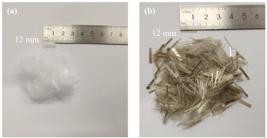
The experimental materials included S95 grade slag, SF, coarse aggregate (particle size 5–40 mm), BF, PPF, and river sand with a fineness modulus of 2.5. The main chemical compositions of the slag and SF are listed in Table 1. The main parameters of BF and PPF are listed in Table 2 and fiber morphologies are shown in Figure 1. A commercial Na2SiO3 solution, with an initial modulus (MS) of 2.25, was used as the alkaline activator, and the modulus was adjusted to MS = 1.5 by adding NaOH.
2.2. Orthogonal experimental design
The parameter levels for each factor in the orthogonal experimental design of this study were determined based on a comprehensive consideration of literature review, guidance from the industry Chinese standard JGJ/T 439-2018, and the results of preliminary single-factor experiments. Building upon this foundation, the orthogonal table was employed to systematically investigate the interactions among these key factors, elucidate the influence of each factor on mechanical properties, and ultimately identify the optimal mix ratio. SF (A), BF (B), PPF (C), and alkali content (D) are designated as the four key factors in the orthogonal experimental design. The SF content is set at 4%, 6% and 8% by mass of S95 grade slag; fiber volume fractions are 0.1%, 0.2% and 0.3%; and alkali content, expressing as the mass ratio of Na2O to total AAS, is 5%, 7% and 9%. A four-factor, three-level orthogonal experiment is conducted (see Table 3); the mixture proportions generated using an L9 (34) orthogonal table is summarized in Table 4.
2.3. Specimen preparation
To prevent rapid heat release due to alkaline dissolution and premature hydration, the alkaline solution was prepared 12 h in advance of use. Based on LEONG et al. [39] and preliminary tests, an alkaline solution modulus of 1.5 was used. Following a 1-minute dry mix of all solid components (aggregates, slag, SF), the alkaline activator was added, and mixing continued for 2 minutes. Fibers were introduced in several increments to ensure uniform dispersion. Water was added last and mixed for a further 3 min. The fresh concrete was homogeneous with no visible agglomerates. It was cast into cubic molds (100 × 100 × 100 mm) and compacted on a vibrating table. After demolding at 24 h following casting under ambient temperature conditions, all specimens were immediately transferred to a standard curing chamber for further curing. The curing environment was maintained at a temperature of (20 ± 2) °C and a relative humidity of no less than 95%. A spacing of 10 to 20 mm was kept between adjacent specimens to ensure uniform exposure to the curing medium. The specimens were cured for designated ages of 7 d and 28 d, respectively. Upon reaching the target curing ages, the specimens were retrieved and subjected to corresponding mechanical property tests and microstructural characterization analyses. Figure 2 is a schematic diagram of the specimen preparation procedure.

2.4. Test methods
2.4.1. Mechanical property tests
Mechanical property tests were performed on specimens cured for 7 d and 28 d following the pertinent Chinese standards: GB/T 50081–2019 and JGJ/T 439–2018. Three replicate specimens for each mix ratio were measured and the average value was used. All strength measurements were logged to 0.001 MPa accuracy.
2.4.2. DIC testing
Figure 3 illustrates the DIC testing system. An electro-hydraulic servo universal testing machine was employed to apply axial load under quasi-static conditions at a displacement rate of 0.1 mm/min until specimen failure, while load–displacement data were synchronously recorded. Prior to the test, the specimen surface was sequentially sprayed with matte white paint and matte black paint to create a random speckle pattern, with an average speckle diameter of approximately 0.3 mm and a contrast ratio greater than 75%. This preparation was performed to minimize optical reflections and improve measurement accuracy.

A dual-CCD camera system with a resolution of 3088 × 2064 pixels was used to continuously capture speckle images of the specimen surface at a frame rate of 10 Hz throughout the loading process. The acquired images were subsequently imported into the Ncorr software for DIC analysis to obtain full-field displacement and strain distributions. For the DIC data processing, the subset radius was set to 55 pixels, corresponding to a subset size of 111 × 111 pixels, and the subset spacing (step size) was 3 pixels. The strain calculation adopted a strain radius of 3 mm with a 7 × 7 strain calculation window.
2.4.3. Hardened pore structure analysis
Hardened pore structure was measured using a TRAHS pore analyzer (see Figure 4). For each mix, three specimens were prepared as 100 mm × 100 mm × 20 mm slices. The cut surfaces were sequentially coarse-ground, fine-ground, and polished. After surface preparation, they were uniformly coated with a water-based black marker and ovendried at 105 °C for 24h; after cooling to room temperature, the pore was filled with BaSO4 powder, and measurements were then taken.

2.4.4. SEM testing
To elucidate the internal strengthening mechanisms induced by the synergistic action of SF and hybrid fibers, microstructural characterization was performed using SEM. Fragments were extracted from the core region of specimens after uniaxial compression testing, immersed in anhydrous ethanol for 48h to terminate hydration, dried and sputtercoated with gold, and finally examined by SEM to observe their microstructural features [40].
3. RESULTS AND DISCUSSION
3.1. Analysis of the orthogonal experimental results
The study employed the range analysis method to evaluate the influence of each factor on the mechanical properties. This method facilitates the clear identification of the effects of each factor on the mechanical properties. The results provided a basis for the selection of the optimal mixture proportion using the comprehensive balance method. The mechanical properties data for all concrete specimens are summarized in Table 5.
Range analysis was applied to determine the relative impact of each factor on the measured mechanical properties, see Table 6. For the 7d UCS, the range values (R) indicated the order of influence as D > A > C > B, corresponding to alkali content > SF > PPF > BF. By comparing the K values under the same factor, the optimal level combination for 7d UCS was determined as A3B2C1D3. Similarly, for the 28d UCS, the order of factor influence was D > B > A > C, with the optimal level combination identified as A2B2C1D3. For the 28d STS, the influence ranking was B > A > C > D, and the optimal level combination was A1B3C1D2. These results provide a quantitative basis for selecting factor levels to maximize the mechanical performance of AAS.
Based on the orthogonal experimental method, this approach enables an intuitive comparative analysis of how factor levels affect the specimens 7d and 28d UCS and 28d STS. Separate factorindex analyses were performed for each dataset in Table 6, and see Figure 5.

As shown in Figures 5a and 5b, the effects of each factor varied with curing age and level. SF exhibited a critical enhancement point at 6%; an appropriate dosage promotes pozzolanic reactions, whereas excessive addition increases specific surface area, covering slag particles and slowing hydration. BF content was optimal and stable at both 7d and 28d, enhancing the matrix through bridging, while excessive content may cause agglomeration and stress concentration, reducing the strength coefficient (K value). For PPF, the 7d K value first decreased and then increased with dosage, while at 28d, higher fiber dosage increases fiber agglomeration and deteriorates dispersion uniformity, leading to a continuous reduction in strength. The Alkali content positively correlated with K values by accelerating Si-O/Al-O bond breakage and C-A-S-H gel formation.
As shown in Figure 5c, SF enhances compressive strength, but excessive addition may induce agglomeration, increase brittleness, and reduce STS. BF effectively bridge cracks, disperse tensile stresses, and improve tensile performance and toughness [41]. PPF, at an optimal dosage (0.9 kg/m3), form a uniform three-dimensional network, enhancing tensile strength and toughness [42].
3.2. Determine the optimal mix ratio through comprehensive balancing
The results summarized in Table 5 was selected as the final evaluation indicators, and the effects of each factor on mechanical properties were assessed using the comprehensive balance method [43]. The comprehensive balance table is presented in Table 7.
The analysis SF (factor A) exhibited the following influence ranking on the mechanical property of indicators: 28d STS > 7d UCS > 28d UCS. This indicates that factor A is the primary determinant of STS. When A was set at level A1, the 28d splitting tensile strength was optimal; at level A3, the 7d UCS reached its maximum. At level A2, the 28d UCS decreased by 8.9% relative to A1, while the 28d STS increased by 9.2%. The B2 level of BF content exhibited minimal variation and good stability, providing a balanced improvement across all indicators and meeting the optimization requirements. For BF (factor B), the effect ranking was 28d STS > 28d UCS > 7d UCS. The 28d STS was maximized at level B3, the 7d and 28d UCS were optimal at B2. When B was set to B3, the 28d STS increased by 20.9% compared with B2, while the 28d UCS decreased by 14.3%, and the 7d UCS decreased by 8%. Considering the overall performance, level B2 provides a balanced compromise across all metrics. Similarly, the optimal levels for the other factors were determined as C1 for PPF and D3 for alkali content. Therefore, the optimal mixture proportion was identified as A2B2C1D3.
3.3. Validation and comparative testing of the optimal mix ratio (A2B2C1D3)
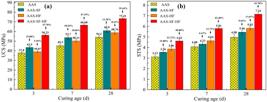
To verify the reliability of the optimal mixture proportion combination A2B2C1D3 (SF 6 wt.%, BF 0.2 vol.%, PPF 0.1 vol.%, alkali 9 wt.%). obtained from the orthogonal experimental design, verification tests on the UCS and STS were conducted on specimens prepared according to this proportion, as shown in Figure 6. For comparison purposes, three control groups were established: a plain slag-based reference group with 9% alkali content (AAS), a SF-only group with 6% SF (AAS-SF), and a hybrid fiber-only group (AAS-HF). The optimal mixture proportion group (A2B2C1D3) was designated as AAS-SF-HF. A comparative analysis of the mechanical properties among these four material systems was conducted to elucidate the synergistic enhancement effect resulting from SF modification and hybrid fiber reinforcement. Three parallel specimens were prepared for each mix, and the average value was taken for analysis.
3.4. Study on strain field evolution and crack propagation
Macroscopic mechanical performance tests can only reflect the final results of the fracture of AAS, and it is difficult to reveal the synergistic effects of SF modification and hybrid fibers during the crack propagation process. This study selected the AAS control group, AAS-SF group, AAS-HF group, and AAS-SF-HF group specimens for comparative analysis. Based on the stress-strain curve and full-field strain analysis, four characteristic stress levels were selected: 30%, 60%, 80% of the peak stress, and the peak stress itself, to carry out crack propagation study. Through DIC, the evolution of the strain field evolution on the surface and the strain in the εxx is monitored in real time (see Figure 7), thereby achieving effective observation of the entire process of crack initiation, propagation, and penetration.

Stress-strain curves of specimens and strain field contour plots. (a) AAS, (b) AAS-SF, (c) AAS-HF, and (d) AAS-SF-HF.
Overall, the crack evolution pattern of the specimens exhibits consistency and common failure characteristics. When the peak stress reaches 30% (point A), the strain field displays a uniform distribution without significant strain concentration zones, and the stress-strain curve shows an approximately linear increase, indicating that the specimens are in the elastic phase and localized damage has not occurred. As the stress reaches 60% of the peak value (point B), microcracks begin to form in the specimens. These cracks correspond to the red striped strain regions in the strain cloud map and extend in the through-thickness direction, indicating that the specimens have entered the damage accumulation phase. When peak stress reaches 80%–100% (points C to D), the main crack rapidly penetrates the surface of the specimen, forming macroscopic cracks. Strain gradient bands of red, yellow, and green are observed on both sides of the crack, while some specimens exhibit a multi-crack distribution pattern, characterized by narrow crack widths and deflected paths. After reaching the peak stress, the stress-strain curve begins to decline. The addition of SF and fibers significant change failure modes and crack propagation paths. Figures 7a and 7b show that AAS specimen of cracks initiate along maximum principal stress direction and extend linearly, characteristic of compressive failure. With SF incorporation, crack path becomes deflected and branched, and fine cracks are dispersed across the specimen surface rather than concentrated along the primary crack. Figures 7c and 7d indicate that fiber addition further alters crack evolution; By altering the internal stress field, the fibers induce cracks that initiate at the edges and propagate inward, thereby forming multiple crack propagation mode. Experimental results show that the combined action of SF and hybrid fibers can guide crack deflection and branching, promoting the cooperative development of multiple cracks, improving the toughness of the material. The mechanism of action can be summarized in the following two aspects: On the one hand, SF reduces the pores between slag particles through its physical filling effect. Under alkaline conditions, reactive SiO2 reacts with Ca2+ and Al2+ derived from slag to form amorphous CASH and CAH gels. These gels encapsulate and bind loose particles, thereby significantly enhancing the densification and mechanical strength of the matrix. This mechanism with the findings reported in earlier studies by CHEAH et al. [44] and ZHAO et al. [45]. On the other hand, BF mainly bear the load and inhibit the propagation of macroscopic cracks, while PPF play a role in bridging microcracks and dissipating energy [46, 47]. When the two are combined, the matrix enhanced by SF optimizes the fiber-matrix interface bonding performance, while the addition of fibers effectively suppresses the brittleness tendency introduced by SF, achieving the effect of synergistic reinforcement and toughening.
3.5. Failure mode of specimen under loading
Figure 8a confirms the typical failure morphology of specimens under peak UCS, highlighting the synergistic effect of SF and hybrid fibers. The control AAS specimen exhibited brittle fracture with wide primary cracks and large spalling fragments. AAS-SF specimen displayed more gradual failure, reduced spalling, and narrower cracks, indicating improved matrix–aggregate interfacial zones and enhanced matrix compactness [48]. AAS-HF and AAS-SF-HF specimens retained better integrity, with pronounced axial compression and lateral bulging. This is attributed to SF refining the fiber-matrix interface and enhancing bonding, allowing fibers to bridge cracks and arrest propagation, consistent with WU et al. [49]. While BF and PPF delay crack growth and transfer loads, collectively improving ductility and tensile performance.

Failure modes of specimens. (a) Macroscopic failure mode and (b) Internal crack nucleation and propagation mechanism.
Figure 8b demonstrates that under compression, axial loading induces transverse tensile stresses, causing cracks to initiate and propagate perpendicular to those stresses. Hybrid fibers suppress crack-tip stress concentrations through crack confinement and deflection, stress redistribution, and energy dissipation, while promoting synergistic microcrack propagation, At the optimal mix, the dense matrix from SF–slag reactions combined with the hybrid fiber network sustains higher stresses and enhances deformability (see Figure 7), and markedly improving ductility and structural toughness.
4. MICROSCOPIC ANALYSIS
4.1. Pore structure analysis
Concrete, as porous material, contains irregular multiscale pores whose morphology, size, orientation, and distribution directly affect its macroscopic mechanical properties. To investigate the synergistic reinforcement effect of SF modification and hybrid fibers in AAS, the pore characteristics of four mix ratios were quantitatively tested and compared using a pore analyzer. Figure 9 presents the surface pore structure captured by the pore analyzer. The control AAS sample exhibits large, clustered voids. SF reduces pore size and homogenizes distribution, and SF combined with hybrid fibers further refines and densifies the pore network, decreasing the volume fraction of large pores while increasing the density and volume fraction of fine pores, indicative of an improved pore structure.

To elucidate the synergistic effect of SF modification and hybrid fibers on refining the pore structure of AAS, the pore structure parameters of each specimen group were systematically tested and analyzed, with the results presented in Figure 10. Compared with the control group (AAS), SF modification alone (AAS-SF) significantly refined the pore size distribution, as manifested by a reduction in the average chord length, a decrease in the spacing coefficient, The specific surface area also increased. This confirms that the number of harmless pores increased and the matrix pores were refined, primarily due to the physical filling of SF and the formation of cementitious products such as C-A-S-H gel chemical reactions. When SF and fibers were incorporated together, the pore structure could be further optimized. Compared to AAS, the air content and specific surface area increased significantly by 41.9% and 49.5%, respectively, while the average chord length and spacing factor decreased to their minimum values. Then, the hybrid fibers further regulated the pore distribution through interfacial synergy with the SF-strengthened matrix, thereby achieving comprehensive refinement and homogenization of the pore structure, which is consistent with the development of mechanical strength (see Figure 6).

Pore structure parameters. (a) Air content and Bubble specific surface area and (b) Bubble spacing coefficient and Average bubble chord length.
4.2. SEM analysis
SEM observations reveal that hybrid fibers improve the mechanical properties of alkali-activated slag primarily through physical bridging mechanisms. In the AAS system, the reactive SiO2 contained in SF exerts a synergistic hydration effect with slag, contributing to the formation of a denser and more stable C-A-S-H gel network.
The SEM micrograph in Figure 11a shows a compact matrix structure with no obvious macro-cracks and abundant reaction products, indicating good overall compactness of the material. Figures 11b–d demonstrate that BF and PPF form an interlaced network structure in the matrix, which facilitates stress transfer and redistribution, thereby enhancing structural integrity and load-bearing capacity. Among them, BF, with their high elastic modulus, mainly bridge macro-cracks and bear tensile stresses, inhibiting the rapid unstable propagation of cracks and contributing significantly to the enhancement of peak strength. PPF, as low-modulus organic fibers, mainly function at the micro-crack scale; their uniform distribution in the matrix hinders the initiation and early development of micro-cracks, thereby improving the toughness and post-peak ductility of the material.

SEM images. (a) Matrix densification, (b) Fiber pull-out, (c) Fiber bridge, and (d) Hydration products on fiber surface.
Further observations indicate that the fiber reinforcement mechanism is mainly reflected in the following aspects. As shown in Figure 11c, fibers spanning the crack bear tensile stresses through bridging action, inhibiting crack propagation. Figures 11b and 11d show that the surfaces of pulled-out fibers are attached with matrix debris and bear longitudinal scratches. Figure 11d reveals hydration products deposited on the fiber surface, indicating strong physicochemical interfacial bonding between the fibers and the matrix. This bonding provides adhesive force and frictional resistance against fiber debonding and slip, thereby improving the overall mechanical properties of the composite.
5. CONCLUSIONS
This study systematically investigated the influence of various factors on the strength of AAS using an orthogonal experimental design, and clarified the synergistic effects of SF, hybrid BF and PPF through comparative experiments. Based on a multi-scale approach macroscopic mechanical testing, DIC testing, pore structure analysis, and microstructural characterization, the mechanisms underlying the synergistic strengthening and toughening effect of SF modification and hybrid fiber reinforcement were comprehensively revealed.
The PPF content and alkali content significantly influenced the compressive strength of AAS. Based on range analysis combined with the comprehensive balance method, the optimal mixture proportion A2B2C1D3 was determined with compressive strength as the primary criterion. The results of verification tests confirmed the reliability of this proportion.
DIC analysis revealed a synergistic effect between SF and hybrid fibers, which promoted internal stress dispersion, inducing crack deflection, branching, and the formation of multiple microcracks. Failure mode analysis further indicated that the incorporation of fibers effectively improved the brittleness of the matrix and helped maintain the structural integrity of the specimens after failure.
SF fills the pore structure through its filling effect and the formation of gel products such as C-A-S-H gel through chemical reactions, thereby promoting the transformation of harmful pores into harmless ones. In contrast, fibers physically block pore connectivity. The synergistic interaction between the two components optimizes the pore structure, thereby collectively contributing to the high strength performance of the material at the macroscopic scale.
SEM analysis further revealed, at the microscopic scale, the synergistic enhancement mechanism between SF and hybrid fibers: SF not only exerts a filling effect but also promotes the formation of hydration products; meanwhile, the incorporated fibers facilitate stress transfer and dissipation through bridging and pull-out behaviors, effectively inhibiting crack propagation, thereby significantly improving the toughness and fracture resistance of the material.
6. ACKNOWLEDGMENTS
This study was financed by Anhui Provincial Natural Science Foundation (No. 2108085ME156 and No. 1808085QE148), China Postdoctoral Science Foundation (No. 2018M642504).
7. DATA AVAILABILITY
The data used to support the findings of this study are available from the corresponding author upon request.
8. BIBLIOGRAPHY
-
[1] AL KHAFFAF, I., HAWILEH, R.A., SAHOO, S., et al, “Toward carbon-neutral construction: a review of zero-carbon concrete”, Journal of Building Engineering, v. 99, pp. 111578, 2025. doi: https://doi.org/10.1016/j.jobe.2024.111578.
» https://doi.org/10.1016/j.jobe.2024.111578 -
[2] BENLI, A., DHEYAALDIN, M.H., ÖZ, A., et al, “Sustainable single and hybrid fiber reinforcement of ternary geopolymer composites with waste marble powder: synergistic effects of micro steel, basalt, and carbon fibers”, Structural Concrete, v. 27, n. 1, pp. 1205–1233, 2026. doi: https://doi.org/10.1002/suco.70173.
» https://doi.org/10.1002/suco.70173 -
[3] XU, J., DENG, Y., SHI, Y., et al, “A bi-level optimization approach for sustainable development and carbon emissions reduction towards construction materials industry: a case study from China”, Sustainable Cities and Society, v. 53, pp. 101828, 2020. doi: https://doi.org/10.1016/j.scs.2019.101828.
» https://doi.org/10.1016/j.scs.2019.101828 -
[4] QURESHI, L.A., ALI, B., ALI, A., “Combined effects of supplementary cementitious materials (silica fume, slag, fly ash and rice husk ash) and steel fiber on the hardened properties of recycled aggregate concrete”, Construction & Building Materials, v. 263, pp. 120636, 2020. doi: https://doi.org/10.1016/j.conbuildmat.2020.120636.
» https://doi.org/10.1016/j.conbuildmat.2020.120636 -
[5] CONG, P., DU, R., GAO, H., et al, “Comparison and assessment of carbon dioxide emissions between alkali-activated materials and OPC cement concrete”, Journal of Traffic and Transportation Engineering, v. 11, n. 5, pp. 918–938, 2024. doi: https://doi.org/10.1016/j.jtte.2023.07.011.
» https://doi.org/10.1016/j.jtte.2023.07.011 -
[6] CEMALGIL, S., YÖN, M.Ş., DENER, M., et al, “Mechanical and durability properties of sustainable alkali‐activated mortars with ceramic insulator waste and andesite powder as partial substitutes for GBFS”, Structural Concrete, v. 27, n. 1, pp. 737–757, 2026. doi: https://doi.org/10.1002/suco.70313.
» https://doi.org/10.1002/suco.70313 -
[7] MA, C.K., AWANG, A.Z., OMAR, W., “Structural and material performance of geopolymer concrete: a review”, Construction & Building Materials, v. 186, pp. 90–102, 2018. doi: https://doi.org/10.1016/j.conbuildmat.2018.07.111.
» https://doi.org/10.1016/j.conbuildmat.2018.07.111 -
[8] PROVIS, J.L., “Alkali-activated materials”, Cement and Concrete Research, v. 114, pp. 40–48, 2018. doi: https://doi.org/10.1016/j.cemconres.2017.02.009.
» https://doi.org/10.1016/j.cemconres.2017.02.009 -
[9] AMERI, F., SHOAEI, P., ZAREEI, S., et al, “Geopolymers vs. alkali-activated materials: a comparative study on durability, microstructure, and resistance to elevated temperatures of lightweight mortars”, Construction & Building Materials, v. 222, pp. 49–63, 2019. doi: https://doi.org/10.1016/j.conbuildmat.2019.06.079.
» https://doi.org/10.1016/j.conbuildmat.2019.06.079 -
[10] AMRAN, M., DEBBARMA, S., OZBAKKALOGLU, T., “Fly ash-based eco-friendly geopolymer concrete: a critical review of the long-term durability properties”, Construction & Building Materials, v. 270, pp. 121857, 2021. doi: https://doi.org/10.1016/j.conbuildmat.2020.121857.
» https://doi.org/10.1016/j.conbuildmat.2020.121857 -
[11] AMRAN, M., FEDIUK, R., MURALI, G., et al, “Rice husk ash-based concrete composites: a critical review of their properties and applications”, Crystals, v. 11, n. 2, pp. 168, 2021. doi: https://doi.org/10.3390/cryst11020168.
» https://doi.org/10.3390/cryst11020168 -
[12] ZHANG, J., LIU, Y., ZHU, J., et al, “Investigation on the flow and thixotropic properties of alkali-activated concrete”, Buildings, v. 14, n. 12, pp. 4085, 2024. doi: https://doi.org/10.3390/buildings14124085.
» https://doi.org/10.3390/buildings14124085 -
[13] BAI, W., YE, D., YE, S., et al, “Study on mechanical properties and damage mechanism of alkali-activated slag concrete”, Journal of Building Engineering, v. 96, pp. 110357, 2024. doi: https://doi.org/10.1016/j.jobe.2024.110357.
» https://doi.org/10.1016/j.jobe.2024.110357 -
[14] YUAN, P., QIAN, P., LI, D., “Experimental study on the mechanical properties of fiber-reinforced alkali-activated slag concrete”, Matéria, v. 30, e20250603, 2025. doi: https://doi.org/10.1590/1517-7076-rmat-2025-0603.
» https://doi.org/10.1590/1517-7076-rmat-2025-0603 -
[15] COLLINS, F., SANJAYAN, J.G., “Microcracking and strength development of alkali activated slag concrete”, Cement and Concrete Composites, v. 23, n. 4-5, pp. 345–352, 2001. doi: https://doi.org/10.1016/S0958-9465(01)00003-8.
» https://doi.org/10.1016/S0958-9465(01)00003-8 -
[16] SUN, M., CHEN, Y., ZHU, J., et al, “Effect of modified polyvinyl alcohol fibers on the mechanical behavior of engineered cementitious composites”, Materials, v. 12, n. 1, pp. 37, 2018. doi: https://doi.org/10.3390/ma12010037. PubMed PMID: 30583548.
» https://doi.org/10.3390/ma12010037 -
[17] TRAN, T.T., PHAM, T.M., HAO, H., “Experimental and analytical investigation on flexural behaviour of ambient cured geopolymer concrete beams reinforced with steel fibers”, Engineering Structures, v. 200, pp. 109707, 2019. doi: https://doi.org/10.1016/j.engstruct.2019.109707.
» https://doi.org/10.1016/j.engstruct.2019.109707 -
[18] JO, H.S., PARK, J.K., TRAN, N.T., et al, “Loading rate effects on multifiber pullout resistance of smooth steel fibers in ultra-high-performance concrete”, Case Studies in Construction Materials, v. 21, e03719, 2024. doi: https://doi.org/10.1016/j.cscm.2024.e03719.
» https://doi.org/10.1016/j.cscm.2024.e03719 -
[19] YU, J., YI, Z., ZHANG, Z., et al, “The effects of Hybrid Steel/Basalt Fibers on the durability of concrete pavement against freeze-thaw cycles”, Materials, v. 16, n. 22, pp. 7137, 2023. doi: https://doi.org/10.3390/ma16227137. PubMed PMID: 38005066.
» https://doi.org/10.3390/ma16227137 -
[20] ZHANG, T., WANG, K., LIN, B., et al, “The enhancement mechanism of modified basalt fiber on the performance of geopolymer concrete”, Construction & Building Materials, v. 417, pp. 135123, 2024. doi: https://doi.org/10.1016/j.conbuildmat.2024.135123.
» https://doi.org/10.1016/j.conbuildmat.2024.135123 -
[21] GUO, X., YANG, J., “Intrinsic properties and micro-crack characteristics of ultra-high toughness fly ash/steel slag based geopolymer”, Construction & Building Materials, v. 230, pp. 116965, 2020. doi: https://doi.org/10.1016/j.conbuildmat.2019.116965.
» https://doi.org/10.1016/j.conbuildmat.2019.116965 -
[22] CHOI, S.J., CHOI, J.I., SONG, J.K., et al, “Rheological and mechanical properties of fiber-reinforced alkali-activated composite”, Construction & Building Materials, v. 96, pp. 112–118, 2015. doi: https://doi.org/10.1016/j.conbuildmat.2015.07.182.
» https://doi.org/10.1016/j.conbuildmat.2015.07.182 -
[23] XIAO, S.H., LIAO, S.J., ZHONG, G.Q., et al, “Dynamic properties of PVA short fiber reinforced low-calcium fly ash-slag geopolymer under an SHPB impact load”, Journal of Building Engineering, v. 44, pp. 103220, 2021. doi: https://doi.org/10.1016/j.jobe.2021.103220.
» https://doi.org/10.1016/j.jobe.2021.103220 -
[24] XU, Y., CHEN, H., WANG, P., “Effect of polypropylene fiber on properties of alkali‐activated slag mortar”, Advances in Civil Engineering, v. 2020, n. 1, pp. 4752841, 2020. doi: https://doi.org/10.1155/2020/4752841.
» https://doi.org/10.1155/2020/4752841 -
[25] ZHANG, D., WANG, Y., ZHANG, T., et al, “Engineering and microstructural properties of carbon-fiber-reinforced fly-ash-based geopolymer composites”, Journal of Building Engineering, v. 79, pp. 107883, 2023. doi: https://doi.org/10.1016/j.jobe.2023.107883.
» https://doi.org/10.1016/j.jobe.2023.107883 -
[26] DENG, L., MA, Y., HU, J., et al, “Preparation and piezoresistive properties of carbon fiber-reinforced alkali-activated fly ash/slag mortar”, Construction & Building Materials, v. 222, pp. 738–749, 2019. doi: https://doi.org/10.1016/j.conbuildmat.2019.06.134.
» https://doi.org/10.1016/j.conbuildmat.2019.06.134 -
[27] SITARZ, M., ZDEB, T., TRACZ, T., et al, “Adhesion of polypropylene, steel, and basalt fibers to a geopolymer matrix with water treatment sludge addition”, Materials, v. 18, n. 20, pp. 4727, 2025. doi: https://doi.org/10.3390/ma18204727. PubMed PMID: 41156956.
» https://doi.org/10.3390/ma18204727 -
[28] WU, F., LI, B., YU, J., et al, “Size effect in the mechanical characteristics of steel fiber reinforced alkali-activated slag/fly ash-based concrete”, Construction & Building Materials, v. 443, pp. 137827, 2024. doi: https://doi.org/10.1016/j.conbuildmat.2024.137827.
» https://doi.org/10.1016/j.conbuildmat.2024.137827 -
[29] NEMATOLLAHI, B., SANJAYAN, J., AHMED SHAIKH, F.U., “Tensile strain hardening behavior of PVA fiber-reinforced engineered geopolymer composite”, Journal of Materials in Civil Engineering, v. 27, n. 10, pp. 04015001, 2015. doi: https://doi.org/10.1061/(ASCE)MT.1943-5533.0001242.
» https://doi.org/10.1061/(ASCE)MT.1943-5533.0001242 - [30] NEMATOLLAHI, B., SANJAYAN, J., “Strain hardening behavior of engineered geopolymer composites: effects of the activator combination”, Journal of the Australian Ceramic Society, v. 51, n. 1, pp. 54–60, 2015.
-
[31] ZHANG, H., SARKER, P.K., WANG, Q., et al, “Comparative fracture properties of ambient-cured geopolymer concrete containing four different fibers in mono and hybrid combinations using digital image correlation”, Journal of Building Engineering, v. 89, pp. 109288, 2024. doi: https://doi.org/10.1016/j.jobe.2024.109288.
» https://doi.org/10.1016/j.jobe.2024.109288 -
[32] ZHANG, H., JIA, T.C., SARKER, P.K., et al, “Effect of fiber addition on the static and dynamic compressive properties of ambient-cured geopolymer concrete”, Journal of Building Engineering, v. 58, pp. 104991, 2022. doi: https://doi.org/10.1016/j.jobe.2022.104991.
» https://doi.org/10.1016/j.jobe.2022.104991 -
[33] RAHIM, N., FAHIM, T.A., UDDIN, S., et al, “Fiber‐reinforced fly ash geopolymers: Effect of fiber type and curing duration on mechanical strength, weight loss, and microstructure”, Structural Concrete, pp. suco.70469, 2026. doi: https://doi.org/10.1002/suco.70469.
» https://doi.org/10.1002/suco.70469 -
[34] BERNAL, S.A., RODRÍGUEZ, E.D., MEJÍA DE GUTIÉRREZ, R., et al, “Performance at high temperature of alkali-activated slag pastes produced with silica fume and rice husk ash-based activators”, Materiales de Construcción, v. 65, n. 318, e049, 2015. doi: https://doi.org/10.3989/mc.2015.03114.
» https://doi.org/10.3989/mc.2015.03114 -
[35] POURDOLAT, N., RAIZADA, P., GUPTA, R., “Mechanical and microstructural performance of fly ash-based geopolymer mortar activated by silica fume-derived sodium silicate”, Journal of Composites Science, v. 10, n. 1, pp. 22, 2026. doi: https://doi.org/10.3390/jcs10010022.
» https://doi.org/10.3390/jcs10010022 -
[36] PANDEY, A., KUMAR, B., “A comprehensive investigation on application of microsilica and rice straw ash in rigid pavement”, Construction & Building Materials, v. 252, pp. 119053, 2020. doi: https://doi.org/10.1016/j.conbuildmat.2020.119053.
» https://doi.org/10.1016/j.conbuildmat.2020.119053 -
[37] ZHANG, H., CAO, L., DUAN, Y., et al, “High-flowable and high-performance steel fiber reinforced concrete adapted by fly ash and silica fume”, CSEM, v. 20, e02796, 2024. doi: https://doi.org/10.1016/j.cscm.2023.e02796.
» https://doi.org/10.1016/j.cscm.2023.e02796 -
[38] DU, W., NI, L., LV, Y., et al, “Role of silica fume in the hydration evolution of fly ash-slag-based geopolymers”, Construction & Building Materials, v. 451, pp. 138879, 2024. doi: https://doi.org/10.1016/j.conbuildmat.2024.138879.
» https://doi.org/10.1016/j.conbuildmat.2024.138879 -
[39] LEONG, H.Y., ONG, D.E.L., SANJAYAN, J.G., et al, “The effect of different Na2O and K2O ratios of alkali activator on compressive strength of fly ash based-geopolymer”, Construction & Building Materials, v. 106, pp. 500–511, 2016. doi: https://doi.org/10.1016/j.conbuildmat.2015.12.141.
» https://doi.org/10.1016/j.conbuildmat.2015.12.141 -
[40] NARESH, T., MALLIK, M., VENKATESWARA RAO, S., et al, “Performance and microstructural optimization of sustainable geopolymer mortars using fly ash, ground granulated blast furnace slag, and rice husk ash”, Structural Concrete, v. 26, n. 6, pp. 7863–7889, 2025. doi: https://doi.org/10.1002/suco.70192.
» https://doi.org/10.1002/suco.70192 -
[41] SADRMOMTAZI, A., TAHMOURESI, B., SARADAR, A., “Effects of silica fume on mechanical strength and microstructure of basalt fiber reinforced cementitious composites (BFRCC)”, Construction & Building Materials, v. 162, pp. 321–333, 2018. doi: https://doi.org/10.1016/j.conbuildmat.2017.11.159.
» https://doi.org/10.1016/j.conbuildmat.2017.11.159 -
[42] BEHFARNIA, K., ROSTAMI, M., “Mechanical properties and durability of fiber reinforced alkali activated slag concrete”, Journal of Materials in Civil Engineering, v. 29, n. 12, pp. 04017231, 2017. doi: https://doi.org/10.1061/(ASCE)MT.1943-5533.0002073.
» https://doi.org/10.1061/(ASCE)MT.1943-5533.0002073 -
[43] KONG, W.H., YANG, L., YAO, Z.S., et al, “Preparation and crack resistance test of high-performance concrete with fiber hybrid and micro expansion freezing shaft wall”, Meikuang Anquan, v. 35, n. 3, pp. 45–48, 2020. doi: https://doi.org/10.13347/j.cnki.mkaq.2020.03.014.
» https://doi.org/10.13347/j.cnki.mkaq.2020.03.014 -
[44] CHEAH, C.B., SAMSUDIN, M.H., RAMLI, M., et al, “The use of high calcium wood ash in the preparation of Ground Granulated Blast Furnace Slag and Pulverized Fly Ash geopolymers: a complete microstructural and mechanical characterization”, Journal of Cleaner Production, v. 156, pp. 114–123, 2017. doi: https://doi.org/10.1016/j.jclepro.2017.04.026.
» https://doi.org/10.1016/j.jclepro.2017.04.026 -
[45] ZHAO, X., LIU, C., ZUO, L., et al, “Synthesis and characterization of fly ash geopolymer paste for goaf backfill: reuse of soda residue”, Journal of Cleaner Production, v. 260, pp. 121045, 2020. doi: https://doi.org/10.1016/j.jclepro.2020.121045.
» https://doi.org/10.1016/j.jclepro.2020.121045 -
[46] ZHOU, X., ZENG, Y., CHEN, P., et al, “Mechanical properties of basalt and polypropylene fibre-reinforced alkali-activated slag concrete”, Construction & Building Materials, v. 269, pp. 121284, 2021. doi: https://doi.org/10.1016/j.conbuildmat.2020.121284.
» https://doi.org/10.1016/j.conbuildmat.2020.121284 -
[47] AKTURK, B., “Fracture behavior of alkali-activated basalt powder/slag systems reinforced with basalt and hybrid fibers”, Materials and Structures, v. 56, n. 2, pp. 46, 2023. doi: https://doi.org/10.1617/s11527-023-02139-3.
» https://doi.org/10.1617/s11527-023-02139-3 -
[48] AHISKALI, A., BAYRAK, B., TOKLU, K., et al, “Characterizing the chemistry of one-part green geopolymer foams: the role of silica fume and fiber hybridization”, ACS Omega, v. 10, n. 20, pp. 20193–20212, 2025. doi: https://doi.org/10.1021/acsomega.4c10738. PubMed PMID: 40454053.
» https://doi.org/10.1021/acsomega.4c10738 -
[49] WU, R., GU, Q., GAO, X., et al, “Effect of basalt fibers and silica fume on the mechanical properties, stress-strain behavior, and durability of alkali-activated slag-fly ash concrete”, Construction & Building Materials, v. 418, pp. 135440, 2024. doi: https://doi.org/10.1016/j.conbuildmat.2024.135440.
» https://doi.org/10.1016/j.conbuildmat.2024.135440


