 Influence of Alccofine 1203 on strength and durability properties of eco-efficient self-curing concrete
ABSTRACT
Concrete becomes an essential part in contemporary infrastructure. However, there are substantial environmental problems allied with the production of ordinary concrete. Large volumes of water are essential for mixing and curing, and major amounts of CO2 are released into the environment during the hydration process of cement. These concerns increase environmental deterioration by aggravating global warming and depleting natural resources. Using sustainable approaches, such as secondary cementitious materials and self-curing procedures, has become more and more important. 4% to 20% Alccofine (AF), an ultrafine slag has been partially substituted for cement. Super Absorbent Polymer (SAP) was added between 0.1% and 0.5% by weight of cement to enrich internal curing. SAP improves long-lasting hydration by absorbing and gradually releasing water in the mix. The workability, compressive strength, and flexural strength of the mixes were assessed. Furthermore, half-cell potential (HCP) and ultrasonic pulse velocity (UPV) studies were conducted for durability assessment. According to test results, adding 0.3% SAP and 12% AF increased 28-day compressive and flexural strength of concrete by 11.4% and 24.1%, respectively. A lower HPC value and an 11% rise in UPV values suggested that the blend was more durable due to lessen micro cracking, and improve internal curing. This combination enhanced the properties of sustainable concrete without sacrificing structural integrity.
Keywords:
Alccofine; Super absorbent polymer; Internal curing; Durability; Structural integrity
1. INTRODUCTION
Affordability and flexibility of concrete enlarged its usage in construction. Now-a-days, the requirement for concrete has increased due to rapid urbanisation and population growth. Concrete has many advantages; however, conventional concrete production is associated with significant environmental issues and raises concerns regarding long-term sustainability [1,2,3,4]. Major environmental problem connected to the manufacture of traditional concrete is the significant use of natural resources. Massive amounts of raw materials are mined for production of cement and concrete. Besides, water is a crucial component in developing concrete mixes and for curing the concrete. In order to attain required strength and durability, the curing process is essential. Conversely, concrete requires substantial amounts of water for curing. In regions with limited freshwater availability, this demand can lead to significant environmental challenges associated with water resource management [5,6,7,8].
Another key environmental issue is the release of carbon dioxide (CO2) during the manufacture of cement. Limestone must be calcined, a chemical process that emits large amounts of CO2, in order to make energy-intensive cement. Worldwide, cement industry emits enormous greenhouse gases and results in global warming. Now-a-days, reducing carbon footprints has become indispensable in infrastructure development. Subsequently, implementing sustainable and eco-friendly concrete technology becomes order of the day. Researchers and engineers focusing on usage of novel curing methods and supplemental cementitious materials (SCMs) in construction to overcome these difficulties. SCMs assist lower cement use and associated CO2 emissions by partially replacing traditional Portland cement. Likewise, internal curing techniques have shown as excellent options to lower outside water needs throughout the curing process in addition to SCMs. Internal curing guarantees ongoing hydration inside the concrete matrix without depending much on surface water application [9,10,11,12].
Alccofine (AF) is a highly reactive, ultrafine supplemental cementitious material derived from slag. Concrete’s strength, durability, and general performance are improved by its micro-filler and pozzolanic actions, which also improve particle packing and encourage the production of extra calcium silicate hydrate (C–S–H) gel. Integrating AF not only enhances mechanical performance but also enhances durability by refining the pore architecture [13,14,15,16,17]. AF helps to cut cement use while keeping or even enhancing structural performance by partly substituting cement in weights between 4% and 20%. Super absorbent polymers (SAPs) have become a viable self-curing technique in addition to SCMs. SAPs are cross-linked polymers that have a high water absorption and retention capacity in relation to their own mass [18,19,20]. SAP particles absorb mixing water when they are put to concrete, and as the internal humidity drops, they gradually release the water. Continuous internal curing is made possible by this regulated release, which guarantees that cement particles will continue to hydrate during the curing process. Subsequently, SAP reduces the need for external curing water, autogenous shrinkage, and cracking. In this work, based on findings reported in previous studies, SAP was added at dosages ranging from 0.1% to 0.5% by weight of cement in order to assess how efficiently it boosted hydration and durability performance [21,22,23].
Usage of SAP and Alccofine offers a sustainable approach in production of concrete. SAP helps to improve long-term hydration and internal moisture control, whereas AF reinforces and densifies the microstructure through its pozzolanic reaction and filler effect. Alccofine and Super Absorbent Polymer have both demonstrated notable advantages in enhancing concrete performance, there are not many research looking at their combined use. In order to create a sustainable high-performance concrete, the synergistic impacts of Alccofine and SAP on strength and durability properties have been thoroughly assessed in this study [24]. Several important characteristics of concrete were evaluated in order to determine how beneficial these changes were [25,26,27,28]. Because the addition of fine materials and polymers can affect flow properties, workability was investigated to ascertain how simple it would be to mix, place, and compaction. Compressive and flexural strengths are considered to be the most important measurements for assessing a structure’s performance under bending pressures [29,30,31]. Ultrasonic Pulse Velocity (UPV) was used for microstructural examination in addition to mechanical testing. UPV analysis helps to evaluate the dense structure of hardened concrete. It is possible to comprehend how AF and SAP affect hydration compound formation, pore refinement, and overall structural densification [32,33,34].
The optimal combination SAP and AF tends to enhance durability characteristics, possibly due to refined particle packing, additional C–S–H formation, and improved internal hydration. A denser pore structure and less micro-cracks improve the overall performance of concrete. At the same time, reducing the amount of cement and curing water helps lower its environmental impact. However, the growing environmental concerns associated with concrete production require the use of sustainable materials and innovative curing techniques. A viable approach to enrich the performance and sustainability is the combination of Alccofine as a partial cement substitute and super absorbent polymer as a self-curing agent [35,36,37]. According to the study, concrete that has an ideal mix proportion of 0.3% SAP and 12% AF can be stronger, more resilient, and more ecologically friendly. These developments greatly aid in the growth of green building techniques and global initiatives for the development of sustainable infrastructure.
2. EXPERIMENTAL PROGRAMME
2.1. Materials
2.1.1. Alccofine
In this study, Alccofine is used in concrete for cement replacement, which is produced from specially processed slag with an ultra-fine particle size (mean particle size of less than 6 microns) that enhances the strength and long-term durability of concrete. The properties of the collected Alccofine has been analysed and it has been used with ordinary portland cement. Chemical properties of Alccofine, and Portland cement are furnished in Table 1. The Physical properties of Alccofine are presented in Table 2.
2.1.2. Super absorbent polymer (SAP)
SAP absorbs water during mixing and slowly releases it during hydration progresses. SAP maintains internal humidity and avoids micro cracks caused due to shrinkage. It helps to reduce permeability by homogeneous hydration. In the experimentation, SAP was used at 0.1%–0.5% by weight of cement. It contribute towards increasing the performance of the concrete. The properties of SAP were shown in Table 3.
2.2. Mix proportion for preparation of concrete
The mix ratio for M20 grade was calculated as 1: 1.61: 3.21 to assess the strength and durability of AF and SAP infused concrete. For concrete manufacturing, a water to binder ratio of 0.46 has been explored in accordance with the mix design requirements for M20 concrete and to achieve the target workability and strength specified in IS 10262-2019 [38]. Utilizing potable water, AF and PEG mixtures were made. M20 is the broadly preferred grade for most of the construction applications, such as residential structures, pavements, and reinforced concrete components, hence M20 grade concrete was chosen. Table 4 presents mixing ratios for 1 m3 of concrete.
Two sets of mixtures were made, AF and SAP-AF. Concrete with alccofine is called AF-series. In AF series of mixes, AF was substituted in the proportions of 4, 8, 12, 16 and 20 wt% of cement. AF-4, AF-8, AF-12, AF-16, and AF-20 respectively designated the samples. Concrete combinations containing AF and SAP designated as SAP-AF series. For each mix 3 number of samples produced for 7 and 28 days compressive strength assessment. In case of flexural strength assessment for each mix on sample produced for 7 and 28 days. For durability studies one sample produced for optimal mix and tested after 28 days of curing. Samples were cured at ambient temperature. With varying percentages of superabsorbent polymer, SAP-AF series comprise 12 wt% alccofine the best replacement amount based on investigation. SAP has been included in cement at 0.1, 0.2, 0.3, and 0.4 wt%. Designations for SAP-AF blends included SAP0.1-AF12, SAP0.2-AF12, SAP0.3-AF12, and SAP0.4-AF12.
2.3. Test methods
The compressive and flexural strengths of traditional, AF, and SAP-AF mixes were studied. The 7, and 28 days compressive and flexural strength has been calculated for the specimens of size 100 × 100 × 100 mm and 100 × 100 × 500 mm respectively [39]. For corrosion testing, cylindrical specimens (150 × 300 mm) planted with steel rod have been used. After 15, 30, 45, 60, 75, 90, 105 and 120 days, samples of concrete immersed in NaCl were assessed for their effects. The half-cell potential test has been performed to study the corrosion activity of the steel [40]. Ultrasonic pulse velocity test has been performed on control, AF and SAP added concrete [41].
3. RESULTS AND DISCUSSION
3.1. Compressive strength characteristics of AF series mixes
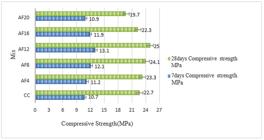
Enhanced compressive strength is seen in concrete mixes containing 12% Alccofine 1203 by weight of cement because of its high glass content and extremely fine particle size. With a particle size normally under 10 microns, low-calcium silicate-based supplementary cementitious material (SCM) Alccofine is significantly finer than typical Portland cement. This ultrafine feature enhances particle packing density, hence lowering gaps and improving pore structure. At a 12% replacement rate, Alccofine adds through both pozzolanic reaction and filler impact. First, its small particles improve matrix densification, hence increasing early-age strength by filling micro-voids between cement grains.
Mix containing 12% Alccofine gained 22.39 % and 10.1% higher compressive strength than the control mix at 7 and 28 days respectively. This may be due to reactive silica in Alccofine then combines with calcium hydroxide (Ca(OH)2) released during cement hydration to create extra calcium silicate hydrate (C–S–H) gel [42]. The greater C–S–H content improves load transfer efficiency by fortifying the interfacial transition zone (ITZ) between aggregate and paste. Moreover, the decreased porosity and perfected capillary structure lowers permeability, therefore directly aiding long-term strength growth and durability. Experimental findings usually show significant increases in 7-day and 28-day compressive strengths compared to control mixes, hence confirming that 12% Alccofine replacement is an ideal ratio for strength improvement without affecting workability. The Compressive strength test results are presented in Figure 1.
Concrete mixtures containing 12% Alccofine 1203 and 0.3% super absorbent polymer (SAP) exhibit notable increases in 7- and 28-day compressive strength due to synergistic microstructure alterations. At 7 and 28 days, the compressive strength of the mix containing 12% Alcofine and 0.3% SAP increased by 28% and 11.4%, respectively, compared to the control mix. With its filling action, ultrafine low-calcium silicate substance Alccofine increases particle packing density and lowers capillary porosity. Reacting with calcium hydroxide, its high reactivity accelerates secondary hydration to generate extra C–S–H gel, therefore densifying the cement matrix and strengthening the interfacial transition zone (ITZ). Including 0.3% SAP absorbs mixing water and slowly releases it during hydration, therefore internally curing it. The compressive strength variations of AF12 and SAP series mixes are presented in Figure 2.

By guaranteeing constant hydration especially in low water–binder ratio systems, this regulated moisture supply helps to reduce self-desiccation and autogenous shrinking. Later in life, the constant hydration helps in the creation of more C–S–H, hence supporting better 28-day strength. Though initially micro-voids are created by SAP particles after water release, the improved pore structure created by Alccofine cancels off this impact. Reduced microcracking, better matrix continuity, and increased load-bearing capability result from the combined action. As a result, the mix has greater early-age strength at 7 days and sustained strength growth at 28 days than ordinary concrete, showing an ideal equilibrium between internal curing and matrix densification. The various mix patterns significantly affected compressive strength, according to a one-way ANOVA test. The relatively low p-value (0.0004) demonstrates that these differences are statistically significant and unlikely to have happened by chance, whereas the computed F-value of 48.0 shows significant variance across the group averages.
3.2. Flexural strength characteristics of AF series mixes
Due to better microstructural densification and bond properties, concrete mixes replacing 12% Alccofine 1203 in part show increased flexural strength. Alccofine incorporated mix attained 23% and 17.2% more flexural strength than the control mix at 7 and 28 days respectively. With typically less than 10 µm particles and a high glass content, Alccofine is an ultrafine ground granular slag which is lot smaller than standard Portland cement. This ultra fine character improves particle packing, lowers voids, and corrects the pore structure of the hardened cement paste. Alccofine helps through chemical as well as physical methods at 12% replacement. Critical for flexural performance, the filler effect increases the packing density inside the matrix and reinforces the interfacial transition zone (ITZ) between aggregate and cement paste.
Chemically, its reactive silica content forms more calcium silicate hydrate (C–S–H) gel by interacting with calcium hydroxide released during cement hydration in secondary pozzolanic reactions. The higher C–S–H content improves matrix tensile stress resistance and crack-bridging ability. The elegant microstructure improves modulus of rupture by lowering micro crack creation and extension under bending stresses. Notable increases observed in 28-day flexural strength, therefore 12% Alccofine substitution provides improved matrix cohesiveness, higher ITZ strength, and overall structural performance under flexural load conditions.The Flexural strength variations of AF series mixes are presented in Figure 3.

Due to influence of efficient internal curing and matrix densification, concrete mixtures containing 12% Alccofine 1203 and 0.3% super absorbent polymer (SAP) exhibit improved flexural strength at both curing periods. Alccofine and SAP incorporated mix obtained 25.6% and 22.4% higher flexural strength than the control mix at 7 and 28 days respectively. Through its micro-filler action, Alccofine, an ultrafine slag-based material with a high glass content and a particle size below 10 µm, escalates packing density and lessens capillary voids. Because of its high pozzolanic reactivity, it can utilize calcium hydroxide and produce more calcium silicate hydrate (C–S–H) gel, which makes secondary hydration easier. This procedure enhances the interfacial transition zone (ITZ), a crucial area controlling flexural behaviour, and fortifies the cementitious matrix [43]. Figure 4 represents the Flexural strength variations of AF12 and SAP series mixes.

Addition of 0.3% SAP improves the performance by absorbing and releasing excess water progressively during hydration which reduces autogenous shrinkage. Incessant presence of moisture stimulates cement and Alccofine hydration, which enhances later-age microstructural refinement, particularly in systems with a low water–binder ratio. By increasing matrix continuity, pore-refining activity mitigates the possibility of minute gaps brought on by SAP’s stored water leaking out. Together, these mechanisms upsurge the modulus of rupture and develop the flexural strength by dropping the formation and propagation of micro cracks under bending loads when compared to conventional concrete mixtures. In statistical analysis, One-way ANOVA test results revealed that the different concrete mixes produced significantly different flexural strengths. The very low p-value (2.10 × 10⁻⁷) indicates that these differences are not due to random experimental variation. The high F-value (153.01) shows a strong separation between the average flexural strengths of the mixes. Furthermore, the effect size (η2 ≈ 0.98) suggests that about 98% of the variation in flexural strength is explained by the mix composition itself. Therefore, the mix design is the dominant factor influencing the flexural performance of the concrete, and each mix exhibits statistically distinct flexural strength characteristics.
3.3. Workability of AF-SAP added mixes
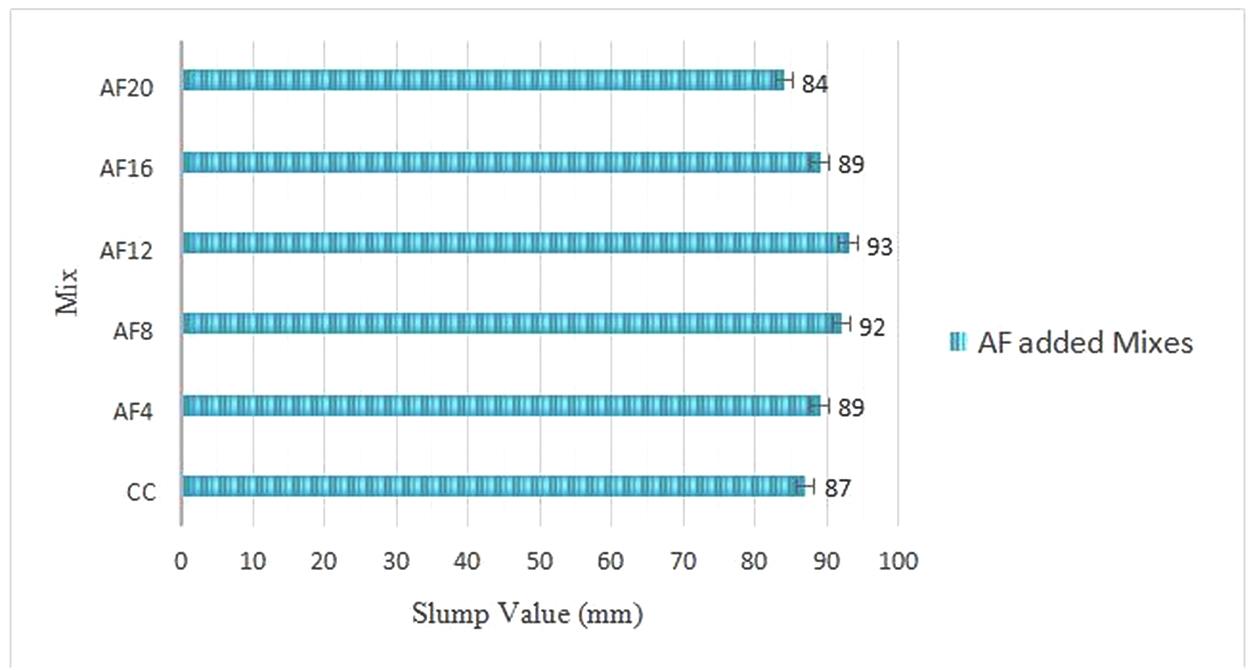
Inclusion of Alccofine up to 12% increased slump values, beyond this limit loss in workability was witnessed. The characteristics of Alccofine 1203, an ultrafine slag-based auxiliary cementitious material with a high glass content and particle size usually less than 10 µm, contribute to the improvement up to the optimum level. Alccofine increases particle packing density at 12% replacement via micro-filler effect. The ultrafine particles enrich the lubrication inside the mix by dropping inter particle friction and filling the pores in cement mantle [44, 45]. Better rheological behaviour results from this optimized particle size distribution, which lets the mix move more easily under its own weight. The Slump variations of AF series mixes are shown in Figure 5.

Furthermore, the smooth and glassy surface texture of Alccofine particles aids mobility of solid particles and raises slump without resulting in segregation or bleeding by means of a “ball-bearing” effect. When the replacement level, though, surpasses 12%, the slump value drops. Higher Alccofine content causes a considerable increase in particular surface area, therefore increasing the water needs of the mix; therefore, this reduction mainly results from that. Excess ultrafine particles absorb more free water, therefore lowering paste viscosity. Moreover, the mix becomes more cohesive and sticky with more powder content, hence limiting aggregate mobility. Therefore, the best dose for reaching better workability while preserving stability and consistency of the concrete mixture is 12%. The increase in slump with 0.3% incorporation of SAP indicates that the SAP might act as a micro-filler, improving particle packing and thus lowering internal friction. More than 0.3% addition of SAP has minimal effects on workability due to reduce particle-to-particle friction [46, 47]. Figure 6 presents the Slump variations of AF 12 and SAP series mixes.

3.4. Ultrasonic pulse velocity results AF12-SAP series mixes
Ultrasonic Pulse Velocity (UPV) results show a noticeable increase in concrete quality for the mixes comprising 12% Alccofine 1203 and 0.3% super absorbent polymer (SAP). Reflecting normal hydration and progressive densification of the cement matrix, the control concrete showed UPV values of 3027 m/s at 7 days and 3468 m/s at 28 days. The increase from 7 to 28 days validates ongoing hydration and decreased interior voids with time. The modified concrete with 12% Alccofine and 0.3% SAP had greater UPV values of 3281 m/s at 7 days and 4119 m/s at 28 days. The higher speeds point to a denser and more homogenous internal structure free from micro cracks and gaps.
Due to its very fine particle size and strong pozzolanic reactivity, Alccofine raises packing density and encourages further C–S–H gel formation via secondary hydration. This results in tightening of the interfacial transition zone (ITZ) and refining of capillary pores. Simultaneously, SAP internal curing releases absorbed water slowly, maintaining hydration and so reducing self-desiccation and small cracking. The coordinated action increases matrix continuity and elastic stiffness, hence enabling faster transit of ultrasonic waves through the material.
In comparison to the control mix, the concrete containing Alcofine and SAP showed higher UPV values at 7 and 28 days, indicating the formation of a denser, more uniform, and less porous microstructure. This is shown in Figure 7. Better internal quality and compactness are reflected in this improvement, which enhances the concrete’s mechanical performance and long-term durability. This improvement can be attributed to enhanced particle packing and internal curing effects, which reduce voids and microcracks. Consequently, the concrete exhibits better durability characteristics, including increased resistance to moisture ingress, chemical attack, and long-term deterioration.

3.5. Half-cell potential values ofAF12-SAP series mixes
Measurements of half-cell potential (HCP) values aid to estimate the likelihood of corrosion activity in embedded reinforcing. Measured voltages for the control concrete varied from –184 mV to –619 mV over a monitoring period of 120 days at an interval of 15 days. ASTM C876 states that values more negative than –350 mV point to a great probability of active corrosion. The lower bound value of –619 mV indicates therefore great de-passivation of the reinforcing steel and elevated corrosion risk. The great possible range also indicates progressive ingress of hostile ions and humidity, which causes passive oxide layer around the steel to degrade.
Conversely, concrete including 12% Alccofine 1203 and 0.3% super absorbent polymer (SAP) showed relatively less negative half-cell potentials, spanning from –172 mV to –537 mV over the same time frame. The movement toward more positive possibilities points to a somewhat reduced chance of corrosion than the conventional mix. The microstructural refinement brought on by Alccofine accounts for the better performance. Its ultra-fine particles improve packing density and stimulate secondary pozzolanic reactions, therefore producing more C–S–H gel that lowers pore connectivity and permeability. This restricts the ingress of moisture, oxygen, and chlorides all of which are required to start corrosion.
Contemporarily, SAP aids through internal curing, ensuring uninterrupted hydration and sinking autogenous shrinkage and micro crack formation. Lower micro cracking confines corrosive agent pathways. The joint influence strengthens the integrity of the interfacial transition zone and sustains the alkaline environment for steel passivation. As a result, modified mix exhibits superior corrosion resistance and long-term durability than control mix over the 120-day exposure period. The comparison of Half cell potential values for CC and AF12-SAP0.3 mixes is shown in Figure 8.

4. CONCLUSION
The test results have led to the following conclusions.
-
Compared to the conventional concrete, the addition of 12% Alccofine 1203 and 0.3% super absorbent polymer (SAP) impressively increased the 7 and 28-day compressive strength of concret.
-
The filler effect and secondary pozzolanic reaction of Alccofine, which produces more C-S-H gel and refines pore structure, are responsible for the increase in compressive strength.
-
At 7 and 28 days, flexural strength also improved, suggesting a stronger interfacial transition zone (ITZ) and better tensile stress resistance.
-
SAP helped with long-term strength growth by avoiding self-desiccation and ensuring continuous hydration through internal curing.
-
Increased particle packing and decreased inter particle friction, helps the mix to obtain good workability at the ideal 12% Alccofine replacement.
-
Results of half-cell potential test revealed that the modified mix unveiled relatively less negative HCP values (–172 mV to –537 mV), demonstrating improved corrosion resistance potential of the mix.
-
The enhanced performance of the mix to withstand corrosion may be endorsed to decreased permeability and micro cracking, which restricted the entry of intimidating ions and maintained steel passivation.
-
Higher Ultrasonic Pulse Velocity (UPV) values confirmed a denser, more homogeneous internal structure in the modified concrete.
-
Overall, the synergistic action of Alccofine and SAP produced a durable, mechanically superior concrete with enhanced structural integrity and long-term performance.
5. DATA AVAILABILITY
The datasets generated and analyzed during the current study are not publicly available but are available from the corresponding author upon reasonable request.
6. BIBLOGRAPHY
- [1] REDDY, M.V.S., ASHALATHA, K., SURENDRA, K., “Studies on eco-friendly concrete by partial replacement of cement with Alccofine and fine fly ash”, Journal of Engineering and Applied Sciences (Asian Research Publishing Network), v. 11, n. 5, pp. 3445–3448, 2016.
-
[2] GAYATHRI, K., RAVICHANDRAN, K., SARAVANAN, J., “Durability and cementing efficiency of Alccofine in concretes”, International Journal of Engineering Research & Technology, v. 5, n. 5, pp. 460–467, 2016. doi: https://doi.org/10.17577/IJERTV5IS050627.
» https://doi.org/10.17577/IJERTV5IS050627 - [3] SUTHAR, S.B., SHAH, B.K., “Study on strength development of high strength concrete containing Alccofine and fly ash”, Indian Journal of Research, v. 2, n. 3, pp. 102–104, 2013.
-
[4] CARDOSO, W., DI FELICE, R., BAPTISTA, R.C., et al., “Evaluation of the use of blast furnace slag as an additive in mortars”, REM - International Engineering Journal, v. 75, n. 3, pp. 215–224, Jul. 2022. doi: https://doi.org/10.1590/0370-44672021750075.
» https://doi.org/10.1590/0370-44672021750075 -
[5] MANI, A., MUTHUKUMAR, S., SATHYANARAYANAN, K.S., “Use of Alccofine 1203 as a sustainable supplementary cementitious material for printable concrete”, Materials Today: Proceedings, v. 93, pp. 489–496, 2023. doi: https://doi.org/10.1016/j.matpr.2023.08.152.
» https://doi.org/10.1016/j.matpr.2023.08.152 -
[6] PRAKASH CHANDAR, S., SANTHOSH, R., “Partial replacement of cement with alternative cementitious material in the production of concrete: A review”, Materials Today: Proceedings, v. 68, pp. 2421–2426, 2022. doi: https://doi.org/10.1016/j.matpr.2022.09.140.
» https://doi.org/10.1016/j.matpr.2022.09.140 -
[7] SRINATH, B.L.N.S., PATNAIKUNI, C.K., BALAJI, K.V.G.D., et al., “A prospective review of Alccofine as supplementary cementitious material”, Materials Today: Proceedings, v. 47, pp. 3953–3959, Jan. 2021. doi: https://doi.org/10.1016/j.matpr.2021.03.719.
» https://doi.org/10.1016/j.matpr.2021.03.719 -
[8] PRASAD YADAV, K., SAMANTA, A.K., “Characterization and development of Alccofine based sustainable concrete - A review”, Materials Today: Proceedings, 2023. doi: https://doi.org/10.1016/j.matpr.2023.05.331.
» https://doi.org/10.1016/j.matpr.2023.05.331 -
[9] AL-MANSOUR, A., CHOW, C.L., FEO, L., et al., “Green concrete: By-products utilization and advanced approaches”, Sustainability, v. 11, n. 19, pp. 5145, 2019. doi: https://doi.org/10.3390/su11195145.
» https://doi.org/10.3390/su11195145 -
[10] VENKATESAN, B., VENUGA, M., DHEVASENAA, P.R., et al., “Experimental study on concrete using partial replacement of cement by Alccofine fine aggregate as iron powder”, Materials Today: Proceedings, v. 37, pp. 2183–2188, 2021. doi: https://doi.org/10.1016/j.matpr.2020.07.648.
» https://doi.org/10.1016/j.matpr.2020.07.648 -
[11] AMRAN, M., HUANG, S.S., ONAIZI, A.M., et al., “Recent trends in ultra-high performance concrete (UHPC): Current status, challenges, and future prospects”, Construction & Building Materials, v. 352, pp. 129029, 2022. doi: https://doi.org/10.1016/j.conbuildmat.2022.129029.
» https://doi.org/10.1016/j.conbuildmat.2022.129029 -
[12] MURALIKRISHNAN, B., SARAVANAN, J., “Effect of addition of Alccofine on the compressive strength of cement mortar cubes”, Emerging Science Journal, v. 5, n. 2, pp. 155–170, 2021. doi: https://doi.org/10.28991/esj-2021-01265.
» https://doi.org/10.28991/esj-2021-01265 - [13] VIPPARTHI, A. “Enhancing the performance and behaviour of M35 Alccofine 1203 grade concrete”, International Journal for Science Technology and Engineering, v. 12, n. 7, pp. 410–422, Dec. 2024.
-
[14] SHARMA, D., SHARMA, S., GOYAL, A., “Utilization of waste foundry slag and Alccofine for developing high strength concrete”, International Journal of Electrochemical Science, v. 11, n. 4, pp. 3190–3205, Mar. 2016. doi: https://doi.org/10.1016/S1452-3981(23)16174-8.
» https://doi.org/10.1016/S1452-3981(23)16174-8 -
[15] HARISH, B., DAKSHINAMURTHY, N.R., SRIDHAR, M., et al., “A study on mechanical properties of high strength concrete with Alccofine as partial replacement of cement”, Materials Today: Proceedings, v. 52, pp. 1201–1210, Jan. 2022. doi: https://doi.org/10.1016/j.matpr.2021.11.037.
» https://doi.org/10.1016/j.matpr.2021.11.037 -
[16] VIVEK, S.S., KARTHIKEYAN, B., BAHRAMI, A., et al., “Impact and durability properties of Alccofine-based hybrid fibre-reinforced self-compacting concrete”, Case Studies in Construction Materials, v. 19, pp. e02275, Dec. 2023. doi: https://doi.org/10.1016/j.cscm.2023.e02275.
» https://doi.org/10.1016/j.cscm.2023.e02275 -
[17] KUMAR, A.G., RAMASAMY, S., SOUNDARARAJAN, E.K., et al., “Sustainable utilization of cement kiln dust and GGBS in the development of eco-friendly concrete composite”, Matéria, v. 29, n. 1, pp. e20240054, 2024. doi: https://doi.org/10.1590/1517-7076-rmat-2024-0054.
» https://doi.org/10.1590/1517-7076-rmat-2024-0054 -
[18] KUNDANATI, R.R., MALPANI, T., SAIRAM, V., “Study on mechanical properties of mortar using Alccofine and graphene oxide”, Materials Today: Proceedings, v. 22, pp. 2431–2438, Jan. 2020. doi: https://doi.org/10.1016/j.matpr.2020.03.369.
» https://doi.org/10.1016/j.matpr.2020.03.369 -
[19] NISHANTH, L., PATIL, N.N., “Experimental evaluation on workability and strength characteristics of self-consolidating geopolymer concrete based on GGBFS, flyash and alccofine”, Materials Today: Proceedings, v. 59, pp. 51–57, Jan. 2022. doi: https://doi.org/10.1016/j.matpr.2021.10.200.
» https://doi.org/10.1016/j.matpr.2021.10.200 - [20] MECHTCHERINE, V., “Towards a better understanding of the effect of superabsorbent polymers on concrete properties”, Cement and Concrete Research, v. 132, pp. 106048, 2020.
-
[21] LI, J., WU, Z., SHI, C., et al., “Durability of ultra-high performance concrete – A review”, Construction & Building Materials, v. 255, pp. 119296, 2020. doi: https://doi.org/10.1016/j.conbuildmat.2020.119296.
» https://doi.org/10.1016/j.conbuildmat.2020.119296 - [22] ARUNVIVEK, G.K., PREETHA, A., BRAGADEESWARAN, T., et al., “Study on behavior of paper industry treated effluent as mixing water in concrete for pollution control and sustainable development”, International Journal of Engineering Research & Technology, v. 3, n. 8, pp. 1049–1051, 2014.
- [23] JENSEN, O.M., HANSEN, P.F., “Autogenous deformation and RH-change in perspective”, Cement and Concrete Research, v. 142, pp. 106359, 2021.
-
[24] AWOYERA, P.O., SIMWANDA, L., VASIĆ, M.V., et al., “Hybrid generative-ensemble approach for predicting recycled aggregate concrete strength properties”, Scientific Reports, v. 16, n. 1, pp. 15205, 2026. doi: https://doi.org/10.1038/s41598-026-42598-6. PubMed PMID: 41787045.
» https://doi.org/10.1038/s41598-026-42598-6 - [25] HUANG, H., YE, G., DAMIDOT, D., “Effect of superabsorbent polymers on the hydration of cement-based materials: A review”, Materials, v. 12, pp. 1113, 2019.
-
[26] LI, Q., WANG, Y., WANG, D., “Environmental conditioning and its impact on internal curing with superabsorbent polymers”, Cement and Concrete Composites, v. 114, pp. 103777, 2020. doi: https://doi.org/10.1016/j.cemconcomp.2020.103777.
» https://doi.org/10.1016/j.cemconcomp.2020.103777 - [27] HASHOLT, M.T., LAUSTSEN, S., JENSEN, O.M., “Impact of superabsorbent polymers on early age properties of concrete”, Cement and Concrete Composites, v. 113, pp. 103684, 2020.
- [28] CHEN, Y., ZHANG, L., LI, J., “Internal curing of concrete using superabsorbent polymers”, Materials, v. 15, pp. 2345, 2022.
- [29] KONG, D., DU, X., WEI, S., “Effects of superabsorbent polymer on the properties of concrete”, Journal of Materials in Civil Engineering, v. 35, pp. 04023045, 2023.
- [30] ARUNVIVEK, G.K., SARAVANAKUMAR, R., SENTHILKUMAR, M., et al., “Experimental study on plasticizing effects of distillery spent wash in concrete”, International Journal of Civil, Structural, Environmental and Infrastructure Engineering Research and Development, v. 3, n. 5, 2013.
- [31] SHI, C., LIU, M., “Effect of super-absorbent polymer on shrinkage and mechanical properties of concrete”, Construction & Building Materials, v. 241, pp. 118010, 2020.
- [32] LIU, Y., GAO, J., LI, Z., “Mechanical properties of concrete with superabsorbent polymer”, Materials and Structures, v. 56, n. 89, 2023.
-
[33] WANG, K., MOON, J., DU, H., et al., “Early-age shrinkage and hydration of concrete incorporating a mutually reinforcing systems of super absorbent polymers and MgO expansive agent under low humidity conditions”, Construction & Building Materials, v. 417, pp. 135350, 2024. doi: https://doi.org/10.1016/j.conbuildmat.2024.135350.
» https://doi.org/10.1016/j.conbuildmat.2024.135350 - [34] LEE, H.X.D., WONG, H.S., BUENFELD, N.R., “Effect of superabsorbent polymer on strength and transport properties of concrete”, Cement and Concrete Research, v. 113, pp. 1–19, 2018.
- [35] ZHAO, H., XU, Y., WANG, D., “Effect of superabsorbent polymer on the hydration of cement-based materials”, Cement and Concrete Composites, v. 123, pp. 104202, 2021.
- [36] YANG, Y., WANG, R., JI, Y., “Development of sustainable and self-healing concrete using superabsorbent polymers”, Sustainability, v. 13, pp. 1187, 2021.
- [37] CHEN, X., WU, S., ZHOU, J., “Influence of superabsorbent polymer on the durability of concrete”, Construction & Building Materials, v. 250, pp. 118928, 2022.
- [38] INDIAN STANDARD, IS 10262: 2019: Concrete Mix Proportioning, New Delhi, IS, 2019.
- [39] INDIAN STANDARD, IS 516: Part 1: Sec 1: 2021: Hardened Concrete Methods of Test, New Delhi, IS, 2021.
- [40] AMERICAN SOCIETY FOR TESTING AND MATERIALS, ASTM C876-15: Standard Test Method for Corrosion Potentials of Uncoated Reinforcing Steel in Concrete, West Conshohocken, ASTM, 2022.
- [41] INDIAN STANDARD, IS 516: Part 5: Sec 1: 2021: Method of Non-Destructive Testing of Concret, New Delhi, IS, 2021.
- [42] RAMESHWARAN, S., VENKATESH, M.P., “Microstructural study and durability characteristics of alccofine-concrete reinforced with polypropylene fibre”, The International Journal of Environmental Studies, v. 11, n. 7, 2025.
-
[43] LYU, Z., SHEN, A., HE, Z., et al., “Absorption characteristics and shrinkage mitigation of superabsorbent polymers in pavement concrete”, The International Journal of Pavement Engineering, v. 23, n. 2, pp. 270–284, 2022. doi: https://doi.org/10.1080/10298436.2020.1742334.
» https://doi.org/10.1080/10298436.2020.1742334 -
[44] DE MEYST, L., KHEIR, J., TENÓRIO FILHO, J.R., et al., “The use of superabsorbent polymers in high performance concrete to mitigate autogenous shrinkage in a large-scale demonstrator”, Sustainability, v. 12, n. 11, pp. 4741, 2020. doi: https://doi.org/10.3390/su12114741.
» https://doi.org/10.3390/su12114741 - [45] LI, L., CHEN, B., “Internal curing effect of superabsorbent polymer on concrete”, Construction & Building Materials, v. 230, pp. 117038, 2020.
-
[46] IMOH, U.U., HABASHNEH, M., KAINE, S.C., et al., “Metakaolin-enhanced laterite rock aggregate concrete: strength optimization and sustainable cement replacement”, Buildings, v. 15, n. 24, pp. 4553, 2025. doi: https://doi.org/10.3390/buildings15244553.
» https://doi.org/10.3390/buildings15244553 -
[47] IMOH, U.U., APATA, A.C., MOVAHEDI RAD, M., “Performance of concrete incorporating waste glass cullet and snail shell powder: workability and strength characteristics”, Buildings, v. 15, n. 13, pp. 2161, 2025. doi: https://doi.org/10.3390/buildings15132161.
» https://doi.org/10.3390/buildings15132161