
 Synergistic effects of steam curing and recycled concrete powder on the mechanical performance of eco-concrete made with recycled concrete aggregates
ABSTRACT
This study investigates the synergistic effects of recycled concrete powder (RCP) and steam curing on the properties of eco-concrete incorporating 50% recycled concrete aggregates (RCA). The goal is to determine the optimal RCP dosage and the most effective curing method. Portland cement was partially substituted with RCP at replacement levels of 10%, 20%, and 30%, and the impact on workability and compressive strength was evaluated under two curing regimes: water curing at 20 ± 1 °C and steam curing at 50 °C. The results indicate that 10% RCP improves workability by 53.4%, while higher replacement levels decrease is due to the increased water absorption capacity of RCP. Steam curing accelerates early-age strength development by activating the pozzolanic potential of RCP; however, excessive RCP content may compromise long-term strength when exposed to elevated curing temperatures. This study highlights a viable approach for incorporating recycled materials in concrete, contributing to sustainable construction practices by reducing cement consumption and promoting waste valorization.
Keywords:
Recycled concrete powder (RCP); Recycled eco-concrete; Steam curing; Substitution; Sustainable construction
1. INTRODUCTION
The construction industry faces mounting pressure to mitigate its substantial environmental footprint, with concrete production recognized as a major contributor to global CO2 emissions, accounting for approximately 8% of the total [1, 2]. This impact stems primarily from the energy-intensive nature of cement manufacturing, which emits large quantities of CO2 into the atmosphere [3], and the extraction of virgin aggregates, which contributes to habitat destruction and the depletion of natural resources [1, 2]. Consequently, developing sustainable concrete solutions, specifically eco-concrete, has become paramount for a more environmentally responsible construction sector [4]. Eco-concrete encompasses a range of approaches and materials aimed at minimizing environmental impact throughout the material’s lifecycle, from raw material extraction to end-of-life management [5, 6]. Additionally, recent work on alkali-activated systems demonstrates that binder chemistry—specifically silicate modulus and alkali concentration—strongly influences early-age and long-term performance of sustainable concretes [7].
A promising strategy in eco-concrete production involves incorporating recycled materials such as recycled concrete aggregates (RCA) and recycled concrete powder (RCP) [8, 9]. Utilizing RCA, obtained from demolished concrete structures, can effectively replace natural aggregates, reducing the environmental burden associated with resource extraction and transportation [10,11,12]. Studies have shown that replacing natural aggregates with RCA can significantly reduce CO2 emissions and energy consumption during concrete production [8, 13]. Recent studies on high-toughness recycled aggregate concretes (HTRAC) have demonstrated that these mixes exhibit superior post-cracking response and mesostructural resilience, thanks to stronger interfacial bonding zones [14, 15]. These imaging results also show measurable toughness improvements compared to conventional recycled aggregate concretes [16]. Additionally, incorporating RCP, a byproduct of RCA production rich in silica and calcium, as a supplementary cementitious material (SCM) presents a viable solution for partially replacing cement, thus lowering the demand for energy-intensive Portland cement production and its associated CO2 emissions [17,18,19,20,21]. The use of RCP not only decreases cement consumption but also provides a sustainable solution for managing construction and demolition waste [22, 23].
Recent studies have demonstrated the potential of advanced data-driven approaches such as machine learning to optimize the design of sustainable concrete mixes by predicting their mechanical performance based on input material parameters. For example, ABDELLATIEF et al. [24] showed that factors like curing age, supplementary cementitious materials (SCMs), and fiber content significantly influence compressive strength in eco-concretes. Similarly, the author [4] emphasized the importance of developing green concretes with low cement content and incorporating recycled materials, highlighting the environmental benefits and feasibility of such mixtures for structural applications [25]. These findings further support the exploration of recycled concrete powder (RCP) and recycled aggregates as viable eco-friendly alternatives in concrete production.
While the incorporation of RCA and RCP offers significant environmental benefits, it is critical to ensure that their incorporation does not compromise the mechanical properties and durability of the resulting concrete. Research has shown that the properties of concrete containing RCA and RCP can be influenced by factors such as the quality of recycled materials, mix design, and curing conditions [26, 27]. Advanced imaging techniques such as in-situ 4D CT have also revealed how fiber reinforcement changes microstructural damage pathways and toughness in recycled aggregate concretes [28]. Furthermore, curing plays a key role in optimizing the reactivity of SCMs like RCP and achieving the desired concrete properties [29, 30].
Steam curing has emerged as an effective alternative to conventional water curing, promoting accelerated strength development, improved early-age properties, and enhanced reactivity of supplementary cementitious materials (SCMs) [31, 32]. This method involves exposing concrete to a controlled environment of elevated temperatures and humidity, typically in an oven or sealed chamber. The increased temperature accelerates cement hydration, promoting the rapid formation of strength-contributing phases such as calcium silicate hydrate (C-S-H) [33]. Additionally, the controlled humidity prevents moisture loss from the concrete, ensuring proper curing and preventing cracking [34]. Moreover, steam curing promotes the pozzolanic reactions of SCMs like RCP, wherein silica and alumina in the SCM react with calcium hydroxide released during cement hydration to form additional C-S-H, further enhancing concrete strength [35, 36]. The temperature employed during steam curing significantly influences the final concrete properties, with higher temperatures generally leading to faster early-age strength gain. However, excessively high temperatures can may result in microcracking or increased porosity, necessitating careful optimization of the steam curing regime [33].
2. RESEARCH SIGNIFICANCE
While numerous studies have investigated the use of recycled aggregates or supplementary cementitious materials independently, limited research has focused on the combined use of recycled concrete powder (RCP) as a partial cement replacement and recycled fine and coarse aggregates (RCA) in a single eco-concrete mix. Furthermore, although steam curing has been explored in enhancing early strength development, few studies have examined its interaction with different levels of RCP replacement in concretes containing high RCA content.
These gaps point to a need for further investigation into the combined effects of RCP content and curing method (steam vs. water) on both the workability and strength development of eco-concrete. Our study addresses this by evaluating the impact of 10%, 20%, and 30% RCP replacement on fresh and hardened properties under two distinct curing regimes.
The specific goal of this research is to determine the optimal RCP dosage and the most effective curing method (between steam curing and conventional water curing) to improve the mechanical performance and sustainability of eco-concrete incorporating 50% recycled aggregates.
3. EXPERIMENTAL PROGRAM
3.1. Used materials
3.1.1. Cement and recycled concrete powder
A Portland composite cement of type CEM II/B-L 42.5N was used in compliance with Algerian specification NA 442. The cement is supplied by LAFARGE Holcim Algeria. Tables 1 and 2 show, respectively, the chemical composition and mineralogical analysis of the cement. The Bogue technique is used to determine mineralogical composition. Table 3 describes the physical properties of cement. The recycled concrete powder (RCP) used in this study was prepared in the laboratory from waste concrete specimens with a 28-day compressive strength of 32 MPa. The waste concrete was first crushed using a jaw crusher to produce gravel-sized particles smaller than 100 mm. These particles were then subjected to a grinding process using an impact crusher. The resulting material was sieved through an 80 µm sieve, and the powder passing through the sieve (RCP) was collected and stored in sealed bags in a dry environment. To ensure a consistent chemical composition and uniform physical characteristics, the total quantity of RCP required for the experimental program was produced in a single batch. The chemical analysis and the physical characteristics of (RCP) are respectively presented in Tables 1 and 3. The (RCP) fines exhibit silico-calcareous properties. The primary components are silica (59.49%) and calcium carbonate (38.18%).
3.1.2. Fine and coarse aggregates
The study used river sand (RS) of the granular class (0/3.15 mm), distinguished by its siliceous composition and sourced from the Djelfa region. The RS has a spherical geometric shape. Two types of coarse aggregates were used: Natural Crushed Aggregate (NCA) and Recycled Concrete Aggregate (RCA), with the granular classes (3.15/8 mm) and (8/16 mm). The NCA is angular in shape and made of limestone derived from quarries in the Djelfa region. The RCA was produced by breaking old concrete blocks—prepared specifically for this study—first using a hammer and then a jaw crusher. Physical properties and granulometric curves of RS, NCA, and RCA are presented in Table 4 and Figure 1, respectively.

3.1.3. Mixing water
The mixing water utilized in the study was sourced from the laboratory’s tap supply. To ensure consistency and accuracy in the experimental conditions, the water temperature was carefully controlled, maintained at 20 ± 2 °C.
3.2. Concretes compositions and testing procedures
3.2.1. Concretes compositions
Using the French “Dreux-Gorisse” graphical method, the granular skeleton for the reference mix (C0RCP) was optimized for a concrete volume of one cubic meter with a cement dosage of 350 kg to achieve good compactness. This optimized skeleton was maintained for all subsequent mixes. Four (04) different concrete compositions were prepared using cement and recycled concrete powder (RCP). The process involved partially substituting the cement volume with (RCP) at rates of 10%, 20%, and 30%. The water content was kept constant across all concrete mixtures (Table 5). After mixing the components in a vertical-axis concrete mixer, the fresh concrete was tested for workability using a slump test, in accordance with the NF EN 12350-2 standard.
3.2.2. Testing procedures
A two-phase experimental procedure was carried out. The first phase involved concrete was produced using recycled concrete powder (RCP) as a partial replacement, in proportions of 10%, 20%, and 30%. Fresh concrete mixes were prepared to investigate effect of varying RCP content on the initial and final setting times and workability, as measured by the slump test. In the second phase, the influence of different curing methods on the mechanical strength of specimens with (RCP) was analyzed at 3, 7, 28, and 56 days. Two curing techniques were employed: water curing (immersion in water at 20 ± 1 °C) and steam curing at 50 °C using a temperature-controlled electric oven. To keep the samples moist during the steam curing procedure, a water-filled container was placed in the oven. The high temperature caused the water to evaporate, providing a humid environment for the samples. The aim of examining these combined effects is to identify the optimal (RCP) content and the most effective steam-curing regime.
Figure 2 illustrates a meticulously controlled steam curing cycle in oven used for concrete specimens, which begins after the initial 24 hours of molding. On Day 1, the cycle starts with the “warming-up phase,” where the temperature of the concrete is gradually increased from 20 °C to 50 °C over a span of 3 hours, from 08:00 a.m. to 11:00 a.m. This is followed by the “treatment phase,” which maintains a constant temperature of 50 °C for 2 hours, from 11:00 a.m. to 01:00 p.m. The “cooling phase” then reverses the warming process, gradually decreasing the temperature from 50 °C back to 20 °C, over 3 hours, from 01:00 p.m. to 04:00 p.m. Finally, the “immersion in water” phase begins at 04:00 p.m., with the concrete submerged in water at a steady 20 °C for 16 hours, concluding at 08:00 a.m. the following day. This complete four-phase cycle is repeated on Days 2 and 3 to ensure consistent and optimal curing conditions, which are essential for achieving the desired properties in the final concrete product.

3.2.3. Preparation of specimens and performed tests
The workability of the fresh concrete was evaluated using the Abrams cone after mixing, in accordance with the procedures specified in the French standard XP P18-451. Once the concrete was molded, plastic sheets were placed over the molds, and they were stored in the laboratory for 24 hours. After demolding, the specimens were subjected to one of two curing conditions until the testing day: either water curing or steam curing.
To evaluate mechanical strengths, cubic specimens measuring 10 × 10 × 10 cm were used for compressive tests in accordance with the EN 12390-3:2012 standard. The compressive strength tests were performed using a testing machine with a maximum load capacity of 1500 kN. Six (06) specimens were tested to obtain the values of strength; and the average of these values was then calculated.
4. RESULTS AND DISCUSSION
This section presents an analysis and interpretation of the results obtained in this study. The first part examines the effect of incorporating recycled concrete powder (RCP) on the workability of concrete made with 50% natural aggregate and 50% recycled concrete aggregate. This is followed by a discussion on the impact of (RCP) on compressive and tensile strengths under two different curing conditions: water curing and steam curing cycle. A comparative evaluation of the two curing environments is also provided to highlight their respective impacts on mechanical performance.
4.1. Effect of (RCP) on the setting time
The initial and final setting times of cement pastes incorporating recycled concrete powder (RCP) were evaluated using a Vicat apparatus, following the procedure outlined in EN 196-3. Four mixtures were tested with 0%, 10%, 20%, and 30% RCP as partial replacements for Portland cement. The results, summarized in Figure 3, show a decreasing trend in initial setting time as RCP content increases—from 140 minutes for the control to 115 minutes at 30% RCP. A similar trend was observed for the final setting time, which decreased from 170 minutes (control) to 175 minutes at 30% RCP, with slight variations. This acceleration in setting time may be attributed to the finer particle size of RCP and its filler effect, which can promote early matrix densification and accelerate the hydration process.

4.2. Effect of (RCP) on concrete workability
Figure 4 illustrates the relationship between slump and the percentage of recycled concrete powder (RCP) in eco-concrete mixtures. According to the XP P18-305 standard, both the reference mix (C0RCP) and the concrete containing 10% RCP are categorized as very plastic, with slump values ranging from 10 to 15 cm. In contrast, concretes with 20% and 30% RCP (C20RCP and C30RCP) are classified as ‘dry’ concretes.

It is evident from Figure 4 that replacing 10% of cement with RCP increases workability by 53.4% compared to the reference mix, highlighting the beneficial effect of this substitution level on the fresh properties of concrete. This improvement aligns with findings reported in the literature [37, 38] that shows how the addition of a moderate amount of RCP can enhance the fluidity of the mix. However, when the RCP content exceeds 10%, the concrete’s workability decreases by 53.4% for 20% RCP and 58.25% for 30% RCP. In the same way, previous studies [39, 40] have shown that beyond a certain threshold, the water absorption properties of RCP begin to negatively impact workability, as the RCP particles absorb water and reduce the mix’s fluidity.
At the 10% RCP level, the particles act as fillers, enhancing the lubrication of the mix and improving its fluidity, thereby making the concrete easier to handle and place. Conversely, when the RCP content exceeds 10%, its effect on consistency becomes detrimental. The high absorption capacity of RCP reduces the amount of free water available in the mix, leading to a drier and less workable concrete. This observation is supported by previous studies [17], which have shown that increasing RCP content raises the water demand of the mix, thereby reducing workability and making the concrete more difficult to handle. This trend is further confirmed by regression analysis, which revealed a parabolic relationship between RCP content and slump. The regression curve showed that slump increases up to 10% RCP, then declines sharply with further addition. This behavior supports the finding that 10% RCP yields optimum workability, likely due to improved particle packing or water retention. The moderate coefficient of determination (R2 = 0.59) suggests that while this trend is evident, other variables such as RCP moisture content or mixing variability may also play a role.
4.3. Effect of (RCP) and curing regimes on mechanical properties
4.3.1. Water curing regimes
Figures 5 and 6 present the compressive strength results obtained under water curing conditions. The data clearly demonstrate that the compressive strength of all tested concrete compositions increases progressively over time. This trend is consistent with established findings in the literature [41,42,43], which confirm that compressive strength typically improves with extended curing durations.

Compressive strength development of eco-concrete with varying RCP content under water curing.

Compressive strength loss of eco-concrete with varying RCP content compared to control during water curing.
The compressive strength values range from 5 to 9 MPa at 3 days, 10 to 14 MPa at 7 days, 18 to 26 MPa at 28 days, and 21 to 32 MPa at 56 days. Additionally, it is evident that the compressive strength of the control concrete consistently exceeds that of the RCP-modified mixes. This observation is supported by previous studies indicating that a higher cement content leads to the formation of a greater amount of calcium-silicate-hydrate (C–S–H) gel, which contributes significantly to strength development [44]. Conversely, compressive strength decreases as the proportion of recycled concrete powder (RCP) increases, illustrating an inverse relationship between RCP content and mechanical performance. This trend aligns with findings reported in the literature [45], who attributed the strength reduction primarily to the dilution effect—where increasing RCP content lowers the proportion of reactive cementitious materials in the mix, thus reducing the effective binder content. Moreover, SEM images presented in their study (Figure 7) reveal a more porous and less compact microstructure in specimens with higher RCP content, confirming that the incorporation of RCP compromises the matrix’s density and the integrity of the interfacial transition zone (ITZ). These microstructural deficiencies directly contribute to the observed decline in compressive strength. The recorded strength reductions range from 12% to 40%, which is consistent with results observed in similar studies [46].

Furthermore, the reduction in compressive strength appears to decrease progressively over time, particularly for the C10RCP mixture. This observation aligns with existing literature [47], which suggests that incorporating low percentages of RCP can be beneficial, as the fine particles contribute to filling the voids between aggregates, thereby enhancing the mix’s compactness without significantly compromising strength. Consequently, a 10% RCP substitution level emerges as optimal, allowing the fines to efficiently occupy interstitial spaces between aggregates [48]. However, when the RCP content exceeds 10%, the excessive fines begin to reduce the overall volume of coarse aggregates in the mix. This reduction in aggregate content may lead to a decline in compressive strength, given the lower availability of solid particles to withstand compressive stresses. Additionally, chemical analysis of cement hydration products indicates that RCP particles do not contribute to strength gain relative to the control mix, suggesting that these fines are either inert or only partially reactive.
4.3.2. Steam curing at 50 °C using electric energy
Figures 8 and 9 illustrate the compressive strength values obtained during the steam curing process conducted at 50 °C using electric energy. The results indicate an enhancement in compressive strength under elevated temperature conditions, which is consistent with findings in the literature [49]. Previous studies have shown that steam curing accelerates the hydration reactions, thereby promoting earlier strength development, particularly in mixtures incorporating recycled materials. This accelerated reaction contributes to improved mechanical performance of eco-concretes at early ages, mitigating some of the strength losses typically associated with the inclusion of recycled concrete powder (RCP).

Compressive strength development of eco-concrete with varying RCP content under steam curing cycle.

Compressive strength loss or gain of eco-concrete with varying RCP content compared to control during steam curing cycle.
In contrast to conventional water curing, exposing the concrete to a thermal drying cycle at 50 °C followed by immersion in water results in a significant improvement in the compressive strength across all tested concrete mixtures. This enhancement can be attributed to the beneficial microstructural changes induced by thermal cycling, which are not typically achieved through standard water curing alone. These findings are consistent with previous studies [50], which report that such temperature-induced conditioning can enhance the formation and densification of hydration products, thereby improving the overall mechanical performance of the concrete.
Figure 9 clearly illustrates that the compressive strength of the recycled concrete mixture incorporating 10% recycled concrete particles (RCP) consistently exceeds that of the control sample at all observed curing intervals—3, 7, 28, and 56 days. The strength improvement ranges from 7% to 12.5%, underscoring the beneficial effect of this treatment method. This enhancement is in agreement with recent findings [31, 35], which demonstrate that thermal curing can significantly improve the performance of concrete mixtures containing pozzolanic materials [51].
This improvement is primarily attributed to the activation of fine particles within the recycled concrete particles (RCP). A portion of these fines exhibit pozzolanic properties, meaning they react with calcium hydroxide in the presence of water to form additional calcium silicate hydrate (C–S–H) gel—the primary compound responsible for strength development in concrete. The elevated temperature during the drying cycle likely accelerates this pozzolanic reaction, facilitating the formation of strength-enhancing compounds. As a result, the concrete matrix becomes denser and more durable. Microstructural evidence from SEM analysis (Figure 10) [33], confirms that curing under elevated temperatures transforms C–S–H morphology from loose, foil-like agglomerates at room temperature into more compact, flake-like structures under steam and autoclave conditions. These morphological changes reflect improved crystallization and densification of the matrix, providing a microstructural basis for the observed strength enhancement. Such densification mechanisms are consistent with strength gains reported under thermal curing regimes.

SEM images of synthetic C–S–H under different curing regimes: (a–c) room curing at 25 °C; (d–f) steam curing at 80 °C; and (g–i) autoclave curing (180 °C, 1 MPa). Adapted from [33].
Overall, this treatment method not only enhances the efficient utilization of recycled materials but also presents a practical solution for improving the mechanical performance of concrete, particularly under environmentally constrained or specific curing conditions.
4.3.3. Comparative analysis of two curing methods
Figure 11 illustrates the variations in compressive strength (Cs) of the concrete samples subjected to the two different curing methods evaluated in this study. The comparison highlights the influence of curing regime on the mechanical performance of both control and recycled mixtures over time.
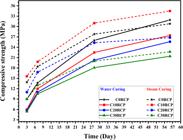
Influence of curing method and RCP content on compressive strength development of eco-concrete.
Figure 11 clearly illustrates that the compressive strength of the concrete mixtures subjected to the drying–wetting cycle is equal to or greater than that of the control concrete cured in water at early ages, specifically after 3 and 7 days. This observation aligns with previous studies [52], which suggest that thermal cycling can improve concrete strength by activating residual cementitious components within recycled aggregates. Similarly, other research has attributed such improvements to the acceleration of pozzolanic reactions under elevated temperatures [53]. However, it is worth noting that some studies have reported inconsistent outcomes, indicating that the effects of thermal cycling on compressive strength can vary depending on the type of aggregates used and the specific curing conditions. In certain cases, thermal treatment may even lead to reduced strength when compared to conventional water curing [54].
Moreover, the C10RCP and C20RCP concretes subjected to repeated heating and cooling cycles exhibit higher compressive strength compared to the water-cured control specimens. In the same way, the B10FR composition cured using the drying–wetting cycle consistently outperforms the control concrete in terms of compressive strength, regardless of whether the control underwent conventional water curing or thermal cycling, and this trend is maintained across all curing ages. These findings are in agreement with previous research [55], which emphasizes the advantages of incorporating recycled aggregates and applying thermal curing to improve the mechanical properties of concrete. Nevertheless, some studies have pointed out that excessive thermal cycling may induce microstructural damage or weaken the interfacial bond between aggregates and the cementitious matrix, potentially resulting in inconsistent or diminished strength gains [50, 56].
The concretes examined in this study incorporate 50% recycled aggregates. This finding is consistent with previous studies reporting that recycled aggregates can enhance compressive strength (Cs), particularly under elevated temperature conditions, due to the presence of residual hydrated or anhydrous cement paste adhered to the aggregates. This residual paste may participate in further hydration or pozzolanic reactions during thermal curing, contributing to strength development. However, other research has indicated that the use of high proportions of recycled aggregates can lead to reduced compressive strength, especially when the recycled aggregates possess high porosity or exhibit weak bonding with the surrounding cementitious matrix.
Elevated curing temperatures can enhance the chemical reactivity of fine demolition particles, such as recycled cementitious powder (RCP). These temperatures stimulate pozzolanic and hydration reactions, promoting the formation of additional binding products and subsequently increasing compressive strength. This observation is supported by recent studies showing that higher curing temperatures significantly improve the performance of concretes incorporating supplementary cementitious materials [57]. However, other research has pointed out that the benefits of high-temperature curing may be offset by adverse effects on the concrete’s microstructure and long-term durability if not carefully managed [58]. Similarly, certain pozzolanic components present in demolition fines may be sensitive to elevated temperatures; their chemical structure may degrade or undergo transformations that limit their reactivity with cement, thereby affecting their contribution to strength development.
5. ENGINEERING IMPLICATIONS AND STUDY LIMITATIONS
The results demonstrate that replacing 10% of cement with RCP, along with 50% recycled aggregates, produces eco-concrete with improved workability and enhanced early-age strength under steam curing. This mix is particularly suitable for precast and early demolding applications. Its practical value lies in reducing virgin material use while maintaining performance, and steam curing at 50 °C further boosts strength through accelerated hydration and pozzolanic activity.
The approach is applicable in regions with abundant demolition waste and can be integrated into existing precast production systems. While the study focused on a single curing temperature (50 °C) to ensure a controlled evaluation, future research can extend this work by testing additional curing conditions and investigating long-term durability to broaden practical implementation and applying optimization tools such as response surface methodology could help refine mix designs and enhance practical implementation in sustainable construction. Additionally, the influence of RCP source variability deserves further study to ensure consistent performance across different material origins.
6. CONCLUSIONS
This study evaluates the combined effects of recycled concrete powder (RCP) and steam curing on the physico-mechanical properties of eco-concrete containing 50% recycled concrete aggregate (RCA). Based on the experimental results, the following conclusions can be drawn:
-
Incorporating 10% recycled concrete powder (RCP) in concrete containing 50% recycled concrete aggregate (RCA) significantly improves workability (by 53.4%) due to the filler and lubrication effects of fine particles.
-
Steam curing at 50 °C enhances the early-age compressive strength of eco-concrete, especially at 10% RCP replacement, surpassing the control mix by 7–12.5%, owing to accelerated hydration and enhanced pozzolanic activity.
-
Increasing RCP content beyond 10% negatively impacts both workability and strength under water curing, due to higher water absorption and dilution effects that limit the formation of key hydration products.
-
The combined use of 10% RCP and steam curing is identified as an optimal strategy for developing eco-concrete with improved mechanical performance and sustainability, offering a promising approach for low-carbon construction applications.
7. BIBLIOGRAPHY
-
[1] RADLINSKI, M., HARRIS, N.J., MONCARZ, P.D., “Sustainable concrete: Impacts of existing and emerging materials and technologies on the construction industry”, In: AEI 2011: Building Integrated Solutions - Proceedings of the AEI 2011 Conference: Buil, pp. 252–262, 2011. doi: http://doi.org/10.1061/41168(399)31.
» https://doi.org/10.1061/41168(399)31 -
[2] HABERT, G., MILLER, S.A., JOHN, V.M., et al., “Environmental impacts and decarbonization strategies in the cement and concrete industries”, Nature Reviews Earth and Environment, v. 1, n. 11, pp. 559–573, 2020. doi: http://doi.org/10.1038/s43017-020-0093-3.
» https://doi.org/10.1038/s43017-020-0093-3 -
[3] OMAR, A., MUTHUSAMY, K., “Concrete industry, environment issue, and green concrete”, Revista de la Construcción, v. 2, n. 1, pp. 1–9, 2022. doi: http://doi.org/10.15282/construction.v2i1.7188.
» https://doi.org/10.15282/construction.v2i1.7188 - [4] KUNTZ, L.M., The “greening” of the concrete industry: factors contributing to sustainable concrete, Cambridge, Massachusetts Institute of Technology, 2006.
-
[5] MÜLLER, H.S., MOFFATT, J.S., HAIST, M., et al., “A New generation of sustainable structural concretes-design approach and material properties”, IOP Conference Series. Earth and Environmental Science, v. 290, n. 1, pp. 012002, 2019. doi: http://doi.org/10.1088/1755-1315/290/1/012002.
» https://doi.org/10.1088/1755-1315/290/1/012002 -
[6] KUMAR, A.G., RAMASAMY, S., SOUNDARARAJAN, E.K., et al., “Sustainable utilization of cement kiln dust and GGBS in the development of eco-friendly concrete composite”, Matéria, v. 29, n. 2, e20240054, 2024. doi: http://doi.org/10.1590/1517-7076-rmat-2024-0054.
» https://doi.org/10.1590/1517-7076-rmat-2024-0054 -
[7] MA, Z., WANG, B., ZHANG, Z., et al., “New insights into the effects of silicate modulus, alkali content and modification on multi-properties of recycled brick powder-based geopolymer”, Journal of Building Engineering, v. 97, pp. 110989, Nov. 2024. doi: http://doi.org/10.1016/j.jobe.2024.110989.
» https://doi.org/10.1016/j.jobe.2024.110989 - [8] PACHECO-TORGAL, F., SHASAVANDI, A., JALALI, S., “Eco-efficient concrete using industrial wastes: a review”, Materials Science Forum, v. 730–732, pp. 581–586, Jan. 2013.
-
[9] RAJ, C.T.A., RAJESH, V., MARIAPPAN, M.R.K., et al., “Evaluation of the microstructural and mechanical properties of eco-friendly concrete reinforced with recycled wind turbine blades”, Matéria, v. 29, n. 3, e20240208, 2024. doi: http://doi.org/10.1590/1517-7076-rmat-2024-0208.
» https://doi.org/10.1590/1517-7076-rmat-2024-0208 -
[10] QUATROQUE, V.H.S.S., SIMÕES, R.D., JOB, A.E., “Concrete in Brazil: brief history, current challenges, and proposals for a sustainable future”, Revista Fórum Ambiental da Alta Paulista, v. 19, n. 4, pp. 105–119, 2023. doi: http://doi.org/10.17271/1980082719420233603.
» https://doi.org/10.17271/1980082719420233603 -
[11] ZEYAD, A.M., “Sustainable concrete production: Incorporating recycled wastewater as a green building material”, Construction & Building Materials, v. 407, pp. 133522, 2023. doi: http://doi.org/10.1016/j.conbuildmat.2023.133522.
» https://doi.org/10.1016/j.conbuildmat.2023.133522 -
[12] NACHIMUTHU, B., VISWANATHAN, R., SUBRAMANIYAN, Y., et al., “Mechanical properties of recycled concrete aggregates with superplasticizer”, Matéria v. 29, n. 2, e20230382, 2024. doi: http://doi.org/10.1590/1517-7076-rmat-2023-0382.
» https://doi.org/10.1590/1517-7076-rmat-2023-0382 - [13] NAIK, T.R., MORICONI, G., “Environmental-friendly durable concrete made with recycled materials for sustainable concrete construction CANMET ”, In: Proceedings of the ACI International Symposium on Sustainable Development of Cement and Concrete, pp. 1–13, Toronto, Canada, 2005.
-
[14] WANG, C., LIU, J., LU, B., et al., “Stiffness degradation and mechanical behavior of microfiber-modified high-toughness recycled aggregate concrete under constant load cycling”, Engineering Fracture Mechanics, v. 312, pp. 110608, Dec. 2024. doi: http://doi.org/10.1016/j.engfracmech.2024.110608.
» https://doi.org/10.1016/j.engfracmech.2024.110608 -
[15] WANG, C., DU, Z., ZHANG, Z., et al., “In-situ 4D CT scanning and digital volume correlation for 3D kinematic field analysis in high-toughness recycled aggregate concrete”, Construction & Building Materials, v. 453, pp. 139075, Nov. 2024. doi: http://doi.org/10.1016/j.conbuildmat.2024.139075.
» https://doi.org/10.1016/j.conbuildmat.2024.139075 -
[16] WANG, C., LIU, J., ZHANG, Y., et al., “Using in-situ 4D CT technology for exploring strength characteristics and softening mechanism of microfiber-reinforced recycled aggregate concrete under constant strain cycling”, Construction & Building Materials, v. 451, pp. 138926, Nov. 2024. doi: http://doi.org/10.1016/j.conbuildmat.2024.138926.
» https://doi.org/10.1016/j.conbuildmat.2024.138926 -
[17] AQUINO ROCHA, J.H., TOLEDO FILHO, R.D., “The utilization of recycled concrete powder as supplementary cementitious material in cement-based materials: a systematic literature review”, Journal of Building Engineering, v. 76, pp. 107319, 2023. doi: http://doi.org/10.1016/j.jobe.2023.107319.
» https://doi.org/10.1016/j.jobe.2023.107319 -
[18] OLIVEIRA, D.R.B., LEITE, G., POSSAN, E., et al., “Concrete powder waste as a substitution for Portland cement for environment-friendly cement production”, Construction & Building Materials, v. 397, pp. 132382, 2023. doi: http://doi.org/10.1016/j.conbuildmat.2023.132382.
» https://doi.org/10.1016/j.conbuildmat.2023.132382 -
[19] DOUARA, T.H., GUETTALA, S., “Effects of curing regimes on the physico-mechanical properties of self-compacting concrete made with ternary sands”, Construction & Building Materials, v. 195, pp. 41–51, 2019. doi: http://doi.org/10.1016/j.conbuildmat.2018.11.043.
» https://doi.org/10.1016/j.conbuildmat.2018.11.043 -
[20] NAAS, A., TAHA-HOCINE, D., SALIM, G., et al., “Combined effect of powdered dune sand and steam-curing using solar energy on concrete characteristics”, Construction & Building Materials, v. 322, pp. 126474, 2022. doi: http://doi.org/10.1016/j.conbuildmat.2022.126474.
» https://doi.org/10.1016/j.conbuildmat.2022.126474 -
[21] JAGADESH, P., OYEBISI, S., MUTHU, A.H., et al., “Recycled concrete powder on cement mortar: Physico-mechanical effects and lifecycle assessments”, Journal of Building Engineering, v. 86, pp. 108507, 2024. doi: http://doi.org/10.1016/j.jobe.2024.108507.
» https://doi.org/10.1016/j.jobe.2024.108507 -
[22] LIKES, L., MARKANDEYA, A., HAIDER, M.M., et al., “Recycled concrete and brick powders as supplements to Portland cement for more sustainable concrete”, Journal of Cleaner Production, v. 364, pp. 132651, 2022. doi: http://doi.org/10.1016/j.jclepro.2022.132651.
» https://doi.org/10.1016/j.jclepro.2022.132651 - [23] BASTIDAS-MARTÍNEZ, J.G., CARDENAS, J.C.R., GARCÍA, L.M., et al., “Incorporating powder from recycled concrete aggregates as filler in hot mixture asphalt”, Matéria, v. 26, n. 3, e13049, 2021.
-
[24] ABDELLATIEF, M., MURALI, G., DIXIT, S., “Leveraging machine learning to evaluate the effect of raw materials on the compressive strength of ultra-high-performance concrete”, Results in Engineering, v. 25, pp. 104542, 2025. doi: http://doi.org/10.1016/j.rineng.2025.104542.
» https://doi.org/10.1016/j.rineng.2025.104542 -
[25] MURALI, G., WONG, L.S., KARTHIKEYAN, K., et al., “Concrete resilience under the impact of water forces: a review of abrasion resistance in hydraulic structures”, Results in Engineering, v. 26, pp. 104654, 2025. doi: http://doi.org/10.1016/j.rineng.2025.104654.
» https://doi.org/10.1016/j.rineng.2025.104654 -
[26] OIKONOMOPOULOU, K., IOANNOU, S., SAVVA, P., et al., “Effect of mechanically treated recycled aggregates on the long term mechanical properties and durability of concrete”, Materials, v. 15, n. 8, pp. 2871, 2022. doi: http://doi.org/10.3390/ma15082871. PubMed PMID: 35454564.
» https://doi.org/10.3390/ma15082871 - [27] PAUL, S.C., VAN ZIJL, G.P., “Mechanical and durability properties of recycled concrete aggregate for normal strength structural concrete”, International Journal of Sustainable Construction Engineering and Technology, v. 4, n. 1, pp. 89–103, 2013.
-
[28] WANG, C., YUAN, J., ZHANG, Y., et al., “Study on the mesoscopic mechanical behavior and damage constitutive model of micro-steel fiber reinforced recycled aggregate concrete”, Construction & Building Materials, v. 443, pp. 137767, Sep. 2024. doi: http://doi.org/10.1016/j.conbuildmat.2024.137767.
» https://doi.org/10.1016/j.conbuildmat.2024.137767 -
[29] XUN, X., RONGHUA, Z., YINGHU, L., “Influence of curing regime on properties of reactive powder concrete containing waste steel fibers”, Construction & Building Materials, v. 232, pp. 117129, 2020. doi: http://doi.org/10.1016/j.conbuildmat.2019.117129.
» https://doi.org/10.1016/j.conbuildmat.2019.117129 -
[30] ABDULRAHMAN, M., AL-ATTAR, A., AHMAD, M., “Effect of different curing conditions on the mechanical properties of reactive powder concrete”, In: Proceedings of the 3rd International Conference on Buildings, Construction and Environmental Engineering, BCEE3-2017, 2018. doi: http://doi.org/10.1051/matecconf/201816202014.
» https://doi.org/10.1051/matecconf/201816202014 -
[31] QIU, C., ZHAO, Y., ZHU, X., et al., “Influence of steam curing on hydration and microstructure of cement paste containing high-volume lithium slag”, Materials Express, v. 14, n. 4, pp. 631–636, 2024. doi: http://doi.org/10.1166/mex.2024.2643.
» https://doi.org/10.1166/mex.2024.2643 -
[32] NAYAKA, R., DIWAKAR, G.S., GUDUR, V., “Effect of steam curing on the properties of high early strength silica fume concrete”, IOP Conference Series. Materials Science and Engineering, v. 431, n. 4, pp. 042011, 2018. doi: http://doi.org/10.1088/1757-899X/431/4/042011.
» https://doi.org/10.1088/1757-899X/431/4/042011 -
[33] WANG, Z., CHEN, Y., XU, L., et al., “Insight into the local C-S-H structure and its evolution mechanism controlled by curing regime and Ca/Si ratio”, Construction & Building Materials, v. 333, pp. 127388, 2022. doi: http://doi.org/10.1016/j.conbuildmat.2022.127388.
» https://doi.org/10.1016/j.conbuildmat.2022.127388 -
[34] SHUMUYE, E.D., ZHAO, J., WANG, Z., “Effect of the curing condition and high-temperature exposure on ground-granulated blast-furnace slag cement concrete”, International Journal of Concrete Structures and Materials, v. 15, n. 1, pp. 15, 2021. doi: http://doi.org/10.1186/s40069-020-00437-6.
» https://doi.org/10.1186/s40069-020-00437-6 -
[35] ZEYAD, A.M., TAYEH, B.A., ADESINA, A., et al., “Review on effect of steam curing on behavior of concrete”, Cleaner Materials, v. 3, pp. 100042, 2022. doi: http://doi.org/10.1016/j.clema.2022.100042.
» https://doi.org/10.1016/j.clema.2022.100042 -
[36] UZAWA, M., SHIMOYAMA, Y., KOSHIKAWA, S., “Various hydration reactions of silica fume blended cement under different curing conditions, and a hypothesis for the ultra high strength development mechanism of RPC”, J-STAGE, v. 55, n. 1, pp. 114–121, 2006. doi: http://doi.org/10.2472/jsms.55.114.
» https://doi.org/10.2472/jsms.55.114 -
[37] DENG, X., LI, J., LU, Z., et al., “Rheological and early hydration of cementitious material containing recycled concrete powders collected from recycled aggregates”, Construction & Building Materials, v. 393, pp. 132108, 2023. doi: http://doi.org/10.1016/j.conbuildmat.2023.132108.
» https://doi.org/10.1016/j.conbuildmat.2023.132108 - [38] CHEN, X., LI, Y., KANG, X., et al., “Study on recycled concrete powders as mineral admixture in recycled concret”, IOP Conference Series: Earth and Environmental Science, v. 330, n. 2, pp. 022113, 2019.
-
[39] JIANG, Y., LI, B., LIU, S., et al., “Role of recycled concrete powder as sand replacement in the properties of cement mortar”, Journal of Cleaner Production, v. 371, pp. 133424, 2022. doi: http://doi.org/10.1016/j.jclepro.2022.133424.
» https://doi.org/10.1016/j.jclepro.2022.133424 -
[40] HORSAKULTHAI, V., “Effect of recycled concrete powder on strength, electrical resistivity, and water absorption of self-compacting mortars”, Case Studies in Construction Materials, v. 15, e00725, 2021. doi: http://doi.org/10.1016/j.cscm.2021.e00725.
» https://doi.org/10.1016/j.cscm.2021.e00725 -
[41] DOUARA, T.H., GUETTALA, S., HADJI, T., et al., “Strength assessment and durability of self-compacting concrete manufactured with various fine aggregates subjected to acidic curing environment”, World Journal of Engineering, v. 19, n. 4, pp. 570–582, Jan. 2022. doi: http://doi.org/10.1108/WJE-01-2021-0060.
» https://doi.org/10.1108/WJE-01-2021-0060 -
[42] AVES JUNIOR, F.A., “Assessment of concrete compressive strength with the incorporation of recycled coarse aggregates across varied curing periods”, International Journal of Advanced Research in Science Communication and Technology, v. 3, pp. 948–956, 2023. doi: http://doi.org/10.48175/IJARSCT-12335.
» https://doi.org/10.48175/IJARSCT-12335 - [43] ULLOA, V.A., GARCÍA-TAENGUA, E., PELUFO, M.J., et al., “New views on effect of recycled aggregates on concrete compressive strength”, ACI Materials Journal, v. 110, n. 6, pp. 687–696, 2013.
-
[44] PALANIAPPAN, P., VELU, G., SOMASUNDARAM, T., et al., “A comparative study of sustainable mix incorporating recycled aggregates”, Matéria, v. 29, n. 3, e20240284, 2024. doi: http://doi.org/10.1590/1517-7076-rmat-2024-0284.
» https://doi.org/10.1590/1517-7076-rmat-2024-0284 - [45] TOPIČ, J., TREJBAL, J., PLACHÝ, T., et al., “Relationship between compressive strength and young’s modulus of cement paste with recycled concrete powder”, Key Engineering Materials, v. 1144, pp. 65–69, 2017.
-
[46] LAU, T.L., ELLEITHY, W., CHOONG, W.K., et al., “Effects of recycled aggregates on concrete strengths”, Materials Research Innovations, v. 18, n. sup6, pp. S6-372–S6-S374, 2014. doi: http://doi.org/10.1179/ 1432891714Z.000000000982.
» https://doi.org/10.1179/1432891714Z.000000000982 -
[47] CHEN, X., LI, Y., BAI, H., et al., “pozzolanic”, Journal of Renewable Materials, v. 9, n. 12, pp. 2189–2208, 2021. doi: http://doi.org/10.32604/jrm.2021.015394.
» https://doi.org/10.32604/jrm.2021.015394 -
[48] HOU, Y., YU, Z., ZHANG, J., et al., “Gray model study of strength and pore structure of recycled concrete powder (RCP) concrete based on low-field NMR technology”, Materials, v. 16, n. 17, pp. 6058, 2023. doi: http://doi.org/10.3390/ma16176058. PubMed PMID: 37687751.
» https://doi.org/10.3390/ma16176058 -
[49] HANIF, A., KIM, Y., USMAN, M., et al., “Optimization of steam-curing regime for recycled aggregate concrete incorporating high early strength cement-a parametric study”, Materials, v. 11, n. 12, pp. 2487, 2018. doi: http://doi.org/10.3390/ma11122487. PubMed PMID: 30544555.
» https://doi.org/10.3390/ma11122487 -
[50] AN, M., HUANG, H., WANG, Y., et al., ”Effect of thermal cycling on the properties of high-performance concrete: Microstructure and mechanism”, Construction & Building Materials, v. 243, pp. 118310, 2020. doi: http://doi.org/10.1016/j.conbuildmat.2020.118310.
» https://doi.org/10.1016/j.conbuildmat.2020.118310 -
[51] SUKUMAR, A., GANESAN, A.K., “Analyzing the mechanical and material characteristics of cellular lightweight foam concrete and optimizing design mix through linear regression analysis”, Matéria, v. 29, n. 3, e20240182, 2024. doi: http://doi.org/10.1590/1517-7076-rmat-2024-0182.
» https://doi.org/10.1590/1517-7076-rmat-2024-0182 -
[52] KHAN, M.S., ALMUTAIRI, S., ABBAS, H., “Mechanical properties of concrete subjected to cyclic thermal loading”, European Journal of Environmental and Civil Engineering, v. 26, n. 7, pp. 2855–2868, 2022. doi: http://doi.org/10.1080/19648189.2020.1782771.
» https://doi.org/10.1080/19648189.2020.1782771 -
[53] LIU, Y., HOU, Z., FENG, Z., “Investigating the performance of alkali-activated cementitious materials under temperature cycling”, International Journal of Heat and Technology, v. 42, n. 2, pp. 490–500, 2024. doi: http://doi.org/10.18280/ijht.420215.
» https://doi.org/10.18280/ijht.420215 -
[54] VARONA, F.B., BAEZA-BROTONS, F., TENZA-ABRIL, A.J., et al., “Residual compressive strength of recycled aggregate concretes pozzolanic high temperature exposure”, Materials, v. 13, n. 8, pp. 1981, 2020. doi: http://doi.org/10.3390/ma13081981. PubMed PMID: 32340391.
» https://doi.org/10.3390/ma13081981 -
[55] LIANG, C., PAN, B., MA, Z., et al., “Utilization of CO2 curing to enhance the properties of recycled aggregate and prepared concrete: a review”, Cement and Concrete Composites, v. 105, pp. 103446, 2020. doi: http://doi.org/10.1016/j.cemconcomp.2019.103446.
» https://doi.org/10.1016/j.cemconcomp.2019.103446 -
[56] SILVA, Y.F., DELVASTO, S., “Sulfate attack resistance of self-compacting concrete with residue of masonry”, Construction & Building Materials, v. 268, pp. 121095, 2021. doi: http://doi.org/10.1016/j.conbuildmat.2020.121095.
» https://doi.org/10.1016/j.conbuildmat.2020.121095 - [57] EZZIANE, K., KADRI, E.H., BOUGARA, A., et al., “Analysis of mortar long-term strength with supplementary cementitious materials cured at different temperatures”, ACI Materials Journal, v. 107, n. 4, pp. 323–331, 2010.
- [58] ZHANG, X., “Quantitative microstructural characterisation of concrete cured under realistic temperature conditions”, D.Sc. Thesis, EPFL, Lausanne, 2007.


