 Experimental characterization of self-compacting concrete reinforced with PET fibres as an alternative of commercial fibres
ABSTRACT
The present study was developed to study the engineering properties of polyethylene terephthalate (PET) waste fibres reinforced self-compacting concrete (SCC). The PET fibres were depolymerised by glycolysis to produce an unsaturated polyester resin, which was then used to prepare PET fibre-reinforced self-compacting concrete (PET-FSCC). The present work supports the transition to circular economy principles in the construction industry by valorising plastic waste into a value-added construction material, thus contributing to the reduction of environmental pollution and the development of sustainable infrastructures. Two fibre geometries (wavy (WPF) and linear (LPF)) and three fibre lengths (35 mm, 40 mm, 50 mm) were studied at volumetric fibre ratios (Vf) ranging from 0.3% to 1.2%. This led to thirty experimental mix designs. The fresh state performance was tested by slump flow, T50, V-funnel and L-box tests and the compressive strength, flexural strength, and modulus of elasticity were examined at 7, 28 and 90 days. The experimental results show that an increase in the fibre length and Vf gradually reduces the workability of fresh SCC and significantly enhances the flexural strength and the modulus of elasticity (up to around 30% and 22.5% respectively at optimal fibre contents). The compressive strength decreased moderately by 3.7 to 5.9% with increasing Vf. The best performance was achieved at Vf = 0.8% for 35 mm fibres and at Vf = 0.5% and 0.3% for 0 mm and 50 mm fibres, respectively. This study has practical implications in that post-consumer PET waste can be used as a macro-fibre reinforcement in SCC and has direct applications in prefabricated elements, floor slabs, tunnel linings, façade panels and eco-efficient building components.
Keywords:
Self compacting concrete; Recycled PET fibres; Flow properties; Mechanical performances; Sustainable construction; Environmental impact; Circular economy
1. INTRODUCTION
The construction sector is being pressured more and more to introduce sustainable methodologies in its processes to decrease its environmental impact, in particular related to the management of plastic waste. Over the last four decades global plastic production has surged, with more than 360 million metric tonnes generated annually, a large fraction of which is composed of polyethylene terephthalate (PET)-based packaging materials that are landfilled or incinerated, causing greenhouse gases and environmental damage [1, 2].
One of the most common thermoplastic polymer plastics is polyethylene terephthalate (PET), and post-consumer PET is one of the major components of the global municipal solid waste streams. Because it is not biodegradable and degrades slowly (it takes a few centuries in natural environments), it is considered an enduring environmental pollutant. The reprocessing of used PET bottles as concrete reinforcement is a technically effective and environmentally feasible process which solves two major issues: minimising the volume of plastic waste and replacing high-energy consumption commercial fibres fabrication [3, 4]. In the framework of a circular economy, the use of recycled PET (rPET) fibres in SCC contributes not only mitigating the problem of plastic waste in the environment and in our landfills, as well as in our rivers, but also to lowering the CO2 emissions linked to the manufacture of traditional synthetic fibres, such as carbon or glass fibres [5], where the production of these synthetic fibres results in the emission of roughly 29,450 kg and 2,500 kg of CO2 per tonne of fibres, respectively [6]. Fibre-reinforced self-compacting concrete (FR-SCC) is an engineered material with high flowability that can be placed by vibration or without vibration and has sufficient filling capacity. The development of fibre reinforced SCC started early in the 2000s. Both academic research and industrial applications have supported this development [7].
Since there is a huge demand for concrete worldwide, particularly in developing nations, recycling and reusing PET plastic waste as aggregate replacement and Fibre in concrete production can be one of the environmentally friendly methods by increasing human awareness of the environment, the economy, and carbon dioxide (CO2) emissions [5, 8]. Various types of fibres have been incorporated into SCC to enhance specific performance characteristics. For instance, polypropylene and basalt fibres have been shown to improve the fire resistance of precast concrete elements and Self compacting concrete [9]. The mechanical, rheological, and durability performances of FR-SCC have also been extensively studied using different types of waste fibres [10, 11, 12, 13, 14]. However, the flow behaviour of SCC is highly sensitive to modifications in mix composition, and it is well established that fibre incorporation significantly affects the fresh properties of SCC. Abbass et al. (2018) also showed the geometry of steel fibres and aspect ratio have a decisive effect on the gains in compressive and tensile splitting strengths, and these gains have a diminishing nature after a certain volumetric limit [7]. ABDULLAH and HAIDO [15] investigated the flexural behaviour of hybrid reinforced concrete beams (HRCB) made with normal concrete (NC) repaired by or bonded to HSC containing the waste PET Fibres (FRC). ASLANI and NEJADI [16] extended the above results to hybrid SCC systems with steel and PP fibres and established synergistic effects on post-peak strain energy dissipation and compressive ductility. Fibre type, diameter (d), aspect ratio (l/d) and volumetric fibre content (Vf) have been shown in the previous studies to be important factors controlling the performance of FR-SCC [17, 18]. The reinforcing index (RI) defined as RI = Vf × (l/d) has been widely used to take into account the combined effect of fibre content and geometry to assess the effect of fibres on concrete behaviour [19]. Additionally, the influence of fibre distribution and orientation on the tensile behaviour of steel fibre-reinforced SCC beams has been investigated by several researchers [20, 21]. Several researchers have demonstrated that the addition of rPET fibres at volumetric contents of 0.25% to 2.0% can improve the flexural tensile strength [22], impact strength and fracture energy of concrete as a result of energy dissipation when opening cracks through the processes of fibre pull-out and fibre rupture, and also rPET fibres can contribute to the assurance of load-bearing continuity after cracking due to the energy dissipation related to the process of pull-out [23, 24]. The recent work of TEIXEIRA and CERQUEIRA [24] revealed that 1% addition of rPET fibre into recycled aggregate concrete beams changed the fracture pattern by enhancing total fracture energy and failure mode from brittle fracture to quasi-ductile, a fact of great importance for structural safety in serviceability conditions. AL HADITHI et al. [25] also highlighted out that the use of PET fibres is an effective method to enhance the mechanical performance of various concrete types, especially regarding toughness, fatigue resistance, impact resistance and flexural strength. Additionally, research has demonstrated that incorporating certain types of fibres can enhance the fire resistance of concrete at elevated temperatures [26]. However, recycled PET fibres usually have a lower mechanical strength than commercial fibres.
Recently, the researchers were more interested in the life-cycle analysis of waste-containing composites instead of only the properties [27, 28, 29, 30]. FATIMA et al. [28] used Life Cycle Assessment (LCA) and Life Cycle Costing (LCC) to evaluate the environmental and economic sustainability of home textiles production using rPET fibre. The influence of multiple energy sources and fibre blends on sustainability outcomes were explored. Recycling post-consumer PET into macro-fibres therefore represents a promising approach for producing more sustainable fibre-reinforced composites by converting plastic waste into a value-added construction material [31, 32]. Thorough review of the literature to date reveals the following research gaps that the present study seeks to address:
-
(i)
Fibre geometry comparison in SCC: Although the effect of fibre content and aspect ratio on FR-SCC has been studied for steel [18], polypropylene [33] and glass fibres, a direct systematic comparison of the wavy versus linear PET fibre geometries in SCC, considering multiple lengths and volumetric fractions, has not been reported. The majority of the existing research on PET fibre is restricted to conventional vibrated concrete or a single fibre geometry [25, 31, 34].
-
(ii)
Recycled PET sweeper waste as fibre source Most of the PET fibre studies use bottle-derived or commercially cut fibres [4, 23, 31, 34]. This study is the first to systematically characterise fibres from post-consumer plastic sweeper waste, a new and widely available waste stream that has not been addressed previously in the SCC literature.
-
(iii)
Reinforcing index as a unified design parameter for PET-FSCC: The reinforcing index (RI = Vf × l/d) as a single predictive parameter that encompasses both fresh flow behaviour and hardened mechanical performance of PET-FSCC across two geometries, three lengths, and six volumetric fractions, presents a novel and practically actionable design framework.
-
(iv)
Wavy vs. linear PET fibre performance in SCC: The trade-off between the rheological penalty and mechanical benefit of wavy and linear PET macro-fibres in SCC has not been quantified in previous studies under the same mix design conditions.
This study fills all these four gaps with a comprehensive parametric study providing new and reproducible experimental data and design recommendations for the sustainable PET fibre reinforced SCC.
Through the use of recycled PET fibres originating from post-consumer materials, this investigation pushes forward the advancement of eco-efficient concrete in line with circular economy strategies, thus minimising environmental burdens, while still delivering enhanced specific mechanicals of SCC.
2. MATERIALS AND METHODS
2.1. PET fibres
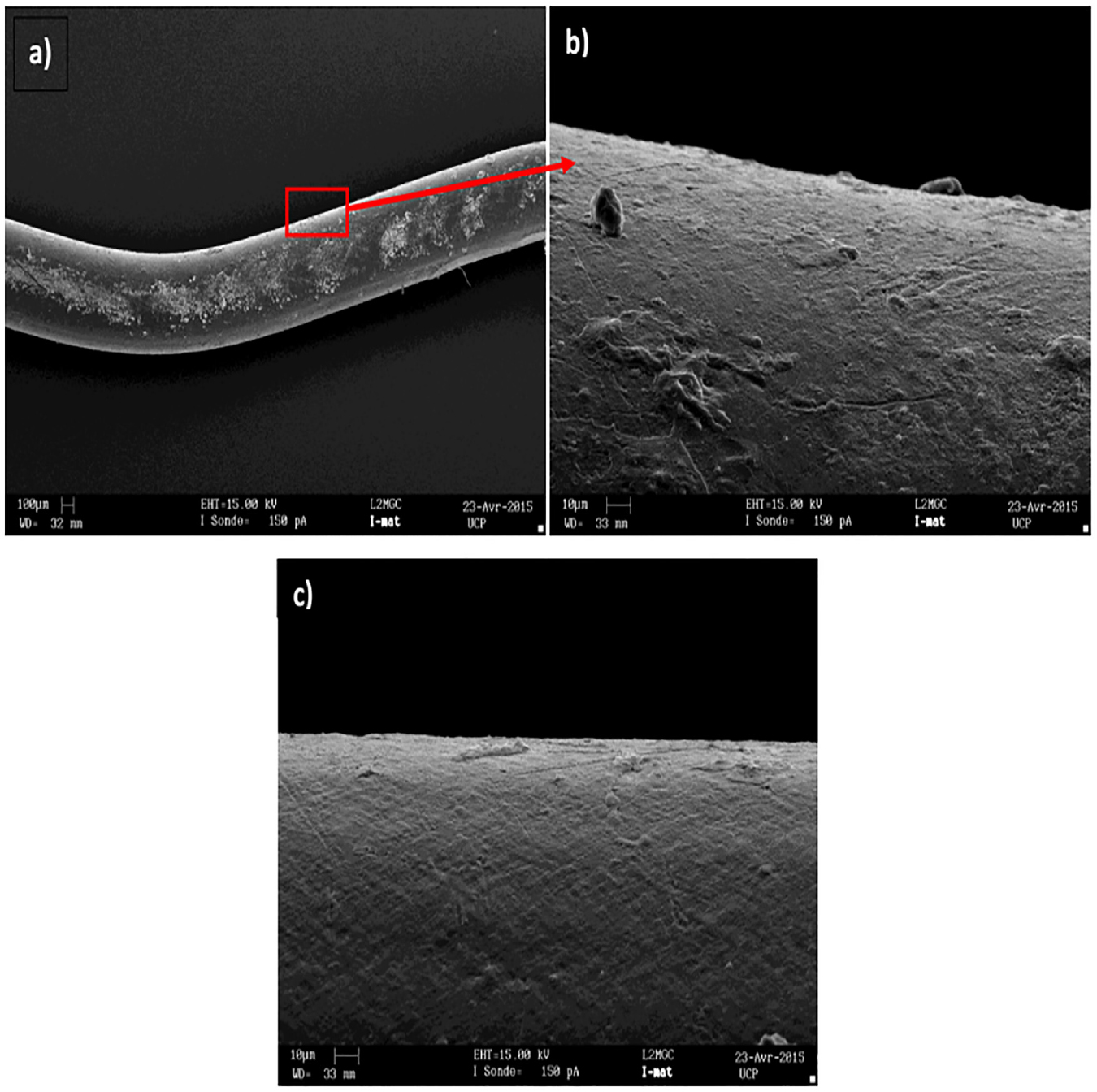
The PET fibres were recovered from the recycled plastic sweeper waste as indicated in the Figure 1. The average diameter of the PET fibres was 0.40 ± 0.02 mm and the density was 0.70 g/cm3. Tensile tests on the PET fibres were conducted for both linear and wavy geometries with a fibre length of 40 mm, using an INSTRON 5567 universal testing machine with a load capacity of 20 kN and a loading rate of 50 mm/min. The Weibull distribution [35] is commonly employed as a statistical approach to describe the tensile strength of brittle fibres such as jute, bamboo, and phoenix fibres [36, 37, 38].

Tensile testing on 40 mm gauge length fibres was conducted for both wavy (WPF) and linear (LPF) shapes as this length was the intermediate value of the range (35–50 mm) and it was expected to provide a representative measure of the fibre mechanical properties. All the three fibre sizes (35, 40 and 50 mm) were machined from the same batch of recycled plastic sweeper waste employing a uniform processing, thereby maintaining same cross-sectional geometry, surface texture, density, and material properties inherent from batch to batch. This method itself is methodologically aligned to established practice for fibre-reinforced concrete (FRC) research where tensile characterization at a ‘representative’ gauge length defines the material-level fibre properties that govern fibre–matrix interaction [36, 39]. The fibre elastic modulus, fibre tensile strength and the fibre failure strain are material properties and are therefore length independent for macro-fibres with constant cross-section, as is validated by the Weibull statistical model utilised herein [35].
The results of tensile strength are represented in Table 1.
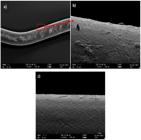
SEM analysis SEM diagrams of wavy PET fibres are shown in Figure 2a and b. Figure 2c presents the SEM analysis of linear PET fibres, and the tensile test results are represented in Figure 3.

2.2. Fibre reinforced specimens
Fibre-reinforced SCC (FR-SCC) mixtures were prepared using CEM II/B 42.5 N cement, with a specific Blaine surface area of 385 m2/kg, a density of 3150 kg/m3, and a 28-day compressive strength of 42.5 MPa according to the Algerian standard NA 442 [40], physical and chemical properties of the cement are summarised in Table 2. The experimental mixtures used a combination of fine (40.17%) and crushed sand (59.83%) aggregates, with fineness modulus values of 1.00 and 3.35, respectively.
The overall fineness modulus was optimised to 2.80, with an absorption rate of 1.52% and a density of 2.55 g/cm3, in the other hand, 50% of each of the two grain sizes- 3/8 and 8/15- were utilised in this investigation as coarse aggregate (CA), the particle size distribution curves, physical and mechanical properties for FA and CA used within this investigation are presented in Figure 4, Table 3 and Table 4 respectively.
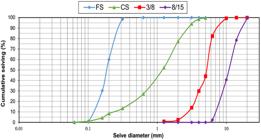
Particle size distribution curves for FA and CA used within this investigation following EN 933-1.
PET fibres of three different lengths (35 mm, 40 mm, and 50 mm ± 2 mm) were incorporated into the SCC at volumetric fractions (Vf) ranging from 0.3% to 1.2% in 0.2% increments. The workability of the concrete mixtures was achieved using a polycarboxylic superplasticizer, MEDAFLOW 145, with specifc gravity of 1.065 kg/m3 ± 0.015 with 30% concentration of dry powder, the manufacturer suggests a dosage of 0.2% to 3% by weight of cement for the superplasticizer, which has a PH of 5 to 6.
A constant water-to-cement ratio (w/c) of 0.40 was intentionally used for all mixture designs in this investigation. This is a well-founded decision considering the methodology most frequently implemented in parametric studies on fibre-reinforced SCC [39, 48], since a constant w/c ratio shields the independent input variables of interest, such fibre type, geometry, length and volume fraction, from alterations in paste microstructure and hydration kinetics. A w/c of 0.40 was chosen because it produce a sufficiently workability of reference SCC and at the same time adequate workability can be achieve by w/c adjustments with superplasticizer, which is common procedures in designing SCC in JSCE guideline [49]. Such a treatment allows to perform a direct, statistically relevant comparison between the entire set of thirty mix designs, so that differences observed in fresh and hardened properties could be univocally attributed to fibre parameters. Additionally, a 0.40 w/c ratio is consistent with the value generally accepted as being representative of structural-grade SCC (0.38–0.45), thereby offering a relevant baseline for practical implementation [49].
2.3. Mixing and testing procedures
Three families of self-compacting concrete (SCC) were prepared, resulting in thirty mix designs incorporating PET fibres, denoted as W35-V, W40-V, W50-V, L35-V, L40-V, and L50-V, along with a reference concrete (R-SCC). The numbers 50, 40, and 35 indicate the lengths (in mm) of wavy (W) and linear (L) PET fibres, while “V” represents the volumetric ratio of PET fibres, ranging from 0.3% to 1.2%, including specific increments of 0.5%, 0.8%, and 1.0%. The proportions of all mix designs are provided in Table 5.
The fibre-reinforced concretes were mixed according to the method suggested and detailed by Rossi et al. (1990), which is based on Baron-Lesage’s approach [50].
Furthermore, the SCC design benchmarks were validated following the guidelines established by the Japanese Society of Civil Engineers (JSCE) [49]. The volume ratio of sand to mortar was maintained constant at 0.45, and a superplasticizer (Sp) dosage of 0.90% by mass of cement was used.
The production process for FR-SCC is identical to that of conventional fibre-reinforced concrete. Three key steps are involved in preparing an SCC mixture. First, the cement and aggregates are dry-mixed for 30 seconds. Second, 60% of the required water is added to the dry mixture and mixed for one minute; the remaining water, including the superplasticizer, is then added and mixed for an additional minute. In the final step, PET fibres are incorporated, and the mixture is blended for five minutes. A two-minute rest period follows, after which the concrete is mixed again for 30 seconds to ensure homogeneity [18, 36].
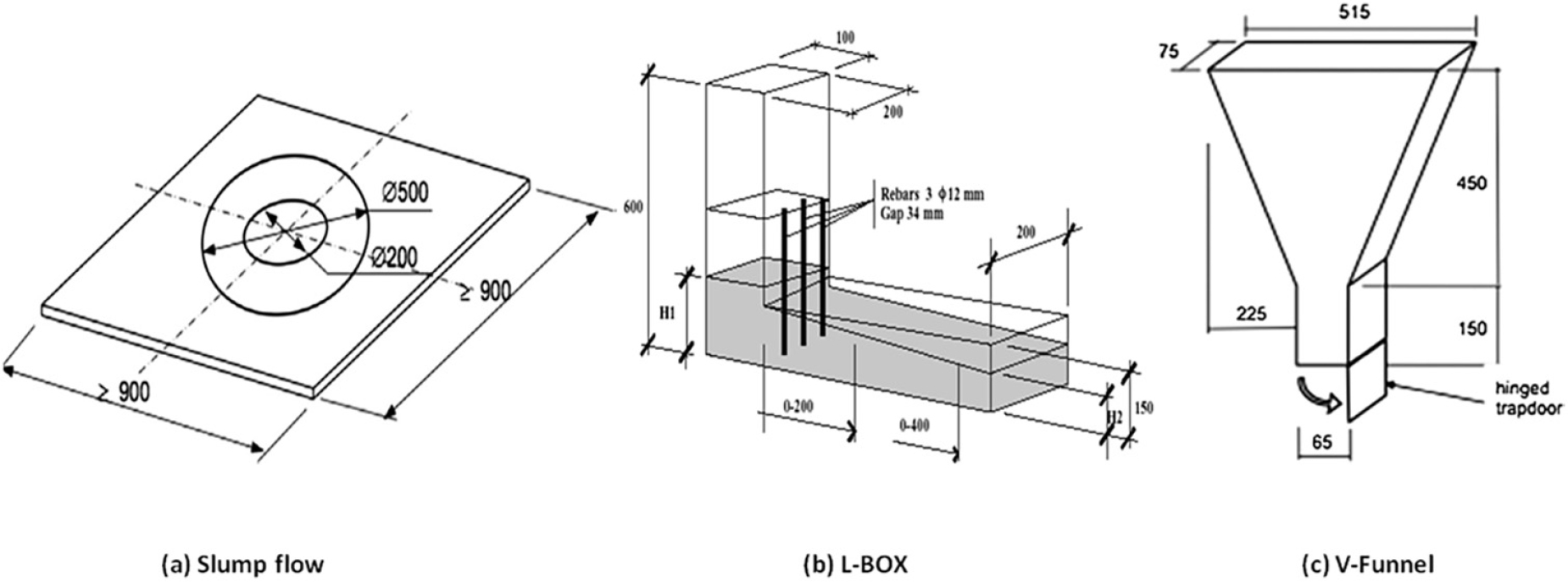
Specific concrete properties must be verified to guarantee uniform fibre distribution throughout the concrete volume. Segregation resistance and the passing ability of the concrete between reinforcement bars are essential criteria to confirm the filling capacity under the weight of the concrete and to achieve a smooth surface after formwork removal [49, 50]. For horizontal surfaces, the flow characteristics are typically evaluated using two conventional methods: slump flow time and flow diameter. Both qualitative observations and quantitative measurements are applied to characterise the material, during testing, the concrete mixes are placed into an Abrams slump cone. Upon lifting the cone, the time elapsed from the start of the upward movement until the concrete spreads to a diameter of 500 mm is recorded as the T50 time. The slump flow diameter is calculated as the average of the two widest orthogonal diameters of the spread concrete [51].
The L-box test is used to evaluate the fresh properties of SCC, specifically its filling and passing capacities. Approximately 12.7 litres of concrete are poured into the tower of the L-box to a height of 600 mm, then allowed to stand for one minute to check for segregation. The gate is subsequently lifted, allowing the concrete to flow. This test provides an indication of the mixture’s viscosity resembles the concrete filling in a formwork by reinforcement bars. The heights H1 and H2 are measured after the concrete has completed its flow. The V-funnel test, introduced by Okamura and Ozawa in 1995, assesses the flowability of concrete through confined spaces by measuring the time (in seconds) required for the concrete to flow out of the funnel [49]. In this study, the concrete was poured into the funnel and allowed to stand for one minute before opening the gate. The outflow time was recorded from the moment the gate was opened until the end of the concrete flow, which is identified when light is visible through the funnel opening. Figure 5 shows the equipment used to characterise the fresh SCC.

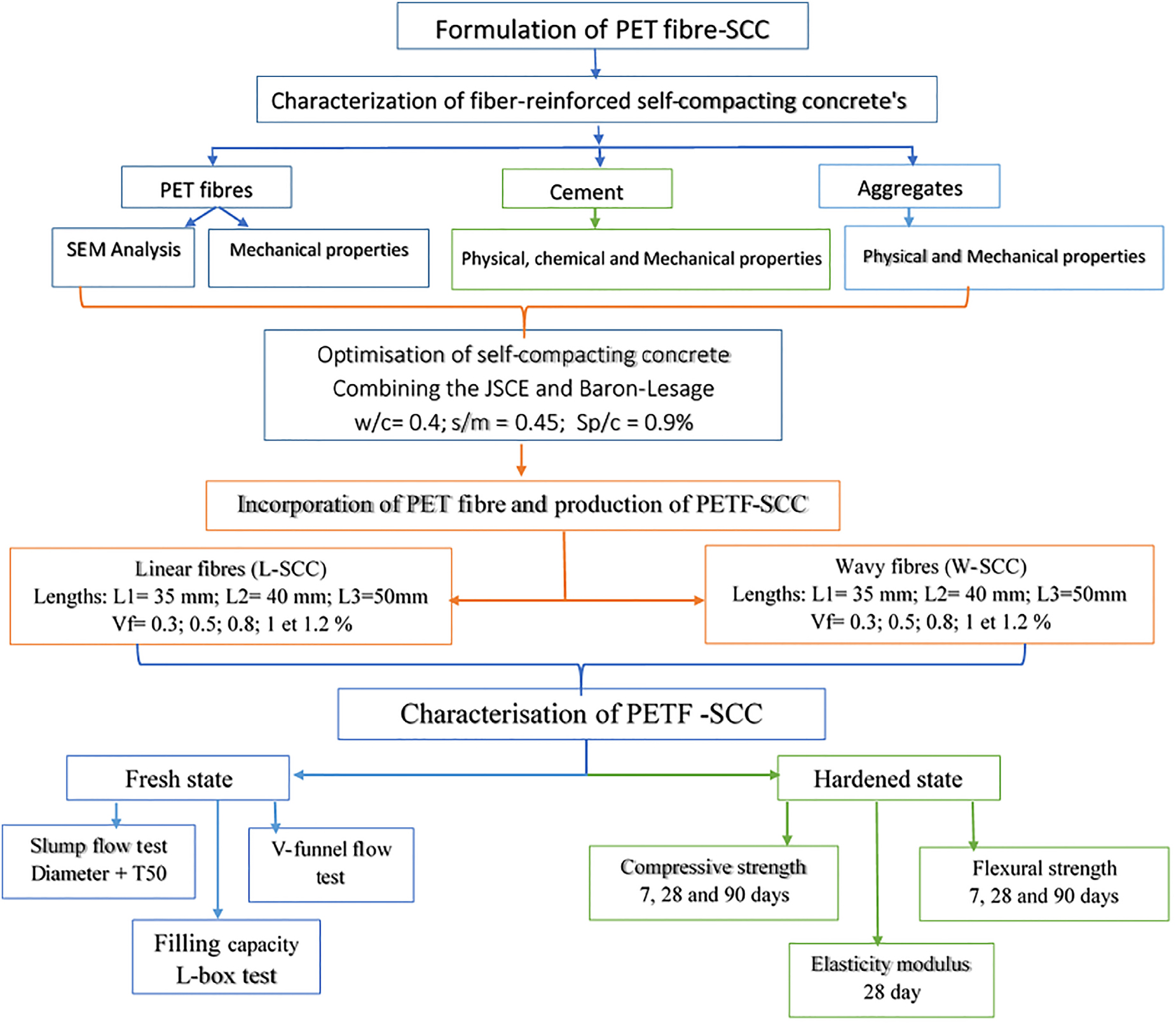
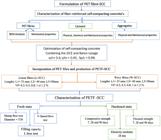
Figure 6 present a flowchart of summarising the production and the test program of the different studied SCC reinforced with PET fibres.
It should be noticed that for 50 mm fibre series (W50-V and L50-V) the volumetric ratio tested was constrained to Vf = 1.0%, unlike the 35 mm and 40 mm series which reached up to 1.2% of Vf.
Such a restriction was imposed considering the preliminary mixing experiments in which 50 mm PET fibres at Vf = 1.2 led to extreme fibre agglomeration, total loss of self-compacting flow characteristics, and filling up of the V-funnel and L-box instrument. As the basic requirement to be considered as SCC is to be proven to flow without the need of vibration, mixes that did not fulfil this requirement were not considered for further experimentation. This finding agrees with the approach taken by other authors studying fibre reinforced SCC at large aspect ratios [18, 20, 52].
For each mix design, three replicate specimens were cast and tested for compressive strength (100 mm cubes, EN 12390-1/2) [53, 54] and flexural strength (70 × 70 × 280 mm prisms, EN 12390-5) [55] at curing ages of 7, 28 and 90 days. The modulus of elasticity was measured on two cylindrical specimens (160 × 320 mm) per mix at the age of 28 days (ISO 1920-10) [56]. All results are expressed as mean ± Standard Deviation (SD).
3. LIFE CYCLE ASSESSMENT
The objective of this life cycle assessment (LCA) is to quantitatively assess and compare the environmental performance of self-compacting concrete reinforced with recycled polyethylene terephthalate (PET) fibres at volumetric dosage Vf = 0.8% with equivalent concrete mixtures reinforced with four types of industrial fibres: steel fibres (SF), polypropylene fibres (PPF), basalt fibres (BF) and glass fibres [57]. The scope of this study is further extended to quantify the environmental credits associated with the valorisation of post-consumer PET waste, the avoidance of landfill disposal and the reduction of virgin synthetic fibre production.
This LCA is performed according to the requirements of ISO 14040 (2006) [58] and ISO 14044 (2006) [59] which set the framework for goal and scope definition, life cycle inventory (LCI) analysis, life cycle impact assessment (LCIA) and interpretation. The study is intended to ease the decision making in sustainable concrete mix design and to provide a rigorous scientific basis to the environmental claims related to the inclusion of recycled PET fibre in SCC.
3.1. Functional unit
The functional unit (FU) considered in this study was:
“1 m3 of self-compacting concrete (SCC) with a 28-day compressive strength of 55–60 MPa, a slump flow diameter of 700–750 mm (EFNARC SF2 class) and a flexural strength ≥ 6.0 MPa after 28 days of water curing with a fibre volumetric dosage of Vf = 0.8%. This functional unit covers the structural performance and fresh state workability requirements that determine the SCC classification, allowing for an equal performance comparison between fibre types in the environmental assessment [52].
3.2. System bound control
A cradle-to-gate system boundary is used as the basis of this LCA to include all processes from raw material acquisition through processing to batching of the compacted concrete at the concrete plant (ready for placing). This definition of boundary limits is in line with those of most published LCA research on fibre concrete [23] and therefore enables straightforward comparability with what have been considered as baseline scenarios.
For the PET fibre system, a modified Cradle to Gate boundary is considered which covers: (i) the collection and sorting of post-consumer PET waste, (ii) mechanical processing (cleaning, cutting, sorting, and quality control of PET fibres) and (iii) transport of processed PET fibres to the concrete batching plant. A sensitivity analysis for end-of-life (EoL) is also performed to analyse the effect of concrete demolition, fibre separation, and recycling or landfilling on the overall environmental balance. The following unit operations are precisely accounted for by system boundaries: recovering and processing cement clinker (CEM II/B 42. 5); combined extraction, crushing and screening of aggregate; production of superplasticizer (polycarboxylate ether, Pce); supply and treatment of water; production or processing of fibres (each type specified separately); batching and mixing of concrete; and transportation of all materials to the batching plant. The processes of concrete placing, curing and compacting are explicitly excluded, as well as the embodied energy of formwork, of steel used for structural reinforcement and the building operation and maintenance stages.
3.3 Analysis of life cycle inventory
The life cycle inventory (LCI) was developed by combining primary data (concrete mix proportions measured in this study), with the ecoinvent v3.9 database [60] and available life cycle assessment (LCA) information for building materials. At Vf = 0.8%, all material amounts are standardised to the functional unit of 1 m3 of SCC. The experimentally determined proportions listed in Table 6 of this manuscript w/c = 0.40, cement content = 524 kg/m3, fine aggregate = 803 kg/m3, coarse aggregate = 800 kg/m3, water = 210 kg/m3, superplasticizer = 4.72 kg/m3, and PET fibre content = 5.52 kg/m3 (corresponding to Vf = 0.8% for 35 mm fibres).
The inventories for the industrial fibres are as follows: steel fibres: ecoinvent v3.9 (steel wire drawing process using an electric arc furnace); polypropylene fibres: PE INTERNATIONAL [61] and ALZUBI et al. [66]; basalt fibres : FOŘT et al. [67] and PANT et al. [68]; glass fibres: BALON et al. [69]. All fibre amounts for the comparison scenarios were scaled to produce the same flexural strength performance as the functional unit, in line with the performance-equivalence approach of ISO 14044 [59]. Table 7 shows the fibre production data for 1 m3 of SCC at Vf = 0.8%. * Energy and GWP for recycled PET solely relate to processing (collecting, cleaning, and cutting); energy and GWP for virgin PET manufacturing are considered avoided burdens.
3.4. Life assumptions, constraints and transportation scenarios
The following main assumptions were made in performing this LCA:
-
The system model is the cut-off one (the recycled PET fibres are assigned no burden for the upstream PET production, which is burdened to the original product system), this means that all the environmental burdens deriving from the production of PET in its primary form are allocated to the original product system. This is in line with ISO 14044 and represents a normalization procedure adopted by LCA studies analysing recycling material valorisation [64, 69].
-
An avoided burden credit is used in the PET waste management scenario to capture the environmental benefit of keeping post-consumer PET out of the solid waste stream. This credit is calculated based on the GWP of PET waste in landfill (around 0.03–0.05 kg CO2-eq/kg PET, from methane production during anaerobic decomposition) and the transportation of waste to landfill sites that is avoided.
-
The transport of all inbound materials is modelled as road freight on a medium-duty truck (16–32 tonnes), assuming an average transport distance of 50 km for local materials (aggregates, water, PET waste) and 200 km for industrial materials (cement, superplasticizer, commercial fibres). These distances are considered to be conservative averages for North African building industry.
-
The energy for mixing and batching of concrete is assumed to be 0.15 – 0.25 kWh/m3, in line with the ecoinvent v3.9 datasets for concrete mixing process.
-
It is explicitly stated that this LCA is forward-looking, screening level study based on a mix of primary data from this study and secondary data from the literature. A complete LCA would need site specific primary data for all unit processes, such as energy source mix, equipment type and actual emissions.
3.5. End-of-life and recycling scenarios
Case-specific demolition and material recovery rates have some impact on the overall environmental results of PET-FSCC: these are evaluated in the sensitivity analysis considering three EoL options.
-
EoL Scenario A (Baseline—Landfill): Papercrete is crushed for 30 km and landfilled in a secure landfill. Fibbers are lost to spoilage. GWP credit = 0.
-
EoL Scenario B (Mechanical Recycling) Broken concrete is crushed and becomes recycled concrete aggregate (RCA). At this stage PET fibre are fragmented and non-recoupable. GWP credit from avoided virgin aggregate production: ~0.005 kg CO2-eq/kg of RCA.
-
EoL Scenario C (Thermal Recovery): Residual PET fibres from crushed concrete are incinerated with energy recovery. GWP of burning PET: 2.23 kg CO2-eq/kg PET. Credit for energy denied from calorific recovery: ~22.5 Mj/kg PET (lower heating value).
-
EoL Scenario A is considered as the baseline for the major findings. The sensitivity analysis also considers the scenarios B and C, to demonstrate the impact of end-of-life treatment on the environmental performance of PET-FSCC.
4. EXPERIMENTAL RESULTS
For fibre-reinforced concretes, the desired mechanical properties depend on both the reinforcing index (RI) and the type of fibres used. However, sufficient fluidity and excellent segregation resistance must be ensured to classify the material as fibre-reinforced SCC [48].
4.1. Slump diameter and T50 results
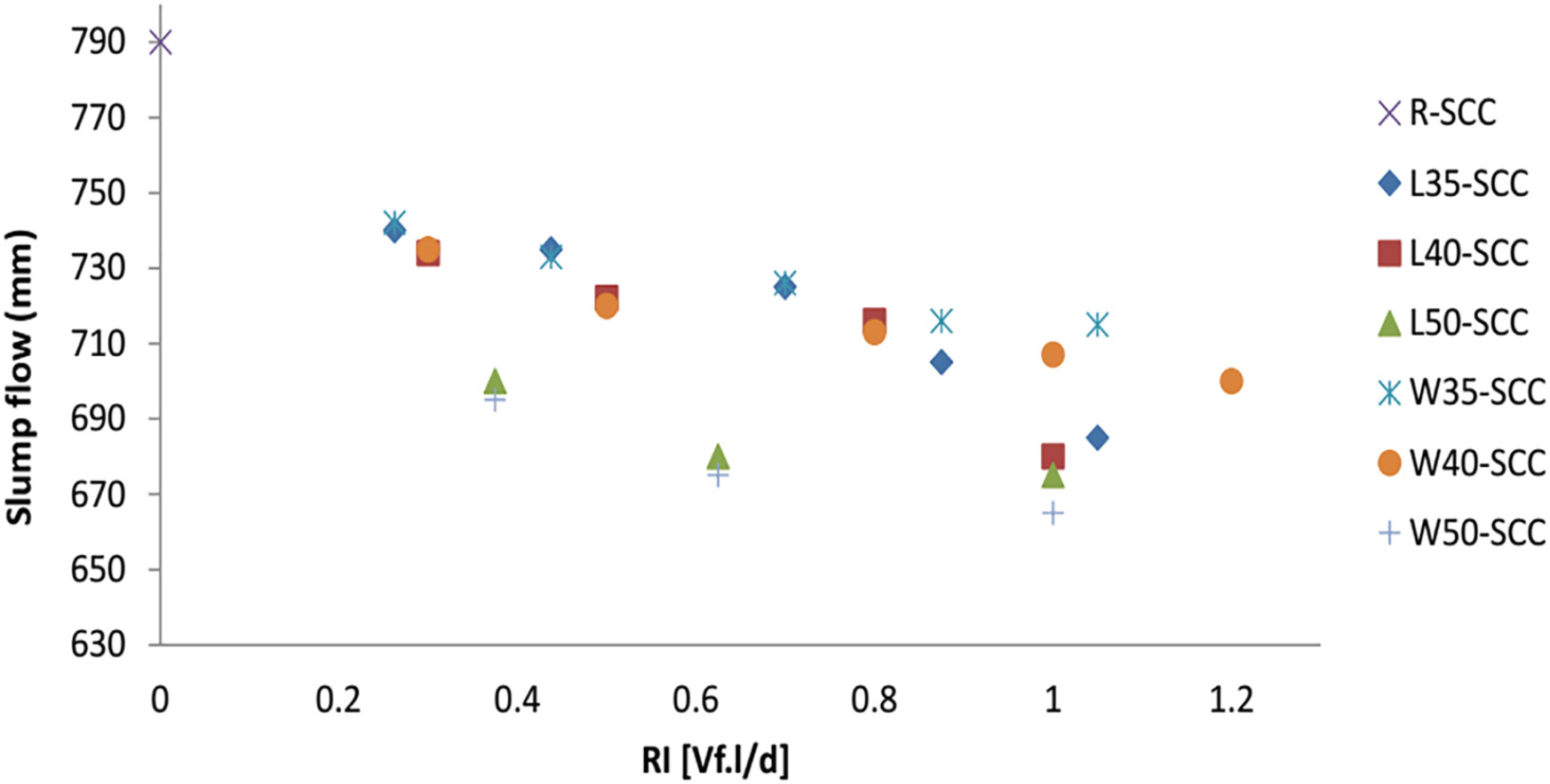
According to EFNARC guidelines, the T50 time should be between 2 and 5 seconds. In this study, the T50 times for slump flow were measured at less than 3.4 seconds, consistent with values reported by the producers [27]. For all mixtures, the slump flow diameters ranged from 665 to 790 mm designated as SF2 by the EFNRC, appropriate for a diverse array of standard applications [51], which falls within the generally accepted range of 650 to 800 mm, as suggested by DING et al. [70]. Figures 7 and 8 illustrate the effect of the reinforcing index (RI) on the slump flow diameters, reflecting flowability, and on the T50 times, representing viscosity, of PETF-SCC, respectively, the incorporation of low percentage of recycled PET fibres did not compromise workability [24].
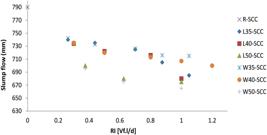
Figure 6 reveals that the flowability of PETF-SCC is strongly influenced by the reinforcing index (RI). As both the fibre length and volumetric fibre ratio increase, the workability of PETF-SCC decreases [18, 20, 24, 48, 70, 71, 72, 73, 74].
It can be observed that the viscosity of PETF-SCC, as indicated by the flow time, is influenced by increases in both fibre length and volumetric fibre ratio. Furthermore, the flowability of mixtures containing wavy fibres is more significantly affected than that of mixtures with linear fibres. Martinie et al. (2010) reported that fibre shape plays a critical role in reducing the flowability of FR-SCC. An RI value of 1% is considered optimal for achieving the best fluidity for both linear and wavy PET fibres [18, 20].
4.2. V-funnel flow-time
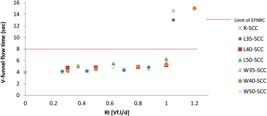
The speed-flowing concrete measurement is simulated through the V-funnel test, and the influence of the (RI) index on the concrete flow time through the V-funnel apparatus is shown in Figure 9.
According to figure 8 and 9, T50 flow intervals ranging from 0.58 to 1.3 seconds were documented for all mixes, exhibiting flow times under 2 seconds and V-funnel flow times below 0.8; these are categorised as VS1/VF1 per EFNRC guidelines. Mixtures exhibiting a flow time over 0.8 are excluded from the characterisation of mechanical properties [51]. Incorporating higher contents of longer fibres further reduces the passing ability of the mixture [52]. We observed a rapid convergence of the flow time toward the threshold as the fibre lengths increased [72]. Specifically, the W40-V mixture showed a rise in V-funnel flow time to a volumetric fibre ratio of 1.2%, with initial indications of segregation and heterogeneity. The high fibre content adversely affects the workability of concrete by increasing the viscosity, segregation and a greater probability of blockage around the reinforcement bars [13, 18, 20]. The observations were also supported by the results of the L-box test.

4.3. L-box results for Filling capacity
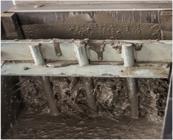
The L-box test is one of the main methods for evaluating the filling ability of self-compacting concrete (SCC) [12, 15]. Figure 10 shows the effect of reinforcing index (RI) on the filling capacity of PETF-SCC. Similar to the flowability, the filling capacity of PETF-SCC decreases with the increase of the volumetric fibre ratio of PET fibres [51], which leads to blockage shown in Figure 11.
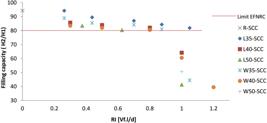
Passing ability refers to the capacity of the fresh mix to traverse limited spaces and narrow apertures, such as congested reinforcing areas, without segregation, loss of uniformity, or obstruction. Mixtures having an H2/H1 ratio exceeding 0.8 are categorised as PA2 according to EFNARC guidelines [51].
Mixtures containing 40 mm and 50 mm PET fibres specifically W40-V, L40-V, W50-V, and L50-V exhibit greater susceptibility to blockage compared to mixtures with 30 mm PET fibres (W30-V and L30-V). The maximum permissible PET fibre volume fraction before SCC blockage occurs is 1.0% for 30 mm PET fibres, whereas SCC reinforced with 40 mm and 50 mm PET fibres becomes blocked at 0.8% and 0.5%, respectively.
However, the filling performance of PETF-SCC is strongly influenced by the length of PET fibres; this reduction in filling performance is also more affected by the wavy fibres than linear fibres.
Nevertheless, of the rheological properties of fibre-reinforced SCC, once a critical level of fibre reinforcement is reached, the SCC fails to flow [52, 73], similar observations have been reported by other researchers, who highlighted the significant impact of fibres on the flowability of PETF-SCC. Beyond this critical fibre ratio, the concrete becomes excessively stiff and exhibits greater difficulty in passing through reinforcement bars [50]. The investigation also revealed that the fresh properties of SCC containing PET fibres remain within the acceptable range specified by EFNARC standards [51] up to a saturation dosage [75].
4.4. Compressive strength
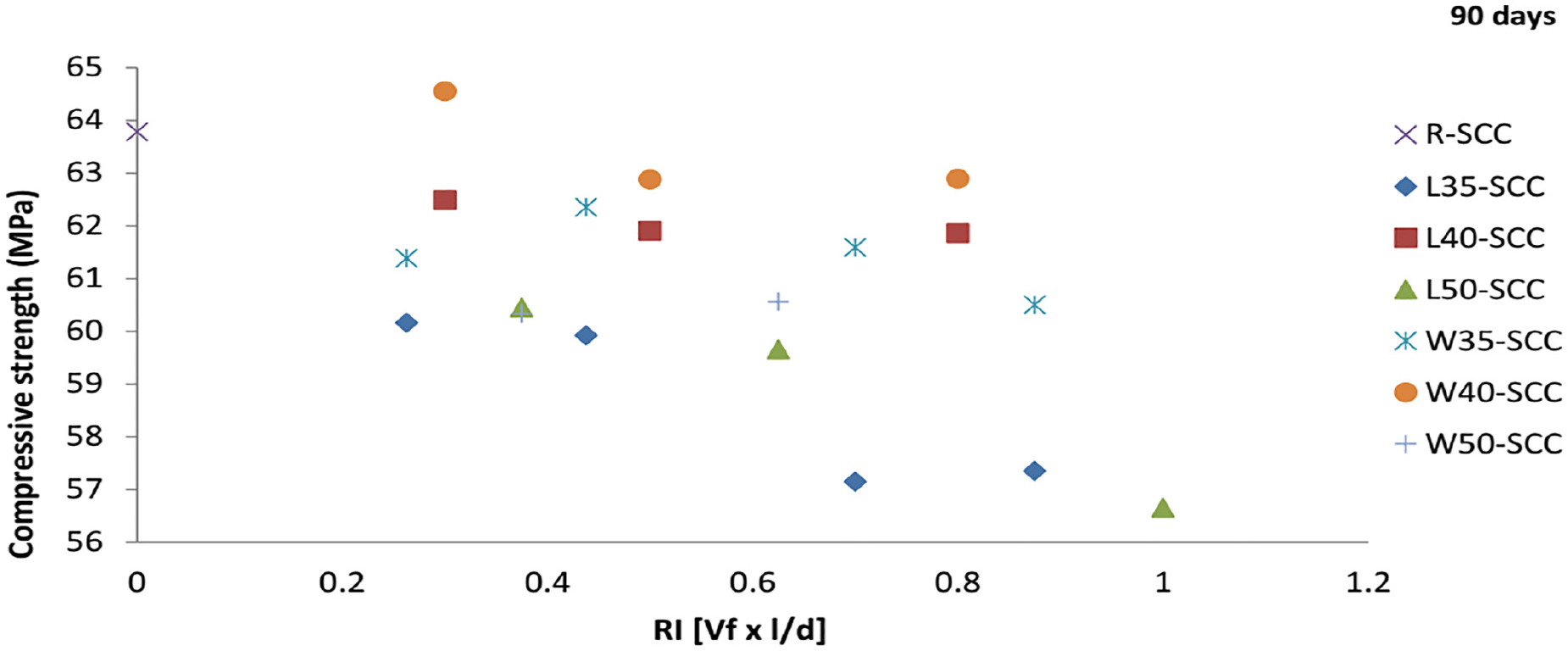
EN12390-1 and EN12390-2 tested cubic 100 mm specimens to evaluate the compressive strength of the concrete, after 7, 28, and 90 days. The moulds were all covered with plastic film, stored in the research laboratory for 24 hours, before removal, then cured in water at 20°C [53, 54]. The outcomes for the 7, 28, and 90-day cure periods are presented in Figures 12, 13, and 14, respectively.

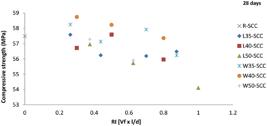

The test results show that the compressive strength of PETF-SCC is affected by RI and decreases with the increase of both the PET fibre length and volume fibre ratio. The average decrease in compressive strength at 28 days was 5.86%, 5.06% and 3.72% for the PETF-SCC with the 50 mm, 40 mm and 30 mm fibres respectively. This decrease is probably attributed to a reduction in concrete density caused by the higher porosity generated by the addition of PET fibre. Workability has also been reported to have a negative effect on the compressive strength of fibre-reinforced SCC at high fibre contents [18, 76, 77]. Boulekbache et al. (2010) observed the same behaviour for steel fibre-reinforced SCC, which included a 6% decrease in compressive strength [78].
4.5. Flexural strength
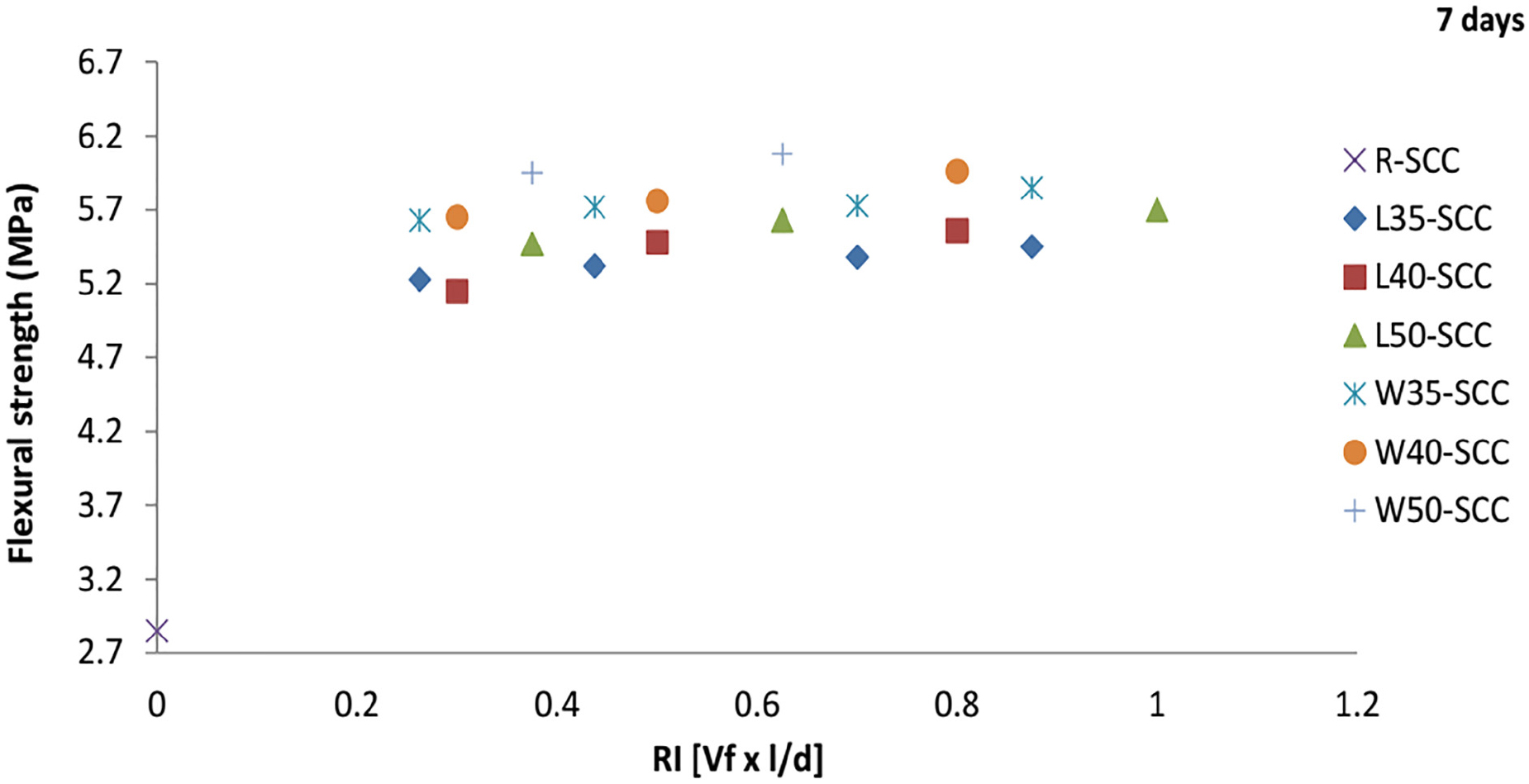
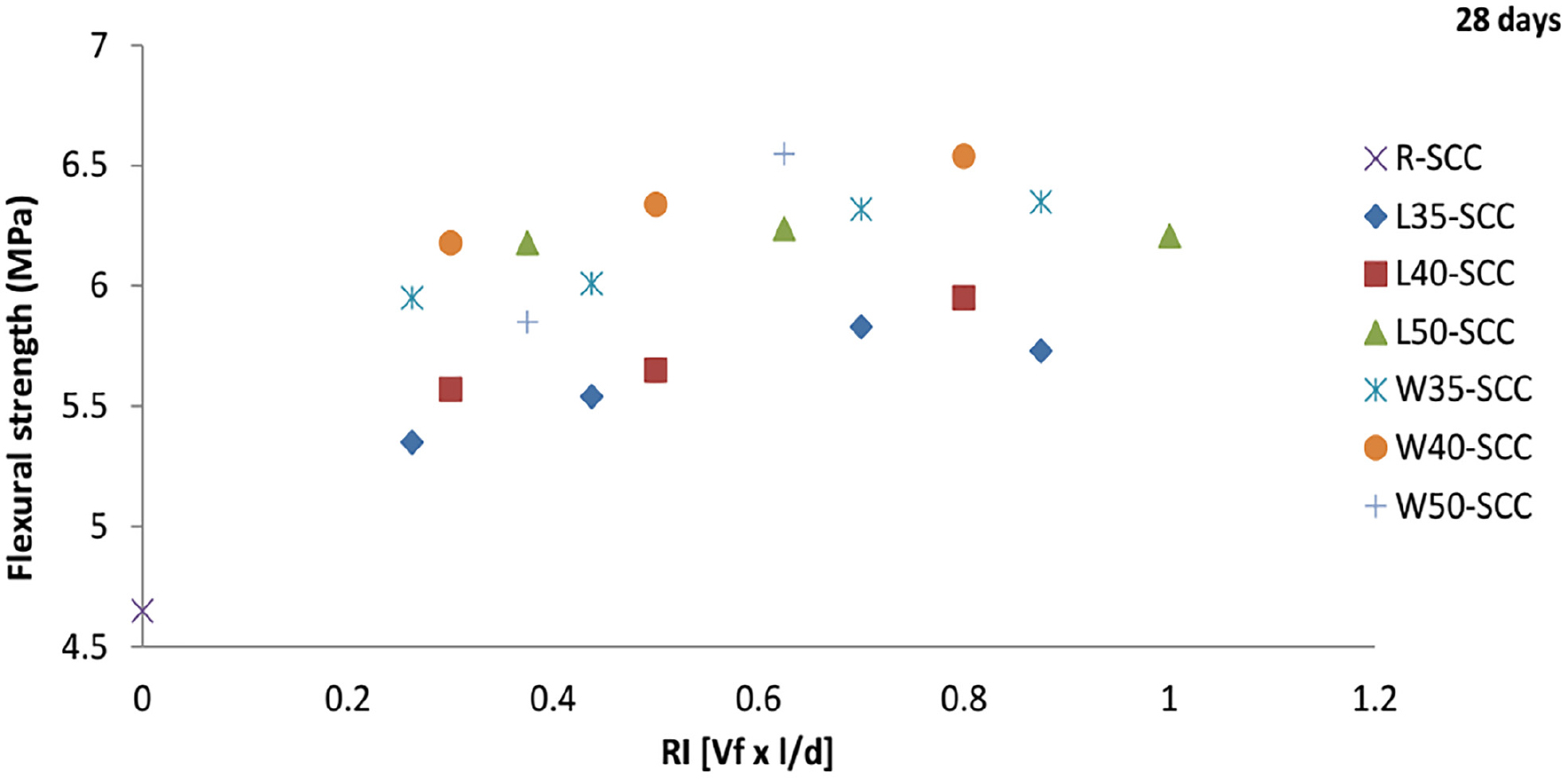
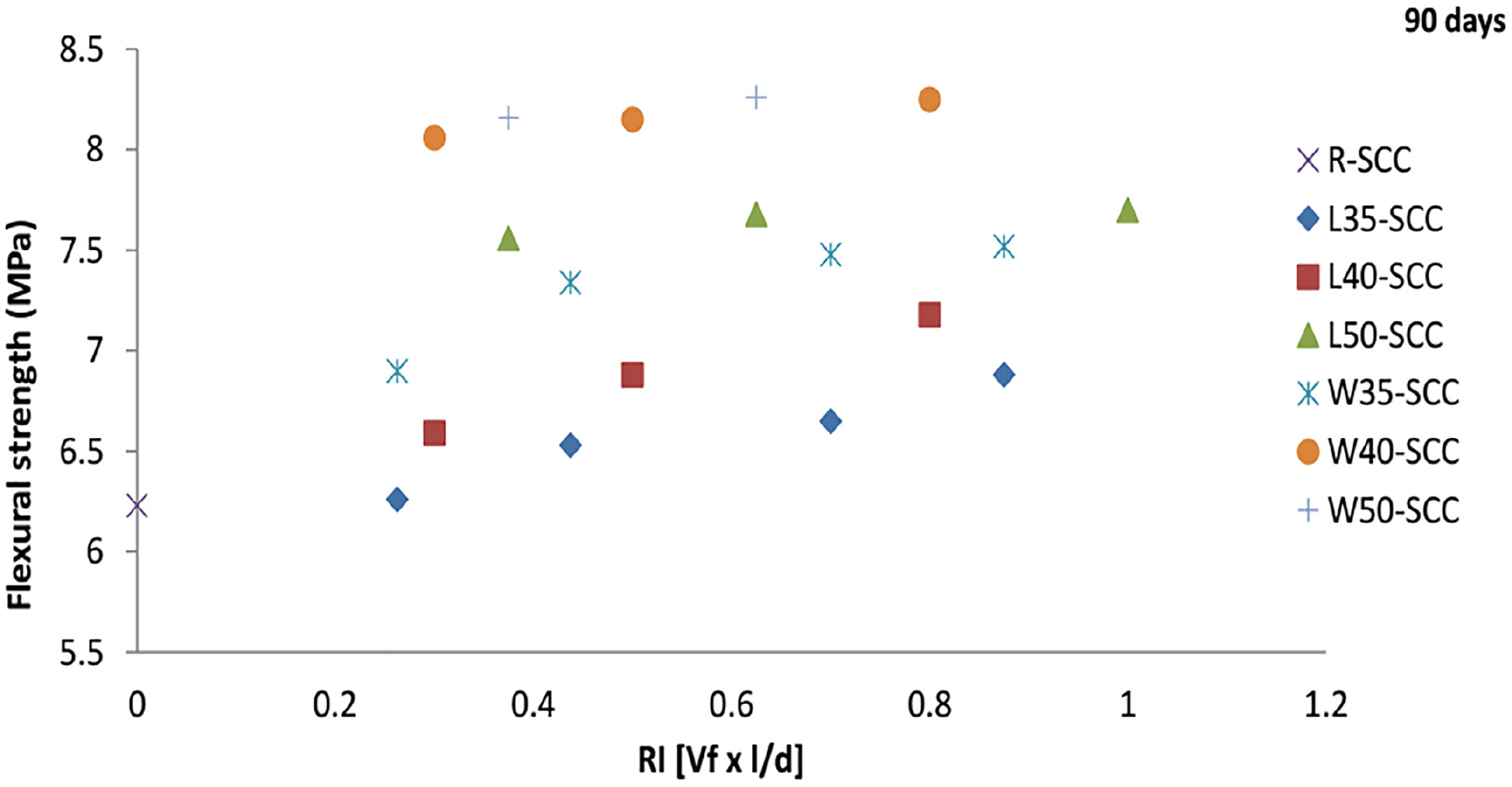
Flexural strength was measured on specimens 70 × 70 × 280 mm3 at the ages of 7, 28 and 90 days. The three-point bending test was conducted with a testing machine with a maximum load capacity of 30 kN according to the requirements of EN 12390-5 [55]. Before demoulding, all the moulds were covered with plastic films and kept in the laboratory for 24 hours before curing in water at 20 °C. Figures 15, 16, and 17 present the flexural strength measurements for the various concrete mixes after 7, 28, and 90 days of curing.

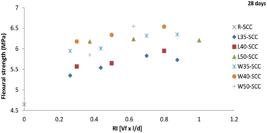
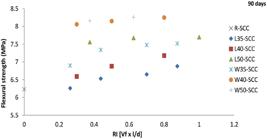
The results show that the flexural strength of PETF-SCC increases with the RI index [79] unlike the compressive strength, with an improvement of approximately 30% with higher PET RI values. The compositions with wavy fibres had higher flexural strength than those with straight fibres. In particular, wavy fibres showed better mechanical properties such as maximum stress, breaking stress, elongation and modulus of elasticity. The rougher surface increased the bond between the fibres and the cementitious matrix [16]. These observations are consistent with previous studies [23, 33, 34, 48, 75, 78, 80, 81]. IRKI et al. [18] also demonstrated that increasing the length and volumetric fraction of steel fibres enhances the performance of steel fibre reinforced SCC (SFR-SCC) with three fibre lengths (35, 40 and 50 mm) at a maximum content of 1.2%.
4.6. Modulus of elasticity
On the twenty-eighth day after casting, we measured the modulus of elasticity of a cylindrical concrete specimen with a diameter of 160 mm and a height of 320 mm using a mechanical extensometer and electrical gauges following [56]. As presented in Figure 18, the results indicated that the modulus of elasticity and flexural splitting strength exhibited similar behaviour and improved with the (RI) index.
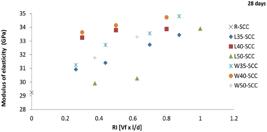
An increase of 20%, 22%, and 22.50% was obtained for W35-1.20%, L40-1.0%, and W50-0.8%, respectively, compared to R-SCC. Including fibres can potentially increase the modulus of elasticity by up to 30%, a significant improvement from its low level of improvement of 6% [18, 82, 83].
5. LIFE CYCLE ASSESSMENT
5.1. Environmental profile of PET-FSCC at Vf = 0.8%
Life cycle environmental measures of 1 m3 PET-FSCC at Vf = 0.8% (35 mm recycled PET fibres) are given in Table 8. These findings support that the production of Portland cement clinker is the major contributor to the GWP of PET-FSCC with 78–82% of the total, which is in line with the known high carbon intensity of the cement production [84]. The recycled PET fibre material, which is made from post-consumer waste, has a footprint of only 0.55–1.60 kg CO2-eq per m3 of concrete, that’s less than 0.4% of the total global warming potential (GWP) of the mix and the result that essentially differentiates recycled PET from other energy intensive industrial fibres.
Similarly, the cement production shares of total FED in PET-FSCC are around 87–88%, and the recycled PET fibre processing amounts to only 2.8–8.3MJ-eq per cubic meter, i.e., less than 0.3% of the total FED. This negligible energy input is a direct result of the low processing route for the recycled PET fibres: post-consumer PET sweeper material is subjected to mechanical sorting, washing and cutting to obtain the macro-fibres employed in this study, processes that use up an average of 0.5–1.5MJ/kg of fibre [62, 65] which is a far cry from the 80–110MJ/kg for virgin polypropylene fibre production or 13–25MJ/kg for basalt or E-glass fibre production. The human toxicity potential (cancer) of PET-FSCC, albeit dominated by the cement-related process emissions, is significantly lower than that of steel fibre-reinforced SCC in which the wire-drawing processes lead to substantial heavy metal emissions and lubricant chemical usage (ecoinvent v3.9). This differentiation is important for the occupational health of construction workers who handle the fibres and manufacture the concrete.
5.2. Environmental comparison between PET and industrial fibbers
A thorough environmental comparison of five SCC systems at Vf = 0.8%, separated only by fibre type, is shown in Table 9.
Comparative LCA results for five fibre-reinforced SCC systems at Vf = 0.8% (1 m3, cradle-to-gate).
This performance-equivalent comparison is an adequate basis for evaluating the relative environmental benefits of recycled PET fibre reinforcement. Under the functional unit defined in section 1.2, it is calibrated to the same class of compressive and flexural strength.
5.2.1. Global warming potential
The comparison analyses indicate that among all five fibre reinforced SCC systems considered, PET-FSCC 0.8% yields the minimum total GWP. The main factor that contributes to this benefit is the very low carbon footprint of the recycled PET fibre ingredient (0.55–1.60 kg CO2-eq/m3 of concrete), which is almost 32–71 times lower than the environmental impact of steel fibres, around 9–11 times lower than that of polypropylene fibres, and 11–20 times lower than basalt, or glass fibres on the basis of equivalent concrete volume (Table 6). YIN et al. [85] previously reported similar conclusions for recycled PP fibres in concrete footpaths, where the recycled origin of the fibre was the principal driver of environmental performance rather than fibre geometry or dosage, which were able to reduce up to 62% of GWP for recycled PET fibre composites against virgin PP fibre composites [65] And it is important to situate these results within the overwhelming contribution of cement production to the total GWP. Because cement dominates the GWP of all SCC systems with a contribution of 78–82 % to the total GWP, the absolute difference in total concrete GWP between different fibres types is limited to 3–20% (Table 9). Yet, if the analysis is done on a pure fibre-component basis, the environmental benefit of recycled PET is several orders of magnitude larger, and this underlines that choice of fibre type is by far the most significant lever available to the concrete mix designer to reduce embodied carbon.
Among all options, PET-FSCC 0.8% has the lowest fossil energy demand with a total FED 2.345–2.750 MJ-eq/m3. The values for steel fibre SCC (3.626–4.973 MJ-eq/m3) show an additional 35–81% FED relative to PET-FSCC due to the energy intensity of steel wire drawing (20–35 MJ/kg) and the large amounts of fibre needed to reach Vf = 0.8% (62.8 kg/m3 because of the high density of steel). Polypropylene fibre SCC is energy intensive at 2.952–3.576 MJ-eq/m3, due to the petrochemical synthesis route for PP, which consists in catalytic cracking and polymerization with an energy input of 80–110 MJ/kg fibre [61, 66].
The energy needed to process recycled PET fibre is very low- about 0.5–1.5 MJ/kg or 2.8–8.3 MJ-eq per cubic meter of concrete- a reduction of about two to three orders of magnitude when compared to producing virgin fibre. This is an energy gain result of bypassing all upstream processes of polymer synthesis and using low-energy mechanical processes (cleaning, cutting and quality sorting) alone, a processing route referred to as “direct mechanical recycling” in the literature on the valorisation of polymer waste [63].
5.2.2. Human toxicity and eco-toxicity indicators
The cancer pathway human toxicity potential (HTPc) of PET-FSCC 0.8% is 16.2–21.4 × 10⁻⁷ CTUh/m3, which is significantly lower than that of steel fibre SCC (28.5–41.2 × 10⁻⁷ CTUh/m3). The higher HTPc of steel fibre production is related to chromium, nickel, and manganese emissions during the electric arc furnace (EAF) and wire drawing procedures which are known carcinogens as per ReCiPe midpoint characterization factors [86]. Conversely, mechanical recycling of PET fibres does not require thermal treatment or leads to heavy metals release; thus, toxicity is substantially reduced.
Polypropylene, basalt, and glass fibre systems are at intermediate levels in the HTPc ranking with 18.0 to 24.0, 17.5 to 23.5 and 18.5 to 25.0 × 10⁻⁷ CTUh/m3, respectively. Toxicity contribution of these fibre types are related to hydrocarbon emissions from PP polymerization [66] boric oxide dust releases from basalt fibre furnace production [66] and fluorine compounds released E-glass production [69].
5.2.3. Depleting resources and mining of minerals
The mineral resource depletion (MRD in kg Fe-eq) indicator is strongly in favour of PET-FSCC compared with steel fibre SCC. The steel fibre content at Vf = 0.8% corresponds to 62.8 kg of steel per m3 of concrete, which equates to 42.0–55.0 kg Fe-eq of mineral resource depletion indicator; this is about 38–65 times higher than that of PET-FSCC (0.85–1.10 kg Fe-eq/m3). This differentiation has direct bearing on the potential for fibre reinforced SCC production in the long term on a mass scale, as concerns about iron ore resource depletion and the energy demands of primary steel production continue to escalate. Basalt and glass fibre systems range in the middle of the spectrum in terms of MRD values (7.5–12.0 kg Fe-eq/m3) and these are related to the processing of basalt rock and silica sand respectively.
5.3. Circular economy advantages and waste diversion
On the other hand, recycled PET fibres and waste at Vf = 0.8% contain a circular economy benefit that is included in the environmental indicators determined by the LCIA but obscured by the system boundary of the conventional LCA and cannot be visualised. 8 kg of post-consumer PET waste is contained in every cubic meter of PET-FSCC 0.8%, which would otherwise be discarded through the waste management system. In the Algerian scenario, the lack of efficient collection and recycling systems for PET waste results in the majority EoL of post-consumer PET waste either being dumped in the open or disposed of in the landfill whether controlled or not.
Avoiding landfill for 5.52 kg of PET waste per cubic meter of concrete prevents: (i) about 0.17–0.28 kg of CO2-eq generation from methane production that results from anaerobic decomposition of PET in the landfill 58; (ii) leaching of plastic related additives (plasticizer, stabiliser) into the aquafer; (iii) usage of the landfill space (around 7.3 × 10⁻³ m3 of space per kg of PET at standard landfill packing density); and (iv) visual contamination and biomarine life destruction due to mismanaged plastic waste polluting the environment.
By the same token, the national application of PET-FSCC at Vf = 0. 8% to just 1% of the annual concrete production of Algeria, would result in about 1,932 tonnes of post-consumer PET waste being given a new purpose every year, with a potential annually avoided GWP credit estimated between 328 and 540 tonnes of CO2-eq. Although it is illustrative rather than prescriptive, this scale-up assessment highlights the cross-sectoral environmental impact of recycled PET fibre concrete as an end-of-life plastic waste management option in the building industry.
Such circular economy benefits are magnified if one considers the replacement of industrial fibre production. For every kilogram of recycled PET fibre used in concrete, one unit of commercial fibre is replaced, eliminating the production, energy use, and carbon emissions associated with virgin polymer. Using the LCI data of Table 7, the substitution of equivalent polypropylene fibres (7.28 kg/m3) with 5.52 kg/m3 of recycled PET fibres leads to a saving in the order of 13.8–18.2 kg CO2-eq and 582–801 MJ-eq of fossil energy per cubic meter of concrete, an aggregated environmental benefit that amount to a decrease of 3.5–4.2% in the overall concrete GWP and of 19–22% in the overall concretes FED.
5.4. Effect of transport distance on the life cycle assessment results
Transport accounts for 3.5–6.5 kg CO2-eq/m3 concrete under the baseline scenario (50 km for local materials, 200 km for industrial materials), which is 0.8–1.5% of the total global warming potential (GWP). A sensitivity analysis was performed to examine the impact of transport distance on the environmental superiority of PET-FSCC over PP fibre SCC and steel fibre SCC.
Sensitivity analyses indicate that PET-FSCC retains its GWP superiority against all industrial fibre options for transport distance s up to 500 km for the PET fibre processing plant. This transport effect insensitivity can be explained by the small mass and processing energy of recycled PET fibres, due to which at even long distances, the increment for transport GWP remains negligible as compared to the savings in GWP by avoiding the production of virgin fibres. Contrarily, steel fibre SCC is very sensitive to transport distance, the large mass of fibres (62.8 kg/m3) highly increases its km.t contribution for distances > 100 km.
5.5. End-of-life sensitivity analysis
Scenario A: Total GWP = 395–435 kg CO2-eq/m3 (Baseline–Landfill)
Total GWP = 392-431 kg CO2-eq/m3 (–0.7 to –1.0%) in Scenario B (Mechanical Recycling/RCA) Scenario C (Thermal recovery of PET fibre): Total GWP = 407–450 kg CO2-eq/m3 (neutral or slightly higher due to CO2 from incineration).
The EoL scenario has a negligible effect on the overall LCA results (<2% change in total GWP) dependent on the EoL pathway indicating that cement production is the main environmental driver. Scenario C (thermal recovery) is approximately neutral, since the PET combustion CO2 is offset by the saved energy credit. Scenario B (RCA recycling) has a small GWP advantage. All three EoL scenarios support the conclusion that PET-FSCC is more environmentally friendly than industrial fibre SCC.
5.6. Scientific comparison: recycled PET and oil-based fibres
5.6.1. Eco-efficiency study
Then, eco-efficiency is defined as mechanical performance divided by environmental impact, so a quantitative assessment of the “flexural strength environmental cost” improvement between different types of beers can be done. This measure, borrowing from eco-efficiency principles of the World Business Council for Sustainable Development (WBCSD), takes into account both performance and environmental impact more holistically when selecting fibres for use in sustainable structural applications than when either metric is viewed in isolation. With the findings of these research (≈30% flexural strength enhancement at Vf = 0.8% for 35mm PET fibres) as a starting point, and LCA results from Section 2, the eco-efficiency performance of PET-FSCC can be estimated and compared to values for industrial fibre SCC found in the literature, Table 10 compares the eco-efficiency of five different fibre types in SCC at Vf = 0.8% GWP and FED of fibre components only (not full concrete). Eco-efficiency is defined as the percentage increase in flexural strength divided by the fibre’s environmental effect per m3. SOUTSOS et al. [14], and AL-HADITHI et al. [25] are examples of literature values.
With a GWP-based eco-efficiency index of 18.8–54.5% flexural strength gain per kg CO2-eq of fibre GWP, roughly 7–97 times higher than the corresponding values for polypropylene, steel, basalt, or glass fibres, recycled PET fibres achieve the highest eco-efficiency of all five fibre types, according to the eco-efficiency analysis (Table 10). The fundamental scientific rationale for classifying recycled PET fibres as a “viable alternative to commercial fibres” in the context of sustainable SCC is this exceptional eco-efficiency ratio, which validates the assertion made in the manuscript title. The eco-efficiency benefit of recycled PET fibres is consistent across GWP and FED performance criteria, indicating that it is not a result of the specific environmental indicator selected.
5.6.2. Mechanical-environmental analysis of trade-offs
Although recycled PET fibres show clear environmental advantages when compared to other industrial fibres, a more detailed analysis of mechanical-environmental trade-offs is necessary at that point in order to convey the full picture about the respective strengths and weaknesses of the different fibres.
Nevertheless, the environmental impacts associated with their production, steel fibres have long been the standard against which flexural toughness, impact resistance, and post-cracking energy absorption of fibre-reinforced concrete have been measured. For the same volume fraction of Vf = 0.8%, the flexural strengths obtained with steel fibre-reinforced SCC are about 8–12 MPa [48, 78], in contrast to 6.0–6.5 MPa for PET-FSCC 0.8% presented in this study, and they exhibit superior residual flexural strength after cracking. For extremely high toughness applications (like impact-resistant structures, industrial floors linings for dynamic load underground), steel fibres could be considered still mechanically higher-cost although keener environmental cost.
Polypropylene fibres represent a middle-ground in terms of mechanical and environmental outcomes. The main benefit over PET fibres is fire resistance: PP fibres burn at a temperature of around 165°C and produce micro-channels which alleviate the pore pressure within the specimen during fire exposure and hinder spalling/oxidative burning of the concrete layers [4, 33]. SEDLMAJER et al. [4] demonstrated that recycled PET bottles can also improve fire resistance of concrete, PP fibres remain the preferred option for fire-critical applications. However, the far higher GWP and fossil energy demand from 9 to11 and from 70 to 97 times higher than recycled PET on a volume-of-concrete basis, respectively [4].
Basalt fibres represent a fascinating middle ground. Basalt fibres are obtained from natural volcanic rock by melt spinning process at a temperature around 1,400°C with good alkali resistance, moderate energy consumption during production (13–25 MJ/kg) and favourable mechanical properties [67]. Yet their environmental burden per cubic meter of concrete (16.8–31.5 CO2-eq kg for the fibrous component) is 10–57 times greater than that of recycled PET fibres. For applications with combined structural and thermal performance requirements, basalt fibres might provide an acceptable balance, but if circular economy considerations dominate in the application, recycled PET fibres are still the best option from an environmental point of view.
E-glass fibres have the highest specific tensile strength amongst all the types of fibres considered here (~1.700–2.400 MPa), but they are susceptible to alkali attack in the high pH environment of cement-based matrices, which hinders their long-term durability as reinforcement in concrete [69]. In addition to the production GWP of 1.2–2.0 kg CO2-eq/kg and moderate energy consumption, glass fibres do not make a strong case for application in standard SCC when compared with recycled PET fibres from eco-efficiency perspective.
5.6.3. Practical sustainability issues
The results of this comparative LCA can also be directly transposed to practical sustainable concrete mixture design under circular economy building. Based on these findings, the following evidence-based recommendations are made to practitioners and decision-makers:
-
For typical structural placements (floor slabs, precast components, tunnel linings) demanding only moderate flexural enhancement and without fire resistance concerns: recycled PET fibres at Vf = 0.8% is the environmentally best option of the five fibre varieties investigated, yielding competitive mechanical performance at a tiny percentage of the environmental impact of industrial fibres.
-
For post-cracking toughness/impact resistant applications: a hybrid fibre system in which recycled PET fibres constitute the majority of the volume (primary) and a small dosage of steel fibres (secondary) is added, could allow an optimised mechanical-environmental trade-off, bringing together the sustainability advantages of PET with the toughness benefit of steel. This hybrid scheme is suggested as a forward-looking focus of investigation.
-
For fire-sensitive applications: for the application-execution-specific fire performance evaluation of using PET fibres should be backed up with tests as PET has a higher melting temperature than PP (about 250°C vs. 165°C), and hence a different spalling prevention mechanism. SEDLMAJER et al. [4] contain important information on the burning behaviour of recycled PET bottle fibre which should be used as reference.
-
For the eventual carbon-neutral construction goals: the co-utilization of recycled PET fibres with other supplementary cementitious materials (SCMs), may produce synergistic GWP savings in the range of 35 to 60% over traditional OPC-based SCC, enabling a feasible route to low-carbon structural concrete.
6. DISCUSSION
Recycled PET fibres can be a suitable substitute for commercial synthetic fibres is supported by literature-based benchmarking. Tensile strengths and elastic moduli of PP fibres of similar size (length, l = 35–50 mm; aspect ratio, l/d = 50–100) commercially available are around 300–600 MPa and 3–10 GPa, respectively, and enhancements on the flexural strength of SCC in the range of 20–35% at V f = 0.5–1.0% have been reported [46].
Within the workability compliance window, the recycled PET fibres used in this work attained 30% flexural strength increases, thus competing with commercially available PP fibre reinforcement while offering significant sustainability benefits through the valorisation of waste and avoidance of carbon emissions. The term “alternative” is thus employed from a perspective of performance equivalence and sustainability, as common in the recent literature [4, 23, 34], and not to state a direct comparative experimental analysis.
6.1. Influence of pet fibre variables on fresh scc behaviour
The noted gradual decrease in the slump flow diameter with the reinforcing index (RI = Vf × l/d) increasing is in consistency with the basic rheological nature of the fibre reinforced cementitious composites. As described by the Bingham model [19], in the presence of fibres, the effective yield stress and plastic viscosity of the fresh mixture increase because of the fibre-to-fibre contact forces and the cementitious paste mobility within the fibre network is limited. The decrease in the slump flow with the increase in the RI is similar with the results of GHERNOUTI et al. [17] for plastic bag waste fibre SCC and with GRÜNEWALD and WALRAVEN [13] for steel fibre SCC. From this work, the critical RI ≈ 1.0 corresponds well to MARTINIE et al.’s concept of a saturation dosage [20]. EL-DIEB and TAHA [12] also found similar flow-limiting rates for FR-SCC, validating the blocking mechanism that has been developed here at large Vf for 40 and 50 mm fibres.
The enhanced reduction in workability because of wavy fibres as opposed to linear fibres is explained in mechanics terms by the additional mechanical interlocking and higher specific contact area of wavy fibres with the mortar matrix. This result corroborates with the finding of IRKI et al. [18] who observed similar trend for wavy steel fibre reinforced SCC and recognised fibre shape as foremost geometric parameter influencing the rheological response.
In a similar way GRÜNEWALD and WALRAVEN [13] confirmed that parameters of fibre geometry such as aspect ratio and surface texture were the most influential parameters affecting the fresh properties of FRSCC.
The flow times of the V-funnel in this study were below the EFNARC limits (6–12 s for class SF) until the saturation dosage and this confirmed that PET-FSCC could be produced in a range of workability compliance for structural use. This observation is in consistence with HUSSAIN et al. [75] who observed similar flow time tendencies in polypropylene fibre-reinforced SCC, and with ABDUL-RAHMAN et al. [52] documented that the incorporation of recycled fibres can preserve SCC compliance for a critical fibre limit.
6.2. Compressive strength behaviour
The slight decrease in compressive strength (3.7–5.9% at 28 days) with increasing PET fibre content is a common finding in fibre-reinforced SCC studies and can be explained by two mechanisms: (i) loss of concretes compactness as a result of fibre-induced voids, and (ii) a lower workability at higher Vf values that hinders self-consolidation and leads to a higher entrapped air content. These mechanisms have been corroborated by Corinaldesi and Moriconi (2011) for synthetic FRSCC [77] and by BUI et al. [34].
This decrease at 28 days is in agreement with CORINALDESI and MORICONI [77] (4–7% for synthetic fibre SCC) and BUI et al. [34]. (~5% for PET bottle fibre recycled aggregate concrete). KHALOO et al. [48] found similar decreases for steel fibre SCC. It is noteworthy that the compressive strength loss obtained in this work (5.9% for 50 mm fibres maximum) is lower than that obtained for steel fibre reinforced SCC by BOULEKBACHE et al. [78] (~6%) and close to the values found by CENTONZE et al. [76] considering recycled steel tire fibres. These findings imply that PET fibres, even in the lower stiffness ones, fail to significantly break the continuity of the compressive matrix at the studied fibre contents, on the other hand, the reduced workability of fibre-reinforced mixtures at higher Vf values may impair the self-compaction capacity of the SCC, leading to incomplete consolidation and residual entrapped voids [77, 78].
6.3. Tensile strength and elastic modulus
PET fibre reinforcing in SCC has the mechanical advantage of boosting flexural strength by 30% as RI increases under flexural action. The improvement is a direct result of the crack bridging process, where fibres cross and prevent microcracks from growing under flexural loading, redistributing tensile stresses and raising the matrix’s strain capacity in the post-cracking condition. Al-Hadithi et al. (2024) confirmed the potential of PET macro-fibres to improve the tension-dominated mechanical characteristics by observing a similar improvement in flexural toughness and impact behaviour for PET fibre reinforced concrete [25]. The superiority of wavy fibres in flexural is also proved by IRKI et al. [18] for wavy steel fibres. SOUTSOS et al. [14] also reported superior flexural performance in synthetic fibre reinforced concrete. The wavy fibres’ greater flexural strength over linear fibres can be attributed to their wavy structure, which improves mechanical anchoring and increases resistance to fibre pull-out and bonding at the fibre–matrix interface. SEM observations (Figure 2), which showed the formation of surface morphology on wavy PET fibres that enables stronger mechanical interaction with the cement matrix, supported this. Similar findings were reported by FRATERNALI et al. [23], which supported the superior bonding behaviour of wavy recycled PET fibres in cement-based composites.
Given that PET fibres have very low intrinsic elastic moduli (57–60 MPa as evaluated in this work), the improvement in modulus of elasticity (up to 22.5% for W50-0.8%) is especially notable. The fibre network’s restraining impact on matrix micro-cracking during compressive loading, which postpones the beginning of inelastic deformation and raises the composite’s effective modulus, explains this seeming paradox. This process is in line with the composite mechanics framework for fibre-reinforced cementitious materials and was reported by ALBERTI et al. [82] for polyolefin fibre-reinforced SCC for polyolefin fibre SCC (15–25% increase). SHAFIGH et al. [83] reported similar E-modulus enhancement for steel fibre lightweight concrete.
6.4. Strength development at 28, 90 days, and its long-term durability
The 90-day data (Figures 12 and 15) indicate the persistence of the strength development pattern at 28 days. A gradual and steady strength increment of 5–10% was observed for compressive strength at 90 days for all of the mixes designs and this is ascribed to further cement hydration based on the pozzolanic and hydration kinetics of CEM II/B 42.5. This increase is in accordance with the conventional hydration profile of Portland-limestone composite cements. In particular, the relative differences between the fibre-reinforced and reference SCC mixes are virtually unchanged at 28 and 90 days, this indicates that the addition of PET fibres does not adversely affect the hydration of cementitious matrix in long-term.
For flexural strength, the 90-day results indicate further improvements compared with 28-day values, corresponding to a 10–20% increase depending on the mixture composition. This behaviour is attributed to the monotonous compaction of the fibre–matrix interface zone along with time, which enhances the mechanical anchorage and pull-out resistance.
Concerning the long-term stability of PET fibres in the alkaline cementitious matrix, it is known that PET (polyethylene terephthalate) has orders of magnitude higher alkali resistance than natural fibres and some synthetic fibres (such as glass fibres) due to its aromatic molecular backbone and hydrophobic surface chemistry. BUI et al. [34] demonstrated persistent mechanical behaviour of recycled aggregate concrete reinforced with PET bottle fibres after 90 days of exposure in an alkaline environment. FRATERNALI et al. [23] also reported chemical stability of recycled PET fibres in accelerated alkaline aging. The above 90 day results are in accordance with these previous studies and further indicate that the PET fibre–matrix interface is structurally sound in the medium–term cure regime under investigation.
6.5. Radar chart and heatmap correlations
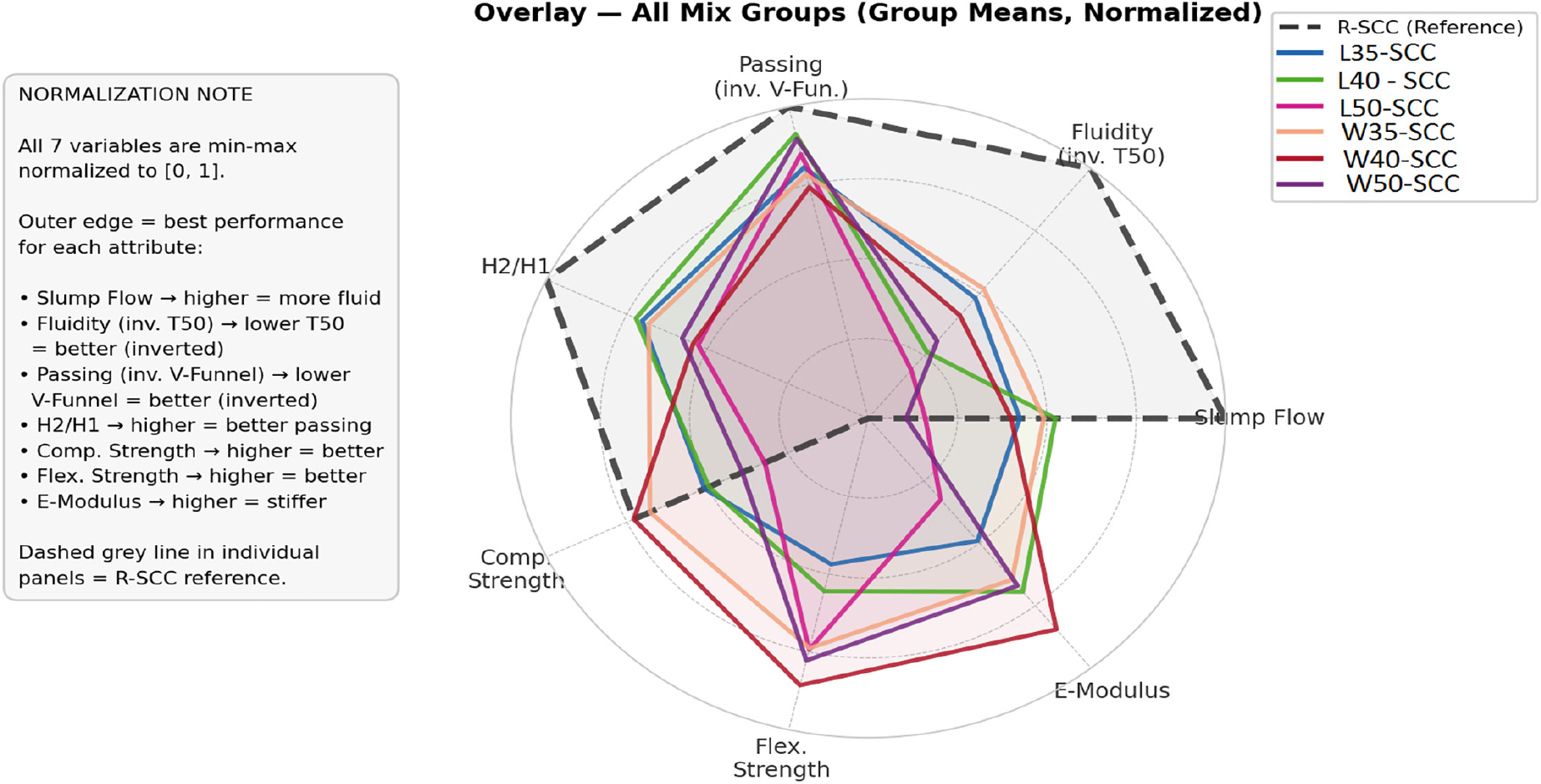
All seven variables were min-max normalised to [0, 1] so that the axes are directly comparable. For T50 and V-funnel (lower is better workability), scores were inverted (1 − normalised value), so that the outer edge of each axis consistently represents better performance, Figure 19 present a radar chart analysis of PETF-SCC.

The reference mix(R-SCC) shows the most balanced profile in the fresh state: maximum slump flow, highest Fluidity (T50) and good Passing Ability (V-funnel and L-box). But it scores the lowest on all three mechanical axes (Compressive Strength, Flexural Strength, E-Modulus) confirming that plain SCC without fibre reinforcement sacrifices performance in the hardened state for rheological ease.
The same basic trade-off appears for both fibre types: Increasing the fibre content enlarges the mechanical polygon (Flexural Strength, E-Modulus) and shrinks the fresh-state polygon (Fluidity, Passing Ability). However, W-fibre mixes consistently show larger mechanical area at equivalent dosages, indicating that the geometry or surface texture of W-fibres provides more efficient crack-bridging per unit volume. In contrast, L-fibre mixes exhibit a slightly better passing ability at low dosages (0.3–0.5%) showing that the fibre geometry results in less inter-particle interference in the fresh state.
The radar chart allows a direct multi-criteria comparison, showing the trade-off between workability and mechanical performance as a function of the fibre content and geometry. The profile of wavy fibres is characterizsed by stronger mechanical axes and weaker workability axes.
A distinct performance hierarchy is confirmed by the overlay radar presented in Table 11.
The data set includes n = 26 SCC mix designs: a reference mix (R-SCC) and fibre-reinforced ones prepared at three lengths (35, 40 and 0.50 mm) and four fibre dosages (0.3–1.2%). Seven continuous variables are considered, namely four fresh-state properties (slump flow, T50, V-funnel, H2/H1) and three hardened-state properties (Compressive Strength, Flexural Strength, Elasticity Modulus), Figure 20 presents the Pearson correlations Heatmap of reinforced concretes and the best correlation respectively.

Regarding the Fresh-State Interdependencies, the highest correlation in the dataset is between V-funnel time and H2/H1 ratio (r = −0.80, p < 0.001). It is observed that the mixes with higher resistance to flow through a restricted orifice have a significantly lower filling ability in the L-box test. This is consistent with the rheological interpretation that both metrics are governed by the plastic viscosity and the inter-particle friction, both of which increase with the fibre content.Similarly, the results for T50 and H2/H1 (r = −0.74, p < 0.001), and slump flow and T50 (r = −0.69, p < 0.001) reinforce the expected rheological hierarchy: larger slump diameters are associated with lower plastic viscosity (faster T50), which correlates with better passing ability.
On the other hand, the mechanical properties of fibre reinforced concretes is presented as follow:
Flexural Strength and Elasticity Modulus reveal the strongest mechanistic association (r = +0.65, p < 0.001). This is physically sound: fibre reinforcement enhances post-crack energy absorption and composite stiffness concurrently, therefore both properties increase simultaneously with increasing fibre dosage within mix families. When, Compressive strength is negatively correlated to T50 (r = −0.65, p < 0.001).
An interesting correlation change was also identified for slump flow: it was positively correlated with the Compressive Strength (r = +0.56, p < 0.01), whilst it was inversely correlated with Flexural Strength (r = −0.62, p < 0.001). This is the classical fibre SCC trade-off with increasing fibre content, the slump diameter reduces (loss of workability) and the flexural ductility increases. Compressive strength since not so sensitive to fibre addition is dominated by w/b ratio which also controls the flowability.
6.6. Originality and contribution to current literature
In comparison to previous research, the current study makes a number of unique contributions: (1) it is one of the first to systematically compare wavy and linear PET fibre geometries within a complete SCC framework across three fibre lengths and six volumetric fractions; (2) it establishes the reinforcing index RI as a unified parameter capable of simultaneously predicting both fresh and hardened state performance of PET-FSCC; it identifies critical RI thresholds for workability compliance and optimal mechanical performance, offering practical design guidance; and (4) it shows that recycled post-consumer PET sweeper fibres, a waste stream that can be used as a functional macro-fibre reinforcement for SCC.
The mechanical and sustainability advantages of PET valorisation in building have been further supported by recent research on PET fibre-reinforced concrete [87, 88]. These investigations, also confirming the tendencies noted here and move PET-FSCC closer to wider structural deployment, next research incorporating durability testing, SCM mixing, and life cycle assessment will build on this foundation.
6.7. Cost benefit analysis
Preliminary qualitative cost–benefit analysis shows that SCC reinforced with recycled PET fibre is economically feasible. The market prices of commercial PP and steel fibres are usually in the range of USD 1.5–4.0/kg and USD 0.8–2.5/kg, respectively. In contrast, recycled PET fibres from post-consumer sweeper waste can be sourced at near-zero raw material cost, with processing costs (collection, cleaning, cutting) estimated at USD 0.1–0.5/kg depending on production scale. At the dose studied (Vf = 0.8%, roughly 5.52 kg/m3) the cost of the fibre component per cubic meter of PETF-SCC would decrease by around 80–95% compared to commercial fibre alternatives while reaching comparable increases in flexural strength. This is a big economic win, especially considering that the costs of managing plastic waste are also high in low- and middle-income countries. All costs are qualitative and vary widely by region and time. Definite cost estimates for commercial implementation would require a comprehensive techno-economic analysis taking into account the cost of collection logistics, production infrastructure, quality control requirements and market pricing.
7. FUTURE RESEARCH
Based on the result of this investigation, the following several significant research topics can be proposed for further study. The durability aspects of PET-FSCC such as the resistance to chloride penetration, sulfate attack, carbonation, and exposure to high temperature should be also investigated following a certain methodology because they are essential for the structural service life prediction. Some recent studies revealed that recycled PET fibres can enhance thermal stability and fire retardancy of cementitious composites [4], which is a potential research opportunity for further study in the SCC field.
Secondly, the addition of SCMS (fly ash, slag or silica fume) to PET-FSCC mix design could be validated, since SCMS addition might improve the flow properties of the mix as well as the densification of the matrix in the microstructural level in terms of the F–M ITZ.
Recent works on the synergistic effect of recycled PET fibres with alternative binders in sustainable concrete materials have emerged, showing coupled enhancement in the mechanical performance [87, 88].
Third, the PET fibres were obtained from one source of post-consumer waste (plastic sweeper material) and the source of PET fibres was not varied, as well as the possibility of a variation in quality of the fibres between batches or sources was not evaluated. Fourth, the pore network, cracking propagation path and fibre–matrix bond quality should be quantitatively investigated by advanced microscopic characterization after PET fibre incorporated, such as micro-CT scanning and mercury intrusion porosimetry. Fifth, based on the rich database provided by this study, ML models could be developed which would enable the prediction of the fresh and hardened properties of the PET-FSCC as a function of the fibre geometry parameters, representing a significant advancement for mix design - optimization.
Sixth, the life cycle calculation and carbon emissions of PET-FSCC versus traditional steel fibre-reinforced SCC should be quantified to validate the environmental statements by the approach presented in terms of a circular economy. Future work should fill in these gaps by considering wider mix design parameters, durability testing, and more advanced microstructural characterization.
8. CONCLUSIONS
This study provides the first full experimental study of a self-compacted concrete mix reinforced with recycled polyethylene terephthalate (PET) fibres (PET-FSCC), obtained from post-consumer plastic sweeper dust. Three fibre lengths 35 mm, 40 mm, and 50 mm, and two fibre types; wavy (WPF) and linear (LPF) were considered at six volumetric fractions levels (Vf = 0.3% to 1.2%), leading to thirty mix designs plus one reference SCC. The fresh state characteristics (slump flow, T50, V-funnel, L-box), mechanical properties in the hardened state (compressive strength, flexural strength, elastic modulus at 7, 28, and 90 days), and a cradle-to-gate life cycle assessment (LCA) were used to perform a holistic evaluation in terms of performance and sustainability. On this basis, the following main findings are summarised.
-
The fresh property of PET-FSCC including slump flow diameter, T50 time, V-funnel flow time, and L-box filling ratio are both fibre length and volumetric fibre ratio (Vf) dependent in a systematic and strong manner. The increase of the reinforcing index (RI = Vf × l/d) leads to a monotonic decrease of both workability and slump flow diameter ranging from 790 mm (R-SCC) up to 665 mm (highest RI) all values falling within the range recommended by EFNARC of 650–800 mm up to the saturation dosage. T50 times went up from 0.4 s (R-SCC) to 1.2 s at the maximum RI, being within the EFNARC limit of 2–5 s for all suitable mixtures.
-
For both wavy and linear PET fibres, the limit of fresh-state compliance was found to be a critical reinforcing index threshold of RI = 1.0%. All SCC classification criteria (EFNARC SF2 class: slump flow 660–750 mm; V-funnel 6–12 s; L-box H2/H1 > 0.80) are met below this barrier. When this threshold is exceeded, filling capacity rapidly deteriorates, viscosity increases, fibre balling is a possibility, and in severe situations, there is total blockage around reinforcement bars. A key design requirement for PET-FSCC mix proportioning is this RI threshold.
-
The maximum volumetric fibre fraction that can be used before SCC blockage takes place was experimentally determined as: Vf,max = 1.0% for PET fibres of 35 mm, Vf,max = 0.8% for PET fibres of 40 mm and Vf,max = 0.5% for PET fibres of 50 mm. The limits are valid for wavy and linear geometries, with wavy fibres showing a higher sensitivity to the increase of the RI due to their larger specific contact area and better mechanical interlock with the mortar matrix leading to larger increments of the flow resistance per unit increase of the RI.
-
The compressive strength of PET-FSCC is slightly reduced with increasing RI, with average decreases of 3.72%, 5.06%, and 5.86% at 28 days for 35 mm, 40 mm, and 50 mm fibres respectively, compared to the reference SCC, the average 28-day compressive strength of the PET-FSCC with the highest fibre contents tested was in the range of 55–64 MPa, corresponding to the structural concrete grade C40/50, confirming the structural adequacy of the material to a wide variety of civil engineering applications.
-
The 90-day compressive strength results show a steady progression of strength development with gains of about 5–10% over 28-day values for all mix designs. The relative performance differences between the fibre-reinforced and reference SCC mixtures were stable from 28 to 90 days, confirming that the incorporation of recycled PET fibre does not affect the long-term hydration kinetics of the CEM II/B 42.5 matrix. This temporal stability is an important finding for the structural durability assessment and it confirms the chemical compatibility of recycled PET fibres with the alkaline cementitious environment over the medium-term curing period studied.
-
Contrary to the compressive strength, the flexural strength of PET-FSCC increases significantly with increasing RI, and shows an increase of about 30 % at the optimal RI values compared to the reference SCC. Additional increases of 10 – 20 % in the 90-day flexural strength values relative to the 28-day results were indicative of progressive densification of the fibre-matrix interfacial transition zone. The results demonstrate also that the wavy PET fibres (WPF) were always superior to the linear fibres (LPF) in the flexural strength for all fibre lengths and Vf levels.
-
The modulus of elasticity of PET-FSCC increased with increasing RI, with the maximum increases of 20%, 22% and 22.5% for W35-1.2%, L40-1.0% and W50-0.8%, respectively, compared to the reference SCC. This improvement, despite the inherently low elastic modulus of the PET fibres (57–60 MPa), This finding is in agreement with the composite mechanics concept for discontinuously fibre-reinforced cementitious materials and has practical implications for structural stiffness design.
-
The life cycle assessment (LCA) conducted at Vf = 0.8% (5.52 kg of recycled PET fibres per m3 of concrete) confirms that the carbon footprint of the recycled PET fibre component is only 0.55–1.60 kg CO2-eq per cubic meter of concrete, representing less than 0.4% of the total GWP of the PET-FSCC mix and approximately 32–71 times lower than the equivalent contribution of steel fibres, 9–11 times lower than polypropylene fibres, and 11–20 times lower than basalt or glass fibres. This result is a direct consequence of the minimal energy required for mechanical PET fibre processing (0.5–1.5 MJ/kg) relative to virgin fibre manufacturing (13–110 MJ/kg).
-
The total GWP of PET-FSCC at Vf = 0.8% (395–435 kg CO2-eq/m3) is the lowest among all five fibre-reinforced SCC systems evaluated, representing reductions of 11–22% relative to steel fibre SCC (445–548 kg CO2-eq/m3), 3–5% relative to polypropylene fibre SCC (409–454 kg CO2-eq/m3), and 4 to 7% relative to basalt and glass fibre SCC. While cement production dominates the total global warming potential at 78–82% in all systems, the fibre component represents the primary controllable variable for carbon footprint reduction within a given SCC mix design framework.
-
The eco-efficiency analysis reveals that recycled PET fibres achieve an eco-efficiency index of 18.8 to 54.5% per kg CO2-eq, which is 7 to 97 times higher than the corresponding values for polypropylene, steel, basalt, or glass fibres. This extraordinary eco-efficiency ratio provides a rigorous scientific basis for the claim that recycled PET fibres represent a viable and superior alternative to commercial industrial fibres from a combined mechanical-environmental performance perspective.
-
Each cubic meter of PET-FSCC at Vf = 0.8% incorporates and valorises 5.52 kg of post-consumer PET waste that would otherwise be landfilled or incinerated. The avoided landfill credit associated with this waste diversion amounts to 0.17 to 0.28 kg CO2-eq per cubic meter of concrete. At the scale of national concrete production (Algeria: ~35 million m3/year), adoption of PET-FSCC at Vf = 0.8% for even 1% of production would valorise approximately 1,932 tonnes of PET waste annually, generating avoided GWP credits of 328–540 tonnes CO2-eq/year. This quantified contribution demonstrates the systemic relevance of PET-FSCC as a plastic waste management strategy embedded within the construction sector.
-
Of the thirty mix designs studied, the W35-0.8% configuration (wavy PET fibres of 35 mm length at Vf = 0.8%) is the most balanced and practically advantageous formulation, achieving: (i) full EFNARC compliance in all fresh-state tests; (ii) about 30% improvement in flexural strength relative to R-SCC; (iii) about 20% improvement in modulus of elasticity; (iv) only 3.7% reduction in compressive strength; and (v) the lowest environmental impact among all tested configurations based on the LCA conducted at Vf = 0.8%. This configuration is proposed as the main reference dosage for structural PET-FSCC applications.
9. DATA AVAILABILITY
All data generated or analysed during this study are included in this published article.
10. BIBLIOGRAPHY
-
[1] ALBATAYNEH, O., AKHTAR, M.N., “Evaluating recycled PET as an alternative material for the construction sector towards sustainability”, Civil Engineering Journal, v. 10, n. 4, pp. 1336–1353, 2024. doi: https://doi.org/10.28991/CEJ-2024-010-04-020.
» https://doi.org/10.28991/CEJ-2024-010-04-020 -
[2] SASU, D.D., Annual production of plastics worldwide from 1950 to 2024, Ludwigshafen, Plastic & Rubber, 2026. https://www.statista.com/statistics/282732/global-production-of-plastics-since-1950/, accessed in January, 2026.
» https://www.statista.com/statistics/282732/global-production-of-plastics-since-1950/ -
[3] CUDZIK, J., KROPISZ, K., “Assessment of utilizing hard-to-recycle plastic waste from the packaging sector in architectural design-case study for experimental building material”, Sustainability, v. 16, n. 14, pp. 6133, 2024. doi: https://doi.org/10.3390/su16146133.
» https://doi.org/10.3390/su16146133 -
[4] SEDLMAJER, M., ZACH, J., BUBENÍK, J., et al., “Utilization of alternative fibres manufactured from recycled PET bottles in concrete technology for the improvement of fire resistance”, Polymers, v. 16, n. 22, pp. 3145, 2024. doi: https://doi.org/10.3390/polym16223145. PubMed PMID: 39599236.
» https://doi.org/10.3390/polym16223145 -
[5] HAIDO, J.H., SAADULLAH, S.T., TAHER, S.M., et al., “Performance of RC deep beams containing eco-friendly waste PET aggregate: experimental investigation”, International Journal of Masonry Research and Innovation, v. 10, n. 3–5, pp. 399–416, 2025. doi: https://doi.org/10.1504/IJMRI.2025.146253.
» https://doi.org/10.1504/IJMRI.2025.146253 -
[6] POK, P., DEL REY CASTILLO, E., INGHAM, J., et al., “Plant fibres as reinforcing material in self-compacting concrete: a systematic literature review”, Sustainability, v. 17, n. 22, pp. 9955, 2025. doi: https://doi.org/10.3390/su17229955.
» https://doi.org/10.3390/su17229955 -
[7] ABBASS, W., KHAN, M.I., MOURAD, S., “Evaluation of mechanical properties of steel fibre reinforced concrete with different strengths of concrete”, Construction & Building Materials, v. 168, pp. 556–569, 2018. doi: https://doi.org/10.1016/j.conbuildmat.2018.02.164.
» https://doi.org/10.1016/j.conbuildmat.2018.02.164 -
[8] SAADULLAH, S.T., HAIDO, J.H., AL-KAMAKI, Y.S., “Mechanical properties of sustainable green self-compacting concrete incorporating recycled waste PET: A state-of-the-art review”, Advances in Concrete Construction, v. 16, n. 1, pp. 35, 2023. doi: https://doi.org/10.12989/acc.2023.16.1.035.
» https://doi.org/10.12989/acc.2023.16.1.035 -
[9] HAIDO, J.H., TAYEH, B.A., MAJEED, S.S., et al., “Effect of high temperature on the mechanical properties of basalt fibre self-compacting concrete as an overlay material”, Construction & Building Materials, v. 268, pp. 121725, 2021. doi: https://doi.org/10.1016/j.conbuildmat.2020.121725.
» https://doi.org/10.1016/j.conbuildmat.2020.121725 -
[10] AS’AD, S., GUNAWAN, P., ALAYDRUS, M.S., “Fresh state behavior of self compacting concrete containing waste material fibres”, Procedia Engineering, v. 14, pp. 797–804, 2011. doi: https://doi.org/10.1016/j.proeng.2011.07.101.
» https://doi.org/10.1016/j.proeng.2011.07.101 -
[11] CATTANEO, S., GIUSSANI, F., MOLA, F., “Flexural behaviour of reinforced, prestressed and composite self-consolidating concrete beams”, Construction & Building Materials, v. 36, pp. 826–837, 2012. doi: https://doi.org/10.1016/j.conbuildmat.2012.06.001.
» https://doi.org/10.1016/j.conbuildmat.2012.06.001 -
[12] EL-DIEB, A., TAHA, M.R., “Flow characteristics and acceptance criteria of fiber-reinforced self-compacted concrete (FR-SCC)”, Construction & Building Materials, v. 27, n. 1, pp. 585–596, 2012. doi: https://doi.org/10.1016/j.conbuildmat.2011.07.004.
» https://doi.org/10.1016/j.conbuildmat.2011.07.004 -
[13] GRÜNEWALD, S., WALRAVEN, J.C., “Parameter-study on the influence of steel fibers and coarse aggregate content on the fresh properties of self-compacting concrete”, Cement and Concrete Research, v. 31, n. 12, pp. 1793–1798, 2001. doi: https://doi.org/10.1016/S0008-8846(01)00555-5.
» https://doi.org/10.1016/S0008-8846(01)00555-5 -
[14] SOUTSOS, M., LE, T., LAMPROPOULOS, A., “Flexural performance of fibre reinforced concrete made with steel and synthetic fibres”, Construction & Building Materials, v. 36, pp. 704–710, 2012. doi: https://doi.org/10.1016/j.conbuildmat.2012.06.042.
» https://doi.org/10.1016/j.conbuildmat.2012.06.042 -
[15] ABDULLAH, Q.M., HAIDO, J.H., “Response of hybrid concrete incorporating eco-friendly waste PET fiber: Experimental and analytical investigations”, Construction & Building Materials, v. 354, pp. 129071, 2022. doi: https://doi.org/10.1016/j.conbuildmat.2022.129071.
» https://doi.org/10.1016/j.conbuildmat.2022.129071 -
[16] ASLANI, F., NEJADI, S., “Self-compacting concrete incorporating steel and polypropylene fibers: Compressive and tensile strengths, moduli of elasticity and rupture, compressive stress–strain curve, and energy dissipated under compression”, Composites. Part B, Engineering, v. 53, pp. 121–133, 2013. doi: https://doi.org/10.1016/j.compositesb.2013.04.044.
» https://doi.org/10.1016/j.compositesb.2013.04.044 -
[17] GHERNOUTI, Y., RABEHI, B., BOUZIANI, T., et al., “Fresh and hardened properties of self-compacting concrete containing plastic bag waste fibers (WFSCC)”, Construction & Building Materials, v. 82, pp. 89–100, 2015. doi: https://doi.org/10.1016/j.conbuildmat.2015.02.059.
» https://doi.org/10.1016/j.conbuildmat.2015.02.059 -
[18] IRKI, I., DEBIEB, F., KADRI, E.H., et al., “Effect of the length and the volume fraction of wavy steel fibers on the behavior of self-compacting concrete”, Journal of Adhesion Science and Technology, v. 31, n. 7, pp. 735–748, 2017. doi: https://doi.org/10.1080/01694243.2016.1231394.
» https://doi.org/10.1080/01694243.2016.1231394 -
[19] MADANDOUST, R., RANJBAR, M.M., GHAVIDEL, R., et al., “Assessment of factors influencing mechanical properties of steel fiber reinforced self-compacting concrete”, Materials & Design, v. 83, pp. 284–294, 2015. doi: https://doi.org/10.1016/j.matdes.2015.06.024.
» https://doi.org/10.1016/j.matdes.2015.06.024 -
[20] MARTINIE, L., ROSSI, P., ROUSSEL, N., “Rheology of fiber reinforced cementitious materials: classification and prediction”, Cement and Concrete Research, v. 40, n. 2, pp. 226–234, 2010. doi: https://doi.org/10.1016/j.cemconres.2009.08.032.
» https://doi.org/10.1016/j.cemconres.2009.08.032 -
[21] RAMIZ, A.R., MITSUYOSHI, A., TAKUMI, K., “Effects of concrete flow on the distribution and orientation of fibers and flexural behavior of steel fiber-reinforced self-compacting concrete beams”, Construction & Building Materials, v. 262, pp. 119963, 2020. doi: https://doi.org/10.1016/j.conbuildmat.2020.119963.
» https://doi.org/10.1016/j.conbuildmat.2020.119963 -
[22] SAADULLAH, S.T., HAIDO, J.H., AL-KAMAKI, Y.S., “Effect of waste PET fibre on rheological and mechanical properties of self-compacting concrete”, International Journal of Masonry Research and Innovation, v. 11, n. 1, pp. 65–84, 2026. doi: https://doi.org/10.1504/IJMRI.2026.150367.
» https://doi.org/10.1504/IJMRI.2026.150367 -
[23] FRATERNALI, F., CIANCIA, V., CHECHILE, R., et al., “Experimental study of the thermo-mechanical properties of recycled PET fiber-reinforced concrete”, Composite Structures, v. 93, n. 9, pp. 2368–2374, 2011. doi: https://doi.org/10.1016/j.compstruct.2011.03.025.
» https://doi.org/10.1016/j.compstruct.2011.03.025 -
[24] TEIXEIRA, A.C.M., CERQUEIRA, N.A., “Influence of 1% recycled PET fiber on the fracture behavior of recycled aggregate concrete beams”, Matéria, v. 31, pp. e20250961, 2026. doi: https://doi.org/10.1590/1517-7076-rmat-2025-0961.
» https://doi.org/10.1590/1517-7076-rmat-2025-0961 -
[25] AL-HADITHI, A.I., FARHAN, A.H., ALI, D.H., “Investigating mechanical properties of SIFCONs produced with waste PET fibers”, Construction & Building Materials, v. 448, pp. 138220, 2024. doi: https://doi.org/10.1016/j.conbuildmat.2024.138220.
» https://doi.org/10.1016/j.conbuildmat.2024.138220 - [26] GRUNERT, J., STROBACH, C.-P., TEUTSCH, M., “Prestressed steelfiber-reinforced SCC beams without steel reinforcement”, Betonwerk + Fertigteil-Technik, pp. 50–55, 2004.
-
[27] CHAIRAT, S., GHEEWALA, S.H., “Life cycle assessment and circularity of polyethylene terephthalate bottles via closed and open loop recycling”, Environmental Research, v. 236, n. Pt 1, pp. 116788, 2023. doi: https://doi.org/10.1016/j.envres.2023.116788. PubMed PMID: 37517501.
» https://doi.org/10.1016/j.envres.2023.116788 -
[28] FATIMA, A., KHAN, F.U., HUSSAIN, M., et al., “Sustainability assessment of home textiles made of recycled PET fibre using life cycle assessment and life cycle costing analyses”, The Science of the Total Environment, v. 982, pp. 179652, 2025. doi: https://doi.org/10.1016/j.scitotenv.2025.179652. PubMed PMID: 40378702.
» https://doi.org/10.1016/j.scitotenv.2025.179652 -
[29] HU, A.H., TING, C.Y., OUATTARA, A., et al., “Life cycle assessment of recycling polyethylene terephthalate (PET): A comparative case study in taiwan”, Recycling, v. 10, n. 3, pp. 98, 2025. doi: https://doi.org/10.3390/recycling10030098.
» https://doi.org/10.3390/recycling10030098 -
[30] KING, C., VAN ROIJEN, E., CHOUDHARY, H., et al., “Life cycle assessment of chemical recycling of polyethylene terephthalate to produce aramid polymers”, ACS Sustainable Chemistry & Engineering, v. 13, n. 30, pp. 11733–11744, 2025. doi: https://doi.org/10.1021/acssuschemeng.5c01025.
» https://doi.org/10.1021/acssuschemeng.5c01025 -
[31] FOTI, D., “Preliminary analysis of concrete reinforced with waste bottles PET fibers”, Construction & Building Materials, v. 25, n. 4, pp. 1906–1915, 2011. doi: https://doi.org/10.1016/j.conbuildmat.2010.11.066.
» https://doi.org/10.1016/j.conbuildmat.2010.11.066 -
[32] YIN, S., TULADHAR, R., RIELLA, J., et al., “Comparative evaluation of virgin and recycled polypropylene fibre reinforced concrete”, Construction & Building Materials, v. 114, pp. 134–141, 2016. doi: https://doi.org/10.1016/j.conbuildmat.2016.03.162.
» https://doi.org/10.1016/j.conbuildmat.2016.03.162 -
[33] MAZAHERIPOUR, H., GHANBARPOUR, S., MIRMORADI, S.H., et al., “The effect of polypropylene fibers on the properties of fresh and hardened lightweight self-compacting concrete”, Construction & Building Materials, v. 25, n. 1, pp. 351–358, 2011. doi: https://doi.org/10.1016/j.conbuildmat.2010.06.018.
» https://doi.org/10.1016/j.conbuildmat.2010.06.018 -
[34] BUI, N.K., SATOMI, T., TAKAHASHI, H., “Recycling woven plastic sack waste and PET bottle waste as fiber in recycled aggregate concrete: An experimental study”, Waste Management, v. 78, pp. 79–93, 2018. doi: https://doi.org/10.1016/j.wasman.2018.05.035. PubMed PMID: 32559972.
» https://doi.org/10.1016/j.wasman.2018.05.035 - [35] WEIBULL, W., “A statistical theory of strength of materials”, IVB-Handl, n. 151, 1939.
-
[36] IRKI, I., EULDJI, M., BENSABER, H., et al., “Characterization of stem phoenix fibres as potential reinforcement of self compacting mortar”, Journal of Adhesion Science and Technology, v. 32, n. 15, pp. 1629–1642, 2018. doi: https://doi.org/10.1080/01694243.2018.1442654.
» https://doi.org/10.1080/01694243.2018.1442654 -
[37] ROY, A., CHAKRABORTY, S., KUNDU, S.P., et al., “Improvement in mechanical properties of jute fibres through mild alkali treatment as demonstrated by utilisation of the Weibull distribution model”, Bioresource Technology, v. 107, pp. 222–228, 2012. doi: https://doi.org/10.1016/j.biortech.2011.11.073. PubMed PMID: 22209134.
» https://doi.org/10.1016/j.biortech.2011.11.073 -
[38] TRUJILLO, E., MOESEN, M., OSORIO, L., et al., “Bamboo fibres for reinforcement in composite materials: Strength Weibull analysis”, Composites. Part A, Applied Science and Manufacturing, v. 61, pp. 115–125, 2014. doi: https://doi.org/10.1016/j.compositesa.2014.02.003.
» https://doi.org/10.1016/j.compositesa.2014.02.003 -
[39] ILYES, I., KESSEIR, M., DEBIEB, F., et al., “Sustainable fibre-concrete reinforcement using manufacturing by-products”, Vojnotehnički Glasnik, v. 74, n. 1, pp. 225–243, 2026. doi: https://doi.org/10.5937/vojtehg74-58016.
» https://doi.org/10.5937/vojtehg74-58016 -
[40] INSTITUT ALGÉRIEN DE NORMALISATION, NA 442 Liants Hydrauliques-ciments Courants: Composition, Spécifications et Critères de Conformité, Argel, IANOR, 2000. https://www.calameo.com/read/001496329437503a35a15, accessed in January, 2026.
» https://www.calameo.com/read/001496329437503a35a15 - [41] EUROPEAN STANDARD, EN197–1: 2000 Cement–Part, Brussels, European Committee for Standardization, 2000.
- [42] EUROPEAN STANDARD, EN B.S., 196–6,-Methods of Testing Cement. Determination of Fineness, London, British Standards Institute, 2010.
- [43] EUROPEAN STANDARD, EN 196–1, E., Methods of Testing Cement. Determination of Strength, Bucharest, Romanian Standard Association, 2016.
- [44] EUROPEAN STANDARD, EN B. 196–2 Methods of Testing Cement-Part 2, Brussels, European Committee for Standardization, 2005.
- [45] EUROPEAN STANDARD, EN 933–1 Tests for Geometrical Properties of Aggregates – Part 1: Determination of Particle Size Distribution - Sieving Method, Brussels, European Committee for Standardization, 2012.
- [46] EUROPEAN STANDARD, EN 1097–6 Tests for Mechanical and Physical Properties of Aggregates. Methods for the Determination of Resistance to Fragmentation, Brussels, European Committee for Standardization, 1996.
- [47] EUROPEAN STANDARD, EN 933–8 Tests for Geometrical Properties of Aggregates—Part 8: Assessment of Fines—Sand Equivalent Test, Caparica, Portugal, Instituto Português da Qualidade, 2012.
-
[48] KHALOO, A., RAISI, E.M., HOSSEINI, P., et al., “Mechanical performance of self-compacting concrete reinforced with steel fibers”, Construction & Building Materials, v. 51, pp. 179–186, 2014. doi: https://doi.org/10.1016/j.conbuildmat.2013.10.054.
» https://doi.org/10.1016/j.conbuildmat.2013.10.054 - [49] OKAMURA, H., OZAWA, K., “Mix design for self-compacting concrete”, Concrete Library of JSCE, v. 25, n. 6, pp. 107–120, 1995.
-
[50] ROSSI, P., HARROUCHE, N., “Mix design and mechanical behaviour of some steel-fibre-reinforced concretes used in reinforced concrete structures”, Materials and Structures, v. 23, n. 4, pp. 256–266, 1990. doi: https://doi.org/10.1007/BF02472199.
» https://doi.org/10.1007/BF02472199 - [51] EFNARC, The European Guidelines for Self-Compacting Concrete: Specifcation, Production, and Use, Flums, Switzerland, EFNARC, 2002.
-
[52] ABDUL-RAHMAN, A.R., YOUNIS, K.H., TAHA, B.O., “Interactive influence of recycled concrete aggregate and recycled steel (Sedlmajer, 2024 #65)fibers on the fresh and hardened performance of eco-efficient fiber-reinforced self-compacting concrete”, Journal of Composites Science, v. 10, n. 1, pp. 9, 2026. doi: https://doi.org/10.3390/jcs10010009.
» https://doi.org/10.3390/jcs10010009 -
[53] EUROPEAN STANDARD, EN C 12390-1 Testing Hardened Concrete–Part 1: Shape, Dimensions and Other Requirements for Specimens and Moulds, Brussels, European Committee for Standardization, 2000. https://standards.iteh.ai/catalog/standards/cen/d1c9ccee-2e5a-425e-a964-961da95d2f99/en-12390-1-2021?srsltid=AfmBOorR30AMbdfc8t1epjwLcjCXgb4Wy0SKZBxjNvkqFIUXdF-Opq5y, accessed in January, 2026.
» https://standards.iteh.ai/catalog/standards/cen/d1c9ccee-2e5a-425e-a964-961da95d2f99/en-12390-1-2021?srsltid=AfmBOorR30AMbdfc8t1epjwLcjCXgb4Wy0SKZBxjNvkqFIUXdF-Opq5y -
[54] EUROPEAN STANDARD, EN T 12390-2 Testing Hardened Concrete-Part 2: Making and Curing Specimens for Strength Tests, Brussels, European Committee for Standardization, 2009. https://standards.iteh.ai/catalog/standards/cen/ae7e6a86-1cbc-455e-8b2a-8964be9087f9/en-12390-2-2019?srsltid=AfmBOooi0JX5FSZ7DDHXOW6U3YkK7kWxBzhYe1J-7gNFdrbCqbb6NwZG, accessed in January, 2026.
» https://standards.iteh.ai/catalog/standards/cen/ae7e6a86-1cbc-455e-8b2a-8964be9087f9/en-12390-2-2019?srsltid=AfmBOooi0JX5FSZ7DDHXOW6U3YkK7kWxBzhYe1J-7gNFdrbCqbb6NwZG - [55] EUROPEAN STANDARD, EN B 12390-5 Testing Hardened Concrete–Part 5: Flexural Strength of Test Specimens, London, British Standards Institute, 2009.
- [56] INTERNATIONAL ORGANIZATION OF STANDARDIZATION, ISO 1920-10 Testing of Concrete—Part 10: Determination of Static Modulus of Elasticity in Compression, Geneva, ISO, 2010.
-
[57] YANG, Q., ZENG, L., WANG, H., et al., “Influence of extra-short extra-fine steel fibers on mechanical properties of self-compacting concrete with single-doped fly ash”, Buildings (Basel, Switzerland), v. 14, n. 5, pp. 1396, 2024. doi: https://doi.org/10.3390/buildings14051396.
» https://doi.org/10.3390/buildings14051396 - [58] INTERNATIONAL ORGANIZATION OF STANDARDIZATION, NEN-EN-ISO 14040, Environmental Management-Life Cycle Assessment-Principles and Framework, Geneva, ISO, 2006.
- [59] INTERNATIONAL ORGANIZATION OF STANDARDIZATION, NEN-EN-ISO 14044, Environmental Management—Life Cycle Assessment—Requirements and Guidelines, Geneva, ISO, 2006.
-
[60] WERNET, G., BAUER, C., STEUBING, B., et al., “The ecoinvent database version 3 (part I): overview and methodology”, The International Journal of Life Cycle Assessment, v. 21, n. 9, pp. 1218–1230, 2016. doi: https://doi.org/10.1007/s11367-016-1087-8.
» https://doi.org/10.1007/s11367-016-1087-8 - [61] PE INTERNATIONAL, Polypropylene fiber production [LCA dataset], GaBi Database, Leinfelden-Echterdingen, Sphera, 2020.
-
[62] FARINA, I., COLANGELO, F., PETRILLO, A., et al., “LCA of concrete with construction and demolition waste”, In: Pacheco-Torgal, F., Ding, Y., Colangelo, F., et al. (eds), Advances in construction and demolition waste recycling, Amsterdam, Elsevier, pp. 501–513, 2020. doi: https://doi.org/10.1016/B978-0-12-819055-5.00024-3.
» https://doi.org/10.1016/B978-0-12-819055-5.00024-3 -
[63] GU, F., GUO, J., ZHANG, W., et al., “From waste plastics to industrial raw materials: A life cycle assessment of mechanical plastic recycling practice based on a real-world case study”, The Science of the Total Environment, v. 601-602, pp. 1192–1207, 2017. doi: https://doi.org/10.1016/j.scitotenv.2017.05.278. PubMed PMID: 28605837.
» https://doi.org/10.1016/j.scitotenv.2017.05.278 -
[64] KHOO, H.H., “LCA of plastic waste recovery into recycled materials, energy and fuels in Singapore”, Resources, Conservation and Recycling, v. 145, pp. 67–77, 2019. doi: https://doi.org/10.1016/j.resconrec.2019.02.010.
» https://doi.org/10.1016/j.resconrec.2019.02.010 -
[65] SBAHIEH, S., MCKAY, G., AL-GHAMDI, S.G., “A comparative life cycle assessment of fiber-reinforced polymers as a sustainable reinforcement option in concrete beams”, Frontiers in Built Environment, v. 9, pp. 1194121, 2023. doi: https://doi.org/10.3389/fbuil.2023.1194121.
» https://doi.org/10.3389/fbuil.2023.1194121 -
[66] ALZUBI, E., KASSEM, A., NOCHE, B., “A comparative life cycle assessment: polystyrene or polypropylene packaging crates to reduce citrus loss and waste in transportation”, Sustainability, v. 14, n. 19, pp. 12644, 2022. doi: https://doi.org/10.3390/su141912644.
» https://doi.org/10.3390/su141912644 -
[67] FOŘT, J., KOČÍ, J., ČERNÝ, R., “Environmental efficiency aspects of basalt fibers reinforcement in concrete mixtures”, Energies, v. 14, n. 22, pp. 7736, 2021. doi: https://doi.org/10.3390/en14227736.
» https://doi.org/10.3390/en14227736 -
[68] PANT, M., NEGI, H., SHARMA, S., “Life cycle analysis, cost analysis, and sustainability of basalt fiber composites”, In: Rahman, Z. and Deshmukh, K. (eds), Advances in basalt fibers and their composites, Washington, ACS Publications, pp. 459–481, 2026. doi: https://doi.org/10.1021/bk-2026-1524.ch013.
» https://doi.org/10.1021/bk-2026-1524.ch013 -
[69] BALON, V., ABHYANKAR, A., SUDARSAN, J., “Life cycle analysis of steel, glass fiber rebar polymer and basalt fiber reinforcement polymer”, Journal of Mines, Metals & Fuels, v. 73, n. 5, pp. 1257–1264, 2025. doi: https://doi.org/10.18311/jmmf/2025/47419.
» https://doi.org/10.18311/jmmf/2025/47419 -
[70] DING, Y.N., LIU, S.G., ZHANG, Y.L., et al., “The investigation on the workability of fibre cocktail reinforced self-compacting high performance concrete”, Construction & Building Materials, v. 22, n. 7, pp. 1462–1470, 2008. doi: https://doi.org/10.1016/j.conbuildmat.2007.03.034.
» https://doi.org/10.1016/j.conbuildmat.2007.03.034 -
[71] AKCAY, B., TASDEMIR, M.A., “Mechanical behaviour and fibre dispersion of hybrid steel fibre reinforced self-compacting concrete”, Construction & Building Materials, v. 28, n. 1, pp. 287–293, 2012. doi: https://doi.org/10.1016/j.conbuildmat.2011.08.044.
» https://doi.org/10.1016/j.conbuildmat.2011.08.044 -
[72] BRANDT, A.M., “Fibre reinforced cement-based (FRC) composites after over 40 years of development in building and civil engineering”, Composite Structures, v. 86, n. 1–3, pp. 3–9, 2008. doi: https://doi.org/10.1016/j.compstruct.2008.03.006.
» https://doi.org/10.1016/j.compstruct.2008.03.006 -
[73] SWAMY, R., MANGAT, P., “Influence of fibre-aggregate interaction on some properties of steel fibre reinforced concrete”, Materiales de Construcción, v. 7, n. 5, pp. 307–314, 1974. doi: https://doi.org/10.1007/BF02473840.
» https://doi.org/10.1007/BF02473840 -
[74] WESTERHOLM, M., LAGERBLAD, B., SILFWERBRAND, J., et al., “Influence of fine aggregate characteristics on the rheological properties of mortars”, Cement and Concrete Composites, v. 30, n. 4, pp. 274-282, 2008. doi: https://doi.org/10.1016/j.cemconcomp.2007.08.008.
» https://doi.org/10.1016/j.cemconcomp.2007.08.008 -
[75] HUSSAIN, A., WANKHADE, R.L., SINGH, H., “Enhancing the properties of Self-compacting concrete by Using Steel and polypropylene fibers”, Practice Periodical on Structural Design and Construction, v. 29, n. 3, pp. 04024037, 2024. doi: https://doi.org/10.1061/PPSCFX.SCENG-1460.
» https://doi.org/10.1061/PPSCFX.SCENG-1460 -
[76] CENTONZE, G., LEONE, M., AIELLO, M., “Steel fibers from waste tires as reinforcement in concrete: a mechanical characterization”, Construction & Building Materials, v. 36, pp. 46–57, 2012. doi: https://doi.org/10.1016/j.conbuildmat.2012.04.088.
» https://doi.org/10.1016/j.conbuildmat.2012.04.088 -
[77] CORINALDESI, V., MORICONI, G., “Characterization of self-compacting concretes prepared with different fibers and mineral additions”, Cement and Concrete Composites, v. 33, n. 5, pp. 596–601, 2011. doi: https://doi.org/10.1016/j.cemconcomp.2011.03.007.
» https://doi.org/10.1016/j.cemconcomp.2011.03.007 -
[78] BOULEKBACHE, B., HAMRAT, M., CHEMROUK, M., et al., “Flowability of fibre-reinforced concrete and its effect on the mechanical properties of the material”, Construction & Building Materials, v. 24, n. 9, pp. 1664–1671, 2010. doi: https://doi.org/10.1016/j.conbuildmat.2010.02.025.
» https://doi.org/10.1016/j.conbuildmat.2010.02.025 -
[79] HU, X., WANG, Y., XIE, F., et al., “Flexural Fracture Behavior and Mechanical Properties of SAP-PVA Fiber-Reinforced Concrete”, Materials (Basel), v. 19, n. 1, pp. 203, 2026. doi: https://doi.org/10.3390/ma19010203. PubMed PMID: 41515871.
» https://doi.org/10.3390/ma19010203 -
[80] HASSANPOUR, M., SHAFIGH, P., MAHMUD, H.B., “Lightweight aggregate concrete fiber reinforcement-a review”, Construction & Building Materials, v. 37, pp. 452–461, 2012. doi: https://doi.org/10.1016/j.conbuildmat.2012.07.071.
» https://doi.org/10.1016/j.conbuildmat.2012.07.071 -
[81] MOHAMMADI, Y., SINGH, S., KAUSHIK, S., “Properties of steel fibrous concrete containing mixed fibres in fresh and hardened state”, Construction & Building Materials, v. 22, n. 5, pp. 956–965, 2008. doi: https://doi.org/10.1016/j.conbuildmat.2006.12.004.
» https://doi.org/10.1016/j.conbuildmat.2006.12.004 -
[82] ALBERTI, M., ENFEDAQUE, A., GÁLVEZ, J., “On the mechanical properties and fracture behavior of polyolefin fiber-reinforced self-compacting concrete”, Construction & Building Materials, v. 55, pp. 274–288, 2014. doi: https://doi.org/10.1016/j.conbuildmat.2014.01.024.
» https://doi.org/10.1016/j.conbuildmat.2014.01.024 -
[83] SHAFIGH, P., MAHMUD, H., JUMAAT, M.Z., “Effect of steel fiber on the mechanical properties of oil palm shell lightweight concrete”, Materials & Design, v. 32, n. 7, pp. 3926–3932, 2011. doi: https://doi.org/10.1016/j.matdes.2011.02.055.
» https://doi.org/10.1016/j.matdes.2011.02.055 -
[84] HABERT, G., MILLER, S.A., JOHN, V.M., et al., “Environmental impacts and decarbonization strategies in the cement and concrete industries”, Nature Reviews. Earth & Environment, v. 1, n. 11, pp. 559–573, 2020. doi: https://doi.org/10.1038/s43017-020-0093-3.
» https://doi.org/10.1038/s43017-020-0093-3 -
[85] YIN, S., TULADHAR, R., SHEEHAN, M., et al., “A life cycle assessment of recycled polypropylene fibre in concrete footpaths”, Journal of Cleaner Production, v. 112, pp. 2231–2242, 2016. doi: https://doi.org/10.1016/j.jclepro.2015.09.073.
» https://doi.org/10.1016/j.jclepro.2015.09.073 -
[86] HUIJBREGTS, M.A., STEINMANN, Z.J., ELSHOUT, P.M., et al., “ReCiPe2016: a harmonised life cycle impact assessment method at midpoint and endpoint level”, The International Journal of Life Cycle Assessment, v. 22, n. 2, pp. 138–147, 2017. doi: https://doi.org/10.1007/s11367-016-1246-y.
» https://doi.org/10.1007/s11367-016-1246-y -
[87] ASADOLLAHFARDI, G., ABDI, E., SALEHI, A.M., et al., “Innovative self-compacting repair mortar: Utilizing municipal solid waste incinerator bottom ash, propylene fiber, and wash water”, Sustainable Chemistry and Pharmacy, v. 46, pp. 102–104, 2025. doi: https://doi.org/10.1016/j.scp.2025.102104.
» https://doi.org/10.1016/j.scp.2025.102104 -
[88] SALEHI, A., ASADOLLAHFARDI, G., MAFAKHERI, S., et al., “Impact of propylene fibers and industrial wastewater on the properties of self-compacting concrete”, Scientific Reports, v. 15, n. 1, pp. 29201, 2025. doi: https://doi.org/10.1038/s41598-025-13454-w. PubMed PMID: 40783418.
» https://doi.org/10.1038/s41598-025-13454-w