 Performance evaluation of additive-modified geopolymer concrete under normal and elevated thermal exposure
ABSTRACT
This research work aims to explore the effect of Spinacia oleracea (SO), Calotropis gigantea (CG), and Polyethylene Glycol (PEG) on the physical and durability characteristics of geopolymer concrete (GPC) at normal curing conditions and at 600 °C for 2 hours. Fly ash and GGBS were used as binder materials, and additives were added at a range of 0.2% to 1% of binder weight. Slump and compactness tests were used to determine workability, and hardened properties were tested by strength parameters, water absorption, sulphuric acid resistance, and RCPT. All mixes had good workability at 0.6% dosage. PEG performed better, and the mix containing 0.6% PEG had a compressive, split and flexural strength of 41.3, 2.74 and 4.28 MPa at 28 days. It also had the lowest water absorption of 2.38%, lowest acid strength reduction of 6.67%, and lowest RCPT value of 2530 coulombs. SEM results showed a compact matrix with fewer pores and better bonding. Although high temperature conditions decreased the properties, the PEG mixes had better residual strength and durability.
Keywords:
Geopolymer; Flyash; GGBS; Spinacia oleracea; Calotropis gigantea; Polyethylene glycol
1. INTRODUCTION
GPC has been found to be a potential eco-friendly substitute for traditional concrete because of its much lower carbon footprint. Several studies have shown that GPC can reduce carbon dioxide emissions by as much as 40–80% compared to OPC concrete, depending on the aluminosilicate precursor and alkaline activator used [1]. The absence of energy-intensive cement clinker processing, along with the use of industrial waste materials like fly ash (FA) and GGBS, not only maximizes resource efficiency but also helps in waste management by reducing landfilling. For structural applications, GPC should have mechanical strengths similar to those of conventional concrete. Generally, a compressive strength of more than 30 MPa is necessary, with tensile strengths between 2.5 and 4.0 MPa [2]. Moreover, the value of the modulus of elasticity should be similar to that of M30 to M40 grade OPC concrete, which will ensure sufficient stiffness and strength. Geopolymer concrete, when properly designed, also has adequate durability properties [3].
Studies have shown that the combined FA-GGBFS binder is more effective in the production of structural-grade GPC when cured under ambient (non-thermal) conditions. Fly ash, with an average composition of 50-60% SiO2 and 20–30% Al2O3, helps in improving workability because of its spherical shape and average particle size below 45 µm [4]. GGBFS, with an average composition of 30–40% CaO, helps in the early geopolymerization process and strength development [5]. The parametric analysis suggests that a 50% FA-50% GGBFS binder mixture often gives the best workability and strength, with a compressive strength of 35–45 MPa when cured under ambient conditions [6]. An increase in the amount of GGBFS to 70–75% can further improve early strength, often exceeding 40 MPa, but may lead to a diminish in workability because of the faster geopolymerization reaction [7]. The addition of micro-fines or micro fly ash has been found to improve particle packing and has resulted in a compressive strength of 30–40 MPa without external heat curing, thus establishing the structural feasibility of cement-free geopolymer materials [8].
One of the issues that have been consistently raised in the literature is the confusion between “ambient curing” and “self-curing.” Ambient curing is the process of developing strength at room temperature, usually between 25–30°C, without the use of external heating [9]. Self-curing or internal curing, on the other hand, involves the use of moisture-retaining agents or porous inclusions that provide additional internal water to counteract shrinkage [10]. The majority of geopolymer mixtures that are described as “self-cured” are actually ambient-cured, requiring only closed conditions. As the water in geopolymer binders is mainly a reaction medium and is not chemically bound as strongly as in OPC hydration, evaporation can result in autogenous shrinkage values in excess of 400–600 microstrain if uncontrolled [11].
In geopolymer mixtures containing expanded clay or other lightweight aggregates (with water absorption values between 10–20%), internal water reservoirs can be created. These mixtures have been found to have densities between 1600–1900 kg/m3, as opposed to 2400 kg/m3 for normal concrete, with compressive strengths above 25–35 MPa [12]. Decreases of 30–50% in thermal conductivity have also been observed. Nevertheless, most research works concentrate on the mechanical strength and thermal performance rather than measuring the efficiency of shrinkage reduction and internal curing [13]. In geopolymer mixtures containing recycled aggregates, improved durability parameters such as water absorption (less than 5%) and relative dynamic modulus after cyclic loading have been observed, but the efficiency of the internal curing process has not been adequately ascertained by microstructural analysis [14].
Durability studies have repeatedly demonstrated that GPC has a better resistance to acidic environments than OPC concrete, with GPC retaining 75–90% of its original compressive strength in acidic conditions [15]. RCPT results for well-designed geopolymer concrete are often below 1000 coulombs, which is a good indicator of low permeability [16]. Although these results are encouraging, it is important to note that most of the durability results are obtained from ambient-cured specimens rather than properly assessed internally cured specimens [16]. Additionally, the durability of geopolymer concrete under combined environmental conditions, such as chloride penetration under sustained saturation and high temperature exposure above 500°C, has not been properly documented, especially for geopolymer concrete containing waste materials [17].
The current literature shows that there are a number of research gaps. There is no significant difference between ambient curing and internal self-curing in geopolymer studies. There is a lack of systematic studies on internal curing agents, such as lightweight aggregates and superabsorbent polymers, especially at higher temperatures above 500°C. There is an insufficiency of long-term durability information on internally cured geopolymer materials exposed to aggressive environments. Moreover, there are no peer-reviewed publications that can support the application of Spinacia oleracea or Calotropis gigantea in geopolymer concrete; hence, their application can be considered as an innovative approach that needs to be experimentally validated. Additionally, there is a lack of standardized mix design approaches that combine rheological optimization and internal curing.
2. MATERIALS AND METHODS
The materials used in the current study are conventional cementitious materials, supplementary cementitious materials, aggregates, and selected natural and chemical admixtures. The mechanical and chemical properties of the materials play a significant role in determining the fresh and hardened concrete properties.
The cement used was OPC 43 grade cement, which was grey in color and had a solid physical state. It had a relative density of 3.14 and an average particle size below 90 microns, which was fine enough for proper hydration [18]. The surface area of 2255 cm2/g measures its reactivity, while a volume expansion of 3 mm is an indication of its satisfactory soundness. The chemical composition of the cement was dominated by calcium oxide (64.09%), which is primarily involved in strength generation through hydration. Silicon dioxide (22.21%) and aluminium oxide (4.55%) are involved in the production of calcium silicate hydrates and calcium aluminate hydrates, respectively, which are responsible for strength. Iron oxide (2.51%) is involved in color and the production of minor compounds, while magnesium oxide (1.65%) and sulphur trioxide (2.18%) are within acceptable limits to ensure durability and controlled setting. The loss on ignition of 2.81% is an indication of the low pre-hydration and carbonate content.
As an additional cementitious material, fly ash had a relative density of 2.46 and a fineness of 318 m2/kg, with particles smaller than 45 µm [19]. The chemical composition was primarily composed of silica (55.76%) and alumina (21.44%), which revealed Class F fly ash with low calcium content (2.49%). This composition is beneficial for increased pozzolanic activity and strength in the long term. GGBS had a relative density of 2.91 with high fineness of 418 m2/kg. The high fineness increases reactivity. The material contains 33.89% CaO and 41.65% SiO2, making it a latent hydraulic material.
The fine aggregate has particle sizes smaller than 2.36 mm. With a bulk density of 1550 kg/m3 and a relative density of 2.65, it demonstrated good packing qualities [20]. The fineness modulus of 2.38 indicates medium grading, which is ideal for concrete production. Water absorption was restricted to 0.5%, which reduces the variability in effective water absorption. Chemically, M-sand was mainly made up of silica (84.17%), which gives hardness and durability, with minor constituents of MgO, Al2O3, and other oxides. The coarse aggregate with a nominal size of 20 mm had a relative density of 2.76 and bulk density of 1652 kg/m3. The fineness modulus of 3.06 indicates that it has proper grading for structural concrete. Water absorption of 1% indicates moderate porosity. The chemical composition indicates the presence of substantial amounts of silica (54.91%) and calcium carbonate (23.23%), which impart strength and stiffness.
Spinacia oleracea (spinach) extract, a natural additive, had high moisture content (88%) and a pH close to neutrality (pH 7.1). It has bioactive components like flavonoids and phenolics, which could affect hydration and microstructure [21]. Calotropis gigantea, another plant material, had 76.09% moisture content and slightly acidic latex (pH 6.05). Its alkaloids and glycosides could affect setting properties and microstructure formation. Polyethylene glycol (PEG), with a molecular weight of 5600 g/mol and density of 1.17 g/cm3, is a water-soluble and hygroscopic chemical. It is chemically stable and non-ionic [22]. PEG can be used as an internal curing agent, retaining water in the concrete matrix. The materials’ chemical and physical characteristics are shown in Tables 1 and 2.
3. METHODOLOGY
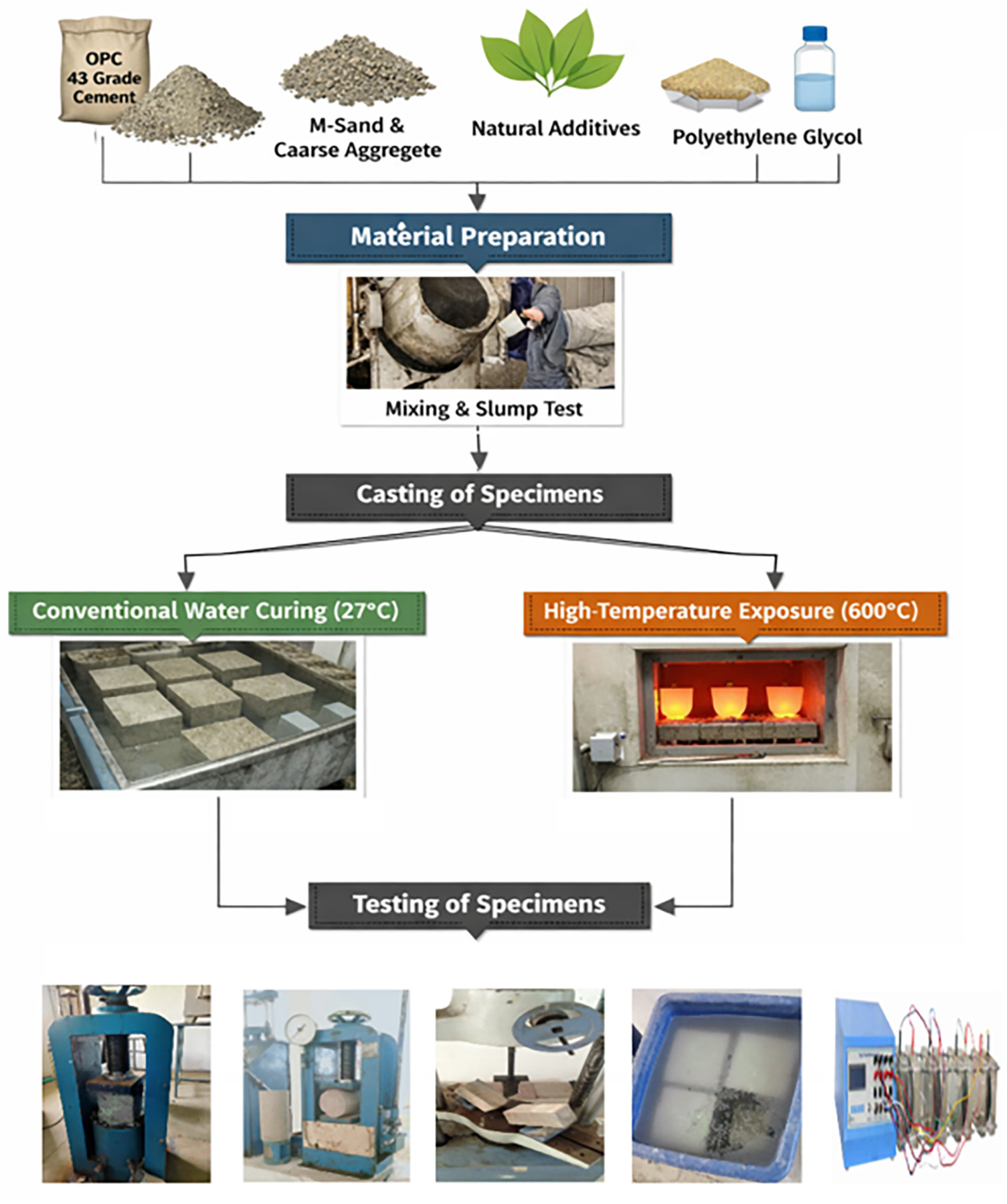
The experimental program involved thirty-one various concrete mixtures, which were grouped based on two curing states: normal curing and high-temperature exposure at 600°C. A control mixture (CC) was designed with 75% cement and 25% fly ash, which was cured normally. For geopolymer concrete mixtures, cement was fully replaced by a blended binder containing 25% fly ash and 75% GGBS [23]. A solution of activator was formulated using sodium hydroxide (NaOH) and sodium silicate (Na2SiO3). The ratio between the activator and binder remained constant at 0.4. Additionally, the ratio of sodium silicate to sodium hydroxide was kept constant at 2.5. A solution of 10 M sodium hydroxide was made one day before making the paste.The effects of three additives, namely Spinacia oleracea (SO), Calotropis gigantea (CG), and Polyethylene Glycol (PEG), with different amounts of 0.2%, 0.4%, 0.6%, 0.8%, and 1% by weight of the binder were also examined.
Freshly collected Spinacia oleracea leaves were washed under running distilled water and dried under normal atmospheric conditions. Leaves were finely ground and extracted by shaking in distilled water at the concentration of 1:10 (w/v). Filtration was done using Whatman No. 1 filter paper to get clear aqueous extract, which was stored in air-tight glass bottles and used up to 24 hours after preparation.
Latex from freshly collected mature stems of Calotropis gigantea plant was prepared by incising small holes into the stem to allow latex flow. Collected latex was filtrated and diluted with distilled water in the ratio of 1:5 (latex: water). Solution thus prepared was kept in sealed glass containers and used up to 24 hours after preparation. For PEG-containing self-curing mixes, PEG was dissolved in mixing water prior to its addition to the mix.
Under normal curing conditions, five mixes with Spinacia oleracea were identified as SO1 to SO5, representing an increase in dosage from 0.2% to 1%. Likewise, five mixes with Calotropis gigantea were identified as CG1 to CG5, and five mixes with Polyethylene Glycol were identified as PEG1 to PEG5, representing the same dosage increment. In all these mixes, the composition was 25% fly ash and 75% GGBS as the main binder without cement, and the geopolymerization reaction was achieved using the alkaline activator solution composed of NaOH and Na2SiO3.
For the assessment of high-temperature resistance, another series of geopolymer mixes was prepared for exposure to 600°C. The mixes with Spinacia oleracea were identified as HSO1 to HSO5, mixes with Calotropis gigantea as HCG1 to HCG5, and mixes with Polyethylene Glycol as HPEG1 to HPEG5. The composition of all these mixes was the same as their counterparts under normal curing conditions, with the only difference being the high-temperature exposure.
All constituent materials were initially dry blended in a mechanical mixer to achieve uniform distribution. Two minutes after starting dry mixing, the alkaline activator solution already prepared earlier together with water was added slowly, then further mixing was done for another three to five minutes [24]. For self-curing mixes, polyethylene glycol (PEG) was first dissolved in the mixing water before incorporation. The mix proportions were designed in accordance with IS 10262 to achieve M30 grade strength. Immediately after mixing, fresh concrete properties were evaluated [25].
This systematic experimental program enabled a comparative assessment of plant-based additives and synthetic PEG on strength, durability, SEM analysis and high-temperature resistance. The graphical procedure is illustrated in Figure 1. The mix designation of various mixes is presented in Table 3.

4. RESULTS AND DISCUSSION
4.1. Workability test
The values of the slump and compaction factors were employed to determine the workability of geopolymer concrete [26]. With a compaction factor of 0.869 and a slump of 113 mm, the control mix (CC) had moderate consistency. Spinacia oleracea was added to enhance the flow properties up to the SO3 mix, which had a compaction factor of 0.923 and a maximum slump of 120 mm. With SO5 having a 112 mm slump and a 0.862 compaction factor, further addition marginally reduced workability, likely due to the increased solid concentration. Calotropis gigantea followed a similar trend, with workability gradually increasing up to CG3 (118 mm slump, 0.908 compaction factor) and then reducing for higher concentrations. The highest improvement was achieved with polyethylene glycol (PEG), with PEG3 having a compaction factor of 0.923 and a slump of 120 mm. Workability was increased by moderate additive levels (about 0.6%), but higher levels reduced flow due to the higher viscosity of the paste. Figure 2 depicts the workability test results.

4.2. Compressive strength test
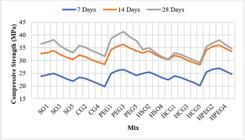
The compressive strength results reveal variations among the mixes for normal and 600 °C curing conditions [27]. For normal curing, the control mix (CC) resulted in 36.45 MPa at 28 days. The addition of Spinacia oleracea increased strength up to SO2 (38.1 MPa), beyond which the strength decreased gradually to SO5 (33.1 MPa). Likewise, Calotropis gigantea mixes decreased in strength beyond CG1, with CG5 having 31.6 MPa at 28 days. Polyethylene glycol (PEG) showed the highest strength increase. PEG3 produced the highest strength of 41.3 MPa at 28 days, which is an approximate 13% increase over the control mix. Beyond 0.6%, the strength marginally decreased, but remained higher than the control mix. But then again, this increase is now being indicated as an average of several samples tested while incorporating the statistical uncertainty in the form of error bars. After 0.6% PEG addition, there was a slight drop in compressive strength though still above the control mix, implying an optimal dosage of 0.6%. At 600 °C, all mixes decreased in strength. The trend of strength for the control mix-related mixes remained the same, with HPEG3 having the highest strength of 37.99 MPa. Plant-based materials showed higher strength degradation at higher temperatures. The addition of 0.6% PEG showed the highest strength development and thermal resistance in geopolymer concrete compared to the other materials. Figure 3 presents the compressive strength results.
4.3. Split tensile strength test
The split tensile strength results followed a pattern comparable to the compressive strength under both ambient and 600 °C exposure conditions. Under normal curing, the control concrete (CC) achieved a 28-day tensile strength of 2.42 MPa. Incorporation of Spinacia oleracea extract enhanced the tensile capacity up to an optimum dosage of 0.4% (SO2), where a strength of 2.53 MPa was recorded. Beyond this level, a gradual reduction was observed, with the 1.0% dosage (SO5) yielding 2.20 MPa at 28 days. In the case of Calotropis gigantea, the highest value was obtained at 0.2% addition (CG1), registering 2.38 MPa. Further increases in dosage led to a steady decline, reaching 2.10 MPa at 1% (CG5). Among all additives, polyethylene glycol (PEG) demonstrated the most pronounced improvement. A maximum split tensile strength of 2.74 MPa was achieved at 0.6% PEG (PEG3), representing an enhancement of approximately 13% compared to the control mix. Although higher PEG contents slightly reduced the strength, the values remained above that of CC. After exposure to 600 °C, all mixtures exhibited a reduction in tensile strength due to thermal effects. Nevertheless, the 0.6% PEG mix (HPEG3) retained the highest residual tensile strength of 2.52 MPa, indicating superior crack resistance and improved thermal stability relative to the plant-based admixtures. The variation in split tensile strength is presented in Figure 4.

4.4. Flexural strength test
The results of flexural strength data follow a trend similar to compressive and split tensile strength. Under normal curing conditions, the control mix (CC) recorded 3.78 MPa at 28 days. The use of Spinacia oleracea increased the flexural strength up to 0.4% (SO2), which recorded 3.95 MPa. Beyond this value, the strength decreased gradually to 3.43 MPa at 1% (SO5). For Calotropis gigantea, the maximum 28 days flexural strength was found at 0.2% (CG1) with 3.72 MPa, followed by a gradual decrease to 3.27 MPa at 1% (CG5). Polyethylene glycol (PEG) demonstrated the highest improvement in flexural strength. The maximum value of 4.28 MPa was found at 0.6% PEG (PEG3), which is approximately 13% higher than the control mix. Although the strength decreased slightly at 0.8% and 1%, it was still higher than the control mix. After heating at 600°C, all mixes showed a reduction in strength. However, 0.6% PEG (HPEG3) showed the highest residual flexural strength of 3.94 MPa, which is an indication of enhanced resistance to cracking and better performance at higher temperature compared to plant-based materials. Figure 5 presents the flexural strength data.

4.5. Saturated water absorption test (SWA)
Results of SWA tests revealed that the addition of various amounts of different additives had a substantial effect on the pore structure and permeability of geopolymer concrete [28]. In normal curing conditions, the control mix (CC) had water absorption of 2.90%, 2.81%, and 2.70% at 28, 56, and 90 days, respectively, which gradually increased with age. The addition of Spinacia oleracea up to 0.4% (SO2) reduced water absorption, which was 2.58% at 90 days, indicating better pore refinement. However, higher dosages (SO4 and SO5) increased water absorption to 2.88% and 2.97%, respectively, indicating the formation of more voids due to excess organic material. Similarly, Calotropis gigantea showed increased water absorption with increasing percentage. The highest value was found for CG5 (3.11% at 90 days), indicating lower compactness of the matrix with higher dosages. Polyethylene glycol (PEG) showed the best results. The lowest water absorption was found at 0.6% PEG (PEG3), which was 2.38% at 90 days, indicating better internal curing and pore refinement. After exposure to 600 °C, water absorption increased for all mixes due to microcracking. However, HPEG3 showed the lowest water absorption (2.59% at 90 days), which confirmed better thermal stability and durability than plant-based additives. Figure 6 shows the percentage of saturated water absorption.

4.6. Acid resistance test
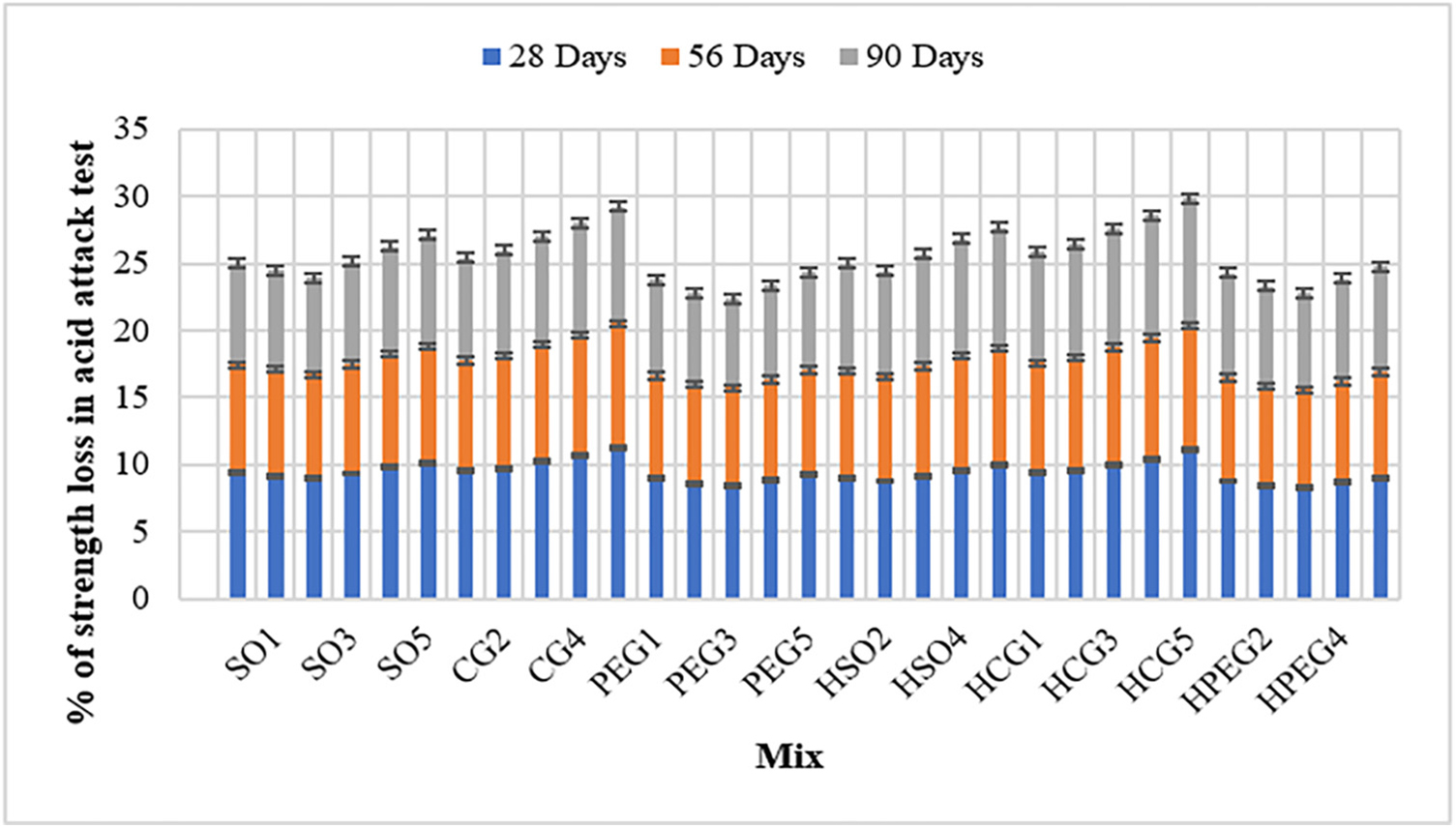
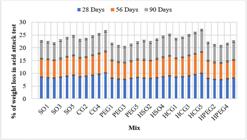
Results for sulphuric acid resistance showed that additive type and content had a significant effect on durability [29, 30]. For normal curing conditions, the control mix (CC) had weight loss of 8.45%, 7.26%, and 6.83%, and corresponding strength loss of 9.35%, 8.03%, and 7.56% at 28, 56, and 90 days, respectively. Addition of Spinacia oleracea enhanced resistance up to 0.4% dosage (SO2), which had lower weight loss (6.53%) and strength loss (7.23%) at 90 days than CC. But higher amounts (SO4 and SO5) resulted in higher weight and strength loss, signifying deterioration due to higher organic material. Similar trend was observed for Calotropis gigantea. CG5 had maximum weight loss (7.88%) and strength loss (8.72%) at 90 days for normal curing. Polyethylene glycol (PEG) showed better performance. The lowest weight loss (6.03%) and strength loss (6.67%) were recorded in 0.6% PEG (PEG3), which ensured better densification of the matrix and lower penetration of acid. The durability slightly decreased due to microcracking caused by heating at 600 °C. However, HPEG3 still showed the highest resistance with only 6.55% weight loss and 7.25% strength loss at 90 days, which ensured better residual durability than plant-based additives. Figures 7 and 8 illustrate the percentage of weight loss and strength loss after the sulphuric acid resistance test.

4.7. RCPT
From the RCPT results, the effect of additive type, dosage, and curing condition on the chloride ion permeability of geopolymer concrete is evident. Under normal curing, the control mix (CC) showed a charge passed of 3684, 3263, and 2867 coulombs at 28, 56, and 90 days, respectively, These values indicate moderate chloride ion permeability as per ASTM C1202 classification. A gradual reduction with age is attributed to continued hydration and progressive pore refinement. The addition of Spinacia oleracea showed a reduction in chloride permeability up to 0.4% dosage (SO2), where the lowest 90-day value of 2743 coulombs was obtained. Higher dosages (SO4 and SO5) showed an increase in charge passed above 3000 coulombs, which is an indication of increased pore connectivity because of excess organic content. Similarly, Calotropis gigantea mixes showed a gradual increase in RCPT values with increasing dosage. The highest permeability was found in CG5, which attained 3307 coulombs at 90 days, indicating reduced resistance to chloride ion penetration at higher dosages. The most effective performance in the reduction of chloride permeability was shown by polyethylene glycol (PEG). The minimum value of RCPT, which is 2530 coulombs at 90 days, was achieved using 0.6% PEG (PEG3), which indicates an increase relative to the control mix and not a change to a low permeability category. This result can be credited to improved internal curing. This is because of the improved internal curing and pore refinement. However, after being exposed to 600 °C, all mixes recorded a higher RCPT value because of the microcracking caused by the high temperature. In spite of the above, the permeability to chloride for HPEG3 was still the lowest among the groups under investigation, but this was moderate since it showed 2750 coulombs after 90 days. Thus, HPEG3 proved only to be better in relation to the others but not superior. Generally, it can be said that RCPT results indicated improvement in terms of chloride permeability. Figure 9 illustrates the RCPT values.

4.8. SEM analysis
The Scanning Electron Microscopy (SEM) results were analyzed to examine the microstructural features of the heat-cured HPEG3 mix with 25% fly ash, 75% GGBS, and polyethylene glycol (PEG). The micrographs indicate a compact and dense matrix with evenly distributed reaction products. The spherical fly ash particles are partially embedded in the geopolymeric/C–S–H gel matrix, signifying successful engagement in the pozzolanic reaction. The addition of GGBS helps to produce supplementary calcium-silicate-hydrate (C-S-H) gel, producing a finer and more compact microstructure.
Heat curing (H) greatly accelerates the degree of reaction, as indicated by the fewer unreacted particles and improved bonding between the precursor materials and the gel matrix. The addition of polyethylene glycol (PEG) seems to affect the refinement of pore structures. In contrast to the non-heated mixes, the HPEG3 mix has fewer large pores and a more uniform distribution of micro-pores. This indicates that PEG may help with internal curing and water retention, facilitating continued hydration and geopolymerization.
In general, the SEM results confirm that the addition of heat curing and PEG incorporation is effective in improving the densification of the matrix, as well as its microstructural integrity. Such improvements are expected to have a positive effect on the mechanical properties of the composite material. Figure 10 shows the SEM images of all the mixes.

(a) SEM of CC mix, (b) SEM of SO2 mix, (c) SEM of CG1 mix, (d) SEM of PEG3 mix, (e) SEM of HSO2 mix, (f) SEM of HCG1 mix, (g) SEM of HPEG3 mix.
5. CONCLUSION
On the basis of the experimental study, the addition of plant-based additives (Spinacia oleracea and Calotropis gigantea) and polyethylene glycol (PEG) had a significant effect on the fresh, mechanical, and durability properties of geopolymer concrete in both normal curing conditions and when subjected to 600 °C for 2 hours.
All mixes exhibited acceptable slump and compaction factor values, according to the workability test results, with 0.6% dose producing the best outcomes. PEG-modified mixtures outperformed in terms of strengths parameters. Under typical curing circumstances, 0.6% PEG (PEG3) produced the highest 4th week compressive, splt and fexural strength of 41.3, 2.74 and 4.28 MPa respectively. Only up to a dosage of 0.4% did plant-based additions perform better; after that, the strength decreased due to increasing porosity.
Results for durability parameters, such as saturated water absorption, resistance to sulphuric acid, and RCPT, indicated better performance at 0.6% PEG. PEG3 had the lowest water absorption (2.38%), lowest strength loss due to acid attack (6.67%), and lowest RCPT value (2530 coulombs) at 90 days.
After being subjected to 600 °C, all mixes had strength loss and permeability increase, but PEG3 had the highest residual strength and durability. Based on the results, 0.6% PEG was found to be the optimal dosage for improving the strength, durability, and thermal resistance of geopolymer concrete. SEM shows dense HPEG3 matrix with reduced pores, improved C–S–H formation, strong fly ash–GGBS bonding, and enhanced microstructural integrity due to heat curing and PEG incorporation.
6. DATA AVAILABILITY
The full dataset supporting the findings of this study is available upon request to the corresponding author.
7. BIBLIOGRAPHY
-
[1] KANDASAMY, M., VIDHYA, K., ARUNKUMAR, G.E., et al., “Application of eco-friendly internal self-curing agents in geo-polymer concrete”, AIP Conference Proceedings, v. 3146, n. 1, pp. 020015, Jul. 2024. doi: https://doi.org/10.1063/5.0225012.
» https://doi.org/10.1063/5.0225012 -
[2] KHATER, H.M., ELMOIED, S.A., “Preparation and characterization of self-cured geopolymer binder using metakaolin precursor”, Scientific Reports, v. 16, n. 1, pp. 3270, 2026. doi: https://doi.org/10.1038/s41598-025-32571-0. PubMed PMID: 41580481.
» https://doi.org/10.1038/s41598-025-32571-0 -
[3] GUPTA, M., KULKARNI, N.H., “Investigation on the characteristics of self-cured geopolymer concrete using GBFS sand”, Innovative Infrastructure Solutions, v. 7, n. 2, pp. 139, 2022. doi: https://doi.org/10.1007/s41062-022-00748-5.
» https://doi.org/10.1007/s41062-022-00748-5 -
[4] HERKI, B.M., “Strength and absorption study on eco-efficient concrete using recycled powders as mineral admixtures under various curing conditions”, Recycling, v. 9, n. 5, pp. 99, 2024. doi: https://doi.org/10.3390/recycling9050099.
» https://doi.org/10.3390/recycling9050099 - [5] LANJEWAR, B.A., POWAR, S., WANKHEDE, M., et al., “Evaluation of one part alkali-activated self-compacting concrete with mining residue”, Proceedings of the Institution of Civil Engineers - Construction Materials, v. 179, n. 3, 2026.
-
[6] MURALI, G., WONG, L.S., ABDULKADIR, I., et al., “Sustainable transformation of waste phosphogypsum into geopolymer concrete: Comprehensive review on strength, durability, and microstructural characteristics”, Journal of Building Engineering, v. 111, pp. 113597, 2025. doi: https://doi.org/10.1016/j.jobe.2025.113597.
» https://doi.org/10.1016/j.jobe.2025.113597 -
[7] MEMON, R.P., HUSEIEN, G.F., SALEH, A.T., et al., “Microstructure and strength properties of sustainable concrete using effective microorganisms as a self-curing agent”, Sustainability, v. 14, n. 16, pp. 10443, 2022. doi: https://doi.org/10.3390/su141610443.
» https://doi.org/10.3390/su141610443 -
[8] MANJUNATH, B., MOUSAVI, S.S., BHAGITHIMAR, Y., et al., “Study on the performance of hydrophilic curing agent and environmentally friendly non-pozzolanic filler for the development of self-curing self-compacting concrete”, Environmental Science and Pollution Research International, v. 31, n. 55, pp. 64210–64227, 2024. doi: https://doi.org/10.1007/s11356-024-35468-z. PubMed PMID: 39531104.
» https://doi.org/10.1007/s11356-024-35468-z -
[9] ANBARASU, N.A., KESHAV, L., KALYANA, C.P.R., et al., “Unraveling the flexural behavior of concrete and compare with innovative fea investigations”, Matéria, v. 29, n. 4, pp. e20240656, 2024. doi: https://doi.org/10.1590/1517-7076-rmat-2024-0656.
» https://doi.org/10.1590/1517-7076-rmat-2024-0656 -
[10] HUSEIEN, G.F., MHAYA, A.M., “A Comparative study of utilizing waste palm oil fuel ash and tile ceramics to enhance slag–fly ash geopolymer property-based composite”, Journal of Composites Science, v. 10, n. 1, pp. 33, 2026. doi: https://doi.org/10.3390/jcs10010033.
» https://doi.org/10.3390/jcs10010033 - [11] SIAL, A.A., SHABBIR, F., SULEIMAN, M., et al., “Performance evaluation of self-cured bio-geopolymer concrete”, Proceedings of the Institution of Civil Engineers - Construction Materials, v. 179, n. 3, 2026.
-
[12] ABDELLATIEF, M., ABD-ELMABOUD, M.E., MORTAGI, M., et al., “A convolutional neural network-based deep learning approach for predicting surface chloride concentration of concrete in marine tidal zones”, Scientific Reports, v. 15, n. 1, pp. 27611, 2025. doi: https://doi.org/10.1038/s41598-025-12035-1. PubMed PMID: 40730630.
» https://doi.org/10.1038/s41598-025-12035-1 -
[13] AMAR, M., LADDURI, B., ALLOUL, A., et al., “Geopolymer synthesis and performance paving the way for greener building material: A comprehensive study”, Case Studies in Construction Materials, v. 20, pp. e03280, 2024. doi: https://doi.org/10.1016/j.cscm.2024.e03280.
» https://doi.org/10.1016/j.cscm.2024.e03280 -
[14] REDDY, B.N., KUMAR, M.V., “An experimental investigation into the durability properties of sustainable self-curing concrete including copper slag and sugarcane bagasse ash”, Journal of Building Pathology and Rehabilitation, v. 11, n. 1, pp. 19, 2026. doi: https://doi.org/10.1007/s41024-025-00693-7.
» https://doi.org/10.1007/s41024-025-00693-7 -
[15] ABDELLATIEF, M., HAMLA, W., HAMOUDA, H., “AI driven prediction of early age compressive strength in ultra high performance fiber reinforced concrete”, Scientific Reports, v. 15, n. 1, pp. 20316, 2025. doi: https://doi.org/10.1038/s41598-025-06725-z. PubMed PMID: 40571697.
» https://doi.org/10.1038/s41598-025-06725-z -
[16] ANNAMALAI, K., SAMPATHKUMAR, S., KACHANCHEERI, M.S., et al., “Exploring the role of recycled aggregates in modern concrete technology”, Matéria, v. 30, pp. e20250033, 2025. doi: https://doi.org/10.1590/1517-7076-rmat-2025-0033.
» https://doi.org/10.1590/1517-7076-rmat-2025-0033 -
[17] SAJEEV, P.S., RAJAGOPAL, V.S.G., ARASU, N., “Investigation of concrete durability enhancement using supplementary cementitious materials”, MethodsX, v. 15, pp. 103527, 2025. doi: https://doi.org/10.1016/j.mex.2025.103527. PubMed PMID: 40799834.
» https://doi.org/10.1016/j.mex.2025.103527 - [18] PUTTALA, S., HIRANPHATTARAROJ, W., HOMWUTTIWONG, S., “Development of a geopolymer made from bagasse ash for use as a cementitious material”, Asia-Pacific Journal of Science and Technology, v. 26, n. 4, pp. 10, 2021.
-
[19] NONGNUANG, T., JITSANGIAM, P., RATTANASAK, U., et al., “Characteristics of waste iron powder as a fine filler in a high-calcium fly ash geopolymer”, Materials, v. 14, n. 10, pp. 2515, 2021. doi: https://doi.org/10.3390/ma14102515. PubMed PMID: 34066254.
» https://doi.org/10.3390/ma14102515 - [20] MOHAMMED, M., BASSAM, A., SHYMAA, M.M., “Banana agriculture waste as eco-friendly material in fibre-reinforced concrete: An experimental study”, Advances in Concrete Construction, v. 14, n. 5, pp. 355–368, 2022.
-
[21] HASSAN, A., ARIF, M., SHARIQ, M., et al., “Fire resistance characteristics of geopolymer concrete for environmental sustainability: a review of thermal, mechanical and microstructure properties”, Environment, Development and Sustainability, v. 25, n. 9, pp. 8975–9010, 2023. doi: https://doi.org/10.1007/s10668-022-02495-0.
» https://doi.org/10.1007/s10668-022-02495-0 -
[22] ANBARASU, N.A., SIVAKUMAR, V., YUVARAJ, S., et al., “Pioneering the next frontier in construction with high-strength concrete infused by nano materials”, Matéria, v. 30, pp. e20240730, 2025. doi: https://doi.org/10.1590/1517-7076-rmat-2024-0730.
» https://doi.org/10.1590/1517-7076-rmat-2024-0730 -
[23] SUWAN, T.J.P., THONGCHUA, H., RATTANASAK, U., et al. “Role of alkaline constituent on properties and microstructure of crushed rock based alkali-activated material for low strength applications”, Research Square, pp. PPR383586, 2021. doi: https://doi.org/10.21203/rs.3.rs-772525/v1.
» https://doi.org/10.21203/rs.3.rs-772525/v1 -
[24] LI, J., XIE, H., ZHANG, B., et al., “Macro–micro characteristics of eco-friendly geopolymer incorporating cement paste recycled powder”, Journal of Materials in Civil Engineering, v. 37, n. 11, pp. 04025384, 2025. doi: https://doi.org/10.1061/JMCEE7.MTENG-20632.
» https://doi.org/10.1061/JMCEE7.MTENG-20632 -
[25] TAHWIA, A.M., NOSHI, A., ABDELLATIEF, M., et al., “Experimental investigation of rubberized concrete slab-on-grade containing tire-recycled steel fibers”, Innovative Infrastructure Solutions, v. 9, n. 2, pp. 46, 2024. doi: https://doi.org/10.1007/s41062-023-01354-9.
» https://doi.org/10.1007/s41062-023-01354-9 -
[26] CHISHI, A.K., GAUTAM, L., “Sustainable use of silica fume in green cement concrete production: A review”, Innovative Infrastructure Solutions, v. 8, n. 7, pp. 195, 2023. doi: https://doi.org/10.1007/s41062-023-01164-z.
» https://doi.org/10.1007/s41062-023-01164-z -
[27] ROMANAZZI, V., LEONE, M., AIELLO, M.A., “Bond performance of geopolymer concrete with steel and FRP reinforcements”, Journal of Composites Science, v. 9, n. 6, pp. 303, 2025. doi: https://doi.org/10.3390/jcs9060303.
» https://doi.org/10.3390/jcs9060303 -
[28] ATHIYAMAAN, V., “Admixture-based self-compacted concrete with self-curing concrete techniques a state of art of review”, Cleaner Engineering and Technology, v. 5, pp. 100250, 2021. doi: https://doi.org/10.1016/j.clet.2021.100250.
» https://doi.org/10.1016/j.clet.2021.100250 -
[29] GONÇALVES, M., VILARINHO, I.S., CAPELA, M., et al., “Waste-based one-part alkali activated materials”, Materials, v. 14, n. 11, pp. 2911, 2021. doi: https://doi.org/10.3390/ma14112911. PubMed PMID: 34071507.
» https://doi.org/10.3390/ma14112911 -
[30] ANNAMALAI, K., ANBARASU, N.A., GOVINDARAJAN, B.P., et al., “Sustainable concrete: integrating environmentally friendly materials for environmentally friendly construction”, Matéria, v. 30, pp. e20250239, 2025. doi: https://doi.org/10.1590/1517-7076-rmat-2025-0239.
» https://doi.org/10.1590/1517-7076-rmat-2025-0239