 Experimental design of plasma-sprayed Alumina-Titania coatings using Taguchi method
ABSTRACT
Atmospheric Plasma sprayed Alumina-Titania (Al2O3-3wt % TiO2) coatings were deposited onto commercial SS304 substrates. A Taguchi L9 design of experiment protocol was used to optimize the coating process parameters. The effect of three factors: spray distance, the arc current, and scan times on the coating responses was studied. The responses of the plasma sprayed coatings were evaluated in terms of porosity, adhesion Strength, and micro-hardness. The results indicated that porosity levels ranged from 8.8% to 4.8%. Less porosity occurred at higher arc currents and intermediate spray distances. While, adhesion strengths ranged from 9.65 to 11.40 MPa, peaking at higher arc currents and optimal spray distances. In addition, microhardness values ranged from 657.30 HV to 770.20 HV. The relationship between the independent variables and the product responses is fitted using the regression analysis technique. Higher arc current, lower scanning times, and a medium spray distance leading to optimum attributes of low porosity, high adhesion Strength, and high micro-hardness.
Keywords:
Atmospheric Plasma Spray; Coating; Alumina-Titania; Design of Experiments (DoE); Taguchi design
1. INTRODUCTION
Surface engineering is a technology at the forefront of materials innovation, focused on improving the surfaces of materials to enhance their performance and longevity using methods such as surface treatments, thin-film deposition, and coating techniques adapted to meet modern industrial requirements [1,2 2 3 4 5,6,7]. Atmospheric Plasma Spraying (APS) has established itself as a transformative technology in surface engineering, providing a versatile and efficient means to develop high-performance coatings. By employing a high-temperature plasma jet to melt and accelerate powder particles, APS enables the creation of dense, durable coatings on various substrates [8, 9]. This technique has been widely adopted across industries such as aerospace, automotive, biomedical, and energy due to its ability to enhance the thermal, mechanical, and chemical properties of materials, particularly in demanding environments [10]. Among the materials used in APS, Alumina (Al2O3) and Titania (TiO2) ceramics are widely used in plasma spray coating within the manufacturing industry. The choice of coating material is determined by the specific application requirements. Known for its exceptional corrosion resistance, alumina is highly effective in combating abrasive wear. Al2O3-TiO2 coatings, commonly referred to as ceramic coatings, are renowned for their excellent adhesion to substrates, high dielectric strength, remarkable wear resistance, and outstanding corrosion protection. According to Ramachandran et al. [11], TiO2 possesses a lower melting point and interacts actively with alumina grains, leading to increased coating density. Consequently, Al2O3-TiO2 composite coatings provide robust, wear-resistant, oxidation-resistant, and corrosion-resistant surfaces, making them a valuable solution for industrial applications.
For obtaining high-quality coating layers, optimization of spray variables is important [8]. A design of experiment methods has been demonstrated to be a cost-effective and time-efficient technique means to systematically investigate process parameters. Researchers have increasingly focused on optimizing APS process parameters to achieve coatings with enhanced mechanical properties. For instance, Yang et al. [12] explored the preparation of nanostructured Al2O3-TiO2-ZrO2 composite powders, showcasing the advantages of nanostructures in improving coating performance. Similarly, Forghani et al. [13] employed a Design of Experiments (DoE) approach to study the influence of APS parameters on TiO2 coatings, demonstrating the efficacity of statistical tools for process optimization. Vicent et al. [14] successfully deposited Al2O3-13% TiO2 nanostructured powders, highlighting the optimization of deposition conditions to produce well-adhered coatings. Michalak et al. [15] investigate the deposition and performance of Al2O3+13wt%TiO2 coatings via Atmospheric Plasma Spraying (APS), emphasizing the influence of feedstock powder preparation on coating properties. The study evaluates spray distance and torch linear velocity using an experimental design to assess their effects on coating microstructure. Mechanical characterization includes Vickers microhardness, fracture toughness, and adhesion strength. Their findings contribute to optimizing APS parameters for improved wear resistance and toughness. Another work presented by Michalak et al. [16] analyzes the effect of TiO2 content in feedstock powders on the microstructure, phase composition, mechanical properties, and tribological performance of Al2O3-TiO2 coatings produced via atmospheric plasma spraying. The study highlights how increasing TiO2 levels leads to phase transformations, influencing hardness and wear resistance. Their findings conclude that Al2O3 + 13 wt.% TiO2 provides the best wear resistance compared to different feedstock powders used, demonstrating its potential as an optimized coating composition for industrial applications. Additionally, some researchers have used Taguchi, response surface methodology, and factorial design to optimize plasma-sprayed Alumina-Titania coating properties in terms of porosity, deposition efficiency, roughness, and thickness. Steeper et al. [17] utilized the Taguchi method to study the effects of process parameters, efficiently reducing experimental trials while enhancing the understanding of porosity, adhesion strength, and hardness. Pierlot et al. [18] applied factorial design to investigate the interaction between plasma spray variables, enabling a structured analysis of deposition efficiency and microstructure. Guessasma et al. [19] expanded on these techniques by integrating artificial neural networks to model the plasma spray process. Li et al. [20] utilized RSM to optimize deposition parameters for Yttria-Stabilized Zirconia coatings, linking key variables with coating performance. Similarly, Azarmi et al. [21] adopted RSM to develop response surfaces, achieving precise predictions for coating quality. Collectively, these studies underscore the importance of statistical methodologies in advancing plasma spray technology and improving coating performance for industrial applications.
Despite these advancements, limited attention has been given to Al2O3-3%TiO2 coatings, particularly in developing mathematical models that link plasma spray parameters to key coating properties such as porosity, adhesion strength, and microhardness. The present study employs a Taguchi L9 orthogonal array to optimize the selected plasma spray variables on the porosity, adhesion strength, and microhardness of Al2O3-3TiO2 coating layers. Among many process parameters of plasma spray the Current, scanning times, and stand-off distance have been identified as parameters that influence coating properties. Empirical relationships have been developed between process parameters and coating properties for Al2O3-3wt % TiO2 coatings.
2. MATERIALS AND METHODS
Plasma spraying was performed using a Sulzer Metco 9MB spray system, with argon and hydrogen as the plasma arc gases, and argon as the powder carrier gas. The Al2O3–3wt%TiO2 powder presented in Figure 1 was deposited onto an AISI 304 stainless steel substrate using Sulzer Metco 9MC atmospheric plasma spray equipment.

Al2O3+3 wt.% TiO2 powder: (a) Top view & cross-section image, (b) Particle size distributions.
The specimens were cut to 25 × 25 × 2 mm; then were sandblasted and cleaned from any oxide and grease with acetone. Critical input parameters considered are spray distance, the arc current and scanning times. At the end, the characteristics of coatings such as Porosity, micro-hardness and adhesion strength were evaluated.
2.1. Design of experiments using Taguchi method
To analyze the influence of plasma spray process parameters, an experimental investigation was conducted using the Design of Experiments (DoE) approach. An L9 orthogonal array based on the Taguchi method was designed using MINITAB 19 software. Arc current, spray distance, and scan speed were identified as the most significant parameters affecting the quality of thermal spray coatings, as summarized in Table 1. The variations in these parameters, as defined by the orthogonal array, are presented in Table 2.
3. RESULTS AND DISCUSSIONS
This section focuses on analyzing the effects of arc current (A) and spray distance (mm), identified as the most significant parameters, on the coating properties (e.g., porosity, adhesion strength, and micro-hardness) of the thermal spray coatings developed in this study. The findings are discussed in the context of the experimental results, providing validation for the research outcomes.
3.1. Porosity (%)
Figure 2 (a and b) shows the iso-response curves and surfaces for porosity, considering the factors of arc current (A) and spray distance (mm). The results indicate that porosity decreases from 8.8% to 4.8% as the spray distance increases from Sd = 80 mm to Sd = 110 mm. Additionally, increasing the arc current improves the porosity of the coatings, likely due to enhanced particle melting and deposition efficiency.

Effect of the APS variables on the Porosity: (a) Linear Iso response curve, (b) Surface Iso response curve.
Porosity was determined through SEM image analysis, with ten fields arbitrarily selected for measurement, as shown in Table 3. Run 1 exhibited the highest porosity, while Run 6 showed the lowest. A decrease in arc current led to an increase in un-melted particles, resulting in higher porosity.
Figure 3 shows the interaction between the two factors on the measured responses. The results indicate that the effect of the arc current improves the coating porosity and its role is very large compared to the role of the spray distances. High coatings porosity was observed at lower arc currents, and shorter spray distances due to poor melting conditions [22,23,24].

Plot of the main effects on porosity for the factors: Arc current, spraying distance and scanning times.
With optimized parameters, the final coating deposited on the substrate is shown in Figure 4. The coating microstructure exhibits very low porosity and excellent adhesion bonding between the coating and the substrate, demonstrating the effectiveness of the optimized process.

Al2O3–3wt% TiO2 Coating obtained with optimum parameters: (a) scan times, (b) arc current, (c) spray distance.
All models used in this work exhibit relatively high correlation coefficients, ranging from 0.91 to 0.98. This indicates a strong agreement between the experimentally obtained responses and the model predictions, suggesting that the models are reliable for predicting the outcomes under the studied conditions. The relationship between the actual and predicted values is illustrated in Figure 5.

3.2. Adhesion strength
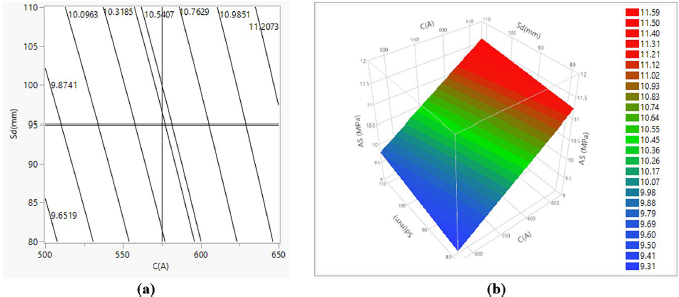
The different types of plots generated from the adhesion strength of the coating analysis, considering the factors of arc current (A) and spray distance (mm) are presented in Figure 6 (a and b). As indicated in Table 3, the highest adhesion strength of 11.40 MPa was achieved in Run 9 (arc current: 650 A), while the lowest adhesion strength of 9.65 MPa was observed in Run 1 (arc current: 500 A).

Effect of the APS variables on the adhesion strength:(a) Linear Iso response curve, (b) Surface Iso response curve.
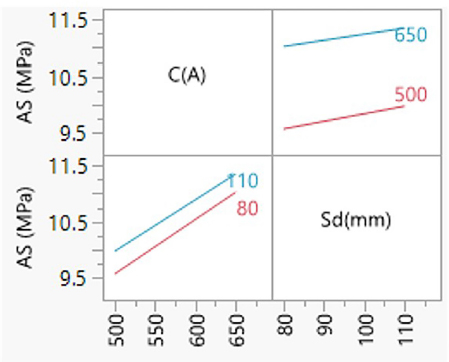
The results presented in Figure 7, demonstrate that arc current has a significant impact on adhesion strength, while spray distance has a relatively smaller effect. Additionally, increasing the spray distance reduces adhesion strength. Maintaining an optimal spray distance is critical for ensuring good coating adherence: a short spray distance may cause overheating, while a long spray distance may result in insufficient particle melting due to cooling and deceleration in the plasma beam. These findings are consistent with previous studies on plasma-sprayed coatings [22, 24, 25] and highlight the importance of parameter optimization for achieving durable and reliable coatings in industrial applications.

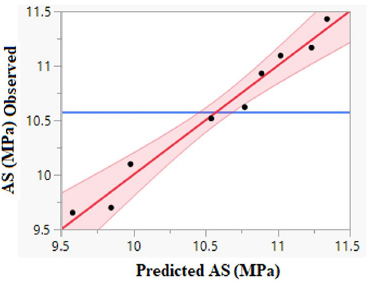
The analysis of variance assesses the contribution of the study factors to the different responses (Table 4). All the models used in this work have relatively high correlation coefficients of 0.91 to 0.98. This shows a good correlation between the responses obtained experimentally and the recordings of the model.
Figure 8 illustrates the correlation between predicted and experimental adhesion strength values of adhesion strength. The results demonstrate satisfactory agreement with the regression model, as the predicted values align well with the experimental values, achieving a confidence level of 97.47%.

3.3. Microhardness (HV)
Figure 9 (a and b)shows the iso-response curve and the iso-response surfaces of the microhardness taking into account the factors of arc current (A) and spray distance (mm). The average of ten microhardness measurements ranged from 657.30 HV to 770.20 HV. As shown in Table 3, the highest microhardness was observed in Run 9 (arc current: 650 A), while the lowest microhardness was recorded in Run 1 (arc current: 500 A). The results indicate that arc current has a more significant effect on microhardness compared to other parameters. Increasing the arc current provides more energy to the plasma beam [23, 25], resulting in improved particle melting and, consequently, higher coating hardness. Additionally, spray distance also has a notable effect on microhardness. A longer spray distance allows sufficient time for the powder to dwell and melt properly, leading to higher coating hardness [24, 25]. These findings highlight the importance of optimizing spray parameters to achieve coatings with superior mechanical properties for industrial applications.

Effect of the APS variables on the microhardness (HV): (a) Linear Iso response curve, (b) Surface Iso response curve.
Figure 10 shows that the effect of the arc current (A) and spray distance (mm) on the microhardness (HV) variation of the deposited coatings and the interaction between the two factors on the measured responses. From these results, it has been observed that the effect of the arc current (A) is very large compared to the role of the spray distance (mm).

Table 5 shows the contribution of each factor arc current (A) and spray distance (mm) with their interactions on the studied responses. The P rob ≤ 0.05 criterion was used to verify the significance of each coefficient.
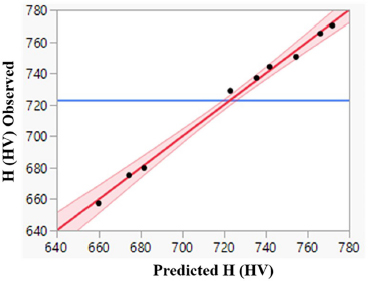
Figure 11 illustrates the correlation between predicted and experimental microhardness (HV) values. The results demonstrate satisfactory agreement with the regression model, as the predicted values align well with the experimental values, achieving a confidence level of 99.44%.

4. OPTIMIZATION OF PROCESS PARAMETERS
In the Taguchi method, optimization of multiple responses is achieved by selecting the most desirable attribute for each response. In this study, the “larger the better” category was chosen for microhardness, while the “smaller the better” category was applied to porosity. For adhesion strength, higher values are more desirable, so it was not assigned to a specific category. By simultaneously considering all three responses, the optimal coating properties were identified, exhibiting low porosity, high adhesion strength, and high microhardness. These properties are essential for ensuring the durability and performance of the coatings in demanding industrial applications.
The regression equations, derived from experimental data, describe the relationships between process parameters (arc current, spray distance, and scanning times) and coating properties (porosity, adhesion strength, and microhardness). Higher R-squared values indicate a better fit of the data to the models. Porosity decreases with higher arc current, spray distance, and scanning times; adhesion strength increases with these parameters; and microhardness increases with arc current and spray distance but decreases with scanning times. These equations allow for the prediction and optimization of coating properties in the plasma spray process.
The regression equations for porosity, adhesion strength, and microhardness are presented below:
With a correlation coefficient: R2 = 81.86%
With a correlation coefficient: R2 = 97.47%
With a correlation coefficient: R2 = 99.44%
These equations can be used to predict the values of porosity, adhesion strength, and microhardness for any given combination of process parameters within the range of the experimental design.
5. CONCLUSIONS
A Taguchi L9 design of experiments was employed to investigate and optimize Al2O3-3wt%TiO2 coatings produced via the atmospheric plasma spray process. The effects of spray distance, arc current, and the number of scanning passes on coating properties such as porosity, adhesion strength, and microhardness were systematically analyzed. This study led to the following key findings:
-
Arc current and spray distance were identified as the most influential parameters, with higher arc current and medium spray distances significantly reducing porosity and improving microhardness and adhesion strength, attributed to enhanced particle melting and deposition quality. Scanning passes exhibited a relatively minor effect, primarily influencing coating uniformity.
-
Optimal process parameters for achieving high-quality coatings were determined: an arc current of 650 A, a spray distance of 110 mm, and 8 scanning passes. Under these conditions, the coatings achieved a porosity of 5.2%, adhesion strength of 11.4 MPa, and microhardness of 770 HV, with excellent agreement between experimental and predicted values (less than 4% deviation).
-
The regression models effectively captured the relationships between process parameters and coating properties, achieving a desirability value of 0.81. These models are, however, constrained to the range of parameters investigated in this study.
This research underscores the utility of the Taguchi method and regression analysis in optimizing atmospheric plasma spray parameters. The findings provide a robust framework for the development of high-performance Al2O3-3wt%TiO2 coatings and serve as a basis for future investigations into advanced surface engineering techniques.
6. BIBLIOGRAPHY
-
[1] MORETTI, M.L., RECCO, A.A.C., “Duplex treatment on AISI D2 tool steel: plasma nitriding and reactive deposition of TiN and TiAlN films via magnetron sputtering”, Matéria, v. 27, n. 3, pp. e20220111, 2022. doi: http://doi.org/10.1590/1517-7076-rmat-2022-0111.
» https://doi.org/10.1590/1517-7076-rmat-2022-0111 -
[2] ROHIT, K., VERMA, A., “Comparative analysis of TiO2 and Al2O3 surface coatings on battery electrodes for enhanced lithium-ion battery performance: addressing selected issues of the Indian electric vehicle supply chain”, Matéria, v. 29, n. 3, pp. e20240439, 2024. doi: http://doi.org/10.1590/1517-7076-rmat-2024-0439.
» https://doi.org/10.1590/1517-7076-rmat-2024-0439 -
[3] SUERO, D.L., ROMO, F.D.J.C., CRUZ, M.D., et al., “Optimizing copper anticorrosive protection: properties of GPTMS-TiO2 hybrid organic- inorganic sol-gel coatings via the dip-coating technique”, Matéria, v. 29, n. 4, pp. e20240169, 2024. doi: http://doi.org/10.1590/1517-7076-rmat-2024-0169.
» https://doi.org/10.1590/1517-7076-rmat-2024-0169 -
[4] RAMOS, R.M., KUNST, S.R., SOARES, L.G., et al., “A comparison between the titanium-based and the zinc phosphate dispersion conditionings of zinc phosphate baths”, Matéria, v. 29, n. 2, pp. e20240070, 2024. doi: http://doi.org/10.1590/1517-7076-rmat-2024-0070.
» https://doi.org/10.1590/1517-7076-rmat-2024-0070 -
[5] BELÉM, M.J.X., LIMA, C.R.C., KUHL, A., CAMARGO, F. “Avaliação da resistência ao desgaste erosivo e abrasivo de revestimentos WC 12Co aplicados por aspersão térmica HVOF”, Revista Matéria, v. 25, n. 1, pp. e–12583, 2020. doi: http://doi.org/10.1590/S1517-707620200001.0909.
» https://doi.org/10.1590/S1517-707620200001.0909 -
[6] LIMA, I.J.D., FERREIRA, B.C.D.F., SANTOS, A.X.D., et al., “Influence of voltage, feed speed and CTWD on the corrosion resistance of Inconel 625 alloy coatings deposited by MIG”, Matéria, v. 27, n. 2, pp. e13171, 2022. doi: http://doi.org/10.1590/s1517-707620220002.1371.
» https://doi.org/10.1590/s1517-707620220002.1371 -
[7] DYER, S.A.S., VOLÚ, R.M., DYER, P.P.O.L., et al., “Study of the metallurgical bond between 316 steel substrates and NiCrAlY coating sprayed by HVOF and irradiated with a low power CO2 laser”, Matéria, v. 24, n. 3, pp. e12466, 2019. doi: http://doi.org/10.1590/s1517-707620190003.0782.
» https://doi.org/10.1590/s1517-707620190003.0782 - [8] BOULOS, M.I., FAUCHAIS, P.L., PFENDER, E.,Handbook of Thermal Plasmas, Heidelberg, Springer International Publishing, 2023.
- [9] KNOTEK, O., “Thermal spraying and detonation gun process”, In: Bunshah, R.F. (ed), Handbook of hard coating, New Jersey, USA, Noyes Publications, pp. 77–107, 2001.
-
[10] PAWLOWSKI, L., The science and engineering of thermal spray coatings, 2 ed., Chichester, UK, Hoboken, NJ, USA, Wiley, 2008. doi: http://doi.org/10.1002/9780470754085.
» https://doi.org/10.1002/9780470754085 -
[11] RAMACHANDRAN, C.S., BALASUBRAMANIAN, V., ANANTHAPADMANABHAN, P.V., et al., “Influence of intermixed interfacial layers in the thermal cycling behaviour of atmospheric plasma sprayed Lanthanum Zirconate based coating”, Ceramics International, v. 38, n. 5, pp. 4081–4096, 2012. doi: http://doi.org/10.1016/j.ceramint.2012.01.066.
» https://doi.org/10.1016/j.ceramint.2012.01.066 -
[12] YANG, Y., WANG, Y., TIAN, W., et al., “Influence of composite powders’ microstructure on the microstructure and properties of Al2O3-TiO2 coatings fabricated by plasma spraying”, Materials & Design, v. 65, pp. 814–822, 2015. doi: http://doi.org/10.1016/j.matdes.2014.09.078.
» https://doi.org/10.1016/j.matdes.2014.09.078 -
[13] FORGHANI, S.M., GHAZALI, M.J., MUCHTAR, A., et al., “Effects of plasma spray parameters on TiO2-Coated mild steel using Design of Experiment (DoE) approach”, Ceramics International, v. 39, n. 3, pp. 3121–3127, 2013. doi: http://doi.org/10.1016/j.ceramint.2012.09.092.
» https://doi.org/10.1016/j.ceramint.2012.09.092 -
[14] VICENT, M., BANNIER, E., BENAVENTE, R., et al., “Influence of the feedstock characteristics on the microstructure and properties of Al2O3-TiO2 plasma sprayed coating”, Surface and Coatings Technology, v. 220, pp. 74–79, 2013. doi: http://doi.org/10.1016/j.surfcoat.2012.09.042.
» https://doi.org/10.1016/j.surfcoat.2012.09.042 -
[15] MICHALAK, M., ŁATKA, L., SOKOŁOWSKI, P., et al., “The microstructure and selected mechanical properties of Al2O3+13wt%TiO2 plasma sprayed coatings”, Coatings, v. 10, n. 2, pp. 173, 2020. doi: http://doi.org/10.3390/coatings10020173.
» https://doi.org/10.3390/coatings10020173 - [16] MICHALAK, M., ŁATKA, L., SOKOŁOWSKI, P., et al., “Effect of TiO2 on the microstructure and phase composition of Al2O3 and Al2O3–TiO2 APS sprayed coatings”, Bulletin of the Polish Academy of Sciences: Technical Sciences, v. 69, n. 2, pp. e136735, 2021.
-
[17] STEEPER, T.J., VARACALLE, D.J., WILSON, G.C., et al., “A design of experiment study of plasma-sprayed alumina-titania coatings”, Journal of Thermal Spray Technology, v. 2, n. 3, pp. 251–256, 1993. doi: http://doi.org/10.1007/BF02650473.
» https://doi.org/10.1007/BF02650473 -
[18] PIERLOT, C., PAWLOWSKI, L., BIGAN, M., et al., “Design of experiments in thermal spraying: a review”, Surface and Coatings Technology, v. 202, n. 18, pp. 4483–4490, 2008. doi: http://doi.org/10.1016/j.surfcoat.2008.04.031.
» https://doi.org/10.1016/j.surfcoat.2008.04.031 -
[19] GUESSASMA, S., MONTAVON, G., CODDET, C., “Modeling of the APS plasma spray process using artificial neural networks: basis, requirements and an example”, Computational Materials Science, v. 29, pp. 315–333, 2004. doi: http://doi.org/10.1016/j.commatsci.2003.10.007.
» https://doi.org/10.1016/j.commatsci.2003.10.007 -
[20] LI, J.F., LIAO, H.L., DING, C.X., et al., “Optimizing the plasma spray process parameters of yttria stabilized zirconia coatings using a uniform design of experiments”, Journal of Materials Processing Technology, v. 160, n. 1, pp. 34–42, 2005. doi: http://doi.org/10.1016/j.jmatprotec.2004.02.039.
» https://doi.org/10.1016/j.jmatprotec.2004.02.039 -
[21] AZARMI, F., COYLE, T.W., MOSTAGHIMI, J., “Optimization of atmospheric plasma spray process parameters using a design of experiment for Alloy 625 coating”, Journal of Thermal Spray Technology, v. 17, n. 1, pp. 144–155, 2008. doi: http://doi.org/10.1007/s11666-007-9142-4.
» https://doi.org/10.1007/s11666-007-9142-4 -
[22] SAHAB, A.R.M., SAAD, N.H., KASOLANG, S., et al., “Impact of plasma spray variables parameters on mechanical and wear behaviour of plasma sprayed Al2O3 3%wt TiO2 coating in abrasion and erosion application”, Procedia Engineering, v. 41, pp. 1689–1695, 2012. doi: http://doi.org/10.1016/j.proeng.2012.07.369.
» https://doi.org/10.1016/j.proeng.2012.07.369 -
[23] MICHALAK, M., ŁATKA, L., SOKOŁOWSKI, P., et al., “The microstructure and selected mechanical properties of Al2O3 + 13wt% TiO2 plasma sprayed coatings”, Coatings, v. 10, pp. 173, 2020. doi: http://doi.org/10.3390/coatings10020173.
» https://doi.org/10.3390/coatings10020173 -
[24] DJENDEL, M., ALLAOUI, O., BOUBAAYA, R., “Characterization of Alumina–Titania coatings produced by atmospheric plasma spraying on 304 SS steel”, Acta Physica Polonica A, v. 132, n. 3, pp. 538–540, 2017. doi: http://doi.org/10.12693/APhysPolA.132.538.
» https://doi.org/10.12693/APhysPolA.132.538 -
[25] DJENDEL, M., ALLAOUI, O., MAAZOUZ, M., et al., “Impact of Critical Plasma Spraying Parameter (CPSP) on plasma-sprayed Al2O3-3TiO2 coatings”, Acta Physica Polonica A, v. 137, n. 4, pp. 505–508, 2020. doi: http://doi.org/10.12693/APhysPolA.137.505.
» https://doi.org/10.12693/APhysPolA.137.505