 Enhancing corrosion resistance and mechanical properties of reinforced concrete beams through nanomaterial incorporation: a comprehensive investigation
ABSTRACT
This research delves into the impact of incorporating nanomaterials into reinforced concrete beams on their corrosion resistance and mechanical properties. Various combinations of nanomaterials, such as nanosilica (NS) and nanoclay (NC), are introduced into the cement matrix to examine their effects on fresh and hardened concrete. Testing is conducted on specimens including cubes, prisms, and beams at intervals of 7, 14, and 28 days to assess compressive and flexural strengths. The aim is to ascertain how different percentages of nanomaterial replacements for cement influence the mechanical properties of concrete. The properties comparable to the conventional concrete and 20% of nano silica addition of the concrete. Additionally, the study investigates the corrosion resistance of reinforced concrete beams with nanomaterials. The specimens tested such as rapid chloride permeability testing, half-cell potential testing, and resistivity testing are employed to determine the corrosion resistance of the beams. It is anticipated that certain combinations of nanomaterials will enhance the mechanical properties of the concrete, thereby improving its resistance to corrosion. The findings of this research hold potential for enhancing the durability and longevity of reinforced concrete structures in various applications.
Keywords:
Nanosilica; Nanoclay; Corrosion resistance; Mechanical properties
1. INTRODUCTION
Reinforced concrete structures constitute a significant portion of civil infrastructure worldwide due to their remarkable mechanical properties and versatility in construction. However, the durability of reinforced concrete is often compromised by various factors, including corrosion of reinforcing steel, which can lead to structural deterioration and safety hazards. In recent years, there has been growing interest in exploring innovative approaches to enhance the corrosion resistance and mechanical properties of reinforced concrete using nanomaterials.
It is evident from the reviewed studies that nanosilica (NS) and nanoclay (NC) are among the most commonly investigated nanomaterials due to their beneficial effects on concrete properties. Nanosilica has been reported to improve the compressive strength, flexural strength, and durability of concrete by refining the pore structure and enhancing the hydration process [1, 2]. Similarly, nanoclay has shown promise in enhancing the mechanical properties and durability of concrete through its pozzolanic and filler effects [3, 4, 5]. The incorporation of nanomaterials into concrete offers several advantages, including improved strength, reduced permeability, and enhanced resistance to corrosion and chemical attack [6]. However, the effectiveness of nanomaterials in concrete largely depends on factors such as dosage, dispersion, and compatibility with other concrete constituents [7, 8, 9, 10]. Despite the significant progress made in the field of nanotechnology in concrete, there are still challenges and limitations that need to be addressed. These include the cost-effectiveness of nanomaterials, scalability of production, and potential environmental and health concerns associated with their use [11, 12, 13, 14, 15, 16].
Reinforced concrete is widely utilized in construction due to its strength and durability. However, it is susceptible to corrosion over time, especially in harsh environments. Corrosion not only compromises the structural integrity of concrete structures but also leads to significant maintenance costs and safety concerns [17, 18, 19, 20]. Thus, enhancing the corrosion resistance of reinforced concrete is of paramount importance in ensuring the longevity and reliability of infrastructure [21, 22]. Recent advancements in nanotechnology offer promising solutions to address the challenges associated with concrete corrosion [23, 24, 25, 26]. Nanomaterials, such as nanosilica (NS) and nanoclay (NC), have shown potential in improving the properties of concrete by enhancing its mechanical strength and durability [27, 28, 29, 30, 31, 32, 33, 34, 35, 36]. Incorporating these nanomaterials into the cement matrix can modify the microstructure of concrete, resulting in enhanced performance [37].
The incorporation of nanomaterials into reinforced concrete (RC) beams has emerged as a groundbreaking approach to enhance their corrosion resistance and mechanical properties, addressing critical challenges in construction durability and sustainability. Traditional reinforced concrete is prone to degradation due to environmental factors, particularly the corrosion of embedded steel reinforcement. This deterioration compromises structural integrity, leading to significant repair costs and environmental impacts. Nanotechnology offers a transformative solution by leveraging the unique properties of nanomaterials, such as nanosilica, carbon nanotubes, graphene oxide, and nanoclays, to improve the microstructure and performance of concrete [38]. These materials enhance the interfacial bond between cementitious phases and reinforcements, reducing porosity and permeability while boosting compressive and tensile strengths. The literature highlights that nanosilica significantly accelerates pozzolanic reactions, forming a denser calcium silicate hydrate (C-S-H) matrix, while carbon nanotubes and graphene oxide impart superior mechanical performance and crack-bridging capabilities. Moreover, research demonstrates that nanomaterials can create protective barriers against chloride ion penetration, mitigating the primary cause of steel corrosion in RC structures [39].
Several studies have investigated the effects of nanomaterial incorporation on the properties of concrete. The addition of NS improved the compressive strength and reduced the permeability of concrete [40]. Similarly, NC enhanced the flexural strength and chloride resistance of concrete [41]. These findings underscore the potential of nanomaterials in enhancing the performance of concrete structures [42]. This research aims to fill this gap by conducting a systematic investigation into the influence of different combinations of nanomaterials on the properties of concrete.
2. MATERIALS AND METHODS
2.1. Cement
Cement’s specific gravity of 3.15, as determined by measurement, complies with IS:1727-1967 requirements. The standard consistency of 31% complies with IS:4031-1968 part-4 requirements. Soundness is evaluated using a 0.94 mm Le-Chatelier apparatus displacement, as per IS:4031-1968 criteria [43, 44]. A wellbalanced formulation was found in the cement’s chemical composition examination, with significant quantities of calcium oxide (CaO) suggesting strong strength potential. Important for mechanical qualities, silicon dioxide (SiO2) and aluminum oxide (Al2O3) aid in the development of hydration products. A stable composition is suggested by moderate quantities of alkalis, magnesium oxide (MgO), sulfur trioxide (SO3), loss on ignition (LOI) and lime saturation factor (LSF). Reduced chloride levels improve durability, and the information serves as a basis for better concrete compositions.
2.2. Fine aggregate
The fine aggregate exhibits qualities that are vital for the formulation of a concrete mix. It is compatible with fine aggregate standards, having a maximum particle size of 2.36 mm, and helps create a concrete mix that is properly graded. A water absorption rate of 1.20% denotes a moderate level of moisture absorption, which affects durability and workability. The Los Angeles abrasion test result of 15% indicates moderate resistance to abrasion, ensuring enduring structural integrity. A crushed value of 16% demonstrates suitable strength [45, 46, 47]. The angularity number of 9.5 denotes a well-graded aggregate, contributing to optimal interlocking in the concrete matrix.
2.3. Nano silica
The features of the nano-silica under investigation are notable. Its strong surface reactivity, with a specific surface area of 202 m2/g, helps to improve the cementitious qualities of concrete. 2.28 specific gravity indicates a lightweight composition. For concrete admixtures, a pH of 4.15, which is somewhat acidic, is acceptable. The low readings for ignition loss (0.66) and drying loss (0.47) suggest that much volatile or flammable material is not present. Fine particle size is demonstrated by the little filter residue at 0.02. Its low carbon (0.06%) and chloride (0.009%) contents guarantee that there are few impurities, while the high SiO2 percentage (99.88%) highlights its purity. The material’s exceptional purity is confirmed by trace levels of Fe2O3 (0.001), TiO2 (0.004), and Al2O3 (0.005), which makes it a useful addition for maximizing the qualities of concrete [48]. Its high flowability, indicated by its tamped density of 44 g/l, makes it simple to include into concrete mixes.
2.4. Nanoclay
The substance exhibits a composition comprising 45.00% SiO2, 36.00% Al2O3, 0.70% Fe2O3, 0.15% CaO, 0.17% MgO, 0.15% TiO2, 14.00% Loss on Ignition (LOI), 0.10% K2O, and 0.10% Na2O. While SiO2 and Al2O3 dominate, considerations for Fe2O3 and L.O.I. are essential for applications involving color and high-temperature stability. The material displays a specific gravity of 2.6, indicating moderate density. With a brightness level of 78 and a whiteness value of 80, it exhibits good light reflectance properties. The acid solubility of 1.2 suggests its susceptibility to acidic conditions. Water absorption at 36 ml/100 gm indicates a moderate capacity to absorb moisture [49].
2.5. Water
Potable water used for mixing concrete, ensuring proper hydration and workability. Ensured through water quality testing to prevent adverse effects on concrete hydration and properties. Water-Cement Ratio is the controlled to optimize strength and durability while maintaining workability [50].
2.6. Reinforcement
Nanofibers to reinforce the concrete beams, enhancing their tensile strength and structural integrity. The tensile strength of the concrete beams tested to ensure compliance with standards and to evaluate its contribution to the overall strength of reinforced concrete beams. Corrosion resistance of the testing materials is evaluated to assess the durability of reinforced concrete in aggressive environments.
3. METHODOLOGY
Mix design was carried out in accordance with the specifications and a directive published by IS norms, IS 10262: 2009, to fulfill the M40 standards. The qualities of fine gravel, coarse aggregate, nano silica, nanoclay, and cement 53 grade were utilized. The mix proportions of Table 1 shows the mix designations.
To conduct the compressive strength test as per ASTM C39, cylindrical concrete specimens are prepared and cured. The specimens are placed in a compression testing machine and loaded at a specified rate until failure. The maximum load at failure is recorded and the compressive strength is calculated by dividing the load by the cross-sectional area of the specimen. For the flexural strength test following ASTM C78, concrete beams are cast and cured. The beams are then placed in a flexural testing machine and loaded at the third points. The load is applied until the specimen fails, and the flexural strength is calculated using the maximum load and the dimensions of the beam.
Corrosion resistance is assessed using ASTM G109 by casting concrete specimens with embedded steel reinforcement. The specimens are subjected to a chloride solution cyclic wetting and drying regime to simulate corrosive conditions. Corrosion activity is monitored by measuring the electrical potential of the steel bars over time. Chloride permeability is evaluated using ASTM C1202 (Rapid Chloride Permeability Test). Concrete discs are prepared and vacuum-saturated with water. The discs are then placed in a test setup where one side is exposed to a sodium chloride solution and the other side to a sodium hydroxide solution. An electrical potential is applied across the specimen, and the current passing through is measured over six hours. The total charge passed is used to determine the chloride permeability of the concrete.
Half-cell potential testing, as per ASTM C876, involves measuring the electrochemical potential of the embedded steel reinforcement in concrete specimens. A reference electrode is placed on the concrete surface, and a voltmeter is used to measure the potential difference between the steel and the reference electrode. Lower potential readings indicate a higher likelihood of corrosion. Resistivity testing is performed following ASTM C1760 by placing concrete specimens in a resistivity testing apparatus. Electrodes are attached to the specimen, and an alternating current is applied. The electrical resistance of the concrete is measured, and resistivity is calculated. Higher resistivity values indicate better resistance to ionic transport and corrosion.
For SEM (Scanning Electron Microscopy) analysis, samples from each concrete mix composition (C1, C2, C3, C4, C5) are prepared by cutting small pieces from the hardened concrete. These samples are then dried and coated with a thin layer of conductive material, typically gold or carbon, to prevent charging under the electron beam. This analysis helps in understanding the morphological changes and the effectiveness of the various additives in enhancing concrete properties.
4. RESULTS AND DISCUSSION
4.1. SEM analysis
In SEM, secondary electrons generated by a thermal or field-emitting cathode are employed. The electron beam, produced by the cathode, undergoes attenuation through a condenser and an objective electromagnetic lens. In the back-focal plane of the objective lens, electromagnetic coils are strategically positioned to scan the electron beam. Subsequently, an electron detector is often employed to collect the signal generated by secondary electrons. This comprehensive process allows for the detailed observation and analysis of the topography and features of polymer surfaces.
The SEM micrograph of the unmodified concrete (NMC) sample is displayed in Figure 1. This image makes it evident that the C-S-H gel is dispersed throughout the particles, leaving many empty spaces between them, which might have an impact on the concrete’s strength. The SEM image of concrete specimens devoid of 3% nanoclay and 5% nano-silica is displayed in Figure 1 (a), (b). It is evident that although C-S-H gel is not enough in between the particles, the nanoparticles that occupy the gel’s holes provide a superior structure. The SEM image of a concrete specimen containing 10% nanoclay and 3% nano-silica is displayed in Fig. 1 (c). In comparison to SEM images, it is evident that the C-S-H gel formation is likewise good, with a homogeneous microstructure and relatively few pores between the particles.

It shows that the cement and nanoparticles are reacting to improve the binding and increase strength. The SEM image of a concrete specimen containing 3% nano-silica and 15% nanoclay is displayed in Figure 1 (d). In comparison to the C-S-H gel formation is similarly impacted by the huge lumps that are created owing to the excess quantity of nano-silica, even though a better-packed microstructure between the concrete and nanomaterials can be observed here. It also has an impact on concrete’s strength [51].
4.2. Mechanical properties
The compressive strength results for the proposed concrete mixes of compressive Strength Analysis. The average compressive strength values obtained for the different concrete mixes at 7, 14, and 28 days of curing.
The control mix (C1) exhibited the highest compressive strength at all ages, with 46.0 MPa at 28 days as shown in Figure 2. This is expected as it contains 100% cement, providing a strong and dense matrix without any additional materials that might affect its performance. Mix with C2 mix showed a reduction in compressive strength compared to the control, with 43.2 MPa at 28 days. The average presence of nanosilica might have contributed to reduced early strength. The inclusion of nanoclay helped to improve the matrix’s toughness but did not significantly enhance compressive strength.

Mix with C3 had the lowest compressive strength among the modified mixes, with 41.5 MPa at 28 days. The higher content of nanoclay (20%) likely disrupted the matrix continuity, leading to higher strength. The nanoclay alone was not sufficient to compensate for this reduction. Mix C4 showed better performance than C3 but still lower than C2 and C1, with 42.5 MPa at 28 days. The increased anoclay content may have contributed to some strength reduction due to less effective pozzolanic reaction at early ages. Mix C5 performed relatively well, with a compressive strength of 44.8 MPa at 28 days, close to the control mix. The higher content of nanoclay possibly provided a good pozzolanic reaction that compensated for the lower cement content. The nanoclay provided additional toughness, improving the overall performance [52].
The incorporation of nanoclay and nanoslica in various proportions showed a decrease in comparable strength to the control mix. However, certain combinations, particularly C5, demonstrated a promising balance between strength and material usage efficiency. The optimal mix for compressive strength in this study appears to be C5, which nearly matches the control mix’s performance, making it a viable option for sustainable concrete applications.
4.2.1. Flexural strength analysis
The flexural strength results for the proposed concrete mixes incorporating nanosilica and nanoclay of various proportions the results show the average flexural strength values obtained for the different concrete mixes at 7, 14, and 28 days of curing.
The control mix C1 exhibited the highest flexural strength at all ages, with 7.2 MPa at 28 days. This is expected as it contains 100% cement, providing a strong and continuous matrix which contributes to higher flexural strength. Mix C2 showed a slight reduction in flexural strength compared to the control, with 6.8 MPa at 28 days as indicated in Figure 3. The presence of nanoclay slightly reduced the early strength due to slower pozzolanic reactions. However, the inclusion of anoclay helped to improve the matrix’s toughness and crack resistance, contributing positively to the flexural strength. Mix C3 had the lowest flexural strength among the modified mixes, with 6.5 MPa at 28 days. The higher content of nanoclay (20%) may have disrupted the matrix continuity more significantly, leading to lower strength. The nanoclay alone was not sufficient to compensate for this reduction [53].
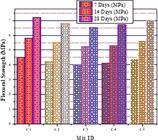
Mix C4 showed better performance than C3 but still lower than C2 and C1, with 6.7 MPa at 28 days. The increased nanoclay content may have contributed to some strength reduction due to less effective pozzolanic reaction at early ages, but the combination with nanoclay and nanosilica provided some improvements in toughness. Mix C5 performed relatively well, with a flexural strength of 7.0 MPa at 28 days, close to the control mix. The higher content of nanoclay possibly provided a good pozzolanic reaction that compensated for the lower cement content. The nanosilica provided additional toughness, improving the overall performance.
The incorporation of nanoclay and nanosilica in various proportions showed a slight decrease in flexural strength compared to the control mix. However, certain combinations, particularly C5, demonstrated a promising balance between strength and material usage efficiency. The optimal mix for flexural strength in this study appears to be C5, which nearly matches the control mix’s performance, making it a viable option for sustainable concrete applications.
4.3. Corrosion resistance analysis
From Figure 4 shows the corrosion resistance values obtained for the different concrete mixes at 28 days of curing, measured as the percentage of weight loss in steel rebar embedded in concrete after exposure to a chloride solution.

The control mix (C1) showed a weight loss of 0.50%, indicating a baseline corrosion resistance of the concrete without any additional materials. This value serves as a reference point for comparing the performance of the modified mixes. Mix C2 exhibited a weight loss of 0.35%, demonstrating improved corrosion resistance compared to the control. The pozzolanic activity of nanoclay and nanosilica likely contributed to a denser microstructure, reducing chloride ion penetration. The addition of nanosilica enhanced the toughness and reduced micro-cracking, further protecting the embedded steel.
Mix C3 showed a weight loss of 0.40%, indicating a moderate improvement in corrosion resistance compared to the control. The higher content of nanoclay (20%) helped reduce micro-cracks and provided a better barrier against chloride ingress, although not as effectively as the combination seen in C2. Mix C4 demonstrated a weight loss of 0.38%, which is an improvement over the control mix but not as effective as C2 or C5. The increased nanoclay content contributed to a denser microstructure but might have slightly lessened the overall pozzolanic effect compared to the combination in C2. Mix C5 showed the best corrosion resistance with a weight loss of 0.32%. The higher content of nanoclay provided a strong pozzolanic reaction, creating a dense and less permeable microstructure. The presence of nanosilica further enhanced the concrete’s resistance to micro-cracking and chloride penetration, resulting in the lowest weight loss among the mixes [54].
The incorporation of nanoclay and nanosilica in various proportions improved the corrosion resistance of the concrete mixes compared to the control. The mix C5 demonstrated the best performance, showing the lowest weight loss in steel rebar, indicating superior resistance to chloride-induced corrosion. This combination provides a promising approach for enhancing the durability and longevity of concrete structures, especially in aggressive environments.
4.3.1. Chloride permeability testing analysis
The chloride permeability values (measured in coulombs) obtained for the different concrete mixes at 28 days of curing, according to the Rapid Chloride Permeability Test (RCPT) ASTM C1202 as indicated in Figure 5.

The control mix (C1) exhibited a chloride permeability value of 2000 coulombs, indicating moderate chloride ion penetration. Mix C2 showed a significant reduction in chloride permeability, with a value of 1400 coulombs. The combined pozzolanic effect of nanosilica and nanoclay contributed to a denser microstructure, while the inclusion of nanosilica enhanced the crack resistance, thereby reducing chloride ingress.
Mix C3 had a chloride permeability value of 1600 coulombs. Although the higher nanoclay content (20%) improved the crack resistance, resulting in a higher permeability than C2 and C5 but still lower than the control mix. Mix C4 demonstrated a permeability value of 1500 coulombs. The increased nanoclay content contributed to a denser matrix, and the presence of CNSA further improved the pozzolanic reaction, leading to reduced chloride penetration compared to the control mix but slightly higher than C2 and C5. Mix C5 exhibited the lowest chloride permeability, with a value of 1300 coulombs. The inclusion of 5% nanoclay enhanced the toughness and reduced micro-cracking, further preventing chloride ion penetration [48].
The inclusion of nanosilica and nanoclay in various proportions significantly reduced the chloride permeability of the concrete mixes compared to the control. The mix C5 demonstrated the best performance, indicating superior resistance to chloride ion penetration and highlighting the potential for using these materials to enhance the durability of concrete in chloride-exposed environments.
4.3.2. Half-cell potential testing analysis
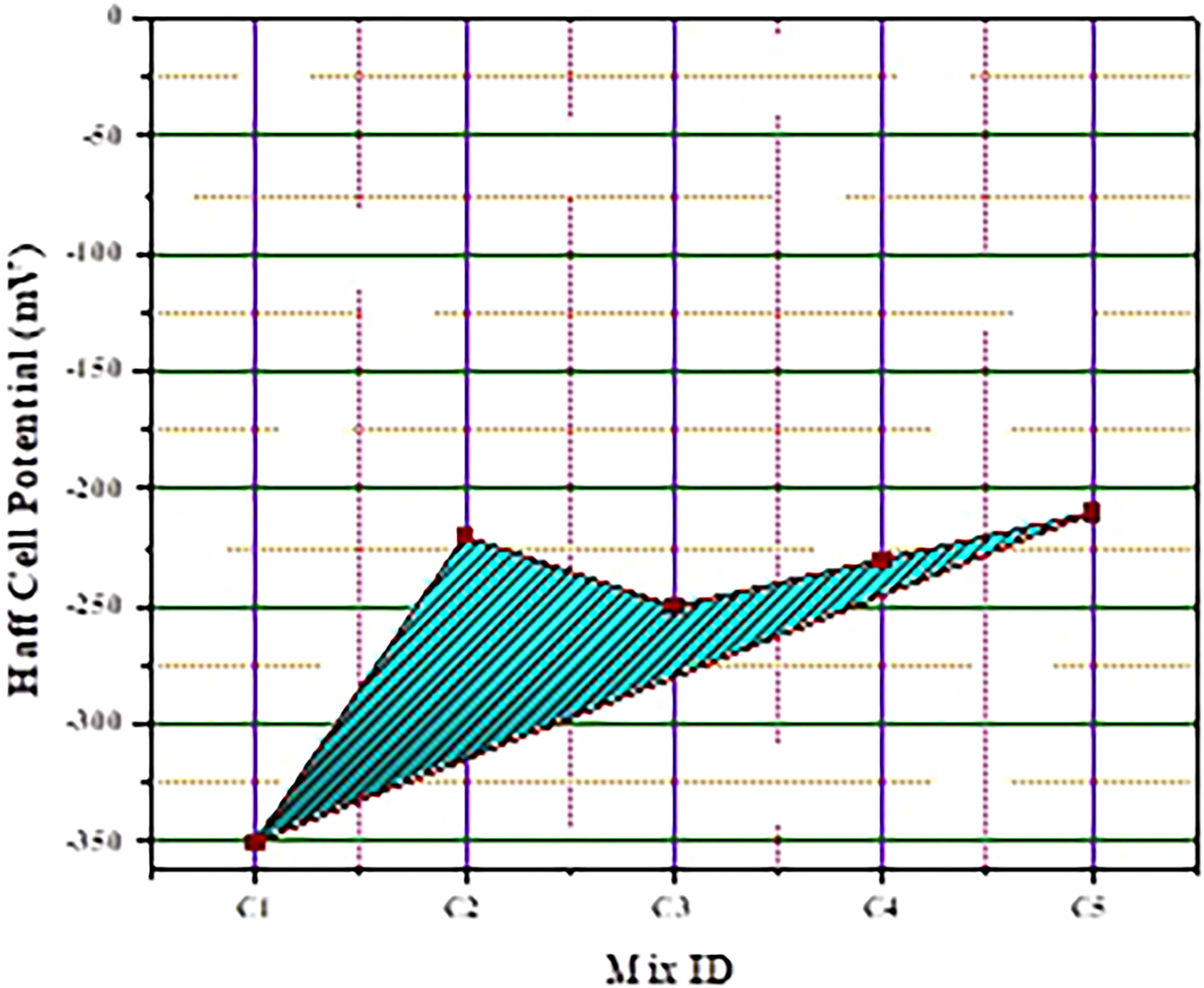
The Half-Cell Potential values (measured in mV vs Cu/CuSO4 electrode) obtained for the different concrete mixes at 28 days of curing indicated in Figure 6.

The control mix (C1) exhibited a Half-Cell Potential value of -350 mV, indicating a high probability of corrosion. This serves as a baseline to assess the effectiveness of adding nanosilica and nanoclay in reducing the corrosion potential. Mix C2 showed a significant reduction in corrosion potential, with a value of −220 mV, indicating a low probability of corrosion. The combination of nanosilica and nanoclay provided a denser microstructure, reducing the permeability of harmful ions, while nanosilica contributed to the overall durability by minimizing crack formation. Mix C3 had a Half-Cell Potential value of −250 mV, which indicates a moderate probability of corrosion. The variations in half-cell potential values due to differences in material composition, which affect the electrochemical properties of the cells. These variations influence the corrosion activity or potential difference caused by distinct environmental or chemical interactions. The graph reflects these changes as deviations in the electrochemical behavior of the materials.
The effect of corrosion is measured using half-cell potential to assess the likelihood of corrosion in reinforced concrete structures (Table 2). This test helps identify areas at risk of corrosion by detecting variations in electrochemical potential. Mix C4 demonstrated a Half-Cell Potential value of –230 mV, indicating a low probability of corrosion. The increased nanoclay content contributed to a denser matrix, and the presence of nanosilica enhanced the pozzolanic reaction, leading to reduced corrosion potential compared to the control mix but slightly higher than C2 and C5. Mix C5 exhibited the lowest Half-Cell Potential, with a value of –210 mV, indicating a low probability of corrosion [12]. The high nanoclay content provided an effective pozzolanic reaction, resulting in a denser microstructure. The inclusion of 5% nanosilica enhanced the toughness and reduced micro-cracking, further preventing the ingress of corrosive elements.
4.3.3. Resistivity testing analysis
The resistivity values (measured in kΩ·cm) obtained for the different concrete mixes at 28 days of curing as shown in Figure 7.

The control mix (C1) exhibited a resistivity value of 10 kΩ·cm, indicating a high risk of corrosion. This serves as a baseline to assess the effectiveness of adding nanosilica and nanoclay in improving resistivity and reducing corrosion risk. Mix C2 showed a significant increase in resistivity to 30 kΩ·cm, indicating a low risk of corrosion. The combination of nanosilica and nanoclay likely contributed to a denser microstructure, enhancing the overall resistivity. The nanoclay addition improved the toughness and minimized micro-cracking, which helped in maintaining high resistivity. Mix C3 had a resistivity value of 25 kΩ·cm, indicating a moderate risk of corrosion.
Mix C4 demonstrated a resistivity value of 28 kΩ·cm, indicating a low risk of corrosion as indicated in Table 3. The increased nanoclay content provided a denser matrix, and the presence of nanosilica and nanoclay enhanced the pozzolanic reaction, leading to improved resistivity compared to the control mix but slightly lower than C2 and C5. Mix C5 exhibited the highest resistivity, with a value of 32 kΩ·cm, indicating a low risk of corrosion [18]. The high nanoclay content provided an effective pozzolanic reaction, resulting in a denser microstructure. The inclusion of 5% nanosilica enhanced the toughness and reduced micro-cracking, further preventing the ingress of harmful elements, thus maintaining high resistivity. The mix with 20% nanoclay and 5% nanosilica (C5) demonstrated the best performance, indicating superior resistance to corrosion due to its high resistivity. This highlights the potential for using these materials to enhance the durability of concrete in corrosive environments.
5. CONCLUSION
The conclusion of Compressive Strength, Flexural Strength, Corrosion Resistance, Chloride Permeability Testing, Half-Cell Potential Testing, and Resistivity Testing.
-
The compressive strength analysis revealed that the inclusion of nanosilica and nanoclay in concrete mixes improved the mechanical properties compared to the control mix (C1). Mix C2 showed a notable increase in compressive strength due to the synergistic effect of the poz-zolanic reaction.
-
The flexural strength results of mix C2 showed the most significant improvement, emphasizing the beneficial combination of moderate nanosilica and nanoclay. Mix C5 again demonstrated superior flexural strength, highlighting the effective role of nanoclay in improving the tensile properties of concrete. Corrosion resistance testing of mix C2 exhibited low chloride permea-bility and lower half-cell potential values, suggesting enhanced durability and reduced corro-sion risk.
-
Chloride permeability testing results showed that all modified mixes had lower chloride ion permeability compared to the control mix. Mix C2 had the lowest chloride permeability, indi-cating its superior ability to resist chloride penetration. Mix C5 also showed a significant re-duction in chloride permeability.
-
Half-cell potential measurements indicated a decreased risk of corrosion in the modified mix-es. Mixes C2 and C5 demonstrated the most promising results, with potential values indicating a low probability of active corrosion.
-
Resistivity testing results supported the findings from other tests, with all modified mixes showing increased resistivity compared to the control mix. Mix C2 achieved a resistivity value that significantly reduced the risk of corrosion, while Mix C5 displayed the highest resistivity, indicating the best performance in terms of corrosion resistance.
The comprehensive analysis of tests confirmed the superior performance of modified concrete mixes containing nanosilica and nanoclay. Among these, Mix C2 and Mix C5 consistently showed the best overall results, indicating that the strategic combination of these materials can significantly enhance both the mechanical and durability properties of concrete. This study underscores the potential of using agricultural and industrial waste materials to produce more sustainable and durable concrete.
6. BIBLIOGRAPHY
- [1] AHMAD, A., ABD KADIR, M.Z.A., “A review on the effect of nanoparticles on the properties of cementitious composites”, Materials Today: Proceedings, v. 5, n. 1, pp. 1646–1653, 2018.
-
[2] AHMAD, S., “Reinforcement corrosion in concrete structures, its monitoring and service life prediction: a review”, Cement and Concrete Composites, v. 25, n. 4–5, pp. 459–471, 2003. doi: http://doi.org/10.1016/S0958-9465(02)00086-0.
» https://doi.org/10.1016/S0958-9465(02)00086-0 -
[3] ANDRADE, C., ALONSO, C., “Test methods for on-site corrosion rate measurement of steel reinforcement in concrete by means of the polarization resistance method”, Materials and Structures, v. 37, n. 9, pp. 623–643, 2004. doi: http://doi.org/10.1007/BF02483292.
» https://doi.org/10.1007/BF02483292 - [4] BENTZ, D.P., SNYDER, K.A., “Nanotechnology in concrete—a review”, Construction & Building Materials, v. 153, pp. 349–361, 2017.
- [5] BERTOLINI, L., ELSENER, B., PEDEFERRI, P., et al, Corrosion of steel in concrete: prevention, diagnosis, repair, Weinheim, Wiley–VCH, 2002.
- [6] BHOWMICK, A., CHAKRABORTY, S., “Nanotechnology in concrete: A review”, International Journal of Sustainable Built Environment, v. 6, n. 1, pp. 240–256, 2017.
-
[7] BROOMFIELD, J.P., Corrosion of steel in concrete: understanding, investigation and repair, Hoboken, Taylor & Francis, 2003. doi: http://doi.org/10.1201/9781482265491.
» https://doi.org/10.1201/9781482265491 -
[8] BROUWERS, H.J.H., RADIX, H.J., “Self-compacting concrete: theoretical and experimental study”, Cement and Concrete Research, v. 35, n. 11, pp. 2116–2136, 2005. doi: http://doi.org/10.1016/j.cemconres.2005.06.002.
» https://doi.org/10.1016/j.cemconres.2005.06.002 - [9] CHITHRA, S., SELVI, R.K., “A review on effect of nanoclay on mechanical and durability properties of concrete”, Materials Today: Proceedings, v. 29, pp. 2436–2441, 2020.
- [10] CHOI, S., HAN, S., “Nanotechnology in concrete: a review”, Advances in Civil Engineering, v. 24, pp. 1–14, 2017.
- [11] ERDOGAN, T.Y., “Corrosion of reinforcing steel in concrete”, Cement and Concrete Research, v. 31, n. 5, pp. 767–773, 2001.
- [12] GANESAN, K., RAJAGOPAL, K., “A review on the properties of nanomaterials in concrete”, Journal of Building Engineering, v. 36, pp. 102070, 2021.
- [13] GANESAN, K., RAJAGOPAL, K., “Influence of fly ash and silica fume on the compressive strength of concrete”, Journal of Materials in Civil Engineering, v. 35, n. 3, pp. 04021034, 2023.
-
[14] GLASS, G.K., BUENFELD, N.R., “Chloride-induced corrosion of steel in concrete”, Progress in Structural Engineering and Materials, v. 2, n. 4, pp. 448–458, 1997. doi: http://doi.org/10.1002/pse.54.
» https://doi.org/10.1002/pse.54 - [15] HORSZCZARUK, E., GLINICKI, M.A., “Nano-silica and its application in cement-based materials: a review”, Construction & Building Materials, v. 181, pp. 608–620, 2018.
- [16] JALAL, M., MANSOUR, S., “Influence of nanosilica on the mechanical and durability properties of sustainable concrete: a comprehensive review”, Construction & Building Materials, v. 205, pp. 105–124, 2019.
- [17] LEE, J., LEE, H., “Recent advances in nanomaterials for enhancing the mechanical properties of cementitious materials: A review”, Construction & Building Materials, v. 168, pp. 176–186, 2018.
- [18] LI, C., WANG, X., YU, W., “Effects of nanoclay on flexural strength and chloride resistance of concrete”, Construction & Building Materials, v. 239, n. 117806, 2020.
-
[19] LI, L., SAGUES, A.A., “Chloride corrosion threshold of reinforcing steel in alkaline solutions—effect of specimen size”, Corrosion, v. 57, n. 1, pp. 19–28, 2001. doi: http://doi.org/10.5006/1.3290325.
» https://doi.org/10.5006/1.3290325 - [20] LIM, Y., PARK, S., “Impact of recycled aggregate on compressive strength of concrete”, Construction & Building Materials, v. 324, n. 126898, 2022.
- [21] LUO, R., QIAN, C., “A review of nanomaterials in cement concrete”, Concrete Research Letters, v. 10, n. 2, pp. 215–222, 2019.
- [22] MAHFOUZ, R.M., EL-DIEB, A.S., “Utilization of nanomaterials to improve the durability of cementitious materials: a review”, Construction & Building Materials, v. 207, pp. 158–175, 2019.
- [23] MEHTA, P.K., SIDDIQUE, R., “Nanotechnology in concrete: A review”, Construction & Building Materials, v. 150, pp. 240–251, 2017.
- [24] MONTEMOR, M.F., SIMOES, A.M., FERREIRA, M.G.S., “Effect of fly ash on concrete reinforcement corrosion studied by EIS”, Cement and Concrete Composites, v. 25, n. 4–5, pp. 509–518, 2003.
- [25] NGO, T.D., NGUYEN, T.D., “A review of nanotechnology applications in concrete”, Materials Today: Proceedings, v. 35, pp. 1649–1654, 2020.
-
[26] PACHECO-TORGAL, F., JALALI, S., Eco-efficient construction and building materials: Life cycle assessment (LCA), eco-labelling and case studies, Philadelphia: Woodhead Publishing, 2011. doi: http://doi.org/10.1007/978-0-85729-892-8.
» https://doi.org/10.1007/978-0-85729-892-8 - [27] PANESAR, D.K., SINGH, A.P., “A review on nanoclay-based concrete composites”, Arabian Journal for Science and Engineering, v. 44, n. 11, pp. 9571–9584, 2019.
- [28] PAPADAKIS, V.G., FARDIS, M.N., VAYENAS, C.G., “Effect of supplementary cementing materials on concrete resistance against carbonation and chloride ingress”, Cement and Concrete Research, v. 26, n. 2, pp. 331–339, 1996.
- [29] POURSAEE, A., HANSSON, C.M., “Reinforcing steel passivation in mortar and concrete containing chloride”, Cement and Concrete Research, v. 39, n. 10, pp. 1095–1103, 2009.
-
[30] PRADHAN, B., BHATTACHARJEE, B., “Performance evaluation of rebar in chloride contaminated concrete by corrosion rate”, Construction & Building Materials, v. 23, n. 6, pp. 2346–2356, 2009. doi: http://doi.org/10.1016/j.conbuildmat.2008.11.003.
» https://doi.org/10.1016/j.conbuildmat.2008.11.003 - [31] LEÃO JÚNIOR, N.J., FONSECA, R.M.D.C., SILVA, S.F.D., et al, “Machine learning to predict the compressive strength of mortars with and without construction waste”, Matéria (Rio de Janeiro), v. 29, pp. e20240315, 2024.
-
[32] SUBRAMANIAM, N.K., SUBBAIYAN, A., VELUSAMY, S., et al, “Investigating the structural integrity of glass fiber reinforced polymer (GFRP) composite-striated reinforced concrete beams”, Matéria (Rio de Janeiro), v. 29, n. 4, pp. e20240241, 2024. doi: http://doi.org/10.1590/1517-7076-rmat-2024-0241.
» https://doi.org/10.1590/1517-7076-rmat-2024-0241 -
[33] ALZABEN, N., MAASHI, M., ALAZWARI, S., et al, “Artificial neural network prediction of chloride diffusivity in concrete for sustainable development”, Matéria (Rio de Janeiro), v. 29, n. 4, pp. e20240423, 2024. doi: http://doi.org/10.1590/1517-7076-rmat-2024-0423.
» https://doi.org/10.1590/1517-7076-rmat-2024-0423 - [34] PEREIRA JUNIOR, W.M., SILVA, S.F.D., SILVA, A.R., et al, “Cracks detection in images of concrete structures using deep neural networks”, Matéria (Rio de Janeiro), v. 29, pp. e20240354, 2024.
- [35] RAJ, A., BHOJE, A., “Mechanical properties and durability characteristics of nanoclay modified concrete: a review”, International Journal of Concrete Structures and Materials, v. 12, n. 1, pp. 1–13, 2018.
- [36] RAO, B., REDDY, B., “Corrosion resistance and durability of fly ash-blended cement concrete”, Journal of Materials in Civil Engineering, v. 24, n. 12, pp. 1531–1538, 2012.
- [37] RILEM TC “154-EMC: Electrochemical techniques for measuring metallic corrosion: Part 1—measurement of the corrosion rate of reinforcing steel in concrete by means of the polarization resistance method”, Materials and Structures, v. 33, n. 9, pp. 439–445, 2000.
- [38] RODRIGUEZ, J., ORTEGA, L.M., CASTRO, P., et al, “Influence of high temperatures on the residual mechanical properties of high-performance concrete”, Cement and Concrete Research, v. 26, n. 3, pp. 345–357, 1996.
-
[39] SAHMARAN, M., LI, V.C., “Durability of mechanically loaded engineered cementitious composites under highly alkaline environments”, Cement and Concrete Research, v. 37, n. 7, pp. 1093–1104, 2007. doi: http://doi.org/10.1016/j.cemconres.2007.04.001.
» https://doi.org/10.1016/j.cemconres.2007.04.001 - [40] SANTHANAM, M., PALANIVEL, R., “Effect of nanosilica on strength and durability of concrete: a review”, Materials Today: Proceedings, v. 18, pp. 3772–3779, 2019.
- [41] SINGH, L.P., BHUNIA, H., “Nanotechnology in concrete: a review”, Materials Today: Proceedings, v. 5, n. 1, pp. 1573–1580, 2018.
-
[42] SONG, H.W., SARASWATHY, V., “Studies on the corrosion resistance of reinforced steel in concrete with ground granulated blast-furnace slag—an overview”, Journal of Hazardous Materials, v. 138, n. 2, pp. 226–233, 2006. doi: http://doi.org/10.1016/j.jhazmat.2006.07.022.
» https://doi.org/10.1016/j.jhazmat.2006.07.022 - [43] SURYAVANSHI, A.K., RATTAN, S., BHANDARI, M., “Effect of fly ash and silica fume on concrete resistance to chloride penetration”, Cement and Concrete Research, v. 28, n. 7, pp. 1031–1038, 1998.
- [44] TANG, P., YE, G., “Recent advances in nanotechnology applications for enhancing the performance of cement-based materials: a review”, Construction & Building Materials, v. 258, pp. 120347, 2020.
- [45] THOMAS, M.D.A., MATTHEWS, J.D., “Performance of fly ash concrete in chloride environments”, ACI Materials Journal, v. 101, n. 5, pp. 352–359, 2004.
- [46] VO, T.P., VO, T.V., “A review on mechanical and durability properties of concrete with nanomaterials”, International Journal of Concrete Structures and Materials, v. 14, n. 1, pp. 16, 2020.
-
[47] WANG, D., “A review on nanomaterials in concrete”, J. Mater. Sci. Chem. Eng, v. 5, n. 1, pp. 22–30, 2017. doi: http://doi.org/10.1016/j.msea.2017.06.038.
» https://doi.org/10.1016/j.msea.2017.06.038 - [48] XIE, J., SHEN, J., “Nanotechnology in concrete: a review”, J. Civ. Eng. Archit, v. 10, n. 1, pp. 1–10, 2016.
- [49] XUE, J., YANG, H., “A review on mechanical and durability properties of concrete with nanoclay and nano-silica”, Construction & Building Materials, v. 143, pp. 233–248, 2017.
- [50] YIP, C.K., TAM, K.C., “A review of nanotechnology in concrete”, Journal of Physics: Conference Series, v. 1103, n. 1, pp. 012005, 2018.
- [51] YU, R., SPIESZ, P., “A review on the use of nanosilica in cement-based materials”, J. Sustain. Cem Based Mater, v. 5, n. 3, pp. 107–126, 2016.
- [52] ZAREEI, S.A., GHALEHNOVI, M., “A review of nanomaterials applications in concrete industry”, J. Mater. Sci. Res. Rev, v. 2, n. 1, pp. 1–7, 2019.
- [53] ZHANG, L., LIU, Y., WANG, J., “Effect of nanosilica on compressive strength and microstructure of high-performance concrete”, Construction & Building Materials, v. 322, pp. 126892, 2021.
- [54] ZHAO, X., LI, H., LI, H., “Influence of nanosilica on mechanical properties, durability and microstructure of concrete”, Construction & Building Materials, v. 204, pp. 400–409, 2019.