
 Experimental investigation of SiC, Al2O3, and hybrid SiC-Al2O3 nanofluids for efficiency improvement in flat plate solar collectors
ABSTRACT
The optimization of thermal performance in flat plate solar collectors (FPSC) is critical for enhancing solar energy utilization. Traditional heat transfer fluids, such as water and antifreeze mixtures, exhibit limited thermal conductivity (TC), which reduces the overall efficiency of the solar collectors. To address this challenge, nanofluids (NFs) suspensions of nanoparticles (NPs) in a base fluid (BF) have been introduced to improve heat transfer properties. This study investigates the potential of hybrid SiC–Al2O3 NFs for improving the thermal efficiency (TE) of FPSCs. Experimental investigations were conducted to analyze the thermophysical properties of SiC and Al2O3 NFs, which were synthesized at various volume fractions (0.025%, 0.05%, 0.075%, and 0.1%). Zeta potential analysis confirmed the stability of the NFs. The novelty of this work lies in the formulation and experimental evaluation of a SiC–Al2O3 hybrid NF as a working medium for FPSCs. The synergistic combination of Al2O3 and SiC enhances both optical absorption and convective heat transfer. The hybrid SiC–Al2O3 NF demonstrated a TC enhancement of 31.96% at 70°C compared to water. Viscosity showed an inverse relationship with temperature, with lower viscosity observed at elevated temperatures, improving fluid dynamics. The FPSC performance was assessed at various mass flow rates (MFRs), showing that the hybrid SiC–Al2O3 NF outperformed conventional fluids, achieving a TE improvement of approximately 38% relative to water at the matched mass flow rate of 0.033 kg/s and 0.1 vol% (based on the absorbed-energy parameter Fr(τα), 0.7897 versus 0.5713). Among the tested materials—SiC, Al2O3, and the hybrid SiC–Al2O3 NF the hybrid NF exhibitedthe best overall performance, reaching an optical (zero-loss) efficiency intercept of about 85% at (Ti−Ta)/Gt = 0, with an enhancement of approximately 38% relative to water at matched operating conditions. These findings demonstrate the suitability of the hybrid NF for solar thermal applications. The synergistic properties of SiC and Al2O3 NPs optimize both TC and specific heat, ensuring stable and efficient FPSC operation.
Keywords:
Solar energy; Thermal performance; Solar collector; Flat plate; Mass flow; Hybrid nanofluids
1. INTRODUCTION
At very low output levels, renewable energy sources (RES) can have environmental impacts at the local level. For instance, one wind turbine can kill quite a few birds or bats. The global use of a specific RES could have environmental impacts once worldwide production reaches a few hundred EJ. There might be alterations to precipitation or wind energy heat fluxes, for instance. With global energy prices in mind, it appears very unlikely that RE would generate as much as 1000 EJ by 2050. Moreover, it appears that with climate change, the total technological potential for RE will also fall. A global transition to RE must be accompanied by a significant reduction in total energy use to achieve environmental sustainability, suggests MORIARTY and HONNERY [1]. To meet the global energy demand, significant conversion and integration technologies and systems are required. The consumption rates of nonrenewable resources, and thus the dependence on fossil fuels, will decline significantly if energy systems start incorporating solar energy to a larger extent. In their research work, NWAIWE et al. [2] assert that photovoltaic (PV) systems are driving the conversion of DC (direct current) solar electricity to AC (alternating current). NFs exhibit enhanced TE compared to conventional working fluids, with reported improvements ranging from 5–35%. Another determinant of the service life of an NF is zeta potential, which indicates dispersion of its particles. Increased stability resulted from the surfactant, the manufacturing process, and the NP concentration (0.2 to 0.3% by volume base). Fouling by NF is a common phenomenon that significantly affects TC (by ≥ 11%). For NFs to become widely used, their dispersion of NPs must be enhanced over extended periods, and stability must be maintained at temperatures exceeding 90 °C, as reported by GARCÍA-RINCÓN and FLORES-PRIETO [3].
Operating parameters, significant environmental factors, and FPSC dimensions all have an impact on the system’s thermal performance. The impact of dimensions on methods for improving thermal performance is significant. Improving the S/S FPSC’s thermal performance may be achieved by widening the microchannel and raising the corrugations, according to the results. Assuming one of the best circumstances, the anticipated momentary efficiency is 86.10%. Furthermore, an equation was proposed to illustrate the relationship between the S/S FPSC’s momentary efficiency and external factors, as HE et al. [4] have demonstrated. The discussion of vibration-based heat transfer improvement and its potential use in FPSC, along with thermal performance enhancement for FPSC, is presented. An examination found that ETSC (evacuated-tube solar collector) might see a 78% improvement in heat transmission with the use of low-frequency vibration. However, there is a lack of literature on the potential uses of vibration in FPSC to improve heat transmission, as SHAMSUL AZHA et al. [5] have noted. The working fluid consisted of an NF containing TiO2 particles. This fluid remains stationary inside the FPSC. Through the network of pipes and the water storage tank, the agent fluid, purified water, was pumped. As a result, compared to earlier models, this procedure increases the FPSC’s lifespan while decreasing costs. Using 5% TiO2 NP by volume fraction and 2.5% TiO2 NP by volume fraction boosted collector efficiency by approximately 45% and 17%, respectively. With an increase in the volume% of TiO2 particles, FPSC absorbed more heat, as AHMADLOUYDARAB et al. [6] have observed. An FPSC with six distinct volume fractions, ranging from 0.1% to 3%, was studied, along with two types of working fluids: alumina NF and double-distilled water (DDW). To assess the FPSC’s overall performance, a numerical model was generated using the ANSYS 17 program. There is substantial evidence from the experiments that backs up the previously proposed theory. According to HAWWASH et al. [7], adding alumina NF enhances FPSC TE up to a volume percentage of 0.5%, beyond which performance declines and pressure drop increases. This study investigates the influence of NF on FPSC TE.
The optical and thermophysical properties of the two NPs make the SiC–Al2O3 hybrid NF suitable for thermal applications. Aluminum oxide enhances TC and stability, while silicon carbide provides good optical absorption and thermal stability at elevated temperatures. The combined effect shows better heat transfer performance compared to a single component NF, making the hybrid formulation an effective working fluid for FPSC applications.
KUMAR et al. [8] investigated the TE of FPSC using NFs. Al2O3 NPs are added to the water-based fluid at volumetric concentrations of 1%, 2%, and 3%, respectively. The thermal inertia of FPSC components was evaluated, and their performance was analyzed at flow rates of 0.004–0.06 kg/s. At 0.004 kg/s, a maximum outlet temperature increase of 7.22% was observed with 3% Al2O3 volume fraction. The critical flow rate was identified as 0.016 kg/s. The study is limited by if it had optimized NF composition and done a long-term stability study. URMI et al. [9] examined 40% ethylene glycol-based TiO2-Al2O3 hybrid NFs’ TC, prepared using a two-stage synthesis method with Polyvinylpyrrolidone (PVP) as a stabilizing agent. The NFs were evaluated at volume concentrations ranging from 0.02% to 0.1%, with temperatures ranging from 30 °C to 80 °C. With a 0.1% concentration, the findings demonstrated maximum TC improvement. However, the addition of PVP decreased the TC by up to 5.33% while also improving stability.
HUSSEIN et al. [10] studied the thermal performance of FPSC with CuO/water NFs, in which CuO NPs (0–1%) were mechanically and ultrasonically dispersed in water. Experiments were done under Iraqi weather conditions for three months (January–March) at MFRs ranging from 0.003–0.076 kg/s. At a 1% CuO content, the findings demonstrated improvements in the collector’s efficiency, outperforming pure water by 11.3%. The study lacked exploration of concentration beyond 1% with degradation of the CuO NPs in the water-based NF over extended use. BHARADWAJ et al. [11] explored r-GO-based NF for improving thermal effectiveness in FPSC. TE was assessed with distilled water and r-GO NFs at 1 lpm MFR and 800 W/m2 solar intensity. The FPSC’s thermal effectiveness for DI water reached 46.75%, whereas for r-GO it peaked at 59.7%, representing a 21.5% improvement. But the study did not focus on the optimal concentration of r-GO NPs.
FARHANA et al. [12] studied various NPs distributed in BFs such as ethylene glycol, water, and their combinations. In this investigation, MXene NPs were distributed in a 60:40 ethylene glycol-water blend at volume fractions of 0.01%, 0.05%, and 0.1%. CFD simulations in ANSYS ICEM and SolidWorks improved FPSC efficiency by 5.83%, 6.06%, and 6.31%, respectively. The study did not explore varying flow conditions, and economic feasibility was not considered. To determine the FPSC efficiency, FARHANA et al. [13] examined Al2O3 as well as CNC NFs dispersed in a water-ethylene glycol BF at 0.3% and 0.5% volume concentration. The procedures used included characterisation, viscosity testing, stability analysis, specific heat, and TC at various temperatures. The maximum enhancement in TC was 11.5% for CNC and 13.4% for Al2O3 at a temperature of 80 °C. CNC NFs had initial instability and high viscosity at lower temperatures, making poses challenges.
HASSAN et al. [14] researched the impact of NFs on FPSC using Al2O3-water NFs of 0.5wt.% concentration and 0.2wt.% concentration. The BF used in the investigation was DI water. The research included experimental testing and numerical simulations using TRNSYS 18 that were validated against real-time data. Using 0.5wt.% Al2O3 NF boosted FPSC efficiency by 17.5% over water and resulted in a 20% increase in absorbed energy. The limitations included a limited MFR, untested long-term stability and economic feasibility based on greenhouse size. NUHASH et al. [15] performed CFD simulations to evaluate the thermal-hydraulic performance of SWCNT/H2O, Al2O3/H2O, and MWCNT/H2O at volume concentrations of 0.025%–1%. Results demonstrated a 22% improvement in heat transfer for MWCNT/ H2O, a 38% improvement for SWCNT/ H2O and an 18% improvement for Al2O3/ H2O. The study had limitations, including higher pumping power (PP) requirements for SWCNT/water and a considerable reduction in outlet temperature at higher concentrations, which reduced overall TE.
RAHMAN et al. [16] compared TiO2/water, Si3N4/water and Al2O3/water NFs, with Si3N4 showing superior properties to improve FPSC’s thermal performance. Experimental analysis and life cycle assessment were accomplished using the Eco Audit CES Edu Pack software. At a volume concentration of 0.09%, Si3N4/water can increase the TC by 33%, efficiency by 8% and collector area by 6.1%. PP was restricted by sedimentation and higher viscosity, which limited the study. MOULEFERA et al. [17] made use of ioNFs (INF) to improve FPSC thermal performance. In this study, the four INF types were designed that combined GO and IL NPs distributed throughout the IL, in IL-water mixes (75–50%) and also in water. The method did not include the experimental evaluation of thermophysical properties and performance of FPSC. The discoveries indicate that IL/GO has a 37.4% enhancement in efficiency compared to water, which yields a 2.5-fold temperature rise. The research posed some difficulties concerning scalability and the higher cost of IL.
NFs (NFs) have significantly improved the performance of FPSCs, but several gaps still remain. Metal- based NFs such as Al2O3 and CuO are known to be efficient, yet their long-term stability, sedimentation behavior, and cost aspects are not fully understood. Hybrid NFs like TiO2–Al2O3 show good TC, and the use of PVP as a stabilizer can further enhance performance when properly optimized. Carbon-based NFs, including SWCNT and MWCNT, generally provide higher heat transfer rates. However, increasing the concentration also raises PP requirements and reduces outlet temperature, which affects practical use. IoNFs (ioNFs/INFs) based on ionic liquids offer promising efficiency, but issues related to scalability and cost still need attention. Si3N4 NFs also appear promising from a life cycle perspective; however, more work is needed to understand their long-term stability and the effect of viscosity on PP, as reported by HUSSEIN et al. [10], HASSAN et al. [14], URMI et al. [9], NUHASH et al. [15], MOULEFERA et al. [17], and RAHMAN et al. [16]. Most reported hybrids pair two high-conductivity particles (for example, carbon–metal-oxide or oxide–oxide combinations such as TiO2–Al2O3, MWCNT/TiO2, and MWCNT/hBN), so the complementary pairing of a high-conductivity, optically absorbing carbide with a high-heat-capacity, well-dispersing oxide has received limited experimental attention for FPSCs. To our knowledge, the SiC–Al2O3 hybrid has not been experimentally evaluated as an FPSC working fluid across the present concentration (0.025–0.1 vol%) and flow-rate (0.0167–0.033 kg/s) range. The two particles play complementary roles: SiC contributes high intrinsic TC (270–330 W/m·K), solar-spectrum absorption, and high-temperature durability, while Al2O3 contributes higher specific heat and superior dispersion stability that keeps the SiC suspended and reduces agglomeration. Their combination is expected to raise effective conductivity and convective transport while retaining colloidal stability an outcome neither particle delivers alone. Accordingly, the objectives of this work are to (i) synthesize and characterize SiC, Al2O3, and hybrid SiC–Al2O3 NFs; (ii) measure their thermophysical properties and stability across 30–70 °C; and (iii) evaluate FPSC thermal performance at varying concentrations and MFRs to quantify the hybrid advantage over the mono-NFs (MNFs) and water.
SARSAM et al. [22] improved the thermal performance of FPSCs by dispersing graphene nanoplatelets (GNPs) in water with changing surface area. The study tested aqueous triethanolamine-functionalized GNPs (TEA-GNPs) as a novel working fluid, synthesized at 0.025%, 0.05%, 0.075%, and 0.1% wt. with specific surface areas (SSA) 300, 500, and 750 m2/g. The author used MATLAB to create a simulation program and plan and execute an experimental setup.
SARSAM et al. [23] advocated increasing FPSC performance with aqueous MWCNT dispersions of varying outer diameters. MWCNTs (<8 nm and 20–30 nm) exhibited SSAs of 500 and 110 m2/g, respectively. Ala-MWCNT/water NFs were produced at concentrations of 0.025%, 0.05%, 0.075%, and 0.1% by weight. A test rig was created, and MATLAB code was used for analysis.
SiC-Al2O3 nanomaterials are characterized using scanning electron microscopy (SEM), X-ray diffraction (X-RD) and dynamic light scattering (DLS). The former two methods verify the purity of the crystalline phase, while the latter two examine the morphology of the particles NARAYANASAMY et al. [24], PERIANNAN et al. [25]. Electrostatic stability is confirmed by zeta potential measurement of the prepared NF, with values above ±30 mV. Long-term dispersion uniformity is further verified by UV–vis spectroscopy and sedimentation monitoring over 72 hours. The experimental procedure involves using a closed-loop flat plate collector test rig to measure solar flux, as well as differential thermocouples and precision flow meters ELUMALAI et al. [26], ALPHONSE et al. [27], VARDE and ARYA [28]. Additionally, ultrasonication is employed with an optimized surfactant concentration to ensure a homogeneous suspension. The dependability of the hybrid NF thermal performance and heat transfer coefficient assessments is established by these characterizations and regulated testing techniques KARTHIKEYAN and HUSSAIN [29], ZHU and HU [30]. SiC NF were shown to dramatically increase the thermo-optical efficiency of the collector in an experimental study conducted by RAFI and MUTHUVEL [31]. Their results verified that the solar thermal system’s heat transfer capability was enhanced by an increase in the volume percentage of nanoparticles.
The important contributions of the study are listed below:
-
Examine how hybrid NF improves thermal performance of FPSCs.
-
Experiment with NPs to identify their thermophysical properties.
-
Analyze the dynamic viscosity, TC, and stability of SiC-Al2O3 NFs at different concentrations and temperatures.
-
Evaluating the thermal performance of FPSC systems with varying NF flow rates and concentrations.
2. MATERIALS AND METHODS
The choice of SiC and Al2O3 nanoparticles was based on matching nanoparticle properties with the functional requirements of a FPSC. For this application, an effective NF should simultaneously provide high TC for rapid heat removal from the absorber surface, sufficient specific heat for sensible energy storage, good colloidal stability in the base fluid, and thermal reliability under repeated solar heating conditions. SiC was selected because of its very high intrinsic TC, strong thermal durability, and good optical absorption characteristics, all of which favor enhanced heat transport and solar energy utilization. Al2O3 was selected because it provides higher specific heat, good chemical stability, and comparatively better dispersion behavior in water, which help maintain heat absorption capability and suspension stability. On this basis, the SiC–Al2O3 hybrid NF was formulated to exploit complementary effects: SiC contributes predominantly to conductive and thermo-optical enhancement, whereas Al2O3 contributes to heat capacity support and stable dispersion. Thus, the hybrid composition was selected on a scientific property–performance basis to overcome the limitations of single-particle NFs and to achieve a better balance between heat-transfer (HT) enhancement and operational stability.
The study investigated FPSC performance using NFs of different materials. The TC and heat transfer capability of the SiC NF were evaluated. Al2O3 NF was investigated because of its greater specific heat capacity (SHC), which helps in better heat absorption. To achieve a well-balanced and efficient thermal performance, a hybrid SiC–Al2O3 NF was formulated by combining Al2O3’s high heat capacity with SiC’s high TC. The energy performance of the FPSC was evaluated at different MFRs and intake temperatures. Each NF’s influence was assessed using experimental trials and computer simulations to investigate heat transport dynamics within the collector. The obtained data were analyzed to compare the effectiveness of each NF and to determine the most efficient formulation for enhanced solar thermal applications.
2.1. NF preparation
The nanomaterials were chosen based on established scientific criteria. These include intrinsic TC, stability in the BF, enhancement mechanisms and suitability for HT applications. Each nanoparticle has certain benefits. Materials that have good TC promote efficient transport of phonons through a medium. Additionally, other materials help with micro-convection due to Brownian motion effects or induce layering at their interface to reduce thermal resistance. The hybrid formula shows a better thermophysical performance than mono NFs owing to greater enhancement capacity by combining complementary enhancement mechanisms. According to science-based selection criteria, hybrid NFs are expected to have higher heat transfer and stability performance.
To ensure maximum dispersion of nanoparticles and stability in the BF, NP were prepared by a two-step process. Before processing, the masses of SiC and Al2O3 NP with 99% purity were taken using an analytical balance. A planetary ball mill was used to mix the 99% pure nanoparticles.
The NFs were prepared by a two-step method, illustrated schematically in Figure 1. First, measured masses of 99%-purity SiC and Al2O3 nanoparticles were weighed on an analytical balance and dry-mixed in a planetary ball mill to break agglomerates. The mixed powder was then dispersed in deionized water at the required volume fraction (0.025–0.1 vol%), a surfactant was added to aid dispersion, and the suspension was ultrasonicated to produce a stable hybrid NF. Figure 2 shows photographs of the prepared SiC, Al2O3, and hybrid samples at the four concentrations, including the vials used for sedimentation monitoring, which confirmed dispersion stability over the test period. The SiC and Al2O3 NP were dispersed in water at various volume fractions (0.025%, 0.05%, 0.075%, and 0.1%). The thermophysical properties of the NP are presented in Table 1.


Photographs of prepared SiC, Al2O3, and SiC-Al2O3 hybrid nanofluids at different volume fractions and vials used for sedimentation monitoring.
2.2. Characterization of the NFs
The characteristics of the NFs were determined using several analytical techniques. X-RD spectra were obtained at a scanning rate of 1°/min under operating conditions of 40 kV and 30 mA to determine the crystalline structure of Al2O3 and SiC NP. The X-RD peaks of Al2O3 and SiC NPs reveal the presence of Al2O3 peak and SiC peak. The XRD patterns of the SiC and Al2O3 nanoparticles are presented in Figure 3, confirming their respective crystalline structures and phase characteristics. The hybrid Al2O3-SiC NF’s diffraction peaks confirmed the presence of both NP types in the liquid. As shown by LOPEZ et al. [18], the use of Fourier transform infrared (FTIR) is employed to examine the NFs with regard to surface functional groups and chemical bonds. The presence of typical Al-O and Si-C functional groups was shown by the study which ensures the stability of NPs within the BF. The calculation of zeta potential provides an initial indication of electrostatic stability but does not take into account the sedimentation and agglomeration processes which are time-dependent. Similarly, changes in the scattering (light) process have a time dependency. UV-vis spectrophotometry was performed after the absorbance measurement at intervals for 72 hours to assess long term stability. When the zeta potential values were greater than ±30 mV, NP developed strong repulsive forces. Therefore, aggregation in the short term can be resisted. The intensity as observed in the UV-vis measurements has not changed over a period of 72 hours. According to the results, the hybrid NF remains stable and homogeneous, making it suitable for continuous flat-plate solar collector operation.

X-ray diffraction (XRD) patterns of (a) silicon carbide (SiC) and (b) aluminum oxide (Al2O3) NP, confirming crystalline phase purity and structural composition.
The size and morphological distribution of the NPs are studied using transmission electron microscopy (TEM), as reported by NIKKAM et al. [19]. SIMPSON et al. [20] investigated the TC and effective characteristics of NF with particle loading and temperature effects. The precise assessment of effective thermophysical characteristics is critical for successful heat transfer prediction in thermal systems. A phosphorescent screen was used to catch transmitted electrons after exposing a thin NP layer to a high-energy electron beam. Al2O3 NPs were mostly spherical (30–50 nm), whereas SiC NPs were cubic (40–70 nm). Equation 1 calculates NF density.
The governing relations used in this work are drawn from established sources: the density and specific- heat mixing rules (Equations 1–2) follow the standard NF property relations of Pak and Cho; the transient hot-wires thermal-conductivity relation (Equations 3 and 6) follows the KD2-Pro/ASTM transient-line-source method; Fourier’s law (Equation 4) and the viscometric relations (Equations 7–11) follow standard HT and rheology texts; and the useful heat gain, collector efficiency, and heat-removal-factor relations (Equations 12–16) follow Duffie and Beckman, Solar Engineering of Thermal Processes. Each equation now carries its corresponding citation in the revised text.
where ρnf is the overall NF density, ρnp1 and ρnp2 are the densities of two NPs. φ1 and φ2 are the volume fractions, and ρbf does the remaining volume fraction weigh the BF density. Equation 2 expresses the NF’s SHC.
where Cp,bf represents the NF’s SHC, Cp,np1 and Cp,np2 gives the SHC of two NPs respectively.
Zeta potential measurements were initially used to assess the short-term stability of the hybrid SiC–Al2O3 NF, providing an indication of the electrostatic repulsion between nanoparticles. While zeta potential offers an initial prediction of colloidal stability, long-term stability is critical for practical applications in solar thermal systems. For this purpose, UV-vis spectrophotometry was employed to evaluate the NF’s stability over an extended period.
UV–vis spectrophotometric measurements were conducted over 30 days to monitor any potential aggregation or sedimentation of the nanoparticles, which could affect the NF’s performance. By examining the changes in the absorption spectra, the dispersion stability of the SiC–Al2O3 nanoparticles in the base fluid was tracked. This extended testing period allowed for a more accurate assessment of the long-term stability of the hybrid NF, ensuring that the suspension remained homogeneous and suitable for continuous use in flat-plate solar collectors.
In the present study, the density and specific heat of the hybrid SiC–Al2O3 NF were calculated using established correlations from the literature. These properties were derived based on the volume fraction of nanoparticles and the specific properties of the base fluid and nanoparticles. While these correlations offer useful approximations, it is acknowledged that experimental measurements would provide more reliable data for these thermophysical properties. Consequently, future work will include experimental measurement of the density and specific heat for the hybrid SiC–Al2O3 NF using standard laboratory techniques to ensure more accurate characterization. These measurements will contribute to a better understanding of the NF’s performance and its suitability for thermal applications such as flat-plate solar collectors.
The density and specific heat of the hybrid SiC–Al2O3 NF were obtained from the mixing relations in Equations (1) and (2) and verified experimentally, with density measured using a pycnometer and specific heat using differential scanning calorimetry. Because the nanoparticle loading is low (0.025–0.1 vol%), both properties remain close to those of water: the computed density rises from 996.35 kg/m3 at 0.025 vol% to 998.28 kg/m3 at 0.1 vol%, while the computed specific heat decreases slightly from 4175.0 to 4165.9 J/kg·K over the same range. Table 2 summarizes the computed and measured values.
Computed thermophysical properties of the hybrid SiC–Al2O3 NF at different volume fractions.
2.3. TC Measurement
The rate of heat dissipation is directly correlated with the fluid’s TC, given by Equation 3.
where k represents the TC, q provides the heat input per unit length, ∆T is the temperature rise due to heating and t1 and t2 give the initial and final time for temperature measurement. Equation 4 employs Fourier’s law of heat to calculate heat transfer from the wire to the surrounding fluid.
where A and k represents the surface area and fluid’s thermal conductivity, respectively, and is the temperature gradient. Equation 5 defines the rate of temperature change in the fluid.
where m is the mass. Based on the measured temperature response of the fluid, Equation 6 provides the TC of the fluid.
where L provides the distance from the wire to the point of measurement, ∆T is the change in temperature of the fluid over the time t. During testing, the probe was placed inside a vial of the NF and a thermal pulse was applied to assess the heat up or cool down rate. In order to determine the TC of NFs, the response was recorded. To ensure measurement accuracy, each experiment was repeated three times at varying temperatures. The KD2-Pro device was calibrated using a standard glycerol sample. After calibration, pure water was tested at different temperatures. The measurement results were compared against ASHRAE Handbook for instrument accuracy. This is shown in Figure 4.

Validation of the experimentally measured TC of deionized water against standard reference values from the ASHRAE Handbook, ensuring accuracy and reliability of the thermal property measurement setup.
2.4. Repeatability and uncertainty analysis
Each thermophysical-property measurement (TC and viscosity) and each solar collector experiment was repeated three times, and the reported results represent the mean values. The run-to-run variation remained below 3%, confirming good experimental repeatability. The measurement accuracies were ±0.1% for thermocouples, ±10 W m−2 for the pyranometer, ±1% for the flow meter, ±5% for the KD2-Pro thermal-property analyzer, and ±1% for the viscometer. The uncertainty in the calculated collector efficiency was estimated using the Kline–McClintock method, where the overall uncertainty was obtained from the root-sum-square of the individual measurement uncertainties associated with MFR, specific heat, temperature rise, absorber area, and solar irradiance. The temperature-difference term was found to be the dominant contributor, particularly at low temperature rises. Based on the minimum measured temperature difference, the maximum uncertainty in the collector efficiency was estimated to be within ±5.2%. This uncertainty-analysis approach is consistent with methodologies commonly reported in recent studies on NF-based solar thermal systems.
2.5. Dynamic viscosity measurement
NF performance also depends on viscosity as it determines the PP and the fluid flow. A Brookfield DV2T rotational viscometer was used to measure viscosity at a temperature of 30–70 °C. The viscosity was evaluated using Equation 7.
where and T represents the shear rate and shear stress, respectively. Equation 8 calculates the shear stress based on the spindle’s geometry and applied torque M.
where r is the radius of the spindle. The shear rate for a rotational viscometer is given by Equation 9.
where N is the spindle rotational speed. A spindle was employed with a shear rate coefficient of 1.325 along with a small adapter device to ensure precise measurements. Thus, the dynamic viscosity in terms of torque and rotational speed is given by Equation 10.
Equation 11 represents the effect of temperature on viscosity.
where A and B are the empirical constants and T is the absolute temperature.
The viscometer was calibrated with distilled water at room temperature during the testing procedure. A precise temperature bath maintained the NF at a constant temperature. A small adapter spindle that had a shear rate coefficient of 1.325 was used for measuring. The viscosity was measured at various shear rates to check whether the fluid is a Newtonian or Non-Newtonian fluid. As temperature increases, viscosity decreases because the fluid layers no longer affect each other as much according to thermal energy.
2.6. Experimental setup for FPSC performance testing
The experimental investigations on the FPSC were conducted at Amrita University in Coimbatore, Tamil Nadu (Longitude 76.93°E, Latitude 11.02°N), which was chosen for maximal solar radiation exposure with low shadow effect. Coimbatore receives 4.8–6.5 kWh/m2/day of solar radiation. The solar collector was erected south facing, with the tilt angle and azimuth adjusted for maximum energy capture. The ideal tilt angle was determined and maintained at 13° for maximum daily solar energy absorption, ensuring that the collector surface is perpendicular to the sun’s rays at noon. Figure 5 depicts the workflow for the proposed investigation.

Schematic representation of the experimental setup used for evaluating the thermal and energy performance of the FPSC employing SiC-Al2O3 hybrid NF as the working fluid.
The technical specifications of the FPSC preparation and the instruments used in this study are presented in Table 3 and Table 4.
The present experimental setup was designed to measure the thermal behavior of the FPSC system, including inlet and outlet temperatures, solar irradiance, ambient temperature, and MFR. However, no differential pressure transducer or manometric arrangement was installed across the collector loop. Therefore, the pressure drop associated with the circulation of water, mono NFs, and hybrid NFs was not directly measured in this study. As a result, the present analysis is restricted to thermal and rheological performance, and a complete thermo-hydraulic evaluation using PP and performance index (PI) was not carried out.
2.7. Thermo-hydraulic analysis
To assess the net benefit of the NF, the hydraulic penalty was evaluated alongside the thermal gain. The pressure drops across the riser tubes was estimated from Δp = f · (L/D) · ( ρv2/2), where the friction factor for laminar flow is f = 64/Re and the Reynolds number is Re = ρvD/μ. For the riser inner diameter of 0.0095 m, the flowremained laminar at all tested flow rates: the Reynolds number per riser was approximately 350, 524, and 691 at total MFRs of 0.0167, 0.025, and 0.033 kg/s, with corresponding friction factors of 0.183, 0.122, and 0.093. The Nusselt number was obtained from the Shah correlation for laminar flow under constant heat flux, and the convective HT coefficient from h = Nu · k/D. The PP was computed as Wp = (ṁ/ρ) · Δp, and a performance index was defined as PI = (Qu, nf · Wp,water)/(Qu,water · Wp,nf) to combine the thermal gain and hydraulic cost. Because the nanoparticle loading is low and the viscosity increase is modest, the additional PP was small relative to the thermal gain, yielding PI > 1 at every tested condition and confirming a net thermo-hydraulic benefit. Computed Nu agreed with the Shah correlation to within 5%, confirming the consistency of the HT results. The viscosity increase raised the Reynolds number requirement only marginally, so the flow regime and PP remained within practical limits for solar-collector operation.
The NF circulation system contains a pump which makes the NF continuously circulate through the FPSC as it absorbs heat The NF leaves the collector upon heating and exchanges heat with a secondary loop in the presence of a heat exchanger, which now stores the heated fluid in a 100-litre storage tank. Different measurement tools are used to measure the performance of the system. The temperature of NF inlet and outlet has been monitored through K-type thermocouples. A flow sensor has been used to monitor the flow of liquid. A flow sensor before the pump and a control valve after it regulates the NF flow rate in an FPSC system. Pyranometer is used to assess environmental conditions to measure solar radiation and one thermocouple measures ambient temperature. The simple valve is placed after the electric pump while the flow sensor is put before the electric pump to control the NF MFR. To measure the NF inlet and outlet temperatures, and one to record the air temperature, the system uses four K-type thermocouples. A PC receives real time temperature and flow data through a 6-channel data logger with sensor connections. The temperature data logger and pyranometer measuring instruments shall be calibrated before and after testing.
2.8. Method of testing
The thermal performance of the FPSC was assessed using SiC NF, Al2O3 NF, and hybrid SiC–Al2O3 NF. The analysis was performed according to ASHRAE Standard 93-2003, which details the methods used for testing the instantaneous efficiency of solar collectors at different ambient temperature, inlet temperature and solar irradiance. The analysis was based on the first law of thermodynamics. Which requires experimental validation of solar energy absorption and heat transfer at steady-state and quasi-steady-state conditions. Tests at different inlet temperatures and flow rates were performed to study the influence on thermal effectiveness.
Experiments were conducted on clear sunny days between 10:00 a.m. and 4:00 p.m. divided into six 60-min sessions with a 15-min test session during each to maintain a quasi-steady-state condition. The temperatures of inlet and ambient stayed constant at ±0.8 °C and ±0.6 °C. A pyranometer showed sustained solar radiation above 790 W/m2 with fluctuations of \pm32 W/m2. Wind speed and ambient temperature were sustained from 3 to 6 m/s. The thermal performance of SiC NF, Al2O3 NF and Hybrid SiC-Al2O3 NF was determined on testing at flow rates of 0.0167, 0.025 and 0.033 kg/s.
Before data collection, the FPSC was exposed to sunlight without fluid circulation to allow the collector’s internal temperature to stabilize with the inlet fluid temperature. After stabilization, the NF was circulated for 30 minutes, after which data collection commenced. Each test run included a 15-minute pre-data collection phase to confirm steady-state operation. Data was recorded every 5 minutes, with temperature readings from thermocouples and solar irradiation measurements from the pyranometer. Equation 12 provides the useful heat energy gain from the solar collector.
where ṁ represents the MFRs of the NF, Tfo and Tfi are the outlet and inlet temperature, respectively. Equation 13 defines the net solar energy absorbed by the collector.
where Ac is the collector area, Fr gives the heat limitation factor, Gt is the total incident radiation, τ is the transmittance, UL represents the total heat loss coefficient, α is the absorptance of the collector and Ta gives the ambient temperature. The thermal efficacy of the FPSC is described as the rate of valuable energy gained to the total energy input from solar radiation, as shown in Equation 14.
Equation 15 presents the reformulated efficiency equation, which explains efficiency in terms of energy absorbed compared to energy lost.
where FR is the heat removal factor as expressed by Equation 16.
The study’s nanomaterials, SiC and Al2O3, were chosen for their ability to enhance the working fluid’s thermal and optical properties through their complementary features. Al2O3’s overall stability and good dispersion properties, and high value of TC enhance conduction or heat transfer. Because of its resistance to agglomeration at high temperatures, good thermal durability and good solar spectrum absorbance, SiC could be a material of choice for energy collection and formation of stable suspensions over the long term. A hybrid NF is formed by combining these two materials, resulting in improved collector efficiency, heat transfer coefficients, and convective heat transport relative to water and mono-NFs.
3. RESULTS
3.1. SiC and Al2O3 NP characterization
The SiC and Al2O3 NPs were characterized taking a variety of analyses for their morphologies, topographies, elemental compositions, and the crystalline structure. Testing these NPs for structural integrity and purity indicates their suitability for NF and solar thermal applications. An X-RD examination of the crystalline structure of the SiC and Al2O3 NPs was performed at 40 kV/30 mA scanning with 1°/min rate. The peaks seen in Figure 6a of SiC NPs confirm that they have a cubic structure, and hence, a crystalline phase. In the same way, the XRD pattern of Al2O3 NPs from Figure 6b confirmed that the NPs were alpha-alumina or α- Al2O3 as a rhombohedral structure was observed from the definite peaks identified. The SiC–Al2O3 hybrid NF outperformed water and MNFs, achieving a peak efficiency of 85%. The enhanced energy capture and convective heat transfer may be attributed to the synergistic effects of Al2O3, which enhances TC and stability, and SiC, which provides improved absorption of the solar spectrum and thermal resilience. Enhanced turbulence and convective heat transfer are promoted by increased Reynolds numbers, which are compatible with larger MFRs. Additionally, thermal boundary layer resistance is reduced by the NP Brownian motion and micro-convection. The performance enhancement is confirmed to be due to the thermophysical and optical properties of the hybrid NF, rather than experimental variability, as the measured efficiency curves, Nusselt number correlations, and heat transfer coefficients align with well-established theoretical models of heat transfer and energy balance.

XRD patterns of (a) SiC and (b) Al2O3 NP, illustrating characteristic diffraction peaks used to identify crystalline phases and particle size estimation.
Field-emission SEM was used to observe the shape, surface topography and particle distribution of both NPs. The FESEM micrographs of SiC NPs at the magnifications of 200 nm and 1 µm are shown in Figure 7a. As seen, the SiC NPs show a cubic morphology with uniformly distributed particles. The FESEM images depict the spherical shape of Al2O3 NPs with some degree of aggregation due to Van der Waals forces. Figure 7b further displays FESEM images of Al2O3 NPs. To further support the FESEM analysis, energy-dispersive X-ray spectroscopy (EDX) was used to monitor the elements present in NP. The EDX spectrum in Figure 8a of SiC is measured at 1.75 keV for silicon (Si) and carbon (C), which suggests the SiC purity. The peaks generated in EDX analysis of Al2O3 NPs (Figure 8b) correspond to Aluminium (Al) and oxygen (O). This suggests the high purity and chemical stability of the NP. The SiC-Al2O3 hybrid NF outperforms the results from recently published NF-assisted FPSC. Research using Al2O3-water NF has shown a 20–30% gain in TE compared to water, while NF based on SiC exhibits a 25–35% improvement due to their strong thermal stability but poor dispersion stability. The current approach outperforms previously reported systems, improving upon water by approximately 38% at matched operating conditions (Fr(τα) = 0.7897 versus 0.5713 at 0.033 kg/s, 0.1 vol%) and reaching an optical efficiency intercept of about 85%. The improvement is a result of the hybrid formulation’s capacity to increase convective heat transfer coefficients and Nusselt numbers by combining the optical absorption and high-temperature resilience of SiC with the TC and stability of Al2O3. Hybrid composition-specific improvements in energy capture and thermal transport processes are supported by the observed efficiency trends, which are in better agreement with predicted heat transfer models than several mono-NF experiments.

Field emission SEM (FESEM) images of (a) SiC and (b) Al2O3 NP, showing particle morphology, size distribution, and surface characteristics.

Energy-dispersive X-ray (EDX) spectra of (a) SiC and (b) Al2O3 NP, confirming elemental composition and purity of the synthesized particles.
The FTIR spectrum of SiC, shown in Figure 9a, exhibits absorption peaks, corresponding to the Si-C bond. The FTIR spectrum of Al2O3 in Figure 9b, reveals characteristic absorption peaks associated with Al-O bond vibrations, confirming the presence of metal-oxide linkages.

Fourier-transform infrared (FTIR) spectra of (a) SiC and (b) Al2O3 NP, identifying surface functional groups and chemical bonding characteristics relevant to dispersion stability.
TEM was used to study the particle size distribution of SiC and Al2O3 NPs. The particle size and morphology of SiC NPs are confirmed by transmission electron micrographs, as shown in Figure 10a. The NPs have a particle size in the range of 40 to 70 nm and exhibit a uniform cubic shape. The TEM images of Al2O3 NPs are shown in Figure 10b. The particles, which range in size from 20 to 50 nm, are spherical and slightly aggregated.

TEM images of (a) SiC and (b) Al2O3 NP, providing detailed visualization of particle size, shape, and agglomeration state.
The characterization techniques confirm the structural integrity, purity, and suitability of SiC and Al2O3 NPs in NF-based solar thermal applications. The results showed that SiC NPs had a more uniform cubic shape, while Al2O3 NPs had a spherical structure. Both NPs exhibit high purity and chemical stability, which can be used to enhance the thermal performance of solar collectors.
3.2. Stability analysis of SiC-Al2O3 hybrid NF
Zeta potential values of dispersed NPs were measured using a Zeta Meter (CAD Instruments), which measures surface charge. As indicated by SANDHYA et al. [21], if the zeta potential falls between ±10 mV and ±30 mV, the NF is unstable. Figure 11 depicts the stability examination of the SiC–Al2O3 hybrid NF, with zeta potential values lying above ±30 mV, indicating good dispersion stability. These results show that the NPs do not exhibit significant settling and remain well dispersed in the base fluid (BF).

Stability analysis of the SiC-Al2O3 hybrid NF using visual sedimentation monitoring and UV-V is absorbance to assess dispersion uniformity over time.
Due to the synergistic effects of SiC and Al2O3 NPs, which improved dispersion, the hybrid SiC-Al2O3 NF was more stable than single-component NFs. The hybrid NF has reduced clumping and better electrostatic repulsion, thus enhancing its long-term stability. The stability of SiC-Al2O3 was shown to be sufficient for FPSC applications. The elevated negative electric charges of the particles caused them to strongly repel one another. This prevents sedimentation and allows for a long floating state in the BF to reduce heat loss.
3.3. Analysis of TC
As the concentration of NPs changes, the TC of SiC-Al2O3 hybrid NF changes with temperature. An increase in solid volume fraction increased TC (Figure 12). More solids increase the fluid’s heat transfer. Heat transfer was enhanced by the increase in TC, which was further promoted by elevated temperatures. A mixture with a volume percent of 0.1% shows 31.96% higher TC than that of pure water at 70oC. This result demonstrates a statistically significant enhancement in thermal performance. This enhancement is attributed to increased Brownian motion, NP clustering, and heat conducting pathways within the NF. Even at the lowest volume fraction (0.025%) the thermal conducting ability is at least 7.32% more than pure water at 30 °C. SiC and Al2O3 energy transfer efficiency boost superior TC and TC coefficient. As temperature goes up to 70 °C, the NPs collide more rapidly which enhances the molecular interactions. Similarly, the TC increases. These results demonstrate that the, SiC-Al2O3 hybrid NF has potential applications in the solar thermal systems and heat exchanger for efficient heat transfer.

Measured TC of the SiC-Al2O3 hybrid NF as a function of NP concentration, compared with BF and literature correlations.
The TC of water shown in Figure 12 has been corrected to its standard reference values, which rise from 0.615 W/m·K at 30 °C to 0.663 W/m·K at 70 °C; the earlier value of approximately 0.8 W/m·K at 30 °C was a plotting error in the water baseline and has been removed. Because the measured NF conductivities were unaffected, the percentage enhancements have been recomputed against the corrected water baseline using (knf - kwater)/kwater at each temperature. The corrected enhancement at 0.1 vol% and 70 °C is 31.96%, and at the lowest volume fraction (0.025 vol%) and 30 °C it is 7.32%. The water viscosity baseline in Figure 13 was likewise checked against reference values (0.798 mPa·s at 30 °C decreasing to 0.404 mPa·s at 70 °C) and corrected where needed. These corrections do not change the qualitative trends but place the enhancement values on a physically correct basis.

Dynamic viscosity of the SiC-Al2O3 hybrid NF at different concentrations and temperatures, illustrating the impact of NP loading on flow characteristics.
3.4. Analysis of dynamic viscosity
The dynamic viscosity of a SiC-Al2O3 hybrid NF is a function of NP concentration and temperature. The solid volume fraction substantially affects a material’s resistance to flow (viscosity). It was observed that at elevated temperatures, viscosity values at the same solid volume fraction exhibit reduced values, which suggests that temperature assists in fluid resistance reduction. The data shows that although the viscosity much increased with solid content, percentage increase will decrease with temperature increasing. At elevated temperatures, intermolecular forces weaken, resulting in reduced viscosity and improved fluid flow characteristics. A lower temperature means that the intermolecular forces and the NP interactions are stronger, making it more resistant to flow. The findings show that increasing the solid volume fraction of hybrid NFs leads to an increase in dynamic viscosity. At the solid volume fraction of 0.1%, the viscosity at a temperature of 30 °C is approximately 90% more than that of pure water or 75% more at 40 °C, 60% more at 50 °C, 45% more at 60 °C and 35% more at 70 °C. This shows that NP addition increases viscosity, but at higher temperatures this effect is negated, and thus pump power demand was within feasible limits for thermal applications. Due to reduced viscosity at higher temperatures and enhanced TC, the hybrid NF demonstrates practical applicability.
3.5. Thermal performance of the FPSC
The reduced temperature parameter was used as an independent variable [(Ti - Ta)/GT] across various scenarios was examined for collector’s thermal performance. The connection between reduced temperature and thermal effectiveness is established by employing linear regression, and the slope of this line represents the detached energy parameter FrUL. The y-intercept, where [(Ti - Ta)/GT] = 0, corresponds to the absorbed energy variables FrUL, which indicates the collector’s maximum optical efficiency when no heat losses occur. The thermo-optical properties are indicated when the thermal effectiveness is maximum and [(Ti - Ta)/GT] is zero. The effect of various volume fractions and MFRs of NPs is considered. Figure 14 illustrates the impact of different NP volume fractions of SiC NF. The correlation between thermal effectiveness and the [(Ti - Ta)/GT] for H2O and the corresponding NF at 0.0167, 0.0250, and 0.033 kg/s MFRs was analysed in Figure 14a, Figure 14b, and Figure 14c, respectively. The results demonstrated the utilization of SiC NF improves the thermos-optical properties of solar collectors as compared to normal water. Efficiency increased with increasing NP concentration. The efficiency of using pure water ranges from 0.50 to 0.58.

Thermal efficiency variation of the FPSC using SiC-water NF under varying MFRs, benchmarked against water.
Table 5 displays the energy characteristics of SiC NF. Figure 15 shows how improved MFRs improve the collector’s thermal properties. The largest volume fraction and MFR resulted in a peak performance of 0.7496 across all situations. Increasing the volume percentage of SiC NPs enhances system efficiency. At 0.025% (Figure 15a), 0.0167 kg/s results in Fr (τα) of 0.638, which rises to 0.6751 at 0.0330 kg/s. Efficiency increases from 0.669 to 0.7061 when 0.05% is applied (Figure 15b). At 0.075% (Figure 15c), it achieves 0.7259 at 0.0330 kg/s. Equation 13e indicates that pure water has lesser performance, with a maximum Fr (τα) of 0.558 at 0.0330 kg/s. These findings show that SiC NPs improve thermo-optical properties, highlighting the importance of NP volume and MFR in enhancing performance.

Variation of TE and heat transfer coefficient of the FPSC with various MFRs using SiC NF, highlighting the relationship between flow conditions, convective heat transfer, and energy capture performance compared to water.
The performance metrics of Al2O3 NF and water are illustrated in Table 6, indicating a substantial enhancement in thermal effectiveness compared to water as the heat transfer fluid. At a volume fraction of 0.1%, the absorbed-energy parameter F_R(τα) increased from 0.7343 at 0.0167 kg/s to 0.7621 at 0.025 kg/s, and further reached 0.7897 at 0.033 kg/s. Similarly, F_RU_L increased from 10.7520 to 11.0754 and 11.1794, respectively, indicating that increasing the mass flow rate enhances the thermal performance of the Al2O3 nanofluid. Increasing the nanoparticle volume fraction consistently improved the heat transfer capability of the working fluid. For a mass flow rate of 0.025 kg/s, F_R(τα) increased from 0.6848 at 0.025 vol% to 0.7621 at 0.1 vol%, representing an 11.3% increase. This indicates that Al2O3 nanoparticles improve the heat absorption capability of the base fluid. Due to the increased turbulence and reduced thermal resistance, higher MFRs yield improved thermal performance. The maximum thermal performance of the Al2O3 nanofluid was achieved at a mass flow rate of 0.033 kg/s and a volume fraction of 0.1%. The R2 value remained above 0.99 for most of the volume fractions, indicating the reliability of the experimental results. These findings suggest that Al2O3 NF provides improved thermal performance compared to conventional water-based systems. This makes it a promising working fluid for FPSC applications because of its improved thermal performance.
Figures 16(a–c) present the TE of the Al2O3 NF as a function of the reduced temperature parameter [(Ti - Ta)/GT] at each MFR (0.0167, 0.025, and 0.033 kg/s), in the same format as the corresponding SiC results, so that the two single-particle fluids are presented consistently. As with SiC, efficiency increased with both volume fraction and MFR, but the Al2O3 values fell between those of water and the hybrid NF.

TE of the FPSC using SiC-Al2O3-water hybrid NF at varying MFRs, compared with water and mono-NF, illustrating the hybrid fluid’s superior heat transfer and energy capture performance.
The study analyzed the performance effectiveness of hybrid SiC-Al2O3 NF in an FPSC under different conditions. Figure 16 illustrates the variations in efficiency at lower MFRs. The efficiency depends on the decreased temperature parameter [(Ti - Ta)/GT]. For MFRs of 0.0167, water exhibits the lowest efficiency, which ranges between 55% and 60% at higher temperature differences, as shown in Figure 16a. The 0.1% SiC-Al2O3 NF showed better efficiency over water with approximately 35% at lower temperature difference. At MFRs of 0.025, the efficiency increases across all NF concentrations, and the gap between NF and water indicates the effectiveness of NF-based TC enhancement, as illustrated in Figure 16b. For an increased MFR of 0.033, Figure 16c shows higher efficiency with a maximum enhancement of approximately 40% compared to water under the same operating conditions. A higher MFR of 0.1% SiC-Al2O3 NF exhibits the highest efficiency enhancement of approximately 38–40% compared to water. Water shows the steepest efficiency drop, indicating its lower thermal performance compared to NFs.
Figure 17 shows the efficiency plots at different solid volume fractions and MFRs. For a volume concentration of 0.025%, as shown in Figure 17a, the efficiency for the highest MFR is about 73–75% as [(Ti - Ta)/GT] increases. The efficiency decreases rapidly at lower flow rates, and the hybrid NF outperforms water by approximately 20–25% in terms of efficiency. The addition of SiC and Al2O3 improves heat transfer due to their higher TC and stability. The improved efficiency to a range of 80% at 0.033 kg/s for 0.05% volume fraction, as depicted in Figure 17b. The synergistic effect of SiC and Al2O3 improves heat transfer properties. The improvements in TC at a higher concentration of 0.33 kg/s, at 0.075%, are confirmed to be effective, with an efficiency ranging around 83%, as illustrated in Figure 17c. Compared to single Al2O3NF, the hybrid NF shows higher improvements with better heat transfer in the collector. As shown in Figure 17d, the best performance is achieved at a 0.1% volume fraction, with an efficiency of around 85%, providing excellent thermal stable for FPSC applications. The performance of water is very low, as shown in Figure 17d, with an enhancement of around 50% for the hybrid NF.

Thermal efficacy variation of the FPSC at different solid volume fractions and MFRs using SiC-Al2O3-water hybrid NF, showing the combined influence of particle concentration and flow conditions on heat transfer performance.
3.6. Performance comparison
Table 7 demonstrates the performance comparison of different nanoparticles using water as the base fluid, together with the proposed hybrid SiC–Al2O3 nanofluid. Figure 18 directly compares the thermal efficiency of the SiC, Al2O3, and hybrid SiC–Al2O3 nanofluids at a volume fraction of 0.1% and a mass flow rate of 0.033 kg/s. The efficiency follows the order: water < Al2O3 < SiC < hybrid, clearly demonstrating the superior performance of the hybrid formulation. In addition, Table 7 includes porous-carbon, MWCNT/TiO2, and MWCNT/hBN nanofluid systems reported in recent studies, together with their base fluid, nanoparticle concentration, and reported thermal enhancement, enabling a consistent comparison with the proposed hybrid nanofluid.
The FPSC’s thermal performance varies significantly depending on the type of NF used. Metal oxide-based NFs, such as Al2O3 and CuO, demonstrated moderate efficiency improvements, with Al2O3 at 3% concentration achieving a 7.22% enhancement, while CuO at 1% improved efficiency by 11.3%. The performance of hybrid and advanced NFs MXene, CNC and SWCNT was much better. Further MXene increased efficiency by 6.31% while CNC-Al2O3 achieved 13.4%. Through development of carbon-based NFs like SWCNT a 38 % improvement was achieved. Si3N4 NFs exhibited a 33% increase in TC. The combination of ionic liquid and graphene oxide achieved 37.4% improvement. The hybrid SiC-Al2O3 NF has emerged as the best-performing NF, with the highest efficiency enhancement among the tested fluids (approximately 38% relative to water at matched operating conditions). This superior performance indicates an optimization potential for FPSC. This improvement is attributed to its enhanced TC, stability, and viscosity characteristics.
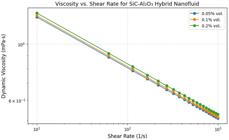
The viscosity of hybrid NF plotted against shear rate at various concentrations is shown in Figure 18. The log-log plot shows that the viscosity of the NP suspension decreases with increasing shear rate indicating shear-thinning behavior. Therefore, it may be classified as a non-Newtonian pseudoplastic fluid. As the concentration increases further, particle networks and microstructural rearrangements under flow reduce resistance. Understanding this rheological trend is essential because it indicates the possible hydraulic implications of the hybrid NF; however, direct pressure-drop measurement and pump-sizing analysis were beyond the scope of the present study.
Figure 19 displays how the TC of the SiC-Al2O3 hybrid NF varies with temperature for different NP concentrations. Each curve shows the volume fraction whereby with an increase in temperature due to Brownian motion or micro-convection effects and also with the increase in particle loading due to the higher intrinsic conductivity of SiC and Al2O3, TC is expected to rise. The increase in the upward trend indicates that the hybrid NF can greatly increase the heat transfer capacity when compared to water at high temperatures.

4. CONCLUSIONS
In this research, the improvement of the thermal performance of FPSC by SiC, Al2O3 and hybrid SiC–Al2O3 NFs was investigated. Water is a traditional heat transfer fluid, but the most important disadvantage of water is that it has low TC. While SiC NF had good TC, it also increased viscosity, requiring more PP. On the contrary, Al2O3 NF displayed a higher SHC for improved heat absorption but lower TC. The hybrid SiC–Al2O3 NF was found to show the combined advantages of both NPs. Thus, the hybrid enhances heat transfer performance without any compromise on viscosity/stability. The results showed that TC increased with NP concentration and temperature. The hybrid NFs exhibited a maximum enhancement of 31.96% at 70 °C as compared to water. The hybrid NF is a viable candidate for FPSC application based on the viscosity measurements. The FPSC efficiency testing at various flow rates showed that the hybrid NFs greatly helped in the performance improvement. The maximum TE obtained was 85% for a volume fraction of 0.1% at a MFR of 0.033 kg/s, which was approximately 40% higher than water. The results confirm that hybrid NFs represent an effective and feasible alternative to conventional working fluids in FPSCs. The stability of the SiC–Al2O3 hybrid NFs, along with optimized TC and heat capacity, increases energy absorption and heat transfer efficiency. The research findings could benefit future exploration of hybrid NFs in solar energy systems, which in turn would contribute towards enhancing the effectiveness and sustainability of thermal energy technologies. The key outcome is that the SiC-Al2O3 hybrid NF achieved an optical (zero-loss) efficiency intercept of about 85% in the FPSC, representing an enhancement of approximately 38% relative to water at matched operating conditions and outperforming both SiC and Al2O3 mono-NF. The efficiency improvement is attributed to the synergistic effects of Al2O3-induced TC enhancement and SiC-driven optical absorption and thermal stability, which together improve convective heat transfer and energy capture.
5. ACKNOWLEDGMENTS
The author would like to express their heartfelt gratitude to the supervisor for his guidance and unwavering support during this research.
6. DATA AVAILABILITY
The experimental data generated and analyzed during the current study are available from the corresponding author upon reasonable request.
7. BIBLIOGRAPHY
-
[1] MORIARTY, P., HONNERY, D., “What is the global potential for renewable energy?”, Renewable & Sustainable Energy Reviews, v. 16, n. 1, pp. 244–252, Jan. 2012. doi: https://doi.org/10.1016/j.rser.2011.07.151.
» https://doi.org/10.1016/j.rser.2011.07.151 -
[2] NWAIGWE, K.N., MUTABILWA, P., DINTWA, E., “An overview of solar power (PV systems) integration into electricity grids”, Materials Science for Energy Technologies, v. 2, n. 3, pp. 629–633, Sep. 2019. doi: https://doi.org/10.1016/j.mset.2019.07.002.
» https://doi.org/10.1016/j.mset.2019.07.002 -
[3] GARCÍA-RINCÓN, M.A., FLORES-PRIETO, J.J., “NFs stability in flat-plate solar collectors: A review”, Solar Energy Materials and Solar Cells, v. 271, pp. 112832, Jan. 2024. doi: https://doi.org/10.1016/j.solmat.2024.112832.
» https://doi.org/10.1016/j.solmat.2024.112832 -
[4] HE, Y., YU, H., DUAN, G., et al., “Thermal performance and experimental analysis of stainless-steel flat plate solar collector with full-flow channels”, Heliyon, v. 10, n. 7, pp. e28255, Jul. 2024. doi: https://doi.org/10.1016/j.heliyon.2024.e28255. PubMed PMID: 38560198.
» https://doi.org/10.1016/j.heliyon.2024.e28255 -
[5] SHAMSUL AZHA, N.I., HUSSIN, H., NASIF, M.S., et al., “Thermal performance enhancement in flat plate solar collector solar water heater: a review”, Processes (Basel, Switzerland), v. 8, n. 7, pp. 756, Jul. 2020. doi: https://doi.org/10.3390/pr8070756.
» https://doi.org/10.3390/pr8070756 -
[6] AHMADLOUYDARAB, M., EBADOLAHZADEH, M., ALI, H.M., “Effects of utilizing NF as working fluid in a lab-scale designed FPSC to improve thermal absorption and efficiency”, Physica A, v. 540, pp. 123109, Jan. 2020. doi: https://doi.org/10.1016/j.physa.2019.123109.
» https://doi.org/10.1016/j.physa.2019.123109 -
[7] HAWWASH, A.A., RAHMAN, A.K.A., NADA, S.A., et al., “Numerical investigation and experimental verification of performance enhancement of flat plate solar collector using nanofluids”, Applied Thermal Engineering, v. 130, pp. 363–374, 2018. doi: https://doi.org/10.1016/j.applthermaleng.2017.11.027.
» https://doi.org/10.1016/j.applthermaleng.2017.11.027 -
[8] KUMAR, D., UPADHYAY, V.V., PUNIA, A., et al., “Thermal performance based numerical investigation on NF applications with solar energy systems”, Journal of Nano and Electronic Physics, v. 16, n. 6, pp. 6007, 2024. doi: https://doi.org/10.21272/jnep.16(6).06007.
» https://doi.org/10.21272/jnep.16(6).06007 -
[9] URMI, W.T., RAHMAN, M.M., KADIRGAMA, K., et al., “Enhancing Thermal Conductivity of Water-Ethylene Glycol Mixtures: A Study on TiO2-Al2O3 Hybrid NFs with Surfactants”, Journal of Advanced Research in Micro and Nano Engineering, v. 27, n. 1, pp. 42–57, Jan. 2025. doi: https://doi.org/10.37934/armne.27.1.4257.
» https://doi.org/10.37934/armne.27.1.4257 -
[10] HUSSEIN, A.M., AWAD, A.T., ALI, H.H.M., “Evaluation of the thermal efficiency of NF flows in flat plate solar collector”, Journal of Thermal Engineering, v. 10, n. 2, pp. 299–307, Mar. 2024. doi: https://doi.org/10.18186/thermal.1448578.
» https://doi.org/10.18186/thermal.1448578 -
[11] BHARADWAJ, G., SHARMA, K., PANDEY, A.K., “Role of reduced graphene oxide-based NF in Thermal performance enhancement of flat plate solar collector”, E3S Web of Conferences, v. 488, pp. 02008, Mar. 2024. doi: https://doi.org/10.1051/e3sconf/202448802008.
» https://doi.org/10.1051/e3sconf/202448802008 -
[12] FARHANA, K., MAHAMUDE, A.S.F., KADIRGAMA, K., et al., “Noble MXene NFs’ impact on solar collector effectiveness enhancement: a CFD numerical evaluation”, Sustainable Energy Research, v. 11, n. 1, pp. 1, Jan. 2024. doi: https://doi.org/10.1186/s40807-023-00090-z.
» https://doi.org/10.1186/s40807-023-00090-z -
[13] FARHANA, K., KADIRGAMA, K., MOHAMMED, H.A., et al., “Analysis of efficiency enhancement of flat plate solar collector using crystal nano-cellulose (CNC) nanofluids”, Sustainable Energy Technologies and Assessments, v. 45, pp. 101049, Jun. 2021. doi: https://doi.org/10.1016/j.seta.2021.101049.
» https://doi.org/10.1016/j.seta.2021.101049 -
[14] HASSAN, Z.F., YAQOB, B.N., ABDULLAH, R.S., “Enhancing greenhouse thermal management with flat plate solar collectors and Al2O3-water NF”, International Journal of Energy Production and Management, v. 8, n. 2, pp. 71–79, Jun. 2023. doi: https://doi.org/10.18280/ijepm.080203.
» https://doi.org/10.18280/ijepm.080203 -
[15] NUHASH, M.M., ALAM, M.I., ZIHAD, A., et al., “Enhancing energy harvesting performance of a flat plate solar collector through integrated carbon-based and metal-based NFs”, Results in Engineering, v. 19, pp. 101276, Oct. 2023. doi: https://doi.org/10.1016/j.rineng.2023.101276.
» https://doi.org/10.1016/j.rineng.2023.101276 -
[16] RAHMAN, S.A., ISSA, S., SAID, Z., et al., “Techno-economic and life cycle analysis of a nano-enhanced flat plate solar collector for improved thermal performance”, SSRN, v. 18, pp. 100433. doi: https://doi.org/10.1016/j.nexus.2025.100433.
» https://doi.org/10.1016/j.nexus.2025.100433 -
[17] MOULEFERA, I., PASTOR, A.R., FUSTER, M.G., et al., “Novel application for graphene oxide-based ioNFs in flat plate solar thermal collectors”, Scientific Reports, v. 14, n. 1, pp. 17610, Apr. 2024. doi: https://doi.org/10.1038/s41598-024-67874-1. PubMed PMID: 39080327.
» https://doi.org/10.1038/s41598-024-67874-1 - [18] LOPEZ, J.A., GONZÁLEZ, F., BONILLA, F.A., et al., “Synthesis and characterization of Fe3O4 magnetic NF”, Revista Latinoamericana de Metalurgía y Materiales, v. 30, n. 1, pp. 60–66, Jan. 2010.
-
[19] NIKKAM, N., SALEEMI, M., HAGHIGHI, E.B., et al., “Fabrication, characterization and thermophysical property evaluation of SiC NFs for heat transfer applications”, Nano-Micro Letters, v. 6, n. 2, pp. 178-189, Dec. 2014. doi: https://doi.org/10.1007/BF03353782.
» https://doi.org/10.1007/BF03353782 -
[20] SIMPSON, S., SCHELFHOUT, A., GOLDEN, C., et al., “NF thermal conductivity and effective parameters”, Applied Sciences (Basel, Switzerland), v. 9, n. 1, pp. 87, Jan. 2018. doi: https://doi.org/10.3390/app9010087.
» https://doi.org/10.3390/app9010087 -
[21] SANDHYA, M., RAMASAMY, D., SUDHAKAR, K., et al., “Ultrasonication an intensifying tool for preparation of stable NFs and study the time influence on distinct properties of graphene NFs-A systematic overview”, Ultrasonics Sonochemistry, v. 73, pp. 105479, Mar. 2021. doi: https://doi.org/ 10.1016/j.ultsonch.2021.105479. PubMed PMID: 33578278.
» https://doi.org/10.1016/j.ultsonch.2021.105479 -
[22] SARSAM, W.S., KAZI, S.N., BADARUDIN, A., “Thermal performance of a flat-plate solar collector using aqueous colloidal dispersions of graphene nanoplatelets with different specific surface areas”, Applied Thermal Engineering, v. 172, pp. 115142, Jan. 2020. doi: https://doi.org/10.1016/j.applthermaleng.2020.115142.
» https://doi.org/10.1016/j.applthermaleng.2020.115142 -
[23] SARSAM, W.S., KAZI, S.N., BADARUDIN, A., “Thermal performance of a flat-plate solar collector using aqueous colloidal dispersions of multi-walled carbon nanotubes with different outside diameters”, Experimental Heat Transfer, v. 35, n. 3, pp. 258–281, Mar. 2022. doi: https://doi.org/10.1080/08916152.2020.1847215.
» https://doi.org/10.1080/08916152.2020.1847215 -
[24] NARAYANASAMY, S., IRUTHAYASAMY, G., PERUMAL, R., et al., “Optimization of solar water heating absorber riser with header tube using RSM and CFD simulation”, Matéria, v. 31, n. 30, pp. e20240850, Jan. 2025. doi: https://doi.org/10.1590/1517-7076-rmat-2024-0850.
» https://doi.org/10.1590/1517-7076-rmat-2024-0850 -
[25] PERIANNAN, D., DHAIRIYASAMY, R., VARSHNEY, D., et al., “Enhancing heat pipe efficiency using silver nanomaterial nanofluids: a hybrid approach with carbon nanotubes, graphene, and quantum Dot-MOS compositions”, Matéria, v. 28, n. 30, pp. e20240935, Apr. 2025. doi: https://doi.org/10.1590/1517-7076-rmat-2024-0935.
» https://doi.org/10.1590/1517-7076-rmat-2024-0935 -
[26] ELUMALAI, S., KADAMBAN, M., “Exploring the thermal benefits of surface-modified silver nanoparticle nanofluids in high heat flux applications”, Matéria, v. 22, n. 29, pp. e20240575, Nov. 2024. doi: https://doi.org/10.1590/1517-7076-rmat-2024-0575.
» https://doi.org/10.1590/1517-7076-rmat-2024-0575 -
[27] ALPHONSE, P., GUNASEKARAN, V.K., DHAIRIYASAMY, R., et al., “Comparative analysis of nanomaterials in heat pipe performance under variable operational conditions”, Matéria, v. 22, n. 29, pp. e20240783, 2024. doi: https://doi.org/10.1590/1517-7076-rmat-2024-0783.
» https://doi.org/10.1590/1517-7076-rmat-2024-0783 -
[28] VARDE, D., ARYA, M., “Investigation of dehumidifier performance parameters using ANN-PSO algorithm”, Matéria (Rio de Janeiro), v. 30, pp. e20250022, Sep. 2025. doi: https://doi.org/10.1590/1517-7076-rmat-2025-0022.
» https://doi.org/10.1590/1517-7076-rmat-2025-0022 -
[29] KARTHIKEYAN, U., HUSSAIN, J., “Enhancing the efficiency of wind energy conversion systems using Novel airfoil based small scale wind turbine”, Matéria, v. 31, n. 30, pp. e20240827, Jan. 2025. doi: https://doi.org/10.1590/1517-7076-rmat-2024-0827.
» https://doi.org/10.1590/1517-7076-rmat-2024-0827 -
[30] ZHU, P., HU, Y., “Carbon nanomaterials intelligent wearable devices for real-time athlete monitoring and performance tracking”, Matéria, v. 30, pp. e20250327, Aug. 2025. doi: https://doi.org/10.1590/1517-7076-rmat-2025-0327.
» https://doi.org/10.1590/1517-7076-rmat-2025-0327 - [31] RAFI, A., MUTHUVEL, S., “Revolutionizing solar energy: optimizing thermal performance of flat plate solar collectors with sic nanofluids”, SSRG International Journal of Mechanical Engineering, v. 21, pp. 75–87, Feb. 2025.


