
 Startup business model adaptation amid uncertainty: evidence from Brazil
Abstract
Purpose This article aims to investigate the relationship between business model adaptation, company performance and digitalization capability among startups during the coronavirus disease-2019 pandemic to determine whether there is a correlation among these aspects in uncertainty scenarios.
Design/methodology/approach The research used a mixed approach. First, it utilized a survey-based data collection method in which over 400 Brazilian startups participated, representing diverse demographic and cultural characteristics. Following the data analysis, the authors interviewed startup founders who participated in the first phase to enrich the discussion section.
Findings The results revealed that startups with stronger digital capabilities and higher performance were associated with lower levels of business model adaptation. However, this association was observed primarily in the dimensions of value creation and value capture, and not in value delivery.
Research limitations/implications The limitation of this study includes the cross-sectional data collection, which prevents the assessment of causality between variables.
Practical implications The findings suggest that startups should carefully evaluate their business models and adaptation strategies during uncertain periods.
Social implications The social implications of this study lie in supporting public policies and initiatives for entrepreneurship and startups. Government agencies and support institutions can use the findings to better understand the challenges faced by startups during uncertain times, effectively guiding their assistance and resources.
Originality/value This research contributes to the literature on business models and digitalization capability. It offers insights into the interplay between performance, digital capabilities and business model adaptation. Furthermore, the study contradicts the common sense that businesses should favor adaptation in uncertain moments, at least for startups in similar contexts.
Uncertainty; Company performance; Startups; COVID-19; Business model adaptation; Digitalization capability
Introduction
Startups and business models are hot topics in entrepreneurship and innovation research. Blank (2013) characterizes startups as organizations in the early stages that aim to find replicable and scalable business models, developing new products or services in environments of extreme uncertainty. In recent years, the success stories of startup companies have made the headlines, arousing the interest of various audiences, including investors, journalists, researchers and professionals from various sectors. Alongside the enthusiasm surrounding startups, there is ongoing interest in business models in management literature and corporate practice (Broccardo, Zicari, Jabeen, & Bhatti, 2023; Caputo, Pizzi, Pellegrini, & Dabić, 2020). The business model can be defined as the architecture of a company’s mechanisms for creating, delivering and capturing value (Foss & Saebi, 2018; Teece, 2010). An important focus in business model studies is the adaptation of business models (Mihailova, 2023; Tian, Coreynen, Matthyssens, & Shen, 2022), defined as the process by which management actively aligns the company’s business model to address a changing environment (Saebi, Lien, & Foss, 2017).
Despite the recent surge in publications on the subject, many studies focus on the benefits of business model adaptation in scenarios of economic stability, often overlooking evaluation in response to uncertainty, such as that generated by the coronavirus disease (COVID-19) pandemic. The pandemic-induced changes have propelled digitalization across all company operations (Nagel, 2020; Agostino, Arnaboldi, & Lema, 2021; Yildirim & Erdil, 2024), including startups and small- to medium-sized companies (Fitriasari, 2020; Islam, & De Reuver, 2022; Molina-Castillo, Stanko; Priyono, Moin, & Putri, 2020). This increase in digitalization and uncertainty in firm performance has underscored the relevance of business models (Clauss, Abebe, Tangpong, & Hock, 2021; Seetharaman, 2020; Soto-Acosta, 2020). While there is a common assumption that business model adaptations are beneficial, guided by the prospect theory (Hutzschenreuter, Kleindienst, Groene, & Verbeke, 2014), it is not always necessary. In times of uncertainty like the COVID-19 pandemic, startups with well-structured business models, better positioned to face external environments, tend to make fewer adaptations. This prompts the question: is a full adaptation of the startup business model imperative in high-uncertainty contexts?
Despite widespread encouragement for startups to adapt their business models in response to uncertainty, guided by the prospect theory, our objective is to show that business model adaptation is not imperative for all startups. Startups with better performance and digitalization tend to adapt their business models less. We test this hypothesis based on the data collected through surveys with representatives of Brazilian startups. Our methodological approach was mixed. It began with a quantitative phase, during which data was collected through a closed electronic questionnaire between June and August 2020, and ended with a qualitative phase in 2023, during which founders of startups that participated in the first phase were interviewed for further exploration. Over 400 valid responses were collected from senior members of startups across all Brazilian states, representing diverse demographics, socioeconomic and cultural characteristics. The results support our thesis that better performance and higher digitalization align with less business model adaptation.
This article’s main contribution is applying the prospect theory to the debate on business models and startups, demystifying the imperative of full adaptation. It extends the findings of Shimizu (2007) and Barberis (2013), indicating that business managers are more inclined to avoid risk in periods of gains and more likely to take risks in loss scenarios. Additionally, it enhances the understanding of business model adaptation in emerging markets (Landau, Karna, & Sailer, 2016; Sharma, Dixit, & Karna, 2016; Liu, Long, Fan, Wan, & Liu, 2023) and in response to uncertainty, such as the COVID-19 pandemic (Chanyasak, Koseoglu, King, & Aladag, 2022; Jabeen, Belas, Santoro, & Alam, 2023). From the digitalization perspective, this article aligns with studies on digitalization’s impact on business models (Bouwman, Nikou, & de Reuver, 2019; Brunelli, Gjergji, Lazzarotti, Sciascia, & Visconti, 2023; Parida, Sjödin, & Reim, 2019; Rachinger, Rauter, Müller, Vorraber, & Schirgi, 2018). Besides its academic originality and impact, the research results hold significant managerial potential, aiding professionals involved in business management, particularly in strategic planning for startups and addressing anxieties about changing business models.
2.Theoretical framework
The concept of business models and their developments is recent discussions in academia compared to the discussions around the prospect theory (Afflerbach, 2015; Harris, Aaron, McDowell, & Cline, 2014; Hutzschenreuter et al., 2014). Although widely accepted for accurately describing risk attitudes in experimental settings, this theory’s applicability is questioned outside the laboratory. However, Barberis (2013) demonstrated various real-world applications confirming the theory’s validity. The prospect theory’s reach extends beyond economics, influencing the understanding of real-world phenomena, from business to law, medicine, political science and public policy (Chiu & Wu, 2010). It aids in developing a descriptive model of individual strategic decision-making and supports research to help managers mitigate the adverse effects of decision-making (Sebora & Cornwall, 1995).
Studies have examined the prospect theory’s relationship with strategic decisions in diverse contexts, including supplier replacements, corporate strategy against foreign competitors, CEO incentive compensation and the commercial value of information technology. This article examines the role of the prospect theory in analyzing the adaptation of startup business models.
2.1Startup performance and business model adaptation in uncertainty scenarios
Although business model innovation (BMI) and adaptation hold significant theoretical relevance in management sciences, Ammirato, Linzalone, & Felicetti (2021) highlight that research in this area is still in its infancy and suffers from a lack of consistency and theoretical connections to the concept of “performance.” We define a business model as the architecture of a company’s mechanisms for creating, delivering and capturing value (Foss & Saebi, 2018; Teece, 2010). Value Creation involves activities allowing suppliers and customers to perceive generated value (Chesbrough, Lettl, & Ritter, 2018; Dyer, Singh, & Hesterly, 2018; Visnjic, Neely, & Jovanovic, 2018), while Value Delivery ensures value appropriation by customers through company–supplier relationships (Achtenhagen, Melin, & Naldi, 2013; Chesbrough et al., 2018). Value Capture ensures profitability by distributing profits among stakeholders (Chesbrough et al., 2018; Sjödin, Parida, Jovanovic, & Visnjic, 2020).
Business model adaptation (BMA) differs from BMI in that it can be noninnovative (Saebi et al., 2017) and responds to external causes, while BMI can stem from internal and external factors (Bucherer, Eisert, & Gassmann, 2012). BMA is the process by which management actively aligns a company’s business model to a changing environment (Saebi et al., 2017), analyzing adaptations in value offering, creation and delivery dimensions.
Adaptations occur due to various external factors, such as new entrants, competitor’s strategies or legal changes in sectors (Saebi, 2014; Saebi et al., 2017; Thornton, 2024). In uncertain scenarios like the COVID-19 pandemic, companies, particularly startups, adapt business models due to anticipated performance losses. Startup performance relates to operational indicator variations, with positive performance indicating increases and negative performance indicating reductions (Gupta & Lehmann, 2003; Oke, Walumbwa, & Myers, 2012; Terziovski & Samson, 2000).
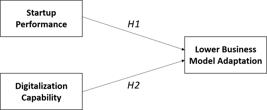
Following the logic of the prospect theory, managers in favorable performance situations are less sensitive to negative scenarios and risk-averse (Fiegenbaum, 1990; Marshall, Huan, Xu, & Nam, 2011; Sebora & Cornwall, 1995). Since any BMA implies an inherent risk, startups with favorable performance adapt business models less due to pandemic-induced uncertainties. Hence, our first hypothesis is:
H1.In uncertainty scenarios, startups with better performance have lower levels of business model adaptation.
2.2Digital capabilities and business model adaptation in uncertainty scenarios
Digitalization is crucial in analyzing BMA, especially during the COVID-19 pandemic. Digital Transformation has emerged as a significant phenomenon in strategic research (Piccinini, 2015; Vial, 2019) and market contexts (Fitzgerald, Kruschwitz, Bonnet, & Welch, 2014). Studies on digitalization’s impact on business models have surged since 2010 (Caputo et al., 2020). Digitalization poses challenges (Parida et al., 2019) but also offers competitive advantages (Annarelli, Battistella, Nonino, Parida, & Pessot, 2021) by enabling new ways of interacting with customers and improving performance (Lenka, Parida, & Wincent, 2017). Pang, Wang, Li, & Duan (2019) even suggest that managers should focus more on innovating their business models to enhance firm performance.
In the COVID-19 context, digitalization’s relevance has increased (Agostino et al., 2021; Seetharaman, 2020; Soto-Acosta, 2020), prompting significant adjustments in company operations (Fitriasari, 2020; Iivari et al., 2020; Nagel, 2020; Priyono et al., 2020). Startups with well-structured digitalization capabilities are better prepared for uncertainty scenarios, reflecting less sensitivity to adverse outcomes and risk aversion (Fiegenbaum, 1990; Marshall et al., 2011; Sebora & Cornwall, 1995). Companies with high digital capabilities adapt business models less due to better alignment with the prevailing context. Thus, our second hypothesis is:
H2.In uncertainty scenarios, startups with higher digitalization capabilities have lower levels of business model adaptation.
The conceptual model (Figure 1) depicts the research framework, including dependent and independent variables and their relationships.
3.
Methodology
Our field research aimed to describe the reality of startups concerning BMA and its relationship with company performance and digitalization capability. At first, a quantitative approach was adopted through a survey conducted during the COVID-19 pandemic. Data were collected through a closed electronic questionnaire between June and August 2020, encompassing startups from all Brazilian states, representing diverse demographics, socioeconomic backgrounds and cultural characteristics. The survey targeted professionals from 3,023 startups nationwide, representing 23.75% of the total 12,727 startups in Brazil, according to a study by the Associação Brasileira de Startups (ABStartups, 2020). The survey utilized random sampling from databases obtained from startup accelerators, facilitated by the authors’ ecosystem relationship. The geographic distribution of the final sample across different Brazilian regions closely resembles national distribution statistics, according to ABStartups (2020). Out of 512 responses received, 410 were considered valid after data processing. Survey data were initially managed on SurveyMonkey, the software for questionnaire creation and response collection. Respondents primarily comprised founders or C-level professionals (83.9%), with others occupying various company leadership positions.
After the survey stage, semi-structured interviews were carried out with the respondents from the first stage during September and October 2023 to better understand the relationships between the variables, including assessing causality. Startups were divided into groups or clusters that segment startups according to (i) the degree of adaptation of the business model, (ii) the level of digitalization capability and (iii) the company’s performance. For this classification, the answers to the questions that indicated the level of impact on each of these performance indicators were used. Based on this division, interviews were carried out with 12 representatives of some of the startups previously researched so that at least four companies represented each of the above clusters. The startups that would be interviewed were randomly selected based on new contacts with the startups. The interviews were carried out virtually, using the Zoom videoconferencing software, with the support of artificial intelligence software that automatically transcribed the conversations to facilitate recording and subsequent consultations.
3.1Constructs
The constructs and their measurement scopes are discussed in the subsequent sections.
3.1.1Business model adaptation.
In this study, BMA refers to actively aligning a company’s business model with a changing external environment, such as the COVID-19 pandemic. Two scales, Spieth & Schneider (2016) and Clauss (2017), were adapted to measure BMA, focusing on changes in Value Creation, Delivery and Capture dimensions. The adapted statements were consolidated into nine building blocks, aligning with Osterwalder, Pigneur, & Tucci’s (2005) business model framework. Questions were presented randomly, and each statement utilized a five-level agreement scale. The complete questionnaire can be found in Appendix.
3.1.2Digitalization capability.
Digitalization capability represents a set of resources and processes managed to enable a company’s digital activities. A scale by (Greif, 2016) was adapted to measure the digitalization capability of Brazilian startups. Digital sales, Customer involvement, and People and Culture were evaluated through a five-level measurement scale, including a nonexistent digitalization level option.
3.1.3Startup performance.
Startup performance was assessed using three commonly monitored indicators: monthly revenue (Oke et al., 2012), number of customers (Gupta & Lehmann, 2003) and number of employees (Terziovski & Samson, 2000). Each indicator was evaluated based on its impact during the COVID-19 pandemic, with respondents accounting for perceived decrease, no change or increase. Subsequently, respondents estimated impact sizes based on five performance levels, facilitating comparison with other constructs.
The methodology used in this study provides a robust framework for examining BMA, startup performance and digitalization capability, offering valuable insights into startups’ responses to uncertain environments such as the COVID-19 pandemic.
4.Results
The SmartPLS 4 software was used for statistical calculations using the structural equation modeling techniques to evaluate the model’s reliability and validity. The results are presented and discussed below.
The reliability and validity of the proposed model were assessed using techniques recommended by the academic literature on SmartPLS software analysis. As shown in Table 1, the average variance extracted (AVE) and composite reliability (rho_c) values exceeded the recommended thresholds for all constructs. Although Cronbach’s alpha for Value Capture was slightly below expectations due to its limited number of variables, it did not significantly impact construct consistency. Discriminant validity, depicted in Table 2, also met expectations according to the Fornell–Larcker criterion.
Table 3 illustrates the constructs’ attributes in the software’s path coefficient calculations. Analysis revealed that only the relationship between Value Delivery aspect adaptation and startup performance was not statistically significant (p > 0.05). Similarly, the relationship between Value Capture aspect adaptation and digital capability was not statistically significant (p > 0.05). However, all other associations were substantial (p < 0.05), supporting the article’s hypotheses.
The results suggest that startups with better digital capabilities and performance tend to exhibit lower levels of BMA. This confirms the article’s hypotheses, indicating that startups with more robust performance and digital capabilities are less likely to adapt their business models in uncertain scenarios. Notably, while the hypothesis was supported for the relationship between digital capability and the dimensions related to Value Creation and Value Delivery of the business model, it was not consistently supported for the Value Capture dimension. On the other hand, the hypothesis was supported by the relationship between company performance and the dimensions related to Value Creation and Value Capture of the business model. Still, it was not consistently supported for the Value Delivery dimension.
5.Discussion
In this study, the hypothesis that startups which adapt their business models less during uncertainty are associated with better performance finds statistical significance for Value Creation and Value Capture, particularly for the former. However, for the Value Delivery dimension, the study failed to confirm or refute the hypothesis, potentially due to the pandemic’s significant impact on organizations’ external aspects. Nonetheless, a negative relationship between performance and adaptation in this dimension is suggested, aligning with decision-making tendencies under the prospect theory, where leaders anticipating positive outcomes exhibit less risk propensity, leading to lesser adaptation. Andersen, Aagaard, & Magnusson (2022) support this tendency, emphasizing managerial decision-making’s centrality in BMI amidst uncertainty. Notably, the study’s findings indicate that startups with higher digitalization capacity were less inclined to adapt their business models during uncertainty, particularly in the Creation and Delivery dimensions, reflecting leaders’ perceptions of organizational readiness and reduced risk inclination. However, the study could not establish a direct correlation between digitalization capacity and adaptation in the Value Capture dimension, possibly due to measurement limitations and the complexity of factors influencing revenue and cost structures within business models. This warrants future investigation of these nuanced dynamics.
The research also underscores the impact of the pandemic on the management’s propensity to innovate business models, contrasting the traditional reluctance among startup leaders with the necessity forced upon them by the crisis. As exemplified by the founder of one of the startups interviewed, which faced a sudden shift in its operational landscape, the pandemic demanded immediate adaptation despite prior hesitations. Moreover, findings by Guckenbiehl & Zubielqui (2022) reveal a nuanced relationship between startup size and adaptation tendencies: smaller startups capitalize on opportunities amidst adversity while larger ones, such as that whose founder was interviewed in this study, leverage their market position to proactively pursue digitalization strategies, accelerating their efforts in response to external pressures. This underscores the complex interplay between external shocks, managerial decision-making and organizational responses in shaping BMAs in the face of crisis.
Our results contribute to both theoretical and practical realms of business management. They align with the prospect theory, suggesting that managers of high-performing startups are more risk-averse and thus less inclined to adapt their business models in times of uncertainty. The findings also advance discussions on BMA, highlighting the nuanced relationship between adaptation and performance and the role of digitalization capability. Additionally, the study addresses future research directions proposed by Foss & Saebi (2018), deepening the understanding of business model interdependencies and the capabilities’ role as drivers of BMI. Finally, this work also contributes to recent research in business management and strategy that deals with these subjects from the perspective of the COVID-19 pandemic (Chanyasak et al., 2022).
From a practical perspective, the results caution against the assumption that innovation always leads to improved business models, especially in uncertain contexts. Managers and investors should carefully evaluate adaptation strategies, considering the impact of their perspectives on company performance and the incorporation of digital trends. The study’s implications extend to government agencies, support institutions and startup hubs, offering insights for policy-making and support initiatives.
6.Conclusion
This research challenges the notion that high uncertainty demands full adaptation of startup business models. Through primary data collection from over 400 Brazilian startup founders and C-level executives during the COVID-19 pandemic, the study reveals that startups with more substantial digital capabilities and higher performance tend to adapt their business models less. This supports the article’s hypotheses and underscores the nuanced relationship between performance, digital capability and BMA. The study addresses a gap in understanding the phenomenon of BMA in startups within contexts of uncertainty, mainly through the lens of the prospect theory and managerial decision-making processes. It investigates whether startups exhibiting superior performance during periods of uncertainty are associated with lesser BMA and if startups with higher digitalization capacities are likewise associated with reduced adaptation levels. The findings contribute to the existing literature on strategic management by supporting the principles of the prospect theory, emphasizing how managerial perceptions of risk influence strategic decisions, especially during uncertain times. Moreover, the study reinforces previous research by highlighting the importance of aligning business model constructs with prevailing market conditions, thus offering insights into the strategic behavior of startups, particularly in emerging markets such as Brazil, and in response to the COVID-19 pandemic.
Furthermore, the study validates measurement scales for BMA and digitalization capacity, providing empirical contributions to the field. By validating existing measurement schemes, the study offers a quantitative foundation for future research in business model studies, addressing a scarcity of validated measurement tools in this domain. These findings advance academic discourse and hold practical implications for policymakers, entrepreneurship support entities and startup managers, aiding in formulating targeted strategies and interventions. However, the study acknowledges methodological limitations, such as the temporal constraints of data collection and the simultaneous measurement of variables, which warrant future research endeavors. Additionally, avenues for future research are suggested, including longitudinal studies and investigations into the moderating role of digitalization capacity on the relationship between performance and BMAs. These offer opportunities for deeper insights into strategic decision-making dynamics in uncertain environments.
Data availability statement
Data are available upon reasonable request.
References
-
ABStartups. (2020). Crescimento das startups. Retrieved from https://abstartups.com.br/cres-cimento-das-startups/ (accessed May 2023).
» https://abstartups.com.br/cres-cimento-das-startups/ -
Achtenhagen, L., Melin, L., & Naldi, L. (2013). Dynamics of business models–strategizing, critical capabilities and activities for sustained value creation. Long Range Planning, 46(6), 427–442, 10.1016/j.lrp.2013.04.002.
» https://doi.org/10.1016/j.lrp.2013.04.002 -
Afflerbach, P. (2015). The business value of IT in light of prospect Theory – A new explanation for IT paradoxes. Business & Information Systems Engineering, 57(5), 299–310, 10.1007/s12599-015-0400-6.
» https://doi.org/10.1007/s12599-015-0400-6 -
Agostino, D., Arnaboldi, M., & Lema, M. D. (2021). New development: COVID-19 as an accelerator of digital transformation in public service delivery. Public Money & Management, 41(1), 69–72, 10.1080/09540962.2020.1764206.
» https://doi.org/10.1080/09540962.2020.1764206 -
Ammirato, S., Linzalone, R., & Felicetti, A. M. (2021). Business model innovation drivers as antecedents of performance. Measuring Business Excellence, 26(1), 6–22, 10.1108/MBE-01-2021-0012.
» https://doi.org/10.1108/MBE-01-2021-0012 -
Andersen, T. C., Aagaard, A., & Magnusson, M. (2022). Exploring business model innovation in SMEs in a digital context: Organizing search behaviours, experimentation, and decision-making. Creativity and Innovation Management, 31(1), 19–34, 10.1111/caim.12474.
» https://doi.org/10.1111/caim.12474 -
Annarelli, A., Battistella, C., Nonino, F., Parida, V., & Pessot, E. (2021). Literature review on digitalization capabilities: Co-citation analysis of antecedents, conceptualization, and consequences. Technological Forecasting and Social Change, 166, 120635. doi: 10.1016/j.techfore.2021.120635.
» https://doi.org/10.1016/j.techfore.2021.120635 -
Barberis, N. (2013). Thirty years of prospect theory in economics: A review and assessment. Journal of Economic Perspectives, 27(1), 173–196, 10.1257/jep.27.1.173.
» https://doi.org/10.1257/jep.27.1.173 - Blank, S. (2013). Why the lean startup changes everything. Harvard Business Review, 91(5), 63–72.
-
Bouwman, H., Nikou, S., & de Reuver, M. (2019). Digitalization, business models, and SMEs: How do business model innovation practices improve performance of digitalizing SMEs? Telecommunications Policy, 43(9), 101828. doi: 10.1016/j.telpol.2019.101828.
» https://doi.org/10.1016/j.telpol.2019.101828 -
Broccardo, L., Zicari, A., Jabeen, F., & Bhatti, Z. A. (2023). How digitalization supports a sustainable business model: A literature review. Technological Forecasting and Social Change, 187, 122146. doi: 10.1016/j.techfore.2022.122146.
» https://doi.org/10.1016/j.techfore.2022.122146 -
Brunelli, S., Gjergji, R., Lazzarotti, V., Sciascia, S., & Visconti, F. (2023). Effective business model adaptations in family SMEs in response to the COVID-19 crisis. Journal of Family Business Management, 13(1), 101–117, 10.1108/JFBM-02-2022-0020.
» https://doi.org/10.1108/JFBM-02-2022-0020 -
Bucherer, E., Eisert, U., & Gassmann, O. (2012). Towards systematic business model innovation: Lessons from product innovation management. Creativity and Innovation Management, 21(2), 183–198, 10.1111/j.1467-8691.2012.00637.x.
» https://doi.org/10.1111/j.1467-8691.2012.00637.x -
Caputo, A., Pizzi, S., Pellegrini, M. M., & Dabić, M. (2020). Digitalization and business models: Where are we going? A science map of the field. Journal of Business Research, 123(C), 489–501, 10.1016/j.jbusres.2020.09.053.
» https://doi.org/10.1016/j.jbusres.2020.09.053 -
Chanyasak, T., Koseoglu, M. A., King, B., & Aladag, O. F. (2022). Business model adaptation as a strategic response to crises: Navigating the COVID-19 pandemic. International Journal of Tourism Cities, 8(3), 616–635, 10.1108/IJTC-02-2021-0026.
» https://doi.org/10.1108/IJTC-02-2021-0026 -
Chesbrough, H., Lettl, C., & Ritter, T. (2018). Value creation and value capture in open innovation. Journal of Product Innovation Management, 35(6), 930–938, 10.1111/jpim.12471.
» https://doi.org/10.1111/jpim.12471 -
Chiu, A., & Wu, G. (2010). Prospect theory. Wiley encyclopedia of operations research and management science, doi: 10.1002/9780470400531.eorms0687.
» https://doi.org/10.1002/9780470400531.eorms0687 -
Clauss, T. (2017). Measuring business model innovation: Conceptualization, scale development, and proof of performance. R&D Management, 47(3), 385–403, 10.1111/radm.12186.
» https://doi.org/10.1111/radm.12186 -
Clauss, T., Abebe, M., Tangpong, C., & Hock, M. (2021). Strategic agility, business model innovation, and firm performance: An empirical investigation. IEEE Transactions on Engineering Management, 68(3), 767–784, 10.1109/TEM.2019.2910381.
» https://doi.org/10.1109/TEM.2019.2910381 -
Dyer, J., Singh, H., & Hesterly, W. S. (2018). The relational view revisited: A dynamic perspective on value creation and value capture. Strategic Management Journal, 39(12), 3140–3162, 10.1002/smj.2785.
» https://doi.org/10.1002/smj.2785 -
Fiegenbaum, A. (1990). Prospect theory and the risk-return association: An empirical examination in 85 industries. Journal of Economic Behavior & Organization, 14(2), 187–203, 10.1016/0167-2681(90)90074-N.
» https://doi.org/10.1016/0167-2681(90)90074-N -
Fitriasari, F. (2020). How do small and medium enterprise (SME) survive the COVID-19 outbreak? Jurnal Inovasi Ekonomi, 5(2) doi: 10.22219/jiko.v5i3.11838.
» https://doi.org/10.22219/jiko.v5i3.11838 - Fitzgerald, M., Kruschwitz, N., Bonnet, D., & Welch, M. (2014). Embracing digital technology: A new strategic imperative. MIT Sloan Management Review, 55(2), 1.
-
Foss, N. J., & Saebi, T. (2018). Business models and business model innovation: Between wicked and paradigmatic problems. Long Range Planning, 51(1), 9–21, 10.1016/j.lrp.2017.07.006.
» https://doi.org/10.1016/j.lrp.2017.07.006 -
Greif, H., Kühnis, N., & Warnking, P. (2016). Digital transformation: how mature are Swiss SMEs?. http://www.pwc.ch/en/publications/2016/pwc_digital_transform_how_mature_are_swiss_smes_survey_16_en.pdf
» http://www.pwc.ch/en/publications/2016/pwc_digital_transform_how_mature_are_swiss_smes_survey_16_en.pdf -
Guckenbiehl, P., & Zubielqui, G. C. (2022). Startups’ business model changes during the COVID-19 pandemic: Counteracting adversities and pursuing opportunities. International Small Business Journal: Researching Entrepreneurship, 40(2), 150–177, 10.1177/02662426211055447.
» https://doi.org/10.1177/02662426211055447 -
Gupta, S., & Lehmann, D. R. (2003). Customers as assets. Journal of Interactive Marketing, 17(1), 9–24, 10.1002/dir.10045.
» https://doi.org/10.1002/dir.10045 -
Harris, M., Aaron, J., McDowell, W., & Cline, B. (2014). Optimal CEO incentive contracts: A prospect theory explanation. Journal of Business Strategies, 31(2), 336–356, 10.54155/jbs.31.2.336-356.
» https://doi.org/10.54155/jbs.31.2.336-356 -
Hutzschenreuter, T., Kleindienst, I., Groene, F., & Verbeke, A. (2014). Corporate strategic responses to foreign entry: Insights from prospect theory. The Multinational Business Review, 22(3), 294–323, 10.1108/MBR-06-2014-0026.
» https://doi.org/10.1108/MBR-06-2014-0026 -
Iivari, N., Sharma, S., & Ventä-Olkkonen, L. (2020). Digital transformation of everyday life–how COVID-19 pandemic transformed the basic education of the young generation and why information management research should care?. International Journal of Information Management, 55, 102183, 10.1016/j.ijinfomgt.2020.102183.
» https://doi.org/10.1016/j.ijinfomgt.2020.102183 -
Jabeen, F., Belas, J., Santoro, G., & Alam, G. M. (2023). The role of open innovation in fostering SMEs’ business model innovation during the COVID-19 pandemic. Journal of Knowledge Management, 27(6), 1562–1582, 10.1108/JKM-05-2022-0347.
» https://doi.org/10.1108/JKM-05-2022-0347 -
Landau, C., Karna, A., & Sailer, M. (2016). Business model adaptation for emerging markets: A case study of a German automobile manufacturer in India. R&D Management, 46(3), 480–503, 10.1111/radm.12201.
» https://doi.org/10.1111/radm.12201 -
Lenka, S., Parida, V., & Wincent, J. (2017). Digitalization capabilities as enablers of value co‐creation in servitizing firms. Psychology & Marketing, 34(1), 92–100, 10.1002/mar.20975.
» https://doi.org/10.1002/mar.20975 -
Liu, L., Long, J., Fan, Q., Wan, W., & Liu, R. (2023). Examining the functionality of digital platform capability in driving B2B firm performance: Evidence from the emerging market. Journal of Business & Industrial Marketing, 38(9), 1941–1957, 10.1108/JBIM-09-2021-0441.
» https://doi.org/10.1108/JBIM-09-2021-0441 -
Marshall, R., Huan, T. C., Xu, Y., & Nam, I. (2011). Extending prospect theory cross-culturally by examining switching behavior in consumer and business-to-business contexts. Journal of Business Research, 64(8), 871–878, 10.1016/j.jbusres.2010.09.009.
» https://doi.org/10.1016/j.jbusres.2010.09.009 -
Mihailova, I. (2023). Business model adaptation for realized international scaling of born-digitals. Journal of World Business, 58(2), 101418. doi: 10.1016/j.jwb.2022.101418.
» https://doi.org/10.1016/j.jwb.2022.101418 -
Molina-Castillo, F. J., Stanko, M. A., Islam, N., & De Reuver, M. (2022). The impact of technological turbulence on SMEs business model innovation performance: The contingent role of entry order. IEEE Transactions on Engineering Management, 71(1), 4116–4130, 10.1109/TEM.2022.3210488.
» https://doi.org/10.1109/TEM.2022.3210488 -
Nagel, L. (2020). The influence of the COVID-19 pandemic on the digital transformation of work. International Journal of Sociology and Social Policy, 40(9-10), 861–875, 10.1108/IJSSP-07-2020-0323.
» https://doi.org/10.1108/IJSSP-07-2020-0323 -
Oke, A., Walumbwa, F. O., & Myers, A. (2012). Innovation strategy, human resource policy, and firms’ revenue growth: The roles of environmental uncertainty and innovation performance. Decision Sciences, 43(2), 273–302, 10.1111/j.1540-5915.2011.00350.x.
» https://doi.org/10.1111/j.1540-5915.2011.00350.x -
Osterwalder, A., Pigneur, Y., & Tucci, C. (2005). Clarifying business models: Origins, present, and future of the concept. Communications of the Association for Information Systems, 16(1) doi: 10.17705/1CAIS.01601.
» https://doi.org/10.17705/1CAIS.01601 -
Pang, C., Wang, Q., Li, Y., & Duan, G. (2019). Integrative capability, business model innovation, and performance: Contingent effect of business strategy. European Journal of Innovation Management, 22(3), 541–561, 10.1108/EJIM-09-2018-0208.
» https://doi.org/10.1108/EJIM-09-2018-0208 -
Parida, V., Sjödin, D., & Reim, W. (2019). Reviewing literature on digitalization, business model innovation, and sustainable industry: Past achievements and future promises. Sustainability, 11(2), 391. doi: 10.3390/su11020391.
» https://doi.org/10.3390/su11020391 - Piccinini, E., Hanelt, A., Gregory, R., & Kolbe, L. (2015). Transforming industrial business: the impact of digital transformation on automotive organizations. In Proceedings of the 36th International Conference on Information Systems (ICIS 2015), Fort Worth, TX, USA. 13-16 December 2015, 1–2.
-
Priyono, A., Moin, A., & Putri, V. N. A. O. (2020). Identifying digital transformation paths in the business model of SMEs during the COVID-19 pandemic. Journal of Open Innovation: Technology, Market, and Complexity, 6(4), 104. doi: 10.3390/joitmc6040104.
» https://doi.org/10.3390/joitmc6040104 -
Rachinger, M., Rauter, R., Müller, C., Vorraber, W., & Schirgi, E. (2018). Digitalization and its influence on business model innovation. Journal of Manufacturing Technology Management, 30(8), 1143–1160, 10.1108/JMTM-01-2018-0020.
» https://doi.org/10.1108/JMTM-01-2018-0020 - Saebi, T. (2014). Evolution, adaptation, or innovation? A contingency framework on business model dynamics. In Foss, N.J. & Saebi, T. (Eds). Business model innovation: the organizational dimension, Oxford: Oxford University Press, pp. 145–168.
-
Saebi, T., Lien, L., & Foss, N. J. (2017). What drives business model adaptation? The impact of opportunities, threats, and strategic orientation. Long Range Planning, 50(5), 567–581, 10.1016/j.lrp.2016.06.006.
» https://doi.org/10.1016/j.lrp.2016.06.006 - Sebora, T., & Cornwall, J. (1995). Expected utility theory vs. prospect theory: Implications for strategic decision makers. Journal of Managerial Issues, 7(1), 41–61.
-
Seetharaman, P. (2020). Business models shifts: Impact of COVID-19. International Journal of Information Management, 54(1), 102173. doi: 10.1016/j.ijinfomgt.2020.102173.
» https://doi.org/10.1016/j.ijinfomgt.2020.102173 -
Sharma, S., Dixit, M. R., & Karna, A. (2016). Design leaps: Business model adaptation in emerging economies. Journal of Asia Business Studies, 10(2), 105–124, 10.1108/JABS-01-2015-0009.
» https://doi.org/10.1108/JABS-01-2015-0009 -
Shimizu, K. (2007). Prospect theory, behavioral theory, and the threat-rigidity thesis: Combinative effects on organizational decisions to divest formerly acquired units. Academy of Management Journal, 50(6), 1495–1514, 10.5465/amj.2007.28226158.
» https://doi.org/10.5465/amj.2007.28226158 -
Sjödin, D., Parida, V., Jovanovic, M., & Visnjic, I. (2020). Value creation and value capture alignment in business model innovation: A process view on outcome‐based business models. Journal of Product Innovation Management, 37(2), 158–183, 10.1111/jpim.12516.
» https://doi.org/10.1111/jpim.12516 -
Soto-Acosta, P. (2020). COVID-19 pandemic: Shifting digital transformation to a high-speed gear. Information Systems Management, 37(4), 260–266, 10.1080/10580530.2020.1814461.
» https://doi.org/10.1080/10580530.2020.1814461 -
Spieth, P., & Schneider, S. (2016). Business model innovativeness: Designing a formative measure for business model innovation. Journal of Business Economics, 86(6), 671–696, 10.1007/s11573-015-0794-0.
» https://doi.org/10.1007/s11573-015-0794-0 -
Teece, D. J. (2010). Business models, business strategy and innovation. Long Range Planning, 43(2–3), 172–194, 10.1016/j.lrp.2009.07.003.
» https://doi.org/10.1016/j.lrp.2009.07.003 -
Terziovski, M., & Samson, D. (2000). The effect of company size on the relationship between TQM strategy and organizational performance. The TQM Magazine, 12(2), 144–149, 10.1108/09544780010318406.
» https://doi.org/10.1108/09544780010318406 -
Thornton, H. C. (2024). Business model change and internationalization in the sharing economy. Journal of Business Research, 170, 114250. doi: 10.1016/j.jbusres.2023.114250.
» https://doi.org/10.1016/j.jbusres.2023.114250 -
Tian, J., Coreynen, W., Matthyssens, P., & Shen, L. (2022). Platform-based servitization and business model adaptation by established manufacturers. Technovation, 118, 102222. doi: 10.1016/j.technovation.2021.102222.
» https://doi.org/10.1016/j.technovation.2021.102222 -
Vial, G. (2019). Understanding digital transformation: a review and a research agenda. The Journal of Strategic Information Systems, 28(2), 118–144, 10.1016/j.jsis.2019.01.003.
» https://doi.org/10.1016/j.jsis.2019.01.003 -
Visnjic, I., Neely, A., & Jovanovic, M. (2018). The path to outcome delivery: Interplay of service market strategy and open business models. Technovation, 72–73, 46–59, 10.1016/j.technovation.2018.02.003.
» https://doi.org/10.1016/j.technovation.2018.02.003 -
Yildirim, A. C., & Erdil, E. (2024). The effect of COVID-19 on digital banking explored under business model approach. Qualitative Research in Financial Markets, 16(1), 87–107, 10.1108/QRFM-08-2021-0142.
» https://doi.org/10.1108/QRFM-08-2021-0142

Edited by
-
ASSOCIATE EDITOR:
Eiriz Vasco


