
 Entrepreneurial intentions and the role of educational and social support: do the self-efficacy and the theory of planned behavior variables matter?
Abstract
Purpose The study aims to ascertain whether educational and social support for entrepreneurs significantly affects university students’ intentions to become successful entrepreneurs. This study examines the mediating role of the Theory of Planned Behavior (TPB) variables (e.g. entrepreneurial personal attitude, subjective norms and entrepreneurial perceived behavioral control) and entrepreneurial self-efficacy in encouraging young entrepreneurs.
Design/methodology/approach An online survey with a structured questionnaire collected data from different university students in Bangladesh; subsequently, it was analyzed through the structural equation model.
Findings The results suggested that educational support has a direct positive relationship with the three variables of TPB. Moreover, the findings indicated that social support positively influences the variables of TPB, entrepreneurial self-efficacy and entrepreneurial intentions. The variables of TPB and entrepreneurial self-efficacy were found to have a significant direct impact on entrepreneurial intentions and also exhibited favorable mediating effects of educational and social support on entrepreneurial intentions.
Research limitations/implications First, the study is only generalized to some sectors of entrepreneurship activities because the researchers used samples from university students across Bangladesh. Second, the implicit limitation of survey-based research is that respondents need to know more ways of understanding the questionnaires accurately, and some participants need to be taught how to answer the question items.
Practical implications The main practical implication for the relationship between entrepreneurial intentions and educational support involves different entrepreneurial educational programs, which give rise to attitude, behavior, self-efficacy and intentions and enhance the student's awareness of advancing a successful entrepreneurial career.
Social implications This study demonstrated that universities and social communities should promote the improvement of innovative thoughts for entrepreneurs and offer essential information about entrepreneurship.
Originality/value Because entrepreneurial educational support is a crucial factor in entrepreneurial intentions, universities need to develop a practical education system that can help improve the skills required to start new ventures. The results will improve a new route to developing students’ entrepreneurial intentions using the variables of TPB and entrepreneurial self-efficacy. Subsequently, these research findings will help to achieve governmental goals and increase the number of startups in the future.
Educational and social support; TPB; Entrepreneurial self-efficacy; Entrepreneurial intentions
Introduction
Entrepreneurship is the strength of the country's economic system, and its primary function is to contribute to economic development by implementing reindustrialization policies, applying innovations and supporting the global economy (Smirnov, Semenov, Zakharova, & Dulina, 2020). Around the world, entrepreneurship is an increasingly popular field for practitioners’ research, and entrepreneurship education is deemed imperative for increasing employment possibilities and facilitating enterprise development by generating profits resulting from the country's economic growth (Anwar, Jamal, Saleem, & Thoudam, 2021). Regarding social aspects, the Global Entrepreneurship Monitor Research (GEMR) reviews that there are connections between a country's GDP and entrepreneurial performance (Urbano, Aparicio, & Audretsch, 2018). In the 21st century, achieving the Sustainable Development Goals (SDGs) is seen as the most important issue for governments, and entrepreneurship plays an essential role in achieving the SDGs by the deadline of 2030 (Luc, 2020).
Many countries have taken initiatives for the educational and social improvement of entrepreneurship, and, at present, the Bangladeshi government is focusing on growing an entrepreneurial environment to cater to the opportunities. To promote entrepreneurship, the government of Bangladesh awarded the 2019 National Youth Award to 22 young entrepreneurs; moreover, the Department of Youth Development and the Ministry of ICT are organizing various agro-entrepreneurship, freelance and self-employment teaching programs for young entrepreneurs in each region (Shahriar, Islam, Zayed, Hasan, & Raisa, 2021). Currently, the young graduates are implicated in structuring their businesses in the ICT field, establishing agro- and dairy-based construction items, restaurants and food carts, and enchanting up freelancing for outsourced employment to meet the stipulated requirements of the engagement financial system (Shahriar et al., 2021).
The unemployment rate in Bangladesh struck an all-time high of 6.91% in November 2023, compared to more tamed rates of 4.2% to 4.5% in the previous two decades (Kashem & Islam, 2023). The employment sector faces several challenges due to the complexity originating from the war between Ukraine and Russia. However, youth forget that entrepreneurship is a possibility through which a person can overcome the unemployment problem. As mentioned earlier, student unemployment rates suggest the necessity for entrepreneurial educational improvement; therefore, entrepreneurship studies reflect on future career directions. Therefore, our study examines how to become a successful entrepreneur by describing the association among entrepreneurial educational support (EES), entrepreneurial social support (ESS), the variables of the Theory of Planned Behavior (TPB), entrepreneurial self-efficacy (ESE) and entrepreneurial intentions (EI).
Does EES and ESS affect university students’ EI in forming successful entrepreneurs?
RQ2.Do TPB variables (e.g. EPA, SN and EPBC) and ESE affect university students’ EI in their becoming successful entrepreneurs?
RQ3.Does TPB variables (e.g. EPA, SN and EPBC) and ESE mediate the relationship between EES and EI in forming successful entrepreneurs?
RQ4.Does TPB variables (e.g. EPA, SN and EPBC) and ESE mediate the relationship between ESS and EI in forming successful entrepreneurs?
Hypotheses development
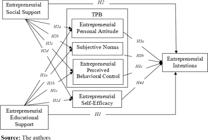
EES positively influences EI in forming successful entrepreneurs.
EES positively influences EPA in forming successful entrepreneurs.
EES positively influences SN in forming successful entrepreneurs.
EES positively influences EPBC in forming successful entrepreneurs.
EES positively influences ESE in forming successful entrepreneurs.
ESS positively influences EI in forming successful entrepreneurs.
ESS positively influences EPA to form successful entrepreneurs.
H3a.EPA positively influences EI to form successful entrepreneurs.
ESS positively influences SN in forming successful entrepreneurs.
H3b.SN positively influences EI in forming successful entrepreneurs.
ESS positively influences EPBC in forming successful entrepreneurs.
H3c.EPBC positively influences EI in forming successful entrepreneurs.
ESS positively influences ESE in forming successful entrepreneurs.
H4a.ESE positively influences EI in forming successful entrepreneurs.
TPB (EPA, SN and EPBC) mediates the relationship between ESS and EI.
H5b.TPB (EPA, SN and EPBC) mediates the relationship between EES and EI.
ESE mediates the relationship between ESS and EI.
H5d.ESE mediates the relationship between EES and EI.
Figure 1 illustrates the research model described in the following section.
3.
Methodology
3.1Survey procedures and data collection
The primary data were collected by an online survey using a structured questionnaire with the support of the Google Docs Form. This questionnaire applied the five-point Likert scale, which ranged from strongly disagree to strongly agree. Additionally, this questionnaire was accumulated online (e.g. through email and social networking sites), and the targeted population was students from different universities in Bangladesh. Furthermore, a pilot test with 21 respondents was conducted earlier in the data collection process to evaluate the data’s clarity. The survey was conducted for approximately four weeks in October 2021. A database of 307 responses was collected, followed by initial data screening and successive data cleaning. Eventually, 278 responses were validated for analysis.
3.2Data analysis
The component analysis was tested as an integral part of the scale to examine the measurement and structural model equally using SPSS 25.0 and AMOS 24.0 software. Moreover, structure equation modeling (SEM) was applied to validate the research model. We applied Harman’s Single Factor Test for common method bias to examine the nonresponse bias. The first aspect of the study explained 27% of the variance. If the variance percentage is less than 50% and some other factors of eigenvalues are higher than 1 (see Table 1), then it is perfect for the next step of the analysis (Podsakoff, MacKenzie, Lee, & Podsakoff, 2003).
4.Empirical results
To analyze the proposed research model, we used exploratory factor analysis (EFA) and confirmatory factor analysis simultaneously to receive better parameter accuracy from the measurement model suggested by Civelek (2018).
4.1Demographic results
The demographic information is also enclosed in the questionnaire. As seen from the demographic result, the numbers of male and female participants were 170 and 124, which correspond to 55.4% and 44.6%, respectively. Approximately 73.4% of the total participants were bachelors, 25.5% were master’s students and 1.1% were PhD or other levels of study.
4.2Exploratory factor analysis
In the EFA, factors are good communalities if higher than 0.3 (Field, 2009), and the reliability is excellent. Subsequently, the variable’s internal consistency reliability was measured using Cronbach's alpha, which was higher than 0.70 (Cortina, 1993) (see Table 1), a trusted implement. It is implicit that the items on the Likert scale estimate the same construct and are extremely interrelated.
4.3Reliability and validity measurements
Table 2 provides the measurement element targets with the measurement model’s reliability and validity statistics, composite reliability (CR) and average variance extracted (AVE). The results of AVE values exceed 0.50 (Bagozzi & Yi, 1988), and all values of CR are higher than 0.70 (Hair, Hult, Ringle, & Sarstedt, 2014). It is evidence of the appropriate interior consistency in the reliability and validity statistics of the measurement model. Furthermore, Appendix 1 displays the measurement questions, factor loadings and associated states and the consequence of heterotrait–monotrait (HTMT) is illustrated in Appendix 2. All the values are lower than 0.85, which indicates excellent HTMT results (Kline, 2011).
4.4Measurement model
To calculate a good model fit for the measurement model, we established the value of the CMIN/DF as lower than 3, and GFI, CFI, IFI and TLI equal to or more than 0.9 (Bentler, 1990). Moreover, the standardized root mean square residual (SRMR) and root mean square error of approximation (RMSEA) should be equal to or less than 0.08, and the AGFI should be equal to or more than 0.85 (Hu & Bentler, 1998). This study model’s outcome indices (CMIN/DF = 1.452; GFI = 0.912; AGFI = 0.881; SRMR = 0.043; CFI = 0.967; IFI = 0.968; TLI = 0.959; and RMSEA = 0.040) reveal a good model fit (see Table 3).
4.5Structural model assessment
After proving the reliability and validity of the measurement model, this research ran a structural model. In the structural model, the outcomes of the model fit indices were CMIN/DF = 1.315 (<3), GFI = 0.908, AGFI = 0.879, SRMR = 0.039, CFI = 0.974 (≥0.90), IFI = 0.975 (≥0.90), TLI = 0.968 (≥0.90) and RMSEA = 0.034 (≤0.08). These values fulfilled the respective thresholds (see Table 3), making the model fit acceptable.
4.6Hypotheses testing
From Table 4, and using the structural equation model, we identified that 16 out of 18 of our hypotheses were validated. The hypotheses results indicated that EES is significantly connected with EPA (β = 0.110, p < 0. 001), SN (β = 0.159, p < 0. 01) and EPBC (β = 0.139, p < 0. 001), and, as a result, H1a, H1b and H1c are supported. However, EES does not affect EI (β = 0.058, p < 0. 355) and ESE (β = 0.059, p < 0. 350); thus, H1 and H1d are not supported. In the case of ESS, it extensively affects EI (β = 0.704, p < 0. 001), EPA (β = 0.600, p < 0. 001), SN (β = 0.741, p < 0. 001), EPBC (β = 0.811, p < 0. 001) and ESE (β = 0.776, p < 0. 001), which supports H2, H2a, H2b, H2c and H2d. In addition, the direct paths of H3a, H3b, H3c and H4a are significant by providing the positive estimates and standardized coefficient values of EPA (β = 0.536, p < 0. 001), SN (β = 0.118, p < 0.01), EPBC (β = 0.189, p < 0. 001) and ESE (β = 0.354, p < 0. 001).
4.7Mediation analysis
To test the mediation impacts, we applied a total of 278 valid samples and used AMOS-24 to perform bootstrapping. The method was repeated more than 2,000 times. The results (Table 5) exhibit that both the bias-corrected 95% CI and percentile 95% CI associated with the indirect impact do not encompass zero, indicating a widespread mediating function of TPB and ESE, therefore supporting the hypotheses H5a, H5b, H5c and H5d.
5.Discussion and implications
The study findings are shown in Tables 4 and 5. Concerning educational support, the research results showed that hypotheses H1a, H1b and H1c are related to EES, EPA, SN and EPBC, which display a significant positive correlation. Similarly, Wardana et al. (2020), Boldureanu et al. (2020) and Hussain et al. (2018) discovered that EES and EPA (H1a) are positively associated. In addition, EES has an essential influence on SN (H1b) and EPBC (H1c), which supports the previous studies of Bhat and Singh (2018) and Ahmed et al. (2020).
From the perspective of social support, this study has shown that the ESS system is essential in developing EI and hypothesized that ESS is significantly connected to EI (H2) among university students. Some prior research (e.g. Nowiński & Haddoud, 2019; Molino et al., 2018) supports this result, which has shown an essential connection between ESS and EI. On the other hand, García-Rodríguez, Gil-Soto, Ruiz-Rosa, and Gutiérrez-Taño (2017) and Schlaegel and Koenig (2014) findings illustrate that the social context exerts an indirect impact on the EI, which is not supported by this study hypothesis (H2). Subsequently, this research revealed that H2a, H2b, H2c and H2d are related to ESS, TPB (EPA, SN, EPBC) and EI, demonstrating a positive connection. All results are supported by the recent studies of Noor et al. (2021), Doekhie et al. (2020) and Neneh (2020), which yielded a positive connection.
Regarding the intentions, the EI suggested that the TPB (EPA, SN and EPBC) and ESE had meaningful relationships with each other (H3a, H3b, H3c and H4a). This result positively connects with the previous research of Sunanto et al. (2023) and Shi et al. (2019). The relevancy of the TPB to EI had received comprehensive empirical support in the past, though some exceptions, e.g. the relationship between EI and SN (H3b) from this analysis, did not support Ernst's (2018) analysis result.
However, the hypotheses H1 and H1d were rejected in this study, allowing for future considerations. Notably, EES has an insignificant impact on both variables of EI and ESE; therefore, the H1 and H1d hypotheses are not supported. On the contrary, some previous research explored that EES has an essential impact on EI (Anjum et al., 2021) and ESE (Kisubi et al., 2021), which do not support our study results. These hypotheses (H1 and H1d) indicate an insignificant relationship between the surrounding situation and educational support, which does not encourage students to become entrepreneurs. However, these results are not the same for every country because they may differ based on institutional characteristics.
Concerning the mediating or indirect effects, this research findings indicated that hypotheses H5a, H5b, H5c and H5d are positively supported by the studies of Kisubi (2020), Hoang et al. (2020) and Ciuchta and Finch (2019). On the other hand, Lu et al. (2021) studies did not support hypothesis H5b, which yielded a weak association between the EES and EI mediated by the TPB. However, no research has been found in the literature to determine the mediating role of ESE and TPB simultaneously in association with EES, ESS and EI. Therefore, our study can make an additional contribution to the literature.
5.1Theoretical implications
Entrepreneurship is a strong alternative for strengthening the community in diverse ways and bringing about financial improvement through jobs and investment. First, from a methodological perspective, the study aims to determine whether EES and ESS enhance students’ EI by using the TPB and ESE to create successful entrepreneurs. For this reason, the data were collected from diverse university students via a structured questionnaire, and the SEM method was applied to evaluate them. This research has additionally provided greater generalizability and reliability and shown sufficient external validity, which will motivate students and researchers to pursue entrepreneurial studies.
This paper mainly contributes to the literature in the fields of EES, ESS, TPB (EPA, SN and EPBC), ESE and EI, and likewise explores a model that is an essential determinant for their simultaneous impacts. This finding encompasses the three elements of TPB (EPA, SN and EPBC) positively connected with EES, which expresses that EES might assemble students’ mindsets, attitudes and behaviors to form realistic entrepreneurs. Moreover, the results ensured that the EES variables had an insignificant effect on EI and ESE. It is noticeable that education will play a crucial role in improving EI and ESE; hence, there is a need to enhance university EES to support the development of the students’ EI and ESE.
Second, this study examines the ESS as a potent element in economic growth. This research provides the ESS's positive and significant influence on TPB (EPA, SN and EPBC), ESE and EI. Furthermore, this study has many implications for countries; e.g. people can learn from these results why they need to develop EI and how ESS helps to motivate people's EI, TPB and ESE. Empirically, the results have confirmed that the natures of TPB and ESE play a role in creating a significantly higher mediating intention with EES, ESS and EI to create successful entrepreneurs. This finding is motivating in the theoretical area and a challenge for educators and policymakers.
5.2Practical implications
In the context of entrepreneurial research, educators and trainers involved with business research could benefit from this research model as a quantitative implementation. An educated person has more potential to choose an entrepreneurial career and develop successful businesses than an illiterate person. Bangladeshi policymakers would benefit by creating better associations among the government, industries and universities, improving students' inner beliefs. Consequently, this study model's strength is its analytical support for originating a well-organized program enlightening entrepreneurial behavior.
Support from the community or society plays an essential role for youth so young entrepreneurs can maintain faith and intentions in their abilities to build enterprises. In addition, some educational institutions and social communities may instigate more vital conferences with entrepreneurs and business plan competitions. With the increase in technological innovations, the ease of accessing information has led to a rise in the number of educated entrepreneurs. Therefore, universities should also design online forums where market members can communicate the knowledge connected to modern market possibilities. Of course, proper educational and social support is needed for would-be entrepreneurs (such as techno-entrepreneurship, female entrepreneurship and family entrepreneurship), which will be accessible and significant components of the structural entrepreneurial climate for students nationwide.
6.Conclusion
The results of the current study are highly compatible with the previous research literature, yet there are some limitations and guidelines for future research. First, the study is only generalizable to some sectors of entrepreneurship activities because the researchers used samples from university students from Bangladesh. Future studies should analyze cross-cultural studies; depending on the situation, cross-cultural analysis may bring different results from the perspective of various countries' cultures. Furthermore, as mentioned in the preceding section, the variables regulated in this research, including university type, gender, field of study and families’ entrepreneurial background, can be incorporated into subsequent studies.
Second, the implicit limitation of survey-based research is that respondents must learn how to understand the questionnaires accurately; some participants even need to be taught how to answer the question items. Third, this research will be capable of examining the sample with a larger population on gender comparison grounds. Through this investigation, the researcher can generalize the outcomes of whether females or males are better instructed to begin a business.
When this paper examined the literature and methodological parts, we found that the essential characteristics of entrepreneurship are generally justified for EES, ESS, TPB, ESE and EI. This research result has exposed that the EES does not directly influence the EI and ESE in the structural model analysis. Therefore, policymakers must believe that the influence of EES on EI and ESE is still undergoing experiential testing, and more research is required to recognize these relationships.
Educational support must develop social support and ecological values to enhance the students’ TPB, ESE and EI by understanding the fundamental process of entrepreneurship education. Consequently, this study suggests that all universities in Bangladesh should train instructors who can communicate with the students to teach them about entrepreneurship knowledge to improve their skills in terms of EI and ESE.
The benefits of social support involve individual contributions, economic aid and leveraging social networks that promote achievement-oriented education by facilitating behavior, norms, attitudes, self-efficacy and intentions concerning themselves with others. It is recommended that future researchers and entrepreneurial practitioners extend the current model to enhance the study of entrepreneurship in making strategic decisions.
Data availability statement
Research data are not shared.
Funding: This work was funded by the Institute of Research and Training (IRT), for financial year 2021-2022 at Hajee Mohammad Danesh Science and Technology University, Dinajpur-5200, Bangladesh.
References
-
Aga, M. K. (2023). The mediating role of perceived behavioral control in the relationship between entrepreneurship education and entrepreneurial intentions of university students in Ethiopia. Journal of Innovation and Entrepreneurship, 12(1), 32, 10.1186/s13731-023-00297-w.
» https://doi.org/10.1186/s13731-023-00297-w -
Ahmed, T., Chandran, V. G. R., Klobas, J. E., Liñán, F., & Kokkalis, P. (2020). Entrepreneurship education programmes: How learning, inspiration and resources affect intentions for new venture creation in a developing economy. The International Journal of Management Education, 18(1), 100327, 10.1016/j.ijme.2019.100327.
» https://doi.org/10.1016/j.ijme.2019.100327 -
Ajzen, I. (1991). The theory of planned behaviour. Organizational Behavior and Human Decision Processes, 50(2), 179–211, 10.1016/0749-5978(91)90020-T.
» https://doi.org/10.1016/0749-5978(91)90020-T -
Anjum, T., Heidler, P., Amoozegar, A., & Anees, R. T. (2021). The impact of entrepreneurial passion on the entrepreneurial intention: Moderating impact of perception of university support. Administrative Sciences, 11(2), 45, 10.3390/admsci11020045.
» https://doi.org/10.3390/admsci11020045 -
Anwar, I., Jamal, M. T., Saleem, I., & Thoudam, P. (2021). Traits and entrepreneurial intention: Testing the mediating role of entrepreneurial attitude and self-efficacy. J. for International Business and Entrepreneurship Development, 13(1), 40–60, 10.1504/JIBED.2021.112276.
» https://doi.org/10.1504/JIBED.2021.112276 - Aprilia, G., & Ardana, I. K. (2021). The influence of subjective norms, locus of control, and need for achievement on entrepreneurial intentions. American Journal of Humanities and Social Sciences Research (AJHSSR), 5(6), 168–173.
-
Bagozzi, R. P., & Yi, Y. (1988). On the evaluation of structural equation models. Journal of the Academy of Marketing Science, 16(1), 74–94, 10.1007/BF02723327.
» https://doi.org/10.1007/BF02723327 -
Bentler, P. M. (1990). Comparative fit indexes in structural models. Psychological Bulletin, 107(2), 238, 10.1037/0033-2909.107.2.238.
» https://doi.org/10.1037/0033-2909.107.2.238 - Bhat, I. H., & Singh, S. (2018). Analyzing the moderating effect of entrepreneurship education on the antecedents of entrepreneurial intention. Journal of Entrepreneurship Education, 21(1), 1–10.
-
Boldureanu, G., Ionescu, A. M., Bercu, A., Bedrule-Grigorut, M. V., & Boldureanu, D. (2020). Entrepreneurship education through successful entrepreneurial models in higher education institutions. Sustainability, 12(3), 1–33, 10.3390/su12031267.
» https://doi.org/10.3390/su12031267 -
Ciuchta, M. P., & Finch, D. (2019). The mediating role of self-efficacy on entrepreneurial intentions: Exploring boundary conditions. Journal of Business Venturing Insights, 11(1), 1–10, 10.1016/j.jbvi.2019.e00128.
» https://doi.org/10.1016/j.jbvi.2019.e00128 -
Civelek, M. E. (2018). Essentials of structural equation modelling, Zea Books, Lincoln, Nebraska, Retrieved from: Lulu.com
» Lulu.com -
Cortina, J. M. (1993). What is coefficient alpha? An examination of theory and applications. Journal of Applied Psychology, 78(1), 98–104, 10.1037/0021-9010.78.1.98.
» https://doi.org/10.1037/0021-9010.78.1.98 -
Doekhie, K. D., Buljac-Samardzic, M., Strating, M. M., & Paauwe, J. (2020). Elderly patients' decision-making embedded in the social context: A mixed-method analysis of subjective norms and social support. BMC Geriatrics, 20(1), 1–15, 10.1186/s12877-020-1458-7.
» https://doi.org/10.1186/s12877-020-1458-7 -
Eagle, D. E., Hybels, C. F., & Proeschold-Bell, R. J. (2019). Perceived social support, received social support and depression among clergy. Journal of Social and Personal Relationships, 36(7), 2055–2073, 10.1177/0265407518776134.
» https://doi.org/10.1177/0265407518776134 - Ernst, K. (2018). Heart over mind–An empirical analysis of social entrepreneurial intention formation on the basis of the theory of planned behaviour (Doctoral dissertation, Universität Wuppertal, FakultätfürWirtschaftswissenschaft/Schumpeter School of Business and Economics), Wuppertal, German.
-
Esfandiar, K., Sharifi-Tehrani, M., Pratt, S., & Altinay, L. (2019). Understanding entrepreneurial intentions: A developed integrated structural model approach. Journal of Business Research, 94, 172–182, 10.1016/j.jbusres.2017.10.045.
» https://doi.org/10.1016/j.jbusres.2017.10.045 -
Farooq, M. S. (2018). Modelling the significance of social support and entrepreneurial skills for determining entrepreneurial behaviour of individuals: A structural equation modelling approach. World Journal of Entrepreneurship, Management and Sustainable Development, 14(3), 242–266, 10.1108/WJEMSD-12-2017-0096.
» https://doi.org/10.1108/WJEMSD-12-2017-0096 - Field, A. (2009). Discovering statistics using SPSS, 3rd ed., London: SAGE.
-
García-Rodríguez, F. J., Gil-Soto, E., Ruiz-Rosa, I., & Gutiérrez-Taño, D. (2017). Entrepreneurial potential in less innovative regions: The impact of social and cultural environment. European Journal of Management and Business Economics, 26(2), 163–179, 10.1108/EJMBE-07-2017-010.
» https://doi.org/10.1108/EJMBE-07-2017-010 - Hair, J., Hult, T., Ringle, C., & Sarstedt, M. (2014). A primer on partial least squares structural equation modelling (PLS-SEM), Los Angeles, CA: SAGE.
-
Hoang, G., Thi Le, T. T., Thi Tran, A. K., & Du, T. (2020). Entrepreneurship education and entrepreneurial intentions of university students in Vietnam: The mediating roles of self-efficacy and learning orientation. Education + Training, 63(1), 115–133, 10.1108/ET-05-2020-0142.
» https://doi.org/10.1108/ET-05-2020-0142 -
Hu, L. T., & Bentler, P. M. (1998). Fit indices in covariance structure modelling: Sensitivity to under parameterized model misspecification. Psychological Methods, 3(4), 424, 10.1037/1082-989X.3.4.424.
» https://doi.org/10.1037/1082-989X.3.4.424 - Hussain, T., Hashmi, A., & Gilani, M. (2018). Attitude towards entrepreneurship: An exploration of technology education students. Bulletin of Education and Research, 40(1), 131–139.
-
Ip, C. Y., Wu, S. C., Liu, H. C., & Liang, C. (2017). Revisiting the antecedents of social entrepreneurial intentions in Hong Kong. International Journal of Educational Psychology, 6(3), 301–323, 10.17583/ijep.2017.2835.
» https://doi.org/10.17583/ijep.2017.2835 -
Kashem, A., & Islam, J. (2023). Unemployment hits all-time high at 6.91% in Nov. The Business Standard. Retrieved from www.tbsnews.net/economy/unemployment-hits-all-time-high-691-nov-569674
» www.tbsnews.net/economy/unemployment-hits-all-time-high-691-nov-569674 - Kisubi, M. K. (2020). The impact of entrepreneurship education and entrepreneurial attitude on entrepreneurial intentions among undergraduate students in Uganda.
-
Kisubi, M., Korir, M., & Bonuke, R. (2021). Entrepreneurial education and self-employment: Does entrepreneurial self-efficacy matter? SEISENSE Business Review, 1(1), 18–30, 10.33215/sbr.v1i1.498.
» https://doi.org/10.33215/sbr.v1i1.498 - Kline, R. B. (2011). Principles and practice of structural equation modelling, New York, NY: Guilford, 14, 1497–1513.
-
Liguori, E., Winkler, C., Vanevenhoven, J., Winkel, D., & James, M. (2019). Entrepreneurship as a career choice: Intentions, attitudes, and outcome expectations. Journal of Small Business & Entrepreneurship, 32(4), 311–331, 10.1080/08276331.2019.1600857.
» https://doi.org/10.1080/08276331.2019.1600857 -
Lu, G., Song, Y., & Pan, B. (2021). How university entrepreneurship support affects college students' entrepreneurial intentions: An empirical analysis from China. Sustainability, 13(6), 3224, 10.3390/su13063224.
» https://doi.org/10.3390/su13063224 -
Luc, P. T. (2020). The influence of personality traits on social entrepreneurial intention among owners of civil society organizations in Vietnam. International Journal of Entrepreneurship and Small Business, 40(3), 291–308, 10.1504/IJESB.2020.107799.
» https://doi.org/10.1504/IJESB.2020.107799 -
Molino, M., Dolce, V., Cortese, C. G., & Ghislieri, C. (2018). Personality and social support as determinants of entrepreneurial intention: Gender differences in Italy. Plos One, 13(6), e0199924, 10.1371/journal.pone.0199924.
» https://doi.org/10.1371/journal.pone.0199924 -
Neneh, B. N. (2020). Entrepreneurial passion and entrepreneurial intention: The role of social support and entrepreneurial self-efficacy. Studies in Higher Education, 47(3), 1–17, 10.1080/03075079.2020.1770716.
» https://doi.org/10.1080/03075079.2020.1770716 -
Noor, N. H. M., Yaacob, M. A., & Omar, N. (2021). Redefining the link between subjective norm and entrepreneurship intention: Mediating effect of locus of control. Journal of International Business, Economics and Entrepreneurship, 6(1), 9–19, 10.24191/jibe.v6i1.14203.
» https://doi.org/10.24191/jibe.v6i1.14203 -
Nowiński, W., & Haddoud, M. Y. (2019). The role of inspiring role models in enhancing entrepreneurial intention. Journal of Business Research, 96, 183–193, 10.1016/j.jbusres.2018.11.005.
» https://doi.org/10.1016/j.jbusres.2018.11.005 -
Podsakoff, P. M., MacKenzie, S. B., Lee, J. Y., & Podsakoff, N. P. (2003). Common method biases in behavioural research: A critical review of the literature and recommended remedies. Journal of Applied Psychology, 88(5), 879, 10.1037/0021-9010.88.5.879.
» https://doi.org/10.1037/0021-9010.88.5.879 -
Ratten, V., & Jones, P. (2021). Covid-19 and entrepreneurship education: Implications for advancing research and practice. The International Journal of Management Education, 19(1), 100432, 10.1016/j.ijme.2020.100432.
» https://doi.org/10.1016/j.ijme.2020.100432 -
Rocha, A. K. L. D., Moraes, G., & Fischer, B. (2021). The role of university environment in promoting entrepreneurial behaviour: Evidence from heterogeneous regions in Brazil. Innovation & Management Review, 19(1), 39–61, 10.1108/INMR-08-2020-0112.
» https://doi.org/10.1108/INMR-08-2020-0112 -
Schlaegel, C., & Koenig, M. (2014). Determinants of entrepreneurial intent: A meta-analytic test and integration of competing models. Entrepreneurship Theory and Practice, 38(2), 291–332, 10.1111/etap.12087.
» https://doi.org/10.1111/etap.12087 - Shahriar, M. S., Islam, K., Zayed, N. M., Hasan, K., & Raisa, T. S. (2021). The impact of COVID-19 on Bangladesh's economy: A focus on graduate employability. The Journal of Asian Finance, Economics, and Business, 8(3), 1395–1403.
-
Shi, L., Yao, X., & Wu, W. (2019). Perceived university support, entrepreneurial self-efficacy, heterogeneous entrepreneurial intentions in entrepreneurship education: The moderating role of the Chinese sense of face. Journal of Entrepreneurship in Emerging Economies, 12(2), 205–230, 10.1108/JEEE-04-2019-0040.
» https://doi.org/10.1108/JEEE-04-2019-0040 - Shiri, N., Mohammadi, D., & Hosseini, S. M. (2012). Entrepreneurial intention of agricultural students: Effects of role model, social support, social norms, and perceived desirability. Archives of Applied Science Research, 4(2), 892–897.
- Smirnov, V., Semenov, V., Zakharova, A., & Dulina, G. (2020). Analysis of the potential of digital youth entrepreneurship development in Russia. Ecological-Socio-Economic systems: Models of competition and cooperation (ESES 2019) (pp. 16–20), Atlantis Press.
- Sunanto, S., Hady, H., & Purba, J. H. V. (2023). Does entrepreneurial self-efficacy matter on professional’s entrepreneurial intention? Asian International Journal of Business, 2(2), 185–204.
-
Urbano, D., Aparicio, S., & Audretsch, D. (2018). Twenty-five years of research on institutions, entrepreneurship, and economic growth: What has been learned? Small Business Economics, 53(1), 1–29, 10.1007/s11187-018-0038-0.
» https://doi.org/10.1007/s11187-018-0038-0 -
Wach, K., & Bilan, S. (2021). Public support and administration barriers towards entrepreneurial intentions of students in Poland. Administrative SI Management Public, (36), 67–80, 10.24818/amp/2021.36-04.
» https://doi.org/10.24818/amp/2021.36-04 -
Wach, D., Kruse, P., Costa, S., & Antonio Moriano, J. (2023). Exploring social and commercial entrepreneurial intentions from theory of planned behaviour perspective: a cross-country study among Namibian and German students. Journal of Social Entrepreneurship, 14(2), 226–247, 10.1080/19420676.2020.1863250.
» https://doi.org/10.1080/19420676.2020.1863250 -
Wang, L. Y., & Huang, J. H. (2019). Effect of entrepreneurial self-efficacy on the entrepreneurial intentions of students at a university in Hainan province in China: Taking social support as a moderator. International Journal of Learning, Teaching and Educational Research, 18(9), 183–200, 10.26803/ijlter.18.9.10.
» https://doi.org/10.26803/ijlter.18.9.10 -
Wardana, L. W., Narmaditya, B. S., Wibowo, A., Mahendra, A. M., Wibowo, N. A., Harwida, G., & Rohman, A. N. (2020). The impact of entrepreneurship education and students' entrepreneurial mindset: The mediating role of attitude and self-efficacy. Heliyon, 6(9), e04922, 10.1016/j.heliyon.2020.e04922.
» https://doi.org/10.1016/j.heliyon.2020.e04922 -
Younis, A., Xiaobao, P., Nadeem, M. A., Kanwal, S., Pitafi, A. H., Qiong, G., & Yuzhen, D. (2021). Impact of positivity and empathy on social entrepreneurial intention: The moderating role of perceived social support. Journal of Public Affairs, 21(1), e2124, 10.1002/pa.2124.
» https://doi.org/10.1002/pa.2124 -
Youssef, A. B., Boubaker, S., Dedaj, B., & Carabregu-Vokshi, M. (2021). Digitalization of the economy and entrepreneurship intention. Technological Forecasting and Social Change, 164, 120043, 10.1016/j.techfore.2020.120043.
» https://doi.org/10.1016/j.techfore.2020.120043
Appendix 1
Appendix 2
*
Minho Kim can be contacted at: kimmh@jbnu.ac.krEdited by
History
-
Received
13 Mar 2024 -
Reviewed
20 May 2024 -
Reviewed
14 July 2024 -
Reviewed
30 July 2024 -
Accepted
01 Aug 2024

