 A new species of Parmotrema (Parmeliaceae, lichenized Ascomycota) from Cerrado vegetation in the state of Maranhão, Brazil
Abstract
A new species of Parmotrema, with medullary lecanoric acid (P. paraisoense), is proposed here. It features a foliose thallus with linear interrupted to subcapitate soralia, occurring mainly on the margins of the lobes. The lobes are 4-8 mm wide, with a ciliate margin, and contain atranorin and lecanoric acid as the main secondary metabolites. This species has a corticolous habit and was found on a fallen tree branch in a cerradão area, a typical vegetation of the Cerrado biome, in the Brazilian state of Maranhão.
Key words:
Foliose thallus; Lecanoric acid; Lichens; Soralia
Resumo
Uma nova espécie de Parmotrema com ácido lecanórico medular (P. paraisoense), é aqui proposta. Apresenta um talo folioso com sorais lineares interrompidos a subcapitados, ocorrendo principalmente nas margens dos lobos. Os lobos têm 4-8 mm de largura, com uma margem ciliada, e contêm atranorina e ácido lecanórico como metabólitos secundários. Esta espécie tem hábito corticícola e foi encontrada em galhos de árvore caídos em uma área de cerradão, uma vegetação típica do bioma Cerrado, no estado brasileiro do Maranhão.
Palavras-chave:
Talo folioso; Ácido lecanórico; Liquens; Sorais
Introduction
Parmotrema is one of the largest genera of lichenized fungi belonging to Parmeliaceae, comprising around 300 species described worldwide (Lücking et al. 2017). The centers of diversity for this genus are primarily in tropical and subtropical regions, especially in South America (Blanco et al. 2006; Crespo et al. 2010).
The species of Parmotrema are morphologically characterized by broad lobes with rounded apexes, the presence or absence of maculae, the frequent occurrence of marginal cilia, soredia or isidia as the main types of vegetative propagules, simple or dimorphic rhizines, the absence of pseudocyphellae, and thick-walled ellipsoid ascospores (Brodo et al. 2001; Nash & Elix 2002). This genus has a considerable diversity of secondary metabolites: mainly atranorin in the upper cortex, and other metabolites can be present in the medulla, such as gyrophoric, lecanoric, norstictic, protocetraric, and salazinic acids and their derivatives (Benatti et al. 2013).
The Cerrado comprises around 60% of the vegetation cover in the state of Maranhão (Spinelli-Araujo et al. 2016). This biome is known for its heterogeneous vegetation types, comprising diverse physiognomies such as cerradões, cerrado sensu stricto, and campos rupestres (rocky fields). These vegetation types harbor significant biodiversity that needs to be explored from a lichenological perspective (Cunha et al. 2015; Santos et al. 2021).
The genus Parmotrema is poorly represented in Maranhão, with only six species reported from Cerrado areas: Parmotrema gardneri (C.W. Dodge) Sérus., P. latissimum (Fée) Hale, P. mordenii (Hale) Hale, P. praesorediosum (Nyl.) Hale, P. spinibarbe (Kurok.) Hale ex DePriest & B.W. Hale, and P. tinctorum (Despr. ex Nyl.) Hale (Aptroot et al. 2017; Santos et al. 2021).
Material and Methods
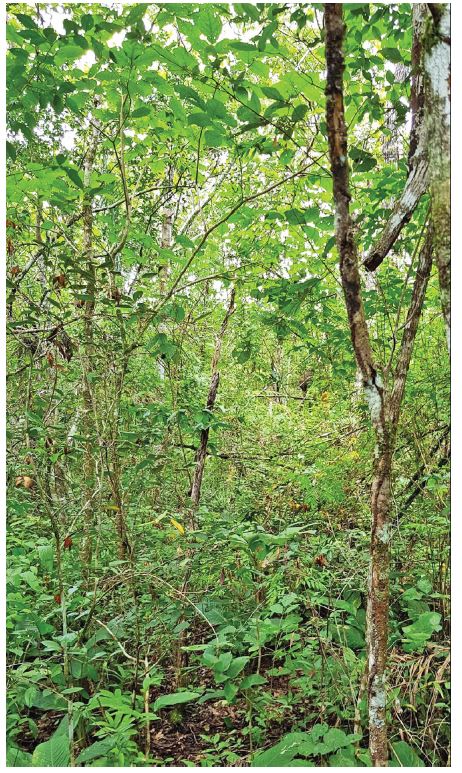
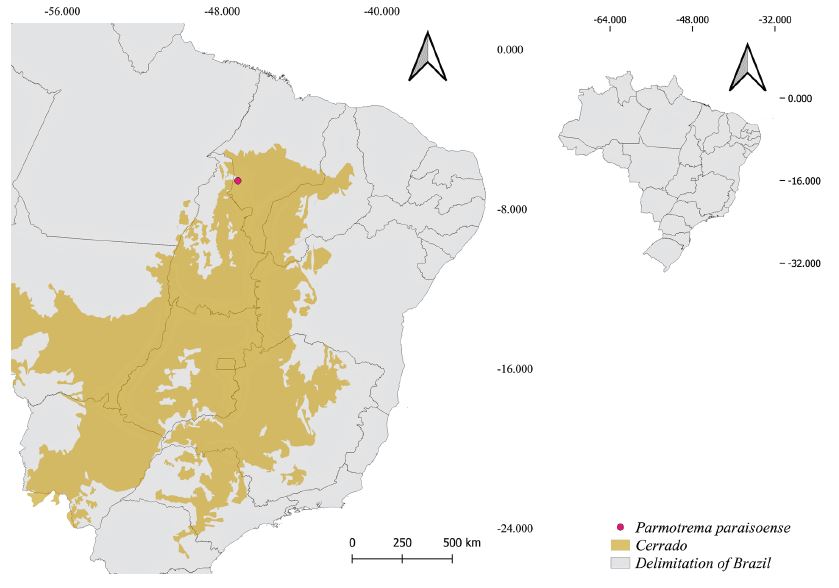
During expeditions in 2018 and 2021 in areas of Cerrado vegetation (Fig. 1) of the municipality of São João do Paraíso (06°27’34’’S, 47°03’24’’W), located in the southern mesoregion of Maranhão, several specimens of lichenized fungi from the Parmeliaceae family were collected, including the specimen of the new species described here (Fig. 2).
Area of cerradão, typical of Cerrado vegetation, represented in the vicinity of where the surveys were carried out.
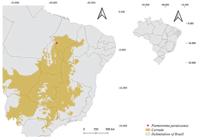
Map showing the collection locality of the new species described, within the Cerrado of Maranhão, Brazil.
The expeditions were carried out randomly, actively searching for specimens on branches and trunks of trees, shrubs, and rocks. The specimens were collected and removed from the substrate following the techniques described by Hale (1979) and Benatti & Marcelli (2007).
The morphological study of the lichen thallus was conducted using a Zeiss Stemi 305 stereomicroscope and a Zeiss - Primo Star 3 optical microscope. To characterize the thallus structures, we used the protocol developed by the Grupo de Estudos Liquenológicos (GEL) of the Botanical Institute of São Paulo, Brazil, as outlined in Canêz & Marcelli (2006), adapting specific terms where necessary.
For the chemical characterization of the specimens, spot tests were performed on the thallus and medulla of the lichen, followed by ultraviolet light (UV) and thin-layer chromatography (TLC). For TLC, two solvent systems were used: solvent A (toluene, dioxane, and acetic acid in a ratio of 180:45:5) and solvent C (toluene and acetic acid in a ratio of 170:30), according to the methodologies of Huneck & Yoshimura (1996), Bungartz (2002), Orange et al. (2010), and Elix (2014). Additionally, the microcrystallization technique was performed using GAW (H2O, glycerol, and ethanol in a 1:1:1 ratio) and GE (acetic acid and glycerol in a 3:1 ratio) (Huneck & Yoshimura 1996) to confirm the presence of lecanoric acid crystals in the medulla and differentiate the acid from other similar substances, such as gyrophoric acid.
Results and Discussion
A new species of Parmotrema was discovered, based on morphological and chemical data from the thallus. A complete description, diagnosis, illustration, comparative table, and thorough discussion are provided below to support the distinction between the new species described here with similar species. Moreover, we provide an identification key for the Parmotrema species recorded in Maranhão.
Key to the species of Parmotrema with records from Cerrado areas in Maranhão, Brazil
1. Thallus with ciliate lobes; cilia simple and sinuous, black 2
2. Medulla with lecanoric acid (K-, C+ red)Parmotrema paraisoense
2’. Medulla with salazinic acid (K+ yellow to red, C-)Parmotrema spinibarbe
1’. Thallus with eciliate lobes 3
3. Thallus with apothecia and/or pycnidia onlyParmotrema latissimum
3’. Thallus with isidia or soredia 4
4. Thallus with coralloid isidia, clumped, laminalParmotrema tinctorum
4’. Thallus with soredia 5
5. Soralia subcapitate, marginal; protocetraric acid present in the medullaParmotrema gardneri
5’. Soralia linear continuous or interrupted, submarginal or marginal; atranorin and fatty acids present in the medullaParmotrema mordenii
Taxonomic treatment
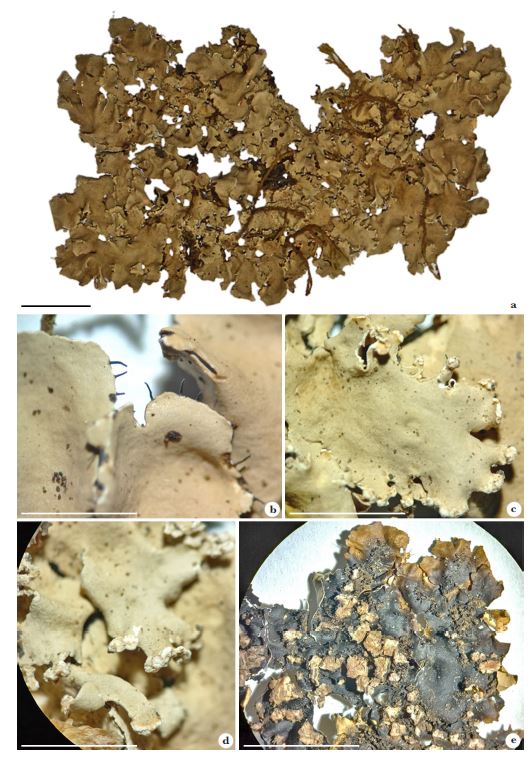
Parmotrema paraisoense I.P.R. Cunha & G.M. Nascimento sp. nov. Type: BRAZIL. MARANHÃO: São João do Paraíso, near the Itaueiras waterfall (06°34’41”S, 47°12’25”W), 15.IX.2018, A.J. Machado-Santos & I.P.R. Cunha-Dias 7 (holotype BOTU 38747). Fig. 3a-e
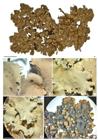
a-e. Parmotrema paraisoense - a. thallus; b. sparse marginal cilia; c-d. lobe’s margins with soralia; e. lower surface light brown at the margin and black in the center. Scale bars: a,e = 2 cm; b-d = 0.8 cm.
Parmotrema paraisoense is similar to species P. austrosinense (Zahlbr.) Hale and P. eitenii Marcelli & Benatti in general morphological aspects of the thallus. This species differs, however, in terms of the width and branching of the lobes, the presence of cilia, and soralia that are linear, interrupted to subcapitate, with granular soredia. mycobank: MB854494
Thallus corticolous; grayish-green, foliose, 11 × 7 cm, membranaceous. Lobes very flat, slightly raised, 4-8 mm wide, rounded with an irregular apex, smooth, with undulate or irregular margins; upper surface glossy, smooth, or rugose in central areas, immaculate. Cilia black, infrequent, short, measuring 0.5-1 mm long, simple, straight, or sinuous. Lobules, macules, pustules, and isidia absent. Soralia marginal or submarginal, linear interrupted to subcapitate; soredia granular. Medulla white, without pigmentation. Lower surface black, rough, lustrous; marginal zone brown, bare, smooth, or sometimes papillate and lustrous. Rhizines black, simple, measuring 0.2-0.5 mm, grouped, frequent. Apothecia absent. Pycnidia marginal, with a brown ostiole, immersed, rare; conidia bacilliform to filiform, 8.5-12.5 µm long. Chemistry: Cortex K+ yellow, UV-; medulla K-, C+ red, KC+ red, UV-, P-. TLC: Atranorin and lecanoric acid.
Additional material examined (paratype): BRAZIL. MARANHÃO: São João do Paraíso, Comunidade Agrícola São Francisco (06°35’18”S, 47°12’27”W), 16.VII.2021, J.S. Santos & I.L.A. Silva 68, 71 (BOTU).
The specific epithet refers to the municipality of São João do Paraíso, where the species was discovered.
Growing only on fallen tree branches and/or shrubs in a Cerradão area near a waterfall. The species appears to have a restricted distribution in the area and may be critically endangered, since only the type specimen and two other specimens have been collected in the vicinity of its place of origin.
Parmotrema paraisoense resembles P. austrosinense and P. eitenii in general aspects of the thallus, such as the general shape of the thallus, the arrangement of the reproductive structures, and medullary chemistry. However, this species differs primarily in the presence of cilia and the branching of lobes. The lobes of P. paraisoense do not exhibit irregular branching, they are only inconspicuously irregular, whereas the lobes of P. austrosinense and P. eitenii are always irregularly branched. Regarding the dimensions of these lobes, P. eitenii has the largest lobes (3-14 mm wide) (Marcelli et al. 2007), while P. paraisoense has smaller lobes (4-8 mm). The lobes of P. austrosinense vary in dimensions, generally reported as 3 to 7.5 mm wide (Spielmann & Marcelli 2009) and 3 to 6.5 mm (Benatti & Marcelli 2009) (Tab. 1).
Another characteristic shared by the three species is the presence of soralia. Upon closer investigation, differences become evident: in P. paraisoense, the soralia are linear interrupted to subcapitate, while in P. austrosinense this structure can vary from linear continuous to slightly interrupted. In P. eitenii, the soralia are generally linear interrupted. As for the soredia, their arrangement and shape can vary, with P. paraisoense having only granular soredia, P. austrosinense having farinose soredia, and P. eitenii featuring granular, corticated soredia that may have an isidioid aspect (Tab. 1).
Comparing these species in terms of the lower surface of the cortex is also worthwhile. This feature is a constant and relatively invariant among the species. While both P. paraisoense and P. eitenii exhibit a completely glossy lower surface with brown marginal zones and a black central zone, P. austrosinense is described by different authors (Benatti & Marcelli 2009; Spielmann & Marcelli 2009) as having a lower surface that is generally white variegated or with a light brown marginal zone, featuring a black and commonly opaque central zone.
Another similar species is P. cooperi (J. Steiner & Zahlbr.) Sérus., which differs by having soralia that are linear to labriform or subcapitate, notably with larger cilia, reported to be up to 2.5 mm long (Bungartz & Spielmann 2019) or up to 6.5 mm long (Masson et al. 2024). Its entire lower surface is usually black, and the presence of pycnidia and conidia is generally not reported; when reported, they are very scarce, with submarginal and immersed pycnidia (Masson et al. 2024) and bacillar conidia, as described in the protologue (Zahlbruckner 1926).
Furthermore, Krog & Swinscow (1981) and Masson et al. (2024) also mention the presence of weak and effigurate maculate in the analyzed material of P. cooperi, which do not occur in P. paraisoense. Although, the species is more common in African countries, it also occurs in Australia, India, Mexico, and Papua New Guinea, and, more recently, has been reported in Réunion, France (Masson et al. 2024). In South America, it has only been reported in Galapagos (Bungartz & Spielmann 2019).
Parmotrema andinum (Müll. Arg.) Hale is also chemically similar to P. paraisoense, but does not produce soredia and/or soralia. This is due to both species only having indirect reproductive structures, such as apothecia and pycnidia.
A noteworthy aspect is that there are other species of Parmotrema with the same medullary chemistry and reproductive structures that have not been recorded in Brazil or on the American continent. For example, P. defectum (Hale) Hale is characterized by lobes with sorediate and eciliate margins, containing lecanoric acid, but it is known to occur in India (Divakar & Upreti 2003) and in regions of the African continent (Hale 1965; Krog & Swinscow 1981).
Acknowledgements
The authors thank FAPEMA (Fundação de Amparo à Pesquisa e ao Desenvolvimento Científico e Tecnológico do Maranhão, Brazil), for the scholarship granted (Process BIC-03552/19) to the second author JSS; and UEMASUL (Universidade Estadual da Região Tocantina do Maranhão) productivity fellowship (object of the edital n° 014/2022-CPG/PROPGI/UEMASUL), for the financial support granted to the first author, IPRCD.
References
- Aptroot A, Feuerstein SC, Cunha-Dias IPR, Nunes ARL, Honorato ME & Cáceres MES (2017) New lichen species and lichen reports from Amazon forest remnants and Cerrado vegetation in the Tocantina region, northern Brazil. The Bryologist 120: 320-328.
- Benatti MN & Marcelli MP (2007) Gêneros de fungos liquenizados dos manguezais do sul-sudeste do Brasil, com enfoque no manguezal do Rio Itanhaém, estado de São Paulo. Acta Botanica Brasilica 21: 863-878.
- Benatti MN & Marcelli MP (2009) Espécies de Parmotrema (Parmeliaceae, Ascomycota) do litoral centro-sul do estado de São Paulo, Brasil. I. Grupos químicos girofórico e lecanórico. Acta Botanica Brasilica 23: 1012-1026.
- Benatti MN, Gernet M & Schmitt I (2013) Parmotrema hydrium, a new species of Parmeliaceae in southeastern Brazil. Acta Botanica Brasilica 27: 810-814.
- Blanco O, Crespo A, Ree RH & Lumbsch HT (2006) Major clades of parmeliold lichens (Parmeliaceae, Ascomycota) and the evolution of their morphological and chemical diversity. Molecular Phylogenetics and Evolution 39: 52-69.
- Brodo IM, Sharnoff SD & Sharnoff S (2001) Lichens of North America. Yale University Press, New Haven and London. 795p.
- Bungartz F (2002) Recipes and other techniques. In: Nash III TH, Ryan BD, Gries C & Bungartz F (eds.) Lichen flora of the Greater Sonoran Desert Region. Vol. 1. Lichens Unlimited. Arizona State University, Tempe. Pp. 49-52.
- Bungartz F & Spielmann AA (2019) The genus Parmotrema (Parmeliaceae, Lecanoromycetes) in the Galapagos Islands. Plant and Fungal Systematics 64: 173-231.
- Canêz LS & Marcelli MP (2006) Gêneros de Parmeliaceae (Ascomycetes Liquenizados) na localidade de Fazenda da Estrela, Vacaria, Rio Grande do Sul, Brasil. Caderno de Pesquisa (Série Biológica) 18: 38-81.
- Crespo A, Kauff F, Divakar PK, del Prado R, Pérez-Ortega S, de Paz GA, Ferencova Z, Blanco O, Roca-Valiente B, Núñez-Zapata J, Cubas P, Argüello A, Elix J, Esslinger TL, Hawksworth DL, Millanes A, Molina MC, Wedin M, Ahti T, Aptroot A, Barreno E, Bungartz F, Calvelo S, Candan M, Cole M, Ertz D, Goffinet B, Lindblom L, Lücking R, Lutzoni F, Mattsson JA, Messuti MI, Miadlikowska J, Piercey-Normore M, Rico VJ, Sipman HJM, Schmitt I, Spribille T, Thell A, Thor G, Upreti DK & Lumbsch HT (2010) Phylogenetic generic classification of parmelioid lichens (Parmeliaceae, Ascomycota) based on molecular, morphological and chemical evidence. Taxon 59: 1735-1753.
- Cunha IPR, Marcelli MP & Pereira EC (2015) Espécies de Canoparmelia s.l. (Parmeliaceae, ascomicetes liquenizados) da região Tocantina, MA e TO, Brasil. Hoenea 42: 265-272.
- Divakar PK & Upreti DK (2003) New species and new records of Parmotrema (Parmeliaceae) from India. The Lichenologist 35: 21-26.
- Elix JA (2014) A catalogue of standardized chromatographic data and biosynthetic relationships for lichen substances. 3rd ed. Published by the author, Canberra. 322p.
- Hale ME (1965) A monograph of Parmelia subgenus Amphigymnia Contributions from the United States National Herbarium 36: 193-358.
- Hale ME (1979) How to know the lichens. 2nd ed. The Pictured-Key Nature Series, Dubuque. 246p.
- Hüneck S & Yoshimura I (1996) Identification of lichen substances. Springer, Berlin. 493p.
- Krog H & Swinscow TDV (1981) Parmelia subgenus Amphigymnia (lichens) in East Africa. Bulletin of the British Museum (Natural History), Botany Series 9: 143-231.
- Lücking R, Hodkinson BP & Leavitt SD (2017) The 2016 classification of lichenized fungi in the Ascomycota and Basidiomycota - approaching one thousand genera. The Bryologist 119: 361-416.
- Marcelli MP, Jungbluth P, Benatti MN, Spielmann AA, Canêz LS, Cunha IPR & Martins MFN (2007) Some new species and combinations of Brazilian lichenized fungi. Bibliotheca Lichenologica 96: 209-227.
- Masson D, Magain N & Sérusiaux E (2024) Small Island but great diversity: thirty six species of Parmotrema (Parmeliaceae, lichenized Ascomycota), including sixteen new species, on Réunion (Mascarenes), with additional data from the Western Indian Ocean. Phytotaxa 657: 001-138.
- Nash III TH & Elix JA (2002) Parmotrema In: Nash III TH, Ryan BD, Gries C & Bungartz F (eds.) Lichen flora of the Greater Sonoran Desert Region. Vol. 1. Lichens Unlimited, Arizona State University, Tempe. Pp. 318-329.
- Orange A, James PW & White FJ (2010) Microchemical methods for the identification of lichens. 2nd ed. British Lichen Society, London. 101p.
- Santos JS, Cunha-Dias IPR, Silva ILA & Nascimento GM (2021) Ocorrência de espécies corticícolas de Parmotrema A.Massal. (Parmeliaceae; Ascomycota liquenizados) em vegetação de Cerrado no estado do Maranhão, Brasil. Revista de Ciências Ambientais 15: 1-15.
- Spielmann AA & Marcelli MP (2009) Parmotrema s.l. (Parmeliaceae, lichenized Ascomycota) from Serra Geral slopes in central Rio Grande do Sul state, Brazil. Hoehnea 36: 551-595.
- Spinelli-Araujo L, Bayma-Silva G, Torresan FE, Victoria D, Vicente LE, Bolfe EL & Manzatto C (2016) Conservação da biodiversidade do estado do Maranhão: cenário atual em dados geoespaciais. Embrapa Meio Ambiente, Jaguariúna. 28p.
- Zahlbruckner A (1926) Afrikanische Flechten (Lichenes). Engler´s Botanische Jahrbücher für Systematik 60: 468-552.
-
The authors thank FAPEMA (Fundação de Amparo à Pesquisa e ao Desenvolvimento Científico e Tecnológico do Maranhão, Brazil), for the scholarship granted (Process BIC-03552/19) to the second author JSS; and UEMASUL (Universidade Estadual da Região Tocantina do Maranhão) productivity fellowship (object of the edital n° 014/2022-CPG/PROPGI/UEMASUL), for the financial support granted to the first author, IPRCD.