
 Chemical profile and microbiological activity of essential oil from Persea venosa: an endemic species from Brazilian Flora
Abstract
The Persea venosa belongs to the Lauraceae family, whose essential oils exhibit diverse bioactivity, including against significant pathogens such as bacteria and fungi of medical interest and/or contribute to food spoilage. Consequently, essential oils are recognized as viable alternatives for developing sustainable antimicrobials. In this study, essential oil was extracted by hydrodistillation from the leaves of P. venosa and analyzed in gas chromatography coupled with mass spectrometry. Microbiological assays were conducted at concentrations up to 2,048 µg/mL against Staphylococcus aureus; S. epidermidis; Escherichia coli; Enterobacter cloacae; Pseudomonas aeruginosa; Klebsiella pneumoniae; Aspergillus flavus; A. parasiticus, and A. westerdjikiae. The extraction yielded 0.10% (w/w) in which sesquiterpene hydrocarbons were identified (90.23%), with β-caryophyllene being the predominant substance at 38.59%. This composition aligns with the literature. The highest tested concentration exhibited inhibitory effects against all bacterial strains. The P. aeruginosa and S. epidermidis exhibited a minimum inhibitory concentration of 1,024 µg/mL. Bactericidal activity was only observed in S. epidermidis in a high concentration, the maximum tested. No antifungal activity was detected at any tested concentration. The present study highlights the antimicrobial effect of P. venosa essential oil (although only in high concentrations), being the first report of the activity related to the species.
Key words:
β-caryophyllene; Antibacterial; Antifungal; Lauraceae
Resumo
A Persea venosa pertence à família Lauraceae, cujos óleos essenciais apresentam bioatividade diversa, incluindo contra patógenos significativos, como bactérias e fungos de interesse médico e/ou que contribuem para a deterioração de alimentos. Consequentemente, os óleos essenciais são reconhecidos como alternativas viáveis para o desenvolvimento de biopesticidas sustentáveis. No presente estudo, o óleo essencial foi extraído por hidrodestilação das folhas de P. venosa e analisado em cromatografia gasosa acoplada à espectrometria de massas. Ensaios microbiológicos foram conduzidos em concentrações de até 2.048 µg/mL contra: Staphylococcus aureus; S. epidermidis; Escherichia coli; Enterobacter cloacae; Pseudomonas aeruginosa; Klebsiella pneumoniae; Aspergillus flavus; A. parasiticus e A. westerdjikiae. A extração rendeu 0,10% (p/p), onde hidrocarbonetos sesquiterpênicos foram identificados (90,23%), com β-cariofileno sendo a substância majoritária com 38,59%. A composição alinha-se a literatura. A maior concentração testada exibiu efeitos inibitórios contra todas as cepas bacterianas. As P. aeruginosa e S. epidermidis exibiram concentração inibitória mínima de 1,024 µg/mL. Atividade bactericida foi observada apenas em S. epidermidis em alta concentração, a máxima testada. Nenhuma atividade antifúngica foi detectada em nenhuma concentração avaliada. O presente estudo destaca o efeito antimicrobiano do óleo essencial de P. venosa (embora em altas concentrações), sendo o primeiro relato da atividade pela espécie.
Palavras-chave:
β-cariofileno; Antibacteriano; Antifúngico; Lauraceae
Introduction
Brazil has the greatest floral biodiversity on the planet, with approximately 15% of global biodiversity concentrated within its borders and about 0.5% of the estimated known plant species being endemic to the country (Valli et al. 2018). The Atlantic Forest biome has significant potential for biotechnological exploration but faces severe environmental challenges, as only 7% of its original area remains intact (Valli et al. 2021).
Within this biome lies the Restinga ecosystem, a coastal environment characterized by marine factors such as high salinity, unstable substrate, and elevated temperatures. These edaphoclimatic conditions may impact the chemical composition of the local plant species. Studies conducted within Rio de Janeiro’s Jurubatiba National Park reveal a diverse metabolic landscape featuring significant bioactivities. These findings highlight the importance of such sites for research and development (Rocha et al. 2023). However, as the biome, these ecosystems are constantly threatened by deforestation despite the government’s conservation efforts. Consequently, the Restingas have endemic species and a rich biochemical diversity in the verge of been forever lost (Lourenço Jr. et al. 2021; Valli et al. 2018).
The Lauraceae family is one of the most prevalent families in the Restinga ecosystem, which is renowned for its diverse secondary metabolites, including steroids, terpenoids, and alkaloids. This family encompasses over 50 genera and more than 3,000 species, distributed across tropical regions worldwide. In Brazil, over 300 species are recognized, along with more than 200 endemics. The Persea genus within this family comprises approximately 200 species, with P. americana Mill., commonly known as avocado, being extensively studied. Species like Persea venosa Nees & Mart., commonly referred to as ‘pau-de-andrade’ or ‘canela-sebo’ have been utilized in traditional medicine due to their medicinal properties (Esteves et al. 2023).
Essential oils are complex mixtures produced by plants’ secondary metabolism extracted through hydrodistillation from various plant parts. Typically consists of monoterpenes, sesquiterpenes, or phenylpropanoids. Over 3,000 essential oils have been described so far, with approximately 300 widely utilized in perfume, food, and pharmaceutical industries due to their diverse biological activities. Most essential oils are classified as Generally Recognized as Safe (GRAS) by regulatory agencies, such as the FDA (2017) (Chamorro et al. 2012; Awadalla et al. 2017; Haro-González et al. 2021).
One of the most demanded bioactivities associated with plant derivatives is their antimicrobial property. According to leading health organizations, including the World Health Organization (WHO 2024) and the Centers for Disease Control and Prevention (CDC 2019), bacteria and fungi pose significant threats as infectious agents, toxin producers, and potential food degraders. Conventional methods for preventing microbiological contamination often employ synthetic additives. However, these raised concerns due to their links to health and environmental harm. These toxic substances can alter the physiology of both consumers and non-target animals, potentially leading to oncogenesis, and cause an increasing disturbance in the resistance of infectious agents to these substances (Anand et al. 2013; Nasrollahzadeh 2022). Consequently, natural products, among them essential oils. have emerged as promising alternatives to control microbiologic contamination with a lower impact on the environment and human health (Gyawali & Ibrahim 2014; Singh et al. 2021).
The bacterial group characterized as ESKAPE (vancomycin-resistant Enterococcus faecium (VRE); methicillin-resistant Staphylococcus aureus; extended-spectrum β-lactamase (ESBL) and carbapenemase-producing Klebsiella pneumoniae; multidrug-resistant Acinetobacter baumannii; multidrug-resistant Pseudomonas aeruginosa, and ESBL-producing Enterobacter spp.) represents a significant threat in the context of hospital-acquired infections, as it has an elevated level of antimicrobial resistance, commonly resulting from the misuse of widely used antibiotics (De Oliveira et al. 2020). There is an increasingly urgent need to discover new antimicrobial agents effective against resistant bacterial strains and this study highlights the Atlantic Forest unique ecosystems as promising sources of novel antimicrobials.
The fungal genus Aspergillus presents a strong association with human food supplies, and it is frequently linked to both superficial and invasive infections. Species like A. flavus and A. parasiticus are particularly concerning as they produce toxins known as aflatoxins, with Aflatoxin B1 (AFB1) being a serious health risk due to its oncogenic effects on liver tissues. This accentuates the need to find bioactive substances capable of reducing those damages without harming the consumers or the environment (Zinedine et al. 2019; Frisvad et al. 2019).
Although a few studies on the species have been published since 2006 (Linsingen et al. 2006), only one study was published in the past five years (Esteves et al. 2023), being also the only investigation focusing on specimens from the Restinga ecosystem. Esteves et al. (2023) characterized the phytochemical composition of the species under the specific edaphoclimatic conditions of the Restinga, revealing notable differences in essential oil profiles compared to populations from other regions, such as the mountains in the interior of Brazil (Silva et al. 2019). While Esteves et al. (2023) evaluated the insecticidal activity of the plant, its bioactivity remains largely unexplored, particularly antimicrobial properties that are so important nowadays. The present study, therefore, aimed to determine if the leaf essential oil of P. venosa can be an asset in the development of future formulations by characterizing its composition (thus validating its diversity under Restinga-specific edaphoclimatic stressors) and evaluating unprecedented antimicrobial efficacy against clinically and food-relevant pathogens.
This research focus on interconnected challenges caused by humanity, including antimicrobial resistance from the overuse or misuse of synthetic drugs in medical and food sectors, toxicity of these substances, and biodiversity loss. It emphasizes integrating human technology with nature’s inherent characteristics as a key mission of this century. By demonstrating P. venosa’s bioactivity, the study may frame biodiversity as a reservoir of solutions for global health crises and advocating interdisciplinary strategies that align environmental protection with pharmacological innovation.
Materials and Methods
Plant material
The fresh leaves of P. venosa were collected in the Restinga of Jurubatiba National Park, Carapebus, RJ, Brazil (-22°12’42,36984’’S, 41°35’20,5954”W). The species was identified, and a voucher specimen was deposited at the herbarium of Universidade Estadual do Rio de Janeiro - Faculdade de Formação de Professores (UERJ-FFP), under registration: M.G.Santos 2336. The collection and research of the plant material were authorized by SisBio/ICMBio (13659-20) and SisGen (A491A56).
Essential oil extraction
Fresh leaves of P. venosa (1,246 g) were homogenized with distilled water using a high-speed homogenizer. Then, the mixture was transferred to a 5.0 L round-bottom flask and subjected to hydrodistillation in a Clevenger-type apparatus for 4 h. The essential oil was dried with sodium sulfate anhydrous and stored in an amber glass vial at 4 oC (Esteves et al. 2023).
Essential oil chemical characterization
The essential oil was characterized with a semi-quantitative method using a GC-MS QP2010 (Shimadzu, Kyoto, Japan) gas chromatograph equipped with a single quadrupole mass spectrometer. The total chromatographic run time was 75 min, with analytes eluting within a retention time window of up to 38 min. The chromatographic conditions were as follows: an injector temperature of 260 °C, using helium as the carrier gas, a constant flow rate of 1 mL/min, and a split ratio of 1:40. The oven temperature initially started at 60 °C and then increased to 290 °C at a rate of 3 °C/min. The essential oil was dissolved in dichloromethane (1,000 ppm) and injected (1 µL) into a DB-5 column (0.25 mm ID, 30 m in length, 0.25 µm film thickness). The mass spectrometry conditions were 70 eV electron ionization (electron impact) and a scan rate of 1 scan/s in positive mode. The arithmetic index (AI) was calculated by interpolating the retention times of a mixture of aliphatic hydrocarbons (C7-C40, Sigma-Aldrich, USA) under the same chromatographic conditions as the sample. Compounds were considered identified only if the experimental AI agreed with published values (Adams 2007) within ±10 index units and the spectral (40 to 500 m/z) similarity in both the Adams and National Institute of Standards and Technology (NIST) libraries was ≥ 90%.
Bacterial strains
Strains were obtained from the Laboratory of Molecular Epidemiology and Biotechnology of Fluminense Federal University (UFF), Brazil. The bacterial strains comprised S. aureus ATCC 25923, S. epidermidis ATCC 12228, E. coli ATCC 25922, Enterobacter cloacae ATCC 13047, P. aeruginosa ATCC 27853, K. pneumoniae ATCC 13883, and S. aureus USA300 were stored in Brain Heart Infusion (BHI) broth with 10% of glycerol at -80 °C.
Minimum Inhibitory Concentration (MIC)
Strains were cultivated on Tryptic Soy Agar (TSA) plates and subsequently transferred to a 0.9% NaCl solution, which was then adjusted to a 0.5 McFarland standard. Essential oils, previously solubilized in 1% DMSO, were applied in 96-well plates with BHI broth and underwent a 2-fold serial dilution in concentrations ranging from 2.04 mg/mL to 0.25 mg/mL, with the final addition of the inoculum according to the 0.5 McFarland scale (1.5 x 10⁸ CFU/mL). Positive controls were diluted with vancomycin for Gram-Positive bacteria and ciprofloxacin for Gram-Negative bacteria. The plates were then incubated at 37 °C for 24 h. Following this, the Minimum Inhibitory Concentration (MIC) was determined by adding 20 µL of resazurin to each well. It is noteworthy that all tests were performed in biological triplicates, following the standard broth microdilution method (CLSI M07-A10), and a control group was realized with DMSO.
Minimum Bactericidal Concentration (MBC)
After MIC incubation, aliquots of 10 µL from the wells were applied to Petri plates containing TSA, divided into fields corresponding to each concentration of the microdilution, including a positive control. The plates were then incubated for 24 h at 37 °C. MBC endpoint is defined according to the last quadrant without bacterial growth, indicating the elimination of 99.9% of bacteria.
Antifungal assays
The strains used were A. flavus RC 2054, A. parasiticus NRRL 2999, and A. westerdjikiae NRRL 3174, all reference strains known to produce aflatoxin B1 (AFB1). The methodology was adapted from Pinto et al. (2023), with the addition of essential oil diluted in DMSO at concentrations of 256, 512, 1,024, and 2,048 µg/mL in 25 mL of Kasvi’s Sabouraud Dextrose Agar (SDA) and then needle-inoculating the strains with 10 µL of the spore suspension. The plates were incubated at 27.5 ± 2.5 °C for 96 h, with daily observation and diameter measurement. Plates containing SDA medium without essential oil served as the control, as well as plates containing the DMSO in the same concentration as the present in the assays. The experiment was realized in biological triplicate.
Statistical analyses
Data evaluation was performed using Analysis of Variance (ANOVA). Tukey’s test was applied with a Confidence Interval of 95% for comparison among different product presentations and concentrations evaluated while considering exposition time variability. The analyses were conducted using the GraphPad Prism (version 8) program.
Result and Discussion
The extraction of the fresh leaves of P. venosa yielded 0.10% (w/w) of essential oil with a greenish transparent aspect. The chemical composition revealed 25 identified substances and 8 unidentified ones. The predominant class of compounds was non-oxygenated sesquiterpene (90.23 %), with β-caryophyllene as the major substance (38.59%), followed by α-copaene (7.57%), α-humulene (6.91%), and Germacrene D (6.60%) (Fig. 1). The complete list of substances is shown in Table 1 below.
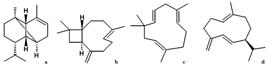
a-d. Major metabolites of the Persea venosa essential oil - a. α-copaene (7.57%); b. β-caryophyllene (38.59%); c. α-humulene (6.91%); d. Germacrene D (6.60%).
The chemical potential of Persea venosa remains almost unexplored due to the restricted geographic distribution of the species. Nevertheless, two authors have reported the chemical profile of the essential oil derived from the leaves. More recently, Esteves et al. (2023) described the presence of β-caryophyllene (43.78%), α-humulene (8.27%), caryophyllene oxide (8.92%), and α-copaene (5.90%) as the major components, as well as presenting the non-oxygenated sesquiterpene fraction as the most predominant fraction of the essential oil (Esteves et al. 2023). Silva et al. (2019) reported the major components as spathulenol (27.8%), humulene epoxide II (11.3%), caryophyllene oxide (7.6%), cadalene (7.1%), and α-copaene (5.5%) (Silva et al. 2019).
The predominant fraction (oxygenated sesquiterpenoids) identified in the essential oil obtained by Silva et al. (2019) differs from the major fraction described by Esteves et al. (2023) and the one observed in this study (non-oxygenated sesquiterpenes). Esteves et al. (2023) and the current study were collected in a coastal Restinga region in Rio de Janeiro state (Brazil) and had the same extraction methodology, justifying the similar results observed. Silva et al. (2019), however, collected their material in the mountains of the state of Minas Gerais (Brazil) and, even though the method was also the same, the environmental pressures and geographical conditions of each collection region may explain the difference between the major compounds (Verma & Shukla 2015). Abiotic stresses characteristic of Restinga ecosystems, such as elevated temperatures, saline soils, and periodic water deficit, have been shown to induce β-caryophyllene accumulation in Persea spp. and related Lauraceae species under analogous conditions (Ceballos et al. 2019; Han et al. 2022; Manasathien et al. 2025). This adaptive response underscores the ecological and chemotaxonomic significance of β-caryophyllene in plant species in harsh edaphoclimatic environments.
The β-caryophyllene, the predominant substance identified, is approved by the U.S. Food and Drug Administration (FDA) for direct use in foods intended for human consumption. Although the Globally Harmonized System of Classification and Labelling of Chemicals (GHS) indicates that β-caryophyllene may be fatal if swallowed or aspirated and that it has the potential to cause allergic skin reactions, eye irritation, or corrosion, recent toxicological evaluations demonstrate consistently, both in vitro and in vivo, that β-caryophyllene exhibits low toxicity. So, the Organization for Economic Co-operation and Development (OECD) classifies it as a Category 5 substance, indicating toxicity only at doses exceeding 2,000 mg/kg. Therefore, despite some potential toxic effects, the concentrations of β-caryophyllene commercially used are safe for humans (Francomano et al. 2019; PubChem 2025; ADMETLab 3.0 2025).
The P. venosa essential oil showed a minimum inhibitory concentration (MIC) of 2,048 µg/mL in S. aureus, E. coli, E. cloacae, and K. pneumoniae. While in S. epidermidis and P. aeruginosa the MIC was 1,024 µg/mL. In addition, the essential oil didn’t show a minimum bacterial concentration (MBC) at the tested concentration, except for S. epidermidis, which exhibited an MBC of 2,048 µg/mL. The inhibition profile is presented in Table 2.
Several studies investigating the antimicrobial potential of essential oils derived from various Persea species have reported significant inhibitory effects. For example, essential oils obtained from P. odorantissima, P. gamblei, and P. duthiei have demonstrated activity against Escherichia coli, Staphylococcus aureus, Salmonella enterica serovar Enterica, and Pasteurella multocida, with minimum inhibitory concentration (MIC) values ranging from 3.9 to 7.81 µL/mL (Joshi et al. 2010). Nasri et al. (2022) similarly evaluated the antimicrobial activity of Persea americana essential oil against S. aureus and S. epidermidis, reporting minimum inhibitory concentration (MIC) values between 1 and 10 µg/mL (Nasri et al. 2022). Assuming an approximate oil density of 0.90 g/mL (P. americana), these values align with the results obtained in the present study.
Overall, the present study findings are consistent with the literature on the antibacterial effect of essential oils, which usually exhibit MIC values in the range of 1,000 µg/mL (Tegos et al. 2002). The sesquiterpenes present in the P. venosa essential oil may interact with the bacterial membrane. At low concentrations, the amount of the compounds is insufficient to induce alterations in membrane structure, allowing bacterial maintenance and membrane integrity. In contrast, at elevated concentrations of essential oil, the monoterpenes, especially the oxygenated ones, due to their intermediate polarity, may reach a state of saturation within the bilayer. This saturation results in lipid disorganization, which consequently increases membrane permeability and can eventually lead to disruption of the bacterial membrane (Nazzaro et al. 2013; Qie et al. 2025). Although antibacterial activity was observed, the high concentration required to achieve efficacy poses a challenge to the therapeutic applicability.
No fungistatic or fungicidal activity of the P. venosa essential oil was observed against the Aspergillus strains at concentrations greater than 2,048 µg/mL. The result aligns with the observations of Tan (2022), with many essential oils rich in β-caryophyllene often displaying a MIC much higher than the maximum of 2,048 µg/mL tested (Tan et al. 2022). Other studies, however, report inhibition of Aspergillus, as the previous work by Nouara (2024) demonstrated that P. americana essential oil inhibited mycelial growth of 43.29-53.12% at 500 µg/mL against A. carbonarius, A. flavus, A. ochraceus, and A. terreus (Nouara & Nouara 2024).
Da Silva et al. (2024) also reported antifungal activity against A. parasiticus and A. flavus using pure β-caryophyllene, the major substance present in the P. venosa essential oil. The pure substance at a 1,024 µg/mL concentration reduced the colonies by 25-30% for 72 h. Other works suggest a modest fungistatic effect from β-caryophyllene being related to its ability to interfere with cell membrane synthesis or integrity through partial inhibition of ergosterol-related metabolic pathways or by modulating oxidative stress. However, based on the results of the present study, the concentration of β-caryophyllene in P. venosa essential oil may not be sufficient to produce a significant antifungal effect (Tan et al. 2022).
The absence of antifungal activity may result from challenges in penetrating the fungal cell wall or interacting with intracellular targets, such as ergosterol, a crucial component of the fungal cell membrane. While other substances of the essential oil have been reported to exhibit antifungal activity (even though low to moderate), the result in the current study also excludes the possibility of synergistic interactions among these constituents against A. flavus and A. parasiticus. The findings suggest that the antifungal activity of the essential oil components is highly concentration-dependent and differs significantly between plant species (Tan et al. 2022).
Further optimization of P. venosa essential oil as a raw material through diverse formulation approaches could enhance its antimicrobial potential for practical applications. Evaluating its synergistic interactions with established antibiotics or antifungals may also demonstrate improved efficacy. Consequently, the essential oil could be developed as an adjuvant or active principle for antimicrobial agents in clinical settings, food preservation, or agricultural pesticides.
The Persea venosa showed β-caryophyllene as the major compound of the essential oil from its leaves. Consistent with existing literature, the essential oil inhibits clinically relevant bacterial strains only at pharmacologically challenging concentrations (> 1,000 µg/mL), and no activity was observed against the Aspergillus species. Nevertheless, this study constitutes the first report of antimicrobial properties for P. venosa, a Brazilian endemic species native to a unique and threatened ecosystem. The direct application of the crude essential oil may be limited; however, its potential for formulation development, with or without synergistic interactions with established antimicrobials, warrants further investigation. Thus, this study reinforces the P. venosa as a promising source for novel antimicrobial agents and the restinga as a reservoir of possible eco-friendly solutions.
Acknowledgements
We would like to thank the National Council for Scientific and Technological Development (CNPq), for financial support through projects 304179/2021-3 and Biodiversity and Sustainability Research Network: Formulation of Biopesticides from Brazilian Flora (406399/2022-0). We would also like to thank FAPERJ, for its support in financing the projects E-26/200.161/2025, E-26/200.675/2021 (262222), E-26/200.162/2025 (304867), E-26/210.598/2023 (285944), and E-26/200.915/2022 (268191).
References
- Adams RP (2017) Identification of essential oil Components by gas chromatography/mass spectroscopy. Biochemical Systematics and Ecology. Vol. 1. Allured Publishing, Illinois. 469p.
-
ADMETlab 3.0 (2025) β-Caryophyllene (C=C1CC/C=C(\C)CC[C@@H]2[C@@H]1CC2(C)C). Available at <https://admetlab3.scbdd.com/server/evaluationCal>. Access on 25 May 2025.
» https://admetlab3.scbdd.com/server/evaluationCal - Anand S & Sati N (2013) Artificial preservatives and their harmful effects: looking toward nature for safer alternatives. International Journal of Pharmaceutical Sciences and Research 4: 2496.
- Awadalla SS, Zayed GM & Hashem AS (2017) Chemical composition and bioactivity of three plant essential oils against Tribolium castaneum (Herbst) and Sitophilus oryzae (L.). Journal of Plant Protection Research 8: 535-539.
- Ceballos R, Rioja T, Ceballos R & Rioja T (2019) Rootstock affects the blend of biogenic volatile organic compounds emitted by ‘Hass’ avocado. Chilean Journal of Agricultural Research 79: 330-334.
- CDC (2019) Antibiotic resistance threats in the United States, Atlanta, GA: U.S. Department of Health and Human Services. Center for Disease control and Prevention 3: 103-104.
-
Chamorro ER, Zambon SN, Morales WG, Sequeira AF & Velasco GA (2012) Study of the chemical composition of essential oils by gas chromatography. In: Gas chromatography in plant science, wine technology, toxicology and some specific applications. IntechOpen. Available at <https://www.intechopen.com/chapters/30595>. Access on 2025.
» https://www.intechopen.com/chapters/30595 - Da Silva DS, Pinto LA, Keller LAM, Machado FP, Eiriz DN, Rocha L & Fernandes CP (2024). Inhibitory potential of Eugenia sulcata essential oil and its nanoemulsions against Aspergillus spp. Journal of Natural Pesticide Research 7: 100064.
- De Oliveira DMP, Forde BM, Kidd TJ, Harris PNA, Schembri MA, Beatson SA, Paterson DL & Walker MJ (2020) Antimicrobial resistance in ESKAPE pathogens. Clinical Microbiology Review 33: 181-190.
- Esteves RS, Apolinário R, Machado FP, Folly D, Viana VCR, Soares AP, Jumbo LOV, Santos MG, Ricci-Junior E, Oliveira EE, Feder D & Rocha L (2023) Insecticidal activity evaluation of Persea venosa Nees & Mart. essential oil and its nanoemulsion against the cotton stainer bug Dysdercus peruvianus and pollinator bees. Industrial Crops and Products 194: 116348.
- Francomano F, Caruso A, Barbarossa A, Fazio A, La Torre C, Ceramella J, Mallamaci R, Saturnino C, Iacopetta D & Sinicropi MS (2019) β-Caryophyllene: a sesquiterpene with countless biological properties. Applied Sciences 9: 5420.
- Frisvad JC, Hubka V, Ezekiel CN, Hong SB, Chen AJ & Houbraken J (2019) Taxonomy of Aspergillus section Flavi and their production of aflatoxins, ochratoxins and other mycotoxins. Studies in Mycology 93: 1-63.
- Gyawali R & Ibrahim SA (2014) Natural products as antimicrobial agents. Food Control 46: 412-429.
- Han X, Zhang J, Han S, Li Chong S, Meng G, Song M, Wang Y, Zhou S, Liu C, Lou L, Lou X, Cheng L, Lin E, Huang H, Yang Q & Tong Z (2022) The chromosome-scale genome of Phoebe bournei reveals contrasting fates of terpene synthase (TPS)-a and TPS-b subfamilies. Plant Communications 3: 100410.
- Haro-González JN, Castillo-Herrera GA, Martínez-Velázquez M & Espinosa-Andrews H (2021) Clove essential oil (Syzygium aromaticum l. Myrtaceae): Extraction, chemical composition, food applications, and essential bioactivity for human health. Molecules 26: 6387.
- Joshi SC, Verma AR & Mathela CS (2010) Antioxidant and antibacterial activities of the leaf essential oils of Himalayan Lauraceae species. Food and Chemical Toxicology 48: 37-40.
- Linsingen LV, Sonehara JDS, Uhlmann A & Cervi A (2006) Composition of the vegetation of the Parque Estadual do Cerrado of Jaguariaíva, Paraná, Brazil. Acta Biológica Paranaense 35: 197-232.
- Lourenco Jr. J, Newman EA, Ventura JA, Milanez CRD, Thomaz LD, Wandekoken DT & Enquist BJ (2021) Soil-associated drivers of plant traits and functional composition in Atlantic Forest coastal tree communities. Ecosphere 12: e03629.
- Manasathien J, Laojinda W & Khanema P (2025) Salinity-Induced VOC modulation and physiological adaptations in Adenosma indiana International Journal of Plant Biology 16: 36.
- Nasri C, Halabi Y, Aghzaf S, Nounah I, Brunel M, Oubihi A, El-Guorrami O, Harhar H, Costa J & Tabyaoui M (2022) Seven Persea americana varieties essential oils comparison: chemical composition, toxicity, antibacterial, and antioxidant activities. Biocatalysis and Agricultural Biotechnology 44: 102468.
- Nasrollahzadeh A, Mokhtari S, Khomeiri M & Saris PEJ (2022) Antifungal preservation of food by lactic acid bacteria. Foods 11: 395.
- Nazzaro F, Fratianni F, De Martino L, Coppola R & De Feo V (2013) Effect of essential oils on pathogenic bacteria. Pharmaceuticals 6: 1451-1474.
- Nouara AM & Nouara AM (2024) First report on antioxidant and antimicrobial activities of essential oil of Persea americana from Algeria. Journal of the Chilean Chemical Society 69: 6078-6081.
- Pinto LA, Machado FP, Esteves R, Farias VM, Köptcke FBN, Ricci-Junior E, Rocha L & Keller LAM (2023) Characterization and inhibitory effects of essential oil and nanoemulsion from Ocotea indecora (Shott) Mez in Aspergillus species. Molecules 28: 3437.
-
PubChem (2025) National Center for Biotechnology Information. Compound summary for CID 5281515, β-Caryophyllene. Available at <https://pubchem.ncbi.nlm.nih.gov/compound/Caryophyllene>. Access on 25 May 2025.
» https://pubchem.ncbi.nlm.nih.gov/compound/Caryophyllene - Qie R, Topgaard D & Sparr E (2025) Effect of intermediate polarity molecule on phase transitions and bilayer structure in phospholipid membranes. Journal of Colloid and Interface Science 686: 556-566.
- Rocha L, Ruppelt BM & Santos MG (orgs.) (2023) Plantas da Restinga - fitoquímica e atividade biológica. Projeto Cultural, Rio de Janeiro. 192p.
- Silva FL, Santo AE, Branco PC, Veras L, Costa-Lotufo MCMY, Murakami C, Cordeiro I, Nicolau SA, Ishibaru LM & Moreno PH (2019) Antioxidant and cytotoxic properties of essential oils from native Brazilian Lauraceae species. Global Journal of Medical Research 19: 1-8.
- Singh BK, Shikha T & Nawal KD (2021) Essential oils and their nanoformulations as green preservatives to boost food safety against mycotoxin contamination of food commodities: a review. Journal of the Science of Food and Agriculture 101: 4879-4890.
- Tan LF, Yap VL, Rajagopal M, Wiart C, Selvaraja M, Leong MY & Tan PL (2022) Plant as an alternative source of antifungals against Aspergillus infections: A review. Plants 11: 3009.
- Tegos G, Stermitz FR, Lomovskaya O & Lewis K (2002) Multidrug pump inhibitors uncover remarkable activity of plant antimicrobials. Antimicrobial Agents and Chemotherapy 46: 3133-3141.
- Valli M, Atanazio LCV, Monteiro GC, Coelho RR, Demarque DP, Andricopulo AD & Bolzani VS (2021) The potential of biologically active Brazilian plant species as a strategy to search for molecular models for mosquito control. Planta Medica 87: 6-23.
- Valli M, Russo HM & Bolzani VS (2018) The potential contribution of the natural products from Brazilian biodiversity to bioeconomy. Anais da Academia Brasileira de Ciências 90: 763-778.
- Verma N & Shukla S (2015) Impact of various factors responsible for fluctuation in plant secondary metabolites. Journal of Applied Research on Medicinal and Aromatic Plants 2: 105-113.
- WHO (2024) WHO bacterial priority pathogens list, 2024: bacterial pathogens of public health importance to guide research, development and strategies to prevent and control antimicrobial resistance. Bacterial pathogens of public health importance to guide research, development and strategies to prevent and control antimicrobial resistance. World Health Organization, Genebra. 72p.
- Zheng X, Zhu Q, Liu Y, Chen J, Wang L, Xiu Y, Zheng H, Lin S, Ling P & Tang M (2024) Combined analysis of transcriptome and metabolome provides insights in response mechanism under heat stress in avocado (Persea americana Mill.). International Journal of Molecular Sciences 25: 10312.
- Zinedine A & El Akhdari S (2019) Food safety and climate change: case of mycotoxins. In: Kahime K, El Hidan M, El Hiba O, Sereno D and Bounoua L (eds.) Handbook of research on global environmental changes and human health. IGI Global, Hershey. Pp. 74-97.
Data availability statement
In accordance with Open Science communication practices, the authors inform that there is no data sharing of this manuscript.

