 Flora of Ceará, Brazil: Simaroubaceae
Abstract
The aim of this study was to carry out a floristic survey and update the distribution of Simaroubaceae species in the state of Ceará, Brazil, as part of the “Flora of Ceará: from Knowledge to Conservation” project. The descriptions were based on the morphological analysis of samples obtained in the field, in collections deposited in herbaria, consultation of protologs, specialized literature and online database collections. In the state of Ceará, the family is represented by two genera and three species: Homalolepis trichilioides, Simarouba amara and S. versicolor. The three species were recorded in the Lowland Semideciduous Seasonal Forest (Mata de Tabuleiro) and the Steppic Savanna (Caatinga). Simarouba amara and S. versicolor are widely distributed in the state with records also in the Semideciduous Seasonal Forest (Dry Forest) and Vegetation under Rainfall and/or Lake Influence (Riparian Forest). All species were registered in Conservation Units. Identification key, morphological descriptions, comments on ecology, distribution, phenology and uses, maps and illustrations of the species are presented.
Key words:
diversity; floristic; Homalolepis; Simarouba
Resumo
No presente estudo objetivou-se realizar o levantamento florístico e atualizar a distribuição de espécies de Simaroubaceae no estado do Ceará, Brasil, sendo parte do projeto “Flora do Ceará: conhecer para conservar”. As descrições foram baseadas na análise morfológica de amostras obtidas em campo, em coleções depositadas em herbários, consulta a protólogos, literaturas especializadas e coleções de banco de dados online. No estado do Ceará, a família é representada por dois gêneros e três espécies: Homalolepis trichilioides, Simarouba amara e S. versicolor. As três espécies foram registradas na Floresta Estacional Semidecidual de Terras Baixas (Mata de Tabuleiro) e na Savana Estépica (Caatinga). Simarouba amara e S. versicolor estão amplamente distribuídas no estado com registros também na Floresta Estacional Semidecídua (Mata Seca) e Vegetação sobre Influência Pluvial e/ou Lacustre (Mata Ciliar). Todas as espécies foram registradas em Unidades de Conservação. Chave de identificação, descrições morfológicas, comentários sobre ecologia, distribuição, fenologia e usos, mapas e ilustrações das espécies são apresentados.
Palavras-chave:
diversidade; florística; Homalolepis; Simarouba.
Introduction
Simaroubaceae comprises approximately 23 genera and 117 species, with distribution in tropical and temperate regions (Clayton et al. 2007; Devecchi et al. 2018). The Neotropical region concentrates the greatest diversity of the family with around 50% of the species grouped into 10 genera (Devecchi & Pirani 2020). In Brazil, there are seven genera and 37 species, of which 21 are endemic; the genus Homalolepis Turcz is the most representative, with 25 species (Devecchi et al. 2024). Representatives of Simaroubaceae are found in all Brazilian states and in all phytogeographic domains (Devecchi et al. 2024).
Simaroubaceae is a monophyletic family positioned in the Sapindales order (Gadek et al. 1996; APG IV 2016). It comprises trees, shrubs and subshrub plants, with alternate, pinnate leaves, generally without stipules; inflorescence terminal or axillary, thyrses, thyrsoids, panicles or less frequently racemes, cymes, pseudo-umbellate, or flowers solitary; actinomorphic, dichlamydeous, bisexual or unisexual (bearing staminodes or pistillodes or not); sepals united at the base; petals free; ovary superior; fruits drupaceous or samaroid fruitlets (Devecchi & Pirani 2020; Devecchi et al. 2024).
The representatives of Simaroubaceae have a striking characteristic, which is the presence of quassinoids, compounds responsible for the bitter taste of some species (Almeida et al. 2007) and various biological activities such as antitumor, antiviral, antimalarial, anorectic, insecticidal, amoebicidal, antiparasitic and herbicidal (Bhattacharjee et al. 2008). The wood of Simarouba amara Aubl. is used for the production of lining materials, boards, toys, paper, furniture, matches and in civil construction, in addition to being considered an ornamental plant and recommended for forest restoration, as it has rapid growth and tolerance to direct light (Lorenzi 1992).
The most complete study of the Simaroubaceae covered the diversity of genera and species in the neotropical region, where 10 genera and 65 species were recorded (Pirani et al. 2021). One of the most extensive studies on the Simaroubaceae in Brazil was carried out in Flora brasiliensis (Engler 1874), in which 7 genera and 30 species were recognized.
In Brazil the representatives of Simaroubaceae have also been the subject of studies of state floras as carried out in the states of Espírito Santo (Devecchi & Pirani 2020), Goiás and Tocantins (Devecchi & Pirani 2021); and local floras such as Serra do Cipó, Minas Gerais (Pirani 1987); Usina São José - Igarassu, Pernambuco (Buril et al. 2014); Cangas da Serra dos Carajás, Pará (Devecchi & Pirani 2016); and Reserva Ducke, Amazonas (Devecchi et al. 2022). Additionally, the family has been mentioned in lists of forest species from Acre (Araújo & Silva 2000) and Alagoas (Lemos et al. 2010) states, where seven and four species were recorded, respectively.
In the state of Ceará, representatives of Simaroubaceae have only been mentioned in floristic lists drawn up for the Araripe National Forest (Ribeiro-Silva et al. 2012), Ubajara National Park (Silveira et al. 2020a); Baturité massif (Silveira et al. 2020b) and in the inventory of the flora of Ceará (Loiola et al. 2020). However, knowledge about the diversity and distribution of Simaroubaceae in this state is still incipient, and more detailed studies of its species are essential.
This study, part of the “Flora of Ceará: from Knowledge to Conservation” project, aims to carry out a floristic survey of representatives of Simaroubaceae, thus expanding knowledge about the diversity and distribution of this group of plants that make up the flora of Ceará state.
Material and Methods
Study area
The state of Ceará covers an area of 148,825.6 km2, corresponding to 1.74% of the Brazilian territory and 9.57% of the Northeast region of the country, and it is the fourth largest state in the region (IPECE 2017). It is bordered to the north by the Atlantic Ocean, to the south by the state of Pernambuco, to the east by the states of Rio Grande do Norte and Paraíba, and to the west by Piauí state (IPECE 2017).
According to Moro et al. (2015), Ceará state has two large geological domains, one of sedimentary origin divided into five relief units called the Coastal Plain, River Plain, Araripe Plateau, Apodi Plateau, and Ibiapaba Mountain Range; and the other of crystalline origin divided into two relief units known as the Sertaneja Depression and the Residual Massif.
For the state of Ceará, the following types of vegetation are recognized: Lowland Semideciduous Seasonal Forest (Mata de Tabuleiro), Semideciduous Seasonal Forest (Dry Forest), Dense Ombrophilous Forest (Wet Forest), Steppic Savanna (Caatinga and/or Carrasco), Forest Savanna (Cerradão), and Vegetation under Fluvial and/or Lacustrine Influence (Riparian Forest), adapted from Figueiredo (1997) and the Brazilian Vegetation Technical Manual (IBGE 2012).
Morphological analysis and distribution
The study was based on morphological analyses of collections deposited in the herbaria ASE, EAC, FCAB, F, FUEL, HCDAL, HDELTA, HUEFS, HVASF, IPA, NY, SP, SPF, UEC, US (acronyms according to Thiers, continuously updated) and HST (not indexed), samples obtained in field expeditions carried out between 2012 and 2023, with queries on protologs and online platforms (CRIA 2024a; REFLORA 2023; Flora e Funga do Brasil - Devecchi et al. 2024). The morphological descriptions were based on the analysis of exsiccates, with floral parts rehydrated when necessary, complemented with observations of natural populations. The sam ples were analyzed with the aid of a stereomicroscope with 10-60 × magnification (SZ-STLA, Olympus).
The specimens were identified using specialized literature (Clayton et al. 2007; Devecchi et al. 2018a; Pirani et al. 2021) and confirmed by comparative analysis with the type collections. The scientific names followed IPNI (2024). Morphological descriptions were standardized according to Harris & Harris (2001). The dimensions of the inflorescences include the peduncle. For each genus and their respective taxa, a specific terminology and pattern of description were adopted. Information on the popular names and flowering and fruiting periods was obtained from the labels on the specimens and/or observations in the field.
Geographical distribution maps were created using ArcGIS software, version 7.4 (Hijmans et al. 2005) and sample records with geographical coordinates. For non-georeferenced records, the coordinates of the municipality were determined using the “geoLoc” tool (CRIA 2024b).
Results and Discussion
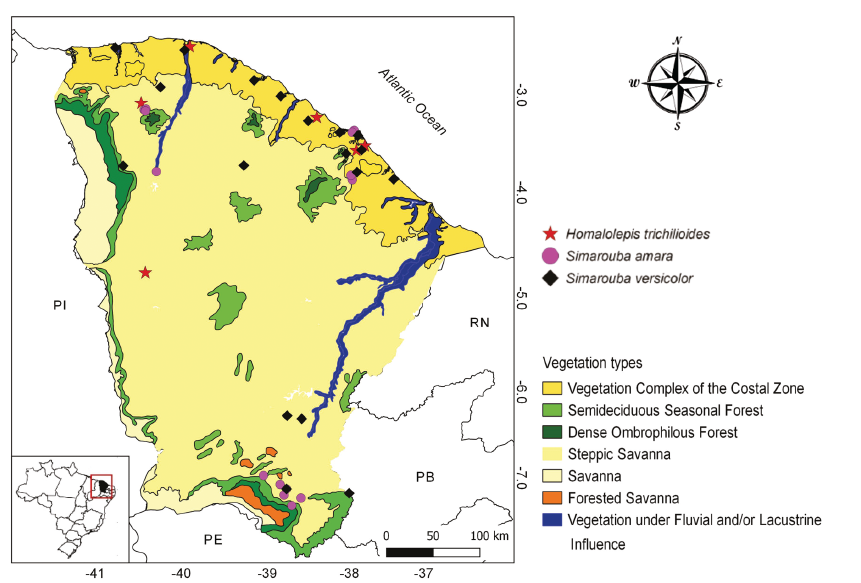
Two genera and three species of Simaroubaceae were recorded in the state of Ceará: Homalolepis trichilioides A.St.-Hil., Simarouba amara Aubl. and Simarouba versicolor A.St.-Hil. The last two taxa are widely distributed (Fig. 1), occurring in the Lowland Semideciduous Seasonal Forest, Semideciduous Seasonal Forest, Steppic Savanna and Vegetation under Fluvial and/or Lake Influence, while H. trichilioides had records only in Lowland Semideciduous Seasonal Forest and Steppic Savanna.
All species were recorded in some Conservation Unit of the Ceará: Dunas da Lagoinha Environmental Protection Area (Simarouba versicolor), Pacoti River Environmental Protection Area (Homalolepis trichilioides, S. versicolor), Araripe-Apodi National Forest (Simarouba amara, S. versicolor), São Gonçalo do Amarante Botanical Garden (H. trichilioides), Ceará Botanical State Park (S. versicolor), Ubajara National Park (S. amara), Serra das Almas Private Natural Heritage Reserve (H. trichilioides) and Pedra da Andorinha Wildlife Refuge (S. versicolor).
Distribution map of Simaroubaceae species in Ceará state, Brazil, within the vegetation types.
Taxonomic treatment
Simaroubaceae.
Shrubs or trees; branches glabrous, glabrescent to pubescent; stipules absent; leaves alternate, pinnately compound; leaflets with entire margin, apical glands present or absent. Thyrse terminal; flowers actinomorphic, bisexual or unissexual (in monoecious or dioecious plants), when unisexual bearing or not staminodes or pistillodes; sepals 4-5, connate at base; petals 4-5, free; bisexual or male flowers with 10 stamens, female flower with staminodes, fillet free or forming a pseudotube and filaments usually bearing a basal appendage; ovary superior, style connate, stigma punctiform or with five divergent branches; gynophore present or absent; pistillode frequently present in male flowers. Fruit drupaceous, obovoid or ellipsoid, glabrous or dense-pubescent, with one seeded.
Key to the species of Simaroubaceae in the state of Ceará
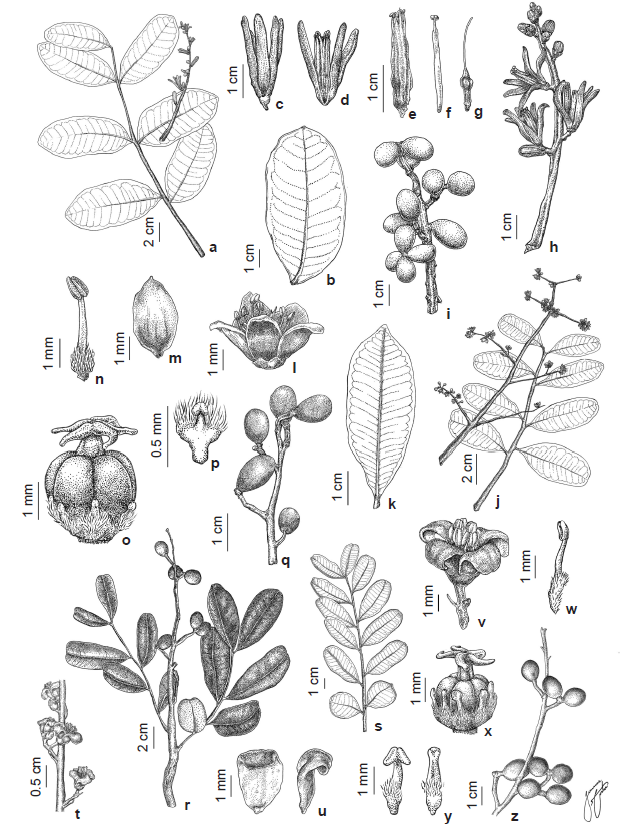
1. Leaflets opposite to subopposite, with conspicuous apical gland; flowers bisexual (monoecious plants); fillet forming a pseudotube; stigma punctiform 1.1. Homalolepis trichilioides (Fig. 2a-i)
1’. Leaflets alternate, apical gland absent; flowers unisexual (dioecious plants); fillet free; stigma with 5 divergent branches.
2. Rachis and petiolules green; leaflets completely glabrous on both sides; petals 3.2-4.3 mm long; staminodes of pistillate flowers 0.7-1 mm long 2.1. Simarouba amara (Fig. 2j-q)
2’. Rachis and petiolules reddish; leaflets glabrous with trichomes restricted to the main vein of the abaxial side; petals 5-6.2 mm long; staminodes of the pistillate flowers 1.8-2.5 mm long 2.2. Simarouba versicolor (Fig. 2r-z)
1. Homalolepis Turcz. Bull. Soc. Imp. Naturalistes Moscou 21: 575 (1848).
The species of the genus can be recognized by the presence of imparipinnate, rarely paripinnate leaves, each leaflet often bearing an apical gland, usually conspicuous. The flowers are bisexual and grouped in a thyrsus or thyrsoid. Androecium is composed of ten stamens, each filament bearing an adaxial laminar appendage, forming a pseudotube surrounding the ovary or overlapping it. Gynoecium consists of five free uniovulate carpels, united only by their styles. The fruit is usually composed of a single or rarely two to five drupaceous mericarps, which are mostly ellipsoid and not laterally flattened.
This genus is the largest genus of Simaroubaceae with 28 species. It is distributed throughout the Neotropical region, from southeastern Brazil to El Salvador in Central America, concentrating mainly in extra-Amazonian regions (Devecchi 2017). In Brazil, occurs 25 species recorded in the Amazon, Caatinga, Cerrado and Atlantic Forest domains (Devecchi et al. 2024). In the state of Ceará, there is a record of only one species, H. trichilioides.
1.1. Homalolepis trichilioides (A.St.-Hil.) Devecchi & Pirani. Phytotaxa 366: 94-97 (2018). Figs. 1; 2a-i; 3a-c
Shrub 1-3 m tall; thin stem, branched or not; young branches pubescent to glabrescent. Leaves compound, imparipinnate, grouped in the distal portion of the branches; rachis 11-25 cm long, pubescent; petioles ca. 1 mm long, pubescent; leaflets 4.3-11.7 × 2.8-6.7 cm, 4-5 pairs, opposite to subopposite, oblong, elliptical or obovate, base cuneate, obtuse, apex acute, rounded, truncated to slightly rectus, with conspicuous apical gland, slightly involute margin, coriaceous; abaxial surface densely pubescent, adaxial surface sparsely pubescent. Thyrsus 30-51 cm long, terminal, lax, densely pubescent to glabrescent. Flowers showy, bisexual (monoecious plants); pedicel 2-2.5 mm long, densely pubescent; calyx 3-5 mm long, densely pubescent, apex of lobes acute; petals 23-29 × 3.2-4.6 mm, linear, apex obtuse or rounded, yellowish to greenish, sericeous to villose on both sides; stamens 10; fillets 13-20 mm long, forming a pseudotube, with basal 4/5 attached and distal 1/5 free, bearing an adaxial appendage with 9-18 mm long, sericeous to villous; anthers ca. 1.5 mm long; gynophore 3.8-5 mm long, cylindrical, slightly lateral, sericeous; ovary 1.3-3 mm long, sericeous; style 11-15 mm long, pubescent at base; stigma punctiform. Fruit 1.2-3.5 × 0.8-2 cm, obovoid, dense pubescent, ferrugineous-green.
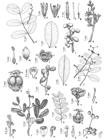
a-i. Homalolepis trichilioides - a. leaf and inflorescence; b.leaflet; c. flower; d. flower with petal removed showing the pseudo floral tube; e. pseudo floral tube; f. stamen; g. carpel; h. inflorescence; i. infructescence. j-q. Simarouba amara - j. leaf and inflorescence; k. leaflet; l. flower; m. petal; n. stamen; o. carpel; p. staminode; q. infrutescence. r-z. Simarouba versicolor - r. branch with leaves and fruits; s. leaf; t. inflorescence; u. petals; v. flower; w. stamen; x. carpel; y. staminode; z. infrutescence. [a-b. Guedes et al. 24208; c-h. Lucena et al. 22; i. Soares Neto et al. 44; j-n. Mascena 225; o-p. Ribeiro (EAC 35510); q. Gonçalves & Freire (EAC 54529); r-s. Reis 03; t-w. Reis 02; x-y. Nunes & Martins (EAC 9528); z. Reis 01].
Selected material: Acaraú, Fazenda do Arroz, 15.X.1967, fl. and fr., F.J.A. Matos (EAC 5462). Crateús, Reserva Natural Serra das Almas, trilha do lajedo, 05º08’39”S, 40º55’21”W, fl., N.G. Bordon & A.C.D. Castelo 19 (UEC). Eusébio, APA do Rio Pacoti, 03°50’57”S, 38°25’13”W, 30.XII.2022, fl., F.S.T. Rabelo 344 (EAC). Fortaleza, bairro Seis Bocas, 5.III.1997, fl. and fr., L.W. Lima-Verde & E. Nunes 2437 (EAC); Campus do Itaperi, Universidade Estadual do Ceará, 03°47’50”S, 38°33’26”W, 14.IX.2018, fl. and fr., E.M.P Lucena et al. 253 (EAC). São Gonçalo do Amarante, Jardim Botânico de São Gonçalo do Amarante, 03°34’26”S, 38°53’15”W, 24.XI.2017, fl. and fr, E.M.P Lucena et al. 22 (EAC). Tianguá, 29.VII.2015, fr., R.L. Soares Neto et al. 44 (EAC).
Homalolepis trichilioides is a plant that is easily distinguished from other species occurring in Ceará by having imparipinnate leaves; petioles pubescent; flowers bisexual; fillets forming a pseudotube and stigma punctiform.
Homalolepis trichilioides is widely distributed in Brazil and Paraguay (Devecchi et al. 2018). In Brazil, it has been recorded in the mid-western, southeastern (northwest of Minas Gerais state), northern and northeastern regions (Devecchi et al. 2024). In Ceará, H. trichilioides has been recorded in Vegetation Complex of the Costal Zone and the Steppic Savanna (Fig. 1) and in the conservation units: the Pacoti River Environmental Protection Area, the Serra das Almas Private Natural Heritage Reserve and the São Gonçalo do Amarante Botanical Garden.
The species is collected with flowers from March to December and with fruit from March to November.
There is no registered use for this species.
There is no registered vernacular name for this species.
2. Simarouba Aubl. Hist. Pl. Guiane 2: 859-864 (1775).
Trees with straight, cylindrical, grayish stems; leaves generally distributed along the distal part of the branches, compound, alternate, paripinate or imparipinnate; leaflets alternate, apical gland absent; inflorescences thyrsoids, terminal, branched; pedicel puberulent; flowers pentamerous, unisexual in dioecious plants; calyx gamosepalous, 5-lobed, campanulate, apex acute, green; corolla actinomorphic, petals oblong-elliptical, apex round to obtuse, glabrous on both sides, yellowish to greenish; staminate flowers with 10 stamens, free fillets bearing an appendage with an obtuse and villous apex, white-green anthers, pistilode present; pistillate flowers with 10 pubescent staminodes, with spatulate appendage; gynophore 0.5-1 mm long, cylindrical, glabrous, gynoecium 5-carpelar, uniovulate, glabrous, style glabrous, stigma with five divergent branches. Fruit ellipsoid, smooth, glabrous, green, vinaceous to blackish.
Simarouba is represented by six species with a distribution centered in the Neotropical region (Devecchi & Pirani 2020). In Brazil, only S. amara and S. versicolor occur, recorded in the Amazon, Caatinga, Cerrado and Atlantic Forest domains (Devecchi et al. 2024) and both species have records in the state of Ceará.
2.1. Simarouba amara Aubl. Hist. Pl. Guiane 2: 860-861 (1775). Figs. 1; 2j-q; 3d-e
Tree 2-12 m tall; leaves with green rachis; petiolules 1-6 mm long, green; leaflets 3.4-10.5 × 1.2-4.7 cm, 5-7 pairs, obovate, oblanceolate, elliptical, base attenuate or cuneate, apex rounded, retuse, apiculate or truncate, completely glabrous on both sides, subcoriaceous, discolor. Inflorescence 18-42 cm long. Staminate flowers: pedicel 1-2 mm long; calyx 1-1.5 mm long, lobes 0.8-1 mm long, ciliate; petals 3.2-4.3 × 1.6-2.1 mm; fillets 2.3-3.5 mm long, bearing an appendage 0.9-1.1 mm long, anthers 0.6-0.8 mm long. Pistillate flowers: pedicel 1-2 mm long, puberulent; staminodes 0.7-1 mm long; calyx 1-1.5 mm long, ciliated; petals 3.2-4.3 × 1.6-2.1 mm; ovary 1.7-1.9 mm long; style 1-1.5 mm long. Fruit 1.2-2 × 0.7-1.2 cm.
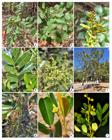
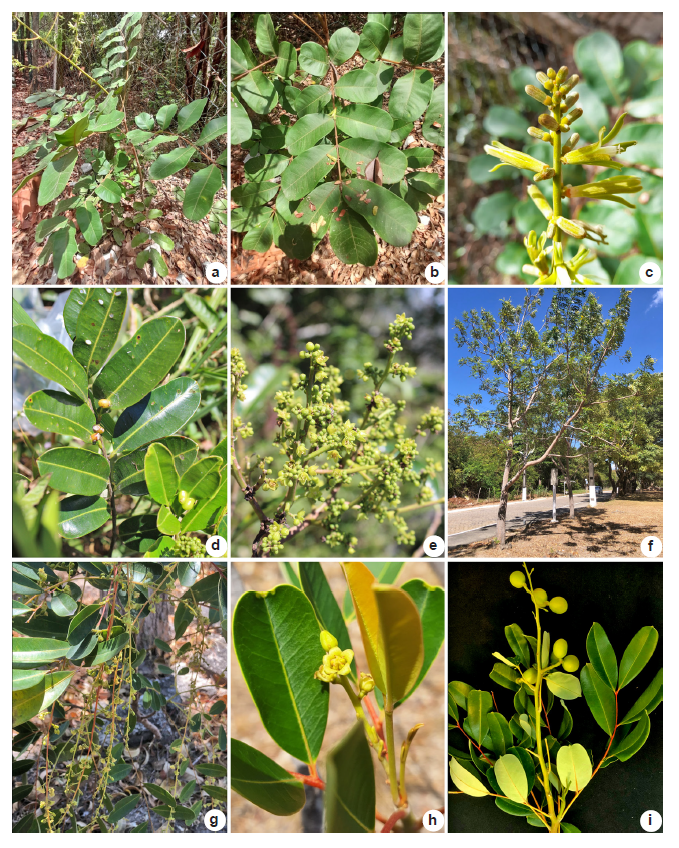
a-c. Homalolepis trichilioides - a. habit; b. leaf; c. inflorescence. d-e. Simarouba amara - d. leaf; e. inflorescence. f-i. Simarouba versicolor - f. habit; g. inflorescence; h. flower; i. infrutescence. (Photos: a-c. R.R. Miranda; d-e. V.S. Sampaio).
Selected material: Aratuba, Sítio Pau Cardoso, 30.VIII.1980, fl., M.A. Figueiredo (EAC 8918). Barbalha, Flona do Araripe, 10.X.2000, fl., I.R. Costa (EAC 32690); 07°13’49”S, 39°12’42”W, 13.X.2014, fl., V.M. Mascena 225 (EAC). Baturité, ALTEE LAB-II, 04°10’49”S, 38°32’33”W, 10.II.2004, fl., V. Gomes & A Xavier LAB.316 (EAC). Brejo Santo, povoado de Timbaúba, 07º27’14”S, 39º04’14W, 11.X.2012, fl., D.G. Oliveira et al. 560 (HVASF, SPF). Crato, Floresta Nacional do Araripe, 07º30’S, 30º35’W, 19.I.1983, fr., T. Plowman & J.T. Caçula 12698 (F, SP); 14.I.1999, fr., A.M. Miranda & D. Lima 3156 (EAC, FCAB, FUEL, HST, HUEFS, IPA); Fortaleza, Campus do Itaperi da Universidade Estadual do Ceará, 03°47’49”S, 38°33’24”W, 6.VII.2018, fl., V.S. Sampaio et al. 508 (EAC). Guaraciaba do Norte, 04°10’01”S, 40°44’51” W, 10.XII.2000, fl., A.S.F. Castro 912 (EAC). Guaramiranga, Sítio Cana Brava, 7.I.1994, fr., M.R.L. Oliveira (EAC 21024). Jardim, Sítio Água Branca, 07º34’57”S, 39º13’01”W, 30.X.2012, fl. and fr., A.C.P. Oliveria & D.R.B. Pinheiro 1753 (HVASF). Nova Olinda, estrada de Nova Olinda, 18.IX.1996, fl., F.A.S. Clemente (EAC 25070). Ubajara, Parque Nacional de Ubajara, 23.IX.1998, fl., A. Fernandes & E. Nunes (EAC 27772); Sítio Murimbeca, 03°29’18”S, 40°32’44”W, 26.VIII.2012, fl., M.I.B. Loiola et al. 1945 (EAC); Serra da Ibiapaba, 3 km road between the town of Ubajara and the entrance of Ubajara National Park, 03º50’S, 40º55’W, 11.XII.1981, fl., J. Jangoux et al. 1823 (NY, US).
Simarouba amara is morphologically similar to S. versicolor in terms of the size and arrangement of leaves and leaflets, differing by its green rachis and petioles (vs. reddish in S. versicolor); leaflets completely glabrous on both sides (vs. with trichomes along the main vein of the abaxial surface), petals 3.2-4.3 mm long. (vs. 5-6.2 mm long), anthers 0.6-0.8 mm long. (vs. 1-1.6 mm long) and staminodes of pistillate flowers 0.7-1 mm long. (vs. 1.8-2.5 mm long).
Simarouba amara occurs in Honduras (Central America), the Caribbean region and Brazil (Devecchi & Pirani 2021). In Brazil, there are records in the northern, northeastern, mid-western and southeastern regions, in the Amazon, Cerrado, Caatinga and Atlantic Forest domains (Devecchi et al. 2024). In Ceará, S. amara was found in 11 municipalities growing on vegetation complex of the costal zone, Semideciduous Seasonal Forest and Steppic Savanna (Fig. 1) and in the conservation units of Araripe-Apodi National Forest and Ubajara National Park.
The wood of Simarouba amara is light, easy to work with and has insect repellent properties, and it is used in the manufacture of lining materials, toys and boxes (Lorenzi 1992). Furthermore, the species has anti-inflammatory, gastro- and hepatoprotective properties (Maranhão 2014).
The vernacular names for this species are Craíba, jitó-branco e paraíba.
2.2. Simarouba versicolor A. St.-Hill. Pl. Us. Bras. t. 5 (1824). Figs. 1; 2r-z; 3f-i
Tree 5-12 m tall; leaves with reddish rachis; petiolules 0.5-4 mm long, reddish; leaflets 2.5-9.5 × 1.1-3.3 cm, 3-8 pairs, oblanceolate, elliptical, base attenuate to obtuse, apex rounded, straight, truncate or obtuse, glabrous on adaxial surface, with trichomes restricted to the main vein of the abaxial surface, coriaceous, discolor. Inflorescence 20-52 cm long. Staminate flowers: pedicel 1.5-2 mm long; calyx 1-2 mm long, lobes ca. 0.5 mm long, glabrous; petals 5-6.2 × 2-2.8 mm; fillets 2.7-3.5 mm long, bearing an appendage 1-1.3 mm long, anthers 1.1-1.6 mm long. Pistillate flowers: pedicel 1-2 mm long, puberulent to glabrescent; staminodes 1.8-2.5 mm long; calyx 1-2 mm long, glabrous; petals 5-6.2 × 2-2.8 mm; ovary 2-2.5 mm long; style 1-1.3 mm long. Fruit 2.2-2.8 × 1.6-2.1 cm.
Selected material: Barbalha, Sítio Melo, 22.IX.2007, fr., J.G. Oliveira 2 (HCDAL, SPF). Beberibe, 8.XII.1989, fr., M.A. Figueiredo (EAC 18616). Camocim, Lago Seco, 02°52’56”S, 40°52’24”W, 11.IX.2014, fl., E.B. Souza (EAC 57653). Cascavel, Caponga, 26.X.1992, fr., F.S. Araújo (EAC 38020). Caucaia, Parque Estadual Botânico do Ceará, 03°42’37”S, 38°38’33”W, 24.VIII.2018, fl., E.M.P. Lucena et al. 242 (EAC). Crato, Chapada do Araripe, FLONA, 20.VIII.1998, fl., D.P. Lima (ASE 1484). Cruz, margem da estrada, 02°53’52”S, 40°27’44”W, 30.X.2022, fr., M.I.B. Loiola et al. 2907 (EAC). Eusébio, 4.XI.2022, fl., M.I.B. Loiola et al. 2908 (EAC); APA do Rio Pacoti, 03°53’51”S, 38°42’28”W, 20.X.2017, fl., S.T. Rabelo & L.X. Sampaio 21 (EAC). Fortaleza, Campus do Pici da Universidade Federal do Ceará, estacionamento entre os departamentos de Geologia e Matemática, 03°44’49’’S, 38°34’24’’W, 10.VIII.2023, fl., A.B.S. Reis 02 (EAC); 03°44’49’’S, 38°34’24’’W, 13.XI.2023, fr., A.B.S. Reis 03 (EAC). Graça, Sítio Santa Clara, 03°57’44”S, 40°49’07”W, 16.VII.2017, fl., F.F. Araújo 277 (EAC, HDELTA, HUEFS). Itapipoca, 03º18’50”S, 39º31’02”W, 6.XI.2023, fl., M.I.B. Loiola et al. 2911 (EAC). Lavras da Mangabeira, 06°50’24”S, 39°03’36”W, 1.XI.2014, fl., R. Moura et al. 1116 (EAC). Milagres, 07°22’556,60”S, 38°57’28,40”W, fl., M. Oliveira et al. 4443 (EAC). Moraújo, Sítio Boa Vista, 10.VI.1988, M.A. Figueiredo (EAC 15504). Pacatuba, Serra da Aratanha, Sítio Monte Alegre, 4.X.1979, fl., A.J. Castro & P. Martins (EAC 7057). Paraipaba, APA de dunas da Lagoinha, 19.X.2003, fr., D.V. Azevedo (EAC 33024). São Gonçalo do Amarante, Pecém, 19.IX.2010, fr., R.G. Ferreira (EAC 48314); 30.X.2007, fr., M.F. Moro et al. 276 (EAC). Sobral, distrito de Taperuaba, Unidade de Conservação REVIS Pedra da Andorinha, 04°04’08”S, 39°59’55”W, 28.VII.2017, fl., E.B. Sousa et al. 4751 (EAC, HUEFS).
Simarouba versicolor is characterized by having rachis and petiolules reddish, leaflets glabrous with trichomes restricted to the main vein of the abaxial side, petals 5-6.2 mm long and staminodes of the pistillate flowers 1.8-2.5 mm long. This species is similar to S. amara being differentiated in the comments of the previous species.
Simarouba versicolor occurs in Brazil and Bolivia (Franceschinelli et al. 1998; Devecchi & Pirani 2021). In Brazil, it was recorded in the northern, northeastern, mid-western and southeastern regions, in the Amazon, Caatinga and Cerrado domains (Devecchi et al. 2024). In Ceará, S. versicolor was recorded in 18 municipalities in vegetation complex of the costal zone, semideciduous seasonal forest, and stepic savana (Fig. 1) and in five conservation units: Lagoinha Dunes Environmental Protection Area, Pacoti River Environmental Protection Area, Ceará Botanical State Park, Araripe-Apodi National Forest and Pedra da Andorinha Wildlife Refuge Conservation Unit.
Simarouba versicolor has light wood, which is easy to handle and can be used in carpentry and in the manufacture of toys, coffins, clogs, funerary urns, toothpicks and plywood core (Lorenzi 1998). The bark fibers are used to produce rustic ropes, tow and paper pulp (Lorenzi 1998). The species also has adstringent, antisyphilitic, antidiarrheal, febrifuge, hepatoprotective, insecticidal and vermifuge medicinal properties (Simote 2006; Carvalho 2010). S. versicolor is fast-growing and is also suitable as an ornamental plant (Carvalho 2010; Lorenzi 1998).
The vernacular names for this species are amargoso, morcegueira, paraíba, pau-paraíba, praíba.
Acknowledgements
We are grateful to Fundação Cearense de Apoio ao Desenvolvimento Científico e Tecnológico (FUNCAP), for the scholarship granted to the first author, a postdoctoral scholarship granted to FDSS (Process 150120/2023-0), and for the financial support for the field expeditions (Process MLC-0191-00147.01.00/22, Edital Mulheres na Ciência). LMS is grateful to CAPES (Coordenação de Aperfeiçoamento de Pessoal de Nível Superior), for the scholarship (Financial Code 001). MIBL would like to thank the National Council for Scientific and Technological Development (CNPq), for the productivity scholarship granted (Process 306723/2023-9). The authors thank Roberta da Rocha Miranda and Valéria da Silva Sampaio, for providing photographs of Homalolepis trichilioides and Simarouba amara, respectively.
Data availability statement
In accordance with Open Science communication practices, the authors inform that there is no data sharing of this manuscript
References
- Almeida MMB, Arriaga AMC, Santos AKL, Lemos TLG, Braz-Filho R & Vieira IJC (2007) Ocorrência e atividade biológica de quassinóides da última década. Química Nova 30: 935-951.
- APG IV - Angiosperm Phylogeny Group (2016) An update of the Angiosperm Phylogeny Group classification for the orders and families of flowering plants: APG IV. Botanical Journal of the Linnean Society 181: 1-20.
- Araújo HJB & Silva IG (2000) Lista de espécies florestais do Acre: ocorrência com base em inventários florestais. Embrapa Acre, Rio Branco. 77p.
- Aublet JBCF (1775) Histoire des plantes de la Guiane Françoise. Vol. 2. Libraire de la Faculté de Médicine, Paris. Pp. 860-861.
- Bhattacharjee S, Gupta G, Bhattacharya P, Mukherjee A, Mujumdar SB, Pal A & Majumdar S (2008) Quassin alters the immunological patterns of murine macrophages through generation of nitric oxide to exert antileishmanial activity. Journal of Antimicrobial Chemotherapy 63: 317-324.
- Buril MT, Thomas WW & Alves M (2014) Flora da Usina São José, Igarassu-PE: Rutaceae, Simaroubaceae e Picramniaceae. Rodriguésia 65: 701-710.
- Carvalho PER (2010) Pau-paraíba (Simarouba versicolor) In: Carvalho PER (ed.) Espécies arbóreas brasileiras. Vol.4. Ed. Embrapa Informação Tecnológica, Brasília. Pp. 427-433.
- Clayton JW, Fernando ES, Soltis PS & Soltis DE (2007) Molecular phylogeny of the tree-of-heaven family (Simaroubaceae) based on chloroplast and nuclear markers. International Journal of Plant Sciences 168: 1325-1339.
-
CRIA - Centro de Referência em Informação Ambiental (2024a) speciesLink. Available at <Available at https://specieslink.net/ >. Access on 2 January 2024.
» https://specieslink.net/ -
CRIA - Centro de Referência em Informação Ambiental (2024b) Geoloc. Available at <Available at http://splink.cria.org.br/ >. Access on 5 January 2024.
» http://splink.cria.org.br/ - Devecchi MF & Pirani JR (2016) Flora das cangas da Serra dos Carajás, Pará, Brasil: Simaroubaceae. Rodriguésia 67: 1471-1476.
- Devecchi MF, Thomas WW & Pirani JR (2018) Taxonomic revision of the neotropical genus Homalolepis Turcz. (Simaroubaceae). Phytotaxa 366: 001-108.
- Devecchi MF & Pirani JR (2020) Flora do Espírito Santo: Simaroubaceae. Rodriguésia 71: e02942018.
- Devecchi MF & Pirani JR (2021) Flora dos estados de Goiás e Tocantins: Simaroubaceae. Vol. 50. Ed. Cegraf UFG, Goiânia. 45p.
- Devecchi MF, Thomas WW & Pirani JR (2022) Flora of the Reserva Ducke, Amazonas, Brasil: Simaroubaceae. Rodriguésia 73: e00182020.
-
Devecchi MF, Pirani JR & Thomas WW (2024). Simaroubaceae in Flora do Brasil 2024 (continuously updated). Jardim Botânico do Rio de Janeiro. Available at <Available at https://floradobrasil.jbrj.gov.br/FB222 >. Access on 5 January 2024.
» https://floradobrasil.jbrj.gov.br/FB222 - Engler HGA (1874) Simaroubaceae. In: Martius CFP & Eichler AGI (eds.) Flora brasiliensis Fleischer, Liepizig. Vol. 12, pars 2, pp. 197-248. t. 27-28.
- Franceschinelli EV, Yamamoto K & Shepherd GJ (1998) Distinctions among three Simarouba species. Systematic Botany 23: 479-488.
- Figueiredo MA (1997) A cobertura vegetacional do Ceará: unidades fitoecológicas. In: Ceará, Atlas do Ceará. Edições IPLANCE, Fortaleza. Pp. 28-29.
- Gadek PA, Fernando ES, Quinn CJ, Hoot SB, Terrazas T, Sheahan MC & Chase MW (1996) Sapindales: Molecular delimitation and infraordinal groups. American Journal of Botany 83: 802-811.
- Harris JG & Harris MW (2001) Plant identification terminology: an illustrated glossary. Spring Lake Publishing, Spring Lake. 206p.
- Hijmans RJ, Cameron SE, Parra JL, Jones PG & Jarvis A (2005) Very high-resolution interpolated climate surfaces for global land areas. International Journal of Climatology 25: 1965-1978.
-
IBGE - Instituto Brasileiro de Geografia e Estatística (2012) Manual técnico da vegetação brasileira. 2ª ed. Available at <Available at https://biblioteca.ibge.gov.br/index.php/biblioteca-catalogo?view=detalhes&id=263011 >. Access on 6 January 2024.
» https://biblioteca.ibge.gov.br/index.php/biblioteca-catalogo?view=detalhes&id=263011 -
IPECE - Instituto de Pesquisa e Estratégia Econômica do Ceará (2017) Ceará em números. Available at <Available at http://www2.ipece.ce.gov.br/publicacoes/ceara_em_numeros/2017/completa/Ceara_em_Numeros_2017.pdf >. Access on 2 February 2024.
» http://www2.ipece.ce.gov.br/publicacoes/ceara_em_numeros/2017/completa/Ceara_em_Numeros_2017.pdf -
IPNI (2024) The International Plant Names Index. The Royal Botanic Gardens, Kew. Available at <Available at http://www.ipni.org >. Access on 24 February 2024.
» http://www.ipni.org - Lemos RPL, Mota MCS, Chagas ECO & Silva FC (2010) Checklist-Flora de Alagoas: Angiospermas. Instituto do Meio Ambiente de Alagoas, Maceió. 158p.
-
Loiola MIB, Ribeiro RTM, Sampaio VS & Souza EB (2020) Diversidade de angiospermas do Ceará. Edições HUVA, Sobral. 257p. Available at <Available at https://ww2.uva.ce.gov.br/apps/common/documentos_uva/ebook_4f67b7b91bb5b9c8d95c217a.pdf >. Access on 21 January 2024.
» https://ww2.uva.ce.gov.br/apps/common/documentos_uva/ebook_4f67b7b91bb5b9c8d95c217a.pdf - Lorenzi H (1992) Árvores brasileiras: manual de identificação e cultivo de plantas arbóreas nativas do Brasil. Ed. Plantarum, Nova Odessa. 326p.
- Lorenzi H (1998) Árvores brasileiras: manual de identificação e cultivo de plantas arbóreas nativas do Brasil . Vol 2. Ed. Plantarum, Nova Odessa . 324p.
- Maranhão HML (2014) Atividades anti-inflamatória, antiulcerogênica, hepatoprotetora e segurança de uso do extrato aquoso da casca do caule de Simarouba amara Aublet (Simaroubaceae). Tese de Doutorado. Universidade Federal de Pernambuco, Recife. 117p.
- Moro MF, Macedo MB, Moura-Fé MM, Castro ASF & Costa RF (2015) Vegetação, unidades fitoecológicas e diversidade paisagística do estado do Ceará. Rodriguésia 66: 717-743.
- Pirani JR (1987) Flora da Serra do Cipó, Minas Gerais: Simaroubaceae. Boletim de Botânica da Universidade de São Paulo 9: 219-226.
- Pirani JR, Majure LC & Devecchi MF (2021) An updated account of Simaroubaceae with emphasis on American taxa. Brazilian Journal of Botany 45: 201-221.
-
REFLORA (2023) Herbário Virtual. Availbale at < Availbale at https://floradobrasil.jbrj.gov.br/reflora/herbarioVirtual/ConsultaPublicoHVUC/ConsultaPublicoHVUC.do >. Access on 4 February 2023.
» https://floradobrasil.jbrj.gov.br/reflora/herbarioVirtual/ConsultaPublicoHVUC/ConsultaPublicoHVUC.do - Ribeiro-Silva S, Medeiros MB, Gomes BM, Seixas ENC & Silva MAP (2012) Angiosperms from the Araripe National Forest, Ceará, Brazil. Check List 8: 744-751.
- Saint-Hilaire MA (1824) Plantes usuelles des brasiliens. Grimbert Libraire, Paris. t. 5. Pp. 1-3.
- Silveira AP, Menezes BS, Loiola MIB, Lima-Verde LW, Zanina DN, Carvalho ECD, Souza BC, Costa RC, Mantovani W, Menezes MOT, Flores LMA, Nogueira FCB, Matias LQ, Barbosa LS, Gomes FM, Cordeiro LS, Sampaio VS, Batista MEP, Soares Neto RL, Silva MAP, Campos NB, Oliveira AA & Araújo FS (2020a) Flora and annual distribution of flowers and fruits in the Ubajara National Park, Ceará, Brazil. Floresta e Ambiente 27: 1-19.
- Silveira AP, Loiola MIB, Gomes VS, Lima-Verde LW, Oliveira TS, Silva EF, Otutumi AT, Ribeiro K, Xavier FAS, Bruno MMA, Souza SSG & Araújo FS (2020b) Flora of Baturité, Ceará: a west island in the Brazilian semiarid. Floresta e Ambiente 27: 1-22.
- Simote SY (2006) Estudo fitoquímico de Helietta puberula (Rutaceae) e Simarouba versicolor (Simaroubaceae) e busca de um processo de microencapsulação de compostos ativos, visando o controle de formigas cortadeira. Tese de Doutorado. Universidade Federal de São Carlos, São Carlos. 232p.
-
Thiers B (continuously updated) Index Herbariorum: a global directory of public herbaria and associated staff. New York Botanical Garden’s Virtual Herbarium. Available at <Available at http://sweetgum.nybg.org/science/ih/ >. Access on 15 January 2024.
» http://sweetgum.nybg.org/science/ih/