 Flora of Ceará, Brazil: Senna (Leguminosae-Caesalpinioideae)
Abstract
We present the taxonomic study of the genus Senna for the state of Ceará. The study was based on material deposited in herbaria, as well as field work carried out between 2022 and 2025. In Ceará, Senna is representd by 21 species, six of which are endemic to Brazil (S. cana, S. cearensis, S. gardneri, S. martiana, S. rizzinii, and S. trachypus). Senna cana is recorded as a new occurrence in the state, reported in the municipality of Crato. The main characteristics for distinguishing the species are the size and shape of the stipules, number and position of leaf nectaries, number and shape of leaflets, bract shapes, flower symmetry, and legume shapes. The highest species richness was sampled in the regions of Chapada do Araripe, Planalto da Ibiapaba, and Serra de Baturité, which are also areas integrated into conservation units. Among the studied species, 15 are classified as Least Concern on the IUCN Red List of Threatened Species. With the exception of S. martiana, all other species were recorded in conservation units. Information is provided to allow identification and discussion of Senna representatives occurring in the state, including morphological descriptions, identification key, taxonomic comments, illustrations, photographs, distribution maps, and phenologies.
Key words:
Caatinga; Cassieae; Fabaceae; Northeastern Brazil; plant taxonomy
Resumo
Apresentamos o estudo taxonômico do gênero Senna para o Ceará. O estudo foi baseado na análise de amostras de herbários, bem como de coletas realizadas entre 2022 e 2025. No Ceará, Senna está representada por 21 espécies, sendo seis delas endêmicas do Brasil (S. cana, S. cearensis, S. gardneri, S. martiana, S. rizzinii e S. trachypus). Senna cana é registrada como uma nova ocorrência para o estado, com registro no municipio do Crato. Os principais caracteres para distinguir as espécies cearenses são o tamanho e forma das estípulas, quantidade e posição dos nectários foliares, número e forma dos folíolos, formas das brácteas, simetria das flores e formato dos legumes. A maior riqueza do grupo foi amostrada nas regiões da Chapada do Araripe, Planalto da Ibiapaba e Serra de Baturité, sendo também áreas integrantes de unidades de conservação. Das espécies estudadas, 15 estão classificadas como pouco preocupantes pela Lista Vermelha de Espécies Ameaçadas da IUCN e, com exceção de S. martiana, todas as outras espécies foram registradas em unidades de conservação. São apresentadas informações que permitem a identificação e discussão sobre os representantes de Senna do Ceará, com descrições, chave de identificação, comentários, ilustrações, fotografias, mapas de distribuição e fenologias.
Palavras-chave:
Caatinga; Cassieae; Fabaceae; Nordeste do Brasil; Taxonomia vegetal
Introduction
The genus Senna Mill. comprises approximately 292 pantropical species, with the Americas being the center of species richness, containing 80% of the group’s representatives, while the remainder are found in Africa, Asia, and Oceania (Irwin & Barneby 1982; Marazzi et al. 2006; Legume Data Portal 2026). In Brazil, approximately 91 species occur, found in all of the country’s phytogeographic domains, with 38 endemic species (Souto et al. 2021; Souto et al. 2025; Bortoluzzi et al. 2026; Legume Data Portal 2026). The Northeastern region has the greatest richness in the group, with approximately 56 species (Souto et al. 2021; Bortoluzzi et al. 2026).
Senna is a monophyletic taxon supported by the sequencing of the rpS16, rpL16, and matK genes (Marazzi et al. 2006; LPWG 2017). With the genera Cassia L. and Chamaecrista (L.) Moench, Senna is circumscribed as part of the subfamily Caesalpinioideae, tribe Cassieae (Irwin & Barneby 1982; Marazzi et al. 2006; Bruneau et al. 2024). Despite the morphological proximity of the three genera, species of Senna can be distinguished from Cassia and Chamaecrista by typically having leaves with convex, clavate, or pyramidal interfoliolar nectaries, the absence of bracteoles on the pedicel, non-sigmoid stamens, and indehiscent or late-dehiscent fruits (Queiroz 2009; Silva et al. 2018; Santos et al. 2020).
The Senna species range from herbs to trees, commonly featuring extrafloral nectaries between the leaflets or on the petiole; with paripinnate leaves and opposite leaflets; inflorescences in racemes or panicles; pentamerous, zygomorphic or asymmetrical flowers, without bracteoles, unguiculate yellow petals, one of which is usually concave, covering the reproductive system, with a heteromorphic androecium with poricidal anthers; and fruits of the legume type (Irwin & Barneby 1982; Silva et al. 2018; Santos et al. 2020).
In Brazil, the taxonomy of Senna was dealt with by Bentham (1871), and in that study it was still included in the genus Cassia. Later, the group became the subject of various studies, such as Lima et al. (2025a) on Senna ser. Bacillares (Benth) H.S.Irwin & Barneby and Souto (2025) on Senna ser. Interglandulosae (Benth.) H.S.Irwin & Barneby in Brazil, in addition to studies focused on the Northeastern region (Ducke 1953; Lewis 1987; Lima 1999; Cardoso & Queiroz 2008; Queiroz 2009; Lima & Mansano 2011; Azevedo & Conceição 2017; Correia & Conceição 2017; Souto et al. 2019; Santos et al. 2020; Lima et al. 2021; Souto et al. 2021; Sousa et al. 2022; Lima et al. 2023; Souto et al. 2024; Lima et al. 2025b), the Northern region (Araújo & Souza 2007; Mattos et al. 2018), Mid-Western region (Fernandes & Bezerra 1984; Alves & Sartori 2009; Dantas & Silva 2013; Santos 2013; Souza & Silva 2016; Santos et al. 2017; Silva et al. 2018), the Southeastern region (Rando et al. 2013; Escobar et al. 2014; Romão & Souza 2016; Oliveira & Garcia 2021; Lima et al. 2023) and the Southern region (Rodrigues et al. 2005; Bortoluzzi et al. 2007; Bortoluzzi et al. 2011; Souto et al. 2025).
The studies on Senna for Ceará include Queiroz (2009), focusing on representatives from the Caatinga region, and Lima & Mansano (2011) for representatives occurring in Serra de Baturité, in the northern of the state. Thus, studies on the taxonomy and distribution of Senna for the entire territory and vegetation types of Ceará were incipient.
The genus has ecological, economic, and sustainable potential and is present in the activities of Northeastern populations, including species used for medicinal purposes [Senna velutina (Vogel) H.S.Irwin & Barneby], forage [Senna macranthera (DC. ex Collad.) H.S.Irwin & Barneby], beekeeping [Senna acuruensis (Benth.) H.S.Irwin & Barneby], timber [Senna occidentalis (L.) Link], ornamental purposes [Senna spectabilis (Schrad.) H.S.Irwin & Barneby], and weed species [Senna obtusifolia (L.) H.S.Irwin & Barneby] (Costa et al. 2002; Sampaio et al. 2005; Lorenzi 2008; Lima et al. 2021; Sousa et al. 2022).
In this context, Senna proved to be a promising group for consideration in floristic studies in the state of Ceará. Thus, this study aimed to investigate the representatives occurring in the state, providing morphological descriptions, comments, identification keys, illustrations, photographs, and maps of geographic distribution and species richness.
Material and Methods
The study was conducted in the state of Ceará, located in the Northeastern region of Brazil, bordering the states of Piauí, Rio Grande do Norte, Paraíba, and Pernambuco. The state has an area of approximately 148,894 km², and its climate is hot semiarid (Bsh), according to Köppen’s classification, with a temperature range between 28 °C and 32 °C (FUNCEME 2026; IBGE 2026; IPECE 2026; Peel et al. 2007).
The morphological analyses and species descriptions were based on specimens collected during fieldwork conducted between 2022 and 2025 in the municipalities of Caucaia, Crateús, Fortaleza, and Ipu, in areas with known records of the group and potential for additional occurrences. The samples were herbarium-prepared following classical techniques (Mori et al. 1985) and deposited in the Herbário Prisco Bezerra (EAC) at the Universidade Federal do Ceará.
Additionally, herbarium specimens of Senna collected in Ceará were examined through three different sources: direct consultation at the Herbário Prisco Bezerra (EAC); analysis of digital images from HVASF and US; and examination of loans, donations, and duplicate specimens from the following herbaria: ALCB, CEN, CEPEC, EAN, ESA, HCDAL, HPL, HST, HTSA, HUEFS, HUFU, HUVA, IPA, MBM, MOSS, NY, PACA, PEL, PEUFR, SPF, and UEC, acronyms following Thiers (continuously updated).
The taxa were identified and described to the species level using literature for the group (Irwin & Barneby 1982; Queiroz 2009; Santos 2013; Silva et al. 2018; Lima et al. 2025a). The IPNI (2026) was used to confirm the scientific names of the species and their authors. To describe morphological characters, the terminologies proposed by Radford et al. (1974), Rizzini (1977), Irwin & Barneby (1982), and Santos (2013) were used. Vernacular names were obtained directly from the herbarium specimens and group literature (Queiroz 2009; Santos 2013).
Photographic plates and illustrations were elaborated using morphological analysis of specimens under a stereomicroscope, registering the main diagnostic characters. Photographic plates of species in the field were also produced. These data complement the descriptions and assist in recognizing the taxa occurring in the state.
Population data were obtained through geographic coordinates from herbarium specimens and field collections using GPS. This information was organized to create geographic distribution maps of the species using QGIS software, version 3.28.3 (QGIS Development Team 2023). The maps’ layouts were adapted according to Rebouças et al. (2020). The richness map was adapted according to Lima et al. 2020. For the analysis, grids of 0.5° longitude × 0.5° latitude were defined, also showing conservation units in Ceará state, with data compiled in the DIVA-GIS 7.5 program (Hijmans et al. 2012).
Vegetation types was adapted from Figueiredo (1997) and Manual Técnico da Vegetação Brasileira do Instituto Brasileiro de Geografia and Estatística (IBGE 2012), following a standard used in studies of the flora of Ceará (Rebouças et al. 2020; Silva et al. 2022). Are considered: Vegetational Complex of the Coastal Zone (comprising Pioneer Psammophilous Vegetation, Forest behind Dunes and Lowland Semideciduous Forest), Semideciduous Seasonal Forest (Dry Forest), Dense Ombrophilous Forest (Wet Forest), Neotropical Savanna (Cerrado), Forest Savanna (Cerradão), Steppic Savanna (Caatinga and/or Carrasco), and Vegetation under Fluvial and/or Lacustrine Influence (Riparian Forest).
Results and Discussion
In the state of Ceará, the genus Senna is represented by 21 species, corresponding to 24% of the taxa found in Brazil and 39% of the Senna species in the Northeastern region. Among the studied species, six are endemic to Brazil: Senna cana (Nees & Mart.) H.S. Irwin & Barneby, Senna cearensis Afr.Fern., Senna gardneri (Benth.) H.S. Irwin & Barneby, Senna martiana (Benth.) H.S.Irwin & Barneby, Senna rizzinii H.S.Irwin & Barneby, and Senna trachypus (Benth.) H.S.Irwin & Barneby.
Senna cana is a new record for the state, with only one collection previously made in the municipality of Crato in 2000, indicating the need for further collections in the region to increase its sampling and verify the extent of its populations.
The occurrence of Senna reticulata (Willd.) H.S. Irwin & Barneby was disregarded, as its only sample for Ceará comes from a plant cultivated for research purposes. The occurrences of Senna lechriosperma H.S. Irwin & Barneby and Senna velutina (Vogel) H.S. Irwin & Barneby in Ceará, according to Bortoluzzi et al. (2026), were not confirmed, as there are no records with the diagnostic characteristics of these species in the region; thus, they were removed from the list.
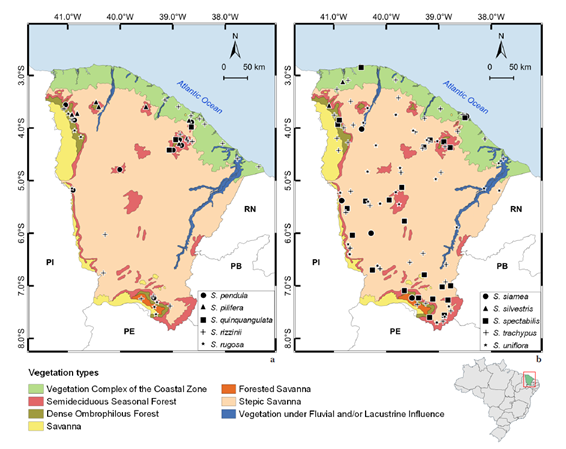
Senna occurs in all vegetation types in Ceará, with 18 species found in the Semideciduous Seasonal Forest (Dry Forest) and Dense Ombrophilous Forest (Wet Forest) located in the regions of Chapada do Araripe, Planalto da Ibiapaba, and Serra de Baturité, which are also conservation unit areas and hold the highest Senna richness in Ceará (Fig. 1). However, some species are more restricted, such as Senna cana, found only in the Forest Savanna (Cerradão).
Regarding the Red List of Threatened Species, 15 species are classified as Least Concern, however, the other six species: Senna gloriosa (H.S.Irwin & Barneby) A.Lima & V.F.Mansano, Senna hirsuta (L.) H.S.Irwin & Barneby, Senna martiana, Senna pilifera (Vogel) H.S.Irwin & Barneby, Senna rizzinii, and Senna uniflora (Mill.) H.S.Irwin & Barneby have not been assessed for their conservation status (IUCN 2026). Due to the wide distribution of the genus in the territory, with the exception of S. martiana, all other species were recorded in conservation units in Ceará.
The main characters used to identify the species in the region were the size and shape of the stipules, the number and position of foliar nectaries, the number and shape of leaflets, the shapes of bracts, flower symmetry, and the shapes of legumes.
Taxonomic treatment
Senna Mill., Gard. Dict. Abr. ed. 4. (1754).
Herbs to trees. Branches glabrous, glabrescent, pubescent, tomentose, hirsute or with glandular trichomes. Stipules linear, lanceolate, triangular, falcate or reniforms, caducous or persistent. Leaves paripinnate, alternate, peciolate; nectary absent or present, linear, fusiform, conical, ovate, clavate or globoid, sessile or stipitate, at the base of the petiole or between the pairs of leaflets; leaflets 2-18 pairs, elliptical, elliptical-obovate, ovate, oval-elliptical, lanceolate, obovate, oblong, oblong-linear, oblong-elliptical, orbicular or oblong-orbicular, apex acute, acuminate, obtuse, retuse, rounded or mucronulate, base acute, obtuse, rounded or asymmetric, margin entire, membranaceous, chartaceous or coriaceous, concolorous or discolorous, glabrous, glabrescent, pubescent, tomentose or hirsute. Inflorescence racemose or paniculate, axillary or terminal; bracts linear, lanceolate, ovate, triangular, obovate, or orbicular, foliaceous or petaloid, caducous or persistent; bracteoles absents. Flowers zygomorphic or asymmetrics, pentamerous; sepals elliptic, ovate, oval-elliptic, oblong, oblong-elliptic, oblong-oval, oblong-obovate or obovate, green, yellow or slightly reddish; petals elliptic, oblong, falcate-oblong, obovate or orbicular, unguiculate, apex rounded to emarginated, base cuneate to asymmetric, yellow; heteromorphic androecium, stamens 10, 3 abaxial, 4 median and 3 staminodes, anthers poricidal, isomorphic or heteromorphic; ovary linear, linear-capitate or oblong, glabrous, glabrescent, pubescent, velutinous, tomentose or hirsute, sessile or stipitate, style linear, stigma punctiform. Legume linear, linear-elliptical or oblong, flat, subquadrangular, subcylindrical, cylindrical or tetragonal with winged valves, straight to curved, smooth, rugose, rough, veiny, wavy, lomentaceous or with T-shaped elevations over each seed, glabrous, glabrescent, pubescent, tomentose or hirsute, brown to dark brown, lately dehiscent or indehiscent, stipitate. Seeds linear, elliptical, ovate, oval-elliptic, oval-oblong, oblong, oblong-elliptic, oblong-rectangular, obovate, rhombic, square, rectangular, orbicular or orbicular-rhomboid, greenish, brown or dark brown.

Identification key for the species of Senna in the state of Ceará
1. Leaves without nectary.
2. Stipules lanceolate or triangular; inflorescence racemose; bracts obovate, petaloid.
3. Stipules triangular; legume tetragonal with winged valves, smooth 1. Senna alata
3’. Stipules lanceolate; legume flat, with T-shaped elevations over each seed 9. Senna martiana
2’. Stipules linear; inflorescence paniculate; bracts lanceolate or triangular, foliaceous.
4. Inflorescence with secondary axes racemose; flowers asymmetric; legume subcylindrical 19. Senna spectabilis
4’. Inflorescence with secondary axes corymbiform; flowers zygomorphic; legume flat.
5. Stipules caducous; leaflets with apex retuse to mucronulate, base acute to asymmetric, chartaceous 17. Senna siamea
5’. Stipules persistent; leaflets with apex acute to acuminate to mucronulate, base rounded, membranaceous 18. Senna silvestris
1’. Leaves with nectary.
6. Nectary located at the base of the petiole.
7. Branches tomentose to hirsute; legume subquadrangular, tomentose to hirsute, brown 7. Senna hirsuta
7’. Branches glabrous to glabrescent; legume flat, glabrous to glabrescent, brown at the margins with a dark brown central stripe 11. Senna occidentalis
6’. Nectary located between the pairs of leaflets.
8. Leaves with three or more pairs of leaflets.
9. Stipules reniforms.
10. Stipules 4-10.5 mm long; leaflets elliptical, legume flat, glabrous to glabrescent 2. Senna cana
10’. Stipules 18-20 mm long; leaflets obovate to oblong-orbicular; legume subquadrangular, pubescent 3. Senna cearensis
9’. Stipules linear, lanceolate, or linear to lanceolate.
11. Nectary only between the first pair of leaflets.
12. Leaflets 3 pairs; inflorescence 2 flowers; seeds rhombic 10. Senna obtusifolia
12’. Leaflets 5-6 pairs; inflorescence 8-12 flowers; seeds ovate 12. Senna pendula
11’. Nectaries between two or more pairs of leaflets.
13. Branches pubescent with glandular trichomes; leaflets 6-8 pairs; legume flat, rugose 20. Senna trachypus
13’. Branches hirsute with glandular trichomes absent; leaflets 3-5 pairs; legume subquadrangular, lomentaceous 21. Senna uniflora
8’. Leaves with two pairs of leaflets.
14. Nectaries between all pairs of leaflets, rarely between all pairs of leaflets in S. macranthera.
15. Branches glabrous to glabrescent; stipules falcate; flowers 1-1.6 cm diam. 14. Senna quinquangulata
15’. Branches pubescent to hirsute; stipules linear; flowers 4-7 cm diam.
16. Petiole hirsute; legume 0.3-0.5 cm larg., flat to subquadrangular 13. Senna pilifera
16’. Petiole pubescent; legume 0.8-1.5 cm larg., cylindrical.
17. Petiole longer than the rachis; petiole 1-2.5 cm long; rachis 0.5-1.5 cm long; bracts 4-5 mm long; centric abaxial stamen with filament 6-10 mm long, anther 8-11 mm long 8. Senna macranthera
17’. Petiole shorter or the same size as the rachis; petiole 0.5-3 cm long; rachis 1-3 cm long; bracts 2.5-3 mm long; centric abaxial stamen with filament 3-5.5 mm long, anther 14-16 mm long 16. Senna rugosa
14’. Nectary only in the first pair of leaflets.
18. Branches pubescent.
19. Paniculate inflorescence; bracts caducous; pedicel 3-4 cm long; flowers 4.5-6 cm diam.; centric abaxial stamen with filament 6-10 mm long; ovary 17-25 mm long 8. Senna macranthera
19’. Racemose inflorescence; bracts persistent; pedicel 1-2 cm long; flowers 2.5-4 cm diam.; centric abaxial stamen with filament 3-4 mm long; ovary 10-15 mm long 15. Senna rizzinii
18’. Branches glabrous or glabrous to glabrescent.
20. Stipules lanceolate or falcate; bracts 6-8 mm long; sepals 2.5-3.5 cm long, lanceolate to elliptic, glabrous 6. Senna gloriosa
20’. Stipules linear; bracts 1.5-3 mm long; sepals 0.5-2 cm long, obovate or ovate to obovate, pubescent or glabrescent to pubescent.
21. Leaflets obovate or oblong-elliptical or orbicular, apex rounded to mucronulate; racemose inflorescence 4. Senna gardneri
21’. Leaflets elliptical to oval-elliptical, apex acuminate; inflorescence paniculate 5. Senna georgica
1. Senna alata Roxb., Fl. Ind. (Roxburgh) 2: 349 (1832). Figs. 2a; 3a-b; 4a-e; 5a
Shrubs 3 m tall. Branches glabrous to glabrescent. Stipules 1-1.5 × 1-1.6 mm, triangular, persistent. Leaves 30-34 cm long; petiole 1-1.3 cm long, pubescent; nectary absent; rachis 30-33 cm long, pubescent; leaflets 10 pairs, 3-14 × 1.5-8 cm, oblong to obovate, apex retuse or rounded or mucronulate, base asymmetric, margin entire, membranaceous, concolorous, adaxial surface glabrous, abaxial surface glabrous to glabrescent. Racemose inflorescence 48.5 cm long, axillary, 18-28 flowers; bracts 27-30 × 12-14 mm, obovate, petaloid, caducous; pedicel 0.5-0.6 cm long, pubescent. Flowers 2-2.5 cm diam., zygomorphic; sepals 1.5-1.6 × 0.4-0.6 cm, oblong-elliptic to obovate, apex obtuse to rounded, yellow, pubescent; petals 1.2-1.5 × 0.9-1.2 cm, obovate, apex rounded to emarginated, base cuneate, yellow; stamens abaxial 3, anthers heteromorphic, centric abaxial filaments 7-8 mm long, anthers 2-3 mm long, latero-abaxial filaments 3-6 mm long, anthers 8-10 mm long, stamens median 4, filaments 2-3 mm long, anthers 3-4 mm long, staminodes 3, 4-5 mm long; ovary 12-13 × 1.5-2 mm, linear, pubescent, stipitate 3-4 mm long, style 4-6 mm long. Legume 13-14.5 × 1.5-1.7 cm, linear, tetragonal with winged valves, straight, smooth, glabrous, dark brown, lately dehiscent, stipitate 5-6 mm long. Seeds 4-6 × 4.5-5.5 mm, rhombic, dark brown.
Material examined: Baturité, Boa Vista, Candeia de Cima, 9.III.2010, fl., A.M.M. Carvalho (EAC 46850). Brejo Santo, Açude Riacho Grande, acesso pela estrada de Jati a São José do Belmonte, 508 m, 8.VI.2012, fl. and fr., V.M. Cotarelli 1840 (HVASF). Caucaia, Lagoa Costeira do Cauípe, próxima a residência, 03º38’37”S, 38º45’52”W, 16.VI.2022, fl. and fr., H.P. Nascimento 12 (EAC). Crateús, Tapuio, 320 m, 10.V.2017, fl., H.M. Meneses 204 (EAC). Fortaleza, Campus do Itaperi, 25 m, 8.VI.2018, fl., V.S. Sampaio et al. 296 (EAC). Graça, 7.VII.1997, fr., F.S. Cavalcanti (EAC 25152). Iguatu, E21-Alencar, Sítio Elson, 16.V.2010, fl. and fr., L.R.O. Normando et al. 369 (EAC). Jati, Reservatório Atalho, localidade do encontro dos rios, 435 m, 13.XI.2012, fl. and fr., F.F.S. Silva 593 (HVASF). Maranguape, Taguaia, 10.IV.2005, I. Ximenes (EAC 34889). Missão Velha, margem do Rio Solaman, APA Cachoeira da Missão Velha, 342 m, 18.VIII.2011, fl., E. Melo 10232 (HUEFS). Pacoti, Sítio São Luís, trilha dos Pratos Rasos, 856 m, 27.V.2017, fl. and fr., J.C.M.S.M. Sobczak 629 (EAC). Pacujá, N, 17.V.2007, fl., I.M. Andrade 2990 (HUEFS). Quixadá, Horto de plantas medicinais-IFCE, 14.V.2013, fl. and fr., J.M. Negreiro 7 (EAC). Russas, açude S. Antônio das russas, 17.IX.1935, fr., F.E. Drouet 2476 (US). São Gonçalo do Amarante, Acende Candeia, várzea do lagamar, 28.VII.2010, fl. and fr, A.S.F. Castro 2364 (EAC). Sobral, Fazenda Experimental da UVA (FAEX), 60 m, 15.VII.2016, fr., E.B. Souza et al. 4307 (EAC, HUVA). Ubajara, Planalto Ibiapaba-Riacho Gameleira, 780 m, 14.X.1998, fl., A. Fernandes et al. (EAC 27677). Viçosa do Ceará, Rampa das Flores, 5.VI.1982, fl., F. Bruno (EAC 11525, HUEFS).
Senna alata is a shrubby species characterized by the absence of nectaries on the leaves and by petaloid bracts, which give a yellow hue to the entire inflorescence. It is similar to S. martiana in habit, leaf shape, and absence of nectaries; however, S. alata has a tetragonal legume with winged valves (vs. flat legume).
Senna alata is native to the Americas, and has been introduced and cultivated in Africa, Asia, and Australia (Irwin & Barneby 1982; Queiroz 2009). In Brazil, it is recorded in all geographical regions, growing in moist areas, and it is also ruderal or a crop weed, occurring in urban areas (Queiroz 2009; Santos 2013; Bortoluzzi et al. 2026). In the state of Ceará, it was sampled in 17 municipalities, widely distributed across the territory, and is recorded in the Vegetational Complex of the Coastal Zone, Semideciduous Seasonal Forest, Dense Ombrophilous Forest, Steppic Savanna and Vegetation under Fluvial and/or Lacustrine Influence. The species was found in four protected areas in Ceará: APA da Chapada do Araripe, APA da Serra de Baturité, APA da Serra da Ibiapaba and APA do Lagamar do Cauípe. Senna alata is evaluated as Least Concern (LC) by the IUCN (2026).
This species was observed with flowers and fruits year-round.
The vernacular name for this species is mata-pasto.
2. Senna cana (Nees & Mart.) H.S.Irwin & Barneby, Mem. New York Bot. Gard. 35: 226 (1982). Figs. 2a; 3c-e; 4f-j; 5b
Shrubs 3 m tall. Branches glabrescent to pubescent. Stipules 4-10.5 × 2-4 mm, reniforms, persistent. Leaves 4-7 cm long; petiole ca. 1 cm long, pubescent; nectary 2-2.5 mm long, fusiform, stipitate, between all pairs of leaflets; rachis ca. 3 cm long, pubescent; leaflets 3-4 pairs, 2-4 × 1-1.8 cm, elliptical, apex acute to mucronulate, base asymmetric, margin entire, membranaceous, discolorous, adaxial surface glabrous, abaxial surface tomentose. Racemose inflorescence 5-14 cm long, terminal, 5-18 flowers; bracts 5-6 × 2-3 mm, lanceolate, foliaceous, caducous; pedicel ca. 1.5 cm long, pubescent. Flowers ca. 4 cm diam., asymmetric; sepals 0.5-1 × 0.3-0.6 cm, obovate, apex rounded, yellow, pubescent; petals 2-3 × 1-1.5 cm, obovate, apex rounded, base cuneate, yellow; stamens abaxial 3, anthers heteromorphic, centric abaxial filaments ca. 1 mm long, anthers ca. 7 mm long, latero-abaxial filaments ca. 1 mm long, anthers 8-9 mm long, stamens median 4, filaments 1-1.5 mm long, anthers ca. 4.5 mm long, staminodes 3, ca. 4 mm long; ovary 9-10 × 1-1.5 mm, linear, pubescent, sessile, style ca. 1 mm long. Legume ca. 12 × 0.6 cm, linear, flat, straight to curved, smooth to rugose, glabrous to glabrescent, brown, lately dehiscent, stipitate ca. 5 mm long. Seeds ca. 4.5 × 4.5 mm, orbicular-rhomboid, brown.
Material examined: Crato, Flona do Araripe, 870 m, 8.VI.2000, fl., L.W. Lima-Verde et al. 2166 (EAC).
Additional material examined: BRAZIL. BAHIA: Catolés, caminho para a serra do Barbado Bahia, 30.IV.2006, fl., M.L. Guedes & R.M. Valadão 12242 (EAC). Cristópolis, Arredores de Cristópolis, estrada para Ibotirama, 17.V.1982, fl., A. Fernandes & F.J.A. Matos (EAC 11356). Mucugê, estrada Mucugê-Andaraí, 25.IV.2011, fl., E.R. Silveira & Chaguinha (EAC 50297). PERNAMBUCO: Buíque, Vale do Catimbau, 4.X.2016, fr., M.R.A. Albuquerque (EAC 63132).
Senna cana is characterized by its shrubby habit, presence of nectaries between all pairs of leaflets, and reniform stipules. It may be confused with S. cearensis, because both species have reniform stipules and leaves with 3-4 pairs of leaflets; however, S. cana has shorter stipules 4-10.5 mm long (vs. longer stipules 18-20 mm long), elliptical leaflets (vs. obovate to oblong-orbicular leaflets), and a flat legume (vs. subquadrangular legume).
a-b. Geographical distribution of Senna species occurring in the state of Ceará, Northeastern Brazil - a. S. alata, S. cana, S. cearensis, S. gardneri, S. georgica and S. gloriosa; b. S. hirsuta, S. macranthera, S. martiana, S. obtusifolia and S. occidentalis.

a-p. Species of Senna occurring in the state of Ceará, Northeast Brazil - a-b. Senna alata - a. branch with leaves; b. inflorescence; c-e. Senna cana - c. leaf; d. flower; e. fruit; f-g. Senna cearensis - f. flower; g. fruit; h-i. Senna gardneri - h. leaves; i. flower; j. Senna georgica - flower; k-l. Senna gloriosa - k. leaf; l. flower; m-n. Senna hirsuta - m. flower; n. fruit; o-p. Senna macranthera - o. flower; p. fruit. (Photos: a-b. H.P. Nascimento; c-e, g-j, k, m, n, o, p. R.T. Queiroz; f, l. L.S. Rodrigues).
According to Bortoluzzi et al. (2026), S. cana is not endemic to Brazil; however, Irwin & Barneby (1982) and data from CRIA (2026) do not report the species in other countries. Therefore, it is considered endemic to Brazil in this study. It is a polymorphic species, with populations distributed mainly in Cerrado and Campo Rupestre areas, and only in the Southern region of Brazil has it not been sampled (Irwin & Barneby 1982; Queiroz 2009; Bortoluzzi et al. 2026). Senna cana represents a new occurrence in Ceará, confirmed only in the municipality of Crato, with new expeditions expected to expand its sampling range to other municipalities in the southern part of the state, especially those with similar vegetation types. In Ceará, the species was recorded in the forest savanna of the Floresta Nacional do Araripe conservation unit. Senna cana is evaluated as Least Concern (LC) by the IUCN (2026).
This species was collected with flowers in June.
The vernacular name for this species is são-joão.
3. Senna cearensis Afr.Fern., Albertoa n.s. 7: 6 (2000). Figs. 2a; 3f-g; 4k-m; 5c
Shrubs 2-3 m tall. Branches glabrescent to pubescent. Stipules 18-20 × 10-12 mm, reniforms, persistent. Leaves 6-16 cm long; petiole 1.5-2.5 cm long, pubescent; nectary 2-3 mm long, fusiform, stipitate, between all pairs of leaflets; rachis 2-7 cm long, pubescent; leaflets 3-4 pairs, 2-6 × 1.5-2.5 cm, obovate to oblong-orbicular, apex acuminate to obtuse, base asymmetric, margin entire, chartaceous, discolorous, adaxial surface glabrous to glabrescent, abaxial surface tomentose. Racemose inflorescence 6.5-9 cm long, terminal, 8-10 flowers; bracts ca. 6 × 2 mm, lanceolate, foliaceous, caducous; pedicel ca. 2.5 cm long, pubescent. Flowers ca. 4.5 cm diam., zygomorphic or asymmetric; sepals 0.7-1.6 × 0.5-1.2 cm, obovate, apex rounded, green to yellow, glabrous; petals 1.4-1.6 × 0.8-1.1 cm, obovate, apex rounded to emarginated, base cuneate, yellow; stamens abaxial 3, anthers heteromorphic, centric abaxial filaments ca. 2 mm long, anthers 8-9 mm long, latero-abaxial filaments ca. 3 mm long, anthers 12-13 mm long, stamens median 4, filaments 1-2 mm long, anthers 6.5-8 mm long, staminodes 3, 5-6 mm long; ovary 11-12 × 1-1.5 mm, linear, pubescent, stipitate ca. 1 mm long, style 2-2.5 mm long. Legume ca. 8 × 0.5 cm, linear, subquadrangular, curved, rugose, pubescent, brown, lately dehiscent, stipitate ca. 5 mm long. Seeds ca. 3 × 3 mm, rhombic, greenish to dark brown.
Material examined: Aiuaba, Estrada da Confiança, 610 m, 5.II.1997, fl., L.W. Lima-Verde et al. 388 (EAC, HUEFS, IPA, MOSS). Barbalha, FLONA do Araripe, proximidades da Casa do Guarda da Santa Rita, ICMBio, 929 m, 27.IV.2014, fl., V.M. Mascena 15 (EAC). Caldas, Subida da Serra, 922 m, 23.V.2011, fl., E. Melo 9743 (HUEFS). Crateús, Serra da almas, 13.VIII.2013, fl., M.G.V. Silva (EAC 54074). Crato, Floresta Nacional do Araripe, 28.II.1980, fl. and fr., P. Martins (EAC 8119, NY). Frecheirinha, margem BR-222, 5.IV.1996, fl., A.S.F. Castro 147 (EAC, HUEFS). Guaraciaba do Norte, Andrade, 27.II.1981, fl. and fr., A. Fernandes & P. Martins (EAC 9829). Ibiapina, localidade Betânia, 26.IV.2012, fr., M.I.B. Loiola et al. 1574 (EAC). Ipu, Várzea do Jiló, 04º20’02,3”S, 40º44’30,3”W, 19.VI.2022, fl. and fr., H.P. Nascimento 17 (EAC). Jardim, estrada de Jardim, 11.VI.1996, fl., M.A.P. Silva 111 (EAC). Mauriti, Lote 6, área de canal, 395 m, 5.I.2010, fr., J.G. Carvalho-Sobrinho 2440 (HVASF). Missão Velha, Jardim, 890 m, 19.VIII.2011, fr., E. Melo 10426 (HUEFS). Nova Olinda, Chapada do Araripe, entrada para Nova Olinda, 16.IX.1992, fl. and fr., E. Nunes & B.S. Cavada (EAC 18797, HUEFS). Novo Oriente, Estrondo, Planalto Ibiapaba, 6.IV.1991, fl., F.S. Araújo 377 (EAC). Reriutaba, estrada para Guaraciaba do Norte, 25.V.1981, fl., A. Fernandes & P. Martins (EAC 10286). São Benedito, Faveira, 27.V.1981, fl., A. Fernandes & P. Martins (EAC 10419). Senador Sá, 18.V.2017, fl., E.R. Silveira et al. 25 (EAC). Tianguá, estrada Tianguá-Viçosa do Ceará, 18.V.2017, fl. and fr., E.R. Silveira et al. 23 (EAC). Ubajara, Cachoeira do Boi Morto, 22.III.1980, fl. and fr., A. Fernandes & P. Martins (EAC 8295, NY). Viçosa do Ceará, Chapada da Ibiapaba, 9.VIII.1985, fl. and fr., A. Fernandes & F.J.A. Matos (EAC 13331, HUEFS, NY).
Senna cearensis is morphologically similar to S. cana, as both species exhibit a shrubby habit, leaves with 3-4 pairs of leaflets, a nectary between all leaflet pairs, and reniform stipules; the distinguishing characteristics have already been presented in the comments on S. cana.
Senna cearensis is a Brazilian endemic species, with populations reported in the Northeastern region, except in the states of Alagoas, Maranhão, Rio Grande do Norte, and Sergipe (Fernandes 1994; Fernandes 2000; Bortoluzzi et al. 2026). In Ceará, it was recorded in 19 municipalities, with predominance in Chapada do Araripe and Planalto da Ibiapaba. In the state, it occurs in Semideciduous Seasonal Forest, Dense Ombrophilous Forest, and Forest Savanna, and it was found in six conservation units in Ceará: APA da Chapada do Araripe, APA da Serra da Ibiapaba, Estação Ecológica de Aiuaba, Floresta Nacional do Araripe, Parque Nacional de Ubajara and RPPN Serra das Almas. The species is evaluated as Least Concern (LC) according to the IUCN (2026).
This species was observed with flowers and fruits year-round.
4. Senna gardneri (Benth.) H.S.Irwin & Barneby, Mem. New York Bot. Gard. 35(1): 192 (1982). Figs. 2a; 3h-i; 4n-p; 5d
Shrubs to subshrubs 3-4 m tall. Branches glabrous. Stipules 2.5-4 × 0.1-0.5 mm, linear, caducous. Leaves 3.5-8 cm long; petiole 1-2 cm long, glabrous to glabrescent; nectary 2.5-4 mm long, linear to clavate, stipitate, between the first pair of leaflets; rachis 0.5-1 cm long, glabrous to glabrescent; leaflets 2 pairs, 1.5-5 × 1.5-2.7 cm, obovate or oblong-elliptical or orbicular, apex rounded to mucronulate, base asymmetric to rounded, margin entire, chartaceous to coriaceous, discolorous, adaxial surface glabrous, abaxial surface glabrous. Racemose inflorescence 4-9 cm long, terminal, 4-8 flowers; bracts 2-3 × 0.5-1 mm, lanceolate to ovate, foliaceous, caducous; pedicel 1.5-2.5 cm long, pubescent. Flowers 4-6 cm diam., zygomorphic; sepals 0.5-2 × 0.5-1.5 cm, obovate, apex rounded, yellow to slightly reddish, glabrescent to pubescent; petals 2-2.5 × 1.5-2 cm, obovate, apex rounded to emarginated, base cuneate, yellow; stamens abaxial 3, anthers isomorphic, centric abaxial filaments 10-12 mm long, anthers 12-15 mm long, latero-abaxial filaments 8-12 mm long, anthers 10-12 mm long, stamens median 4, filaments 2-4 mm long, anthers 7-9 mm long, staminodes 3, 5-6 mm long; ovary 18-22 × 1-2.5 mm, linear, pubescent, stipitate 5 mm long, style 3-4 mm long. Legume 7-12 × 0.8-1.3 cm, linear-elliptical, cylindrical, straight to curved, smooth to rugose, glabrous, dark brown, indehiscent, stipitate 5-15 mm long. Seeds 4-5.5 × 3-3.5 mm, ovate, dark brown.

a-e. Senna alata - a. branch with leaves, inflorescence and fruit; b. stipule; c. petaloid bract; d. androecium and gynoecium; e. fruit. f-j. Senna cana - f. branch with leaves and inflorescence; g. stipule; h. nectary interfoliolar; i. floral bud with bract at the base of the pedicel; j. fruit. k-m. Senna cearensis - k. branch with leaves, inflorescence and fruit; l. stipule; m. fruit. n-p. Senna gardneri - n. branch with leaves and inflorescence; o. stipule; p. fruit. q-s. Senna georgica - q. branch with leaves and inflorescence; r. stipule; s. fruit. [a. F.S. Cavalcanti (EAC 15020); b. M. Aparecida (EAC 12906); c-d. V.S. Sampaio et al. 296; e. A.S.F Castro 2364; f-h. L.W. Lima-Verde et al. 2166; i. M.L. Guedes & R.M. Valadão 12242; j. M.R.A. Albuquerque (EAC 63132); k. E.R. Silveira et al. 23; l. I.R. Costa (EAC 32765); m. M.I.B. Loiola et al. 1574; n-o. R.C. Costa 291Probio; p. A. Fernandes & F.J.A Matos (EAC 11272); q-r. J.R. Lima 163; s. E. Nunes & P. Martins (EAC 7801)].
Material examined: Acaraú, Jericoacoara, 20.X.1984, fl. and fr., A. Fernandes & J. Goergen (EAC 12880). Carnaubal, 16.VI.1979, fl., A. Fernandes et al. (EAC 6591, HUEFS). Crateús, RPPN Serra das Almas, Croatá, 19.VI.2003, fl., R.C. Costa 253 (EAC). Guaraciaba do Norte, Andrade, 24.XII.1980, fr., P. Martins (EAC 9539, HUEFS). Ibiapina, Serra da Ibiapaba, 4.XI.1978, fl. and fr., A. Fernandes & P. Bezerra (EAC 5104, HUEFS). Novo Oriente, Serra da Ibiapaba, estrada Novo Oriente, 25.VII.1979, fl., A. Fernandes et al. (EAC 6784, HUEFS). Tianguá, 17.X.1977, fl. and fr., A. Fernandes & F.J.A. Matos (EAC 3524). Ubajara, Pl. Ibiapaba Norte, Jaburuna Sul, 830 m, 31.V.1993, fl., F.S. Araújo 799 (EAC, UEC). Viçosa do Ceará, estrada Viçosa do Ceará-Tianguá, 27.VIII.2010, fl. and fr., E.R. Silveira & M.G.V. Silva (EAC 47385).
Additional material examined: BRAZIL. PIAUÍ: Corrente, 14.V.1982, fl. and fr., A. Fernandes & F.J.A Matos (EAC 11272).
Senna gardneri is characterized by a shrubby to subshrubby habit, glabrous branches, linear stipules, leaves with two pairs of obovate, oblong-elliptical, or orbicular leaflets, craspedodromous secondary veins, a nectary only on the first pair of leaflets, and racemose inflorescences.
Senna gardneri is endemic to Brazil, occurring in the Northeastern region, and it is frequent on sandy and rocky soils at elevations between 300 and 1,000 m (Irwin & Barneby 1982; Queiroz 2009; Lima et al. 2021; Bortoluzzi et al. 2026). In Ceará, it occurs mainly in the Planalto da Ibiapaba region, with records in nine municipalities, in the Vegetational Complex of the Coastal Zone, Semideciduous Seasonal Forest, Dense Ombrophilous Forest, Neotropical Savanna, and Vegetation under Fluvial and/or Lacustrine Influence, and it has been recorded in the conservation units of APA da Serra da Ibiapaba and RPPN Serra das Almas. The species is evaluated as Least Concern (LC) by the IUCN (2026).
This species was observed with flowers and fruits from May to December.
The vernacular name for this species is são-joão.
5. Senna georgica H.S.Irwin & Barneby, Mem. New York Bot. Gard. 35(1): 193 (1982), nom. nov. (1982). Figs. 2a; 3j; 4q-s; 5e
Shrubs to trees 2.5-5 m tall. Branches glabrous to glabrescent. Stipules 8-11 × 1-1.5 mm, linear, caducous. Leaves 15-25 cm long; petiole 3.5-6 cm long, glabrous to glabrescent; nectary 3.5-5 mm long, ovate, sessile to stipitate, between the first pair of leaflets; rachis 3-5 cm long, glabrous to glabrescent; leaflets 2 pairs, 7-15 × 4-9 cm, elliptical to oval-elliptical, apex acuminate, base obtuse to rounded, margin entire, chartaceous, discolorous, adaxial surface glabrous, abaxial surface glabrous. Paniculate inflorescence 10-17 cm long, terminal, secondary axes racemose, 4-6 flowers on the secondary axes; bracts 1.5-2.5 × 1-1.5 mm, lanceolate to ovate, foliaceous, caducous; pedicel 2-5 cm long, pubescent. Flowers 5-8 cm diam., asymmetric; sepals 0.7-1.5 × 0.5-1 cm, ovate to obovate, apex rounded, green, pubescent; petals 3.5-5.2 × 2-3 cm, obovate, the latero-abaxial right one oblong, apex rounded to emarginated, base cuneate, yellow; stamens abaxial 3, anthers isomorphic, centric abaxial filaments 15-20 mm long, anthers 11-16 mm long, latero-abaxial filaments 5-10 mm long, anthers 13-17 mm long, stamens median 4, filaments 2-3 mm long, anthers 6-10 mm long, staminodes 3, 2-3 mm long; ovary 35-40 × 2-3 mm, linear, pubescent, stipitate 5 mm long, style 3-5 mm long. Legume 12-33 × 0.7-1 cm, linear, subquadrangular, straight to curved, rugose, glabrescent to pubescent, dark brown, indehiscent, stipitate 5-13 mm long. Seeds 4-5 × 2.5-3 mm, oval-oblong to oblong, dark brown.
Material examined: Aratuba, Urubu, 30.VIII.1980, fl., M.A. Figueiredo (EAC 8921). Baturité, 9.XI.2016, fl., M.L. Guedes et al. 25239 (ALCB, EAC, HUFU). Capistrano, Sítio Pedra d’Água, Quebrada da Serra, 16.X.1979, fl. and fr., E. Nunes & A.J. Castro (EAC 7107). Crato, Chapada do Araripe, 17.X.1982, fr., L.P. Félix (EAC 19002). Graça, Garapa, 2.X.2008, fl., F.C.A. Eufrásio 51 (HUEFS). Guaramiranga, Pico Alto, 1,000 m, 18.IX.2007, fl., J.R. Lima 163 (CEPEC, EAC, UEC). Maranguape, Serra de Maranguape, 26.VI.1981, fl., P. Martins & E. Nunes (EAC 10495). Meruoca, Serra da Meruoca, 8.VII.2002, fl., A. Fernandes (EAC 32145). Mulungu, Sítio Álvaro-mata saco do vaqueiro, 893 m, 9.X.2007, fl., J.R. Lima 252 (EAC). Pacatuba, Serra da Aratanha, Sítio Pitaguari, 3.X.1979, fl. and fr., P. Martins & A.J. Castro (EAC 7031, HUEFS). Pacoti, Sítio Olho d’Água dos Tangarás, 16.IX.1995, fl., L.W. Lima-Verde (EAC 23195). Redenção, estrada para Serrinha, 10.X.1980, fl., P. Martins & E. Nunes (EAC 8993). Sobral, Serra da Meruoca, Sítio Santa Cruz, trilha do Delta, 800 m, 27.VII.2017, fl., E.B. Souza et al. 4734 (EAC, HUEFS, HUVA). Tianguá, subida da Serra, Em frente ao Restaurante e Pousada Descanso da Serra, 3.VI.2012, fl., M.I.B. Loiola et al. 1727 (EAC). Ubajara, Parque Nacional de Ubajara, no caminho da lanchonete para o bondinho, 815 m, 23.VIII.2012, fl. and fr., M.I.B. Loiola 1923 (EAC).

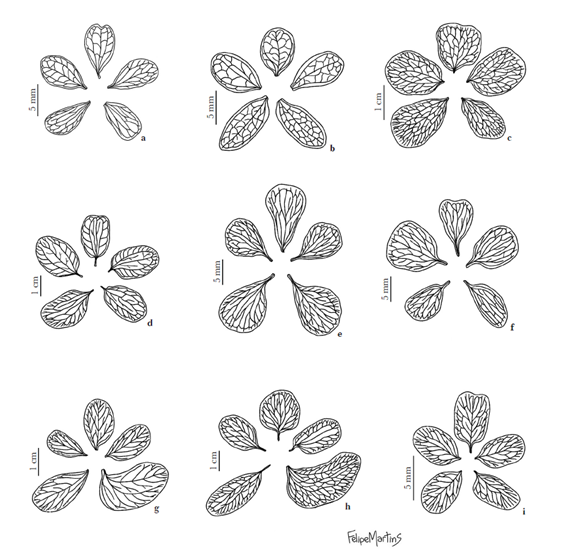
a-l. Corolla patterns of Senna species occurring in the state of Ceará, Northeastern Brazil - a. Senna alata; b. Senna cana; c. Senna cearensis; d. Senna gardneri; e. Senna georgica; f. Senna gloriosa; g. Senna hirsuta; h. Senna macranthera; i. Senna martiana; j. Senna obtusifolia; k. Senna occidentalis; l. Senna pendula. [a. V.S. Sampaio et al. 296; b. E.R. Silveira & Chaguinha (EAC 50297); c. H.M. Meneses 149; d. E.R. Silveira & M.G.V. Silva (EAC 47385); e. M.I.B. Loiola et al. 1727; f. M.G.V. Silva et al. (EAC 63884); g. A. Fernandes (EAC 11296); h. M.G.V. Silva (EAC 54072); i. L.R. Lima 4; j. J.C.M.S.M. Sobczak 52; k. A. Fernandes (EAC 33541); l. M.G.V. Silva (EAC 54075)].
Additional material examined: BRAZIL. MARANHÃO: Passagem Franca, Coco Nanico, 15.XII.1979, fl. and fr., E. Nunes & P. Martins (EAC 7801).
Senna georgica is a shrub to tree species, with glabrous to glabrescent branches and leaves with two pairs of elliptical to oval-elliptical leaflets. It may be confused with S. quinquangulata, as both occur sympatrically and share similar vegetative morphology. However, S. georgica has leaflets with an obtuse to rounded base (vs. leaflets with an asymmetric base), a nectary between the first pair of leaflets (vs. a nectary between all pairs of leaflets), flowers 5-8 cm in diameter (vs. flowers 1-1.6 cm in diameter), and a subquadrangular legume (vs. a subcylindrical to cylindrical legume).
Senna georgica is widely distributed in South America and in Cuba, occurring in forests and anthropized areas between 80 and 1,000 m (Irwin & Barneby 1982; Santos et al. 2017; Lima et al. 2021). In Brazil, it is confirmed in the Northern, Northeastern, and Mid-Western regions (Bortoluzzi et al. 2026). In Ceará, it was recorded in 15 municipalities, at elevations between 600 and 1,000 m, in Semideciduous Seasonal Forest and Dense Ombrophilous Forest, and it has been recorded in the conservation units APA da Chapada do Araripe, APA da Serra da Aratanha, APA da Serra da Ibiapaba, APA da Serra de Baturité, Floresta Nacional de Sobral, and Parque Nacional de Ubajara. The species is evaluated as Least Concern (LC) by the IUCN (2026).
This species was observed with flowers and fruits from June to November.
6. Senna gloriosa (H.S.Irwin & Barneby) A.G.Lima & Mansano, Nordic J. Bot. 2023(9)-e03947: 11 (2023). Figs. 2a; 3k-l; 5f; 6a-c
Shrubs 2-4 m tall. Branches glabrous. Stipules 7-11 × 1.5-2 mm, lanceolate or falcate, caducous. Leaves 5-11 cm long; petiole 1.5-2.5 cm long, glabrous; nectary 3-4 mm long, fusiform to clavate, stipitate, between the first pair of leaflets; rachis 0.7-1.5 cm long, glabrous to glabrescent; leaflets 2 pairs, 3-7 × 1.2-1.6 cm, elliptical to oblong, apex obtuse to rounded, base asymmetric to rounded, margin entire, chartaceous, discolorous, adaxial surface glabrous, abaxial surface glabrous. Racemose inflorescence 6-10 cm long, axillary or terminal, 3-6 flowers; bracts 6-8 × 3-4 mm, lanceolate to ovate, foliaceous, caducous; pedicel 2-3 cm long, glabrous. Flowers 5-8 cm diam., zygomorphic; sepals 2.5-3.5 × 1-2 cm, lanceolate to elliptic, apex acute to obtuse, green, glabrous; petals 3-4 × 2-2.7 cm, oblong to obovate, apex rounded to emarginated, base cuneate, yellow; stamens abaxial 3, anthers heteromorphic, centric abaxial filaments 5-6 mm long, anthers 10-12 mm long, latero-abaxial filaments 8-10 mm long, anthers 13-16 mm long, stamens median 4, filaments 2-4 mm long, anthers 8-11 mm long, staminodes 3, 5-6 mm long; ovary 26-30 × 1-1.5 mm, linear, pubescent, stipitate ca. 5 mm long, style 3-4 mm long. Legume 17-27 × 1-1.5 cm, linear, cylindrical, straight, smooth, glabrous to glabrescent, brown, indehiscent, stipitate 10-25 mm long. Seeds 4-5 × 3-4 mm, ovate, dark brown.
Material examined: Aiuaba, Estação Ecológica de Aiuaba, próximo à estrada da Confiança, 30.V.1984, fl., E. Nunes (EAC 12619). Alcantâras, Serra da Meruoca, Distrito de Carmolândia, 830 m, 27.VII.2017, fr., E.B. Souza et al. 4748 (EAC, HUEFS, HUVA). Aquiraz, 4.XI.1992, fr., L.P. Félix 5521 (EAC). Aratuba, Sítio Jardim, 770 m, 30.VIII.1980, fl., M.A. Figueiredo (EAC 8920). Barbalha, FLONA do Araripe, proximidades da Casa do Guarda da Santa Rita, ICMBio, 929 m, 22.V.2014, fl., V.M. Mascena 54B (EAC). Brejo Santo, Igrejinha, 28.IV.2015, fl., M. Oliveira 6067 (HUEFS). Caucaia, Parque Botânico, 21.IX.2000, fl., G.N. Maia (EAC 30086). Crateús, centro da cidade, área urbana, 03º55’42”S, 40º53’25,2”W, 18.VI.2022, fl., H.P. Nascimento 15 (EAC). Crato, Flona do Araripe, 930 m, 13.VIII.1999, fr., L.W. Lima-Verde et al. 1633 (EAC). Eusébio, APA do Rio Pacoti, trilha do Centro de Estudos Ambientais Costeiros (CEAC) - UFC, 19.IX.2017, fl., S.T. Rabelo & L.X. Sampaio 9 (EAC). Fortaleza, Parque Estadual Botânico do Ceará, 15 m, 29.VI.2018, fl., V.S. Sampaio et al. 435 (EAC). Graça, 13.VI.2007, fl., J.R. Lemos 33 (HUEFS). Guaraciaba do Norte, entre Guaraciaba e São Benedito, 8.IX.1997, fl. and fr., M. Aparecida (EAC 25325). Guaramiranga, Sítio Lagoa, 940 m, 19.XII.2002, fl., A. Silveira & R.F. Oliveira 505 (EAC). Ibiapina, Localidade Betânia, 26.IV.2012, fl., M.I.B. Loiola et al. 1581 (EAC). Itapipoca, Cemoabá, bacia do Rio Mundaú, pequena chapada, 30.X.1995, fl., M.A. Figueiredo (EAC 23392). Jardim, Boa Vista, 700 m, 11.VI.1996, fl., M.A.P. Silva 100 (EAC). Jijoca de Jericoacoara, Parque Nacional (PARNA) de Jericoacoara, 02º50’24”S, 40º30’37”W, 4.IV.2024, fl., S.T. Rabelo 547 (EAC). Lavras da Mangabeira, Sítio Garra, 365 m, 9.VII.2014, fr., A.P. Fontana 8246 (HUEFS). Maranguape, Serra Maranguape, 26.VIII.1988, fl., M.F. Mata (EAC 17206). Meruoca, distrito de Palestina, 22.IV.2019, fl., M.G.V. Silva et al. (EAC 63882). Missão Velha, Fazenda Genipapeiro, 949 m, 19.VIII.2011, fl., E. Melo 10368 (HUEFS). Mulungu, Vila, Sítio Jardim, mata do Damásio, Vertente sotavento, 800 m, 14.VII.2008, fl. and fr., J.R. Lima (EAC 46142). Novo Oriente, Miudinho, Planalto da Ibiapaba, 03.VIII.1990, fr., F.S. Araújo 138 (EAC). Pacoti, Volta do Rio, 532 m, 19.V.2016, fl., J.C.M.S.M. Sobczak 196 (EAC). Poranga, 10.VII.1980, fr., A. Fernandes & E. Nunes (EAC 8857). Quixadá, João Maurício, Serra do Estevão, 28.IX.1982, fl., L.P. Félix 5329 (EAC). Reriutaba, 26.IV.2019, fl., M.G.V. Silva et al. (EAC 63884). Santa Quitéria, Serra dos Quirino or dos Pajeú, 26.IV.2012, fl., J. Paula-Souza et al. 10985 (EAC). Santana do Cariri, Cancelão, 928 m, 24.V.2011, fr., E. Melo 9828 (HUEFS). São Gonçalo do Amarante, Pecém, 31.X.2007, fr., M.F. Moro et al. 268 (EAC). Sobral, serra da Meruoca, Sítio Santa Cruz, trilha do Delta, 600 m, 21.VIII.2015, fl., E.B. Souza et al. 3679 (EAC, HUVA). Tianguá, km 329, 17.V.2017, fl. and fr., E.R. Silveira et al. 22 (EAC). Ubajara, Planalto da Ibiapaba, Sítio São Luís, 900 m, 23.VIII.2017, fl., E.B. Souza et al. 4781 (EAC, HUVA). Viçosa do Ceará, CE-075, entre Tianguá e Viçosa do Ceará, 30.V.1979, fl. and fr., E. Nunes & A.J. Castro (EAC 6211, HUEFS).

a-c. Senna gloriosa - a. branch with leaves and inflorescence; b. stipule; c. fruit. d-f. Senna hirsuta - d. branch with leaves and fruits; e. nectary at the base of the petiole; f. fruit. g-j. Senna macranthera - g. branch with leaves and inflorescence; h. stipule; i. leaf; j. fruit. k-n. Senna martiana - k. branch with leaves and fruit; l. stipule; m. petaloid bract; n. fruit. o-q. Senna obtusifolia - o. branch with leaves and inflorescence; p. stipule; q. fruit. [a-b. E. Nunes (EAC 12619); c. E.R. Silveira et al. 12; d-e. A. Fernandes & J. Goergen (EAC 14206); f. A. Fernandes (EAC 2791); g-h. F.C.B. Nogueira (EAC 54131); i. P. Martins (EAC 8178); j. I.M. Andrade (EAC 21888); k-l, n. E.R. Silveira & M.G.V. Silva (EAC 32440); m. A. Fernandes (EAC 6123); o-p. F.J.A. Matos 29; q. L.M.R. Melo 10].
Senna gloriosa is a shrubby species characterized by glabrous branches, lanceolate or falcate stipules, two pairs of elliptical to oblong leaflets, a nectary between the first pair of leaflets, and lanceolate to elliptic sepals.
Senna gloriosa is native to South America (Brazil, Paraguay, and Uruguay) and has been introduced and cultivated in Africa and Asia, with populations occurring between 450 and 1,300 m in forests, riparian vegetation, and as an ornamental plant in urban areas (Irwin & Barneby 1982; Santos 2013; Silva et al. 2018). In Brazil, it is recorded in the Northeastern, Mid-Western, Southeastern, and Southern (Paraná state) regions (Bortoluzzi et al. 2026). In the state of Ceará, it has been widely sampled in 38 municipalities, occurring in the Vegetational Complex of the Coastal Zone, Semideciduous Seasonal Forest, Dense Ombrophilous Forest, Neotropical Savanna, Forest Savanna, Steppic Savanna, and Vegetation under Fluvial and/or Lacustrine Influence. It has been collected in 10 conservation units in Ceará: APA da Chapada do Araripe, APA da Serra de Baturité, APA da Serra da Ibiapaba, APA do Rio Pacoti, Estação Ecológica de Aiuaba, Floresta Nacional de Sobral, Floresta Nacional do Araripe, Parque Botânico do Ceará, Parque Nacional de Jericoacoara and Parque Nacional de Ubajara. The species does not have conservation data in the IUCN (2026).
This species was observed with flowers and fruits year-round.
The vernacular names for this species are aleluia, são-joão.
7. Senna hirsuta (L.) H.S.Irwin & Barneby, Phytologia 44(7): 499. (1979). Figs. 2b; 3m-n; 5g; 6d-f
Shrubs to subshrubs ca. 1.5 m tall. Branches tomentose to hirsute. Stipules ca. 5 × 1 mm, linear, caducous. Leaves 13-20 cm long; petiole 4-6 cm long, tomentose to hirsute; nectary 4 mm long, ovate to oblong, stipitate, at the base of the petiole; rachis 6-12 cm long, tomentose to hirsute; leaflets 4 pairs, 2-9 × 1-4 cm, elliptical to ovate, apex acute, base acute to obtuse, margin entire, chartaceous, discolorous, adaxial surface hirsute, abaxial surface hirsute. Racemose inflorescence 8 cm long, axillary, ca. 5 flowers; bracts ca. 5 × 1 mm, linear, foliaceous, caducous; pedicel ca. 1 cm long, tomentose to hirsute. Flowers ca. 2 cm diam., zygomorphic; sepals 0.5-0.6 × 0.4-0.5 cm, oblong to obovate, apex rounded, green, pubescent; petals 0.5-1 × 0.4-0.5 cm, obovate, apex rounded, base cuneate, yellow; stamens abaxial 3, anthers heteromorphic, centric abaxial filaments ca. 2.5 mm long, anthers ca. 3 mm long, latero-abaxial filaments 1-2 mm long, anthers 6 mm long, stamens median 4, filaments 1-3 mm long, anthers 2.5-3.5 mm long, staminodes 3, ca. 2.5 mm long; ovary 13-14 × 1.5-2 mm, linear, tomentose, stipitate 1 mm long, style 3-4 mm long. Legume ca. 13 × 0.5 cm, linear, subquadrangular, curved, rough, tomentose to hirsute, brown, lately dehiscent, stipitate ca. 2 mm long. Seeds ca. 3 × 2.5 mm, orbicular, brown.
Material examined: Baturité, Convento Jesuíta, 21.IV.1986, fr., A. Fernandes & J. Goergen (EAC 14206, HUEFS). Uruburetama, Serra de Uruburetama, 1.X.1990, fl. and fr., A. Fernandes et al. (EAC 17106).
Additional material examined: BRAZIL. BAHIA: Entre Rios, 153 m, 26.V.2007, fl. and fr., A.V. Popovkin 10 (HUEFS). Formosa do Rio Preto, 15.V.1982, fl. and fr., A. Fernandes (EAC 11296).
Senna hirsuta has a shrubby to subshrubby habit, leaves with nectaries located at the base of the petiole, and four pairs of leaflets. It is similar to S. occidentalis in habit, nectary position, and leaflet shape. However, S. hirsuta has tomentose to hirsute branches (vs. glabrous to glabrescent branches) and a subquadrangular legume, tomentose to hirsute (vs. a flat legume, glabrous to glabrescent).
Senna hirsuta occurs from the United States of America to Argentina and has been introduced in Africa, Asia, and Australia, where it is considered a weed (Irwin & Barneby 1982; Lima & Mansano 2011; Santos 2013). In Brazil, it is found in all regions (Bortoluzzi et al. 2026). In Ceará, S. hirsuta has been recorded in two municipalities, occurring in Semideciduous Seasonal Forest and Dense Ombrophilous Forest, and it has been recorded in the conservation unit of APA da Serra de Baturité. The species does not have conservation data in the IUCN (2026).
This species was observed with flowers and fruits from April to October.
8. Senna macranthera (DC. ex Collad.) H.S.Irwin & Barneby, Mem. New York Bot. Gard. 35(1): 181. (1982). Figs. 2b; 3o-p; 5h; 6g-j
Shrubs to trees 1.5-6 m tall. Branches pubescent. Stipules 5-9 × 0.5-1 mm, linear, persistent. Leaves 4-8 cm long; petiole 1-2.5 cm long, pubescent; nectary 2-5 mm long, conical to ovate, stipitate, between the first pair of leaflets or rarely between all pairs of leaflets; rachis 0.5-1.5 cm long, pubescent; leaflets 2 pairs, 2.5-7 × 1-3.5 cm, elliptical, apex acute to mucronulate, base asymmetric, margin entire, chartaceous to coriaceous, discolorous, adaxial surface glabrous to pubescent, abaxial surface pubescent. Paniculate inflorescence 8-15 cm long, axillary or terminal, secondary axes racemose, 5-8 flowers on the secondary axes; bracts 4-5 × 2-3 mm, lanceolate to ovate, foliaceous, caducous; pedicel 3-4 cm long, pubescent. Flowers 4.5-6 cm diam., zygomorphic; sepals 0.5-1 × 0.4-0.7 cm, ovate to obovate, apex obtuse to rounded, green, pubescent; petals 2.5-4 × 1.2-2.5 cm, obovate, apex rounded, base cuneate, yellow; stamens abaxial 3, anthers isomorphic, centric abaxial filaments 6-10 mm long, anthers 8-11 mm long, latero-abaxial filaments 6-11 mm long, anthers 9-12 mm long, stamens median 4, filaments 2-3 mm long, anthers 7-9 mm long, staminodes 3, 3-5 mm long; ovary 17-25 × 2-3 mm, linear, pubescent, stipitate 4 mm long, style 3-4 mm long. Legume 5-14 × 0.8-1.5 cm, linear to oblong, cylindrical, straight to curved, smooth to rugose, pubescent, dark brown, indehiscent, stipitate 3-6 mm long. Seeds 5-6 × 3-4 mm, ovate, dark brown.
Material examined: Aiuaba, 9.IV.2014, fl., M. Mayer 95 (EAC). Araripe, 3.VI.2014, fl. and fr., W. Batista 504 (EAC). Barbalha, Malhada Bonita, Chapada do Araripe, 22.VI.2006, fl., M.A.P. Silva 2253 (EAC). Campos Sales, BR-275, a 3 km da cidade, 27.II.1980, fl. and fr., P. Martins (EAC 8083, HUEFS). Caridade, ponte sobre o riacho Salgado, próximo ao km 356, 15.V.2017, fl., E.R. Silveira et al. 1 (EAC). Cascavel, Curralinho, 22.IV.2019, fl., M.G.V. Silva et al. (EAC 63887). Caucaia, 19.V.1993, fr., F.S. Araújo (EAC 21348). Cedro, Estação Ecológica de Aiuaba, estrada da Gameleira, 29.IV.1981, fl. and fr., P. Martins (EAC 10222, HUEFS). Crateús, Croatá, RPPN, Serra das Almas, 19.VIII.2003, fl. and fr., R.C. Costa 283Probio (EAC). Crato, Cariri, Chapada do Araripe, Baixa do Maracujá, 820 m, 2.IV.1998, fl., L.W. Lima-Verde et al. 891 (EAC). Fortaleza, Campus do Pici, UFC, 21.VII.2014, fl. and fr., F.G.A. Santos 133 (EAC). Guaiuba, 1.VI.2013, fl., M.G.V. Silva (EAC 54072). Guaraciaba do Norte, Andrade, 24.XII.1980, fr., P. Martins (EAC 9538). Ibiapina, 2.VIII.1978, fr., A. Fernandes & P. Bezerra (EAC 5037, HUEFS). Jaguaribe, Maciço do Pereiro, 12.IV.2011, fl., A.M. Miranda & K. Manso 6330 (EAC, HST, HTSA, HUEFS). Madalena, São José dos Guerras, arredores, 10.VI.2018, fl. and fr., E.D. Lozano et al. 4169 (MBM). Morada Nova, Fazenda Serraria, 25.IV.1997, fl., M.A. Figueiredo 741 (EAC). Novo Oriente, Estrondo, Planalto Ibiapaba, 750 m, 3.VIII.1990, fr., F.S. Araújo 141 (EAC). Ocara, 10.VII.2018, fl. and fr., E. Silveira (EAC 61469). Parambu, Fazenda Pau Preto, 23.V.1982, fl., E. Nunes (EAC 11475, HUEFS). Poranga, 10.VII.1980, fr., E. Nunes & A. Fernandes (EAC 38173). Quixadá, Fazenda Não Me Deixes, 2.VIII.2013, fl. and fr., F.C.B. Nogueira (EAC 54131). Quixeramobim, 15.V.2017, fl. and fr., E.R. Silveira et al. 6 (EAC). Quixeré, Fazenda Mato Alto, 110 m, 12.VI.1996, fl., M.A. Figueiredo et al. 619 (EAC, IPA). Santa Quitéria, 26.IV.2019, fl., M.G.V. Silva et al. (EAC 63902). São Gonçalo do Amarante, estrada Paracuru-São Gonçalo do Amarante, 9.IX.1995, fr., A.S.F. Castro 45 (EAC). Senador Sá, 18.V.2017, fl. and fr., E.R. Silveira et al. 24 (EAC). Sobral, distrito de Taperuaba, Refúgio da Vida Silvestre Pedra da Andorinha (REVIS), 232 m, 10.V.2018, fl., E.B. Souza & F.F. Araújo 5260 (EAC). Tamboril, Sucesso, 23.IV.1978, fr., A. Fernandes & F.J.A. Matos (EAC 3807, HUEFS, PEL). Tauá, entre Marrecas and Barra, 27.IV.1981, fl. and fr., P. Martins (EAC 10132, HUEFS). Tianguá, BR-222, próximo à divisa, 710 m, 22.VII.2002, fr., A.S.F. Castro 1350 (EAC). Ubajara, Sítio Murimbeca, entorno do Parque de Ubajara, 875 m, 26.VIII.2012, fr., M.I.B. Loiola et al. 1948 (EAC). Umirim, BR-222, 17.V.2017, fl., E.R. Silveira et al. 17 (EAC). Viçosa do Ceará, 1.V.1976, fl., A. Fernandes (EAC 2751).
Senna macranthera exhibits a shrubby to arboreal habit, with pubescent branches, leaves with two pairs of elliptical leaflets, a nectary between the first pair of leaflets or, rarely, between all pairs of leaflets, zygomorphic flowers, and a cylindrical legume. It may be confused with S. rizzinii and S. rugosa, as they occur sympatrically in Ceará and share similar morphology. In comparison with S. rizzinii, S. macranthera presents paniculate inflorescences (vs. racemose inflorescences), pedicels 3-4 cm long (vs. pedicels 1-2 cm long), and flowers 4.5-6 cm in diameter (vs. flowers 2.5-4 cm in diameter).
In the literature, S. macranthera can be distinguished from S. rugosa by the presence of a nectary only between the first pair of leaflets (vs. a nectary between all pairs of leaflets) and by a petiole longer than the rachis (vs. a petiole shorter than the rachis) (Irwin & Barneby 1982; Santos 2013). However, the same literature also reports individuals of S. macranthera with a nectary between all pairs of leaflets, which reduces the reliability of this character, making the petiole-rachis length relationship the main distinguishing character. For Ceará, individuals with a petiole longer than the rachis were treated as S. macranthera (vs. a petiole shorter than or equal in length to the rachis for S. rugosa).
This South American species occurs at forest edges and in open fields, in Caatinga, Cerrado, or anthropized areas where it may be cultivated as an ornamental plant (Irwin & Barneby 1982; Queiroz 2009; Santos et al. 2017). In Brazil, it is confirmed in all regions (Bortoluzzi et al. 2026). It is widely distributed in Ceará, recorded in 34 municipalities, in the Vegetational Complex of the Coastal Zone, Semideciduous Seasonal Forest, Dense Ombrophilous Forest, Neotropical Savanna, Steppe Savanna, and Vegetation under Fluvial and/or Lacustrine Influence, and it has been recorded in the conservation units of APA da Chapada do Araripe, APA da Serra da Aratanha, APA da Serra da Ibiapaba, Estação Ecológica de Aiuaba, Parque Nacional de Ubajara, RPPN Serra das Almas, and Unidade de Conservação Municipal de Proteção Integral Refúgio de Vida Silvestre Pedra da Andorinha. The species is evaluated as Least Concern (LC) by the IUCN (2026).
This species was observed with flowers and fruits year-round.
The vernacular name for this species is são-joão.
9. Senna martiana (Benth.) H.S.Irwin & Barneby, Mem. New York Bot. Gard. 35(2): 465. (1982). Figs. 2b; 5i; 6k-n; 7a-c
Shrubs 2 m tall. Branches glabrous to glabrescent. Stipules 13-15 × 3.5-4 mm, lanceolate, persistent. Leaves 20-28 cm long; petiole 1.5-2.5 cm long, glabrous to glabrescent; nectary absent; rachis 18-25 cm long, glabrous to glabrescent; leaflets 15-18 pairs, 2.5-5 × 1-2 cm, oblong-linear to oblong-elliptical, apex acute to mucronulate, base asymmetric, margin entire, membranaceous, concolorous, adaxial surface glabrous to glabrescent, abaxial surface glabrous to glabrescent. Racemose inflorescence 30-65 cm long, axillary or terminal, 20-35 flowers; bracts 23 × 14 mm, obovate, petaloid, caducous; pedicel 1-2 cm long, glabrous to glabrescent. Flowers 4.5 cm diam., zygomorphic; sepals 0.9-1.5 × 0.5-1 cm, oblong-elliptic to obovate, apex rounded, yellow, pubescent; petals 1.7-2 × 1-1.2 cm, obovate, apex rounded, base cuneate, yellow; stamens abaxial 3, anthers heteromorphic, centric abaxial filaments 5 mm long, anthers 5 mm long, latero-abaxial filaments 2-3 mm long, anthers 12 mm long, stamens median 4, filaments 2-3 mm long, anthers 6-7 mm long, staminodes 3, 4-5 mm long; ovary 15-16 × 1.5-2 mm, linear, pubescent, stipitate 2 mm long, style 10 mm long. Legume 7.3 × 1.5 cm, linear to oblong, flat, straight, with T-shaped elevations over each seed, glabrous, brown, lately dehiscent, stipitate 2 mm long. Seeds 6.5 × 4.5 mm, obovate to square, dark brown.
Material examined: Alto Santo, 13.I.1977, fr., A. Fernandes & A. Lima (EAC 3079, HUEFS). Limoeiro do Norte, 17.IV.1998, fl., A. Fernandes (EAC 26332). Quixeré, Fazenda Mato Alto, 110 m, 13.VI.1996, fr., L.W. Lima-Verde et al. 277 (EAC). Tabuleiro do Norte, Estrada Mossoró, 20.VIII.1977, fl. and fr., A. Fernandes & F.J.A. Matos (EAC 3437, HUEFS).
Additional material examined: BRAZIL. PERNAMBUCO: Petrolina, Faz. Experimental, Campus da Universidade Federal do Vale, 393 m, 4.XI.2008, fl. and fr., L.R. Lima 4 (EAC). PIAUÍ: São Raimundo Nonato, 8.IV.1979, fl. and fr., A. Fernandes (EAC 6123).
Senna martiana has a shrubby habit, petaloid bracts and leaves without nectaries. It can be confused with S. alata, the main difference being the shape of the fruits, as previously presented in the comments on S. alata.
This species is endemic to Brazil, reported for the Northeastern Region, except for the states of Maranhão and Sergipe (Irwin & Barneby 1982; Queiroz 2009; Bortoluzzi et al. 2026). It is mainly found in the Caatinga on sandy soils, associated with seasonally flooded areas such as river banks and temporary lagoons, also colonizing disturbed areas (Irwin & Barneby 1982; Queiroz 2009). In Ceará, it has been recorded in four municipalities located in the eastern portion of the state, in Steppic Savanna and Vegetation under Fluvial and/or Lacustrine Influence. Senna martiana is the only species of the genus not recorded in conservation units in the state. The species does not have conservation data in the IUCN (2026).
This species was observed with flowers and fruits from January to August.
The vernacular names for this species are besouro, mata-pasto.
10. Senna obtusifolia (L.) H.S.Irwin & Barneby, Mem. New York Bot. Gard. 35: 252. (1982). Figs. 2b; 5j; 6o-q; 7d-e
Herbs to subshrubs 0.5-1 m tall. Branches glabrous to glabrescent. Stipules ca. 13 × 1 mm, linear to lanceolate, persistent. Leaves 4-10 cm long; petiole 2-4 cm long, glabrous to glabrescent; nectary ca. 3 mm long, linear to fusiform, stipitate, between the first pair of leaflets; rachis 2-4 cm long, glabrous to glabrescent; leaflets 3 pairs, 2-6 × 1-2.5 cm, obovate to oblong, apex obtuse to mucronulate, base asymmetric, margin entire, membranaceous, concolorous, adaxial surface glabrous, abaxial surface glabrescent to pubescent. Racemose inflorescence 3-4 cm long, axillary or terminal, 2 flowers; bracts ca. 6 × 1 mm, lanceolate, foliaceous, caducous; pedicel 1.5-2 cm long, glabrous to glabrescent. Flowers 1.5-2.5 cm diam., zygomorphic or asymmetric; sepals 0.7-1 × 0.4-0.6 cm, oblong-oval, apex obtuse, green, glabrescent; petals 0.8-1 × 0.5-0.7 cm, obovate, the latero-abaxial right one oblong, apex rounded to emarginated, base cuneate to asymmetric, yellow; stamens abaxial 3, anthers heteromorphic, centric abaxial filaments ca. 1.5 mm long, anthers ca. 4.5 mm long, latero-abaxial filaments 1.5-2 mm long, anthers 3.5-4 mm long, stamens median 4, filaments 2 mm long, anthers 2.5-3 mm long, staminodes 3, 2 mm long; ovary ca. 14 × 1 mm, linear, glabrescent to pubescent, stipitate 1 mm long, style 3 mm long. Legume 10-20 × 0.3-0.5 cm, linear, cylindrical, curved, smooth, glabrous to glabrescent, brown, indehiscent, stipitate 3 mm long. Seeds 5 × 3 mm, rhombic, brown.
Material examined: Aiuaba, Estação Ecológica de Aiuaba, 450 m, 9.IV.1997, fl., L.W. Lima-Verde et al. 616 (EAC, HUEFS, IPA, MOSS). Amontada, entrada da cidade, 7.IX.2013, fl., M.I.B. Loiola et al. 2073 (EAC). Aracati, Fazenda Belém, coletada na área do projeto reúso de água produzida para irrigação, 2.VI.2014, fr., M.I.B. Loiola & A.S. Quaresma 2299 (EAC). Aurora, Sítio Santa Helena, 327 m, 20.VIII.2014, fr., L.B. Pimentel 240 (HUEFS, HTSA). Brejo Santo, Sítio Poço, Cachoeirinha, 390 m, 10.IV.2013, fl., N.M. Almeida 510 (HVASF). Capistrano, Serra de Baturité, Fazenda Aracanga, 130 m, 14.VII.1994, fl. and fr., J.B.L.P. Medeiros & L.W. Lima-Verde 121 (EAC). Caridade, Lagoa Contendas, 8.III.2009, fl., A.B. Tabosa 8 (EAC). Caucaia, Terreno próximo ao SESC Iparana, 03º41’30”S 38º37’47”W, 16.VI.2022, fl. and fr., H.P. Nascimento 10 (EAC). Crateús, Lagoa Queimadas, Posto São Judas Tadeu, 16.V.2017, fl., E.R. Silveira et al. 9 (EAC). Farias Brito, 12.V.2013, fl., J.G. Ferreira 3544 (HUEFS). Fortaleza, Campus do Pici - UFC, 7.VI.2016, fl. and fr., F.G. Santos 331 (EAC). Graça, 15.V.2008, fl., F.C.A. Eufrásio 24 (HUEFS). Irauçuba, Fazenda Cacimba Salgada, 17.V.2000, fr., A.M.S. Bitencourt 23 (EAC). Itaiçaba, Morro do Ereré, 10.IV.1982, fl. and fr., E. Nunes (EAC 11172). Juazeiro do Norte, 28.XII.2004, fr., T.B. Granjeiro & W.M. Bezerra (EAC 34767). Lavras da Mangabeira, Sítio Bonita, 247 m, 11.VII.2013, fr., A.C.P. Oliveira 2817 (HVASF). Limoeiro do Norte, Chapada do Apodi, área de pivô central, 22.VII.2005, fl. and fr., A.V. Vieira (EAC 37724).

a-p. Species of Senna occurring in the state of Ceará, Northeast Brazil - a-c. Senna martiana - a. leaf; b. inflorescence; c. fruit; d-e. Senna obtusifolia - d. leaf; e. flower; f-g. Senna occidentalis - f. leaf; g. flower; h-j. Senna pendula - h. leaf; i. flower; j. fruit; k. Senna pilifera - k. flower; l-m. Senna quinquangulata - l. leaf; m. inflorescence; n-p. Senna rizzinii - n. leaf; o. flower; p. fruit. (Fotos: a-c, g-j, l-m, p. R.T. Queiroz; d-f, n-o. H.P. Nascimento; k. L.S. Rodrigues).
Madalena, Fazenda Jamunda, arredores, 11.VI.2018, fl., E.D. Lozano et al. 4194 (MBM). Marco, Fazenda experimental da Embrapa, parcela angico, 25.IV.2017, fl., M.C. Barroso et al. 2624 (EAC). Morada Nova, Fazenda Serraria, 25.IV.1997, fl., M.A. Figueiredo (EAC 25377). Mulungu, Sítio Jardim, mata do Damásio, Sotavento, 830 m, 6.VI.2008, fl., L.W. Lima-Verde et al. 3484 (EAC). Quixadá, Sítio Califórnia, 30.VI.2006, fl. and fr., E.R. Silveira & F.S. Cavalcanti 1022 (EAC). Quixeramobim, assentamento Vista Alegre - Agrossilvipastoril, 22.III.2014, fl., L.B. Oliveira 176 (CEN). Quixeré, Manga do Mamoeiro, 16.VI.1997, fr., L.M.R. Melo 103 (EAC). São Gonçalo do Amarante, próximo ao Porto, dunas do Pecém, Beira de estrada, 13.VI.2004, fr., A.V. Vieira & M.F. Lima (EAC 34243). Sobral, distrito de Taperuaba, Unidade de Conservação Refúgio da Vida Silvestre Pedra da Andorinha, 210 m, 8.XI.2017, fr., E.B. Souza et al. 4823 (EAC, HUEFS, HUVA). Tururu, comunidade quilombola de Conceição dos Caetanos, 26.V.2015, fl. and fr., J.C.M.S.M. Sobczak 52 (EAC). Ubajara, Portão Planalto da Ibiapaba, Araticum- Parna, 200 m, 24.II.1999, fl., A. Fernandes et al. (EAC 27921). Uruburetama, Fazenda Santa Eliza, 18.VII.1985, fl. and fr., R. Ferreira (EAC 14233).
Senna obtusifolia is a ruderal species with a herbaceous to subshrubby habit, stipules linear to lanceolate and leaflets obovate to oblong. It may be confused with S. uniflora, as both occur sympatrically in Ceará and share similar habits and leaflet shapes. Senna obtusifolia can be distinguished from S. uniflora by presenting glabrous to glabrescent branches (vs. hirsute branches), and a cylindrical and smooth legume (vs. subquadrangular and lomentaceous legume).
It is a species of probable American origin, distributed throughout the tropical regions of the Americas, Africa, Asia and Oceania (Australia), occurring as a ruderal and invasive plant associated with anthropized and/or seasonally flooded areas (Irwin & Barneby 1982; Queiroz 2009; Santos et al. 2020). In Brazil, S. obtusifolia has been reported in all regions (Bortoluzzi et al. 2026). Its representatives have a wide distribution in Ceará, where they have been recorded in 29 municipalities, occurring in Vegetational Complex of the Coastal Zone, Semideciduous Seasonal Forest, Dense Ombrophilous Forest, Neotropical Savanna, Steppic Savanna and Vegetation under Fluvial and/or Lacustrine Influence. It has also been recorded in four conservation units in Ceará: APA da Chapada do Araripe, APA da Serra de Baturité, Estação Ecológica de Aiuaba and Unidade de Conservação Municipal de Proteção Integral Refúgio de Vida Silvestre Pedra da Andorinha. The species is evaluated as Least Concern (LC) by the IUCN (2026).
This species was observed with flowers and fruits year-round.
The vernacular names for this species are fedegoso, mata-pasto, mata-pasto liso.
11. Senna occidentalis (L.) Link, Handbuch [Link] 2: 140. (1831). Figs. 2b; 5k; 7f-g; 8a-c
Subshrubs 0.3-1.5 m tall. Branches glabrous to glabrescent. Stipules ca. 7.5 × 3 mm, lanceolate to triangular, caducous. Leaves 16-18 cm long; petiole 3-5.5 cm long, glabrous; nectary ca. 1.5 mm long, ovate to globoid, sessile, at the base of the petiole; rachis 5.5-10 cm long, glabrous to glabrescent; leaflets 3-5 pairs, 4.5-8 × 2-3.5 cm, elliptical to lanceolate, apex acuminate, base acute to asymmetric, margin entire, membranaceous, concolorous or discolorous, adaxial surface glabrous to glabrescent, abaxial surface glabrous to glabrescent. Racemose inflorescence 3-5 cm long, axillary or terminal, 3-8 flowers; bracts 19 × 5 mm, lanceolate, foliaceous, caducous; pedicel 0.5-1 cm long, glabrous to pubescent. Flowers 2-2.5 cm diam., zygomorphic; sepals 0.8-1 × 0.5-0.6 cm, ovate to oblong-obovate, apex obtuse to rounded, green, glabrous; petals 0.8-1 × 0.4-0.5 cm, obovate, apex rounded to emarginated, base cuneate, yellow; stamens abaxial 3, anthers heteromorphic, centric abaxial vestigial, latero-abaxial filaments 4-5 mm long, anthers 6-7 mm long, stamens median 4, filaments 2-3 mm long, anthers 3.5-5 mm long, staminodes 3, 4-5 mm long; ovary 8-10 × 1-1.5 mm, linear, pubescent, stipitate 1 mm long, style 5 mm long. Legume 11-12 × 0.8-1 cm, linear, flat, straight to curved, smooth to wavy, glabrous to glabrescent, brown at the margins with a dark brown central stripe, indehiscent, stipitate ca. 2 mm long. Seeds ca. 4.5 × 3 mm, oval-elliptic, dark brown.
Material examined: Aiuaba, Estação Ecológica de Aiuaba, 460 m, 4.II.1997, fl. and fr., M.A. Figueiredo et al. 666 (EAC). Beberibe, Sítio Uberaba, 5.XI.2008, fl. and fr., L.P.M. Jorge (EAC 44155). Brejo Santo, Sítio Poço, Cachoeirinha, 383 m, 10.IV.2013, fl., N.M. Almeida 505 (HVASF). Caridade, povoado do Pendanga, 3.IV.2009, fl. and fr., A.C. Bezerra 37 (EAC). Carnaubal, na saída de Carnaubal para Campo Maior, 16.VI.1979, fr., A. Fernandes et al. (EAC 6578). Caucaia, Iparana, Parque Botânico do Ceará, 27.V.1998, fl. and fr., E.B. Souza 244 (EAC). Crateús, Realejo, 339 m, 8.II.2017, fl. and fr., H.M. Meneses 102 (EAC). Eusébio, Sítio, 10.III.2004, fl. and fr., A. Fernandes (EAC 33541). Fortaleza, Campus do Pici, próximo ao Horto de Plantas Medicinais Prof FJA Matos, 1.XII.2023, fl. and fr., H.P. Nascimento 24 (EAC). General Sampaio, RPPN Francy Nunes, Fazenda Natália, 26.V.2007, fl. and fr., M.F. Moro et al. 196 (EAC). Graça, 15.V.2008, fl. and fr., I.H.C.V.Silva 16 (HUEFS). Groaíras, Marrecas, 80 m, 7.IV.2017, fl. and fr., E.B. Souza et al. 4541 (EAC, HUEFS). Independência, estrada para Quiterianópolis, 10.IV.1998, fr., E.B. Souza (EAC 26392, HUEFS). Ipu, localidade de Manuíno, 4.IV.2017, fl., F.F. Araújo et al. 154 (EAC, HUEFS). Irauçuba, Fazenda Cacimba Salgada, 4.V.2001, fl. and fr., A.M.M. Carvalho 5 (EAC). Juazeiro do Norte, 28.XII.2004, fl. and fr., T.B. Granjeiro & W.M. Bezerra (EAC 34764). Limoeiro do Norte, Chapada do Apodi, área de pivô central, 22.VII.2005, fl. and fr., A.V. Vieira (EAC 37725). Marco, fazenda experimental da Embrapa, 24.V.2017, fl. and fr., M.C. Barroso et al. 2633 (EAC). Massapê, ao lado do 4° CIA/3° BPM, 18.VII.2014, fl. and fr., M.I.B. Loiola et al. 2376 (EAC). Morada Nova, Fazenda Serraria, 25.IV.1997, fl., M.A. Figueiredo (EAC 25406). Pacoti, residência do Sr. Augusto Alves, 25.IX.1981, fl. and fr., F.S. Cavalcanti & M.F.F.B. Queiroz (EAC 10856). Parambu, Fazenda Pau Preto, 23.V.1982, fl. and fr., E. Nunes (EAC 11477). Penaforte, bairro Nossa Senhora Aparecida, 466 m, 12.VIII.2010, fl. and fr., M.V. Meiado 221 (HVASF). Redenção, Fazenda Experimental Piroás (UNILAB), próximo aos canteiros, 24.IX.2015, fl., J.C.M.S.M. Sobczak 102 (EAC). Reriutaba, no sangradouro do açude Araras, 13.IV.1979, fl. and fr., A.J. Castro (EAC 5660). Santa Quitéria, beira da estrada, 28.IV.2012, fl., J. Paula-Souza et al. 11068 (EAC, ESA). Sobral, distrito de Taperuaba, Refúgio da Vida Silvestre Pedra da Andorinha (REVIS), 232 m, 10.V.2018, fl. and fr., E.B. Souza & F.F. Araújo 5276 (EAC, HUVA). Uruburetama, Fazenda Santa Eliza, 2.VII.1985, fl. and fr., R. Ferreira (EAC 14232). Viçosa do Ceará, Pirapora - Cachoeira - Padre Vieira, 3.V.2003, fl. and fr., A. Fernandes (EAC 32515).

a-c. Senna occidentalis - a. branch with leaves, inflorescence and fruit; b. nectary at the base of the petiole; c. fruit. d-f. Senna pendula - d. branch with leaves and inflorescence; e. stipule; f. fruit. g-i. Senna pilifera - g. branch with leaves and inflorescence; h. stipule; i. fruit. j-l. Senna quinquangulata - j. branch with leaves and inflorescence; k. stipule; l. fruit. m-p. Senna rizzinii - m. branch with leaves and inflorescence; n. stipule; o. leaf; p. fruit. [a-b. A. Fernandes (EAC 33541); c. E.O. de Barros et al. 42; d-e. A.S.F. Castro 2655; f. A.S.F. Castro 2502; g-h. E.R. Silveira (EAC 29800); i. E.B. Souza et al. 4746; j-k. E.R. Silveira (EAC 40609); l. M.R.L. Oliveira & I.M.B. Sá 62; m-n. V.S. Sampaio et al. 646; o. M.F. Moro 573; p. A. Fernandes & E. Silva (EAC 14693)].
Senna occidentalis has a subshrubby habit, with glabrous to glabrescent branches, leaves with nectaries located at the base of the petiole, and a legume with brown margins and a dark brown central stripe. It can be confused with S. hirsuta based on vegetative characters (see comments under that taxon).
Its populations are distributed across the Americas, Africa, Asia, and Oceania (Australia), occurring in disturbed environments and wetlands, as a ruderal species in agricultural areas and along roadsides, and it is sometimes cultivated as a medicinal plant (Irwin & Barneby 1982; Queiroz 2009; Lima & Mansano 2011; Santos 2013). In Brazil, S. occidentalis has been reported in all states (Bortoluzzi et al. 2026). In Ceará, its representatives are widely distributed, recorded in 29 municipalities, occurring in the Vegetational Complex of the Coastal Zone, Semideciduous Seasonal Forest, Dense Ombrophilous Forest, Neotropical Savanna, Steppic Savanna, and Vegetation under Fluvial and/or Lacustrine Influence. It has been collected in six conservation units in Ceará: APA da Serra da Ibiapaba, APA da Serra de Baturité, Estação Ecológica de Aiuaba, Parque Botânico do Ceará, RPPN Ambientalista Francy Nunes, and the Unidade de Conservação Municipal de Proteção Integral Refúgio de Vida Silvestre Pedra da Andorinha. The species is evaluated as Least Concern (LC) by the IUCN (2026).
This species was observed with flowers and fruits year-round.
The vernacular names for this species are fedegoso, manjerioba.
12. Senna pendula (Humb. & Bonpl. ex Willd.) H.S.Irwin & Barneby, Mem. New York Bot. Gard. 35(1): 378. (1982). Figs. 5l; 7h-j; 8d-f; 9a
Shrubs 4-5 m tall. Branches glabrous to pubescent. Stipules ca. 5.5 × 1 mm, lanceolate, caducous. Leaves 9-11 cm long; petiole 3-3.5 cm long, glabrescent to pubescent; nectary 1 mm long, ovate, sessile, between the first pair of leaflets; rachis 4-5 cm long, glabrescent to pubescent; leaflets 5-6 pairs, 1.8-3 × 1.2-1.6 cm, obovate to oblong, apex obtuse to mucronulate to rounded, base asymmetric, margin entire, membranaceous, discolorous, adaxial surface glabrous, abaxial surface glabrescent. Racemose inflorescence to paniculate 10-16 cm long, axillary or terminal, 8-12 flowers; bracts ca. 5 × 1 mm, lanceolate, foliaceous, caducous; pedicel 1.5-2 cm long, glabrescent to pubescent. Flowers 4-5 cm diam., zygomorphic; sepals 0.7-1.3 × 0.5-1 cm, oblong to obovate, apex rounded, green, glabrous; petals 1.3-1.5 × 0.7-1.5 cm, obovate to orbicular, apex rounded to emarginated, base cuneate, yellow; stamens abaxial 3, anthers heteromorphic, centric abaxial filaments 4-5 mm long, anthers 9-13 mm long, latero-abaxial filaments 7-8 mm long, anthers 7-9 mm long, stamens median 4, filaments 1.5-2 mm long, anthers 6-7 mm long, staminodes 3, 5-6 mm long; ovary 15-16 × 1-1.5 mm, linear, pubescent, stipitate ca. 2 mm long, style 6-7 mm long. Legume 15-20 × 0.7-1 cm, linear, cylindrical, straight, smooth, glabrous, brown, indehiscent, stipitate ca. 10 mm long. Seeds ca. 4 × 2.5 mm, ovate, dark brown.
Material examined: Aratuba, Sítio Jacarandá, 15.V.1980, fl., E. Nunes (EAC 8642). Baturité, Pico Alto, 12.VI.1976, fl., A. Fernandes (EAC 2789). Crateús, Serra da almas, 13.VIII.2013, fl., M.G.V. Silva (EAC 54075). Crato, Flona do Araripe, 930 m, 24.VI.1999, fr., L.W. Lima-Verde et al. 1530 (EAC). Guaramiranga, Pico Alto, 10.VI.2012, fl., A.S.F. Castro 2655 (EAC). Maranguape, Serra de Maranguape, estrada Pirapora - Castelo, 27.VI.1981, fr., P. Martins & E. Nunes (EAC 10533). Monsenhor Tabosa, Sobradinho, Sa. das Matas, 24.VI.2011, fl. and fr., A.S.F. Castro 2502 (EAC). Pacoti, Pico Alto, 21.VI.2004, fl., W.M. Bezerra (EAC 34304). Ubajara, PARNA Ubajara, Chapada da Ibiapaba, 2.VI.1978, fl., A. Fernandes & F.J.A. Matos (EAC 3906, HCDAL, HUEFS). Viçosa do Ceará, Chapada de Ibiapaba, 9.VIII.1985, fl. and fr., A. Fernandes & F.J.A. Matos (EAC 13324, HUEFS).
Senna pendula is a shrub with lanceolate stipules, 5-6 pairs of obovate to oblong leaflets, and racemose to paniculate inflorescences. It can be confused with S. trachypus, as both share a similar habit and leaflet number and shape. However, S. pendula has glabrous to pubescent branches (vs. pubescent branches with glandular trichomes), a nectary only between the first pair of leaflets (vs. nectaries between all pairs of leaflets), and a cylindrical legume (vs. flat legume).
This species is distributed from Mexico to Argentina (Irwin & Barneby 1982; Queiroz 2009; Santos et al. 2017; Silva et al. 2018). In Brazil, it has been reported in all states (Bortoluzzi et al. 2026). In Ceará, S. pendula has been recorded in 10 municipalities, occurring in Semideciduous Seasonal Forest and Dense Ombrophilous Forest, and reported in six conservation units: APA da Chapada do Araripe, APA da Serra da Ibiapaba, APA da Serra de Baturité, Floresta Nacional do Araripe, Parque Nacional de Ubajara, and RPPN Serra das Almas. The species is evaluated as Least Concern (LC) by the IUCN (2026).
This species was observed with flowers and fruits from April to August.
13. Senna pilifera (Vogel) H.S.Irwin & Barneby, Mem. New York Bot. Gard. 35(1): 241. (1982). Figs. 7k; 8g-i; 9a; 10a
Subshrubs 0.6-2 m tall. Branches pubescent to hirsute. Stipules ca. 10 × 1 mm, linear, persistent. Leaves 6-12 cm long; petiole 3-5 cm long, hirsute; nectary ca. 3 mm long, fusiform, stipitate, between all pairs of leaflets; rachis 0.5-1 cm long, hirsute; leaflets 2 pairs, 2.5-8 × 1.5-4 cm, elliptical-obovate, apex obtuse to mucronulate to rounded, base asymmetric, margin entire, membranaceous to chartaceous, discolorous, adaxial surface glabrous, abaxial surface pubescent. Racemose inflorescence 3-4 cm long, axillary, 3 flowers; bracts 2 × 1.5 mm, lanceolate, foliaceous, persistent; pedicel 1.5-2 cm long, pubescent to hirsute. Flowers ca. 4 cm diam., zygomorphic; sepals ca. 0.6 × 0.4 cm, oval-elliptic, apex acute, green, pubescent to hirsute; petals 1-1.5 × 0.5-1 cm, elliptic to obovate, apex rounded to emarginated, base cuneate, yellow; stamens abaxial 3, anthers isomorphic, filaments ca. 1 mm long, anthers 4-5 mm long, stamens median 4, filaments ca. 1 mm long, anthers 2-3 mm long, staminodes 3, 2 mm long; ovary ca. 5 × 0.5 mm, linear, velutinous, sessile, style 1-2 mm long. Legume 12-17 × 0.3-0.5 cm, linear, flat to subquadrangular, curved, rough, hirsute, brown, lately dehiscent, stipitate ca. 5 mm long. Seeds ca. 4.5 × 2 mm, oblong-rectangular dark brown.

a-b. Geographical distribution of Senna species occurring in the state of Ceará, Northeastern Brazil - a. S. pendula, S. pilifera, S. quinquangulata, S. rizzinii and S. rugosa; b. S. siamea, S. silvestris, S. spectabilis, S. trachypus and S. uniflora.
Material examined: Acarape, Garapa, 6.VI.2000, fl., E.R. Silveira (EAC 29800). Baturité, subida da Serra de Baturité, 20.VII.1991, fl., E. Nunes et al. (EAC 17853). Frecheirinha, pé da serra Grande, 5.VII.1974, fl., A. Fernandes (EAC 2438). Guaramiranga, Serra de Baturité, Sítio Venezuela, 13.VIII.1976, fl., A. Fernandes & F.J.A. Matos (EAC 2849, HUEFS). Maranguape, Serra da Aratanha, Sítio São José, 3.X.1978, fl. and fr., A. Fernandes (EAC 4207, HUEFS). Meruoca, 20.IX.1991, fl., A. Fernandes (EAC 17677). Redenção, Estrada Serrinha-Redenção, 5.VI.1983, fl., A. Fernandes & P. Bezerra (EAC 12068). Sobral, Serra da Meruoca, Sítio Santa Cruz, trilha do Delta, 800 m, 27.VII.2017, fr., E.B. Souza et al. 4746 (EAC, HUEFS, HUVA). Ubajara, Parque Nacional de Ubajara, caminho para Araticum, 6.VII.1978, fl. and fr., A. Fernandes & F.J.A. Matos (EAC 4000). Uruburetama, Serra de Uruburetama, 28.XI.1975, fr., A. Fernandes (EAC 2657).
Senna pilifera is characterized by a subshrubby habit, pubescent to hirsute branches, linear stipules, two pairs of elliptical-obovate leaflets, nectaries between all pairs of leaflets, with a linear and hirsute legume.
A polymorphic species, it occurs from North America (Mexico) to South America (Irwin & Barneby 1982; Santos et al. 2017). In Brazil, it has been reported in all regions (Bortoluzzi et al. 2026). In Ceará, its representatives occur at altitudes between 600 and 800 m and have been recorded in 10 municipalities, in Semideciduous Seasonal Forest and Dense Ombrophilous Forest, and in four conservation units: APA da Serra da Aratanha, APA da Serra de Baturité, Floresta Nacional de Sobral, and Parque Nacional de Ubajara. The species does not have conservation data in the IUCN (2026).
This species was observed with flowers and fruits from June to November.
14. Senna quinquangulata (Rich.) H.S.Irwin & Barneby, Mem. New York Bot. Gard. 35: 153. (1982). Figs. 7l-m; 8j-l; 9a; 10b
Shrubs ca. 4 m tall. Branches glabrous to glabrescent. Stipules 7-9 × 1-2 mm, falcate, caducous. Leaves 10-20 cm long; petiole 2.5-5 cm long, glabrescent to pubescent; nectary 4-5 mm long, conical to ovate, stipitate, between all pairs of leaflets; rachis 2-3 cm long, glabrescent to pubescent; leaflets 2 pairs, 5-10 × 3.5-6 cm, elliptical to oval-elliptical, apex acuminate, base asymmetric, margin entire, chartaceous, discolorous, adaxial surface glabrous, abaxial surface glabrescent to pubescent. Racemose inflorescence to paniculate 4-10 cm long, axillary or terminal, 3-5 flowers on the secondary axes; bracts 2-2.5 × 1.5-2 mm, lanceolate to ovate, foliaceous, caducous; pedicel 0.7-1 cm long, pubescent. Flowers 1-1.6 cm diam., zygomorphic; sepals 0.4-0.6 × 0.3-0.6 cm, ovate to obovate, apex rounded, green, pubescent; petals 0.7-1 × 0.5-0.7 cm, oblong to obovate or orbicular, apex rounded, base cuneate, yellow; stamens abaxial 3, anthers isomorphic, centric abaxial filaments 2-3 mm long, anthers 5-6 mm long, latero-abaxial filaments 2-3 mm long, anthers 5-7 mm long, stamens median 4, filaments 1.5-2 mm long, anthers 5-7 mm long, staminodes 3, 1.5-2 mm long; ovary 13-15 × 2-2.5 mm, linear-capitate, pubescent, stipitate ca. 1 mm long, style ca. 1 mm long. Legume 14-30 × 1-1.5 cm, linear, subcylindrical to cylindrical, straight, veiny, glabrous to glabrescent, dark brown, indehiscent, stipitate 5-10 mm long. Seeds 5-7 × 3.5-4 mm, oblong, dark brown.
Material examined: Aratuba, Sítio Pau Cardoso, 14.V.1980, fl., E. Nunes & P. Martins (EAC 8621, HUEFS). Baturité, 12.VI.1976, fl., A. Fernandes (EAC 2792). Guaramiranga, Pico Alto, 1.VIII.2007, fl., E.R. Silveira (EAC 40609). Maranguape, Serra da Aratanha, Espírito Santo, 2.XI.2015, fr., A.S.F. Castro 2896 (EAC). Mulungu, Sítio Heliomar, 29.VIII.1995, fl., F.S. Cavalcanti & S. Lemos (EAC 23078, HUEFS). Pacatuba, Serra de Aratanha, Sítio Pitaguari, 2.X.1979, fr., A.J. Castro & P. Martins (EAC 7001, HUEFS). Pacoti, Sítio Olho d’Água dos Tangarás, 820 m, 17.VII.1997, fl., L.W. Lima-Verde 2411 (EAC).
Senna quinquangulata has a shrubby habit, glabrous to glabrescent branches, leaves with two pairs of elliptical to oval-elliptical leaflets, racemose to paniculate inflorescences, and flowers 1-1.6 cm in diameter. It is morphologically similar to S. georgica (see taxon comments).
Its populations occur from North America (Mexico) to South America, in humid tropical forests between 70 and 1,500 m (Irwin & Barneby 1982; Santos 2013; Silva et al. 2018). In Brazil, it is confirmed for the Northern, Northeastern, Mid-Western (Mato Grosso), and Southeastern (Rio de Janeiro) regions (Bortoluzzi et al. 2026). In Ceará, it has been reported in the northern portion of the state in seven municipalities, at altitudes between 700 and 1,000 m, in Semideciduous Seasonal Forest and Dense Ombrophilous Forest, with records in the conservation units: APA da Serra da Aratanha and APA da Serra de Baturité. The species is evaluated as Least Concern (LC) by the IUCN (2026).
This species was observed with flowers and fruits year-round.
15. Senna rizzinii H.S.Irwin & Barneby, Mem. New York Bot. Gard. 35: 174. (1982). Figs. 7n-p; 8m-p; 9a; 10c
Shrubs 1-3.5 m tall. Branches pubescent. Stipules 5-7 × 0.3-0.5 mm, linear, caducous. Leaves 3-6.5 cm long; petiole 0.5-2.5 cm long, pubescent; nectary 3-4 mm long, fusiform, stipitate, between the first pair of leaflets; rachis 0.5-1 cm long, pubescent; leaflets 2 pairs, 1.5-5 × 0.8-1.5 cm, elliptical to obovate, apex acute to mucronulate to rounded, base asymmetric, margin entire, chartaceous to coriaceous, discolorous, adaxial surface glabrous to glabrescent, abaxial surface pubescent. Racemose inflorescence 5-10 cm long, axillary or terminal, 4-6 flowers; bracts 5-7 × 3-5 mm, lanceolate to orbicular, foliaceous, persistent; pedicel 1-2 cm long, pubescent. Flowers 2.5-4 cm diam., zygomorphic; sepals 0.5-1 × 0.4-0.6 cm, obovate, apex rounded, green, glabrous; petals 1.3- 2 × 0.7-1.5 cm, oblong to obovate, apex rounded to emarginated, base cuneate, yellow; stamens abaxial 3, anthers isomorphic, centric abaxial filaments 3-4 mm long, anthers 6-8 mm long, latero-abaxial filaments 4-5 mm long, anthers 7-8 mm long, stamens median 4, filaments 1.5-2.5 mm long, anthers 4-5.5 mm long, staminodes 3, 1.5-2 mm long; ovary 10-15 × 1-1.5 mm, linear, pubescent, stipitate ca. 3 mm long, style 3-4 mm long. Legume 6-11 × 1-1.6 cm, linear to oblong, cylindrical, straight to curved, smooth to rugose, glabrescent to pubescent, dark brown, indehiscent, stipitate 6-10 mm long. Seeds 5-6.5 × 4-5 mm, ovate, dark brown.

a-i. Corolla patterns of Senna species occurring in the state of Ceará, Northeastern Brazil - a. Senna pilifera; b. Senna quinquangulata; c. Senna rizzinii; d. Senna rugosa; e. Senna siamea; f. Senna silvestris; g. Senna spectabilis; h. Senna trachypus; i. Senna uniflora. [a. A. Fernandes & P. Bezerra (EAC 12068); b. E.R. Silveira (EAC 40609); c. V.S. Sampaio et al. 269; d. A.S.F. Castro 2755; e. F.G.A. Santos 73; f. A.M. Miranda & J. Ferraz 6436; g. M.R.K.G. Mota 23; h. E.M.P. Lucena et al. 455A; i. M.R.K.G. Mota 11].
Material examined: Abaiara, 26.III.1982, fl., A. Fernandes & F.J.A. Matos (EAC 11128). Acarape, Garapa, 6.VI.2000, fl., E.R. Silveira (EAC 29799). Aiuaba, Gameleira, Estação Ecológica de Aiuaba, 682 m, 24.V.2013, fl., M.I.B. Loiola & F.R.S. Tabosa 2030 (EAC). Aquiraz, Barro Preto, 26.VII.1986, fl. and fr., A. Fernandes et al. (EAC 14540, HUEFS). Aracati, CE-040, 15.VI.2012, fl., A.M.M. Carvalho (EAC 52581). Beberibe, Sucatinga, fl., Odilon 74 (NY). Cascavel, entre Cascavel and Beberibe, 19.X.1990, fl. and fr., E. Nunes et al. (EAC 16957, HUEFS). Caucaia, fazenda próxima a rua principal, Jacarandá, 03º37’43”S, 38º47’14”W, 16.VI.2022, fl., H.P. Nascimento 11 (EAC). Crato, Sítio Leite, 29.VI.2008, fl. and fr., J.R. Sousa 70 (EAC). Fortaleza, fragmento de vegetação de cerca de 25 ha na zona urbana de Fortaleza (CE), adjacente à Av. Oliveira Paiva, pertencente aos Correios, bairro Cambeba, 10.VII.2008, fl. and fr., M.F. Moro 573 (EAC, HUEFS). Ibiapina, Sítio Laranjeiras, Mirante de Ibiapina, 710 m, 12.IX.2014, E.B. Souza & L.A.F. Ponte 3195 (EAC, HUVA). Icapuí, APA de redonda, 8.IX.2000, fl., R.S. Oliveira 1 (EAC). Ocara, 16.V.2018, fl., E. Silveira (EAC 61468). Paraipaba, Lagoinha, 6.X.1992, fr., L.P. Félix 5247 (EAC). Santana do Cariri, 475 m, 28.V.1996, fl., M.A.P. Silva 34 (EAC). São Gonçalo do Amarante, Jardim Botânico de São Gonçalo do Amarante, 22 m, 3.V.2018, fl., V.S. Sampaio et al. 269 (EAC). Tauá, Cachoeirinha, 450 m, 27.IV.1981, fl., E. Nunes & M.A. Figueiredo (EAC 10074, HUEFS). Ubajara, Sítio Murimbeca, entorno do Parque de Ubajara, 875 m, 26.VIII.2012, fl., M.I.B. Loiola et al. 1944 (EAC). Viçosa do Ceará, 4.XI.1995, fr., M.A. Oliveira (EAC 23384).
Senna rizzinii has a shrubby habit, pubescent branches, leaves with two pairs of elliptical to obovate leaflets, racemose inflorescences, zygomorphic flowers, and a cylindrical legume. Senna rizzinii may be confused with S. macranthera (see species comments) and S. rugosa. It differs from the latter by having a nectary between the first pair of leaflets (vs. nectaries between all pairs of leaflets), bracts 5-7 mm long (vs. 2.5-3 mm long), and a center-abaxial stamen with an anther 6-8 mm long (vs. 14-16 mm long).
Senna rizzinii is endemic to Brazil and occurs in the Northeastern region, mainly on sandy soils of the Caatinga, as well as in Cerrado, semideciduous forests, and coastal dune regions, from sea level to 1,000 m (Irwin & Barneby 1982; Queiroz 2009; Santos et al. 2020). In Ceará, it has been sampled in 19 municipalities, occurring in Vegetational Complex of the Coastal Zone, Semideciduous Seasonal Forest, Dense Ombrophilous Forest, Forest Savanna, Steppic Savanna, and Vegetation under Fluvial and/or Lacustrine Influence, and recorded in the conservation units APA da Chapada do Araripe, APA da Praia da Ponta Grossa, APA da Serra da Ibiapaba, Estação Ecológica de Aiuaba, Floresta Nacional do Araripe, and Parque Nacional de Ubajara. The species does not have conservation data in the IUCN (2026).
This species was observed with flowers and fruits year-round.
The vernacular names for this species are são-joão.
16. Senna rugosa (G.Don) H.S.Irwin & Barneby, Mem. New York Bot. Gard. 35(1): 188. (1982). Figs. 9a; 10d; 11a-b; 12a-c
Shrubs 1.2-2.7 m tall. Branches pubescent. Stipules 5-9 × 0.3-1 mm, linear, caducous. Leaves 5-15 cm long; petiole 0.5-3 cm long, pubescent; nectary 3-4 mm long, ovate to clavate, sessile to stipitate, between all pairs of leaflets; rachis 1-3 cm long, pubescent; leaflets 2 pairs, 2-9 × 1.5-3.5 cm, elliptical to oblong, apex acute to retuse to mucronulate to rounded, base asymmetric, margin entire, coriaceous, discolorous, adaxial surface pubescent, abaxial surface pubescent. Racemose inflorescence to paniculate 8-15 cm long, axillary or terminal, 4-6 flowers; bracts 2.5-3 × 2-2.5 mm, lanceolate to ovate, foliaceous, caducous to persistent; pedicel 2-5 cm long, pubescent. Flowers 4-7 cm diam., zygomorphic; sepals 0.5-1.5 × 0.5-1 cm, elliptic to ovate, apex obtuse to rounded, green, pubescent; petals 2-3 × 1.3- 2.5 cm, elliptic to oblong to obovate, apex rounded, base cuneate, yellow; stamens abaxial 3, anthers isomorphic, centric abaxial filaments 3-5 mm long, anthers 14-16 mm long, latero-abaxial filaments 3-6 mm long, anthers 12-15 mm long, stamens median 4, filaments 1-3 mm long, anthers 6-10 mm long, staminodes 3, 3-5 mm long; ovary 10-16 × 2-2.5 mm, linear, pubescent, stipitate 2 mm long, style 4.5-5 mm long. Legume 4-10 × 1-1.3 cm, linear to oblong, cylindrical, straight to curved, smooth to rugose, pubescent, dark brown, indehiscent, stipitate 5-15 mm long. Seeds 5-7 × 4-5.5 mm, ovate, dark brown.
Material examined: Barbalha, Flona do Araripe, 870 m, 2.VIII.2000, fr., I.R. Costa & L.W. Lima-Verde 42 (EAC, EAN). Crateús, sítio, Serra das Almas, 19.VIII.2003, fl., R.C. Costa 308Probio (EAC). Crato, Barreiro Grande, 8.X.1995, fr., E.R. Silveira & F.S. Cavalcanti (EAC 23201). Guaraciaba do Norte, Andrade, 27.II.1981, fl., A. Fernandes & P. Martins (EAC 9800). Jardim, Gravatá, beira da CE-060, km 28, 844 m, 4.IX.2014, fr., A.P. Fontana 8454 (HUEFS). Missão Velha, Barbalha-Jardim, 936 m, 19.VIII.2011, fr., E. Melo 10389 (HUEFS). São Benedito, Chapada da Ibiapaba, 4.VIII.1982, fl., A. Fernandes & F.J.A. Matos (EAC 11651). Tianguá, Pitanguinha, 1.IX.2013, fl. and fr., A.S.F. Castro 2755 (EAC). Viçosa do Ceará, Sítio Vambira, 25.IV.2019, fl., M.G.V. Silva et al. (EAC 63901).
Senna rugosa is characterized by its shrubby habit, pubescent branches, leaves with two pairs of elliptical to oblong leaflets, nectaries between all pairs of leaflets, racemose to paniculate inflorescences, zygomorphic flowers, and a cylindrical legume. It shows morphological similarity to S. macranthera and S. rizzinii (see comments under each taxon).
A South American species (Bolivia, Brazil, and Paraguay), it occurs in Cerrado areas between 300 and 1,500 m elevation, usually on clayey or rocky soils (Irwin & Barneby 1982; Santos et al. 2020). In Brazil, it is confirmed in all regions (Bortoluzzi et al. 2026). In the state of Ceará, the taxon occurs along the Chapada do Araripe and Planalto da Ibiapaba, with records from nine municipalities, in Semideciduous Seasonal Forest, Dense Ombrophilous Forest, and Forest Savanna. It is recorded in the following conservation units of Ceará: APA da Chapada do Araripe, APA da Serra da Ibiapaba, Floresta Nacional do Araripe, Parque Nacional de Ubajara, and RPPN Serra das Almas. The species is evaluated as Least Concern (LC) by the IUCN (2026).
This species was observed with flowers and fruits year-round.
The vernacular name for this species is besouro.
17. Senna siamea (Lam.) H.S.Irwin & Barneby, Mem. New York Bot. Gard. 35(1): 98. (1982). Figs. 9b; 10e; 11c-d; 12d-f
Trees ca. 5 m tall. Branches glabrescent to pubescent. Stipules ca. 1.5 × 0.5 mm, linear, caducous. Leaves 15-25 cm long; petiole 2-3 cm long, glabrescent to pubescent; nectary absent; rachis 12-20 cm long, glabrescent to pubescent; leaflets 6-10 pairs, 2.5-4.5 × 1-2 cm, oblong, apex retuse to mucronulate, base acute to asymmetric, margin entire, chartaceous, discolorous, adaxial surface glabrous, abaxial surface glabrescent to pubescent. Paniculate inflorescence 15-22 cm long, terminal, secondary axes corymbiform, 6-15 flowers on the secondary axes; bracts 9 × 2 mm, lanceolate, foliaceous, caducous; pedicel 2-3 cm long, pubescent. Flowers ca. 2.5 cm diam., zygomorphic; sepals 0.5-1 × 0.5-0.7 cm, obovate, apex rounded, yellow, pubescent; petals 1-1.3 × 0.8-1 cm, obovate, apex rounded to emarginated, base cuneate, yellow; stamens abaxial 3, anthers isomorphic, filaments 3-4 mm long, anthers 6-7 mm long, stamens median 4, filaments ca. 3 mm long, anthers ca. 6 mm long, staminodes 3, ca. 4 mm long; ovary 8-9 × 1-1.5 mm, linear, tomentose, sessile, style 4-4.5 mm long. Legume 20 × 1.3 cm, linear, flat, curved, wavy, glabrescent to pubescent, brown, indehiscent, stipitate 5-6 mm long. Seeds 8 × 6 mm, orbicular, dark brown.
Material examined: Cariré, Sítio Jaburu, 27.VI.2010, fl. and fr., R.L. Oliveira (EAC 47196). Crateús, Santana, 377 m, 13.I.2017, fl., H.M. Meneses 65 (EAC). Crato, Vila Guilherme, 6.XI.2009, fl. and fr., J.R. Sousa 82 (EAC). Fortaleza, Campus do Pici, próximo ao estacionamento da Química, 03º44’44,3”S, 38º34’34,2”W, 2.VIII.2022, fl. and fr., H.P. Nascimento 16 (EAC). Tauá, Serrote Quinamuiu, 20.III.2014, fl. and fr., L.F.W.G. Moura 2 (EAC).
Senna siamea has an arboreal habit, leaves without nectaries, and a paniculate inflorescence. The morphology of S. siamea, S. silvestris, and S. spectabilis is similar, as all are trees with many pairs of leaflets and leaves without nectaries. To distinguish S. siamea from S. silvestris, in S. siamea the leaflets have a retuse to mucronulate apex and are chartaceous (vs. leaflets with an acute to acuminate apex and membranaceous). In comparison with S. spectabilis, S. siamea has inflorescences with corymbiform secondary axes (vs. racemose secondary axes), zygomorphic flowers (vs. asymmetric flowers), and a flat legume (vs. subcylindrical legume).
A species native to Myanmar and Thailand, it has been widely planted and naturalized in the tropics, and it is considered an ornamental tree used in urban areas such as parks and avenues (Irwin & Barneby 1982; Bortoluzzi et al. 2026). In Brazil, it occurs in all regions (Bortoluzzi et al. 2026). In Ceará, it has been sampled in five municipalities, occurring in the Vegetational Complex of the Coastal Zone, Semideciduous Seasonal Forest, Dense Ombrophilous Forest, Steppic Savanna, and Vegetation under Fluvial and/or Lacustrine Influence. It is also recorded in the conservation unit APA da Chapada do Araripe. The species is evaluated as Least Concern (LC) by the IUCN (2026).
This species was observed with flowers and fruits year-round.
18. Senna silvestris (Vell.) H.S.Irwin & Barneby, Mem. New York Bot. Gard. 35: 87. (1982). Figs. 9b; 10f; 11e-f; 12g-i
Shrubs to trees 2-3.5 m tall. Branches glabrous to glabrescent. Stipules 10 × 1 mm, linear, persistent. Leaves 15-25 cm long; petiole 3-5 cm long, pubescent; nectary absent; rachis 12-20 cm long, pubescent; leaflets 9-10 pairs, 3-6 × 1-2.5 cm, oblong-elliptical, apex acute to acuminate to mucronulate, base rounded, margin entire, membranaceous, discolorous, adaxial surface glabrous, abaxial surface glabrous to glabrescent. Paniculate inflorescence ca. 25 cm long, terminal, secondary axes corymbiform, 8-15 flowers on the secondary axes; bracts ca. 2 × 1 mm, triangular, foliaceous, caducous; pedicel 1-2 cm long, pubescent. Flowers ca. 2.5 cm diam., zygomorphic; sepals 0.5-1 × 0.3-0.6 cm, oblong-elliptic to obovate, apex rounded, yellow, glabrous to pubescent; petals 1-1.2 × 0.6-1 cm, obovate, apex rounded to emarginated, base cuneate, yellow; stamens abaxial 3, anthers heteromorphic, centric abaxial filaments 4-5 mm long, anthers 6-7 mm long, latero-abaxial filaments 4-5 mm long, anthers 7-8 mm long, stamens median 4, filaments 3-4 mm long, anthers ca. 4 mm long, staminodes 3, ca. 4 mm long; ovary ca. 8 × 1 mm, linear, glabrous, sessile, style ca. 2 mm long. Legume 12-17 × 1.5-1.8 cm, linear to oblong, flat, straight, smooth, glabrous, dark brown, lately dehiscent, stipitate 5-10 mm long. Seeds ca. 5.5 × 3 mm, oblong-elliptic, dark brown.

a-n. Species of Senna occurring in the state of Ceará, Northeast Brazil - a-b. Senna rugosa - a. branch with leaves and inflorescence; b. flower; c-d. Senna siamea - c. flower; d. fruits; e-f. Senna silvestris - e. flower; f. fruits; g-h. Senna spectabilis - g. branch with leaves and inflorescence; h. flower; i-l. Senna trachypus - i. branches with glandular trichomes and linear stipule; j. leaf; k. flower; l. fruit; m-n. Senna uniflora - m. flower; n. fruits. (Fotos: a-b, e-k, m-n. R.T. Queiroz; c-d, l. H.P. Nascimento).
Material examined: Granja, Palmeira, sopé da Serra da Ubatuba, 11.VI.2007, fr., A.S.F. Castro 1949 (EAC, HUEFS). Viçosa do Ceará, entre Viçosa do Ceará and Granja, Descida da serra, 18.VI.1991, fl. and fr., A. Fernandes et al. (EAC 17597, HUEFS).
Additional material examined: BRAZIL. BAHIA: Crisópolis, Fazenda Jequitibá, 29.XI.2011, fl., A.M. Miranda & J. Ferraz 6436 (EAC, HST). MARANHÃO: Imperatriz, BR-010 perto de Açailândia, 4.VIII.1978, fl. and fr., A. Fernandes & F.J.A. Matos (EAC 4050).
Senna silvestris is characterized by an arboreal habit, membranaceous leaves without nectaries, and a paniculate inflorescence. The species can be confused with S. siamea (see species comments) and with S. spectabilis. It differs from the latter by having inflorescences with corymbiform secondary axes (vs. racemose secondary axes), zygomorphic flowers (vs. asymmetric flowers), and a flat legume (vs. subcylindrical legume).
Native to South America, its populations occur in Bolivia, Brazil, Colombia, Paraguay, and Venezuela, in Cerrado areas and coastal and inland forests (Irwin & Barneby 1982; Santos 2013; Santos et al. 2020). In Brazil, the species is recorded in all regions (Bortoluzzi et al. 2026). In the state of Ceará, it was collected in the belt between the municipalities of Granja and Viçosa do Ceará, in the northern portion of the state, in the Vegetational Complex of the Coastal Zone and Dense Ombrophilous Forest, probably occurring within the conservation unit APA da Serra da Ibiapaba. The species is evaluated as Least Concern (LC) by the IUCN (2026).
This species was observed with flowers and fruits in June.
19. Senna spectabilis (DC.) H.S.Irwin & Barneby, Mem. New York Bot. Gard. 35: 600. (1982). Figs. 9b; 10g; 11g-h; 12j-l
Trees 4-8 m tall. Branches pubescent. Stipules ca. 10 × 0.5 mm, linear, caducous. Leaves 20-25 cm long; petiole 1.5-3 cm long, pubescent; nectary absent; rachis 15-20 cm long, pubescent; leaflets 11-16 pairs, 1.5-4.5 × 1-1.8 cm, oblong, apex obtuse to mucronulate to acuminate, base asymmetric to rounded, margin entire, chartaceous, discolorous, adaxial surface pubescent, abaxial surface pubescent. Paniculate inflorescence 21-37 cm long, terminal, secondary axes racemose, 6-10 flowers on the secondary axes; bracts ca. 3 × 2 mm, lanceolate, foliaceous, caducous; pedicel 2.5-3.5 cm long, pubescent. Flowers 4.5-5 cm diam., asymmetric; sepals 0.5-1 × 0.3-0.7 cm, obovate, apex rounded, yellow, glabrous to glabrescent; petals 2-3 × 1-1.5 cm, elliptic to oblong to obovate, the latero-abaxial right one falcate-oblong, apex rounded, base cuneate, yellow; stamens abaxial 3, anthers isomorphic, filaments 3 mm long, anthers 5-6 mm long, stamens median 4, filaments ca. 2 mm long, anthers 5-6 mm long, staminodes 3, 3.5 mm long; ovary 13-13.5 × 1-1.5 mm, linear, glabrous, stipitate ca. 3 mm long, style ca. 4 mm long. Legume ca. 18 × 1.3 cm, linear, subcylindrical, straight to curved, smooth, glabrous, dark brown, indehiscent, stipitate ca. 5 mm long. Seeds ca. 6 × 4 mm, elliptical, brown.
Material examined: Aiuaba, Gameleira de Cima, 450 m, 9.IV.1997, fl., L.W. Lima-Verde et al. 526 (EAC, IPA, MOSS). Aracoiaba, 14.VIII.1976, fl., A. Fernandes & F.J.A. Matos (EAC 2852, HUEFS). Aurora, Sítio Santa Clara, 276 m, 31.VIII.2012, fl., A.C.P. Oliveira 1577 (HVASF). Barro, povoado de Riacho Seco, área de plantio and queimadas, 365 m, 4.XII.2012, fl. and fr., R.A. Silva 2249 (HVASF). Boa Viagem, Fação, km 182, 21.X.2003, fl. and fr., E.R. Silveira & M.G.V. Silva (EAC 33013). Brejo Santo, estrada para Açude Atalho, 434 m, 9.II.2009, fl., J.G. Carvalho-Sobrinho et al. 1920 (EAC, HVASF). Canindé, Campos Belos, Fazenda Feijão, 20.VI.1940, fr., B. Landim (EAC 162). Caridade, povoado do Pendanga, 13.II.2009, fl., A.C. Bezerra 11 (EAC). Crateús, Santana, 377 m, 13.I.2017, fl., H.M. Meneses 59 (EAC). Crato, 21.VI.1976, fl., A. Fernandes & F.J.A. Matos (EAC 2819). Fortaleza, Campus do Pici-UFC, ao lado do Bloco 904, 03º44’43”S, 38º34’27”W, 6.XI.2025, fl., H.P. Nascimento 30 (EAC). Guaramiranga, Campos Belos, ladeira para Pendanga, vertente sotavento, 22.I.2009, fl., J.R. Lima (EAC 46144). Jardim, povoado de São João, Jardimirin, 644 m, 23.VIII.2012, fr., R.A. Silva 2204 (HVASF). Jati, reservatório Jati, 460 m, 20.III.2013, fl., F.F.S. Silva 762 (HVASF). Mauriti, Jazida 10 do PISF, 380 m, 15.III.2011, fl., C.D.S. Pessoa 115 (EAC). Milagres, esteada para Mombaça, 428 m, 29.IV.2013, fl., C. Correia 917 (HUEFS). Missão Velha, Estrada da Caiçara, 15.I.2008, fr., A.M. Miranda 5598 (HUEFS, HST). Mombaça, estrada Mombaça - Mineirolândia, fl., J.E.R. Collares & L. Dutra 180 (MBM, NY). Mulungu, Sítio Jardim, mata do damásio, 740 m, 14.XI.2007, fr., J.R. Lima 390 (EAC). Nova Olinda, Chapada do Araripe, 18.IX.1992, fr., E. Nunes & B.S. Cavada (EAC 18800). Novo Oriente, Três Irmãos, 400 m, 25.XII.1988, fl., F.S. Araújo (EAC 16252). Paracatú, estrada para Mombaça, 288 m, 28.IV.2013, fl., C. Correia 916 (HUEFS). Parambu, Altamira, 4.II.2017, fl., M.R.K.G. Mota 23 (EAC). Quiterianópolis, entre Novo Oriente e Tauá, ca. 77km de Tauá, 400 m, 3.19.2002, fl., V.C. Souza et al. 28747 (ESA, HPL). Quixeramobim, BR-020, km 165, 15.V.2017, fl. and fr., E.R. Silveira et al. 7 (EAC). Tauá, Tecelão, bacia do riacho Carrapateira, 696 m, 20.IV.2014, fl., R.C. Gomes 50 (EAC). Tianguá, Estrada de Piçarra, 26.IV.2012, fl. and fr., M.I.B. Loiola et al. 1454 (EAC). Ubajara, Serra da Ibiapaba, cultivada no Horto Florestal de, 9.I.1942, fr., P. Bezerra 418 (EAC).

a-c. Senna rugosa - a. branch with leaves and inflorescence; b. stipule; c. leaf. d-f. Senna siamea - d. branch with leaves and inflorescence; e. stipule; f. fruit. g-i. Senna silvestris - g. branch with leaves and inflorescence; h. stipule; i. fruit. j-l. Senna spectabilis - j. branch with leaves and inflorescence; k. stipule; l. fruit. m-o. Senna trachypus - m. branch with leaves and inflorescence; n. stipule; o. fruit. p-r. Senna uniflora - p. branch with leaves, inflorescence and fruits; q. stipule; r. fruit. [a-b. A.S.F. Castro 2755; c. A. Fernandes et al. (EAC 6733); d. J.R. Sousa 82; e. H.P. Nascimento 16; f. F.G.A. Santos 73; g. A. Fernandes & F.J.A. Matos (EAC 4050); h. A. Fernandes et al. (EAC 16814); i. A. Fernandes et al. (EAC 17597); j-k. R. Albuquerque 1; l. E.R. Silveira & M.G.V. Silva (EAC 33013); m. M.I.B. Loiola et al. 1869; n. H.P. Nascimento 18; o. R.G. Ferreira 113; p-q. A.V. Vieira (EAC 37726); r. R.C. Gomes A4].
Senna spectabilis is a tree species with leaves without nectaries, asymmetric flowers, and subcylindrical fruits. Its vegetative morphology and habit make S. spectabilis similar to S. siamea and S. silvestris (differences in the comments for each taxon).
Its populations extend from North America (Mexico) to South America, occurring in seasonal forests, Cerrado, Caatinga, and as an ornamental plant in urban areas (Irwin & Barneby 1982; Queiroz 2009; Lima & Mansano 2011; Santos 2013). In the Caatinga it is common in degraded areas and may become dominant, suggesting a potential role of S. spectabilis in soil recovery (Queiroz 2009). In Brazil, the species is recorded in all regions (Bortoluzzi et al. 2026). In Ceará, it has been collected in 29 municipalities, with wide distribution across the state in Vegetational Complex of the Coastal Zone, Semideciduous Seasonal Forest, Dense Ombrophilous Forest, Neotropical Savanna, and Steppic Savanna. It has also been recorded in three conservation units in the state: APA da Chapada do Araripe, APA da Serra de Baturité, and Estação Ecológica de Aiuaba. The species is evaluated as Least Concern (LC) by the IUCN (2026).
This species was observed with flowers and fruits year-round.
The vernacular names for this species are canafista, canafístula, são-joão.
20. Senna trachypus (Benth.) H.S.Irwin & Barneby, Mem. New York Bot. Gard. 35(2): 509. (1982). Figs. 9b; 10h; 11i-l; 12m-o
Shrubs 1.5-5 m tall. Branches pubescent with glandular trichomes. Stipules 6-8 × 0.2-0.3 mm, linear, caducous. Leaves 8-14 cm long; petiole 2.5-5 cm long, pubescent with glandular trichomes; nectary 1-2 mm long, ovate, stipitate, between all pairs of leaflets or absent only in the last pair; rachis 6.5-9 cm long, pubescent with glandular trichomes; leaflets 6-8 pairs, 2.3-3.5 × 1-1.5 cm, obovate to oblong, apex obtuse to mucronulate to rounded, base asymmetric to rounded, margin entire, chartaceous, discolorous, adaxial surface glabrous, abaxial surface glabrous. Racemose inflorescence 6-12 cm long, axillary or terminal, 4-6 flowers; bracts 2-2.5 × 1-1.5 mm, obovate, foliaceous, caducous; pedicel 2-4 cm long, pubescent with glandular trichomes. Flowers 5-6.5 cm diam., asymmetric; sepals 0.6-1 × 0.4-0.8 cm, ovate to obovate, apex obtuse to rounded, green, glabrous; petals 2.5-3.2 × 1-1.8 cm, obovate, the latero-abaxial right one falcate-oblong, apex rounded, base cuneate, yellow; stamens abaxial 3, anthers heteromorphic, centric abaxial filaments 3-4 mm long, anthers 7-10 mm long, latero-abaxial filaments 4-6 mm long, anthers 9-11 mm long, stamens median 4, filaments 2-3 mm long, anthers 6-8 mm long, staminodes 3, 5-6 mm long; ovary 18-20 × 1.5-2.2 mm, linear, glabrous, stipitate ca. 4 mm long, style 2-3 mm long. Legume 8-13 × 1.3- 1.6 cm, linear, flat, straight, rugose, glabrous, dark brown, indehiscent, stipitate ca. 6 mm long. Seeds 7-8 × 1-1.3 mm, linear to oblong, greenish.
Material examined: Aiuaba, Estação Ecológica de Aiuaba, 400 m, 27.V.2004, fl., J.R. Lemos & P. Matias 201 (EAC, HUEFS, IPA, SPF). Amontada, Agroísa, margem da estrada, 8.IX.2013, fr., M.I.B. Loiola et al. 2118 (EAC). Aracati, 11.VII.1964, fr., F.J.A. Matos & M.M.B. Miranda (EAC 5385). Barbalha, Chapada do Araripe, estrada de Arajara-Barbalha, 600 m, 2.VI.1988, fl., M.A. Figueiredo & A. Barboza (EAC 15188). Baturité, Serra de Baturité, 17.V.1959, fl., A. Fernandes (EAC 1870). Beberibe, Aroeiras, próximo ao Córrego da Aroeira, 33 m, 1.V.2015, fl., M.I.B. Loiola et al. 2600 (EAC). Brejo Santo, estrada para Açude Atalho, 434 m, 9.II.2009, fl., J.G. Carvalho-Sobrinho 1919 (HUEFS, HVASF). Canindé, Campos Belos, Fazenda Feijão, 3.VII.1940, fr., B. Landim (EAC 182). Caridade, Lagoa Contendas, 9.III.2009, A.B. Tabosa 33 (EAC). Carnaubal, saída de Carnaubal para Campo Maior- PI, 16.VI.1979, fl. and fr., A. Fernandes et al. (EAC 6580, HUEFS). Caucaia, 18.V.2017, fl., E.R. Silveira et al. 28 (EAC). Crateús, Serra das Almas, 13.VIII.2013, fl. and fr., M.G.V. Silva (EAC 54073). Crato, Sítio Padre Cícero, 29.VI.2008, fl. and fr., J.R. Sousa 69 (EAC). Croatá, Sítio Canindezinho, 30.IV.2008, fl., H. Santos (EAC 42771). Fortaleza, Parque Estadual Botânico do Ceará, 14 m, 29.VI.2018, fl., E.M.P. Lucena et al. 455A (EAC). General Sampaio, RPPN Francy Nunes, Fazenda Natália, 27.V.2007, fl., M.F. Moro et al. 213 (EAC). Graça, Sítio Santa Clara, 14.V.2017, fl., F.F. Araújo 209 (EAC, HUEFS). Granja, CE-085, entre o entrocamento de Granja and Parazinho, 70 m, 13.VI.2014, fl. and fr., E.B. Souza et al. 3126 (EAC, HUVA). Guaiuba, 1.VI.2013, fl., M.G.V. Silva (EAC 54071). Guaraciaba do Norte, Andrade, 5.III.1981, fl., P. Martins (EAC 9855, HUEFS). Ibiapina, localidade Betânia, 26.IV.2012, fl., M.I.B. Loiola et al. 1583 (EAC). Icó, Sítio Bonita, Serra da Celpe, 263 m, 11.VII.2013, fl. and fr., A.C.P. Oliveira 2822 (HVASF). Iguatu, Iguatu, Chapada do Moura, 269 m, 28.VII.1989, fl. and fr., M.A. Barboza et al. (EAC 16150, PACA-AGP). Independência, Chapada do Angical, 13.V.1983, fl., M.A. Figueiredo (EAC 12170). Ipu, Várzea do Jiló, 04º20’02,3”S, 40º44’30,3”W, 19.VI.2022, fl. and fr., H.P. Nascimento 18 (EAC). Jati, Lote 05, estrada para o açude Atalho, 688 m, 5.VIII.2011, fl., E.V.R. Ferreira 359 (HVASF). Jucas, 355 m, fl., J.E.R. Collares 195 (HUEFS, NY). Lavras da Mangabeira, Sítio Garra, 365 m, 9.VII.2014, fr., A.P. Fontana 8241 (HUEFS). Madalena, Fazenda Jamunda, arredores, 11.VI.2018, fl., E.D. Lozano et al. 4196 (MBM). Mauriti, jazida 13, lote 6, próximo ao canteiro Conssórcio Nordestino, 404 m, 24.V.2011, fl., F.A. Basso 40 (HVASF). Missão Velha, próximo ao Parque Arajara, 734 m, 18.VIII.2011, fr., E. Melo 10280 (HUEFS). Moraújo, Sítio Boa Vista, 60 m, 10.VI.1988, fl. and fr., M.A. Figueiredo & Margarete (EAC 15508). Novo Oriente, Estrondo, Planalto Ibiapaba, 3.VIII.1990, fl., F.S. Araújo 139 (EAC, IPA, PEUFR). Ocara, 16.V.2018, fl., E. Silveira (EAC 61467). Pacujá, Dto Bom Gosto, 385 m, 28.III.2012, fl., E.B. Souza et al. 2429 (EAC, HUVA). Parambu, Covodoma, Chapada, 10.IV.1982, fl., M.A. Figueiredo (EAC 11232). Pentecoste, Fazenda Canaã, 18.VI.2008, fl. and fr., R.G. Ferreira 113 (EAC). Quixadá, Fazenda Não Me Deixes, 19.VIII.2013, fl. and fr., F.C.B. Nogueira (EAC 54128). Reriutaba, Juré, 25.V.1981, fl., A. Fernandes & P. Martins (EAC 10298, HUEFS). São Gonçalo do Amarante, próximo à rodovia estadual CE-341, a 5.200 m do distrito de Croatá, 47 m, 21.VI.2015, fl. and fr., J.L. Veras Santos 11 (EAC). Senador Sá, 18.V.2017, fl. and fr., E.R. Silveira et al. 26 (EAC). Tianguá, km 330, 26.VIII.2010, fl. and fr., E.R. Silveira & M.G.V. Silva (EAC 47377). Ubajara, norte de Ibiapaba, Jaburuna Norte, 28.VIII.1992, fr., F.S. Araújo (EAC 39103).
Senna trachypus has a shrubby habit, branches with glandular trichomes that give them a sticky texture to the touch, 6-8 pairs of obovate to oblong leaflets, and a flat legume. It is morphologically similar to S. pendula (see comments under that taxon).
Senna trachypus is endemic to Brazil, reported in the Northeastern and Southeastern regions, at elevations between 100 and 700 m (Irwin & Barneby 1982; Queiroz 2009; Bortoluzzi et al. 2026). In Ceará, it is widely distributed throughout the state, with collections from 43 municipalities, occurring in the Vegetational Complex of the Coastal Zone, Semideciduous Seasonal Forest, Dense Ombrophilous Forest, Neotropical Savanna, Forest Savanna, Steppic Savanna, and Vegetation under Fluvial and/or Lacustrine Influence. It is the species of Senna occurring in the greatest number of conservation units in Ceará: APA da Chapada do Araripe, APA da Serra da Aratanha, APA da Serra de Baturité, APA da Serra da Ibiapaba, Estação Ecológica de Aiuaba, Floresta Nacional do Araripe, Parque Botânico do Ceará, RPPN Ambientalista Francy Nunes, RPPN Arajara Park, and RPPN Serra das Almas. The species is evaluated as Least Concern (LC) by the IUCN (2026).
This species was observed with flowers and fruits year-round.
21. Senna uniflora (Mill.) H.S.Irwin & Barneby, Mem. New York Bot. Gard. 35: 258. (1982). Figs. 9b; 10i; 11m-n; 12p-r
Herbs to subshrubs 0.4-1.5 m tall. Branches hirsute. Stipules 15-18 × 0.3-1 mm, linear, persistent. Leaves 8-15 cm long; petiole 2-4 cm long, hirsute; nectary 3-3.5 mm long, fusiform to clavate, stipitate, between pairs of leaflets and absent in the last pair; rachis 4.5-8 cm long, hirsute; leaflets 3-5 pairs, 3-7 × 1.6-4 cm, elliptical to obovate, apex obtuse to mucronulate to rounded, base asymmetric, margin entire, membranaceous, discolorous, adaxial surface hirsute, abaxial surface hirsute. Racemose inflorescence 2-3 cm long, axillary, 4-7 flowers; bracts ca. 10 × 12 mm, linear, foliaceous, persistent; pedicel 0.2-0.5 cm long, hirsute. Flowers 1.5-2 cm diam., zygomorphic or asymmetric; sepals 0.4-0.6 × 0.2-0.4 cm, obovate, apex rounded, green, hirsute; petals 0.6-0.8 × 0.4-0.6 cm, obovate, the latero-abaxial right one oblong, apex rounded to emarginated, base cuneate, yellow; stamens abaxial 3, anthers heteromorphic, centric abaxial filaments 1.5-1.7 mm long, anthers 2-2.5 mm long, latero-abaxial filaments 2-2.5 mm long, anthers 2.5-3 mm long, stamens median 4, filaments 1-1.5 mm long, anthers 1.5-2 mm long, staminodes 3, ca. 1 mm long; ovary 5-6 × 1.5-2 mm, oblong, hirsute, stipitate ca. 0.5 mm long, style 2.5-3 mm long. Legume 3.5-6 × 0.5-0.6 cm, linear, subquadrangular, straight, lomentaceous, hirsute, brown, indehiscent, stipitate ca. 1.5 mm long. Seeds 4-4.5 × 2.5-4 mm, rectangular, brown.
Material examined: Aiuaba, Lagoa do Meio, 400 m, 25.IV.1996, fl. and fr., M.A. Figueiredo et al. 570 (EAC, HUEFS, IPA, MOSS). Boa Viagem, 11.III.2014, fl., W. Batista 289 (EAC). Brejo Santo, área de abrangência da unidade amostral PMN 12, 461 m, 3.IV.2013, fl., R.A. Silva 2657 (HVASF). Caridade, Fazenda Feijão, 25.III.1990, fl. and fr., B. Freitas (EAC 16844). Crateús, Tapuio, 320 m, 7.II.2017, fl., H.M. Meneses 98 (EAC). General Sampaio, RPPN Francy Nunes, Fazenda Natália (área agricultura), 29.IV.2007, fl., M.F. Moro et al. 111 (EAC). Groaíras, Marrecas, 80 m, 7.IV.2017, fl., E.B. Souza et al. 4539 (EAC, HUEFS, HUVA). Guaramiranga, Sítio Salva-Vidas, Lixão, sotavento, 690 m, 30.V.2009, fl., L.W. Lima-Verde et al. 3622 (EAC). Iguatu, F25-Assis I, 17.V.2010, fr., L.R.O. Normando et al. 435 (EAC). Independência, Escola Família Agrícola Dom Fragoso, área de 7 ha do projeto FNIRS, 15.IV.2014, fl., A.C. Cavalcante 164 (CEN). Irauçuba, Fazenda Aroeira, 4.V.2001, fl. and fr., A.M.M. Carvalho 2 (EAC). Itaiçaba, Morro do Ereré, 10.IV.1982, fr., E. Nunes (EAC 11182). Jaguaribe, 20.IV.1997, fl., A.S.F. Castro 375 (EAC). Jati, Área de Supressão Vegetal (ASV) próxima ao Reservatório Jati, 445 m, 10.VII.2013, fl. and fr., F.F.S. Silva 834 (HVASF). Limoeiro do Norte, área de pivô central, Chapada do Apodi, 22.VII.2005, fl. and fr., A.V. Vieira (EAC 37726). Madalena, Riacho Teotônio, 11.VI.2018, fl., E.D. Lozano et al. 4221 (MBM). Mauriti, 720 m, 3.III.2016, fl., M. Oliveira 6401 (HUEFS, HTSA). Mulungu, vila, Sítio Jardim, mata do Damásio, vertente sotavento, 800 m, 14.VII.2008, fl. and fr., J.R. Lima (EAC 46103). Parambu, Altamira, 26.III.2016, M.R.K.G. Mota 11 (EAC). Pedra Branca, BR-020, 27.IV.1981, fl. and fr., P. Martins (EAC 10148). Quixadá, Fazenda Iracema, 5.VI.1982, fl. and fr., E. Nunes (EAC 11571). Quixeré, Fazenda Mato Alto, 110 m, 16.VI.1997, fr., L.M.R. Melo et al. 102 (EAC). Santa Quitéria, CE-032, km 70, Sobral-Canindé, beira de estrada, 15.VI.1979, fr., L. Coradin et al. 1956 (CEN, EAC, NY). Sobral, Estrada dos Remédios, Fazenda Pedra Branca, 73 m, 3.IV.2017, fl., E.B. Souza et al. 4511 (EAC, HUEFS, HUVA). Tamboril, 27.V.1981, fl. and fr., A. Fernandes & P. Martins (EAC 10281, HUEFS). Tauá, bacia hidrográfica do riacho Carrapateiras, 692 m, 17.VIII.2013, R.C. Gomes A4 (EAC).
Senna uniflora is characterized by a herbaceous to subshrubby habit, hirsute branches, linear stipules, leaves with three to five pairs of leaflets with nectaries between the leaflet pairs and absent on the last pair, and a lomentaceous legume. It is similar to S. obtusifolia (see comments under that taxon).
It is an American species reported from Mexico to South America, occurring in anthropized and/or humid areas and considered a ruderal and invasive plant (Irwin & Barneby 1982; Queiroz 2009; Santos 2013; Silva et al. 2018). In Brazil, S. uniflora has disjunct distribution, reported in the Northern (Roraima), throughout the Northeastern, the Mid-Western (Goiás), and the Southeastern (Minas Gerais, São Paulo) (Bortoluzzi et al. 2026). In Ceará, its populations are widely distributed, recorded in 26 municipalities, occurring in the Vegetational Complex of the Coastal Zone, Semideciduous Seasonal Forest, Steppic Savanna, and Vegetation under Fluvial and/or Lacustrine Influence. It has also been collected in three conservation units: APA da Serra de Baturité, Estação Ecológica de Aiuaba, and RPPN Ambientalista Francy Nunes. The species does not have conservation data in the IUCN (2026).
This species was observed with flowers and fruits from February to August.
The vernacular names for this species are babuja, mata-pasto.
Acknowledgements
We thank the Herbário Prisco Bezerra (EAC), for providing the space and equipment necessary for the completion of the manuscript. We also thank to Sarah Sued Gomes de Souza, for her assistance and for updating the samples in the collection’s database.
References
-
Alves FM & Sartori ALB (2009) Caesalpinioideae (Leguminosae) de um remanescente de Chaco em Porto Purtinho, Mato Grosso do Sul, Brasil. Rodriguésia 60: 531-550. DOI: 10.1590/2175-7860200960305
» https://doi.org/10.1590/2175-7860200960305 -
Araújo AO & Souza VC (2007) Uma nova espécie de Senna Mill. (Leguminosae - Caesalpinoideae) do Brasil. Rodriguésia 58: 359-362. DOI: 10.1590/2175-7860200758210
» https://doi.org/10.1590/2175-7860200758210 -
Azevedo FP & Conceição AS (2017) The genus Senna Mill. (Leguminosae: Caesalpinioideae) in the Serra Geral of Licínio de Almeida, Bahia, Brazil. Acta Scientiarum. Biological Sciences 39: 95-112. DOI: 10.4025/actascibiolsci.v39i1.32030
» https://doi.org/10.4025/actascibiolsci.v39i1.32030 - Bentham G (1871) Cassia. In: Martius CFP, Endlicher S & Urban I (eds.) Flora brasiliensis. Vol. 15, pars II, pp. 82-176.
- Bortoluzzi RLC, Miotto STS & Reis A (2007) Novos registros de Chamaecrista Moench e Senna Mill. (Leguminosae-Caesalpinioideae-Cassieae) na flora sul-brasileira. Iheringia, Série Botânica 62: 121-130.
- Bortoluzzi RLC, Miotto STS & Reis A (2011) Leguminosas-Cesalpinioideas: tribo Cassieae. Flora Ilustrada Catarinense. Vol. 4. Herbário Barbosa Rodrigues, Itajaí. 174p.
-
Bortoluzzi RLC, Lima AG, Souza VC, Rosignoli-Oliveira LG & Conceição AS (2026) Senna in Flora e Funga do Brasil 2020 (continuously updated). Jardim Botânico do Rio de Janeiro. https://floradobrasil.jbrj.gov.br/FB23149
» https://floradobrasil.jbrj.gov.br/FB23149 -
Bruneau A, Queiroz LP, Ringelberg JJ, Borges LM, Bortoluzzi RLC, Brown GK, Cardoso DBOS, Clark RP, Conceição AS, Cota MMT, Demeulenaere E, Duno de Stefano R, Ebinger JE, Ferm J, Fonseca-Cortés A, Gagnon E, Grether R, Guerra E, Haston E, Herendeen PS, Hernández HM, Hopkins HCF, Huamantupa-Chuquimaco I, Hughes CE, Ickert-Bond SM, Iganci J, Koenen EJM, Lewis GP, Lima HC, Lima AG, Luckow M, Marazzi B, Maslin BR, Morales M, Morim MP, Murphy DJ, O’Donnell SA, Oliveira FG, Oliveira ACS, Rando JG, Ribeiro PG, Ribeiro CL, Santos FS, Seigler DS, Silva GS, Simon MF, Soares MVB & Terra V (2024) Advances in Legume Systematics 14. Classification of Caesalpinioideae. Part 2: higher-level classification. PhytoKeys 240: 1-552. DOI: 10.3897/phytokeys.240.101716
» https://doi.org/10.3897/phytokeys.240.101716 -
Cardoso DBOS & Queiroz LP (2008) A new species of Senna (Leguminosae, Caesalpinioideae) from Eastern Brazil. Novon 18: 140-143. DOI: 10.3417/2006115
» https://doi.org/10.3417/2006115 -
Correia CLSB & Conceição AS (2017) The genus Senna Mill. (Leguminosae: Caesalpinioideae) in a fragment of the Ecological Station Raso da Catarina, Bahia, Brazil. Acta Scientiarum. Biological Sciences 39: 357-372. DOI: 10.4025/actascibiolsci.v39i3.32850
» https://doi.org/10.4025/actascibiolsci.v39i3.32850 - Costa JAS, Nunes TS, Ferreira APL, Stradman MTS & Queiroz LP (2002) Leguminosas forrageiras da caatinga: espécies importantes para comunidades rurais do sertão da Bahia. Universidade Estadual de Feira de Santana: SASOP, Feira de Santana. 112p.
-
CRIA (2026) speciesLink. http://splink.cria.org.br/
» http://splink.cria.org.br/ -
Dantas MM & Silva MJ (2013) O gênero Senna Mill. (Leguminosae, Caesalpinioideae, Cassieae) no Parque Estadual da Serra Dourada, GO, Brasil. Hoehnea 40: 99-113. DOI: 10.1590/S2236-89062013000100005
» https://doi.org/10.1590/S2236-89062013000100005 - Ducke A (1953) As leguminosas de Pernambuco e Paraíba. Memórias do Instituto Oswaldo Cruz 51: 417-461.
-
Escobar NAG, Silva ED & Tozzi AMGA (2014) Sinopse das Caesalpinioideae (Leguminosae) na Serra do Japi, São Paulo, Brasil. Rodriguésia 65: 751-765. DOI: 10.1590/2175-78602014653103
» https://doi.org/10.1590/2175-78602014653103 - Fernandes A & Bezerra P (1984) Uma nova especie de Fabaceae do genero Senna Mill. Bradea 4: 49-51.
- Fernandes A (1994) Novitates Florae Nordestinae Brasiliensis. Bradea 6: 280-288.
- Fernandes A (2000) Corrigendas nomenclaturais em leguminosae do Brasil. Albertoa, Nova série 7: 6-7.
- Figueiredo MA (1997) A cobertura vegetal do Ceará (Unidades Fitoecológicas): Atlas do Ceará. Governo do Estado do Ceará, IPLANCE, Fortaleza. 65p.
-
FUNCEME (2026) Fundação Cearense de Meteorologia e Recursos Hídricos. PCDs. https://pcd.funceme.br
» https://pcd.funceme.br -
Hijmans RJ, Guarino L & Mathur P (2012) DIVA-GIS, Version 7.5.0. A geographic information system for the analysis of species distribution data. https://diva-gis.org
» https://diva-gis.org -
IBGE - Instituto Brasileiro de Geografia e Estatística (2026) Cidades. http://www.cidades.ibge.gov.br
» http://www.cidades.ibge.gov.br - IBGE - Instituto Brasileiro de Geografia e Estatística (2012) Manual técnico da vegetação brasileira. 2a ed. IBGE, Rio de Janeiro. 272p.
-
IPECE - Instituto de Pesquisa e Estratégia Econômica do Ceará (2026) Ceará em mapas. http://www2.ipece.ce.gov.br
» http://www2.ipece.ce.gov.br -
IPNI (2026) The International Plant Names Index. The Royal Botanic Gardens, Kew. http://www.ipni.org
» http://www.ipni.org - Irwin HS & Barneby RC (1982) The American Cassinae. A synoptical revision of Leguminosae, tribe Cassieae, subtribe Cassinae in the new world. Memoires of the New York Botanical Garden 35: 1-918.
-
IUCN (2026) The IUCN Red List of Threatened Species. Version 2025-2. https://www.iucnredlist.org
» https://www.iucnredlist.org -
Legume Data Portal (2026) Legume Phylogeny Working Group. https://www.legumedata.org
» https://www.legumedata.org - Lewis GP (1987) Legumes of Bahia. Royal Botanic Gardens, Kew. 369p.
-
Lima AG, Queiroz LP, Tomazello-Filho M, Lewis GP & Souza VC (2021) A new endangered species of Senna (Leguminosae) from the Atlantic Forest of Bahia, Brazil, supported by X-ray analysis of leaflets. Systematic Botany 46: 828-833. DOI: 10.1600/036364421X16312067913589
» https://doi.org/10.1600/036364421X16312067913589 -
Lima AG, Trovó M, Bacon CD, Queiroz LP, Souza V & Mansano VF (2023) Taxonomic novelties in Senna ser. Bacillares (Leguminosae, Cassieae). Nordic Journal of Botany: e03947. DOI: 10.1111/njb.03947
» https://doi.org/10.1111/njb.03947 -
Lima AG, Mansano VF, Oliveira MTL, Lewis GP, Bacon CD & Souza VC (2025a) A synopsis of Senna ser. Bacillares (Leguminosae, Caesalpinioideae, Cassieae) in Brazil, including a remarkable new species from Amazonia. Brittonia 77: 314-349. DOI: 10.1007/s12228-025-09835-0
» https://doi.org/10.1007/s12228-025-09835-0 -
Lima AG, Mansano VF, Trovó M & Bacon CD (2025b) Morphometric and taxonomic studies of Senna ser. Coriaceae (Leguminosae, Caesalpinioideae, Cassieae), including a new species from Chapada Diamantina, Bahia, Brazil. Brazilian Journal of Botany 48: 1-19. DOI: 10.1007/s40415-024-01054-3
» https://doi.org/10.1007/s40415-024-01054-3 -
Lima IG, Rebouças NC, Ribeiro RTM, Cordeiro LS & Loiola MIB (2020) Flora do Ceará, Brasil: Begoniaceae. Rodriguésia 71: e01402018. DOI: 10.1590/2175-7860202071018
» https://doi.org/10.1590/2175-7860202071018 - Lima JEG (1999) Os gêneros Cassia L. e Senna Mill. (Leguminosae: Caesapinoidae: Cassieae) no estado de Pernambuco-Brasil Dissertação de Mestrado. Universidade Rural de Pernambuco, Recife. 162p.
-
Lima JR & Mansano VF (2011) A família Leguminosae na Serra de Baturité, Ceará, uma área de Floresta Atlântica no semiárido. Rodriguésia 62: 563-613. DOI: 10.1590/2175-7860201162309
» https://doi.org/10.1590/2175-7860201162309 - Lorenzi H (2008) Plantas daninhas do Brasil: terrestres, aquáticas, parasitas e tóxicas. 4ª ed. Plantarum, Nova Odessa. 640p.
-
LPWG - The Legume Phylogeny Working Group (2017) A new subfamily classification of the Leguminosae based on a taxonomically comprehensive phylogeny. Taxon 66: 44-77. DOI: 10.12705/661.3
» https://doi.org/10.12705/661.3 -
Marazzi B, Endress PK, Queiroz LP & Conti E (2006) Phylogenetic relationships within Senna (Leguminosae, Cassiinae) based on three chloroplast DNA regions: patterns in the evolution of floral symmetry and extrafloral nectaries. American Journal of Botany 93: 288-303. DOI: 10.3732/ajb.93.2.288
» https://doi.org/10.3732/ajb.93.2.288 -
Mattos CMJ, Silva WLS, Carvalho CS, Lima AN, Faria SM & Lima HC (2018) Flora das cangas da serra dos Carajás, Pará, Brasil: Leguminosae. Rodriguésia 69: 1147-1220. DOI: 10.1590/2175-7860201869323
» https://doi.org/10.1590/2175-7860201869323 - Mori SA, Silva LAM, Lisboa G & Coradin L (1985) Manual de manejo do herbário fanerogâmico. 2ª ed. Centro de Pesquisas do Cacau, Ilhéus. 97p.
-
Oliveira LGR & Garcia FCP (2021) Senna (Leguminosae-Caesalpinioideae) in Minas Gerais state, Brazil. Rodriguésia 72: e01482019. DOI: 10.1590/2175-7860202172104
» https://doi.org/10.1590/2175-7860202172104 -
Peel MC, Finlayson BL & McMahon TA (2007) Updated world map of the Köppen-Geiger climate classification. Hydrology and Earth System Sciences 11: 1633-1644. DOI: 10.5194/hess-11-1633-2007
» https://doi.org/10.5194/hess-11-1633-2007 -
QGIS Development Team (2023) QGIS Geographic Information System. Ver. 3.28.3. Open Source Geospatial Foundation Project. https://qgis.org
» https://qgis.org - Queiroz LP (2009) Leguminosas da caatinga. Universidade Estadual de Feira de Santana, Feira de Santana. 443p.
- Radford AE, Dickison WC, Massey JR & Bell CR (1974) Vascular plant systematics. Harper & Row, New York. 891p.
-
Rando JG, Hervencio P, Souza VC, Giulietti AM & Pirani JR (2013) Flora da Serra do Cipó, Minas Gerais: Leguminosae - “Caesalpinioideae”. Boletim de Botanica da Universidade de São Paulo 31: 141-198. DOI: 10.11606/issn.2316-9052.v31i2p141-198
» https://doi.org/10.11606/issn.2316-9052.v31i2p141-198 -
Rebouças NC, Lima IG, Cordeiro LS, Ribeiro RTM & Loiola MIB (2020) Flora do Ceará, Brasil: Symplocaceae. Rodriguésia 71: e00522018. DOI: 10.1590/2175-7860202071017
» https://doi.org/10.1590/2175-7860202071017 - Rizzini CT (1977) Sistematização terminológica da folha. Rodriguésia 29: 103-125.
-
Rodrigues RS, Flowers AS, Miotto STS & Baptista LRM (2005) O gênero Senna (Leguminosae, Caesalpinioideae) no Rio Grande do Sul, Brasil. Acta Botanica Brasilica 19: 1-16. DOI: 10.1590/S0102-33062005000100002
» https://doi.org/10.1590/S0102-33062005000100002 - Romão GO & Souza VC (2016) Senna P. Miller. In: Wanderley MGL, Shepherd GJ, Melhem TS, Giulietti AM & Martins SE (eds.) Flora fanerogâmica do estado de São Paulo. Instituto de Botânica, São Paulo. Vol. 8, pp. 51-62.
- Sampaio EVSB, Pareyn FGC, Figueirôa JM & Santos Junior AG (2005) Espécies da flora nordestina de importância econômica potencial. Associação Plantas do Nordeste, Recife. 331p.
- Santos JP (2013) O gênero Senna Mill. (Leguminosae, Caesalpinioideae, Cassieae) na Região Centro-Oeste do Brasil, com ênfase nas espécies ocorrentes no estado de Goiás Dissertação de Mestrado. Universidade Federal de Goiás, Goiânia. 170p.
- Santos JP, Souza AO & Silva MJ (2017) Taxonomia e diversidade do gênero Senna Mill. (Leguminosae, Caesalpinioideae, Cassieae) no estado de Goiás, Brasil. Iheringia, Série Botânica 72: 75-105.
-
Santos TT, Oliveira ACS, Queiroz RT & Silva JS (2020) O gênero Senna (Leguminosae-Caesalpinioideae) no município de Caetité, Bahia, Brasil. Rodriguésia 71: e01222018. DOI: 10.1590/2175-7860202071002
» https://doi.org/10.1590/2175-7860202071002 -
Silva MJ, Santos JP & Souza JPS (2018) Sinopse taxonômica do gênero Senna (Leguminosae, Caesalpinioideae, Cassieae) na Região Centro-Oeste do Brasil. Rodriguésia 69: 733-763. DOI: 10.1590/2175-7860201869233
» https://doi.org/10.1590/2175-7860201869233 -
Silva MVCC, Sousa LM, Ribeiro RTM, Soares Neto RL & Loiola MIB (2022) Flora of Ceará, Brazil: Rhamnaceae. Rodriguésia 73: e01692021. DOI: 10.1590/2175-7860202273110
» https://doi.org/10.1590/2175-7860202273110 - Sousa EE, Souto FS, Queiroz RT & Pereira MS (2022) Senna Mill. (Fabaceae, Caesalpinioideae) em Cachoeira dos Índios, Paraíba, Brasil. Pesquisas Botânica 76: 8-28.
-
Souto FS, Quaresma AA, Queiroz RT & Pereira MS (2019) Estudo taxonômico da Tribo Cassieae (Leguminosae - Caesalpinioideae) no Parque Ecológico Engenheiro Ávidos, Cajazeiras-PB. Pesquisa e Ensino em Ciências Exatas e da Natureza 3: 18-39. DOI: 10.29215/pecen.v3i1.1146
» https://doi.org/10.29215/pecen.v3i1.1146 -
Souto FS, Queiroz RT & Agra MF (2021) Senna pluribracteata (Leguminosae, Caesalpinioideae), a new species from Paraíba state, Brazil, with notes on leaf anatomy. Systematic Botany 46: 352-360. DOI: 10.1600/036364421X16231782047325
» https://doi.org/10.1600/036364421X16231782047325 -
Souto FS, Queiroz RT & Agra MDF (2024) Taxonomic study of Senna section Chamaefistula series Bacillares (Fabaceae) in the Atlantic Forest north of the São Francisco River, Brazil, and nomenclatural updates. Australian Systematic Botany 37: SB23009. DOI: 10.1071/SB23009
» https://doi.org/10.1071/SB23009 - Souto FS (2025) Revisão taxonômica e anatomia foliar de Senna ser. Interglandulosae (Benth.) H.S.Irwin & Barneby (Leguminosae, Caesalpinioideae) no Brasil Tese de Doutorado. Universidade Federal de Pernambuco, Recife. 205p.
-
Souto FS, Queiroz RT & Agra MF (2025) Senna hatschbachii (Leguminosae, Caesalpinioideae): a newly discovered endangered species from the Brazilian Atlantic Forest. Phytotaxa 702: 61-71. DOI: 10.11646/phytotaxa.702.1.4
» https://doi.org/10.11646/phytotaxa.702.1.4 -
Souza AO & Silva MJ (2016) Senna (Leguminosae, Caesalpinioideae) na Floresta Nacional de Silvânia, Goiás, Brasil. Rodriguésia 67: 773-784. DOI: 10.1590/2175-7860201667316
» https://doi.org/10.1590/2175-7860201667316 -
Thiers B Index Herbariorum: a global directory of public herbaria and associated staff. New York Botanical Garden’s Virtual Herbarium. http://sweetgum.nybg.org/science/ih/
» http://sweetgum.nybg.org/science/ih/