 Flora of Ceará state, Brazil: Burseraceae
Abstract
We present the floristic study of Burseraceae in the state of Ceará, as part of the “Flora of Ceará: from Knowledge to Conservation” project. The study was based on the morphological analysis of specimens deposited in herbaria (ALCB, CSTR, EAC, HCDAL, HDELTA, HRSN, HST, HUEFS, IAN, IPA, MBM, NY, P and UFP) and obtained from field expeditions, specialized bibliography and typus collections available on on-line platforms. In Ceará state, three Burseraceae species were registered: Commiphora leptophloeos, Protium heptaphyllum and P. sagotianum. Of these, C. leptophloeos is widely distributed throughout Ceará, occurring predominantly in Steppe Savanna, but was also registered in Lowland Semideciduous Forest, Savanna and Vegetation under Fluvial and/or Lacustrine Influence. We present an identification key, morphological description, geographic distribution, taxonomic and ecological comments, flowering and fruiting period, illustration of diagnostic characters and photographs of the species in the field.
Key words:
biodiversity; Brazilian flora; floristic; Sapindales
Introduction
The Burseraceae family comprises 19 genera and approximately 750 species (Daly et al. 2021). It has a pantropical distribution, limited to low-altitude zones in the subtropics of America, Africa, Asia and the Pacific, with the greatest species richness concentrated in South America (Weeks et al. 2014). In Brazil, five genera and 118 species (29 endemic) occur, distributed in all regions and in the Amazon, Caatinga, Cerrado and Atlantic Forest domains in anthropized areas, Riparian Forest, Seasonal Deciduous Forest, Ombrophilous Forest and vegetation on Rocky Outcrop (Daly 2024). In the Northeastern region, three genera and 31 species were recorded, representing 36% of the species recorded in Brazil (Daly 2024).
Burseraceae is a monophyletic group (Weeks et al. 2014), characterized by an arboreal, occasionally shrubby habit, alternate leaves, compound or occasionally simple, pinnate, imparipinnate, rarely bipinnate, opposite leaflets with a developed pulvinule, terminal or axillary inflorescence, actinomorphic, unisexual or rarely bisexual flowers, and fleshy or dry drupe (Daly et al. 2012). Although this family is morphologically well characterized, the recognition of many species, especially those of Protium Burm.f., is difficult, as they have subtle specific delimitation, which justifies the need to carry out floristic-taxonomic studies to provide tools that assist in their identification (Daly & Fine 2011; Daly 2020).
The Burseraceae species stand out for their medicinal, timber and ecological potential. Many Protium species produce essential oils whose constituents have antibiotic and anti-inflammatory actions (Otuki et al. 2005) and are used in the treatment of gastric, respiratory and nervous system disorders (Fernandez 2008). Commiphora leptophloeos (Mart.) J.B.Gillett has antimicrobial and anti-inflammatory properties (Medeiros 2019). Other species of Protium have wood that is easy to process, and these species are used in furniture production (Loureiro et al. 1997). Furthermore, several species stand out for their ecological importance, as they have seeds with a fleshy aril and striking colors that are highly appreciated by birds, making them fundamental to the maintenance of birdlife (Fernandez 2008).
The most wide-ranging taxonomic studies on Burseraceae have focused on representatives of Protium and other related genera occurring in the Neotropical region (Swart 1942), and of Commiphora Jacq. in South America (Gillett 1980). A recent review of Burseraceae for the New World was carried out, in which 280 species distributed in six genera were recorded (Daly et al. 2021). In Brazil, the taxonomic review of Protium species was carried out in the eastern Amazon region (Daly 1987). The other studies comprise floristic surveys such as those carried out in the Southeast region of Serra do Cipó (Pirani 1987) and Grão-Mogol (Pirani 2003), in the state of Minas Gerais. In the Northern region, a floristic study of the family was carried out in Serra dos Carajás, where only Protium pilosissimum Engl. was recorded (Hiura & Watanabe 2017). In the state of Ceará, the Burseraceae were mentioned in the floristic list of the National Forest Inventory, in which they are represented by three species (MMA 2016; Loiola et al. 2020).
It is still rare to find taxonomic-floristic studies that address the representatives of this family, which constitute important components of the flora of different vegetation types, mainly in the Northeastern region of Brazil. This study, part of the “Flora of Ceará: from Knowledge to Conservation” project, aims to present a floristic study of the Burseraceae, promoting knowledge about their diversity and distribution in the flora of Ceará State, in addition to providing assistance in recognizing their species.
Material and Methods
This study was based on the comparative analysis of vegetative and reproductive morphological structures of specimens collected in the field (Mori et al. 1989) from January 2010 to December 2023 - and specimens deposited in the ALCB, CSTR, EAC, HCDAL, HDELTA, HRSN, HUEFS, IAN, IPA, MBM, NY, P and UFP herbaria (acronyms according to Thiers, continuously updated), HST (Herbarium Sérgio Taváres) and CSTR (Herbarium Rita Baltazar de Lima) but not indexed, and by consulting specialized literature, protologues, images of samples and type collections available on online platforms (JSTOR 2023; CRIA 2024; Daly 2024).
Identifications were made based on specialized bibliography (Swart 1942; Gillett 1980; Daly & Fine 2011) and comparison with images from standard collections available on an online database (<https://plants.jstor.org/>). The binomials are according to the IPNI (2024). The morphological descriptions were standardized according to Harris & Harris (2001). Data regarding the type of habit, flowering and fruiting period were obtained from exsiccate labels and/or from the field observations.
Data about geographic distribution in the world and in Brazil were obtained according to specialized literature (Swart 1942; Daly & Fine 2011) and from the site Flora e Funga do Brazil (Daly 2024), respectively. Distribution maps were prepared using ArcGIS software, version 7.4 (Development Team 2019), based mainly on records with original geographic coordinates. For records without any site coordinates associated with collections, those of another species collected at the same location were used through the tool geoLoc (CRIA 2024). The terminology for vegetation types was based on Figueiredo (1997) and the Technical Manual of Brazilian Vegetation (IBGE 2012): Vegetation Complex of the Coastal Zone (comprising Pioneer Psammophilous Vegetation, Forest behind Dunes and Lowland Semideciduous Seasonal Forest = Mata de Tabuleiro), Semideciduous Seasonal Forest, Dense Ombrophilous Forest, Steppe Savanna, Savanna, Forested Savanna and Vegetation under Fluvial and/or Lacustrine Influence.
Results and Discussion
In Ceará, the Burseraceae family is represented by two genera and three species: Commiphora leptophloeos, Protium heptaphyllum and P. sagotianum. The morphological characteristics used to distinguish the species were: the appearance of the rhytidome, the type of indumentum on the leaflets, the type of inflorescence, the morphology of the calyx and the persistence of stipes in the fruit. Loiola et al. (2020) cited P. warmingianum Marchand for the state of Ceará, however, these specimens belong to P. heptaphyllum. The species were recorded in the Coastal Zone Vegetation Complex (Lowland Semideciduous Seasonal Forest), in Dense Ombrophilous Forest, Semideciduous Seasonal Forest, Steppe Savanna, Savanna, Forested Savanna and Vegetation under Fluvial and/or Lacustrine Influence. Among these phytoecological units, the Lowland Semideciduous Seasonal Forest and the Dense Ombrophilous Forest have the greatest species richness. Commiphora leptophloeos is the most widely distributed species in Ceará, recorded in Steppe Savanna, Lowland Semideciduous Seasonal Forest, Savanna and Vegetation under Fluvial and/or Lacustrine Influence.
Burseraceae species were recorded in six Conservation Units: Rio Pacoti Environmental Protection Area (C. leptophloeos); Aiuaba Ecological Station (C. leptophloeos); Araripe-Apodi National Forest (Protium heptaphyllum); São Gonçalo do Amarante Botanical Garden (Protium heptaphyllum); Francy Nunes Private Natural Heritage Reserve (C. leptophloeos) and Ubajara National Park (Protium heptaphyllum and P. sagotianum).
Taxonomic treatment
BurseraceaeKunth, Ann. Sci. Nat. (Paris) 2: 346. 1824.
Trees with pubescent to glabrous branches, resinous, smooth or exfoliating rhytidome; branches with axillary spines or unarmed, lenticelate. Leaves alternate or whorled at the apex of the branches, pinnate, imparipinnate, leaflets sessile or with petioles, opposite, elliptical, obovate, lanceolate, oblong, pubescent to glabrescent or glabrous. Inflorescence in axillary panicle or thyrse; flowers 3-4 mm long, dichlamydeous, actinomorphic, pentamerous, unisexual; androecium diplostemones, anthers with longitudinal dehiscence; gynoecium with superior ovary, 2 ovules per locule, intrastaminal disc generally annular, 1 style persistent or not in the fruit. Drupe fleshy, globose, monospermic, dehiscent; wrinkled seed, blackish with redish to orange aril.
Identification key for Burseraceae species occurring in Ceará state
1. Rhytidome exfoliating; leaflet sessile, abaxial surface densely pubescent to glabrescent; cylindrical nodal region between leaflets................................................................................1. Commiphora leptophloeos
1’. Rhytidome non-exfoliating; leaflet petiolate, abaxial surface glabrous; constricted nodal region between leaflet.
2. Leaflet elliptical with acuminate apex; flowers in panicle; pedicellate flowers; subtruncate calyx; persistent style in the fruit.........................................................................2.1. Protium heptaphyllum
2’. Leaflet oblong to lanceolate with caudate apex; flowers in thyrse; sessile flowers; lobed calyx; not persistent style in the fruit..............................................................................2.2. Protium sagotianum
1. Commiphora leptophloeos (Mart.) J.B.Gillett, Kew Bull. 34(3): 582. 1980.
Bursera leptophloeos Mart. in Flora 11(2): 393. 1828.
Type: BRAZIL. BAHIA: Martius (holotype M n.v.). Figs. 1a-d; 2a-d; 3
Tree 3-9 m tall; stem with rhytidome smooth, thin, brown, exfoliating, when detached it exposes the greenish stem, glabrous; twisted branches with axillary spines, pubescent when young, glabrescent and lenticellate at maturity. Leaves alternate, verticillate at the apex of the branches, petiole 1-4 cm long, pubescent to glabescent; rachis 1.2-7.2 cm long, pubescent to glabrescent, cylindrical nodal region between leaflets; leaflets sessile, 2 (1)-4 pairs, blade 1.5-4.2 × 1-3.2 cm, elliptic, obovate, base cuneate, rounded or cordate, apex rounded, obtuse or cuspidate, abaxial surface densely pubescent to glabrescent, adaxial surface sparsely pubescent to glabrescent, margin entire or slightly crenate, main vein not prominent on abaxial surface, lateral veins not very prominent, papyraceous. Panicle 5-8 cm long, axillary, flowers 3-4 mm long, isolated; bracteoles ca. 2 mm long, ovate, pubescent. Functionally male flowers: calyx ca. 2 mm long, campanulate, lobes ca. 1 mm long, deltoid; corolla 4.5-5 mm long, oblanceolate, yellowish, inflexed apicle on adaxial side, stamens in two unequal series, filaments 1.5-3 mm long, anthers ca. 1 mm long, oblong, connective evident; pistilloid present. Flowers functionally female: calyx ca. 2 mm long, deltoid, lobes ca. 1 mm long, deltoid; corolla 4-5 mm long, oblanceolate, yellowish, inflexed apicle on adaxial side, staminodes in two unequal series. Drupe ca. 1.2 × 1.5 cm, globose. Seeds not observed.
Examined material: Aiuaba, Lagoa do Meio, Estação Ecológica de Aiuaba, 14.I.1981, fl., J.G. Oliveira & R. Sabadia (NY 2218635). Aquiraz, APA do Rio Pacoti 5.II.2020, fl., S.T. Rabelo 253 (EAC). Caridade, Campos Belos, estrada de Inhuporanga para Guaramiranga, 8.VII.2008, fl., M.O.T. Menezes 72 (EAC). Caucaia, 29.IV.2006, fl., M. Oliveira & A. Galileu 2293 (UFP). Crateús, Jatobá Medonho, 12.V.2017, fl., H.M. Menezes 214 (EAC). Fortaleza, Messejana, Capoeira, 14.IX.1956, fl., A. Ducke 2564 (IAN). General Sampaio, RPPN Francy Nunes, 1.VI.2008, fr., M.F. Moro 256 (EAC). Itapajé, 14.I.2014, fl., W. Batista 133 (EAC). Itapiúna, Faz. Santo Onofre, 23.II.1996, fl., Paulo (EAC 23549). Jaguaribe, Maciço do Pereiro, 10.IV.2011, fl., A.M. Miranda 6275 (HUEFS). Jaguaruana, entre Giqui e logradouro Itaiçaba, 26.I.1998, fl., A.S.F. Castro 535 (EAC). Lavras da Mangabeira, Serra do Boqueirão, região do Cariri, 25.II.2018, fl., J.T. Calixto 13495 (HCDAL). Madalena, São José dos Guerras, 10.VI.2018, fr., E.D. Lozano et. al. 4160 (MBM). Maranguape, Faz. Bom Jardim, 30.XI.2000, fl., G.N. Maia (EAC 30219). Milagres, 29.I.2011, fl., C.G. Silva 11 (CSTR). Morada Nova, Fazenda Serraria, 18.XII.1967, fl., J.S. Sobrinho 401 (HST). Mulungu, Sítio Jardim, 15.X.2003, fl., V. Gomes 1169 (EAC). Novo Oriente, Planalto da Ibiapaba, 9.III.1991, fl., F.S. Araújo 346 (EAC). Pacujá, 1.IV.2013, fl., I.M. Andrade 4319 (HDELTA). Pentecoste, Serrote do Tamanduá, 31.III.2001, fl., A. Andrade (EAC 30582). Quixadá, Fazenda Não me Deixes, 15.VIII.2014, fr., M.L. Guedes & T.F. Costa 22288 (ALCB). Santa Quitéria, Faz. Intam de Cima, 7.V.1997, fl., L.W. Liima-Verde (EAC 25534). Tauá, Tecelão, bacia hidrográfica do riacho Carrapateira, 5.II.2015, fl., R.C. Gomes (EAC 57780). Tururu, Comunidade quilombola de Conceição dos Caetanos, 22.IV.2017, fl., J.C.M.S.M. Sobczak 479 (EAC). Umari, Lajedo da Serra do Covão, 9.V.2023, fr., U.N.S. Dias & L.P.B. Santos 154 (HRSN). Viçosa do Ceará, 20.I.2014, fr., A.E.S. Ferreira 146 (EAC).
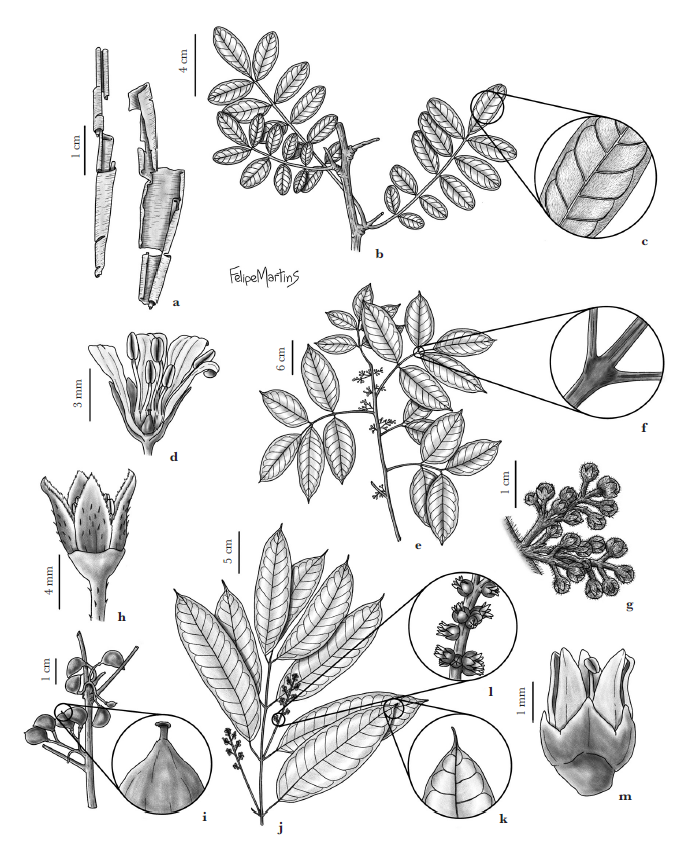
a-d. Commiphora leptophloeos - a. appearance of exfoliating rhytidome; b. branches with thorns and leaves; c. abaxial surface densely pubescent to glabrescent; d. male flower. e-i. Protium heptaphyllum - e. fertile branch showing the leaflet elliptical with acuminate apex; f. constricted nodal region between leaflet; g. flowers in panicle with pedicellate flowers; h. flowers showing the truncate calyx; i. style persistent in the fruit. j-m. Protium sagotianum - j. fertile branch; k. leaves with a caudate apex; l. detail of the sessile flowers; m. flowers with lobed calyx. (a-c. M.F. Moro et al. 256; d. M.I.B. Loiola et al. 1393; e-i. A. Fernande & F.J.A. Matos 10797; j-m. A. Fernandes EAC 10797). Drawn by Felipe Martins.
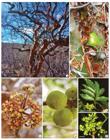
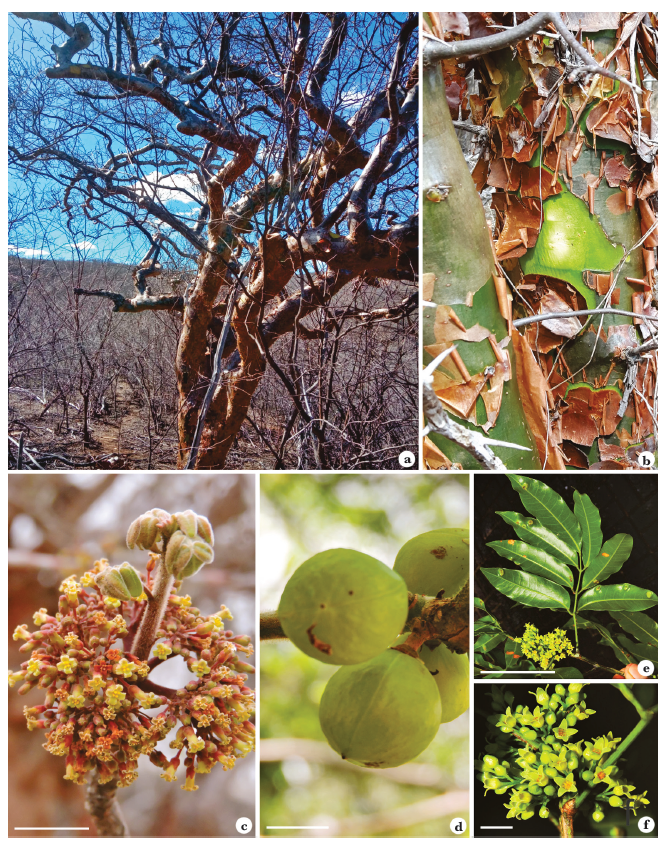
a-d. Commiphora leptophloeos - a. habit; b. branch with smooth, thin and exfoliating rhytidome; c. flowers in panicle (scale 3 cm long); d. fruits (scale 0.6 cm long). e-f. Protium heptaphyllum - e. fertile branch (scale 8 mm long); f. flowers in panicle (photos: a. FD Santos; b-f. MIB Loiola).
Commiphora leptophloeos is a species with very peculiar characteristics and can be easily identified by the stem with its smooth, thin, rusty, exfoliating rhytidome and, when detached, the green part is exposed and there is a cylindrical nodal region between leaflets. Another striking feature are the sessile leaflets, with abaxial surface densely pubescent to glabrescent.
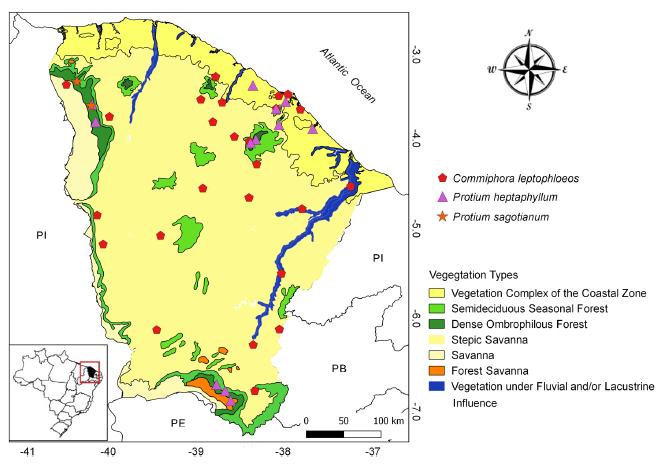
Commiphora leptophloeos occurs in Bolivia, Paraguay and Brazil (Gillett 1980). In Brazil, it is recorded in the Northern (Amazonas, Pará, Roraima and Tocantins), Northeastern (Alagoas, Bahia, Ceará, Maranhão, Paraíba, Pernambuco, Piauí, Rio Grande do Norte, Sergipe), Mid-Western (Goiás, Mato Grosso do South, Mato Grosso) and Southeastern (Minas Gerais) regions, in the Amazon, Caatinga, Cerrado domains (Daly 2024). In Ceará, this species is widely distributed in the Steppe Savanna, and is also recorded in the Lowland Semideciduous Seasonal Forest, Savanna and Vegetation under Fluvial and/or Lacustrine Influence (Fig. 3). Populations of this species were recorded in three Conservation Units: Aiuaba Ecological Station, Pacoti River Environmental Protection Area and Francy Nunes Private Natural Heritage Reserve.
The species was found with flowers between the months of January and October, and with fruit in January, June and August.
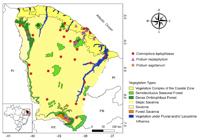
Phytoecological distribution of the Burseraceae species recorded in Ceará state, northeastern Brazil.
2. Protium Burm. f., F. Indica 88. 1768.
Trees with transparent aromatic resin; branches glabrous, lenticelate. Leaves compound, alternate, imparipinnate; leaflets elliptical to lanceolate, base obtuse or asymmetrical, apex acuminate, glabrous, margin entire, main vein prominent on the abaxial side, lateral veins slightly prominent on the abaxial side, papyraceous; rachis glabrous; constricted nodal region between leaflet. Axillary panicle, congested; bracteoles ca. 1 mm long. Flowers 4-5-merous, red to vinaceous, pedicellate; sepals campanulate, discreetly lobed, puberulate; petals lanceolate to ovate, erect, reflexed only at the apex, thickened, dense puberula, truncated base, acute apex, papillose margin; androecium with 10 stamens, subulate fillets, oblong anthers; upper ovary, 4-carpellate; glabrous style, persistent or not in the fruit; capitate stigma, 4-lobed; intrastaminal nectariferous disc lobed, annular, thick. Drupe ovoid to globose, oblique, red at maturity. Seeds not observed.
2.1. Protium heptaphyllum (Aubl.) Marchand, Viddensk. Meddel. Dansk Naturhist. Foren. Kjobenhavn 5: 54. 1873.
Icica heptaphylla Aubl. Hist. PI. Guian. fr. I, p.337. 1775.
Type: Without locality: Aublet (BM n.v). Figs. 1e-i; 2e-f; 3
Trees 5-12 m tall. Compound leaves; petiole 2.5-7.5 cm long, rounded on the abaxial side; rachis 2.4-10 cm long; petioles 0.2-1.3 cm long; leaflets 2-4 pairs, blade 5.5-12 × 2.5-6.2 cm, elliptic to lanceolate, base obtuse or asymmetric, apex acuminate, both sides glabrous, margin entire, main vein prominent on the abaxial side, lateral veins slightly prominent on the abaxial side, papyraceous. Panicle up to 2.5 cm long, axillary, congested; bracteoles triangular, pubescent. Flowers ca. 8 mm, 4-5-merous; pedicel ca. 3 mm long, glabrous; calyx ca. 1 mm long, campanulate, truncate apice, slightly lobed, pubescent; petals ca. 1.5 mm long, lanceolate to ovate, erect, reflexed at the apex, thickened, densely pubescent, base truncate, apex acute, margin papillose, red to vinaceous; stamens 10, filaments 1.5-2 mm long, subulate, anthers ca. 0.8 mm long, oblong; ovary ca. 0.5 mm long, glabrous; style ca. 1 mm long, glabrous, usually persistent in the fruit; capitate stigma, 4-lobed; intrastaminal nectary disc lobed, annular, thick. Drupe 0.9-1.3× 0.7-1 cm, ovoid to globose, oblique. Seeds not observed.
Examined material: Aquiraz, trilha das Sucurujubas, 15.I.2016, fl. and fr., A.P. Negreiros 12 (EAC). Barbalha, Chapada do Araripe, 26.X.2012, fl., L.B. Silva (IPA 88342). Baturité, ATEE Labirinto, 10.IX.2003, fl., V. Gomes 252 (EAC). Crato, Chapada do Araripe, Parque Florestal do Araripe, Flona, 30.VII.1997, fl., R.C. Oliveira 765 (EAC). Guaramiranga, Sítio Cana Brava, 27.XI.1993, fl., M.R.L. Oliveira (EAC 20905). Horizonte, estrada Coluna-Cascavel, 10.VIII.2008, fl. and fr., J.E. Alves (EAC 43872). Maranguape, 10.X.1988, fl., M. Andrade Neto (EAC 15500). Missão Velha, Chapada do Araripe, 23.X.2019, fl., L.F. Lima et al. 2318 (HRSN). São Benedito, Serra da Ibiapaba, Muricituba, 8.I.1942, fl., P. Bezerra 406 (EAC). São Gonçalo do Amarante, Jardim Botânico, 26.X.2017, fl., V.S. Sampaio 182 (EAC). Ubajara, Pl. Ibiapaba, Portão do Planalto Neblina, PARNA de Ubajara, 14.X.1998, fl., A. Fernandes (EAC 27666).
Protium heptaphyllum is similar to P. sagotianum in sharing glabrous and petiolate leaflets, differing from the latter in the presence of elliptic leaflets (vs. oblong to lanceolate) with acuminate apex (vs. caudate), inflorescence in panicle (vs. thyrse), pedicellate flowers (vs. sessile), subtruncate calyx apex (vs. lobed) and persistent style in the fruit.
Among the South American species of the genus, Protium heptaphyllum is the most widely distributed, with records from Colombia, Venezuela and the Guianas to Paraguay (Daly 1987). In Brazil, it has been recorded in almost all regions, with the exception of the Southern region, and in the Amazon, Caatinga, Cerrado and Atlantic Rainforest domains (Daly 2024). In Ceará, P. heptaphyllum occurs in Lowland Semideciduous Seasonal Forest and Dense Ombrophilous Forest (Fig. 3). This species was collected in Araripe-Apodi National Forest and São Gonçalo do Amarante Botanical Garden.
Collected with flowers in January, July, August, October, November, and with fruit in January and August.
2.2. Protium sagotianumMarchand., Adansonia 8: 69. 1867.
Type: GUIANA FRANCESA: Sagot 1191 (holotype B n.v). Figs. 1j-m; 3
Tree 4-18 m tall. Compound leaves; petiole 7-10 cm long, slightly furrowed on the abaxial side; rachis 12-17 cm long; petioles 1-3 cm long; leaflets 2-4 pairs, blade 6-22 × 3.5 -6 cm, lanceolate, oblong, base obtuse or asymmetrical, apex caudate, both sides glabrous, margin entire, main vein prominent on the abaxial side, lateral veins slightly prominent on the abaxial side, chartaceous. Thyrse 5-8 cm long, axillary, lax; bracteoles lanceolate to ovate, puberulent to glabrescent. Flowers ca. 3 mm, 5-merous, sessile; calyx 1-1.5 mm long, campanulate, lobes 0.5-0.7 mm long, pubescent to glabrescent; petals ca. 2 mm long, lanceolate, erect, thickened, glabrous, base truncate, apex obtuse, margin papillose, white; stamens 10, filaments 1.5-2 mm long, subulate, anthers ca. 0.3 mm long, oblong; ovary ca. 0.8 mm long, pubescent; style ca. 1 mm long, glabrous, not persistent in the fruit; capitate stigma, 4-lobed; intrastaminal nectary disc lobed, annular, thick. Drupe 0.9-1.3 × 0.7-1cm, ovoid to globose, symmetrical to oblique. Seeds not observed.
Examined material: Ubajara, Pl. Ibiapaba, trilha para a gruta, PARNA, 25.IX.1998, fl., A. Fernandes (EAC 27740). Viçosa do Ceará, estrada Viçosa-Lameiro, 26.IX.1981, fl., A. Fernandes (EAC 10797).
Material adicional: BRAZIL. Alagoas: Serra da Saudinha, 28.I.2006, fr., A. Costa (MAC 26057).
Protium sagotianum is characterized by the glabrous and petiolate leaflets, oblong to lanceolate leaflets with a caudate apex, inflorescence in thyrse, sessile flowers, lobed calyx and persistent style in the fruit. Its relationship with the most similar species was discussed in the comments on that species.
Protium sagotianum occurs in northern South America, in the Guianas, Suriname and Brazil (Swart 1942). In Brazil, it is recorded in the Northern (Acre, Amazonas, Amapá, Pará, Rondônia and Roraima) and Northeastern (Ceará and Maranhão) regions, and in the Amazon domain (Daly 2024). In Ceará, P. sagotianum was only recorded in Dense Ombrophilous Forest (Fig. 3) in the Ubajara National Park, representing here its first record for the Atlantic Forest.
The species was collected with flowers in September.
Acknowledgements
We are grateful for the funding grant awarded by FUNCAP as a scholarship (Edital Funcap/CNPq nº 03/2022 - Programa de Apoio à Fixação de Jovens Doutores no Brasil - Process 150120/2023-0). LMS is grateful to CAPES (Cooordenação de Aperfeiçoamento de Pessoal de Nível Superior), for the scholarship (Financial Code 001). MIBL thanks CNPq, for the research productivity scholarship granted (Process 306723/2023-9) and FUNCAP (Edital Mulheres na Ciência - Process MLC-0191-00147.01.00/22). We thank the editor and the reviewers, for their valuable contributions.
Data availability statement
In accordance with Open Science communication practices, the authors inform that there is no data sharing of this manuscript.
References
- Burman NL (1768) Flora Indica. Johannes Schreuderum, Amstelaedami. 260p.
-
CRIA (2024) Geoloc. Available at <http://splink.cria.org.br/>. Access on 23 August 2023.
» http://splink.cria.org.br/ - Daly DC (1987) A taxonomic revision of the genus Protium (Burseraceae) in eastern Amazonia and the Guianas. Tese de Doutorado. City University of New York, New York. 1987. 96p.
- Daly DC & Fine PVA (2011) A new Amazonian section of Protium (Burseraceae) including both edaphic specialist and generalist taxa. Studies in Neotropical Burseraceae XVI. Systematic Botany 36: 939-949.
- Daly DC, Fine PVA & Martínez-Habibe MC (2012) Burseraceae: a model for studying the Amazon flora. Rodriguésia 63: 21-30.
- Daly DC (2020) New species of Protium sect. Tetragastris from the Andes, the Brazilian Cerrado, and Amazonia. Studies in Neotropical Burseraceae. Brittonia 72: 290-302.
- Daly DC, Perdiz RO, Fine VA, Damasco G, Martinez-Habibe MC & Calvillo-Canadell L (2021) A review of Neotropical Burseraceae. Brazilian Journal of Botany 45: 120-125.
-
Daly DC (2024) Burseraceae in Lista de Espécies da Flora do Brasil. Jardim Botânico do Rio de Janeiro. Available at <http://floradobrasil2015.jbrj.gov.br/FB16656>. Access 2 February 2024.
» http://floradobrasil2015.jbrj.gov.br/FB16656 -
Development Team (2019) QGIS Geographic information system: Open-Source Geospatial Foundation Project. Available at <http://qgis.osgeo.org>. Access on 6 May 2022.
» http://qgis.osgeo.org - Fernandez MH (2008) Anatomia, morfologia e identificação de espécies de breu (Burseraceae) na reserva de desenvolvimento sustentável Tupé, Manaus, AM. Dissertação de Mestrado. Instituto Nacional de Pesquisas na Amazonia, Manaus. 2008. 88p.
- Figueiredo MA (1997) A cobertura vegetal do Ceará (Unidades Fitoecológicas): Atlas do Ceará. Governo do Estado do Ceará - IPLANCE, Fortaleza. 65p.
- Gillett JB (1980) Commiphora (Burseraceae) in South America and its relationship to Bursera Kew Bulletin 34: 569-587.
- Harris JG & Harris MW (2001) Plant identification terminology: an illustrated glossary. 2nd ed. Spring Lake Publishing, Utah. 216p.
- Hiura AL & Watanabe MTC (2017) Flora das cangas da Serra dos Carajás, Pará Brasil: Burseraceae. Rodriguésia 68: 921-923.
-
IBGE - Instituto Brasileiro de Geografia e Estatística (2012) Manual técnico da vegetação brasileira. 2a ed. Available at <https://ftp://geoftp.ibge.gov.br/documentos/recursos_naturais/ manuais_tecnicos/manual_tecnico_vegetacao_brasileira.pdf>. Access on 3 December 2023.
» https://ftp://geoftp.ibge.gov.br/documentos/recursos_naturais/ manuais_tecnicos/manual_tecnico_vegetacao_brasileira.pdf -
IPNI (2024) The International Plant Names Index. The Royal Botanic Gardens, Kew. Available at <http://www.ipni.org>. Access on 22 July 2023.
» http://www.ipni.org -
JSTOR - Global Plants. Burseraceae. Available at <https://plants.jstor.org/>. Access on 2 January 2023.
» https://plants.jstor.org/ - Kunth KS (1824) Burseraceae. Annales des Sciences Naturelles 2: 346.
- Loiola MIB, Ribeiro RTM, Sampaio VS & Souza EB (2020) Diversidade de angiospermas do Ceará: Herbário Prisco Bezerra - 80 anos de história. Edições UVA, Sobral. 260p.
- Loureiro AA, Silva MF & Alencar JC (1977) Essências madeireiras da Amazônia. Vol. 3. INPA, Manaus. 245p.
- Marchand NL (1867) Protium sagotianum Adansonia 8: 69.
- Marchand NL (1873) Protium heptaphyllum Videnskabelige Meddelelser fra Dansk Naturhistorisk Forening Kjøbenhavn 5: 54.
- Medeiros RD (2019) Commiphora leptophloeos (Mart.) J.B. Gillett (Burseraceae): estudo fitoquímico, toxicidade e avaliação do potencial anti-inflamatório e antimicrobiano. Tese de Doutorado. Universidade Federal do Rio Grande do Norte, Natal. 2019. 123p.
- MMA - Ministério do Meio Ambiente (2016) Ceará: inventário florestal nacional: principais resultados. Serviço Florestal Brasileiro, Brasília. 64p.
- Mori AS, Silva LAM, Lisboa G & Coradin L (1989) Manual de Manejo do Herbário Fanerogâmico. 2a ed. Centro de Pesquisas do Cacau, Itabuna. 104p.
- Otuki MF, Vieira-Lima F, Malheiros A & Yunes RA (2005) Topical antiinflammatory effects of the ether extract from Protium kleinii and α-amyrin pentacyclic triterpene. European Journal Pharmacology 507: 253-59.
- Pirani JR (1987) Flora da Serra do Cipó, Minas Gerais: Burseraceae. Boletim de Botânica 9: 211-218.
- Pirani JR (2003) Flora de Grão-Mogol, Minas Gerais: Burseraceae. Boletim de Botânica 21: 143-145.
- Swart JJ (1942) Monograph of the genus Protium and some allied genera (Burseraceae). Recueil des travaux botaniques néerlandais 39: 211-446.
-
Thiers B (continuously updated) Index Herbariorum: a global directory of public herbaria and associated staff. New York Botanical Garden’s Virtual Herbarium. Available at <http://sweetgum.nybg.org/science/ih/>. Access on 2 January 2024.
» http://sweetgum.nybg.org/science/ih/ - Weeks A, Zapata F, Pell SK, Daly DC, Mitchell JD & Fine PVA (2014) To move or to evolve: contrasting patterns of intercontinental connectivity and climatic niche evolution in “Terebinthaceae” (Anacardiaceae and Burseraceae). Front Genet 5: 409.