 The effect of agricultural management on seed rain and seed banks during regeneration in Brazil’s Cerrado-Caatinga ecotone
Abstract
Seed rain and seed banks are mechanisms for the entry of propagules that assist in the regeneration of agricultural areas. We hypothesized that the seed rain and seed banks of managed areas (10 and 25 years old) - when compared to non-managed areas - have lower species richness and greater numbers of seeds/seedling emergences, in addition to greater richness and number of seeds/seedling emergences for autochoric dispersal syndrome, herbaceous growth patterns and differing species compositions. We collected in three plots of 50 m × 50 m. For each plot, 20 collectors were installed for seed rain sampling. For the seed bank, 15 soil samples were collected and cultivated for the germination of seeds. Seed rain from managed areas showed higher values for species richness, herbaceous and tree autochory, as well as differing species compositions between areas. The seed bank showed lower values for species richness and higher values for herbaceous autochory, with differing compositions between areas. The abundance of seed rain and seed banks did not differ between areas, whereas the composition of dispersal mechanisms did. In creating areas dependent on autochthonous species (anemochorous and autochorous), agricultural management compromises the regeneration of dry forests.
Key words:
Agriculture; Composition; Dispersal; Succession; Syndrome
Resumo
Chuva e banco de sementes são mecanismos de entrada de propágulos que auxiliam na regeneração de áreas agrícolas. Pressupomos que a chuva e o banco de sementes de áreas manejadas (10 anos e 25 anos) possuem menor riqueza de espécies e maior número de sementes/emergência, além de maior riqueza e número de sementes/emergências para síndrome de dispersão autocórica, formas de vida herbáceas e composição de espécies diferentes, quando comparado com áreas não manejadas. Coletamos em três parcelas de 50 m × 50 m. Para cada área, instalamos 20 coletores para amostragem da chuva de sementes, assim como coletamos e cultivamos 15 amostras para a contagem de plântulas. A chuva de sementes das áreas manejadas possuiu maior riqueza de espécies, autocoria, herbácea e arbóreo, além de composição diferentes entre as áreas. O banco de sementes, por outro lado, possuiu menores valores em riqueza de espécies, e maiores valores de autocoria, herbácea, e composição diferentes entre áreas. A abundância da chuva e banco de sementes não diferiu entre as áreas, já a composição entre os mecanismos de dispersão diferiu. O manejo agrícola compromete a regeneração de florestas secas tornando essas áreas dependentes de espécies autóctones (anemocórico e autocórico).
Palavras-chave:
Agricultura; Composição; Dispersão; Sucessão; Síndrome
Introduction
Changes in land use, such as the conversion of native vegetation into agricultural plantations, result in alterations in species composition, community dynamics, and ecosystem processes in response to environmental filters imposed by deforestation and the use of fire, on a small scale or across landscapes (Garnier et al. 2007; Laliberté et al. 2009). It is worth noting that deforestation and changes in land use for agriculture intensify the effects of forest fragmentation, directly compromising the dispersal process of diaspores (Lindenmayer & Nix 1993).
Such changes cause a decline in the availability of pollinators and seed dispersers. These modifications affect seedling mortality and recruitment rates, directly interfering with population and community dynamics (Laurance & Bierregaard 1997). An example of this is dispersal limitation. This occurs in anthropized environments due to distances between forest fragments and adjacent matrices (Taylor et al. 1993). The absence of food attractants from local vegetation reduces the frequent arrival of dispersal agents (Ingle 2003; Montesinos 2015).
To assess the potential for recovery of areas degraded by agriculture, it is necessary to investigate characteristics related to species colonization and dispersal (Cramer et al. 2008). Studies involving seed banks and seed rain have been used frequently in recent years, mainly to investigate differences in species composition in the regeneration process of abandoned agricultural lands (Pakeman & Small 2005; Vieira & Scariot 2006; Douh et al. 2018; Bezerra et al. 2022, 2023; Paula et al. 2023). However, there are still few studies analyzing the effects of agricultural management on seed banks and seed rain, on the richness and abundance of dispersal syndromes and on habits for growth.
Seed rain is characterized by the deposition of propagules into the soil through dispersal (Campos et al. 2009). Thus, seed dispersal is an efficient mechanism that allows species to colonize new areas (Janzen 1970; Hyatt et al. 2003; Traveset et al. 2014). The spreading of seeds enhances germination potential, survival, and species recruitment, whether from local areas (autochthonous dispersal to preserve local diversity) or from distant areas via animal dispersal (allochthonous dispersal), ultimately increasing species richness (Connell 1978; Sheldon & Nadkarni 2013; Sccoti et al. 2016). Thus, seed rain plays an essential role in connectivity between disturbed and adjacent preserved areas (Souza et al. 2014), as habitat connectivity facilitates the entry of new species and the formation of a seed bank (Silva et al. 2016).
The seed bank comprises the set of seeds stored in the soil, representing both local and surrounding vegetation (Overdyck & Clarkson 2012; Capellesso et al. 2015; Oliveira et al. 2018). The formation of the seed bank is a key mechanism in natural regeneration and a primary source of recruitment of new individuals after disturbances (Oliveira et al. 2018; Török et al. 2018), enabling rapid colonization (Kebrom & Bekele 2000). Factors such as the absence of attractants for seed dispersing fauna, landscape barriers, and seed size can affect propagule entry into environments and the formation of transient or persistent seed banks (Daniel & Jankauskis 1989; Ottaviani et al. 2020). Recognition of changes in growth behavior during succession can facilitate the comparison of areas in ecological studies (Poorter et al. 2023), as the seed bank and seed rain provide a snapshot of the vertical vegetation structure during regeneration (Hopfensperger 2007; O’Donnell et al. 2016). Consequently, transitions from herbaceous growth habits to larger vegetation, like trees, may indicate an advancement in succession in areas undergoing regeneration following the cessation of agricultural practices or other anthropogenic activities (Egler 1954; Finegan 1996).
Understanding dispersal strategies and their role in recolonization dynamics in anthropized environments (Zimmerman et al. 2000) can facilitate the identification of successional trajectories over time (Dent & Estrada-Villegas 2021). For example, in management areas, autochthonous dispersal strategies (autochory and anemochory) are common. As succession progresses, the availability of resources attractive for animal dispersers increases, leading to more interactions between plant species and their dispersers, thereby favoring allochthonous propagule inputs through zoochory (Martins 2016). Studies on changes in dispersal strategies throughout succession can help clarify the community assembly process during regeneration in disturbed environments (Huanca-Nuñez et al. 2019; Wendt et al. 2022).
Understanding the diversity of seed rain and seed banks is crucial for comprehending the successional dynamics of colonization and species replacement in abandoned areas after disturbances (Lopes et al. 2012; Souza et al. 2014; Ferreira et al. 2016; Bezerra et al. 2023; Paula et al. 2023). Applied research on the taxonomic diversity of seed rain and seed banks in anthropized areas can reveal the mechanisms driving spatiotemporal changes in community composition and the effects of natural and anthropogenic disturbances on species diversity (Magurran 2004; Baselga 2010). Knowledge of taxonomic diversity can also be applied to select appropriate restoration strategies for degraded areas. These recovery practices can manage changes in species composition over time and space (Budka et al. 2019; Li et al. 2019).
Ecotonal areas, such as those in the southeast region of the state of Piauí are strongly influenced by plant species from the Cerrado and Caatinga domains. Indeed, locations further from the center of the Cerrado biome show greater differences in floristic composition, often reflecting characteristics from adjacent domains, such as Caatinga, in the northeastern region (Vieira et al. 2019).
The objective of this study was to create a survey of species in the seed bank and seed rain in non-managed and managed areas at different stages of regeneration (managed after 10 and 25 years) and, thus, to test the following suppositions: (i) Species richness inside the soil’s seed bank and seed rain is expected to be higher in non-managed areas due to reduced anthropogenic disturbance, facilitating the maintenance of a more diverse propagule pool, preserving the integrity of native plant communities; (ii) Seed density and seedling species diversity will be greater in managed areas as a result of silvicultural interventions and ecological restoration practices that enhance natural regeneration and floristic heterogeneity. Conversely, non-managed areas may exhibit lower diversity due to the absence of disturbance-driven recruitment dynamics; (iii) The non-managed area is expected to exhibit a higher seed abundance and greater zoochoric species richness, attributed to increased animal activity and natural dispersal processes. In contrast, managed areas are anticipated to display a higher seed count and a predominance of autochoric species, because of management practices that promote self-dispersing plant species; (iv) The non-managed area is expected to exhibit a higher abundance of seeds and greater diversity of tree and shrub species, driven by natural succession processes. Conversely, managed areas are anticipated to present a higher seed density and species richness of herbaceous plants, resulting from management practices that promote early-successional or ground-cover species; (v) Species composition in the seed bank and seed rain is expected to be similar among management areas due to standardized practices, with turnover rate being the main component to explain beta diversity through species replacement; (vi) Species composition between the seed bank and seed rain will be more similar in the non-managed area due to natural ecological processes promoting continuity, whereas in the managed area, differences will be more pronounced due to human interventions altering dispersal and recruitment patterns.
Material and Methods
Study area
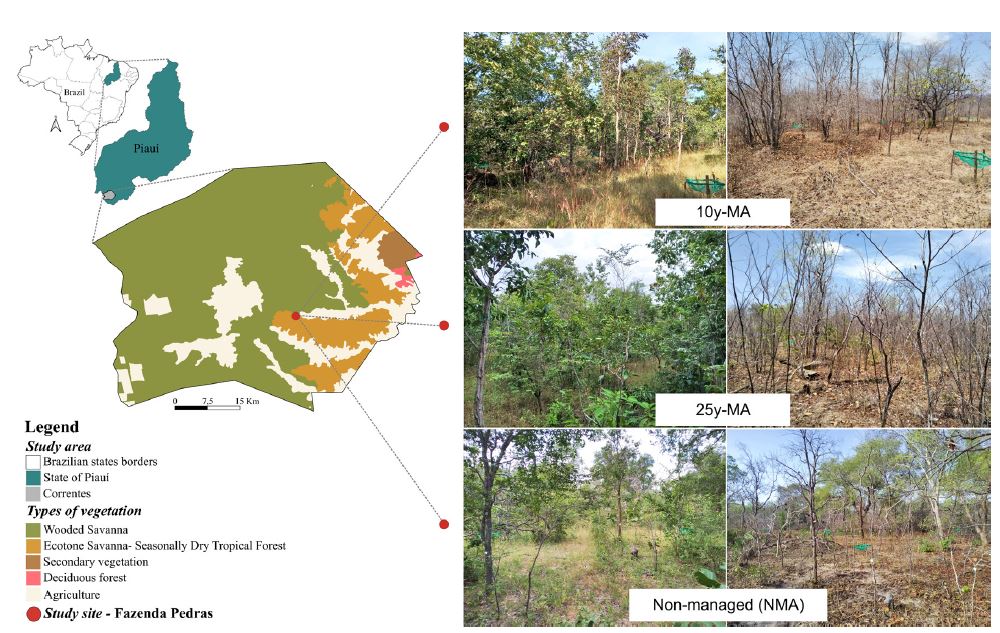
The study was conducted in a transitional area between the Cerrado and Caatinga biomes in the municipality of Corrente, state of Piauí, located in the micro-region of the Chapadas of the extreme south of Piauí, with altitudes reaching up to 438 m (Cepro 1992). The sampling units were installed on a private property known as Fazenda Pedras, located at coordinates 10°31’16.5”S and 45°11’24.51”W (Fig. 1). In the region two types of vegetation predominate: campo cerrado and arboreal and shrubby caatinga (IBGE 2019). The soil is characterized by the presence of dystrophic red-yellow latosols, which are associated with dystrophic sandy quartz, indiscriminate tropical soils, and lithic soils (Cepro 1992). The rainy season typically lasts from December to May. The wettest months are January and February, with annual rainfall totaling 1,035 mm. Temperatures range from a minimum of 23 °C to a maximum of 39 °C, with an average annual temperature of 25 °C. (Aguiar & Gomes 2004).
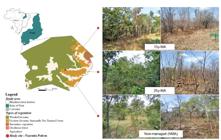
Location of the selected areas for the study of seed rain and seed bank with diferente management histories and sucessional times, in the transition region between Cerrado and Caatinga, Corrente, Piauí.
Fazenda Pedras covers an area of 90 hectares. Inside the boundaries of this property, three areas with differing management histories were selected. According to the owner, who has lived on the property for over 60 years, the first area is a non-managed area (NMA), and has no history of deforestation and agricultural planting. The other two areas have undergone vegetation clearing and soil mechanization for agricultural planting. Of these, one was managed 10 years ago (10y-MA) and another 25 years ago (25y-MA) (Fig. 1). The managed areas are undergoing natural regeneration, safeguarded by fences, although they are occasionally impacted by sporadic fires from neighboring areas.
Collecting data
Seed rain sampling
The data used in this research were compiled from a database collected by collaborators of the Botany Laboratory at the State University of Piauí (UESPI) - Campus Dep. Jesualdo Cavalcante, Corrente, Piauí.
Seed rain sampling was conducted monthly over a period of 12 months, from November 2020 to October 2021. In each area, a plot of 50 m × 50 m was established and subdivided into 10 m × 10 m subplots, totaling 25 subplots. Next, 20 subplots were randomly selected to install 20 collectors in each one. The collectors each worked an area of 0.50 m² and a bowl depth of approximately 0.30 m, constructed using 1 mm nylon mesh. The collectors were installed at the center of each subplot, approximately 0.70 m above the ground to prevent them from being toppled by herbaceous growth during the rainy season. The total sampling area was 30 m², with 10 m² in each management history.
Seeds deposited in the seed rain collectors were stored in paper bags labeled with the collector number, collection date, and collection area. Subsequently, the samples were transported to the Botany Laboratory at the university (UESPI). Fruits were opened to remove and count the seeds. To aid in the diaspores identification we examined collected fruits in plants near the collectors when they were available. Diaspore identification was carried out by comparing plants collected with fruits from the study area, consulting specialized literature (Barroso et al. 1999; Kuhlmann & Ribeiro 2016), and, when necessary, by comparing them with specimens from the herbarium of the Federal University of Piauí - TEPB. Each identified species was classified according to their dispersal syndrome as zoochorous, anemochorous, or autochorous (Van Der Pijl 1982), as well as growth habit: tree, shrub, herbaceous, or liana (Fragoso et al. 2018).
Seed bank sampling
For seed bank sampling, the same three plots of 50 m × 50 m used for seed rain collection were utilized. Fifteen plots were randomly selected in each area for seed bank sampling, totaling 45 sampling units. Within each subplot, three sub-samples measuring 30 × 30 cm and 5 cm deep were collected, spaced three meters apart, and combined in a container to obtain a homogeneous composite sample, including the litter layer above the soil. From each composite sample, 1 kg of soil was extracted and placed in properly labeled plastic bags, then transported to the nursery at the UESPI campus, for the application of the emergency method (Santos et al. 2009). Two collections were conducted with a 180-day interval (October 2021 and April 2022) to capture seasonal variations in propagule production.
The samples were placed in 30 × 20 × 6 cm trays perforated at the base and marked for identification. A layer of 2 cm of sterilized sand was added to the bottom of the trays to facilitate water drainage. The seed bank samples were spread over the sand to form a three-centimeter layer and placed in a nursery covered with a 70% shading net to prevent the entry of propagules. For each treatment, a tray with sterile sand was added to identify contamination by propagules from plants near the experiment (Bao et al. 2020). Over six months, daily irrigation was applied with the same water content for each treatment to maintain suitable conditions for germinating as many seeds as possible.
Monthly, seedlings were counted, morphotyped, and removed from the tray, with the soil being turned over to promote the germination of buried seeds. For the botanical identification of plants that emerged from the seed bank, at least two individuals of each species were transplanted into polyethylene bags, and their development was monitored until they could be properly identified. Collection and herborization of the sampled species in the seed bank followed the guidelines of Fidalgo & Bononi (1984). The distribution of taxonomies arose according to Angiosperm Phylogeny Group IV (2016) classification. Brazil’s website for Flora and Fungi (Flora e Funga do Brasil 2023, continuously updated) was used for further verification. Similar to the seed rain, the species in the seed bank were classified according to their dispersal syndrome and growth behavior.
Data analysis
Rarefaction curves were constructed to determine whether the non-managed area had higher species richness in both seed rain and seed banks than the managed areas (Gotelli & Colwell 2011). For seed rain, we used a matrix of the number of seeds per species, while for the seed bank, we used a matrix of the number of seedlings per species. The iNEXT function in the iNEXT package (Hsieh et al. 2016), which uses Hill numbers to construct extrapolation and interpolation intervals (Chao et al. 2014), was employed. Jackknife I estimator with 999 permutations assessed closeness between observed species richness in the seed rain and seed banks and the estimated richness (Magurran 2004; Gotelli & Ellison 2010). Species presence-absence matrices were employed to analyze this.
In the attempt to confirm that the number of seeds and seedling species in the seed bank and in the seed rain was higher in managed areas and lower in non-managed areas, generalized linear models (GLMs) were used. To this end, R packages stats, car, and MASS were used. The various models related sets of variables, with dependent variables (richness and abundance - growth habit and dispersal syndrome) and independent variables (regeneration time - 10y MA, 25y MA, and NMA) to explain the variations occurring in the different managed and non-managed areas. The Poisson distribution family was used, with a dispersion adjustment to Quasipoisson for species richness and seedling numbers, after overdispersion of the residuals was confirmed.
To test the associations of dispersal syndromes and growth habits through successional stages we applied G tests (Likelihood Ratio Test) by using the Gtest() function from the “DescTools” package (Signorell 2024). Besides the general G test, we also applied a G test for every dispersal syndrome and growth habit between successional stages adjusting the p-values with Bonferroni correction method.
To verify the difference in species composition regarding seed banks and seed rain in the comparison between managed and non-managed areas, PERMANOVA with 999 permutations (Anderson & Robison 2001) and NMDS (Non-metric Multidimensional Scaling) - a non-parametric multidimensional scaling technique (Gotelli & Ellison 2010) - were utilized. For the PERMANOVA, a matrix of seed numbers per species for seed rain and a matrix of seedling numbers per species for the seed bank were used. These matrices were employed to calculate distance matrices using the Bray-Curtis index. The pairwise permutation test was conducted using the “pairwise.perm.amanova” function from the “RVAideMemoire” package to compare pairs of the studied areas. NMDS was used to reduce the visual representation of the sampled units compared to two axes in the PERMANOVA (Gotelli & Ellison 2010). The same analyses were employed to determine whether the species compositions between the seed bank and seed rain are more similar in non-managed areas and dissimilar in managed areas.
To answer the question regarding differences in species composition between seed bank and seed rain across areas (beta diversity), the turnover component (βsim) was best explained using the “beta.multi” and “beta.pair” functions from the betapart package (Baselga & Orme 2012). The Sørensen dissimilarity index (pairwise comparison between areas) was utilized to obtain the total beta diversity measure (βsor), which was then decomposed into turnover (βsim) and nestedness (βsne) components. To calculate the different components of beta diversity, the “beta.pair” function was employed, while the “beta.multi” function was used to assess the contribution of these components to the total community variation (Baselga et al. 2018). To visually represent species sharing between seed banks and seed rain across areas, a Venn diagram was generated using the Venny 2.1 program (Oliveros 2015).
All analyses were conducted using R 4.0 software (R Core Team 2020), and a significance level of p < 0.05 was applied to all analyses.
Results
A seed rain of 4,610 seeds belonging to 13 families and 19 species was to be collected from the three areas. The Fabaceae family (5 species) was the most representative in terms of species number (25%). In terms of seed numbers deposited in the collectors, one would highlight the species Terminalia fagifolia Mart. (41.62%) and Astronium urundeuva (M. Allemão) Engl. (29.93%), which together represent 72% of the collected seeds (Tab. 1).
List of families and species of seed rain, with respective number of seeds, for areas with 10y MA, 25y MA, and NMA, in the transition region between Cerrado and Caatinga, Corrente, Piauí.
The highest number of seeds deposited in the collectors was observed in the non-managed area, while the lowest was recorded for the 25y MA area. The 10y MA area exhibited the highest observed species richness. It also had the highest estimated species richness (Jack 1). Conversely, the lowest values were found for the 25y MA and non-managed areas, demonstrating similarity when considering the standard deviation (Tab. 2).
Number of seeds, species richness, number of families, and Jackniffe I values for areas with 10y MA, 25y MA and NMA, in the transition region between Cerrado and Caatinga, Corrente, Piauí.
In the three areas under study, seedling emergence from seed banks revealed 2,468 seeds belonging to 21 families and 35 species. The Fabaceae (5 species) and Poaceae (4 species) families were the most representative in terms of species number (25.71%). The Paspalum plicatulum Michx species, belonging to the Poaceae family, exhibited the highest emergence of seedlings (37.44%), followed by the Borreria tenella species (Kunth Cham. & Schltdl) (19.36%), from the Rubiaceae family. Together, these species accounted for 57% of emergence (Tab. 3).
List of families and seedlings species from the seed bank with respective numbers of individuals for areas with 10y MA, 25y MA and NMA, in the transition region between Cerrado and Caatinga, Corrente, Piauí.
We observed higher seedling emergence in the 10y MA area. However, there were fewer species and families and a lower estimated richness (Jack 1; Tab. 4). On the other hand, 25y MA and NMA areas showed higher values of species and family richness. The observed and estimated richness values were similar between 25y MA and NMA areas (considering the standard deviation) (Tab. 4).
Number of seedlings, species richness, number of families, and Jackniffe I values for areas with 10y MA, 25y MA and NMA, in the transition region between Cerrado and Caatinga, Corrente, Piauí.
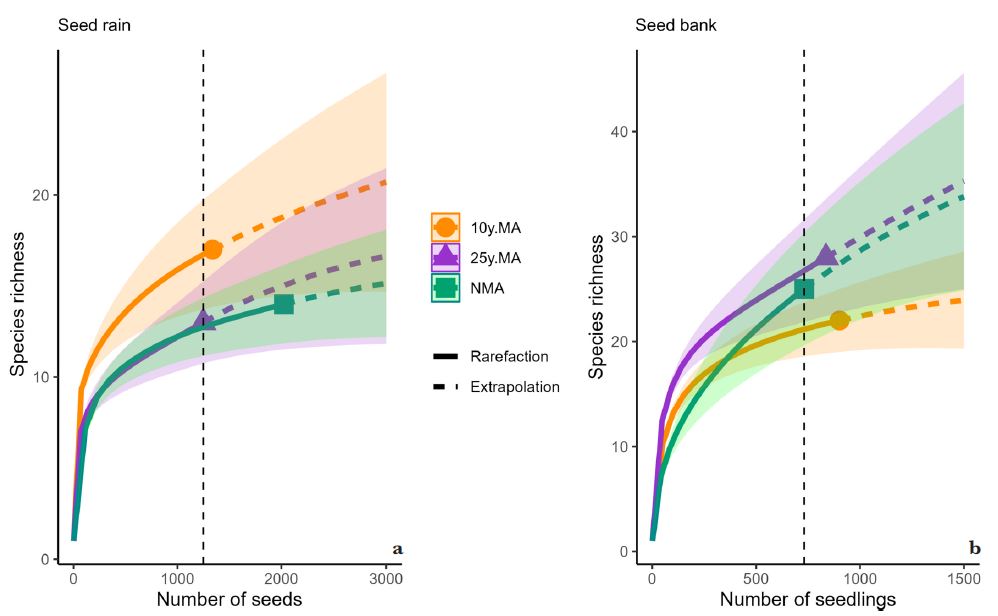
Regarding seed rain, there is no difference in species richness between non-managed and 25y MA areas, with overlapping confidence within the interpolation interval (Fig. 2a). Conversely, the 10y MA area showed higher richness and differed from the others, with no overlap of confidence intervals within the interpolation interval (Fig. 2a). Thus, the rarefaction curves support the result of the Jacknife 1 richness estimator.
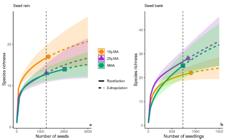
a-b. Rarefaction curve in areas with 10y MA, 25y MA and NMA, in the transition region between Cerrado and Caatinga, Corrente, Piauí - a. seed rain; b. seed bank. (The dashed vertical line indicates the interpolation interval).
For the seed bank, we observed a similar species richness between 25y MA and non-managed areas, as evidenced by the overlapping confidence intervals in interpolation (Fig. 2b). However, the area with 10y MA differed from the others in species richness, as there was no overlap of interpolation interval (Fig. 2b).
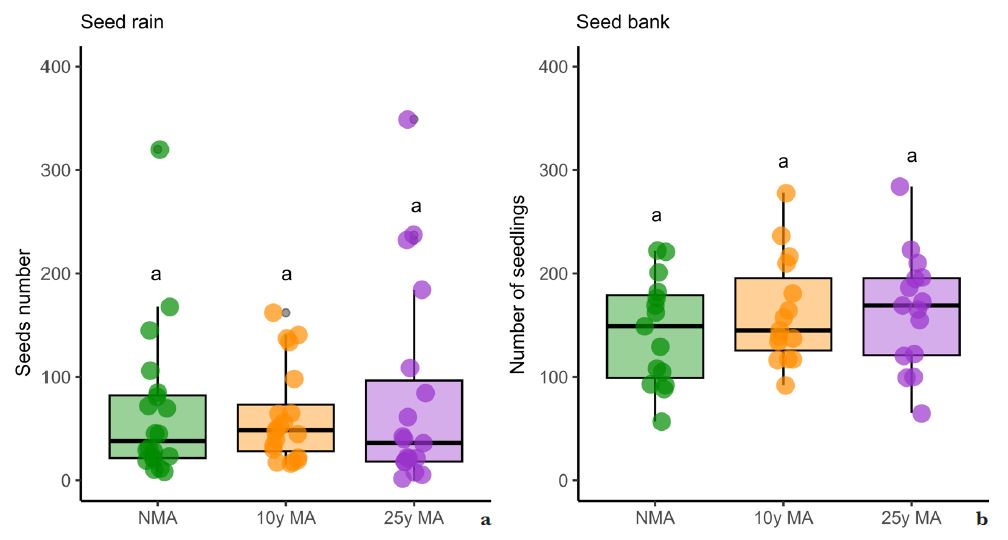
For seed rain, no differences were observed in the number of seeds between managed and non-managed areas (p = 0.347; df = 42; F = 0.695) (Fig. 3a; Appendix S1, available on supplementary material <https://doi.org/10.6084/m9.figshare.29420837.v1>). We found no difference in the means of the number of seedlings from the seed bank between managed (10y and 25y) and non-managed areas (p = 0.504; df = 57; F = 1.077) (Fig. 3b; Appendix S2, available on supplementary material <https://doi.org/10.6084/m9.figshare.29420837.v1>).
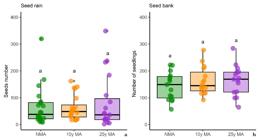
a-b. Boxplot of the number of emerged seeds and deposited seeds in areas with 10y MA, 25y MA and NMA, in the transition region between Cerrado and Caatinga, Corrente, Piauí - a. seed rain; b. seed bank.
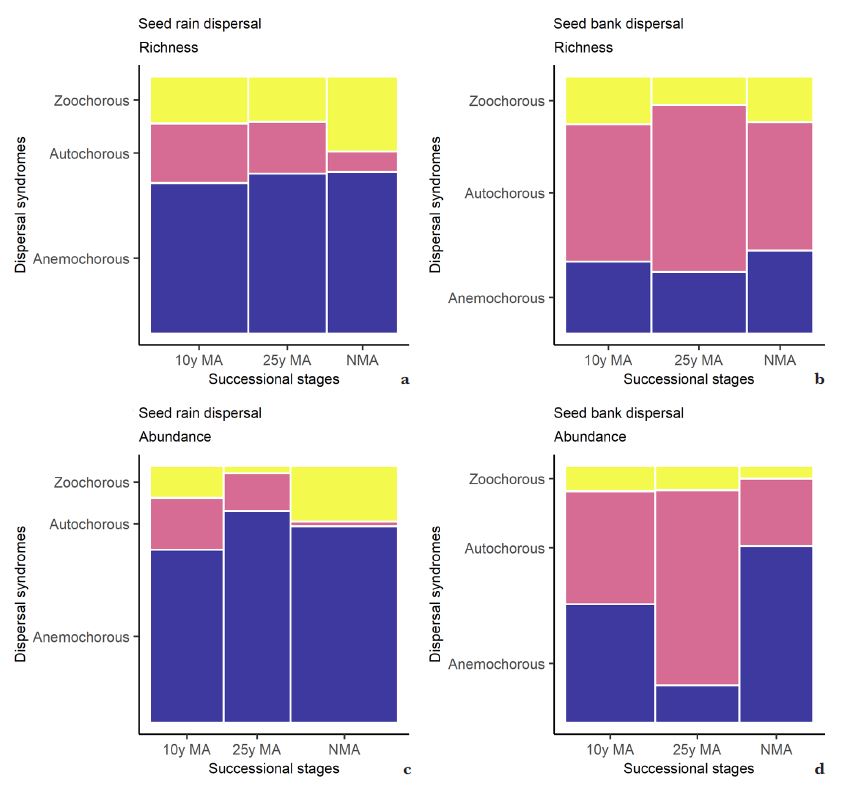
Regarding species richness, we detected a relationship between dispersal syndrome and regeneration stages for the seed rain (G = 10137; p = 0.038), with autochorous being higher in 10y PM than NM (G = 11661; p = 0.003) (Fig. 4a; Appendix S3, available on supplementary material <https://doi.org/10.6084/m9.figshare.29420837.v1>). There was no association between the richness of seed bank dispersal syndromes and succession stages (Fig. 4b; Appendix S3, available on supplementary material <https://doi.org/10.6084/m9.figshare.29420837.v1>). However, the abundance of seed dispersal syndromes in the seed rain was strongly related to succession stages, with all syndromes varying significantly (G = 699.26; p < 0.001) (Fig. 4c; Appendix S3, available on supplementary material <https://doi.org/10.6084/m9.figshare.29420837.v1>). Likewise, the abundance of seed bank dispersal syndromes varied between dispersal stages, with all syndromes varying significantly (G = 557.9; p < 0.001) (Fig. 4d; Appendix S3, available on supplementary material <https://doi.org/10.6084/m9.figshare.29420837.v1>).

a-d. Relationship between species richness and abundance with different types of dispersal syndromes across different successional stages (10y MA, 25y MA and NMA) in the transition region between Cerrado and Caatinga, Corrente, Piauí- a,c. seed rain; b,d. seed bank.
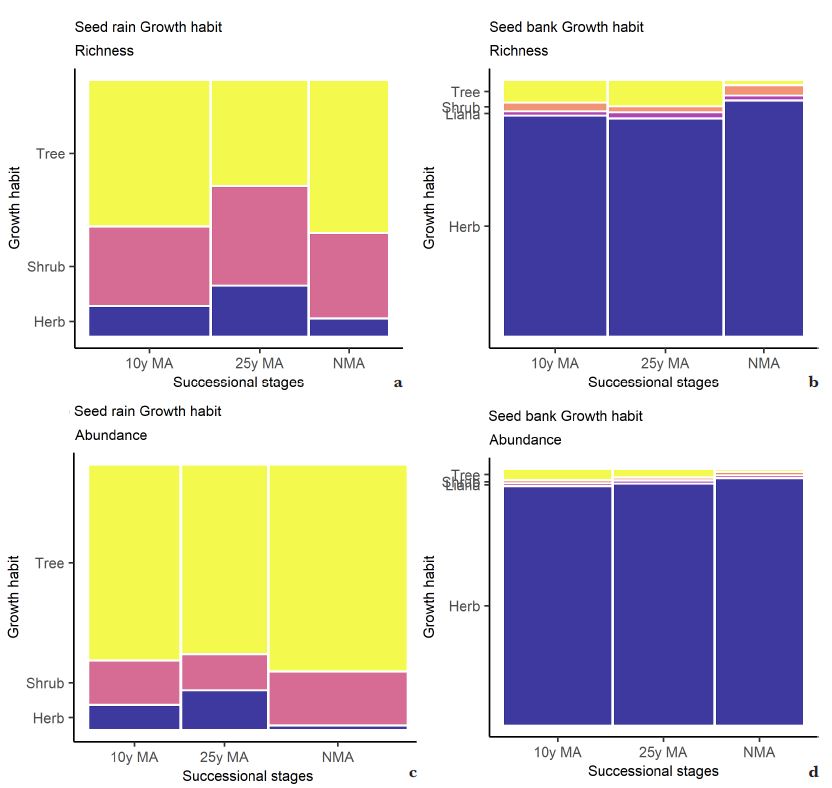
For the richness of growth habit in the seed rain, there was no association with the succession stages (G = 8.8721; p = 0.06) (Fig. 5a; Appendix S4, available on supplementary material <https://doi.org/10.6084/m9.figshare.29420837.v1>). Likewise, there was no association between the richness of growth habit in the seed bank and the stages (G = 10.06, p = 0.12) (Fig. 5b; Appendix S4, available on supplementary material <https://doi.org/10.6084/m9.figshare.29420837.v1>). Regarding the abundance of growth habit in the seed rain, there was an association with the succession stages, with all growth habit varying between stages (G = 285.09, p < 0.001) (Fig. 5c; Appendix S4, available on supplementary material <https://doi.org/10.6084/m9.figshare.29420837.v1>). Likewise, there was an association between the abundance of growth habits in the seed bank and the stages (G = 31.273, p < 0.001). However, only trees (G = 36.063; p < 0.001) and herbs (G = 12.54; p < 0.001) varied between stages (Fig. 5d; Appendix S4, available on supplementary material <https://doi.org/10.6084/m9.figshare.29420837.v1>).
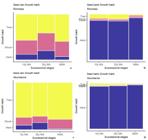
a-d. Relationship between species richness and abundance with different types of growth habits across different successional stages (10y MA, 25y MA and NMA) in the transition region between Cerrado and Caatinga, Corrente, Piauí - a,c. seed rain; b,d. seed bank.
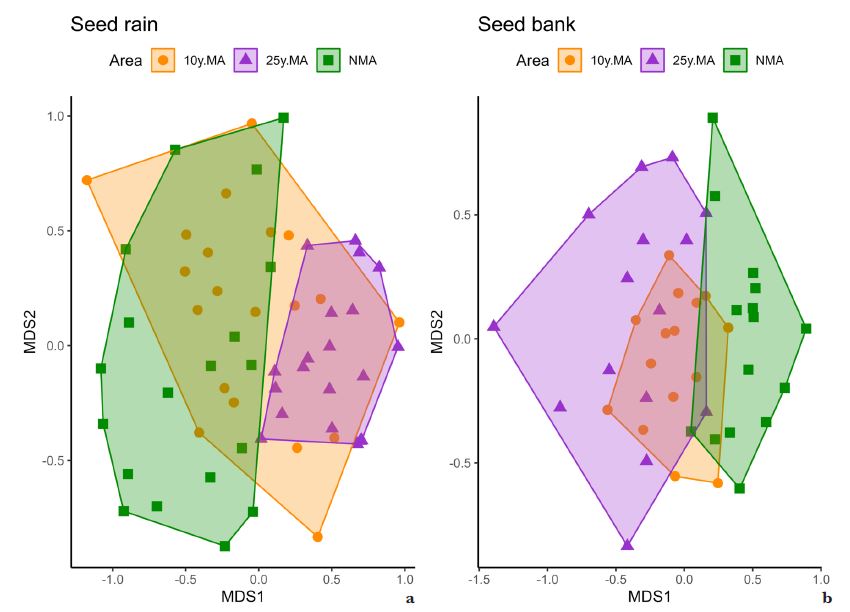
For seed rain, differences in species composition between areas were also evident (R2 = 0.210, p < 0.001). The post-hoc test demonstrated differences in species composition between non-managed and managed areas (stress = 0.244) (Fig. 6a). We verified differences in the species composition of the seed bank between areas at different concessional stages (R2 = 0.210, p < 0.001). The post-hoc test showed that the areas with 10y MA showed no difference in the species composition of the seed bank in comparison to the non-managed area, as expressed in the NMDS (stress = 0.239) (Fig. 6b).
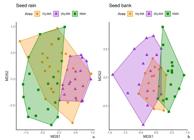
a-b. Ordination of sampling units based on the matrix of species emergence and seed counts in areas with 10y MA, 25y MA and NMA, in the transition region between Cerrado and Caatinga, Corrente, Piauí - a. seed rain; b. seed bank.
Beta diversity analysis (0.33) for species richness in the seed bank revealed a greater turnover (0.26) than nestedness (0.07) in all regeneration times. Similarly, for the seed rain, the beta diversity analysis (0.39) for species richness in the seed bank revealed greater turnover (0.30) and, to a lesser extent, nestedness (0.09).
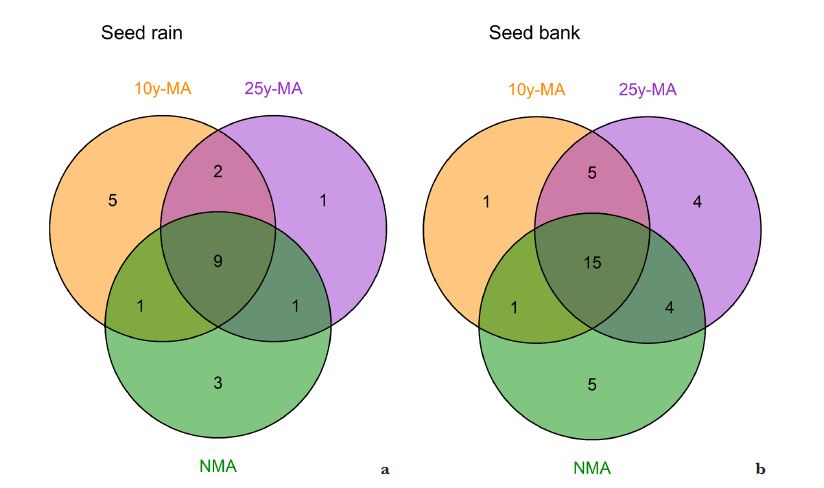
The Venn diagram showed that the most numerous sharing of seed rain occurred between the 10-year and 25-year regeneration areas (two species); however, there was low sharing between the other areas (one species). The area with 10 years of regeneration presented more exclusive species (five species) (Fig. 7a). For the seed bank, the areas with 10 and 25 years of regeneration shared a more significant number of species (five species), while the area with 10 years of regeneration, alongside being non-managed, shared the lowest number of species (one species). The non-managed area presented more exclusive species (five species) (Fig. 7b).
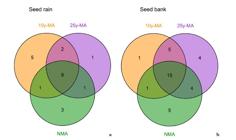
a-b. Venn diagram showing the species sharing between areas at different sucessional stages (10y MA,25y MA and NMA), in the transition region between Cerrado and Caatinga, Corrente, Piauí - a. seed rain; b.seed bank.
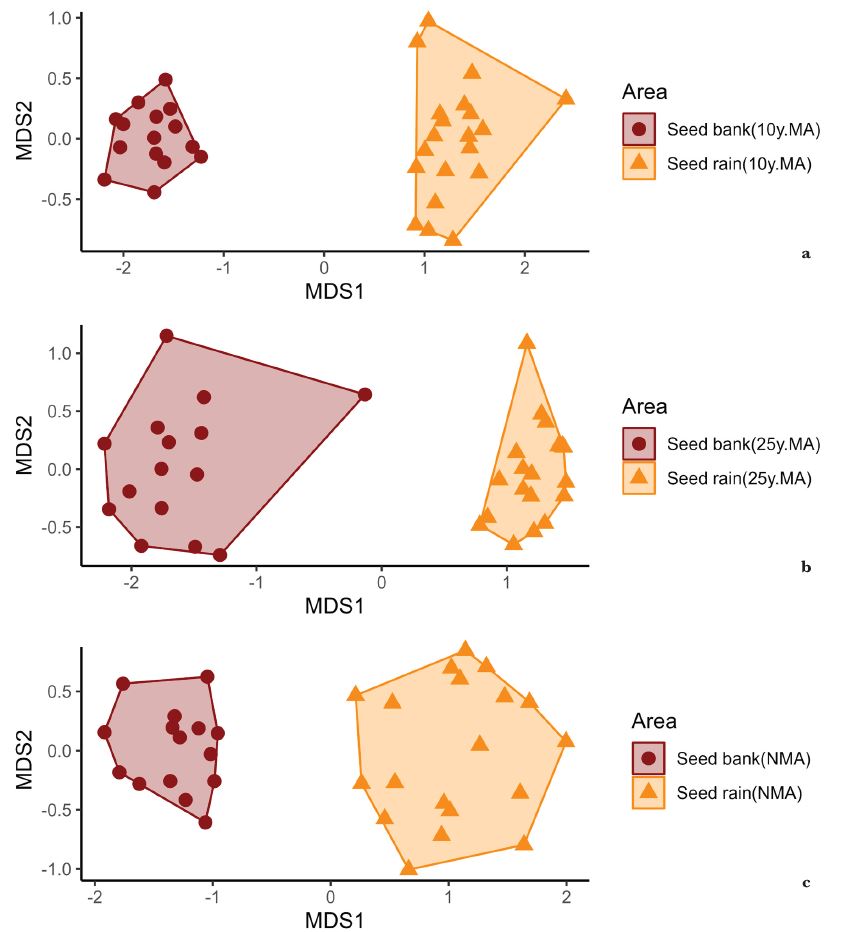
Differences were found in species composition between seed rain and seed bank for the area with 10 years of regeneration (R2 = 0.422, p = 0.001; NMDS stress = 0.089) (Fig. 8a). For the area with 25 years of regeneration, differences in species composition between seed bank and seed rain were also observed (R2 = 0.370, p = 0.001; NMDS stress = 0.100) (Fig. 8b). Lastly, for the non-managed area, seed bank and seed rain also differed in species composition (R2 = 0.350, p = 0.001; NMDS stress = 0.089) (Fig. 8c).
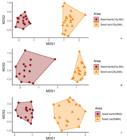
a-c. Non-parametric multidimensional scaling (NMDS) demonstrating the comparison in species composition of seed bank and seed rain for the areas differents in the transition region between Cerrado and Caatinga, Corrente, Piauí - a. 10y MA; b. 25y MA; c. NMA.
Discussion
Species richness in the seed bank would be higher in the non-managed area and lower in areas subjected to agricultural management. We believe intensive management causes changes in the environmental conditions of managed areas, affecting soil compaction and exposure, temperature, and luminosity, directly influencing the formation of a transient seed bank. Changes in environmental conditions in regenerating areas improve during the process of recovery for degraded environments, allowing for the recruitment of species contained in the seed bank, thus boosting species richness observed in seedlings that have emerged from the seed bank during succession (Török et al. 2018).
Considering the above, reduction in species richness in the seed bank can be explained by the intensity of management and regeneration time. At the beginning of regeneration, a pool of emergent herbaceous species, mostly dispersed by autogenic dispersal, is common, resulting in a more significant autochthonous increment of propagules in the seed bank. On the other hand, due to the low entry of allochthonous propagules, there is also expected to be low species richness in the seed bank in early successional stages (Bekker et al. 2000). A seed bank influenced by autogenic sources plays a vital role for seed density in disturbed areas, as this can increase the possibility of species recruitment (Teketay 2005). Thus, we emphasize that agricultural management can affect the seed bank, reducing the number of species and limiting colonization and recruitment potential (Bezerra et al. 2022).
If species richness in seed rain was higher in non-managed areas and lower in areas undergoing regeneration was not confirmed. We believe that agricultural management contributes to the higher deposition of autochthonous propagules in seed rain, as seeds are dispersed close to the mother plant, which may decrease the possibility of emergence and recruitment of species, mainly arboreal and shrubby ones. While the predominance of species with anemochorous and autocorous strategies may favor more significant seed deposition in the soil, these species are also subject to exit factors, such as pathogen action and mortality due to inter- and intra-specific competition, which during regeneration may result in a community with lower species richness, as observed in managed areas (Janzen 1970; Connell 1971).
It is also worth noting that in open vegetation formations with low density, shorter heights, and deciduous characteristics - as described by Gomes et al. (2024) in a study using plots like the ones used in this research - the predominance of species with anemochorous and autocorous syndromes is standard (Griz & Machado 2001; Yamamoto et al. 2007; Piña-Rodrigues & Aoki 2014). Thus, these changes in physionomies reduce barriers to dispersion, favoring more significant deposition of autocorous and anemochorous seeds in the early stages of ecological succession, which may increase seed deposition in the seed bank.
The higher number of seeds in managed areas is due to the strong influence of the emergence of herbaceous species present in the seed bank in the studied areas, such as the large amount of Poaceae emergence. The Poaceae family plays an important role in the structuring and functioning of open ecosystems, such as savanna fields (Oliveira 2023), as they have the C4 metabolism and take advantage of high luminosity in rainy summers to convert into high biomass and seed production due to their early reproduction (Bond & Keeley 2005; Jeschke et al. 2008). Herbaceous species generally have a short reproductive cycle, playing a predominant role in colonizing disturbed areas that receive sufficient light for germination and establishment, especially in disturbed environments. These species are essential for soil cover and stability due to their roots’ rapid growth over the surface. They help contain erosion, reduce compaction, and increase the accumulation of organic matter (Sutili & Gavassoni 2017).
The similarity we have found in the number of seeds deposited in seed rain may have been strongly influenced by an autochthonous contribution due to the extensive deposition of anemochorous and autocorous seeds. In dry forests, the predominant dispersal strategies in seed rain are anemochorous and autocorous (Martínez-Garza et al. 2011), which have characteristics of short-distance dispersion near the mother plant (Janzen 1970). This may have caused the deposition of a large number of propagules in the collectors.
The entry of zoochoric species into the study areas can be explained by the connectivity of the vegetation with adjacent areas, which can serve as routes for dispersers and a source of resources for dispersing fauna (Ribas et al. 2016). The emergency of zoochoric species in the seed bank, even in small quantities, reveals the potential of these areas to attract dispersers and, consequently, the importance of the conservation of local fauna, as well as enabling the formation of a seed bank influenced by allochthonous species (Gasparino et al. 2006; Martins 2016). Differences in microhabitats between conserved and managed areas may favor the emergency of herbaceous species in the seed bank (Reis et al. 2006; Santos et al. 2013, Silva et al. 2013; Silva et al. 2016). Managed areas have less dense vegetation, therefore receiving a greater amount of light, while in more advanced stages, they have denser vegetation and are therefore more shaded, due to the presence of canopy trees, resulting in a decrease in the herbaceous component (Souza et al. 2006).
A low input of zoochoric seeds and species in the study areas reveals little influence of dispersal agents in seed rain (Dent & Estrada-Villegas 2021). The limited availability of food attractants and the absence of perching plants in these areas may contribute to the low attractiveness for dispersing fauna and, consequently, low deposition of zoochoric species in seed rain (Ingle 2003). On the other hand, the strong influence of autochoric and anemochoric seeds and species, as previously highlighted, occurs due to the characteristics of the vegetation types that facilitate short-distance dispersal from the mother plant (Nathan et al. 2002), increasing the deposition of propagules and further demonstrating the autochthonous’ solid influence on seed rain formation (Gonçalves et al. 2021).
The presence of all growth behaviors in the seed bank demonstrates the potential of contributing to the vertical stratification of the plant community during regeneration (Fróes et al. 2020; Garcia et al. 2022). It is worth noting the importance of tree component diaspores in the seed bank for the future structuring of the community during regeneration. In addition to the tree component, due to their canopy, they can serve as natural perches and also improve microclimatic conditions such as cooler temperatures, higher humidity, and soil nutrients to facilitate the colonization of species from adjacent areas (Ribaski et al. 2001). Thus, the increase in species richness of the tree component in managed areas is evidence of succession advancement (Baider et al. 2001). Our results showed that the areas receive diaspores representing all strata, which may contribute to forming a more functionally diverse seed bank (Costa 2017), as evidenced in this study. Replenishing a seed bank with representatives of all growth habits ensures the regeneration process of disturbed areas, especially their vertical structure (Grombone-Guarantini & Rodrigues 2002; Bezerra et al. 2023).
The dominance of herbaceous plants across all successional stages can contribute to maintaining both productivity and species richness (Araújo et al. 2004). In ecological succession, herbaceous plants play a vital ecological role by preserving soil moisture and enhancing the potential for seeds of other species to integrate with their roots and remain in the seed bank (Alves et al. 2018). Conversely, the lower number of tree species observed across all successional stages may be attributed to the prolonged dormancy period typical of these plants (Fávero et al. 2015). This dormancy strategy improves survival rates, persistence, and seed viability in the seed bank, ensuring that a certain number of individual trees establish themselves in the environment as succession progresses (Pereira et al. 2013).
We believe the seed rain is strongly influenced by the local vegetation (trees and shrubs). On the other hand, the seed bank is more affected by the regenerating stratum due to the predominance of herbaceous growth habit (Baider et al. 2001; Martins & Engel 2007), which justifies the differing species composition between seed rain and seed bank observed in this study. In a study conducted in identical plots, Gomes et al. (2024) demonstrated that the species composition of the tree and shrub community differed from the regenerating stratum at all stages studied here.
Thus, this study highlights the negative consequences of intensive agricultural management for diversity in the ecotone area between the Cerrado and Caatinga. Activities of this nature promoted higher averages of autochthonous and herbaceous species in the regenerating areas for both seed rain and seed banks. This factor hindered the progress of succession by limiting the entry of propagules from more distant regions. However, our results also revealed the importance of the seed bank and seed rain in supplying propagules belonging to various growth habits in the vertical structuring of the community in regeneration.
The difference in species composition of the seed bank between managed areas can be justified because the species emerging in the seed bank in the 10-year managed area reflect a persistent seed bank formed in the past, similar in species composition to non-managed areas (Paulsen et al. 2013). On the other hand, the dissimilarity in species composition of the seed bank in the 25-year managed area in regeneration can be explained by the fact that it is composed of seeds representing the local vegetation from a seed bank formed in the past or by dispersal from adjacent areas (Sorreano 2002; Silva et al. 2013; Valenta et al. 2015). Our evidence can be supported by the findings of Gomes et al. (2024), who showed differences in species composition and highlighted the substitution of tree, shrub, and regenerating species among regeneration times in the same plots used in this study. Our results reinforce the importance of local vegetation in seed bank formation, as species replacement occurs in response to improved environmental conditions and the advancement of regeneration time in managed areas (Poorter et al. 2019).
However, the species composition of the seed rain differed between the areas. The observed difference in species composition between the regions studied reflects the autochthonous seed dispersal of the local plant community, as shown in the work of Gomes et al. (2024). After all, seed rain generally tends to have more species from the permanent vegetation that makes up the established community in the area (Jara-Guerrero et al. 2020). Thus, we can perceive that the effect of management on vegetation may end up favoring local dispersion by promoting limitation of dispersal (San-José et al. 2019).
Finally, we highlight the negative consequences of agricultural management, since management activities promote an increase in the autochone and herbaceous contribution to both seed rain and the seed bank. Our results also revealed the importance of the seed bank and seed rain in providing propagules belonging to different forms of life in the vertical structuring of the regenerating community. Finally, this study highlights the importance of implementing diversity analyses to understand community dynamics during the natural regeneration process, comparing areas at different stages of regeneration.
Acknowledgements
We thank the Graduate Program in Biodiversity and Conservation (UFPI), and the Botany Laboratory at the State University of Piauí; Dep. Jesualdo Cavalcante Campus, for their collaboration in the development of this research.
Data availability statement
In accordance with Open Science communication practices, the authors inform that there is no data sharing of this manuscript.
References
-
Aguiar RB & Gomes JRC (2004) Projeto cadastro de fontes de abastecimento por água subterrânea, estado do Piauí: diagnóstico do município de Corrente: CPRM - Serviço Geológico do Brasil. Available at <https://rigeo.sgb.gov.br/handle/doc/15910>. Access on 25 February 2023.
» https://rigeo.sgb.gov.br/handle/doc/15910 -
Alves APA, Pereira TMS, Marques AL, Moura DC & Melo JIM (2018) Sucessão ecológica em área de exploração mineral do semiárido paraibano (Brasil). Acta Geográfica 12: 75-93. DOI: 10.18227/2177-4307.acta.v12i29.5020
» https://doi.org/10.18227/2177-4307.acta.v12i29.5020 -
Anderson MJ & Robinson J (2001) Permutation tests for linear models. Australian and New Zealand Journal of Statistics 43: 75-88. DOI: 10.1111/1467-842X.00156
» https://doi.org/10.1111/1467-842X.00156 -
APG IV - Angiosperm Phylogeny Group (2016) An update of the Angiosperm Phylogeny Group classification for the orders and families of flowering plants: APG IV. Botanical Journal of the Linnean Society 181: 1-20. DOI: 10.1111/boj.12385
» https://doi.org/10.1111/boj.12385 - Araújo MM, Barros PLC, Longhi SJ & Brena DA (2004) Caracterização da chuva de sementes, banco de sementes do solo e banco de plântulas em Floresta Estacional Decídua ripária Cachoeira do Sul, RS, Brasil. Scientia Forestalis 66: 128-141.
-
Baider C, Tabarelli M & Mantovani W (2001) The soil seed bank during Atlantic forest regeneration in southeast Brazil. Revista Brasileira de Biologia 61: 35-44. DOI: 10.1590/S0034-71082001000100006
» https://doi.org/10.1590/S0034-71082001000100006 -
Bao F, Assis MA & Pott A (2020) Applicability of seed bank assessment methods in wetlands: advantages and disadvantages. Oecologia Australis 25: 22-33. DOI: 10.4257/oeco.2021.2501.03
» https://doi.org/10.4257/oeco.2021.2501.03 - Barroso GM, Morin MP, Peixoto AL & Ichaso CLF (1999) Frutos e sementes: morfologia aplicada à sistemática de dicotiledôneas. Ed. UFV, Viçosa. 443p.
-
Baselga A (2010) Partitioning the turnover and nestedness components of beta diversity. Global Ecology and Biogeography 19: 134-143. DOI: 10.2307/40405792
» https://doi.org/10.2307/40405792 -
Baselga A & Orme CDL (2012) Betapart: an R package for the study of beta diversity. Methods in Ecology and Evolution 3: 808-812. DOI: 10.1111/j.2041-210X.2012.00224.x
» https://doi.org/10.1111/j.2041-210X.2012.00224.x -
Baselga A, Orme D, Villeger S, De Bortoli J & Leprieur F (2018) Betapart: partitioning beta diversity into turnover and nestedness components. R package version 1.5.0. Available at <https://cran.r-project.org/web/packages/betapart/index.html>. Access on 13 February 2023.
» https://cran.r-project.org/web/packages/betapart/index.html -
Bekker RM, Verweij GL, Bakker JP & Fresco LFM (2000) Soil seed bank dynamics in hayfield succession. Journal of Ecology 88: 594-607. DOI: 10.1046/j.1365-2745.2000.00485.x
» https://doi.org/10.1046/j.1365-2745.2000.00485.x -
Bezerra JS, Arroyo-Rodríguez V, Leal A, Leal IR & Tabarelli M (2022) Drastic impoverishment of the soil seed bank in a tropical dry forest exposed to slash-and-burn agriculture. Forest Ecology an Management 513: 120185. DOI: 10.1016/j.foreco.2022.120185
» https://doi.org/10.1016/j.foreco.2022.120185 -
Bezerra JS, Arroyo-Rodríguez V, Dupuy-Tapa J, Leal IR & Tabarelli M (2023) Negative impact of slash-and-burn agriculture on the seed rain in a tropical dry forest. Forest Ecology an Management 531: 120821. DOI: 10.1016/j.foreco.2023.120821
» https://doi.org/10.1016/j.foreco.2023.120821 -
Bond WJ & Keeley JE (2005) Fire as a global ‘herbivore’: the ecology and evolution of flammable ecosystems. Trends in Ecology & Evolution 20: 387-394. DOI: 10.1016/j.tree.2005.04.025
» https://doi.org/10.1016/j.tree.2005.04.025 -
Budka M, Matyjasiak P, Typiak J, Okołowski M & Zagalska-Neubauer M (2019) Experienced males modify their behaviour during playback: the case of the chaffinch. Journal of Ornithology 160: 673-684. DOI: 10.1007/s10336-019-01647-w
» https://doi.org/10.1007/s10336-019-01647-w -
Campos EP, Vieira MF, Silva AF, Martins SV, Carmo FMS, Moura VM & Ribeiro ASS (2009) Chuva de sementes em Floresta Estacional Semidecidual em Viçosa, MG, Brasil. Acta Botanica Brasilica 23: 451-458. DOI: 10.1590/S0102-33062009000200017
» https://doi.org/10.1590/S0102-33062009000200017 -
Capellesso ES, Santolin SF & Zanin EM (2015) Banco e chuva de sementes em área de transição florestal no sul do Brasil. Revista Árvore 39: 821-829. DOI: 10.1590/0100-67622015000500005
» https://doi.org/10.1590/0100-67622015000500005 -
CEPRO - Fundação Centro de Pesquisas (1992) Perfil dos municípios Teresina. Fundação CEPRO, Teresina. 420p. Available at <http://www.cepro.pi.gov.br/download/201102/CEPRO25_291479f320.pdf>. Access on 13 February 2023.
» http://www.cepro.pi.gov.br/download/201102/CEPRO25_291479f320.pdf -
Chao A, Gotelli NJ, Hsieh TC, Sander EL, Ma KH, Colwell RK & Ellison AM (2014) Rarefaction and extrapolation with Hill numbers: a framework for sampling and estimation in species diversity studies. Ecological Monographs 84: 45-67. DOI: 10.1890/13-0133.1
» https://doi.org/10.1890/13-0133.1 - Connell JH (1971) On the role of natural enemies in preventing competitive exclusion in some marine animals and in rain forest trees. Proceedings of the Advanced Study Institute on Dynamics of Numbers in Populations, 298-312.
- Connell JH (1978) Diversity in tropical rain forests and coralreefs: high diversity of trees and corals is maintained only in a nonequilibrium state. Science 199: 1302-1310.
- Costa PF (2017) Indicadores ecológicos no monitoramento de áreas em processo de restauração florestal localizadas no sul do estado do Mato Grosso do Sul - MS. Tese de Doutorado. Universidade Federal da Grande Dourados, Dourados. 2017. 137p.
-
Cramer VA, Hobbs RJ & Standish RJ (2008) What’s new about old fields? Land abandonment and ecology assembly. Trends in Ecology & Evolution 23: 104-112. DOI: 10.1016/j.tree.2007.10.005
» https://doi.org/10.1016/j.tree.2007.10.005 - Daniel O & Jankauskis J (1989) Avaliação de metodologia para estudo do estoque de sementes do solo, em floresta de terra firme na Amazônia brasileira. IPEF 41,42: 18-26.
-
Dent DH & Estrada-Villegas S (2021) Uniting niche differentiation and dispersal limitation predicts tropical forest succession. Trends in Ecology & Evolution 36: 700-708. DOI: 10.1016/j.tree.2021.04.001
» https://doi.org/10.1016/j.tree.2021.04.001 -
Douh C, Daïnou K, Joël Loumeto J, Moutsambote JM, Fayolle A, Tosso F, Forni E, Gourlet-Fleury S & Doucet JL (2018) Soil seed bank characteristics in two central African forest types and implications for forest restoration. Forest Ecology and Management 409: 766-776. DOI: 10.1016/j.foreco.2017.12.012
» https://doi.org/10.1016/j.foreco.2017.12.012 -
Egler FE (1954) Vegetation science concepts I. Initial floristic composition, a factor in old-field vegetation development with 2 figs. Plant Ecology 4: 412-417. DOI: 10.1007/BF00275587
» https://doi.org/10.1007/BF00275587 -
Fávero AA, Costa MP, Figueira M, Andriollo DD & Longhi SJ (2015) Distribuição de abundância de espécies da comunidade arbórea do topo de um morro na floresta estacional subtropical. Ciência Rural 45: 806-813. DOI: 10.1590/0103-8478cr20121238
» https://doi.org/10.1590/0103-8478cr20121238 -
Ferreira CD, Souto PC, Lucena DS, Sales FCV & Souto JS (2016) Fitossociologia do banco de sementes em diferentes estágios de regeneração natural de caatinga, Seridó paraibano. Agropecuária Científica no Semiárido 12: 301-318. DOI: 10.30969/acsa.v12i3.857
» https://doi.org/10.30969/acsa.v12i3.857 - Fidalgo O & Bononi VL (1984) Guia de coleta, preservação e herborização de material botanico. Instituto de Botânica, São Paulo. 62p.
-
Finegan B (1996) Pattern and process in neotropical secondary rain forests: the first 100 years of succession. Trends in Ecology & Evolution 11: 119-124. DOI: 10.1016/0169-5347(96)81090-1
» https://doi.org/10.1016/0169-5347(96)81090-1 -
Flora e Funga do Brasil 2023 (continuously updated) Jardim Botânico do Rio de Janeiro. Available at <http://floradobrasil.jbrj.gov.br/>. Access on 14 February 2023.
» http://floradobrasil.jbrj.gov.br/ -
Fragoso RDO, Carpanezzi AA, Zuffellato-Ribas KC & Koehler HS (2018) Seed bank fromabandoned pastures in the coastal region of Paraná. Floresta e Ambiente 25: 1-11. DOI: 10.1590/2179-8087.029515
» https://doi.org/10.1590/2179-8087.029515 -
Fróes CQ, Costa FP, Fernandes SSL, Silva APV, Jesus RM & Pereira ZV (2020) Chuva de sementes como indicador ambiental de áreas em processo de restauração ecológica do Mato Grosso do Sul. Ciência Florestal 30: 01039954. DOI: 10.5902/1980509839087
» https://doi.org/10.5902/1980509839087 -
Garcia MAA, Terra ABC & Roma TN (2022) Regeneration with or without seedling management: Serra do Mar slope, São Sebastião/SP. Revista Agrogeoambiental 13: 583-594. DOI: 10.18406/2316-1817v13n320211638
» https://doi.org/10.18406/2316-1817v13n320211638 -
Garnier E, Lavorel S, Ansquer P, Castro H, Cruz P, Dolezal J, Eriksson O, Fortunel C, Freitas H, Golodets C, Grigulis K, Jouany C, Kazakou E, Kigel J, Kleyer M, Lehsten V, Leps J, Meier T, Pakeman R, Papadimitriou M, Papanastasis VP, Quested H, Quétier F, Robson M, Roumet C, Rusch G, Skarpe C, Sternberg M, Theau JP, Thébault A, Vile D & Zarovali MP (2007) Assessing the effects of land-use change on plant traits, communities and ecosystem functioning in grasslands: a standardized methodology and lessons from an application to 11 European sites. Annals of Botany 99: 967-985. DOI: 10.1093/aob/mcl215
» https://doi.org/10.1093/aob/mcl215 -
Gasparino D, Malavasi UC, Malavasi MM & Souza I (2006) Quantificação do banco de sementes sob diferentes usos do solo em área de domínio ciliar. Árvore 30: 1-9. DOI: 10.1590/S0100-67622006000100001
» https://doi.org/10.1590/S0100-67622006000100001 -
Gomes MTD, Jacobina HP, Alves GM, Filho HJCL, Reis HS, Morais RF & Funch LS (2024) Revealing floristic and structural variation in regenerating areas in the Cerrado-Caatinga transition: an analysis across seres. Rodriguésia 75: e00112022.2024. DOI: 10.1590/2175-7860202475020
» https://doi.org/10.1590/2175-7860202475020 -
Gonçalves FB, Ferreira RA, Gama DC & Freitas BAL (2021) Chuva de sementes em remanescente de Caatinga, Porto da Folha, Sergipe, Brasil, Advances in Forest Science 8: 1279-1290. DOI: 10.34062/afs.v8i1.10849
» https://doi.org/10.34062/afs.v8i1.10849 - Gotelli NJ & Colwell RK (2011) Estimating species richness. In: Magurran AE & McGill BJ (eds.) Biological diversity: frontiers in measurement and assessment. Oxford University Press, Oxford. Pp. 39-54.
- Gotelli NJ & Ellison AM (2010) Princípios de estatística em ecologia. ARTMED, Porto Alegre. 527p.
-
Griz LMS & Machado ICS (2001) Fruiting phenology and seed dispersal syndromes in caatinga, a tropical dry forest in the northeast of Brazil. Journal of Tropical Ecology 17: 303-321. DOI: 10.1017/S0266467401001201
» https://doi.org/10.1017/S0266467401001201 -
Grombone-Guarantini MT & Rodrigues RR (2002) Seed bank and seed rain a season semi-deciduous forrest in south-eastern Brazil. Journal of Tropical Ecology 18: 759-774. DOI: 10.1017/S0266467402002493
» https://doi.org/10.1017/S0266467402002493 -
Hopfensperger KN (2007) A review of similarity between seed bank and standing vegetation across ecosystems. Oikos 116: 1438-1448. DOI: 10.1111/j.0030-1299.2007.15818.x
» https://doi.org/10.1111/j.0030-1299.2007.15818.x -
Hsieh TC, Ma KH & Chao A (2016) iNEXT: an R package for rarefaction and extrapolation of species diversity (Hill numbers). Methods in Ecology and Evolution 7: 1451-1456. DOI: 10.1111/2041-210X.12613
» https://doi.org/10.1111/2041-210X.12613 -
Huanca-Nuñez N, Chazdon RL & Russo SE (2021) Seed-rain-successional feedbacks in wet tropical forests. Ecology 102: e03362. DOI: 10.1002/ecy.3362
» https://doi.org/10.1002/ecy.3362 -
Hyatt LA, Rosenberg MS, Howard TG, Bole G, Fang W, Anastasia J, Brown K, Grella R, Hinman K, Kurdziel JP & Gurevitch J (2003) The distance dependence prediction of the Janzen-Connell hypothesis: a meta-analysis. Oikos 103: 590-602. DOI: 10.1034/j.1600-0706.2003.12235.x
» https://doi.org/10.1034/j.1600-0706.2003.12235.x -
IBGE - Instituto Brasileiro de Geografia e Estatística (2019) Corrente - Panorama. IBGE, Rio de Janeiro, 2019. Available at <https://cidades.ibge.gov.br/brasil/pi/corrente/panorama>. Access on 13 February 2022.
» https://cidades.ibge.gov.br/brasil/pi/corrente/panorama -
Ingle NM (2003) Seed dispersal by wind, birds, and bats between Philippine montane rainforest and successional vegetation. Oecologia 134: 251-61. DOI: 10.1007/s00442-002-1081-7
» https://doi.org/10.1007/s00442-002-1081-7 -
Janzen DH (1970) Herbivores and the number of tree species in tropical forests. The American Naturalist 104: 501-528. DOI: 10.1086/282687
» https://doi.org/10.1086/282687 -
Jara-Guerrero A, Espinosa CI, M’Endez M, De La Cruz M & Escudero A (2020) Dispersal syndrome influences the match between seed rain and soil seed bank of woody species in a Neotropical dry forest. Journal of Vegetation Science 31: 995-1005. DOI: 10.1111/jvs.12894
» https://doi.org/10.1111/jvs.12894 -
Jeschke JM, Gabriel W & Kokko H (2008) r-Strategist/K-Strategists. In: Jørgensen SE & Fath BD (eds.) Encyclopedia of Eology. Elsevier, Oxford. Pp. 3113-3122. DOI: 10.1016/B978-008045405-4.00648-0
» https://doi.org/10.1016/B978-008045405-4.00648-0 -
Kebrom T & Bekele T (2000) The role of soil seed banks in the rehabilitation of degraded hillslopes in southern Wello, Ethiopia. Biotropica 32: 23-32. DOI: 10.1111/j.1744-7429.2000.tb00444.x
» https://doi.org/10.1111/j.1744-7429.2000.tb00444.x -
Kuhlmann M & Ribeiro JF (2016) Evolution of seed dispersal in the Cerrado biome: ecological and phylogenetic considerations. Acta Botanica Brasilica 30: 271-282. DOI: 10.1590/0102-33062015abb0331
» https://doi.org/10.1590/0102-33062015abb0331 -
Laliberté E, Wells JA & Declerck F (2009) Land-use intensification reduces functional redundancy and response diversity in plant communities. Ecology Letters 13: 76-86. DOI: 10.1111/j.1461-0248.2009.01403.x
» https://doi.org/10.1111/j.1461-0248.2009.01403.x -
Laurance WF & Bierregaard-Jr RO (1997) Tropical forest remnants: ecology, management, and conservation of fragmented communities. The University of Chicago Press, Chicago. 632p. DOI: 10.2307/1383118
» https://doi.org/10.2307/1383118 -
Li N, Chu H, Qi Y, Li C, Ping X, Sun Y & Jiang Z (2019) Alpha and beta diversity of birds along elevational vegetation zones on the southern slope of Altai Mountains: implication for conservation. Global Ecology and Conservation 19: e00643. DOI: 10.1016/j.gecco.2019.e00643
» https://doi.org/10.1016/j.gecco.2019.e00643 - Lindenmayer DB & Nix HA (1993) Ecological principles for the design of wildlife corridors. Conservation Biology 7: 627-631.
-
Lopes CGR, Ferraz EMN, Castro CC, Lima EN, Santos JMFF, Santos DM & Araújo EL (2012) Forest succession and distance from preserved patches in the Brazilian semiarid region. Forest Ecology and Management 271: 115-123. DOI: 10.1016/j.foreco.2012.01.043
» https://doi.org/10.1016/j.foreco.2012.01.043 -
Magurran AE (2004) Measuring biological diversity. African Journal of Aquatic Science 29: 285-286. DOI: 10.2307/4126959
» https://doi.org/10.2307/4126959 -
Martínez-Garza C, Osorio-Beristain M, Valenzuela-Galván D & Nicolas-Medina A (2011) Intra and inter-annual variation in seed rain in asecondary dry tropical forest excluded from chronic disturbance. Forest Ecology Management 262: 2207-2218. DOI: 10.1016/j.foreco.2011.08.013
» https://doi.org/10.1016/j.foreco.2011.08.013 -
Martins AM & Engel VL (2007) Soil seed banks in tropical forest fragments with different disturbance histories in southeastern Brazil. Ecological Engineering 31: 165-174. DOI: 10.1016/j.ecoleng.2007.05.008
» https://doi.org/10.1016/j.ecoleng.2007.05.008 - Martins SV (2016) Recuperação de áreas degradadas: ações em áreas de preservação permanente, voçorocas, taludes rodoviários e de mineração. In: Aprenda fácil. Vol. 1. 4ª ed. Viçosa, Viçosa. 270p.
- Montesinos D (2015) Plant-plant interactions: from competition to facilitation. Web Ecology 15: 1-2.
-
Nathan R, Horn HS, Chave J & Levin SA (2002) Mechanistic models for tree seed dispersal by wind in dense forests and open landscapes. In: Third International Symposium-Workshop on Frugivores and Seed Dispersal, São Pedro, Brazil, 6-11 August 2000. Pp. 69-82. DOI: 10.1079/9780851995250.0069
» https://doi.org/10.1079/9780851995250.0069 -
O’Donnell J, Fryirs KA & Leishman MR (2016) Seed banks as a source of vegetation regeneration to support the recovery of degraded rivers: a comparison of river reaches of varying condition. Science of the Total Environment 542: 591-602. DOI: 10.1016/j.scitotenv.2015.10.118
» https://doi.org/10.1016/j.scitotenv.2015.10.118 - Oliveira ACC (2023) Produção e plantio de mudas de gramíneas nativas para restauração de fisionomias abertas do Cerrado. Tese de Doutorado. Universidade de São Paulo, São Paulo. 2023. 70p.
-
Oliveira TJF, Barroso DG, Andrade AG, Freitas ILJ & Amim RT (2018) Banco de sementes do solo para uso na recuperação de matas ciliares degradadas na região noroeste fluminense. Ciência Florestal 28: 206-217. DOI: 10.5902/1980509831653
» https://doi.org/10.5902/1980509831653 -
Oliveros JC (2015) Venny. Uma ferramenta interativa para comparar listas com diagramas de Venn. Available at <https://bioinfogp.cnb.csic.es/tools/venny/index.html>. Access 13 de February 2023.
» https://bioinfogp.cnb.csic.es/tools/venny/index.html - Ottaviani G, Keppel G, Götzenberger L, Harrison S, Opedal ØH, Conti L, Liancourt P, Klimešová J, Silveira FAO, Jiménez-Alfaro B, Negoita L, Doležal J, Hájek M, Ibanez T, Méndez-Castro FE & Chytrý M (2020) Linking plant functional ecologyto island biogeography. Trends in Plant Science 25: 329-339. DOI: 10.1016/j.tplants.2019.12.022
- Overdyck E & Clarkson BD (2012) Seed rain and soil seed banks limit native regeneration within urban forest restoration plantings in Hamilton City. New Zealand Journal of Ecology 36: 177-190.
-
Pakeman RJ & Small JL (2005) The role of the seed bank, seed rain and the timing of disturbance in gap regeneration. Journal of Vegetation Science 16: 121-130. DOI: 10.1111/j.1654-1103.2005.tb02345.x
» https://doi.org/10.1111/j.1654-1103.2005.tb02345.x -
Paula AS, Sfair JC, Trindade DPF, Rito KF, Tabarelli M & Barros MF (2023) The role of seed rain and soil seed bank in the regeneration of a Caatinga dry forest following slash-and-burn agriculture. Journal of Arid Environments 211: 104948. DOI: 10.1016/j.jaridenv.2023.104948
» https://doi.org/10.1016/j.jaridenv.2023.104948 -
Paulsen TR, Colville L, Kranner I, Daws MI, Hogstedt G, Vandvik V & Thompson K (2013) Physical dormancy in seeds: a game of hide and seek? New Phytologist 198: 496-503. DOI: 10.1111/nph.12191
» https://doi.org/10.1111/nph.12191 -
Pereira SR, Laura VA & Souza ALT (2013) Superação de dormência de sementes como estratégia para restauração florestal de pastagem tropical. Pesquisa Agropecuária Brasileira 48: 148-156. DOI: 10.1590/S0100-204X2013000200004
» https://doi.org/10.1590/S0100-204X2013000200004 -
Piña-Rodrigues FCM & Aoki J (2014) Chuva de sementes como indicadora do estádio de conservação de fragmentos florestais em Sorocaba-SP. Ciência Florestal 24: 909-921. DOI: 10.5902/1980509816603
» https://doi.org/10.5902/1980509816603 -
Poorter L, Amissah L, Bongers F, Hordijk I, Kok J, Laurance SGW, Lohbeck M, Martinez-Ramos M, Matsuo T, Meove JA, Muñoz R, Peña-Claros M & Van-Der-Sande MT (2023) Successional theories. Biological Reviews 98: 2049-2077. DOI: 10.1111/brv.12995
» https://doi.org/10.1111/brv.12995 -
R CORE TEAM (2020) R: a language and environment for statistical computing. R Foundation for Statistical Computing. Available at <https://www.R-project.org>. Access on 20 February 2022.
» https://www.R-project.org -
Reis AM, Araújo EL & Moura AN (2006) Inter-annual variations in the floristic na population structure of na herbaceous Community of “Caatinga” vegetation in Pernambuco, Brazil. Brazilian Journal of Botany 29: 497-508. DOI: 10.1590/S0100-84042006000300017
» https://doi.org/10.1590/S0100-84042006000300017 -
Ribas RP, Gontijo BM & Moura ACM (2016) Análise da conectividade entre fragmentos de vegetação na paisagem: estudo na região da Serra do Espinhaço em Minas Gerais. Revista Brasileira de Cartografia 68: 301-312. DOI: 10.14393/rbcv68n2-44396
» https://doi.org/10.14393/rbcv68n2-44396 - Ribaski J, Montoya Vilcahuaman LJ & Rodigheri HR (2001) Sistemas agroflorestais: aspectos ambientais e sócio-econômicos. Informe Agropecuário 22: 61-67.
-
San-José M, Arroyo-Rodríguez V, Jordano P, Meave JÁ & Martínez-Ramos M (2019) The scale of landscape effect on seed dispersal depends on both response variables and landscape predictor. Landscape Ecology 34: 1069-1080. DOI: 10.1007/s10980-019-00821-y
» https://doi.org/10.1007/s10980-019-00821-y -
Santos DM, Silva KA & Araújo FS (2009) Variabilidade espacial do banco de sementes em área de Caatinga no nordeste do Brasil. Revista Brasileira de Ciências Agrárias 9: 562-569. DOI: 10.5902/1980509840039
» https://doi.org/10.5902/1980509840039 -
Santos DM, Silva KA, Albuquerque UP, Santos JMFF, Lopes CGR & Araújo EL (2013) Can spatial variation and inter-annual variation in precipitation explain the seed density and species richness of the germinable soil seed bank in a tropical dry forest in north-eastern Brazil? Flora 208: 445-452. DOI: 10.1016/j.flora.2013.07.006
» https://doi.org/10.1016/j.flora.2013.07.006 -
Sccoti MSV, Araújo MM, Tonetto TS & Longhi SJ (2016) Dinâmica da chuva desementes em remanescente de Floresta Estacional Subtropical. Ciência Florestal 26: 1179-1188. DOI: 10.5902/1980509825109
» https://doi.org/10.5902/1980509825109 -
Sheldon KS & Nadkarmi NS (2013) Spatial and temporal variation of seed rain in the canopy and on the ground of a tropical cloud forest. Biotropica 45: 549-556. DOI: 10.1111/btp.12043
» https://doi.org/10.1111/btp.12043 -
Signorell A (2024) DescTools: tools for descriptive statistics. R package version 0.99.54. Available at <https:// CRAN.R-project.org/package=DescTools>. Access on 20 February 2024.
» https:// CRAN.R-project.org/package=DescTools -
Silva ACC, Prata APN, Mello AA & Santos ACAS (2013) Síndromes de dispersão de Angiospermas em uma Unidade de Conservação na Caatinga, SE, Brasil. Hoehnea 40: 601-609. DOI: 10.1590/S2236-89062013000400003
» https://doi.org/10.1590/S2236-89062013000400003 -
Silva EP, Figueiredo FG, Séfara S & Fernandes L (2016) Evaluation of the potential of seed rain as an alternative for forest restoration in Permanent Preservation Areas. Revista Árvore 40: 21-28. DOI: 10.1590/0100-67622016000100003
» https://doi.org/10.1590/0100-67622016000100003 - Sorreano MCM (2002) Avaliação de aspectos da dinâmica de florestas restauradas, com diferentes idades. Dissertação de Mestrado. Universidade de São Paulo, São Paulo. 2002. 154p.
-
Souza JT, Ferraz EM, Albuquerque UP & Araújo EL (2014) Does proximity to a mature forest contribute to the seed rain and recovery of an abandoned agriculture area in a semiarid climate? Plant Biology 16: 748-756. DOI: 10.1111/plb.12120
» https://doi.org/10.1111/plb.12120 - Souza PA, Venturin N, Griffith JJ & Martins SV (2006) Avaliação do banco de sementes contido na serapilheira de um fragmento florestal visando recuperação de áreas degradadas. Cerne 12: 56-67.
- Sutili FJ & Gavassoni E (2017) The development of soil bioengineering as an analytical discipline. Ciência & Ambiente 46: 5-31. DOI: 10.1590/2179-8087-FLORAM-2022-0088
-
Taylor PD, Fahrig L, Henein K & Merriam G (1993) Connectivity is a vital element of landscape structure. Oikos 68: 571-573. DOI: 10.2307/3544927
» https://doi.org/10.2307/3544927 - Teketay D (2005) Seed and regeneration ecology in dry Afromontane forests of Ethiopia: I. Seed production - population structures. Tropical Ecology 46: 29-44.
-
Török P, Kelemen A, Valkó O, Miglécz T, Tóth K, Tóth E, Sonkoly J, Kiss R, Csecserits A, Rédei T, Deák B, Szűcs P, Varga N & Tóthmérész B (2018) Succession in soil seed banks and its implications for restoration of calcareous sand grasslands. Restoration Ecology 26: S134-S140. DOI: 10.1111/rec.12611
» https://doi.org/10.1111/rec.12611 - Traveset A, Heleno R & Nogales M (2014) The ecology of seed dispersal. In: Gallagher RS (ed.) Seeds: the ecology of regeneration in plant communities. 3rd ed. CABI International, Wallingford. Pp. 62-93.
-
Valenta K, Stefens TS, Rafaliarisor RR, Chapman CA & Lehman SM (2015) seed banks in savanna, forest fragments, and continuous forest edges differ in a tropical dry forest in Madagascar. Biotropica 47: 435-440. DOI: 10.1111/btp.12228
» https://doi.org/10.1111/btp.12228 - Van Der Pijl L (1982) Principles of dispersal in higher plants. Springer-Verlag, Berlin. 215p.
-
Vieira DLM & Scariot A (2006) Principles of natural regeneration of tropical dry forests for restoration. Restoration Ecology 14: 11-20. DOI: 10.1111/j.1526-100X.2006.00100.x
» https://doi.org/10.1111/j.1526-100X.2006.00100.x -
Vieira LTA, Castro AAJF, Coutinho JMCP, Sousa SR, Farias RRS, Castro NMCF & Martins FR (2019) A biogeographic and evolutionary analysis of the flora of the North-eastern cerrado, Brazil. Plant Ecology & Diversity 12: 475-488. DOI: 10.1080/17550874.2019.1649311
» https://doi.org/10.1080/17550874.2019.1649311 -
Wendt AL, Chazdon RL & Vargas Ramirez O (2022) Successional trajectories of seed dispersal mode and seed size of canopy tree species in wet tropical forests. Frontiers in Forests and Global Change 5: 1-16. DOI: 10.3389/ffgc.2022.946541
» https://doi.org/10.3389/ffgc.2022.946541 -
Yamamoto LF, Kinoshita LS & Martins FR (2007) Síndromes de polinização e de dispersão em fragmentos da Floresta Estacional Semidecídua Montana, SP, Brasil. Acta Botânica Brasilica 21: 553-573. DOI: 10.1590/S0102-33062007000300005
» https://doi.org/10.1590/S0102-33062007000300005 -
Zimmerman JK, Pascarella JB & Aide TM (2000) Barriers to forest regeneration in an abandoned pasture in Puerto Rico. Restoration Ecology 8: 350-360. DOI: 10.1046/j.1526-100x.2000.80050.x
» https://doi.org/10.1046/j.1526-100x.2000.80050.x