Influence of different ambient luminances on the perception of gray values
Abstract
Introduction In clinical practice, dental offices present varying ambient light conditions that may influence the assessment of radiographic exams.
Objective Evaluate the influence of ambient light conditions on the contrast sensitivity function in the perception of different densities on dental radiographs.
Material and method 55 conventional radiographs of aluminum step-wedges were evaluated by four previously trained and calibrated observers (two undergraduate students and two graduate students) in two environments with different luminance: 50 lux and 500 lux. The radiographs were obtained by positioning two aluminum step-wedges (one fragmented and one intact) with 11 different thicknesses in a periapical film. The fragmented steps were randomly arranged on the upper side of a periapical film while the intact step-wedge was positioned on the bottom part. Over the radiographic series, this arrangement was set respecting a previously standardized organization in five combinations, always maintaining a constant central step. During image analysis, the observers indicated the correspondence of the central fragmented step on the intact step-wedge that served as a reference. After 30 days, 25% of the sample was reevaluated. The statistical analysis was performed using weighted Kappa and Wilcoxon tests.
Result The results did not demonstrate statistically significant differences between the data obtained in the same environment with the two different light conditions (p=0.174). However, in both conditions, most evaluations indicated a perception of higher radiopacity in the central step.
Conclusion Different ambient light conditions do not interfere with the contrast sensitivity function in the perception of gray values in conventional radiographs.
Descriptors:
X-ray film; visual perception; radiography, dental; contrast sensitivity
Resumo
Introdução Na prática clínica, os consultórios odontológicos apresentam diferentes condições de iluminação que podem influenciar na avaliação de exames radiográficos.
Objetivo Avaliar a influência da luminância do ambiente na função de sensibilidade ao contraste na percepção de diferentes densidades em radiografias convencionais.
Material e método Essa pesquisa in vitro contou com 55 radiografias de duas escalas de alumínio. As imagens foram avaliadas por 4 observadores previamente instruídos e calibrados, dois alunos de graduação e dois alunos de pós-graduação, em dois ambientes com diferentes luminâncias: 50 lux e 500 lux. Para a obtenção das radiografias, os degraus da escala fragmentada foram posicionados na parte superior de um filme radiográfico orientado na horizontal, enquanto a escala íntegra foi posicionada na parte inferior. Nas séries radiográficas, os fragmentos foram dispostos aleatoriamente, respeitando-se uma organização previamente padronizada em cinco combinações, e de forma que sempre se mantivesse um degrau central constante. Tendo como referência os níveis de radiopacidade da escala íntegra, os avaliadores indicaram qual era o degrau central disposto na escala fragmentada. Após 30 dias, 25% da amostra foi reavaliada. A análise estatística contou os testes Kappa ponderado e Wilcoxon.
Resultado Os resultados não demonstraram diferenças estatisticamente significativas entre os dados obtidos em ambientes com diferentes luminâncias (p=0.174). Entretanto, em ambas as condições, a maioria das avaliações indicou degraus mais radiopacos que o padrão de referência.
Conclusão Dessa forma, pode-se concluir que a luminância do ambiente não interfere na função de sensibilidade ao contraste na percepção de tons de cinza de radiografias convencionais.
Descritores:
Filme para raios X; percepção visual; radiografia dentária; sensibilidades de contraste
INTRODUCTION
The visual performance of an individual can be measured by the number of saccades and fixations1. Saccades are rapid eye movements common in search actions, and fixations are periods of less eye movement that indicate focus and attention2. During the interpretation of imaging exams, there is an alternation of these eye movements and studies have shown that fixation time and diagnostic performance are directly correlated1. In addition, a study has shown that pupil size increases as anomalies are visualized in imaging exams, and that the pupillary dilation is greater as the diagnostic difficulty increases2. The observer fatigue caused by the combination of eye movements and pupillary activity can be aggravated by the high luminance of the environment and, therefore, negatively affect the diagnosis3. Some authors discuss that a controlled increase in ambient lighting can reduce the severity of such pupillary adjustments by minimizing the different luminance levels that the eyes have to adapt to when visualizing an imaging exam4.
In clinical practice, dental offices present varying ambient light conditions that may influence the observer diagnostic ability5. In this subject, caries diagnosis is the most frequent and requires greater perception of subtle density variations in the radiographic exam6. Such diagnosis becomes even more challenging when the suspected area is close to restorations or at the level of the alveolar bone crest6. Studies show that subtle changes in the density of dental tissues are better visualized in radiographs observed in environments with moderate luminance, between 500 and 1000 lux5,7,8. This moderate luminance reduces the pupillary adaptation discomfort caused by discrepancies between the light emitted by viewing box or computer screen on which the images are displayed, improving the perception of contrast6.
Besides the ambient lighting condition, the acquisition method of the exam can influence the diagnostic task9,10. In an in vitro study that investigated the density of endodontic filling materials, Ochoa-Rodríguez et al.10 demonstrated that digital receptors (sensor-based system and phosphor plate) present higher radiopacity values than conventional radiographic film on the gray scale. However, Danz et al.11 showed that conventional radiography can represent a greater number of shades of gray, which can favor diagnosis since the human visual perception works better with the availability of at least 64 gray values. It is also noteworthy that the quality of images obtained from digital receptors may vary due to the diversity of computer displays, not to mention that dentists rarely use medical monitors in general practice8.
Up to this point, studies that investigated the impact of different ambient light conditions on the evaluation of dental radiographs have focused on digital images3,5,8. Although there is a tendency that digital radiographs will replace the conventional ones9,11, many dental offices and dental education institutions still use the conventional radiographic system. Therefore, it is reasonable to investigate the best ambient conditions for the interpretation of conventional radiographs, in addition to establish methods that compensate the high luminance of dental office when evaluating radiographs. The aim of the present study was to evaluate the influence of different ambient light conditions on the contrast sensitivity function in the perception of gray values in conventional dental radiographs. The null hypothesis is that different ambient light conditions do not interfere with the contrast sensitivity function when evaluating conventional radiographs.
MATERIAL AND METHOD
The present in vitro study evaluated the influence of different ambient light conditions on the perception of different densities in dental radiographic images. For this purpose, were used two aluminum step-wedges with 99.5% purity and thicknesses ranging from 1 to 11 mm, in 1 mm increments12. One of the step-wedges was fragmented to obtain isolated steps of all the aluminum thicknesses so it was possible to evaluate the contrast sensitivity function for the detection of specific gray values in the presence of different densities (Figure 1).
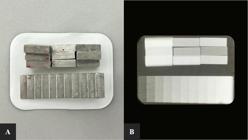
A) Demonstration of the organization of the two aluminum step-wedges over the radiographic film. B) Radiographic presentation of the images from the sample.
The radiographs were obtained with the film positioned horizontally and positioning both aluminum step-wedges on the sensitive side of a Kodak Insight intraoral radiographic film (Eastman Kodak Company, New York, USA), size 2 (31.00 x 40.90 mm). The steps of the fragmented step-wedge were randomly arranged on the upper side of a periapical film while the intact step-wedge was positioned on the bottom part. Over the radiographic series, this arrangement was set respecting a previously standardized organization in five combinations, always maintaining a constant central step. For each one of the 11 constant steps, the 5 combinations were made, totaling 55 images which comprised the final sample of the study (Figure 1). The films were exposed using an X-ray equipment (Timex 70E, Gnatus, Ribeirão Preto-SP, Brazil) adopting fixed acquisition parameters (0.4 s, 7 mA, 70 kVp), as well as the standardized focus-film distance of 40 cm, following the parallelism technique. After exposure, the films were processed in an automatic processor with Kodak processing solutions (Eastman Kodak Company, New York, USA) prepared according to the manufacturer's recommendations.
Four previously instructed and calibrated observers evaluated the radiographs on a viewing box covered by an opaque black cardboard mask with its edges attached to the equipment to prevent light leakage outside the area of observation13. In each image, the observers were asked to indicate which step/thickness of the intact aluminum step-wedge corresponded to the central fragmented step (Figure 2). The evaluation of the 55 images was performed in two different environments with different lighting conditions: 50 lux (ideal condition) and 500 lux (luminance in dental office environment). Previously to each evaluation, the luminance of the environments was measured by positioning a lux meter (model MLM-1011, Minipa do Brasil Ltda., São Paulo, Brazil) on the desk where the viewing box was located for evaluating the images. The analyses were always performed in the same environment to ensure the same viewing conditions, and the lighting levels were adjusted when necessary. After an interval of 30 days to guarantee de-memorization, 25% of the sample was re-evaluated in both lighting conditions so that the intra-observer and inter-observer reproducibility could be calculated.
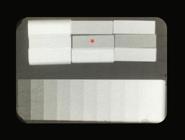
The red asterisk (*) indicates the central step of the fragmented scale that should be recognized in the intact step-wedge
The MedCalc software (version 11.2.1.0, MedCalc Software, Oostende, Belgium) was used to perform the statistical analysis of the present study. The statistical difference between the evaluations in the different luminance conditions in relation to the gold standard was verified by the nonparametric Wilcoxon test. A descriptive analysis of the correct answers rate in each luminance was performed for the general overview and for each thickness of the aluminum step-wedge. The reproducibility was calculated by the weighted Kappa and interpreted according to Landis, Koch14. All tests were applied at a significance level of 5%.
RESULT
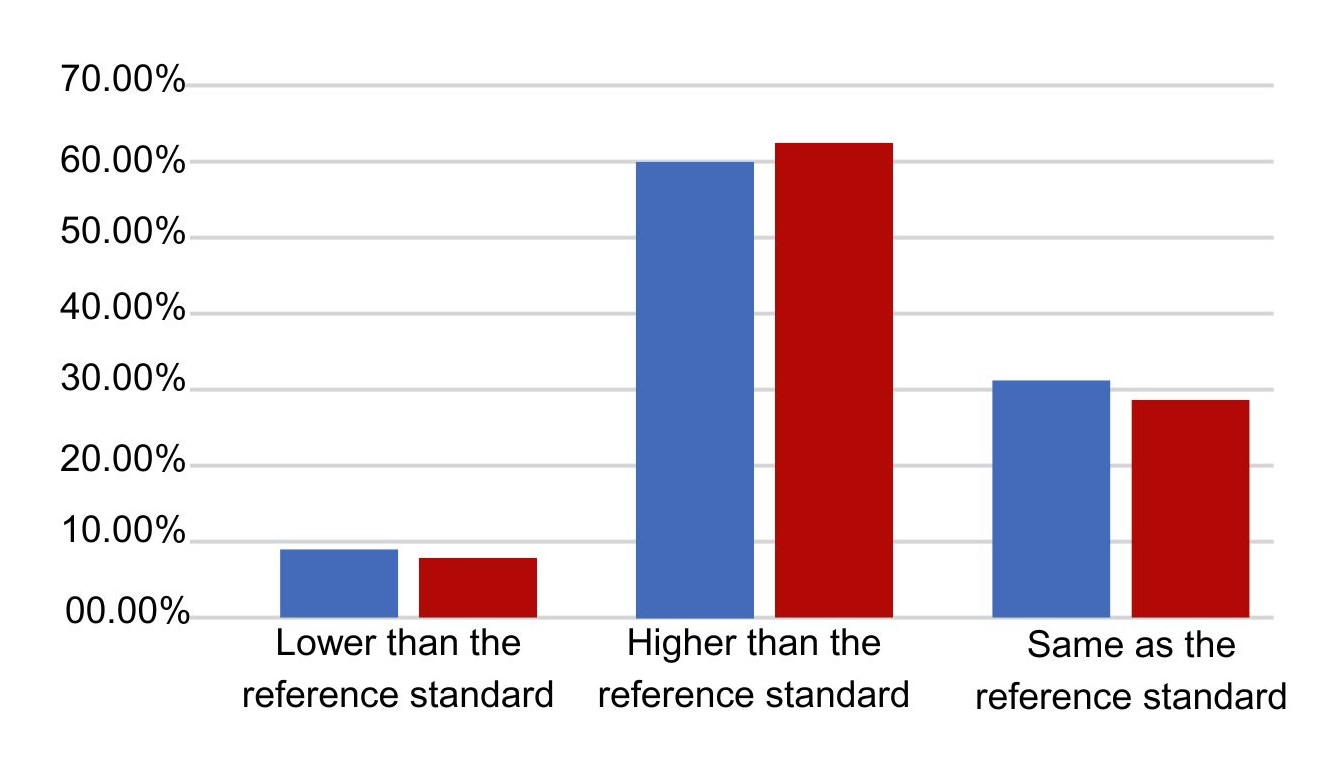
Table 1 shows the descriptive analysis of the evaluations at luminance of 50 and 500 lux compared to the reference standard. The results of the Wilcoxon test showed no statistical difference between the data obtained in both conditions in relation to the reference standard (p=0.174). When analyzing the relative frequencies of correct answers, it was observed that, in general, the 50 lux condition presented a 31% accuracy rate, and for 500 lux 29.2%. It was also observed that most of the evaluations were above the reference standard in the 50 lux (60%) and 500 lux (62.27%) conditions (Figure 3). This means that the observers interpreted the gray values as more radiopaque than they were in fact.
Descriptive analysis, in millimeters of aluminum, of the reference standard and evaluations with different luminances

Relative frequencies of evaluation performance under 50 and 500 Lux in relation to the reference standard.
The Kappa test showed that the intra-observer reproducibility was considered almost perfect in the luminance of 50 lux (0.808 to 0.884) and substantial to almost perfect in the 500 lux condition (0.720 to 0.880). In both environments, inter-observer reproducibility ranged from substantial to almost perfect, with Kappa values of 0.628 to 0.841 for 50 lux and 0.757 to 0.824 for 500 lux.
DISCUSSION
The present in vitro study aimed to evaluate the influence of ambient light conditions on the contrast sensitivity function in the perception of different gray values in conventional periapical radiographs evaluated at a simulated clinical scenario. The results did not demonstrate differences between the data obtained in environments with different luminance, but most evaluations indicated a perception of higher radiopacity in the central step in both conditions. Thus, the null hypothesis that different ambient lighting conditions do not interfere with the contrast sensitivity function when evaluating conventional radiographs was accepted.
The influence of ambient light conditions on the evaluation of imaging exams is still controversial in literature. Unlike the present study, Hellén-Halme, Lith7 and Cruz et al.15 showed that decreasing ambient luminance increases the contrast between different gray values and improves the detection of dental alterations in digital radiographs. Similarly to our study, other investigations found no statistical difference between radiographic evaluations conducted in environments with different luminance5,6,16. Contrary to all these results, Lima et al.9 found that increasing ambient luminance led to a significant improvement in the success of dental radiographs evaluation. However, direct comparison between these studies is difficult given the different methodological designs employed. First, there was no standardization of ambient luminance among these investigations, and only Ohla et al.5 evaluated the conditions of 50 and 500 lux used in the present study. Second, none of these studies investigated the influence of ambient lightning condition on the evaluation of conventional radiographs, highlighting an important differential of the present work. Finally, another important methodological aspect of our research was the use of aluminum step-wedges with 99.5% purity12. According to these authors, the use of this step-wedge facilitates the comparison of data between different studies and allows approximation to clinical reality, considering that the radiopacity of pure aluminum (>99.5%) is very close to that of human dentin. Other studies analyzed the influence of ambient luminance in the evaluation of the radiopacity of aluminum step-wedges, however these investigations used digital images for measurements5,15.
Although our results did not differ in the two ambient luminances, in both conditions most evaluations indicated a perception of higher radiopacity in the central step. This fact may lead to an underdiagnosis of conditions that present as subtle changes in the density of the dental tissues. Interproximal caries, for example, represent a diagnostic challenge as they may be barely seen on clinical examination and only be seen on radiography when 30-40% of mineral tissue is lost16. Since carious lesions detection relies on the perception of a demineralization that is frequently subtle, if the observer visualizes a structure more radiopaque than it really is, the diagnosis may be compromised. In association with the “Mach Band” effect, the misinterpretation of caries could be even more frequent17.
In spite the tendency of replacement of conventional radiographs for digital ones9,11, many dental offices and higher education institutions still use the conventional radiographic system due to its low cost15. Therefore, it is reasonable to investigate the best ambient conditions for interpreting these images and compare these results with the digital techniques. As an example, the study by Ochoa-Rodríguez et al.10 compared the radiopacity of endodontic filling materials in conventional and digital radiographs obtained with digital-based sensor and phosphor plate. The results of this study showed that digital receptors present significantly higher gray values than conventional radiographic film, which can be explained by the greater sensitivity of digital-based sensor and phosphor plate. However, this difference does not appear to interfere with diagnostic performance when evaluating conventional radiographs18, even though the sharpness and contrast of digital images are greater8. This may be explained by the fact that the successful radiographic interpretation relays not only on image quality, but also on the observer's experience, the way the exam is displayed, and the evaluation environment8,13.
In the present study, conventional radiographs were evaluated using an opaque black cardboard mask attached to the viewing box to avoid light leakage around the area where the images would be positioned13. The mentioned masking is supposed to reduce pupil contraction in the presence of luminance adjacent to the radiograph that could reduce the perception of low-contrast structures in the image18. A previous study used masking in the interpretation of digital radiographs to evaluate the influence of this method on diagnostic performance and the results showed that it significantly improved the success rate and reduced the time taken to diagnose carious lesions, even in environments with higher luminance13. As previously mentioned, our results did not demonstrate statistical difference between the two luminance conditions evaluated, which may have been influenced by the masking proposed by the study of Kutcher et al.13. However, further studies are still needed to better investigate the influence of masks on the observer's perception on the diagnosis of clinical images.
The present in vitro study presents inherent limitations to its methodological design. The lack of difference between the two ambient lighting conditions may have been influenced by the fact that the observers were not analyzing small caries or subtle changes in the trabecular bone pattern3,9. Additionally, the radiographs were obtained with the standardization of the focus-film distance following the parallelism technique, which eliminates the interpretation challenges imposed by geometric projection6. As mentioned before, it is also important to emphasize that the masking of the luminance around the radiograph may have influenced the results13. Given the lack of studies comparing the evaluation of conventional radiographs with and without masking, the possibility for new research arises. Furthermore, studies are suggested to investigate the influence of masking on the evaluation of conventional radiographs compared to digital ones.
CONCLUSION
The analysis of radiographs performed in environments with luminance between 50 and 500 lux allows the observer to obtain similar results regarding the distinction of different gray values.
ACKNOWLEDGMENTS
This study was partially supported by FAPEMIG, Minas Gerais State Agency for Research and Development, CAPES, Coordination of Higher Education and Graduate Training (Finance Code 001) and CNPq, National Council for Scientific and Technological Development (INCT Saúde Oral e Odontologia) 406840/2022-9; 406261/2023-7.
-
How to cite:
Vieira CSC, Almeida LM, Verner FS, de Rezende Barbosa GL. Influence of different ambient luminances on the perception of gray values. Rev Odontol UNESP. 2025;54:e20250004. https://doi.org/10.1590/1807-2577.00425
REFERENCES
-
1 Borchers C, Eder TF, Richter J, Keutel C, Huettig F, Scheiter K. A time slice analysis of dentistry students’ visual search strategies and pupil dilation during diagnosing radiographs. PLoS One. 2023 Jun;18(6):e0283376. http://doi.org/10.1371/journal.pone.0283376 PMid:37289785.
» http://doi.org/10.1371/journal.pone.0283376 -
2 Castner N, Appel T, Eder T, Richter J, Scheiter K, Keutel C, et al. Pupil diameter differentiates expertise in dental radiography visual search. PLoS One. 2020 May;15(5):e0223941. http://doi.org/10.1371/journal.pone.0223941 PMid:32469952.
» http://doi.org/10.1371/journal.pone.0223941 -
3 Jacquet W, Cleymaet RG, Bottenberg P. Grey value contrast sensitivity of dental practitioners in function of luminance and age. Dentomaxillofac Radiol. 2019 Sep;48(6):20180398. http://doi.org/10.1259/dmfr.20180398 PMid:30807210.
» http://doi.org/10.1259/dmfr.20180398 -
4 Pollard BJ, Chawla AS, Delong DM, Hashimoto N, Samei E. Object detectability at increased ambient lighting conditions. Med Phys. 2008 Jun;35(6):2204-13. http://doi.org/10.1118/1.2907566 PMid:18649449.
» http://doi.org/10.1118/1.2907566 -
5 Ohla H, Dagassan-Berndt D, Payer M, Filippi A, Schulze RKW, Kühl S. Role of ambient light in the detection of contrast elements in digital dental radiography. Oral Surg Oral Med Oral Pathol Oral Radiol. 2018 Nov;126(5):439-43. http://doi.org/10.1016/j.oooo.2018.08.003 PMid:30228056.
» http://doi.org/10.1016/j.oooo.2018.08.003 -
6 Lima CAS, Nascimento EHL, Gaêta-Araujo H, Oliveira-Santos C, Freitas DQ, Haiter-Neto F, et al. Is the digital radiographic detection of approximal caries lesions influenced by viewing conditions? Oral Surg Oral Med Oral Pathol Oral Radiol. 2020 Feb;129(2):165-70. http://doi.org/10.1016/j.oooo.2019.08.007 PMid:31474575.
» http://doi.org/10.1016/j.oooo.2019.08.007 -
7 Hellén-Halme K, Lith A. Carious lesions: diagnostic accuracy using pre-calibrated monitor in various ambient light levels: an in vitro study. Dentomaxillofac Radiol. 2013;42(8):20130071. http://doi.org/10.1259/dmfr.20130071 PMid:23775926.
» http://doi.org/10.1259/dmfr.20130071 -
8 Freire RT, Prata-Júnior AR, Pinho JNA, Takeshita WM. Diagnostic accuracy of caries and periapical lesions on a monitor with and without DICOM-GSDF calibration under different ambient light conditions. J Digit Imaging. 2022 Jun;35(3):654-59. http://doi.org/10.1007/s10278-022-00596-w PMid:35166971.
» http://doi.org/10.1007/s10278-022-00596-w -
9 Lima CAS, Freitas DQ, Ambrosano GMB, Haiter-Neto F, Oliveira ML. Influence of interpretation conditions on the subjective differentiation of radiographic contrast of images obtained with a digital intraoral system. Oral Surg Oral Med Oral Pathol Oral Radiol. 2019 May;127(5):444-50. http://doi.org/10.1016/j.oooo.2019.01.003 PMid:30738753.
» http://doi.org/10.1016/j.oooo.2019.01.003 -
10 Ochoa-Rodríguez VM, Wilches-Visbal JH, Roma B, Coaguila-Llerena H, Tanomaru-Filho M, Gonçalves A, et al. Radiopacity of endodontic materials using two models for conversion to millimeters of aluminum. Braz Oral Res. 2020;34:e080. http://doi.org/10.1590/1807-3107bor-2020.vol34.0080 PMid:32696910.
» http://doi.org/10.1590/1807-3107bor-2020.vol34.0080 -
11 Danz JC, Flück HP, Campus G, Wolf TG. Computed vs. film-based radiographs’ contour artifacts influence diagnosis of secondary caries. Eur J Radiol. 2023 Sep;166:111004. http://doi.org/10.1016/j.ejrad.2023.111004 PMid:37556885.
» http://doi.org/10.1016/j.ejrad.2023.111004 -
12 Watts DC, McCabe JF. Aluminium radiopacity standards for dentistry: an international survey. J Dent. 1999 Jan;27(1):73-8. http://doi.org/10.1016/S0300-5712(98)00025-6 PMid:9922615.
» http://doi.org/10.1016/S0300-5712(98)00025-6 -
13 Kutcher MJ, Kalathingal S, Ludlow JB, Abreu M Jr, Platin E. The effect of lighting conditions on caries interpretation with a laptop computer in a clinical setting. Oral Surg Oral Med Oral Pathol Oral Radiol Endod. 2006 Oct;102(4):537-43. http://doi.org/10.1016/j.tripleo.2005.11.004 PMid:16997122.
» http://doi.org/10.1016/j.tripleo.2005.11.004 -
14 Landis JR, Koch GG. The measurement of observer agreement for categorical data. Biometrics. 1977 Mar;33(1):159-74. http://doi.org/10.2307/2529310 PMid:843571.
» http://doi.org/10.2307/2529310 -
15 Cruz AD, Lobo IC, Lemos AL, Aguiar MF. Evaluation of low-contrast perceptibility in dental restorative materials under the influence of ambient light conditions. Dentomaxillofac Radiol. 2015;44(5):20140360. http://doi.org/10.1259/dmfr.20140360 PMid:25629721.
» http://doi.org/10.1259/dmfr.20140360 -
16 Abdinian M, Keshani F, Sadeghi F, Soltani P, Spagnuolo G, Rengo C. Evaluation of the effects of postprocessing settings in digital bitewing radiographs on proximal caries detection. Clin Exp Dent Res. 2024 Jun;10(3):e889. http://doi.org/10.1002/cre2.889 PMid:38712390.
» http://doi.org/10.1002/cre2.889 -
17 Fontenele RC, Nejaim Y, Farias Gomes A, Gaêta-Araujo H, Haiter-Neto F, Freitas DQ. Does the addition of a lead foil to digital radiographic receptors influence image contrast and approximal caries lesions diagnosis? Dentomaxillofac Radiol. 2020 May;49(4):20190384. http://doi.org/10.1259/dmfr.20190384 PMid:32027521.
» http://doi.org/10.1259/dmfr.20190384 - 18 Moshfeghi M, Shahbazian M, Sajadi SS, Sajadi S, Ansari H. Effects of different viewing conditions on radiographic interpretation. J Dent. 2015 Nov;12(11):853-58. PMid:27507997.