 Panstrongylus guentheri Berg, 1879 (Hemiptera, Reduviidae, Triatominae): first record in Mato Grosso, Brazil
ABSTRACT
Background: This paper reports the occurrence of Panstrongylus guentheri Berg, 1879 in the State of Mato Grosso (MT).
Methods: Triatomines were captured in rural environments in municipalities of MT. Specimens were identified, and Trypanosoma cruzi infection was investigated.
Results: Nineteen specimens of Panstrongylus guentheri were found, primarily inside houses. The geographical distribution of this species was recorded in nine municipalities of Mato Grosso, and parasitological tests did not detect T. cruzi on P. guentheri.
Conclusions: The distribution of this species in Brazil has been recently updated.
Keywords:
Chagas disease; New records; Cerrado; Surveillance programs; Trypanosoma cruzi
Chagas disease, an infection caused by the protozoan parasite Trypanosoma cruzi (Chagas, 1909), has emerged as a risk to humans with the establishment of triatomine vectors in homes. Triatominae is a subfamily of Reduviidae (Hemiptera and Heteroptera), which includes bugs with morphological adaptations associated with host-seeking and blood-feeding1,2. These blood-sucking insects are vectors of T. cruzi, which is transmitted to humans and other mammals through feces and urine. The parasite can also spread through oral transmission, blood transfusions, organ transplants, or from mother to child. Therefore, even in the absence of triatomines in houses, the risk of transmission remains high. The subfamily Triatominae comprises 158 species, 155 extant and three extinct species, within 18 genera and five tribes3,4.
The genus Panstrongylus Berg, 1879, has a wide geographic distribution in the Neotropical region2. New reports of home invasions by Panstrongylus specimens have been documented in Brazil5. The highest diversity of Panstrongylus species was found in rainforest habitats6. They are found in rural, urban, and suburban areas with wildlife corridors and vector domiciliation. Species of Panstrongylus are potential vectors of T. cruzi. The increasing frequency of Panstrongylus species and the ability to invade and colonize human habitats is of interest to medical entomologists and Chagas disease control managers throughout Latin America7.
The genus was described based on Panstrongylus guentheri Berg, 1879, and comprises 16 extant species and one fossil species described6,8. In Brazil, 10 species of this genus have been recorded, with five occurring in the state of Mato Grosso9. These include P. megistus (Burmeister, 1835), P. geniculatus (Latreille, 1811), P. rufotuberculatus (Champion, 1899), P. lignarius (Walker, 1873)10 and P. diasi Pinto and Lent, 194611.
Panstrongylus guentheri has been documented in Argentina, Bolivia, Paraguay, and Uruguay. It occurs in the dry Chaco forests and savanna-grassland ecoregions of the Río de la Plata Basin2,12. In Brazil, it has been reported in the State of Mato Grosso do Sul9. This species has been observed in armadillo and rodent caves, as well as in association with opossums1. It has also been documented in the peridomicile, in proximity to woodpiles and environments frequented by goats and dogs2.
From an epidemiological point of view, studies on the geographic distribution of these understudied vectors are crucial for understanding the epidemiological aspects of T. cruzi transmission and must be considered to guide disease control and monitoring. The present study describes the occurrence of P. guentheri in the state of Mato Grosso, Brazil. We present new records of P. guentheri, extend the distribution of species in the Cerrado areas, and present data on collection habitats and parasitological examinations.
In this study, the presence of P. guentheri was discovered for the first time in 2006 during the routine work of the Chagas Disease Control Program of Environmental Health Surveillance. One female and one male were collected from peridomiciles in the rural locality of Sítio Bom Jesus in the municipality of Várzea Grande, Mato Grosso, Brazil (15.541667N, 56.288333 W).
The specimens of P. guentheri from Várzea Grande were identified by technicians at the Entomology Laboratory of the Secretaria de Estado de Saúde de Mato Grosso (SESMT) using the dichotomous keys of Lent and Wygodzinsky1. The specimens were deposited in the Entomology Laboratory of the SESMT and Triatominae Collection at the Oswaldo Cruz Institute (CTIOC) with registration number 12288. Trypanosoma cruzi infection was investigated using optical microscopy of live bugs in the laboratory. Therefore, this study included the geographical distribution of this species in the State of Mato Grosso, Brazil.
The identification of P. guentheri was based on the anterolateral processes of pronotum elongation and prominence. We also noted the upper surface of the head convex in the lateral view, the anterior and middle femora with more than three denticles, and the lateral margins of the pronotum lobes forming a distinct angle (Figure 1).
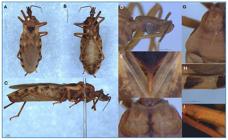
Male of Panstrongylus guentheri of Varzéa Grande, Mato Grosso State, Brazil. A: dorsal view. B: ventral view. C: lateral view, D: the orange-brown head, lateral view. E: apical process of the scutellum. F: tubercles discs in the anterior lobe of the pronotum. G: humeral angles rounded. H: intersegmental suture of the connexivum. I: denticles of the femora.
The female specimen of P. guentheri found in Várzea Grande had the following characteristics: length 27 mm; pronotum width 6 mm; and width of abdomen 9.5 mm. General color orange-brown, with dark brown areas on pronotum, scutellum, corion, and connexivum; apparently glabrous body surface. Head orange-brown, strongly raised between the eyes in dorsal view; one and a half times longer than the width between the eyes (1:0,6) and smaller than the pronotum (1:1,5); anteocular region twice as long as the postocular region (1:0.5); clypeus narrow, widened posteriorly; gena narrow, apically rounded; juga abruptly terminated; eyes in lateral view, distant from upper surface of head and extending below level of lower surface; ratio of width of eyes to distance between eyes 1:2.5. Ocellus surrounded by a dark grey ring. Antenna tubercle with small apicolateral process. The first rostral segment is close to the level of the anterior margin of the eyes; the second segment extends to the level of the base of the neck; the first and lower surfaces of the second rostral segment practically glabrous; upper surface of second and third segments with setae as long as or longer than diameter of segment; ratio of rostral segments 1:1.5:0.5. Pronotum pale brown with median groove, anterior and posterior margins dark brown; anterior lobe convex, irregularly rugose, disc tubercles rudimentary, lateral tubercles absent; posterior lobe transversely rough; submedian carinae low and fading in the posterior half; humeral angles rounded; anterolateral projection prominent and conical. The scutellum is dark brown and rough with shallow median depression; the posterior process is light brown, horizontal, cylindrical, apically rounded, and as long as the main body of the scutellum. Hemelytra extending to the seventh urotergite; clavus brown; corium dark brown except at the base, where it forms a light spot; membrane also light dark brown. Orange-brown legs: anterior and middle femora with more than two denticles visible, anterior femora with additional small denticles of irregular arrangement.
Convex abdomen transversely striated, with discrete short setae and apparently glabrous median region; colored orange-brown, darkened on sides and genital region, dark reddish brown near connexivum tissue. Connexivum brown-reddish, anterior half or two-thirds of each connexival plate with a subrectangular dark brown spot adjacent to intersegmental suture; rudimentary spiracles from connexival suture; suture between rudimentary uroternites II and III.
Triatomine specimens were collected from the municipality of Várzea Grande, MT, during routine entomological surveillance between 2006 and 2023 (Figure 2). Since then, the presence of P. guentheri has been confirmed in other municipalities of the state. Nineteen specimens of P. guentheri were collected: 11 males, 5 females, and 3 unidentified. Microscopic examination of the feces of the five specimens did not reveal the presence of T. cruzi (Table 1). New records of P. guentheri have occurred, and currently, this species has been detected in nine municipalities in Mato Grosso in the Cerrado biome (Figure 2), between altitudes of 185 and 600 m (Table 1).

Municipalities of Mato Grosso, Brazil, with records of Panstrongylus guentheri. 1: Paranatinga. 2: Várzea Grande. 3: Poxoréu. 4: Tesouro. 5: Guiratinga. 6: Rondonópolis. 7: São José do Povo. 8: Pedra Preta 9: Itiquira.
Records of Panstrongylus guentheri in Mato Grosso, Brazil: geographical data, sex, habitats, and parasitological results.
The geographical distribution of P. guentheri has expanded to the State of Mato Grosso, resulting in an updated distribution map of the species in Brazil, which now includes two states: Mato Grosso do Sul and Mato Grosso. Since the discovery of P. guentheri in Mato Grosso, there has been a notable expansion of its spatial distribution. This highlights the necessity for future studies to gain a deeper understanding of this occurrence and its epidemiological significance.
Notably, some of these new records broadened the altitudinal distribution of P. guentheri12,13. Another important observation from these records was their strong association with the Cerrado biome. Lent and Wygodzinsky1 classified this species as wild type. However, it is important to note that specimens were recorded in both rural and urban areas.
Native triatomine species can invade and colonize both domestic and peridomestic environments. P. guentheri specimens were collected from and around houses. However, to date, only adult specimens have been observed in domiciles, corroborating the findings of Brito14 about house invasion by sylvatic triatomines14. Nevertheless, there was no evidence of intrahousehold colonization by this species, as the specimens were captured inside houses. In this study, it was observed that both male and female P. guentheri invaded houses. However, the number of males was slightly higher than that of females, which is in agreement with Brito et al.14. Natural infection of P. guentheri by T. cruzi was not observed in this study. However, other studies have reported P. guentheri is naturally infected with T. cruzi1,6.
In conclusion, the geographic distribution of P. guentheri in the Cerrado area of Brazil was updated. It is recommended that a continuous surveillance program be implemented in the municipalities to monitor the occurrence of P. guentheri in the Mato Grosso and Mato Grosso do Sul States and in the surrounding areas of Brazil, Argentina, Bolivia, Paraguay, and Uruguay. Future studies that develop ecological niche models15 are necessary to analyze the potential geographical distribution of P. guentheri in these countries.
ACKNOWLEDGMENTS
This research was supported by the Brazilian National Research Council (Conselho Nacional de Desenvolvimento Científico e Tecnológico). We thanks the Secretaria de Estado de Saúde de Mato Grosso for supporting the surveillance actions, to Jaqueline Aparecida Menegatti by taxonomic identification of the first specimens and Elaine Cristina de Oliveira from Laboratório de Entomologia of Laboratório Central de Saúde Pública to Secretaria de Estado de Saúde de Mato Grosso, Cuiabá, MT, Brazil for the donation a specimem of P. guentheri for to CTIOC. We thank Maria Ignez Castrillon from Universidade Estadual de Mato Grosso (UNEMAT) for the detailed description of the species.
REFERENCES
- 1 Lent H, Wygodzinsky P. Revision of triatominae (Hemiptera, Reduviidae), and their significance as vectors of Chagas disease. Bull Am Mus Nat Hist. 1979;163(3):123-520.
- 2 Abad-Franch F, Gurgel-Gonçalves R. The ecology and natural history of wild Triatominae in the Americas. In: Guarneri, AA, Lorenzo, MG, editors. Triatominae: The biology of Chagas disease vectors. In: Entomology in Focus. 1ed. Switzerland: Springer, Cham; 2021. p. 388-445.
- 3 Alevi KCC, Oliveira J, Galvão C. Trends in Taxonomy of Chagas Disease Vectors (Hemiptera, Reduviidae, Triatominae): From Linnaean to Integrative Taxonomy. Pathogens. 2021;10(12):1627.
-
4 Campos FF, de Oliveira J, Santos Santana JK, Ravazi A, dos Reis YV, Marson Marquioli L, Galvão C, de Azeredo-Oliveira MTV, Aristeu da Rosa J, Alevi KCC. One genome, multiple phenotypes: Would Rhodnius milesi Carcavallo, Rocha, Galvão & Jurberg, 2001 (Hemiptera, Triatominae) be a valid species or a phenotypic polymorphism of R. neglectus Lent, 1954? Diversity 2024; 16, 472. https:// doi.org/10.3390/d16080472.
» https://doi.org/10.3390/d16080472 - 5 Souza ESS, Meneguetti DUO, Galvão C, Paiva VF, Guimarães IZ, Silva ACL, et al. Initial report of Panstrongylus rufotuberculatus (Champion, 1899) Triatominae (Hemiptera: Reduviidae) in Roraima, western Amazon state, Brazil. Rev Soc Bras Med Trop. 2022;55:e0113-2022.
- 6 Tineo-González E, Fermín R, Bonilla-Rivero A, Herrera L. Geographic Distribution of the Genus Panstrongylus Berg, 1879 in the Neotropic with Emphasis on Trypanosoma cruzi Vectors. Trop Med Infect Dis. 2023;8(272).
- 7 Abad-Franch F, Paucar CA, Carpio CC, Cuba Cuba CA, Aguilar VHM, Miles MA. Biogeography of Triatominae (Hemiptera: Reduviidae) in Ecuador: implications for the design of control strategies. Mem Inst Oswaldo Cruz. 2001;(96):611-20.
- 8 Gil-Santana HR, Chavez T, Pita S, Panzera F, Galvão C. Panstrongylus noireaui, a remarkable new species of Triatominae (Hemiptera, Reduviidae) from Bolivia. Zookeys. 2022;1104:203-25.
-
9 Galvão C, Gil-Santana HR, Oliveira J. The taxonomic catalog of the Brazilian fauna: biodiversity and geographical distribution of Triatominae (Hemiptera, Reduviidae) in Brazil, Zoologia, 2024;41: e24006. https://doi.org/10.1590/S19844689.v41.e24006.
» https://doi.org/10.1590/S19844689.v41.e24006 - 10 Paula AM, Castrillon MI, Maciel GBML, Galvão C. Registro de ocorrência de Panstrongylus lignarius (Walker, 1837) (Hemiptera: Reduviidae: Triatominae) no Estado de Mato Grosso, Brasil. Acta Amaz. 2013;43(1):117-9.
- 11 Martins FM, Morares SC, Obara MT, Galvão C. Panstrongylus diasi Pinto & Lent, 1946 (Hemiptera, Reduviidae, Triatominae): first record in Mato Grosso, Brazil. Check List. 2019;15(2):259-64.
- 12 Carcavallo R, Rodriguez M, Salvatella R, Curto De Casas S, Rocha D, Sherlock I, et al. Habitats and related Fauna. In Atlas of Chagas Disease Vectors in the Americas; Carcavallo R, Galíndez I, Jurberg J, Lent H, editors; Editora Fiocruz: Rio Janeiro, Brasil. 1999; (2), p. 537-560.
- 13 Almeida PS, Santos HR, Barata JMS, Obara MT, Ceretti W Jr. Occurrence ofPanstrongylus guentheriBerg (Hemiptera: Reduviidae) in Mato Grosso do Sul State, Brazil. Neotrop Entomol.2008;37(1):107-8.
- 14 Brito RN, Gorla DE, Diotaiuti L, Gomes ACF, Souza RCM, Abad-Franch F. Drivers of house invasion by sylvatic Chagas disease vectors in the Amazon-Cerrado transition: A multi-year, state-wide assessment of municipality-aggregated surveillance data. PLoS Negl Trop Dis. 2017;11(11):e0006035.
- 15 Gurgel-Gonçalves R, Galvão C, Costa J, Peterson AT. Geographic distribution of Chagas disease vectors in Brazil based on ecological niche modeling. J Trop Med. 2012;705326.