 Diversity and host range of tachinid (Diptera: Tachinidae) parasitizing stink bugs in Brazil
ABSTRACT
Tachinidae flies within the Phasiinae subfamily are parasitoids of Pentatomidae stink bugs, playing a crucial role in suppressing stink bug populations in agricultural fields. Nevertheless, comprehensive information on the diversity of tachinid flies associated with stink bugs in the Neotropical region, particularly in Brazil, remains scarce. We conducted an exploratory analysis to characterize tachinid flies associated with 14 stink bug species, using both morphological and DNA barcoding methods. Our collection yielded a total of 184 tachinid specimens, which were classified into 13 species distributed across two subfamilies: Dexiinae (2 species) and Phasiinae (11 species). Furthermore, we recorded 17 new instances of interactions between tachinid flies and stink bugs in the family Pentatomidae. Among the flies, Gymnoclytia sp. exhibited the broadest host range, parasitizing five species (Euschistus heros Fabricius, Euschistus taurulus Berg, Diceraeus melacanthus Dallas, Oebalus ypsilongriseus De Geer, and Mormidea v-luteum Lichtenstein), while six species were associated with only one host. DNA barcoding was effectively employed to confirm morphological identifications, demonstrating its value for species characterization within the Tachinidae family. The integration of both morphological and DNA barcoding approaches proved essential for species identification, revealing previously unknown cryptic diversity of Tachinidae linked to Pentatomidae pests in Brazil. Our findings offer valuable insights into the diversity of tachinid species, their host range, and their potential application as biological control agents for stink bugs affecting crops in Brazil.
Keywords
Dexiinae; Phasiinae; Pentatomidae; crops; parasitoids
Introduction
Tachinidae flies belonging to the subfamily Phasiinae are closely associated with Pentatomidae stink bugs (Hemiptera: Heteroptera). This relationship is characterized by a complex coevolution, with these flies serving as biological control agents that help suppress stink bug populations under field conditions (Stireman et al., 2006; Sahebari et al., 2016; Blaschke et al., 2018). Within the Phasiinae subfamily, the genera Gymnoclytia, Trichopoda, and Cylindromyia are notably prevalent as parasitoids of stink bugs across the Americas (Lucini et al., 2020; Zerbino and Panizzi, 2019; Tillman and Grabarczyk, 2025). These genera are important biological control agents, achieving parasitism rates of up to 35 % in adult stink bugs (Fernández et al., 2024; Cingolani and Laumann, 2024). Additionally, tachinids parasitize stink bugs during the off-season of crops (Fernández et al., 2024), thereby mitigating the risk of population outbreaks in subsequent seasons. However, this aspect of stink bug control during the off-season remains underexplored in management programs (Hickmann et al., 2025).
One of the primary challenges in studying parasitoids is their identification, which is complicated by their high species diversity and complex morphology (Stireman et al., 2006; O'Hara, 2013). Information on host range and geographical distribution is also valuable, as it can aid in species identification and inform future management strategies for conservation or their use as biological control agents. Integrative taxonomy is an effective approach for differentiating various insect species, as it combines ecological, morphological, and molecular data (Wang et al., 2016; Zhang et al., 2017; Araújo et al., 2023). The cytochrome c oxidase subunit I (COI) serves as a DNA barcoding region for animal species (Hebert et al., 2003). This approach is commonly employed to describe the cryptic diversity of insect species in both natural and anthropized environments (Floyd et al., 2010; Lima et al., 2022; Ren and Zhang, 2024), including tachinid species (Smith et al., 2006, 2007).
Despite ongoing efforts, information on the diversity of tachinid associated with stink bugs remains scarce in the Neotropical region, particularly in Brazil. This scarcity is primarily attributed to taxonomic challenges that hinder the characterization of this highly diverse group of flies. To address this gap, we conducted an exploratory analysis to characterize tachinid associated with 14 stink bug species, using both morphological and DNA barcoding methods. Our findings provide valuable insights into the diversity of tachinid species and their host ranges, thereby highlighting their potential as biological control agents for stink bug pests in Brazil.
Materials and Methods
Sampling, rearing hosts, and obtaining parasitoids
Tachinid adults were obtained from parasitized stink bugs in the field. Initially, we actively captured adult stink bugs through manual methods or a sweep net at five locations across three Brazilian regions. São Paulo state: Piracicaba (22°42’26" S, 47°38’11" W, altitude 535 m and 22°42’50" S, 47°37’29" W, altitude 527 m), Pirassununga (21°39’08" S, 47°29’04" W, altitude 650 m) [Southeast]; Rio Grande do Sul state: Restinga Sêca, (29°43’11" S, 53°30’57" W, altitude 92 m), Santa Maria, (29°42’43" S, 53°35’43" W, altitude 79 m) [South], and Goiás state: Mineiros (17°37’35" S, 52°36’58" W, altitude 751 m) [Center-West]. Collections were conducted in the early morning (7h00-10h00) or late afternoon (17h00-19h00), except in the sorghum crop, where collections were carried out between 20h00 and 23h00. There was no standardized timing of stink bug collection; rather, these insects were collected randomly at the designated locations between 2019 and 2021. In the field, stink bugs were temporarily housed in containers with their respective hosts before being separated by species and placed in cages with a natural diet. The sampling efforts involved one to four people working simultaneously in the field. Stink bugs were collected from six different host plants: soybean Glycine max (L.) Merrill (Fabaceae), hairy beggar ticks Bidens pilosa L. (Asteraceae), sorghum Sorghum bicolor (L.) Moench, Urochloa sp., rice Oryza sativa L. (Poaceae), and the ornamental plant Thunbergia grandiflora Roxb. (Acanthaceae). All insect collections were carried out under SISBIO (Biodiversity Authorization and Information System) permit number 75681-4 issued by the Brazilian Environmental Agency.
The stink bugs were categorized by species and maintained in a room at 25 ± 1 °C, with a relative humidity (RH) of 60 % and a 14h photoperiod. The insects were provided a diet consisting of dried seeds of G. max, Helianthus annuus L., and Arachis hypogaea L., and pods of Phaseolus vulgaris L., with water, available ad libitum. Identification of the stink bugs was performed using dichotomic keys as outlined by Grazia et al. (2015), and they were kept under these conditions until either parasitoid larvae emerged or the bugs died. Each parasitoid pupa was then placed in a 100 mL plastic container filled with moistened vermiculite substrate. After their emergence, the parasitoids were kept in a plastic container for 24h to allow the adults to extend their wings and fully develop their coloration. Subsequently, the parasitoids were individually transferred to 1.5 mL microtubes filled with 95 % alcohol and stored in a freezer at −22 °C.
Morphotyping and molecular characterization
Based on morphological characteristics (Brown et al., 2009), parasitoids from various hosts were grouped into species and morphotypes, with at least one representative of each group being sequenced for the COI gene fragment. Subsequently, the genitalia of sequenced individuals were dissected to facilitate morphological identification, following the methodology described by Dios and Nihei (2020). The specimens were also compared with material deposited at the Museu de Zoologia (MZUSP) of the Universidade de São Paulo and the Museu de Entomologia Luiz de Queiroz (MELQ) of Escola Superior de Agricultura Luiz de Queiroz (ESALQ).
DNA extractions from the flies were carried out using the mesothoracic legs and portions of the thoracic tissues, following the cetyltrimethylammonium bromide (CTAB) protocol (Doyle and Doyle, 1987) with slight modifications. The first third of the COI gene was amplified via polymerase chain reaction (PCR) using primers LCO1490/LEPF1 and HCO2198/LEPR1 (Folmer et al., 1994; Hebert et al., 2004). PCR reactions were performed in a total volume of 25 μL with Invitrogen TM reagents, containing 12.5 μL ultrapure water, 2.5 μL buffer (10× −Mg 2+), 2 μL of MgCl2 (50 mM), 0.8 μL of deoxyribonucleoside triphosphate (dNTPs) (10 μM), 1 μL of each primer (5 nM), 3 μL of DNA (40 ng), and 0.2 μL of Taq platinum DNA Polymerase (1 U). The primary denaturation step was performed at 95 °C for 3 min, followed by 35 cycles of 30 s at 95 °C, 30 s at 57 °C, and 2 min at 72 °C, with a final extension at 72 °C for 10 min. After confirming amplification through agarose gel electrophoresis, the PCR solution was purified using the enzymes exonuclease I (EXO I) and thermosensitive alkaline phosphatase (FastAP). Sequencing was carried out using the Sanger method.
The quality of the obtained sequences was assessed using BioEdit (Hall, 1999), after which they were submitted to GenBank (PX626205-PX626276). The aligned sequences ranged from 476 to 658 bp, with approximately 80 % of the material sent for sequencing meeting the quality standards, namely sequences with no double peaks and a consistent fluorescence signal from Sanger sequencing. Sequences that did not meet these quality criteria were discarded.
The genetic distance between individuals was calculated using the Kimura-2-parameter (K2P) model (Kimura, 1980) in MEGA X (Kumar et al., 2018). A bayesian phylogenetic tree was constructed among individuals, with the optimal evolutionary substitution model, General Time Reversible (GTR), incorporating gamma-distributed rate variation among sites and a proportion of invariant sites (GTR+G+I), selected by the MRMODELTEST (v2.3 software). Bayesian phylogenetic analyses were conducted using MRBAYES (v3.1.2) (Ronquist and Huelsenbeck, 2003), employing four simultaneous runs of 25 million generations, each consisting of one cold and three warm chains. After these runs, the first 25 % of trees were discarded as burn-in samples. The consensus tree derived from the four independent runs was obtained, with posterior probabilities exceeding 0.50. The integration of morphological and molecular data, in conjunction with checks of original descriptions, photographs, and personal notes on type material, indicates a high degree of species diversity.
Results
Tachinidae species, hosts, and geographic distribution
A total of 14 stink bug species were collected from five locations in Brazil, with Oebalus ypsilongriseus De Geer species with the highest number of individuals collected (n = 1769), followed by Euschistus heros Fabricius (n = 1157), Mormidea v-luteum Lichtenstein (n = 223), and Piezodorus guildinii Westwood (n = 193) (Table 1).
Host range, collection sites, plant hosts, and stink bug (Hemiptera: Pentatomidae) host of Tachinidae parasitoid specimens (Diptera) collected across five different locations in Brazil.
A total of 184 tachinid specimens associated with these stink bugs were obtained and classified into 13 distinct species. These species were grouped into two subfamilies: Dexiinae, which includes two species – Beskia aelops Walker and Euthera barbiellini Bezzi – and Phasiinae, which comprises 11 species. Within the Phasiinae subfamily, there are two species from the genus Phasia Latreille, referred to as Phasia sp. 1 and Phasia sp. 2, as well as two species from the genus Cylindrophasia Townsend, labeled Cylindrophasia sp. 1, Cylindrophasia sp. 2. Additionally, there is one species from the genus Gymnoclytia Brauer and von Berganstamm, one from Eutrichopoda Townsend, and three species from genus Trichopoda Berthold: Trichopoda gradata Wiedemann, Trichopoda aff. curvicercus, Trichopoda pictipennis Bigot. Lastly, the subfamily also includes one species from the genus Xanthomelanopsis Townsend, and the species Strongygaster brasiliensis Townsend.
We documented 17 new reports of interactions between tachinid and Pentatomidae species (Tables 1 and 2). The flies exhibiting the broadest host range were Gymnoclytia sp., which parasitized five hosts (E. heros, E. taurulus, D. melacanthus, O. ypsilongriseus, and M. v-luteum), alongside Trichopoda picitipennis and Phasia sp. 1, each with three hosts (Tables 1 and 2). This finding indicates a generalist behavior among these species. In contrast, the other tachinid species parasitized only a single host, including Phasia sp. 2, Eutrichopoda sp., Trichopoda aff. curvicercus, Xanthomelanopsis sp., S. brasiliensis, and E. barbiellini (Tables 1 and 2).
Host range of Tachinidae species parasitizing different stink bug pests (Hemiptera: Pentatomidae) collected from five distinct locations in Brazil.
We observed a diverse abundance of tachinid and their hosts in our insect collection across different regions of Brazil (Table 1). Gymnoclytia sp. and Phasia sp. 1 emerged as the most prevalent species, noted for their wide distribution, as they were found at all collection sites from Rio Grande do Sul to Goiás. Additionally, B. aelops was recorded at one site in Rio Grande do Sul (Restinga Sêca) and at another in Goiás (Mineiros), further demonstrating its wide geographic distribution. The other tachinid species were less frequent and showed a more limited geographic distribution in our study (Table 1).
Tachinidae DNA barcoding
We performed 5,184 pairwise genetic distance comparisons among tachinid (72 specimens), with at least one per species, using COI gene sequencing. The intraspecific pairwise genetic distance (comparing individuals within the same species) ranged from 0.00 to 0.0089, while the interspecific pairwise genetic distance (comparing individuals from different species) ranged from 0.0135 to 0.215 (Figure 1).

Intraspecific (yellow) and interspecific (purple) pairwise distance Kimura-2-parameter (K2P) of Tachinidae parasitoid specimens (Diptera) of stink bugs (Hemiptera: Pentatomidae), based on the cytochrome c oxidase subunit I gene fragment.
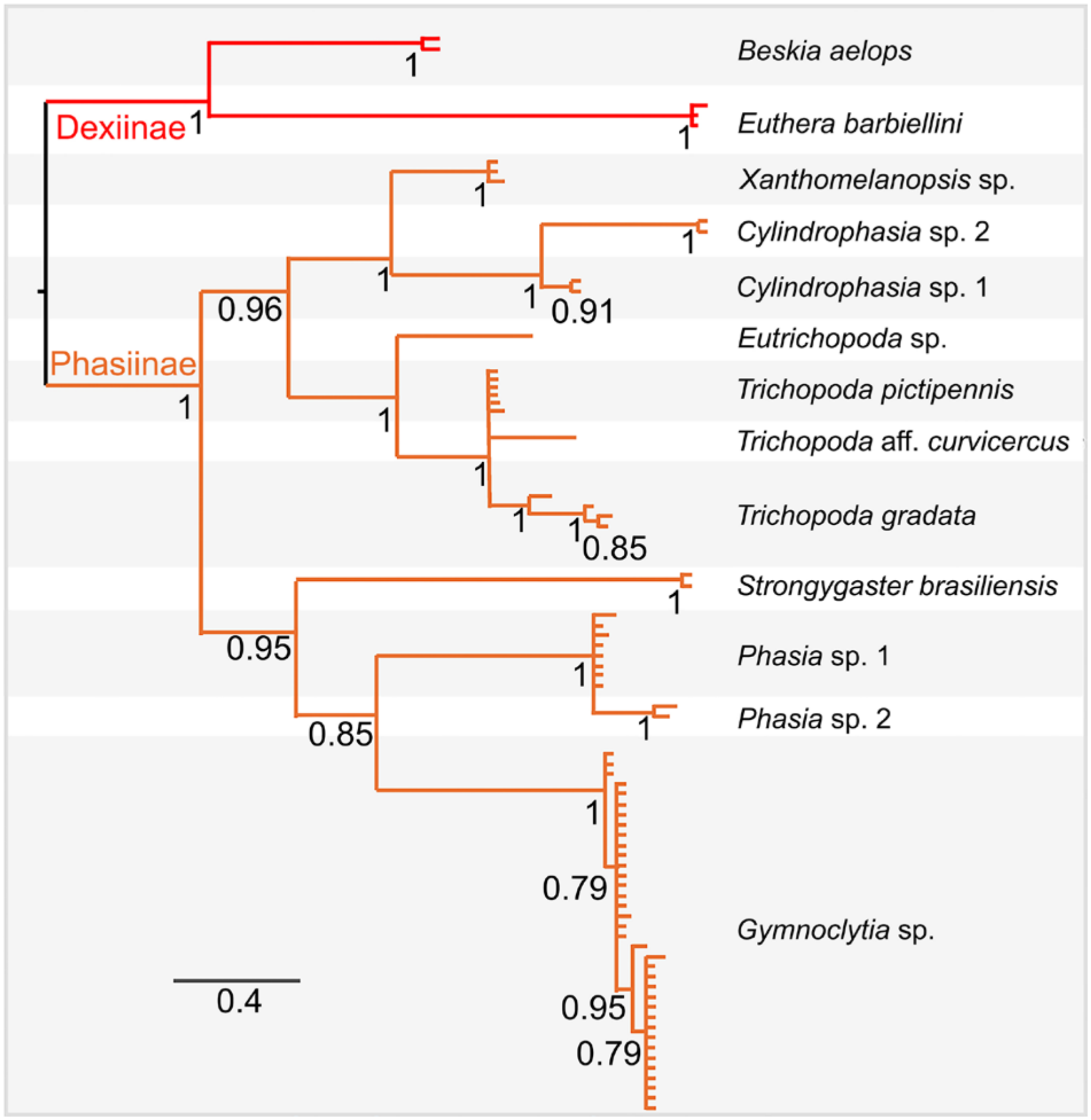
A bayesian phylogenetic tree was constructed using COI sequences from 72 individuals (Figure 2). The resulting phylogeny supported our species identifications, revealing monophyletic branches for individuals grouped within each species, except for T. picitipennis and Trichopoda aff. curvicercus that did not show a monophyletic branch with bootstrap support (Figure 2).

Bayesian tree of Tachinidae parasitoid specimens (Diptera) with posterior probabilities (> 0.50) for each node/branch, based on cytochrome c oxidase subunit I gene fragment sequences.
The subfamilies Dexiinae and Phasiinae have been confirmed as monophyletic, with clear identification of various tribes within the Phasiinae specimens. Within the Dexiinae, two tribes were recovered: Epigrimyiini (B. aleops) and Eutherini (E. barbiellini), both with 100 % support. Within the Phasiinae, the support and phylogenetic distance suggest a division into four groups that corroborate the current classification of tribes, which are further divided into two branches. One branch consists of some Gymnosomatini, previously classified under Trichopodini (including species from the genera Trichopoda, Xanthomelanopsis, and Cylindrophasia), while the other branch includes Strongygasterini, Phasiini, and additional Gymnosomatini (Figure 2).
Discussion
The identification and molecular characterization of tachinids associated with stink bugs (Pentatomidae) in this study represent a significant advancement in understanding these parasitoids in Brazil. A total of 14 host species were collected, resulting in the identification of 13 parasitoid fly species, whether described taxonomically or not, along with 17 new reports of tachinid parasitizing Pentatomidae stink bug pests. It is important to note that we did not adopt a strict schedule for collections; rather, samples were often collected across different seasons and times of day. This uncontrolled sampling introduces spatial and temporal biases, as levels of parasitism can vary with season, time of day, and environmental conditions. As a result, the observed differences may reflect environmental variations that could either underestimate or overestimate the diversity of parasitoids associated with stink bugs. However, this approach enabled us to successfully achieve our objective of characterizing tachinid species associated with Pentatomidae using molecular methods.
Euschistus heros (n = 1157) was extensively collected across all five collection sites in Brazil (Table 1), confirming its widespread abundance throughout the country (Panizzi et al., 2022; Saldanha et al., 2024). Oebalus ypsilongriseus had many specimens collected (n = 1730); however, nearly all were obtained from a single location (Mineiros, Goiás State) during a nocturnal active collection in a sorghum crop. These factors can affect the number and diversity of tachinid species collected from each host, making it difficult to draw conclusions about the parasitism rate or fly abundance in those areas. Conversely, we did not find Tachinidae associated with P. guildinii, despite nearly 200 individuals being collected in the same area (Piracicaba, São Paulo State) where flies parasitized other stink bug species. The absence of parasitism in P. guildinii could be attributed to seasonal factors, a lack of specific parasitoids in the area, or to morphological or behavioral traits of this stink bug species that enable it to avoid tachinids. Additionally, P. guildinii is rarely parasitized by parasitoid flies (Zerbino and Panizzi, 2019), supporting the findings of this study.
In addition to stink bugs that affect major crops, we also collected the species Antiteuchus mixtus Fabricius, which is known to damage ornamental plants and blackberries (Morus nigra L., Moraceae) (Dellapé, 2021). This host was captured in T. grandiflora, yielding a Gymnosomatini species, Xanthomelanopsis sp. Furthermore, an unidentified species of Cylindrophasia Townsend, 1916 was obtained from the predatory stink bug Podisus, marking an intriguing new association record. Notably, no cases of parasitoids recovered from Podisus species have been documented. However, several species from the subfamily Phasiinae have been captured in pheromone traps using compounds associated with Podisus (Aldrich, 1995; Aldrich et al., 1997, 2006).
In our study, we collected representatives from two subfamilies of Tachinidae, namely Dexiinae and Phasiinae, which enhances our understanding of their distribution and host range. Within the Dexiinae, E. barbiellini has been documented as a specialized parasitoid of Thyanta perditor Fabricius, particularly in soybean crops (Lucini et al., 2020). Additionally, specimens of B. aelops were collected from the hosts O. ypsilongriseus and Oebalus spp. in the states of Goiás and Rio Grande do Sul, corroborating earlier findings (Nilakhe, 1974; Sutherland et al., 2002).
The remaining 11 species of Tachinidae, categorized into seven genera, belong to the Phasiinae subfamily. These species are generally more abundant and exhibit generalist habits, particularly concerning the stink bug hosts collected in our study, as reported by Fernández et al. (2024). The genus Phasia is cosmopolitan and diverse, having been revised by Sun and Marshall (2003), which excluded most of the Neotropical species. Consequently, accurate species identification in the Neotropical region poses significant challenges. A notable characteristic of the females of these parasitoids is their specialized genitalia, which enable them to pierce and deposit eggs into their hosts, and they typically grasp the host during egg laying (Sun and Marshall, 2003).
Cylindrophasia is another genus within the Phasiinae subfamily, comprising only four described Neotropical species (Guimarães, 1971). This genus exhibits a complex taxonomy that requires revision, hindering proper species identification. Some species may be conspecific with those of other Gymnsomatini genera, especially Homogenia, as males have been identified as Homogenia while females were classified as Cylindrophasia. Additionally, it morphologically overlaps with other monotypic genera in the Gymnosomatini. A specimen belonging to the genus Eutrichopoda was also collected; this genus includes seven described species throughout the Neotropical region, spanning from southern Mexico to Brazil (Guimarães, 1971). However, species-level identification of the single specimen obtained was not possible due to extensive abdominal damage.
Three species from the genus Trichopoda were collected. Several species within this genus are biological control agents for stink bugs, with some being intentionally introduced to manage Nezara viridula L. in various regions worldwide, while others occurred accidentally (Dios and Nihei, 2020; Dios et al., 2021). Trichopoda aff. curvicercus is an undescribed new species that is closely associated with T. curvicercus (Dios and Nihei, 2020) and shares a similar female terminalia. The specimens of Xanthomelanopsis collected represent a new species, as they exhibit distinct morphological characteristics compared to the described species. In our phylogenetic tree, these individuals form a unique branch and are closely related to Trichopoda. However, this genus is classified within the Acaulona complex sensu (Sabrosky, 1950), as it lacks the feather-like setae on the hind tibia characteristic of Trichopoda and Eutrichopoda.
Specimens of Gymnoclytia exhibit distinct morphological traits and demonstrate a wide host range in our study. Identifying species within this genus can be challenging due to polymorphism and sexual dimorphism. A taxonomic revision of Gymnoclytia, particularly concerning the Neotropical species, is necessary and is currently underway, with results to be published soon. Accurate identification of this taxon could enhance studies evaluating its potential as a natural enemy in biological control programs, especially given its high parasitism rates in E. heros, a key pest species in the region.
All specimens of the genus Strongygaster are classified as S. brasiliensis. This genus is unique within the subfamily Phasiinae for its parasitism on various insect orders, including Hemiptera, Coleoptera, Lepidoptera, and Hymenoptera (Guimarães, 1977; Arnaud, 1978; Tschorsnig, 2017; Castro-Guedes et al., 2018). Within the Heteroptera, records of S. brasiliensis have only been documented from Dysdercus sp. Guerin-Méneville in the Neotropics, with the new record of T. perditor here. Additionally, the genus includes undescribed species within the region, highlighting the need for further exploration and revision.
DNA barcoding was used to validate our characterization of Tachinidae (Smith et al., 2007; Pohjoismäki et al., 2016), thereby establishing a barcoding gap, defined as the interval between the highest intraspecific and the lowest interspecific genetic distances (Hebert et al., 2003). This gap is crucial for genetically based species delimitation and aids in future identification. In our study, the observed barcoding gap for the Tachinidae ranged from 0.0089 to 0.0135, consistent with findings in other Diptera groups (Scheffer et al., 2006; Yusseff-Vanegas and Agnarsson, 2017; Bušić et al., 2024). The genetic similarity observed among certain species may indicate recent speciation, suggesting that their short evolutionary history has not yet allowed the development of significant genetic differences (Templeton, 1980). However, our analysis did not encompass many species within the same genus, contributing to the establishment of our barcode gap. Consequently, when examining closely related species, the barcode alone may be insufficient for accurate species determination, and additional data sources, such as morphological characteristics, ecological information, or other molecular markers, are required to enhance our understanding of species delimitation. This is particularly evident in the cases of Trichopoda and Gymnoclytia (Figure 2): while we sampled multiple species within the Trichopoda genus, Gymnoclytia may represent a species complex.
The Bayesian tree constructed from the COI gene fragment effectively confirmed the identification of most of our species, exhibiting monophyletic branches for individuals within each species. However, T. picitipennis and Trichopoda aff. curvicercus did not display a monophyletic branch with bootstrap support, despite the consistent genetic distance observed among the individuals. Additionally, the Bayesian tree based on the COI gene was instrumental in elucidating the genetic relationships among genera and tribes within Tachinidae. This characteristic is relatively uncommon among other insect families, given that the COI gene is known for its rapid evolution, which often leads to inconsistent results in phylogenetic analysis across tribes and genera (Howland and Hewitt, 1995; Roca-Cusachs et al., 2022).
Despite employing an integrative approach that combined morphological characters with molecular tools, we were unable to identify certain morphospecies to the species level. This challenge resulted from a combination of factors. Firstly, some of the specimens represent species that have not yet been formally described, which inherently hinders conclusive identification. Furthermore, the DNA barcoding database contains known inconsistencies, often resulting from sequences deposited with incorrect identifications or lacking validation by specialists in the field, thereby reducing the reliability of the obtained matches. Lastly, the taxonomy of Tachinidae is historically intricate. Many Neotropical genera remain without updated revisions, and the existing dichotomous keys are often based on faunas from other regions (such as the Nearctic or Palearctic), which fail to adequately represent the richness of Brazilian biodiversity. Collectively, these factors limit our ability to identify some morphospecies to the species level.
The application of molecular techniques has significantly improved species identification. In this study, we identified 13 species within the family Tachinidae associated with stink bugs in the Central-South region of Brazil. We documented 17 new host-parasitoid interactions, revealing the highly generalist behavior of several taxa. Additionally, we report new tachinid species that parasitize agricultural pests, including three on E. heros, one on D. melacanthus, two on Edessa meditabunda Fabricius, and two on O. ypsilongriseus, underscoring their relevance for future pest management strategies. By integrating genetic distances, phylogenetic analyses, and morphological characteristics, we established robust taxonomic groups for multiple species. However, some taxa remain undescribed or identified only at the genus level, indicating the necessity for a detailed taxonomic revision based on available holotypes. Collectively, these findings advance our understanding of this morphologically complex group and support evaluating Tachinidae as potential agents in biological control programs targeting stink bugs within the family Pentatomidae in Brazil.
Declaration of use of AI technologies
Data availability statement
The authors confirm that the data supporting the findings of this study are available within the article or in the GenBank database.
Acknowledgments
We thank the partial financial support of Fundação de Amparo à Pesquisa do Estado de São Paulo (FAPESP-Process 2018/02317-5) as part of the São Paulo Advanced Research Center for Biological Control (SPARCBio), hosted at the Escola Superior de Agricultura Luiz de Queiroz (ESALQ) of the Universidade de São Paulo (USP), sponsored by FAPESP, Koppert, and USP. First, second, and third authors had FAPESP fellowships, process #2020/07976-7, #2018/20351-6, and #2022/14482-6, respectively. The fourth author was granted a fellowship by the Conselho Nacional de Desenvolvimento Científico e Tecnológico (CNPq) at #310376/2021-1.
References
-
Aldrich JR. 1995. Testing the "new associations" biological control concept with a tachinid parasitoid (Euclytia flava). Journal of Chemical Ecology 21: 1031-1042. https://doi.org/10.1007/bf02033806
» https://doi.org/10.1007/bf02033806 -
Aldrich JR, Zanuncio JC, Vilela EF, Torres JB, Cave RD. 1997. Field tests of predaceous pentatomid pheromones and semiochemistry of Podisus and Supputius species (Heteroptera: Pentatomidae: Asopinae). Anais da Sociedade Entomológica do Brasil 26: 1-14. https://doi.org/10.1590/s0301-80591997000100001
» https://doi.org/10.1590/s0301-80591997000100001 - Aldrich JR, Khrimian A, Zhang A, Shearer PW. 2006. Bug pheromones (Hemiptera, Heteroptera) and tachinid fly host-finding. Denisia 19: 1015-1031.
-
Araújo AS, Zucchi RA, Norrbom AL, Nanini F, Corrêa AS, Alvarenga CD, et al. 2023. Integrative approach reveals the identity of Brazilian specimens previously recognized as Anastrepha dissimilis Stone, 1942 (Diptera: Tephritidae). Zootaxa 5228: 317-336. https://doi.org/10.11646/zootaxa.5228.3.5
» https://doi.org/10.11646/zootaxa.5228.3.5 - Arnaud PH. 1978. A Host-Parasite Catalog of North American Tachinidae (Diptera). Department of Agriculture, Science and Education Administration, Washington, DC, USA.
-
Blaschke JD, Stireman JO III, O'hara JE, Cerretti P, Moulton JK. 2018. Molecular phylogenetics and piercer evolution in the bug-killing flies (Diptera: Tachinidae: Phasiinae). Systematic Entomology 43: 218-238. https://doi.org/10.1111/syen.12272
» https://doi.org/10.1111/syen.12272 - Brown BV, Borkent A, Cumming JM, Wood DM, Woodley NE, Zumbado MA. 2009. Manual of Central American Diptera. NRC ResearchPress, Ottawa, Canada.
-
Bušić N, Klobučar A, Landeka N, Žitko T, Vignjević G, Turić N, et al. 2024. A DNA barcode reference library of Croatian mosquitoes (Diptera: Culicidae): implications for identification and delimitation of species, with notes on the distribution of potential vector species. Parasites and Vectors 17: 216. https://doi.org/10.1186/s13071-024-06291-9
» https://doi.org/10.1186/s13071-024-06291-9 -
Castro-Guedes CF, Dios RVP, Almeida LM. 2018. Parasitism of Harmonia axyridis (Pallas) (Coleoptera: Coccinellidae) by Strongygaster brasiliensis (Towsend) (Diptera: Tachinidae). EntomoBrasilis 11: 49-51. https://doi.org/10.12741/ebrasilis.v11i1.713
» https://doi.org/10.12741/ebrasilis.v11i1.713 -
Cingolani MF, Laumann RA. 2024. Conservation biological control of stink bugs: current knowledge and future perspectives. BioControl 69: 485-491. https://doi.org/10.1007/s10526-024-10283-0
» https://doi.org/10.1007/s10526-024-10283-0 -
Dellapé G. 2021. An update of the distribution of the stink bugs (Hemiptera: Pentatomidae) from Argentina. Revista de la Sociedad Entomológica Argentina 80: 23-32. https://doi.org/10.25085/rsea.800103
» https://doi.org/10.25085/rsea.800103 -
Dios RVP, Nihei SS. 2020. Taxonomic revision of the genus Trichopoda Berthold, 1827 (Diptera: Tachinidae: Phasiinae), with emphasis on the Neotropical fauna. Zootaxa 4870: 1-104. https://doi.org/10.11646/zootaxa.4870.1.1
» https://doi.org/10.11646/zootaxa.4870.1.1 -
Dios RVP, Ziegler J, Zeegers T. 2021. The American genus Trichopoda (Diptera: Tachinidae) in Europe: decades of a misidentified invasive species. Contributions to Entomology 71: 221-225. https://doi.org/10.21248/contrib.entomol.71.2.221-225
» https://doi.org/10.21248/contrib.entomol.71.2.221-225 - Doyle JJ, Doyle JL. 1987. A rapid DNA isolation procedure for small quantities of fresh leaf tissue. Phytochemical Bulletin 19: 11-15
-
Fernández CA, Punschke EL, Cingolani MF, Carrizo AP, Barakat MC, Dios RVP, et al. 2024. Tachinids in conservation biological control of phytophagous Pentatomidae. BioControl 69: 539-550. https://doi.org/10.1007/s10526-024-10282-1
» https://doi.org/10.1007/s10526-024-10282-1 -
Floyd R, Lima J, deWaard J, Humble L, Hanner R. 2010. Common goals: policy implications of DNA barcoding as a protocol for identification of arthropod pests. Biological Invasions 12: 2947-2954. https://doi.org/10.1007/s10530-010-9709-8
» https://doi.org/10.1007/s10530-010-9709-8 - Folmer O, Black M, Hoeh W, Lutz R, Vrijenhoek R. 1994. DNA primers for amplification of mitochondrial cytochrome c oxidase subunit I from diverse metazoan invertebrates. Molecular Marine Biology and Biotechnology 3: 294-299.
-
Grazia J, Panizzi AR, Greve C, Schwertner CF, Campos LA, Garbelotto TA, et al. 2015. Stink bugs (Pentatomidae). p. 681-756. In: Panizzi AR, Grazia J. eds. True bugs (Heteroptera) of the neotropics. Springer, Dordrecht, The Netherlands. https://doi.org/10.1007/978-94-017-9861-7_22
» https://doi.org/10.1007/978-94-017-9861-7_22 - Guimarães JH. 1971. Family Tachinidae (Larvaevoridae). p. 1-333. In: Papavero NA. Catalogue of the Diptera of Americas south of the United States. Museu de Zoologia, Universidade de São Paulo, São Paulo.
-
Guimarães JH. 1977. Host-parasite and parasite-host catalogue of South American Tachinidae (Diptera). Arquivos de Zoologia 28: 1-131. https://doi.org/10.11606/issn.2176-7793.v28i3p1-131
» https://doi.org/10.11606/issn.2176-7793.v28i3p1-131 - Hall TA. 1999. BioEdit: a user-friendly biological sequence alignment editor and analysis program for Windows 95/98/NT. Nucleic Acids 41: 95-98.
-
Hebert PDN, Cywinska A, Ball SL, deWaard JR. 2003. Biological identifications through DNA barcodes. Proceedings of the Royal Society B: Biological Sciences 270: 313-321. https://doi.org/10.1098/rspb.2002.2218
» https://doi.org/10.1098/rspb.2002.2218 -
Hebert PDN, Penton EH, Burns JM, Janzen DH, Hallwachs W. 2004. Ten species in one: DNA barcoding reveals cryptic species in the neotropical skipper butterfly Astraptes fulgerator Proceedings of the National Academy of Sciences 101: 14812-14817. https://doi.org/10.1073/pnas.0406166101
» https://doi.org/10.1073/pnas.0406166101 -
Hickmann F, Meuti ME, Michel AP, Corrêa AS. 2025. Where do all the pests go? Understanding the genomic mechanisms of crop pest dynamics during the off-season. Current Opinion in Insect Science 69: 101340. https://doi.org/10.1016/j.cois.2025.101340
» https://doi.org/10.1016/j.cois.2025.101340 -
Howland DE, Hewitt GM. 1995. Phylogeny of the Coleoptera based on mitochondrial cytochrome oxidase I sequence data. Insect Molecular Biology 4: 203-215. https://doi.org/10.1111/j.1365-2583.1995.tb00026.x
» https://doi.org/10.1111/j.1365-2583.1995.tb00026.x -
Kimura M. 1980. A simple method for estimating evolutionary rates of base substitutions through comparative studies of nucleotide sequences. Journal of Molecular Evolution 16: 111-120. https://doi.org/10.1007/BF01731581
» https://doi.org/10.1007/BF01731581 -
Kumar S, Stecher G, Li M, Knyaz C, Tamura K. 2018. MEGA X: molecular evolutionary genetics analysis across computing platforms. Molecular Biology and Evolution 35: 1547-1549. https://doi.org/10.1093/molbev/msy096
» https://doi.org/10.1093/molbev/msy096 -
Lima ÉFB, Alencar ÁRS, Nanini F, Michelotto MD, Corrêa AS. 2022. "Unmasking the Villain": integrative taxonomy reveals the real identity of the key pest (Thysanoptera: Thripidae) of peanuts (Arachis hypogaea L.) in South America. Insects 13: 120. https://doi.org/10.3390/insects13020120
» https://doi.org/10.3390/insects13020120 -
Lucini T, Panizzi AR, Dios RVP. 2020. Tachinid fly parasitism and phenology of the Neotropical red-shouldered stink bug, Thyanta perditor (F.) (Heteroptera: Pentatomidae), on the wild host plant, Bidens pilosa L. (Asteraceae). Neotropical Entomology 49: 98-107. https://doi.org/10.1007/s13744-019-00706-4
» https://doi.org/10.1007/s13744-019-00706-4 - Nilakhe SS. 1974. Host Plant Resistance and Ecological Studies on the Rice Stink Bug Oebalus pugnax (Fabricius). Louisiana State University and Agricultural and Mechanical College, Baton Rouge, LA, USA.
-
O'Hara JE. 2013. History of tachinid classification (Diptera, Tachinidae). ZooKeys 316: 1-34. https://doi.org/10.3897/zookeys.316.5132
» https://doi.org/10.3897/zookeys.316.5132 -
Panizzi AR, Lucini T, Aldrich JR. 2022. Dynamics in pest status of phytophagous stink bugs in the Neotropics. Neotropical Entomology 51: 18-31. https://doi.org/10.1007/s13744-021-00928-5
» https://doi.org/10.1007/s13744-021-00928-5 -
Pohjoismäki JL, Kahanpää J, Mutanen M. 2016. DNA barcodes for the northern European tachinid flies (Diptera: Tachinidae). PLoS One 11: e0164933. https://doi.org/10.1371/journal.pone.0164933
» https://doi.org/10.1371/journal.pone.0164933 -
Ren J, Zhang R. 2024. Delimiting species, revealing cryptic diversity in Molytinae (Coleoptera: Curculionidae) weevil through DNA barcoding. Journal of Insect Science 24: ieae083. https://doi.org/10.1093/jisesa/ieae083
» https://doi.org/10.1093/jisesa/ieae083 -
Roca-Cusachs M, Schwertner CF, Kim J, Eger J, Grazia J, Jung S. 2022. Opening Pandora's box: molecular phylogeny of the stink bugs (Hemiptera: Heteroptera: Pentatomidae) reveals great incongruences in the current classification. Systematic Entomology 47: 36-51. https://doi.org/10.1111/syen.12514
» https://doi.org/10.1111/syen.12514 -
Ronquist F, Huelsenbeck JP. 2003. MrBayes 3: Bayesian phylogenetic inference under mixed models. Bioinformatics 19: 1572-1574. https://doi.org/10.1093/bioinformatics/btg180
» https://doi.org/10.1093/bioinformatics/btg180 - Sabrosky CW. 1950. Notes on Trichopodini (Diptera, Larvaevoridae), with description of a new parasite of cotton stainers in Puerto Rico. Journal of the Washington Academy of Science 40: 361-371.
-
Saldanha AV, Horikoshi R, Dourado P, Lopez-Ovejero RF, Berger GU, Martinelli S, et al. 2024. The first extensive analysis of species composition and abundance of stink bugs (Hemiptera: Pentatomidae) on soybean crops in Brazil. Pest Management Science 80: 3945-3956. https://doi.org/10.1002/ps.8097
» https://doi.org/10.1002/ps.8097 -
Scheffer SJ, Lewis ML, Joshi RC. 2006. DNA barcoding applied to invasive leafminers (Diptera: Agromyzidae) in the Philippines. Annals of the Entomological Society of America 99: 204-210. https://doi.org/10.1603/0013-8746(2006)099%5B0204:DBATIL%5D2.0.CO;2
» https://doi.org/10.1603/0013-8746(2006)099%5B0204:DBATIL%5D2.0.CO;2 -
Sahebari FS, Khaghaninia S, Ziegler J, Gilasian E, Talebi AA. 2016. On the fauna of the subfamily Phasiinae (Diptera: Tachinidae) in northwestern Iran. Zoology and Ecology 26: 181-190. https://doi.org/10.1080/21658005.2016.1174504
» https://doi.org/10.1080/21658005.2016.1174504 -
Smith MA, Wood DM, Janzen DH, Hallwachs W, Hebert PDN. 2007. DNA barcodes affirm that 16 species of apparently generalist tropical parasitoid flies (Diptera, Tachinidae) are not all generalists. Proceedings of the National Academy of Sciences 104: 4967-4972. https://doi.org/10.1073/pnas.0700050104
» https://doi.org/10.1073/pnas.0700050104 -
Smith MA, Woodley NE, Janzen DH, Hallwachs W, Hebert PDN. 2006. DNA barcodes reveal cryptic host-specificity within the presumed polyphagous members of a genus of parasitoid flies (Diptera: Tachinidae). Proceedings of the National Academy of Sciences 103: 3657-3662. https://doi.org/10.1073/pnas.0511318103
» https://doi.org/10.1073/pnas.0511318103 -
Stireman JO III, O'Hara JE, Wood DM. 2006. Tachinidae: evolution, behavior, and ecology. Annual Review of Entomology 51: 525-555. https://doi.org/10.1146/annurev.ento.51.110104.151133
» https://doi.org/10.1146/annurev.ento.51.110104.151133 -
Sun X, Marshall SA. 2003. Systematics of Phasia Latreille (Diptera: Tachinidae). Zootaxa 276: 1-320. https://doi.org/10.11646/zootaxa.276.1.1
» https://doi.org/10.11646/zootaxa.276.1.1 -
Sutherland JP, Baharally V. 2002. Spatio-temporal distribution of Beskia aelops (Walker) (Diptera: Tachinidae) and its potential for the biocontrol of Oebalus poecilus (Dallas) (Hemiptera: Pentatomidae). Biocontrol Science and Technology 12: 513-517. https://doi.org/10.1080/09583150220146077
» https://doi.org/10.1080/09583150220146077 -
Templeton AR. 1980. Modes of speciation and inferences based on genetic distances. Evolution 34: 719-729. https://doi.org/10.1111/j.1558-5646.1980.tb04011.x
» https://doi.org/10.1111/j.1558-5646.1980.tb04011.x -
Tillman PG, Grabarczyk EE. 2025. Success of parasitism of Nezara viridula and Halyomorpha halys (Hemiptera: Pentatomidae) by Trichopoda pennipes (Diptera: Tachinidae) in the southeastern United States. Journal of Insect Science 25: 3. https://doi.org/10.1093/jisesa/ieaf046
» https://doi.org/10.1093/jisesa/ieaf046 -
Tschorsnig HP. 2017. Preliminary host catalogue of Palaearctic Tachinidae (Diptera). Stuttgart, Germany. Available at: https://www.uoguelph.ca/nadsfly/Tach/WorldTachs/CatPalHosts/Cat_Pal_tach_hosts_Ver1.pdf [Accessed Sept 17, 2025]
» https://www.uoguelph.ca/nadsfly/Tach/WorldTachs/CatPalHosts/Cat_Pal_tach_hosts_Ver1.pdf -
Wang Y, Nansen C, Zhang Y. 2016. Integrative insect taxonomy based on morphology, mitochondrial DNA, and hyperspectral reflectance profiling. Zoological Journal of the Linnean Society 177: 378-394. https://doi.org/10.1111/zoj.12367
» https://doi.org/10.1111/zoj.12367 -
Yusseff-Vanegas SZ, Agnarsson I. 2017. DNA-barcoding of forensically important blow flies (Diptera: Calliphoridae) in the Caribbean region. PeerJ 5: e3516. https://doi.org/10.7717/peerj.3516
» https://doi.org/10.7717/peerj.3516 -
Zerbino MS, Panizzi AR. 2019. The underestimated role of pest pentatomid parasitoids in southern South America. Arthropod-Plant Interactions 13: 703-718. https://doi.org/10.1007/s11829-019-09703-1
» https://doi.org/10.1007/s11829-019-09703-1 -
Zhang YM, Ridenbaugh RD, Sharanowski BJ. 2017. Integrative taxonomy improves understanding of native beneficial fauna: revision of the Nearctic Peristenus pallipes complex (Hymenoptera: Braconidae) and implications for release of exotic biocontrol agents. Systematic Entomology 42: 596-608. https://doi.org/10.1111/syen.12233
» https://doi.org/10.1111/syen.12233