 Separated for too long: plant nutrition as the functional interface linking the plant-soil microbiome to plant performance
ABSTRACT:
One of the central challenges in contemporary agriculture is to sustain productivity with reduced inputs while improving crop nutritional quality. In this context, reconnecting plant nutrition with the plant-soil microbiome represents a critical and timely opportunity. Despite increasing recognition of the microbiome's pivotal role in plant nutrition, this relationship is often conceptualized within fragmented, domain-specific frameworks rather than as a fully integrated system. Here, we argue that plant nutrition provides a robust, quantitative framework to reposition the microbiome within agronomy by linking microbial processes to measurable outcomes such as nutrient uptake, nutrient use efficiency, crop quality, and plant responses to environmental stress. We propose that nutrient acquisition should not be viewed as a purely physicochemical process, but as a biologically mediated outcome emerging from interactions among plants, microorganisms, and their environment, particularly in the rhizosphere. Evidence from isotopic, physiological, and ecological studies indicates that microbiome contributions to plant nutrition are measurable but strongly context-dependent, helping to explain their variability under field conditions and the limitations of simplified inoculant approaches. Finally, we advocate for integrative frameworks that explicitly connect microbial ecology, plant physiology, and nutrient dynamics across scales.
Keywords:
microbial inoculants; nutrient acquisition; soil microbiology; soil fertility; rhizosphere
Plant nutrition and the plant-soil microbiome are often still treated as adjacent rather than truly integrated domains. This separation is increasingly untenable in modern agriculture, which must simultaneously sustain productivity, reduce external inputs, improve food quality, and operate within tighter ecological constraints. Recent advances suggest that microbiome-mediated processes can contribute directly to nutrient acquisition and plant performance, yet their role remains conceptually underdefined within plant nutrition. Here, we adopt a broad view of the microbiome as a functional continuum encompassing microorganisms, their habitats, and the biochemical interactions that occur across the soil-plant interface, including the rhizosphere, bulk soil, and plant-associated compartments (Copeland et al., 2025). Within this continuum, microbial processes influence not only nutrient availability but also plant physiological functioning, reinforcing the need to integrate microbiome dynamics into plant nutrition frameworks. The existing conceptual fragmentation limits our ability to translate microbiome research into agronomic practice and hampers the development of more efficient and sustainable nutrient management strategies.
Rather than constituting a new scientific field, microbiome-mediated plant nutrition exposes a fundamental limitation of classical mineral nutrition, which has long framed nutrient acquisition as a predominantly physicochemical process governed by soil stocks and extractable pools, with biological mediation treated as secondary. Accumulating evidence now challenges this view, demonstrating that microorganisms play a central role in regulating nutrient accessibility, transforming poorly available forms into plant-accessible pools, and modulating nutrient fluxes in situ (Jacoby et al., 2017; Pantigoso et al., 2022). For example, plants can actively recruit microbial communities involved in phosphorus mobilization, but nutrient availability itself also shapes recruitment patterns (Fonseca et al., 2025). Likewise, isotopic evidence demonstrates that biologically mediated nitrogen inputs can contribute measurably to plant nutrition under specific environmental (Thiengo et al., 2024) and field conditions (Galindo et al., 2024). These findings reinforce that nutrient acquisition is not purely a chemical process but a biologically mediated outcome emerging from plant-microbe interactions, whose magnitude and consistency depend on environmental and nutritional context. This shift challenges the traditional separation between soil chemistry and biology and calls for a more integrated conceptual structure.
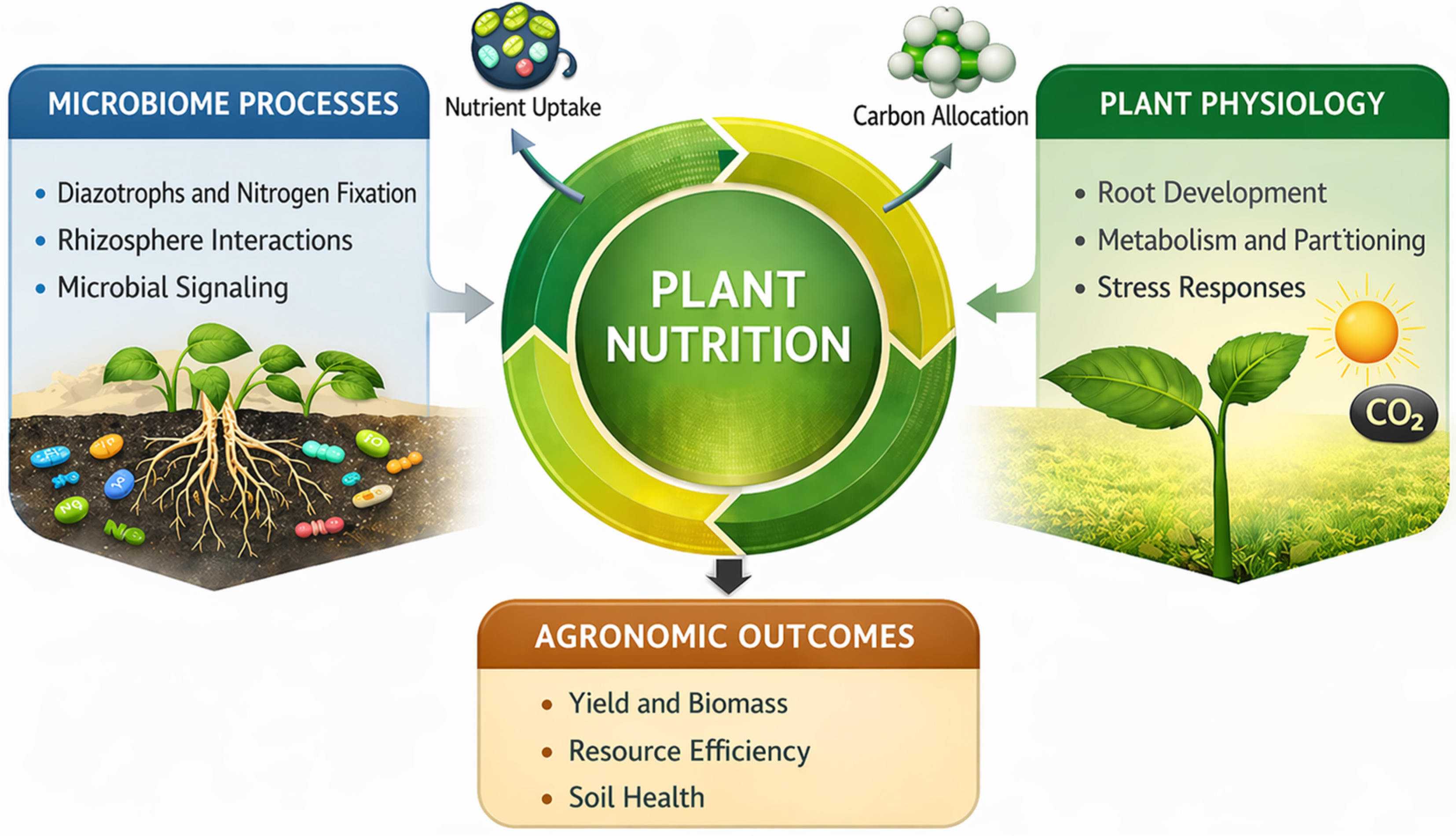
Plant nutrition should therefore be repositioned as the central framework through which microbiome function becomes agronomically intelligible. This is because plant nutrition provides a quantitative and integrative configuration already embedded in agronomic decision-making. This positioning enables the interpretation of microbiome processes within the same structure used to guide fertilization and nutrient management strategies. While microbiome research is often framed in terms of resilience, sustainability, plant health, or stress tolerance, these categories only become agronomically meaningful when translated into measurable nutritional and physiological outcomes (Copeland et al., 2025; Singh et al., 2025). Plant nutrition offers this interface by linking microbial activity to measurable outcomes, including nutrient uptake, nutrient use efficiency, fertilizer recovery, crop quality, and plant responses to environmental stress. This integrative approach, where plant nutrition acts as the functional interface linking microbiome processes to plant physiology and agronomic outcomes, is summarized in Figure 1.
Integrative framework in which plant nutrition operates as the functional interface linking microbiome processes to plant physiology and agronomic outcomes. Microbiome processes, including diazotroph activity, rhizosphere interactions, and microbial signaling, influence nutrient uptake and contribute to plant nutritional status. In turn, plant nutrition connects these microbial processes with physiological responses such as root development, metabolism and partitioning, and stress responses, ultimately shaping agronomic outcomes including yield and biomass, resource efficiency, and soil health.
This perspective requires a dynamic understanding of the rhizosphere as a biologically active interface rather than a passive zone of interaction, shaped by continuous feedback between plant physiology and microbial activity. For instance, microorganisms influence root development, nutrient-responsive gene expression, and physiological processes such as photosynthesis and water use efficiency (Fonseca et al., 2025; Thiengo et al., 2025; Galindo et al., 2024), thereby linking nutrient acquisition to plant physiological performance and resilience. From this perspective, tolerance to abiotic and biotic stress should not be treated as an isolated microbiome function but as an emergent property arising from the integration of nutritional status and physiological regulation.
The rapid expansion of microbial inoculants has made these issues more pressing. Although inoculation strategies are often designed to deliver specific functions, their effectiveness depends on interactions with resident microbial communities and the surrounding environmental context. This context dependency helps explain the often-inconsistent performance of microbial inoculants under field conditions. Evidence increasingly shows that microbial consortia can reshape rhizosphere chemistry, plant nutrition, and productivity more effectively than single-strain inoculants due to complementary mechanisms and ecological interactions (Moretti et al., 2024; Galindo et al., 2025). Beyond bacteria and fungi, emerging evidence indicates that other biological agents, such as soil viruses, can influence nutrient cycling by modulating microbial functional potential, particularly under environmental constraints such as soil acidification (Cheng et al., 2026). These findings suggest that nutrient dynamics are shaped by multi-layered biological interactions that extend beyond classical plant-microbe frameworks, reinforcing the need for integrative approaches that account for ecological complexity.
Reconnecting plant nutrition with the plant-soil microbiome does not represent the addition of a new layer to agronomy but rather the restoration of a fundamental biological dimension. Advances in multi-omics approaches are rapidly revealing the mechanistic basis of these interactions, connecting microbial communities, plant physiology, and nutrient dynamics at unprecedented resolution (Li et al., 2026). This integration is particularly relevant because microbiome-mediated processes influence nutrient acquisition, plant physiological responses to environmental stress, and crop nutritional quality. These interactions may extend across scales, linking soil processes to plant performance and, ultimately, to human nutrition and health within a broader One Health perspective (Ma et al., 2025). Moving forward, integrating plant nutrition and microbiome science will not only refine our understanding of nutrient acquisition but fundamentally reshape how agricultural systems are designed and managed.
Acknowledgments
The first author acknowledges the continued support of the Fundação de Amparo à Pesquisa do Estado de São Paulo (FAPESP) for funding his research program (grants 21/05372-0, 23/02584-1, and 25/14275-9). The third author acknowledges FAPESP (2019/16043-7) and the Conselho Nacional de Desenvolvimento Científico e Tecnológico (CNPq) (402050/2023-1 and 305036/2024-6). The fourth author acknowledges support from the CNPq (process 305614/2024-0).
Data availability statement
The information and database for this research are not currently on a platform or website. The corresponding author can provide them.
References
-
Cheng S, Dai Z, He D, Xue R, Zhao K, Rodrigues JLM, et al. 2026. Long-term N fertilization altered viral community composition and increased functional potentials of phosphorus cycling by causing soil acidification. Soil Biology and Biochemistry 217: 110137. https://doi.org/10.1016/j.soilbio.2026.110137
» https://doi.org/10.1016/j.soilbio.2026.110137 -
Copeland C, Schulze-Lefert P, Ma K-W. 2025. Potential and challenges for application of microbiomes in agriculture. The Plant Cell 37: koaf185. https://doi.org/10.1093/plcell/koaf185
» https://doi.org/10.1093/plcell/koaf185 -
Fonseca M, Pedrinho A, Merloti LF, Bossolani JW, Lemos LN, Martins MM, et al. 2025. Differential stimulation of phosphorus-mobilizing bacteria by common bean genotypes in Amazonian Dark Earth and agricultural soils with varying fertility levels. Rhizosphere 33: 101026. https://doi.org/10.1016/j.rhisph.2025.101026
» https://doi.org/10.1016/j.rhisph.2025.101026 -
Galindo FS, Pagliari PH, Silva EC, Lima BH, Fernandes GC, Thiengo CC, et al. 2024. Unveiling contribution and fate of nitrogen with 15N techniques affected by microbial co-inoculation on field-grown maize: a novel approach to optimize N-fertilizer use efficiency. Plant Physiology and Biochemistry 217: 109261. https://doi.org/10.1016/j.plaphy.2024.109261
» https://doi.org/10.1016/j.plaphy.2024.109261 -
Galindo FS, Thiengo CC, Pagliari PH, Bernardes JVS, Santos GD, Longato PAF, et al. 2025. Interactive effects of bacterial consortia and basal nitrogen fertilization on initial maize growth: an investigation based on physiological parameters and 15N isotopic analysis. Journal of Plant Growth Regulation 44: 6878-6894. https://doi.org/10.1007/s00344-024-11365-0
» https://doi.org/10.1007/s00344-024-11365-0 -
Jacoby R, Peukert M, Succurro A, Koprivova A, Kopriva S. 2017. The role of soil microorganisms in plant mineral nutrition—current knowledge and future directions. Frontiers in Plant Science 8: 1617. https://doi.org/10.3389/fpls.2017.01617
» https://doi.org/10.3389/fpls.2017.01617 -
Li N, Li G, Huang X, Ma L, Wang D, Luo Y, et al. 2026. Large-scale multi-omics unveils host–microbiome interactions driving root development and nitrogen acquisition. Nature Plants 12: 319-336. https://doi.org/10.1038/s41477-025-02210-7
» https://doi.org/10.1038/s41477-025-02210-7 -
Ma H, Cornadó D, Raaijmakers JM. 2025. The soil-plant-human gut microbiome axis into perspective. Nature Communications 16: 7748. https://doi.org/10.1038/s41467-025-62989-z
» https://doi.org/10.1038/s41467-025-62989-z -
Moretti LG, Crusciol CAC, Leite MFA, Momesso L, Bossolani JW, Costa OYA, et al. 2024. Diverse bacterial consortia: key drivers of rhizosoil fertility modulating microbiome functions, plant physiology, nutrition, and soybean grain yield. Environmental Microbiome 19: 50. https://doi.org/10.1186/s40793-024-00595-0
» https://doi.org/10.1186/s40793-024-00595-0 -
Pantigoso HA, Newberger D, Vivanco JM. 2022. The rhizosphere microbiome: plant–microbial interactions for resource acquisition. Journal of Applied Microbiology 133: 2864-2876. https://doi.org/10.1111/jam.15686
» https://doi.org/10.1111/jam.15686 -
Singh BK, Hu H-W, Macdonald CA, Xiong C. 2025. Microbiome-facilitated plant nutrient acquisition. Cell Host & Microbe 33: 869-881. https://doi.org/10.1016/j.chom.2025.05.005
» https://doi.org/10.1016/j.chom.2025.05.005 -
Thiengo CC, Galindo FS, Bernardes JVS, Rocha LO, Silva CD, Burak DL, et al. 2024. Nitrogen fertilization regulates crosstalk between Marandu palisadegrass and Herbaspirillum seropedicae: an investigation based on 15N isotopic analysis and root morphology. Environmental Research 249: 118345. https://doi.org/10.1016/j.envres.2024.118345
» https://doi.org/10.1016/j.envres.2024.118345 -
Thiengo CC, Galindo FS, Rodak BW, Bernardes JVS, Rocha LO, Gaziola SA, et al. 2025. Harnessing plant growth-promoting bacteria (Herbaspirillum seropedicae) from an optimal mineral nitrogen supply: A study on improving nitrogen use efficiency in marandu palisadegrass. Plant Physiology and Biochemistry 220: 109497. https://doi.org/10.1016/j.plaphy.2025.109497
» https://doi.org/10.1016/j.plaphy.2025.109497
Edited by
-
Edited by:
Quirijn de Jong van Lier https://orcid.org/0000-0002-7131-5523