
 Enhancing access to removable dental prosthesis in public health through digital pathway: A study in Rio de Janeiro
ABSTRACT
This study compares three methods for producing Removable Dental Prostheses (RDPs) within Rio de Janeiro’s public health system. Between June and December 2023, a convenience-sampled, three-arm, parallel-group study involving 45 patients was conducted. Participants were allocated based on their position on the waiting list for prosthodontic services: Conventional Method (CM), Hybrid Method (HM), or Digital Method (DM). Data on the number of appointments and production time were collected. Descriptive statistics and the Kruskal-Wallis H test were used to assess differences among the methods. Of the 45 patients, 44.4% received RDPs via CM, 40% via HM, and 15.6% via DM. DM required the highest average number of appointments (5.86), followed by CM (5.35) and HM (4.83). Production time was longest for CM (156.45 days), while HM (37.44 days) and DM (33.57 days) were significantly faster. HM and DM reduced production time and appointments, enhancing RDPs service efficiency in public health. Expanding DMs and HMs may improve access to care for edentulous patients and public health outcomes. The findings support public health policies aimed at increasing access to prosthodontic services and optimizing resource allocation by integrating digital workflows.
KEYWORDS
Dental prosthesis; Dentures; partial; removable; Mouth; edentulous; Technology; medical; Public health.
RESUMO
Este estudo compara três métodos de produção de Próteses Dentárias Removíveis (PDR) no sistema público de saúde do Rio de Janeiro. Entre junho e dezembro de 2023, conduziu-se estudo paralelo de três braços, com amostragem por conveniência, envolvendo 45 pacientes alocados conforme a posição na lista de espera dos serviços de prótese dentária: Método Convencional (MC), Método Híbrido (MH) ou Método Digital (MD). Coletaram-se dados sobre número de consultas e tempo necessário para produzir as próteses. Realizou-se análise descritiva e aplicou-se o teste de Kruskal-Wallis H para avaliar diferenças entre os métodos. Dos 45 pacientes, 44,4% receberam PDR pelo MC, 40% pelo MH e 15,6% pelo MD. O MD demandou mais consultas (5,86), seguido do MC (5,35) e do MH (4,83). O tempo de produção foi maior no MC (156,45 dias) e significativamente menor no MH (37,44 dias) e no MD (33,57 dias). MH e MD reduziram o tempo de produção e o número de consultas, tornando os serviços mais eficientes; sua ampliação pode ampliar o acesso de pacientes edêntulos e melhorar os desfechos em saúde pública. Os resultados podem subsidiar políticas públicas voltadas à modernização dos serviços protéticos e à equidade no cuidado.
PALAVRAS-CHAVE
Prótese dentária; Prótese parcial removível; Boca edêntula; Tecnologia em saúde; Saúde pública.
Introduction
Oral health issues represent a global public health concern, affecting billions of individuals and leading to a multitude of challenges, including pain, compromised chewing, speech difficulties, and aesthetic considerations1-3. Despite progress in addressing oral health challenges, significant disparities persist, particularly among vulnerable populations such as seniors. These disparities are exacerbated by adverse social and economic variables, barriers to accessing care, social determinants that influence oral health, and common risk factors associated with these challenges. Such complexities necessitate a targeted approach to improve oral health outcomes in these populations4,5.
A notable example is the Brazilian context, where data from the 2010 National Oral Health Survey highlight the magnitude of oral health challenges faced by the population. Approximately 13.7%, 68.8%, and 92.7% of Brazilians aged 15-19, 35-44, and 65-74 years, respectively, require a dental prosthesis. Public policies must reduce income and education gaps, implement preventive dental interventions, and expand oral rehabilitation efforts, particularly for the most vulnerable populations6-9. Despite efforts to expand access in Rio de Janeiro, the demand for Removable Dental Prostheses (RDPs) continues to exceed the service capacity, leading to long waiting times and care gaps, especially among elderly patients.
Initiatives such as expanding primary care services to include clinical procedures for dental prosthesis installation and establishing Regional Dental Prosthesis Laboratories aim to restore lost functional capabilities through oral rehabilitation6,10. In this context, the rapid development of three-dimensional (3D) printing technology, also known as additive manufacturing, has significantly contributed to innovations in dental sciences over the past four decades11.
This research aimed to compare three distinct processes for producing RDPs, with the goal of expanding their availability within the public health system of Rio de Janeiro.
Material and methods
A convenience-sampled, three-arm, parallel-group study was conducted following approval from the Rio de Janeiro Municipal Health Department’s Research Ethics Committee (CEP) under CAAE 77157524.0.0000.5279 and approval number 6.646.450. The study complied with the ethical principles established in Resolution CNS No. 466/2012 and Resolution No. 510/2016 of the Brazilian National Health Council, as well as with the World Medical Association’s Code of Ethics (Declaration of Helsinki) for research involving human participants12,13. All participants received an information sheet and provided written informed consent.
The study compared three processes for producing complete and partial dentures: the Conventional Method (CM), the Hybrid Method (HM), and the Digital Method (DM). Dentures were fabricated between June 2023 and December 2023. Initially, the sample included 20 patients in the CM group, 20 in the HM group, and 10 in the DM group; however, due to patient non-attendance, the final sample consisted of 45 participants: 20 in the CM group, 18 in the HM group, and 7 in the DM group. It is important to acknowledge potential sources of bias in this study. Participants were not randomly assigned to groups; instead, the allocation was determined by their position on the prosthodontic service waiting list. This pragmatic approach reflects the operational flow of public health service logistics, ensuring feasibility within the logistical and ethical constraints of the municipal system. It also aimed to avoid disruptions in patient care and to maintain equity in service delivery by respecting the chronological order of access. However, this method may limit group comparability, and this limitation should be considered when interpreting the findings.
Data were collected on the number of appointments and the time required (in calendar days) for denture production according to the production method used. Descriptive data analysis was conducted, and the Kruskal-Wallis H test, a non-parametric test used to compare three or more independent groups, was applied to assess differences in production time across the methods.
Conventional protocols for complete and partial denture fabrication involve a sequence of clinical and laboratory steps to achieve proper retention, stability, and functional adaptation14-16. However, these procedures often pose challenges, such as distortions in wax patterns and poor casting fit, which can impact outcomes. These factors highlight the need for more efficient protocols that reduce patient burden while maintaining prosthetic quality. HMs and DMs were developed to streamline these steps and improve workflow efficiency. The DM, in particular, leverages 3D printing technology, which has been shown to enhance precision, reduce production time, and lower costs compared to traditional approaches17,18.
Eligibility criteria
The study included patients who used the public health system in the municipality of Rio de Janeiro. The patients must have been evaluated by a general dental practitioner and deemed suitable candidates for the placement of RDPs, such as upper or lower partial or complete dentures. Additionally, all participants were required to be on the waiting list for referral to specialized prosthodontic services.
Patients were allocated to the study groups according to their position on the waiting list for prosthodontic services. They attended the required appointments based on their assigned production method, culminating in the delivery of their prosthesis. Subsequently, all participants were scheduled for a follow-up visit, during which any necessary minor adjustments were made. However, these follow-up consultations were not included in the appointment count for this study.
Results
Based on the methodology described above, this study included 45 patients and presents the results related to the production of RDPs using three different methods. Some patients required both upper and lower prostheses, while others needed only an upper or lower prosthesis. Of the RDPs fabricated, 44.4% were produced using the CM, 40.0% with the HM, and 15.6% with the DM. The DM required the highest average number of appointments for prosthesis fabrication, with a mean of 5.86 visits, followed by the CM with 5.35 visits. The HM demonstrated the most outstanding efficiency, requiring the fewest appointments, with a mean of 4.83 visits, as shown in graph 1.

Number of appointments for removable dental prostheses according to the work model (conventional, hybrid, and digital)
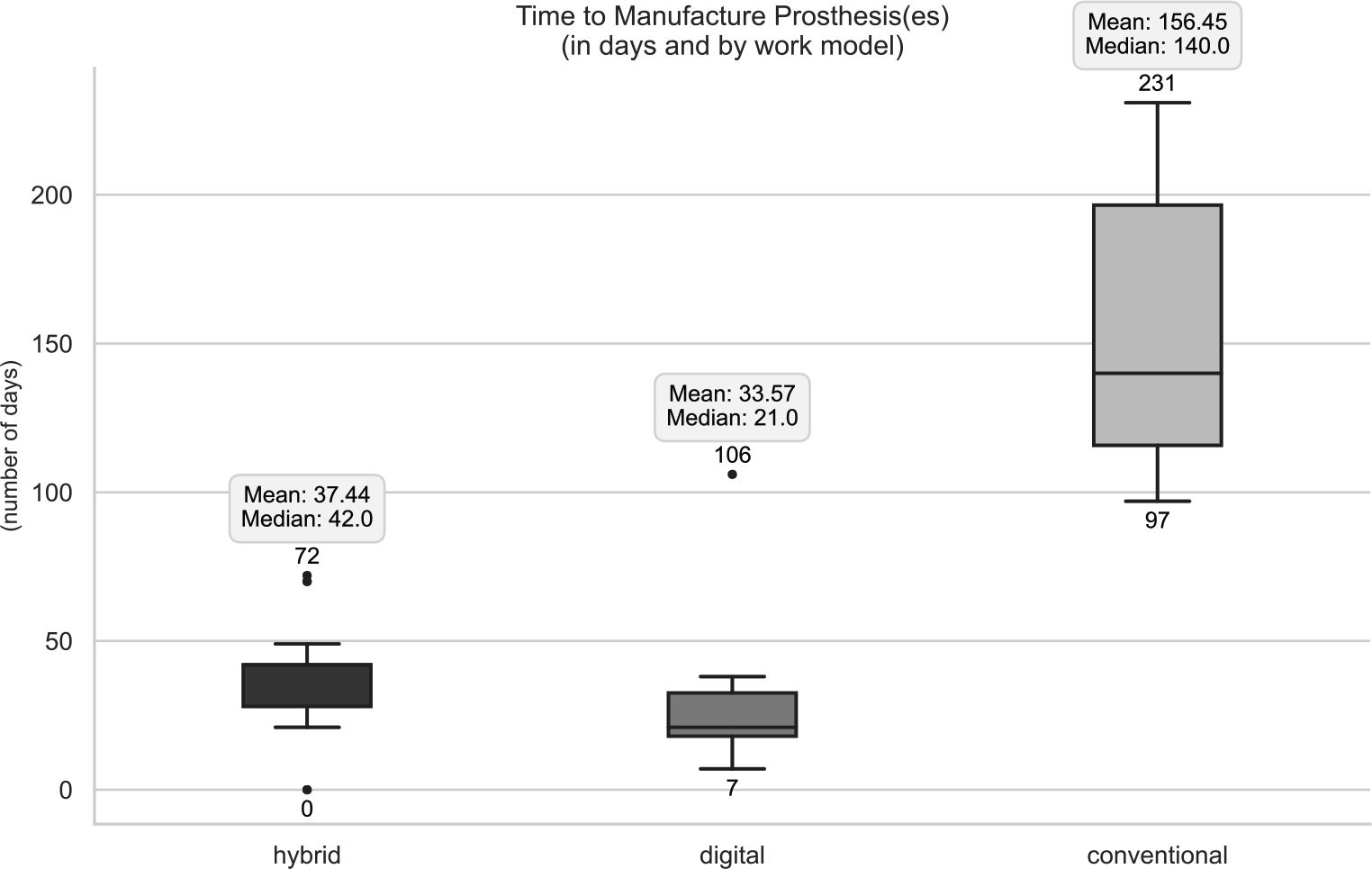
Among the records, the DM was responsible for the highest number of repeated steps during the RDPs fabrication process. Regarding production time, the CM exhibited the longest average time at 156.45 days, followed by the HM with 37.44 days. The shortest production time was observed with the DM, which averaged 33.57 days.
The Kruskal-Wallis H test revealed a highly significant p-value (p = 6.15e-08) for the association between the production method and the variable production time, as illustrated in graph 2. This association was further validated by Spearman’s correlation matrix, which indicated a strong negative correlation between production time and the selected production method (graph 3). The discussion below further explores these findings in light of existing literature and the context of public health service delivery.

Production time for removable dental prostheses according to the work model (conventional, hybrid, and digital)

Correlation matrix between the number of appointments, production time, and work model for removable dental prostheses
Discussion
Building on the findings presented, the analysis reveals significant differences in production time among the three prosthetic fabrication methods. These results reinforce the potential advantages of hybrid and digital workflows in reducing waiting times and improving patient access to prosthetic rehabilitation in public health settings.
The CM exhibited the longest production time, averaging 156 days, reflecting the multiple clinical and laboratory procedures involved. In contrast, the HM and DM significantly shortened the production period to 37 and 33 days, respectively, suggesting that integrating digital elements into prosthetic workflows can substantially enhance service efficiency. These findings align with previous research that highlights the role of digital technologies in optimizing prosthetic production timelines14,17,18.
Complete tooth loss represents a widespread oral health challenge, disproportionately affecting individuals with lower socioeconomic status8,9. It is closely linked to psychosocial impacts, including diminished self-image and quality of life, as reported in previous studies5,9,19-21. Addressing this issue is central to the principles of universal and equitable access within Brazil’s public health system. Providing prosthodontic care for vulnerable populations aims not only to restore oral functionality but also to improve self-esteem and overall well-being in a socially inclusive framework2,8,9,22.
Moving from a traditional to a digital workflow represents a fundamental shift in modern prosthodontics. Compared to CMs, 3D printing offers several significant advantages, including higher precision, faster production, and the ability to scale production on demand. It also enables more personalized treatments and streamlines the traditionally complex workflow associated with denture production. However, 3D printing requires digital file acquisition, a process that can be time-consuming and technically demanding, necessitating well-trained operators18,23. This was evident in this study, where the initial consultation for DM was notably more extended than the traditional techniques.
Integrating Computer-Aided Design/Computer-Aided Manufacturing (CAD/CAM) technologies into prosthodontics offers multiple advantages, including reduced chairside time, enhanced reproducibility, and superior functional and aesthetic outcomes. Additionally, CAD/CAM decreases the risk of microorganism colonization on the denture surfaces, lowering the likelihood of related infections16-18,24. To construct a prosthesis using CAD/CAM, an intraoral or extraoral scanner captures impressions or conventional casts, generating a Standard Tessellation Language (STL). Then, the STL file is transferred to CAD software for design and, finally, to 3D printing18,25,26. Nevertheless, the process of scanning edentulous patients remains a challenge, as seen in this study, requiring ongoing advancements in technology and software to improve efficiency.
Contrary to expectations, DM required the highest average number of appointments (5.86), surpassing both HM (4.83) and CM (5.35). This unexpected outcome was attributed to the repeated steps necessitated by technical challenges, which identified issues with occlusal vertical dimension recording and the transfer of maxillomandibular relation in digital workflows. These challenges highlight the need for enhanced training and technological refinements in digital workflows, as reported by Bilgin et al.17.
While the DM required a higher number of appointments, it also delivered the shortest total production time, emphasizing its ability to streamline the workflow without increasing the overall clinical burden. This suggests that, with the same investment in consultation time, it is possible to accelerate prosthesis delivery, thereby improving patient access and quality of care.
Statistical analysis further reinforced the benefits of hybrid and digital workflows. The Kruskal-Wallis test revealed a significant association between fabrication methods and production time. At the same time, Spearman’s matrix demonstrated a strong negative correlation, indicating that production time decreased significantly as fabrication methods shifted from conventional to hybrid or digital workflows. These findings align with the existing literature, which advocates for adopting digital workflows to enhance prosthesis production efficiency18.
Despite the promise of digital workflows, barriers must be addressed to ensure their successful implementation in public health programs. The lack of training among prosthodontists and the evolving nature of digital technologies pose challenges that require targeted interventions. Additionally, while preliminary findings suggest improved surface quality frames from 3D printing and reduced production time from digital workflows, further evidence through Randomized Clinical Trials (RCTs) is necessary to validate their clinical performance16,27.
The implications of this research extend to public health policy, particularly in addressing the backlog of prosthodontic services. By reducing production time and improving access, HMs and DMs could significantly enhance oral health outcomes for vulnerable populations. This is particularly relevant in Rio de Janeiro, where barriers to public oral rehabilitation services must be overcome to ensure equitable and timely care. The adoption of digital prosthesis fabrication in public health care underscores the critical role of technological innovation in addressing unmet needs and improving the quality of life for underserved populations.
Although MD and HM workflows have demonstrated clear advantages in reducing production time, their adoption in the public health system may present challenges, such as financial investment, professional training, and adaptation of infrastructure to integrate digital technologies into existing service routines. However, digital solutions can reduce inequities in access to dental prosthesis services in the Unified Health System (SUS).
Conclusions
In summary, this study’s findings emphasize key aspects that support the clinical relevance of both conventional and 3D-printed RDPs, demonstrating their potential to shape clinical practice and influence dental public health strategies. The findings indicate that the HMs and DMs significantly reduce production time, demonstrating their potential to improve the efficiency of prosthodontic services within the SUS. By optimizing processes and integrating digital workflows, these advancements could enhance service capacity, reduce waiting lists, and expand access to RDP services for underserved populations. The results underscore the importance of investing in digital technology and training to improve public health outcomes further and ensure equitable, efficient dental care. However, this study has some limitations, including the non-randomized allocation of participants and a limited sample size. Future studies should explore the long-term clinical outcomes of digital and hybrid workflows, along with cost-effectiveness analyses and implementation strategies across broader public health contexts.
-
Financial support:
Non-existent
Data availability:
Research data are contained in the manuscript itself
References
-
1 Peres MA, Macpherson LMD, Weyant RJ, et al. Oral diseases: a global public health challenge. Lancet. 2019;394(10194):249-60. DOI: https://doi.org/10.1016/S0140-6736(19)31146-8
» https://doi.org/10.1016/S0140-6736(19)31146-8 -
2 Marinho MF, Groisman S. Alma Ata: Reflections and future prospects in family health strategy. Rev Gaúch Odontol. 2020;68:e20200034. DOI: https://doi.org/10.1590/1981-863720200003420190051
» https://doi.org/10.1590/1981-863720200003420190051 -
3 Cardoso M, Balducci I, Telles DM, et al. Edentulism in Brazil: trends, projections and expectations until 2040. Ciênc saúde coletiva. 2016;21(4):1239-46. DOI: https://doi.org/10.1590/1413-81232015214.13672015
» https://doi.org/10.1590/1413-81232015214.13672015 -
4 Meaney S, Connell BO, Elfadil S, et al. A qualitative investigation into patients’ perspectives on edentulousness. Gerodontology. 2017;34(1):79-85. DOI: https://doi.org/10.1111/ger.12229
» https://doi.org/10.1111/ger.12229 -
5 Yu X, Chen Y, Li Y, et al. A Bibliometric Mapping Study of the Literature on Oral Health-related Quality of Life. J Evid Based Dent Pract. 2023;23(1S):101780. DOI: https://doi.org/10.1016/j.jebdp.2022.101780
» https://doi.org/10.1016/j.jebdp.2022.101780 -
6 Silva ET, Oliveira RT, Leles CR. O Edentulismo no Brasil: epidemiologia, rede assistencial e produção de próteses pelo Sistema Único de Saúde. Tempus. 2015;9(3):121-34. DOI: https://doi.org/10.18569/tempus.v9i3.1790
» https://doi.org/10.18569/tempus.v9i3.1790 -
7 Peres MA, Barbato PR, Freitas CH, et al. Tooth loss in Brazil analysis of the 2010 Brazilian oral health survey. Rev Saúde Pública. 2013;47(Suppl 3):78-89. DOI: https://doi.org/10.1590/S0034-8910.2013047004226
» https://doi.org/10.1590/S0034-8910.2013047004226 -
8 Vettore MV, Vieira JMR, Gomes JFF, et al. Individualand city-level socioeconomic factors and tooth loss among elderly people: A cross-level multilevel analysis. Int J Environ Res Public Health. 2020;17(7):2345. DOI: https://doi.org/10.3390/ijerph17072345
» https://doi.org/10.3390/ijerph17072345 -
9 Roberto LL, Crespo TS, Monteiro-Junior RS, et al. Sociodemographic determinants of edentulism in the elderly population: A systematic review and meta-analysis. Gerodontology. 2019;36(4):325-37. DOI: https://doi.org/10.1111/ger.12430
» https://doi.org/10.1111/ger.12430 -
10 Guimarães MR, Pinto RS, Vargas AM, et al. Challenges related to dental prosthesis offer in the public health system. Rev Odontol UNESP. 2017;46(1):39-44. DOI: https://doi.org/10.1590/1807-2577.08716
» https://doi.org/10.1590/1807-2577.08716 -
11 Raschke SU. 3D Printing in Prosthetics, Orthotics and Assistive Technology: Myth and Reality. Can Prosthet Orthot J. 2023;6(2):42222. DOI: https://doi.org/10.33137/cpoj.v6i2.42222
» https://doi.org/10.33137/cpoj.v6i2.42222 - 12 Conselho Nacional de Saúde (BR). Resolução nº 466, de 12 dezembro de 2012. Aprova as diretrizes e normas regulamentadoras de pesquisas envolvendo seres humanos. Diário Oficial da União, Brasília, DF. 2013 jun 13; Edição 112; Seção I:59-62.
- 13 Conselho Nacional de Saúde (BR). Resolução nº 510, de 7 de abril de 2016. Dispõe sobre as normas aplicáveis a pesquisas em Ciências Humanas e Sociais. Diário Oficial da União, Brasília, DF. 2016 maio 24; Edição 98; Seção I:44-46.
-
14 Stilwell C, Kalberer N, Mojon P, et al. Extra-oral assessment of conventional and CAD-CAM complete denture appearance by dental professionals and CRDP wearers: A randomized survey. J Dent. 2021;115:103843. DOI: https://doi.org/10.1016/j.jdent.2021.103843
» https://doi.org/10.1016/j.jdent.2021.103843 -
15 Cunha TR, Della Vecchia MP, Regis RR, et al. A randomised trial on simplified and conventional methods for complete denture fabrication: masticatory performance and ability. J Dent. 2013;41(2):133-42. DOI: https://doi.org/10.1016/j.jdent.2012.09.008
» https://doi.org/10.1016/j.jdent.2012.09.008 -
16 Perea-Lowery L, Minja IK, Lassila L, et al. Assessment of CAD-CAM polymers for digitally fabricated complete dentures. J Prosthet Dent. 2021;125(1):175-81. DOI: https://doi.org/10.1016/j.prosdent.2019.12.008
» https://doi.org/10.1016/j.prosdent.2019.12.008 -
17 Bilgin MS, Baytaroğlu EN, Erdem A, et al. A review of computer-aided design/computer-aided manufacture techniques for removable denture fabrication. Eur J Dent. 2016;10(2):286-91. DOI: https://doi.org/10.4103/1305-7456.178304
» https://doi.org/10.4103/1305-7456.178304 -
18 Tian Y, Chen C, Xu X, et al. A Review of 3D Printing in Dentistry: Technologies, Affecting Factors, and Applications. Scanning. 2021;2021:9950131. DOI: https://doi.org/10.1155/2021/9950131
» https://doi.org/10.1155/2021/9950131 -
19 Gil-Montoya JA, Mello AL, Barrios R, et al. Oral health in the elderly patient and its impact on general well-being: a nonsystematic review. Clin Interv Aging. 2015;10:461-7. DOI: https://doi.org/10.2147/CIA.S54630
» https://doi.org/10.2147/CIA.S54630 -
20 Jabr CL, Oliveira LP, Pero AC, et al. Masticatory performance, self-perception of oral health, oral health-related quality of life and nutritional status of completely edentulous elderly patients submitted to different rehabilitation treatments: A cross-sectional study. J Oral Rehabil. 2024;51(4):724-32. DOI: https://doi.org/10.1111/joor.13640
» https://doi.org/10.1111/joor.13640 -
21 Michaud PL, Talmazov G, Dort H. Are patient-reported outcomes improved by implant-assisted maxillary prostheses compared to conventional maxillary dentures? A systematic review. J Dent. 2025;152:105490. DOI: https://doi.org/10.1016/j.jdent.2024.105490
» https://doi.org/10.1016/j.jdent.2024.105490 - 22 Ministério da Saúde (BR), Departamento de Atenção Básica, Coordenação Geral de Saúde Bucal. Projeto SBBrasil 2010: Pesquisa Nacional de Saúde Bucal: resultados principais. Brasília, DF: Ministério da Saúde; 2011.
-
23 Jafarpour D, El-Amier N, Feine J, et al. 3D printing vs traditional workflow for the fabrication of mandibular implant overdentures: study protocol for a mixed-methods cross-over RCT. Trials. 2024;25(1):267. DOI: https://doi.org/10.1186/s13063-024-08097-7
» https://doi.org/10.1186/s13063-024-08097-7 -
24 Chander NG, Gopi A. Trends and future perspectives of 3D printing in prosthodontics. Med J Armed Forces India. 2024;80(4):399-403. DOI: https://doi.org/10.1016/j.mjafi.2024.05.003
» https://doi.org/10.1016/j.mjafi.2024.05.003 -
25 Rezaie F, Farshbaf M, Dahri M, et al. 3D Printing of Dental Prostheses: Current and Emerging Applications. J Compos Sci. 2023;7(2):80. DOI: https://doi.org/10.3390/jcs7020080
» https://doi.org/10.3390/jcs7020080 -
26 Cai H, Xu X, Lu X, et al. Dental materials applied to 3D and 4D printing technologies: A review. Polymers (Basel). 2023;15(10):2405. DOI: https://doi.org/10.3390/polym15102405
» https://doi.org/10.3390/polym15102405 -
27 Balhaddad AA, Garcia IM, Mokeem L, et al. Three-dimensional (3D) printing in dental practice: Applications, areas of interest, and level of evidence. Clin Oral Investig. 2023;27(6):2465-81. DOI: https://doi.org/10.1007/s00784-023-04983-7
» https://doi.org/10.1007/s00784-023-04983-7
Edited by
-
Editor in charge:
Paulo Victor Rodrigues de Carvalho

 Source: Own elaboration.
 Source: Own elaboration.
 Source: Own elaboration.