
 Literature Review of Relief-Soil-Plant Interaction in Rock Outcrops
Abstract
Rock outcrops (ROs) are geological-geomorphological features that span a wide variety of climates and biomes. In hot arid and semiarid regions, ROs support the occurrence of landscape elements different from those in the surrounding matrix. Furthermore, ROs are essential for protecting and maintaining specialized ecosystems, serving as a shelter for biodiversity. This importance is even more visible with the growing number of publications. A systematic literature review synthesized the relief-soil-vegetation relations influenced by ROs under hot arid and semiarid climates. A bibliometric survey was carried out on the Scopus platform throughout the available sample period (1903-2022). The searches focused only on research and review articles in English in the title, abstract, and keyword fields. Most ROs studies focused on biological components, mainly vegetation, while climate, relief, and soil are considered support variables. ROs are essential for the occurrence and persistence of specialized ecosystems. Differential erosion, faults and accumulation of sediments, organic residues and water create microhabitats in ROs. These microhabitats host a high richness and diversity, once submit species to different temperature and soil moisture regimes. This diversification of microhabitats provides biodiversity with relatively safer and more stable shelters, characterizing them as refuges in dry climates and protecting elements that indicate past temporal conditions. Future studies/analyses should investigate how variables operate in these environments.
Palavras-chave:
Abiotic and biotic interactions; Biodiversity; Ecological refuges; Inselbergs; Microhabitats
INTRODUCTION
Rock outcrops (ROs) are litho-structural formations that project above the surface of the surrounding land (Fitzsimons; Michael, 2017). This term has been used to identify landscapes with surfaces predominantly composed of rock (Kulkarni, 2022; Porembski; Barthlott, 2000). They are found on all continents, in various climates, biomes, and origins (Migoń, 2006; Twidale, 2002; Twidale; Romani, 2005).
Typically, ROs have very clear boundaries compared to the predominant landscape matrix. The higher elevation in relation to their surroundings, differences in porosity, and the different morphologies of the ROs (Figure 1) control the flow of water, sediments, nutrients and organic residues into depressions - e.g., gnammas or cavities - (Figures 1A; 1E; 1F), cracks/fissures/fractures (Figures 1B; 1D; 1G) and especially to the surrounding rocky slopes (Figures 1F; 1H), constituting depositional and water recharge zones (Letz et al., 2021; Schut et al., 2014; Zhao et al., 2019). These areas accumulate water and sediment, providing favorable conditions for the colonization of plant species - often considered azonal species - (Bárcenas-Argüello et al, 2010; Burke, 2001; 2002; Clark-Ioannou; Wardell-Johnson; Millett, 2021; Porembski, 2007; Szarzynsnki, 2000) and the development of soil with higher contents of organic carbon (Pérez, 2023; Zhu et al., 2017).
The ROs isolate ecosystems and induce the occurrence of endemic plant species (Fitzsimons; Michael, 2017; Ottaviani et al., 2016). In general, ROs favor the occurrence of isolated ecosystems (terrestrial islands), interspersed in the surrounding landscape, a condition that makes them favorable to the presence of endemic plant species, as well as others not yet known, occurring especially in arid and semiarid climate environments (Fitzsimons; Michael, 2017; Ottaviani et al., 2016). Each RO houses different microhabitats, with different soil conditions and microclimatic factors. Summits and gentle slopes have shallow, seasonally flooded soils isolated by bare rock. Seasonal herbaceous species or low shrubs cover these areas. At the base of RO, soils accumulate water and sediments carried from the upper part, forming deeper soils, continuous, dense, and tall vegetation (Bárcenas-Argüello et al., 2010; Schut et al., 2014; Yates et al., 2019). The relative isolation between microhabitats (Oliveira; Godoy, 2007; Ornduff, 1987; Keppel et al., 2012) leads to an increase in diversity in plant communities (Kluge; Brulfert, 2000; Porembsky; Barthlott, 2000).
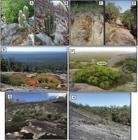
Microhabitats diversification in ROs according to their geomorphic position. Summit conditions: Cracks/fissures (A and B) and gnammas (E - red circle, and F). Shoulder, backslope, and footslope conditions: Shallow soils (C), cracks/fissures (B, D and G) and gnammas (F - blue circle). Toeslope conditions (F - white circle, and H).
The ROs in humid tropical regions, such as southeastern Brazil, are usually occupied by species adapted to xeric ecosystems (Porembski; Barthlott, 2000; Porembski et al., 1998). The opposite is observed in dry environments, such as southwestern Australia (Clark-Ioannou et al., 2021) and the desert regions of Namibia (Burke, 2001; 2002; 2003a), Niger (Anthelme et al., 2008), Iran (Rafiee et al., 2022) and Israel (Yair; Danin, 1980). In dry climate conditions, ROs regulate the flow of rainwater to the lower areas close to their surroundings, allowing greater accumulation of moisture compared to the predominant landscape matrix, and thus favoring the colonization of plants adapted to mesic environments (Burke, 2003b; Lopes et al., 2017; Porembski, 2007; Schut et al., 2014; Yates et al., 2019). Burke (2001; 2002; 2003b) and Oliveira and Godoy (2007) state that ROs induce shallow soils, high-temperature fluctuations, insolation and strong winds, water scarcity and high evaporation rates, composing what many authors call "xeric islands" under the regional domain of humid climates (Porembsky et al., 1998; Parmentier, 2003), presenting a high regional diversity of plant communities (Kluge; Brulfert, 2000).
ROs occur in a wide variety of climates, although they are more abundant in dry conditions, presenting diverse microhabitats (Porembsky et al., 1998; Rafiee et al., 2022; Twidale; Romani, 2005). They thus harbor species with distinct ecological requirements, whose composition reflects the depth of the soils and topographic gradients on a local scale associated with regional climatic conditions which, together, affect the availability of water (Parmentie et al., 2005; Sarthou et al., 2017; Schut et al., 2014). Although there is growing interest in studies of these areas, many gaps still need to be filled, particularly those concerning the presence of plant species and the specific environmental factors that determine their colonization in these areas (Yates et al., 2019).
Based on this, we decided to carry out a systematic review of the existing literature to synthesize the main interactions that occur between relief, soil and vegetation influenced by ROs under hot arid and semiarid climates. Our work aims to: (I) characterize the types of rocky outcrops studied (landforms, lithology and geographical location); (II) analyze the aims of the studies; (III) synthesize the main geomorphological, pedological and ecological conditions of the ROs that support vegetation distinct from the environmental characteristics of the predominant landscape matrix; and (IV) identify the existing gaps and suggest ways of solving them.
METHODOLOGY
We used the Scopus database, the most extensive grouping of information from summaries and citations of peer-reviewed literature, with bibliometric tools to track, analyze, and visualize the research. Only scientific articles published in English were considered. The source should meet the criteria of a peer-reviewed article or full-text review with abstracts and texts available electronically. Based on the methodological proposal of the protocol Preferred Reporting Items for Systematic Review and Meta-Analysis - PRISMA (Page et al., 2021; Pham et al., 2014), the following steps (Figure 2) were included in the systematic review:

-
Identification: potential articles were listed in the selected electronic database, and snowballing was used to add relevant articles, manually analyzing the references section of the articles (Greenhalgh; Peacock, 2005). The search query applied to the database included the following terms: rock*, outcrop*, arid*, semiarid*, semi-arid*, dry*, hot*, soil*, plant*, vegeta*, landform*, water*. We truncated the suffix of all the words, using the "*" to broaden the scope of the searches. The initial search was implemented in September 2022 and updated in January and February 2023. The entire sample period available by Scopus (1903-2022) was considered except for 2023. All information regarding the selected articles was imported, and duplicate records were removed.
-
Screening: manuscripts that did not meet the minimum inclusion criteria were excluded after analysis of title, abstract, and keywords.
-
Eligibility: manuscripts that did not address in detail the interactions between soil-plant-geomorphology in the ROs were excluded.
-
Included: articles that met the eligibility criteria were included, tabulated and analyzed in subsequent sections. Those that were excluded in this selection phase but were considered useful for this review were also referenced in other sections.
Methodological arrangements of selected articles
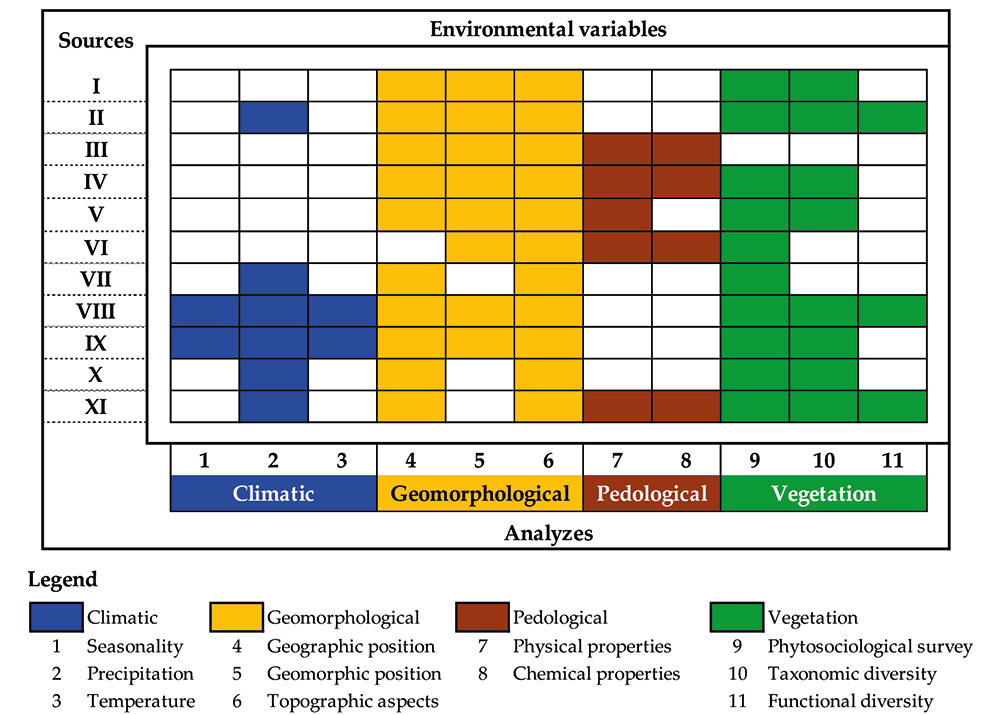
The methodological framework was divided into the most present environmental variables, namely: climatological, geomorphological, pedological, and vegetation. Subsequently, these variables were subdivided to facilitate further the organization and understanding of the respective methodological information in the articles included in the review. With this, we have the following:
-
Climate: Seasonality - use of data relating to precipitation and temperature at certain times of the year to compare the temporal variation of results; Precipitation and Temperature - measured and used in studies.
-
Geomorphology: Geographic position - refers to its exact positioning, the degree of isolation of an RO concerning others, and the direction of the slopes; Geomorphic position - compartmentalizes the position of microhabitats, following a geomorphic surface logic (Alves et al., 2024; Zinck, 2023); Topographic aspects - the topographic characteristics of ROs are relative, such as slope, degree of curvature and amplitude.
-
Soil: Physical soil properties - in this item only texture/granulometry was considered, as it was the predominant analysis in the selected studies; Chemical soil properties - analyzes of pH (acidity), nutrient content (Ca, Mg, P, K, N, etc.) and organic carbon (C) were considered when available.
-
Vegetation: Phytosociological survey - standardized collection of vegetation; Taxonomic diversity - quantification of the number of species presents in an area; Functional diversity - expresses the degree of functional differences between species. We searched the literature for studies on taxonomic diversity involving Angiosperms, given their permanent nature in arid and semiarid climate areas as well as their functional diversity.
Word cloud elaboration
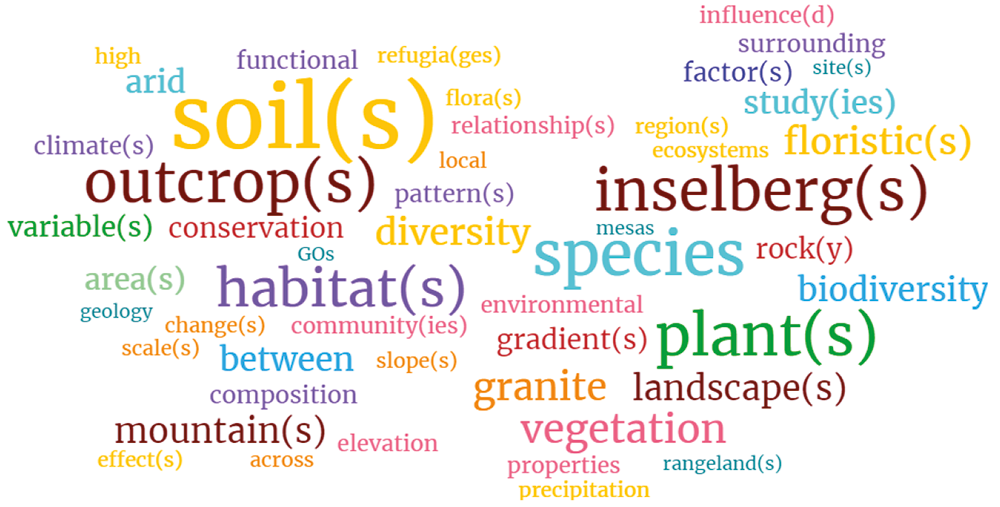
To understand the predominance of modal concepts used in the studies selected in this review, a word cloud was created. We selected only the titles, abstracts and keywords of the articles. The word cloud was created on the Fluorish* platform (2023).
RESULTS
Overview
After all identification, screening, eligibility, and inclusion procedures based on PRISMA (Figure 2), 11 articles were selected for review (Supplementary Material). Figure 3 and Table 1 show, respectively, the location and main characteristics of the study areas of these articles.

According to Table 1, it was observed that studies are mainly concentrated in Australia (4) and Namibia (3). The other articles are evenly distributed in Israel (1), Niger (1), Mexico (1) and Iran (1). The geology is variable, with emphasis on the predominance of granites (7), followed by limestone (3) and basalt (2). Regarding the different landforms, inselbergs are the most recurrent (6), followed by mountains and hills with two each. Mesa (tableland) had only one study (Table 1).
The elevation of the study areas varies between 125 m in Australia and 2.655 m in Iran, revealing a wide variation (Table 1). The areas with lower altitudes are located in Australia (125 m), Mexico (163 m), and Israel (478 m), conversely in Iran (2.655 m), Niger (2.000 m), and Namibia (1.379 m), there are areas higher.
Average annual rainfall varies from 50 mm in African countries (Namibia and Niger) to 1.400 mm in Australia. As a reflection of the previously mentioned physical-environmental configurations, it was observed that the vegetation formations are quite diverse and complex, ranging from Forests (6), Barren Desert (5), Herbaceous (4), Woodlands (4), Scrubs (4) and Dwarf scrub (3). It is evident that in Australia, all studies were carried out in the so-called Southwest Australian Floristic Region (SWAFR), one of the most important hotspots of biodiversity in the world (Zachos; Habel, 2011).
Word cloud
The word cloud was created based on the most recurrent keywords in the 11 selected articles (Figure 4). In Figure 4, the 50 words with the greatest predominance can be seen. Of these, the following stand out: “soil(s)” (56); “species” (37); “plant(s)” (35); “island mountain(s)” (34); “outcrop(s)” (34); “habitat(s)” (31); “vegetation” (22); “granite” (21); “diversity” (20); and "floristic(s)” (20). These terms suggest that the fields of knowledge focused on the biotic environment, such as ecology, botany and biogeography, are the most present in studies on ROs. Other words, like, “biodiversity” (17), “conservation” (13), “functional” (11), “environmental” (10), and “community(ies)” (10), seem to reinforce this preference.

Methodological aspects
The main objects of the selected studies were divided into the four most common environmental variables (Figure 5). The most significant emphasis is given to geomorphological analyses (29 - orange boxes), followed by vegetation (21 - green boxes), climatic elements (10 - blue boxes), and, finally, soil (9 - brown boxes).
In geomorphological analysis, it is possible to observe that topographic aspects are present in all studies, followed by geographic position (10) and geomorphic position (8). In the context of vegetation, the phytosociological survey (10) is a basic procedure, serving as a prerequisite for analyses of taxonomic diversity (8) and functional diversity (3).
Soil classification was mentioned in a general way, with the most probably soil groups and orders but no soil profiles were identified in the studies. Even so, there is a wide variety of approaches. Analyzes of physical properties are restricted to granulometry (5), while the chemical properties monitored include pH, organic carbon (C), nitrogen (N), and phosphorus (P), and exchangeable contents of potassium (K), sodium (Na), calcium (Ca), magnesium (Mg) and iron (Fe) (4).

About climatic elements, precipitation is the most used (6), while only two studies addressed seasonality and temperature. In fact, for arid and semiarid environments, precipitation is the most important regional climate factor (Rafiee et al., 2022).
Description of the main results and interactions observed in the selected articles
-
Yair and Danin (1980): The authors observed two trends in the spatial variability of the soil moisture regime: a) In areas of resistant rocks and low porosity, the moisture regime is controlled mainly by the bedrock structure, i.e. by the thickness of the rock strata and the spacing between adjacent fissures/faults/fractures. In the case of massive limestone, the rock strata are thick and contain spaced joints. Surface properties are characterized by extensive ROs and deep fissures/faults/fractures in the rock (ranging from 100 to 150cm) filled with limited volumes of soil. Combining these extensive rocky surfaces - where runoff is high - with the limited soil volume (collecting water directly from rain and subsequently from runoff) resulted in a better water regime on slopes (ROs) in arid environments. The dimensions of water and sediment/soil receiving areas can vary greatly over short distances, favoring a wide diversity of microhabitats in ROs with uniform lithology and appearance. Dense, shallow joints and relatively thin rock strata were visualized for not massive rock units. Surface properties are characterized by very limited/small ROs and shallow, stony soils. Under these conditions, water entry via runoff is limited, resulting in a relatively poor to very poor water regime. Field observations carried out in the deserts of Israel and Sinai indicate that: a) the relationship between rock structure and soil moisture regime described above can also be found in other massive rock formations, such as dolomite and granite; b) along slopes with the lower part covered by a colluvial blanket, the thickness of which increases along the slope, a systematic and gradual decrease in soil moisture content was recorded in the colluvium section. This trend is probably caused by the fact that most, and often all, of the surface runoff generated in the upper rocky part of the slope infiltrates the upper to middle part of the colluvium. The lower part of the colluvium is typically fed by the limited amount of direct rain that falls in the area. Such a water regime implies, over a slope length of 20-30m, a rapid transition from a Mediterranean-Iranotoranian plant community to a community where Saharo-Arabian species predominate.
-
Burke (2001): a) At a landscape scale (macroscale), the floristic composition of inselberg plant communities was largely determined by the geographic position, geology, elevation, habitat diversity, surrounding the ROs and the surface area of the inselbergs; b) the environmental variables that operate at the landscape level had a greater influence on the functional composition than on the floristic composition; c) stochastic variables were more important in the formation of the flora of the arid inselbergs of Nama Karoo than deterministic processes, such as niche relationships and competition.
-
Burke (2002): a) The underlying geology determines the physical properties of the soil; b) soil chemical properties are influenced by underlying geology and probably biogenic processes as well as atmospheric input; c) soil properties are affected by topography and relief but are not influenced by the aspect of the slope. The study also showed that the relief characteristics probably affect the release, redistribution and deposition of nutrients. The role of inselbergs in contributing nutrients to the surrounding plains can be extremely important in maintaining functioning ecosystems and landscapes, as well as a seed reservoir, which is an important aspect to consider in resource conservation and planning. Granite inselbergs showed closer links with nearby mountainous habitats than dolerite ridges. Higher ROs had closer links to mountainous habitats than lower ones. Many species, largely with broad habitat requirements, are shared between inselbergs and potential continental habitats. More transient populations of short-lived species are probably shared between the dolerite ridges and the potential mainland, compared to longer-lived plants on granite inselbergs.
-
Burke (2003a): Mesa (tableland) supports different plant communities than the surrounding plains, while slopes indicate varying mixing levels with summit vegetation. Differences between mesas/ summit and plains became more pronounced with increasing elevation. However, no clear vegetation belts related to elevation were observed. Plant species richness and number of mesa/summit specialists tended to increase in numbers with elevation, but these trends were not statistically significant, largely due to high variability among samples. Soil properties evidenced soil gradients. Altitudinal effects expressed by humidity and temperatures influenced plant species composition and richness directly. Soil gradients can also indicate the flow of nutrients from Mesa (tableland) to surrounding lowlands, a process of ecological importance particularly in degraded sites due to overgrazing becomes problematic in lowland areas.
-
Anthelme et al. (2008): The results indicated that among the 151 species identified, 12 were recorded for the first time in Niger, and 53 were not found in the adjacent lowlands, thus highlighting the true specificity of a mountain. A five-class habitat variable separated a relatively high portion of Saharan-Mediterranean species (8%) located in microhabitats on volcanic rock, and Guinean-Sudanese-Zambezian species (13%) located in microhabitats on granite rock. These two habitats provided local abiotic refuges, which protected a group of aridity relict species and, probably, herbivores. Therefore, species persistence may depend on regional and local abiotic variables.
-
Bárcenas-Argüello et al. (2010): The discontinuous distribution of the three species of Cephalocereus is not restricted to a calcareous environment. The distribution pattern appears related to specific rock inclusions for each species acting as rocky and edaphic islands. All species studied accumulate biominerals in their tissues, but this does not impact the mineral composition of the soil. The authors reveal that the crystalline forms present in the species do not belong to the same system, and the wide variety of forms must be studied to understand their taxonomic value. Due to the association between parental material and soil preference in the three Cephalocereus species studied, the authors state that these factors promoted their endemicity; that is, it is essential to take into account parental material and soil preference associations to understand the endemicity of the Cactaceae fully.
-
Schut et al. (2014): Using granite ROs in the SWAFR as a case study, they found that the vegetation surrounding the ROs included a wide range of structural classes, reflecting differences in local topography, soil depth, and water influx associated with the great diversity of habitats that were found there. In a scenario of reduced rainfall predicted for the region, they identified areas where the vegetation structure could persist for longer, thus providing safe havens for biota under climate change. However, it is recognized that interactions such as fire and declining water tables also influence the response to climate change. Furthermore, the projections are likely conservative, as the current vegetation structure may not yet reflect the major changes in reduced rainfall that occurred in 2000-2010.
-
Ottaviani et al. (2016): a) Functional diversification, probably aimed at avoiding intra- and interspecific competition for the acquisition of light and nutrients, maybe the important factor in deep soil (micro)habitats; b) patches of deep soil around granite ROs can serve as ecological microrefuges for biota associated with resource-rich environments.
-
Yates et al. (2019): The authors recorded 92 families and 1.060 plant species. They compared three types of habitats in granite ROs, namely: herbaceous vegetation in gnamma (HVG); woody vegetation in gnamma (WVG), and woody vegetation in the alluvium-colluvium found around/toeslope of the ROs (WVB). At the plot level, local soil variables that affect aridity were correlated with species richness in herbaceous and woody vegetation of gnammas filled by soil (HVG and WVG), but not woody vegetation in deeper soils at the toeslope of ROs (WVB). At the RO level, bioclimatic variables affecting aridity were correlated with species richness in two habitats (WVG and WVB), but, contrary to predictions from island biogeography, were not correlated with the inselberg area and isolation in either of the three habitats. Species turnover in each of the three habitats was also influenced by aridity, correlated with bioclimatic variables and the geographic distance between the plots, and for the HVG and WVG habitats with local variables. At the RO level, species replacement was the dominant component of species turnover in the three habitats, consistent with expectations for long-term stable landscapes.
-
Clark-Ioannou et al. (2021): The floristic composition of the RO was mainly controlled by the geographical position and topography of the RO (slope and northern aspect), while the diversity of the plant community (richness, abundance, uniformity and diversity of Simpson) was strongly controlled by soil patch size, regardless of RO location or size. ROs with larger soil patches harbored greater plant diversity.
-
Rafiee et al. (2022): The results show that changes in soil properties (organic C) most affected taxonomy, functional diversity, and functional characteristics in RO. Whereas similar environmental factors (P, organic C, and precipitation) regulated the taxonomic diversity of ROs and nearby grasslands, functional diversity showed greater drought-adapted traits at the RO community level. These results highlight the important role of microscale (local) environmental factors, such as critical species (keystone species) and microhabitat effects on plant community composition and diversity across environmental gradients.
DISCUSSION
Water: the element that connects the (eco)system
Water availability is essential for the development of life on the planet, varying spatio-temporally, especially for regions with arid and semiarid climates (Arca et al., 2021; Huxman et al., 2004). In the context of ROs, specifically, water availability seems to be even more crucial for the occurrence of microhabitats (Ottaviani et al., 2016; Rafiee et al., 2022; Schut et al., 2014; Yair; Danin, 1980), serving as a kind of “fuel” that interconnects and dictates the dynamics of the (eco)systems observed in ROs.
Precipitation is the main source of water in these environments. Once the rain occurs, part of it will be intercepted by vegetation, another will accumulate in the different microhabitats, while the largest volume will be drained to the toeslope of the ROs. Surface runoff ensures the erosion of mineral and organic particles to the toeslope of the ROs or concave surfaces. In these portions, organic acids and water accumulation induce hydrolysis and formation of fine clay and silt-sized particles (Lopez; Bacilio, 2020). Considering that ROs are mainly composed of lithologies with high resistance to weathering, the production of fine material in gnammas, cracks, or at the toeslope of ROs is important for life support (Burke, 2001, 2002, 2003b; Ottaviani et al., 2016).
Although the studies do not include rain interception by the vegetation canopy and soil water availability data, it is expected that the higher content of soil organic matter increases the field capacity and amount of available soil water to ensure that part of the precipitation persists in the system and nourishes the plants after rainy events and even during the dry season (Emerson; Mcgarry, 2003; Hudson, 1994; Minasny; Mcbratney, 2018). The aggregation of mineral and organic particles via wetting/drying cycles and biological activity favors the formation of pores, especially macropores - especially in dry climate environments (Bronick; Lal, 2005; Hirmas et al., 2018). Macropores are responsible for infiltrating meteoric water that will remain stored in the soil, through micropores, or feed the water table. Although the erosion process is complex and has no linear relationship with precipitation, soils with greater vegetation cover and porosity showed less surface runoff and soil erosion (Bronick; Lal, 2005; Hirmas et al., 2018; Jarvis; Larsbo, 2023).
Relief-soil-plant interactions at the RO interface
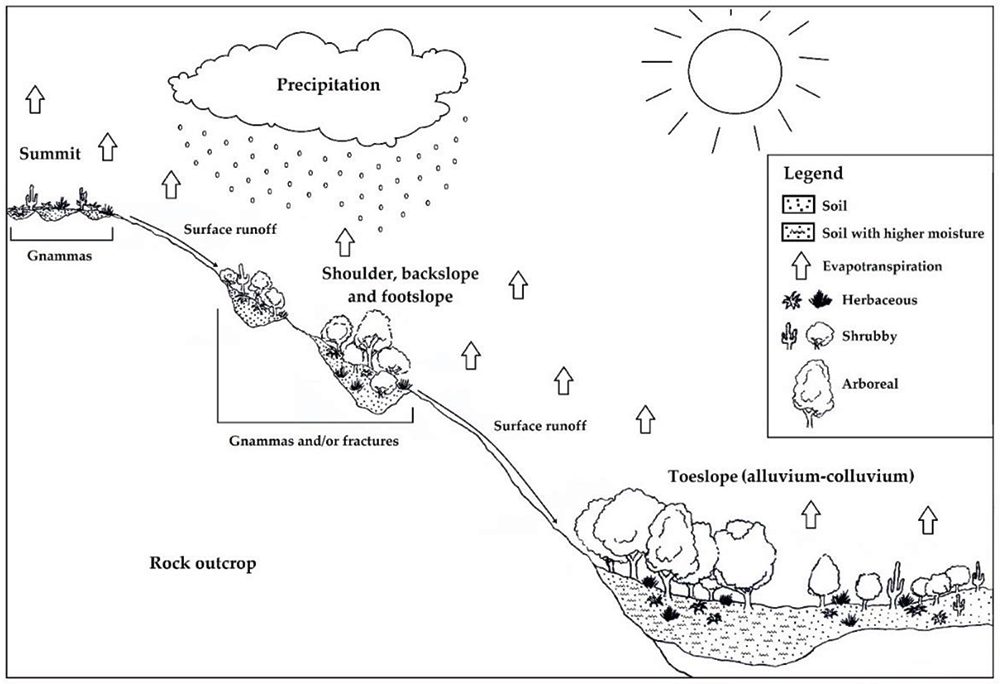
To indicate the establishment of patterns of interactions observed between relief-soil-plant in ROs, this topic was structured in a geomorphic surface logic (Alves et al., 2024; Zinck, 2023), that is, the interpretations were divided into different geomorphic positions, being located in conditions of summit, shoulder, backslope, footslope, and toeslope (alluvium-colluvium), based on a hypothetical scheme of this dynamic (Figure 6).

Simplified hypothetical scheme of the physical-environmental dynamics of ROs in hot and dry climate zones.
The summit of ROs presents numerous gnammas of variable size and depth. Sediments accumulated in these gnammas can form incipient soils. These soils are, unstable, shallow, and have high porosity due to the gravelly coarse texture (Burke, 2002; Lopez; Bacilio, 2020). Consequently, they are highly susceptible to climatic seasonality, varying between being saturated with water during the rainy season and having humidity below the permanent wilting point during the dry season (Certini et al., 2002). These soil pockets are isolated from each other by extensive areas of rock outcrop. The vegetation is generally herbaceous, with a short life cycle or low shrub (Figure 7) (Anthelme et al., 2008; Clark-Ioannou et al., 2021).

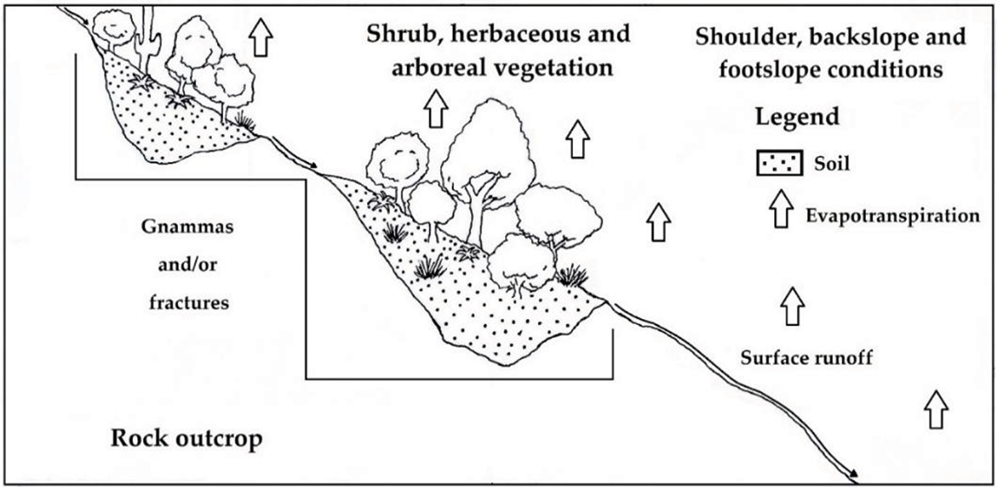
The shoulder, backslope and footslope, are characterized by housing transitional microhabitats between the summit and toeslope of the ROs. In most cases, microhabitats provided by cracks/faults/fissures and gnammas along the slopes receive moisture, sediments, and nutrients from the top, and consequently, due to gravity, they eventually lose them to the toeslope (alluvium-colluvium) of the ROs. The vegetation consists of annual herbaceous plants, with a dominance of shrubs and, to a lesser extent, trees (Schut et al., 2014; Yates et al., 2019).
Because of these transitional conditions of shoulders, backslopes, and footslopes the environmental conditions are variable, as depending on the morphological characteristics they may present conditions similar to the microhabitats at the summit (shallow soils and smaller vegetation) or enable the occurrence of elements similar to those found at the toeslope of ROs (deep soils and larger vegetation), as represented in Figure 8 (Ottaviani et al., 2016; Yates et al., 2019).
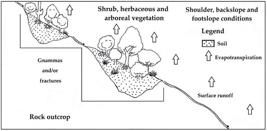
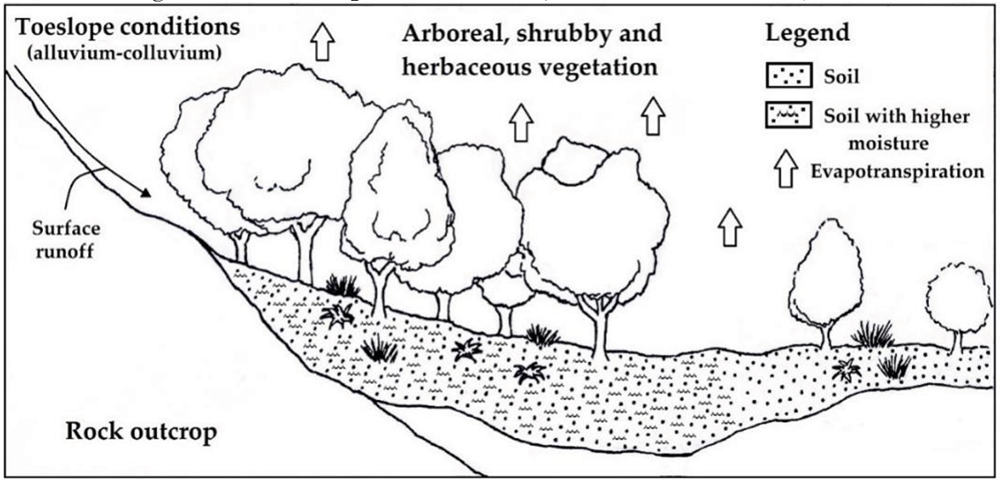
Water runoff from higher altitudes (summit and shoulder, backslope and footslope) accumulates in toeslope and favors deeper soils (Ottaviani et al., 2016). These features have higher moisture and nutrient contents, especially organic C. The vegetation presents greater continuity and may be denser and taller than in the summit areas and along the slope (Figure 9), or even in the surrounding matrix landscape (Anthelme et al., 2008; Burke, 2001; 2002; Ottaviani et al., 2016; Schut et al., 2014; Yates et al., 2019).

Synthesis of dynamics in ROs
In summary, the dynamics of precipitation and surface runoff on the hard surface of ROs dictate the redistribution of nutrients, contributing to the diversification of microhabitats on summit, shoulder, backslope, footslope and toeslope (alluvial-colluvial) of ROs (Burke, 2002; Clark-Ioannou et al., 2021). Some of the microhabitats - mainly associated with the toeslope of ROs - alluvium-colluvium (Ottaviani et al., 2016; Schut et al., 2014) - serve as deposits of nutrients and moisture which, in turn, time, they provide essential inputs for the occurrence of deeper soils and with greater input of organic C, enabling the creation of pockets (soil pockets) rich in resources capable of maintaining relatively stable environmental conditions for long periods (Burke, 2002; 2003a; 2003b; Ottaviani et al., 2016).
These dynamics analyzed in ROs become even more important when the local microclimate of these microhabitats shows a decoupling effect, mainly observed when the surrounding landscape begins to suffer from periods of drought, some lasting years, while that sheltered microhabitats retain greater humidity (Keppel et al., 2012; Schut et al., 2014). Based on the articles included in this review, it is suggested that the relative environmental stability provided by microhabitats has greater potential to promote the persistence of diverse functional characteristics than the predominant landscape (Anthelme et al., 2008; Ottaviani et al., 2016; Yates et al., 2019; Rafiee et al., 2022).
ROs as refuges for biodiversity
ROs are ecological refuges since the host species are not found in their surroundings (Parmentier et al., 2005; Porembsk et al., 2000). The occurrence of these exclusive species is attributed to speciation and extinction due to past climate changes (Hopper, 2009). Therefore, this set of characteristics ends up giving ROs high paleoenvironmental importance.
ROs are unique relief forms that can be considered as true “land islands” or “exception areas” (Burke, 2003b; Clark-Ioannou et al., 2021; Porembski; Barthlott, 2000; Rafiee et al., 2022). According to Ottaviani, Marcantonio, and Mucina (2016), due to their high diversity of microhabitats, ROs preserve elements (mainly soils and vegetation) that allow insight into past environmental circumstances (Souza et al., 2022). These characteristics of ROs, in addition to preserving the past, can serve to maintain microhabitats in the future, thus functioning as a kind of refuge for biodiversity (Burke, 2003b; Keppel et al., 2012; Lopes et al., 2017; Speziale; Ezcurra, 2014). This is even more important, especially during climate fluctuations (Hampe et al., 2013), directly interfering with the dynamics of water stress (Schut et al., 2014; Yair; Danin, 1980).
In general, Keppel et al. (2012) define refuges as sites or microhabitats where species can potentially retreat to less favorable environmental conditions, survive and expand into surrounding landscapes when environmental stress (such as water scarcity) occurs reduce. Many studies such as those by Keppel et al. (2012), Ottaviani et al. (2016), Schmalholz and Hyleer (2011), Schut et al. (2014), Yates et al. (2019), among many others, consider that the potential of refuge is intrinsically related to the microclimatic dissociation of predominant regional climate patterns, that is, while the regional climate experiences increasing water stress, ROs could preserve the patterns of previous microclimatic conditions (pre-stress).
Lopes et al. (2017) also mentioned that the steep slope in ROs promotes greater biodiversity conservation by restricting or hindering human use/access to these environments. Therefore, it is believed that ROs may be capable of mitigating environmental changes (Fitzsimons; Michael, 2017;Keppel et al., 2012) due to the diversification (spatial scale) and stability (temporal scale) of microhabitats related to the decoupling of the local microclimate from the regionally predominant climate (Ottaviani et al., 2016; Schmalholz; Hyleer, 2011; Schut et al., 2014; Speziale; Ezcurra, 2014), in addition to the high slope in some ROs (Lopes et al. , 2017).
Methodological aspects and knowledge limitations
Through the 11 articles included in this review, associated with other equally relevant works on ROs (e.g.: Keppel et al., 2012; Kulkarni et al., 2022; Porembski, 2007, among others - Supplementary Material), there is a clear tendency on the part of scholars to focus their research on biological components, and in this case, on vegetation. The word cloud in Figure 4 corroborates this interpretation. Vegetation is considered the thermometer and synthesis of current environmental conditions and one of the most visible landscape elements (Motzkin et al., 1999). Due to the characteristic heterogeneity of ROs, the possibility of finding new species tends to be greater in these areas than in more homogeneous environments (Porembski; Barthlott, 2000; Porembski, 2007), which reinforces the idea of priority for researchers to study the vegetation of ROs. In this regard, advances are considerable and extremely relevant since the identification and subsequent establishment of standards seem increasingly recurrent. However, they are insufficient to explain the complex dynamics in these areas’ ecosystems.
This work noted that practically all studies employed some phytosociological vegetation survey in ROs - except Burke (2002). Usually, this procedure precedes a quantification of taxonomic diversity in angiosperms, and functional diversity is analyzed in isolated cases. Funk et al. (2017), Rafiee et al. (2022) and Zheng et al. (2015) reveal that approaches based on functional characteristics are very promising and need to be measured simultaneously with taxonomic diversity to improve the understanding of different environmental variables in structuring biodiversity in ROs and their surrounding landscapes (Loreau, 2000). Lithology, geomorphology, and pedology are less detailed and described succinctly and superficially.
In the case of soil analyses, trenches are not opened to consider the complete profile. This approach only superficial samples and estimates the depth through the averages of random samples, as in the case of Ottaviani et al. (2016). For physical and chemical properties, studies focus on soil particle size and moisture and pH, C, N, P and K, respectively.
The recurrence of using methodological variables such as topographical aspects and geographic position (geomorphological) and phytosociological survey (vegetation) suggests a preference or even a probable methodological standardization between studies (see Figure 5), even in very distant locations.
Therefore, the importance of adopting an interdisciplinary approach in these studies on ROs is highlighted to improve the understanding of the systemic functioning of these environments. Otherwise, a given variable will be much more investigated and detailed than the others, leading to a fragmented and reductionist understanding of systemic dynamics.
Suggestions for future research/analysis
Regarding future research, it is suggested that they consider deepening/verticalizing the understanding of variables that are already widely covered, including other types of analysis, such as:
-
Climate: When dealing with predominantly arid to semiarid (hot and dry) climatic environments, which characteristically suffer from high spatio-temporal variability in the distribution of rainfall, it is recommended to analyze the seasonal distribution of precipitation and minimum and maximum temperatures in different environmental gradients (scales), similar to studies carried out by Rafiee et al. (2022) in Iran and Yates et al. (2019) in Australia.
-
Geomorphological: Carry out aerial photogrammetric surveys to generate Digital Elevation Models (DEMs) and Digital Terrain Models (DTMs) to improve the surface detail of the ROs. This makes it possible to calculate the potential surface runoff from these rock surfaces to the lower areas, similar to the study by Lunguinho (2018) in Paraiba, Brazil and Schut et al., (2014) in Australia.
-
Pedological: There is an urgent need to include data on water availability through soil water retention curves to compare the permanent wilting point and field capacity between ROs and surrounding areas. In addition to measuring available water, such data will allow us to determine the total stocks of C, N, and P, and better understand the role of the Caatinga as a reservoir of C. Measuring the C:N:P relationship will shed light on the regulation of water patterns, vegetation cover (Bui; Henderson, 2013; Fan et al., 2015), directly reflecting on soil fertility and indirectly on the nutritional status of plants (Wang; Yu, 2008). Carry out physical-chemical tests to confirm the stability mechanism of soil organic matter (SOM). This can be done through the fractionation of SOM, and then the characterization of its composition (Campos; Machado, 2017), which consequently allows its quality to be identified, being more useful for understanding C cycling in the soil (Campos; Machado, 2017; Cunha et al., 2015). Calculating the stocks of C, N and P for each fraction is also possible, as they have different sensitivities to degradation (Fan et al., 2015; Six et al., 2022; Tan et al., 2004). Stable C isotope and radiocarbon analyses are valuable for SOM and litter dynamics studies. According to Longbottom et al. (2014), the content of δ13C is an indicator of the precursor of the plant type, particularly useful in distinguishing between plants C3 and C4, which may be related to past climatic conditions, being widely used for paleoenvironmental reconstruction studies (Souza et al., 2022; Xiao et al., 2013). Quantifying the pedodiversity of these environments also is an important proposal that plays significant roles in ecosystem goods and services as well as in human activities (Adhikari; Hartemink, 2016; Bartkowski et al., 2020). This approach provides information that reinforces the indication of priority areas for studies and conservation (Mikhailova et al., 2021).
CONCLUSIONS
Based on the literature consulted, the diversification of microhabitats - originating from different lithological, geomorphological, hydrological and pedological conditions - provides biodiversity with relatively safer and more stable shelters, characterizing them as refuges in areas with a dry climate, protecting elements that indicate past temporal conditions, which need to be further and better investigated in an integrated manner.
The analysis revealed the need for systematic interdisciplinary studies to advance knowledge of relief-soil-plant interactions. In general, these studies still prevail in biology and are therefore disciplinary and partial in their integrated reading of functional relationships within the environmental system.
It is suggested that future work delve deeper into analyses of the biotic elements that form these environments, which, in an integrated manner, are the reason for the existence and permanence of existing singularities, of fundamental importance for a better understanding and preservation of these areas, as holders of inherited conditions of the past and with a solid future influence, particularly when thinking in terms of climate change predicted for dry climate environments around the world.
REFERENCES
-
ADHIKARI, K.; HARTEMINK, A. E. Linking soils to ecosystem services - A global review. Geoderma, v. 262, p. 101-111, 2016. https://doi.org/10.1016/j.geoderma.2015.08.009
» https://doi.org/10.1016/j.geoderma.2015.08.009 -
ALVES, G. B.; OLIVEIRA, F. S. de; SILVA, A. H. N. da; SOUZA JUNIOR, V. S. de. Toposequence: What are we talking about? Revista Brasileira de Ciência do Solo, v. 48, e0230137, 2024. https://doi.org/10.1016/j.geoderma.2015.08.009
» https://doi.org/10.1016/j.geoderma.2015.08.009 -
ANTHELME, F.; MATO, M. W.; MALEY, J. Elevation and local refuges ensure persistence of mountain specific vegetation in the Nigerien Sahara. Journal of Arid Environments, v. 72, n. 12, p. 2232-2242, 2008. https://doi.org/10.1016/j.jaridenv.2008.07.003
» https://doi.org/10.1016/j.jaridenv.2008.07.003 -
ARCA, V.; POWER, S. A.; DELGADO-BAQUERIZO, M.; PENDALL, E.; OCHOA-HUESO, R. Seasonal effects of altered precipitation regimes on ecosystem-level CO2 fluxes and their drivers in a grassland from Eastern Australia. Plant and Soil, v. 460, pp. 435-451, 2021. https://doi.org/10.1007/s11104-020-04811-x
» https://doi.org/10.1007/s11104-020-04811-x -
BÁRCENAS-ARGUELLO, M. L.; GUTIERREZ-CASTORENA, M. de C.; TERRACE, T.; LOPEZ-MATA, L. Rock-Soil Preferences of Three Cephalocereus (Cactaceae) Species of Tropical Dry Forests. Soil Science Society of America Journal, v. 74, n. 4, pp. 1374-1382, 2010. https://doi.org/10.2136/sssaj2009.0310
» https://doi.org/10.2136/sssaj2009.0310 -
BARTKOWSKI, B.; BARTKE, S.; HELMING, K.; PAUL, C.; TECHEN, A.; HANSJÜRGENS, B. Potential of the economic valuation of soil-based ecosystem services to inform sustainable soil management and policy. Peter J, v. 8, e8749, p. 1-31, 2020. https://doi.org/10.7717/peerj.8749
» https://doi.org/10.7717/peerj.8749 - BREMER, H.; SANDER, H. Inselbergs: geomorphology and geoecology. In: Porembski, S.; Barthlott, W. (Eds.) Inselbergs: Biotic diversity of isolated rock outcrops in tropical and temperate regions. Berlin, Germany: Springer Verlag, v. 146, 2000. p. 7-35.
-
BRONICK, C. J.; LAL, R. Soil structure and management: a review. Geoderma, v. 124, n. 1-2, p. 3-22, 2005. https://doi.org/10.1016/j.geoderma.2004.03.005
» https://doi.org/10.1016/j.geoderma.2004.03.005 -
BUI, E. N.; HENDERSON, B. L. C:N:P stoichiometry in Australian soils with respect to vegetation and environmental factors. Plant and Soil, v. 373, pp. 553-568, 2013. https://doi.org/10.1007/s11104-013-1823-9
» https://doi.org/10.1007/s11104-013-1823-9 -
BURKE, A. Determinants of inselberg floras in arid Nama Karoo landscapes. Journal of Biogeography, v. 28, n. 10, pp. 1211-1220, 2001. https://doi.org/10.1046/j.1365-2699.2001.00623.x
» https://doi.org/10.1046/j.1365-2699.2001.00623.x -
BURKE, A. How special are Etendeka mesas? Flora and elevation gradients in an arid landscape in north-west Namibia. Journal of Arid Environments, v. 55, n. 4, p. 747-764, 2003a. https://doi.org/10.1016/S0140-1963(02)00293-8
» https://doi.org/10.1016/S0140-1963(02)00293-8 -
BURKE, A. Inselbergs in a changing world - global trends. Diversity and Distributions, v. 9, n. 5, p. 375-383, 2003b. https://doi.org/10.1046/j.1472-4642.2003.00035.x
» https://doi.org/10.1046/j.1472-4642.2003.00035.x -
BURKE, A. Properties of soil pockets on arid Nama Karoo inselbergs-the effect of geology and derived landforms. Journal of Arid Environments, v. 50, n. 2, pp. 219-234, 2002. https://doi.org/10.1006/jare.2001.0907
» https://doi.org/10.1006/jare.2001.0907 - CAMPOS, D. V. B.; MACHADO, P. L. O. A. Physical fractionation of organic matter. In: TEIXEIRA, P. C.; DONAGEMMA, G. K.; FONTANA, A.; TEIXEIRA, W. G. (Ed.). Soil Analysis Methods Manual. 3rd revised and expanded edition, Brasília-DF: Embrapa, chap. 7, 2017, p. 415-425.
-
CERTINI, G.; CORTI, G.; UGOLINI, F. C.; DE SIENA, C. Rock weathering promoted by embryonic soils in surface cavities. European Journal of Soil Science, v. 53, n. 1. P. 139-146, 2002. https://doi.org/10.1046/j.1365-2389.2002.00434.x
» https://doi.org/10.1046/j.1365-2389.2002.00434.x -
CLARK-IOANNOU, S. M.; WARDELL-JOHNSON, G. W.; MILLETT, J. Multi-scale biogeographic controls over plant communities on granite outcrops in the Southwest Australian Floristic Region. Austral Ecology, v. 46, p. 627-639, 2021. https://doi.org/10.1111/aec.13018
» https://doi.org/10.1111/aec.13018 -
COOPER, A. Plant species coexistence in cliff habitats. Journal of Biogeography, v. 24, p. 483-494, 1997. https://doi.org/10.1111/j.1365-2699.1997.00128.x
» https://doi.org/10.1111/j.1365-2699.1997.00128.x -
CORRÊA, A. C. D. B., TAVARES, B. D. A. C., MONTEIRO, K. D. A., CAVALCANTI, L. C. D. S., LIRA, D. R. Megageomorfologia e morfoestrutura do Planalto da Borborema. Revista do Instituto Geológico, v. 31, n. 1-2, 2010, p. 35-52. http://dx.doi.org/10.5935/0100-929X.20100003
» https://doi.org/10.5935/0100-929X.20100003 -
CUNHA, T. J.; MENDES, A. M. S.; GIONGO, V. Soil organic matter. In: NUNES, R. R.; REZENDE, M. O. O. (Ed.) Soil resource: properties and uses. Editora Cubo, São Carlos, 2015, p. 273-293. Available: http://www.iqsc.usp.br/iqsc/sites/recursosolo/LIVRO/livroRECURSOSOLO.pdf Accessed on: jul. 13, 2024.
» http://www.iqsc.usp.br/iqsc/sites/recursosolo/LIVRO/livroRECURSOSOLO.pdf -
EMERSON, W. W.; McGARRY, D. Organic carbon and soil porosity. Australian Journal of Soil Research, v. 41, n. 1, p. 107-118, 2003. https://doi.org/10.1071/SR01064
» https://doi.org/10.1071/SR01064 -
EUROSTAT. Database. Available: https://ec.europa.eu/eurostat/web/main/home Accessed on: mar. 25, 2020.
» https://ec.europa.eu/eurostat/web/main/home -
FAN, H.; WU, J.; LIU, W.; YUAN, Y.; HU, L.; CAI, Q. Linkages of plant and soil C:N:P stoichiometry and their relationships to forest growth in subtropical plantations. Plant and Soil, v. 392, pp. 127-138, 2015. https://doi.org/10.1007/s11104-015-2444-2
» https://doi.org/10.1007/s11104-015-2444-2 -
FITZSIMONS, J. A.; MICHAEL, D. R. Rocky outcrops: A hard road in the conservation of critical habitats. Biological Conservation, v. 211, n. Part B, p. 36-44, 2017. https://doi.org/10.1016/j.biocon.2016.11.019
» https://doi.org/10.1016/j.biocon.2016.11.019 -
FLOURISH. Data Visualization & Storytelling. https://flourish.studio Accessed on: feb. 20, 2023.
» https://flourish.studio -
FUNK, J. L.; LARSON, J. E.; AMES, G. M.; BUTTERFIELD, B. J.; CAVENDER-BARES, J.; FIRN, J.; LAUGHLIN, D. C.; SUTTON-GRIER, A. E.; WILLIAMS, L.; WRIGHT, J. Revisiting the Holy Grail: Using plant functional traits to understand ecologica processes. Biological Reviews, v. 9, n. 2, pp. 1156-1173, 2017. https://doi.org/10.1111/brv.12275
» https://doi.org/10.1111/brv.12275 -
GREENHALGH, T.; PEACOCK, R. Effectiveness and efficiency of search methods in systematic reviews of complex evidence: audit of primary sources. BMJ, v. 331, 1064-1065, 2005. https://doi.org/10.1136/bmj.38636.593461.68
» https://doi.org/10.1136/bmj.38636.593461.68 -
HAMPE, A.; RODRÍGUEZ-SÁNCHEZ, F.; DOBROWSKI, S.; HU, F. S.; GAVIN, D. G. Climate refugia: from the Last Glacial Maximum to the twenty-first century. New Phytologist, v. 197, pp. 16-18, 2013. https://doi.org/10.1111/nph.12059
» https://doi.org/10.1111/nph.12059 -
HIRMAS, D. R.; GIMÉNEZ, D.; NEMES, A.; KERRY, R.; BRUNSELL, N. A.; WILSON, C. J. Climate-induced changes in continental-scale soil macroporosity may intensify water cycle. Nature, v. 561, p. 100-103, 2018. https://doi.org/10.1038/s41586-018-0463-x
» https://doi.org/10.1038/s41586-018-0463-x -
HOPPER, S. D. OCBIL theory: towards an integrated understanding of the evolution, ecology and conservation of biodiversity on old, climatic buffered, infertile landscapes. Plant and Soil, v. 322, n. ½, p. 49-86, 2009. https://doi.org/10.1007/s11104-009-0068-0
» https://doi.org/10.1007/s11104-009-0068-0 -
HUDSON, B. D. Soil organic matter and available water capacity. Journal of Soil and Water Conservation, v. 49, n. 2, p. 189-194, 1994. Available: https://www.jswconline.org/content/49/2/189 Accessed on: mar. 23, 2023.
» https://www.jswconline.org/content/49/2/189 -
HUXMAN, T. E.; SNYDER, K. A.; TISSUE, D.; LEFFLER, A. J.; OGLE, K.; POCKMAN, W. T.; SANDQUIST, D. R.; POTTS, D. L.; SCHWINNING, S. Precipitation pulses and carbon fluxes in semiarid and arid ecosystems. Ecology, v. 141, pp. 254-268, 2004. https://doi.org/10.1007/s00442-004-1682-4
» https://doi.org/10.1007/s00442-004-1682-4 - IUCN. International Union for Conservation of Nature and Natural Resources. A working system for classification of world vegetation. Morges, Switzerland, 1973, 23p.
-
JARVIS, N.; LARSBO, M. Macropores and macropore flow. In: GOSS, M. J.; OLIVER, M. (Eds.) Encyclopedia of Soils in the Environment (Second Edition), Elsevier, p. 306-313, 2023. https://doi.org/10.1016/B978-0-12-822974-3.00098-7
» https://doi.org/10.1016/B978-0-12-822974-3.00098-7 -
KEPPEL, G.; VAN NIEL, K. P.; WARDELL-JOHNSON, G. W.; YATES, C. J.; BYRNE, M.; MUCINA, L.; SCHUT, A. G. T.; HOPPER, S. D.; FRANKLIN, S. E. Refugia: identifying and understanding safe havens for biodiversity under climate change. Global Ecology and Biogeography, v. 21, pp. 393-404, 2012. https://doi.org/10.1111/j.1466-8238.2011.00686.x
» https://doi.org/10.1111/j.1466-8238.2011.00686.x -
KLUGE, M.; BRULFERT, J. Ecophysiology of vascular plants on inselbergs. In: POREMBSKI, S.; BARTHLOTT, W. (Eds.) Inselbergs biotic diversity of isolated rock outcrops in tropical and temperate regions. Ecological Studies, Springer-Verlag, Berlin, v. 146. 2000, p. 143-176. https://doi.org/10.1007/978-3-642-59773-2_9
» https://doi.org/10.1007/978-3-642-59773-2_9 -
KULKARNI, A.; SHIGWAN, B. K.; VIJAYAN, S.; WATVE, A.; KARTHICK, B.; DATAR, M. N. Indian rock outcrops: review of flowering plant diversity, adaptations, floristic composition and endemism. Tropical Ecology, pp. 1-17. 2022. https://doi.org/10.1007/s42965-022-00283-5
» https://doi.org/10.1007/s42965-022-00283-5 -
LETZ, O. SIEBNER, H.; AVRAHAMOV, N.; EGOZI, R.; ESHEL, G.; DAHAN, O. The impact of geomorphology on groundwater recharge in a semi-arid mountainous area. Journal of Hydrology, v. 603, n. Part C, 127029, p. 1-11, 2021.: https://doi.org/10.1016/j.jhydrol.2021.127029
» https://doi.org/10.1016/j.jhydrol.2021.127029 -
LONGBOTTOM, T. L.; TOWNSEND-SMALL, A.; OWEN, L. A.; MURARI, M. K. Climatic and topographic controls on soil organic matter storage and dynamics in the Indian Himalaya: Potential carbon cycle-climate change feedbacks. Catena, v. 119, p. 125-135, 2014. https://doi.org/10.1016/j.catena.2014.03.002
» https://doi.org/10.1016/j.catena.2014.03.002 -
LOPES, S. F.; RAMOS, M. B.; ALMEIDA, G. R. The Role of Mountains as Refugia for Biodiversity in Brazilian Caatinga: Conservationist Implications. Tropical Conservation Science, v. 10, p. 1-12, 2017. https://doi.org/10.1177/1940082917702651
» https://doi.org/10.1177/1940082917702651 -
LOPEZ, B. R.; Barcilio, M. Weathering and soil formation in hot, dry environments mediated by plant-microbe interactions. Biology and Fertility of Soils, v. 56, n. 4, p. 447-459, 2020. https://doi.org/10.1007/s00374-020-01456-x
» https://doi.org/10.1007/s00374-020-01456-x -
LOREAU, M. Biodiversity and ecosystem functioning: Recent theoretical advances. Oikos, v. 91, n. 1, p. 3-17, 2000. https://doi.org/10.1034/j.1600-0706.2000.910101.x
» https://doi.org/10.1034/j.1600-0706.2000.910101.x - LUNGUINHO, R. L. On the paths of residual reliefs: contribution to the ecohydrology of slopes in the Brazilian semi-arid region. 2018. Thesis (Doctorate in Geography) - Postgraduate Program in Geography at the Universidade Federal da Paraíba (PPGG-UFPB), João Pessoa-PB, 2018, 266p.
-
MIGOŃ, P. Granite landscapes of the world. Oxford, UK: Oxford University Press. 2006. 416p. https://doi.org/10.1093/oso/9780199273683.001.0001
» https://doi.org/10.1093/oso/9780199273683.001.0001 -
MIKHAILOVA, E. A.; ZURQANI, H. A.; POST, C. J.; SCHLAUTMAN, M. A.; POST, G. C. Soil Diversity (Pedodiversity) and Ecosystem Services. Land, v. 10, n. 288, p. 1-34, 2021. https://doi.org/10.3390/land10030288
» https://doi.org/10.3390/land10030288 -
MINASNY, B.; McBRATNEY, A. B. Limited effect of organic matter on soil available water capacity. European Journal of Soil Science, v. 69, n. 1, p. 39-47, 2018. https://doi.org/10.1111/ejss.12475
» https://doi.org/10.1111/ejss.12475 -
MOTZKIN, G.; WILSON, P.; FOSTER, D. R.; ALLEN, A. Vegetation patterns in heterogeneous landscapes: The importance of history and environment. Journal of Vegetation Science, v. 10, n. 6, p. 903-920, 1999. https://doi.org/10.2307/3237315
» https://doi.org/10.2307/3237315 -
OLIVEIRA, R. B.; GODOY, S. A. P. Floristic composition of the rocky outcrops of Morro do Forno, São Paulo. Biota Neotropica, v. 7, n. 2, p. 37-48, 2007. https://doi.org/10.1590/S1676-06032007000200004
» https://doi.org/10.1590/S1676-06032007000200004 - ORNDUFF, R. Islands on Islands: Plant Life on the Granite Outcrops of Western Australia. University of Hawaii, Honolulu. 1987.
-
OTTAVIANI, G.; MARCANTONIO, M.; MUCINA, L. Soil depth shapes plant functional diversity in granite outcrops vegetation of Southwestern Australia. Plant Ecology & Diversity, v. 9, n. 3, p. 263-276, 2016. https://doi.org/10.1080/17550874.2016.1211192
» https://doi.org/10.1080/17550874.2016.1211192 -
PAGE, M. J.; MCKENZIE, J. E.; BOSSUYT, P. M.; BOUTRON, I.; HOFFMANN, T. C.; MULROW, C. D.; SHAMSEER, L.; TETZLAFF, J. M.; AKL, E. A.; BRENNAN, S. E.; CHOU, R.; GLANVILLE, J.; GRIMSHAW, J. M.; HRÓBJARTSSON, A.; LALU, M. M.; LI, T.; LODER, E. W.; MAYO-WILSON, E.; MCDONALD, S.; MCGUINNESS, L. A.; STEWART, L. A.; THOMAS, J.; TRICCO, A. C.; WELCH, V. A.; WHITHING, P.; MOHER, D. The PRISMA 2020 statement: an updated guideline for reporting systematic reviews. BMJ, v. 372, n. 71, p. 1-9, 2021. https://doi.org/10.1136/bmj.n71
» https://doi.org/10.1136/bmj.n71 -
PARMENTIER, I. Study of the vegetation composition in three inselbergs from continental equatorial guinea (western central Africa): effects of site, soil factors and position relative to forest fringe. Belgian Journal of Botany, v. 136, n. 1, p. 63-72, 2003. Available: https://www.jstor.org/stable/20794516 Accessed on: sep. 27, 2023.
» https://www.jstor.org/stable/20794516 -
PARMENTIER, I.; STÉVART, T.; HARDY, O. J. The inselberg flora of Atlantic Central Africa. I. Determinants of species assemblages. Journal Biogeography, v. 32, p. 685-696, 2005. https://doi.org/10.1111/j.1365-2699.2004.01243.x
» https://doi.org/10.1111/j.1365-2699.2004.01243.x -
PÉREZ, F. L. Geoecology of a granite dome: Spatial interactions between gnammas, rills, soils, and plant cover, Enchanted Rock (Texas, USA). Catena, v. 223, 106938, 2023. https://doi.org/10.1016/j.catena.2023.106938
» https://doi.org/10.1016/j.catena.2023.106938 -
PHAM, M. T.; RAJIĆ, A.; GREIG, J. D.; SARGEANT, J. M.; PAPADOPOULOS, A.; MCEWEN, S. A. A scoping review of scoping reviews: advancing the approach and enhancing the consistency. Researsh Synthesis Methods, v. 5, n. 4, pp. 371-385, 2014. https://doi.org/10.1002/jrsm.1123
» https://doi.org/10.1002/jrsm.1123 -
POREMBSKI, S. Tropical inselbergs: habitat types, adaptive strategies and diversity patterns. Brazilian Journal of Botany, v. 30, n. 4, p. 579-586, 2007. https://doi.org/10.1590/S0100-84042007000400004
» https://doi.org/10.1590/S0100-84042007000400004 -
POREMBSKI, S.; BARTHLOTT, W. (Eds.) Inselbergs biotic diversity of isolated rock outcrops in tropical and temperate regions. Ecological Studies, Springer-Verlag, Berlin, v. 146. 2000. 556p. https://doi.org/10.1007/978-3-642-59773-2_21
» https://doi.org/10.1007/978-3-642-59773-2_21 -
POREMBSKI, S.; MARTINELLI, G.; OHLEMÜLLER, R.; BARTHLOTT, W. Diversity and ecology of saxicolous vegetation mats on inselbergs in the Brazilian Atlantic rainforest. Diversity and Distributions, v. 4, n. 3, p. 107-119, 1998. https://doi.org/10.1046/j.1365-2699.1998.00013.x
» https://doi.org/10.1046/j.1365-2699.1998.00013.x - POREMBSKI, S.; SEINE, R.; BARTHLOTT, W. Factors controlling species richness of inselbergs. In: POREMBSKI, S.; BARTHLOTT, W. (Eds.) Inselbergs biotic diversity of isolated rock outcrops in tropical and temperate regions. Ecological Studies, Springer-Verlag, Berlin, v. 146. 2000, p. 451-481.
-
RAFIEE, F.; EJTEHADI, H.; FARZAM, M.; ZARE, H.; BASHIRZADEH, M. Changes in plant biodiversity facets of rocky outcrops and their surrounding rangelands across precipitation and soil gradients. Scientific Reports, v. 12, pp. 1-11, 2022. https://doi.org/10.1038/s41598-022-13123-2
» https://doi.org/10.1038/s41598-022-13123-2 -
SARTHOU, C.; PAVOINE, S.; GASC, J. P. D.; MASSARY, J. C.; PONGE, J. F. From inselberg to inselberg: Floristic patterns across scales in French Guiana (South America). Flora, v. 229, p. 147-158, 2017. https://doi.org/10.1016/j.flora.2017.02.025
» https://doi.org/10.1016/j.flora.2017.02.025 -
SCHMALHOLZ, M.; HYLANDER, K. Microtopography creates small-scale refugia for boreal forest floor bryophytes during clear-cut logging. Ecography, v. 34, n. 4, p. 637-648, 2011. https://doi.org/10.1111/j.1600-0587.2010.06652.x
» https://doi.org/10.1111/j.1600-0587.2010.06652.x -
SCHUT, A. G. T.; WARDELL-JOHNSON, G. W.; YATES, C. J.; KEPPEL, G.; BARAN, I.; FRANKLIN, S. E.; HOPPER, S. D.; VAN NIEL, K. P.; MUCINA, L.; BYRNE, M. Rapid Characterisation of Vegetation Structure to Predict Refugia and Climate Change Impacts across a Global Biodiversity Hotspot. PLoS ONE, v. 9, n. 1, e82778, p. 1-15, 2014. https://doi.org/10.1371/journal.pone.0082778
» https://doi.org/10.1371/journal.pone.0082778 -
SIX, J.; CONANT, R. T.; PAUL, E. A.; PAUSTIAN, K. Stabilization mechanisms of soil organic matter: Implications for C-saturation of soils. Plant and Soil, v. 241, p. 155-176, 2002. https://doi.org/10.1023/A:1016125726789
» https://doi.org/10.1023/A:1016125726789 -
SOUZA, J. J. L. L.; SOUZA, B. I.; XAVIER, R. A.; CARDOSO, E. C. M.; MEDEIROS, J. R.; FONSECA, C. F.; SCHAEFER, C. E. G. R. Organic carbon rich-soils in the brazilian semiarid region and paleoenvironmental implications. Catena, v. 212, p. 1-14, 2022. https://doi.org/10.1016/j.catena.2022.106101
» https://doi.org/10.1016/j.catena.2022.106101 -
SPEZIALE K. L.; EZCURRA, C. Rock outcrops as potential biodiversity refugia under climate change in North Patagonia. Plant Ecology & Diversity, v. 8, n. 3, p. 353-361, 2014. https://doi.org/10.1080/17550874.2014.983200
» https://doi.org/10.1080/17550874.2014.983200 -
SZARZYNSKI, J. Xeric islands: environmental conditions on inselbergs. In: POREMBSKI, S.; BARTHLOTT, W. (Eds.) Inselbergs biotic diversity of isolated rock outcrops in tropical and temperate regions. Ecological Studies. Springer-Verlag, Berlin, v. 146, 2000. p. 37-48. https://doi.org/10.1007/978-3-642-59773-2_3
» https://doi.org/10.1007/978-3-642-59773-2_3 -
TAN, Z. X.; LAL, R.; SMECK, N. E.; CALHOUN, F. G. Relationships between surface soil organic carbon pool and site variables. Geoderma, v. 121, n. 3-4, p. 187-195, 2004. https://doi.org/10.1016/j.geoderma.2003.11.003
» https://doi.org/10.1016/j.geoderma.2003.11.003 -
TWIDALE, C. R. The two-stage concept of landform and landscape development involving etching: origin, development and implications of an idea. Earth-Science Reviews, v. 57, n. 1-2, p. 37-74, 2002. https://doi.org/10.1016/S0012-8252(01)00059-9
» https://doi.org/10.1016/S0012-8252(01)00059-9 -
TWIDALE, C. R.; ROMANI, J. R. V. Landforms and Geology of Granite Terrains. Taylor & Francis Group plc, London, UK, 2005. 330p. https://doi.org/10.1201/9780367803407
» https://doi.org/10.1201/9780367803407 -
WANG, Q.; SHIXIONG, L.; ZENGCHUN, J.; WENYING, W. Response of carbon and nitrogen content in plants and soils to vegetation cover change in alpine Kobresia meadow of the source region of Lantsang, Yellow and Yangtze Rivers. Acta Ecologica Sinica, v. 28, n. 3, pp. 885-894, 2008. https://doi.org/10.1016/S1872-2032(08)60031-1
» https://doi.org/10.1016/S1872-2032(08)60031-1 -
XIAO, L.; YANG, H.; SUN, B.; LI, X.; GUO, J. Stable isotope compositions of recent e fossil sun/shade leaves e implications for palaeoenvironmental reconstruction. Review of Palaeobotany and Palynology, v. 190, p. 75-84, 2013. https://doi.org/10.1016/j.revpalbo.2012.10.002
» https://doi.org/10.1016/j.revpalbo.2012.10.002 -
YAIR, A., DANIN, A. Spatial variations in vegetation as related to the soil moisture regime over an arid limestone hillside, northern Negev, Israel. Ecology, v. 47, pp. 83-88, 1980. https://doi.org/10.1007/BF00541779
» https://doi.org/10.1007/BF00541779 -
YATES, C. J.; ROBINSON, T.; WARDELL-JOHNSON, G. W.; KEPPEL, G.; HOPPER, S. D.; SCHUT, A. G. T.; BYRNE, M. High species diversity and turnover in granite inselberg floras highlight the need for a conservation strategy protecting many outcrops. Ecology and Evolution, v. 9, p. 7660-7675, 2019. https://doi.org/10.1002/ece3.5318
» https://doi.org/10.1002/ece3.5318 -
ZACHOS, F. E.; HABEL, J. C. (Eds.) Biodiversity Hotspots: Distribution and Protection of Conservation Priority Areas. Springer Berlin, Heidelberg, 2011. 546p. https://doi.org/10.1007/978-3-642-20992-5
» https://doi.org/10.1007/978-3-642-20992-5 -
ZHAO, Z.; SHEN, Y.; JIANG, R.; WANG, Q. Rock outcrops change infiltrability and water flow behavior in a karst soil. Vadose Zone Journal, v. 19, n. 1, e20002, p. 1-15, 2019. https://doi.org/10.1002/vzj2.20002
» https://doi.org/10.1002/vzj2.20002 -
ZHENG, S.; LI, W.; LAN, Z.; REN, H.; WANG, K. Functional trait responses to grazing are mediated by soil moisture and plant functional group identity. Scientific Reports, v. 5, 18163, p. 1-12, 2015. https://doi.org/10.1038/srep18163
» https://doi.org/10.1038/srep18163 -
ZHU, X.; SHEN, Y.; HE, B.; ZHAO, Z. Humus soil as a critical driver of flora conversion on karst rock outcrops. Scientific reports, v. 7, 2017. https://doi.org/10.1038/s41598-017-13060-5
» https://doi.org/10.1038/s41598-017-13060-5 -
ZINCK, J. A. The Geomorphic Landscape: Classification of Geoforms. In: Zinck, J. A.; Metternicht, G.; del Valle, H. F.; Angelini, M. (Eds) Geopedology: An Integration of Geomorphology and Pedology for Soil and Landscape Studies. Springer, Cham, 2023, p. 107-131. https://doi.org/10.1007/978-3-031-20667-2_7
» https://doi.org/10.1007/978-3-031-20667-2_7
-
FUNDING SOURCE
We would like to thank the Coordenação de Aperfeiçoamento de Pessoal de Nível Superior (CAPES) for the first author's doctoral scholarship Nº 88887.616334/2021-00. To the Postgraduate Program in Geography at the Universidade Federal do Paraná (PPGGEO-UFPR). The partnership built between the authors and their respective institutions and groups.

 Source: Figures A, B, and C are examples of Mexican ROs (
 * The snowballing was carried out only on articles previously selected from Scopus’s database.Source: The authors (2023). Adapted from PRISMA (
 Source: The authors (2023).
 Source: The authors (2023).
 Source: The authors (2023). Adapted on the work of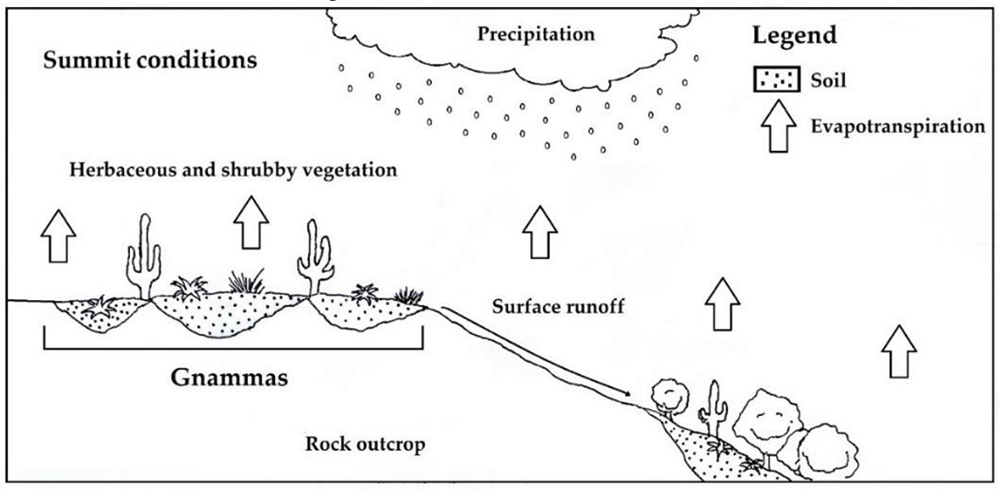
 Source: The authors (2023).
 Source: The authors (2023).