
 Geoepidemiological Profile of Venomous Animal Incidents in Indigenous and Non-Indigenous Populations in Brazil
Abstract
This study analyzes venomous animal incidents between 2012 and 2023 using data from the Notifiable Diseases Information System (SINAN), focusing on differences between Indigenous and non-Indigenous populations. It uses a cross-sectional and ecological methodology, incorporating descriptive statistical analyses and Moran's spatial autocorrelation to examine geographic patterns and identify prevalence clusters. The results reveal a concentration of notifications in the Southeast region. Among the groups analyzed, the Indigenous population had the highest prevalence rate, with 2,654 cases per 100,000 inhabitants, demonstrating significant vulnerability to venomous animal incidents. Regarding age groups, Indigenous children and adolescents were particularly susceptible. Scorpions were the main causative agent among non-Indigenous individuals (57.3%), while snakes were more prevalent among Indigenous groups (56.6%). The study underscores the need for public policies and prevention strategies that consider the cultural and environmental specificities of vulnerable populations, emphasizing the importance of educational and public health actions adapted to local realities.
Keywords:
Indigenous Population; Non-Indigenous Population; Geoepidemiology; Public Health
Resumo
Este estudo analisa os acidentes por animais peçonhentos entre 2012 e 2023 a partir dos dados do Sistema de Informação de Agravos de Notificação (SINAN) com enfoque nas diferenças entre populações indígenas e não-indígenas. A metodologia adotada é transversal e ecológica, incorporando análises descritivas estatísticas e a autocorrelação espacial de Moran para examinar padrões geográficos e identificar aglomerados de prevalência. Os resultados revelam a concentração das notificações na região Sudeste. Entre os grupos analisados, a população indígena apresentou a maior taxa de prevalência, com 2.654 casos por 100.000 habitantes, evidenciando uma vulnerabilidade significativa a acidentes por animais peçonhentos. Em relação à faixa etária, crianças e adolescentes indígenas mostraram-se particularmente suscetíveis. Quanto aos agentes causadores, escorpiões lideram entre os não-indígenas (57,3%), enquanto as serpentes são mais prevalentes entre os indígenas (56,6%). Sublinha-se a necessidade de políticas públicas e estratégias de prevenção que considerem as especificidades culturais e ambientais das populações vulnerabilizadas, enfatizando a importância de ações educativas e de saúde pública adaptadas às realidades locais.
Palavras-chave:
População Indígena; População Não Indígena; Geoepidemiologia; Saúde Coletiva
INTRODUCTION
In recent years, accidents involving venomous animals have become a relevant topic in public health, reflecting the complex connections between human health and environmental factors, including, but not limited to, climate change. It is anticipated that climate change, alongside other factors (e.g., habitat loss), will lead to increased migration of venomous animals such as snakes, spiders, and insects like bees and ants (Needleman et al., 2018a). The destruction of natural habitats, often driven by unregulated urban expansion and the conversion of natural areas into agricultural land, forces these animals to migrate to new territories, raising the risk of interactions with humans. These transformations are not restricted to terrestrial animals and include marine species and venomous amphibians, such as jellyfish, poisonous fish, and toxic frogs, which are also affected by environmental changes (Needleman et al., 2018b). It is important to distinguish that venomous animals possess specialized structures for injecting venom, such as fangs or stingers, while poisonous animals release toxins through their skin or other body parts when touched or ingested. Transformations in climate patterns, including global warming and changes in rainfall regimes, directly impact both venomous and poisonous animals, increasing risks to human and animal health, particularly for historically vulnerable populations, and bringing significant implications for industries, trade, and tourism.
Changes in global climate patterns, characterized by global warming and altered rainfall regimes, directly affect the behavior and geographic distribution of venomous animals (Needleman et al., 2018a). Global warming causes changes in the behavioral patterns of these animals, such as periods of activity, reproduction, and hibernation (Moreno-Rueda et al., 2009). That, in turn, can lead to an increase in the frequency of interactions between these animals and humans, especially in rural and peri-urban areas where human expansion encroaches on natural habitats (Zacarias, Loyola, 2018). As global temperatures rise, the activity season for many venomous animals may lengthen, leading to a more extended yearly period during which the risk of envenomation is elevated. That is particularly relevant for regions experiencing a significant increase in average and minimum temperatures (Martínez et al., 2022), especially in Global South countries like Brazil.
In this context, this study describes and analyzes accidents involving venomous animals reported in the Sistema de Informação de Agravos de Notificação (SINAN, national SUS system that records notifications of health issues) between 2013 and 2022, focusing on Indigenous populations. It also identifies geographic distribution patterns and highlights differences in how vulnerable these populations are to these risks.
The relevance of this study lies in the need to understand the factors reshaping the risks associated with venomous animal accidents. Indigenous peoples, who maintain a deep connection to their traditional territories, are disproportionately affected, facing not only an elevated risk of accidents but also the associated complications that affect their lives at a community level, resulting in the loss of livelihood and culture (Green; Raygorodetsky, 2010). Therefore, it is imperative to investigate these dynamics to develop effective prevention and mitigation strategies, safeguarding public health and Indigenous populations' cultural and environmental integrity.
With this in mind, this study conducts a comparative analysis of the epidemiological profile and spatial distribution of accidents involving venomous animals, distinguishing between Indigenous and non-Indigenous populations. It seeks to identify geographic distribution patterns and highlight how Indigenous peoples are more vulnerable to these risks. This analysis will advance our understanding of the impacts of these accidents on public health and inform the development of effective responses to the challenges posed by venomous animals.
METHODOLOGY
This cross-sectional and ecological study aimed to investigate the prevalence of venomous animal accidents in Brazil from 2013 to 2022, using records from the SINAN. Following the guidelines of the Brazilian Ministry of Health (2024), a confirmed case was characterized by clinical signs of envenomation specific to the animal category involved without the need to identify the causative animal.
Data included individuals of all age groups, genders, and other sociodemographic variables as available in SINAN. The variables analyzed included individual notification data, such as age, gender, pregnancy status, race/color, and education level; residential data, such as municipality of residence; epidemiological background, such as the interval between the bite and medical attention and the location of the bite; and clinical data, including local and systemic manifestations, type of accident, case classification, and outcome. Non-Indigenous individuals were classified as those reported under white, black, brown, and yellow (Asian) race/ethnicity categories, while Indigenous individuals were those reported as Indigenous. Rates were calculated per 100,000 inhabitants. Missing data referred to records in which information about race/ethnicity was not adequately filled out in the system, leading to absent or inconsistent data that could not be accurately classified.
Data was collected via the DATASUS file transfer system, supplemented by demographic and socioeconomic information from the 2010 Census (Instituto Brasileiro de Geografia e Estatística - IBGE, the Brazilian Institute of Geography and Statistics). Data processing was performed using the R statistical software, where descriptive statistics and Pearson's Chi-square test were conducted to assess differences between populations. Spatial analysis was integrated using Anselin Moran I's spatial autocorrelation index, categorizing the spatial distribution of events into four types of spatial association: High-High and Low-Low Clusters, and High-Low and Low-High Outliers (where clusters represent geographically proximate areas with similar values of a specific variable, and outliers represent areas with discrepant values compared to their surroundings). To generate the maps, the shapefile resulting from the LISA spatial analysis was processed using the ArcGIS software, licensed by the Universidade Federal do Rio Grande do Sul (Federal University of Rio Grande do Sul in English).
The study adhered to the ethical principles outlined by the General Data Protection Law (Law No. 13,709/2018) and the Resolution of the National Health Council No. 466/2012. Since it utilized anonymized secondary data, ethical approval by a Research Ethics Committee was waived.
RESULTS
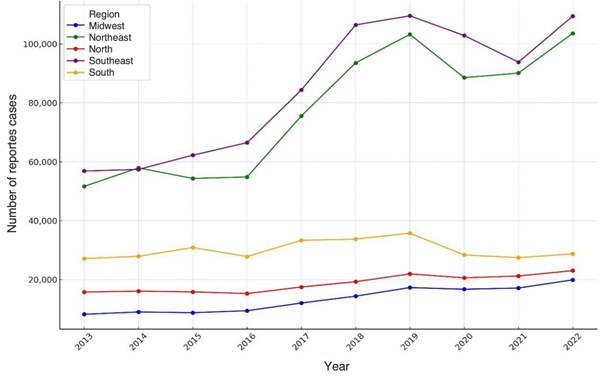
In the analysis of notifications of venomous animal accidents (Figure 1), the Southeast region leads from 2013 to 2022, followed by the Northeast region. The South, North, and Central-West regions rank third, fourth, and fifth, respectively. The peak in notifications across all regions occurred in 2019.

Evolution of reported cases of venomous animal accidents, Major Regions, Brazil, 2013 to 2022
The results presented in Table 1 show that the majority of reported cases involve individuals identified as brown (pardos), representing 46.6% of the total, followed by white individuals (34.0%) and black individuals (5.6%). The lowest prevalence was observed among individuals of Asian descent (0.7%). Notably, the highest prevalence rate was recorded among Indigenous peoples, with 2,654.0 cases per 100,000 inhabitants, suggesting a heightened vulnerability of this group to venomous animal accidents. On the other hand, cases categorized as "Ignored" and "Invalid Data" represent 10.3% and 1.9% of the total, respectively, indicating gaps in the recording of racial data in health systems.
Table 2 presents information on the non-Indigenous and Indigenous populations by sex and age group. A predominance of cases is observed among males in the non-Indigenous population (55.2% of cases, at a rate of 1,325.5 per 100,000 inhabitants) and the Indigenous population (61.6%, at a rate of 3,260.5). For females, the numbers are slightly lower among non-Indigenous individuals (44.8%, rate of 1,032.8) compared to Indigenous individuals (38.4%, rate of 2,044.1), indicating a statistically significant (p<0.0001) discrepancy in the incidence rate per 100,000 inhabitants between sexes and between Indigenous and non-Indigenous populations.
Regarding age groups, the data reveal that the prevalence of accidents varies considerably, with the highest rates observed among younger and older groups in the Indigenous population, highlighting greater vulnerability or exposure to venomous animals. Specifically, Indigenous infants under 1 year and adolescents aged 15 to 17 show elevated prevalence rates (2,488.5 and 3,229.7 per 100,000 inhabitants, respectively). In contrast, among non-Indigenous individuals, the age distribution of accidents shows a different pattern, with higher rates observed between the 18 to 29 and 50 to 59 age groups.
Regarding education level (Table 3), it is notable that there were no recorded cases among illiterate individuals in either group, suggesting potential gaps in data collection or accessibility to the notification system for all segments of the population. Among non-Indigenous individuals, the majority of cases are concentrated among people with some primary education, representing 25.6% of the total, followed by individuals with complete secondary education and some secondary education. In the Indigenous population, there is also a significant presence of cases among people with some primary education, as well as a notable percentage of records categorized as "Ignored" or "Invalid Data (missing)," indicating issues with data accuracy and the integrity of the reported information.
As for pregnancy status, a relatively low number of cases were reported among pregnant individuals, distributed fairly evenly across the three trimesters in both populations. However, the vast majority of records indicate that most individuals were not pregnant at the time of the accident or that this information was not applicable, which may include male individuals or non-pregnant women.
In the identified accidents (Table 4), scorpions are the primary cause of venomous animal accidents among non-Indigenous individuals, representing 57.3% of cases, followed by spiders (14.1%) and snakes (12.9%). In contrast, among the Indigenous population, snake accidents are the most predominant, accounting for 56.6% of cases.
Regarding the location of the bite, both groups show a tendency for bites on the feet as the most common, especially among Indigenous individuals, where 44% of accidents affect this part of the body. That suggests greater exposure of the feet to environments where such animals are prevalent, likely due to differences in daily activities or footwear use.
The time to receive medical care is critical in managing venomous animal accidents, with most cases receiving care within 1 to 3 hours after the bite. However, a significant proportion of notifications, both among non-Indigenous and Indigenous individuals, report seeking care over 24 hours after the accident.
Regarding case classification, most cases in both populations are classified as mild, with 82.5% among non-Indigenous individuals and 62.2% among Indigenous individuals, indicating that a significant portion of the accidents result in less severe symptoms. However, the proportion of moderate and severe cases is significantly higher among Indigenous people (27.8% and 5.6%, respectively) compared to non-Indigenous people (11.3% and 1.6%).
The prevalence of local complications is also higher among Indigenous individuals, with 4% of cases reporting complications, in contrast to only 1.1% among non-Indigenous individuals. This stark difference may reflect not only the nature of the accidents but also disparities in access to immediate medical care and effective treatment, highlighting a critical public health issue.
Secondary infection and extensive necrosis are the most common among the specified local complications. Notably, the proportion of cases resulting in amputation, though low, is significantly higher when local complications are reported, indicating the potential severity of these accidents. Systemic complications, though less frequent, also show a discrepancy, being more prevalent among Indigenous people.
Most cases result in recovery, precisely 91.4% for non-Indigenous individuals and 89.4% for Indigenous individuals. However, the mortality rate due to venomous animal accidents is higher among Indigenous people (0.6% compared to 0.1% among non-Indigenous people), a statistically significant difference that underscores the inequalities in the impact of these accidents between the populations.
Regarding the distribution of spatial clustering levels, as illustrated in Figure 1, there is a predominant concentration of High-High clusters among the Indigenous population in the states of Amazonas, Acre, and Mato Grosso, regions with a higher proportion of Indigenous residents. Notably, there is a continuous sequence of Low-Low clusters extending from the northeast of Paraná to the northeastern coast of Brazil, also encompassing parts of the northern region. In the extreme south of the country, specifically in the south-central region of Rio Grande do Sul, approximately half of the territory is also influenced by a Low-Low cluster.
For the non-Indigenous population, a High-High cluster is observed along the coast of Paraná and, in a more dispersed manner, in the state of São Paulo, Pará, as well as in the southwestern and northwestern regions of Minas Gerais and southern Bahia. The states of Mato Grosso and Rio Grande do Sul are notable for their almost complete coverage by Low-Low clusters, with some High-Low outliers.

Level of spatial clustering for reported venomous animal accidents, Indigenous (A) and non-Indigenous (B), Brazil, 2013 to 2022
DISCUSSION
Our results highlight a differentiated vulnerability to venomous animal accidents between Indigenous and non-Indigenous populations. Research indicates that unregulated urban expansion, lack of pest control, and inadequate waste management significantly contribute to the proliferation of scorpions in urban and peri-urban areas (Zanetta et al., 2020; Cruz et al., 1995; Guerra-Duarte et al., 2023). These factors create favorable environments for the survival and reproduction of these arachnids, increasing the incidence of scorpion accidents, especially in densely populated regions (Olivero et al., 2021).
The higher prevalence of snakebite accidents among Indigenous peoples reflects the more frequent contact of these communities with natural habitats. A study conducted in the Western Brazilian Amazon showed that people living in rural or forested areas are more likely to be affected by snakebites due to the presence of snakes and activities such as extractivism and agriculture (Silva; Colombini Moura-da-Silva; Souza; Monteiro; Bernarde, 2020; Silva; Fonseca; Silva, Amaral; Ortega; Oliveira; Correa; Oliveira; Monteiro; Bernarde, 2020). Schneider et al. (2021) demonstrated that Indigenous people have the highest rates of exposure to snakebites (194.3 per 100,000 inhabitants), significantly higher compared to other population groups.
The tendency for snakebites to occur on the feet, particularly among Indigenous people, reflects cultural practices and outdoor activities often carried out by this population without proper protection and adequate lighting (Pierini et. al., 1996). In many cases, Indigenous and other rural populations engage in subsistence activities such as hunting, gathering, or farming while barefoot or using minimal footwear, which significantly increases their exposure to snakes (Leite et al., 2013; Jayawardana et al., 2020; Venugopalan et al., 2021). Moreover, these activities typically occur in environments with a high presence of snakes, such as forests, fields, and riverbanks, which are natural habitats for these animals (Eniang et. al., 2012;Silva; Fonseca; Silva; Amaral; Ortega; Oliveira; Correa; Oliveira; Monteiro; Bernarde, 2020).
The time to access healthcare is a crucial factor in preventing severe complications, particularly for Indigenous populations who face significant geographical and logistical barriers. Studies indicate that distance and the lack of adequate infrastructure delay access to treatment, substantially increasing health risks (Nguyen et al., 2020). Additionally, cultural issues and discrimination in healthcare further hinder admittance and care continuity (Nelson; Wilson, 2018). Decentralizing, improving infrastructure in remote areas, and developing intercultural strategies in healthcare services are essential to mitigate these risks and ensure that care reaches vulnerable populations efficiently (Juárez-Ramírez et al., 2019). Community initiatives like building healthcare infrastructure adapted to local needs have also shown positive results in expanding access to primary care (Dutta, 2020).
The classification of venomous animal accident cases, with increased severity among Indigenous populations, underscores the urgent need for culturally appropriate and effective public health interventions (Farias et al., 2023). The high prevalence of complications, such as secondary infections and extensive necrosis in these populations, highlights the need for immediate and adequate healthcare, along with continuous follow-up to treat complications (Murta et al., 2023). Studies demonstrate that decentralizing antivenom treatment to local healthcare units within Indigenous territories can reduce the time between diagnosis and treatment, improving the prognosis of envenomation and reducing severe sequelae (Monteiro et al., 2020).
Although this study does not explore the effects of climate change on the reporting of venomous animal accidents, it is worth considering that changes in temperature and precipitation regimes may influence the geographic distribution and behavior of some venomous species (Needleman, 2018a; 2018b; Bouazza et al., 2019; Martinez et. al., 2018; Martinez et. al., 2022; Martinez et. al., 2024; Zacarias, Loyola., 2018). Future studies could explore these hypotheses using predictive models to assess how climate change may alter risk patterns.
The gap in data completeness in the healthcare sector, combined with the need for interoperability with environmental data, highlights the urgency for more robust and integrated reporting systems. Effective integration is crucial to ensure accessible health information to support evidence-based decision-making (Ying et al., 2007).
Scientific literature suggests that integrating data from various sources can significantly improve the completeness of records, contributing to more efficient healthcare management (Emran et. al., 2017). Furthermore, interoperability between healthcare systems enables not only the secure exchange of information but also enhances the quality of available data for epidemiological analysis (Dixon et al., 2011).
CONCLUSION
This study highlighted the heightened vulnerability of Indigenous populations to venomous animal accidents, particularly the high prevalence of snakebites within this group. The results demonstrated that the geographic distribution of accidents is influenced by factors such as proximity to natural habitats and the cultural practices of Indigenous populations, who are often exposed to greater risks. Additionally, the spatial analysis underscored the importance of targeted, territory-based strategies for allocating healthcare resources, especially in remote regions with a high concentration of accidents.
Public policies must account for these vulnerabilities when planning interventions to ensure rapid and effective access to treatment, such as the decentralization of healthcare units equipped with antivenom in Indigenous areas. The findings of this research emphasize the need to improve healthcare infrastructure and data collection to optimize the response to these accidents and mitigate disparities between Indigenous and non-Indigenous populations.
To further comprehend the dynamics underlying this context, future research should adopt analyses of socio-environmental factors and the implications of climate change. Given that variations in temperature and precipitation patterns have the potential to alter the geographic distribution and behavior of venomous animals, it is crucial to explore how climate change may increase risks for vulnerable populations. Such studies could contribute to establishing a solid scientific foundation to support the development of effective and interculturally based interventions, as well as health policies that not only anticipate but also mitigate the impacts of climate change on human health, with particular attention to Indigenous communities.
References
- BOUAZZA, A.; EL HIDAN, M. A.; AIMRANE, A.; KAHIME, K.; LANSARI, A.; LAARADIA, M. A.; LAHOUAOUI, H.; MOUKRIM, A. Climate Change Effects on Venomous Snakes: Distribution and Snakebite Epidemiology. In: Handbook of Research on Global Environmental Changes and Human Health. IGI Global, 2019.
-
CRUZ, E.; YASSUDA, C. R.; JIM, J.; BARRAVIERA, B. Programa de controle de surto de escorpião Tityus serrulatus, Lutz e Mello 1922, no município de Aparecida, SP (Scorpiones, Buthidae). Revista da Sociedade Brasileira de Medicina Tropical, v. 28, n. 2, p. 123-128, 1995. https://doi.org/10.1590/S0037-86821995000200007
» https://doi.org/10.1590/S0037-86821995000200007 -
DIXON, B.; McGOWAN, J.; GRANNIS, S. Electronic laboratory data quality and the value of a health information exchange to support public health reporting processes. AMIA - Annual Symposium proceedings, p. 322-330, 2011. Disponível em: https://www.ncbi.nlm.nih.gov/pmc/articles/PMC3243173/ Acesso em: 20 ago. 2024.
» https://www.ncbi.nlm.nih.gov/pmc/articles/PMC3243173/ -
DUTTA, U. Indigenous Health Organizing at the Margins: Creating Access to Health by Building Health Infrastructure. Health Communication, v. 35, p. 1177-1189, 2020. https://doi.org/10.1080/10410236.2019.1622065
» https://doi.org/10.1080/10410236.2019.1622065 -
EMRAN, N.; LEZA, F. N. M.; ABDULLAH, N. Measuring Improvement in Access to Complete Data in Healthcare Collaborative Database Systems. In: Król, D., Nguyen, N., Shirai, K. (eds) Advanced Topics in Intelligent Information and Database Systems. ACIIDS 2017. Studies in Computational Intelligence, v. 710. Springer, Cham. 2017. https://doi.org/10.1007/978-3-319-56660-3_11
» https://doi.org/10.1007/978-3-319-56660-3_11 -
ENIANG, E.; IJEOMAH, H. Epidemiology of snake bites among selected communities in the enclave of Cross River National Park: Oban division, Nigeria. Journal of Agriculture, Forestry and the Social Sciences, v. 9, n. 2. 2012. https://doi.org/10.4314/JOAFSS.V9I2.8
» https://doi.org/10.4314/JOAFSS.V9I2.8 -
FARIAS, A. S.; NASCIMENTO, E. F.; GOMES FILHO, M. R.; FELIX, A. C.; ARÉVALO, M. C.; ADRIÃO, A. A. X.; WEN, F. H.; CARVALHO, F. G.; MURTA, F.; MACHADO, V. A.; SACHETT, J.; MONTEIRO, W. M. Building an explanatory model for snakebite envenoming care in the Brazilian Amazon from the indigenous caregivers’ perspective. PLoS Neglected Tropical Diseases, v. 17, n. 3, 2023. https://doi.org/10.1371/journal.pntd.0011172.
» https://doi.org/10.1371/journal.pntd.0011172 -
FEITOSA, E.; SAMPAIO, V.; SALINAS, J.; QUEIROZ, A.; SILVA, I.; GOMES, A.; SACHETT, J.; SIQUEIRA, A.; FERREIRA, L.; SANTOS, M.; LACERDA, M.; MONTEIRO, W. Older Age and Time to Medical Assistance Are Associated with Severity and Mortality of Snakebites in the Brazilian Amazon: A Case-Control Study. PLoS ONE, v. 10, n. 7. 2015. https://doi.org/10.1371/journal.pone.0132237
» https://doi.org/10.1371/journal.pone.0132237 -
GREEN, D.; RAYGORODETSKY, G. Indigenous knowledge of a changing climate. Climatic Change, v. 100, p. 239-242, 2010. https://doi.org/10.1007/S10584-010-9804-Y
» https://doi.org/10.1007/S10584-010-9804-Y -
GUERRA-DUARTE, C.; SAAVEDRA-LANGER, R.; MATAVEL, A.; OLIVEIRA-MENDES, B.; CHÁVEZ-OLÓRTEGUI, C.; PAIVA, A. Scorpion envenomation in Brazil: Current scenario and perspectives for containing an increasing health problem. PLoS Neglected Tropical Diseases, v. 17, 2023. https://doi.org/10.1371/journal.pntd.0011069.
» https://doi.org/10.1371/journal.pntd.0011069 -
INSTITUTO BRASILEIRO DE GEOGRAFIA E ESTATÍSTICA - IBGE. Sistema IBGE de Recuperação Automática (SIDRA). 2010. Disponível em: https://sidra.ibge.gov.br/pesquisa/censo-demografico/demografico-2022/universo-caracteristicas-dos-domicilios Acesso em: 13 abr. 2024.
» https://sidra.ibge.gov.br/pesquisa/censo-demografico/demografico-2022/universo-caracteristicas-dos-domicilios -
INSTITUTO BRASILEIRO DE GEOGRAFIA E ESTATÍSTICA - IBGE. Malha Municipal. 2022. Disponível em: https://www.ibge.gov.br/geociencias/organizacao-do-territorio/malhas-territoriais/15774-malhas.html Acesso em: 14 nov. 2024.
» https://www.ibge.gov.br/geociencias/organizacao-do-territorio/malhas-territoriais/15774-malhas.html -
JAYAWARDANA, S.; ARAMBEPOLA, C.; CHANG, T.; GNANATHASAN, A. Prevalence, vulnerability and epidemiological characteristics of snakebite in agricultural settings in rural Sri Lanka: A population-based study from South Asia. PLoS ONE, v. 15, n. 12. 2020. Available: https://doi.org/10.1371/journal.pone.0243991.
» https://doi.org/10.1371/journal.pone.0243991 -
JUÁREZ-RAMÍREZ, C.; VILLALOBOS, A.; SAUCEDA-VALENZUELA, A.; NIGENDA, G. Barriers for indigenous women to access obstetric services within the framework of integrated health services networks. Gaceta Sanitaria, v. 34, n. 6. 2019. https://doi.org/10.1016/j.gaceta.2019.05.015.
» https://doi.org/10.1016/j.gaceta.2019.05.015 -
LEITE, R. S.; TARGINO, I. T. G.; LOPES, Y. A. C. F.; BARROS, R. M.; VIEIRA, A. A. Epidemiology of snakebite accidents in the municipalities of the state of Paraíba, Brazil. Ciência & Saúde Coletiva, v. 18, n. 5, 2013. Available: https://doi.org/10.1590/S1413-81232013000500032.
» https://doi.org/10.1590/S1413-81232013000500032 -
MARTINEZ, P. A.; ANDRADE, M. A.; BIDAU, C. J. Potential effects of climate change on the risk of accidents with poisonous species of the genus Tityus (Scorpiones, Buthidae) in Argentina. Spat Spatiotemporal Epidemiol., v. 25, p. 67-72, jun. 2018. https://doi.org/10.1016/j.sste.2018.03.002.
» https://doi.org/10.1016/j.sste.2018.03.002 -
MARTINEZ, P.; GUTIÉRREZ, J.; OLALLA‐TÁRRAGA, M.; AMADO, T. Venomous animals in a changing world. Global Change Biology, v. 28, p. 3750-3753, 2022. https://doi.org/10.1111/gcb.16175.
» https://doi.org/10.1111/gcb.16175 -
MARTINEZ, P. A.; TEIXEIRA, I. B. d. F.; SIQUEIRA-SILVA, T.; et al. Climate change-related distributional range shifts of venomous snakes: a predictive modelling study of effects on public health and biodiversity. Lancet Planet Health, v. 8, p. e163-e170, 2024. https://doi.org/10.1016/S2542-5196(24)00005-6.
» https://doi.org/10.1016/S2542-5196(24)00005-6 -
MONTEIRO, W. M.; FARIAS, A. S.; VAL, F.; SILVA NETO, A. V.; SACHETT, A.; LACERDA, M.; SAMPAIO, V.; CARDOSO, D.; GARNELO, L.; VISSOCI, J. R. N.; SACHETT, J.; WEN, F. H. Providing Antivenom Treatment Access to All Brazilian Amazon Indigenous Areas: ‘Every Life has Equal Value’. Toxins, v. 12, 2020. https://doi.org/10.3390/toxins12120772.
» https://doi.org/10.3390/toxins12120772 -
MORENO-RUEDA, G.; PLEGUEZUELOS, J.; ALAMINOS, E. Climate warming and activity period extension in the Mediterranean snake Malpolon monspessulanus. Climatic Change, v. 92, p. 235-242, 2009. https://doi.org/10.1007/S10584-008-9469-Y.
» https://doi.org/10.1007/S10584-008-9469-Y -
MURTA, F.; STRAND, E.; FARIAS, A. S.; ROCHA, F.; SANTOS, A. C.; RONDON, E. A. T.; OLIVEIRA, A. P. S.; GAMA, H. S. S.; ROCHA, Y. V.; ROCHA, G. S.; FERREIRA, M.; MACHADO, V. A.; LACERDA, M.; PUCCA, M.; CERNI, F.; VISSOCI, J. R. N.; TUPETZ, A.; GERARDO, C. J.; MOURA-DA-SILVA, A. M.; WEN, F. H.; SACHETT, J.; MONTEIRO, W. “Two Cultures in Favor of a Dying Patient”: Experiences of Health Care Professionals Providing Snakebite Care to Indigenous Peoples in the Brazilian Amazon. Toxins, v. 15, 2023. Available: https://doi.org/10.3390/toxins15030194. Accessed on: 25 ago. 2024.
» https://doi.org/10.3390/toxins15030194 -
NEEDLEMAN, R.; NEYLAN, I.; ERICKSON, T. Potential Environmental and Ecological Effects of Global Climate Change on Venomous Terrestrial Species in the Wilderness. Wilderness & Environmental Medicine, v. 29, p. 226-238, 2018a. https://doi.org/10.1016/j.wem.2017.11.004.
» https://doi.org/10.1016/j.wem.2017.11.004 -
NEEDLEMAN, R.; NEYLAN, I.; ERICKSON, T. Environmental and Ecological Effects of Climate Change on Venomous Marine and Amphibious Species in the Wilderness. Wilderness & Environmental Medicine, v. 29, p. 343-356, 2018b. https://doi.org/10.1016/j.wem.2018.04.003.
» https://doi.org/10.1016/j.wem.2018.04.003 -
NELSON, S. E.; WILSON, K. Understanding barriers to health care access through cultural safety and ethical space: Indigenous people's experiences in Prince George, Canada. Social Science & Medicine, v. 218, p. 21-27, 2018. https://doi.org/10.1016/j.socscimed.2018.09.017
» https://doi.org/10.1016/j.socscimed.2018.09.017 -
NGUYEN, N.; SUBHAN, F.; WILLIAMS, K.; CHAN, C. B. Barriers and Mitigating Strategies to Healthcare Access in Indigenous Communities of Canada: A Narrative Review. Healthcare, v. 8, 2020. https://doi.org/10.3390/healthcare8020112.
» https://doi.org/10.3390/healthcare8020112 -
NUCKOLS, J.; WARD, M.; JARUP, L. Using Geographic Information Systems for Exposure Assessment in Environmental Epidemiology Studies. Environmental Health Perspectives, v. 112, p. 1007-1015, 2004. https://doi.org/10.1289/ehp.6738.
» https://doi.org/10.1289/ehp.6738 -
OLIVERO, P.; OVIEDO-DIEGO, M.; VRECH, D.; MATTONI, C.; PERETTI, A. Sensitivity of genital and somatic traits of scorpions to developmental instability caused by increasing urbanization: A 20-year experiment. Ecological Indicators, v. 122, p. 107272, 2021. https://doi.org/10.1016/j.ecolind.2020.107272.
» https://doi.org/10.1016/j.ecolind.2020.107272 -
PIERINI, S., WARRELL, D., PAULO, A., & THEAKSTON, R. High incidence of bites and stings by snakes and other animals among rubber tappers and Amazonian Indians of the Juruá Valley, Acre State, Brazil Toxicon: official journal of the International Society on Toxinology, 34 2, 225-36. 1996. https://doi.org/10.1016/0041-0101(95)00125-5.
» https://doi.org/10.1016/0041-0101(95)00125-5 -
SCHNEIDER, M.; VUČKOVIĆ, M.; MONTEBELLO, L.; SARPY, C.; HUANG, Q.; GALAN, D.; MIN, K.; CÂMARA, V.; LUIZ, R. Snakebites in Rural Areas of Brazil by Race: Indigenous the Most Exposed Group. International Journal of Environmental Research and Public Health, v. 18, 2021. https://doi.org/10.3390/ijerph18179365.
» https://doi.org/10.3390/ijerph18179365 -
SILVA, A. M.; COLOMBINI, M.; MOURA-DA-SILVA, A. M.; SOUZA, R. M.; MONTEIRO, W. M.; BERNARDE, P. S. Epidemiological and clinical aspects of snakebites in the upper Juruá River region, western Brazilian Amazonia. Acta Amazonica, 2020. https://doi.org/10.1590/1809-4392201901561.
» https://doi.org/10.1590/1809-4392201901561 -
SILVA, J.; FONSECA, W.; SILVA, A.; AMARAL, G.; ORTEGA, G.; OLIVEIRA, A.; CORREA, R.; OLIVEIRA, I.; MONTEIRO, W.; BERNARDE, P. Venomous snakes and people in a floodplain forest in the Western Brazilian Amazon: Potential risks for snakebites. Toxicon: Official Journal of the International Society on Toxinology, v. 187. 2020. https://doi.org/10.1016/j.toxicon.2020.09.007.
» https://doi.org/10.1016/j.toxicon.2020.09.007 -
SINAN. Sistema de Informação de Agravos de Notificação. Dados abertos. c2024. Disponível em: https://datasus.saude.gov.br/informacoes-de-saude-tabnet/ Acesso em: 23 ago. 2024
» https://datasus.saude.gov.br/informacoes-de-saude-tabnet/ -
VENUGOPALAN, A.; VIJAYKUMAR, S.; SREEKUMAR, G.; KARUNANITHI, K.; PRASAD, B.; SREEKRISHNAN, T. P.; KUMAR, G. K. Venomous snakebite - Significance of the bite site and local reaction. IP International Journal of Forensic Medicine and Toxicological Sciences, 2021. https://doi.org/10.18231/J.IJFMTS.2021.012.
» https://doi.org/10.18231/J.IJFMTS.2021.012 -
VINE, M.; DEGNAN, D.; HANCHETTE, C. Geographic information systems: their use in environmental epidemiologic research. Environmental Health Perspectives, 1997. https://doi.org/10.1289/EHP.97105598.
» https://doi.org/10.1289/EHP.97105598 -
ZACARIAS, D.; LOYOLA, R. Climate change impacts on the distribution of venomous snakes and snakebite risk in Mozambique. Climatic Change, v. 152, p. 195-207, 2018. https://doi.org/10.1007/s10584-018-2338-4
» https://doi.org/10.1007/s10584-018-2338-4 -
ZANETTA, S.; GERMINO, C.; RODRIGUES, I.; WARAGAIA, A. Urbanization and increased cases of scorpionism in Brazilian cities. European Journal of Public Health, v. 30, 2020. https://doi.org/10.1093/eurpub/ckaa166.163
» https://doi.org/10.1093/eurpub/ckaa166.163 -
YING, B.; RONG, Z.; XIAO, J. A Data Integration Approach to E-Healthcare System. In: 2007 1st International Conference on Bioinformatics and Biomedical Engineering, p. 1129-1132, 2007, Wuhan, China. https://doi.org/10.1109/ICBBE.2007.292.
» https://doi.org/10.1109/ICBBE.2007.292

 Source: The authors (2023) based on