
 Economic Growth and Environmental Sustainability in Latin American Countries: A Green GDP Approach
Abstract
Since the second half of the twentieth century, advancing economic growth in global economies has led to a significant increase in environmental concerns. In this context, it has become evident that widely used socioeconomic indicators do not include variables related to the environment and other social issues, such as labor and education. Therefore, it is necessary to reflect on and develop new indicators that address these aspects, with Green GDP being a prominent example of how to bridge this gap. The aim of this study is to analyze the relationship between economic growth and environmental sustainability in Latin American countries by comparing the growth rates of traditional GDP and Green GDP across twenty selected countries. The methodology involved estimating Green GDP, which adjusts traditional GDP by excluding the cost of natural resource consumption and environmental depletion. Data were gathered from reputable sources, such as the World Bank, the Australian Energy Regulator, the Latin America and Caribbean Energy Hub, and Global Petrol Prices. The main findings indicate that the growth rate of Green GDP was higher than that of traditional GDP in the analyzed sample. Regionally, Central American countries showed significantly better results than South American countries. It can be concluded that most Latin American countries demonstrated more sustainable development, with the results suggesting that sustainability is, to some extent, accompanying economic growth in the region.
Keywords:
Green GDP; Economic growth; Latin America; Sustainable development; Environmental indicators
Resumo
A partir da segunda metade do século XX, o avanço do crescimento econômico nas economias globais levou a um aumento significativo das preocupações com as questões ambientais. Nesse contexto, tornou-se evidente que os indicadores socioeconômicos amplamente utilizados não incluíam variáveis relacionadas ao meio ambiente e a outros aspectos sociais, como trabalho e educação. Surge, então, a necessidade de refletir e desenvolver novos indicadores que englobem esses temas, sendo o PIB Verde um exemplo proeminente para preencher essa lacuna. Este estudo teve como objetivo analisar a relação entre crescimento econômico e sustentabilidade ambiental em países da América Latina, comparando as taxas de crescimento do PIB tradicional e do PIB Verde em vinte países selecionados. A metodologia utilizada envolveu a estimativa do PIB Verde, que ajusta o PIB tradicional ao excluir o custo do consumo de recursos naturais e os custos de esgotamento ambiental. Foram utilizados os dados mais recentes disponíveis para o ano de 2024, extraídos de fontes consolidadas, como o Banco Mundial, Australian Energy Regulator, o Hub de Energia da América Latina e do Caribe, e Global Petrol Prices, entre outros. Os principais resultados indicam que a taxa de crescimento do PIB Verde foi superior à do PIB tradicional na amostra analisada. No âmbito regional, os países da América Central apresentaram resultados significativamente melhores em comparação com os da América do Sul. Conclui-se que a maioria dos países da América Latina demonstrou um desenvolvimento direcionado para a sustentabilidade, com os resultados sugerindo que a sustentabilidade está, de algum modo, acompanhando o crescimento econômico na região.
Palavras-chave:
PIB Verde; Crescimento Econômico; América latina; Desenvolvimento Sustentável; Indicadores Ambientais
INTRODUCTION
The effects of rapid global economic and population growth experienced in the second half of the twentieth century marked the beginning of environmental concerns on a global scale. The constant pressures resulting from changes in consumption patterns, the labor market and the economic system as a whole have impacted the capacity of natural systems, with consequences such as environmental deterioration, loss of biodiversity, pollution, soil degradation, climate change and global warming (Andrade; Romero, 2011; Márquez Delgado et al., 2021).
As these concerns are now on the agenda of the international scientific community, a set of studies has been conducted in an attempt to understand and explain the relationship between environmental degradation and economic growth. Among the empirical studies, the works of Panayotou (1993), Grossman and Krueger (1995), Shafik and Bandyopadhyay (1992) and Shafik (1994) stand out, which were based on the concept of the Environmental Kuznets Curve (EKC), originally proposed by Simon Kuznets in 1955 (Andrée et al., 2019). The theoretical basis is that the early stages of economic development are typically associated with intense environmental deterioration (such as air, soil and water pollution), which is subsequently mitigated by increasing income, resulting in an inverted U-shaped curve (Alkhars et al., 2022).
According to Andrée et al. (2019), despite being a promising concept for sustainability, the EKC hypothesis has some notable flaws. For example, most studies on this hypothesis focus on a single variable as an indicator of environmental degradation, ignoring other relevant dimensions of environmental impacts. Thus, its conclusions apply only to specific types of pollutants and cannot be generalized to the environment as a whole.
In this respect, criticism of the relationship between economic growth and environmental degradation goes beyond the limitations of the EKC, also affecting the use of Gross Domestic Product (GDP) as an indicator of economic growth, especially in relation to three main issues: well-being, economic prosperity and sustainability (Bleys, 2012; Kurniawan et al., 2021). In other words, GDP does not measure the sustainability of economic growth, as a country can achieve a temporarily high GDP through the overexploitation of its natural resources; nor does GDP take into account income distribution, family production, loss of leisure time, the costs of environmental degradation, and social and public health costs, which are directly related to economic activity. Consequently, GDP is inadequate when it comes to measuring social well-being (Stjepanović et al., 2017).
Given the limitations of GDP as an indicator of sustainability, alternatives have emerged such as the Ecological Footprint (EF), Adjusted Net Savings (ANS), Inclusive Wealth (IW) and Green GDP, the latter being the focus of the present study. According to Stjepanović et al. (2017), Green GDP is a comprehensive concept that refers to a set of adjusted GDP measures, corrected for social and environmental costs. These measures incorporate elements that are not traditionally presented in monetary terms. Considering the importance and universal nature of the topic, this study is limited to Latin American countries in order to reflect on the current dynamics of this group of developing nations and the future challenges they face to achieve the Sustainable Development Goals (SDGs) of the 2030 Agenda.
In light of these considerations, this paper aims to analyze the relationship between economic growth and environmental sustainability in twenty Latin American countries by comparing conventional GDP growth rates with Green GDP growth rates. The methodology for estimating Green GDP is based on the model described by Stjepanović et al. (2017), which calculates adjusted GDP by excluding the cost of natural resource consumption and environmental depletion costs.
To achieve the proposed objective, the study is structured in six sections, including this introduction. The second section addresses discussions on the relationship between economic growth and environmental conservation. The third section explores the limitations of GDP as an indicator and future perspectives regarding the concept of Green GDP. The methodology is then described, including the geographical delimitation of the study, the data and sources used, and the model for estimating Green GDP. Finally, the section containing the analysis and discussion of the results presents the main contributions of the study, followed by the final considerations.
ECONOMIC GROWTH AND ENVIRONMENTAL CONSERVATION
Since the late 1960s, environmental issues have become a priority in the international debate due to their complexity and the negative impacts they have on society in both the ecological and socioeconomic spheres (Márquez Delgado et al., 2021). This decade was notable for the importance that the environment acquired in the scientific arena, notably with the action of the Club of Rome. For the first time, ecology stood out in international discussions, bringing together various groups and sectors of society. A significant publication in this context was the study by Meadows et al. (1972), known as the Meadows Report, which gained prominence at the United Nations Environment Conference in 1972. This report discussed the limits of economic growth and concluded that insistence on the current economic model and the scarcity of resources would lead to a catastrophic scenario, so that global equilibrium would be the only viable solution for environmental issues.
According to Andrade and Romeiro (2011), the relationship between economic growth and the environment has already been explored by classical economists, such as Adam Smith, David Ricardo and John Stuart Mill. These authors predicted the need for a “steady state”, since the limitation of natural resources and the impossibility of unrestricted productivity growth were obstacles to continuing economic expansion.
The United Nations conferences of 1972 and 1992, in addition to other events, discussions and research, highlighted the importance of sustainable development in contemporary societies (Hogan, 1993). According to Hogan (1993), there was growing environmental awareness, associated with concern for economic growth in less developed nations, as evidenced in the Brundtland report, Our Common Future. In this context, an attempt was made to define the concept of sustainable development, emphasizing the need to meet the demands of the current generation without compromising future generations (Caiado et al., 2018).
According to Andrade and Romero (2011), economic growth has a strong impact on environmental integrity. The transformation of capitalism in the late twentieth century brought about profound changes, affecting work processes, consumption patterns, and geographical and geopolitical configurations (Harvey, 1992), which in turn impacted the capacity of natural systems (Andrade; Romero, 2011). Traditional development, which prioritizes economic growth at any cost, without considering the limits of ecosystems, has accelerated environmental deterioration, resulting in loss of biodiversity, pollution, soil degradation, climate change, and global warming, among other consequences that directly affect living conditions on the planet (Márquez Delgado et al., 2021).
In response to these concerns regarding the limits of economic expansion and its environmental effects, several studies have sought to gain a better understanding of this relationship through the concept of the Environmental Kuznets Curve (EKC), derived from the idea of Simon Kuznets, who was awarded the Nobel Prize in Economic Sciences in 1971. Kuznets (1955) analyzed the relationship between economic growth and income distribution, concluding that, in the early phases, income is concentrated, but, with the increase in per capita income, distribution improves, characterizing an “inverted U” curve. According to Alkhars et al. (2022), the early stages of economic development are generally associated with intense deterioration of the environment, resulting from air, soil, and water pollution and other damage, with the environment tending to recover as income rises.
Studies conducted in the late twentieth century investigated the relationship between economic growth and environmental issues. Panayotou (1993) identified the presence of the EKC in relation to deforestation and pollution by sulfur dioxide (SO2), nitrogen oxides (NOx) and suspended particles, analyzing data from 55 countries, 41 of which were developing. Panayotou (1993) argued that, although environmental degradation is inevitable in the structural transformations that accompany growth, the EKC has not been as deep in many developing countries. In a similar study, Grossman and Krueger (1995) found that, in most of the indicators analyzed (air pollution, oxygen regime status, fecal contamination and heavy metal contamination), environmental deterioration was in its early stages, followed by improvement, evidencing an “inverted U” curve. This pattern was also identified by Shafik and Bandyopadhyay (1992) and Shafik (1994), who analyzed the relationship between per capita income and environmental quality based on a wide range of indicators, later incorporated into the World Bank's World Development Report 1992 (Andrée et al., 2019).
Recent studies have continued to test the EKC hypothesis. Aquilas et al. (2022) examined the relationship between deforestation and economic activities in Congo Basin countries, concluding that agriculture and GDP were significant determinants of deforestation, although the inverted-U relationship was not confirmed, except for the manufacturing industry. Frodyma, Papiez, and Smiech (2022) investigated the EKC in the European Union between 1970 and 2017, analyzing emissions based on energy production, consumption, and transformation, finding no evidence of a long-term relationship with the EKC. Cheikh, Zaied, and Chevallier (2021), studying the MENA region, observed an inverted-U pattern between energy use and CO₂ emissions, indicating a reduction in environmental degradation above a certain income level. Oduniyi et al. (2023), when gauging the impact of COVID-19 on the monthly average of carbon monoxide emissions in developed economies between 2014 and 2023, concluded that economic activity and environmental impact were not significant. Furthermore, the variables associated with COVID-19 were also not significant when it came to explaining the environmental impacts.
In Latin America, the EKC has also been identified in some studies. Ortiz-Paniagua and Gómez (2021), analyzing 19 countries in the region between 1970 and 2016, found that, after a certain point of economic growth, pollutant emissions began to decrease. Sánchez and Caballero (2019) confirmed the EKC for the relationship between climate change and economic activity, estimating that per capita income of US$10,134 would be necessary to reduce emissions. Ugalde Hernández (2023), in an analysis of Costa Rica from 1990 to 2021, concluded that the growth of CO₂ per capita was positively influenced by GDP per capita and energy consumption per capita. However, Ugalde Hernández (2023) claimed that the results could not be confirmed due to inconsistency in the statistical model. Finally, Freire, Silva and Oliveira (2023) corroborated the EKC hypothesis for Brazilian states between 1980 and 2020, mainly for environmental pollutants such as carbon dioxide and nitrous oxide.
LIMITATIONS OF THE GDP INDICATOR AND FUTURE PROSPECTS OF THE GREEN GDP CONCEPT
The development of modern civilization over the last three centuries has been diffuse in economic terms, making it increasingly necessary for it to be measured quantitatively. In the early twentieth century, the use of indicators, including non-economic ones, was adopted almost automatically by society. A scientifically calculated number, based on past and real observations and situations, would be ideal for identifying whether a country was growing at rates higher than, lower than or equal to the global average.
Gross Domestic Product (GDP), since the mid-twentieth century, has been commonly used by nations as a proxy to reflect economic development. GDP is defined as the aggregate value of all final goods and services produced within the economic territory of a country, regardless of the nationality of the owners of the production units (Sandroni, 1987, p. 234).
However, the introduction of GDP as an indicator of countries' economic development is based on the historical concept of development itself. Economic development is viewed as economic growth accompanied by improvements in the general quality of life (Oliveira, 2002).
Souza (1993) identified two main schools of thought on the subject. The first considers economic growth as synonymous with economic development, while the second argues that growth is a necessary but not sufficient condition for development. Thus, GDP represents the quantitative variation of the product, thereby measuring growth. On the other hand, development involves a more complex process, with significant structural transformations in the economic, political, social and environmental spheres (Scatolin, 1989).
Despite the rapid adoption of GDP as an indicator of economic growth, criticisms have been voiced since as far back as the 1960s owing to its limitations in representing the real economy. It has been argued that GDP does not adequately measure aspects such as social welfare, economic prosperity, environmental and sustainability issues, and aspects of the labor market (Siedenberg, 2003; Tayra; Ribeiro, 2006; Stjepanović et al., 2017). As noted by Bleys (2012), the problems of GDP as a measurement of economic well-being have been historically recognized by economists and social scientists.
In addition to not capturing income distribution, GDP also does not measure household production, leisure time, the costs of environmental degradation, and the social and public health costs related to economic activity, making it an insufficient indicator for social well-being (Stjepanović et al., 2017).
From an environmental viewpoint, GDP fails to measure whether a nation is growing at high rates at the expense of degrading its natural resources (Rauch; Chi, 2010; Stjepanović et al., 2017). In a scenario of growing concern over environmental issues, such as climate change and biome conservation, it is essential for policymakers to have more robust indicators available that are capable of detailing environmental reality over time.
According to Kurniawan et al. (2021), just as society has not yet resolved the issue of environmental degradation (which is responsible for countless socioeconomic problems), simply adopting economic growth has not improved social well-being in recent decades. Therefore, it is necessary to consider indicators that include environmental, labor, and well-being issues if the goal is to achieve fair and sustainable economic development.
The limitations of GDP as a measure of growth have led to studies that proposed alternative indicators to measure the sustainability of economic growth, whether as an adjustment, replacement or complement to GDP. This study addresses some of these indicators, such as the Ecological Footprint (EF) (Wackernagel et al., 1999; Rees, 1992), Adjusted Net Savings (ANS) (Hamilton; Clemens, 1999) and Inclusive Wealth (IW) (Arrow et al., 2003).
The EF measures the biologically productive area required to support current consumption patterns, considering current economic and technological processes (Wackernagel et al., 1999). ANS, proposed by the World Bank, measures the real savings rate after accounting for investments in human capital, depletion of natural resources and environmental damage (Bolt et al., 2002). IW, in turn, considers all capital assets (natural, human and produced), expressed in monetary terms, to assess contributions to human well-being (Cheng et al., 2022).
Another relevant indicator is Green GDP, which emerged in the 1990s in response to the limitations of traditional GDP in relation to environmental costs. This indicator adjusts GDP with regard to social and environmental costs, integrating the environment into the economy and highlighting its importance for sustainable development (Stjepanović et al., 2017).
Recent studies, such as that of Veklych and Shlapak (2013), have applied Green GDP to Ukraine, demonstrating its dependence on natural capital. Wang (2011) used Green GDP data to analyze the impact of trade liberalization in Chinese provinces. Stjepanović et al. (2017) calculated Green GDP for 44 countries in the European Union and the OECD, proposing a mechanism to compare sustainable economic growth across nations. The present study is based on this methodology, as the choice and use of variables are more enlightening for the desired proposal. In the future, technology and improved environmental databases are expected to help countries manage their natural capital, avoiding long-term environmental damage (Stjepanović et al., 2017).
METHODOLOGY
Geographical delimitation of the study
According to the report entitled Perspectivas económicas de América Latina 2022: hacia uma Transición Verde y Justa, climate change can have an even stronger impact on the economy and heighten inequality in Latin America. It is considered essential to have a green agenda that covers the whole territory and prioritizes the well-being of the entire population.
Considering the reflections presented above, it was decided to select developing countries in Latin America for the purposes of this study. This decision was based not only on the concerns raised in the report, but also on the relevance of measuring Green GDP as an indicator capable of reflecting on how economic growth is being understood and achieved in these countries. Furthermore, the aim was to understand the scenario of the Latin American region in relation to sustainable development. Thus, this study was conducted by analyzing 20 Latin American countries (Table 1).
Given that several studies have focused on analyzing Green GDP in developed countries, as discussed in the previous section, the proposal to investigate the scenario of Latin American countries, which have different realities, offers a current view of possible advances and challenges regarding the level of commitment to global environmental priorities. This includes alignment with the Sustainable Development Goals (SDGs), the 2030 Agenda, the protection of biodiversity, and the reduction of CO₂ emissions, among other aspects.
Data and sources
To calculate the Green GDP indicator for the different countries, it was necessary to define a set of variables that would allow for subsequent analysis and comparison. To ensure the reliability of the results, the most recent data available in 2024 (corresponding to information from 2019) from internationally recognized sources such as the World Bank, the Australian Energy Regulator, the Latin American and Caribbean Energy Hub, and Global Petrol Prices, were consolidated (Table 2). Green GDP will be presented in terms of growth rate, which will allow a direct comparison with the traditional GDP of the countries in question.
In order to facilitate understanding of the use of certain variables in the model, these need to be further explained. The calculation of the NRD (Natural Resource Depletion) variable involves three components detailed below: first, net depletion of forests: unit of resource rent multiplied by the excess of timber cut in its natural state, as it was felled (with or without bark) in relation to natural growth; second, energy depletion: rate or ratio between the value of stocks of energy resources and the remaining life of the reserves (limited to 25 years), including coal, crude oil and natural gas; third, mineral depletion: rate or ratio between the value of the stock of mineral resources and the remaining life of the reserve (limited to 25 years), including tin, gold, lead, zinc, iron, copper, nickel, silver, bauxite and phosphates (Stjepanović et al., 2017).
The idea of using savings adjusted in the natural resource depletion (NRD) variable as a percentage of each country’s Gross National Income (GNI) is precisely to estimate how much of the income characterized by GNI was obtained with a greater or lesser degree of depletion of natural resources (Stjepanović et al., 2017).
Regarding the Twaste variable, in the case of Brazil, the data available from the WDI (2024) were verified and compared with the data available from the Associação Brasileira de Empresas de Limpeza Pública e Resíduos Especiais, which is a non-profit association that represents companies providing urban cleaning and solid waste management services in Brazil (ABRELPE).
Regarding the Pelect variable, most of the data were taken from the databases of the OLADE (2024) and HEALC (2024). For Argentina, Chile, Cuba, Jamaica and Mexico the Pelect variable was calculated as an average between residential and industrial prices. However, for Cuba and Mexico, statistics published by the Cuban Ministry of Mines and Energy (MINEM, 2024) and GPP (2024) were used.
A reference value was used for the metric that refers to how many kWh are produced with 1 ton of waste. This estimate was obtained from the study of Stjepanović et al. (2017), which was based on data from the AER (2015) and Waste to Energy in Denmark (2006).
For the statistics of the PCDM variable, the value obtained by Stjepanović et al. (2017), which was based on Capoor and Ambrosi (2007), was taken as a reference. The value of the variable was updated in accordance with the Consumer Price Index (CPI) of the U.S. Bureau of Labor Statistics.
Model for estimating Green GDP
Some studies have used the Green GDP indicator in their methodology. Of note is the work of Gao (2005), who presented a model for constructing Green GDP based on agricultural system services in China, adding an ecological component to the result of conventional GDP. Boyd (2007) expanded this methodology, adding to conventional GDP a term called the Ecosystem Services Index (ESI), which represents the final value of ecosystem services in a given analysis. In turn, Kunanuntakij et al. (2017) calculated Green GDP using the sum of conventional GDP with three components: depletion cost, degradation cost, and defensive cost.
In this study, the model used to obtain Green GDP is based on the formulation described by Stjepanović et al. (2017). This model adapts the traditional GDP indicator by excluding the cost of natural resource consumption and costs associated with environmental depletion. This choice was made due to the breadth of the various components of the formula in their environmental dimensions. The general equation for this indicator takes the following form:
Where:
-
GDP = traditional GDP indicator;
-
ktCO2 = CO2 emissions in kt;
-
PCDM = Market price of carbon;
-
Twaste = Total urban solid waste generation in tons;
-
74kWh = Number of kWh of electricity that can be generated from a ton of waste;
-
Pelect = Price of electricity;
-
GNI = Gross National Income;
-
NRD = Natural resource depletion.
The first deduction considers the costs of CO₂ pollution, calculated as the product of CO₂ emissions and the market price of carbon. The second deduction addresses the opportunity costs associated with a ton of waste that could be used to produce electricity. The third deduction represents the savings adjusted for depletion of natural resources, expressed as a percentage of each country’s gross national income (Stjepanović et al., 2017).
The indicator proposed by Stjepanović et al. (2017) seeks to present a clearer perspective of the consequences of economic progress by offering a new approach to quantifying the cost of ecological and environmental degradation. The indicator analyzes economic growth through an environmental prism, going beyond the perspective of income and monetary circumstances.
ANALYSIS AND DISCUSSION OF THE RESULTS
To characterize better the sample of countries analyzed in this study, Table 3 presents data on some selected variables from the equation. This summary is intended to provide the reader with a more detailed understanding of the countries covered in this study.
It can be seen that Brazil and Mexico have the highest GDP values among the selected countries. On the other hand, Barbados and Guyana have the smallest economies in the sample. It might be expected that, due to the size of their economies, each country would have CO₂ emissions proportional to its size. However, this is not the case. The largest carbon emitter in the sample is Mexico, closely followed by Brazil, while the smallest emitters are Barbados and Guyana.
Regarding Gross National Income (GNI), the same pattern is observed: Brazil and Mexico have the highest values, while Barbados and Guyana have the lowest GNI in the sample. Considering the NRD variable, it can be inferred that higher values indicate that the available natural resources are not sufficient to keep up with economic growth. Thus, Guyana, Colombia and Ecuador have the highest NRD values. In contrast, the countries with the lowest NRD rates are Uruguay, Costa Rica and Honduras.
Following the same line of analysis, the Twaste variable shows that the countries that produce the most tons of urban and commercial solid waste are Brazil, Mexico and Argentina. On the other hand, Barbados, Guyana and Jamaica generate the least solid waste. It is worth noting that the volume of solid waste generated by Brazil and Mexico is substantially higher than that of the other countries.
In relation to electricity prices, the lowest values were observed in Cuba, Paraguay and Argentina, respectively, while Barbados, Guyana and Nicaragua recorded the highest average annual electricity prices in the sample.
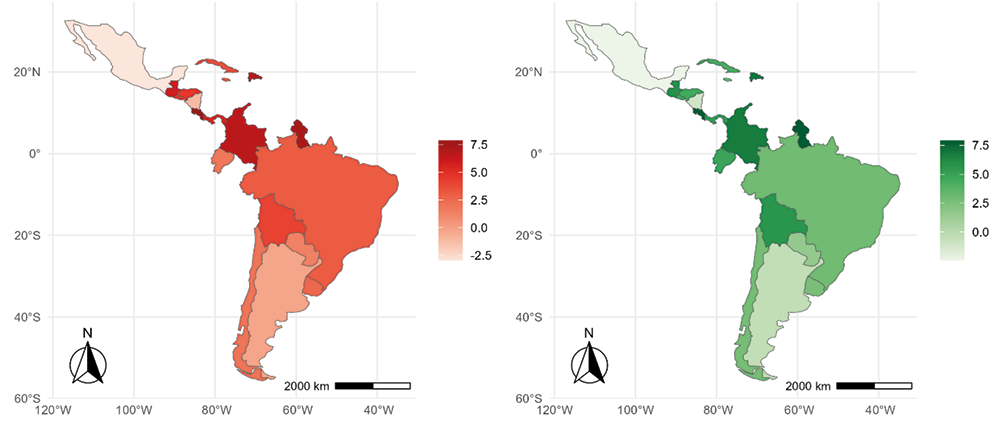
Based on the data presented in Figure 1, some points may be highlighted. Mexico had the worst result for Green GDP of the countries analyzed. In contrast, Guyana and Costa Rica had the highest absolute values for Green GDP growth rates, reaching almost 8% growth year-on-year. These results enable a discussion of the difficulties faced by countries with larger economies (such as Mexico and Argentina) in reconciling economic growth and environmental sustainability.
The comparison of the rates presented in Figure 1 opens the discussion of the reasons why some countries enjoy better Green GDP performance. These results, given the formula of this indicator, can stem from two scenarios: an increase in the growth rate of conventional GDP, on the left side of the formula, or on the right side of the equation, it may mean that some countries have managed to reduce their carbon emissions, or have succeeded in reducing the volume of solid waste generated (Twaste) or reduced the rate of their natural resource depletion (NRD). These effects could be the result of using more sustainable energy sources, the transformation of energy matrices, the reduction of per capita generation of solid waste, a shift towards low-carbon agriculture and economy, and enacting environmental policies based on the protection and conservation of natural resources.
On the other hand, the satisfactory performance of economies such as Costa Rica, Guyana and the Dominican Republic may reflect the availability of space for economic policies that integrate environmental considerations, enabling these countries to overcome, to a certain extent, their backwardness in relation to global economic development.
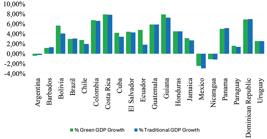
From this point on, an overview will be presented of the differences between the GDP and Green GDP growth rates in the selected countries, using the most recent data available for 2024. Green GDP provides a more comprehensive view of the development process, by considering social and environmental elements that conventional GDP does not incorporate. This analysis goes beyond economic aspects, also seeking to assess environmental and social effects. Figure 2 illustrates the comparison between the annual GDP and Green GDP growth rates, calculated with the most recent data for 2024.

Overall, the average GDP growth for the 20 Latin American countries analyzed in this study was 3.59%. This value was obtained from the geometric mean of countries with positive GDP growth. In turn, the average Green GDP growth for these same countries was 4.07%, resulting in a difference of 0.48 percentage points between the two rates. This suggests that this difference can be explained by reductions in carbon emissions, better solid waste management, and controlled natural resource depletion, aspects that signal the efforts of Latin American countries towards sustainability and achieving the goals of the 2030 Agenda.
Furthermore, no opposite behaviors were observed between the growth rates: in cases where GDP increased, Green GDP also registered growth, and vice versa. A more detailed analysis of the behavior of these rates can be observed specifically for the countries of South America, as illustrated in Figure 3.

Regarding South America (Figure 3), the average growth in Green GDP was higher than that of conventional GDP, being 3.84% and 3.04%, respectively. This trend is consistent with the analysis of Latin America as a whole. In greater detail, it can be seen that the largest difference between the growth rates of Green GDP and conventional GDP occurred in Ecuador (3.01%), followed by Bolivia (1.62%), while other less expressive differences were observed in Chile (0.80%), Guyana (0.68%), Paraguay (0.19%), Colombia (0.12%) and Uruguay (0.02%).
Although some countries did not show a very significant difference, in all of them Green GDP grew more than GDP. In the case of Brazil, the GDP growth rate was slightly higher than that of Green GDP (0.10%). As explained by Stjepanović et al. (2017), the smaller the difference between GDP and Green GDP, the more satisfactory the level of sustainable development will be. In view of this, it can be concluded that, in the aforementioned countries, behavior is suggested that leads to a proximity between Green GDP and conventional GDP, which signals the adoption of strategies and actions in the drive for sustainable development.
Three South American countries deserve a special mention: Bolivia, Ecuador and Argentina. In Ecuador and Bolivia, the difference between the growth of the two indicators was greater than in the other countries in the region, at 3.01% and 1.62%, respectively, indicating significantly higher growth in Green GDP compared with conventional GDP. This indicates more sustainable development in these locations, although on a smaller scale than in other South American countries. On the other hand, Argentina presented the worst scenario among the countries analyzed, since there was a reduction in both indicators, indicating the lack of economic and sustainable development in the country.
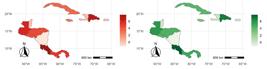
In Central America (Figure 4), the average growth trend was similar to that observed for the whole of Latin America. The average growth in Green GDP was 4.29%, while for GDP it was 4.16%, showing very similar results. A closer examination shows that the countries of Central America performed slightly better than those of South America, but it is important to consider particular features. In Panama (0.11%) and Barbados (0.09%), the GDP growth rate was slightly higher than Green GDP. In other countries in the region, such as Cuba (0.80%), Jamaica (0.39%), El Salvador (0.14%), the Dominican Republic (0.04%), Honduras (0.02%), Costa Rica (0.01%) and Guatemala (0.01%), Green GDP grew more than GDP, suggesting more sustainable development, although the differences between the indicators were minimal.
On the other hand, Nicaragua was the only country in Central America to show a negative growth rate for both indicators, as did Mexico, which represents North America in the analysis. In both cases, there was a regression in terms of economic and sustainable development.
In countries where Green GDP has surpassed GDP, there may have been a shift in economic growth toward sustainability. For example, Ecuador may have prioritized more organic and sustainable practices in agribusiness, to the detriment of conventional agriculture, which favors intensive mechanization. These countries may also have prioritized economic sectors that promote lower carbon emissions or adopted less carbon-intensive production models. Long-term development plans may have aided these advances in sustainability.
It can be concluded that most of the Latin American countries in the sample follow a trend in which GDP growth is characterized as more sustainable (see Green GDP formula). The results indicate that, in general, sustainability is keeping pace with economic growth, except in a few cases. Several factors could account for these results. Of note at the regional level is the Montevideo Consensus on Population and Development, which brought together representatives from 38 countries of the Economic Commission for Latin America and the Caribbean (ECLAC) in August 2013. According to the ECLAC document, the conference aimed to analyze the region's progress over the past 20 years and identify necessary actions for the future, emphasizing the importance of seeking sustainable development to ensure the well-being of current and future generations. The document recognized the need to balance population, resources, environment and development, with an emphasis on sustainability as a regional priority.
Other factors that can explain the sustainable development scenario in most Latin American countries are the agendas and conferences organized by the main global organizations, with emphasis on the 2030 Agenda and the United Nations Climate Change Conferences (COP). The 2030 Agenda is an action plan that aims to promote measures for the benefit of society, the planet and sustainability. It encompasses 17 Sustainable Development Goals (SDGs) and 169 targets, which seek to balance the three dimensions of sustainable development: economic, social and environmental.
These initiatives may have aided progress towards sustainable development in Latin America, since the 2030 Agenda constitutes a global action aimed at ensuring well-being and quality of life on the planet. The agenda promotes more sustainable consumption and production practices, the responsible management of natural resources and the establishment of climate change policies within the context of sustainable development.
FINAL CONSIDERATIONS
This study analyzed the relationship between economic growth and environmental sustainability in Latin America, comparing the growth rates of conventional GDP with those of Green GDP in twenty selected countries. The methodology adopted the Green GDP estimate, which adjusts traditional GDP by excluding the cost of natural resource consumption and the costs of environmental depletion.
This work makes a contribution to the field by discussing how economic growth is related to environmental issues, highlighting the need for economic growth, so greatly desired at the global level, to be sustainable, respecting the limits of sustainability. It also reinforces the limitations of conventional GDP in terms of sustainability, as it ignores aspects such as social well-being, economic prosperity, environmental issues, characteristics of the labor market and educational systems. This points to the importance of alternative tools, such as Green GDP, to measure dimensions not gauged by GDP.
In the analyzed sample, the average growth rate of Green GDP was higher than that of GDP. Central American countries showed, in absolute terms, an average growth rate of Green GDP higher than that of South American countries. Another important finding was the absence of opposite behavior between the growth rates of Green GDP and GDP: no country showed GDP growth with a simultaneous decline in Green GDP, a result that differs from empirical studies in OECD member countries. However, negative economic growth was observed, accompanied by a reduction in Green GDP, in countries such as Mexico, Argentina and Nicaragua.
Economies such as Ecuador, Cuba, Chile and Bolivia stood out for presenting significant differences between the growth rates of GDP and Green GDP. In contrast, some countries, including Brazil, Guatemala, Panama and the Dominican Republic, had lower growth rates in Green GDP than in GDP.
Among the limitations of the study, it is worth highlighting the difficulty involved in obtaining data for all 33 countries that make up Latin America, particularly for the solid waste variable. Moreover, the lack of a complete time series prevents an analysis of long-term trends in Green GDP.
This study is expected to contribute to the literature by proposing new approaches to calculating GDP, whether in theoretical or methodological terms, through the measurement of Green GDP. A recommendation for future research is to investigate gaps regarding how Latin American countries can integrate environmental issues into their long-term economic growth strategies.
References
-
AER - Australian Energy Regulator. Australia: AER, 2015. Disponível em: https://www.aer.gov.au/industry/registers/charts Acesso em: 05 mar. 2024.
» https://www.aer.gov.au/industry/registers/charts -
ALKHARS, M. A. ALWAHAISHI, S.; FALLATAH, M.; KAYAL, A. A literature review of the Environmental Kuznets Curve in GCC for 2010-2020. Environmental and Sustainability Indicators, v. 14, p. 100-181, 2022. https://doi.org/10.1016/j.indic.2022.100181
» https://doi.org/10.1016/j.indic.2022.100181 - ANDRADE, D. C.; ROMEIRO, A. R. Capital natural, serviços ecossistêmicos e sistema econômico: rumo a uma “Economia dos Ecossistemas”. Texto para Discussão IE/Unicamp, v. 159, 2009.
- ANDRADE, D. C.; ROMEIRO, A. R. Degradação ambiental e teoria econômica: algumas reflexões sobre uma “economia dos ecossistemas”. EconomiA, v. 12, n. 1, 2011.
-
ANDRÉE, B.; CHAMORRO, A.; SPENCER, P.; KOOMEN, E.; DOGO, H. Revisiting the relation between economic growth and the environment; a global assessment of deforestation, pollution and carbon emission. Renewable and Sustainable Energy Reviews, v. 114, p. 109-221, 2019. https://doi.org/10.1016/j.rser.2019.06.028
» https://doi.org/10.1016/j.rser.2019.06.028 -
AQUILAS, N. A.; MUKONG, A.; KIMENGSI, J.; NGANGNCHI, F. Economic activities and deforestation in the Congo basin: An environmental kuznets curve framework analysis. Environmental Challenges, v. 8, p. 100-553, 2022. https://doi.org/10.1016/j.envc.2022.100553
» https://doi.org/10.1016/j.envc.2022.100553 -
ARROW, K. J.; DASGUPTA, P.; MÄLER, K. The genuine savings criterion and the value of population. Economic theory, v. 21, p. 217-225, 2003. https://doi.org/10.1007/978-3-662-05858-9_2
» https://doi.org/10.1007/978-3-662-05858-9_2 -
BLEYS, B. Beyond GDP: Classifying alternative measures for progress. Social indicators research, v. 109, p. 355-376, 2012. https://doi.org/10.1007/s11205-011-9906-6
» https://doi.org/10.1007/s11205-011-9906-6 - BOLT, K., MATETE, M., CLEMENS, M. Manual for Calculating Adjusted Net Savings, Environment Department, World Bank, p. 1-23, 2002.
-
BOYD, J. Nonmarket benefits of nature: What should be counted in green GDP? Ecological economics, v. 61, n. 4, p. 716-723, 2007. https://doi.org/10.1016/j.ecolecon.2006.06.016
» https://doi.org/10.1016/j.ecolecon.2006.06.016 -
CAIADO, R.; LEAL FILHO, W.; QUELHAS, O.; NASCIMENTO, D.; ÁVILA, L. A literature-based review on potentials and constraints in the implementation of the sustainable development goals. Journal of cleaner production, v. 198, p. 1276-1288, 2018. https://doi.org/10.1016/j.jclepro.2018.07.102
» https://doi.org/10.1016/j.jclepro.2018.07.102 - CAPOOR, K.; AMBROSI, P. State and trends of the carbon market 2007. Washington DC: The World Bank. 2007.
-
CHEIKH, N. B.; ZAIED, Y. B.; CHEVALLIER, J. On the nonlinear relationship between energy use and CO2 emissions within an EKC framework: Evidence from panel smooth transition regression in the MENA region. Research in International Business and Finance, v. 55, p. 101-331, 2021. https://doi.org/10.1016/j.ribaf.2020.101331
» https://doi.org/10.1016/j.ribaf.2020.101331 -
CHENG, D.; XUE, Q.; HUBACEK, K.; FAN, J.; SHAN, Y.; ZHOU, Y.; COFFMAN, D.; MANAGI, S.; ZHANG, X. Inclusive wealth index measuring sustainable development potentials for Chinese cities. Global Environmental Change, v. 72, p. 102-417, 2022. https://doi.org/10.1016/j.gloenvcha.2021.102417
» https://doi.org/10.1016/j.gloenvcha.2021.102417 -
FREIRE, F. S.; SILVA, N. O.; OLIVEIRA, V. R. F. Economic growth and greenhouse gases in Brazilian States: is the environmental Kuznets curve applicable hypothesis? Environmental Science and Pollution Research, v. 30, n. 15, 2023. https://doi.org/10.1007/s11356-023-25411-z
» https://doi.org/10.1007/s11356-023-25411-z -
FRODYMA, K.; PAPIEŻ, M.; ŚMIECH, S. Revisiting the environmental Kuznets curve in the European Union countries. Energy, v. 241, p. 122-899, 2022. https://doi.org/10.1016/j.energy.2021.122899
» https://doi.org/10.1016/j.energy.2021.122899 - GAO, W. S.; CHEN, Y. Q.; CHEN, D. D. A New Index System of Agricultural Green Accounting Based on Value of Agroecosystem Services. Research of Agricultural Modenization, v. 26, n. 1, p. 1-5, 2005.
-
GPP - Global Petrol Prices. Atlanta: GPP, 2024. Disponível em: https://www.globalpetrolprices.com/electricity_prices/ Acesso em: 05 mar. 2024.
» https://www.globalpetrolprices.com/electricity_prices/ -
GROSSMAN, G. M.; KRUEGER, A. B. Economic growth and the environment. The quarterly journal of economics, v. 110, n. 2, p. 353-377, 1995. https://doi.org/10.2307/2118443
» https://doi.org/10.2307/2118443 -
HAMILTON, K.; CLEMENS, M. Genuine savings rates in developing countries. The World Bank Economic Review, v. 13, n. 2, p. 333-356, 1999. https://doi.org/10.1093/wber/13.2.333
» https://doi.org/10.1093/wber/13.2.333 - HARVEY, D. A condição pós-moderna: uma pesquisa das origens sobre a mudança cultural. São Paulo: Editora Edições Loyola, 1992.
-
HEALC. Hub de Energía America Latina y el Caribe. Washington: HEALC, 2024. Disponível em: https://hubenergia.org/en/indicators/evolution-electricity-rates-latin-america-and-caribbean Acesso em: 05 mar. 2024.
» https://hubenergia.org/en/indicators/evolution-electricity-rates-latin-america-and-caribbean - HECHT, J. National environmental accounting: Bridging the gap between ecology and economy. Routledge: 2012.
-
HOGAN, D. J. Crescimento populacional e desenvolvimento sustentável. Lua Nova: revista de cultura e política, p. 57-78, 1993. https://doi.org/10.1590/S0102-64451993000300004
» https://doi.org/10.1590/S0102-64451993000300004 -
KUNANUNTAKIJ, K.; VARABUNTOONVIT, V.; VORAYOS, N.; PANJAPORNPON, C.; MUNGCHAROEN, T. Thailand Green GDP assessment based on environmentally extended input-output model. Journal of Cleaner Production, v. 167, p. 970-977, 2017. https://doi.org/10.1016/j.jclepro.2017.02.106
» https://doi.org/10.1016/j.jclepro.2017.02.106 -
KURNIAWAN, R.; SUGIAWAN, Y.; MANAGI, S. Economic growth-environment nexus: An analysis based on natural capital component of inclusive wealth. Ecological Indicators, v. 120, p. 106982, 2021. https://doi.org/10.1016/j.ecolind.2020.106982
» https://doi.org/10.1016/j.ecolind.2020.106982 -
KUZNETS, S. Economic Growth and Income Inequality. The American Economic Review, v. 45, n. 1, p. 1-28, 1955. Disponível em: https://www.jstor.org/stable/1811581 Acesso em: 08 mar. 2024.
» https://www.jstor.org/stable/1811581 - MÁRQUEZ DELGADO, D. L.; SANTOYO, A. H.; MÁRQUEZ DELGADO, L. H. La educación ambiental: evolución conceptual y metodológica hacia los objetivos del desarrollo sostenible. Revista Universidad y sociedad, v. 13, n. 2, p. 301-310, 2021.
- MEADOWS, D. H.; MEADOWS, D. L.; RANDERS, J.; BEHRENS, W. Limits to growth. Nova York: Universe Books, 1972.
-
MIKHAILOVA, I. Sustentabilidade: evolução dos conceitos teóricos e os problemas da mensuração prática. Economia e Desenvolvimento, 2004. https://doi.org/10.5902/141465093442
» https://doi.org/10.5902/141465093442 -
MINEM - Ministerio de Energía y Minas. Cuba: MINEM, 2024. Disponível em: https://www.minem.gob.cu/es/actividades/electricidad Acesso em: 05 mar. 2024.
» https://www.minem.gob.cu/es/actividades/electricidad -
ODUNIYI, O. S.; RIVEROS, J.; HASSAN, S.; ÇITAK, F. Testing the theory of Kuznet curve on environmental pollution during pre-and post-Covid-19 era. Scientific Reports, v. 13, n. 1, 2023. https://doi.org/10.1038/s41598-023-38962-5
» https://doi.org/10.1038/s41598-023-38962-5 -
OLADE. Organización Latinoamericana de Energía. Equador: OLADE, 2024. Disponível em: https://sielac.olade.org/default.aspx Acesso em: 05 mar. 2024.
» https://sielac.olade.org/default.aspx -
OLIVEIRA, G. B. Uma discussão sobre o conceito de desenvolvimento. Revista da FAE, Curitiba, v.5, n.2, p.41-48, maio/ago. 2002. Disponível em: https://revistafae.fae.edu/revistafae/article/view/477 Acesso em: 20 mar. 2024.
» https://revistafae.fae.edu/revistafae/article/view/477 -
ORTIZ-PANIAGUA, C. F.; GÓMEZ, M. Crecimiento económico y calidad ambiental en América Latina, perspectiva desde Kuznets, 1970-2016. Economía: teoría y práctica, n. 55, p. 17-36, 2021. https://doi.org/10.24275/etypuam/ne/552021/ortiz
» https://doi.org/10.24275/etypuam/ne/552021/ortiz - PANAYOTOU, T. Empirical tests and policy analysis of environmental degradation at different stages of economic development. In: Working paper WP238, technology and employment programme. Geneva: ILO; 1993.
-
RAUCH, J. N.; CHI, Y. F. The plight of green GDP in China. Consilience, n. 3, p. 102-116, 2010. https://doi.org/10.7916/consilience.v0i3.4498
» https://doi.org/10.7916/consilience.v0i3.4498 -
REES, W. E. Ecological footprints and appropriated carrying capacity: what urban economics leaves out. Environment and urbanization, v. 4, n. 2, p. 121-130, 1992. https://doi.org/10.1177/095624789200400212
» https://doi.org/10.1177/095624789200400212 -
SÁNCHEZ, L.; CABALLERO, K. La curva de Kuznets ambiental y su relación con el cambio climático en América Latina y el Caribe: un análisis de cointegración con panel, 1980-2015. Revista de Economía del Rosario, v. 22, n. 1, p. 101-142, 2019. https://doi.org/10.12804/revistas.urosario.edu.co/economia/a.7769
» https://doi.org/10.12804/revistas.urosario.edu.co/economia/a.7769 - SANDRONI, P. Dicionário de economia: nova edição revista e ampliada. São Paulo: Best Seller, 1987.
- SCATOLIN, F. D. Indicadores de desenvolvimento: um sistema para o Estado do Paraná. 1989. Dissertação (Mestrado em Economia) - Universidade Federal do Rio Grande do Sul. Porto Alegre. 1989.
- SHAFIK, N.; BANDYOPADHYAY, S. Economic growth and environmental quality: time series and cross-country evidence. World Bank Policy Research Papers; 1992.
-
SHAFIK, N. Economic development and environmental quality: an econometric analysis. Oxford economic papers, v. 46, n.1, p. 757-773, 1994. https://doi.org/10.1093/oep/46.Supplement_1.757
» https://doi.org/10.1093/oep/46.Supplement_1.757 -
SIEDENBERG, D. R. Indicadores de desenvolvimento socioeconômico: uma síntese. Desenvolvimento em questão, v. 1, n. 1, p. 45-71, 2003. https://doi.org/10.21527/2237-6453.2003.1.45-71
» https://doi.org/10.21527/2237-6453.2003.1.45-71 - SOUZA, N. J. Desenvolvimento econômico. São Paulo: Atlas, 1993.
-
STJEPANOVIĆ, S.; TOMIĆ, D.; ŠKARE, M. A new approach to measuring green GDP: a cross-country analysis. Entrepreneurship and sustainability issues, v. 4, p. 574-590, 2017. https://doi.org/10.9770/jesi.2017.4.4(13)
» https://doi.org/10.9770/jesi.2017.4.4(13) -
TAYRA, F.; RIBEIRO, H. Modelos de indicadores de sustentabilidade: síntese e avaliação crítica das principais experiências. Saúde e Sociedade, v. 15, n. 1, p. 84-95, 2006. https://doi.org/10.1590/S010412902006000100009
» https://doi.org/10.1590/S010412902006000100009 -
UGALDE HERNÁNDEZ, O. Could Economic growth propel Costa Rica to lessen its environmental debasement? environmental kuznets curve (1990-2021). Revista Relaciones Internacionales, v. 96, n. 2, 2023. http://dx.doi.org/10.15359/ri.96-2.2
» https://doi.org/10.15359/ri.96-2.2 -
VEKLYCH, O.; SHLAPAK, M. Green GDP as an indicator of environmental cost of economic growth in Ukraine. Macroeconomics problems, v.23, p. 244-248, 2013. http://dx.doi.org/10.1134/S1075700712030100
» https://doi.org/10.1134/S1075700712030100 -
WACKERNAGEL, M.; ONISTO, L.; BELLO, P.; LINARES, A.; FALFÁN, I.; GARCÍA, J.; GUERRERO, A.; GUERRERO, M. National natural capital accounting with the ecological footprint concept. Ecological economics, v. 29, n. 3, p. 375-390, 1999. https://doi.org/10.1016/S0921-8009(98)90063-5
» https://doi.org/10.1016/S0921-8009(98)90063-5 -
WANG, X. Green GDP and Openness: Evidence from Chinese Provincial Comparable Green GDP. Journal of Cambridge Studies, v. 6, n.1, 2011. https://doi.org/10.17863/CAM.1375
» https://doi.org/10.17863/CAM.1375 -
WASTE TO ENERGY IN DENMARK. The most efficient waste management system in Europe. 2006. Disponível em: https://stateofgreen.com/files/download/275 Acesso em: 05 mar. 2024.
» https://stateofgreen.com/files/download/275 -
WDI. World Bank Database Indicators. World Bank, 2024. Disponível em: https://databank.worldbank.org/source/world-development-indicators Acesso em: 05 mar. 2024.
» https://databank.worldbank.org/source/world-development-indicators

 Source: The authors (2024).
 Source: The authors (2024).Legend: Green GDP (on the right in green). Conventional GDP (on the left, in red).
 Source: The authors (2024).Legend: Green GDP (on the right in green). Conventional GDP (on the left, in red).
 Source: The authors (2024).Legend: Green GDP (on the right in green). Conventional GDP (on the left, in red).