 Numerical and experimental analysis of shallow foundations on tropical climate soil using Mohr-Coulomb cap model
Abstract
The application of loading tests allows us to evaluate the behavior of shallow foundations under real conditions. This article addresses the application of a constitutive model based on Mohr-Coulomb with a cap failure criterion that simulates the compaction of the material and limits its shear strength to describe the behavior of a footing resting on tropical climate soil composed of silt-clay sand. The foundation was tested in terms of axial compression through a static and slowly maintained loading test (SML) until its failure was characterized by significant settlement. A two-dimensional axisymmetric finite element numerical model was used to process the numerical analyses. The numerical model used was able to simulate with high similarity the load-settlement behavior of the footing tested in the loading test, under different water content conditions and preload imposed in the field tests. Additionally, the experimental results facilitated the successful guidance of the numerical analyses, providing parameters to safely analyze similar foundations under other conditions.
Keywords:
Tropical climate soil; Collapsible soil; Shallow foundations; Behavior prediction; Footing loading test
1. Introduction
The load versus settlement curve for foundations in tropical climate soils is an important topic to consider in foundation design projects. These soils are typically collapsible, with a metastable structure resulting from their formation process in tropical climate regions. Various methods for predicting the load and settlement behavior of foundations in these soils have already been developed (Barata, 1973; D’appolonia et al., 1970; Kumar et al., 2007; Oh & Vanapalli, 2011; Vesić, 1973). These methods encompass analytical, empirical, and experimentais approaches. However, the static load test is considered the most important test for determining the load versus settlement behavior of a foundation. Nonetheless, few load tests are conducted on full-scale prototypes under the same conditions as real constructions, especially in tropical climate soils with matric suction measurements.
To estimate settlement in shallow foundations, solutions based on the theory of elasticity are commonly adopted (Boussinesq, 1885; Poulos, 1968; Milovic, 1992), as well as those that consider factors such as embedding, flexibility, and modulus increase with depth, as proposed by Mayne & Poulos (1999). Additionally, other analytical solutions, like those by Terzaghi & Peck (1963) based on Meyerhof's (1956) work, are used. The effects of suction on shallow foundation behavior were later described using the mechanics of unsaturated soils, according to studies by Alonso et al. (1990), Fredlund et al. (2012), Briaud (2013), and Giacheti et al. (2019). These studies indicate that the increase in failure stress of footings in unsaturated soils is due to increased suction, with Briaud (2013) explaining differences in considering this resistance increase over the term 0.5⋅γ ⋅B⋅Nγ instead of the term c’⋅Nc.
It is established that tropical climate soils, despite being compressible, have high initial stiffness. This stiffness can be attributed to the effects of drainage, load application speed, and particle bonding (Consoli et al., 1998; Terzaghi et al., 1996; Atkinson, 2000; Poulos & Small, 2000). Therefore, understanding the behavior of shallow foundations in tropical climate soils, considering the inherent aspects of soil matric suction, is crucial.
Understanding the geomechanical parameters of tropical climate soils is essential for comprehending foundation behavior, and these parameters should be obtained through laboratory tests, field tests, and loading tests under natural and flooded conditions. Employing the finite element method (FEM) allows for evaluating foundation behavior under varying water content and compaction conditions. This study presents a modification to Décourt (1999) proposal, enabling the description of foundation behavior in tropical climate soil based on geomechanically parameters, incorporating variables such as stress history and compressibility obtainable in the laboratory.
In the conclusion of this study, the results obtained from empirical and numerical methods are compared with those established in foundation literature. The findings indicate that soil suction enhances the load capacity and stiffness of the soil beneath the footing. The modified Décourt method demonstrates strong agreement with the loading test results, showcasing its potential as a new alternative for designing footings in popular buildings.
2. Materials and methods
2.1 Experimental site and geotechnical profile
The footing load test was performed at the Experimental Field Mechanics of Soils and Foundations of the Federal University of Uberlândia (CEMSF-UFU), located in the city of Uberlândia, Minas Gerais, Brazil. The characterization of the local subsoil was carried out by collecting deformed samples obtained in simple recognition surveys with a standard penetration test (SPT) up to a depth of 21 meters for basic soil characterization (Figure 1).

The water level was detected at a depth of 10 meters, and the local soil consisted of silty clayey sand, with traces of gravel, belonging to the SC-SM group, according to the Unified Soil Classification System. The uncorrected values provided by the SPT test indicated, according to ABNT (2020), that the soil had a relative density from loose to very loose up to a depth of 19 meters (Figure 2).

(a) Uncorrected SPT values; (b) geotechnical profile of the experimental site obtained by SPT sounding.
Geological surveys revealed that the regional soil formation is linked to the weathering of basalt from the Serra Geral Formation with detrital-lateritic sediments of colluvial origin (CODEMIG, 2017). Therefore, the friction angle was determined by a direct shear test under drained conditions and was equal to 21° (Figure 3a), in accordance with ASTM D3080 (ASTM, 2012), using a displacement rate of 0.10 mm/min and oedometer tests for 1-meter soil (Figure 3b). In addition to the friction angle, the effective cohesion (c’) in saturated conditions was determined by a direct shear test. This parameter, in turn, is highly influenced by the variation in suction in tropical climate soils, which depends on the value of the air entry value (uwae) obtained through the Soil Water Characteristic Curve (SWCC), following the method given by ASTM (2016).

Results of soil characterization tests: (a) direct shear test under natural and flooded condition and (b) oedometer tests for 1-meter soil depth with a log pressure scale under different water contents.
From the SWCC (Figure 4), a value of 6 kPa was obtained for the air entry value. Thus, the proposal of Khalili & Khabbaz (1998) was used to determine the portion of apparent cohesion relative to the gain in shear strength due to the relationship between the suction in the soil and the air entry value, presented in Briaud (2013) as Equation 1:
where uw is the suction present in the soil and uwae is the of air entry into the soil.

The suction was measured by tensiometers installed in the field at 0.65 m below the ground surface, varying between 15 and 40 kPa for the rainy and dry seasons, respectively. For the silty clayey sand soil, a suction of 30 kPa was adopted in the analyses.
The compressibility of the surface soil was evaluated by an oedometer test because tropical climate soils tend to collapse when moistened. The magnitude of the collapse that the soil exhibits when flooded was estimated by the collapse index (CP) according to the proposal of Jennings & Knight (1975), as defined by Equation 2:
where e0 is the void ratio under natural moisture conditions and a vertical pressure of 200 kPa and ec is the void ratio after flooding under a vertical pressure of 200 kPa, which is taken together with the curve of the oedometer test under flooding.
The authors presented a severity of collapse scale, in which CP values less than 5 are considered moderate. With the oedometer curves at the 9% and 16% moisture levels, the calculated CP was equal to 11, indicating that the severity of soil collapse was in the category of “severe trouble”. From the oedometer test, several parameters were calculated at different moisture contents that were used in the analyses, including λ = Cc / ln10 and κ = Cr / ln10, in addition to the yield stress (σp) estimated by Casagrande construction and the oedometer moduli (Table 1).
For the data from Table 1, the proposal of Alonso et al. (1990) for unsaturated soils describes the increase in the yield stress with increasing suction. This occurs in most Brazilian soils and is known as apparent preconsolidation stress. In addition, the stress values were transformed into the triaxial stress state for the numerical analyses. In a simplified manner, for void ratio from 0.80 to 0.90 and up to a suction interval of 200 kPa, the increase in the yield stress (in kPa) is given by Equation 3:
where pp is the yield stress for the triaxial stress state.
2.2 Loading test setup
The tested foundation is a circular footing with diameter B equal to 1.00 m and a thickness of 0.20 m, this thickness dimension is used in foundations employed in low-income buildings financed by low-income housing programs. In addition, the current study is part of a larger study with combined foundations.
The footing was designed and constructed using reinforced concrete following recommendations of the ABNT (2014) and by excavation, following the recommendations of the ABNT (2019). The footing base is supported at a depth of 0.40 m below the surface; however, a previous excavation around the footing was performed to eliminate the influence of the lateral friction of the footing with the surrounding soil. Soil samples were collected close to the footing before and after each load test. In the laboratory, the values of water content, void ratio, and matric suction were obtained in accordance with ASTM D7263-21 and ASTM D5298-16 (ASTM, 2016, 2021). For the Experimental Loading Test in Situ (LT-EXP-NAT), the observed moisture content (w) was 8.7%, while the void ratio (e) was 0.78. The suction measurement (uw), inferred from readings of tensiometers positioned near the tested foundation, was 30. In the case of the Experimental Loading Test Flooded (LT-EXP-FLO), the moisture content (w) was significantly higher, recorded at 17.81%, and the void ratio (e) was 0.62. There was no suction measurement (uw) in this case, with its value being 0.
A load cell with an accuracy of 0.20 kN was used to measure the load applied during the test. Four dial gages were used for displacement measurements with 0.01 mm precision and 100 mm range, positioned orthogonal on top of the tested footing.
Two loading tests were performed, the first under natural moisture conditions, named LT-EXP-NAT, and the second performed after a 24-h period of soil flooding, named LT-EXP-FLO (Figure 5). The flooding process was induced by supplying water via the surface in order to form a constant water level.

Loading test: (a) under natural conditions (LT-EXP-NAT); (b) under flooded conditions (LT-EXP-FLO).
2.3 Existing methods
For the estimation of the ultimate load and settlement, theoretical-analytical and empirical methods have been established in the literature. Such methods are based on parameters sometimes determined in the laboratory, sometimes estimated by in situ tests, which in turn allow correlations.
2.3.1 Ultimate bearing capacity equations
The known solution of Terzaghi & Peck (1963) with the shape factors given by Vesic (1975) is given by Equation 4:
where c’ is the effective cohesion; γ is the unit weight; B is the dimension of foundation width; and Nc = (Nq-1)cotϕ’, Nγ=2(Nq+1)tanϕ’, and Nq = eπ⋅tanϕ’⋅tan2(45º+ϕ’/2) are bearing capacity factors that apply to their respective terms and depend on the friction angle ϕ’.
Briaud (2013) suggests a modification to the proposal of Terzaghi & Peck (1963) to consider the addition of a term that represents the shear strength by the effective stress as a function of the soil suction by Equation 5:
where c’ is the effective cohesion; γ is the unit weight; B is the dimension of the foundation; Nc, Nγ, and Nq are bearing capacity factors that apply to their respective terms, Sc, Sγ, and Sq are shape factors as indicated in Vesic (1975) for circular geometry; α is a coefficient defined by Equation 1; and uw is the matric suction present in the soil.
The bearing capacity factors can also be obtained through an axisymmetric formulation with the lower bound limit analysis as explained in Kumar & Khatri (2011).
2.3.2 Empirical equation
The empirical equation of Décourt (1999) estimates the settlement of foundations in sandy, clayey, or intermediate soils using data from the SPT test. Through the observation of the curves of foundations and tested prototypes, Décourt (1999) presented the following equation Equation 6:
where Beq is the dimension equivalent to that of a square footing; C is a compressibility parameter equal to 0.426, a value suggested by the author with a variation of + or - 10%; qr is the reference stress; q is the pressure applied by the foundation; and s is the settlement.
2.4 Upgrade proposed for the Décourt (1999) method
A modification of Equation 6 proposed by Décourt (1999) allows us to make predictions of the foundation behavior in unsaturated soils and to consider the collapse of the soil, a phenomenon also related to increase in stiffness with suction caused by drying in tropical climate soils. To the term qr of Equation 6, the term α⋅uw⋅tanϕ’peak ⋅Nγ(ϕ’peak), which incorporates the contribution of suction to shear strength, was added, as suggested by Briaud (2013) for the equation of Terzaghi & Peck (1963).
In placing settlement (s) as a stress-dependent variable (q) applied to the footing by Equation 7:
where qr is the reference stress; OCR(uw=0,e) = pv/pp is the relationship between the highest effective vertical stress applied to the soil layer and the corresponding yield stress in the oedometer compression curve under flooded conditions for the same void ratio; uw is the soil matric suction; α=(uwae/uw)0.5; Nγ is the bearing capacity factor given by Terzaghi & Peck (1963).
Thus, the term α in Equation 7 comprises an asymptotic increase in the bearing capacity with suction and incorporates strength parameters based on the measured friction angle for the compactness of the material.
The term OCR(uw=0,e) is related to the increase in rigidity already widely observed in soils where the matric suction phenomenon is present, in addition to incorporating the history of stresses imposed on the soil, which also influences the rigidity of the soil.
The proposal also maintains the possibility of considering the shape of the footing, adopting a dimension equivalent to that of a square footing Beq, that is, dispensing with the application of shape correction factors.
2.5 2D FEM numerical models
The numerical models were constructed using the software RS2 from Rocscience. Based on the axisymmetry of the foundation, a two-dimensional geometry was constructed that simulates the three-dimensional space (Figure 6a). Regarding the boundary conditions of the semi space, restrictions were applied to the displacements in the X-direction on the sides and at the base, and the displacements in the X- and Y-directions were restricted. A gradual refinement of the mesh was applied near the footing (Region 1) to improve the convergence of the results (Figure 6b). The elements used in the foundation models were positioned in an installed manner, without the use of interface elements.

Geometry and details of the 2D axisymmetric model: (a) finite element mesh and boundary conditions; (b) mesh refinement near footing; (c) load stage chart.
Concerning the number of elements, convergence tests were performed to choose the mesh with the lower number of elements (1353) and nodes (2832), which leads to a reduced computational effort. The finite element used is of the triangular type with a total of 6 nodes, 3 of them being middle nodes, and each node has 2 degrees of freedom in the constructed model. The validation of the numerical model applied was carried out from the experimental results obtained in loading tests in the field.
The materials consisted of the concrete represented by the footing (Region 1) and the soil (Regions 2-7). For the soil, the Mohr-Coulomb with cap constitutive model was used, and for the concrete, the Mohr–Coulomb criterion was used.
The numerical loading tests were denoted LT-NUM-NAT and LT-NUM-FLO to identify the condition of the soil tested (natural and flooded), following the nomenclature given for the experimental tests. For each series, loading was divided into 11 stages, and unloading was divided into 4 stages (Figure 6c).
2.5.1 Constitutive model of soil
The Mohr–Coulomb with cap constitutive model employed by RS2 makes it possible to simulate an initial state of compaction or densification. The two yield surfaces of interest to the analyses were the Coulomb yield surface and the elliptical cap.
The failure criterion for the Mohr–Coulomb yield surface employed by the RS2 program is given by Equation 8:
where c’ is the cohesion; ϕ’peak is the peak friction angle; (σ1-σ3) and p are the differential and mean stresses, respectively; and M is a parameter dependent on the stresses acting on the material.
The parameter pp, called the yield mean stress, is related to the yield stress (σp) determined by the oedometer tests calculated using Equation 3. For LT-NUM-NAT, a suction (uw) of 30 kPa led to a yield mean stress of approximately 60 kPa. For LT-NUM-FLO, a suction (uw) of 0 kPa led to a yield mean stress of 25 kPa but considering that there is a reduction in the soil void ratio due to the load imposed by the LT-NUM-NAT series, the value of 40 kPa was adopted.
The failure criterion for the elliptical surface employed by the RS2 program is given by Equation 9:
where c’ is the cohesion; ϕ’peak is the peak friction angle; (σ1-σ3) and p are the deviatoric and mean stresses, respectively; Mf is a parameter dependent on the stresses acting on the material; and pp is the yield stress.
According to a suggestion in the unsaturated soil literature (Briaud, 2013), a way to incorporate the effect of matric suction into the cohesion intercept c is given by Equation 10:
where c’ is the effective cohesion intercept, set equal to 1 kPa; α = (uwae/uw)0.5, which for an equal soil suction uw = 30 kPa assumes an approximate value of 0.45; and ϕ’ = ϕ’cv = 21º. Therefore, for the unsaturated condition, the cohesion intercept adopted was c = 9 kPa (Table 2).
The parameters used in the simulations are shown below (Table 2).
2.5.2 Constitutive model of concrete
The behavior of the reinforced concrete composing the footing was represented by the Mohr–Coulomb model employed by the RS2 program. This representation of the behavior of the concrete references Ardiaca (2009).
The failure criterion applied to the concrete material is given by Equation 11, which in turn is associated with Equation 12 given in EHE-08 (del Hormigón, 2011):
where c is cohesion, ϕ is the friction angle, and σ is the normal stress.
Another parameter is the tensile strength of the material, which in this case was obtained based on Equation 13 presented in EHE-08 (del Hormigón, 2011):
where β and μ are coefficients with mean values of 0.30 and 0.70, respectively, and fck is the characteristic compressive strength of concrete, equal to 20 MPa. With the above values, the angle of internal friction (ϕ) was 35°; the cohesion (c) was 442 kPa; and the design value of the tensile strength (fct,d) was 1473 kPa.
The elastic properties, i.e., the Young’s modulus and Poisson ratio, were defined as E = 23 GPa and ν = 0.20, respectively, according to EHE-08 (del Hormigón, 2011).
2.5.3 Loading and unloading behavior
The deformation model of the material is elastoplastic and isotropic, using the Young’s moduli E and Eur to represent the rigidity of the soil during loading and unloading, respectively. The values of these moduli were obtained through oedometer tests, according to void ratios measured before each loading test (Table 1). In this sense, these Young’s moduli were determined by Equation 14, according to Selvadurai (1979), since the conditions were confined.
where E is Young’s modulus; Eoed is the oedometer modulus; and ν is the Poisson’s ratio of the soil.
For Poisson’s coefficient, a mean value of 0.35 was assumed for the silty clayey sand according to Bowles (1997). Thus, the modulus (E) was equal to approximately 62% of the values obtained in the oedometer test.
3. Results and discussion
3.1 Ultimate bearing capacity
For loose or soft soils, Terzaghi & Peck (1963) recommend that a reduction factor of 1/3 be applied to the tangent of the friction angle, which reduces the friction angle to 21°. The following is a summary of the results (Table 3).
3.2 Loading tests
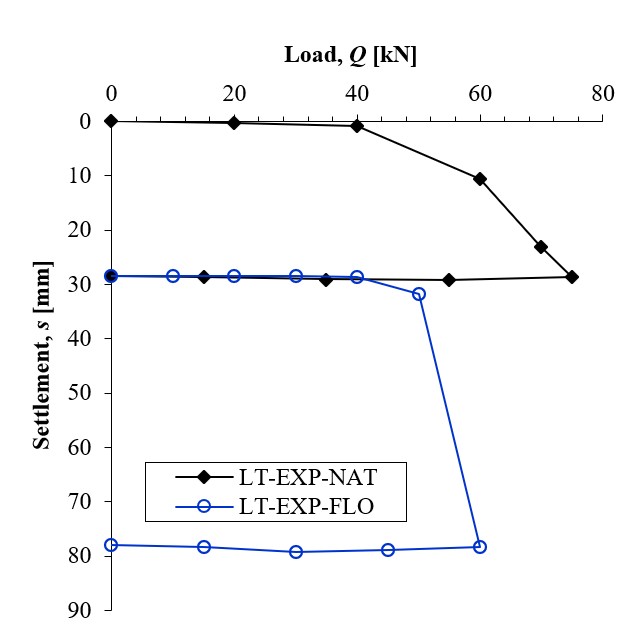
From the performance of the loading tests, load vs. settlement curves were obtained. These curves are presented individually to demonstrate the sequence of tests performed, natural and flooded (Figure 7).

In Figure 8, the settlements are presented in a normalized manner with the B dimension of the foundation on a semilogarithmic scale to show the range of percentage settlement in which the rigidity of the footing undergoes a marked decrease, that is, starting at 50 kPa.

With the load vs. settlement curves of the footing, it is possible to infer the value of Young’s secant modulus (Es), as shown in BSI EN 1997-2 (BSI, 2007), by means of the theoretical solution for a circular rigid plate based on a homogeneous elastic soil. It is noteworthy that the presence of lateritic particles in the soil gives the soil a high initial rigidity. Compared to the oedometer moduli for the same range of void ratio, the values of the initial secant moduli obtained in the field are high due to the effect of soil confinement and the presence of lateritic particles.
3.3 Numerical simulations
The overlap of the load vs. settlement curves obtained numerically with the experimental points indicates significant agreement (Figure 9). Interestingly, the footing exhibits linear-elastic behavior for loads below 50% of the maximum applied load.

In the linear-elastic regime, the contact stresses under the foundation on “sandy soil” are higher at the edge than in the center, which corroborates the observations made in Brown (1969) regarding the behavior of a rigid circular footing and agrees with the theoretical solution given by Boussinesq (1885). In addition, for higher stresses, following the plastic regime, the normalized stresses tend to be uniformly distributed (Figure 10).

Contact stresses below the circular footing: (a) under natural conditions for the indicated stress levels; (b) under flooded conditions for the indicated stress levels.
Analysis of the distribution of normalized stresses along the central axis of the footing shows that the numerical results of both simulations are generally similar to the theoretical solutions of Milovic (1992) and Boussinesq (1885) (Figure 11a). Specifically, the solution of Milovic (1992) assumes that the support layer is homogeneous and has a finite length of 3B, whereas the solution of Boussinesq (1885) supposes such a homogeneous layer with an infinite length. Thus, in both numerical analyses, the results for the stresses in the elastic-linear regime show greater agreement with the solution of Milovic (1992). For stresses greater than 60% of qmax, the solution of Milovic (1992) still maintains agreement with the stresses measured in LT-NUM-NAT, while in the case of LT-NUM-FLO, the solution of Boussinesq (1885) is the closest to the numerical results in the elastoplastic regime (Figure 11b). These results agree with those found by Useche-Infante et al. (2021) that employed experiments and numerical models, observing a graded reduction of the stresses in depth below the footing that become unimportant for depth greater than 2B.

Comparison of the distribution of vertical stresses with depth along the center of the footing: (a) in LT-NUM-NAT; (b) in LT-NUM-FLO.
3.4 Upgraded Décourt (1999) method
From Equation 7, the settlement is estimated when the soil is flooded for a current overconsolidation ratio, OCR(uw=0,e), considering the yield stress, pp, obtained by Equation 3. Therefore, for the water content condition in which uw is equal to 0 kPa, this stress is equal to 25 kPa because before the loading test under natural conditions, the soil is subjected only to the stress of its own weight and to the soil suction effect, which is obtained by Equation 3, considering uw = 30 kPa. Therefore, the yield stress, pp, is 60 kPa and corresponds to the effective stress (pv). Thus, the value of OCR(uw=0,e) calculated is 2.4, approaching 2.
Under the flooded soil conditions, the value of the effective stress experienced by the soil is equal to the maximum stress in the load test under the natural conditions (q = 95 kPa) added to the stress due to the weight of the soil, which transformed to the triaxial state of stresses, is approximately 98 kPa. In this case, the over consolidation ratio, OCR(uw=0,e), is equivalent to 4.
According to the geotechnical profile, the N72 of the layer on which the footing rests is equal to 1. As the analyzed soil contains several fractions, the reference rate, qr, is considered equal to 90⋅N72.
The angle of the peak friction (ϕ’peak) used to consider the state of compactness of the material by means of dilation and used to calculate the factor Nγ (ϕ’peak) is 21°, given by Terzaghi & Peck (1963), according to Table 4.
The load vs. settlement curves are built with the method originally presented by Décourt (1999) and the modified approach addressed in this article, taking into account the soil conditions and characteristics of the site. Note that in the curve obtained with Décourt (1999), the term OCR(uw=0,e) was assumed to be 1 since it is normally consolidated soil, without changing the value of the constant (C) defined by the author as equal to 0.426.
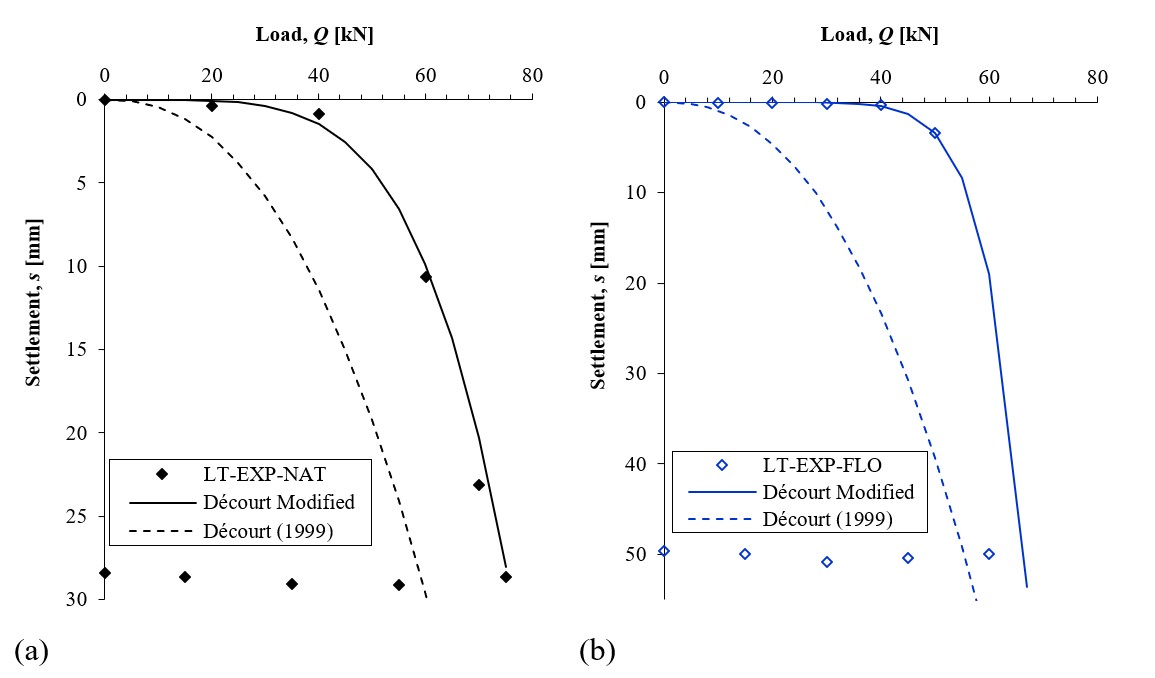
In Figure 12, the curves drawn with the modified method of Décourt (1999) agree with the points obtained with LT-EXP-NAT and LT-EXP-FLO. This agreement corroborates the observations reported in Terzaghi et al. (1996) regarding the general appearance of the load vs. settlement curves for loose or dense soils.

Observed load-settlement curve plotted with Equation 7 by the proposed method: (a) under natural condition; (b) flooded condition.
3.5 Comparison between the allowable stress results
The admissible stress results obtained by different approaches (experimental, analytical, and empirical) are compared using the settlement criterion derived from the Building Code of the City of Boston, where the nominal values are 10 mm and 25 mm. Such methodology is recommended by Terzaghi et al. (1996) to define the allowable stress in soils that do not show clear failure, as is the case of the curve displayed in the load test under the natural conditions (Figure 13).

Relationship between soil suction and allowable bearing pressures based on settlement criteria.
The two series plotted with the modified method of Décourt (1999) were calculated with the term OCR(uw=0,e) equal to 2 to eliminate the effect of the remaining compaction due to the load test under the natural conditions. Together with results from the modified proposal of Décourt (1999), the points obtained in the loading tests are presented as well as the results obtained by Terzaghi & Peck (1963) with the suggestions given by Briaud (2013) for unsaturated soils.
Regarding the factor of safety (FS), to the stresses corresponding to a settlement equal to 25 mm (σ25mm), an FS equal to 2 was applied, and the same FS was applied to the values of the allowable stresses (qa) calculated by the analytical proposal of Terzaghi & Peck (1963) with Briaud (2013). For the stresses corresponding to a settlement equal to 10 mm (σ10mm), no FS was applied.
The comparison of the predicted and measured results shows the effect of suction on the admissible load capacity of the footing, in addition to indicating the load gain with increased suction. However, for routine design, it is advisable to restrict this increase to the maximum suction values observed in the in situ, which, for the analyzed soil, did not exceed 40 kPa.
Regarding the admissible stresses, the values calculated by Terzaghi & Peck (1963) and Briaud (2013) are satisfactorily close to the values of σ25mm predicted with the method proposed in this article, especially for suction values below 30 kPa. The stresses indicated by the modified proposal of Décourt (1999) present good agreement with the points obtained in the load tests. The main advantage of the method is the prediction of the load vs. settlement behavior of footings in this type of soil.
4. Conclusions
In this study, aspects inherent to the behavior of a footing on a tropical climate soil subjected to axial compression were evaluated by means of static and slow load tests, initially in the in-situ condition and later in the flooded condition. Analytical and numerical models were used to predict behavior and extrapolate analyses from field tests.
The loading tests are fundamental for analyzing the behavior of the footing, as well as for validating the numerical model for extrapolation of the results of the studied foundation.
The numerical model used allowed to simulate with high similarity the load-settlement behavior of the footing tested in loading test, in the different conditions of water content and preload imposed in the field tests.
Décourt’s (1999) adjusted method, proposed in this article, made it possible to estimate the load vs. settlement curve of the tested foundation with significant precision when compared to the result obtained in loading tests carried out in the field, since the parameters of water content and overconsolidation ratio were incorporated into the original equation.
List of symbols and abbreviations
c Apparent cohesion intercept
c′ Effective cohesion
cd Design value compressive strength of concrete
e0 Void ratio under natural moisture conditions
ec Void ratio after flooding under a vertical pressure of 200 kPa
fck Characteristic compressive strength of concrete
fct,d Design value of the tensile strength
p Mean stress
pp Yield stress for the triaxial stress state / Yield mean stress under flooded condition
pv Highest mean stress applied to the soil layer
q Load applied in soil by footing
qa Allowable stress
qr Reference stress
qu Ultimate bearing capacity
s Settlement
uw Air entry into the soil
uwae The suction present in the soil
ABNT Associação Brasileira de Normas Técnicas
ASTM American Society for Testing and Materials
B Footing width
Beq Dimension equivalent to that of a square footing
BSI British Standards Institution
C Compressibility parameter equal to 0.426
CAPES Improvement of Higher Education Personnel
Cc Compression index
CEMSF Experimental Field Mechanics of Soils and Foundations
CODEMIG Companhia de Desenvolvimento Econômico de Minas Gerais
CP Collapse index
CPMTC Centro de Pesquisa em Mineração e Tecnologia
Cr Recompression index
E Young’s modulus
EHE Instrucción del Hormigón Estructural
Eoed Oedometer modulus
Eur Young’s modulus of the soil during loading and unloading
FAPEMIG Minas Gerais Research Funding Foundation
FEM Finite Element Method
FS Factor of Safety
GWL Groundwater Level
IGC Instituto de Geociências da UFMG
LT-EXP-FLO Experimental Loading Test Flooded
LT-EXP-NAT Experimental Loading Test in Situ
M Parameter dependent on the stresses acting on the material
Mf Parameter dependent on the stresses acting on the material
Nc, Nγ Bearing capacity factors
Nγ (ϕ peak) Bearing capacity factor using effective peak friction angle
OCR Overconsolidation Ratio
OCR (uw=0,e) Overconsolidation ratio between the highest effective vertical stress applied to the soil layer and the corresponding yield stress in the oedometer compression curve under flooded conditions for an equal void ratio
Q Pressure applied
Sc, Sγ Shape factors
SC-SM Clayey Sands – Silty Sands
SML Slowly Maintained Loading Test
SPT Standard Penetration Test
SWCC Soil Water Characteristic Curve
UFMG Universidade Federal de Minas Gerais
UFU Universidade Federal de Uberlândia
α Relationship between the suction in the soil and the air entry value
β, μ Coefficients
κ Slope of swelling line
λ Slope of normal consolidation line
ν Poisson ratio
σ1 Major principal stress
σ10mm Stress corresponding to a settlement equal to 10 mm
σ25mm Stress corresponding to a settlement equal to 25 mm
σ3 Minor principal stress
σcd Design value compressive strength of concrete
σ Normal stress
σp Yield stress
τ Shear strength
τmd Tensile strength of the material
ϕ’cv Constant volume friction angle
ϕ’peak Peak friction angle
ψ Soil suction
Data availability
Some or all data, models, or code that support the findings of this study are available from the corresponding author upon reasonable request.
Acknowledgements
This work was supported by the Coordination for the Improvement of Higher Education Personnel (CAPES) [finance code 001]; the Minas Gerais Research Funding Foundation (FAPEMIG); the Federal University of Uberlândia (UFU) for the acquisition of the software license used in this article. The authors report there are no competing interests to declare.
-
Discussion open until August 31, 2025.
-
Declaration of use of generative artificial intelligence
This work was not prepared with the assistance of Generative Artificial Intelligence (GenAI).
References
- ABNT NBR 6118. (2014). Design of concrete structures. ABNT - Associação Brasileira de Normas Técnicas, Rio de Janeiro, RJ (in Portuguese).
- ABNT NBR 6122. (2019). Design and construction of foundations. ABNT - Associação Brasileira de Normas Técnicas, Rio de Janeiro, RJ (in Portuguese).
- ABNT NBR 6484. (2020). Soil - standard test method for standard penetration test (SPT) - test procedure. ABNT - Associação Brasileira de Normas Técnicas, Rio de Janeiro, RJ (in Portuguese).
-
Alonso, E.E., Gens, A., & Josa, A. (1990). A constitutive model for partially saturated soils. Geotechnique, 40(3), 405-430. http://doi.org/10.1680/geot.1990.40.3.405
» http://doi.org/10.1680/geot.1990.40.3.405 - Ardiaca, D.H. (2009). Mohr-Coulomb parameters for modelling of concrete structures. Plaxis Bulletin, (Spring), 12-15.
- ASTM D3080. (2012). Standard test method for direct shear test of soils under consolidated drained conditions. ASTM International, West Conshohocken, PA.
- ASTM D5298-16. (2016). Standard test method for measurement of soil potential (suction) using filter paper. ASTM International, West Conshohocken, PA.
- ASTM D7263-21. (2021). Standard test methods for laboratory determination of density and unit weight of soil specimens ASTM International, West Conshohocken, PA.
-
Atkinson, J.H. (2000). Non-linear soil stiffness in routine design. Geotechnique, 50(5), 487-508. http://doi.org/10.1680/geot.2000.50.5.487
» http://doi.org/10.1680/geot.2000.50.5.487 - Barata, F.E. (1973). Prediction of settlements of foundations on sand. In Proceedings of the 8th International Conference on Soil Mechanics and Foundation Engineering (pp. 7-14), Moscow.
- Boussinesq, J. (1885). Application des potentiels à l’étude de l’équilibre et du mouvement des solides élastiques Gauthier-Villars.
- Bowles, J.E. (1997). Foundation analysis and design New York: McGraw-Hill Book Co.
-
Briaud, J.-L. (2013). Geotechnical engineering New Jersey: John Wiley & Sons. http://doi.org/10.1002/9781118686195
» http://doi.org/10.1002/9781118686195 - British Standards Institute – BSI. (2007). BSI EN 1997-2. Eurocode 7: geotechnical design. Part 2: ground investigation and testing. London.
-
Brown, P.T. (1969). Numerical analyses of uniformly loaded circular rafts on deep elastic foundations. Geotechnique, 19(3), 399-404. http://doi.org/10.1680/geot.1969.19.3.399
» http://doi.org/10.1680/geot.1969.19.3.399 - Companhia de Desenvolvimento Econômico de Minas Gerais – CODEMIG. Instituto de Geociências – IGC. Centro de Pesquisa Prof. Manoel Teixeira da Costa – CPMTC. Universidade Federal de Minas Gerais – UFMG. (2017). Projeto Triângulo Mineiro, folha Uberlândia SE.22-Z-B-VI escala 1:100.000. Belo Horizonte.
-
Consoli, N.C., Schnaid, F., & Milititsky, J. (1998). Interpretation of plate load tests on residual soil site. Journal of Geotechnical and Geoenvironmental Engineering, 124(9), 857-867. http://doi.org/10.1061/(ASCE)1090-0241(1998)124:9(857)
» http://doi.org/10.1061/(ASCE)1090-0241(1998)124:9(857) -
D’appolonia, D.J., D’appolonia, E., & Brissette, R.F. (1970). Closure to “settlement of spread footings on sand”. Journal of the Soil Mechanics and Foundations Division, 96(2), 754-762. http://doi.org/10.1061/JSFEAQ.0005552
» http://doi.org/10.1061/JSFEAQ.0005552 - Décourt, L. (1999). Behavior of foundations under working load conditions. In Proceedings of the XI International Conference on Soil Mechanics and Geotechnical Engineering, Foz do Iguaçu. ABMS.
- del Hormigón, C.P. (2011). EHE-08: instrucción del hormigón estructural Madrid: Centro de Publicaciones.
-
Fredlund, D.G., & Xing, A. (1994). Equations for the soil-water characteristic curve. Canadian Geotechnical Journal, 31(4), 521-532. http://doi.org/10.1139/t94-061
» http://doi.org/10.1139/t94-061 -
Fredlund, D.G., Rahardjo, H., & Fredlund, M.D. (2012). Unsaturated soil mechanics in engineering practice New Jersey: John Wiley & Sons. http://doi.org/10.1002/9781118280492
» http://doi.org/10.1002/9781118280492 -
Giacheti, H.L., Bezerra, R.C., Rocha, B.P., & Rodrigues, R.A. (2019). Seasonal influence on cone penetration test: an unsaturated soil site example. Journal of Rock Mechanics and Geotechnical Engineering, 11(2), 361-368. http://doi.org/10.1016/j.jrmge.2018.10.005
» http://doi.org/10.1016/j.jrmge.2018.10.005 - Jennings, J.E., & Knight, K. (1975). A guide to construction on or with materials exhibiting additional settlement due to collapse of grain structure. In Proceedings of the Sixth Regional Conference for Africa and Soil Mechanics and Foundation Engineering (pp. 99-105), Durban.
-
Khalili, N., & Khabbaz, M.H. (1998). A unique relationship for χ for the determination of the shear strength of unsaturated soils. Geotechnique, 48(5), 681-687. http://doi.org/10.1680/geot.1998.48.5.681
» http://doi.org/10.1680/geot.1998.48.5.681 -
Kumar, A., Walia, B., & Saran, S. (2007). Pressure settlement characteristics of rectangular footings on reinforced layered soil. International Journal of Geotechnical Engineering, 1(1), 81-90. http://doi.org/10.3328/IJGE.2007.01.01.81-90
» http://doi.org/10.3328/IJGE.2007.01.01.81-90 -
Kumar, J., & Khatri, V.N. (2011). Bearing capacity factors of circular foundations for a general c-ϕ soil using lower bound finite elements limit analysis. International Journal for Numerical and Analytical Methods in Geomechanics, 35(3), 393-405. http://doi.org/10.1002/nag.900
» http://doi.org/10.1002/nag.900 -
Mayne, P.W., & Poulos, H.G. (1999). Approximate displacement influence factors for elastic shallow foundations. Journal of Geotechnical and Geoenvironmental Engineering, 125(6), 453-460. http://doi.org/10.1061/(ASCE)1090-0241(1999)125:6(453)
» http://doi.org/10.1061/(ASCE)1090-0241(1999)125:6(453) -
Meyerhof, G.G. (1956). Penetration tests and bearing capacity of cohesionless soils. Journal of the Soil Mechanics and Foundations Division, 82(1), 1-19. http://doi.org/10.1061/JSFEAQ.0000001
» http://doi.org/10.1061/JSFEAQ.0000001 - Milovic, D.M. (1992). Stresses and displacements for shallow foundations Amsterdam: Elsevier.
-
Oh, W.T., & Vanapalli, S.K. (2011). Modelling the applied vertical stress and settlement relationship of shallow foundations in saturated and unsaturated sands. Canadian Geotechnical Journal, 48(3), 425-438. http://doi.org/10.1139/T10-079
» http://doi.org/10.1139/T10-079 - Poulos, H.G. (1968). The behaviour of a rigid circular plate resting on a finite elastic layer. Civil Engineering. Transactions of the Institution of Engineers, 10, 213-219.
-
Poulos, H.G., & Small, J.C. (2000). Development of design charts for concrete pavements and industrial ground slabs. In D. Beckett (Ed.), Design applications of raft foundations (pp. 39-70). Leeds: Thomas Telford Publishing. http://doi.org/10.1680/daorf.27657.0002
» http://doi.org/10.1680/daorf.27657.0002 - Selvadurai, A.P.S. (1979). Elastic analysis of soil-foundation interaction Amsterdam: Elsevier.
- Terzaghi, K., & Peck, R.B. (1963). Soil mechanics in engineering practice New Jersey: John Wiley & Sons.
- Terzaghi, K., Peck, R.B., & Mesri, G. (1996). Soil mechanics in engineering practice (3rd ed.). New Jersey: John Wiley & Sons.
-
Useche-Infante, D., Aiassa-Martínez, G., Arrúa, P., & Eberhardt, M. (2021). Scale model to measure stress under circular footings resting on sand. International Journal of Geotechnical Engineering, 15(7), 877-886. http://doi.org/10.1080/19386362.2018.1541626
» http://doi.org/10.1080/19386362.2018.1541626 -
Vesić, A.S. (1973). Analysis of ultimate loads of shallow foundations. Journal of the Soil Mechanics and Foundations Division, 99(1), 45-73. http://doi.org/10.1061/JSFEAQ.0001846
» http://doi.org/10.1061/JSFEAQ.0001846 -
Vesic, A.S. (1975). Bearing capacity of shallow foundations. In H.Y. Fang & J. Daniels (Eds.), Introductory geotechnical engineering (pp. 352-386). New York: Taylor & Francis. http://doi.org/10.4324/9780203403525_chapter_12
» http://doi.org/10.4324/9780203403525_chapter_12
Edited by
-
Editor: Renato P. Cunha https://orcid.org/0000-0002-2264-9711